Gasparini1 Keith R Abrams1 Michael J Crowther1 1Department of Health Sciences, University of Leicester, Leicester, United Kingdom Statistical Analysis of Multi-Outcome Data Conference 2017
models or the Cox model. Nevertheless: 1. Subjects may be exposed to different baseline risk levels 2. Subjects may be clustered (clinical trials, geographical clusters, paired organs, twin studies, …) 3. Subjects may experience repeated events (infections, cancer recurrence, …) An elegant and increasingly popular approach: including in the model a multiplicative random effect that allows accounting for this unobserved heterogeneity (i.e. a frailty). Further details in Hougaard (2000) and Wienke (2010). [email protected] 1 of 19
the ith cluster: hij(t) = h0(t) exp(Xijβ)ui (1) hij(t) = h0(t) exp(Xijβ + wi) (2) In a parametric world, we need to choose: 1. baseline hazard h0(·): exponential, Weibull, Gompertz, flexible spline-based, … 2. distribution of the frailty ui (or wi ): Gamma, log-Normal, positive stable, … [email protected] 2 of 19
hazard is often data-driven, using information criteria such as AIC and BIC 2. Relative risk estimates are insensitive to the correct specification of the baseline hazard (Rutherford, 2015) 3. Flexible parametric models (Royston, 2002) are robust to the choice of degrees of freedom for the spline function, assuming a sufficient number of degrees of freedom it is used (Rutherford, 2015) 4. The choice of frailty distribution has little impact on the estimation and testing of regression coefficients (Pickles, 1995) [email protected] 3 of 19
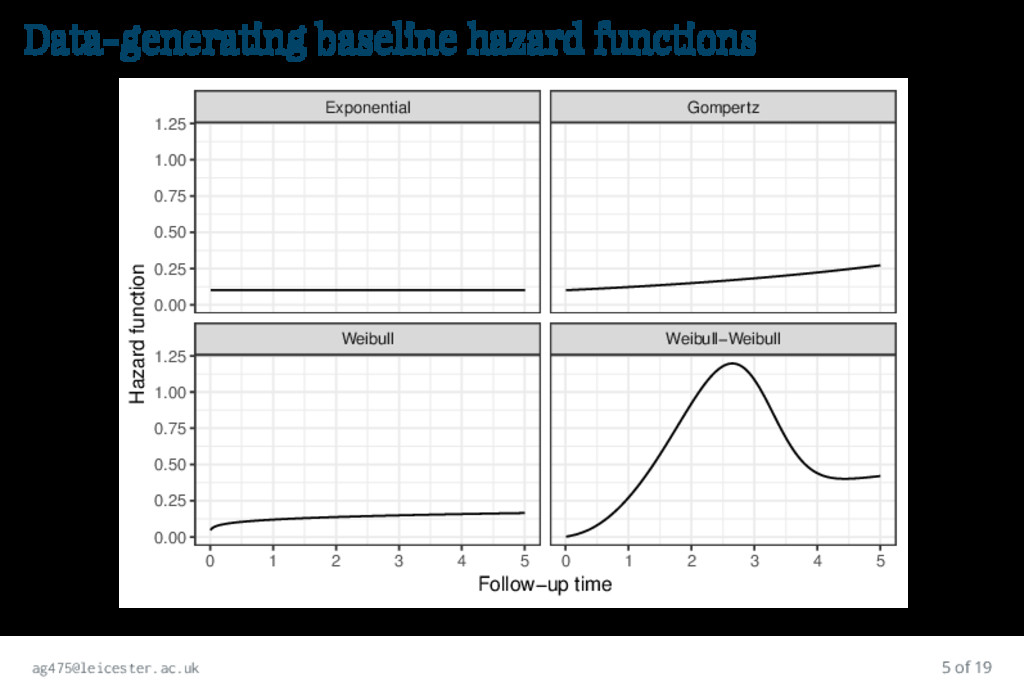
the baseline hazard or the frailty distribution in a wide range of clinically and biologically plausible scenarios Data-generating mechanisms: • exponential baseline hazard • Weibull baseline hazard • Gompertz baseline hazard • mixture Weibull baseline hazard [email protected] 4 of 19
frailty distribution • number of clusters (15, 50) and number of individuals per cluster (30, 100) • frailty variance (0.25, 0.50, 1.00) • log-treatment effect of -0.50 Methods: • exponential, Weibull, Gompertz parametric survival models • Royston-Parmar model with 3 to 9 degrees of freedom • Royston-Parmar model using penalised likelihood • each model with Gamma or log-Normal frailty [email protected] 6 of 19
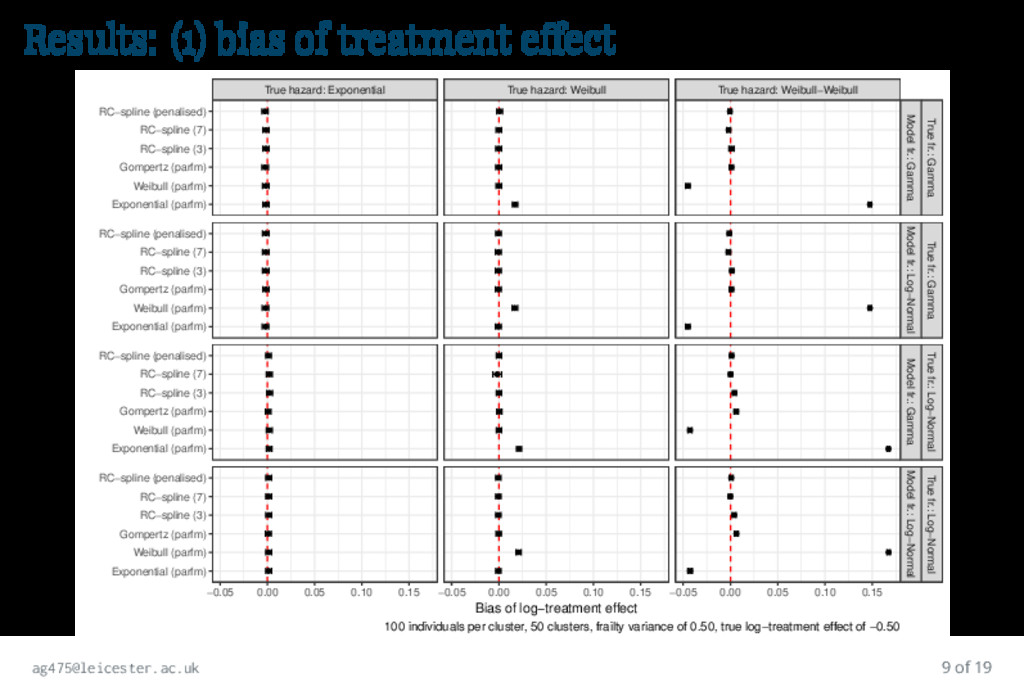
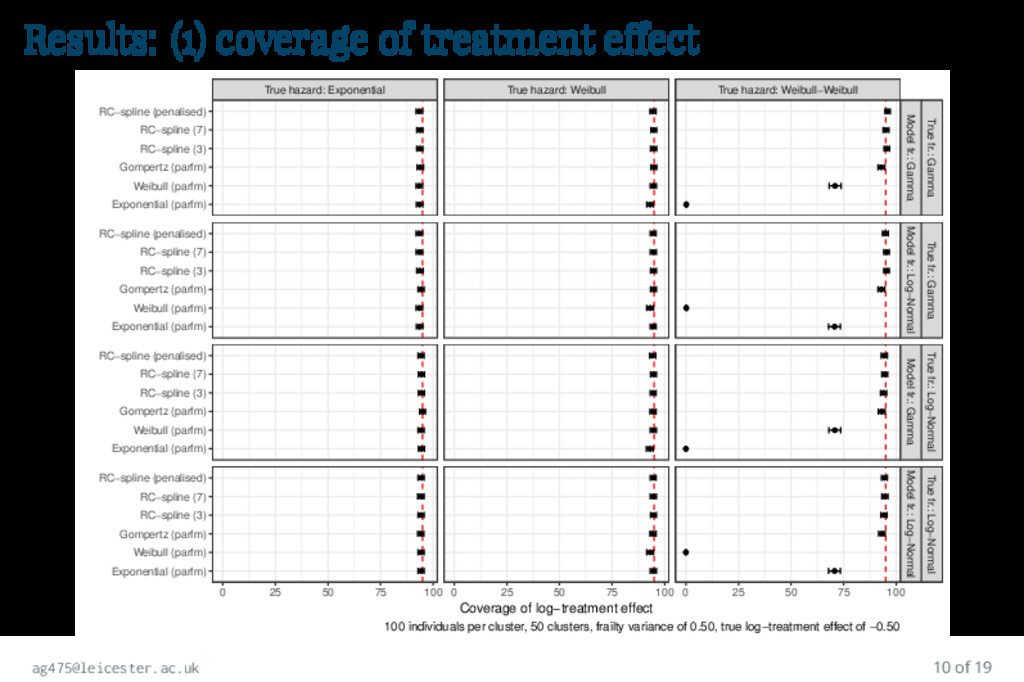
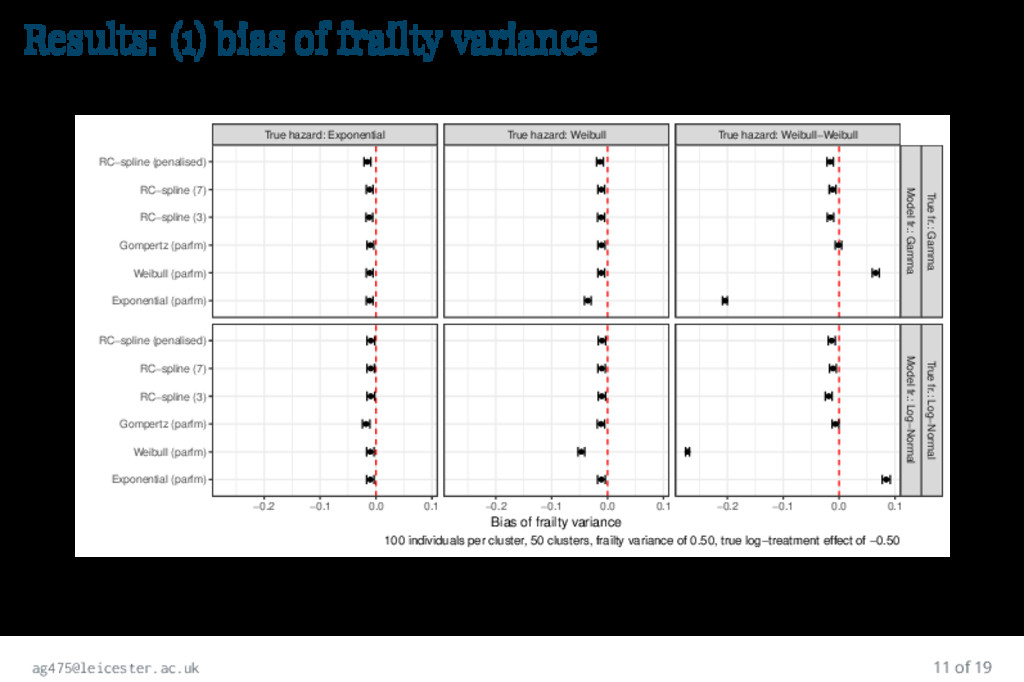
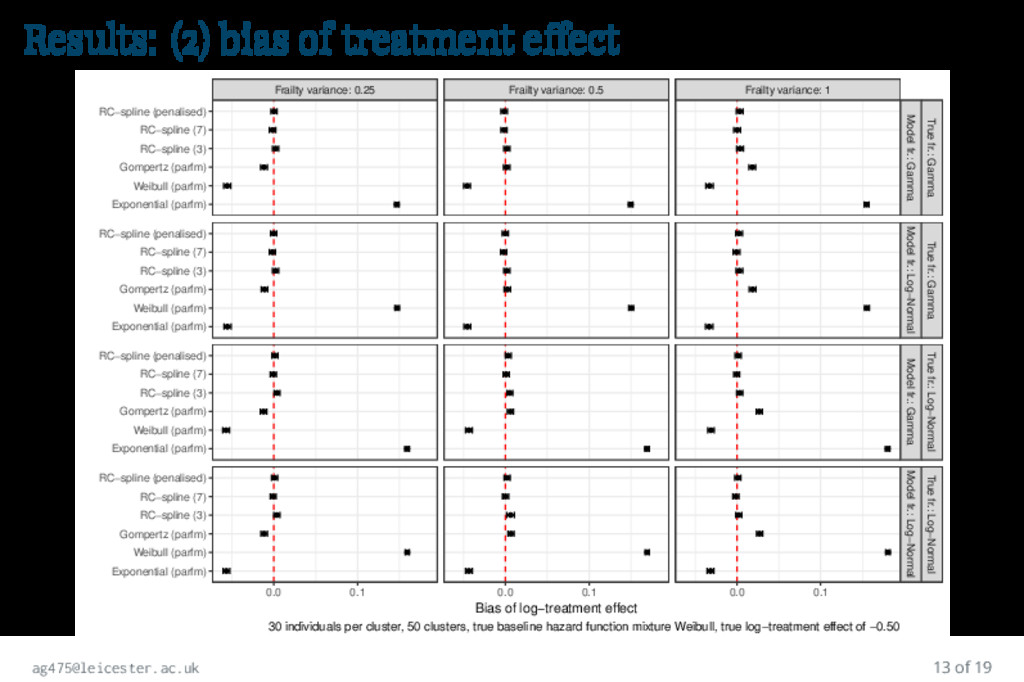
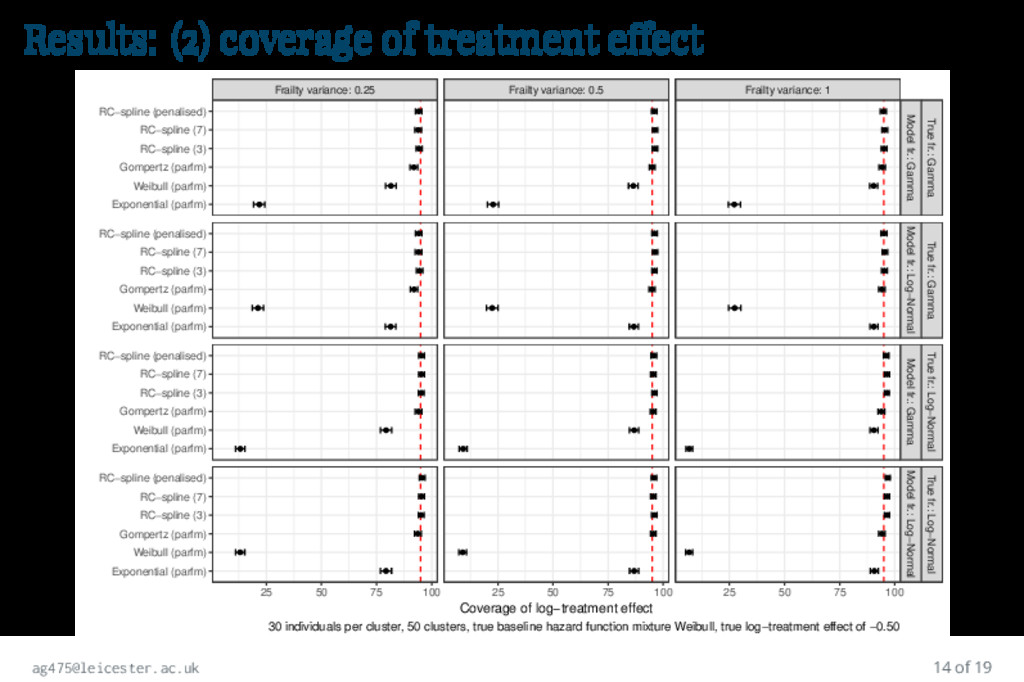
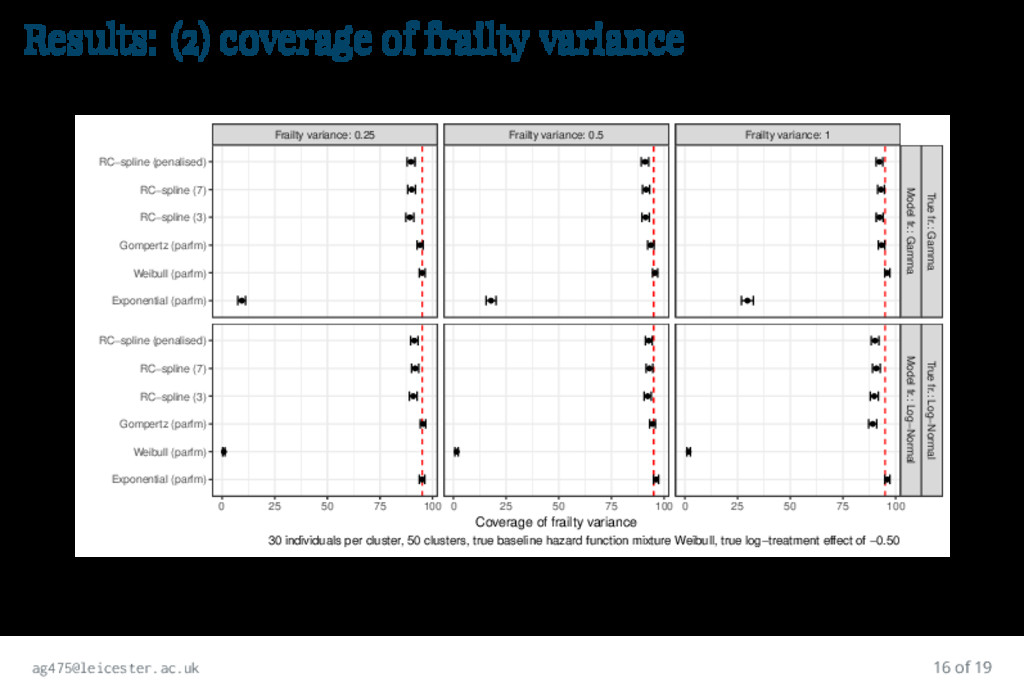
regression coefficients, irrespectively of the frailty distribution Misspecification of the baseline hazard can also yield biased estimates of the frailty variance, even when the frailty distribution is well specified Misspecification of the frailty distribution has a negligible impact on bias of regression coefficients Flexible parametric models tend to be quite robust to model misspecification, using both full and penalised likelihood estimation procedures Further simulations will provide greater insight on the topic, especially on absolute risk predictions [email protected] 17 of 19
of 2 observations each: twin data 2. Adding marginal survival as estimand: ease of obtaining absolute risk predictions is one of the advantages of parametric models 3. Adding further comparisons with available software: shared frailty models with M-splines on the hazard scale estimated using penalised likelihood (R package frailtypack), … [email protected] 18 of 19
New York Wienke A (2010). Frailty models in survival analysis, Chapman and Hall / CRC Rutherford MJ, Crowther MJ and Lambert PC (2015). The use of restricted cubic splines to approximate complex hazard functions in the analysis of time-to-event data: a simulation study, Journal of Statistical Computation and Simulation, 85(4):777-793 Royston P and Parmar MK (2002). Flexible parametric proportional-hazards and proportional-odds models for censored survival data, with application to prognostic modelling and estimation of treatment effects, Statistics in Medicine, 21(15):2175-2197 Pickles A and Crouchley R (1995). A comparison of frailty models for multivariate survival data, Statistics in Medicine, 14(13):1447-1461 [email protected] 19 of 19


 sam2017conference
 ontheslope
 sishi2026
 fr0gger
 kobayashi31
 izumiyama_lab
 rikkabotan7
 nzw0301
 dk999
dk999
 upura
upura
.png) satai
satai
 datascientistsociety
 nttcom
 jonyablonski
 bcantrill
.png) helenjbeal
helenjbeal
 watany
 ipullrank
 jacobian
 szymonslowik
 techseoconnect
 lynnandtonic
 aemeredith
 akademiya2063
 irinanazarova