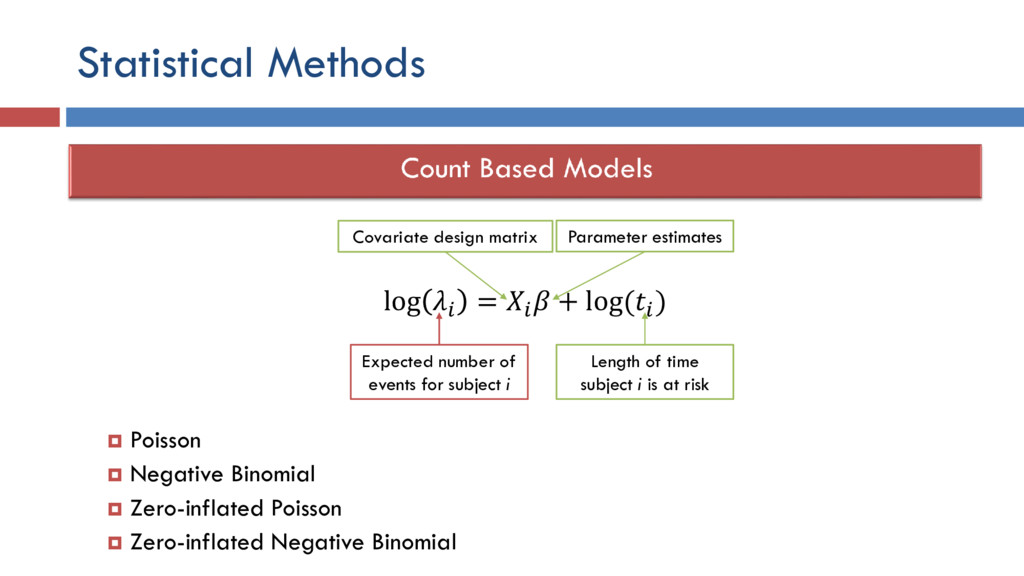
Negative Binomial Zero-inflated Poisson Zero-inflated Negative Binomial Expected number of events for subject i Length of time subject i is at risk Covariate design matrix Parameter estimates
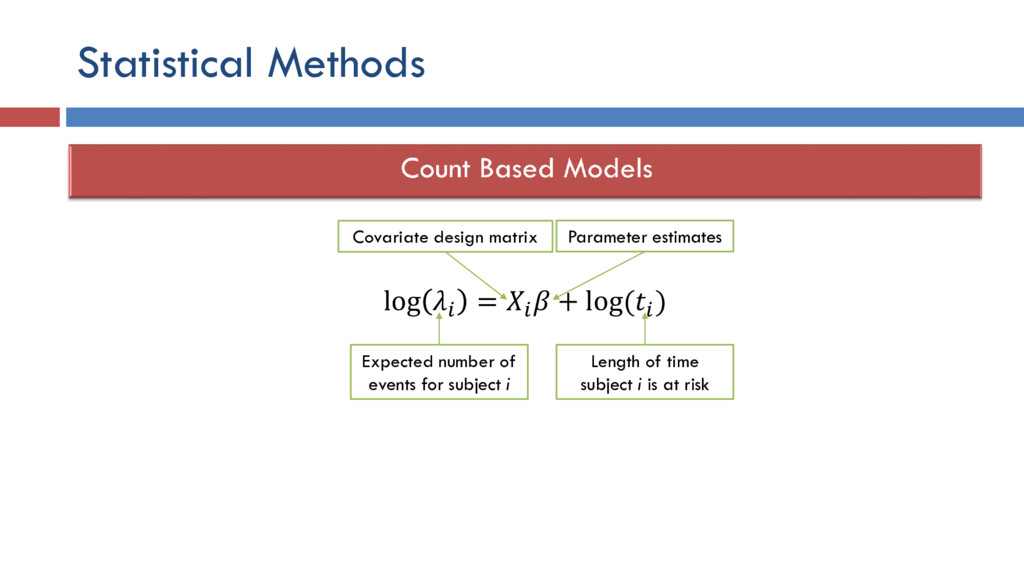
Negative Binomial Zero-inflated Poisson Zero-inflated Negative Binomial Expected number of events for subject i Length of time subject i is at risk Covariate design matrix Parameter estimates
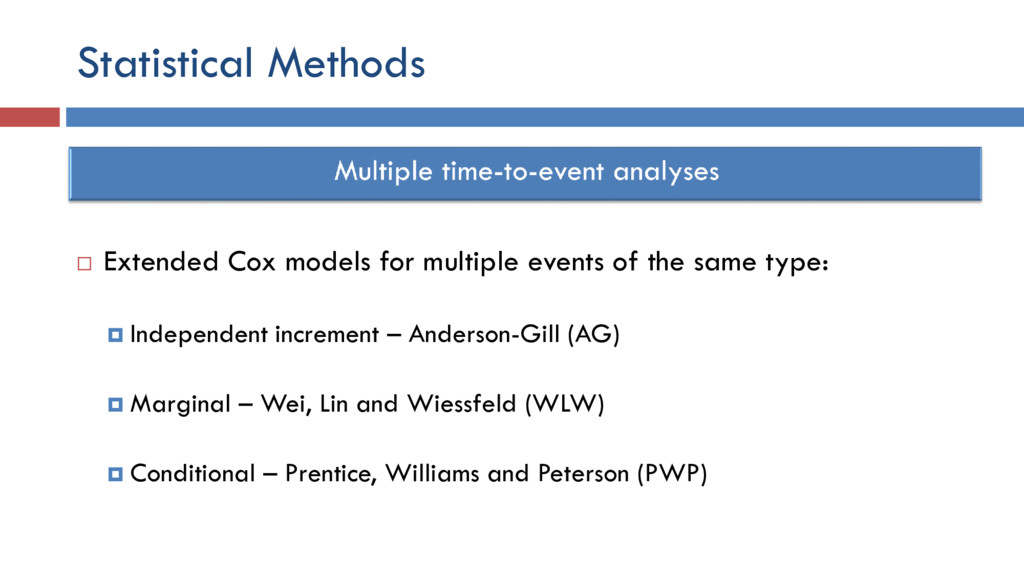
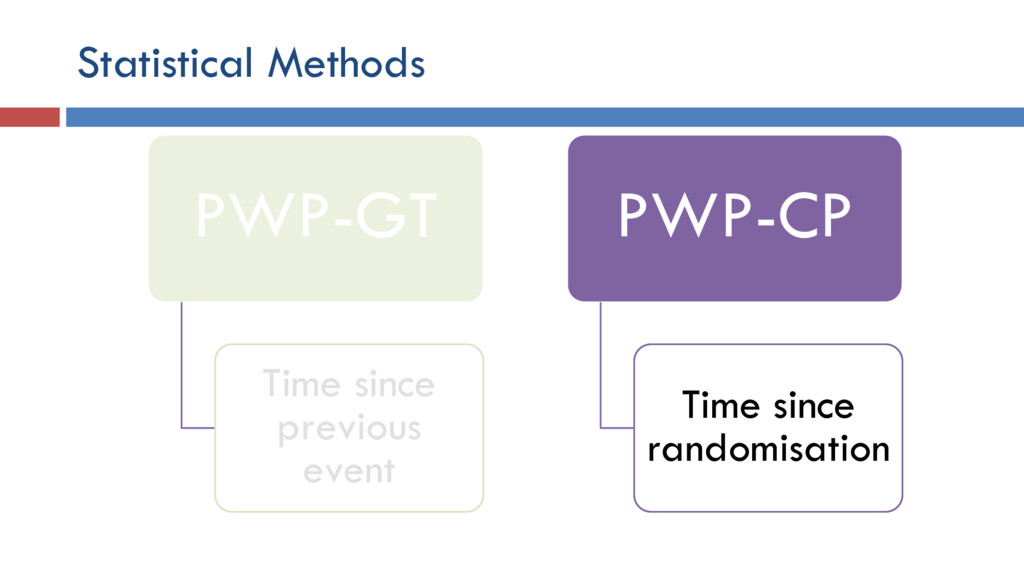
the same type: Independent increment – Anderson-Gill (AG) Marginal – Wei, Lin and Wiessfeld (WLW) Conditional – Prentice, Williams and Peterson (PWP)
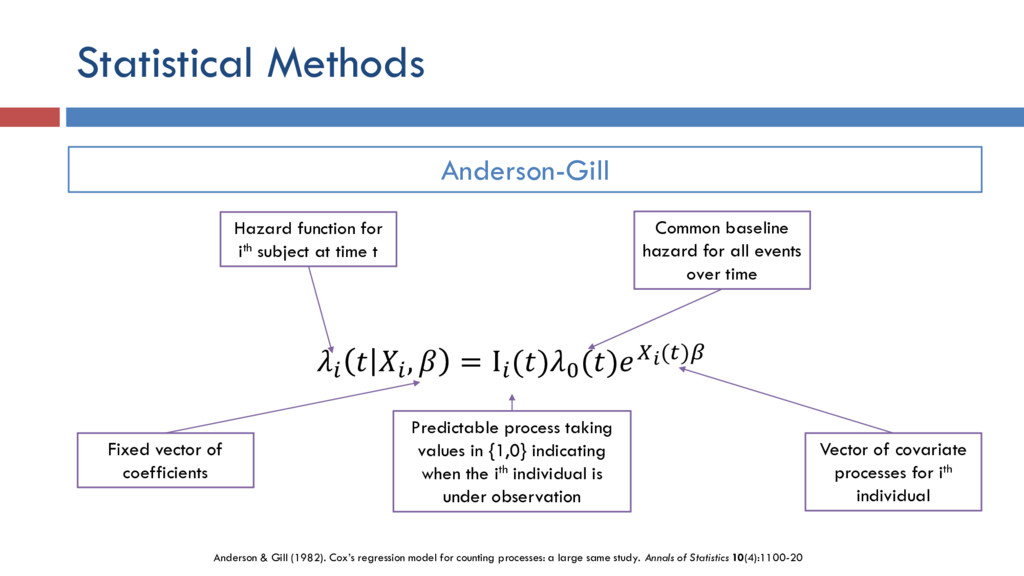
for ith subject at time t Common baseline hazard for all events over time Vector of covariate processes for ith individual Fixed vector of coefficients Predictable process taking values in {1,0} indicating when the ith individual is under observation Anderson & Gill (1982). Cox’s regression model for counting processes: a large same study. Annals of Statistics 10(4):1100-20
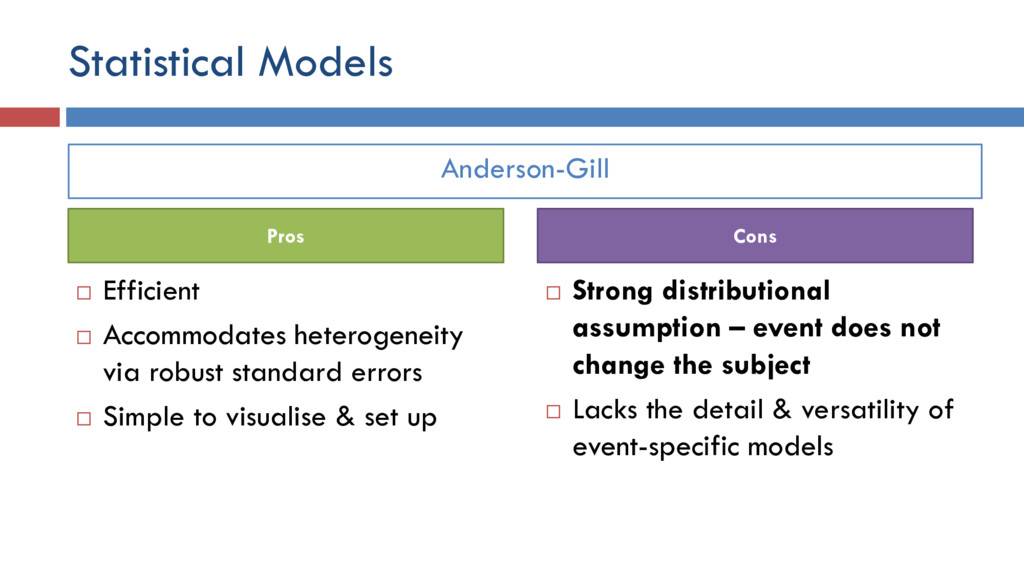
standard errors Simple to visualise & set up Strong distributional assumption – event does not change the subject Lacks the detail & versatility of event-specific models Pros Cons
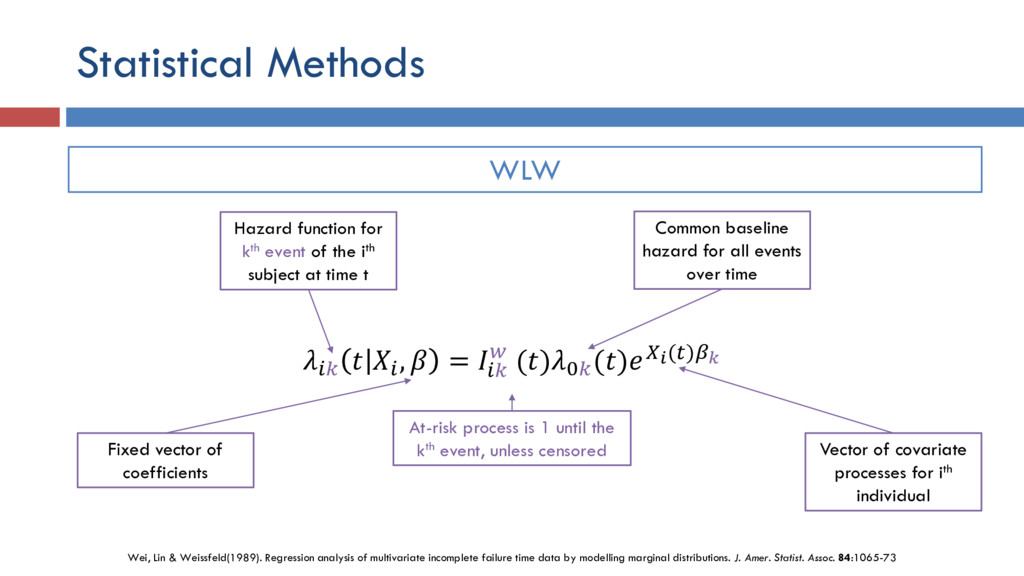
kth event of the ith subject at time t Common baseline hazard for all events over time Vector of covariate processes for ith individual Fixed vector of coefficients At-risk process is 1 until the kth event, unless censored Wei, Lin & Weissfeld(1989). Regression analysis of multivariate incomplete failure time data by modelling marginal distributions. J. Amer. Statist. Assoc. 84:1065-73
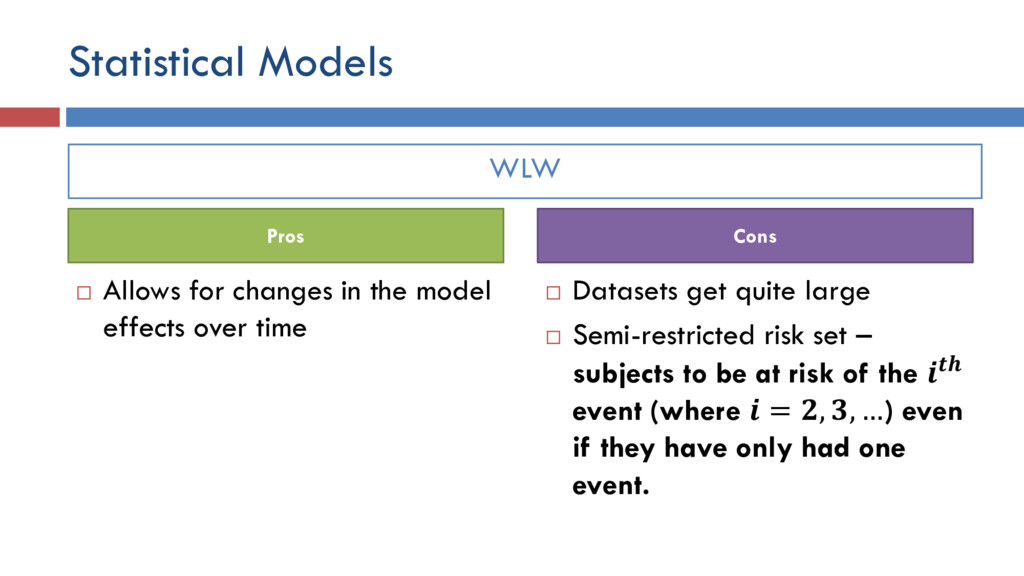
effects over time Datasets get quite large Semi-restricted risk set – subjects to be at risk of the event (where = , , …) even if they have only had one event. Pros Cons
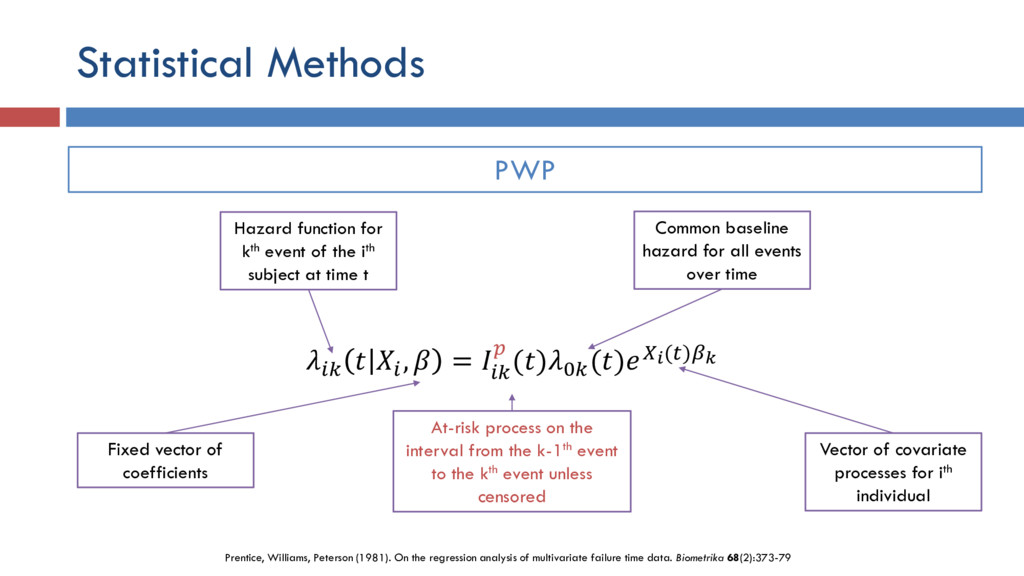
kth event of the ith subject at time t Common baseline hazard for all events over time Vector of covariate processes for ith individual Fixed vector of coefficients At-risk process on the interval from the k-1th event to the kth event unless censored Prentice, Williams, Peterson (1981). On the regression analysis of multivariate failure time data. Biometrika 68(2):373-79
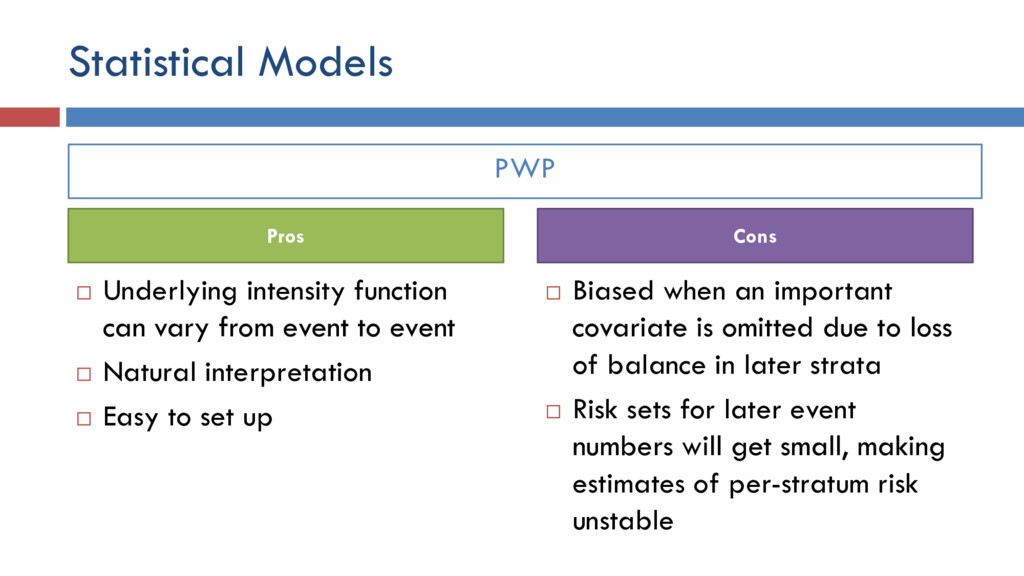
event to event Natural interpretation Easy to set up Biased when an important covariate is omitted due to loss of balance in later strata Risk sets for later event numbers will get small, making estimates of per-stratum risk unstable Pros Cons
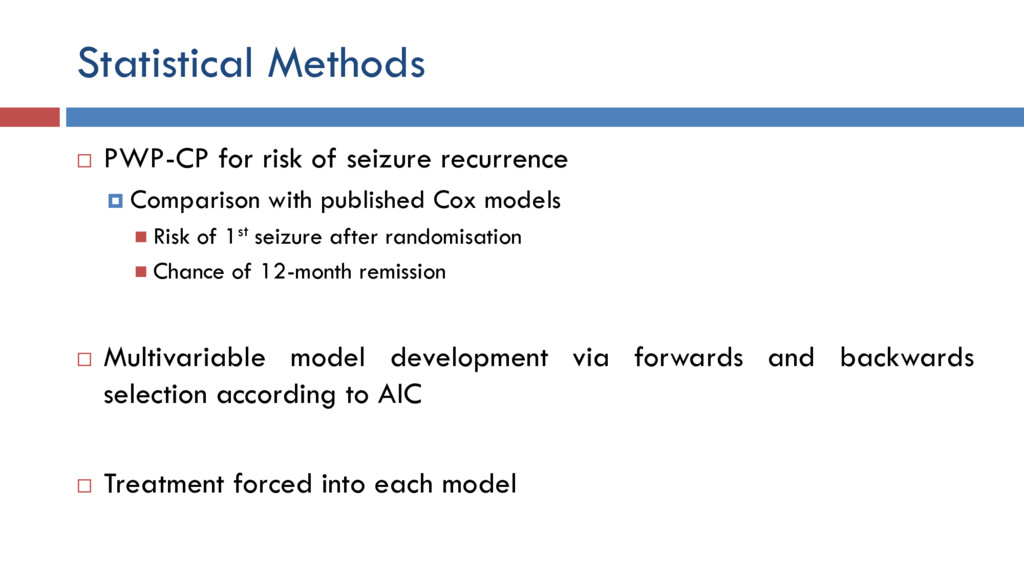
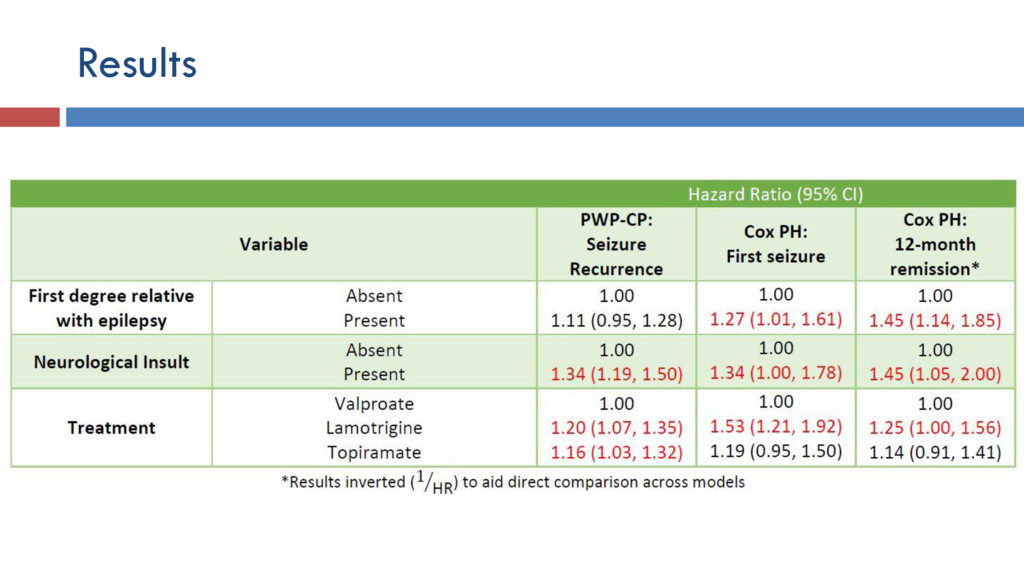
Comparison with published Cox models Risk of 1st seizure after randomisation Chance of 12-month remission Multivariable model development via forwards and backwards selection according to AIC Treatment forced into each model
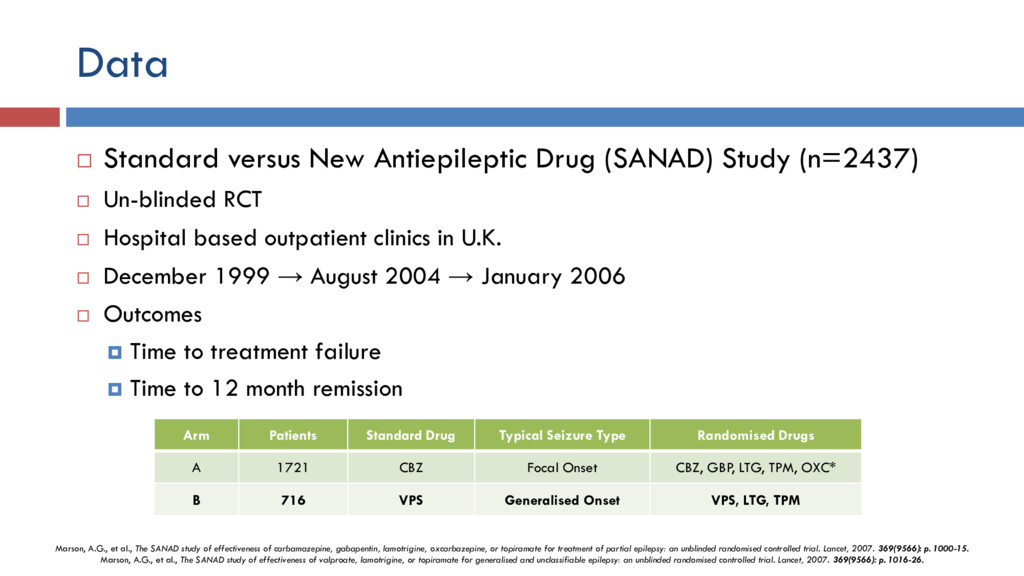
Un-blinded RCT Hospital based outpatient clinics in U.K. December 1999 → August 2004 → January 2006 Outcomes Time to treatment failure Time to 12 month remission Arm Patients Standard Drug Typical Seizure Type Randomised Drugs A 1721 CBZ Focal Onset CBZ, GBP, LTG, TPM, OXC* B 716 VPS Generalised Onset VPS, LTG, TPM Marson, A.G., et al., The SANAD study of effectiveness of carbamazepine, gabapentin, lamotrigine, oxcarbazepine, or topiramate for treatment of partial epilepsy: an unblinded randomised controlled trial. Lancet, 2007. 369(9566): p. 1000-15. Marson, A.G., et al., The SANAD study of effectiveness of valproate, lamotrigine, or topiramate for generalised and unclassifiable epilepsy: an unblinded randomised controlled trial. Lancet, 2007. 369(9566): p. 1016-26.
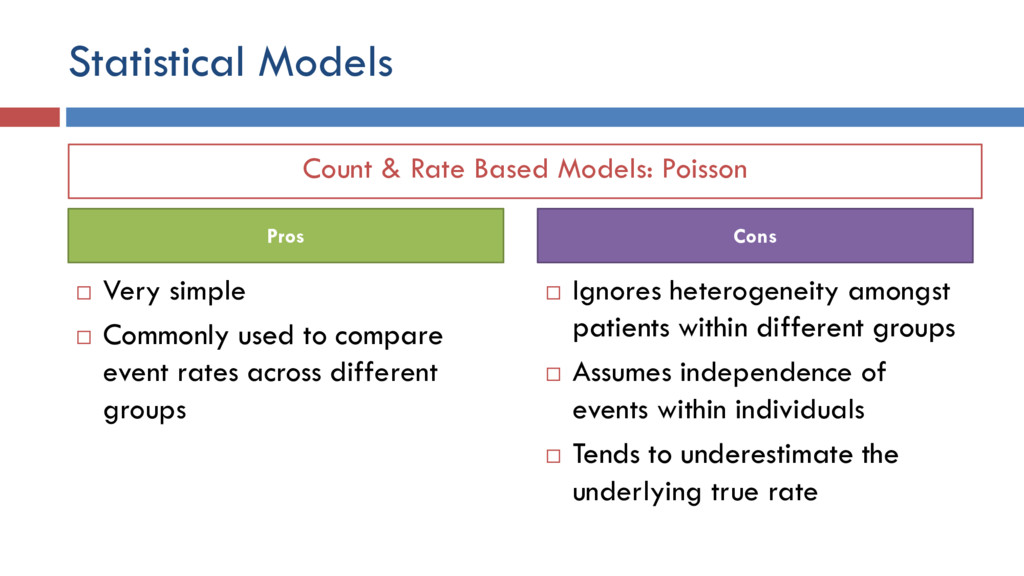
simple Commonly used to compare event rates across different groups Ignores heterogeneity amongst patients within different groups Assumes independence of events within individuals Tends to underestimate the underlying true rate Pros Cons
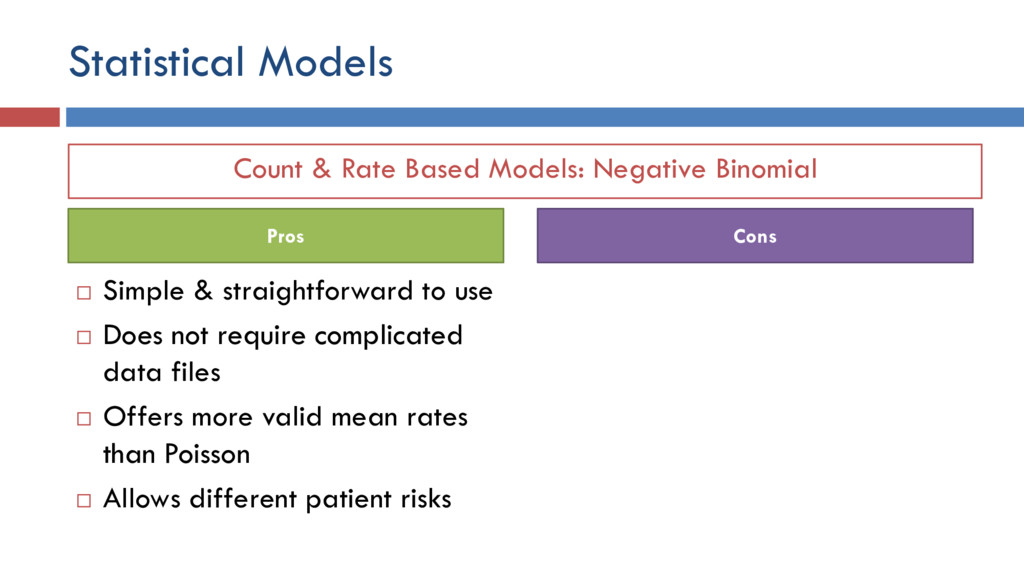
Simple & straightforward to use Does not require complicated data files Offers more valid mean rates than Poisson Allows different patient risks Pros Cons
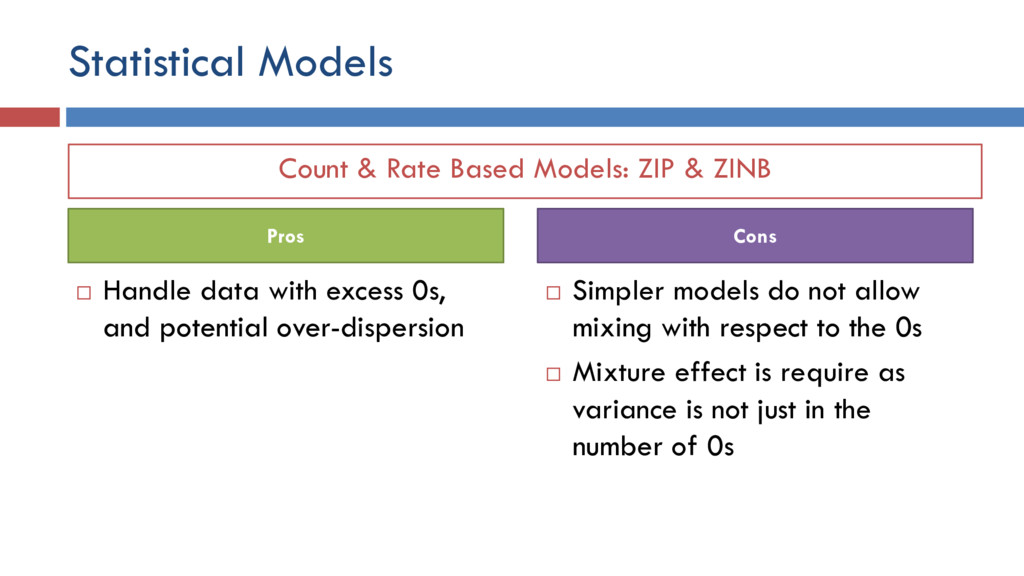
Handle data with excess 0s, and potential over-dispersion Simpler models do not allow mixing with respect to the 0s Mixture effect is require as variance is not just in the number of 0s Pros Cons


 sam2017conference
 analokmaus
 recsyslab
 koide3
 imai448
 murakawatakuya
 kzinmr
 kobayashi31
 upura
upura
 yuukit
 shunk031
 institudelelevage
 yukako_nakano
 leimatthew05
 emna__ayadi
 ryanjones
 rocio
rocio
 lara
lara
 inesmontani
 marketingsoph
 427marketing
 skoyamalab
 jmmastey