Upgrade to PRO for Only $50/Year—Limited-Time Offer! 🔥

Full-stack Data Transformation Solution from Mi...

Avatar for Shiv Iyer Shiv Iyer PRO
December 13, 2025

Full-stack Data Transformation Solution from MinervaDB

A deck on full-stack Data Transformation Solution from MinervaDB

Avatar for Shiv Iyer

Shiv Iyer PRO

December 13, 2025
Tweet

More Decks by Shiv Iyer

Other Decks in Business

Transcript

  1. MinervaDB: Pioneering Data Transformation Solutions for Modern Enterprises MinervaDB stands

    at the forefront of digital transformation, delivering unparalleled expertise in enterprise-grade database infrastructure engineering, advanced analytics, and comprehensive operations management. Our meticulously crafted solutions are designed to empower contemporary businesses to harness the full potential of their data assets, driving innovation, efficiency, and sustained growth in today's rapidly evolving technological landscape. We understand that robust, scalable, and secure data foundations are paramount for competitive advantage, and our services are tailored to meet these critical demands. Our expansive technical expertise encompasses a broad spectrum of critical data technologies, ensuring that our clients benefit from the most appropriate and cutting-edge solutions available. This includes: Traditional SQL Databases: Deep proficiency in relational database management systems, including Oracle, SQL Server, MySQL, PostgreSQL, and other industry standards, covering design, optimization, and high-availability configurations. NoSQL Data Stores: Extensive experience with non-relational databases such as MongoDB, Cassandra, Redis, DynamoDB, and Couchbase, enabling flexible schema designs and handling of diverse data types and massive scale. NewSQL Systems: Mastery of NewSQL databases that combine the scalability of NoSQL with the ACID properties of traditional SQL, offering transactional consistency at web scale. Cloud-Native Data Platforms: Specialized knowledge in architecting, migrating, and managing data solutions across leading cloud providers, including AWS (e.g., Aurora, Redshift, Snowflake), Azure (e.g., Azure SQL Database, Cosmos DB), and Google Cloud (e.g., BigQuery, Cloud Spanner), optimizing for performance, cost, and elasticity. Cutting-Edge Analytics: Implementation of sophisticated data warehousing strategies, business intelligence (BI) solutions, real-time analytics, and predictive modeling, transforming raw data into actionable insights for strategic decision-making. We leverage modern data pipelines and visualization tools to present complex information clearly. Artificial Intelligence Solutions: Development and deployment of AI/ML frameworks, including machine learning models for predictive analysis, natural language processing (NLP) for unstructured data, and advanced automation, integrating intelligence directly into business processes. Every service and solution provided by MinervaDB is fortified by our unwavering commitment to client success, manifested through our 24/7 consultative services available globally. This comprehensive support model ensures continuous operational excellence, proactive problem resolution, strategic guidance, and expert assistance regardless of time zone or geographic location. We partner with our clients to not just solve immediate challenges but also to build future-proof data ecosystems that support long-term business objectives and technological evolution.
  2. Full-Stack Database Infrastructure Excellence MinervaDB excels in full-stack database infrastructure

    solutions, offering unparalleled expertise in both engineering and operations management. Our comprehensive approach covers the entire data platform lifecycle, from initial design and deployment to ongoing optimization, scaling, and robust security. We ensure your database environment is resilient, high-performing, and perfectly aligned with your business objectives and future growth. Our services encompass a wide array of database technologies, categorized by core functionalities and deployment models: Self-Managed and On-Premise Database Solutions: Relational Databases: We provide in-depth engineering and operational support for traditional relational systems like PostgreSQL, MySQL, and MariaDB. This includes schema design, query optimization, advanced replication strategies, high availability setups (e.g., clustering, failover), and proactive performance tuning for demanding transactional workloads. NoSQL Databases: For applications requiring flexible schemas and massive scalability, our expertise covers MongoDB, Cassandra, Redis, and Valkey. We specialize in designing distributed architectures, managing data consistency, optimizing read/write operations, and implementing efficient caching mechanisms for low-latency access and resilience. Analytical and Data Warehousing Systems: MinervaDB offers robust solutions for data-intensive analytics with ClickHouse and Trino. Our services include data pipeline integration, complex query optimization, columnar storage management, and performance tuning to accelerate analytical insights from large datasets. Vector Databases: Supporting AI and machine learning initiatives, we provide specialized support for vector similarity search databases like Milvus. This encompasses deployment, optimization for vector embeddings, and integration with AI applications for efficient similarity search and retrieval of unstructured data. Cloud-Native Database Infrastructure Expertise: Leveraging leading cloud providers, MinervaDB delivers optimized and cost-effective cloud database solutions. Our cloud infrastructure services include migration strategies, architecture re-platforming, cost optimization, performance scaling, and advanced security configurations tailored to each platform: Oracle MySQL HeatWave: We unlock HeatWave's full potential for high-performance OLTP and real-time analytics, focusing on in-memory query acceleration and seamless integration within Oracle Cloud Infrastructure. Amazon Web Services (AWS): Our proficiency spans Amazon RDS for managed relational databases, Amazon Aurora for high-performance, scalable relational workloads, and Amazon Redshift for petabyte-scale data warehousing and analytics. We optimize for elasticity, availability, and cost efficiency. Microsoft Azure: We provide expert management for Azure SQL Database and other Azure data services, ensuring robust performance, geo- replication, and integration with the broader Azure ecosystem for enterprise applications. Google Cloud Platform (GCP): MinervaDB guides clients through effective utilization of Google BigQuery for serverless, highly scalable analytics, optimizing data ingestion, query performance, and cost management for vast datasets. Specialized Cloud Platforms: Our expertise also includes advanced data platforms like Snowflake for cloud data warehousing and Databricks for unified data analytics and AI/ML workloads, covering optimization, governance, and integration across diverse data sources. By delivering this holistic, full-stack approach, MinervaDB empowers businesses to achieve maximum efficiency, performance, and security from their critical database infrastructure, fostering a robust foundation for all data-driven initiatives.
  3. Our Core Focus Areas Performance Engineering Our performance engineering services

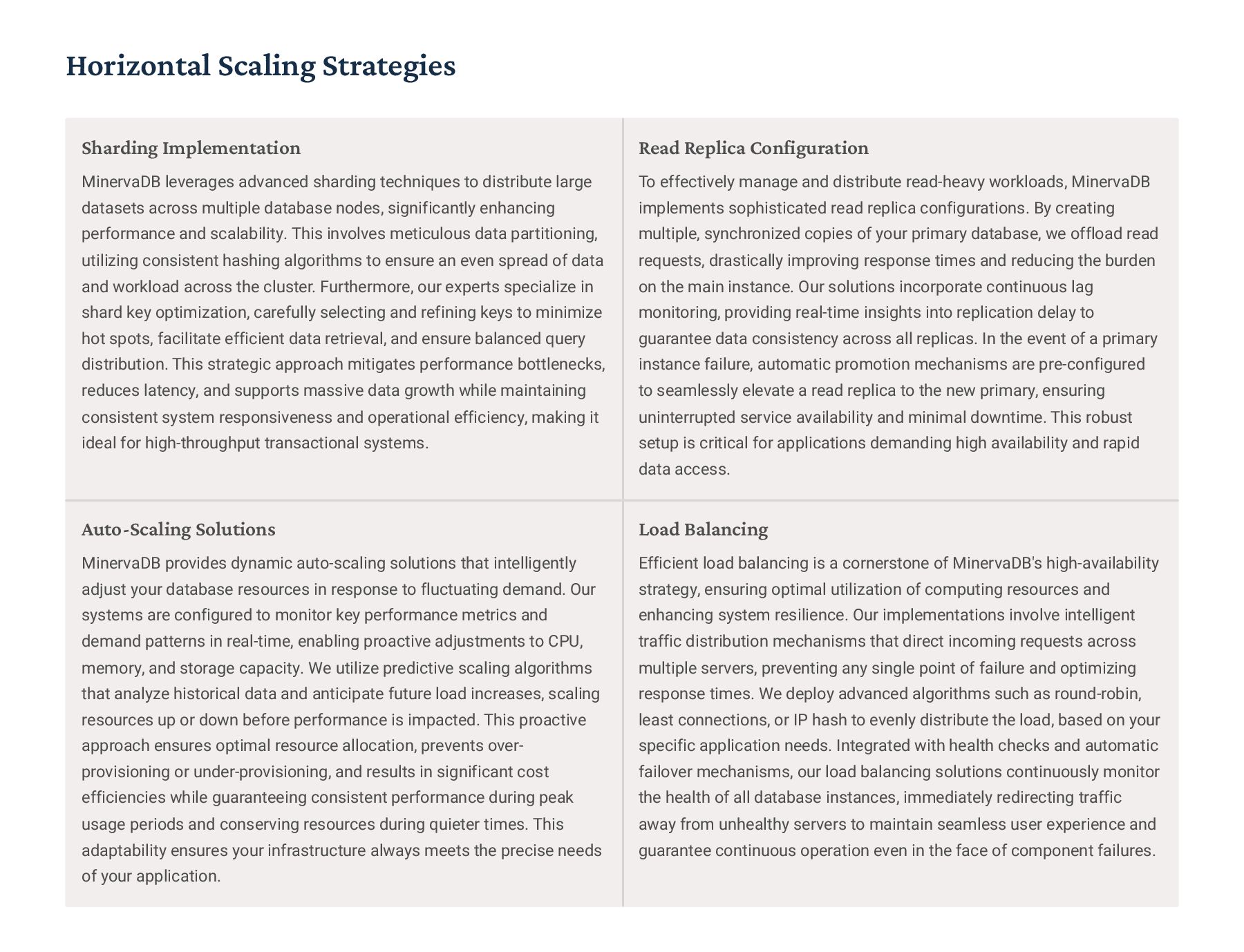
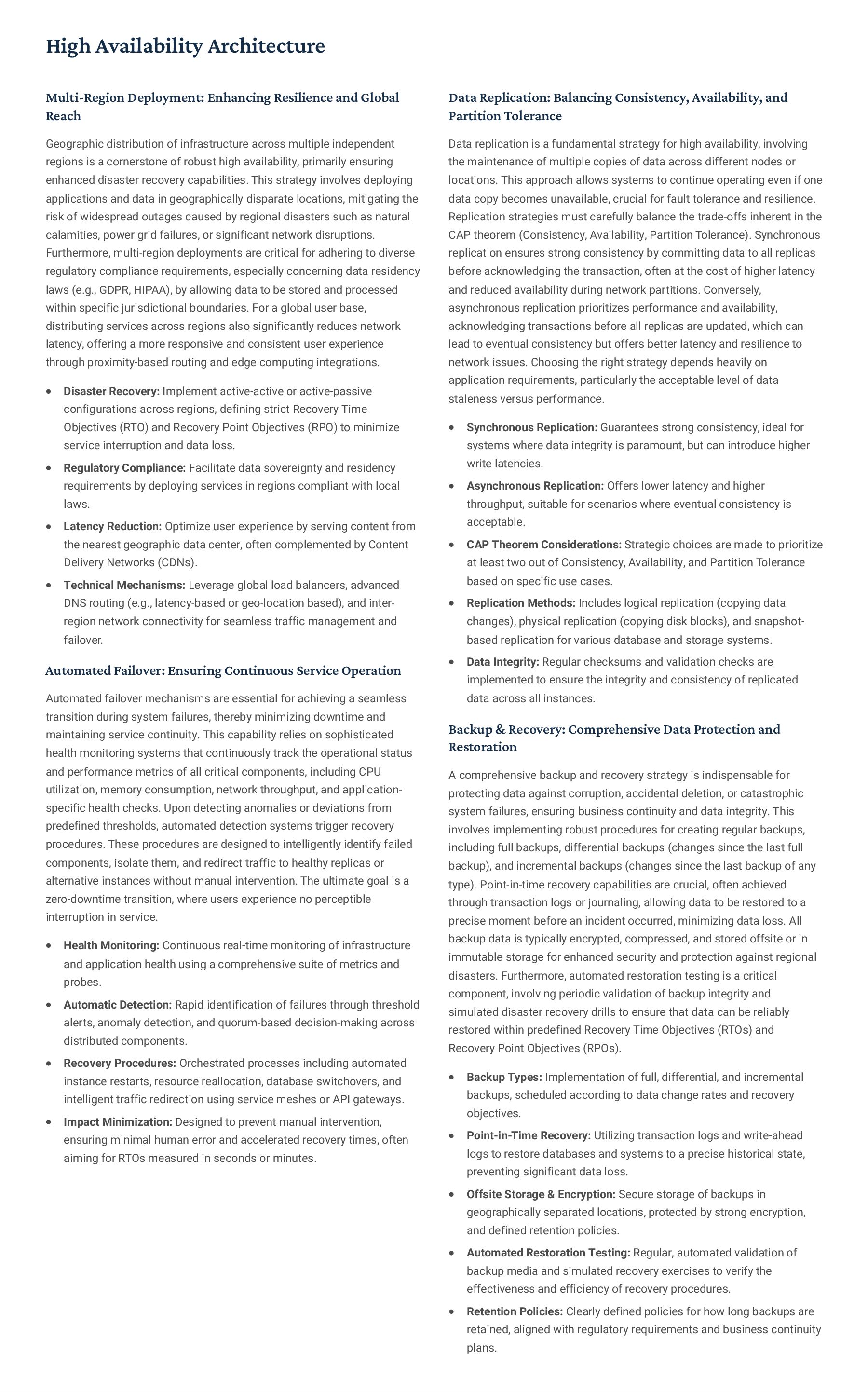
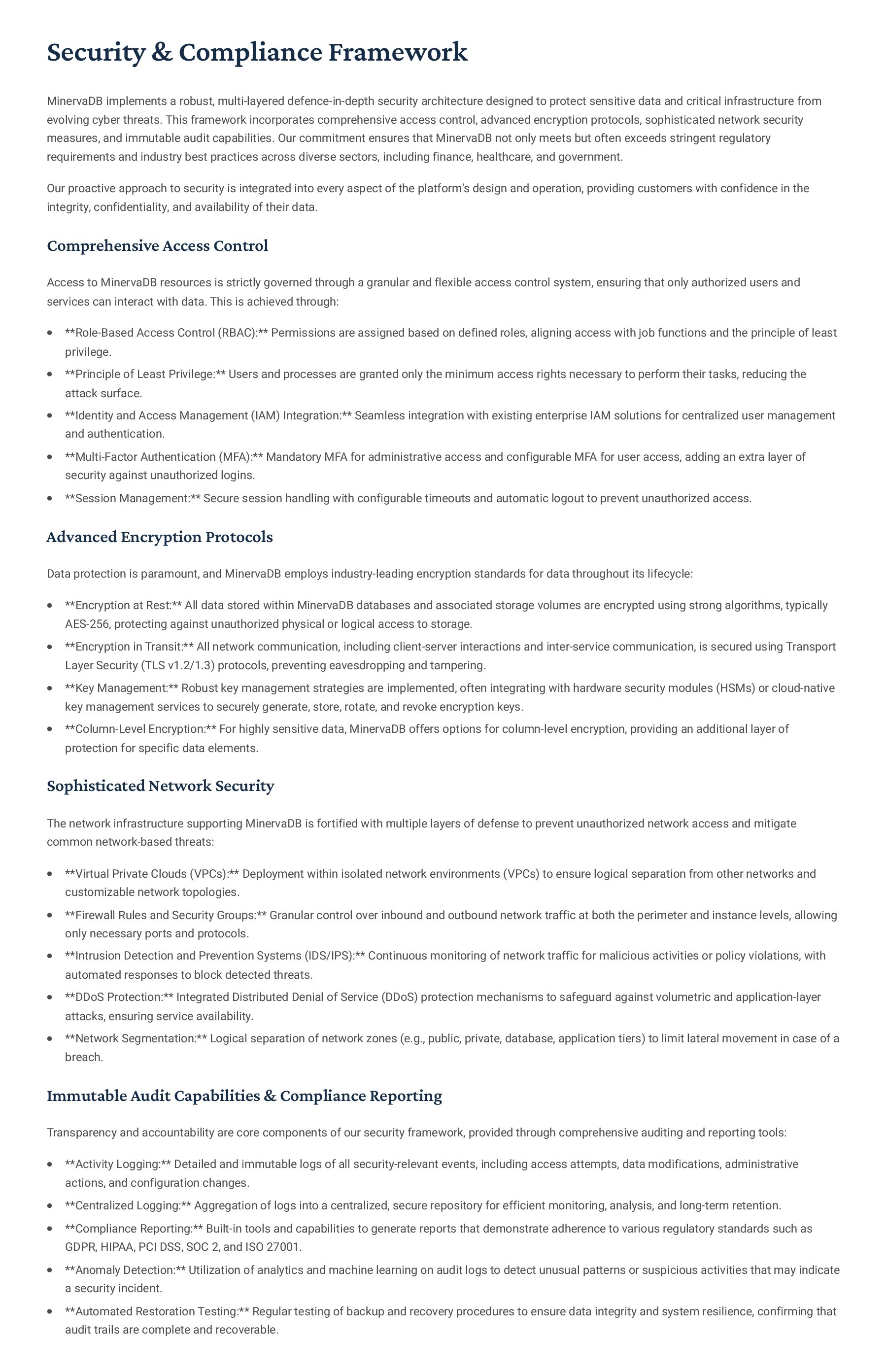
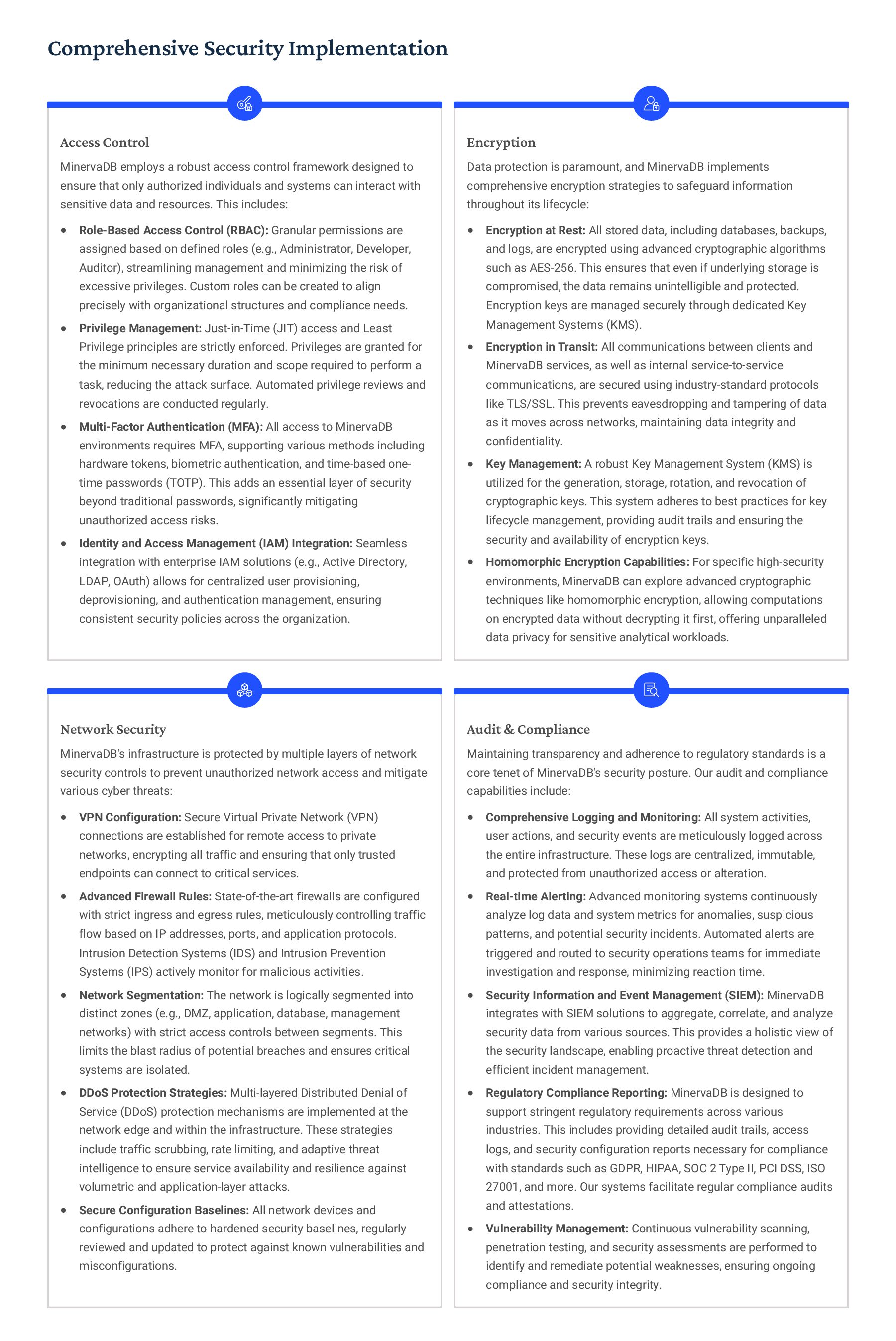
    focus on meticulously optimising database systems to achieve peak efficiency and responsiveness. We employ advanced query optimisation techniques, including the analysis of execution plans, rewriting inefficient queries, and implementing appropriate hints to guide the query optimizer. This is complemented by sophisticated indexing strategies, where we identify optimal index types (e.g., B-tree, hash, full-text, partial, covering indexes) and their placement to accelerate data retrieval operations without unduly impacting write performance. Furthermore, we fine-tune resource allocation across CPU, memory, and I/O subsystems, ensuring that your database infrastructure leverages its hardware capabilities to the fullest. This includes optimising buffer cache sizes, memory grants, parallelism settings, and implementing efficient connection pooling. Our goal is to achieve maximum database throughput, minimise latency for critical operations, and ensure a consistently fluid user experience even under heavy load, while simultaneously reducing operational costs by making the most of existing resources. Scalability Solutions We design and implement robust scalability solutions that enable your database infrastructure to seamlessly accommodate exponential data growth and fluctuating traffic patterns. Our expertise covers both horizontal and vertical scaling architectures. For horizontal scaling, we deploy strategies such as sharding, data partitioning, and the implementation of distributed database systems, ensuring that data is spread across multiple nodes or clusters to distribute the load and enhance read/write capacity. This involves careful planning of sharding keys and data distribution logic to prevent hot spots and maintain data integrity. In parallel, we refine vertical scaling approaches by optimising server configurations, upgrading hardware specifications (CPU, RAM, storage I/O), and implementing high-performance storage solutions. Our solutions integrate intelligent load balancing, advanced connection management, and read-replica strategies to offload read-intensive queries. These comprehensive approaches ensure that your applications maintain optimal performance, low latency, and high availability as user demand and data volumes continue to expand, providing a future-proof foundation for your business growth. High Availability Achieving unwavering reliability is paramount, and our high availability solutions are engineered to deliver 99.99% uptime guarantees for your critical database systems. We implement multi-region deployment strategies, leveraging both active-active and active-passive configurations with synchronous or asynchronous data replication across geographically diverse data centers. This ensures continuous data accessibility and resilience against localised outages or regional disasters. Our services include the deployment of automated failover mechanisms that instantly detect primary node failures and promote a standby replica without manual intervention, minimising downtime and data loss. We meticulously define Recovery Time Objectives (RTO) and Recovery Point Objectives (RPO) to meet your specific business continuity requirements. Furthermore, we establish comprehensive disaster recovery systems, encompassing robust backup and restore procedures, point-in-time recovery capabilities, and continuous data protection solutions. Regular drills and testing are conducted to validate the effectiveness of these systems, guaranteeing that your database infrastructure remains operational and data remains secure even in the face of unforeseen catastrophic events. Data Security Data security is an integral component of our database infrastructure strategy, where we implement a defence-in-depth approach to protect your sensitive information. This involves multiple layers of security controls, starting from network segmentation, stringent firewall rules, and advanced intrusion detection and prevention systems to safeguard against unauthorised access and cyber threats. We ensure comprehensive data encryption, both at rest (using transparent data encryption, disk encryption) and in transit (via SSL/TLS protocols), coupled with secure key management practices to protect your data throughout its lifecycle. Our access control mechanisms are built on the principle of least privilege, implementing robust Role-Based Access Control (RBAC) and granular permissions to ensure that users and applications only have access to the data necessary for their specific functions. This is further enhanced by multi-factor authentication (MFA) and regular access reviews. We also focus heavily on compliance with global regulatory standards such as GDPR, HIPAA, PCI DSS, ISO 27001, and SOC 2, providing auditing capabilities and ensuring that your database environment meets the strictest legal and industry requirements. Regular vulnerability assessments, penetration testing, and security audits are performed to proactively identify and mitigate potential weaknesses, maintaining an impregnable security posture for your valuable data assets.
  4. Comprehensive Database Technology Expertise MinervaDB is a premier provider of

    professional database infrastructure operations solutions, addressing the complex needs across all modern data platforms. We empower businesses by ensuring their data ecosystems are robust, reliable, and exceptionally performant. As a boutique consulting firm, we blend enterprise-grade quality with a deeply personalized service model. This unique approach enables us to deliver bespoke strategies and hands-on support, meticulously designed to optimize database performance, enhance operational efficiency, and maximize return on investment from your critical data assets. Our expertise spans a wide array of database technologies, including: Relational Databases: PostgreSQL, MySQL, Oracle, SQL Server NoSQL Databases: MongoDB, Cassandra, Redis Cloud-Native Data Warehouses: Snowflake, Amazon Redshift, Google BigQuery We offer architectural design, implementation, ongoing maintenance, proactive monitoring, and advanced troubleshooting, ensuring your data infrastructure operates at peak efficiency. Global Reach, Local Expertise: Headquartered in the San Francisco Bay Area, MinervaDB utilizes a network of globally distributed teams. This model ensures comprehensive, round-the-clock support across multiple time zones, delivering unparalleled responsiveness and a follow-the-sun service strategy to all clients, regardless of location. Our local presence combined with global capabilities ensures culturally aware, compliant, and highly effective service delivery.
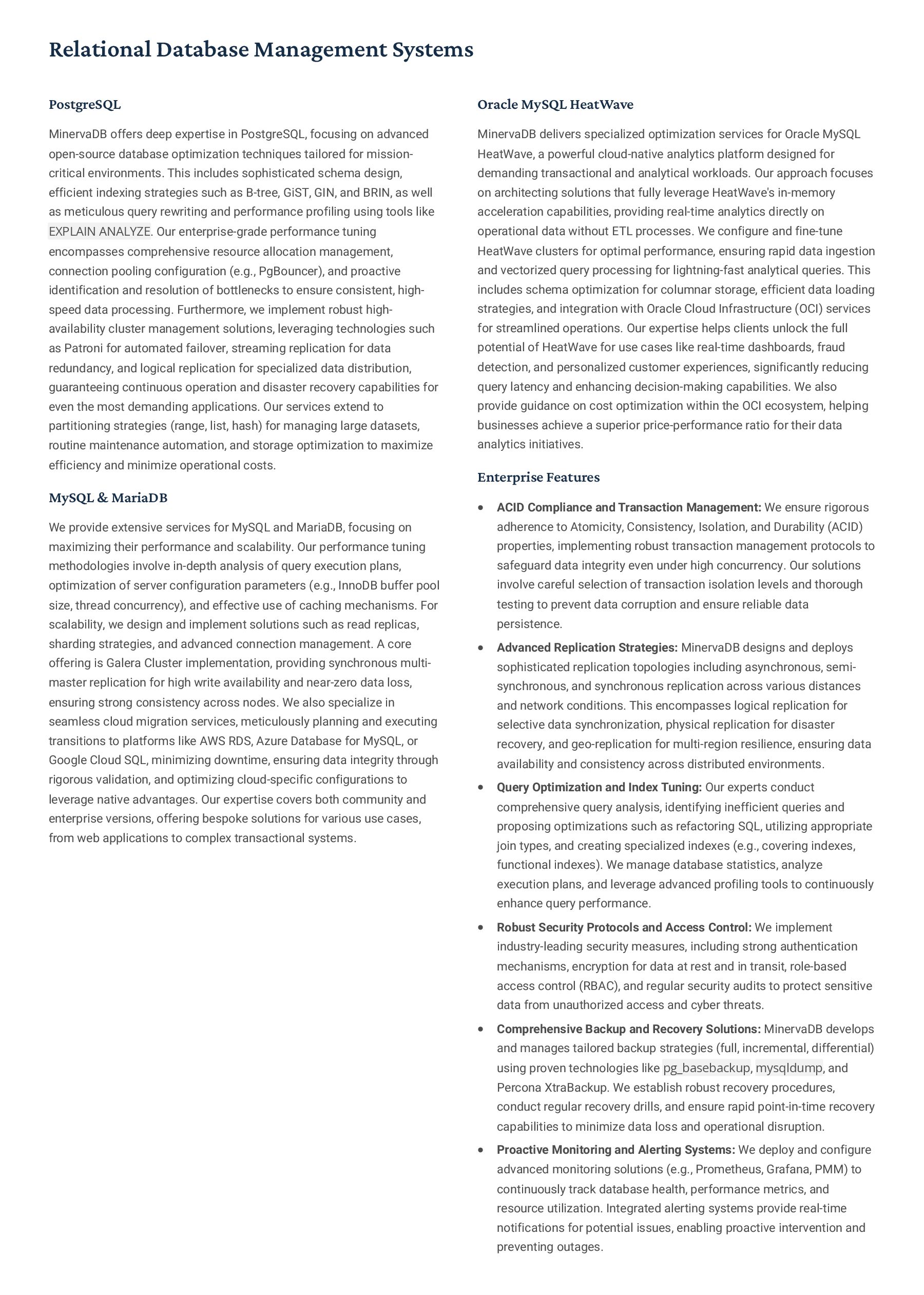
  5. Relational Database Management Systems PostgreSQL MinervaDB offers deep expertise in

    PostgreSQL, focusing on advanced open-source database optimization techniques tailored for mission- critical environments. This includes sophisticated schema design, efficient indexing strategies such as B-tree, GiST, GIN, and BRIN, as well as meticulous query rewriting and performance profiling using tools like EXPLAIN ANALYZE. Our enterprise-grade performance tuning encompasses comprehensive resource allocation management, connection pooling configuration (e.g., PgBouncer), and proactive identification and resolution of bottlenecks to ensure consistent, high- speed data processing. Furthermore, we implement robust high- availability cluster management solutions, leveraging technologies such as Patroni for automated failover, streaming replication for data redundancy, and logical replication for specialized data distribution, guaranteeing continuous operation and disaster recovery capabilities for even the most demanding applications. Our services extend to partitioning strategies (range, list, hash) for managing large datasets, routine maintenance automation, and storage optimization to maximize efficiency and minimize operational costs. MySQL & MariaDB We provide extensive services for MySQL and MariaDB, focusing on maximizing their performance and scalability. Our performance tuning methodologies involve in-depth analysis of query execution plans, optimization of server configuration parameters (e.g., InnoDB buffer pool size, thread concurrency), and effective use of caching mechanisms. For scalability, we design and implement solutions such as read replicas, sharding strategies, and advanced connection management. A core offering is Galera Cluster implementation, providing synchronous multi- master replication for high write availability and near-zero data loss, ensuring strong consistency across nodes. We also specialize in seamless cloud migration services, meticulously planning and executing transitions to platforms like AWS RDS, Azure Database for MySQL, or Google Cloud SQL, minimizing downtime, ensuring data integrity through rigorous validation, and optimizing cloud-specific configurations to leverage native advantages. Our expertise covers both community and enterprise versions, offering bespoke solutions for various use cases, from web applications to complex transactional systems. Oracle MySQL HeatWave MinervaDB delivers specialized optimization services for Oracle MySQL HeatWave, a powerful cloud-native analytics platform designed for demanding transactional and analytical workloads. Our approach focuses on architecting solutions that fully leverage HeatWave's in-memory acceleration capabilities, providing real-time analytics directly on operational data without ETL processes. We configure and fine-tune HeatWave clusters for optimal performance, ensuring rapid data ingestion and vectorized query processing for lightning-fast analytical queries. This includes schema optimization for columnar storage, efficient data loading strategies, and integration with Oracle Cloud Infrastructure (OCI) services for streamlined operations. Our expertise helps clients unlock the full potential of HeatWave for use cases like real-time dashboards, fraud detection, and personalized customer experiences, significantly reducing query latency and enhancing decision-making capabilities. We also provide guidance on cost optimization within the OCI ecosystem, helping businesses achieve a superior price-performance ratio for their data analytics initiatives. Enterprise Features ACID Compliance and Transaction Management: We ensure rigorous adherence to Atomicity, Consistency, Isolation, and Durability (ACID) properties, implementing robust transaction management protocols to safeguard data integrity even under high concurrency. Our solutions involve careful selection of transaction isolation levels and thorough testing to prevent data corruption and ensure reliable data persistence. Advanced Replication Strategies: MinervaDB designs and deploys sophisticated replication topologies including asynchronous, semi- synchronous, and synchronous replication across various distances and network conditions. This encompasses logical replication for selective data synchronization, physical replication for disaster recovery, and geo-replication for multi-region resilience, ensuring data availability and consistency across distributed environments. Query Optimization and Index Tuning: Our experts conduct comprehensive query analysis, identifying inefficient queries and proposing optimizations such as refactoring SQL, utilizing appropriate join types, and creating specialized indexes (e.g., covering indexes, functional indexes). We manage database statistics, analyze execution plans, and leverage advanced profiling tools to continuously enhance query performance. Robust Security Protocols and Access Control: We implement industry-leading security measures, including strong authentication mechanisms, encryption for data at rest and in transit, role-based access control (RBAC), and regular security audits to protect sensitive data from unauthorized access and cyber threats. Comprehensive Backup and Recovery Solutions: MinervaDB develops and manages tailored backup strategies (full, incremental, differential) using proven technologies like pg_basebackup, mysqldump, and Percona XtraBackup. We establish robust recovery procedures, conduct regular recovery drills, and ensure rapid point-in-time recovery capabilities to minimize data loss and operational disruption. Proactive Monitoring and Alerting Systems: We deploy and configure advanced monitoring solutions (e.g., Prometheus, Grafana, PMM) to continuously track database health, performance metrics, and resource utilization. Integrated alerting systems provide real-time notifications for potential issues, enabling proactive intervention and preventing outages.
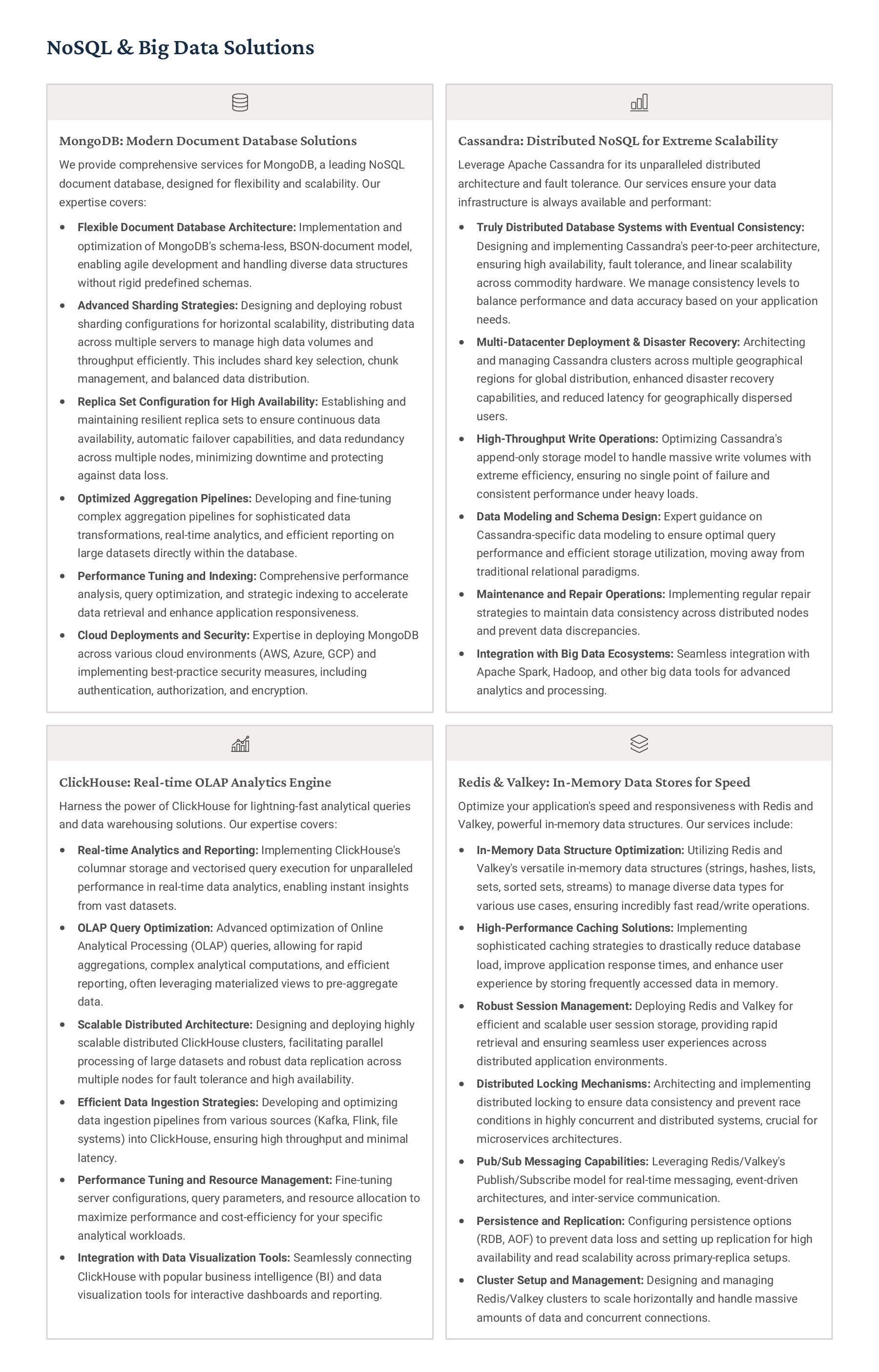
  6. NoSQL & Big Data Solutions MongoDB: Modern Document Database Solutions

    We provide comprehensive services for MongoDB, a leading NoSQL document database, designed for flexibility and scalability. Our expertise covers: Flexible Document Database Architecture: Implementation and optimization of MongoDB's schema-less, BSON-document model, enabling agile development and handling diverse data structures without rigid predefined schemas. Advanced Sharding Strategies: Designing and deploying robust sharding configurations for horizontal scalability, distributing data across multiple servers to manage high data volumes and throughput efficiently. This includes shard key selection, chunk management, and balanced data distribution. Replica Set Configuration for High Availability: Establishing and maintaining resilient replica sets to ensure continuous data availability, automatic failover capabilities, and data redundancy across multiple nodes, minimizing downtime and protecting against data loss. Optimized Aggregation Pipelines: Developing and fine-tuning complex aggregation pipelines for sophisticated data transformations, real-time analytics, and efficient reporting on large datasets directly within the database. Performance Tuning and Indexing: Comprehensive performance analysis, query optimization, and strategic indexing to accelerate data retrieval and enhance application responsiveness. Cloud Deployments and Security: Expertise in deploying MongoDB across various cloud environments (AWS, Azure, GCP) and implementing best-practice security measures, including authentication, authorization, and encryption. Cassandra: Distributed NoSQL for Extreme Scalability Leverage Apache Cassandra for its unparalleled distributed architecture and fault tolerance. Our services ensure your data infrastructure is always available and performant: Truly Distributed Database Systems with Eventual Consistency: Designing and implementing Cassandra's peer-to-peer architecture, ensuring high availability, fault tolerance, and linear scalability across commodity hardware. We manage consistency levels to balance performance and data accuracy based on your application needs. Multi-Datacenter Deployment & Disaster Recovery: Architecting and managing Cassandra clusters across multiple geographical regions for global distribution, enhanced disaster recovery capabilities, and reduced latency for geographically dispersed users. High-Throughput Write Operations: Optimizing Cassandra's append-only storage model to handle massive write volumes with extreme efficiency, ensuring no single point of failure and consistent performance under heavy loads. Data Modeling and Schema Design: Expert guidance on Cassandra-specific data modeling to ensure optimal query performance and efficient storage utilization, moving away from traditional relational paradigms. Maintenance and Repair Operations: Implementing regular repair strategies to maintain data consistency across distributed nodes and prevent data discrepancies. Integration with Big Data Ecosystems: Seamless integration with Apache Spark, Hadoop, and other big data tools for advanced analytics and processing. ClickHouse: Real-time OLAP Analytics Engine Harness the power of ClickHouse for lightning-fast analytical queries and data warehousing solutions. Our expertise covers: Real-time Analytics and Reporting: Implementing ClickHouse's columnar storage and vectorised query execution for unparalleled performance in real-time data analytics, enabling instant insights from vast datasets. OLAP Query Optimization: Advanced optimization of Online Analytical Processing (OLAP) queries, allowing for rapid aggregations, complex analytical computations, and efficient reporting, often leveraging materialized views to pre-aggregate data. Scalable Distributed Architecture: Designing and deploying highly scalable distributed ClickHouse clusters, facilitating parallel processing of large datasets and robust data replication across multiple nodes for fault tolerance and high availability. Efficient Data Ingestion Strategies: Developing and optimizing data ingestion pipelines from various sources (Kafka, Flink, file systems) into ClickHouse, ensuring high throughput and minimal latency. Performance Tuning and Resource Management: Fine-tuning server configurations, query parameters, and resource allocation to maximize performance and cost-efficiency for your specific analytical workloads. Integration with Data Visualization Tools: Seamlessly connecting ClickHouse with popular business intelligence (BI) and data visualization tools for interactive dashboards and reporting. Redis & Valkey: In-Memory Data Stores for Speed Optimize your application's speed and responsiveness with Redis and Valkey, powerful in-memory data structures. Our services include: In-Memory Data Structure Optimization: Utilizing Redis and Valkey's versatile in-memory data structures (strings, hashes, lists, sets, sorted sets, streams) to manage diverse data types for various use cases, ensuring incredibly fast read/write operations. High-Performance Caching Solutions: Implementing sophisticated caching strategies to drastically reduce database load, improve application response times, and enhance user experience by storing frequently accessed data in memory. Robust Session Management: Deploying Redis and Valkey for efficient and scalable user session storage, providing rapid retrieval and ensuring seamless user experiences across distributed application environments. Distributed Locking Mechanisms: Architecting and implementing distributed locking to ensure data consistency and prevent race conditions in highly concurrent and distributed systems, crucial for microservices architectures. Pub/Sub Messaging Capabilities: Leveraging Redis/Valkey's Publish/Subscribe model for real-time messaging, event-driven architectures, and inter-service communication. Persistence and Replication: Configuring persistence options (RDB, AOF) to prevent data loss and setting up replication for high availability and read scalability across primary-replica setups. Cluster Setup and Management: Designing and managing Redis/Valkey clusters to scale horizontally and handle massive amounts of data and concurrent connections.
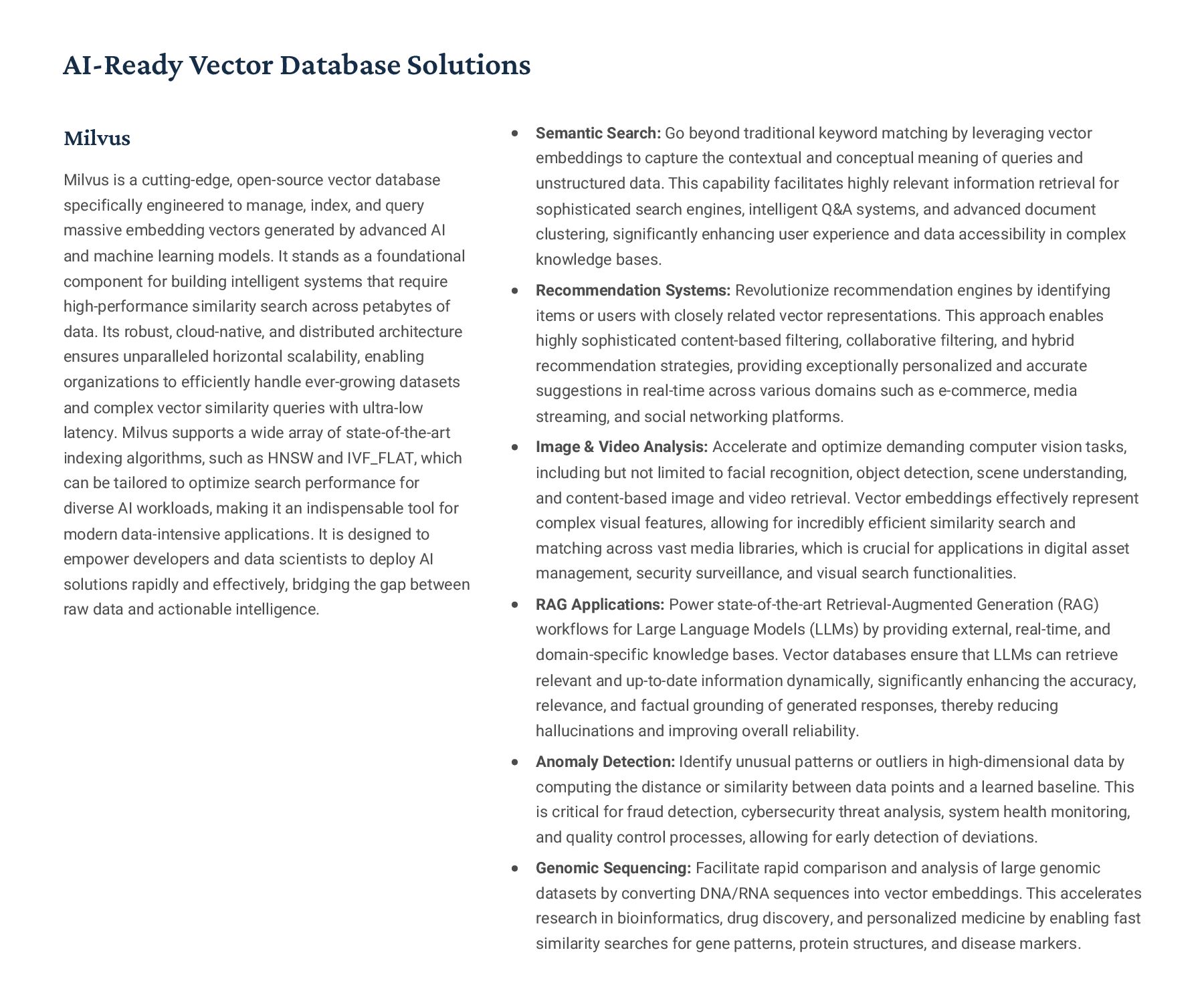
  7. AI-Ready Vector Database Solutions Milvus Milvus is a cutting-edge, open-source

    vector database specifically engineered to manage, index, and query massive embedding vectors generated by advanced AI and machine learning models. It stands as a foundational component for building intelligent systems that require high-performance similarity search across petabytes of data. Its robust, cloud-native, and distributed architecture ensures unparalleled horizontal scalability, enabling organizations to efficiently handle ever-growing datasets and complex vector similarity queries with ultra-low latency. Milvus supports a wide array of state-of-the-art indexing algorithms, such as HNSW and IVF_FLAT, which can be tailored to optimize search performance for diverse AI workloads, making it an indispensable tool for modern data-intensive applications. It is designed to empower developers and data scientists to deploy AI solutions rapidly and effectively, bridging the gap between raw data and actionable intelligence. Semantic Search: Go beyond traditional keyword matching by leveraging vector embeddings to capture the contextual and conceptual meaning of queries and unstructured data. This capability facilitates highly relevant information retrieval for sophisticated search engines, intelligent Q&A systems, and advanced document clustering, significantly enhancing user experience and data accessibility in complex knowledge bases. Recommendation Systems: Revolutionize recommendation engines by identifying items or users with closely related vector representations. This approach enables highly sophisticated content-based filtering, collaborative filtering, and hybrid recommendation strategies, providing exceptionally personalized and accurate suggestions in real-time across various domains such as e-commerce, media streaming, and social networking platforms. Image & Video Analysis: Accelerate and optimize demanding computer vision tasks, including but not limited to facial recognition, object detection, scene understanding, and content-based image and video retrieval. Vector embeddings effectively represent complex visual features, allowing for incredibly efficient similarity search and matching across vast media libraries, which is crucial for applications in digital asset management, security surveillance, and visual search functionalities. RAG Applications: Power state-of-the-art Retrieval-Augmented Generation (RAG) workflows for Large Language Models (LLMs) by providing external, real-time, and domain-specific knowledge bases. Vector databases ensure that LLMs can retrieve relevant and up-to-date information dynamically, significantly enhancing the accuracy, relevance, and factual grounding of generated responses, thereby reducing hallucinations and improving overall reliability. Anomaly Detection: Identify unusual patterns or outliers in high-dimensional data by computing the distance or similarity between data points and a learned baseline. This is critical for fraud detection, cybersecurity threat analysis, system health monitoring, and quality control processes, allowing for early detection of deviations. Genomic Sequencing: Facilitate rapid comparison and analysis of large genomic datasets by converting DNA/RNA sequences into vector embeddings. This accelerates research in bioinformatics, drug discovery, and personalized medicine by enabling fast similarity searches for gene patterns, protein structures, and disease markers.
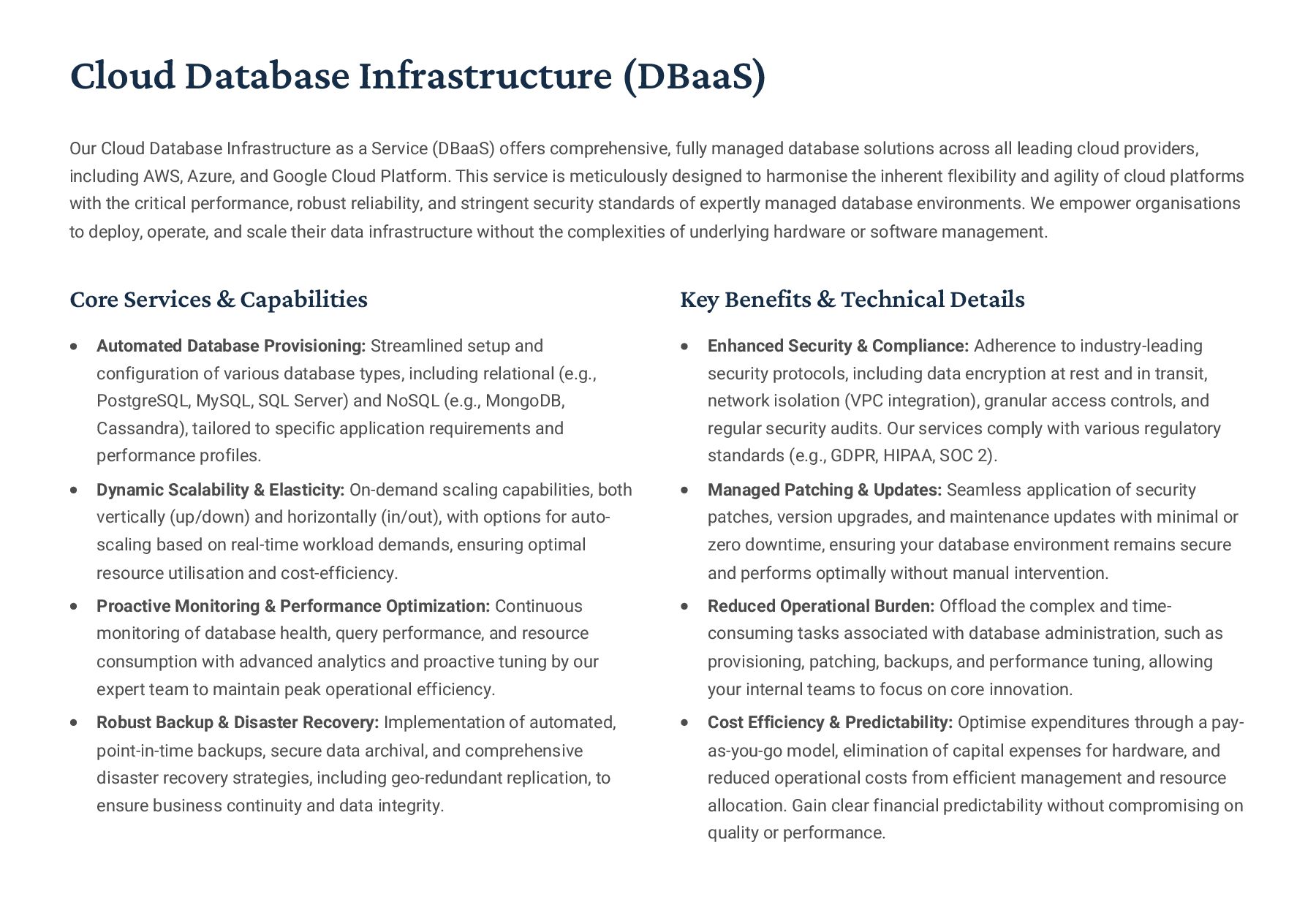
  8. Cloud Database Infrastructure (DBaaS) Our Cloud Database Infrastructure as a

    Service (DBaaS) offers comprehensive, fully managed database solutions across all leading cloud providers, including AWS, Azure, and Google Cloud Platform. This service is meticulously designed to harmonise the inherent flexibility and agility of cloud platforms with the critical performance, robust reliability, and stringent security standards of expertly managed database environments. We empower organisations to deploy, operate, and scale their data infrastructure without the complexities of underlying hardware or software management. Core Services & Capabilities Automated Database Provisioning: Streamlined setup and configuration of various database types, including relational (e.g., PostgreSQL, MySQL, SQL Server) and NoSQL (e.g., MongoDB, Cassandra), tailored to specific application requirements and performance profiles. Dynamic Scalability & Elasticity: On-demand scaling capabilities, both vertically (up/down) and horizontally (in/out), with options for auto- scaling based on real-time workload demands, ensuring optimal resource utilisation and cost-efficiency. Proactive Monitoring & Performance Optimization: Continuous monitoring of database health, query performance, and resource consumption with advanced analytics and proactive tuning by our expert team to maintain peak operational efficiency. Robust Backup & Disaster Recovery: Implementation of automated, point-in-time backups, secure data archival, and comprehensive disaster recovery strategies, including geo-redundant replication, to ensure business continuity and data integrity. Key Benefits & Technical Details Enhanced Security & Compliance: Adherence to industry-leading security protocols, including data encryption at rest and in transit, network isolation (VPC integration), granular access controls, and regular security audits. Our services comply with various regulatory standards (e.g., GDPR, HIPAA, SOC 2). Managed Patching & Updates: Seamless application of security patches, version upgrades, and maintenance updates with minimal or zero downtime, ensuring your database environment remains secure and performs optimally without manual intervention. Reduced Operational Burden: Offload the complex and time- consuming tasks associated with database administration, such as provisioning, patching, backups, and performance tuning, allowing your internal teams to focus on core innovation. Cost Efficiency & Predictability: Optimise expenditures through a pay- as-you-go model, elimination of capital expenses for hardware, and reduced operational costs from efficient management and resource allocation. Gain clear financial predictability without compromising on quality or performance.
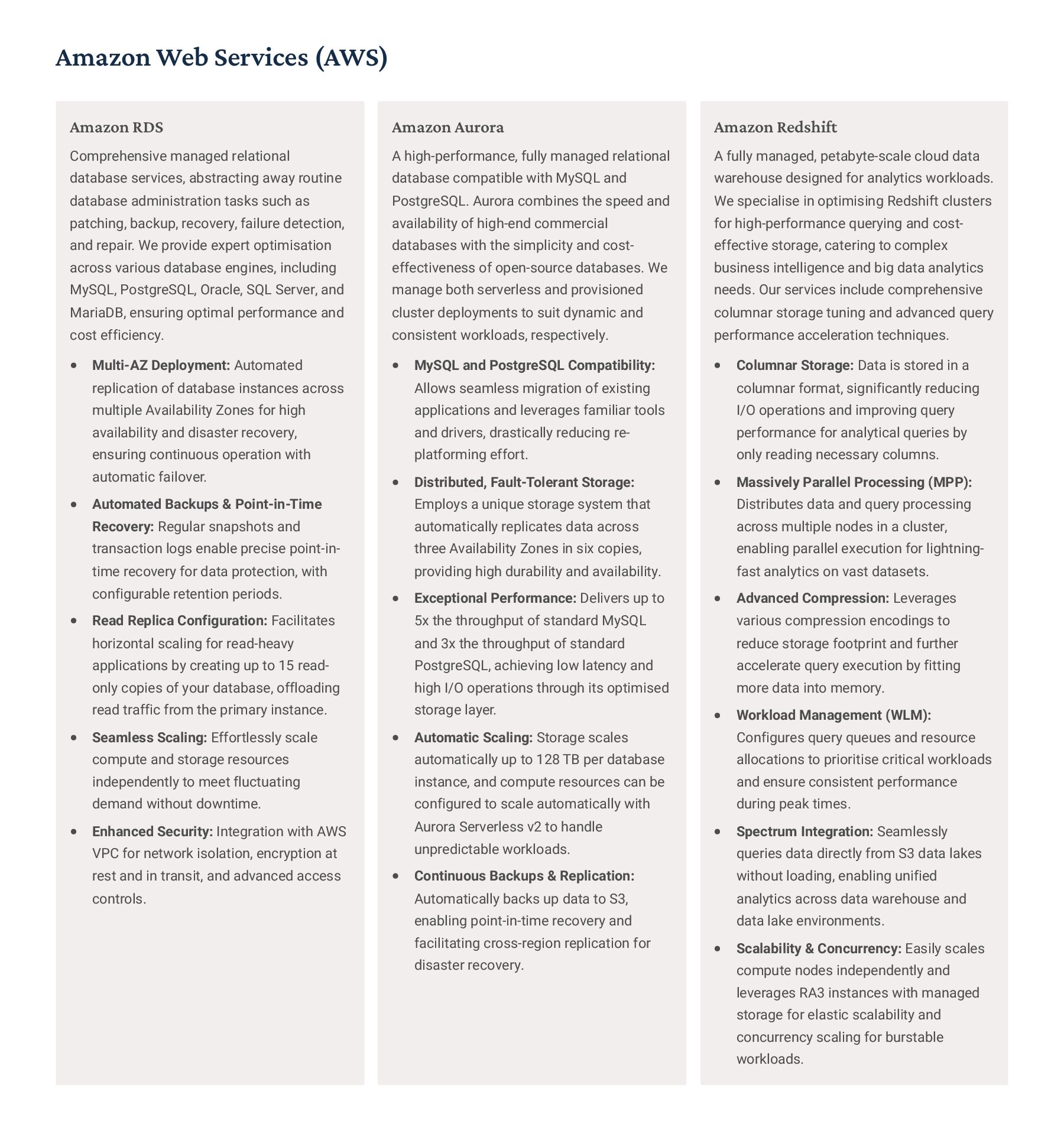
  9. Amazon Web Services (AWS) Amazon RDS Comprehensive managed relational database

    services, abstracting away routine database administration tasks such as patching, backup, recovery, failure detection, and repair. We provide expert optimisation across various database engines, including MySQL, PostgreSQL, Oracle, SQL Server, and MariaDB, ensuring optimal performance and cost efficiency. Multi-AZ Deployment: Automated replication of database instances across multiple Availability Zones for high availability and disaster recovery, ensuring continuous operation with automatic failover. Automated Backups & Point-in-Time Recovery: Regular snapshots and transaction logs enable precise point-in- time recovery for data protection, with configurable retention periods. Read Replica Configuration: Facilitates horizontal scaling for read-heavy applications by creating up to 15 read- only copies of your database, offloading read traffic from the primary instance. Seamless Scaling: Effortlessly scale compute and storage resources independently to meet fluctuating demand without downtime. Enhanced Security: Integration with AWS VPC for network isolation, encryption at rest and in transit, and advanced access controls. Amazon Aurora A high-performance, fully managed relational database compatible with MySQL and PostgreSQL. Aurora combines the speed and availability of high-end commercial databases with the simplicity and cost- effectiveness of open-source databases. We manage both serverless and provisioned cluster deployments to suit dynamic and consistent workloads, respectively. MySQL and PostgreSQL Compatibility: Allows seamless migration of existing applications and leverages familiar tools and drivers, drastically reducing re- platforming effort. Distributed, Fault-Tolerant Storage: Employs a unique storage system that automatically replicates data across three Availability Zones in six copies, providing high durability and availability. Exceptional Performance: Delivers up to 5x the throughput of standard MySQL and 3x the throughput of standard PostgreSQL, achieving low latency and high I/O operations through its optimised storage layer. Automatic Scaling: Storage scales automatically up to 128 TB per database instance, and compute resources can be configured to scale automatically with Aurora Serverless v2 to handle unpredictable workloads. Continuous Backups & Replication: Automatically backs up data to S3, enabling point-in-time recovery and facilitating cross-region replication for disaster recovery. Amazon Redshift A fully managed, petabyte-scale cloud data warehouse designed for analytics workloads. We specialise in optimising Redshift clusters for high-performance querying and cost- effective storage, catering to complex business intelligence and big data analytics needs. Our services include comprehensive columnar storage tuning and advanced query performance acceleration techniques. Columnar Storage: Data is stored in a columnar format, significantly reducing I/O operations and improving query performance for analytical queries by only reading necessary columns. Massively Parallel Processing (MPP): Distributes data and query processing across multiple nodes in a cluster, enabling parallel execution for lightning- fast analytics on vast datasets. Advanced Compression: Leverages various compression encodings to reduce storage footprint and further accelerate query execution by fitting more data into memory. Workload Management (WLM): Configures query queues and resource allocations to prioritise critical workloads and ensure consistent performance during peak times. Spectrum Integration: Seamlessly queries data directly from S3 data lakes without loading, enabling unified analytics across data warehouse and data lake environments. Scalability & Concurrency: Easily scales compute nodes independently and leverages RA3 instances with managed storage for elastic scalability and concurrency scaling for burstable workloads.
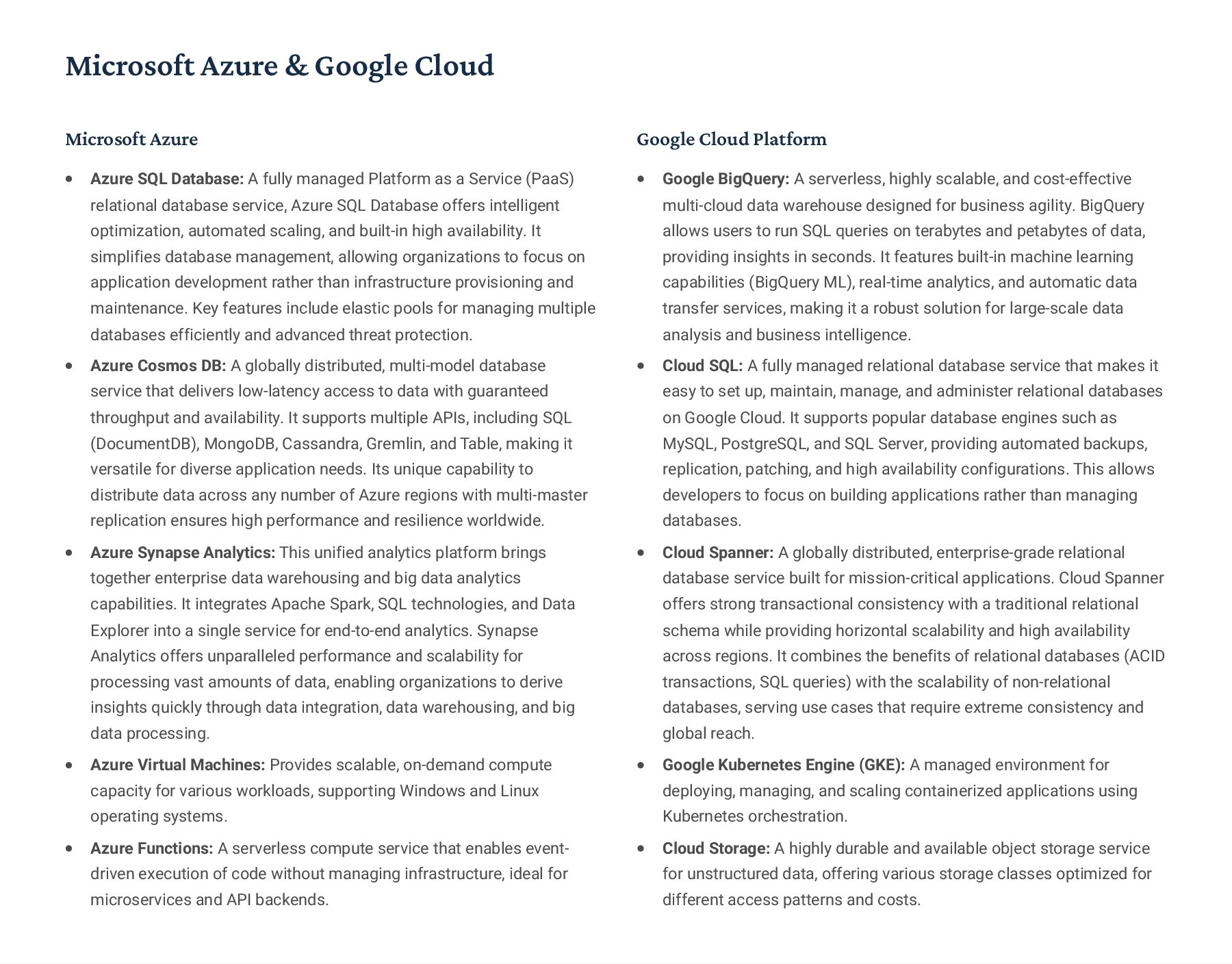
  10. Microsoft Azure & Google Cloud Microsoft Azure Azure SQL Database:

    A fully managed Platform as a Service (PaaS) relational database service, Azure SQL Database offers intelligent optimization, automated scaling, and built-in high availability. It simplifies database management, allowing organizations to focus on application development rather than infrastructure provisioning and maintenance. Key features include elastic pools for managing multiple databases efficiently and advanced threat protection. Azure Cosmos DB: A globally distributed, multi-model database service that delivers low-latency access to data with guaranteed throughput and availability. It supports multiple APIs, including SQL (DocumentDB), MongoDB, Cassandra, Gremlin, and Table, making it versatile for diverse application needs. Its unique capability to distribute data across any number of Azure regions with multi-master replication ensures high performance and resilience worldwide. Azure Synapse Analytics: This unified analytics platform brings together enterprise data warehousing and big data analytics capabilities. It integrates Apache Spark, SQL technologies, and Data Explorer into a single service for end-to-end analytics. Synapse Analytics offers unparalleled performance and scalability for processing vast amounts of data, enabling organizations to derive insights quickly through data integration, data warehousing, and big data processing. Azure Virtual Machines: Provides scalable, on-demand compute capacity for various workloads, supporting Windows and Linux operating systems. Azure Functions: A serverless compute service that enables event- driven execution of code without managing infrastructure, ideal for microservices and API backends. Google Cloud Platform Google BigQuery: A serverless, highly scalable, and cost-effective multi-cloud data warehouse designed for business agility. BigQuery allows users to run SQL queries on terabytes and petabytes of data, providing insights in seconds. It features built-in machine learning capabilities (BigQuery ML), real-time analytics, and automatic data transfer services, making it a robust solution for large-scale data analysis and business intelligence. Cloud SQL: A fully managed relational database service that makes it easy to set up, maintain, manage, and administer relational databases on Google Cloud. It supports popular database engines such as MySQL, PostgreSQL, and SQL Server, providing automated backups, replication, patching, and high availability configurations. This allows developers to focus on building applications rather than managing databases. Cloud Spanner: A globally distributed, enterprise-grade relational database service built for mission-critical applications. Cloud Spanner offers strong transactional consistency with a traditional relational schema while providing horizontal scalability and high availability across regions. It combines the benefits of relational databases (ACID transactions, SQL queries) with the scalability of non-relational databases, serving use cases that require extreme consistency and global reach. Google Kubernetes Engine (GKE): A managed environment for deploying, managing, and scaling containerized applications using Kubernetes orchestration. Cloud Storage: A highly durable and available object storage service for unstructured data, offering various storage classes optimized for different access patterns and costs.
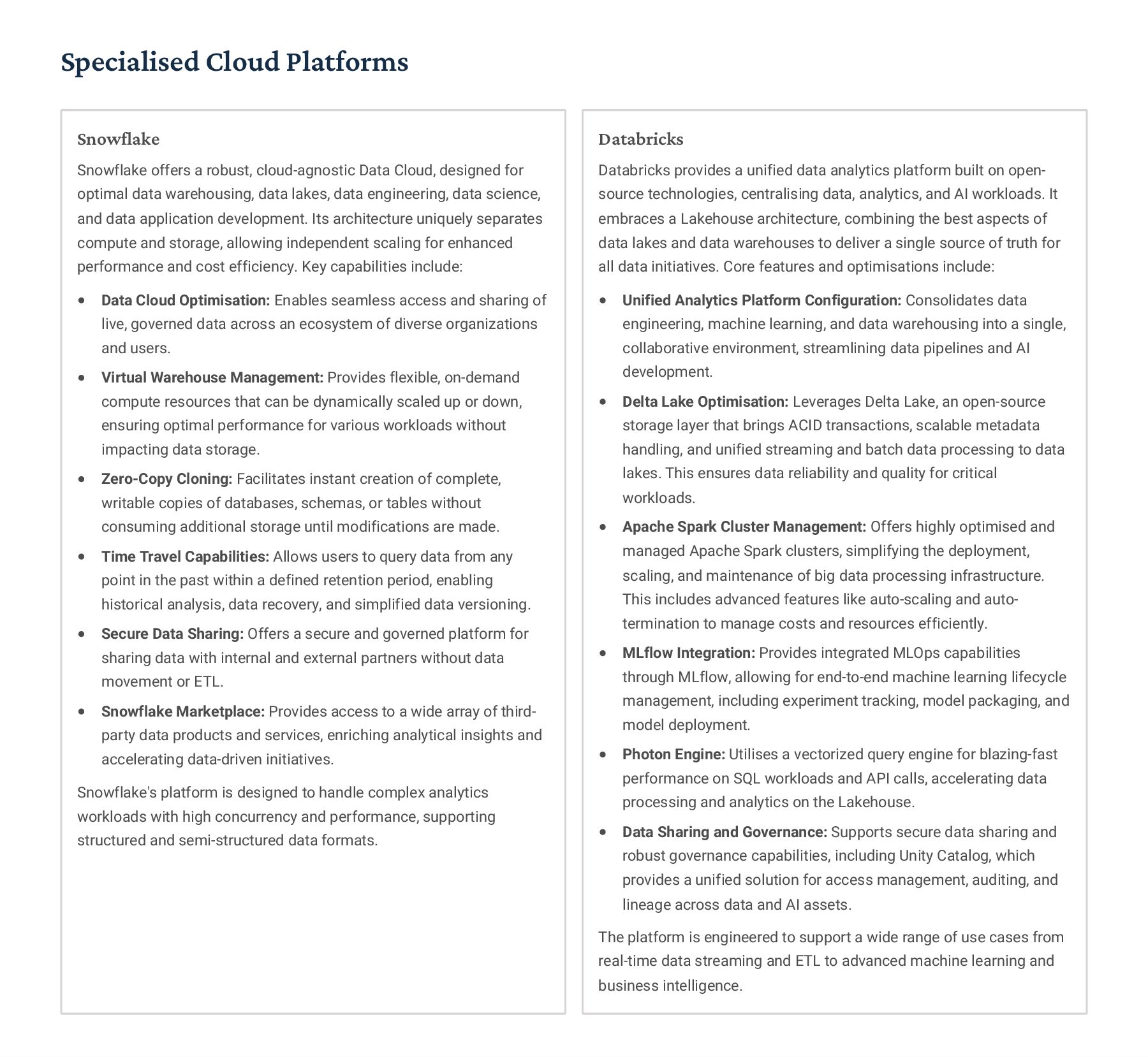
  11. Specialised Cloud Platforms Snowflake Snowflake offers a robust, cloud-agnostic Data

    Cloud, designed for optimal data warehousing, data lakes, data engineering, data science, and data application development. Its architecture uniquely separates compute and storage, allowing independent scaling for enhanced performance and cost efficiency. Key capabilities include: Data Cloud Optimisation: Enables seamless access and sharing of live, governed data across an ecosystem of diverse organizations and users. Virtual Warehouse Management: Provides flexible, on-demand compute resources that can be dynamically scaled up or down, ensuring optimal performance for various workloads without impacting data storage. Zero-Copy Cloning: Facilitates instant creation of complete, writable copies of databases, schemas, or tables without consuming additional storage until modifications are made. Time Travel Capabilities: Allows users to query data from any point in the past within a defined retention period, enabling historical analysis, data recovery, and simplified data versioning. Secure Data Sharing: Offers a secure and governed platform for sharing data with internal and external partners without data movement or ETL. Snowflake Marketplace: Provides access to a wide array of third- party data products and services, enriching analytical insights and accelerating data-driven initiatives. Snowflake's platform is designed to handle complex analytics workloads with high concurrency and performance, supporting structured and semi-structured data formats. Databricks Databricks provides a unified data analytics platform built on open- source technologies, centralising data, analytics, and AI workloads. It embraces a Lakehouse architecture, combining the best aspects of data lakes and data warehouses to deliver a single source of truth for all data initiatives. Core features and optimisations include: Unified Analytics Platform Configuration: Consolidates data engineering, machine learning, and data warehousing into a single, collaborative environment, streamlining data pipelines and AI development. Delta Lake Optimisation: Leverages Delta Lake, an open-source storage layer that brings ACID transactions, scalable metadata handling, and unified streaming and batch data processing to data lakes. This ensures data reliability and quality for critical workloads. Apache Spark Cluster Management: Offers highly optimised and managed Apache Spark clusters, simplifying the deployment, scaling, and maintenance of big data processing infrastructure. This includes advanced features like auto-scaling and auto- termination to manage costs and resources efficiently. MLflow Integration: Provides integrated MLOps capabilities through MLflow, allowing for end-to-end machine learning lifecycle management, including experiment tracking, model packaging, and model deployment. Photon Engine: Utilises a vectorized query engine for blazing-fast performance on SQL workloads and API calls, accelerating data processing and analytics on the Lakehouse. Data Sharing and Governance: Supports secure data sharing and robust governance capabilities, including Unity Catalog, which provides a unified solution for access management, auditing, and lineage across data and AI assets. The platform is engineered to support a wide range of use cases from real-time data streaming and ETL to advanced machine learning and business intelligence.
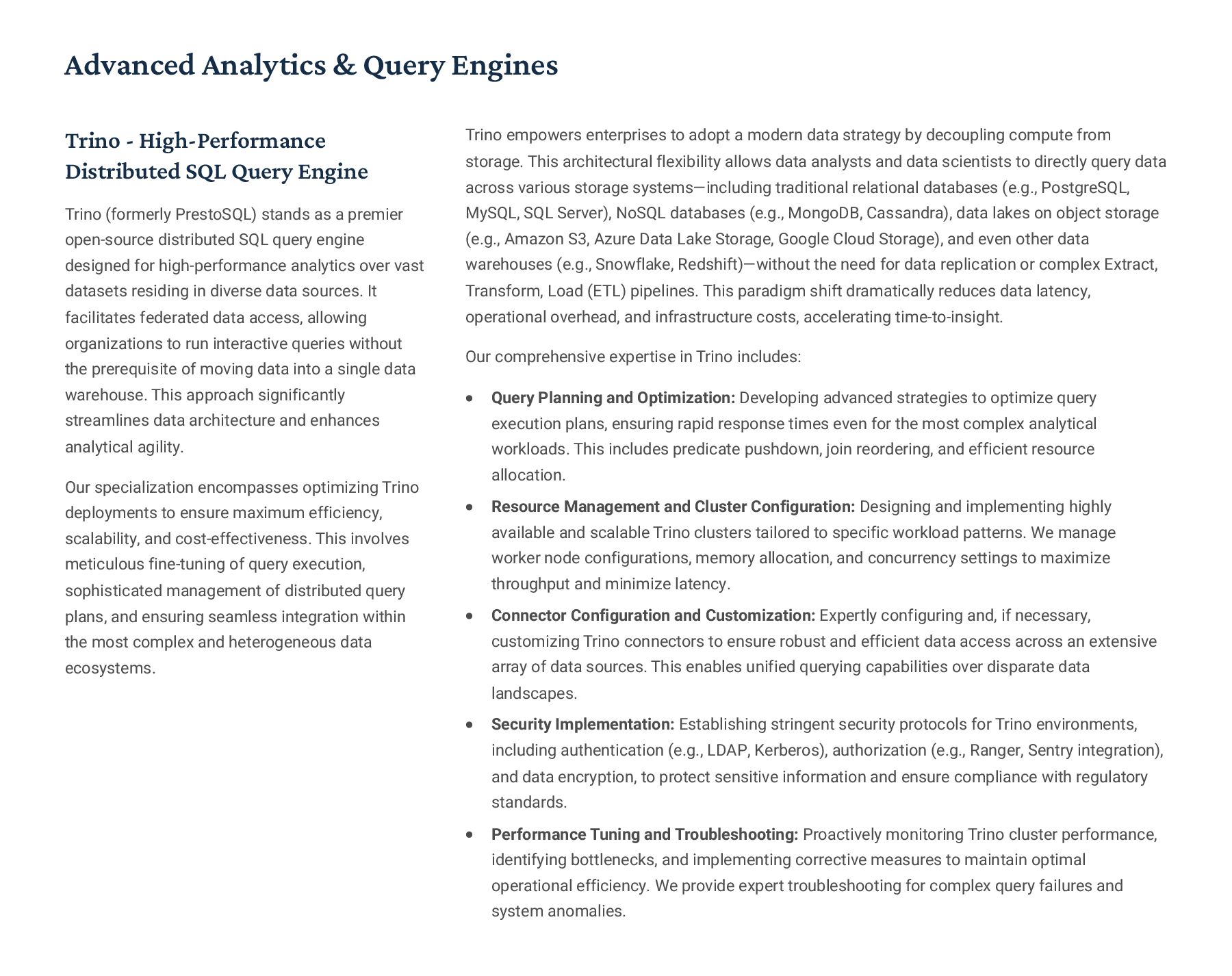
  12. Advanced Analytics & Query Engines Trino - High-Performance Distributed SQL

    Query Engine Trino (formerly PrestoSQL) stands as a premier open-source distributed SQL query engine designed for high-performance analytics over vast datasets residing in diverse data sources. It facilitates federated data access, allowing organizations to run interactive queries without the prerequisite of moving data into a single data warehouse. This approach significantly streamlines data architecture and enhances analytical agility. Our specialization encompasses optimizing Trino deployments to ensure maximum efficiency, scalability, and cost-effectiveness. This involves meticulous fine-tuning of query execution, sophisticated management of distributed query plans, and ensuring seamless integration within the most complex and heterogeneous data ecosystems. Trino empowers enterprises to adopt a modern data strategy by decoupling compute from storage. This architectural flexibility allows data analysts and data scientists to directly query data across various storage systems4including traditional relational databases (e.g., PostgreSQL, MySQL, SQL Server), NoSQL databases (e.g., MongoDB, Cassandra), data lakes on object storage (e.g., Amazon S3, Azure Data Lake Storage, Google Cloud Storage), and even other data warehouses (e.g., Snowflake, Redshift)4without the need for data replication or complex Extract, Transform, Load (ETL) pipelines. This paradigm shift dramatically reduces data latency, operational overhead, and infrastructure costs, accelerating time-to-insight. Our comprehensive expertise in Trino includes: Query Planning and Optimization: Developing advanced strategies to optimize query execution plans, ensuring rapid response times even for the most complex analytical workloads. This includes predicate pushdown, join reordering, and efficient resource allocation. Resource Management and Cluster Configuration: Designing and implementing highly available and scalable Trino clusters tailored to specific workload patterns. We manage worker node configurations, memory allocation, and concurrency settings to maximize throughput and minimize latency. Connector Configuration and Customization: Expertly configuring and, if necessary, customizing Trino connectors to ensure robust and efficient data access across an extensive array of data sources. This enables unified querying capabilities over disparate data landscapes. Security Implementation: Establishing stringent security protocols for Trino environments, including authentication (e.g., LDAP, Kerberos), authorization (e.g., Ranger, Sentry integration), and data encryption, to protect sensitive information and ensure compliance with regulatory standards. Performance Tuning and Troubleshooting: Proactively monitoring Trino cluster performance, identifying bottlenecks, and implementing corrective measures to maintain optimal operational efficiency. We provide expert troubleshooting for complex query failures and system anomalies.
  13. Industry-Proven Experience Our team of highly skilled database consultants possesses

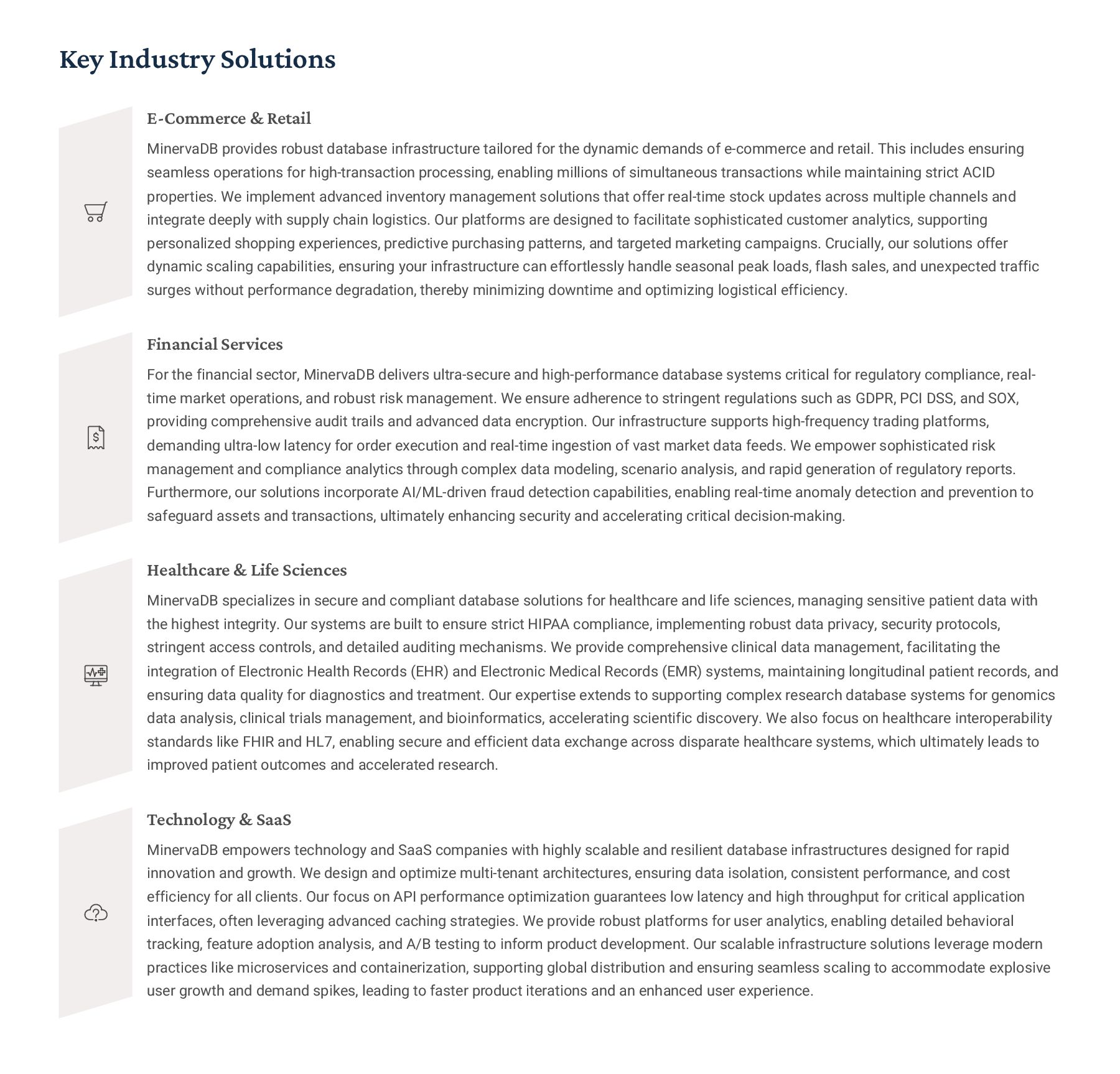
    a profound and extensive track record in architecting, optimizing, and managing web-scale database infrastructure. This expertise spans across a multitude of diverse industries and geographic regions worldwide, enabling us to tackle even the most complex data challenges. We specialize in designing robust, scalable, and high-performance database systems that are capable of handling immense volumes of data, millions of concurrent users, and critical real-time transactional workloads. Our architectural prowess ensures not just operational efficiency and resilience, but also the agility required to adapt to rapidly evolving business demands. We meticulously focus on aspects such as high availability, disaster recovery, stringent security protocols, and optimal query performance to guarantee uninterrupted service and data integrity. A cornerstone of our approach is a deep understanding of the unique operational challenges, regulatory requirements, and strategic imperatives inherent to each specific vertical. Whether it's the stringent compliance and transactional velocity of the financial sector, the peak load management and personalized customer experiences crucial for e-commerce platforms, the vast data privacy and analytical needs of healthcare, or the real-time data ingestion and processing demanded by IoT and telecommunications, we possess the insights to craft solutions that are not merely generic but intrinsically tailored. By leveraging this nuanced understanding, we consistently deliver bespoke database solutions that are precisely aligned with your business objectives. These tailored strategies encompass everything from strategic database selection (SQL, NoSQL, NewSQL, Graph, etc.) and sophisticated schema design to performance tuning, cloud migration, and comprehensive data governance frameworks. Ultimately, our interventions are designed to unlock significant value, translating directly into enhanced operational efficiency, faster time-to-insight through advanced analytics, minimized downtime, a superior customer experience, and a definitive competitive advantage in your marketplace.
  14. Verticals We Serve Content Delivery Networks We specialize in architecting

    and optimizing high-performance data distribution systems designed to support millions of concurrent users globally. Our expertise ensures ultra-low latency data delivery, critical for seamless user experiences across various digital platforms. This includes: Designing resilient, geographically distributed database clusters. Implementing advanced caching mechanisms and content invalidation strategies. Optimizing data replication for global edge deployment, ensuring content availability and speed. Managing large-scale traffic surges and maintaining consistent service levels during peak demand. Mobile Advertising Networks Our consultants possess deep knowledge in building robust database infrastructures for mobile advertising. This encompasses sophisticated real-time bidding (RTB) infrastructure, ensuring millisecond response times, and comprehensive impression tracking and click-stream analytics capabilities. We focus on: Developing scalable systems for ingesting and processing massive volumes of ad event data. Implementing advanced analytics for granular campaign performance optimization, maximizing ROI for advertisers. Ensuring data integrity and security for sensitive user and advertising data. Facilitating seamless integration with demand-side platforms (DSPs) and supply-side platforms (SSPs). E-Commerce Platforms For e-commerce, we deliver robust database solutions that manage high- volume transaction processing, intricate inventory management across multiple warehouses, and sophisticated customer data platforms. Our designs also power advanced recommendation engines, all while efficiently handling: Extreme peak loads during seasonal sales events and promotional periods without performance degradation. Secure and compliant storage of sensitive payment and customer information. Real-time product availability updates and dynamic pricing adjustments. Personalization features through data-driven insights to enhance the shopping experience. Social Media Applications We provide expertise in managing the complex data ecosystems of social media platforms. This includes designing scalable solutions for extensive user data management, efficient content delivery pipelines, and the development of high-performance social graph databases. Our focus is on: Enabling real-time feed generation and content moderation for billions of daily interactions. Ensuring data consistency and availability across highly distributed systems. Implementing robust privacy controls and compliance measures for user data. Facilitating rapid retrieval and analysis of vast datasets for trend identification and user engagement strategies. Software as a Service Our consultants are adept at architecting multi-tenant database solutions tailored for SaaS growth. We focus on providing secure data isolation strategies, optimizing API performance to ensure responsive applications, and building highly scalable infrastructure. Key areas of our service include: Designing flexible database schemas to support diverse client requirements within a single application instance. Implementing robust security protocols for data segregation and access control. Optimizing query performance and database indexing for rapid data retrieval. Enabling seamless scaling to accommodate growing user bases and expanding feature sets, supporting continuous integration and deployment. Gaming Industry We support the demanding requirements of the gaming industry with specialized database solutions for real-time data processing, comprehensive player statistics tracking, and dynamic leaderboard management. Our services extend to: Designing resilient systems for in-game economy management and virtual asset tracking. Leveraging advanced user analytics to understand player behavior and drive engagement. Ensuring low-latency data access for millions of concurrent players to maintain competitive gameplay. Implementing anti-cheat mechanisms and fraud detection to preserve game integrity and fairness.
  15. Financial Services & Digital Payments Digital Payment Solutions We specialize

    in architecting and implementing robust digital payment solutions that ensure secure, efficient, and compliant financial transactions. This encompasses sophisticated secure transaction processing mechanisms utilizing advanced encryption protocols and tokenization to protect sensitive customer data at every stage. Our systems integrate state-of-the- art fraud detection systems powered by machine learning algorithms and behavioral analytics, designed to identify and mitigate fraudulent activities in real-time. Furthermore, we provide comprehensive compliance management frameworks, ensuring adherence to stringent global and regional financial regulations such as PCI DSS, GDPR, PSD2, and SOX, critical for payment gateways, neobanks, and various financial technology platforms. Our solutions are built for unparalleled scalability, capable of handling millions of transactions during peak loads while maintaining ultra-low latency. Our expertise extends to integrating with diverse banking systems and payment networks, facilitating seamless fund transfers and payment orchestration. We offer tailored solutions for various financial products, including mobile wallets, cross-border payments, peer-to-peer transfers, and merchant services, all designed with a focus on reliability, security, and user experience. Key Capabilities PCI DSS Compliance & Data Security: We ensure full adherence to Payment Card Industry Data Security Standard (PCI DSS) requirements through robust data encryption (AES-256), tokenization of cardholder data, secure network configurations, and regular vulnerability assessments and penetration testing. Our solutions implement comprehensive data integrity checks and strict access controls to safeguard all sensitive financial information. High-Frequency Transaction Processing: Engineered for extreme efficiency, our platforms support high-volume, low-latency transaction processing, achieving throughputs of thousands of transactions per second. We leverage distributed architectures and optimized database technologies to manage rapid micro-transactions and large batch processes without performance degradation, crucial for competitive financial markets. Real-time Fraud Detection & Prevention: Deploying AI-driven anomaly detection, machine learning models, and complex rule-based engines, our systems provide instantaneous fraud scoring and prevention capabilities. This includes behavioral biometrics, geospatial analysis, and transaction pattern recognition to identify and block suspicious activities before they impact the financial ecosystem, minimizing false positives while maximizing security. Audit Trails & Regulatory Reporting: We implement immutable audit trails for all financial activities, providing detailed, time-stamped records that are crucial for forensic analysis and regulatory scrutiny. Automated reporting tools generate comprehensive reports for compliance with Anti-Money Laundering (AML), Know Your Customer (KYC), and other relevant financial regulations, streamlining audit processes and ensuring transparency. Geographic Redundancy & Business Continuity: To guarantee uninterrupted service, our payment systems are deployed across multiple geographically dispersed data centers with active-active configurations. This ensures high availability, disaster recovery capabilities, and seamless failover, minimizing downtime and ensuring business continuity even under extreme conditions. Scalable API Integration & Orchestration: We provide well-documented, high- performance APIs for seamless integration with third-party services, banking partners, and internal systems. Our solutions include powerful payment orchestration layers that intelligently route transactions, optimize processing fees, and enhance conversion rates. Custom Risk Management Frameworks: Development of bespoke risk assessment and management tools, including configurable risk scoring models and automated decision-making engines, tailored to the unique risk appetite and operational requirements of financial institutions.
  16. 24/7 Global Database Support Services Round-the-Clock Monitoring & Support Our

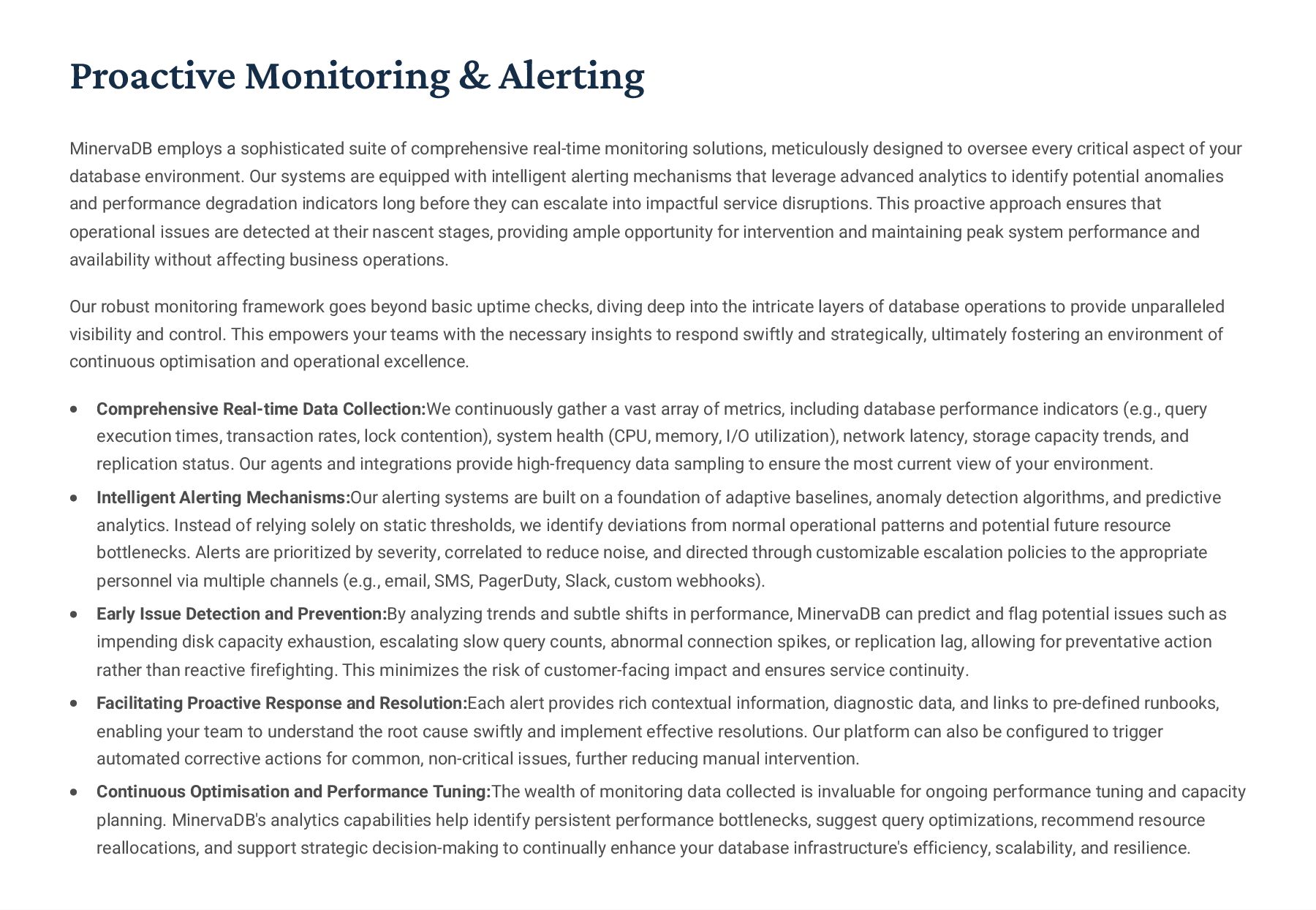
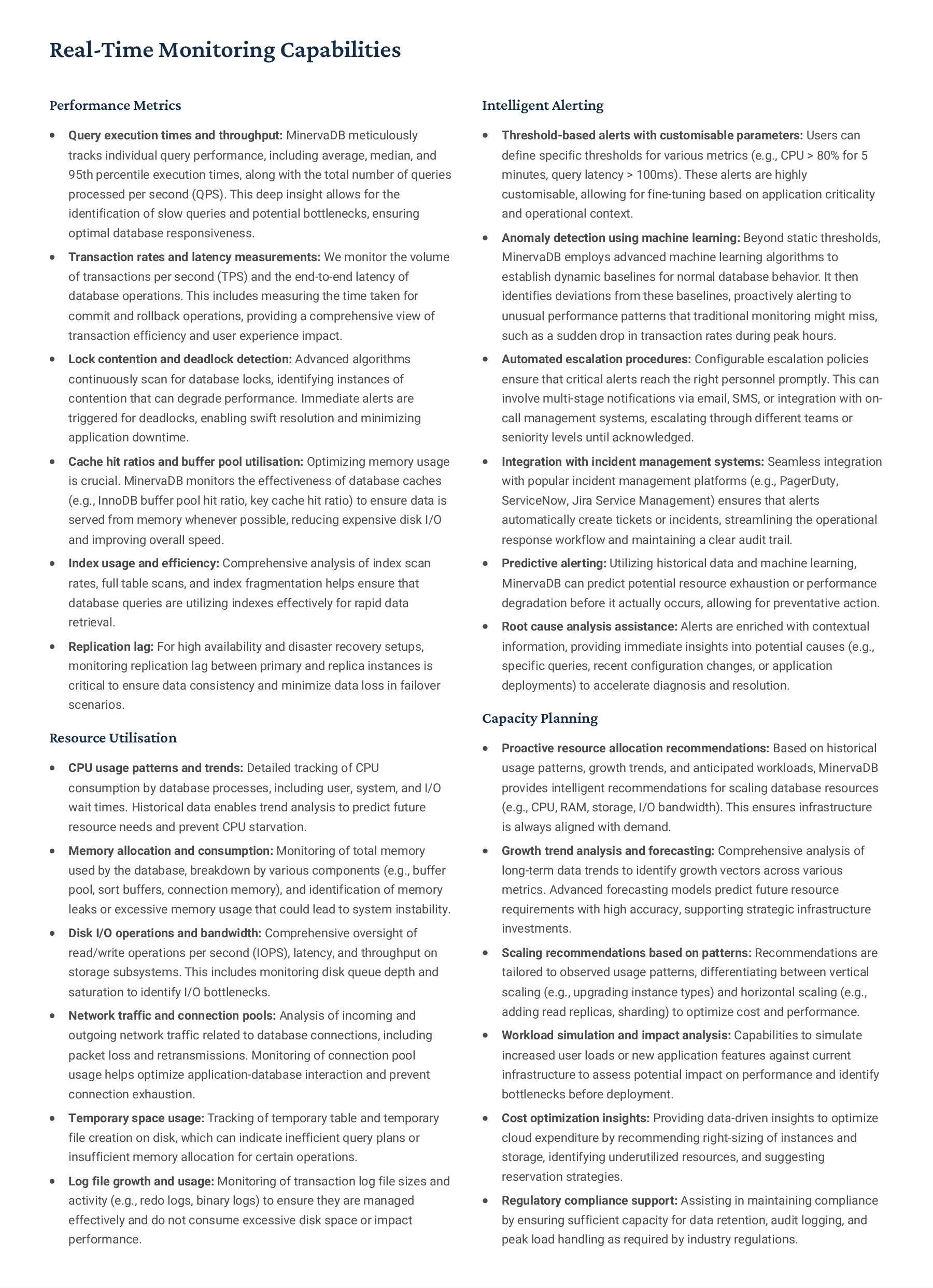
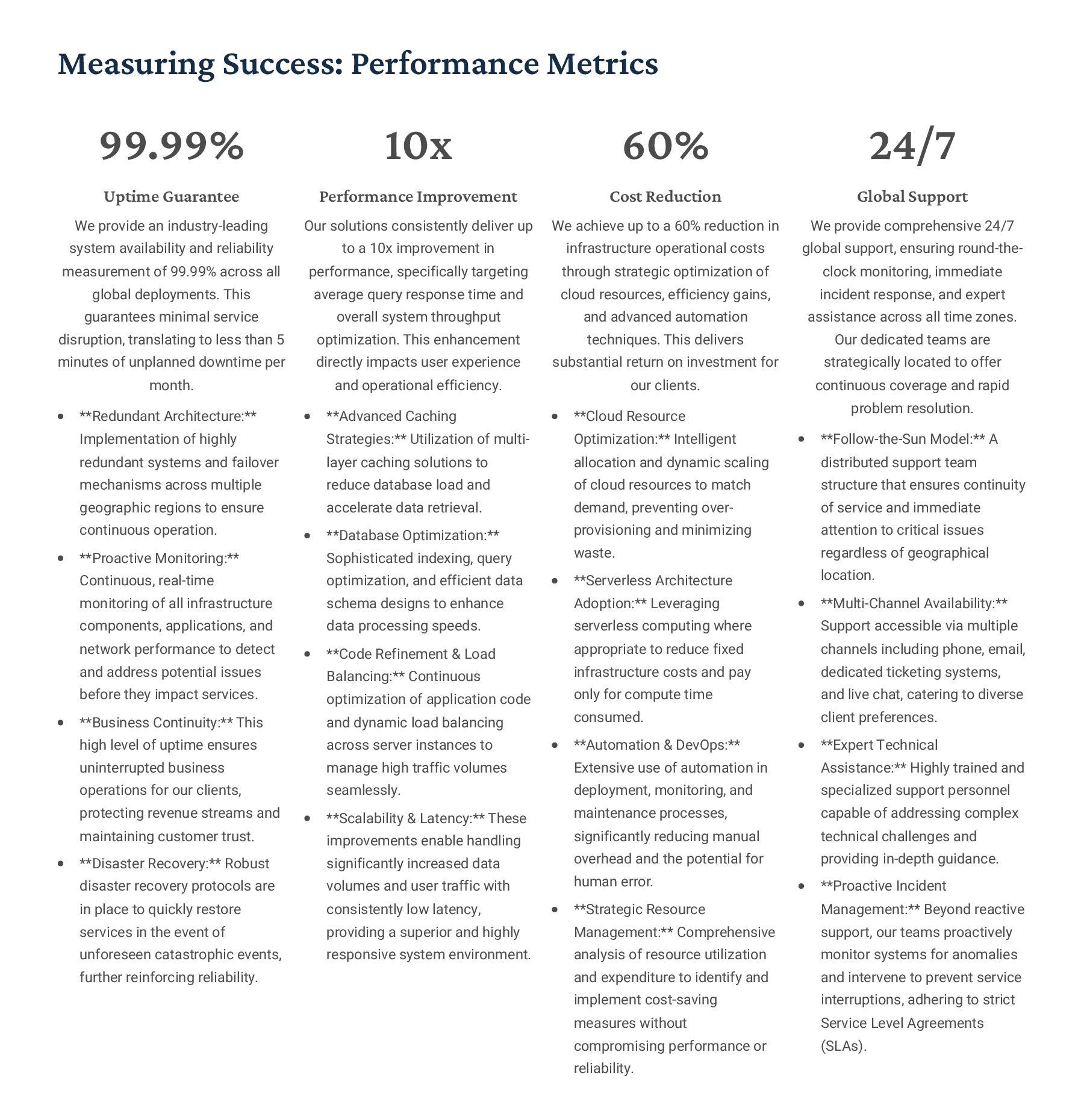
    globally distributed team operates across multiple time zones, leveraging a "follow-the-sun" model to ensure uninterrupted, continuous database infrastructure monitoring and support. This strategic staffing approach guarantees that expert assistance is always available, regardless of your geographical location or operational hours. We don't just react to problems; we proactively identify and resolve potential issues before they can escalate and impact your critical business operations, ensuring maximum uptime and optimal performance. We deliver enterprise-class service with the personalized attention to detail of a boutique provider, tailoring our solutions to meet your unique operational requirements and strategic objectives. Comprehensive Monitoring and Alerting Our advanced monitoring systems utilize a suite of industry-leading tools combined with proprietary scripts to collect real-time performance metrics, health indicators, and security logs from your database environments. This comprehensive data collection enables us to establish sophisticated baselines and anomaly detection algorithms. Any deviations from established thresholds or patterns automatically trigger alerts to our engineers, often indicating nascent issues such as: Impending storage capacity limits Spikes in query execution times Abnormal resource consumption (CPU, memory, I/O) Replication lag or synchronization errors Security vulnerabilities or unauthorized access attempts This proactive alerting mechanism allows our team to investigate and mitigate risks well before they impact end-users or business continuity. Advanced Incident Management and Resolution Upon detection of an anomaly or alert, our certified database administrators (DBAs) initiate a structured incident response protocol. This includes immediate triage, in-depth root cause analysis, and the rapid deployment of corrective measures. Our expertise spans a wide array of database technologies, including but not limited to, Oracle, SQL Server, MySQL, PostgreSQL, MongoDB, and Cassandra. We are adept at handling complex performance tuning, disaster recovery planning and execution, data migration, and high-availability configuration. Our commitment extends beyond simple fixes; we strive for permanent resolutions and provide detailed post-incident reports with recommendations to prevent recurrence. Key Benefits of Partnering with Us Maximization of database uptime and availability, reducing costly service interruptions. Enhanced database performance through continuous optimization and proactive tuning. Robust data security and compliance adherence with industry best practices and regulatory requirements. Reduced operational overhead and staffing costs by leveraging our specialized expertise. Access to a global pool of expert DBAs with diverse skill sets and experience. Predictable operational expenses through flexible service level agreements (SLAs). Strategic guidance on database architecture, scaling, and technology adoption. Increased business agility and responsiveness, allowing your internal teams to focus on core innovation.
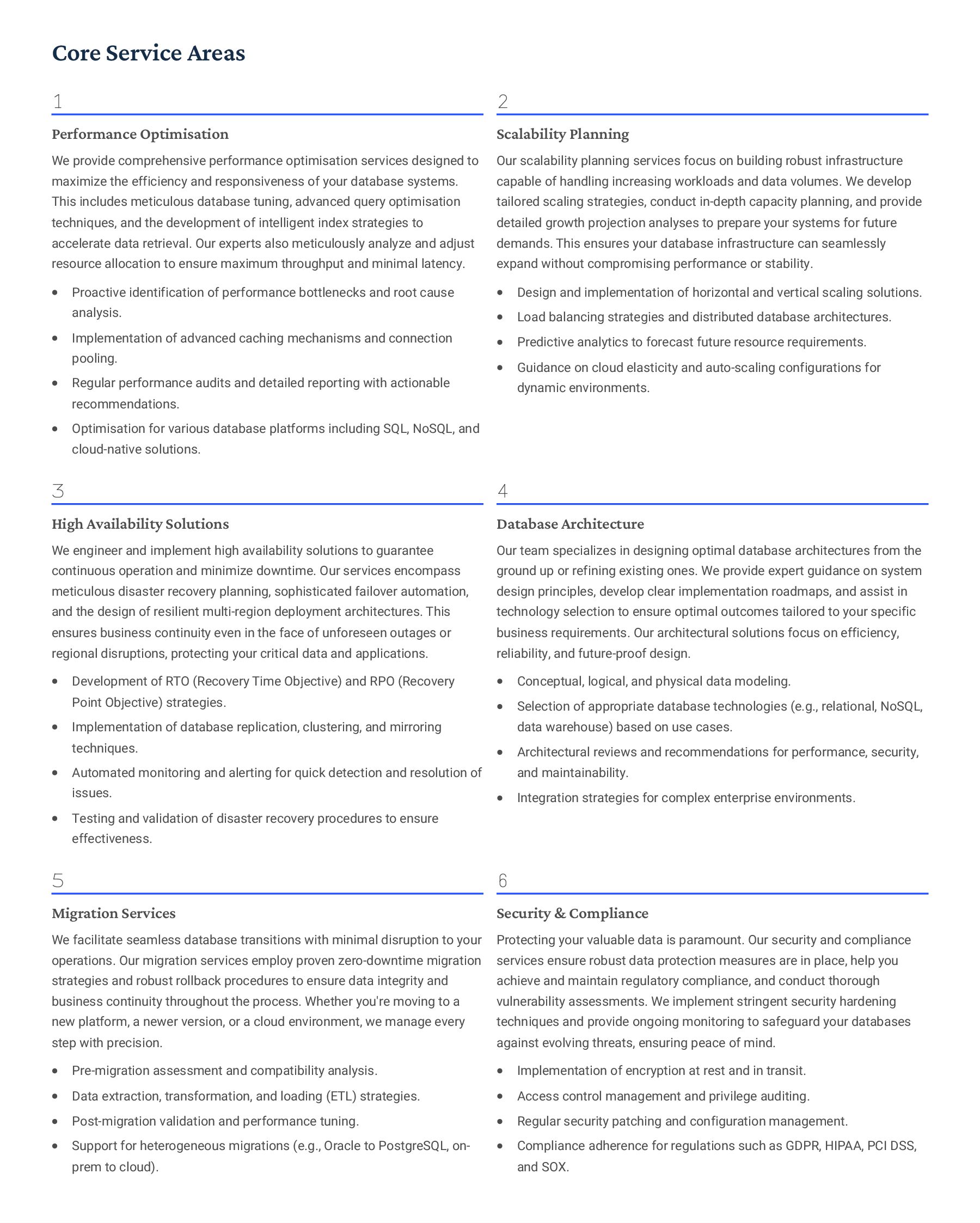
  17. Core Service Areas Performance Optimisation We provide comprehensive performance optimisation

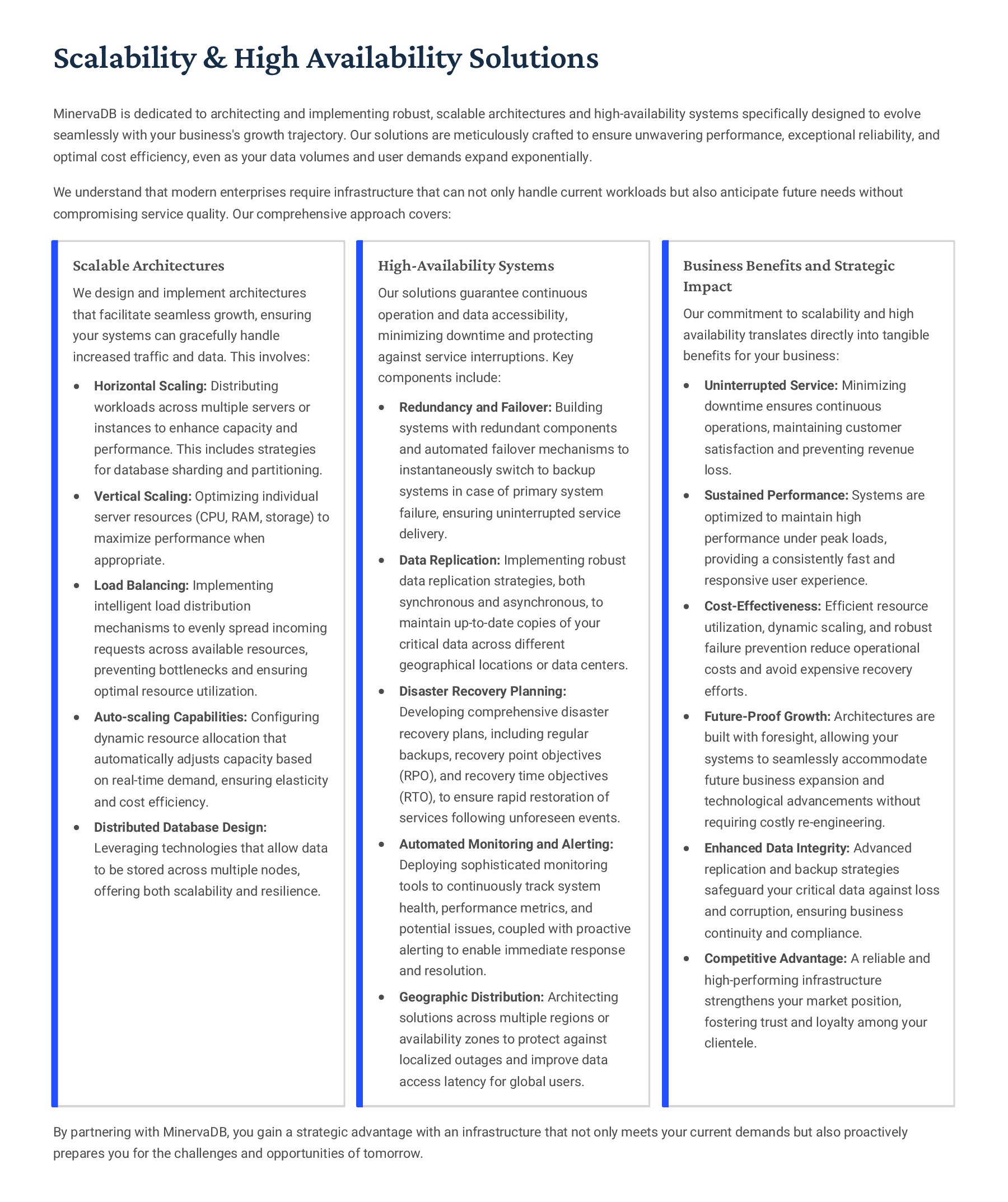
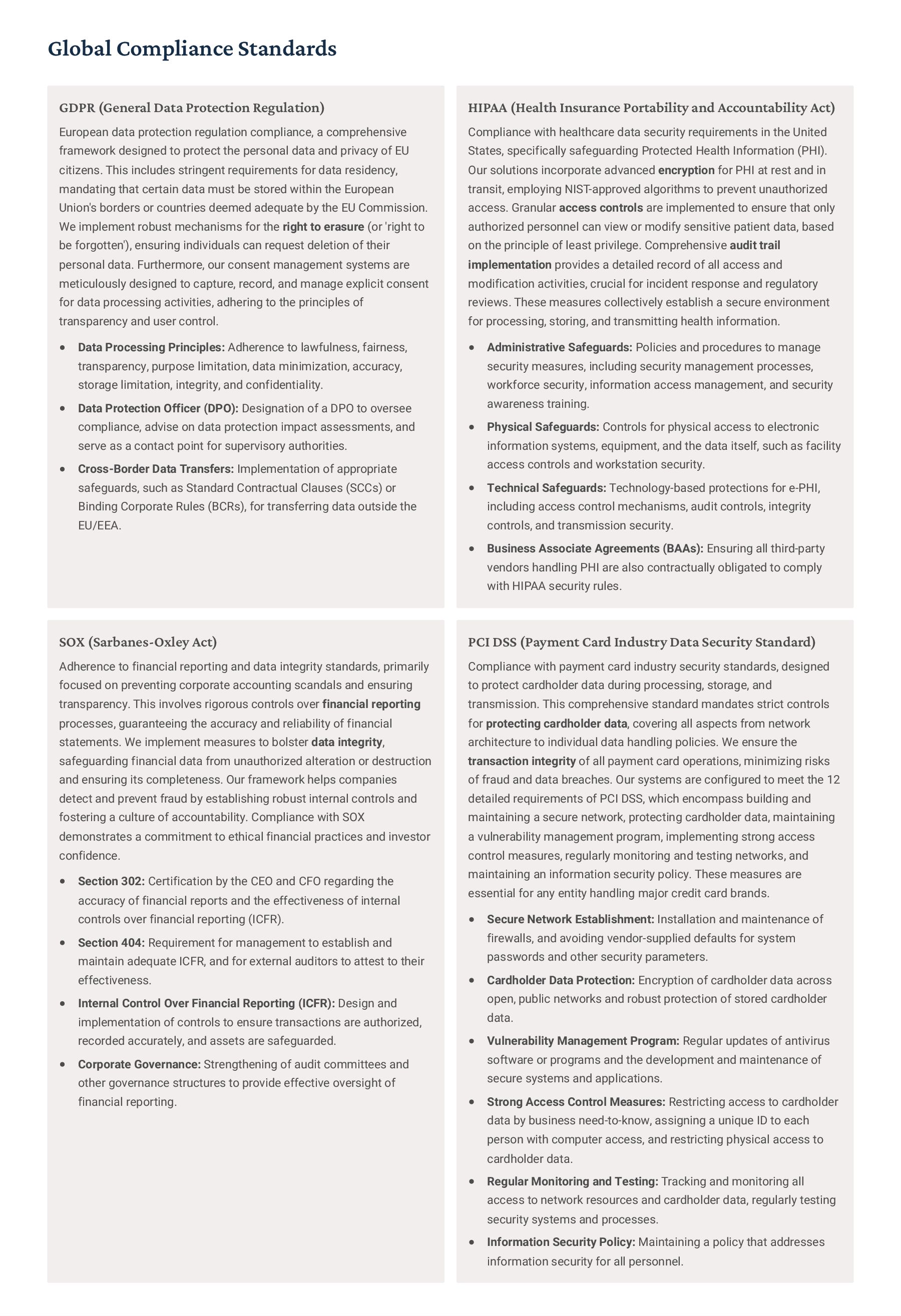
    services designed to maximize the efficiency and responsiveness of your database systems. This includes meticulous database tuning, advanced query optimisation techniques, and the development of intelligent index strategies to accelerate data retrieval. Our experts also meticulously analyze and adjust resource allocation to ensure maximum throughput and minimal latency. Proactive identification of performance bottlenecks and root cause analysis. Implementation of advanced caching mechanisms and connection pooling. Regular performance audits and detailed reporting with actionable recommendations. Optimisation for various database platforms including SQL, NoSQL, and cloud-native solutions. Scalability Planning Our scalability planning services focus on building robust infrastructure capable of handling increasing workloads and data volumes. We develop tailored scaling strategies, conduct in-depth capacity planning, and provide detailed growth projection analyses to prepare your systems for future demands. This ensures your database infrastructure can seamlessly expand without compromising performance or stability. Design and implementation of horizontal and vertical scaling solutions. Load balancing strategies and distributed database architectures. Predictive analytics to forecast future resource requirements. Guidance on cloud elasticity and auto-scaling configurations for dynamic environments. High Availability Solutions We engineer and implement high availability solutions to guarantee continuous operation and minimize downtime. Our services encompass meticulous disaster recovery planning, sophisticated failover automation, and the design of resilient multi-region deployment architectures. This ensures business continuity even in the face of unforeseen outages or regional disruptions, protecting your critical data and applications. Development of RTO (Recovery Time Objective) and RPO (Recovery Point Objective) strategies. Implementation of database replication, clustering, and mirroring techniques. Automated monitoring and alerting for quick detection and resolution of issues. Testing and validation of disaster recovery procedures to ensure effectiveness. Database Architecture Our team specializes in designing optimal database architectures from the ground up or refining existing ones. We provide expert guidance on system design principles, develop clear implementation roadmaps, and assist in technology selection to ensure optimal outcomes tailored to your specific business requirements. Our architectural solutions focus on efficiency, reliability, and future-proof design. Conceptual, logical, and physical data modeling. Selection of appropriate database technologies (e.g., relational, NoSQL, data warehouse) based on use cases. Architectural reviews and recommendations for performance, security, and maintainability. Integration strategies for complex enterprise environments. Migration Services We facilitate seamless database transitions with minimal disruption to your operations. Our migration services employ proven zero-downtime migration strategies and robust rollback procedures to ensure data integrity and business continuity throughout the process. Whether you're moving to a new platform, a newer version, or a cloud environment, we manage every step with precision. Pre-migration assessment and compatibility analysis. Data extraction, transformation, and loading (ETL) strategies. Post-migration validation and performance tuning. Support for heterogeneous migrations (e.g., Oracle to PostgreSQL, on- prem to cloud). Security & Compliance Protecting your valuable data is paramount. Our security and compliance services ensure robust data protection measures are in place, help you achieve and maintain regulatory compliance, and conduct thorough vulnerability assessments. We implement stringent security hardening techniques and provide ongoing monitoring to safeguard your databases against evolving threats, ensuring peace of mind. Implementation of encryption at rest and in transit. Access control management and privilege auditing. Regular security patching and configuration management. Compliance adherence for regulations such as GDPR, HIPAA, PCI DSS, and SOX.
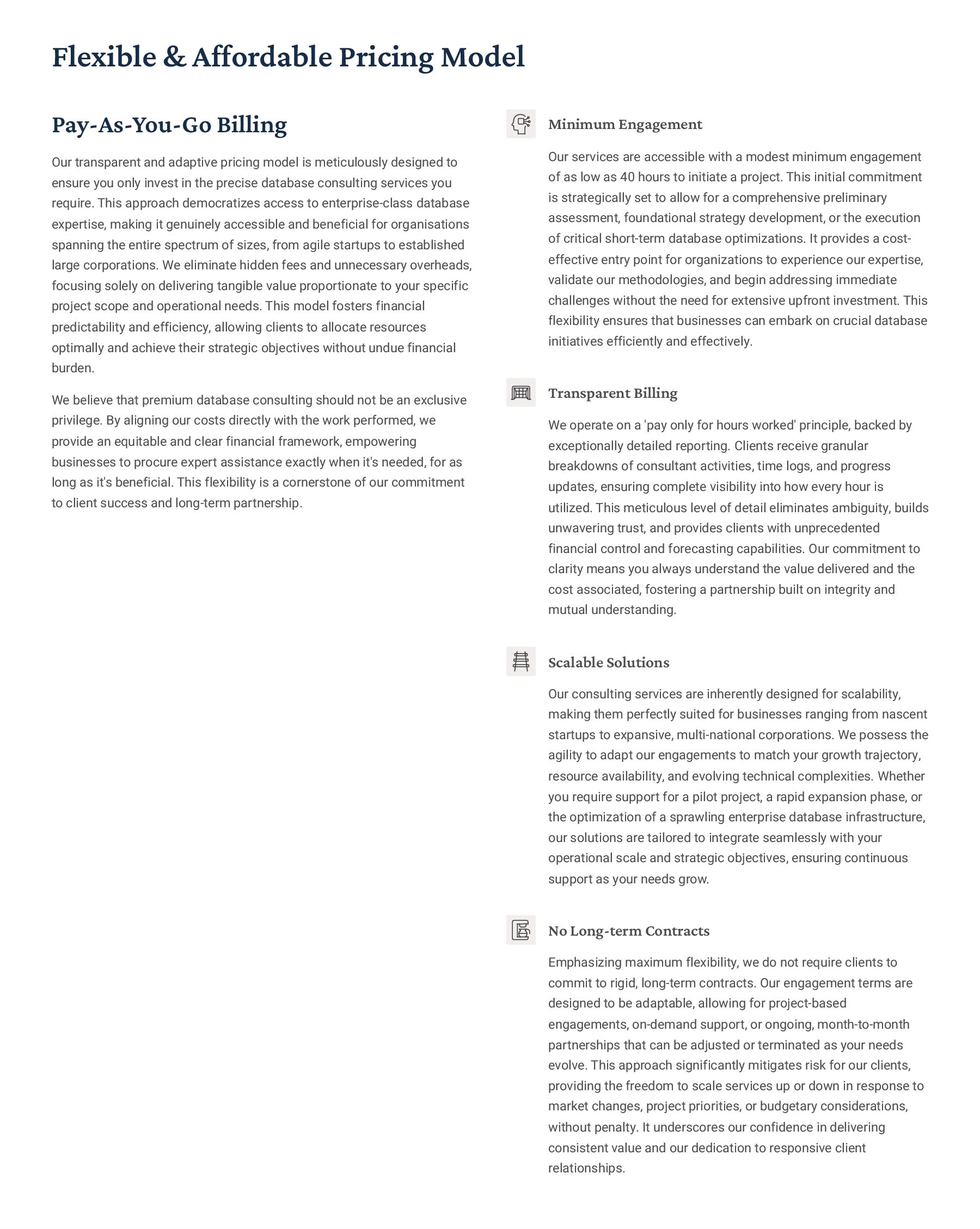
  18. Flexible & Affordable Pricing Model Pay-As-You-Go Billing Our transparent and

    adaptive pricing model is meticulously designed to ensure you only invest in the precise database consulting services you require. This approach democratizes access to enterprise-class database expertise, making it genuinely accessible and beneficial for organisations spanning the entire spectrum of sizes, from agile startups to established large corporations. We eliminate hidden fees and unnecessary overheads, focusing solely on delivering tangible value proportionate to your specific project scope and operational needs. This model fosters financial predictability and efficiency, allowing clients to allocate resources optimally and achieve their strategic objectives without undue financial burden. We believe that premium database consulting should not be an exclusive privilege. By aligning our costs directly with the work performed, we provide an equitable and clear financial framework, empowering businesses to procure expert assistance exactly when it's needed, for as long as it's beneficial. This flexibility is a cornerstone of our commitment to client success and long-term partnership. Minimum Engagement Our services are accessible with a modest minimum engagement of as low as 40 hours to initiate a project. This initial commitment is strategically set to allow for a comprehensive preliminary assessment, foundational strategy development, or the execution of critical short-term database optimizations. It provides a cost- effective entry point for organizations to experience our expertise, validate our methodologies, and begin addressing immediate challenges without the need for extensive upfront investment. This flexibility ensures that businesses can embark on crucial database initiatives efficiently and effectively. Transparent Billing We operate on a 'pay only for hours worked' principle, backed by exceptionally detailed reporting. Clients receive granular breakdowns of consultant activities, time logs, and progress updates, ensuring complete visibility into how every hour is utilized. This meticulous level of detail eliminates ambiguity, builds unwavering trust, and provides clients with unprecedented financial control and forecasting capabilities. Our commitment to clarity means you always understand the value delivered and the cost associated, fostering a partnership built on integrity and mutual understanding. Scalable Solutions Our consulting services are inherently designed for scalability, making them perfectly suited for businesses ranging from nascent startups to expansive, multi-national corporations. We possess the agility to adapt our engagements to match your growth trajectory, resource availability, and evolving technical complexities. Whether you require support for a pilot project, a rapid expansion phase, or the optimization of a sprawling enterprise database infrastructure, our solutions are tailored to integrate seamlessly with your operational scale and strategic objectives, ensuring continuous support as your needs grow. No Long-term Contracts Emphasizing maximum flexibility, we do not require clients to commit to rigid, long-term contracts. Our engagement terms are designed to be adaptable, allowing for project-based engagements, on-demand support, or ongoing, month-to-month partnerships that can be adjusted or terminated as your needs evolve. This approach significantly mitigates risk for our clients, providing the freedom to scale services up or down in response to market changes, project priorities, or budgetary considerations, without penalty. It underscores our confidence in delivering consistent value and our dedication to responsive client relationships.
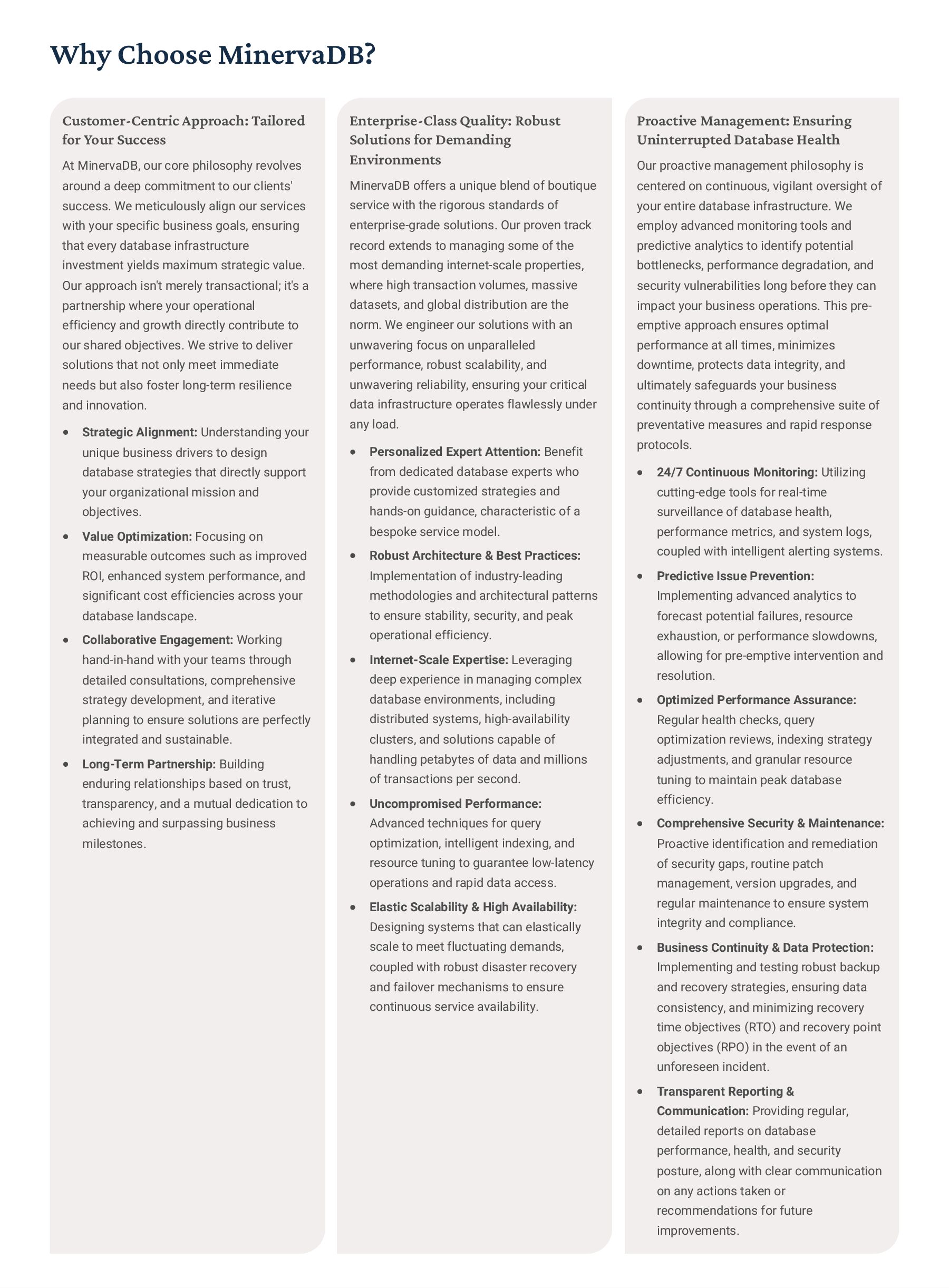
  19. Why Choose MinervaDB? Customer-Centric Approach: Tailored for Your Success At

    MinervaDB, our core philosophy revolves around a deep commitment to our clients' success. We meticulously align our services with your specific business goals, ensuring that every database infrastructure investment yields maximum strategic value. Our approach isn't merely transactional; it's a partnership where your operational efficiency and growth directly contribute to our shared objectives. We strive to deliver solutions that not only meet immediate needs but also foster long-term resilience and innovation. Strategic Alignment: Understanding your unique business drivers to design database strategies that directly support your organizational mission and objectives. Value Optimization: Focusing on measurable outcomes such as improved ROI, enhanced system performance, and significant cost efficiencies across your database landscape. Collaborative Engagement: Working hand-in-hand with your teams through detailed consultations, comprehensive strategy development, and iterative planning to ensure solutions are perfectly integrated and sustainable. Long-Term Partnership: Building enduring relationships based on trust, transparency, and a mutual dedication to achieving and surpassing business milestones. Enterprise-Class Quality: Robust Solutions for Demanding Environments MinervaDB offers a unique blend of boutique service with the rigorous standards of enterprise-grade solutions. Our proven track record extends to managing some of the most demanding internet-scale properties, where high transaction volumes, massive datasets, and global distribution are the norm. We engineer our solutions with an unwavering focus on unparalleled performance, robust scalability, and unwavering reliability, ensuring your critical data infrastructure operates flawlessly under any load. Personalized Expert Attention: Benefit from dedicated database experts who provide customized strategies and hands-on guidance, characteristic of a bespoke service model. Robust Architecture & Best Practices: Implementation of industry-leading methodologies and architectural patterns to ensure stability, security, and peak operational efficiency. Internet-Scale Expertise: Leveraging deep experience in managing complex database environments, including distributed systems, high-availability clusters, and solutions capable of handling petabytes of data and millions of transactions per second. Uncompromised Performance: Advanced techniques for query optimization, intelligent indexing, and resource tuning to guarantee low-latency operations and rapid data access. Elastic Scalability & High Availability: Designing systems that can elastically scale to meet fluctuating demands, coupled with robust disaster recovery and failover mechanisms to ensure continuous service availability. Proactive Management: Ensuring Uninterrupted Database Health Our proactive management philosophy is centered on continuous, vigilant oversight of your entire database infrastructure. We employ advanced monitoring tools and predictive analytics to identify potential bottlenecks, performance degradation, and security vulnerabilities long before they can impact your business operations. This pre- emptive approach ensures optimal performance at all times, minimizes downtime, protects data integrity, and ultimately safeguards your business continuity through a comprehensive suite of preventative measures and rapid response protocols. 24/7 Continuous Monitoring: Utilizing cutting-edge tools for real-time surveillance of database health, performance metrics, and system logs, coupled with intelligent alerting systems. Predictive Issue Prevention: Implementing advanced analytics to forecast potential failures, resource exhaustion, or performance slowdowns, allowing for pre-emptive intervention and resolution. Optimized Performance Assurance: Regular health checks, query optimization reviews, indexing strategy adjustments, and granular resource tuning to maintain peak database efficiency. Comprehensive Security & Maintenance: Proactive identification and remediation of security gaps, routine patch management, version upgrades, and regular maintenance to ensure system integrity and compliance. Business Continuity & Data Protection: Implementing and testing robust backup and recovery strategies, ensuring data consistency, and minimizing recovery time objectives (RTO) and recovery point objectives (RPO) in the event of an unforeseen incident. Transparent Reporting & Communication: Providing regular, detailed reports on database performance, health, and security posture, along with clear communication on any actions taken or recommendations for future improvements.
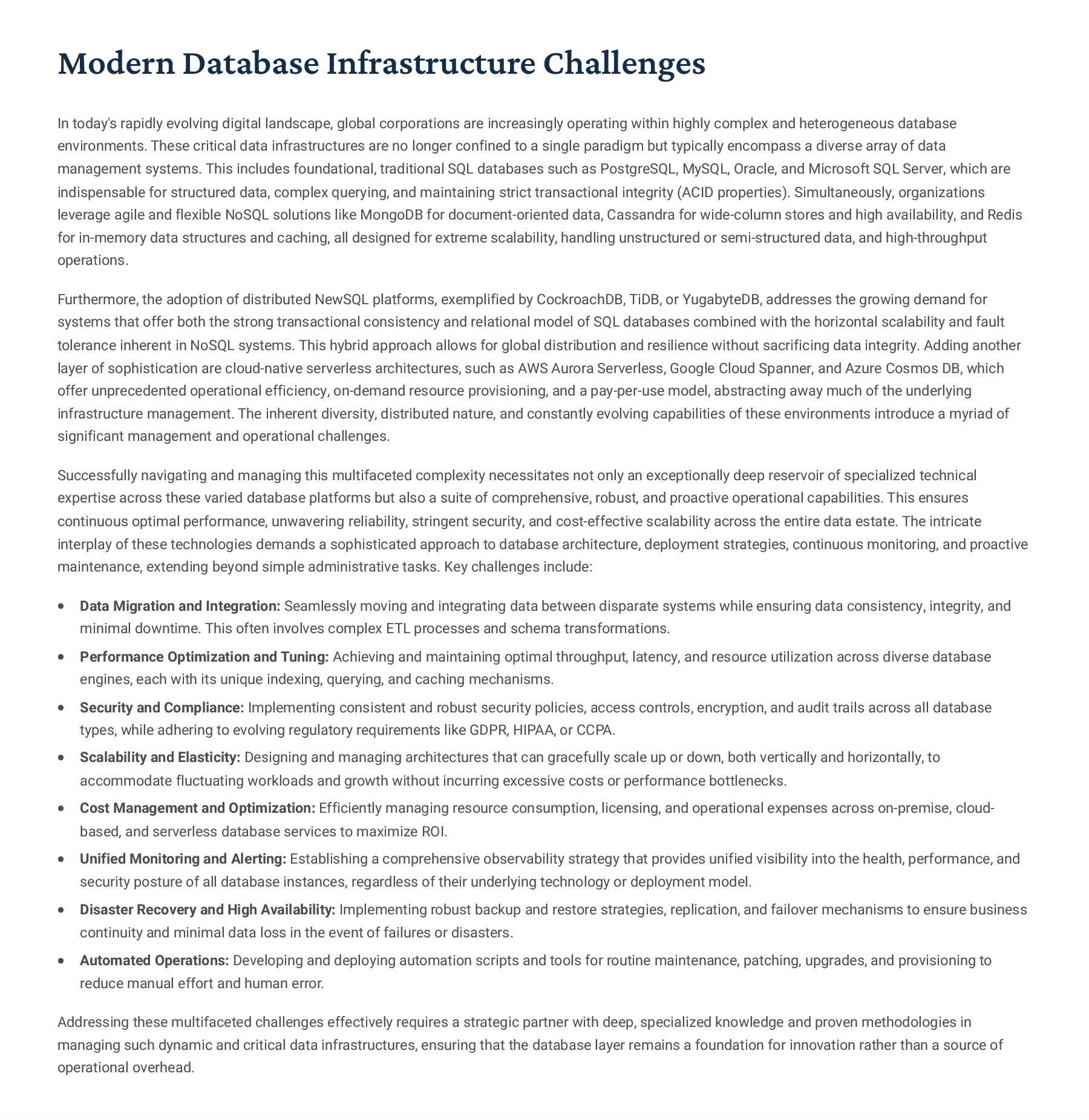
  20. Modern Database Infrastructure Challenges In today's rapidly evolving digital landscape,

    global corporations are increasingly operating within highly complex and heterogeneous database environments. These critical data infrastructures are no longer confined to a single paradigm but typically encompass a diverse array of data management systems. This includes foundational, traditional SQL databases such as PostgreSQL, MySQL, Oracle, and Microsoft SQL Server, which are indispensable for structured data, complex querying, and maintaining strict transactional integrity (ACID properties). Simultaneously, organizations leverage agile and flexible NoSQL solutions like MongoDB for document-oriented data, Cassandra for wide-column stores and high availability, and Redis for in-memory data structures and caching, all designed for extreme scalability, handling unstructured or semi-structured data, and high-throughput operations. Furthermore, the adoption of distributed NewSQL platforms, exemplified by CockroachDB, TiDB, or YugabyteDB, addresses the growing demand for systems that offer both the strong transactional consistency and relational model of SQL databases combined with the horizontal scalability and fault tolerance inherent in NoSQL systems. This hybrid approach allows for global distribution and resilience without sacrificing data integrity. Adding another layer of sophistication are cloud-native serverless architectures, such as AWS Aurora Serverless, Google Cloud Spanner, and Azure Cosmos DB, which offer unprecedented operational efficiency, on-demand resource provisioning, and a pay-per-use model, abstracting away much of the underlying infrastructure management. The inherent diversity, distributed nature, and constantly evolving capabilities of these environments introduce a myriad of significant management and operational challenges. Successfully navigating and managing this multifaceted complexity necessitates not only an exceptionally deep reservoir of specialized technical expertise across these varied database platforms but also a suite of comprehensive, robust, and proactive operational capabilities. This ensures continuous optimal performance, unwavering reliability, stringent security, and cost-effective scalability across the entire data estate. The intricate interplay of these technologies demands a sophisticated approach to database architecture, deployment strategies, continuous monitoring, and proactive maintenance, extending beyond simple administrative tasks. Key challenges include: Data Migration and Integration: Seamlessly moving and integrating data between disparate systems while ensuring data consistency, integrity, and minimal downtime. This often involves complex ETL processes and schema transformations. Performance Optimization and Tuning: Achieving and maintaining optimal throughput, latency, and resource utilization across diverse database engines, each with its unique indexing, querying, and caching mechanisms. Security and Compliance: Implementing consistent and robust security policies, access controls, encryption, and audit trails across all database types, while adhering to evolving regulatory requirements like GDPR, HIPAA, or CCPA. Scalability and Elasticity: Designing and managing architectures that can gracefully scale up or down, both vertically and horizontally, to accommodate fluctuating workloads and growth without incurring excessive costs or performance bottlenecks. Cost Management and Optimization: Efficiently managing resource consumption, licensing, and operational expenses across on-premise, cloud- based, and serverless database services to maximize ROI. Unified Monitoring and Alerting: Establishing a comprehensive observability strategy that provides unified visibility into the health, performance, and security posture of all database instances, regardless of their underlying technology or deployment model. Disaster Recovery and High Availability: Implementing robust backup and restore strategies, replication, and failover mechanisms to ensure business continuity and minimal data loss in the event of failures or disasters. Automated Operations: Developing and deploying automation scripts and tools for routine maintenance, patching, upgrades, and provisioning to reduce manual effort and human error. Addressing these multifaceted challenges effectively requires a strategic partner with deep, specialized knowledge and proven methodologies in managing such dynamic and critical data infrastructures, ensuring that the database layer remains a foundation for innovation rather than a source of operational overhead.
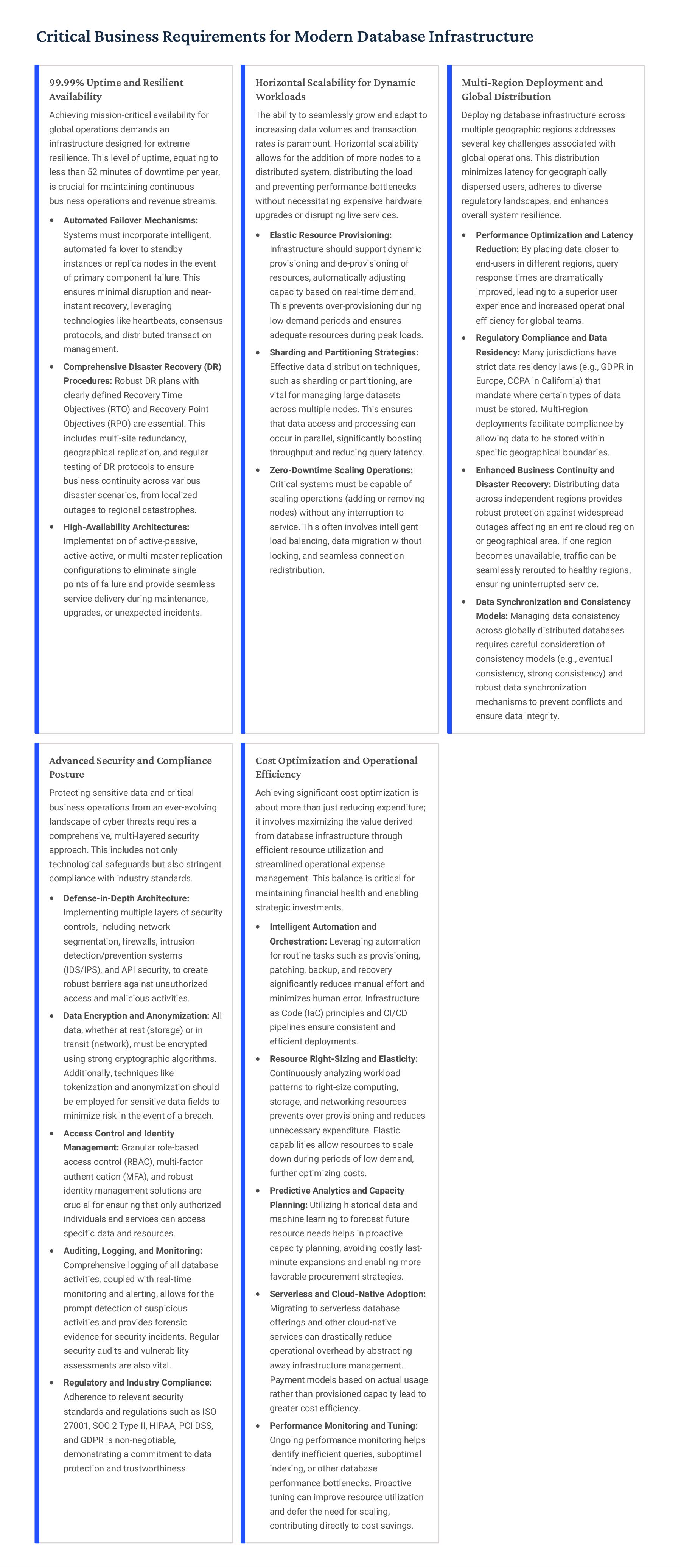
  21. Critical Business Requirements for Modern Database Infrastructure 99.99% Uptime and

    Resilient Availability Achieving mission-critical availability for global operations demands an infrastructure designed for extreme resilience. This level of uptime, equating to less than 52 minutes of downtime per year, is crucial for maintaining continuous business operations and revenue streams. Automated Failover Mechanisms: Systems must incorporate intelligent, automated failover to standby instances or replica nodes in the event of primary component failure. This ensures minimal disruption and near- instant recovery, leveraging technologies like heartbeats, consensus protocols, and distributed transaction management. Comprehensive Disaster Recovery (DR) Procedures: Robust DR plans with clearly defined Recovery Time Objectives (RTO) and Recovery Point Objectives (RPO) are essential. This includes multi-site redundancy, geographical replication, and regular testing of DR protocols to ensure business continuity across various disaster scenarios, from localized outages to regional catastrophes. High-Availability Architectures: Implementation of active-passive, active-active, or multi-master replication configurations to eliminate single points of failure and provide seamless service delivery during maintenance, upgrades, or unexpected incidents. Horizontal Scalability for Dynamic Workloads The ability to seamlessly grow and adapt to increasing data volumes and transaction rates is paramount. Horizontal scalability allows for the addition of more nodes to a distributed system, distributing the load and preventing performance bottlenecks without necessitating expensive hardware upgrades or disrupting live services. Elastic Resource Provisioning: Infrastructure should support dynamic provisioning and de-provisioning of resources, automatically adjusting capacity based on real-time demand. This prevents over-provisioning during low-demand periods and ensures adequate resources during peak loads. Sharding and Partitioning Strategies: Effective data distribution techniques, such as sharding or partitioning, are vital for managing large datasets across multiple nodes. This ensures that data access and processing can occur in parallel, significantly boosting throughput and reducing query latency. Zero-Downtime Scaling Operations: Critical systems must be capable of scaling operations (adding or removing nodes) without any interruption to service. This often involves intelligent load balancing, data migration without locking, and seamless connection redistribution. Multi-Region Deployment and Global Distribution Deploying database infrastructure across multiple geographic regions addresses several key challenges associated with global operations. This distribution minimizes latency for geographically dispersed users, adheres to diverse regulatory landscapes, and enhances overall system resilience. Performance Optimization and Latency Reduction: By placing data closer to end-users in different regions, query response times are dramatically improved, leading to a superior user experience and increased operational efficiency for global teams. Regulatory Compliance and Data Residency: Many jurisdictions have strict data residency laws (e.g., GDPR in Europe, CCPA in California) that mandate where certain types of data must be stored. Multi-region deployments facilitate compliance by allowing data to be stored within specific geographical boundaries. Enhanced Business Continuity and Disaster Recovery: Distributing data across independent regions provides robust protection against widespread outages affecting an entire cloud region or geographical area. If one region becomes unavailable, traffic can be seamlessly rerouted to healthy regions, ensuring uninterrupted service. Data Synchronization and Consistency Models: Managing data consistency across globally distributed databases requires careful consideration of consistency models (e.g., eventual consistency, strong consistency) and robust data synchronization mechanisms to prevent conflicts and ensure data integrity. Advanced Security and Compliance Posture Protecting sensitive data and critical business operations from an ever-evolving landscape of cyber threats requires a comprehensive, multi-layered security approach. This includes not only technological safeguards but also stringent compliance with industry standards. Defense-in-Depth Architecture: Implementing multiple layers of security controls, including network segmentation, firewalls, intrusion detection/prevention systems (IDS/IPS), and API security, to create robust barriers against unauthorized access and malicious activities. Data Encryption and Anonymization: All data, whether at rest (storage) or in transit (network), must be encrypted using strong cryptographic algorithms. Additionally, techniques like tokenization and anonymization should be employed for sensitive data fields to minimize risk in the event of a breach. Access Control and Identity Management: Granular role-based access control (RBAC), multi-factor authentication (MFA), and robust identity management solutions are crucial for ensuring that only authorized individuals and services can access specific data and resources. Auditing, Logging, and Monitoring: Comprehensive logging of all database activities, coupled with real-time monitoring and alerting, allows for the prompt detection of suspicious activities and provides forensic evidence for security incidents. Regular security audits and vulnerability assessments are also vital. Regulatory and Industry Compliance: Adherence to relevant security standards and regulations such as ISO 27001, SOC 2 Type II, HIPAA, PCI DSS, and GDPR is non-negotiable, demonstrating a commitment to data protection and trustworthiness. Cost Optimization and Operational Efficiency Achieving significant cost optimization is about more than just reducing expenditure; it involves maximizing the value derived from database infrastructure through efficient resource utilization and streamlined operational expense management. This balance is critical for maintaining financial health and enabling strategic investments. Intelligent Automation and Orchestration: Leveraging automation for routine tasks such as provisioning, patching, backup, and recovery significantly reduces manual effort and minimizes human error. Infrastructure as Code (IaC) principles and CI/CD pipelines ensure consistent and efficient deployments. Resource Right-Sizing and Elasticity: Continuously analyzing workload patterns to right-size computing, storage, and networking resources prevents over-provisioning and reduces unnecessary expenditure. Elastic capabilities allow resources to scale down during periods of low demand, further optimizing costs. Predictive Analytics and Capacity Planning: Utilizing historical data and machine learning to forecast future resource needs helps in proactive capacity planning, avoiding costly last- minute expansions and enabling more favorable procurement strategies. Serverless and Cloud-Native Adoption: Migrating to serverless database offerings and other cloud-native services can drastically reduce operational overhead by abstracting away infrastructure management. Payment models based on actual usage rather than provisioned capacity lead to greater cost efficiency. Performance Monitoring and Tuning: Ongoing performance monitoring helps identify inefficient queries, suboptimal indexing, or other database performance bottlenecks. Proactive tuning can improve resource utilization and defer the need for scaling, contributing directly to cost savings.
  22. MinervaDB's Comprehensive Methodology for Database Transformation MinervaDB employs a meticulously

    structured and holistic methodology to guide enterprises through complex database infrastructure transformations. Our approach is designed to ensure seamless integration, optimal performance, and sustained reliability. It comprehensively combines strategic foresight, precision-driven implementation, ongoing operational optimisation, and robust, proactive support. This integrated framework is engineered to not only meet immediate technical requirements but also to deliver tangible, measurable business outcomes that align directly with your strategic objectives, safeguarding your data assets and enhancing operational efficiency. 1. Strategic Planning & Architecture Design Our methodology begins with an exhaustive strategic planning phase, where we delve deep into your existing database landscape, business objectives, and future growth projections. This involves detailed assessments of current infrastructure, data schemas, workload patterns, and compliance requirements. We collaborate closely with your stakeholders to define clear success metrics and translate business needs into a robust, scalable, and secure database architecture. This phase culminates in the development of a comprehensive transformation roadmap, including technology selection, capacity planning, and risk mitigation strategies, ensuring every decision is informed and aligned with long-term vision. In-depth current state analysis and stakeholder interviews Requirements gathering for performance, scalability, security, and resilience Technology stack evaluation and selection (e.g., SQL, NoSQL, cloud-native) Detailed architecture blueprint and migration strategy development Comprehensive risk assessment and mitigation planning 2. Expert Implementation & Migration Once the strategic blueprint is finalized, our certified experts execute the implementation and migration with meticulous precision. This phase covers everything from infrastructure provisioning and database setup to complex data migration and integration with existing applications. We leverage best practices and automation tools to minimize downtime and ensure data integrity throughout the transition. Every step is rigorously tested to validate functionality, performance, and security, ensuring that the new environment is fully operational and optimized from day one. Our team is adept at handling diverse database systems and cloud environments, facilitating a smooth and efficient transition. Secure provisioning and configuration of new database environments High-fidelity data migration, including schema conversion and data validation Integration with existing applications and enterprise systems Performance tuning and optimization during deployment Rigorous testing protocols for functionality, stress, and security 3. Continuous Optimisation & Performance Management The transformation journey extends beyond initial deployment. MinervaDB is committed to continuous optimisation, ensuring your database infrastructure consistently performs at its peak. Our approach involves real-time monitoring, proactive identification of bottlenecks, and intelligent resource allocation. We implement advanced performance analytics and automated tuning mechanisms to adapt to changing workloads and evolving business demands. This ongoing process focuses on maximizing efficiency, reducing operational costs, and enhancing overall system responsiveness, ensuring your database assets deliver sustained value. 24/7 real-time monitoring and advanced performance analytics Proactive identification and resolution of performance bottlenecks Automated resource scaling and intelligent workload management Regular security audits and patch management Cost optimization through efficient resource utilization and cloud spend analysis 4. Proactive Support & Managed Services To underpin the entire methodology, MinervaDB provides comprehensive proactive support and managed services. Our dedicated support teams offer 24/7 incident response, ensuring rapid resolution of any issues and minimizing potential disruptions. Beyond reactive support, we engage in proactive maintenance, regular health checks, and capacity planning to anticipate future needs and prevent problems before they arise. Our clients benefit from direct access to senior database architects and engineers, receiving expert guidance, strategic advice, and continuous knowledge transfer to empower their internal teams and maintain peak operational efficiency. Dedicated 24/7 support with guaranteed service level agreements (SLAs) Proactive monitoring, alerting, and incident management Regular database health checks, backups, and recovery planning Expert consultation and advisory services for database strategy Continuous knowledge transfer and training for client teams
  23. Architecture Design & Planning Current State Analysis & Discovery This

    foundational phase involves a meticulous, in-depth evaluation of your existing database infrastructure. Our experts conduct comprehensive assessments to understand current operational patterns, identify bottlenecks, and document critical dependencies. The goal is to establish a clear baseline and uncover opportunities for enhancement. Detailed Infrastructure Evaluation: A thorough review of database systems, including RDBMS and NoSQL platforms, schema structures, stored procedures, and existing integrations. Performance Benchmarking: Utilizing industry-standard tools and methodologies to measure current system performance, including query response times, throughput, resource utilization (CPU, memory, I/O), and latency under various load conditions. Workload Profiling: Analyzing typical and peak workload patterns to accurately understand system demands and identify areas for optimization or potential scaling challenges. Security and Compliance Audit: Assessing current security postures, access controls, encryption practices, and adherence to relevant industry regulations and internal policies. Gap Analysis: Identifying discrepancies between the current operational state and desired future state, highlighting areas of risk, inefficiency, or non-compliance. Strategic Design & Optimization Leveraging insights from the current state analysis, we craft a bespoke database architecture designed to meet your specific business objectives, performance requirements, and scalability needs. This phase focuses on architecting a robust, secure, and future-proof data environment. Technology Selection & Justification: Recommending optimal database technologies (e.g., PostgreSQL, MySQL, SQL Server, MongoDB, Cassandra) and cloud platforms (AWS, Azure, GCP) based on performance, cost, scalability, and operational fit. Scalability Planning: Designing for horizontal and/or vertical scalability, including sharding strategies, read replicas, connection pooling, and auto- scaling mechanisms to accommodate anticipated growth and peak loads. High Availability & Disaster Recovery Design: Implementing robust solutions such as replication, clustering, failover mechanisms, backup/restore strategies, and defining Recovery Point Objectives (RPO) and Recovery Time Objectives (RTO). Security Architecture Enhancements: Integrating advanced security measures, including data encryption (at rest and in transit), robust access control policies (RBAC/ABAC), data masking, vulnerability management, and audit logging. Resource & Cost Optimization Modeling: Developing detailed resource allocation plans and conducting cost-benefit analyses for various architectural options, ensuring efficient utilization of infrastructure and licensing. Implementation & Validation In this critical stage, our team executes the approved strategic design, focusing on precision, minimal disruption, and rigorous validation. We employ best practices to ensure a seamless transition and optimal performance of your new or enhanced database infrastructure. Zero-Downtime Migration Strategies: Employing advanced techniques such as logical replication, dual-write approaches, and change data capture (CDC) to facilitate migrations with virtually no impact on ongoing business operations. Performance Tuning & Optimization: Applying expert-level tuning to database configurations, indexing strategies, query rewriting, and caching mechanisms to maximize speed and efficiency. Infrastructure Provisioning & Configuration: Setting up and configuring new database instances, servers, and related infrastructure components, ensuring adherence to security and performance baselines. Comprehensive Testing Procedures: Conducting extensive unit testing, integration testing, load testing, stress testing, and user acceptance testing (UAT) to validate functionality, performance, and resilience under various scenarios. Operational Handover & Documentation: Providing detailed documentation of the new architecture, configurations, and operational procedures, along with training for your internal teams to ensure smooth ongoing management.
  24. Zero-Downtime Migration Excellence Migration Methodology: A Foundation for Uninterrupted Operations

    MinervaDB leverages a meticulously crafted and proven migration approach designed to ensure truly seamless transitions for critical database systems. Our methodology is built upon industry best practices, proprietary tools, and deep expertise, guaranteeing that your business operations remain entirely undisturbed throughout the entire migration lifecycle. We eliminate the risks typically associated with database changes, ensuring: Zero Business Disruption: Operations continue without interruption, maintaining service availability for your users and customers. Absolute Data Integrity: Strict protocols prevent any data loss or corruption, ensuring every byte is accurately transferred and verified. Flawless Application Compatibility: Extensive analysis and testing ensure that all connected applications function perfectly with the new database environment from day one. Maximized Uptime: Our strategies prioritize continuous availability, minimizing maintenance windows and maximizing operational efficiency. Reduced Risk: A comprehensive risk assessment and mitigation framework is integrated into every phase, protecting against unforeseen challenges. Our commitment is to deliver a migration experience that is not only successful but also transparent and risk-free, preserving business continuity and enhancing performance. Comprehensive Migration Phases and Capabilities Pre-Migration Planning & Discovery: This initial phase is critical for laying a solid foundation. We conduct an exhaustive analysis of your current database environment, including: 1. Detailed System Assessment: Understanding existing infrastructure, hardware, software versions, and network topology. Performance Baselining: Establishing key performance indicators (KPIs) for current workloads to measure post-migration improvements. Dependency Mapping: Identifying all interconnected applications, services, and data flows to prevent unexpected impacts. Data Volume and Growth Projections: Analyzing current data sizes and predicting future growth to inform target environment sizing. Compliance & Security Review: Ensuring the migration plan adheres to all regulatory requirements and security policies. Strategic Alignment: Defining clear objectives, success criteria, and a tailored migration roadmap that aligns with your business goals. Comprehensive Risk Assessment: Identifying potential challenges and developing proactive mitigation strategies. Advanced Data Synchronisation & Replication: Achieving true zero-downtime requires sophisticated data handling. Our approach includes: 2. Real-time Change Data Capture (CDC): Implementing robust mechanisms to capture and replicate all changes from the source database to the target in real-time. Logical vs. Physical Replication: Employing the most suitable replication technology (e.g., logical replication for heterogeneous migrations, physical for homogeneous) to maintain data consistency. Data Integrity Verification: Continuous checks and balances to ensure the target database is an exact, consistent replica of the source at all times. Handling Large Datasets: Efficiently managing and synchronizing multi- terabyte databases and high-velocity data streams without performance degradation. Incremental Synchronization: Minimizing the initial data load by synchronizing only changes after an initial baseline transfer, ensuring minimal impact on source systems. Application Compatibility & Integration: Ensuring that applications seamlessly transition to the new database is paramount. Our services include: 3. Code Analysis & Remediation: Reviewing application code for database- specific syntax or features that may require modification. Driver & Connector Validation: Verifying compatibility and configuring appropriate database drivers and connection pools. Multi-Phase Testing: Conducting rigorous unit, integration, system, and user acceptance testing (UAT) with the new database. Performance & Load Testing: Simulating production loads on the target environment to confirm performance parity or improvement. Middleware Configuration: Adjusting and optimizing any middleware layers to ensure efficient communication with the new database. Robust Rollback Procedures & Contingency Planning: While we strive for flawless execution, a comprehensive contingency plan is essential. Our rollback strategy includes: 4. Point-in-Time Recovery Capabilities: Ensuring the ability to revert to a consistent state prior to the migration cutover if necessary. Defined Switch-Back Mechanisms: Establishing clear, tested procedures to quickly revert to the source database with minimal impact. Automated Rollback Triggers: Implementing monitoring and automation to detect critical issues and initiate rollback if predetermined thresholds are breached. Communication Protocols: Clear internal and external communication plans for all migration scenarios, including rollback. Drill Exercises: Conducting "fire drills" to ensure the rollback process is well-understood and can be executed efficiently under pressure. Post-Migration Validation, Optimization & Support: Our commitment extends beyond the cutover. This final phase ensures long-term success: 5. Performance Verification: Comparing post-migration KPIs against baselines to confirm expected performance gains. Resource Optimization: Fine-tuning database configurations, indexing, and resource allocation for peak efficiency in the new environment. Monitoring & Alerting Setup: Configuring advanced monitoring tools to track database health, performance, and security continuously. Knowledge Transfer & Documentation: Providing your team with comprehensive documentation and training on the new database environment. Ongoing Support: Offering continued expert support to address any post- migration queries or optimization needs, ensuring sustained success.
  25. Performance Optimisation Process Query Performance Tuning MinervaDB employs a meticulous

    approach to SQL optimization, execution plan analysis, and query rewriting, ensuring significant improvements in database efficiency and application response times. Our process involves: Advanced SQL Optimization: Refinement of complex queries, identification of inefficient joins, subquery optimization, and intelligent use of common table expressions (CTEs) to reduce data retrieval overhead. Execution Plan Analysis: In-depth examination of query execution plans to pinpoint bottlenecks, identify full table scans, excessive sort operations, and ensure optimal index utilization. We leverage advanced tools to visualize and interpret these plans, guiding precise adjustments. Query Rewriting Strategies: Strategic restructuring of queries for better performance without altering business logic. This includes converting correlated subqueries, optimizing `WHERE` clauses, and simplifying complex `UNION` operations to minimize resource consumption. Proactive Monitoring & Benchmarking: Continuous monitoring of query performance metrics and benchmarking against established baselines to detect degradation early and validate the effectiveness of optimizations. These techniques collectively reduce processing time, minimize I/O operations, and enhance overall database throughput, directly contributing to a superior user experience. Index Strategy We design and implement optimal indexing strategies that balance read and write performance across diverse workload patterns, ensuring rapid data retrieval while minimizing the impact on data modification operations. Our comprehensive approach includes: Intelligent Index Selection: Identifying critical columns for indexing based on query patterns, join conditions, and `WHERE`/`ORDER BY` clauses. This involves selecting appropriate index types (e.g., B- tree, hash, full-text) for specific data types and usage scenarios. Covering and Composite Indexes: Creation of covering indexes to satisfy queries entirely from the index, and composite indexes to support multiple column predicates efficiently, reducing table access. Clustered vs. Non-Clustered Index Optimization: Strategic placement and design of clustered indexes to optimize physical data storage and retrieval, complemented by non-clustered indexes for secondary access paths, carefully considering the impact on data insertion and updates. Index Maintenance & Fragmentation Management: Regular analysis of index usage statistics, fragmentation levels, and page density. We implement maintenance plans, including rebuilds and reorganizations, to sustain optimal performance over time. Impact Assessment: Thorough analysis of index creation and modification on DML operations (INSERT, UPDATE, DELETE) to mitigate negative performance impacts and ensure a harmonious balance between read and write efficiency. A well-architected index strategy is fundamental for high-performance databases, significantly accelerating data access and improving overall application responsiveness. Resource Allocation Effective resource allocation is paramount for maximizing database performance and ensuring high availability. MinervaDB meticulously optimizes memory, CPU, storage, and network configurations to achieve peak utilization efficiency and system stability. Our services include: Memory Optimization: Fine-tuning critical memory components such as buffer pools, cache sizes, shared memory segments, and connection memory grants. We analyze memory usage patterns to prevent paging, reduce I/O, and maximize data caching for frequently accessed data. CPU Optimization: Configuration of database parameters to optimize CPU scheduling, parallel processing, and thread management. This includes identifying and resolving CPU-intensive queries, optimizing algorithms, and ensuring efficient distribution of workloads across available cores. Storage Optimization: Comprehensive analysis and optimization of disk I/O subsystems, including appropriate RAID configurations, intelligent use of Solid State Drives (SSDs) for high-performance workloads, and data file placement strategies. We implement partitioning and table compression techniques to enhance storage efficiency and query performance. Network Optimization: Minimizing latency and maximizing throughput through network protocol tuning, optimizing database listener configurations, and ensuring efficient data transfer between application servers and the database. This includes managing network bandwidth and reducing unnecessary network traffic. Operating System Layer Tuning: Adjusting kernel parameters, file system settings, and other OS-level configurations that directly impact database performance, ensuring the underlying infrastructure is optimally configured. By meticulously managing these resources, we ensure that your database operates with maximum efficiency, resilience, and scalability, supporting demanding application workloads. Connection Management Robust connection management is critical for application responsiveness, resource utilization, and maintaining stable database performance under varying load conditions. MinervaDB implements advanced strategies for connection pooling, resource governance, and concurrency control to optimize database interaction: Advanced Connection Pooling: Designing and configuring efficient connection pools to minimize the overhead of establishing new database connections. This includes optimizing pool size, connection timeouts, and idle connection management to ensure quick access to database resources without over-provisioning. Resource Utilization & Governance: Implementing mechanisms to monitor and control the number of active connections, preventing resource starvation or overload. We configure session limits, resource profiles, and idle session termination to release unused resources and maintain system health. Concurrency Control Optimization: Strategic tuning of transaction isolation levels (e.g., Read Committed, Repeatable Read, Serializable) to balance data consistency with application concurrency. This involves minimizing contention, reducing locking overhead, and implementing strategies for deadlock detection and prevention to ensure smooth concurrent operations. Statement Caching & Prepared Statements: Utilizing statement caching and prepared statements to reduce parsing overhead and improve the efficiency of repetitive queries, thereby conserving CPU cycles and network bandwidth. Load Balancing & High Availability: Integrating connection management with load balancing solutions and high-availability setups to distribute client requests efficiently across database instances, ensuring continuous service and optimal performance even during peak loads or failovers. Effective connection management dramatically improves application scalability, reduces database load, and enhances overall system stability and responsiveness, leading to a more reliable and performant environment.
  26. Scalability & High Availability Solutions MinervaDB is dedicated to architecting

    and implementing robust, scalable architectures and high-availability systems specifically designed to evolve seamlessly with your business's growth trajectory. Our solutions are meticulously crafted to ensure unwavering performance, exceptional reliability, and optimal cost efficiency, even as your data volumes and user demands expand exponentially. We understand that modern enterprises require infrastructure that can not only handle current workloads but also anticipate future needs without compromising service quality. Our comprehensive approach covers: Scalable Architectures We design and implement architectures that facilitate seamless growth, ensuring your systems can gracefully handle increased traffic and data. This involves: Horizontal Scaling: Distributing workloads across multiple servers or instances to enhance capacity and performance. This includes strategies for database sharding and partitioning. Vertical Scaling: Optimizing individual server resources (CPU, RAM, storage) to maximize performance when appropriate. Load Balancing: Implementing intelligent load distribution mechanisms to evenly spread incoming requests across available resources, preventing bottlenecks and ensuring optimal resource utilization. Auto-scaling Capabilities: Configuring dynamic resource allocation that automatically adjusts capacity based on real-time demand, ensuring elasticity and cost efficiency. Distributed Database Design: Leveraging technologies that allow data to be stored across multiple nodes, offering both scalability and resilience. High-Availability Systems Our solutions guarantee continuous operation and data accessibility, minimizing downtime and protecting against service interruptions. Key components include: Redundancy and Failover: Building systems with redundant components and automated failover mechanisms to instantaneously switch to backup systems in case of primary system failure, ensuring uninterrupted service delivery. Data Replication: Implementing robust data replication strategies, both synchronous and asynchronous, to maintain up-to-date copies of your critical data across different geographical locations or data centers. Disaster Recovery Planning: Developing comprehensive disaster recovery plans, including regular backups, recovery point objectives (RPO), and recovery time objectives (RTO), to ensure rapid restoration of services following unforeseen events. Automated Monitoring and Alerting: Deploying sophisticated monitoring tools to continuously track system health, performance metrics, and potential issues, coupled with proactive alerting to enable immediate response and resolution. Geographic Distribution: Architecting solutions across multiple regions or availability zones to protect against localized outages and improve data access latency for global users. Business Benefits and Strategic Impact Our commitment to scalability and high availability translates directly into tangible benefits for your business: Uninterrupted Service: Minimizing downtime ensures continuous operations, maintaining customer satisfaction and preventing revenue loss. Sustained Performance: Systems are optimized to maintain high performance under peak loads, providing a consistently fast and responsive user experience. Cost-Effectiveness: Efficient resource utilization, dynamic scaling, and robust failure prevention reduce operational costs and avoid expensive recovery efforts. Future-Proof Growth: Architectures are built with foresight, allowing your systems to seamlessly accommodate future business expansion and technological advancements without requiring costly re-engineering. Enhanced Data Integrity: Advanced replication and backup strategies safeguard your critical data against loss and corruption, ensuring business continuity and compliance. Competitive Advantage: A reliable and high-performing infrastructure strengthens your market position, fostering trust and loyalty among your clientele. By partnering with MinervaDB, you gain a strategic advantage with an infrastructure that not only meets your current demands but also proactively prepares you for the challenges and opportunities of tomorrow.
  27. Horizontal Scaling Strategies Sharding Implementation MinervaDB leverages advanced sharding techniques

    to distribute large datasets across multiple database nodes, significantly enhancing performance and scalability. This involves meticulous data partitioning, utilizing consistent hashing algorithms to ensure an even spread of data and workload across the cluster. Furthermore, our experts specialize in shard key optimization, carefully selecting and refining keys to minimize hot spots, facilitate efficient data retrieval, and ensure balanced query distribution. This strategic approach mitigates performance bottlenecks, reduces latency, and supports massive data growth while maintaining consistent system responsiveness and operational efficiency, making it ideal for high-throughput transactional systems. Read Replica Configuration To effectively manage and distribute read-heavy workloads, MinervaDB implements sophisticated read replica configurations. By creating multiple, synchronized copies of your primary database, we offload read requests, drastically improving response times and reducing the burden on the main instance. Our solutions incorporate continuous lag monitoring, providing real-time insights into replication delay to guarantee data consistency across all replicas. In the event of a primary instance failure, automatic promotion mechanisms are pre-configured to seamlessly elevate a read replica to the new primary, ensuring uninterrupted service availability and minimal downtime. This robust setup is critical for applications demanding high availability and rapid data access. Auto-Scaling Solutions MinervaDB provides dynamic auto-scaling solutions that intelligently adjust your database resources in response to fluctuating demand. Our systems are configured to monitor key performance metrics and demand patterns in real-time, enabling proactive adjustments to CPU, memory, and storage capacity. We utilize predictive scaling algorithms that analyze historical data and anticipate future load increases, scaling resources up or down before performance is impacted. This proactive approach ensures optimal resource allocation, prevents over- provisioning or under-provisioning, and results in significant cost efficiencies while guaranteeing consistent performance during peak usage periods and conserving resources during quieter times. This adaptability ensures your infrastructure always meets the precise needs of your application. Load Balancing Efficient load balancing is a cornerstone of MinervaDB's high-availability strategy, ensuring optimal utilization of computing resources and enhancing system resilience. Our implementations involve intelligent traffic distribution mechanisms that direct incoming requests across multiple servers, preventing any single point of failure and optimizing response times. We deploy advanced algorithms such as round-robin, least connections, or IP hash to evenly distribute the load, based on your specific application needs. Integrated with health checks and automatic failover mechanisms, our load balancing solutions continuously monitor the health of all database instances, immediately redirecting traffic away from unhealthy servers to maintain seamless user experience and guarantee continuous operation even in the face of component failures.
  28. High Availability Architecture Multi-Region Deployment: Enhancing Resilience and Global Reach

    Geographic distribution of infrastructure across multiple independent regions is a cornerstone of robust high availability, primarily ensuring enhanced disaster recovery capabilities. This strategy involves deploying applications and data in geographically disparate locations, mitigating the risk of widespread outages caused by regional disasters such as natural calamities, power grid failures, or significant network disruptions. Furthermore, multi-region deployments are critical for adhering to diverse regulatory compliance requirements, especially concerning data residency laws (e.g., GDPR, HIPAA), by allowing data to be stored and processed within specific jurisdictional boundaries. For a global user base, distributing services across regions also significantly reduces network latency, offering a more responsive and consistent user experience through proximity-based routing and edge computing integrations. Disaster Recovery: Implement active-active or active-passive configurations across regions, defining strict Recovery Time Objectives (RTO) and Recovery Point Objectives (RPO) to minimize service interruption and data loss. Regulatory Compliance: Facilitate data sovereignty and residency requirements by deploying services in regions compliant with local laws. Latency Reduction: Optimize user experience by serving content from the nearest geographic data center, often complemented by Content Delivery Networks (CDNs). Technical Mechanisms: Leverage global load balancers, advanced DNS routing (e.g., latency-based or geo-location based), and inter- region network connectivity for seamless traffic management and failover. Automated Failover: Ensuring Continuous Service Operation Automated failover mechanisms are essential for achieving a seamless transition during system failures, thereby minimizing downtime and maintaining service continuity. This capability relies on sophisticated health monitoring systems that continuously track the operational status and performance metrics of all critical components, including CPU utilization, memory consumption, network throughput, and application- specific health checks. Upon detecting anomalies or deviations from predefined thresholds, automated detection systems trigger recovery procedures. These procedures are designed to intelligently identify failed components, isolate them, and redirect traffic to healthy replicas or alternative instances without manual intervention. The ultimate goal is a zero-downtime transition, where users experience no perceptible interruption in service. Health Monitoring: Continuous real-time monitoring of infrastructure and application health using a comprehensive suite of metrics and probes. Automatic Detection: Rapid identification of failures through threshold alerts, anomaly detection, and quorum-based decision-making across distributed components. Recovery Procedures: Orchestrated processes including automated instance restarts, resource reallocation, database switchovers, and intelligent traffic redirection using service meshes or API gateways. Impact Minimization: Designed to prevent manual intervention, ensuring minimal human error and accelerated recovery times, often aiming for RTOs measured in seconds or minutes. Data Replication: Balancing Consistency, Availability, and Partition Tolerance Data replication is a fundamental strategy for high availability, involving the maintenance of multiple copies of data across different nodes or locations. This approach allows systems to continue operating even if one data copy becomes unavailable, crucial for fault tolerance and resilience. Replication strategies must carefully balance the trade-offs inherent in the CAP theorem (Consistency, Availability, Partition Tolerance). Synchronous replication ensures strong consistency by committing data to all replicas before acknowledging the transaction, often at the cost of higher latency and reduced availability during network partitions. Conversely, asynchronous replication prioritizes performance and availability, acknowledging transactions before all replicas are updated, which can lead to eventual consistency but offers better latency and resilience to network issues. Choosing the right strategy depends heavily on application requirements, particularly the acceptable level of data staleness versus performance. Synchronous Replication: Guarantees strong consistency, ideal for systems where data integrity is paramount, but can introduce higher write latencies. Asynchronous Replication: Offers lower latency and higher throughput, suitable for scenarios where eventual consistency is acceptable. CAP Theorem Considerations: Strategic choices are made to prioritize at least two out of Consistency, Availability, and Partition Tolerance based on specific use cases. Replication Methods: Includes logical replication (copying data changes), physical replication (copying disk blocks), and snapshot- based replication for various database and storage systems. Data Integrity: Regular checksums and validation checks are implemented to ensure the integrity and consistency of replicated data across all instances. Backup & Recovery: Comprehensive Data Protection and Restoration A comprehensive backup and recovery strategy is indispensable for protecting data against corruption, accidental deletion, or catastrophic system failures, ensuring business continuity and data integrity. This involves implementing robust procedures for creating regular backups, including full backups, differential backups (changes since the last full backup), and incremental backups (changes since the last backup of any type). Point-in-time recovery capabilities are crucial, often achieved through transaction logs or journaling, allowing data to be restored to a precise moment before an incident occurred, minimizing data loss. All backup data is typically encrypted, compressed, and stored offsite or in immutable storage for enhanced security and protection against regional disasters. Furthermore, automated restoration testing is a critical component, involving periodic validation of backup integrity and simulated disaster recovery drills to ensure that data can be reliably restored within predefined Recovery Time Objectives (RTOs) and Recovery Point Objectives (RPOs). Backup Types: Implementation of full, differential, and incremental backups, scheduled according to data change rates and recovery objectives. Point-in-Time Recovery: Utilizing transaction logs and write-ahead logs to restore databases and systems to a precise historical state, preventing significant data loss. Offsite Storage & Encryption: Secure storage of backups in geographically separated locations, protected by strong encryption, and defined retention policies. Automated Restoration Testing: Regular, automated validation of backup media and simulated recovery exercises to verify the effectiveness and efficiency of recovery procedures. Retention Policies: Clearly defined policies for how long backups are retained, aligned with regulatory requirements and business continuity plans.
  29. Security & Compliance Framework MinervaDB implements a robust, multi-layered defence-in-depth

    security architecture designed to protect sensitive data and critical infrastructure from evolving cyber threats. This framework incorporates comprehensive access control, advanced encryption protocols, sophisticated network security measures, and immutable audit capabilities. Our commitment ensures that MinervaDB not only meets but often exceeds stringent regulatory requirements and industry best practices across diverse sectors, including finance, healthcare, and government. Our proactive approach to security is integrated into every aspect of the platform's design and operation, providing customers with confidence in the integrity, confidentiality, and availability of their data. Comprehensive Access Control Access to MinervaDB resources is strictly governed through a granular and flexible access control system, ensuring that only authorized users and services can interact with data. This is achieved through: **Role-Based Access Control (RBAC):** Permissions are assigned based on defined roles, aligning access with job functions and the principle of least privilege. **Principle of Least Privilege:** Users and processes are granted only the minimum access rights necessary to perform their tasks, reducing the attack surface. **Identity and Access Management (IAM) Integration:** Seamless integration with existing enterprise IAM solutions for centralized user management and authentication. **Multi-Factor Authentication (MFA):** Mandatory MFA for administrative access and configurable MFA for user access, adding an extra layer of security against unauthorized logins. **Session Management:** Secure session handling with configurable timeouts and automatic logout to prevent unauthorized access. Advanced Encryption Protocols Data protection is paramount, and MinervaDB employs industry-leading encryption standards for data throughout its lifecycle: **Encryption at Rest:** All data stored within MinervaDB databases and associated storage volumes are encrypted using strong algorithms, typically AES-256, protecting against unauthorized physical or logical access to storage. **Encryption in Transit:** All network communication, including client-server interactions and inter-service communication, is secured using Transport Layer Security (TLS v1.2/1.3) protocols, preventing eavesdropping and tampering. **Key Management:** Robust key management strategies are implemented, often integrating with hardware security modules (HSMs) or cloud-native key management services to securely generate, store, rotate, and revoke encryption keys. **Column-Level Encryption:** For highly sensitive data, MinervaDB offers options for column-level encryption, providing an additional layer of protection for specific data elements. Sophisticated Network Security The network infrastructure supporting MinervaDB is fortified with multiple layers of defense to prevent unauthorized network access and mitigate common network-based threats: **Virtual Private Clouds (VPCs):** Deployment within isolated network environments (VPCs) to ensure logical separation from other networks and customizable network topologies. **Firewall Rules and Security Groups:** Granular control over inbound and outbound network traffic at both the perimeter and instance levels, allowing only necessary ports and protocols. **Intrusion Detection and Prevention Systems (IDS/IPS):** Continuous monitoring of network traffic for malicious activities or policy violations, with automated responses to block detected threats. **DDoS Protection:** Integrated Distributed Denial of Service (DDoS) protection mechanisms to safeguard against volumetric and application-layer attacks, ensuring service availability. **Network Segmentation:** Logical separation of network zones (e.g., public, private, database, application tiers) to limit lateral movement in case of a breach. Immutable Audit Capabilities & Compliance Reporting Transparency and accountability are core components of our security framework, provided through comprehensive auditing and reporting tools: **Activity Logging:** Detailed and immutable logs of all security-relevant events, including access attempts, data modifications, administrative actions, and configuration changes. **Centralized Logging:** Aggregation of logs into a centralized, secure repository for efficient monitoring, analysis, and long-term retention. **Compliance Reporting:** Built-in tools and capabilities to generate reports that demonstrate adherence to various regulatory standards such as GDPR, HIPAA, PCI DSS, SOC 2, and ISO 27001. **Anomaly Detection:** Utilization of analytics and machine learning on audit logs to detect unusual patterns or suspicious activities that may indicate a security incident. **Automated Restoration Testing:** Regular testing of backup and recovery procedures to ensure data integrity and system resilience, confirming that audit trails are complete and recoverable.
  30. Comprehensive Security Implementation Access Control MinervaDB employs a robust access

    control framework designed to ensure that only authorized individuals and systems can interact with sensitive data and resources. This includes: Role-Based Access Control (RBAC): Granular permissions are assigned based on defined roles (e.g., Administrator, Developer, Auditor), streamlining management and minimizing the risk of excessive privileges. Custom roles can be created to align precisely with organizational structures and compliance needs. Privilege Management: Just-in-Time (JIT) access and Least Privilege principles are strictly enforced. Privileges are granted for the minimum necessary duration and scope required to perform a task, reducing the attack surface. Automated privilege reviews and revocations are conducted regularly. Multi-Factor Authentication (MFA): All access to MinervaDB environments requires MFA, supporting various methods including hardware tokens, biometric authentication, and time-based one- time passwords (TOTP). This adds an essential layer of security beyond traditional passwords, significantly mitigating unauthorized access risks. Identity and Access Management (IAM) Integration: Seamless integration with enterprise IAM solutions (e.g., Active Directory, LDAP, OAuth) allows for centralized user provisioning, deprovisioning, and authentication management, ensuring consistent security policies across the organization. Encryption Data protection is paramount, and MinervaDB implements comprehensive encryption strategies to safeguard information throughout its lifecycle: Encryption at Rest: All stored data, including databases, backups, and logs, are encrypted using advanced cryptographic algorithms such as AES-256. This ensures that even if underlying storage is compromised, the data remains unintelligible and protected. Encryption keys are managed securely through dedicated Key Management Systems (KMS). Encryption in Transit: All communications between clients and MinervaDB services, as well as internal service-to-service communications, are secured using industry-standard protocols like TLS/SSL. This prevents eavesdropping and tampering of data as it moves across networks, maintaining data integrity and confidentiality. Key Management: A robust Key Management System (KMS) is utilized for the generation, storage, rotation, and revocation of cryptographic keys. This system adheres to best practices for key lifecycle management, providing audit trails and ensuring the security and availability of encryption keys. Homomorphic Encryption Capabilities: For specific high-security environments, MinervaDB can explore advanced cryptographic techniques like homomorphic encryption, allowing computations on encrypted data without decrypting it first, offering unparalleled data privacy for sensitive analytical workloads. Network Security MinervaDB's infrastructure is protected by multiple layers of network security controls to prevent unauthorized network access and mitigate various cyber threats: VPN Configuration: Secure Virtual Private Network (VPN) connections are established for remote access to private networks, encrypting all traffic and ensuring that only trusted endpoints can connect to critical services. Advanced Firewall Rules: State-of-the-art firewalls are configured with strict ingress and egress rules, meticulously controlling traffic flow based on IP addresses, ports, and application protocols. Intrusion Detection Systems (IDS) and Intrusion Prevention Systems (IPS) actively monitor for malicious activities. Network Segmentation: The network is logically segmented into distinct zones (e.g., DMZ, application, database, management networks) with strict access controls between segments. This limits the blast radius of potential breaches and ensures critical systems are isolated. DDoS Protection Strategies: Multi-layered Distributed Denial of Service (DDoS) protection mechanisms are implemented at the network edge and within the infrastructure. These strategies include traffic scrubbing, rate limiting, and adaptive threat intelligence to ensure service availability and resilience against volumetric and application-layer attacks. Secure Configuration Baselines: All network devices and configurations adhere to hardened security baselines, regularly reviewed and updated to protect against known vulnerabilities and misconfigurations. Audit & Compliance Maintaining transparency and adherence to regulatory standards is a core tenet of MinervaDB's security posture. Our audit and compliance capabilities include: Comprehensive Logging and Monitoring: All system activities, user actions, and security events are meticulously logged across the entire infrastructure. These logs are centralized, immutable, and protected from unauthorized access or alteration. Real-time Alerting: Advanced monitoring systems continuously analyze log data and system metrics for anomalies, suspicious patterns, and potential security incidents. Automated alerts are triggered and routed to security operations teams for immediate investigation and response, minimizing reaction time. Security Information and Event Management (SIEM): MinervaDB integrates with SIEM solutions to aggregate, correlate, and analyze security data from various sources. This provides a holistic view of the security landscape, enabling proactive threat detection and efficient incident management. Regulatory Compliance Reporting: MinervaDB is designed to support stringent regulatory requirements across various industries. This includes providing detailed audit trails, access logs, and security configuration reports necessary for compliance with standards such as GDPR, HIPAA, SOC 2 Type II, PCI DSS, ISO 27001, and more. Our systems facilitate regular compliance audits and attestations. Vulnerability Management: Continuous vulnerability scanning, penetration testing, and security assessments are performed to identify and remediate potential weaknesses, ensuring ongoing compliance and security integrity.
  31. Global Compliance Standards GDPR (General Data Protection Regulation) European data

    protection regulation compliance, a comprehensive framework designed to protect the personal data and privacy of EU citizens. This includes stringent requirements for data residency, mandating that certain data must be stored within the European Union's borders or countries deemed adequate by the EU Commission. We implement robust mechanisms for the right to erasure (or 'right to be forgotten'), ensuring individuals can request deletion of their personal data. Furthermore, our consent management systems are meticulously designed to capture, record, and manage explicit consent for data processing activities, adhering to the principles of transparency and user control. Data Processing Principles: Adherence to lawfulness, fairness, transparency, purpose limitation, data minimization, accuracy, storage limitation, integrity, and confidentiality. Data Protection Officer (DPO): Designation of a DPO to oversee compliance, advise on data protection impact assessments, and serve as a contact point for supervisory authorities. Cross-Border Data Transfers: Implementation of appropriate safeguards, such as Standard Contractual Clauses (SCCs) or Binding Corporate Rules (BCRs), for transferring data outside the EU/EEA. HIPAA (Health Insurance Portability and Accountability Act) Compliance with healthcare data security requirements in the United States, specifically safeguarding Protected Health Information (PHI). Our solutions incorporate advanced encryption for PHI at rest and in transit, employing NIST-approved algorithms to prevent unauthorized access. Granular access controls are implemented to ensure that only authorized personnel can view or modify sensitive patient data, based on the principle of least privilege. Comprehensive audit trail implementation provides a detailed record of all access and modification activities, crucial for incident response and regulatory reviews. These measures collectively establish a secure environment for processing, storing, and transmitting health information. Administrative Safeguards: Policies and procedures to manage security measures, including security management processes, workforce security, information access management, and security awareness training. Physical Safeguards: Controls for physical access to electronic information systems, equipment, and the data itself, such as facility access controls and workstation security. Technical Safeguards: Technology-based protections for e-PHI, including access control mechanisms, audit controls, integrity controls, and transmission security. Business Associate Agreements (BAAs): Ensuring all third-party vendors handling PHI are also contractually obligated to comply with HIPAA security rules. SOX (Sarbanes-Oxley Act) Adherence to financial reporting and data integrity standards, primarily focused on preventing corporate accounting scandals and ensuring transparency. This involves rigorous controls over financial reporting processes, guaranteeing the accuracy and reliability of financial statements. We implement measures to bolster data integrity, safeguarding financial data from unauthorized alteration or destruction and ensuring its completeness. Our framework helps companies detect and prevent fraud by establishing robust internal controls and fostering a culture of accountability. Compliance with SOX demonstrates a commitment to ethical financial practices and investor confidence. Section 302: Certification by the CEO and CFO regarding the accuracy of financial reports and the effectiveness of internal controls over financial reporting (ICFR). Section 404: Requirement for management to establish and maintain adequate ICFR, and for external auditors to attest to their effectiveness. Internal Control Over Financial Reporting (ICFR): Design and implementation of controls to ensure transactions are authorized, recorded accurately, and assets are safeguarded. Corporate Governance: Strengthening of audit committees and other governance structures to provide effective oversight of financial reporting. PCI DSS (Payment Card Industry Data Security Standard) Compliance with payment card industry security standards, designed to protect cardholder data during processing, storage, and transmission. This comprehensive standard mandates strict controls for protecting cardholder data, covering all aspects from network architecture to individual data handling policies. We ensure the transaction integrity of all payment card operations, minimizing risks of fraud and data breaches. Our systems are configured to meet the 12 detailed requirements of PCI DSS, which encompass building and maintaining a secure network, protecting cardholder data, maintaining a vulnerability management program, implementing strong access control measures, regularly monitoring and testing networks, and maintaining an information security policy. These measures are essential for any entity handling major credit card brands. Secure Network Establishment: Installation and maintenance of firewalls, and avoiding vendor-supplied defaults for system passwords and other security parameters. Cardholder Data Protection: Encryption of cardholder data across open, public networks and robust protection of stored cardholder data. Vulnerability Management Program: Regular updates of antivirus software or programs and the development and maintenance of secure systems and applications. Strong Access Control Measures: Restricting access to cardholder data by business need-to-know, assigning a unique ID to each person with computer access, and restricting physical access to cardholder data. Regular Monitoring and Testing: Tracking and monitoring all access to network resources and cardholder data, regularly testing security systems and processes. Information Security Policy: Maintaining a policy that addresses information security for all personnel.
  32. Proactive Monitoring & Alerting MinervaDB employs a sophisticated suite of

    comprehensive real-time monitoring solutions, meticulously designed to oversee every critical aspect of your database environment. Our systems are equipped with intelligent alerting mechanisms that leverage advanced analytics to identify potential anomalies and performance degradation indicators long before they can escalate into impactful service disruptions. This proactive approach ensures that operational issues are detected at their nascent stages, providing ample opportunity for intervention and maintaining peak system performance and availability without affecting business operations. Our robust monitoring framework goes beyond basic uptime checks, diving deep into the intricate layers of database operations to provide unparalleled visibility and control. This empowers your teams with the necessary insights to respond swiftly and strategically, ultimately fostering an environment of continuous optimisation and operational excellence. Comprehensive Real-time Data Collection:We continuously gather a vast array of metrics, including database performance indicators (e.g., query execution times, transaction rates, lock contention), system health (CPU, memory, I/O utilization), network latency, storage capacity trends, and replication status. Our agents and integrations provide high-frequency data sampling to ensure the most current view of your environment. Intelligent Alerting Mechanisms:Our alerting systems are built on a foundation of adaptive baselines, anomaly detection algorithms, and predictive analytics. Instead of relying solely on static thresholds, we identify deviations from normal operational patterns and potential future resource bottlenecks. Alerts are prioritized by severity, correlated to reduce noise, and directed through customizable escalation policies to the appropriate personnel via multiple channels (e.g., email, SMS, PagerDuty, Slack, custom webhooks). Early Issue Detection and Prevention:By analyzing trends and subtle shifts in performance, MinervaDB can predict and flag potential issues such as impending disk capacity exhaustion, escalating slow query counts, abnormal connection spikes, or replication lag, allowing for preventative action rather than reactive firefighting. This minimizes the risk of customer-facing impact and ensures service continuity. Facilitating Proactive Response and Resolution:Each alert provides rich contextual information, diagnostic data, and links to pre-defined runbooks, enabling your team to understand the root cause swiftly and implement effective resolutions. Our platform can also be configured to trigger automated corrective actions for common, non-critical issues, further reducing manual intervention. Continuous Optimisation and Performance Tuning:The wealth of monitoring data collected is invaluable for ongoing performance tuning and capacity planning. MinervaDB's analytics capabilities help identify persistent performance bottlenecks, suggest query optimizations, recommend resource reallocations, and support strategic decision-making to continually enhance your database infrastructure's efficiency, scalability, and resilience.
  33. Real-Time Monitoring Capabilities Performance Metrics Query execution times and throughput:

    MinervaDB meticulously tracks individual query performance, including average, median, and 95th percentile execution times, along with the total number of queries processed per second (QPS). This deep insight allows for the identification of slow queries and potential bottlenecks, ensuring optimal database responsiveness. Transaction rates and latency measurements: We monitor the volume of transactions per second (TPS) and the end-to-end latency of database operations. This includes measuring the time taken for commit and rollback operations, providing a comprehensive view of transaction efficiency and user experience impact. Lock contention and deadlock detection: Advanced algorithms continuously scan for database locks, identifying instances of contention that can degrade performance. Immediate alerts are triggered for deadlocks, enabling swift resolution and minimizing application downtime. Cache hit ratios and buffer pool utilisation: Optimizing memory usage is crucial. MinervaDB monitors the effectiveness of database caches (e.g., InnoDB buffer pool hit ratio, key cache hit ratio) to ensure data is served from memory whenever possible, reducing expensive disk I/O and improving overall speed. Index usage and efficiency: Comprehensive analysis of index scan rates, full table scans, and index fragmentation helps ensure that database queries are utilizing indexes effectively for rapid data retrieval. Replication lag: For high availability and disaster recovery setups, monitoring replication lag between primary and replica instances is critical to ensure data consistency and minimize data loss in failover scenarios. Resource Utilisation CPU usage patterns and trends: Detailed tracking of CPU consumption by database processes, including user, system, and I/O wait times. Historical data enables trend analysis to predict future resource needs and prevent CPU starvation. Memory allocation and consumption: Monitoring of total memory used by the database, breakdown by various components (e.g., buffer pool, sort buffers, connection memory), and identification of memory leaks or excessive memory usage that could lead to system instability. Disk I/O operations and bandwidth: Comprehensive oversight of read/write operations per second (IOPS), latency, and throughput on storage subsystems. This includes monitoring disk queue depth and saturation to identify I/O bottlenecks. Network traffic and connection pools: Analysis of incoming and outgoing network traffic related to database connections, including packet loss and retransmissions. Monitoring of connection pool usage helps optimize application-database interaction and prevent connection exhaustion. Temporary space usage: Tracking of temporary table and temporary file creation on disk, which can indicate inefficient query plans or insufficient memory allocation for certain operations. Log file growth and usage: Monitoring of transaction log file sizes and activity (e.g., redo logs, binary logs) to ensure they are managed effectively and do not consume excessive disk space or impact performance. Intelligent Alerting Threshold-based alerts with customisable parameters: Users can define specific thresholds for various metrics (e.g., CPU > 80% for 5 minutes, query latency > 100ms). These alerts are highly customisable, allowing for fine-tuning based on application criticality and operational context. Anomaly detection using machine learning: Beyond static thresholds, MinervaDB employs advanced machine learning algorithms to establish dynamic baselines for normal database behavior. It then identifies deviations from these baselines, proactively alerting to unusual performance patterns that traditional monitoring might miss, such as a sudden drop in transaction rates during peak hours. Automated escalation procedures: Configurable escalation policies ensure that critical alerts reach the right personnel promptly. This can involve multi-stage notifications via email, SMS, or integration with on- call management systems, escalating through different teams or seniority levels until acknowledged. Integration with incident management systems: Seamless integration with popular incident management platforms (e.g., PagerDuty, ServiceNow, Jira Service Management) ensures that alerts automatically create tickets or incidents, streamlining the operational response workflow and maintaining a clear audit trail. Predictive alerting: Utilizing historical data and machine learning, MinervaDB can predict potential resource exhaustion or performance degradation before it actually occurs, allowing for preventative action. Root cause analysis assistance: Alerts are enriched with contextual information, providing immediate insights into potential causes (e.g., specific queries, recent configuration changes, or application deployments) to accelerate diagnosis and resolution. Capacity Planning Proactive resource allocation recommendations: Based on historical usage patterns, growth trends, and anticipated workloads, MinervaDB provides intelligent recommendations for scaling database resources (e.g., CPU, RAM, storage, I/O bandwidth). This ensures infrastructure is always aligned with demand. Growth trend analysis and forecasting: Comprehensive analysis of long-term data trends to identify growth vectors across various metrics. Advanced forecasting models predict future resource requirements with high accuracy, supporting strategic infrastructure investments. Scaling recommendations based on patterns: Recommendations are tailored to observed usage patterns, differentiating between vertical scaling (e.g., upgrading instance types) and horizontal scaling (e.g., adding read replicas, sharding) to optimize cost and performance. Workload simulation and impact analysis: Capabilities to simulate increased user loads or new application features against current infrastructure to assess potential impact on performance and identify bottlenecks before deployment. Cost optimization insights: Providing data-driven insights to optimize cloud expenditure by recommending right-sizing of instances and storage, identifying underutilized resources, and suggesting reservation strategies. Regulatory compliance support: Assisting in maintaining compliance by ensuring sufficient capacity for data retention, audit logging, and peak load handling as required by industry regulations.
  34. Disaster Recovery & Business Continuity 1 Recovery Time Objectives (RTO)

    Recovery Time Objective (RTO) defines the maximum acceptable duration of time that an application or system can be unavailable after an incident or disaster. Our strategy focuses on aggressively minimising this downtime to ensure critical business operations resume swiftly. Automated Failover Mechanisms: We implement sophisticated systems that automatically detect primary system failures and initiate a seamless transition to pre-configured standby environments. This includes load balancer reconfigurations, DNS updates, and application service rerouting. Rapid Recovery Procedures: Our procedures are designed for efficiency, utilising pre-provisioned recovery environments, orchestrated startup sequences for applications, and automated validation scripts to confirm service restoration. This minimizes manual intervention and speeds up the restoration process. Active-Passive & Active-Active Setups: Depending on the criticality of the service, we deploy either active-passive configurations for cost-effective failover or active-active configurations for near-zero RTO, distributing workloads across multiple regions for continuous availability. Infrastructure as Code (IaC): Recovery environments are defined using Infrastructure as Code principles, allowing for consistent, repeatable, and rapid deployment of infrastructure components in the event of a disaster. 2 Recovery Point Objectives (RPO) Recovery Point Objective (RPO) specifies the maximum acceptable amount of data loss measured in time. Our approach is engineered to ensure minimal data loss, safeguarding the integrity and currency of critical information assets even in the face of catastrophic events. Continuous Data Replication: Essential data is continuously replicated from primary to secondary sites in real-time or near real-time. This ensures that the recovery point is always very close to the moment of the disaster, significantly reducing potential data loss. Incremental Backups & Snapshots: We utilise a tiered backup strategy combining regular full backups with frequent incremental backups and application-consistent snapshots. This allows for granular point-in-time recovery options without the overhead of constant full backups. Transaction Log Shipping & Database Mirroring: For databases, we employ advanced techniques such as transaction log shipping and database mirroring to maintain highly synchronous or asynchronous replicas, ensuring transactional integrity during recovery. Immutable Backups: Critical backups are stored in immutable formats, protecting them from accidental deletion, tampering, or ransomware attacks, thus providing an uncompromised recovery source. 3 Geographic Distribution & Resilience To withstand regional disasters and maintain uninterrupted service, our infrastructure leverages robust geographic distribution. This multi-region strategy ensures that services and data remain accessible and operational even if an entire geographical area is compromised. Multi-Region Deployment Architecture: Critical applications and data are deployed across multiple distinct geographic regions or availability zones. This isolates the impact of localized outages, natural disasters, or large-scale infrastructure failures. Cross-Region Data Synchronisation: Data is continuously synchronised and verified across all distributed sites, ensuring consistency and availability regardless of which region is active. This includes active-active data solutions where possible. Isolated Network Infrastructure: Each geographic site operates on an independent network infrastructure, preventing cascading failures and ensuring that a network outage in one region does not affect others. Compliance & Data Sovereignty: Geographic distribution also supports compliance with data residency regulations by allowing data to be stored and processed within specific jurisdictional boundaries while maintaining disaster recovery capabilities. 4 Testing & Validation Framework Effective disaster recovery and business continuity depend critically on rigorous, regular testing and validation. Our comprehensive framework ensures that all recovery plans are robust, up-to-date, and perform as expected under actual disaster conditions. Scheduled Disaster Recovery Drills: We conduct regular, planned disaster recovery drills, ranging from tabletop exercises to full simulated failovers. These drills test the entire recovery process, from alert notification to full service restoration. Scenario-Based Testing: Tests are designed to simulate a variety of potential disaster scenarios, including data centre outages, specific system failures, regional network disruptions, and cyber- attacks, ensuring comprehensive preparedness. Post-Test Analysis & Improvement: Every test is followed by a detailed post-mortem analysis to identify any gaps, inefficiencies, or areas for improvement. Findings are documented, and recovery plans are updated to incorporate lessons learned. Automated Validation & Reporting: We employ automated tools to validate recovery targets (RTO/RPO) and generate detailed reports on test outcomes. This provides transparent insights into preparedness levels and helps maintain audit readiness. Team Training & Documentation: Regular training sessions are conducted for all relevant personnel on their roles and responsibilities during a disaster. Recovery plans and procedures are meticulously documented and updated to reflect any changes in infrastructure or strategy.
  35. Remote DBA Services MinervaDB's Remote Database Administration (DBA) Services offer

    a holistic and proactive approach to managing your critical database infrastructure. We provide end-to-end support that encompasses comprehensive database administration, continuous real-time performance monitoring, strategic capacity management, and robust security oversight. This integrated suite of services ensures your databases operate with enterprise-class reliability, efficiency, and security, all while eliminating the significant operational and financial burden associated with recruiting, training, and retaining an in-house team of database specialists. Our experts leverage industry best practices and cutting-edge tools to deliver unparalleled database health and performance. Comprehensive Database Administration: Our dedicated team handles all facets of routine and complex database management. This includes essential tasks such as regular patching, version upgrades, and seamless database migrations across environments. We also manage user access and permissions, database backups, disaster recovery planning, and configuration optimization to ensure peak operational efficiency and data integrity. Continuous Performance Monitoring: We provide 24/7 real-time monitoring of your database systems, proactively identifying and resolving potential performance bottlenecks before they impact your applications and users. Our monitoring goes beyond basic health checks, delving into query optimization, index tuning, and resource utilization analysis to maintain optimal speed and responsiveness. Strategic Capacity Management: MinervaDB helps you anticipate and plan for future growth. Our experts analyze current usage patterns and project future resource needs, ensuring your database infrastructure scales efficiently with your business demands. This includes optimizing storage, CPU, memory, and I/O resources, preventing costly over-provisioning or performance degradation due to under-resourcing. Robust Security Oversight: Data security is paramount. We implement stringent security measures, including vulnerability assessments, regular security audits, access control management, and compliance adherence to industry standards. Our team works to protect your sensitive data from unauthorized access, cyber threats, and ensures regulatory compliance. By partnering with MinervaDB, businesses gain access to a team of highly certified and experienced DBA professionals without the typical overheads of an internal department, such as recruitment costs, ongoing training, benefits, and infrastructure investments. This model provides superior expertise, flexibility, and cost-effectiveness, allowing your internal IT staff to focus on core business initiatives. 24/7/365 Support Guarantee: MinervaDB stands by its commitment to uninterrupted service. We provide continuous, round-the-clock support every day of the year, ensuring that expert assistance is always available. Our support model features rapid response times for all critical issues, backed by stringent Service Level Agreements (SLAs) that guarantee quick issue resolution and minimal downtime. Furthermore, our proactive monitoring systems are designed to detect anomalies and potential problems, enabling us to intervene and prevent issues from escalating, often before they can impact your operations. This ensures maximum uptime and business continuity.
  36. Continuous Improvement Lifecycle Baseline Establishment The crucial first step involves

    a comprehensive assessment to establish an accurate performance baseline and thorough documentation of the current database environment. This includes: Performance Benchmarking: In-depth analysis of key performance indicators (KPIs) such as query response times, transaction throughput, resource utilization (CPU, memory, I/O), and network latency under various load conditions. This establishes a quantitative measure of current operational efficiency. Current State Documentation: Detailed recording of the existing database architecture, configurations, schema designs, stored procedures, replication setups, and inter-system dependencies. Understanding these foundational elements is vital for informed decision- making and strategic planning. Workload Analysis: Identification of critical business processes and their corresponding database interactions to prioritize areas for optimization based on business impact. This phase sets the foundation, enabling objective measurement of future improvements and providing a clear understanding of the system's operational characteristics. Continuous Monitoring Following baseline establishment, a robust and persistent monitoring framework is deployed to ensure real-time visibility into database health and performance. This involves: Proactive Performance Tracking: Utilizing advanced monitoring tools to continuously collect and analyze metrics related to database activity, resource consumption, and user experience. This includes tracking SQL query execution plans, locking mechanisms, and connection patterns. Advanced Anomaly Detection: Implementing sophisticated algorithms and machine learning models to identify deviations from established performance norms or unusual patterns that may indicate emerging issues. This enables us to detect potential problems before they escalate into critical incidents. Trend Analysis and Predictive Analytics: Analyzing historical data to identify long- term performance trends, anticipate future capacity requirements, and forecast potential bottlenecks. This allows for proactive capacity planning and resource allocation. Alerting and Notification Systems: Configuring intelligent alerts for critical thresholds and anomalies, ensuring that our expert DBA teams are immediately notified of any potential issues, allowing for rapid response and mitigation. Continuous monitoring provides the intelligence required to maintain peak database performance and availability, ensuring business continuity. Optimisation Implementation Leveraging insights from continuous monitoring, this phase focuses on executing targeted improvements designed to enhance database performance, efficiency, and scalability. Key activities include: Query and Index Tuning: Identifying inefficient SQL queries and optimizing them for faster execution, alongside the strategic creation or modification of database indexes to accelerate data retrieval operations. Schema Optimization: Recommending and implementing changes to database schemas, including normalization/denormalization strategies, data types, and partitioning, to improve data integrity and performance characteristics. Infrastructure Enhancements: Advising on and implementing upgrades to underlying hardware, storage systems, and network configurations. This also encompasses cloud-native optimizations for cloud-based database environments. Configuration Management: Fine-tuning database parameters, buffer sizes, and other configuration settings to match specific workload patterns and hardware capabilities for optimal resource utilization. Caching Strategies: Implementing and optimizing various caching mechanisms to reduce database load and improve response times for frequently accessed data. These regular enhancements are conducted with minimal disruption, driving tangible improvements in system responsiveness and resource efficiency. Results Validation The final, yet cyclical, stage involves rigorously measuring the impact of implemented optimizations against the initial baseline and predefined objectives to ensure value delivery. This critical process encompasses: Performance Measurement & Comparison: Quantifying the improvements achieved in KPIs such as query execution times, transaction rates, and resource utilization, directly comparing them to the established baseline metrics. ROI and Business Impact Assessment: Translating technical performance gains into tangible business benefits, such as reduced operational costs, increased user satisfaction, faster application response times, and improved revenue potential. Comprehensive Reporting: Providing detailed, transparent reports that highlight the improvements, validate the effectiveness of optimization strategies, and demonstrate the return on investment for all initiatives undertaken. Stakeholder Communication: Presenting findings to stakeholders, demonstrating the value delivered and outlining next steps in the continuous improvement cycle. Feedback Loop Integration: Utilizing validated results to inform subsequent monitoring and optimization efforts, ensuring a perpetual cycle of enhancement and adaptation to evolving business needs and technical landscapes. This validation phase closes the loop, confirming the success of optimizations and providing data-driven insights for future strategic planning within the continuous improvement lifecycle.
  37. Industry-Specific Solutions MinervaDB stands at the forefront of providing meticulously

    tailored database infrastructure solutions, expressly engineered to meet the distinct and often complex requirements of diverse industry verticals. Our approach integrates profound technical expertise with invaluable domain-specific knowledge, forming a powerful synergy that is instrumental in driving sustained business success for our clients. We recognize that a one-size-fits-all approach is insufficient in today's specialized markets, leading us to develop bespoke solutions that are not only technologically robust but also perfectly aligned with industry norms, compliance mandates, and operational objectives. Our commitment to delivering excellence extends to understanding the granular details of each sector. This involves a comprehensive analysis of: Regulatory Frameworks: Ensuring strict adherence to industry-specific data governance, privacy laws, and compliance standards (e.g., GDPR, HIPAA, PCI DSS). Performance Demands: Designing systems capable of handling extreme transaction volumes, low-latency queries, or massive data ingestion depending on the industry's operational tempo. Scalability Needs: Architecting solutions that can seamlessly scale to accommodate growth, seasonal peaks, or unpredictable demand fluctuations. Security Protocols: Implementing advanced security measures and encryption practices tailored to the sensitivity of data managed within a given industry. Integration Challenges: Developing flexible architectures that integrate smoothly with existing legacy systems, third-party applications, and evolving technological landscapes. MinervaDB's capabilities span a wide array of database technologies, including relational databases (SQL Server, Oracle, PostgreSQL, MySQL), NoSQL databases (MongoDB, Cassandra, Redis), and specialized analytical databases. We leverage this diverse technical proficiency to design, deploy, and manage database environments that are optimized for performance, reliability, and cost-efficiency. Our solutions typically encompass database design and optimization, migration services, 24/7 monitoring and support, disaster recovery planning, and performance tuning, all customized to the unique context of each industry. By partnering with MinervaDB, organizations gain access to a strategic advantage: an infrastructure that not only supports their current operations but also empowers future innovation, reduces total cost of ownership, mitigates operational risks, and enhances overall data management efficacy. This holistic approach ensures that our clients can focus on their core business competencies, confident that their critical data assets are managed by industry-leading experts.
  38. Key Industry Solutions E-Commerce & Retail MinervaDB provides robust database

    infrastructure tailored for the dynamic demands of e-commerce and retail. This includes ensuring seamless operations for high-transaction processing, enabling millions of simultaneous transactions while maintaining strict ACID properties. We implement advanced inventory management solutions that offer real-time stock updates across multiple channels and integrate deeply with supply chain logistics. Our platforms are designed to facilitate sophisticated customer analytics, supporting personalized shopping experiences, predictive purchasing patterns, and targeted marketing campaigns. Crucially, our solutions offer dynamic scaling capabilities, ensuring your infrastructure can effortlessly handle seasonal peak loads, flash sales, and unexpected traffic surges without performance degradation, thereby minimizing downtime and optimizing logistical efficiency. Financial Services For the financial sector, MinervaDB delivers ultra-secure and high-performance database systems critical for regulatory compliance, real- time market operations, and robust risk management. We ensure adherence to stringent regulations such as GDPR, PCI DSS, and SOX, providing comprehensive audit trails and advanced data encryption. Our infrastructure supports high-frequency trading platforms, demanding ultra-low latency for order execution and real-time ingestion of vast market data feeds. We empower sophisticated risk management and compliance analytics through complex data modeling, scenario analysis, and rapid generation of regulatory reports. Furthermore, our solutions incorporate AI/ML-driven fraud detection capabilities, enabling real-time anomaly detection and prevention to safeguard assets and transactions, ultimately enhancing security and accelerating critical decision-making. Healthcare & Life Sciences MinervaDB specializes in secure and compliant database solutions for healthcare and life sciences, managing sensitive patient data with the highest integrity. Our systems are built to ensure strict HIPAA compliance, implementing robust data privacy, security protocols, stringent access controls, and detailed auditing mechanisms. We provide comprehensive clinical data management, facilitating the integration of Electronic Health Records (EHR) and Electronic Medical Records (EMR) systems, maintaining longitudinal patient records, and ensuring data quality for diagnostics and treatment. Our expertise extends to supporting complex research database systems for genomics data analysis, clinical trials management, and bioinformatics, accelerating scientific discovery. We also focus on healthcare interoperability standards like FHIR and HL7, enabling secure and efficient data exchange across disparate healthcare systems, which ultimately leads to improved patient outcomes and accelerated research. Technology & SaaS MinervaDB empowers technology and SaaS companies with highly scalable and resilient database infrastructures designed for rapid innovation and growth. We design and optimize multi-tenant architectures, ensuring data isolation, consistent performance, and cost efficiency for all clients. Our focus on API performance optimization guarantees low latency and high throughput for critical application interfaces, often leveraging advanced caching strategies. We provide robust platforms for user analytics, enabling detailed behavioral tracking, feature adoption analysis, and A/B testing to inform product development. Our scalable infrastructure solutions leverage modern practices like microservices and containerization, supporting global distribution and ensuring seamless scaling to accommodate explosive user growth and demand spikes, leading to faster product iterations and an enhanced user experience.
  39. Measuring Success: Performance Metrics 99.99% Uptime Guarantee We provide an

    industry-leading system availability and reliability measurement of 99.99% across all global deployments. This guarantees minimal service disruption, translating to less than 5 minutes of unplanned downtime per month. **Redundant Architecture:** Implementation of highly redundant systems and failover mechanisms across multiple geographic regions to ensure continuous operation. **Proactive Monitoring:** Continuous, real-time monitoring of all infrastructure components, applications, and network performance to detect and address potential issues before they impact services. **Business Continuity:** This high level of uptime ensures uninterrupted business operations for our clients, protecting revenue streams and maintaining customer trust. **Disaster Recovery:** Robust disaster recovery protocols are in place to quickly restore services in the event of unforeseen catastrophic events, further reinforcing reliability. 10x Performance Improvement Our solutions consistently deliver up to a 10x improvement in performance, specifically targeting average query response time and overall system throughput optimization. This enhancement directly impacts user experience and operational efficiency. **Advanced Caching Strategies:** Utilization of multi- layer caching solutions to reduce database load and accelerate data retrieval. **Database Optimization:** Sophisticated indexing, query optimization, and efficient data schema designs to enhance data processing speeds. **Code Refinement & Load Balancing:** Continuous optimization of application code and dynamic load balancing across server instances to manage high traffic volumes seamlessly. **Scalability & Latency:** These improvements enable handling significantly increased data volumes and user traffic with consistently low latency, providing a superior and highly responsive system environment. 60% Cost Reduction We achieve up to a 60% reduction in infrastructure operational costs through strategic optimization of cloud resources, efficiency gains, and advanced automation techniques. This delivers substantial return on investment for our clients. **Cloud Resource Optimization:** Intelligent allocation and dynamic scaling of cloud resources to match demand, preventing over- provisioning and minimizing waste. **Serverless Architecture Adoption:** Leveraging serverless computing where appropriate to reduce fixed infrastructure costs and pay only for compute time consumed. **Automation & DevOps:** Extensive use of automation in deployment, monitoring, and maintenance processes, significantly reducing manual overhead and the potential for human error. **Strategic Resource Management:** Comprehensive analysis of resource utilization and expenditure to identify and implement cost-saving measures without compromising performance or reliability. 24/7 Global Support We provide comprehensive 24/7 global support, ensuring round-the- clock monitoring, immediate incident response, and expert assistance across all time zones. Our dedicated teams are strategically located to offer continuous coverage and rapid problem resolution. **Follow-the-Sun Model:** A distributed support team structure that ensures continuity of service and immediate attention to critical issues regardless of geographical location. **Multi-Channel Availability:** Support accessible via multiple channels including phone, email, dedicated ticketing systems, and live chat, catering to diverse client preferences. **Expert Technical Assistance:** Highly trained and specialized support personnel capable of addressing complex technical challenges and providing in-depth guidance. **Proactive Incident Management:** Beyond reactive support, our teams proactively monitor systems for anomalies and intervene to prevent service interruptions, adhering to strict Service Level Agreements (SLAs).
  40. Connect With MinervaDB Contact Information & Dedicated Support Channels Toll

    Free Phone (24×7): (844) 588-7287 Our dedicated, toll-free support line is available around the clock to assist you with urgent technical issues, critical incidents, and immediate consultation needs. Staffed by experienced database professionals, this channel ensures that expert help is always just a phone call away, regardless of your time zone or operational hours. We provide prompt responses and resolution for all your database challenges. Fax: +1 (209) 314-2364 For formal documentation, secure transmission of sensitive data, or official correspondence, our fax line is available. This traditional communication method ensures that all legal and administrative documents are handled with the utmost security and confidentiality, providing an authenticated record for your peace of mind. Email: [email protected] For general inquiries, detailed service requests, scheduling consultations, or non-urgent technical support, please reach out to us via email. Our team monitors this inbox diligently and aims to provide comprehensive responses within one business day. This is an ideal channel for questions regarding our services, partnership opportunities, or administrative matters. Founder & CEO: Shiv Iyer [email protected] Shiv Iyer, the visionary founder and CEO of MinervaDB, is dedicated to advancing the field of database optimization and management. You may connect with him directly for strategic partnerships, executive-level discussions, or to share feedback regarding our mission and vision. His leadership drives our commitment to innovation and client success. Corporate Addresses & Strategic Locations California Office: MinervaDB Inc. 440 N Barranca Ave #9718 Covina, CA 91723 Our California office serves as a key operational hub, strategically positioned to foster innovation and technological advancements. This location facilitates close collaboration with leading technology partners and provides a vibrant environment for our engineering and research and development teams. It enables us to stay at the forefront of database technology, constantly refining our solutions to meet evolving industry demands. Delaware Office: MinervaDB Inc. PO Box 2093 Philadelphia Pike #3339 Claymont, DE 19703 The Delaware office manages our corporate and administrative functions, ensuring compliance and robust operational governance. This central location supports our expanding client base across North America, handling legal, financial, and strategic business development activities. It is integral to our ability to deliver seamless and scalable services to organizations of all sizes. MinervaDB is committed to providing comprehensive global coverage, ensuring that our expertise is accessible to clients worldwide. Our strategic office locations enable us to efficiently manage a diverse portfolio of clients and respond effectively to market demands, providing localized support and tailored solutions whenever required. Ready to elevate and transform your database infrastructure to meet the demands of modern business applications? Contact MinervaDB today to initiate a discussion on how our unparalleled expertise and cutting-edge solutions can meticulously optimize your critical data platforms. We specialize in enhancing performance through advanced tuning techniques, ensuring robust scalability to handle exponential data growth, and bolstering reliability with proactive monitoring and resilient architecture designs. Our services extend beyond mere optimization; we aim to deliver a holistic improvement in your database operations, reducing operational overheads, minimizing downtime, and securing your most valuable asset: your data. Engage with our experts to discover bespoke strategies that align with your business objectives and drive sustainable digital transformation.