Upgrade to Pro — share decks privately, control downloads, hide ads and more …

Collective Predictive Coding and World Models ...

Collective Predictive Coding and World Models in LLMs: A System 0/1/2/3 Perspective on Hierarchical Physical AI (IEEE SII 2026 Plenary Talk)

Plenary talk slides from IEEE SII 2026 in Cancun, Mexico (Jan 13, 2026).
https://sice-si.org/SII2026/plenary-sessions/

Abstract: In this talk, I introduced the "System 0/1/2/3" architecture, a novel cognitive framework for Physical AI that extends the traditional dual-process theory. By integrating embodiment-based pre-cognitive adaptation (System 0) and collective intelligence (System 3) with individual cognitive loops (System 1/2), we can bridge the gap between physical dynamics and social symbol systems. I also discussed the "Collective Predictive Coding (CPC)" hypothesis, interpreting Large Language Models (LLMs) as collective world models.

Key Topics:
- Symbol Emergence in Robotics
- System 0/1/2/3 Quad-process Theory
- Collective Predictive Coding (CPC) & LLMs
- Physical AI & Morphological Computation

References:

Taniguchi, T., Murata, S., Suzuki, M., Ognibene, D., Lanillos, P., Uğur, E., Jamone, L., Nakamura, T., Ciria, A., Lara, B., & Pezzulo, G. (2023). World models and predictive coding for cognitive and developmental robotics: Frontiers and challenges. Advanced Robotics, 37(13), 780–806. Advanced Robotics Best Survey Paper Award 2024.
https://www.tandfonline.com/doi/full/10.1080/01691864.2023.2225232

Friston, K., Moran, R. J., Nagai, Y., Taniguchi, T., Gomi, H., & Tenenbaum, J. (2021). World model learning and inference. Neural Networks.
https://www.sciencedirect.com/science/article/pii/S0893608021003610

Osada, M., Garcia Ricardez, G. A., Suzuki, Y., & Taniguchi, T. (2024). Reflectance estimation for proximity sensing by vision-language models: Utilizing distributional semantics for low-level cognition in robotics. Advanced Robotics, 38(18), 1287-1306.
https://www.tandfonline.com/doi/full/10.1080/01691864.2024.2393408

Taniguchi, T., Ueda, R., Nakamura, T., Suzuki, M., & Taniguchi, A. (2024). Generative Emergent Communication: Large Language Model is a Collective World Model. arXiv preprint arXiv:2501.00226.
https://arxiv.org/abs/2501.00226

Taniguchi, T., Yoshida, Y., Matsui, Y., Le Hoang, N., Taniguchi, A., & Hagiwara, Y.. Emergent communication through Metropolis-Hastings naming game with deep generative models. Advanced Robotics, 37(19), 1266-1282. (2023)
https://www.tandfonline.com/doi/full/10.1080/01691864.2023.2260856

Taniguchi, Tadahiro. "Collective predictive coding hypothesis: Symbol emergence as decentralized Bayesian inference." Frontiers in Robotics and AI 11 (2024): 1353870. (Outstanding article award)
https://www.frontiersin.org/journals/robotics-and-ai/articles/10.3389/frobt.2024.1353870/full

Taniguchi, T., Takagi, S., Otsuka, J., Hayashi, Y., & Hamada, H. T. (2025). Collective predictive coding as model of science: Formalizing scientific activities towards generative science. Royal Society Open Science
https://royalsocietypublishing.org/rsos/article/12/6/241678/235366/Collective-predictive-coding-as-model-of-science

Taniguchi, T., Hirai, Y., Suzuki, M., Murata, S., Horii, T., & Tanaka, K. (2025). System 0/1/2/3: Quad-Process Theory for Multitimescale Embodied Collective Cognitive Systems. Artificial Life, 31(4), 465-496.
https://direct.mit.edu/artl/article-abstract/31/4/465/134613/System-0-1-2-3-Quad-Process-Theory-for?redirectedFrom=fulltext
https://arxiv.org/abs/2503.06138

Yoshida, N., & Taniguchi, T. (2025, November). Reward-Independent Messaging for Decentralized Multi-Agent Reinforcement Learning. In International Conference on Neural Information Processing (pp. 367-382). Best Paper Award Runner-Up at ICONIP 2025
https://dl.acm.org/doi/10.1007/978-981-95-4367-0_25
https://arxiv.org/abs/2505.21985

Avatar for Tadahiro Taniguchi

Tadahiro Taniguchi

January 13, 2026
Tweet

More Decks by Tadahiro Taniguchi

Other Decks in Research

Transcript

  1. Collective Predictive Coding and World Models in LLMs: A System

    0/1/2/3 Perspective on Hierarchical Physical AI Tadahiro Taniguchi 1) Professor, Graduate School of Informatics, Kyoto University 2) Affiliate Professor, Research Organization of Science and Technology, Ritsumeikan University IEEE SII 2026, Keynote, 13th January 2026
  2.  Biography  2003-2006: PhD student, Kyoto University  2005-2008:

    JSPS research fellow, Kyoto University  2008: Assistant professor, Ritsumeikan University  2010: Associate professor, Ritsumeikan University  2015-2016: Visiting Associate Professor, Imperial College London  2017: Professor, Ritsumeikan University  2017: Visiting General Chief Scientist, Panasonic (Holdings) Corporation  2024-: Professor, Graduate School of Informatics, Kyoto University  2024-: Visiting Professor, Research Organization of Science and Technology, Ritsumeikan University  2024-: Senior Technical Advisor, Panasonic Holdings Corporation  2025-: Advisor, ABEJA Inc.  2025-: AIRoA (AI Robot Association), Director  2025-: IEEE CIS TC Cognitive Developmental Systems, Chair  Keywords: Symbol Emergence, AI, Robotics, Cognitive Systems Tadahiro Taniguchi Email: [email protected] X (personal): @tanichu
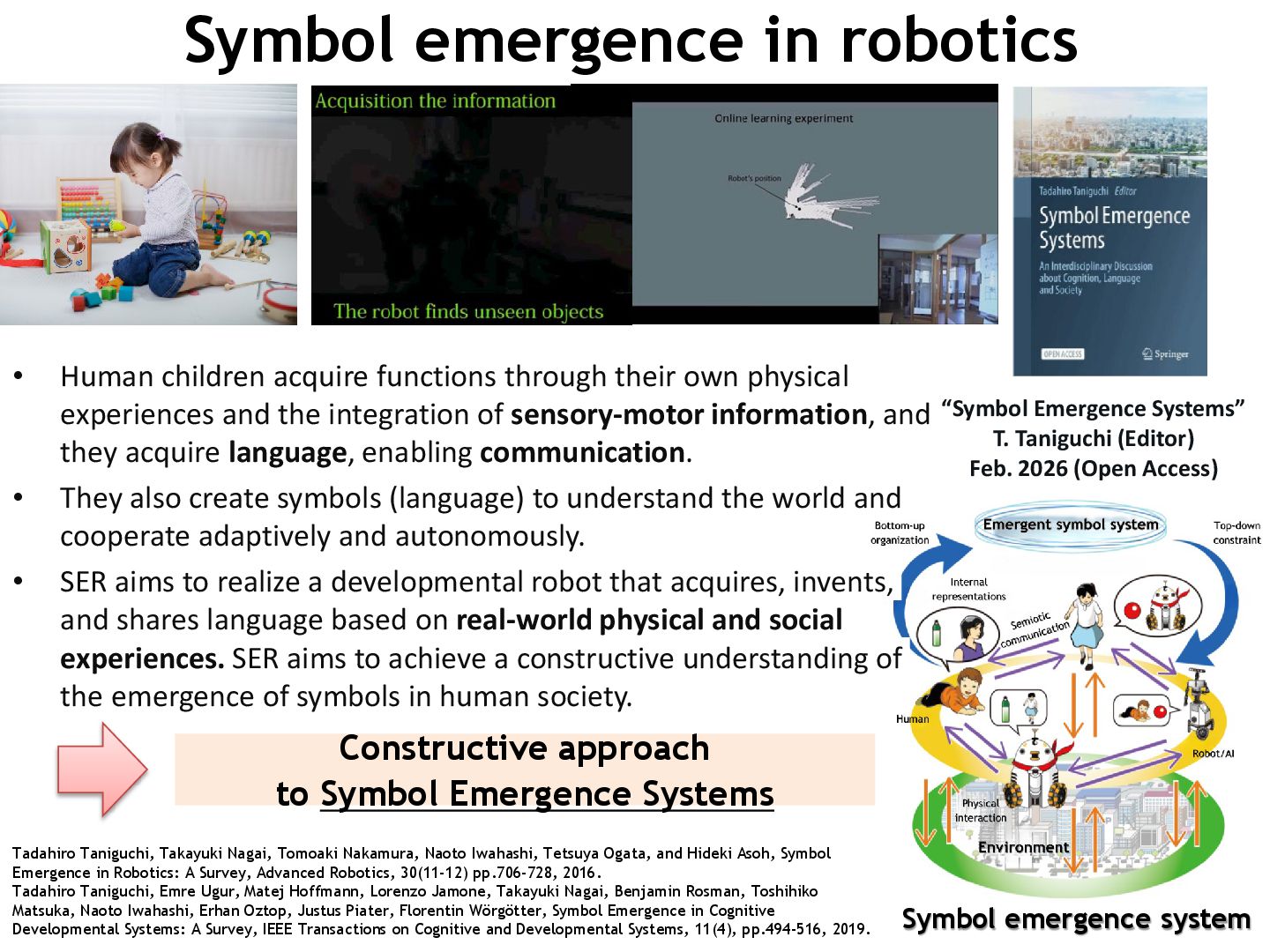
  3. • Human children acquire functions through their own physical experiences

    and the integration of sensory-motor information, and they acquire language, enabling communication. • They also create symbols (language) to understand the world and cooperate adaptively and autonomously. • SER aims to realize a developmental robot that acquires, invents, and shares language based on real-world physical and social experiences. SER aims to achieve a constructive understanding of the emergence of symbols in human society. Constructive approach to Symbol Emergence Systems Symbol emergence system Tadahiro Taniguchi, Takayuki Nagai, Tomoaki Nakamura, Naoto Iwahashi, Tetsuya Ogata, and Hideki Asoh, Symbol Emergence in Robotics: A Survey, Advanced Robotics, 30(11-12) pp.706-728, 2016. Tadahiro Taniguchi, Emre Ugur, Matej Hoffmann, Lorenzo Jamone, Takayuki Nagai, Benjamin Rosman, Toshihiko Matsuka, Naoto Iwahashi, Erhan Oztop, Justus Piater, Florentin Wörgötter, Symbol Emergence in Cognitive Developmental Systems: A Survey, IEEE Transactions on Cognitive and Developmental Systems, 11(4), pp.494-516, 2019. Symbol emergence in robotics “Symbol Emergence Systems” T. Taniguchi (Editor) Feb. 2026 (Open Access)
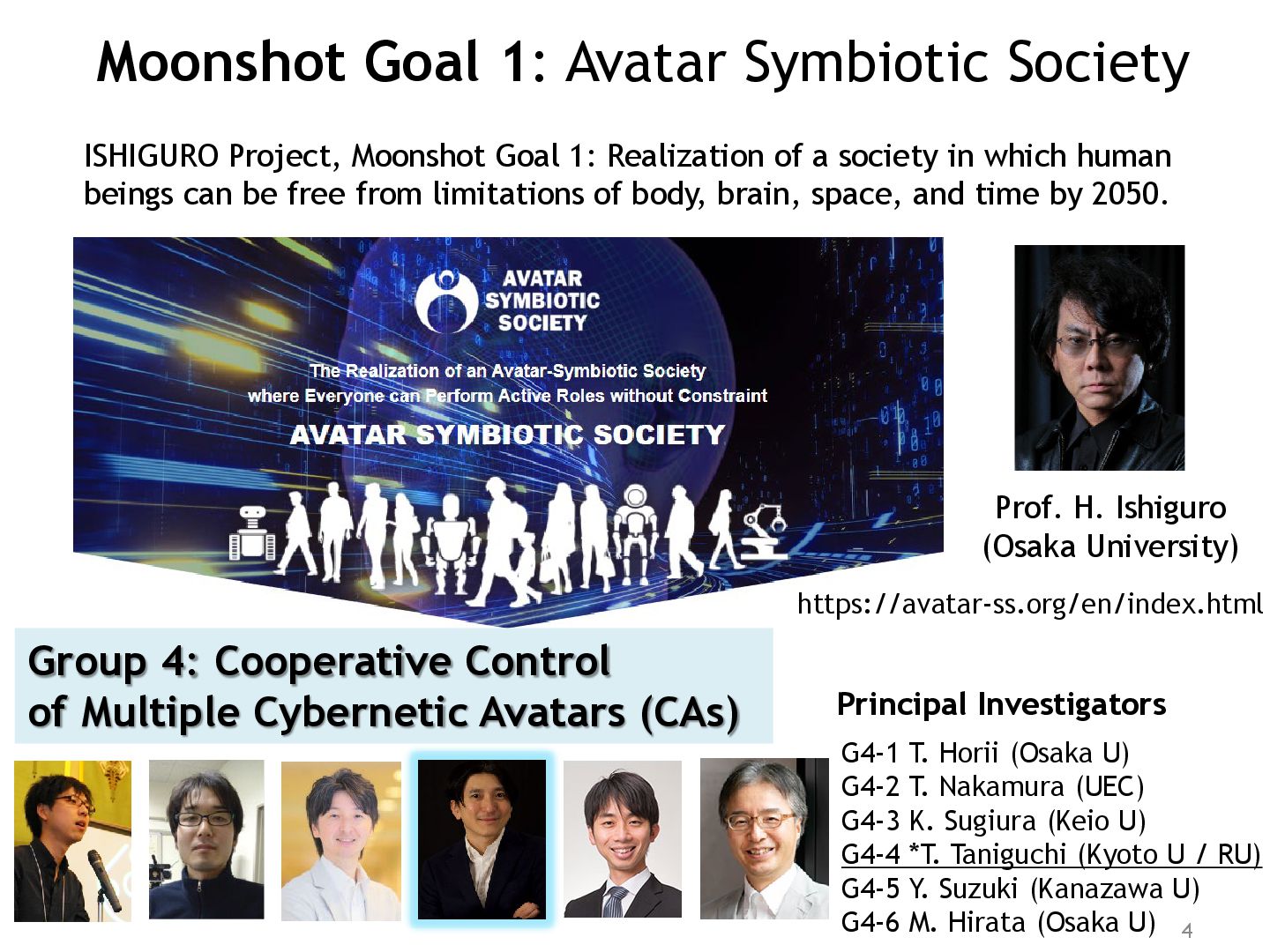
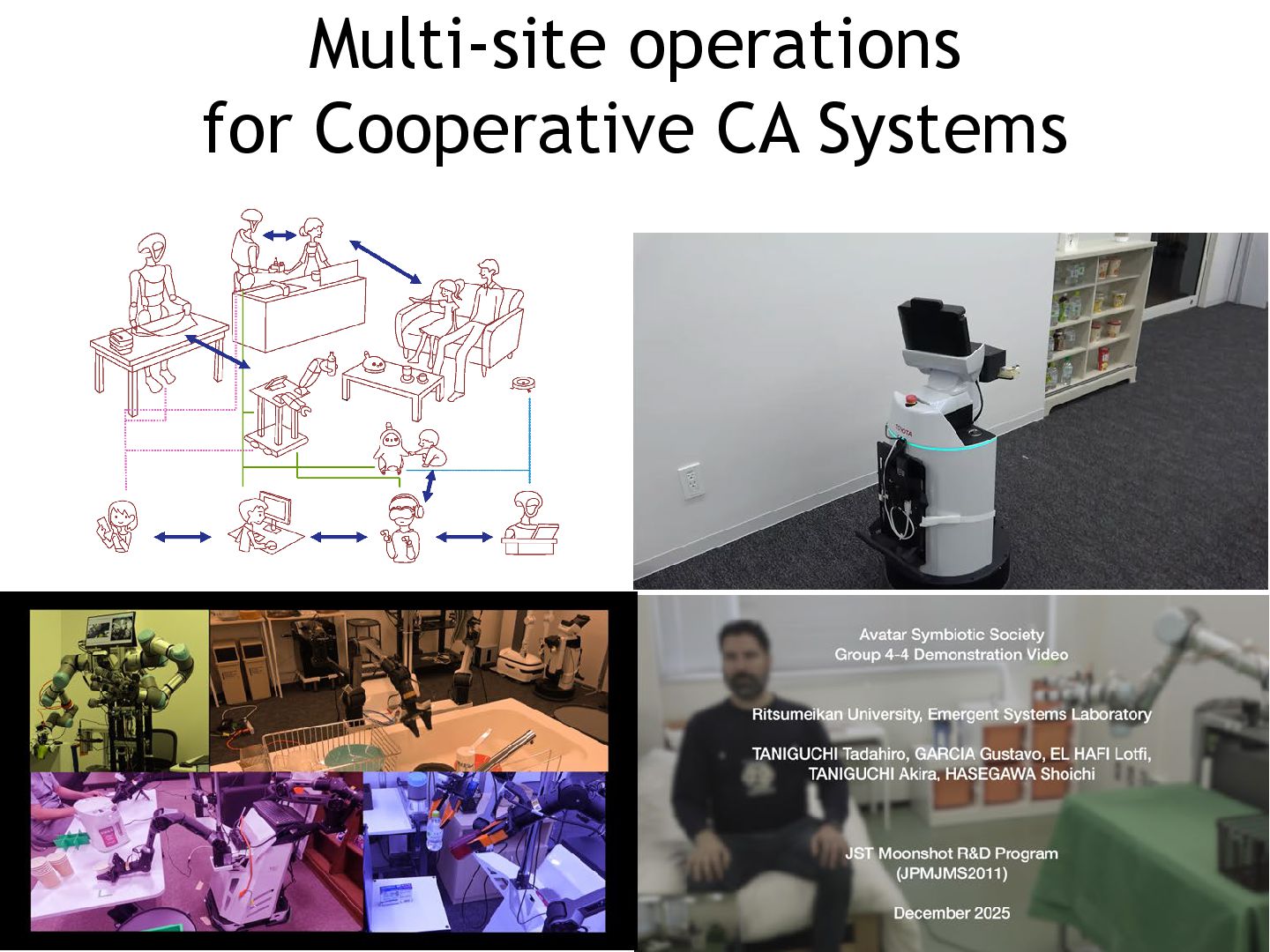
  4. Moonshot Goal 1: Avatar Symbiotic Society 4 ISHIGURO Project, Moonshot

    Goal 1: Realization of a society in which human beings can be free from limitations of body, brain, space, and time by 2050. https://avatar-ss.org/en/index.html Prof. H. Ishiguro (Osaka University) Group 4: Cooperative Control of Multiple Cybernetic Avatars (CAs) G4-1 T. Horii (Osaka U) G4-2 T. Nakamura (UEC) G4-3 K. Sugiura (Keio U) G4-4 *T. Taniguchi (Kyoto U / RU) G4-5 Y. Suzuki (Kanazawa U) G4-6 M. Hirata (Osaka U) Principal Investigators
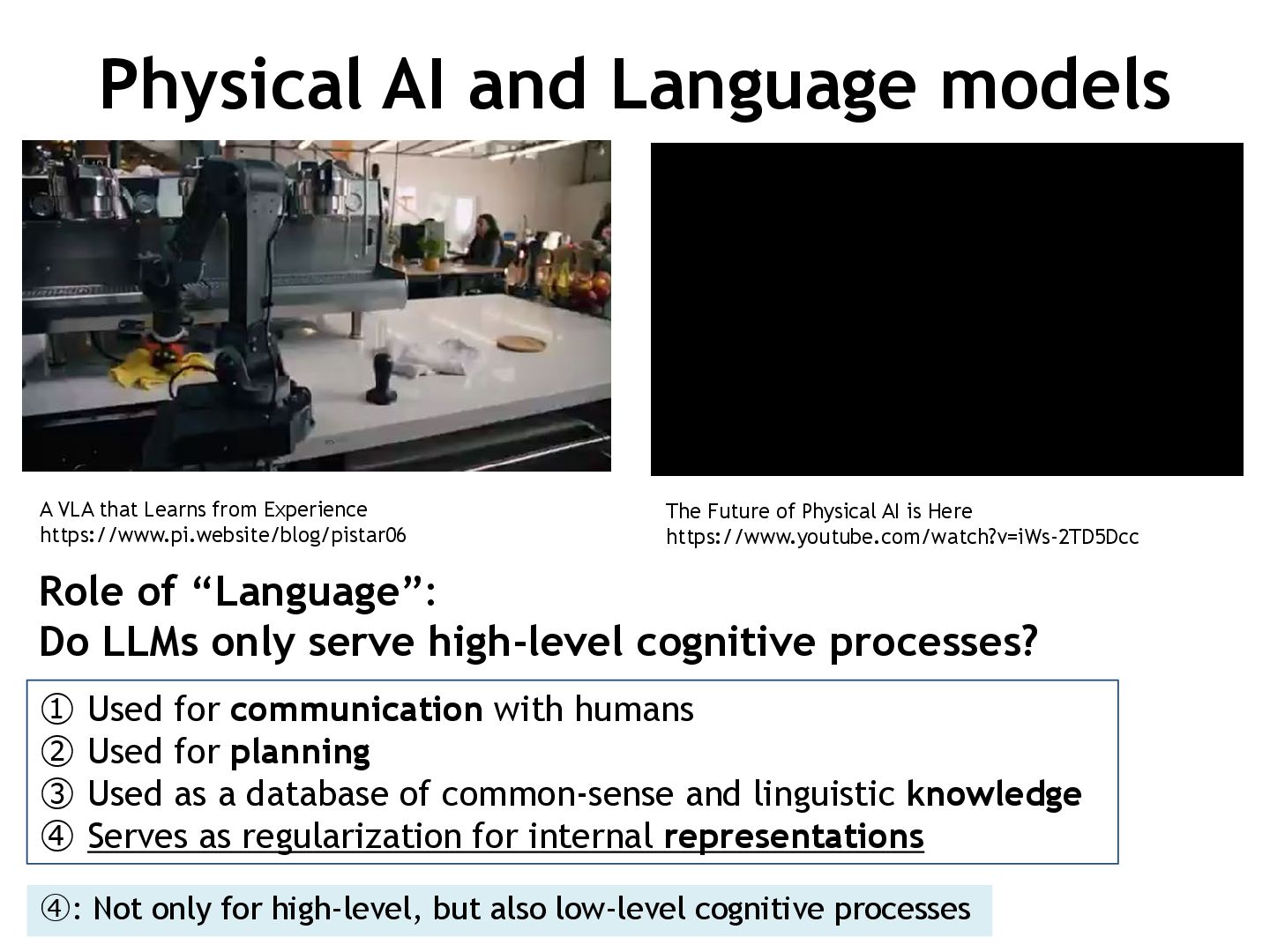
  5. Physical AI and Language models The Future of Physical AI

    is Here https://www.youtube.com/watch?v=iWs-2TD5Dcc A VLA that Learns from Experience https://www.pi.website/blog/pistar06 Role of “Language”: Do LLMs only serve high-level cognitive processes? ① Used for communication with humans ② Used for planning ③ Used as a database of common-sense and linguistic knowledge ④ Serves as regularization for internal representations ④: Not only for high-level, but also low-level cognitive processes
  6. Contents 1. World models and LLMs 2. Symbol Emergence Systems

    3. Collective Predictive Coding 4. System 0/1/2/3 5. Conclusion
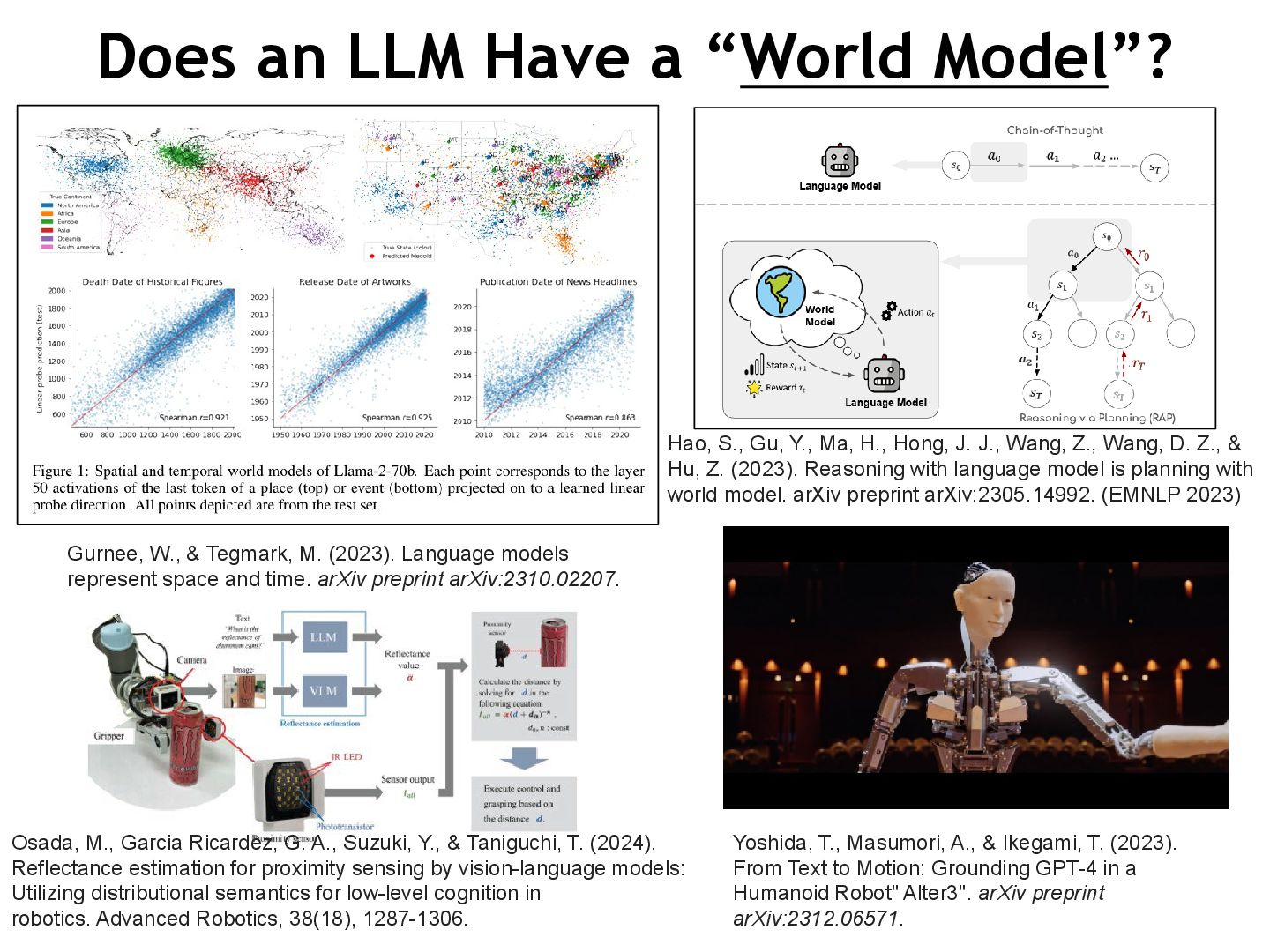
  7. Does an LLM Have a “World Model”? Gurnee, W., &

    Tegmark, M. (2023). Language models represent space and time. arXiv preprint arXiv:2310.02207. Yoshida, T., Masumori, A., & Ikegami, T. (2023). From Text to Motion: Grounding GPT-4 in a Humanoid Robot" Alter3". arXiv preprint arXiv:2312.06571. Hao, S., Gu, Y., Ma, H., Hong, J. J., Wang, Z., Wang, D. Z., & Hu, Z. (2023). Reasoning with language model is planning with world model. arXiv preprint arXiv:2305.14992. (EMNLP 2023) Osada, M., Garcia Ricardez, G. A., Suzuki, Y., & Taniguchi, T. (2024). Reflectance estimation for proximity sensing by vision-language models: Utilizing distributional semantics for low-level cognition in robotics. Advanced Robotics, 38(18), 1287-1306.
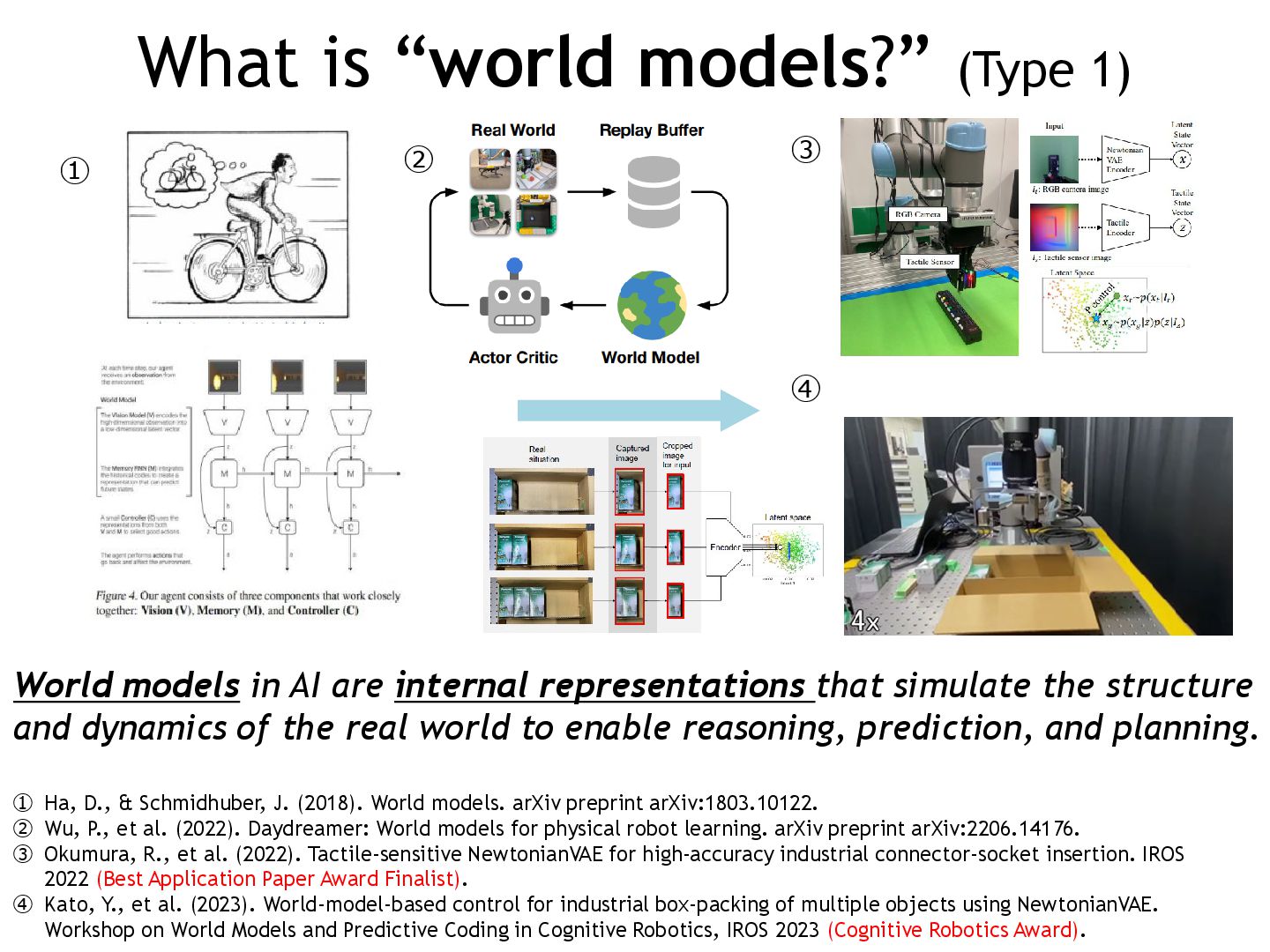
  8. Two Types of “World Models”  [Type 1] World(/Umwelt) Model:

    An internal model that dynamically captures perception-action relations from the agent’s subjective view.  [Type 2] Model of the World: A model possessing objective world knowledge. Taniguchi, T., Murata, S., Suzuki, M., Ognibene, D., Lanillos, P., Ugur, E., Jamone, L., Nakamura, T., Ciria, A., Lara, B., & Pezzulo, G. (2023). World models and predictive coding for cognitive and developmental robotics: frontiers and challenges. Advanced Robotics, 37(13), 780-806. The assertion that “LLMs have a world model” is often intended in the sense of Type 2, but it may nonetheless be computationally or logically related to Type 1.
  9. What is “world models?” (Type 1) ① Ha, D., &

    Schmidhuber, J. (2018). World models. arXiv preprint arXiv:1803.10122. ② Wu, P., et al. (2022). Daydreamer: World models for physical robot learning. arXiv preprint arXiv:2206.14176. ③ Okumura, R., et al. (2022). Tactile-sensitive NewtonianVAE for high-accuracy industrial connector-socket insertion. IROS 2022 (Best Application Paper Award Finalist). ④ Kato, Y., et al. (2023). World-model-based control for industrial box-packing of multiple objects using NewtonianVAE. Workshop on World Models and Predictive Coding in Cognitive Robotics, IROS 2023 (Cognitive Robotics Award). ① ② ③ ④ World models in AI are internal representations that simulate the structure and dynamics of the real world to enable reasoning, prediction, and planning.
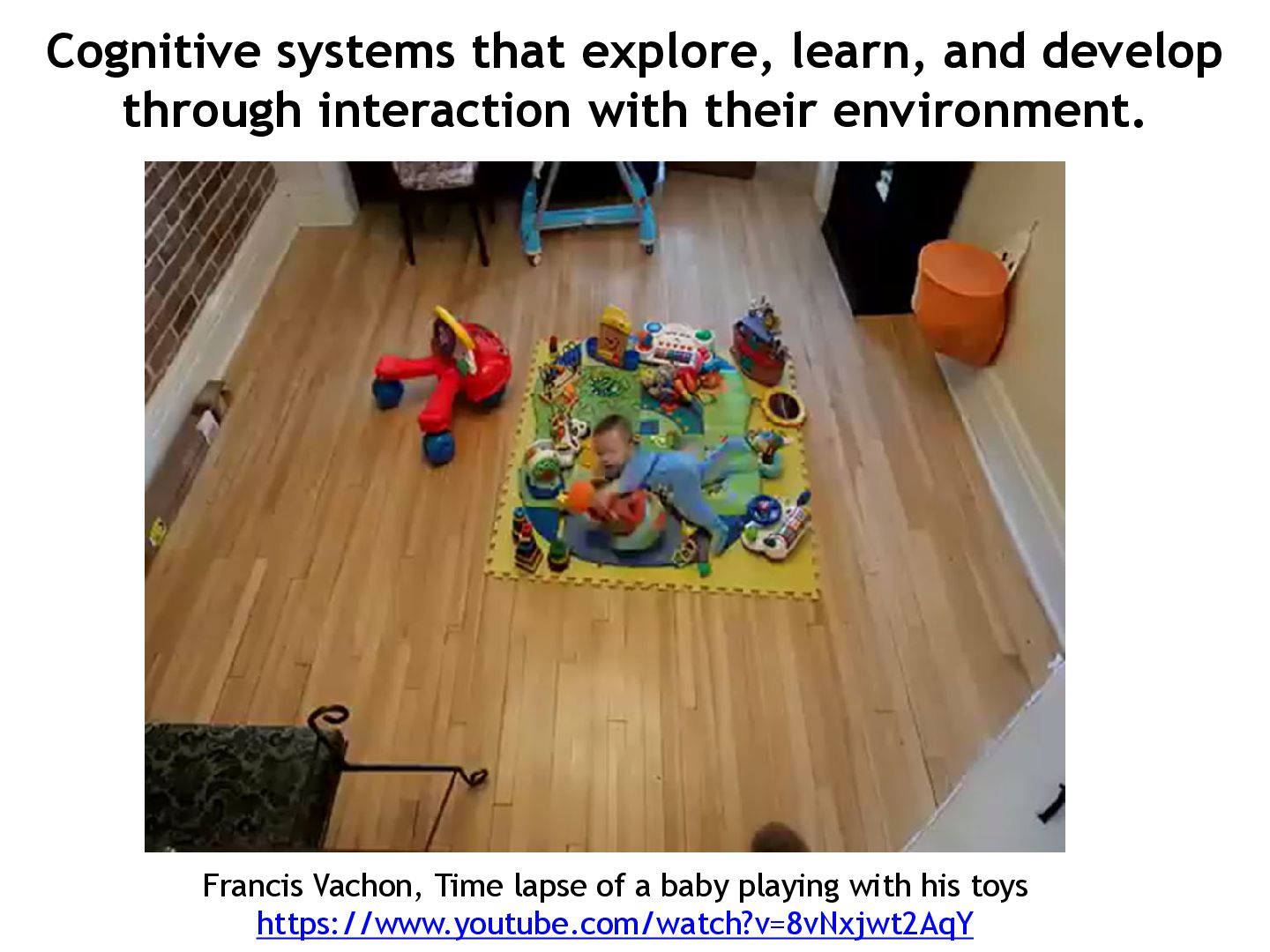
  10. Cognitive systems that explore, learn, and develop through interaction with

    their environment. Francis Vachon, Time lapse of a baby playing with his toys https://www.youtube.com/watch?v=8vNxjwt2AqY
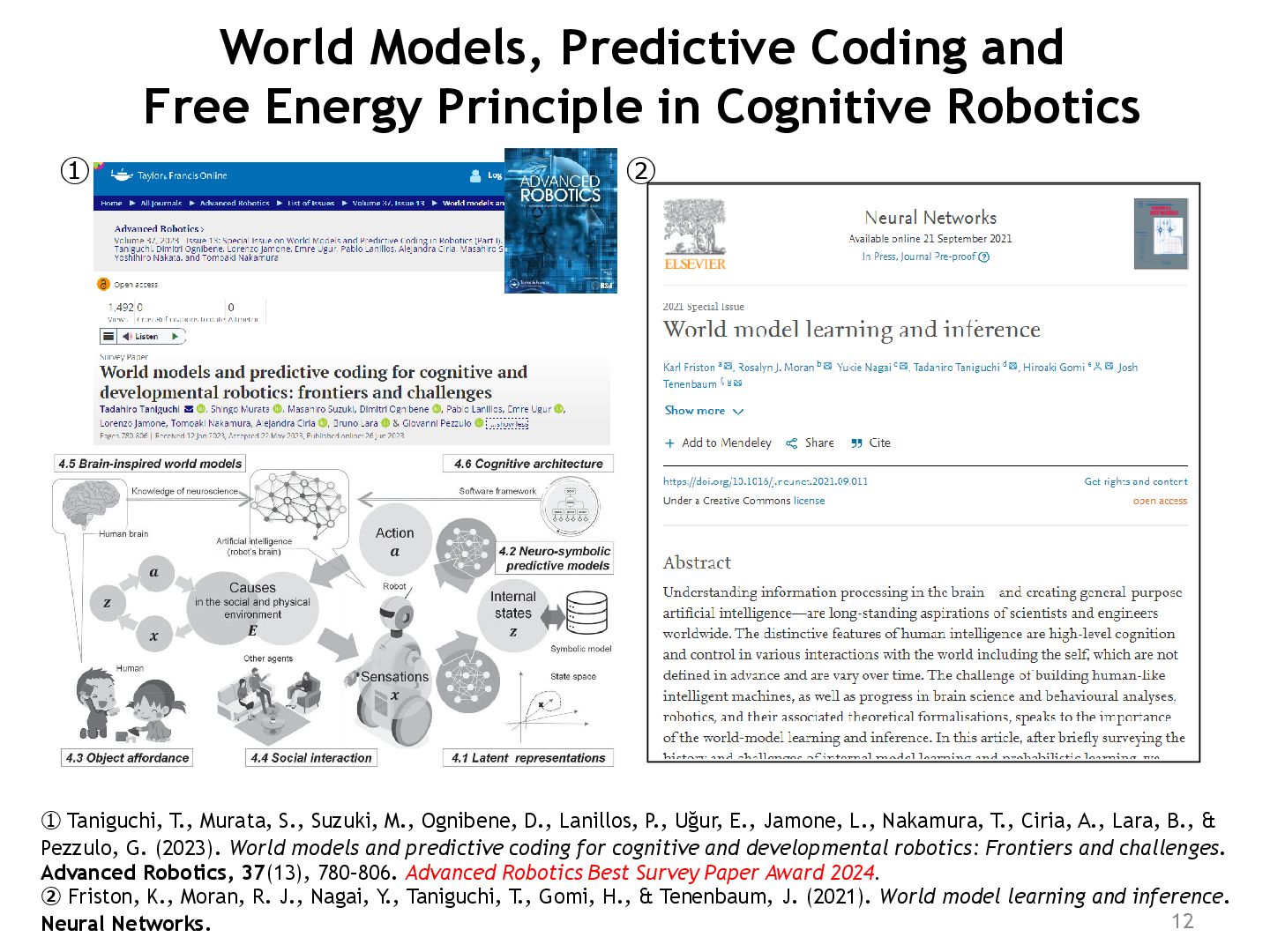
  11. World Models, Predictive Coding and Free Energy Principle in Cognitive

    Robotics 12 ① Taniguchi, T., Murata, S., Suzuki, M., Ognibene, D., Lanillos, P., Uğur, E., Jamone, L., Nakamura, T., Ciria, A., Lara, B., & Pezzulo, G. (2023). World models and predictive coding for cognitive and developmental robotics: Frontiers and challenges. Advanced Robotics, 37(13), 780–806. Advanced Robotics Best Survey Paper Award 2024. ② Friston, K., Moran, R. J., Nagai, Y., Taniguchi, T., Gomi, H., & Tenenbaum, J. (2021). World model learning and inference. Neural Networks. ① ②
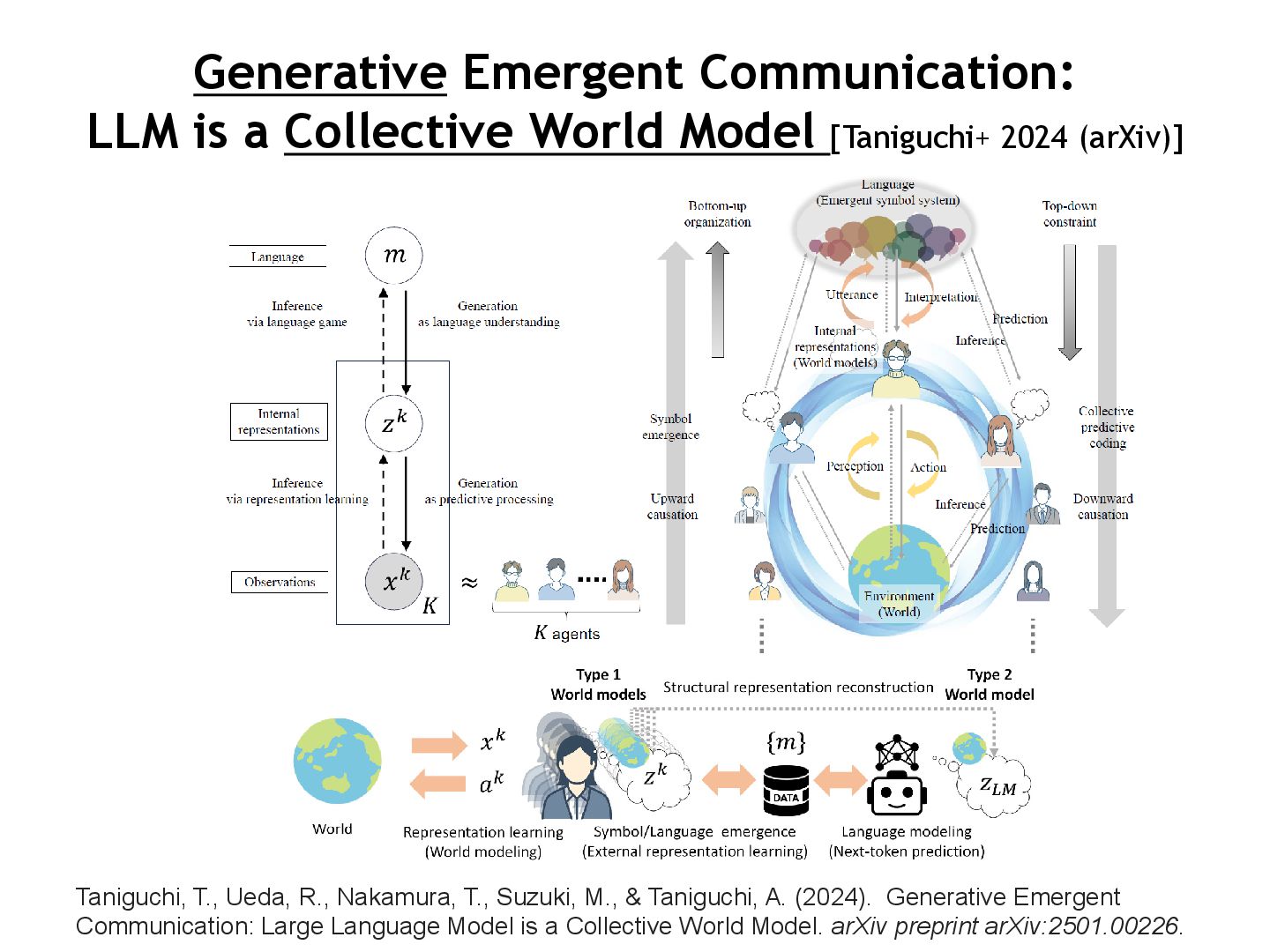
  12. Generative Emergent Communication: LLM is a Collective World Model [Taniguchi+

    2024 (arXiv)] Taniguchi, T., Ueda, R., Nakamura, T., Suzuki, M., & Taniguchi, A. (2024). Generative Emergent Communication: Large Language Model is a Collective World Model. arXiv preprint arXiv:2501.00226.
  13. Contents 1. World models and LLMs 2. Symbol Emergence Systems

    3. Collective Predictive Coding 4. System 0/1/2/3 5. Conclusion
  14. Symbol emergence systems [Taniguchi+ 2016] Tadahiro Taniguchi, Takayuki Nagai, Tomoaki

    Nakamura, Naoto Iwahashi, Tetsuya Ogata, and Hideki Asoh, S ymbol Emergence in Robotics: A Survey, Advanced Robotics, 30(11-12) pp.706-728, 2016. DOI:10.1080/01691864.2016.1164622 Representation learning by individuals (World model learning) 15 “Symbol Emergence Systems” T. Taniguchi (Editor) Feb. 2026 (Open Access)
  15. Symbol emergence systems [Taniguchi+ 2016] Tadahiro Taniguchi, Takayuki Nagai, Tomoaki

    Nakamura, Naoto Iwahashi, Tetsuya Ogata, and Hideki Asoh, S ymbol Emergence in Robotics: A Survey, Advanced Robotics, 30(11-12) pp.706-728, 2016. DOI:10.1080/01691864.2016.1164622 Representation learning by individuals (World model learning) Symbol emergence by groups 16
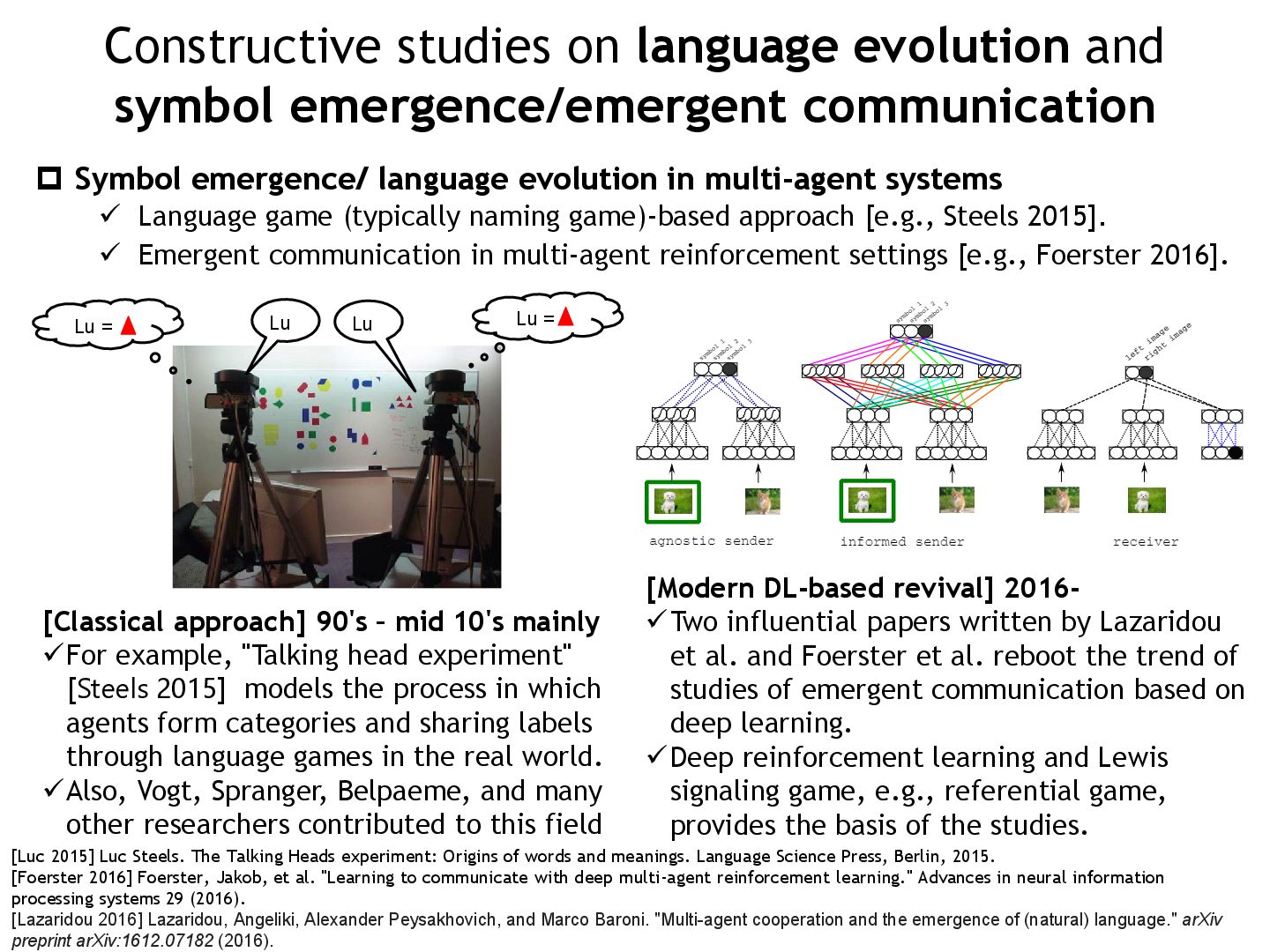
  16. Constructive studies on language evolution and symbol emergence/emergent communication 

    Symbol emergence/ language evolution in multi-agent systems  Language game (typically naming game)-based approach [e.g., Steels 2015].  Emergent communication in multi-agent reinforcement settings [e.g., Foerster 2016]. [Luc 2015] Luc Steels. The Talking Heads experiment: Origins of words and meanings. Language Science Press, Berlin, 2015. [Foerster 2016] Foerster, Jakob, et al. "Learning to communicate with deep multi-agent reinforcement learning." Advances in neural information processing systems 29 (2016). [Lazaridou 2016] Lazaridou, Angeliki, Alexander Peysakhovich, and Marco Baroni. "Multi-agent cooperation and the emergence of (natural) language." arXiv preprint arXiv:1612.07182 (2016). [Classical approach] 90's – mid 10's mainly For example, "Talking head experiment" [Steels 2015] models the process in which agents form categories and sharing labels through language games in the real world. Also, Vogt, Spranger, Belpaeme, and many other researchers contributed to this field Lu Lu Lu = Lu = [Modern DL-based revival] 2016- Two influential papers written by Lazaridou et al. and Foerster et al. reboot the trend of studies of emergent communication based on deep learning. Deep reinforcement learning and Lewis signaling game, e.g., referential game, provides the basis of the studies.
  17. Metropolis-Hastings naming game [Taniguchi+ 2023] Outline 1. Perception: Speaker and

    Listener agents (Sp and Li) observe the d-th object and infer their internal representations (assuming joint attention). 2. Communication: Speaker tells the name of the object probabilistically. The Listener determines if it accepts the naming with a certain probability depending on its belief state. 3. Learning: After the communication is performed, the Listener updates its internal parameters for representation learning and naming. 4. Turn taking: Speaker and Listener alternate their roles and go back to 1. Observation o u Semiotic Communication Representation learning Object Agent A Agent B Internal representations Speaker utters a sign as sampling Listener judges if it accepts the sign Observation Sign  Taniguchi, T., Yoshida, Y., Matsui, Y., Le Hoang, N., Taniguchi, A., & Hagiwara, Y.. Emergent communication through Metropolis-Hastings naming game with deep generative models. Advanced Robotics, 37(19), 1266-1282. (2023)  Yoshinobu Hagiwara , Hiroyoshi Kobayashi, Akira Taniguchi and Tadahiro Taniguchi, Symbol Emergence as an Interpersonal Multimodal Categorization, Frontiers in Robotics and AI, 6(134), pp.1-17, 2019 The acceptance probability depends on how well the proposed name fits the listener's belief.
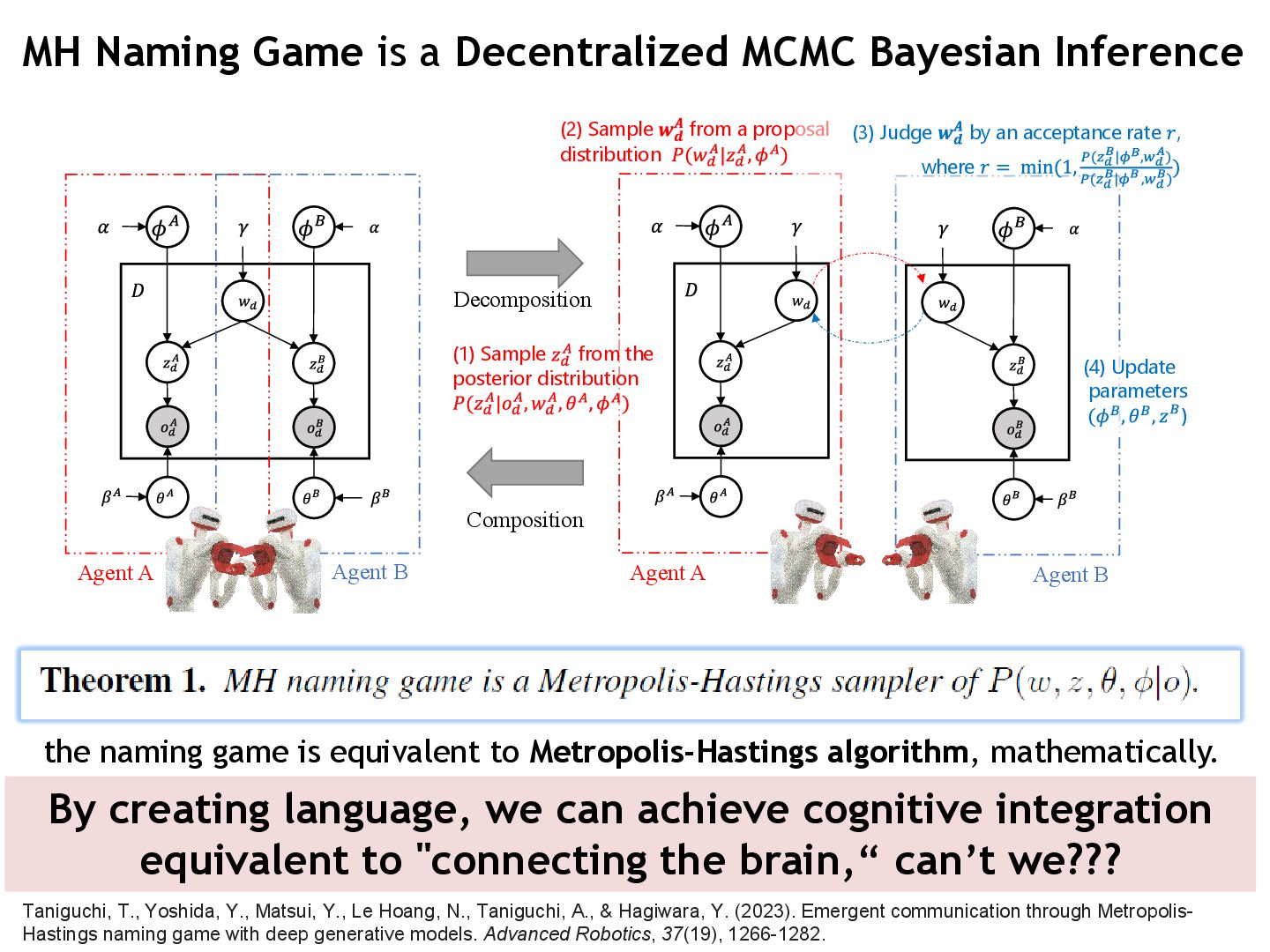
  18. MH Naming Game is a Decentralized MCMC Bayesian Inference Agent

    A Agent B Agent A Agent B (2) Sample from a proposal distribution (3) Judge by an acceptance rate , where (1) Sample from the posterior distribution (4) Update parameters ) Decomposition Composition the naming game is equivalent to Metropolis-Hastings algorithm, mathematically. Taniguchi, T., Yoshida, Y., Matsui, Y., Le Hoang, N., Taniguchi, A., & Hagiwara, Y. (2023). Emergent communication through Metropolis- Hastings naming game with deep generative models. Advanced Robotics, 37(19), 1266-1282. By creating language, we can achieve cognitive integration equivalent to "connecting the brain,“ can’t we???
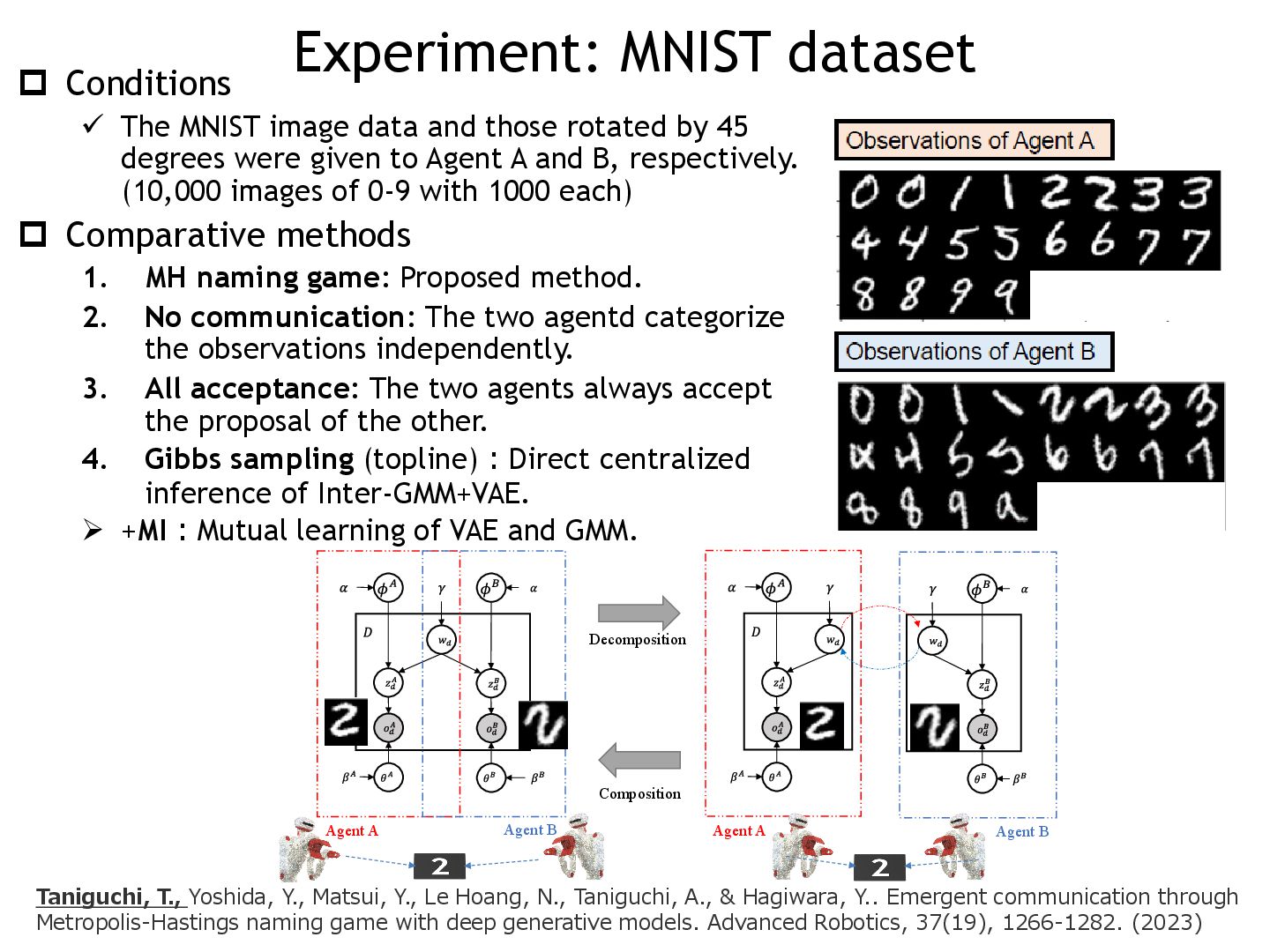
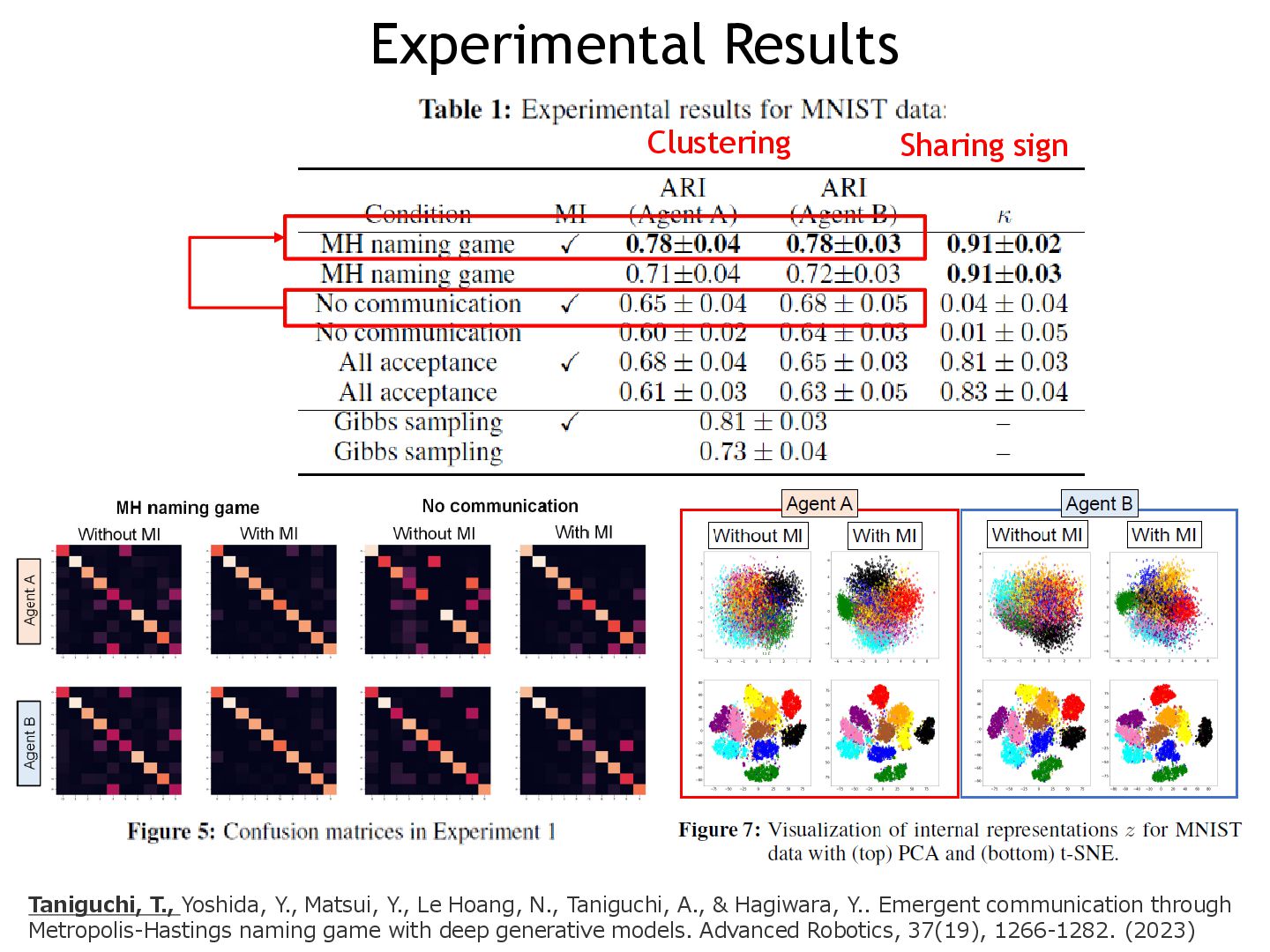
  19. Experiment: MNIST dataset  Conditions  The MNIST image data

    and those rotated by 45 degrees were given to Agent A and B, respectively. (10,000 images of 0-9 with 1000 each)  Comparative methods 1. MH naming game: Proposed method. 2. No communication: The two agentd categorize the observations independently. 3. All acceptance: The two agents always accept the proposal of the other. 4. Gibbs sampling (topline):Direct centralized inference of Inter-GMM+VAE.  +MI:Mutual learning of VAE and GMM. Agent A Agent B Agent A Agent B Decomposition Composition Taniguchi, T., Yoshida, Y., Matsui, Y., Le Hoang, N., Taniguchi, A., & Hagiwara, Y.. Emergent communication through Metropolis-Hastings naming game with deep generative models. Advanced Robotics, 37(19), 1266-1282. (2023)
  20. Experimental Results Clustering Sharing sign Taniguchi, T., Yoshida, Y., Matsui,

    Y., Le Hoang, N., Taniguchi, A., & Hagiwara, Y.. Emergent communication through Metropolis-Hastings naming game with deep generative models. Advanced Robotics, 37(19), 1266-1282. (2023)
  21. Contents 1. World models and LLMs 2. Symbol Emergence Systems

    3. Collective Predictive Coding 4. System 0/1/2/3 5. Conclusion
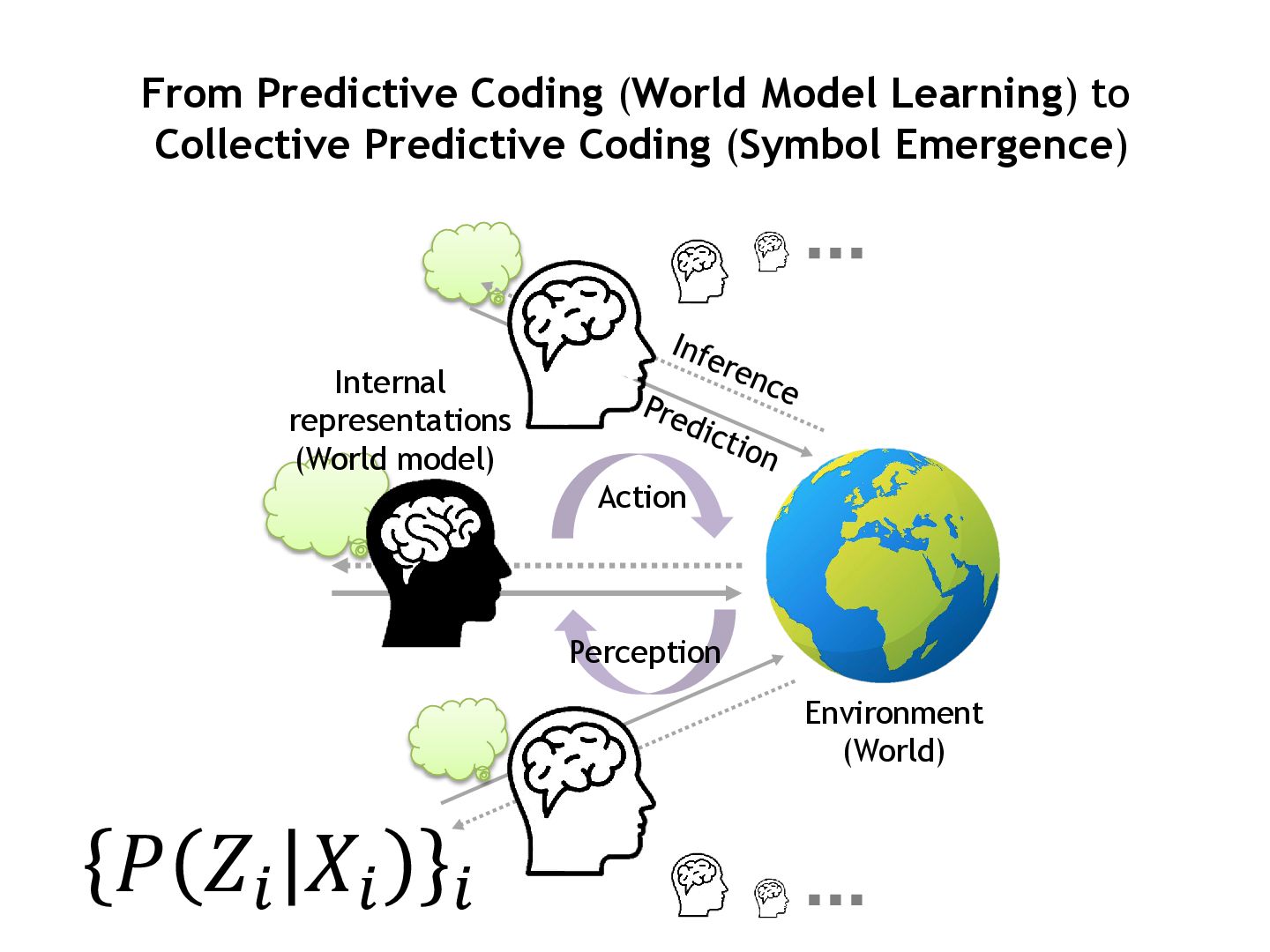
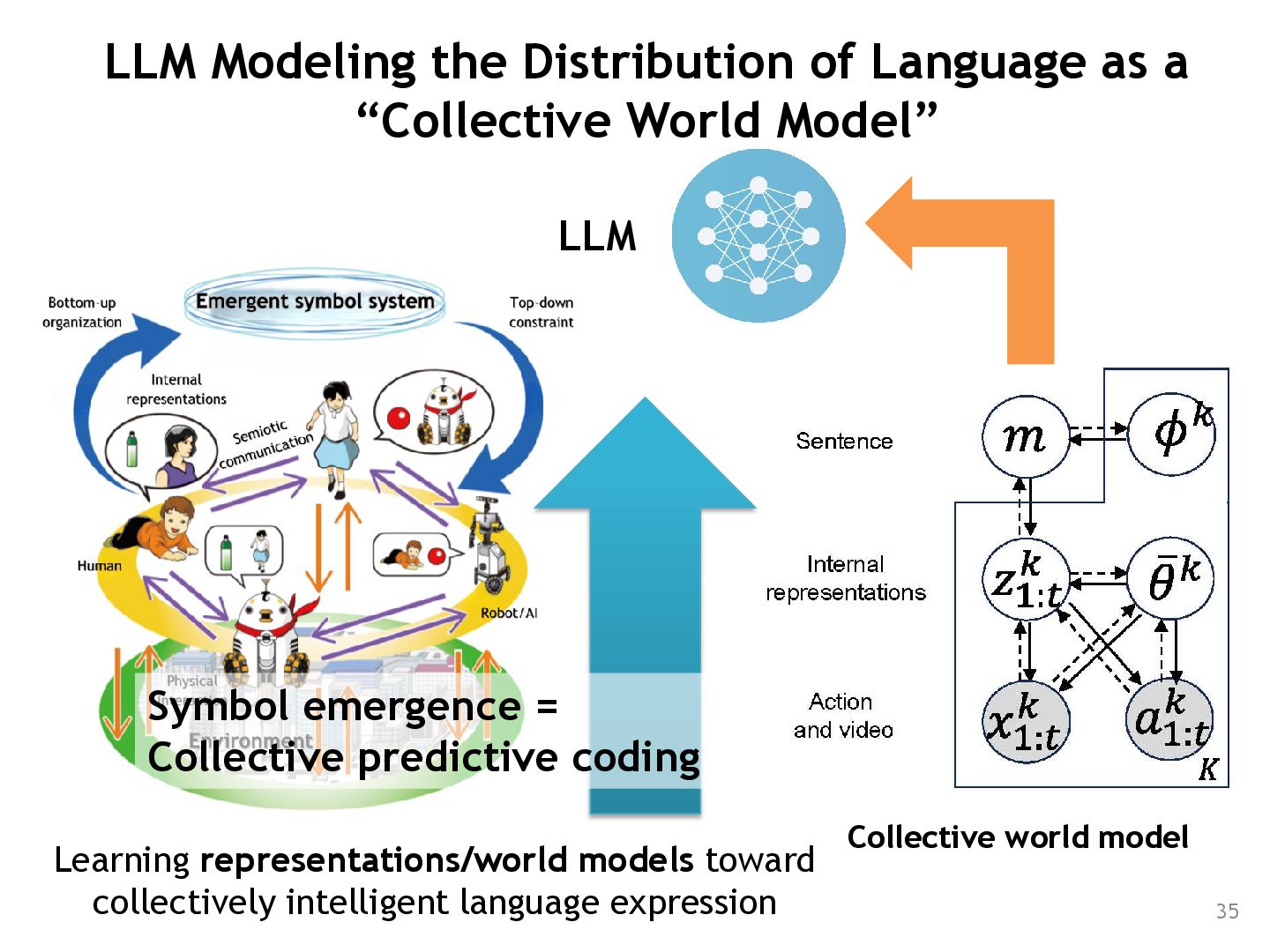
  22. Collective Predictive Coding Hypothesis [Taniguchi ‘24]  Language is formed

    through collective predictive coding (CPC) performed by humans. Therefore, the information of the world is coded in distributional semantics.  Symbol/language emergence can be understood as a social (external) representation learning. Taniguchi, Tadahiro. "Collective predictive coding hypothesis: Symbol emergence as decentralized Bayesian inference." Frontiers in Robotics and AI 11 (2024): 1353870. (Outstanding article award)
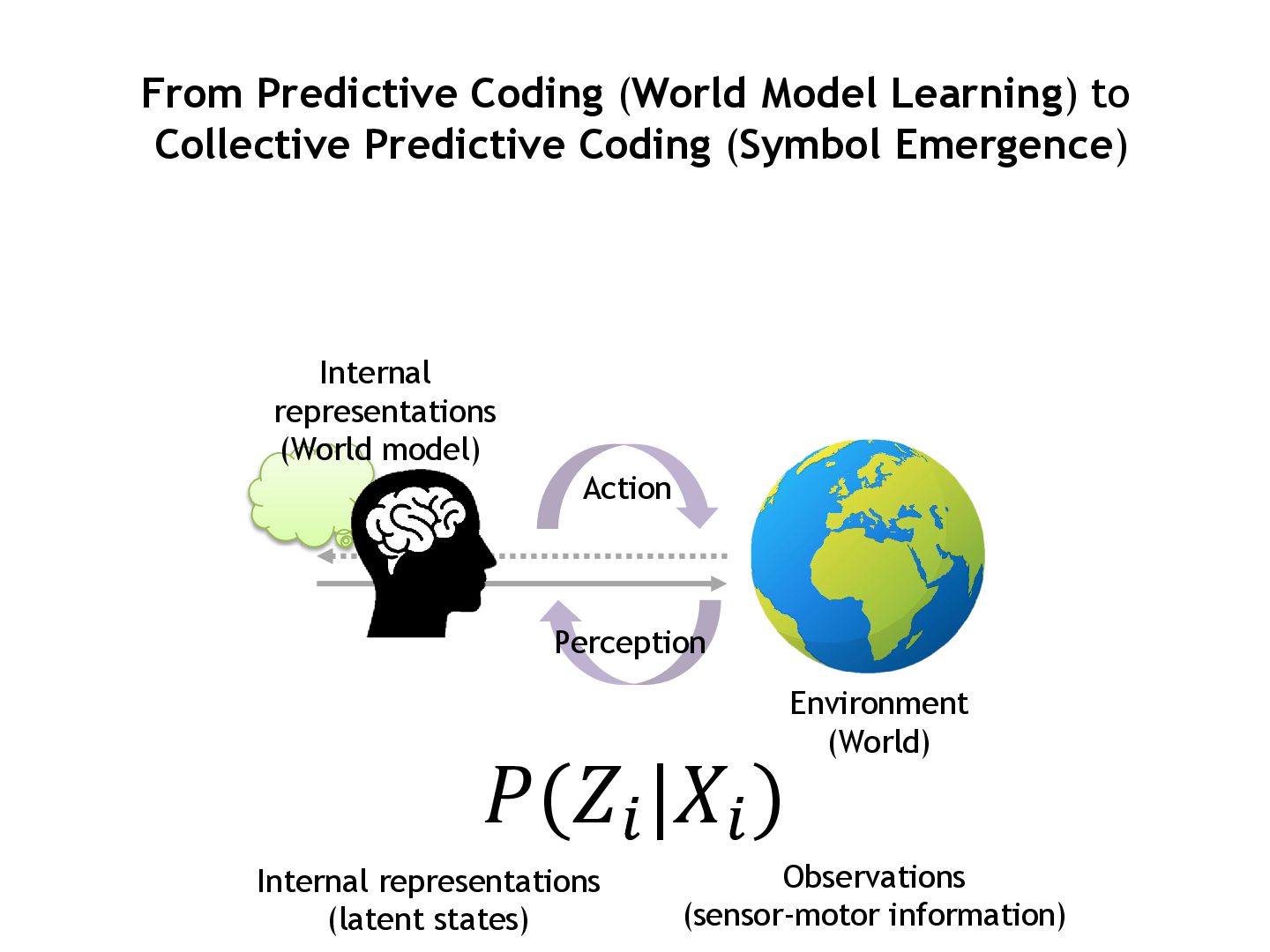
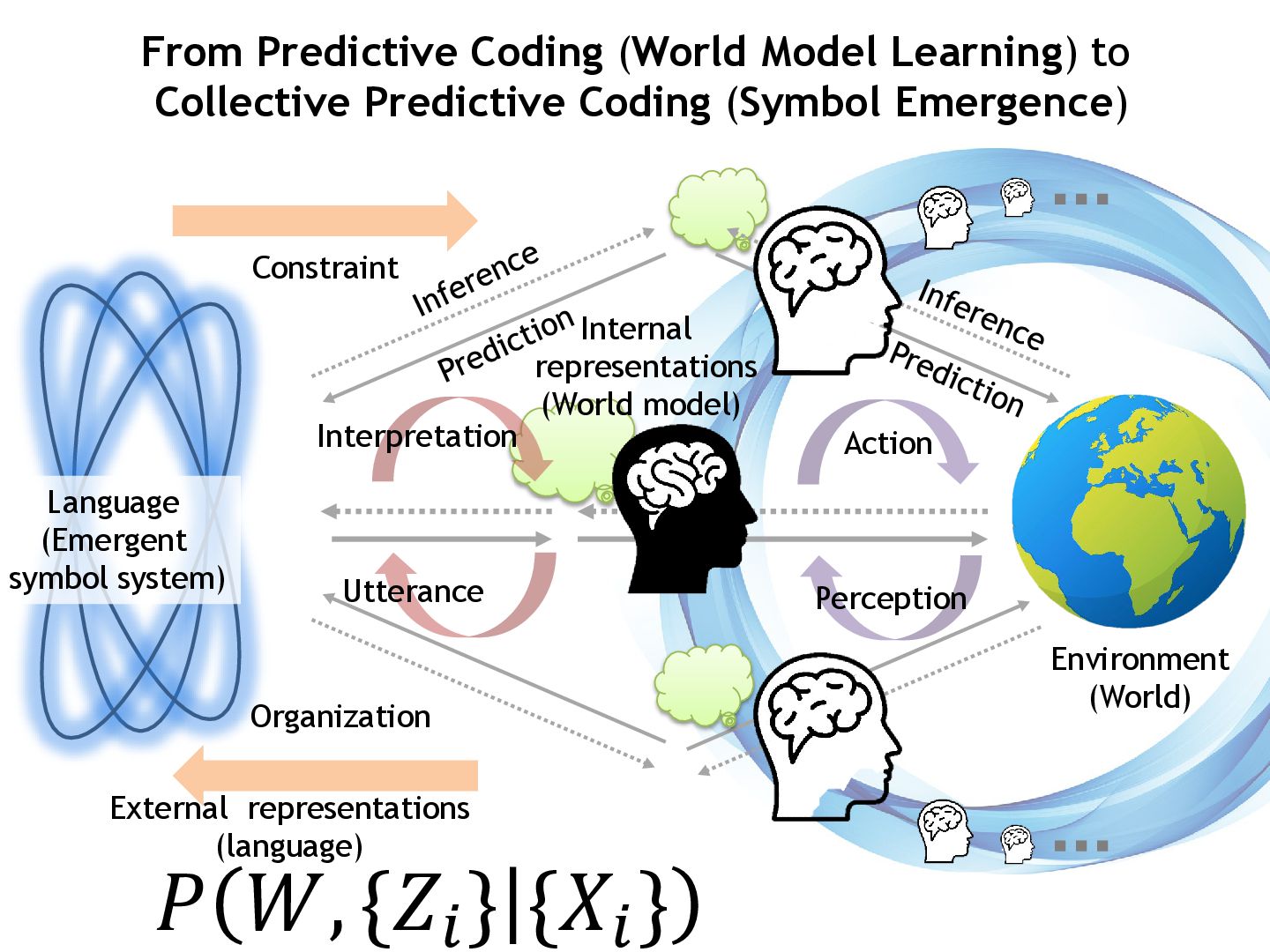
  23. Action Perception Internal representations (World model) Environment (World) From Predictive

    Coding (World Model Learning) to Collective Predictive Coding (Symbol Emergence) 𝑃𝑃(𝑍𝑍𝑖𝑖 |𝑋𝑋𝑖𝑖 ) Internal representations (latent states) Observations (sensor-motor information)
  24. Action Perception Internal representations (World model) Environment (World) From Predictive

    Coding (World Model Learning) to Collective Predictive Coding (Symbol Emergence) 𝑃𝑃 𝑍𝑍𝑖𝑖 𝑋𝑋𝑖𝑖 𝑖𝑖
  25. Action Perception Internal representations (World model) Language (Emergent symbol system)

    Environment (World) Utterance Interpretation Constraint Organization From Predictive Coding (World Model Learning) to Collective Predictive Coding (Symbol Emergence) 𝑃𝑃 𝑊𝑊, {𝑍𝑍𝑖𝑖 } {𝑋𝑋𝑖𝑖 } External representations (language)
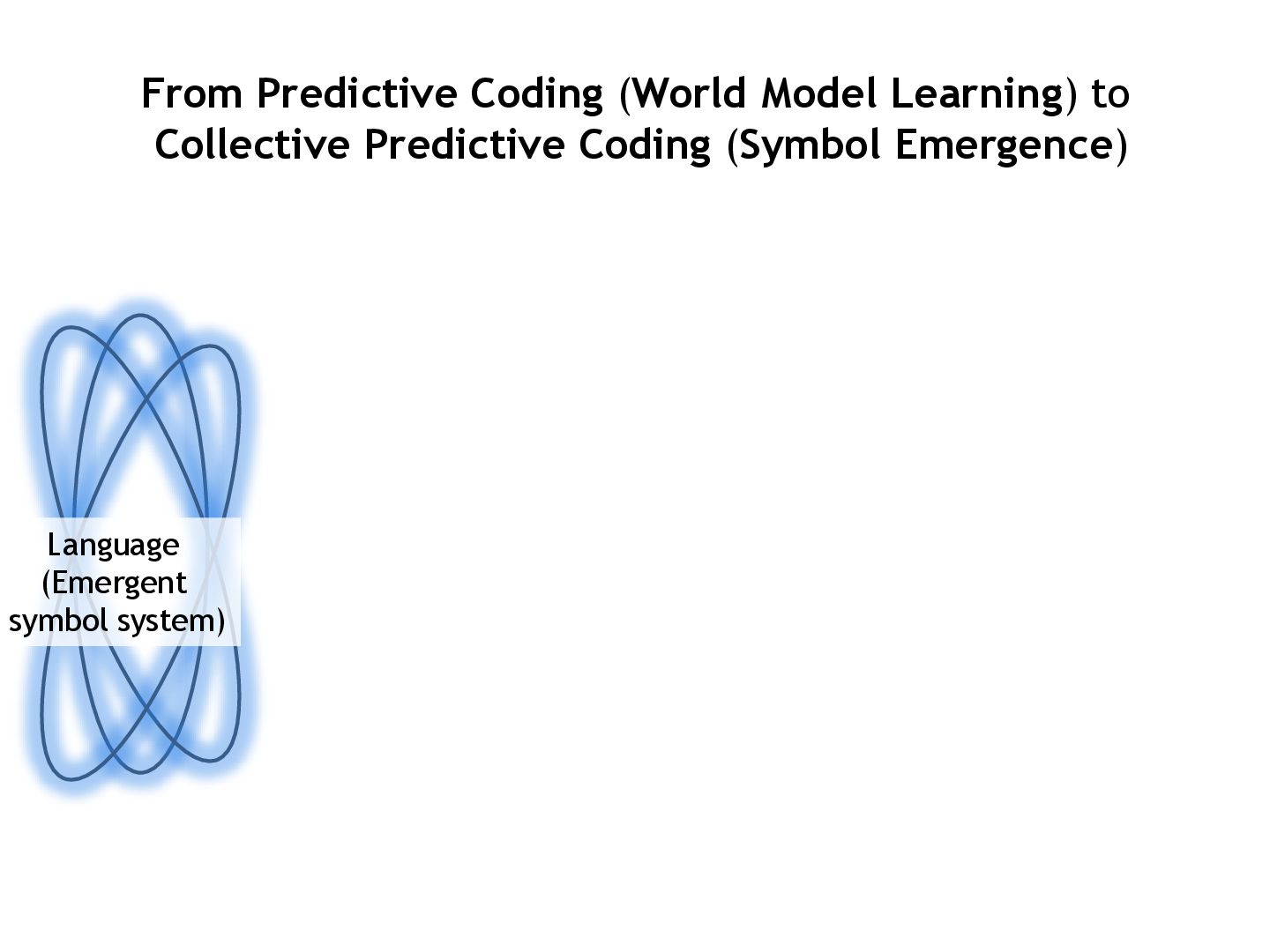
  26. Language (Emergent symbol system) From Predictive Coding (World Model Learning)

    to Collective Predictive Coding (Symbol Emergence)
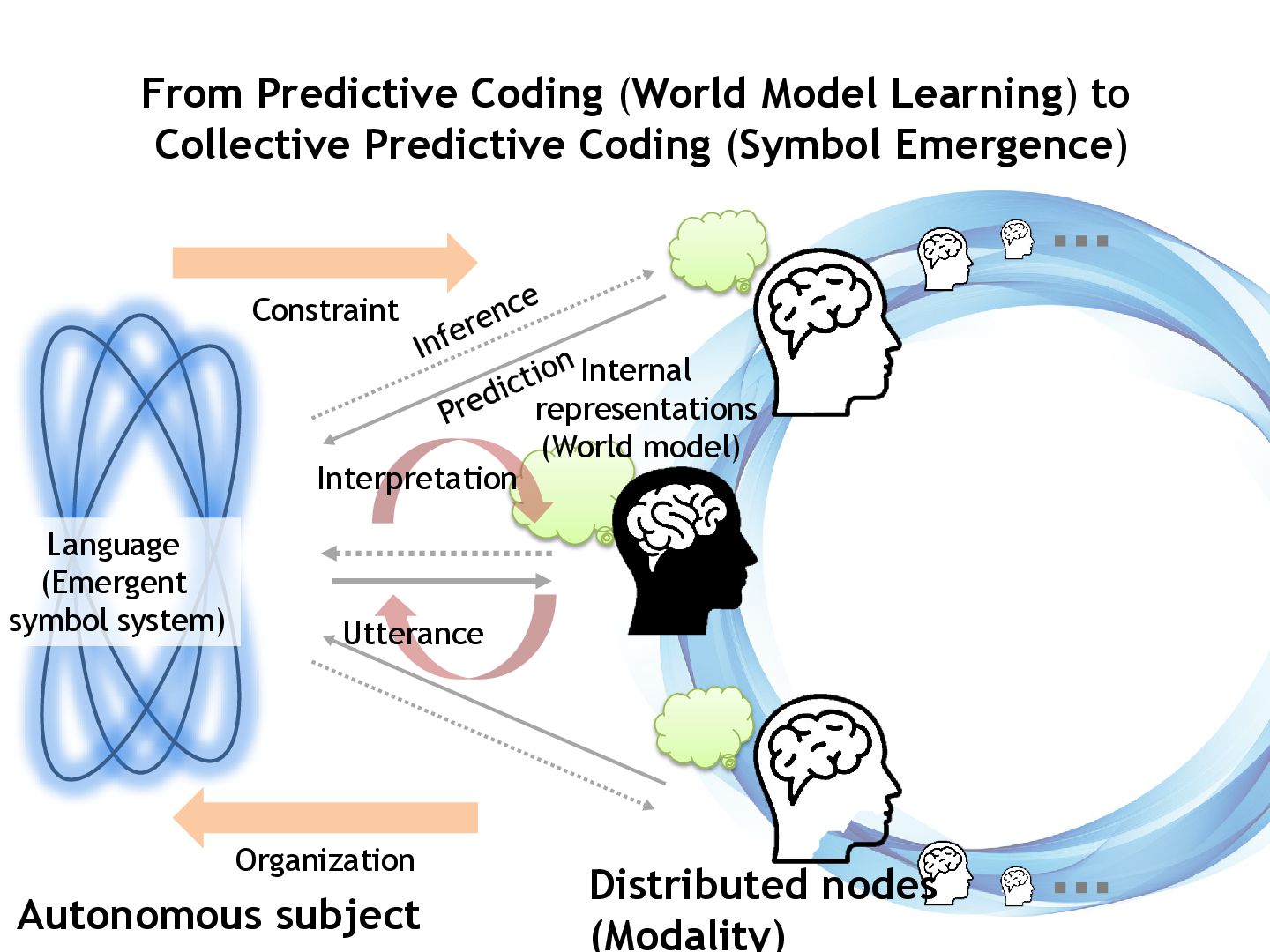
  27. Internal representations (World model) Language (Emergent symbol system) Utterance Interpretation

    Constraint Organization From Predictive Coding (World Model Learning) to Collective Predictive Coding (Symbol Emergence) Autonomous subject Distributed nodes (Modality)
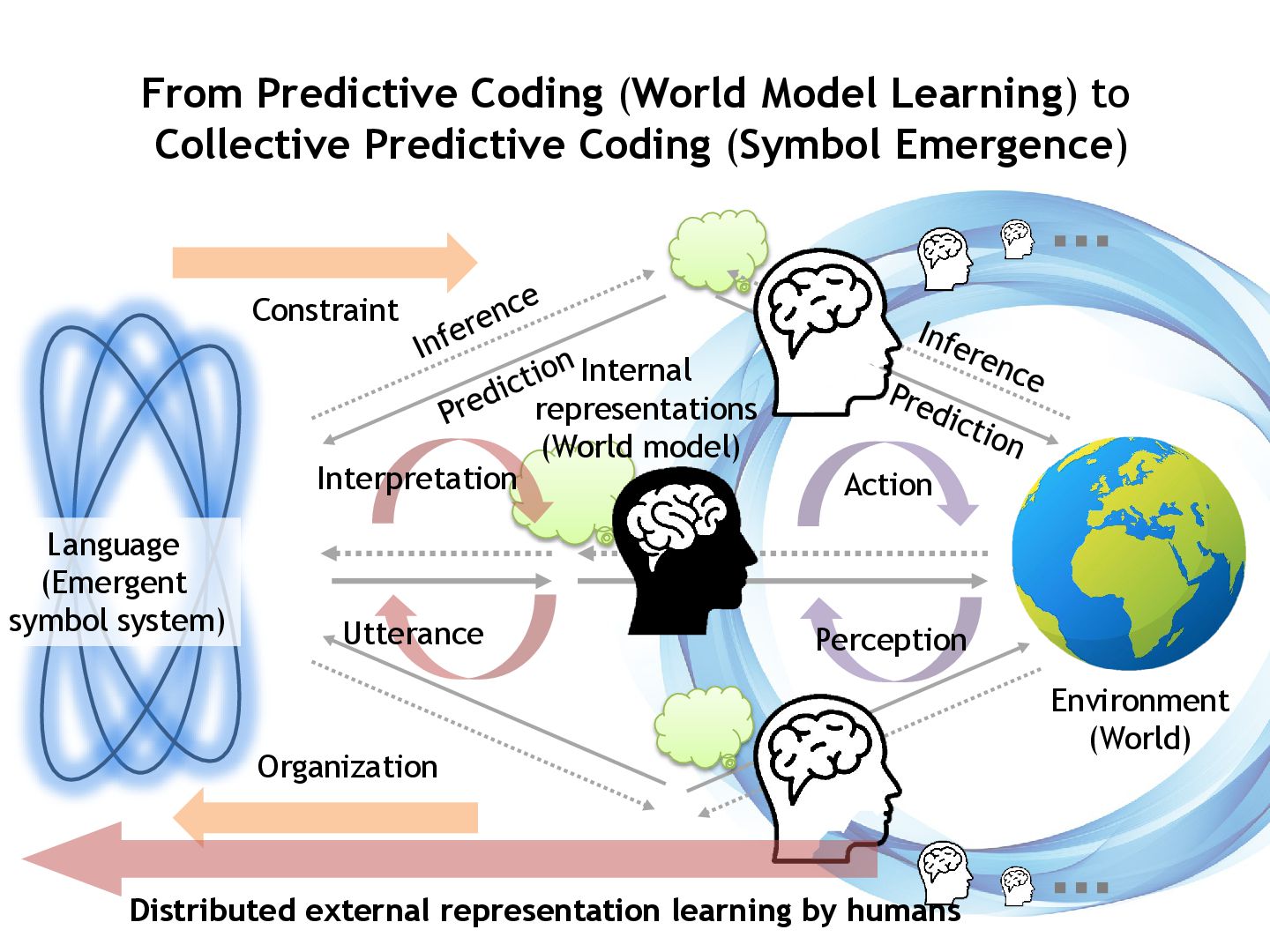
  28. Action Perception Internal representations (World model) Language (Emergent symbol system)

    Environment (World) Utterance Interpretation Constraint Organization From Predictive Coding (World Model Learning) to Collective Predictive Coding (Symbol Emergence) Distributed external representation learning by humans
  29. 30  Taniguchi, T., Takagi, S., Otsuka, J., Hayashi, Y.,

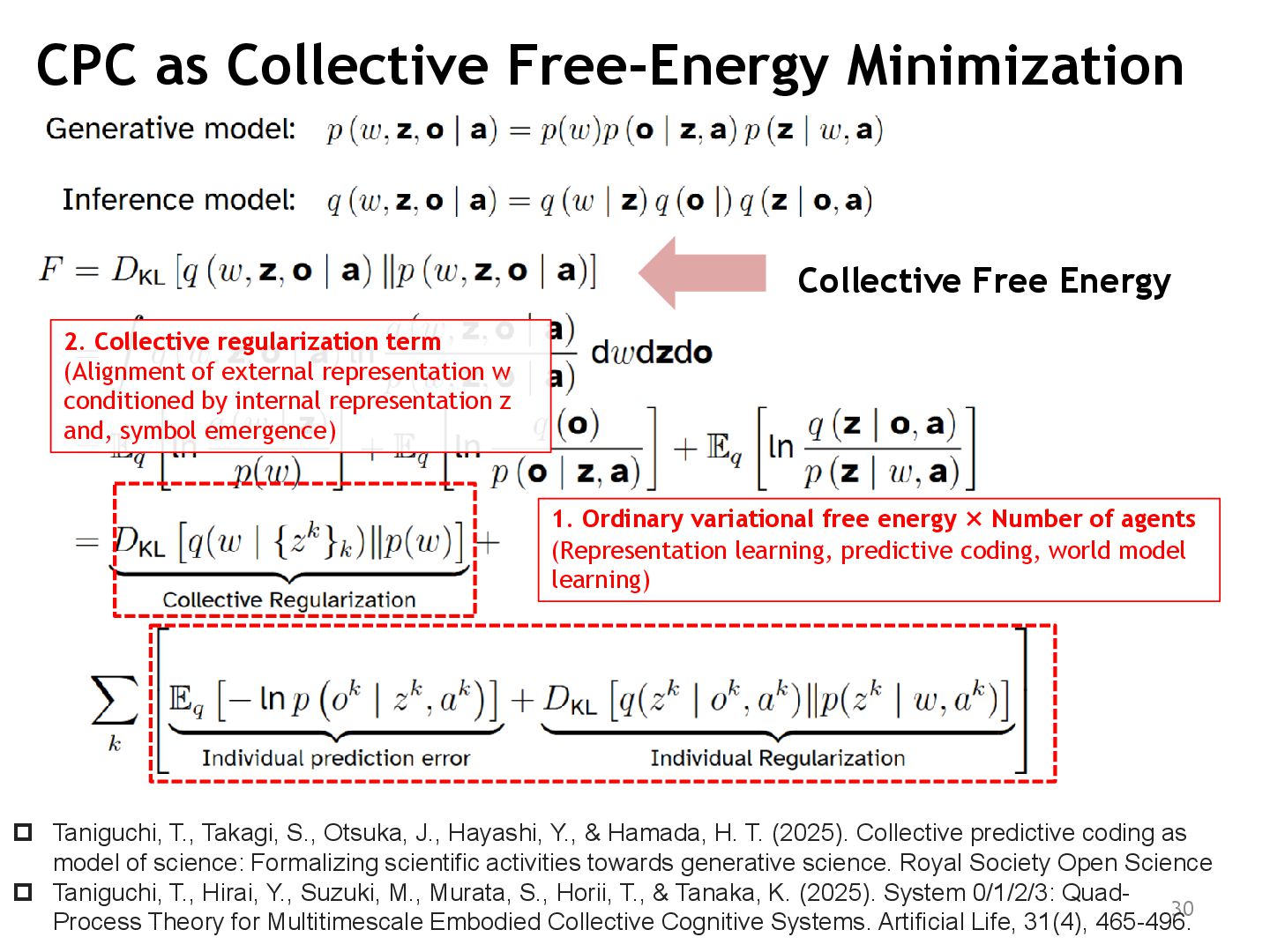
    & Hamada, H. T. (2025). Collective predictive coding as model of science: Formalizing scientific activities towards generative science. Royal Society Open Science  Taniguchi, T., Hirai, Y., Suzuki, M., Murata, S., Horii, T., & Tanaka, K. (2025). System 0/1/2/3: Quad- Process Theory for Multitimescale Embodied Collective Cognitive Systems. Artificial Life, 31(4), 465-496. CPC as Collective Free-Energy Minimization 1. Ordinary variational free energy × Number of agents (Representation learning, predictive coding, world model learning) 2. Collective regularization term (Alignment of external representation w conditioned by internal representation z and, symbol emergence) Collective Free Energy
  30. Extensions of Generative Emergent Communication 31 1. Inukai, J., Taniguchi,

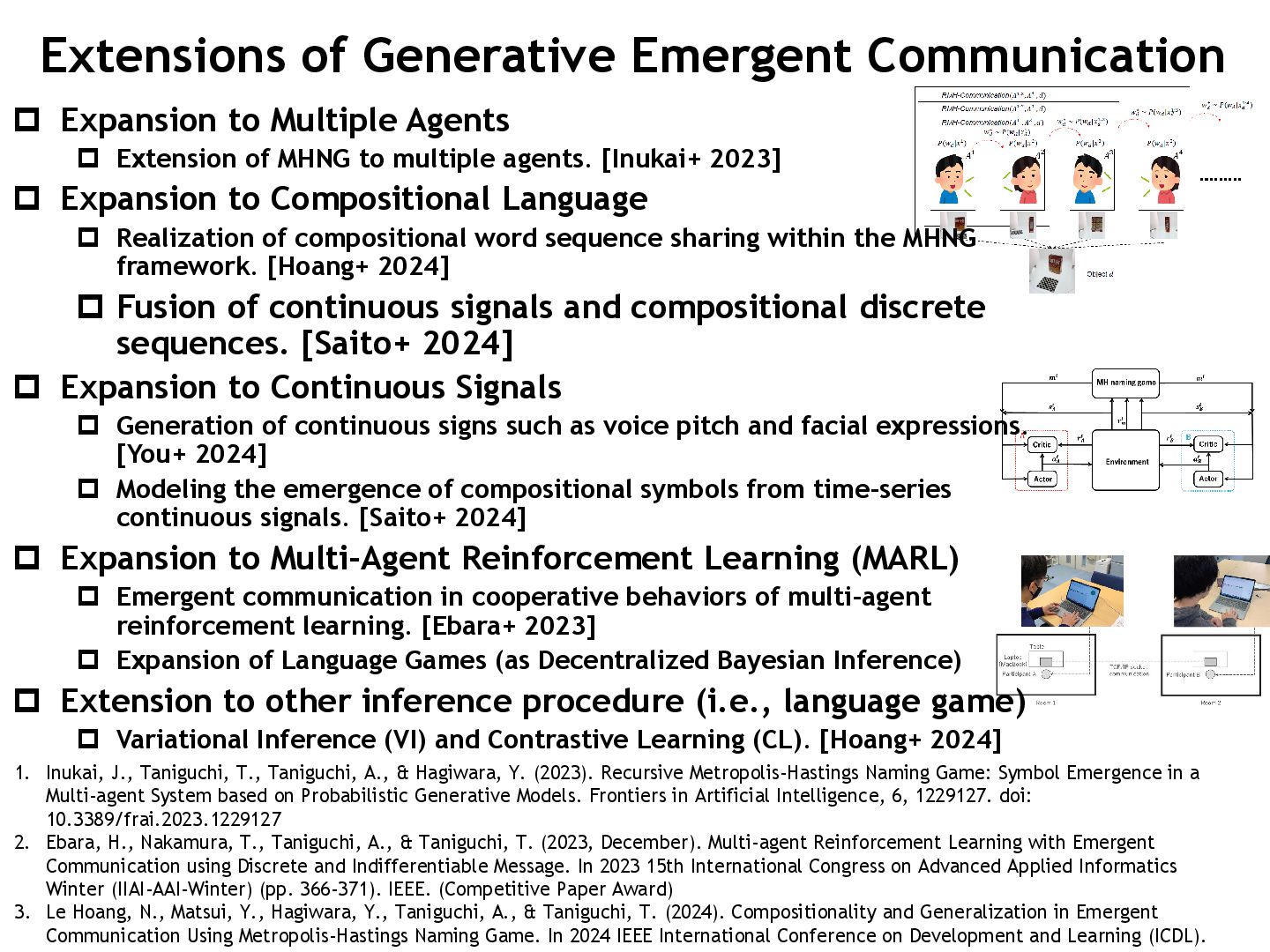
    T., Taniguchi, A., & Hagiwara, Y. (2023). Recursive Metropolis-Hastings Naming Game: Symbol Emergence in a Multi-agent System based on Probabilistic Generative Models. Frontiers in Artificial Intelligence, 6, 1229127. doi: 10.3389/frai.2023.1229127 2. Ebara, H., Nakamura, T., Taniguchi, A., & Taniguchi, T. (2023, December). Multi-agent Reinforcement Learning with Emergent Communication using Discrete and Indifferentiable Message. In 2023 15th International Congress on Advanced Applied Informatics Winter (IIAI-AAI-Winter) (pp. 366-371). IEEE. (Competitive Paper Award) 3. Le Hoang, N., Matsui, Y., Hagiwara, Y., Taniguchi, A., & Taniguchi, T. (2024). Compositionality and Generalization in Emergent Communication Using Metropolis-Hastings Naming Game. In 2024 IEEE International Conference on Development and Learning (ICDL).  Expansion to Multiple Agents  Extension of MHNG to multiple agents. [Inukai+ 2023]  Expansion to Compositional Language  Realization of compositional word sequence sharing within the MHNG framework. [Hoang+ 2024]  Fusion of continuous signals and compositional discrete sequences. [Saito+ 2024]  Expansion to Continuous Signals  Generation of continuous signs such as voice pitch and facial expressions. [You+ 2024]  Modeling the emergence of compositional symbols from time-series continuous signals. [Saito+ 2024]  Expansion to Multi-Agent Reinforcement Learning (MARL)  Emergent communication in cooperative behaviors of multi-agent reinforcement learning. [Ebara+ 2023]  Expansion of Language Games (as Decentralized Bayesian Inference)  Extension to other inference procedure (i.e., language game)  Variational Inference (VI) and Contrastive Learning (CL). [Hoang+ 2024]
  31. Bayesian Integration of Multiple Vision-Language Models through a Caption Generation

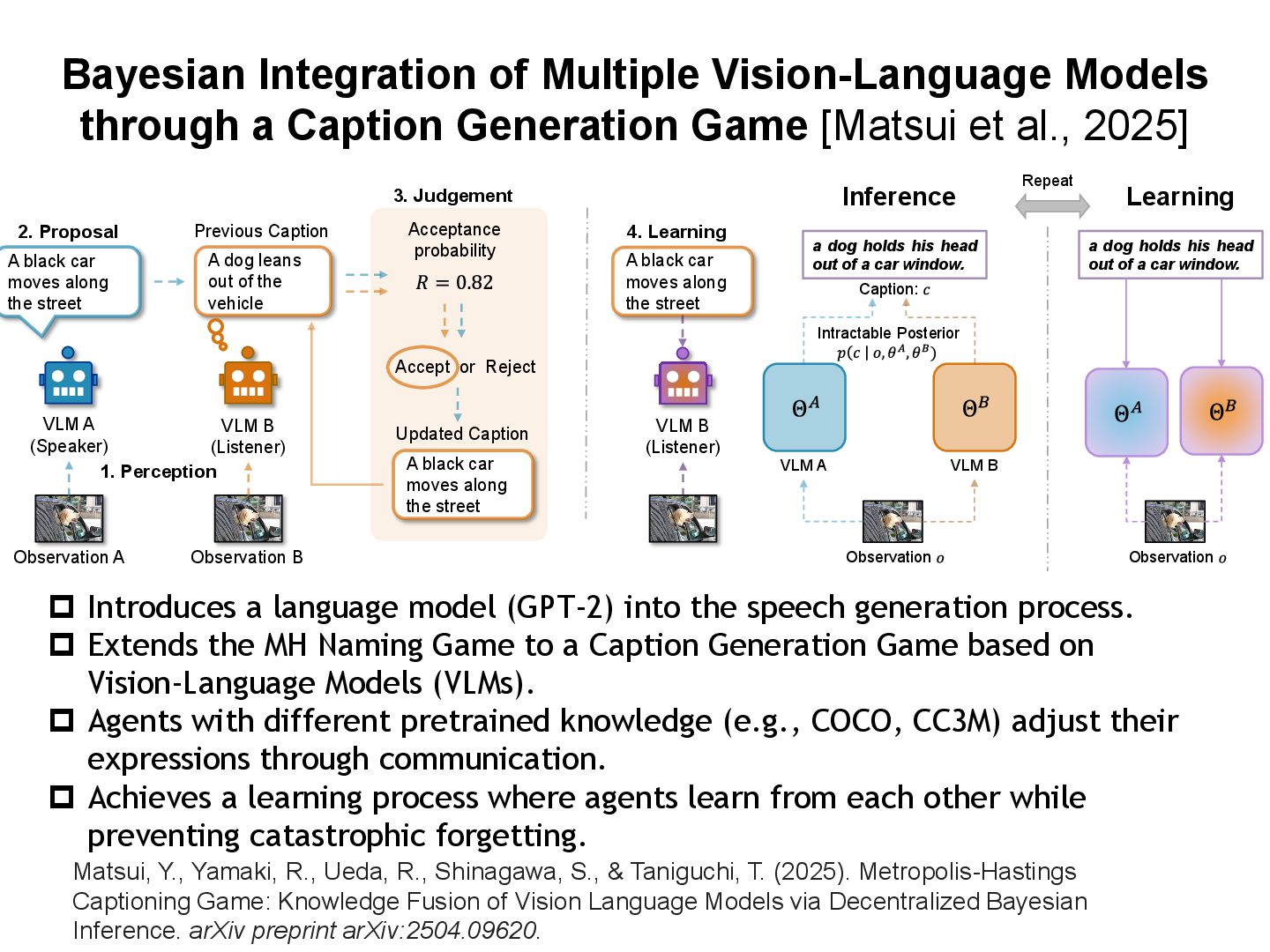
    Game [Matsui et al., 2025] Matsui, Y., Yamaki, R., Ueda, R., Shinagawa, S., & Taniguchi, T. (2025). Metropolis-Hastings Captioning Game: Knowledge Fusion of Vision Language Models via Decentralized Bayesian Inference. arXiv preprint arXiv:2504.09620. Intractable Posterior Caption: VLM A VLM B a dog holds his head out of a car window. Observation a dog holds his head out of a car window. Learning Inference Observation Repeat VLM A (Speaker) A dog leans out of the vehicle VLM B (Listener) A black car moves along the street 2. Proposal Previous Caption A black car moves along the street Acceptance probability Accept or Reject 1. Perception Observation A 3. Judgement Updated Caption Observation B A black car moves along the street 4. Learning VLM B (Listener)  Introduces a language model (GPT-2) into the speech generation process.  Extends the MH Naming Game to a Caption Generation Game based on Vision-Language Models (VLMs).  Agents with different pretrained knowledge (e.g., COCO, CC3M) adjust their expressions through communication.  Achieves a learning process where agents learn from each other while preventing catastrophic forgetting.
  32. Reward-Independent Messaging for Decentralized Multi-Agent Reinforcement Learning [Yoshida+ 2025] We

    demonstrated that Collective Predictive Coding (CPC) can be applied to multi-agent reinforcement learning (MARL) to enable the emergence of communication without relying on shared rewards. Yoshida, N., & Taniguchi, T. (2025, November). Reward-Independent Messaging for Decentralized Multi- Agent Reinforcement Learning. In International Conference on Neural Information Processing (pp. 367-382). Best Paper Award Runner-Up at ICONIP 2025
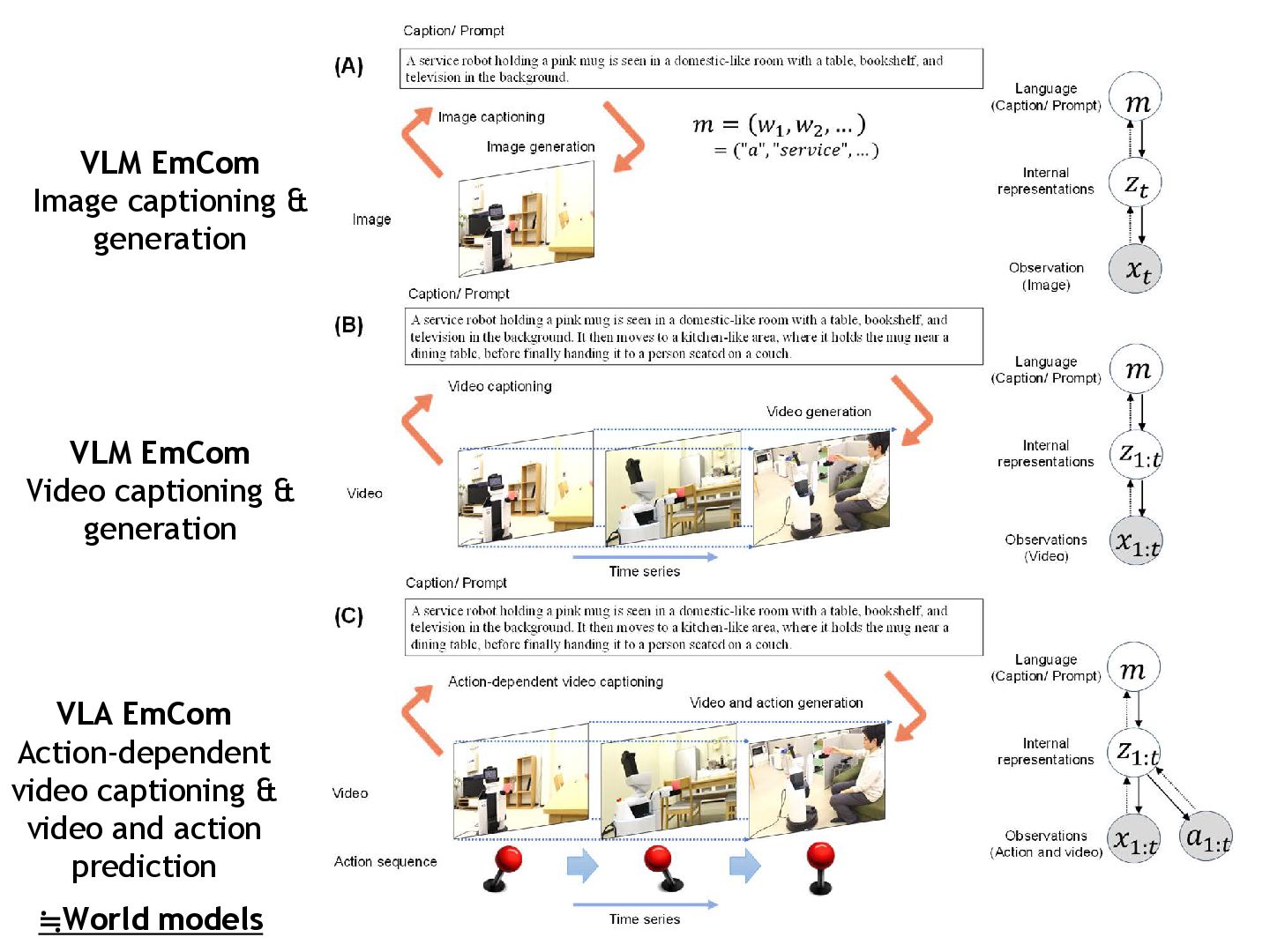
  33. VLM EmCom Image captioning & generation VLM EmCom Video captioning

    & generation VLA EmCom Action-dependent video captioning & video and action prediction ≒World models
  34. LLM Modeling the Distribution of Language as a “Collective World

    Model” Learning representations/world models toward collectively intelligent language expression Symbol emergence = Collective predictive coding 35 Collective world model LLM
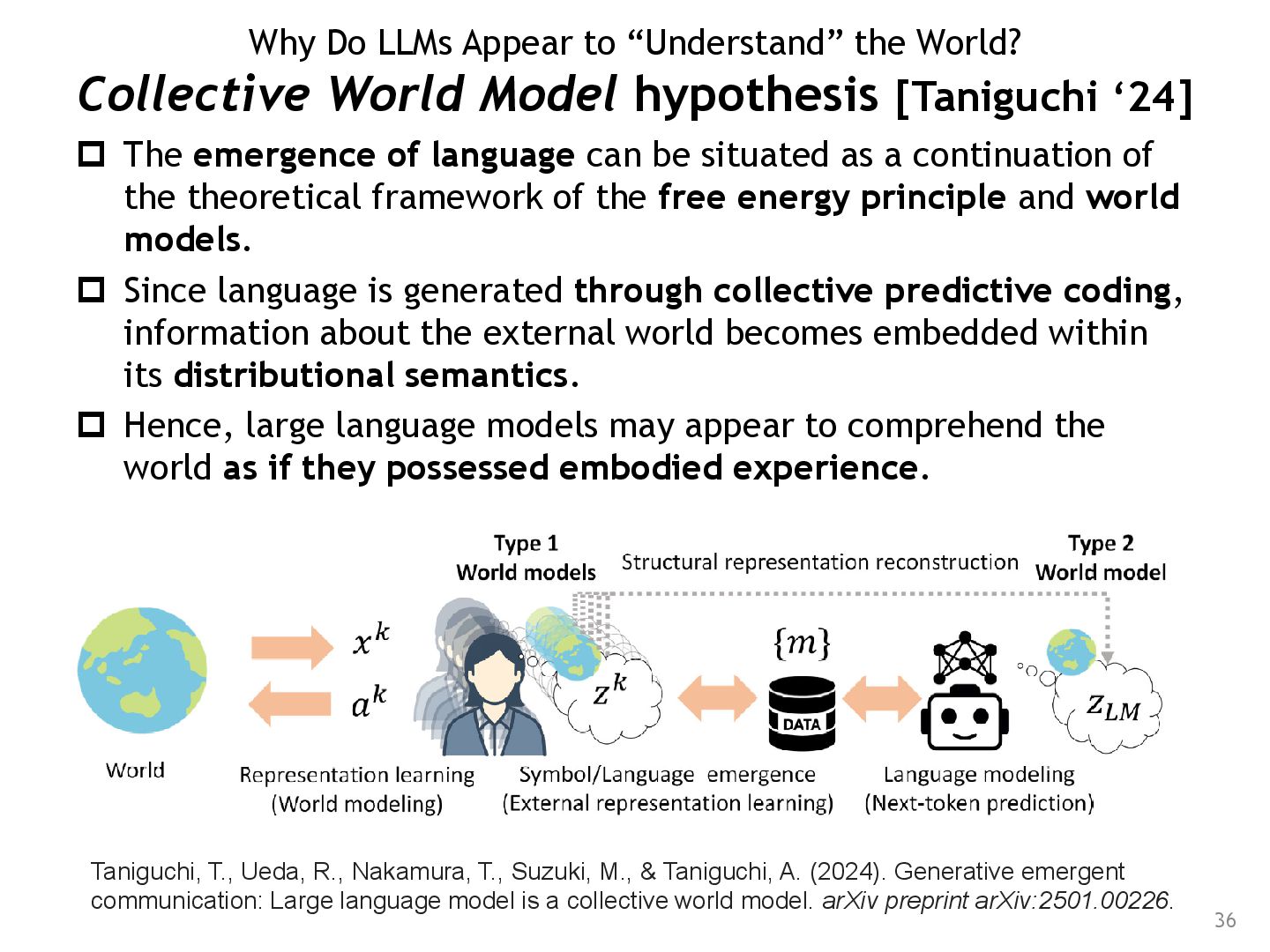
  35. Why Do LLMs Appear to “Understand” the World? Collective World

    Model hypothesis [Taniguchi ‘24]  The emergence of language can be situated as a continuation of the theoretical framework of the free energy principle and world models.  Since language is generated through collective predictive coding, information about the external world becomes embedded within its distributional semantics.  Hence, large language models may appear to comprehend the world as if they possessed embodied experience. 36 Taniguchi, T., Ueda, R., Nakamura, T., Suzuki, M., & Taniguchi, A. (2024). Generative emergent communication: Large language model is a collective world model. arXiv preprint arXiv:2501.00226.
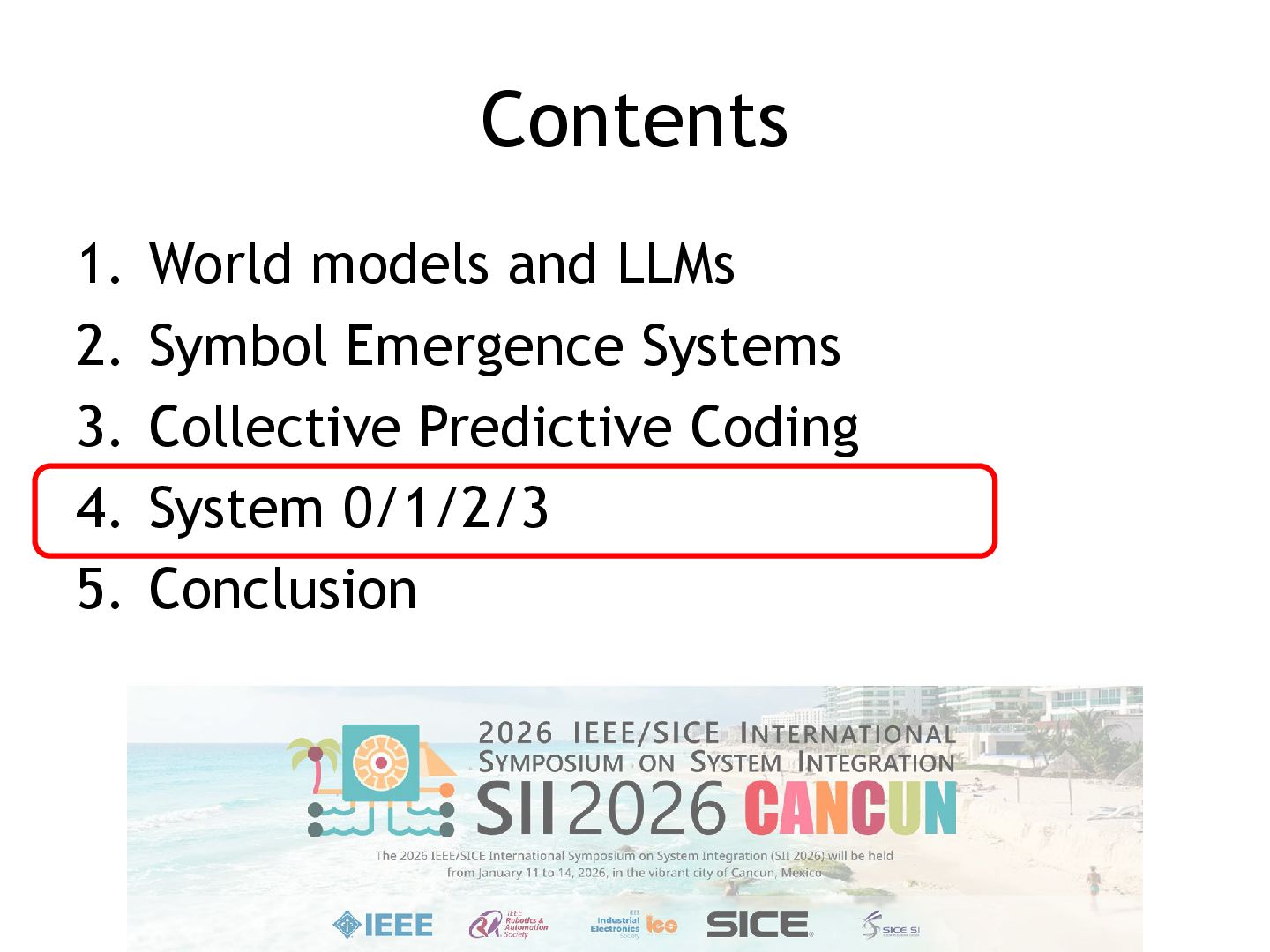
  36. Contents 1. World models and LLMs 2. Symbol Emergence Systems

    3. Collective Predictive Coding 4. System 0/1/2/3 5. Conclusion
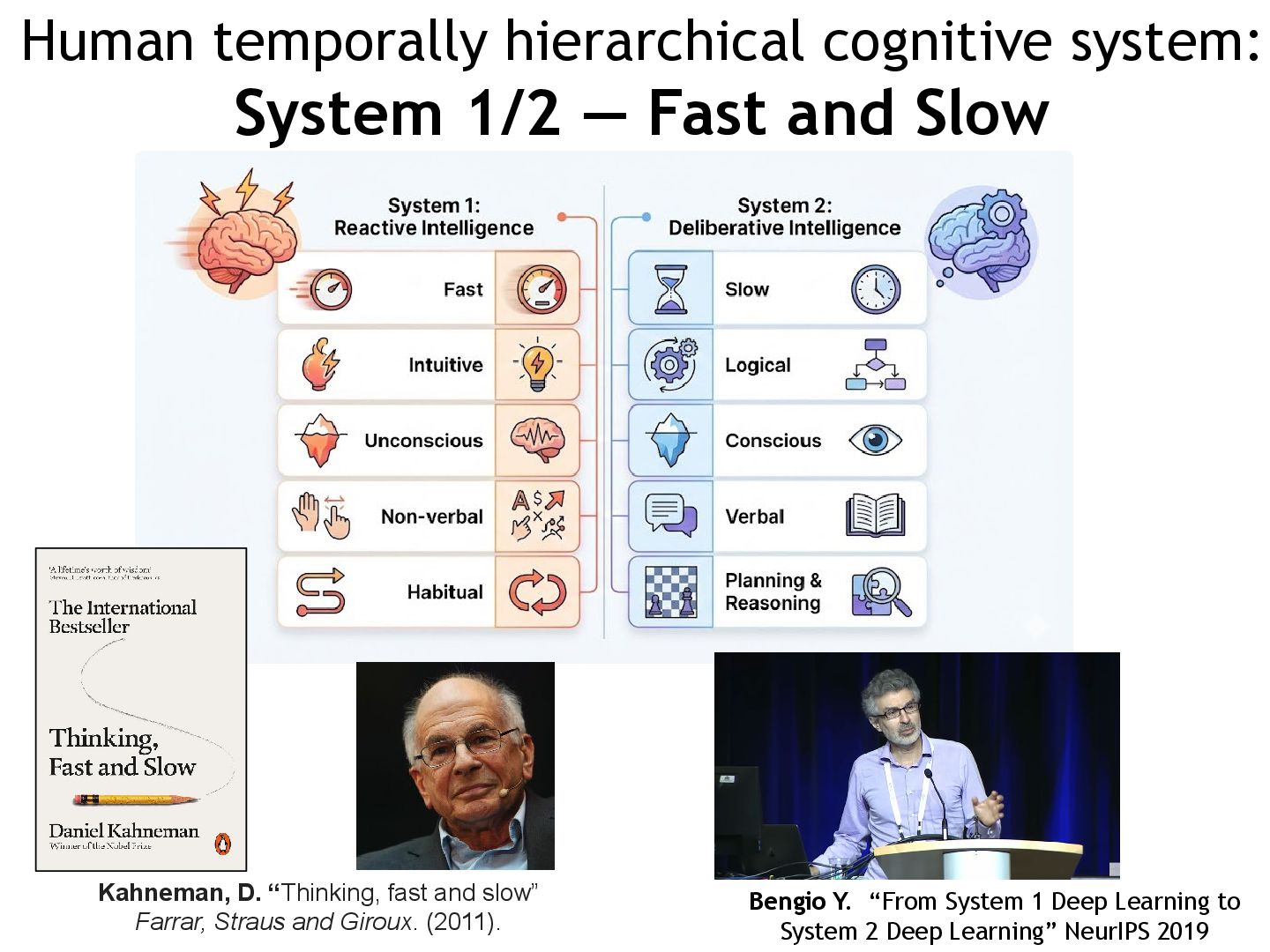
  37. Human temporally hierarchical cognitive system: System 1/2 — Fast and

    Slow Kahneman, D. “Thinking, fast and slow” Farrar, Straus and Giroux. (2011). Bengio Y. “From System 1 Deep Learning to System 2 Deep Learning” NeurIPS 2019
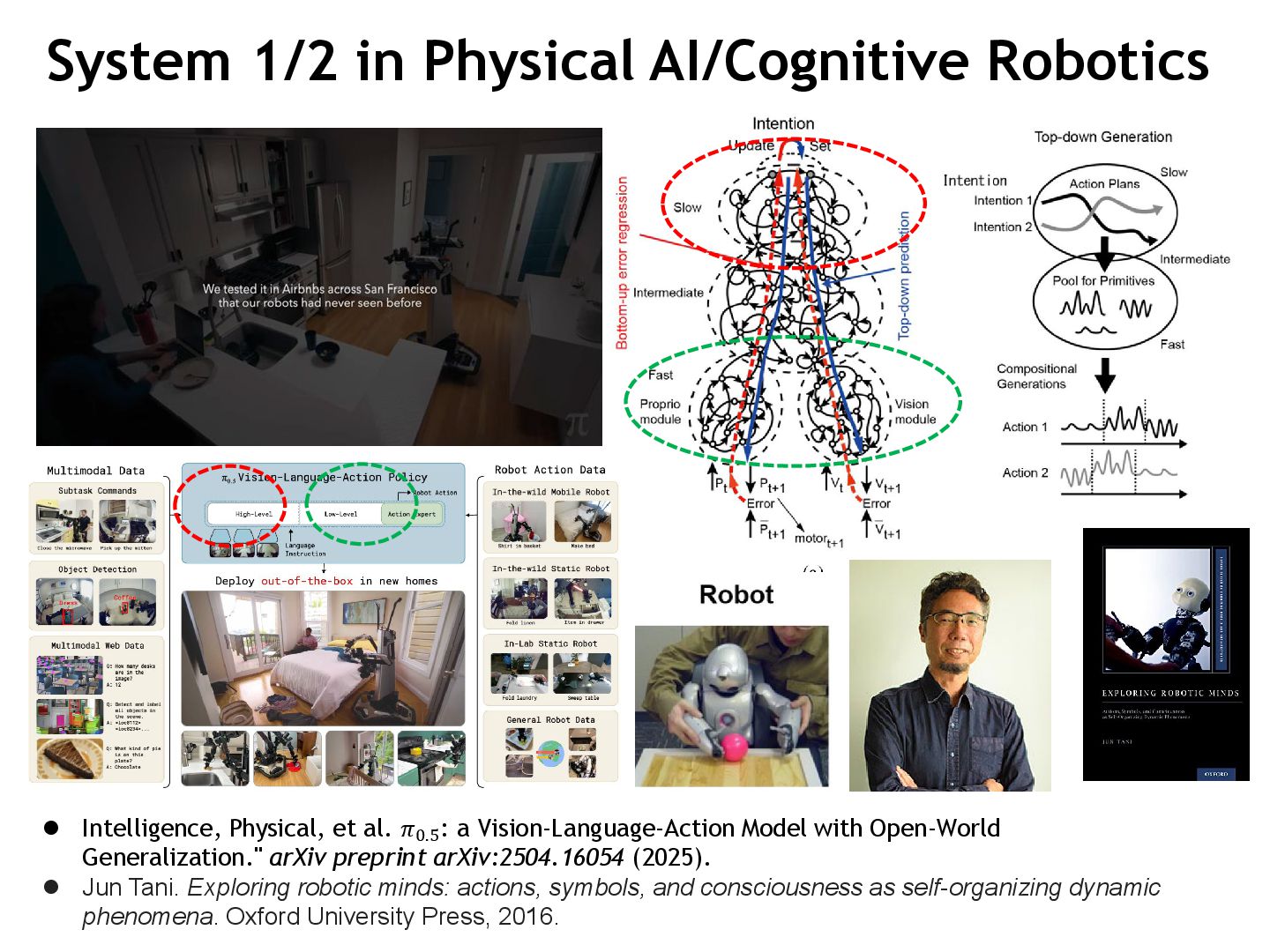
  38. System 1/2 in Physical AI/Cognitive Robotics  Intelligence, Physical, et

    al. 𝜋𝜋0.5 : a Vision-Language-Action Model with Open-World Generalization." arXiv preprint arXiv:2504.16054 (2025).  Jun Tani. Exploring robotic minds: actions, symbols, and consciousness as self-organizing dynamic phenomena. Oxford University Press, 2016.
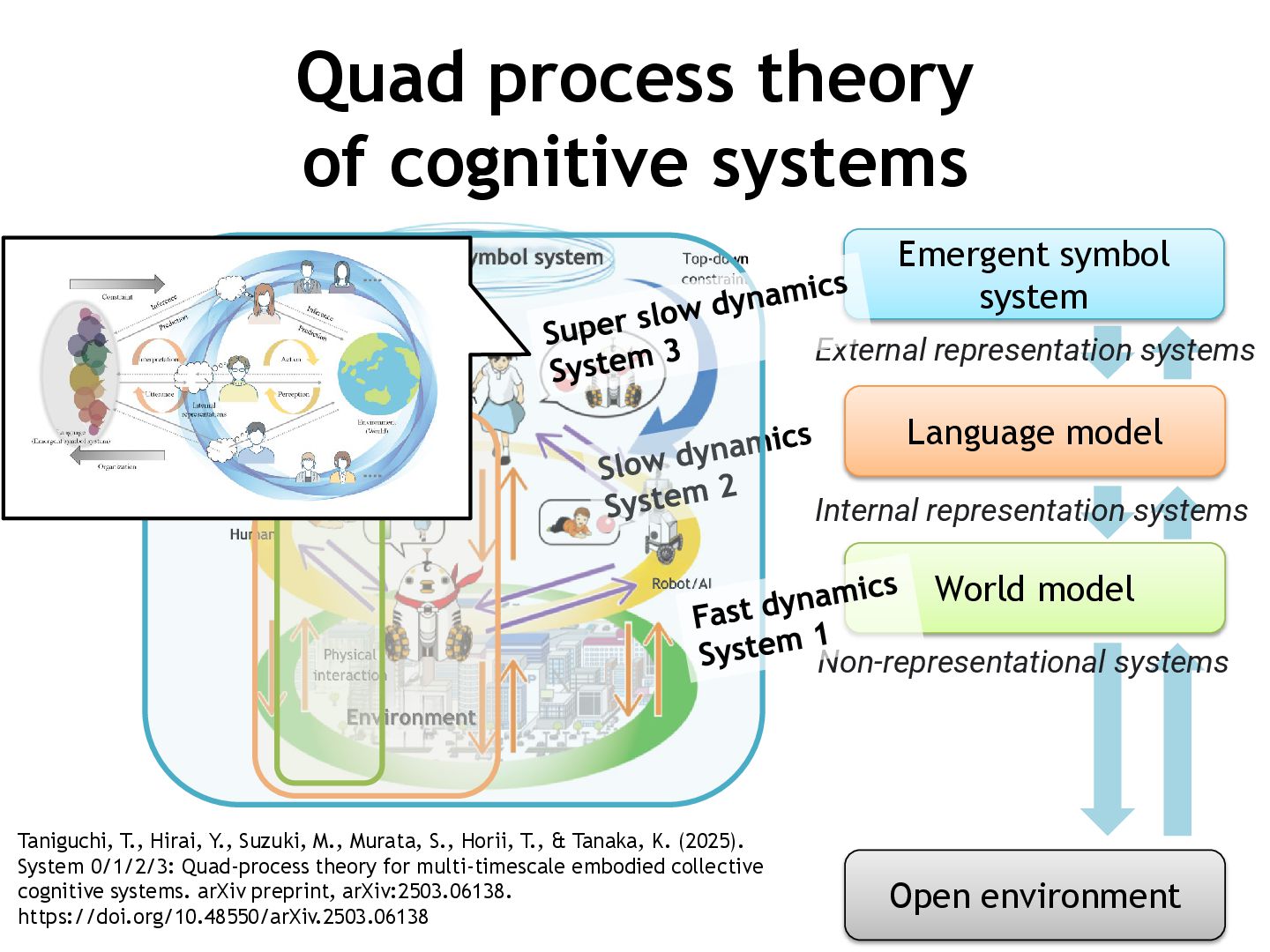
  39. Quad process theory of cognitive systems 40 Open environment Internal

    representation systems Language model External representation systems Emergent symbol system Non-representational systems World model Taniguchi, T., Hirai, Y., Suzuki, M., Murata, S., Horii, T., & Tanaka, K. (2025). System 0/1/2/3: Quad-process theory for multi-timescale embodied collective cognitive systems. arXiv preprint, arXiv:2503.06138. https://doi.org/10.48550/arXiv.2503.06138
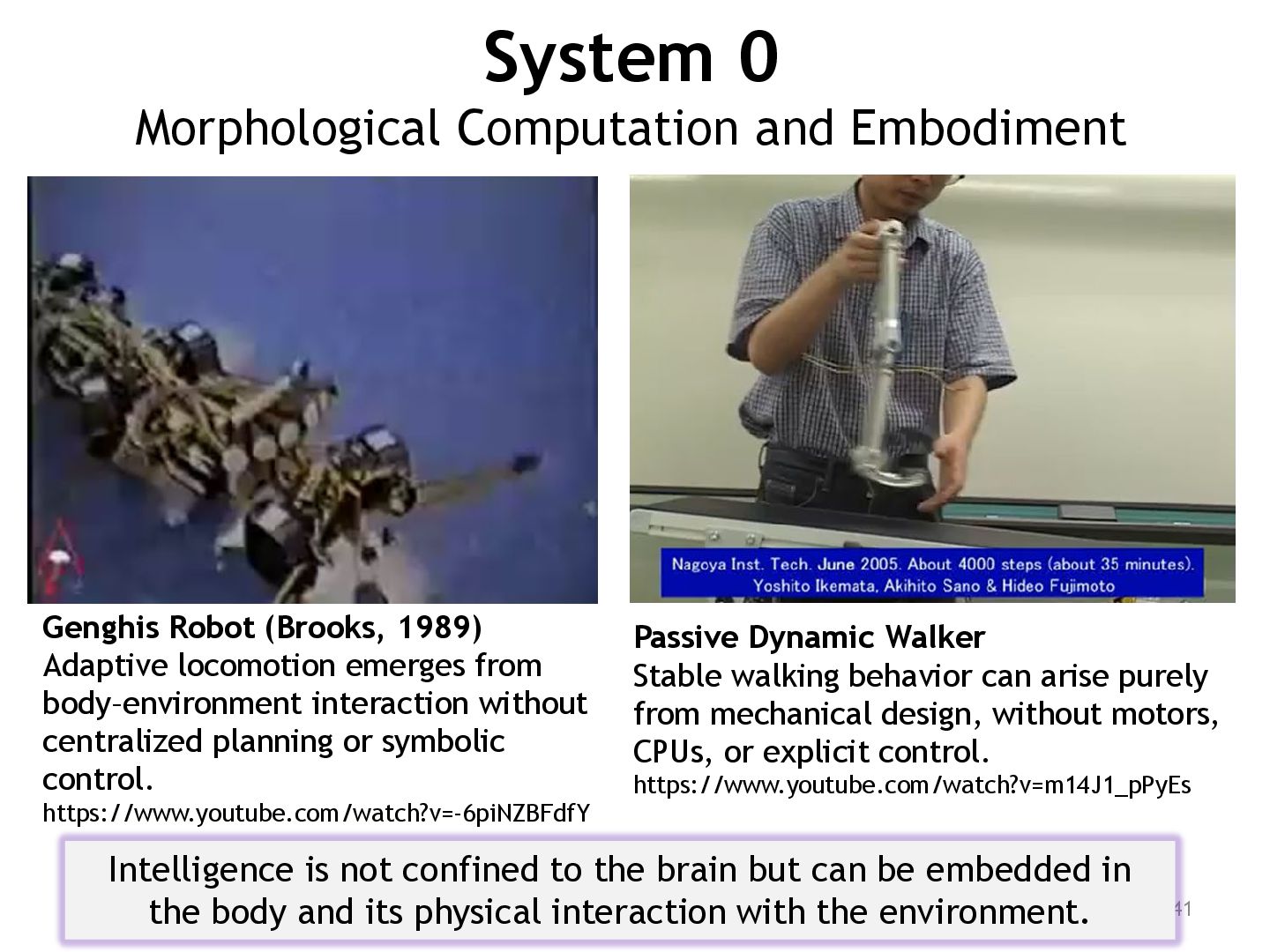
  40. System 0 Morphological Computation and Embodiment 41 Genghis Robot (Brooks,

    1989) Adaptive locomotion emerges from body–environment interaction without centralized planning or symbolic control. https://www.youtube.com/watch?v=-6piNZBFdfY Passive Dynamic Walker Stable walking behavior can arise purely from mechanical design, without motors, CPUs, or explicit control. https://www.youtube.com/watch?v=m14J1_pPyEs Intelligence is not confined to the brain but can be embedded in the body and its physical interaction with the environment.
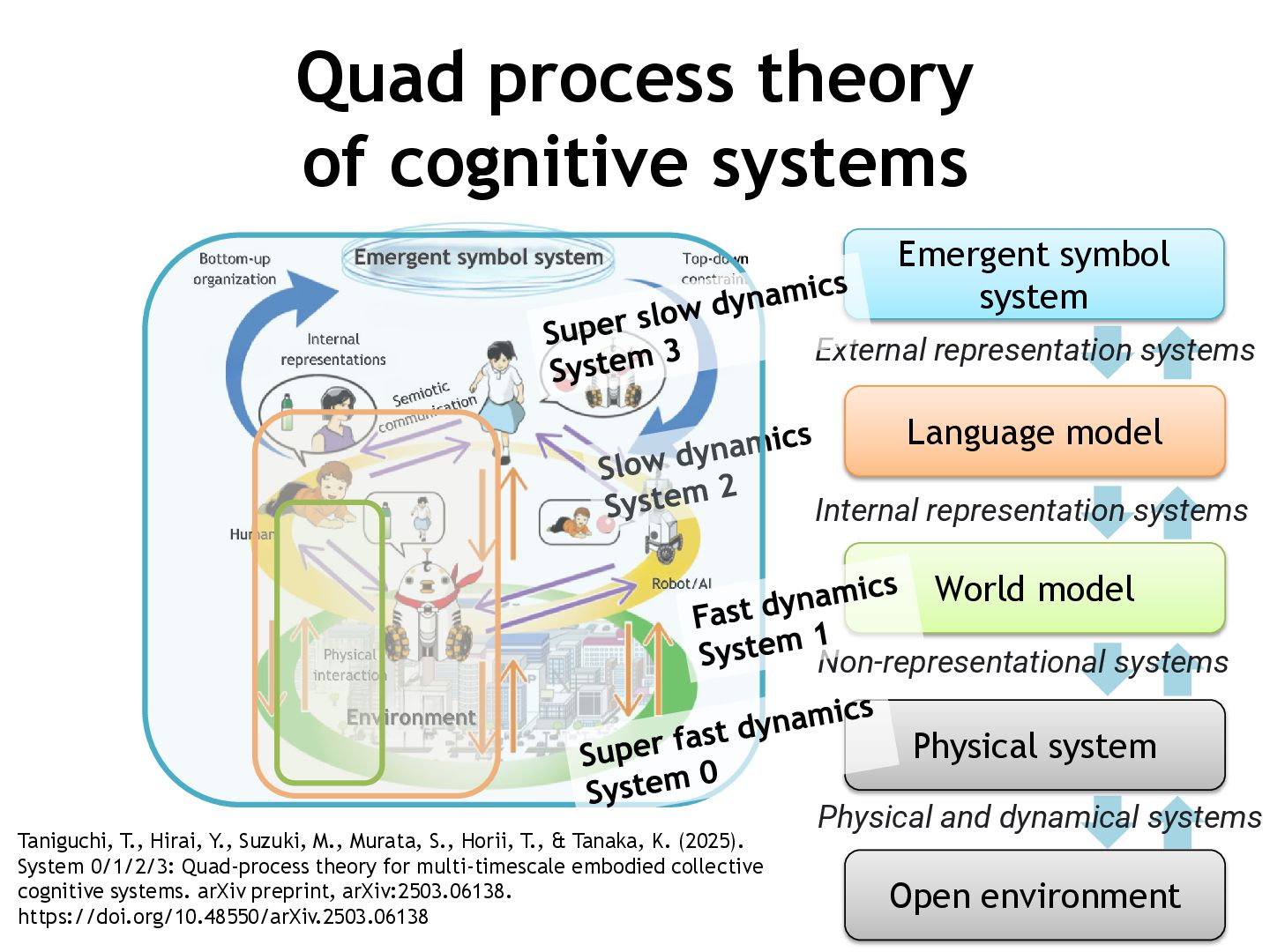
  41. Quad process theory of cognitive systems 42 Open environment Internal

    representation systems Language model External representation systems Emergent symbol system Non-representational systems World model Taniguchi, T., Hirai, Y., Suzuki, M., Murata, S., Horii, T., & Tanaka, K. (2025). System 0/1/2/3: Quad-process theory for multi-timescale embodied collective cognitive systems. arXiv preprint, arXiv:2503.06138. https://doi.org/10.48550/arXiv.2503.06138 Physical system Physical and dynamical systems
  42. System 0/1/2/3: Quad-process theory [Taniguchi+ 2025] We propose a System

    0/1/2/3 model that extends Dual Process Theory by integrating multiple cognitive time scales, ranging from embodiment-based pre-cognitive adaptation (System 0) and intuitive thinking (System 1) to deliberative reasoning (System 2) and collective intelligence with symbol emergence (System 3). Taniguchi, T., Hirai, Y., Suzuki, M., Murata, S., Horii, T., & Tanaka, K. (2025). System 0/1/2/3: Quad- Process Theory for Multitimescale Embodied Collective Cognitive Systems. Artificial Life, 31(4), 465-496.
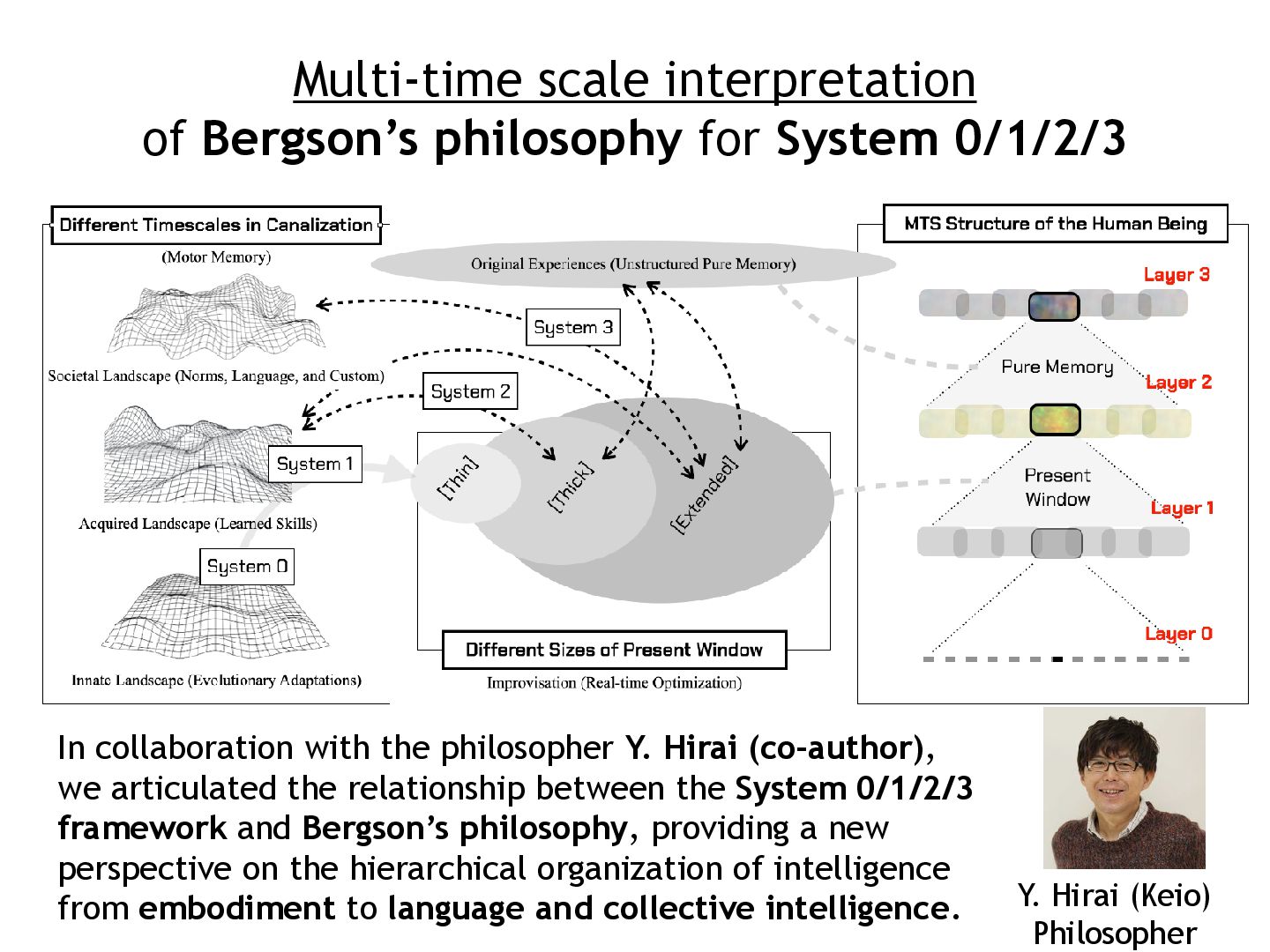
  43. Multi-time scale interpretation of Bergson’s philosophy for System 0/1/2/3 In

    collaboration with the philosopher Y. Hirai (co-author), we articulated the relationship between the System 0/1/2/3 framework and Bergson’s philosophy, providing a new perspective on the hierarchical organization of intelligence from embodiment to language and collective intelligence. Y. Hirai (Keio) Philosopher
  44. Contents 1. World models and LLMs 2. Symbol Emergence Systems

    3. Collective Predictive Coding 4. System 0/1/2/3 5. Conclusion
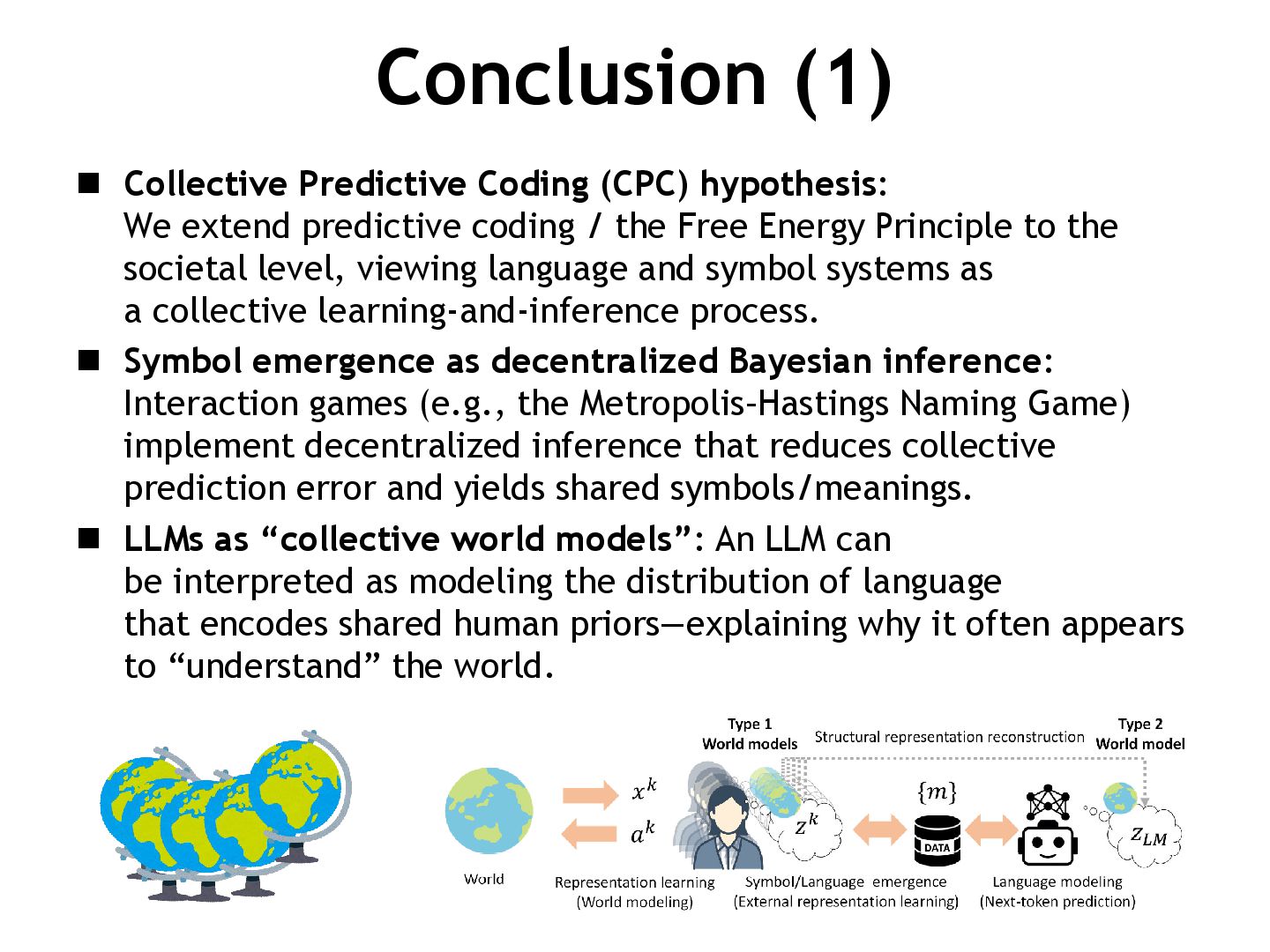
  45. Conclusion (1)  Collective Predictive Coding (CPC) hypothesis: We extend

    predictive coding / the Free Energy Principle to the societal level, viewing language and symbol systems as a collective learning-and-inference process.  Symbol emergence as decentralized Bayesian inference: Interaction games (e.g., the Metropolis–Hastings Naming Game) implement decentralized inference that reduces collective prediction error and yields shared symbols/meanings.  LLMs as “collective world models”: An LLM can be interpreted as modeling the distribution of language that encodes shared human priors—explaining why it often appears to “understand” the world.
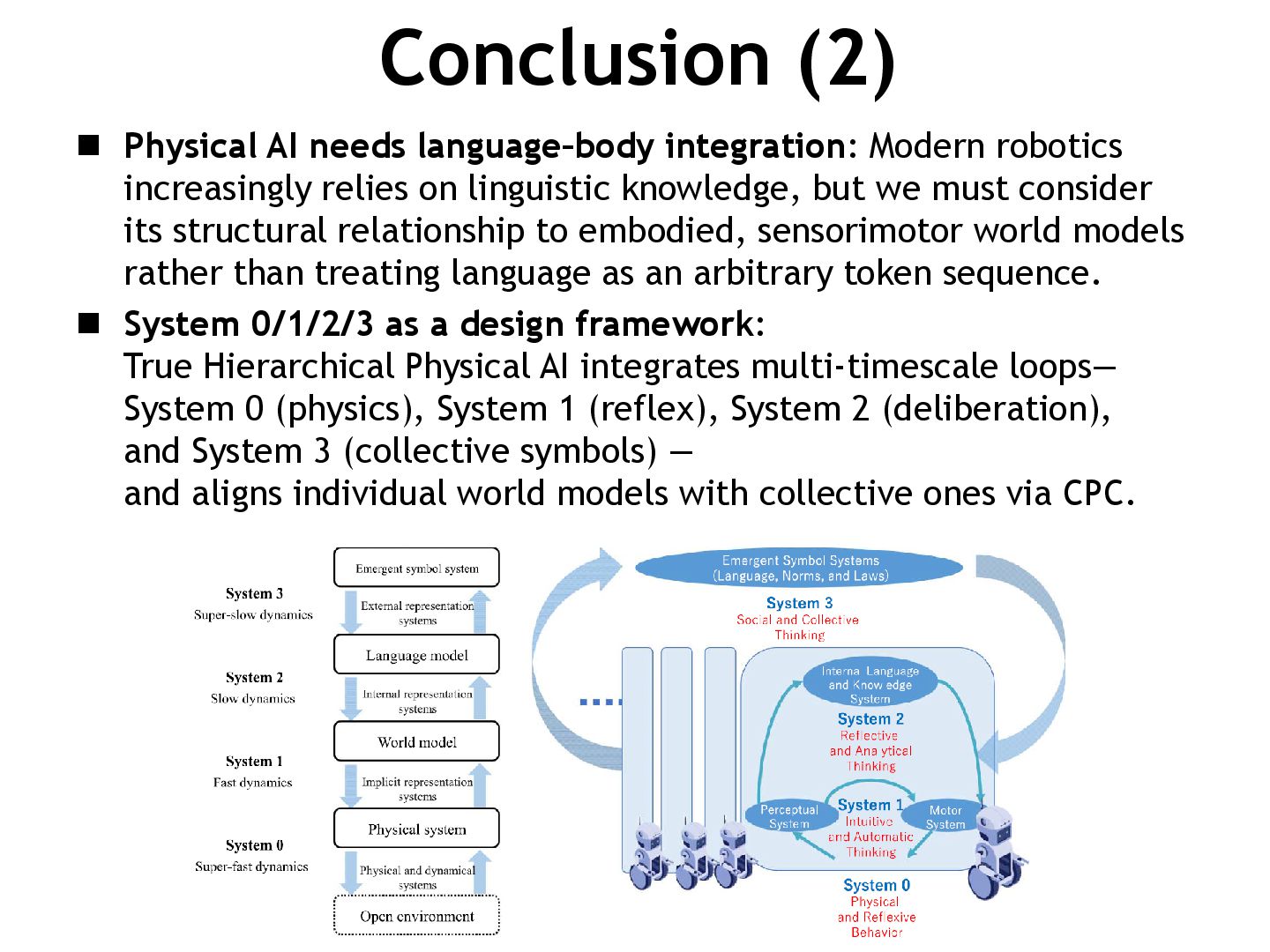
  46. Conclusion (2)  Physical AI needs language–body integration: Modern robotics

    increasingly relies on linguistic knowledge, but we must consider its structural relationship to embodied, sensorimotor world models rather than treating language as an arbitrary token sequence.  System 0/1/2/3 as a design framework: True Hierarchical Physical AI integrates multi-timescale loops— System 0 (physics), System 1 (reflex), System 2 (deliberation), and System 3 (collective symbols) — and aligns individual world models with collective ones via CPC.
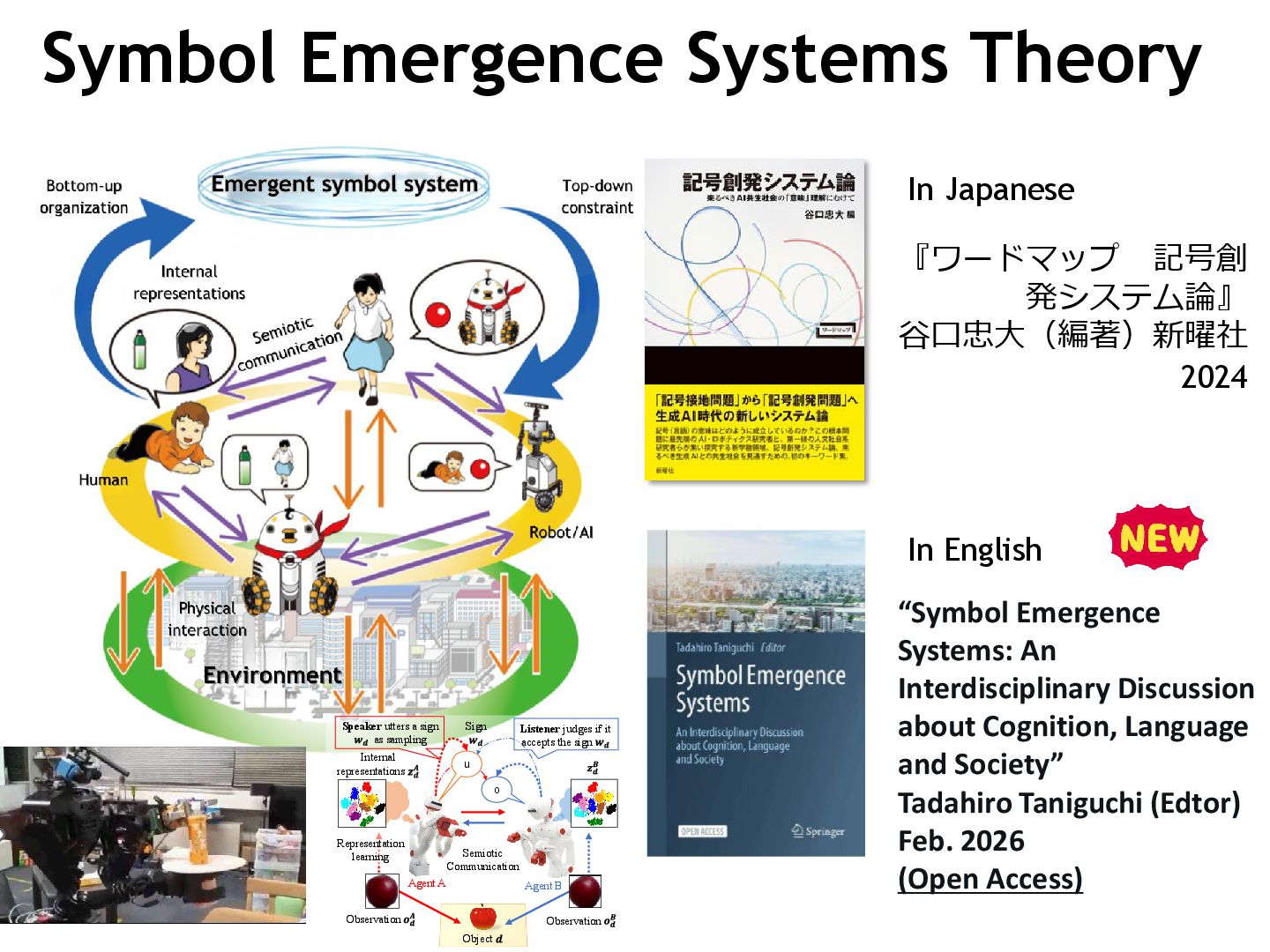
  47. Symbol Emergence Systems Theory 『ワードマップ 記号創 発システム論』 谷口忠大(編著)新曜社 2024 “Symbol

    Emergence Systems: An Interdisciplinary Discussion about Cognition, Language and Society” Tadahiro Taniguchi (Edtor) Feb. 2026 (Open Access) In Japanese In English Observation o u Semiotic Communication Representation learning Object Agent A Agent B Internal representations Speaker utters a sign as sampling Listener judges if it accepts the sign Observation Sign