Share
Embed
学習型データ構造:機械学習を内包する新しいデータ構造の設計と解析
第28回情報論的学習理論ワークショップ(IBIS)2025、企画セッション3「アルゴリズム・データ構造と機械学習」、2025/11/14, @那覇, 沖縄
松井勇佑(東京大学)https://yusukematsui.me/index_jp.html
学習型データ構造とは、B-treeやブルームフィルタといった古典的なデータ構造に対し小さな機械学習モジュールを組み合わせることで性能を向上させる、新しいデータ構造である。例えばブルームフィルタは集合を表現する確率的データ構造であり、要素が集合に含まれるか近似的に判定するが、学習型ブルームフィルタはまず小さな機械学習モジュールで要素が集合に属するかざっくり判定し、その後に小さなブルームフィルタを適用する。このような構成は、最終的なメモリ・精度トレードオフに優れると報告されている。本講演では、近年発展を遂げている学習型データ構造の外観を示し、それが大規模言語モデルやコンピュータビジョンといった応用先にどのように用いられる可能性があるかを議論する。
Yusuke Matsui
November 10, 2025
Transcript
64 slides
-
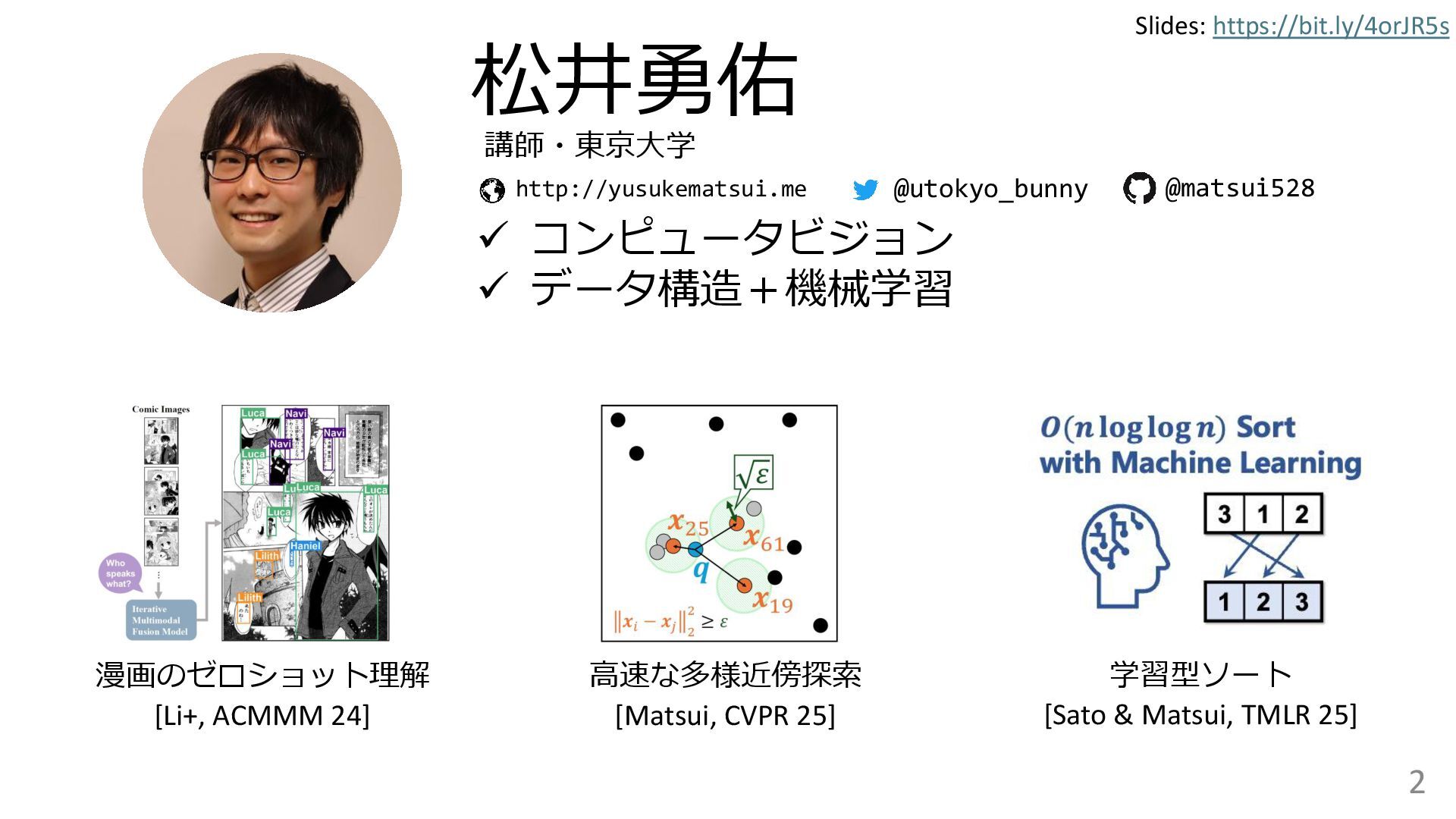
https://bit.ly/4orJR5s Slides: https://bit.ly/4orJR5s 2 松井勇佑 ✓ コンピュータビジョン ✓ データ構造+機械学習 http://yusukematsui.me
講師・東京大学 @utokyo_bunny @matsui528 漫画のゼロショット理解 [Li+, ACMMM 24] 高速な多様近傍探索 [Matsui, CVPR 25] 学習型ソート [Sato & Matsui, TMLR 25] -
https://bit.ly/4orJR5s Slides: https://bit.ly/4orJR5s 3 三次元復元 [1] [1] Wang+, “VGGT: Visual
Geometry Grounded Transformer”, CVPR 2025 [2] Fawzi+, “Discovering faster matrix multiplication algorithms with reinforcement learning”, Nature, 2022 [3] https://gemini.google/jp/overview/image-generation/ https://finance.yahoo.com/news/gm-unveils-eyes-off-self-driving-conversational-google-ai-for-its-cars-at-tech-event-151049822.html https://en.wikipedia.org/wiki/ChatGPT#/media/File:ChatGPT-Logo.svg ChatGPT 自動運転 科学的発見 [2] Text-to-Image [3] AIコーディング https://www.claude.com/product/claude-code 機械学習は大人気 -
https://bit.ly/4orJR5s Slides: https://bit.ly/4orJR5s 4 三次元復元 [1] [1] Wang+, “VGGT: Visual
Geometry Grounded Transformer”, CVPR 2025 [2] Fawzi+, “Discovering faster matrix multiplication algorithms with reinforcement learning”, Nature, 2022 [3] https://gemini.google/jp/overview/image-generation/ https://finance.yahoo.com/news/gm-unveils-eyes-off-self-driving-conversational-google-ai-for-its-cars-at-tech-event-151049822.html https://en.wikipedia.org/wiki/ChatGPT#/media/File:ChatGPT-Logo.svg ChatGPT 自動運転 科学的発見 [2] Text-to-Image [3] AIコーディング https://www.claude.com/product/claude-code 機械学習は大人気 我々は大きい問題に注目しがち 機械学習を小さい要素に適用できないか? 学習型データ構造 (=機械学習で強化されたデータ構造) -
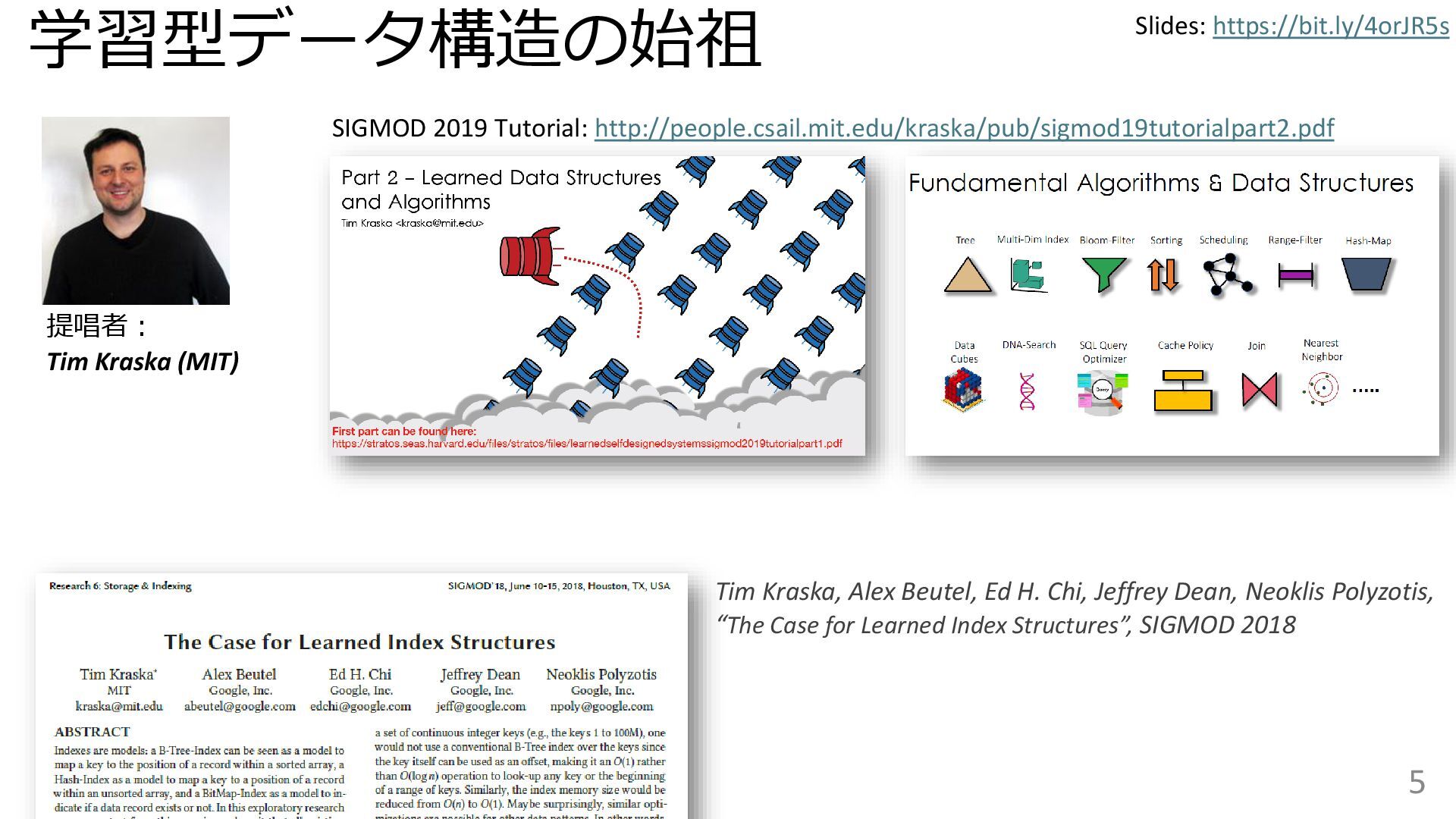
https://bit.ly/4orJR5s Slides: https://bit.ly/4orJR5s 5 学習型データ構造の始祖 SIGMOD 2019 Tutorial: http://people.csail.mit.edu/kraska/pub/sigmod19tutorialpart2.pdf 提唱者:
Tim Kraska (MIT) Tim Kraska, Alex Beutel, Ed H. Chi, Jeffrey Dean, Neoklis Polyzotis, “The Case for Learned Index Structures”, SIGMOD 2018 -
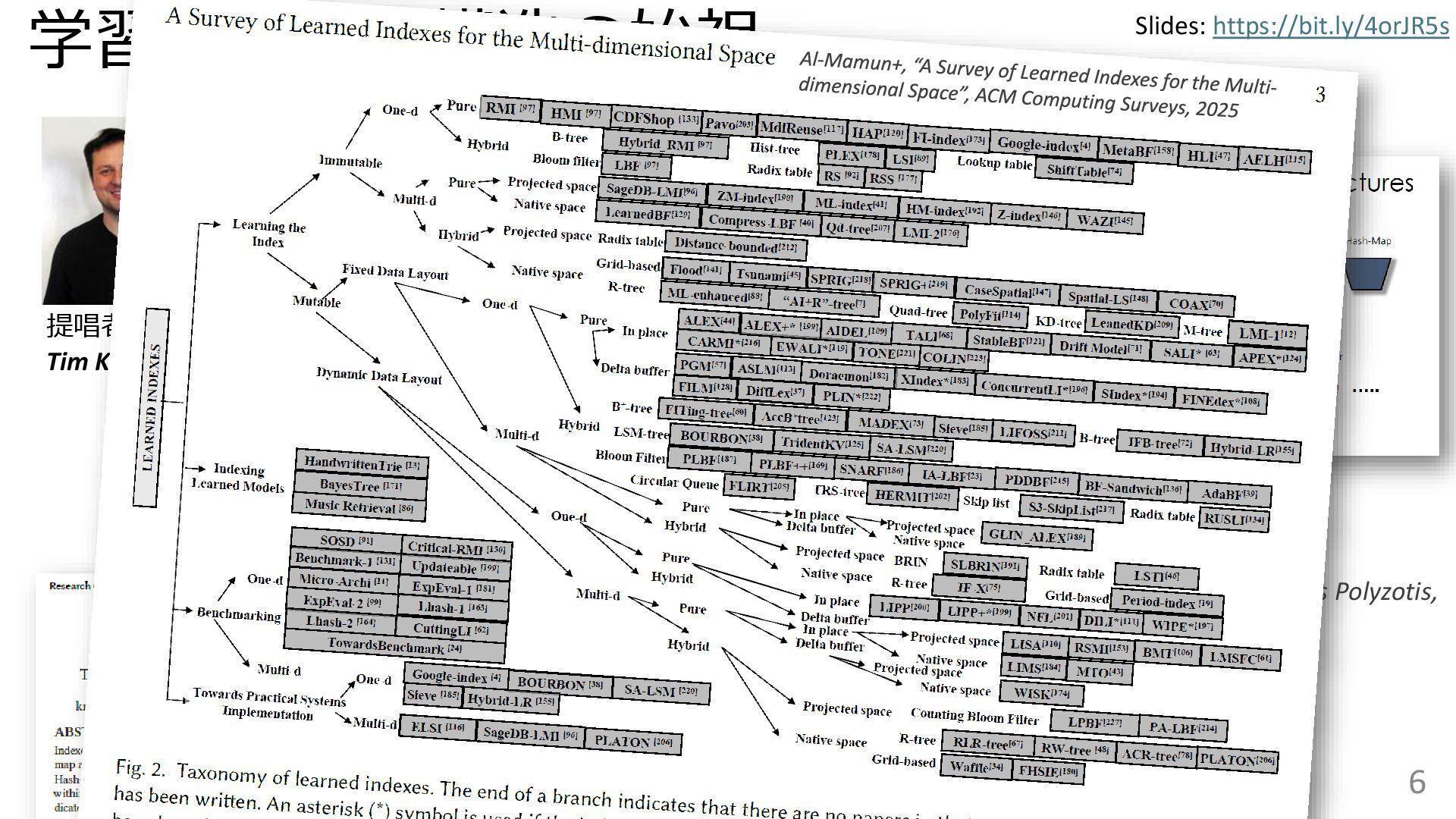
https://bit.ly/4orJR5s Slides: https://bit.ly/4orJR5s 6 学習型データ構造の始祖 SIGMOD 2019 Tutorial: http://people.csail.mit.edu/kraska/pub/sigmod19tutorialpart2.pdf 提唱者:
Tim Kraska (MIT) Tim Kraska, Alex Beutel, Ed H. Chi, Jeffrey Dean, Neoklis Polyzotis, “The Case for Learned Index Structures”, SIGMOD 2018 -
https://bit.ly/4orJR5s Slides: https://bit.ly/4orJR5s 8 アウトライン 1. 一次元インデクス 2. 多次元インデクス 3.
ブルームフィルタ 4. 近似最近傍探索 5. 議論 -
https://bit.ly/4orJR5s Slides: https://bit.ly/4orJR5s 9 アウトライン 1. 一次元インデクス 2. 多次元インデクス 3.
ブルームフィルタ 4. 近似最近傍探索 5. 議論 -
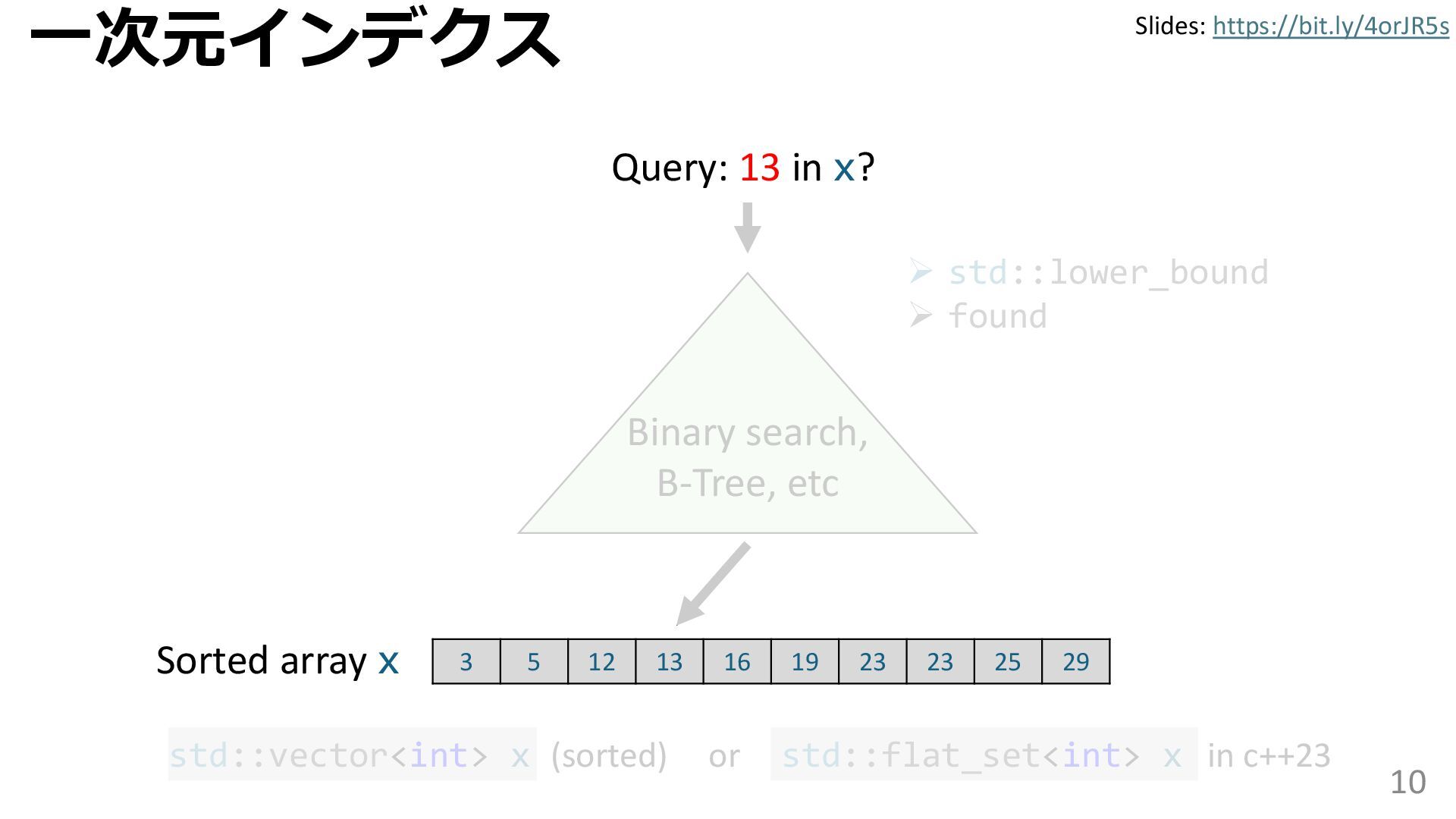
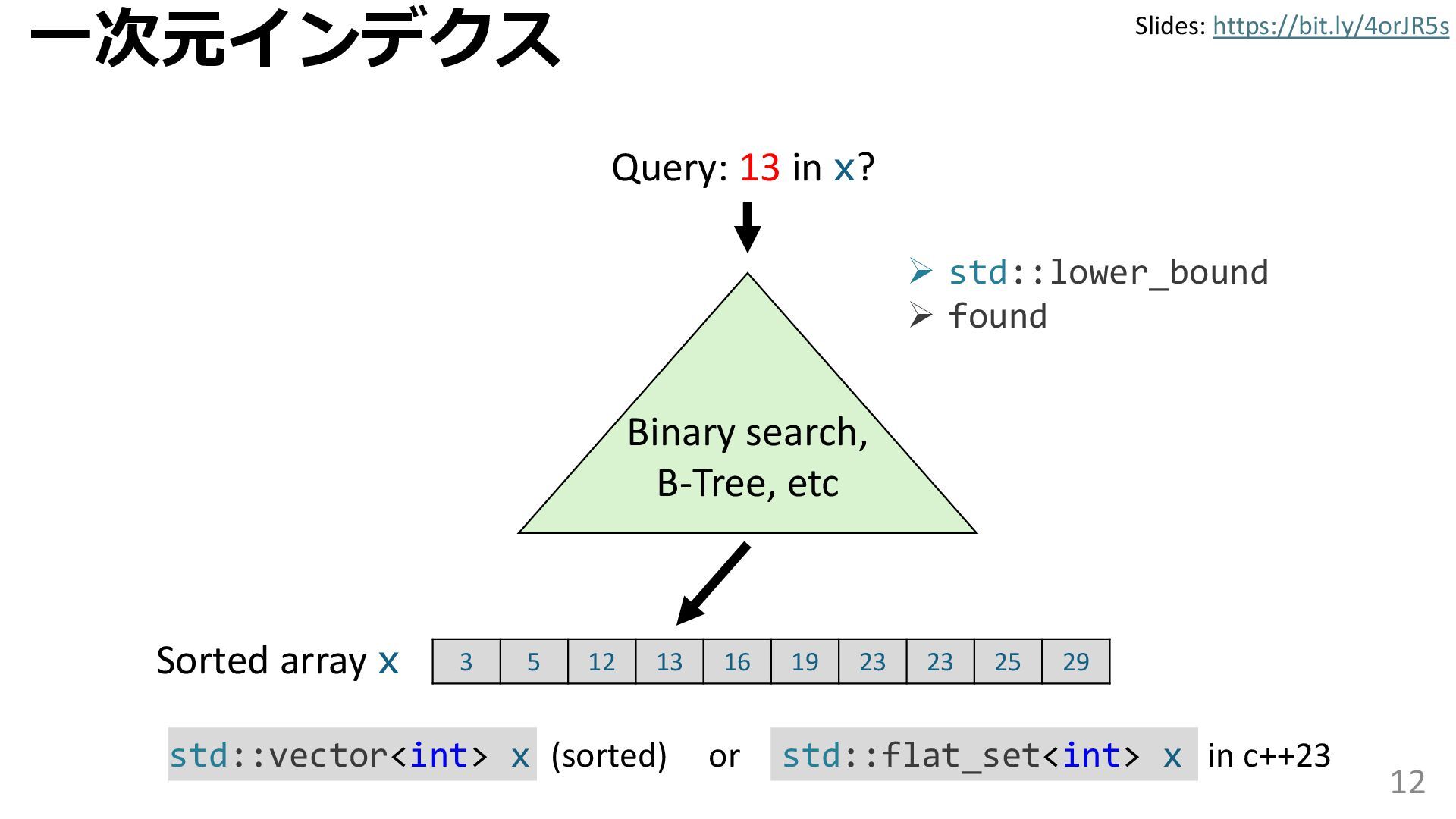
https://bit.ly/4orJR5s Slides: https://bit.ly/4orJR5s 10 3 5 12 13 16 19
23 23 25 29 Sorted array x Query: 13 in x? Binary search, B-Tree, etc std::vector<int> x (sorted) or std::flat_set<int> x in c++23 ➢ std::lower_bound ➢ find 一次元インデクス -
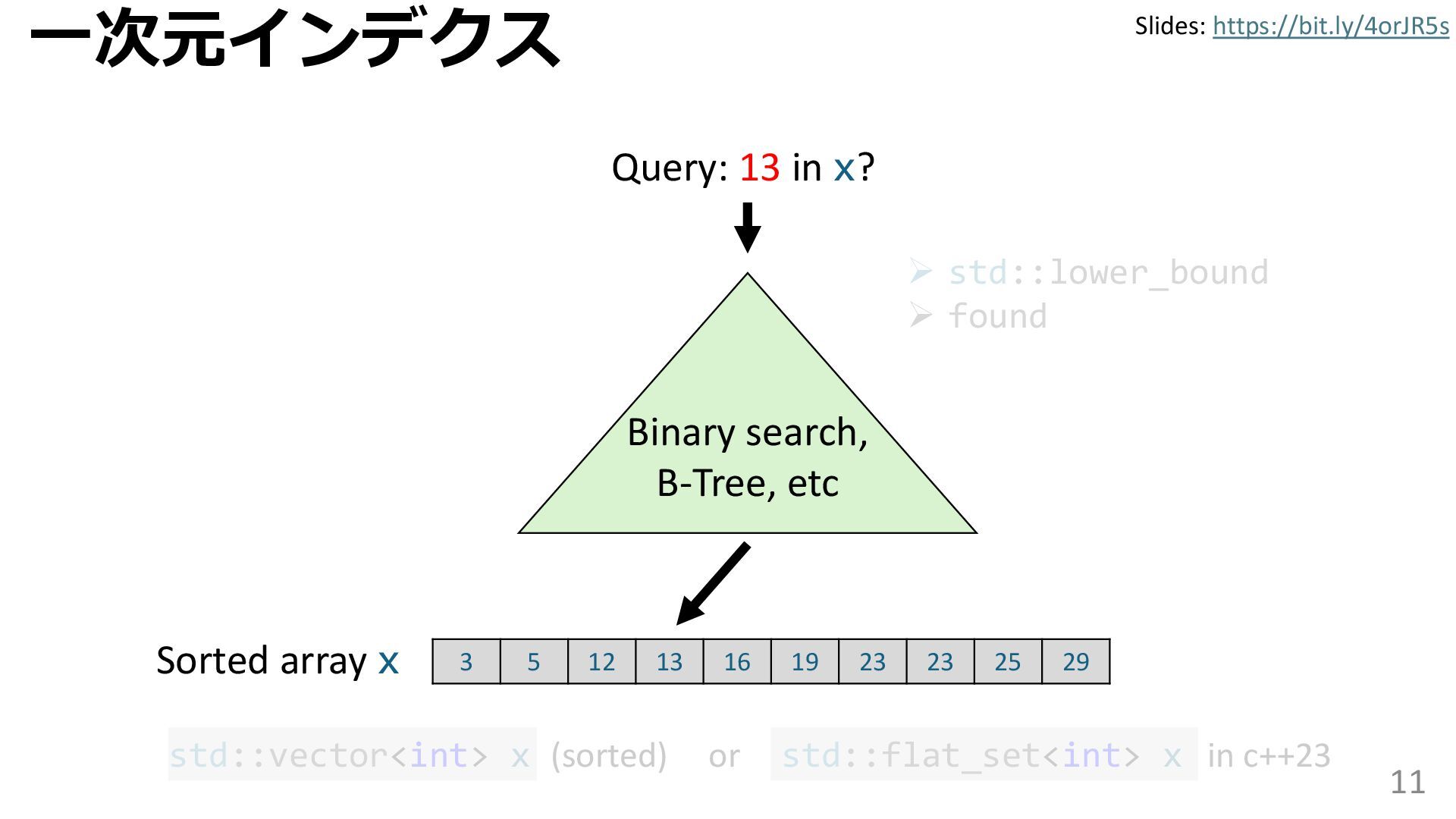
https://bit.ly/4orJR5s Slides: https://bit.ly/4orJR5s 11 3 5 12 13 16 19
23 23 25 29 Sorted array x Query: 13 in x? Binary search, B-Tree, etc std::vector<int> x (sorted) or std::flat_set<int> x in c++23 ➢ std::lower_bound ➢ find 一次元インデクス -
https://bit.ly/4orJR5s Slides: https://bit.ly/4orJR5s 12 3 5 12 13 16 19
23 23 25 29 Sorted array x Query: 13 in x? Binary search, B-Tree, etc std::vector<int> x (sorted) or std::flat_set<int> x in c++23 ➢ std::lower_bound ➢ find 一次元インデクス -
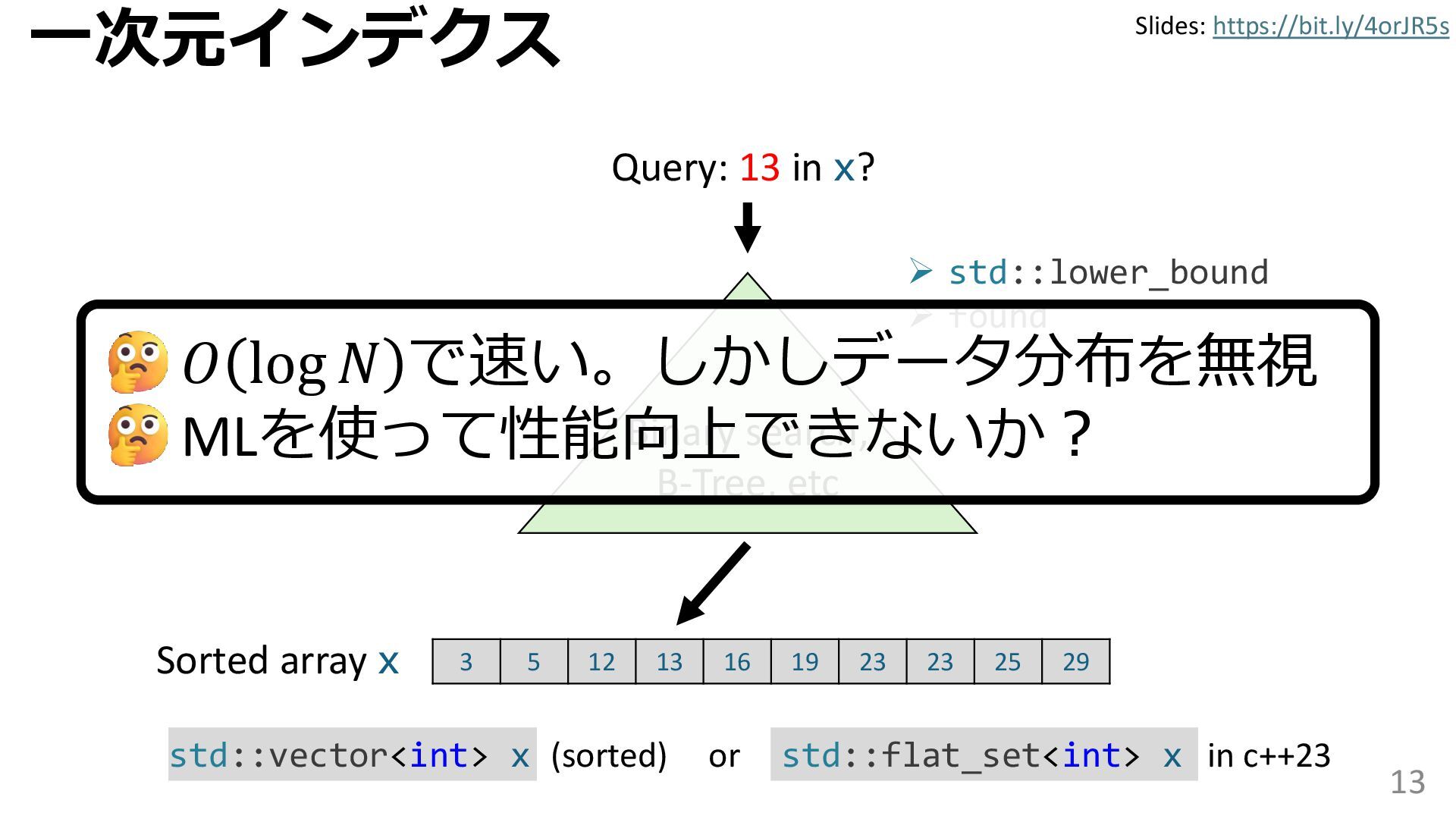
https://bit.ly/4orJR5s Slides: https://bit.ly/4orJR5s 13 3 5 12 13 16 19
23 23 25 29 Sorted array x Query: 13 in x? Binary search, B-Tree, etc std::vector<int> x (sorted) or std::flat_set<int> x in c++23 ➢ std::lower_bound ➢ find 一次元インデクス 𝑂 log 𝑁 で速い。しかしデータ分布を無視 MLを使って性能向上できないか? -
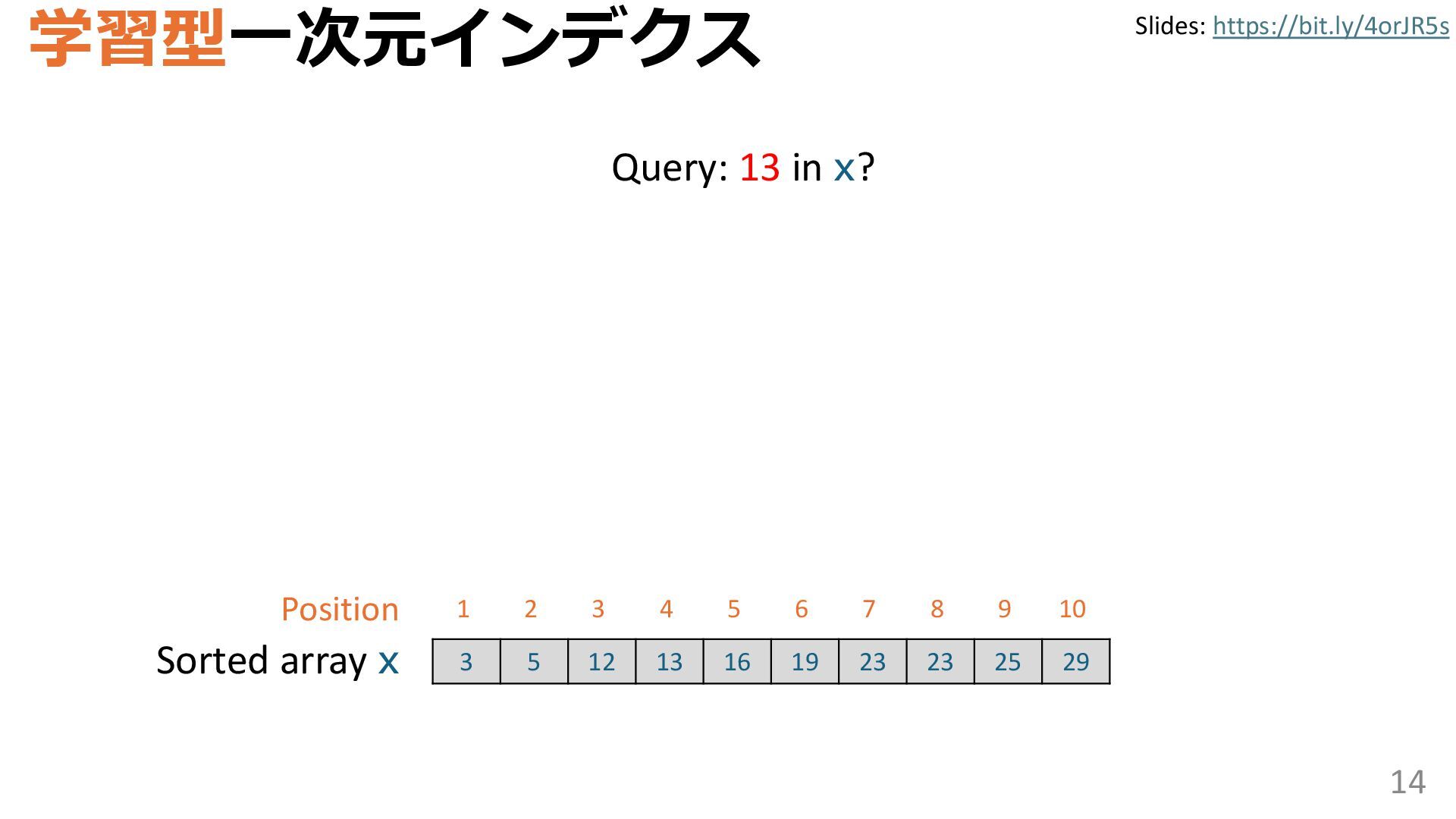
https://bit.ly/4orJR5s Slides: https://bit.ly/4orJR5s 14 学習型一次元インデクス 3 5 12 13 16
19 23 23 25 29 Sorted array x 1 2 3 4 5 6 7 8 9 10 Position Query: 13 in x? -
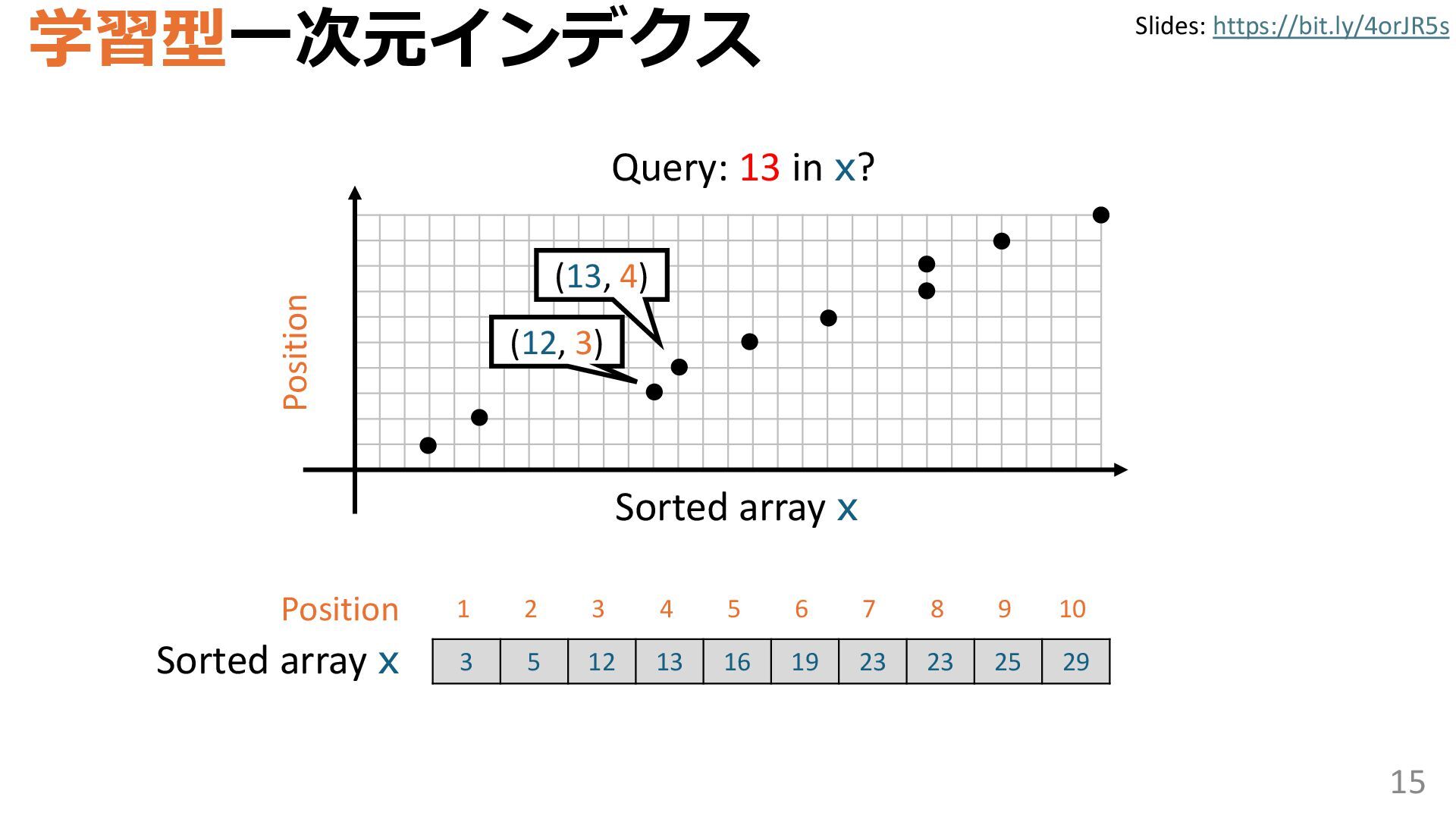
https://bit.ly/4orJR5s Slides: https://bit.ly/4orJR5s 15 学習型一次元インデクス 3 5 12 13 16
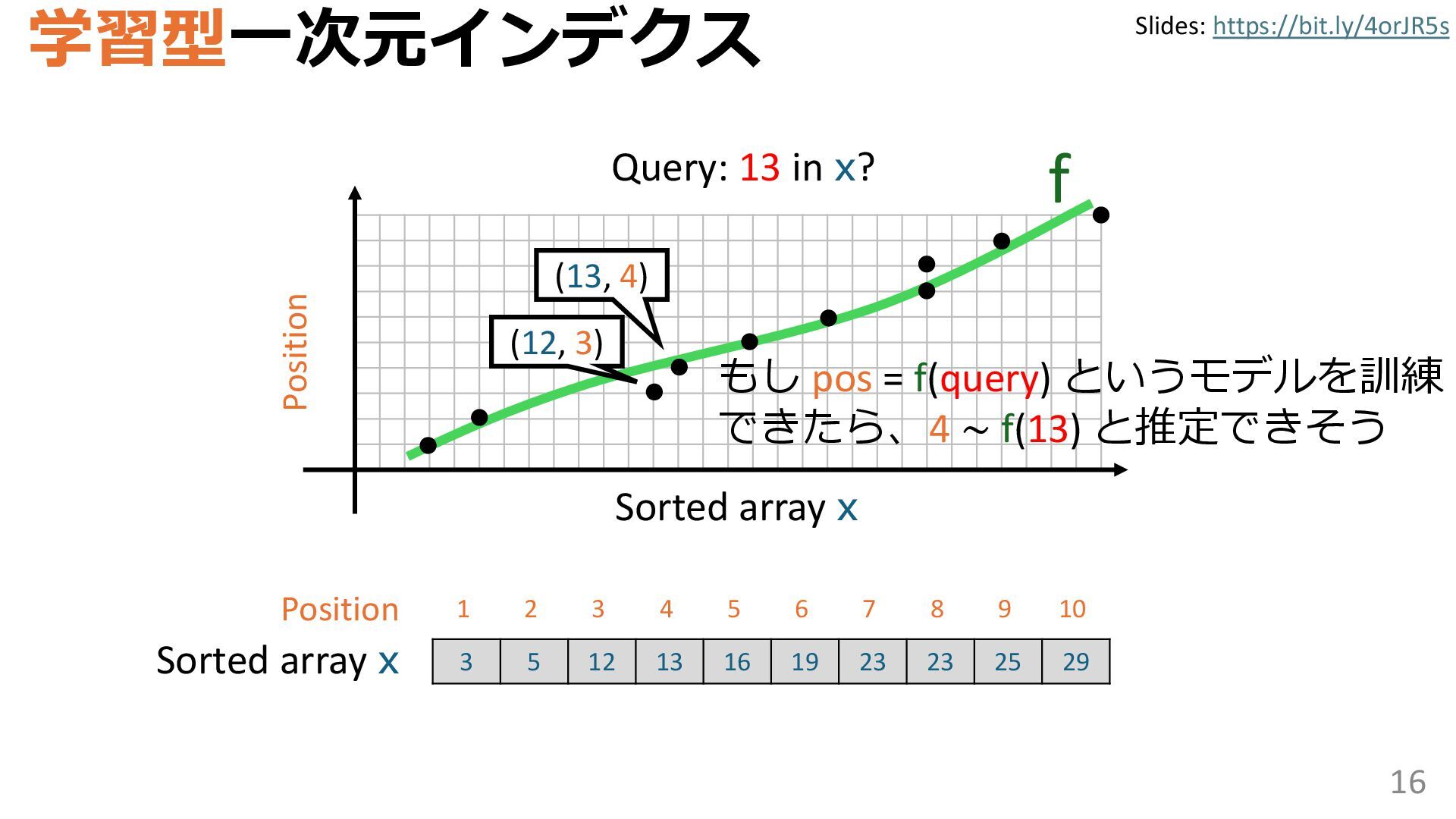
19 23 23 25 29 Sorted array x 1 2 3 4 5 6 7 8 9 10 Position Position Sorted array x (12, 3) (13, 4) Query: 13 in x? -
https://bit.ly/4orJR5s Slides: https://bit.ly/4orJR5s 16 学習型一次元インデクス 3 5 12 13 16
19 23 23 25 29 Sorted array x 1 2 3 4 5 6 7 8 9 10 Position Position Sorted array x (12, 3) (13, 4) もし pos = f(query) というモデルを訓練 できたら、4 ∼ f(13) と推定できそう Query: 13 in x? f -
https://bit.ly/4orJR5s Slides: https://bit.ly/4orJR5s 17 学習型一次元インデクス 3 5 12 13 16
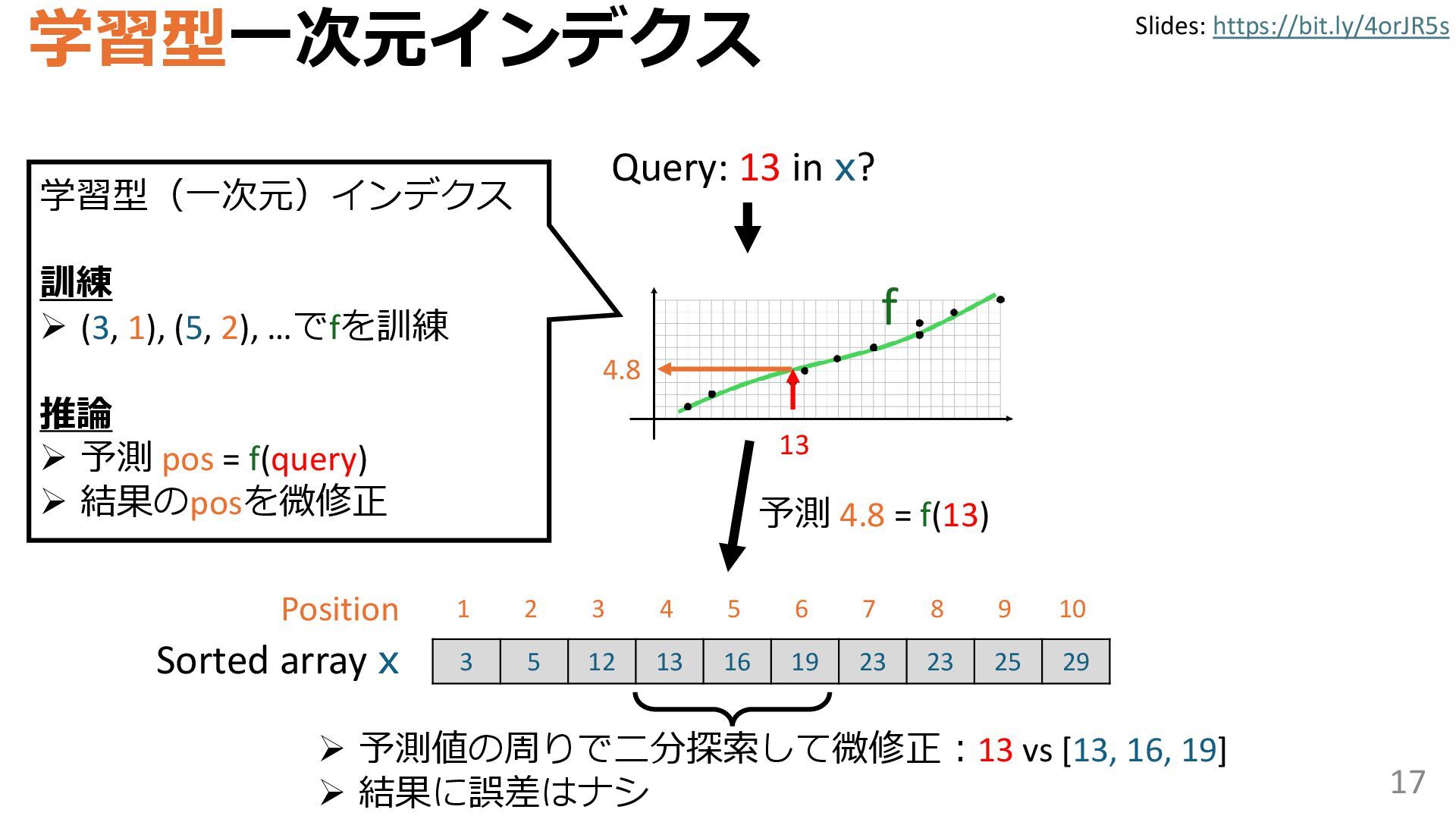
19 23 23 25 29 Sorted array x 1 2 3 4 5 6 7 8 9 10 Position ➢ 予測値の周りで二分探索して微修正:13 vs [13, 16, 19] ➢ 結果に誤差はナシ Query: 13 in x? 学習型(一次元)インデクス 訓練 ➢ (3, 1), (5, 2), …でfを訓練 推論 ➢ 予測 pos = f(query) ➢ 結果のposを微修正 13 4.8 予測 4.8 = f(13) f -
https://bit.ly/4orJR5s Slides: https://bit.ly/4orJR5s 18 学習型一次元インデクス 3 5 12 13 16
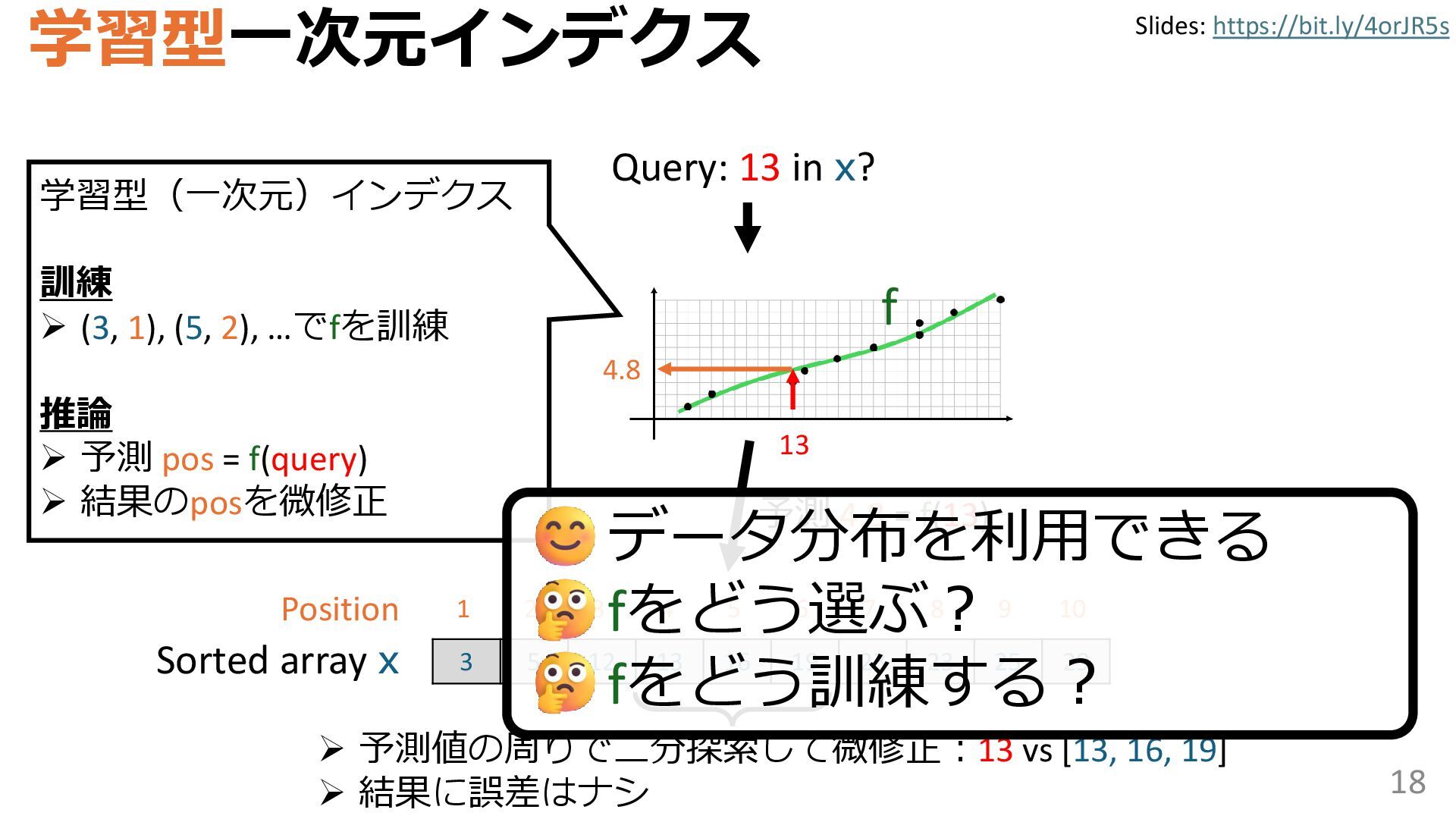
19 23 23 25 29 Sorted array x 1 2 3 4 5 6 7 8 9 10 Position ➢ 予測値の周りで二分探索して微修正:13 vs [13, 16, 19] ➢ 結果に誤差はナシ Query: 13 in x? 学習型(一次元)インデクス 訓練 ➢ (3, 1), (5, 2), …でfを訓練 推論 ➢ 予測 pos = f(query) ➢ 結果のposを微修正 13 4.8 予測 4.8 = f(13) f データ分布を利用できる fをどう選ぶ? fをどう訓練する? -
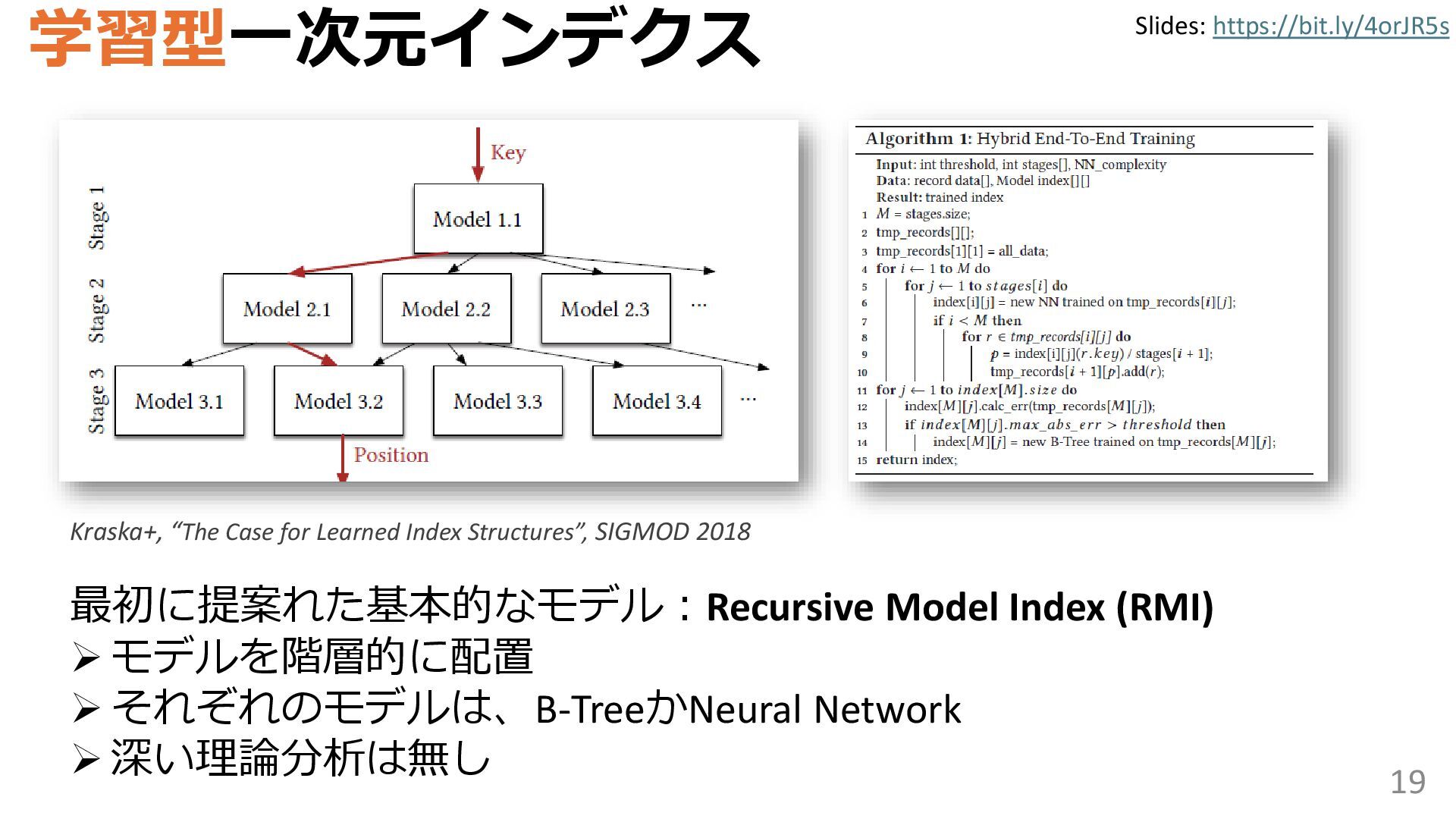
https://bit.ly/4orJR5s Slides: https://bit.ly/4orJR5s 19 学習型一次元インデクス 最初に提案された基本的なモデル:Recursive Model Index (RMI) ➢
モデルを階層的に配置 ➢ それぞれのモデルは、B-TreeかNeural Network ➢ 深い理論分析は無し Kraska+, “The Case for Learned Index Structures”, SIGMOD 2018 -
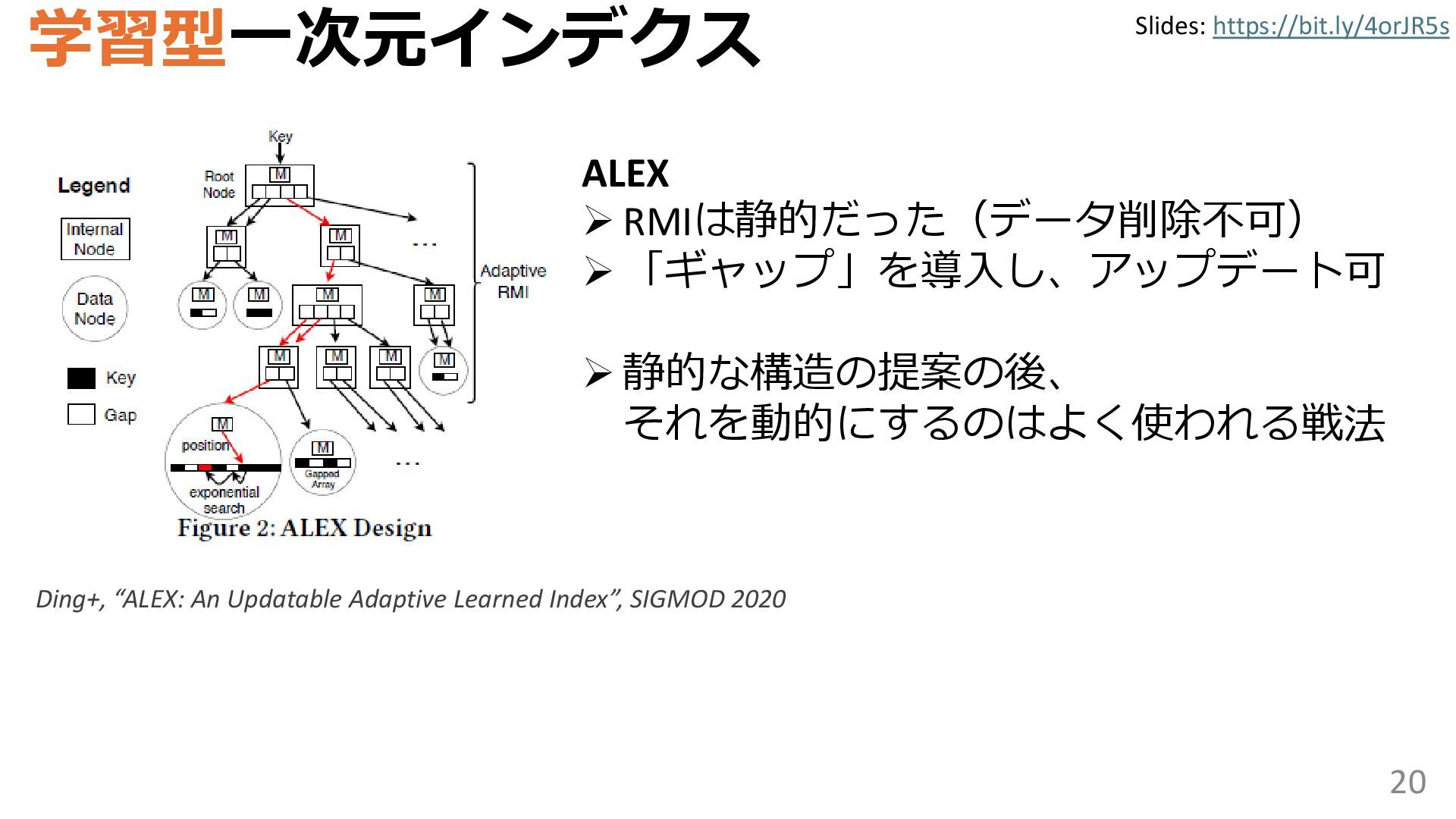
https://bit.ly/4orJR5s Slides: https://bit.ly/4orJR5s 学習型一次元インデクス ALEX ➢ RMIは静的だった(データ削除不可) ➢ 「ギャップ」を導入し、アップデート可 ➢
静的な構造の提案の後、 それを動的にするのはよく使われる戦法 Ding+, “ALEX: An Updatable Adaptive Learned Index”, SIGMOD 2020 20 -
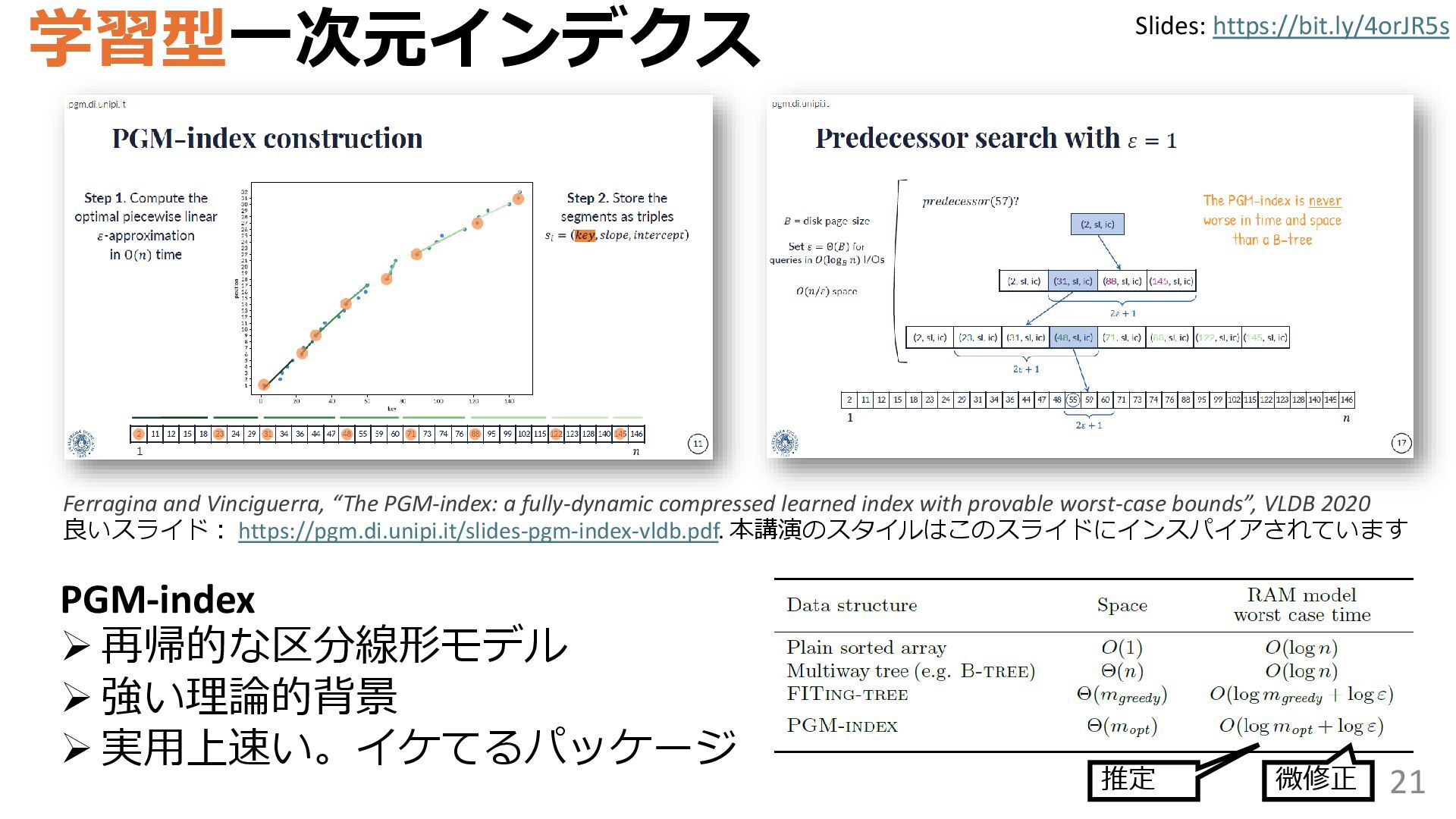
https://bit.ly/4orJR5s Slides: https://bit.ly/4orJR5s 学習型一次元インデクス PGM-index ➢ 再帰的な区分線形モデル ➢ 強い理論的背景 ➢
実用上速い。イケてるパッケージ Ferragina and Vinciguerra, “The PGM-index: a fully-dynamic compressed learned index with provable worst-case bounds”, VLDB 2020 良いスライド: https://pgm.di.unipi.it/slides-pgm-index-vldb.pdf. 本講演のスタイルはこのスライドにインスパイアされています 推定 微修正 21 -
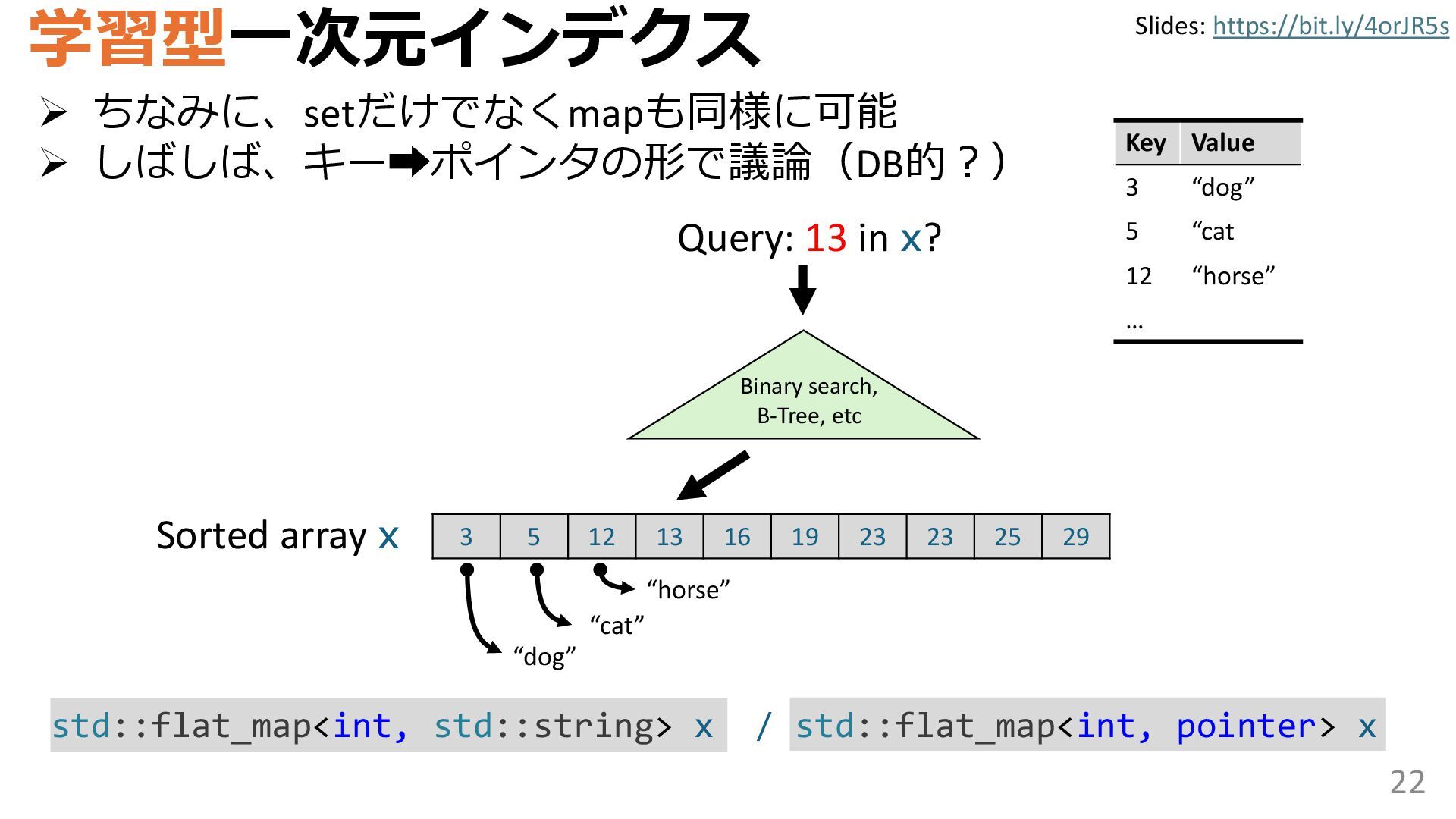
https://bit.ly/4orJR5s Slides: https://bit.ly/4orJR5s 22 学習型一次元インデクス 3 5 12 13 16
19 23 23 25 29 Sorted array x Query: 13 in x? Binary search, B-Tree, etc std::flat_map<int, std::string> x / std::flat_map<int, pointer> x ➢ ちなみに、setだけでなくmapも同様に可能 ➢ しばしば、「キー ポインタ」の形で議論(DB的?) “dog” “cat” “horse” Key Value 3 “dog” 5 “cat 12 “horse” … -
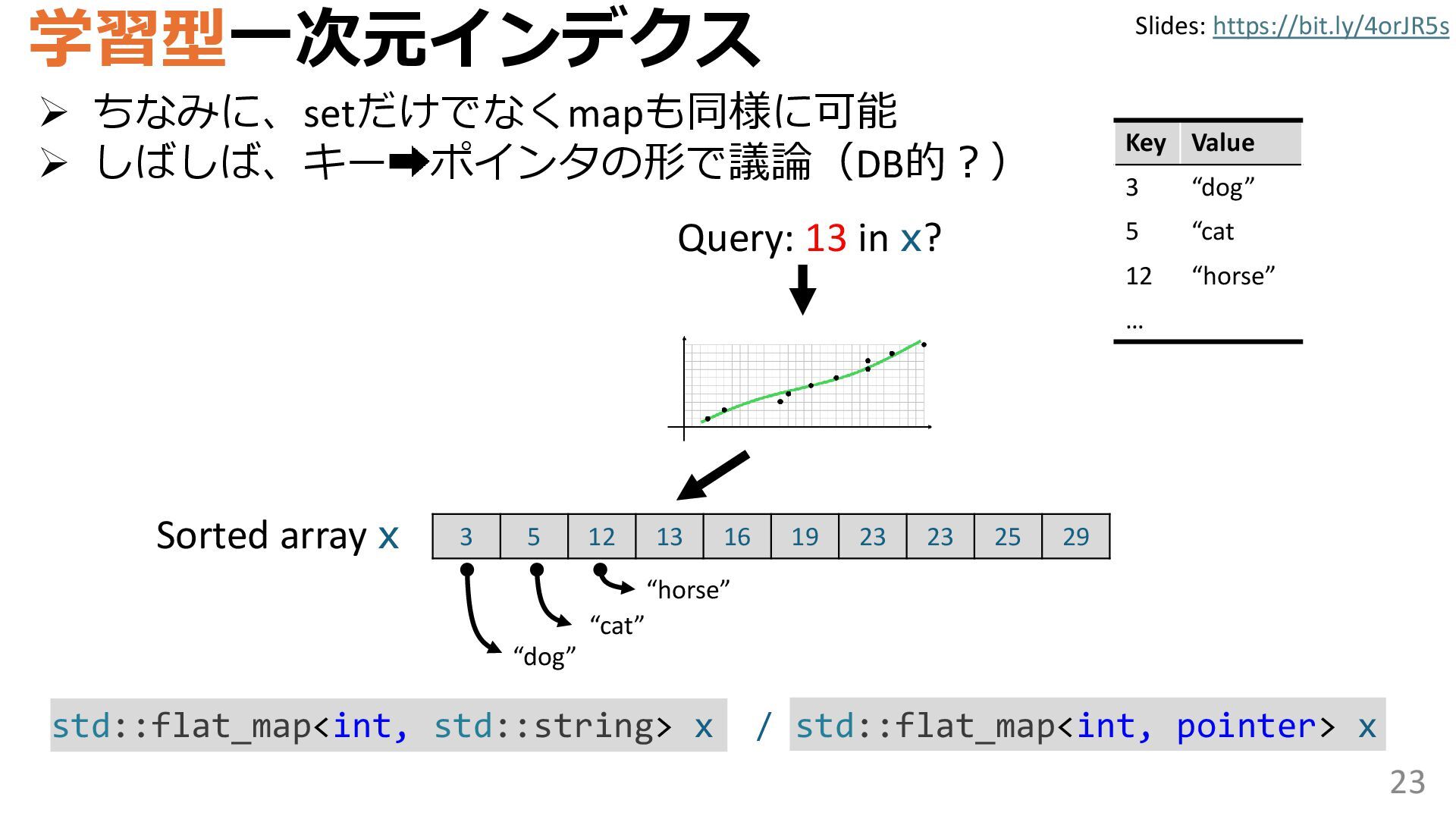
https://bit.ly/4orJR5s Slides: https://bit.ly/4orJR5s 23 学習型一次元インデクス 3 5 12 13 16
19 23 23 25 29 Sorted array x Query: 13 in x? std::flat_map<int, std::string> x / std::flat_map<int, pointer> x ➢ ちなみに、setだけでなくmapも同様に可能 ➢ しばしば、「キー ポインタ」の形で議論(DB的?) “dog” “cat” “horse” Key Value 3 “dog” 5 “cat 12 “horse” … -
https://bit.ly/4orJR5s Slides: https://bit.ly/4orJR5s 24 アウトライン 1. 一次元インデクス 2. 多次元インデクス 3.
ブルームフィルタ 4. 近似最近傍探索 5. 議論 -
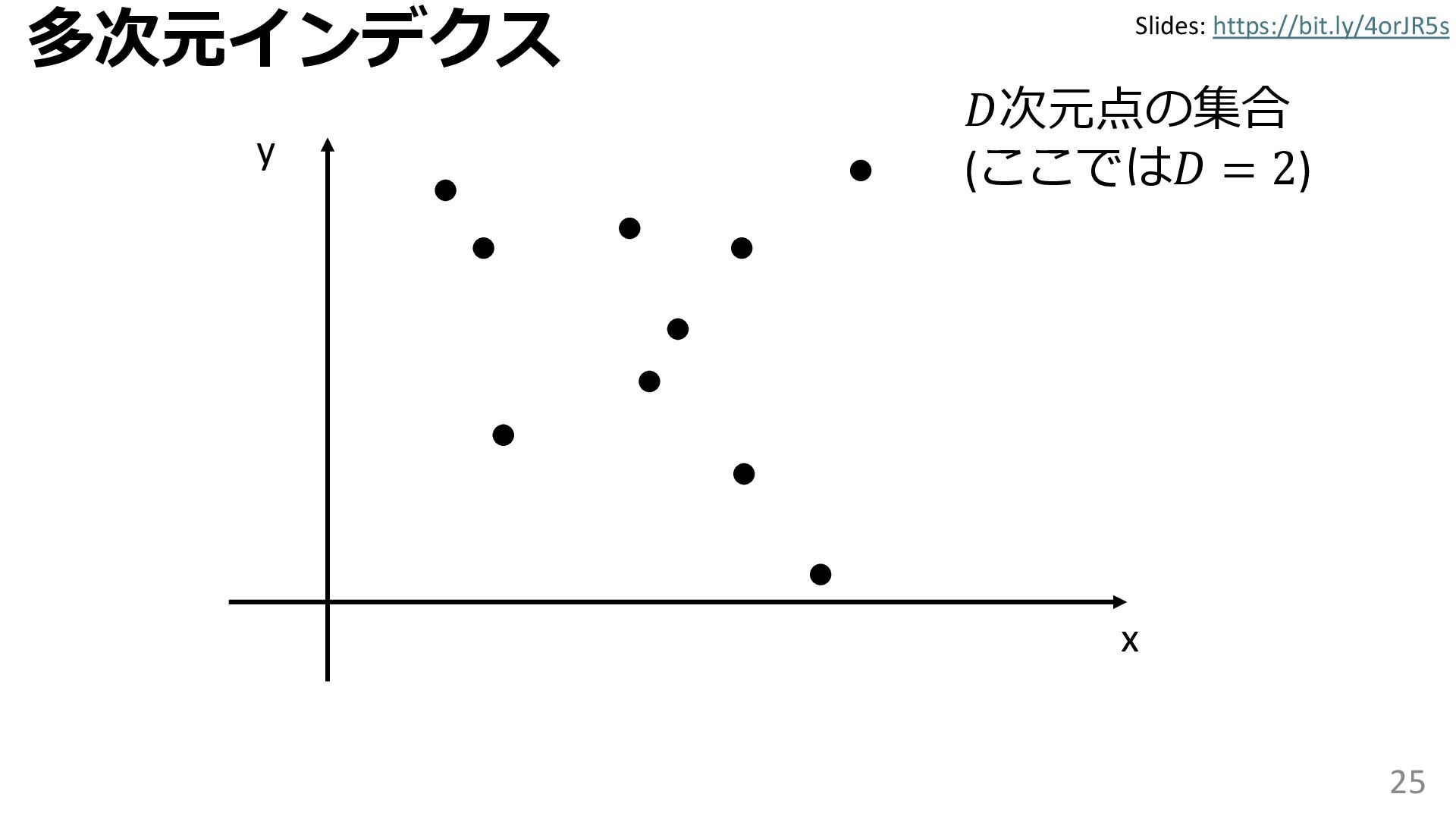
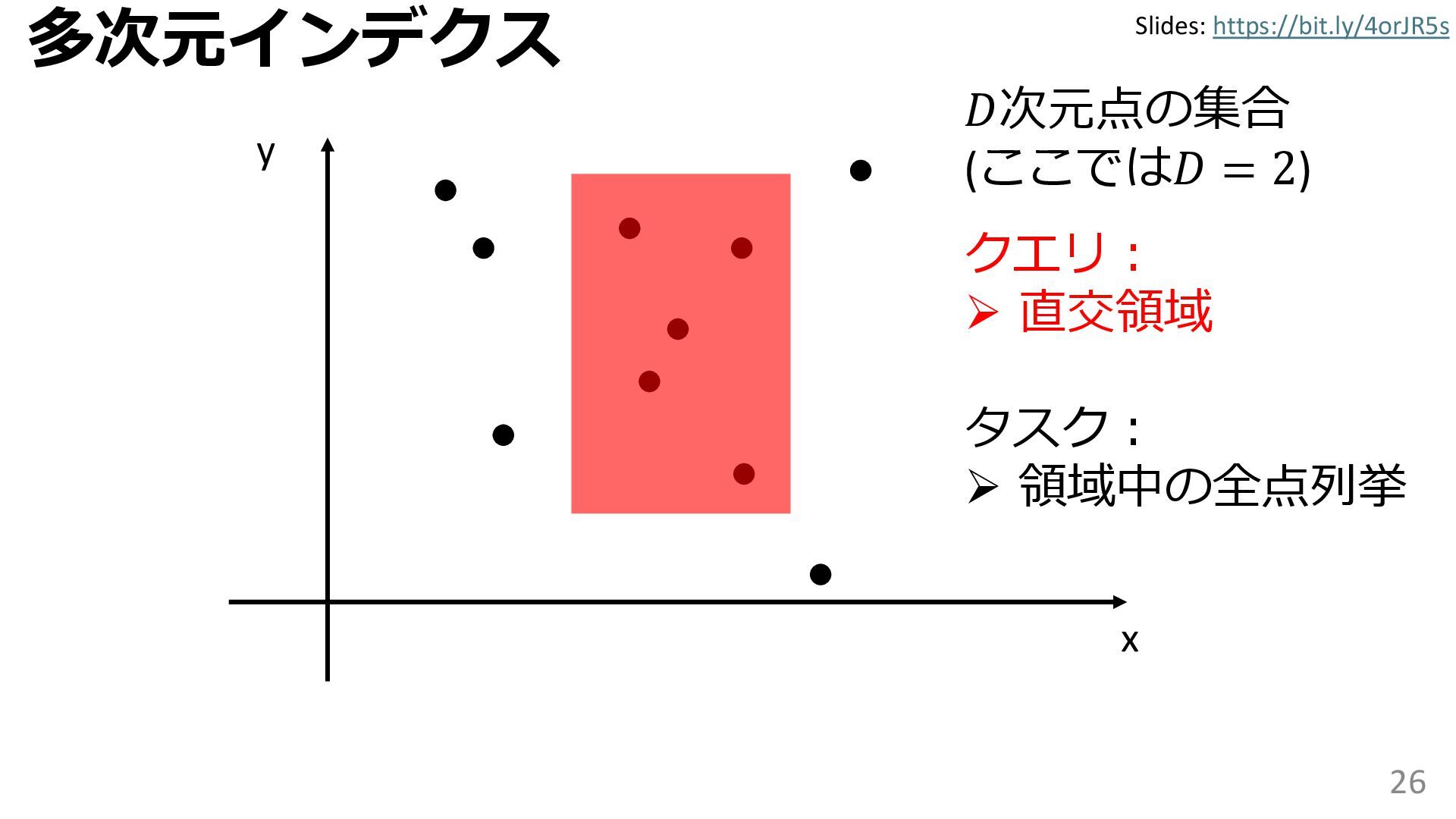
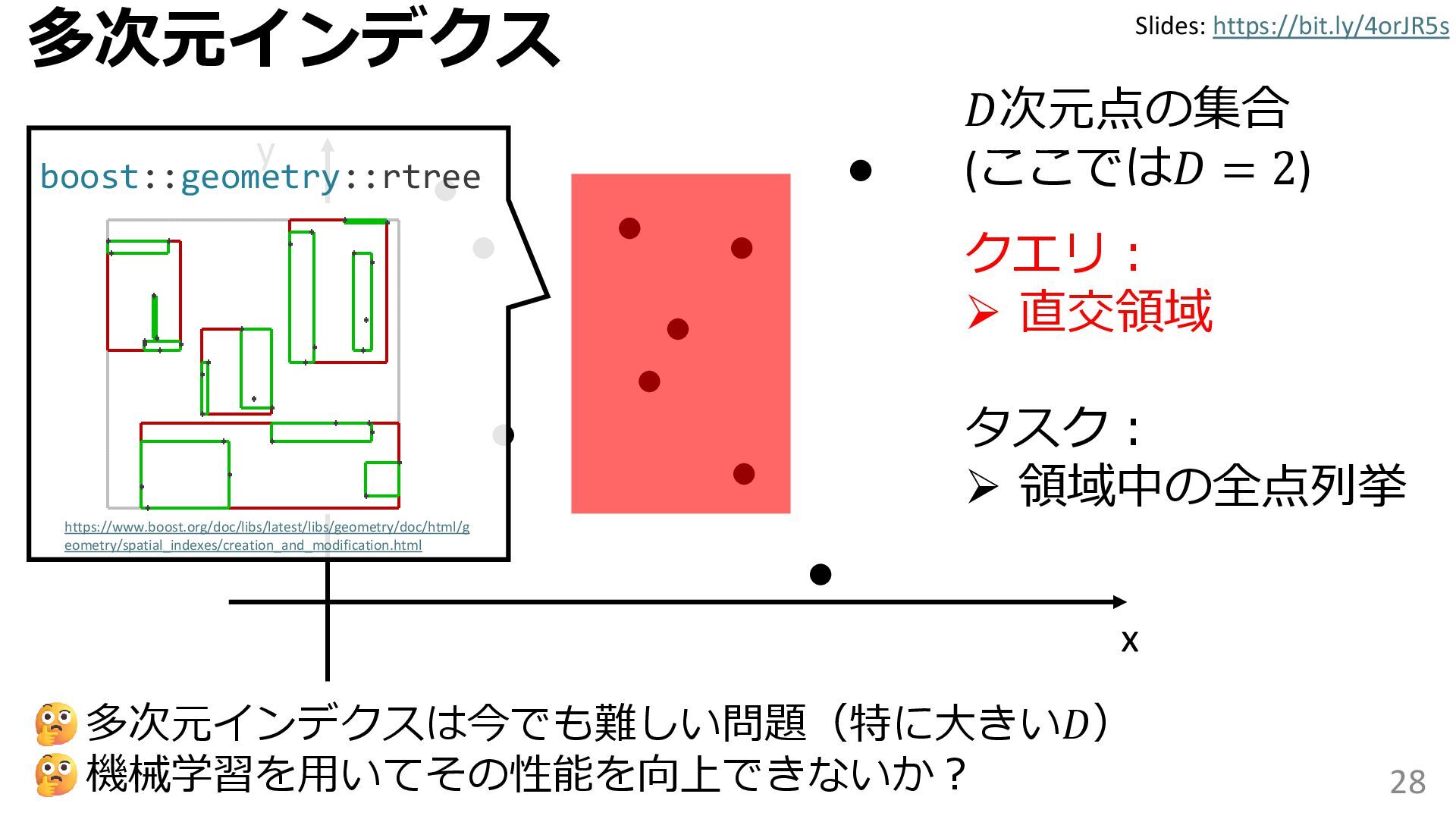
https://bit.ly/4orJR5s Slides: https://bit.ly/4orJR5s 多次元インデクス 26 x y 𝐷次元点の集合 (ここでは𝐷 =
2) クエリ: ➢ 直交領域 タスク: ➢ 領域中の全点列挙 -
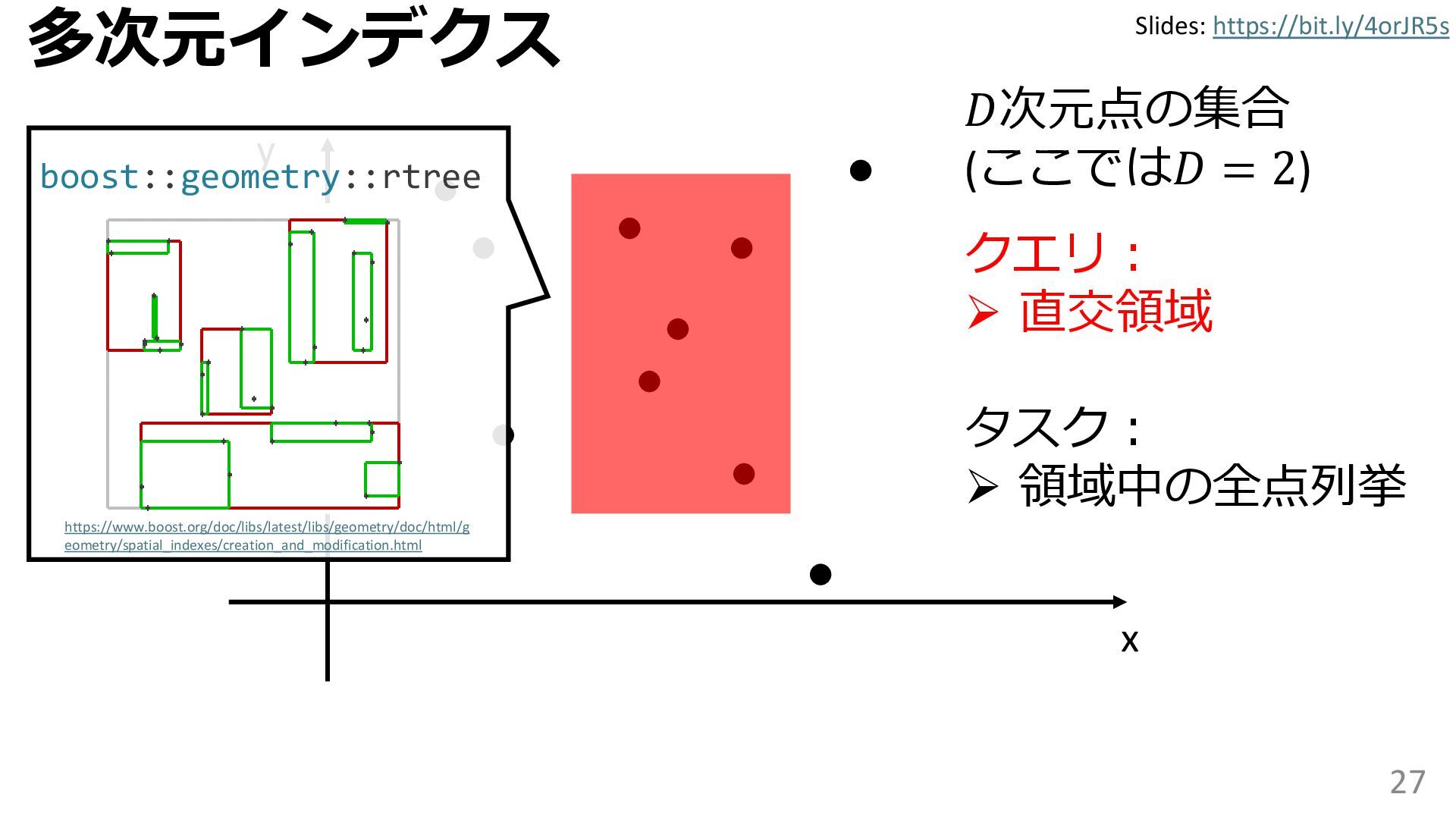
https://bit.ly/4orJR5s Slides: https://bit.ly/4orJR5s 多次元インデクス 27 x y 𝐷次元点の集合 (ここでは𝐷 =
2) boost::geometry::rtree https://www.boost.org/doc/libs/latest/libs/geometry/doc/html/g eometry/spatial_indexes/creation_and_modification.html クエリ: ➢ 直交領域 タスク: ➢ 領域中の全点列挙 -
https://bit.ly/4orJR5s Slides: https://bit.ly/4orJR5s 多次元インデクス 28 x y boost::geometry::rtree https://www.boost.org/doc/libs/latest/libs/geometry/doc/html/g eometry/spatial_indexes/creation_and_modification.html
多次元インデクスは今でも難しい問題(特に大きい𝐷) 機械学習を用いてその性能を向上できないか? 𝐷次元点の集合 (ここでは𝐷 = 2) クエリ: ➢ 直交領域 タスク: ➢ 領域中の全点列挙 -
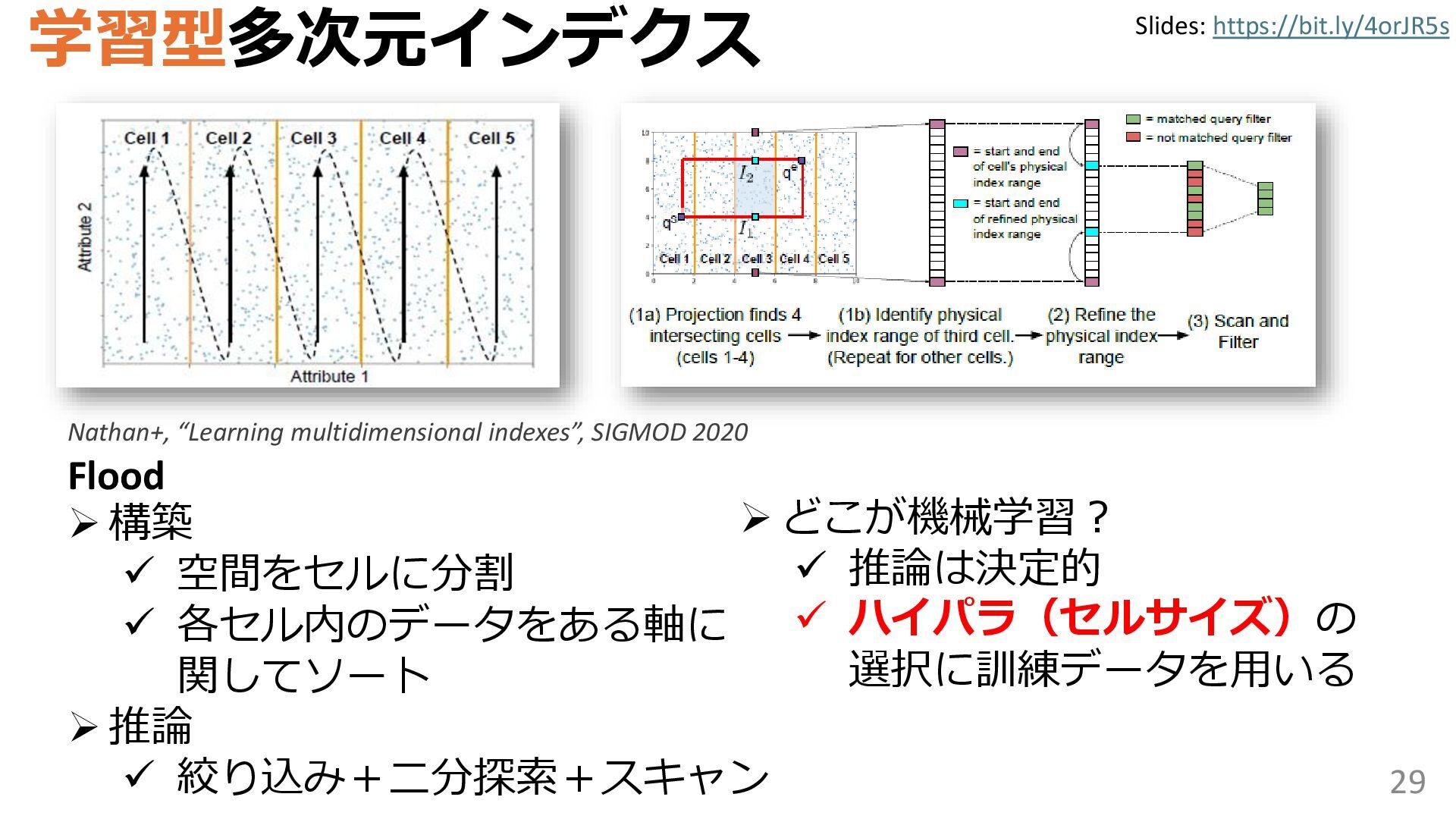
https://bit.ly/4orJR5s Slides: https://bit.ly/4orJR5s 学習型多次元インデクス 29 Nathan+, “Learning multidimensional indexes”, SIGMOD
2020 Flood ➢ 構築 ✓ 空間をセルに分割 ✓ 各セル内のデータをある軸に 関してソート ➢ 推論 ✓ 絞り込み+二分探索+スキャン ➢ どこが機械学習? ✓ 推論は決定的 ✓ ハイパラ(セルサイズ)の 選択に訓練データを用いる -
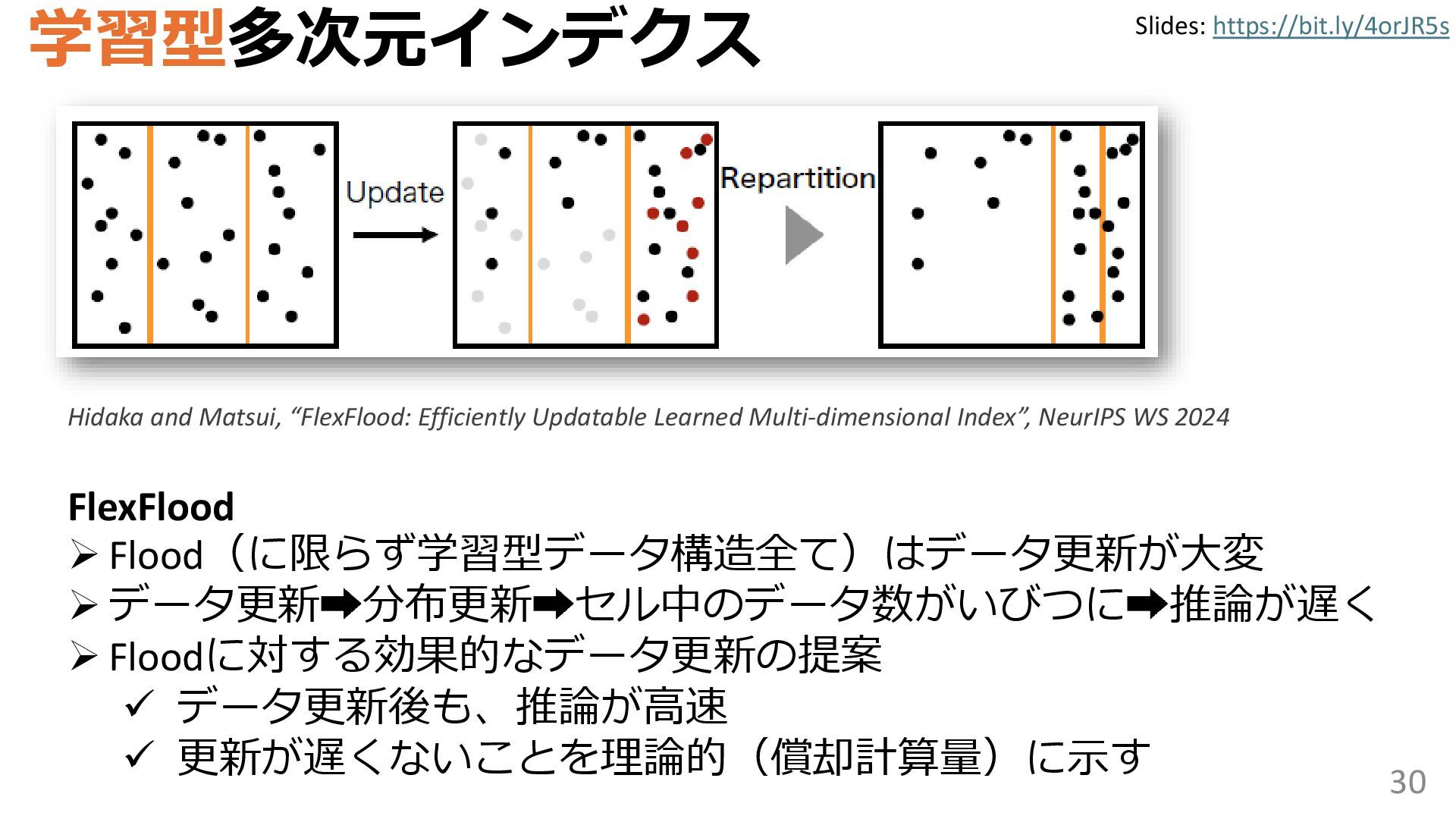
https://bit.ly/4orJR5s Slides: https://bit.ly/4orJR5s 学習型多次元インデクス 30 Hidaka and Matsui, “FlexFlood: Efficiently
Updatable Learned Multi-dimensional Index”, NeurIPS WS 2024 FlexFlood ➢ Flood(に限らず学習型データ構造全て)はデータ更新が大変 ➢ データ更新 分布更新 セル中のデータ数がいびつに 推論が遅く ➢ Floodに対する効果的なデータ更新の提案 ✓ データ更新後も、推論が高速 ✓ 更新が遅くないことを理論的(償却計算量)に示す -
https://bit.ly/4orJR5s Slides: https://bit.ly/4orJR5s 31 アウトライン 1. 一次元インデクス 2. 多次元インデクス 3.
ブルームフィルタ 4. 近似最近傍探索 5. 議論 -
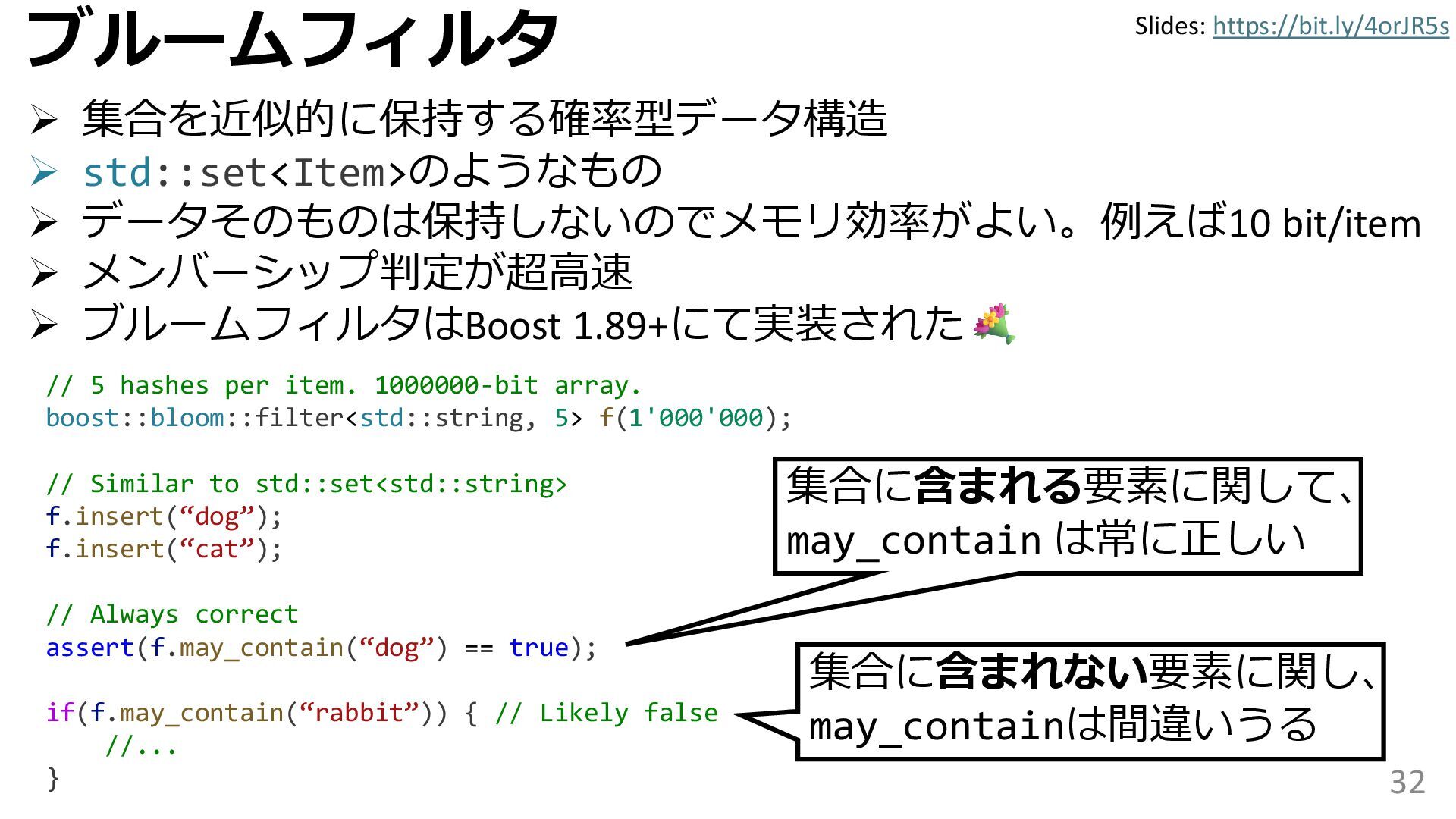
https://bit.ly/4orJR5s Slides: https://bit.ly/4orJR5s 32 ブルームフィルタ ➢ 集合を近似的に保持する確率型データ構造 ➢ std::set<Item>のようなもの ➢
データそのものは保持しないのでメモリ効率がよい。例えば10 bit/item ➢ メンバーシップ判定が超高速 ➢ ブルームフィルタはBoost 1.89+にて実装された // 5 hashes per item. 1000000-bit array. boost::bloom::filter<std::string, 5> f(1'000'000); // Similar to std::set<std::string> f.insert(“dog”); f.insert(“cat”); // Always correct assert(f.may_contain(“dog”) == true); if(f.may_contain(“rabbit”)) { // Likely false //... } 集合に含まれる要素に関して、 may_contain は常に正しい 集合に含まれない要素に関し、 may_containは間違いうる -
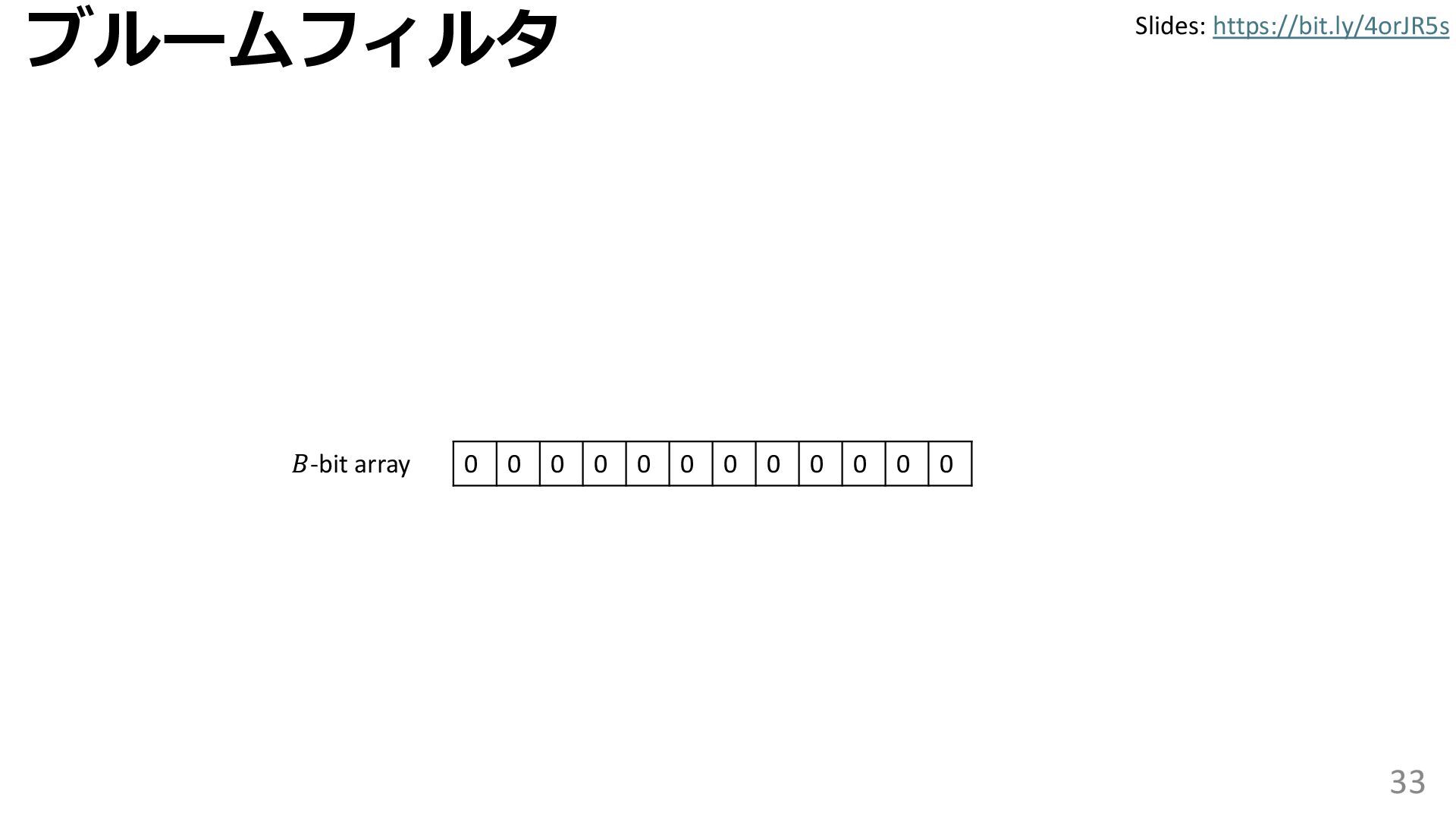
https://bit.ly/4orJR5s Slides: https://bit.ly/4orJR5s 33 ブルームフィルタ 0 0 0 0 0
0 0 0 0 0 0 0 𝐵-bit array -
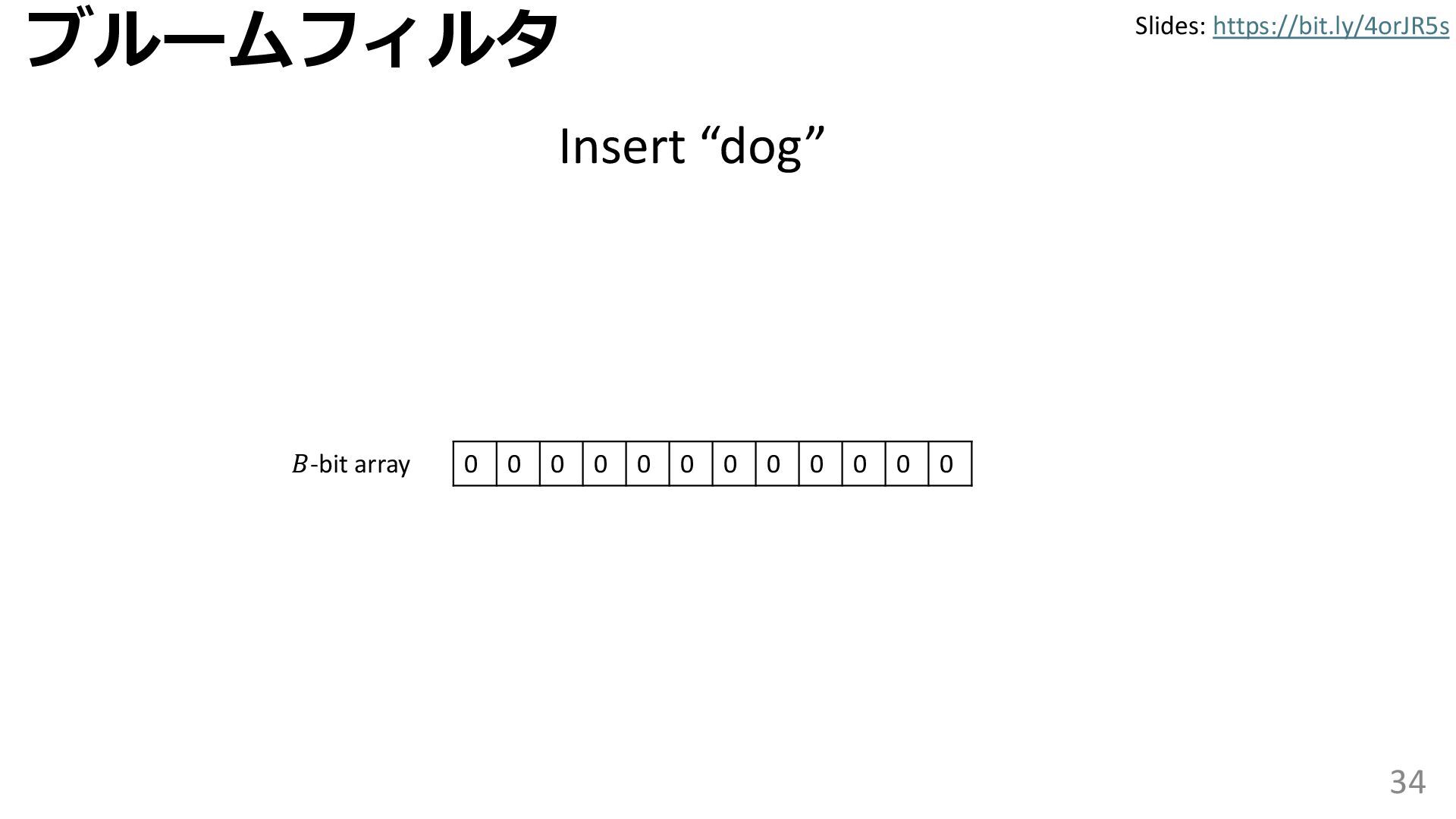
https://bit.ly/4orJR5s Slides: https://bit.ly/4orJR5s 34 ブルームフィルタ 0 0 0 0 0
0 0 0 0 0 0 0 Insert “dog” 𝐵-bit array -
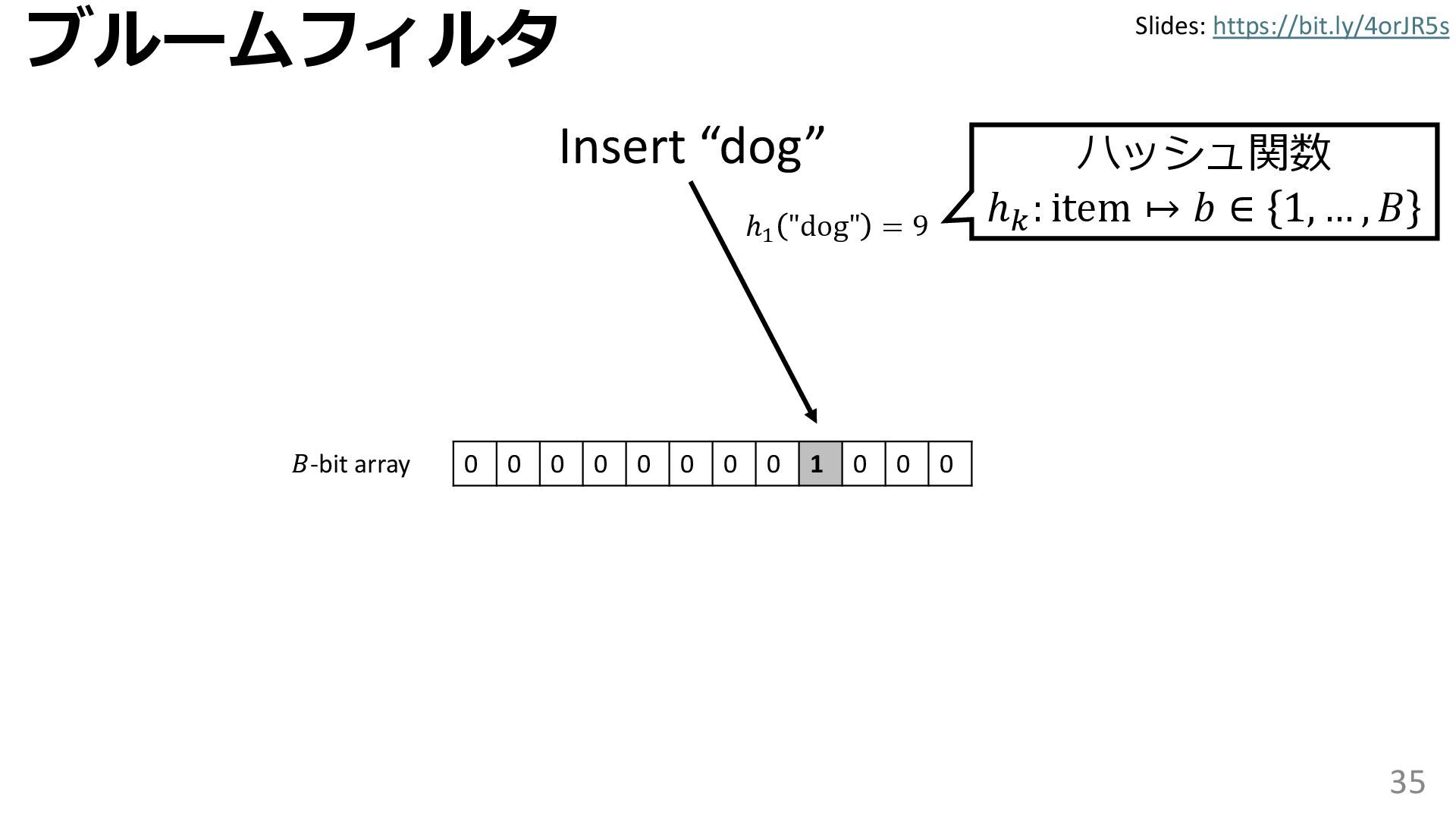
https://bit.ly/4orJR5s Slides: https://bit.ly/4orJR5s 35 ブルームフィルタ 0 0 0 0 0
0 0 0 1 0 0 0 Insert “dog” ℎ1 "dog" = 9 𝐵-bit array ハッシュ関数 ℎ𝑘 : item ↦ 𝑏 ∈ 1, … , 𝐵 -
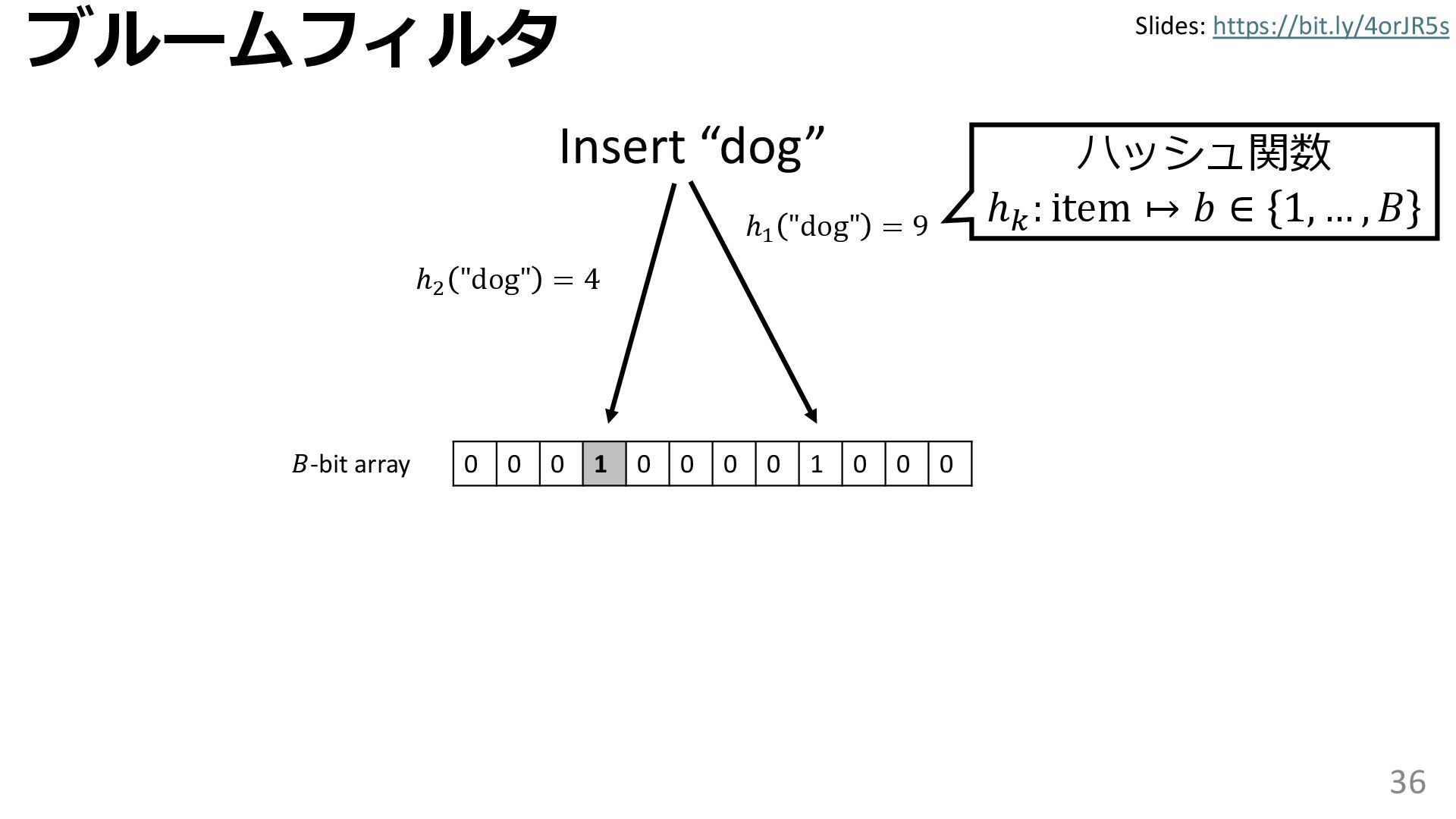
https://bit.ly/4orJR5s Slides: https://bit.ly/4orJR5s 36 ブルームフィルタ 0 0 0 1 0
0 0 0 1 0 0 0 Insert “dog” ℎ2 "dog" = 4 ℎ1 "dog" = 9 𝐵-bit array ハッシュ関数 ℎ𝑘 : item ↦ 𝑏 ∈ 1, … , 𝐵 -
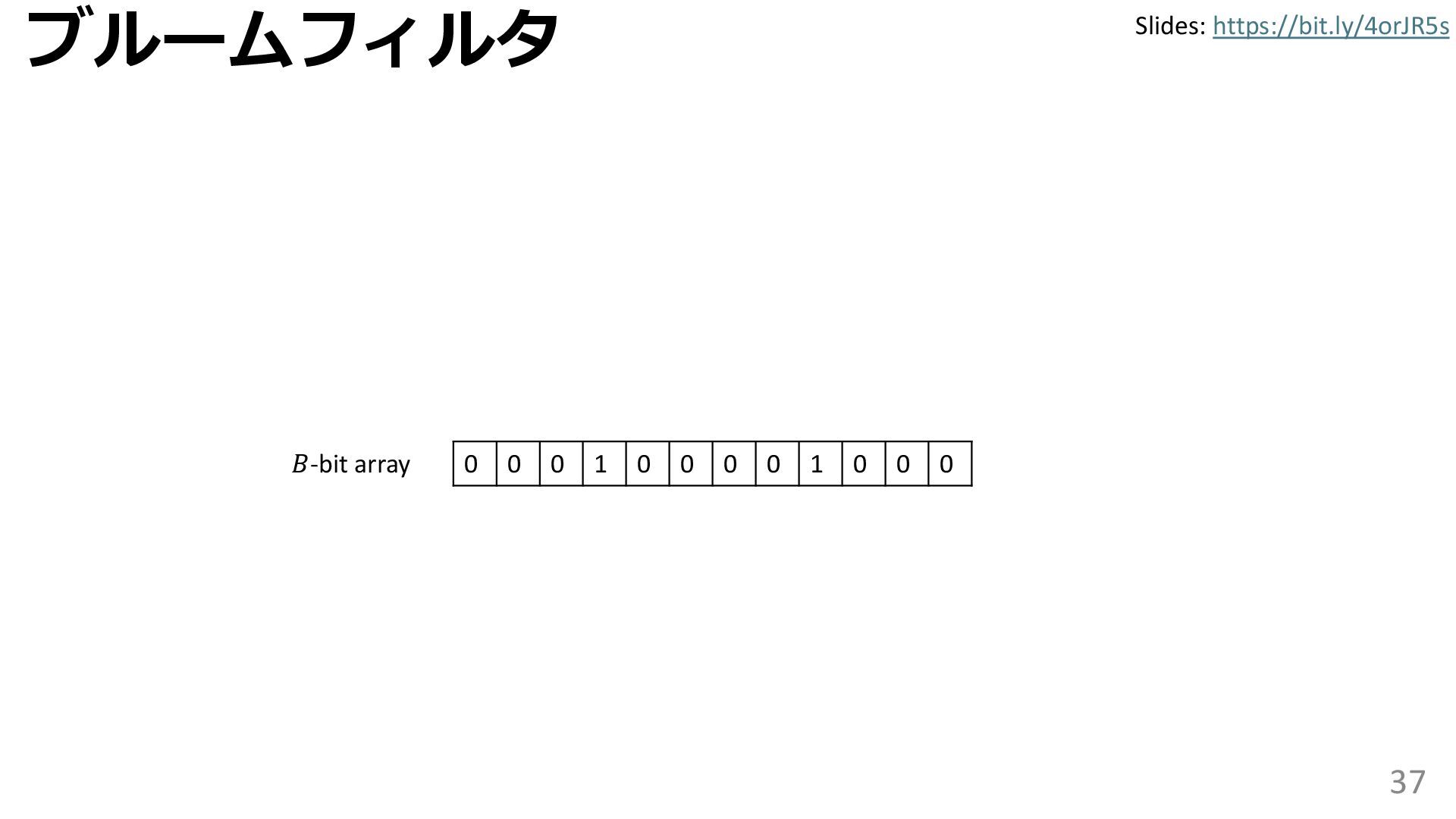
https://bit.ly/4orJR5s Slides: https://bit.ly/4orJR5s 37 ブルームフィルタ 0 0 0 1 0
0 0 0 1 0 0 0 𝐵-bit array -
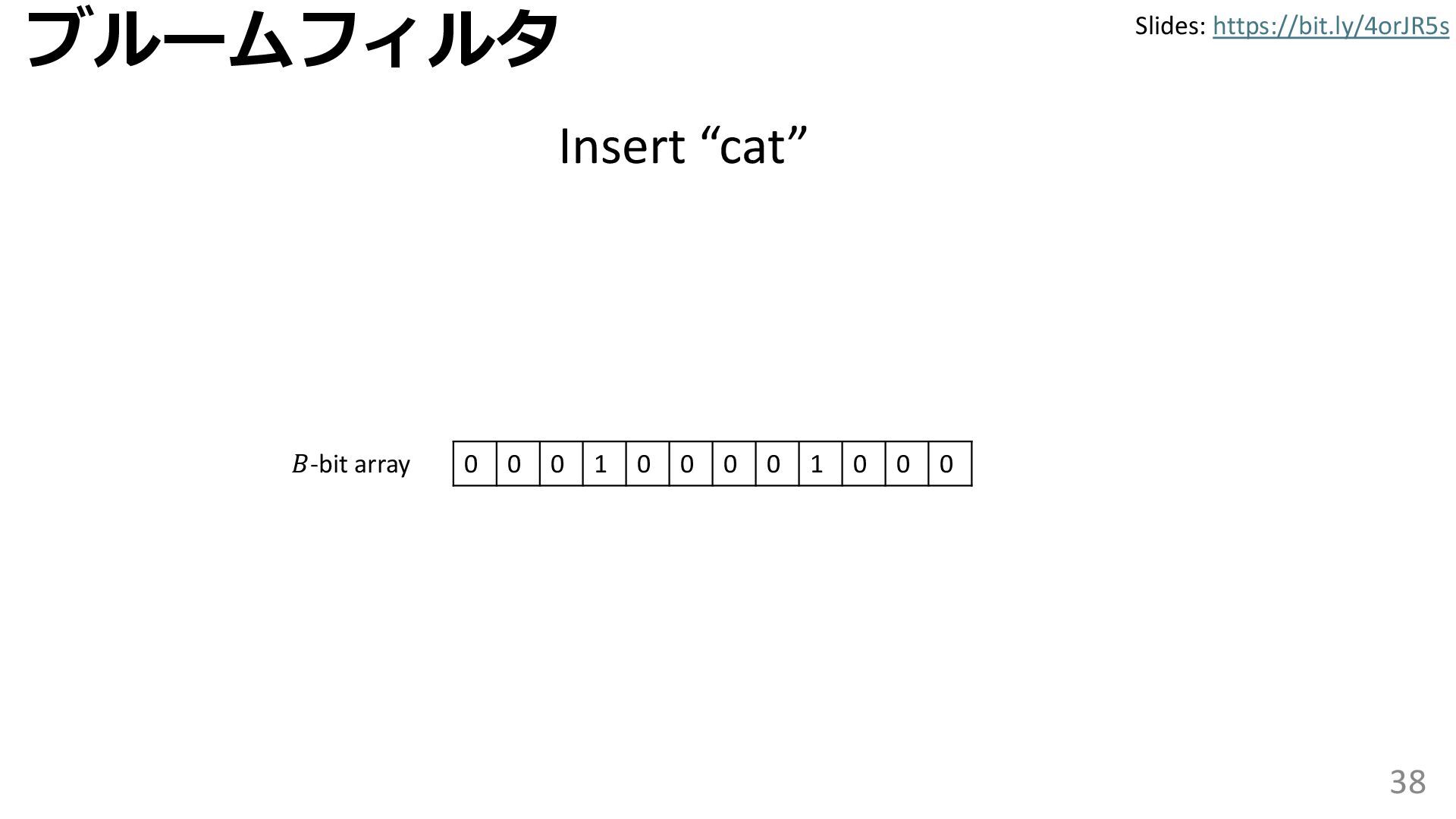
https://bit.ly/4orJR5s Slides: https://bit.ly/4orJR5s 38 ブルームフィルタ 0 0 0 1 0
0 0 0 1 0 0 0 Insert “cat” 𝐵-bit array -
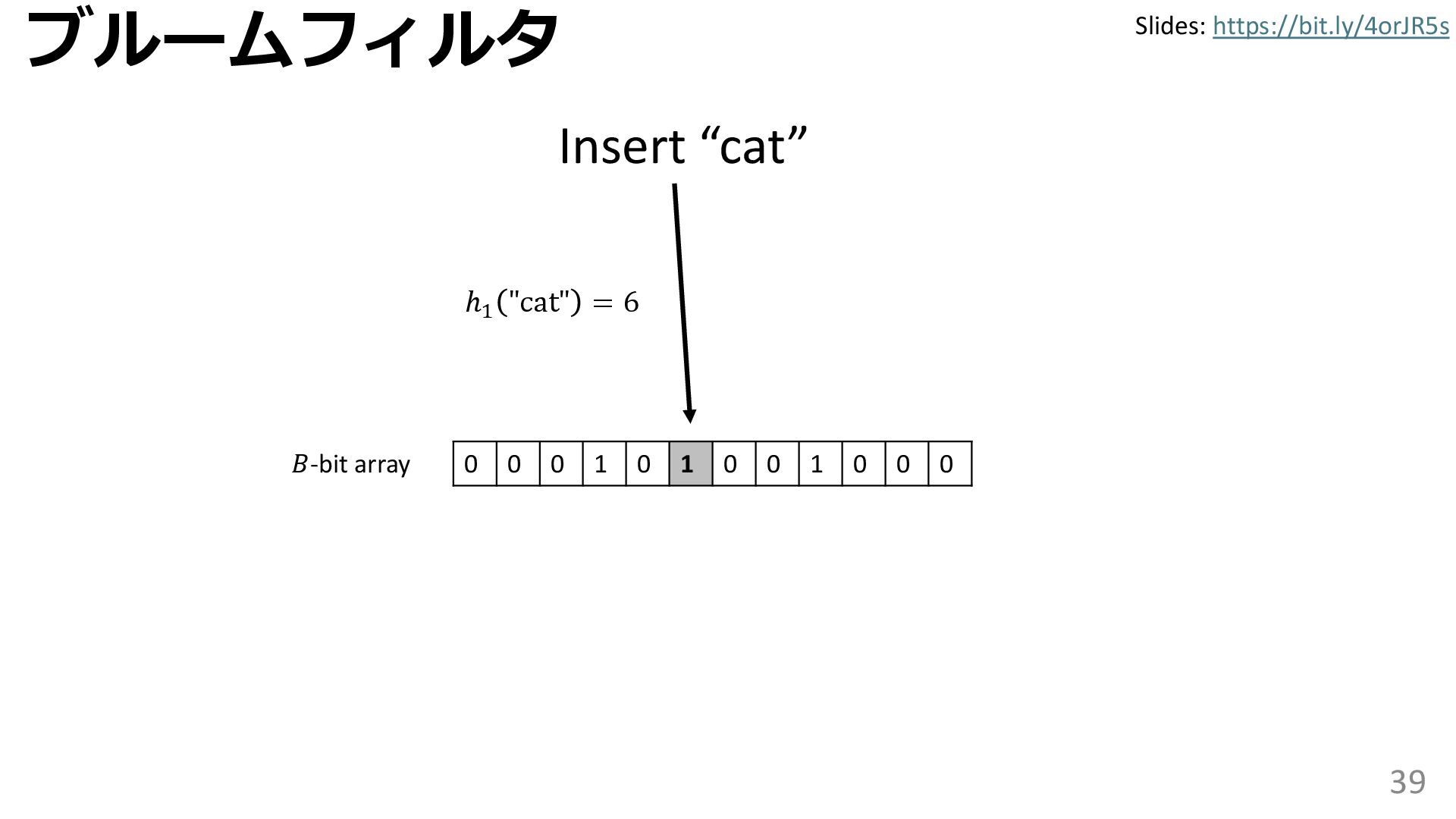
https://bit.ly/4orJR5s Slides: https://bit.ly/4orJR5s 39 ブルームフィルタ 0 0 0 1 0
1 0 0 1 0 0 0 ℎ1 "cat" = 6 Insert “cat” 𝐵-bit array -
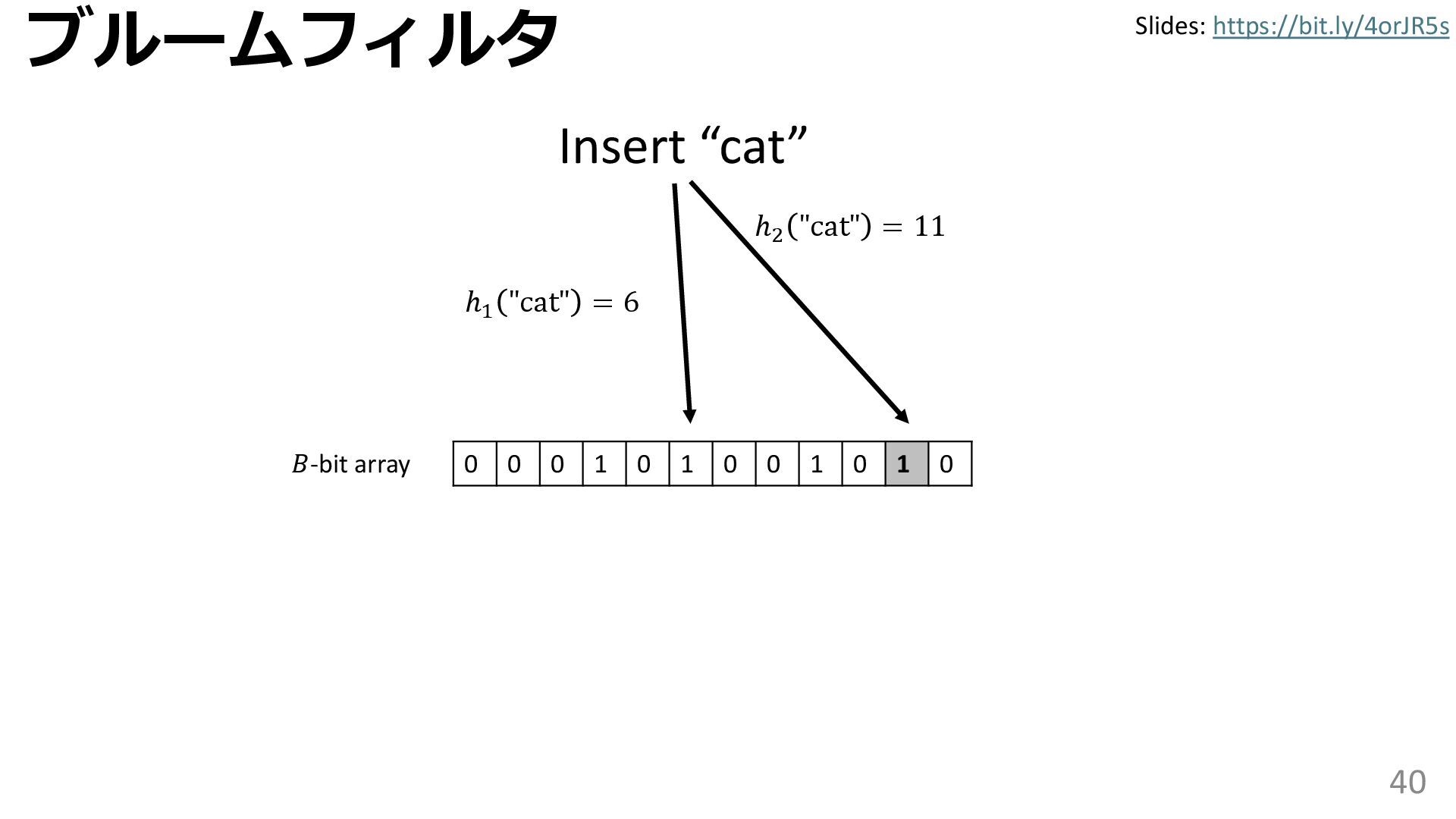
https://bit.ly/4orJR5s Slides: https://bit.ly/4orJR5s 40 ブルームフィルタ 0 0 0 1 0
1 0 0 1 0 1 0 ℎ1 "cat" = 6 ℎ2 "cat" = 11 Insert “cat” 𝐵-bit array -
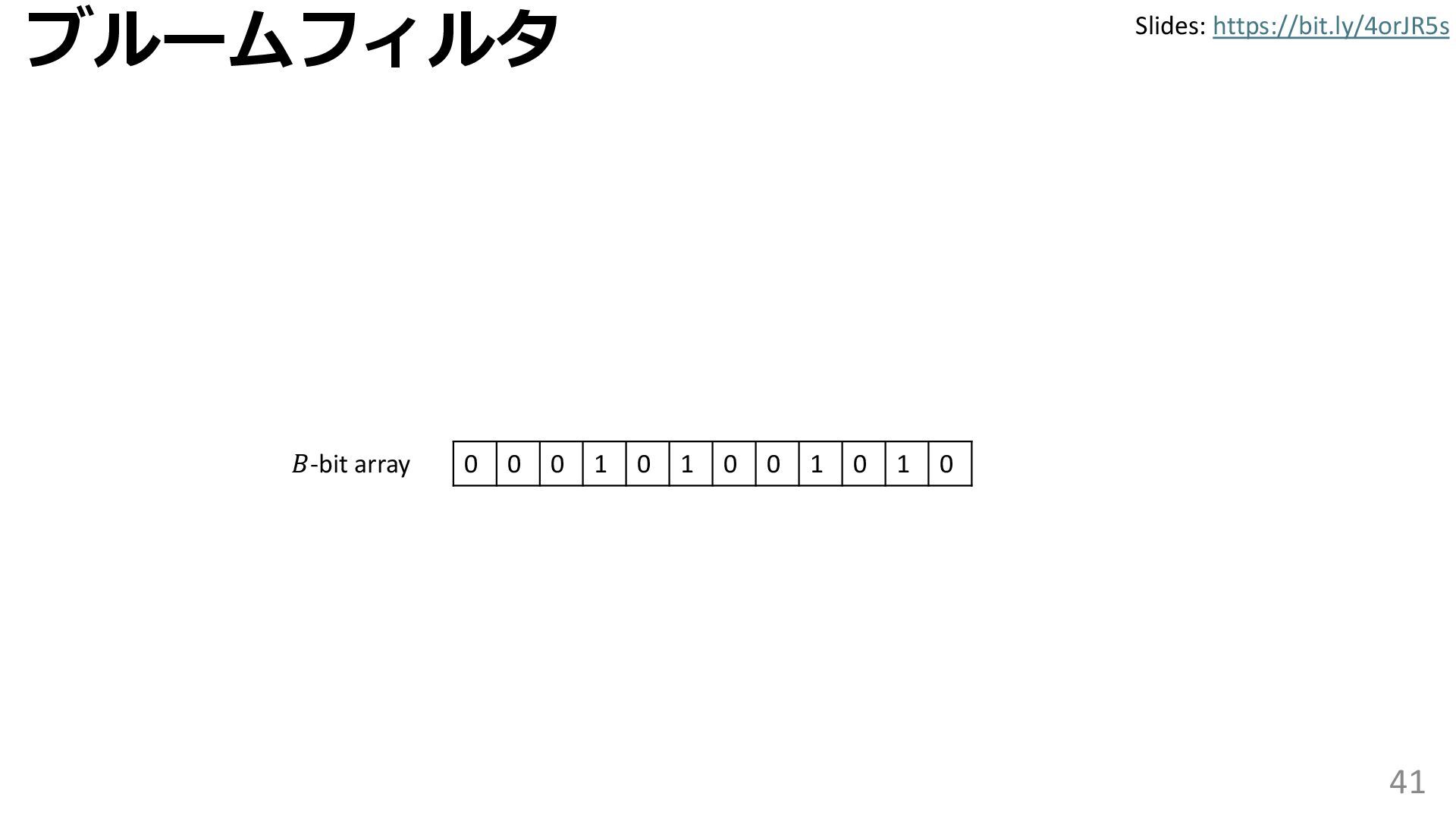
https://bit.ly/4orJR5s Slides: https://bit.ly/4orJR5s 41 0 0 0 1 0 1
0 0 1 0 1 0 𝐵-bit array ブルームフィルタ -
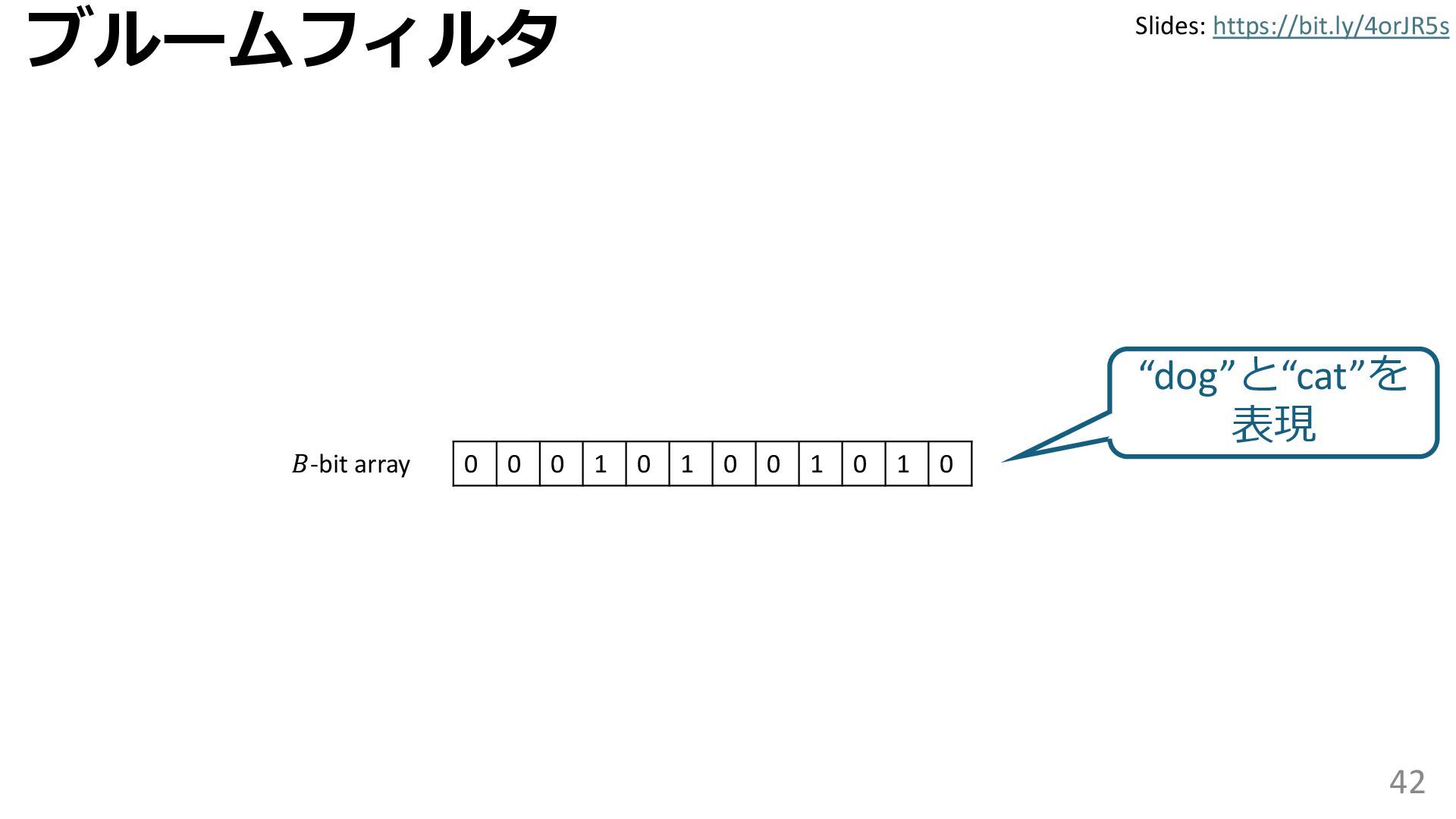
https://bit.ly/4orJR5s Slides: https://bit.ly/4orJR5s 42 0 0 0 1 0 1
0 0 1 0 1 0 𝐵-bit array ブルームフィルタ “dog”と“cat”を 表現 -
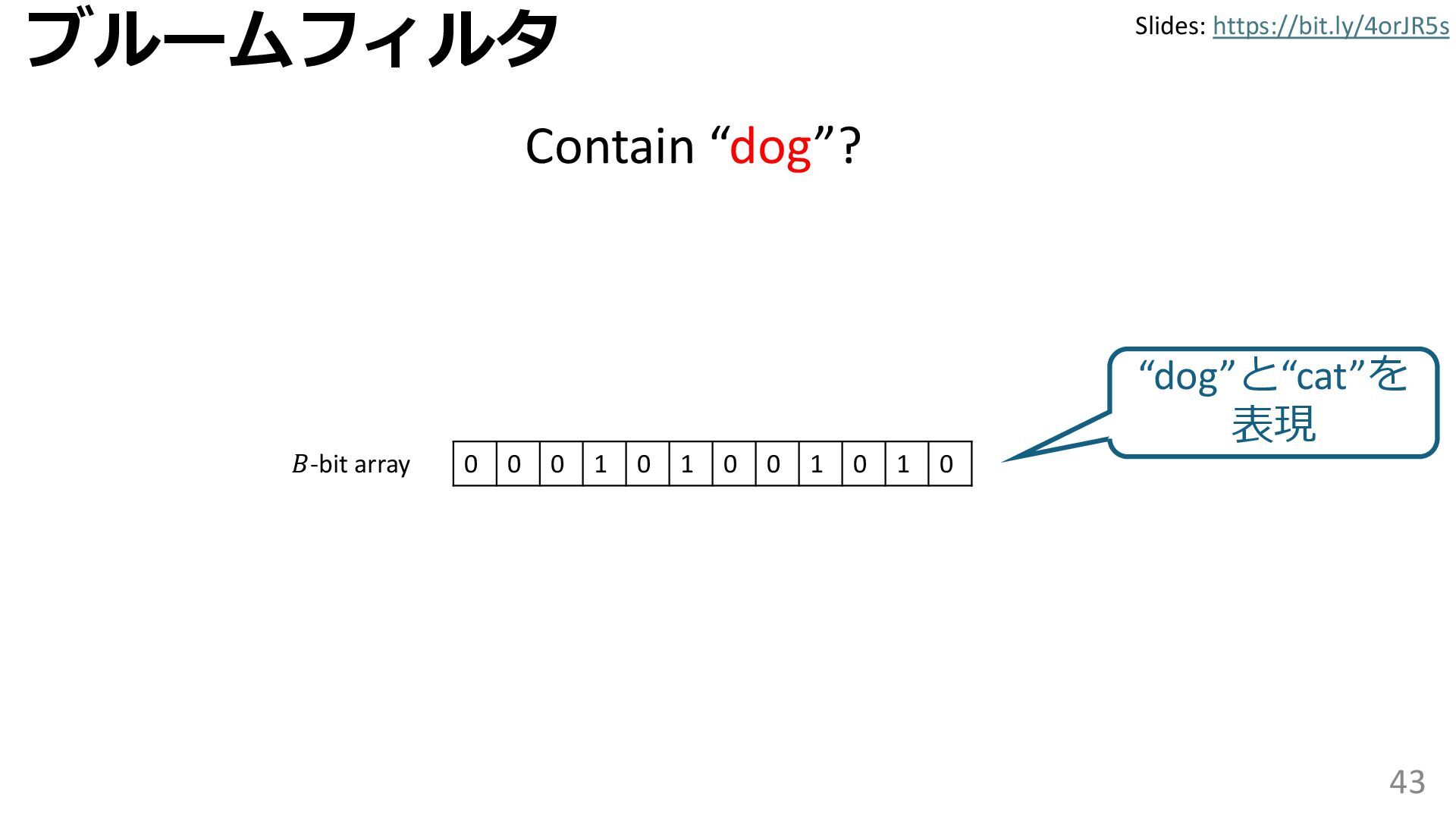
https://bit.ly/4orJR5s Slides: https://bit.ly/4orJR5s 43 ブルームフィルタ 0 0 0 1 0
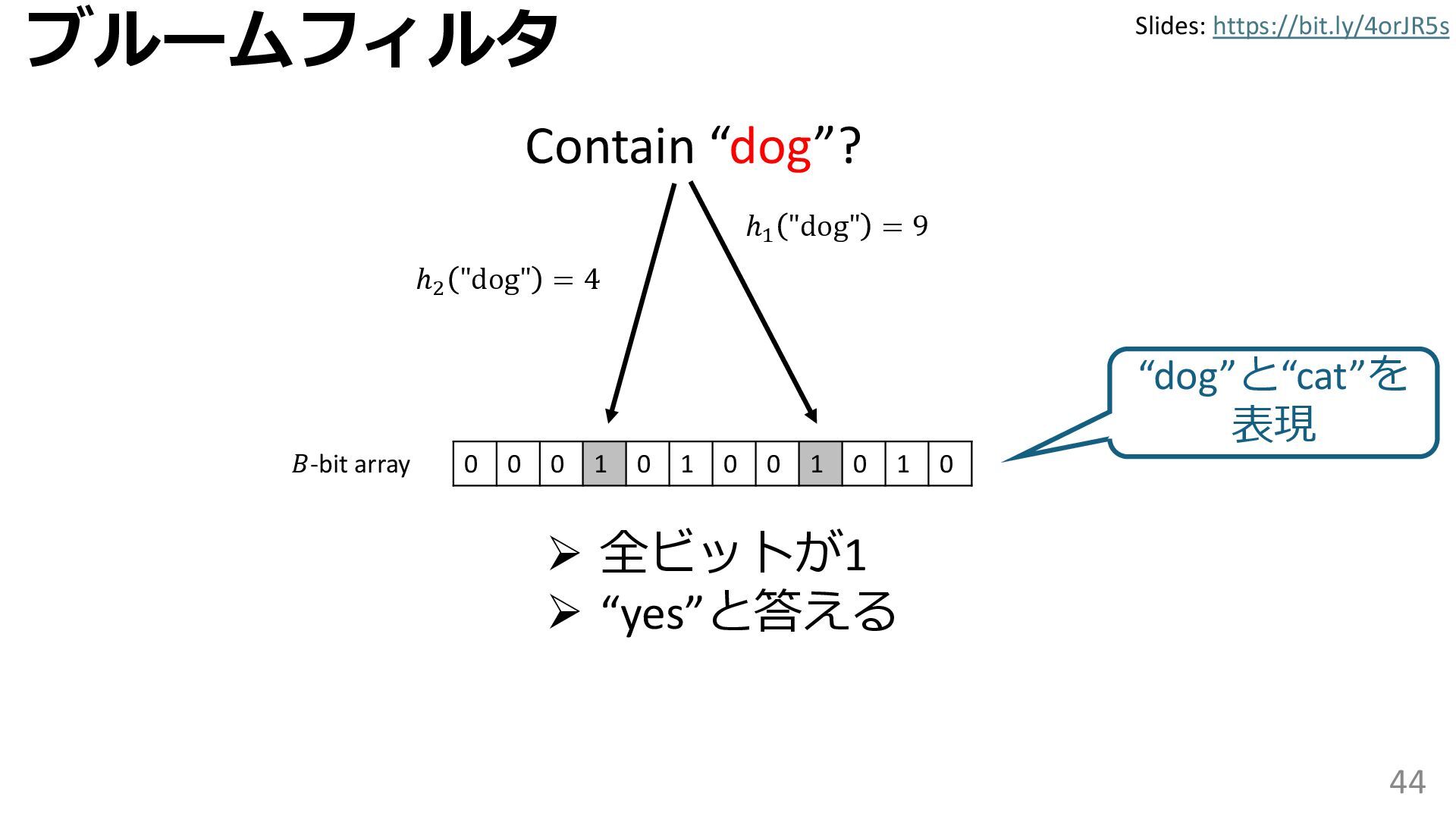
1 0 0 1 0 1 0 𝐵-bit array Contain “dog”? “dog”と“cat”を 表現 -
https://bit.ly/4orJR5s Slides: https://bit.ly/4orJR5s 44 ブルームフィルタ 0 0 0 1 0
1 0 0 1 0 1 0 𝐵-bit array Contain “dog”? ℎ2 "dog" = 4 ℎ1 "dog" = 9 ➢ 全ビットが1 ➢ “yes”と答える “dog”と“cat”を 表現 -
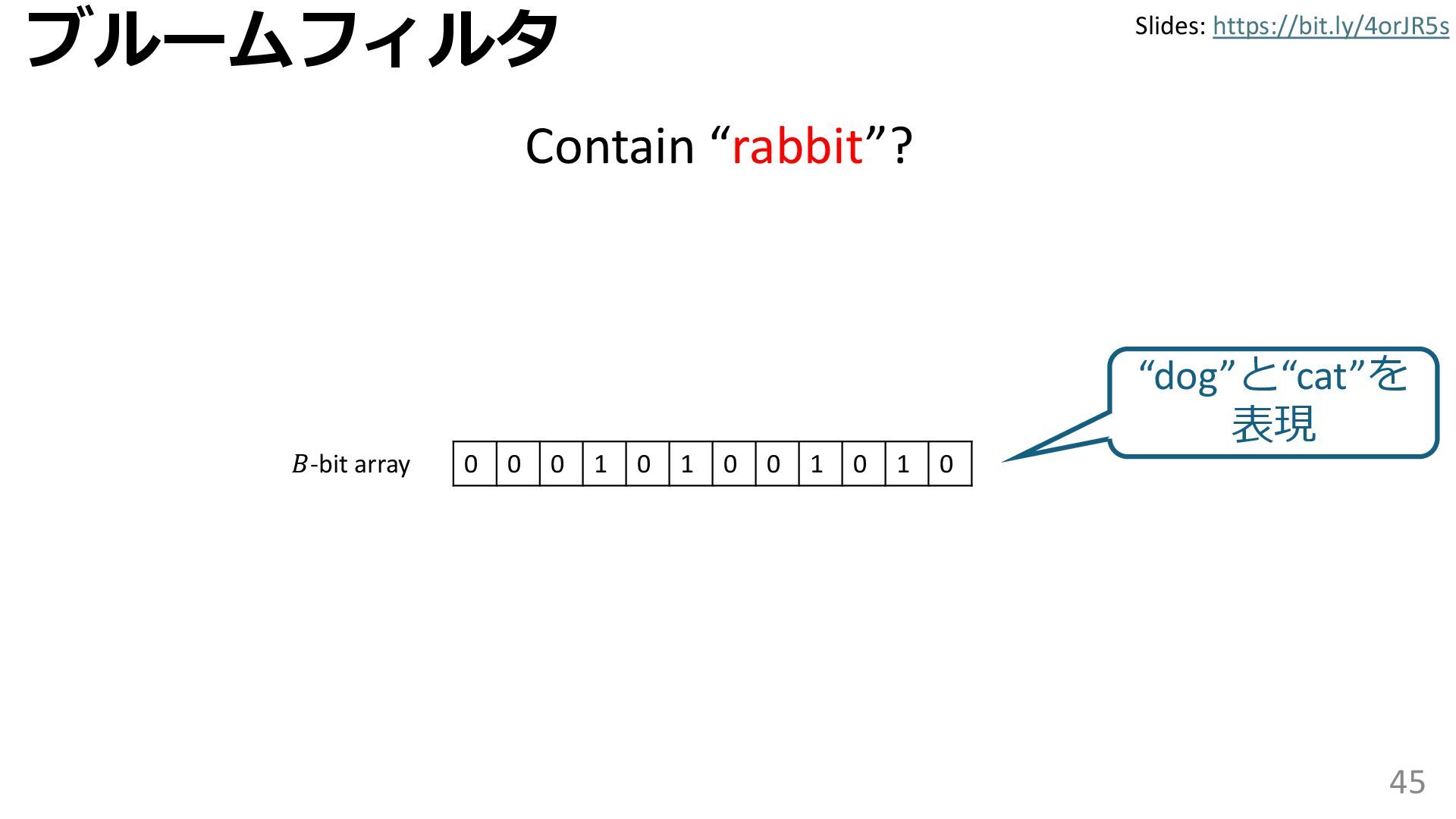
https://bit.ly/4orJR5s Slides: https://bit.ly/4orJR5s 45 ブルームフィルタ 0 0 0 1 0
1 0 0 1 0 1 0 𝐵-bit array Contain “rabbit”? “dog”と“cat”を 表現 -
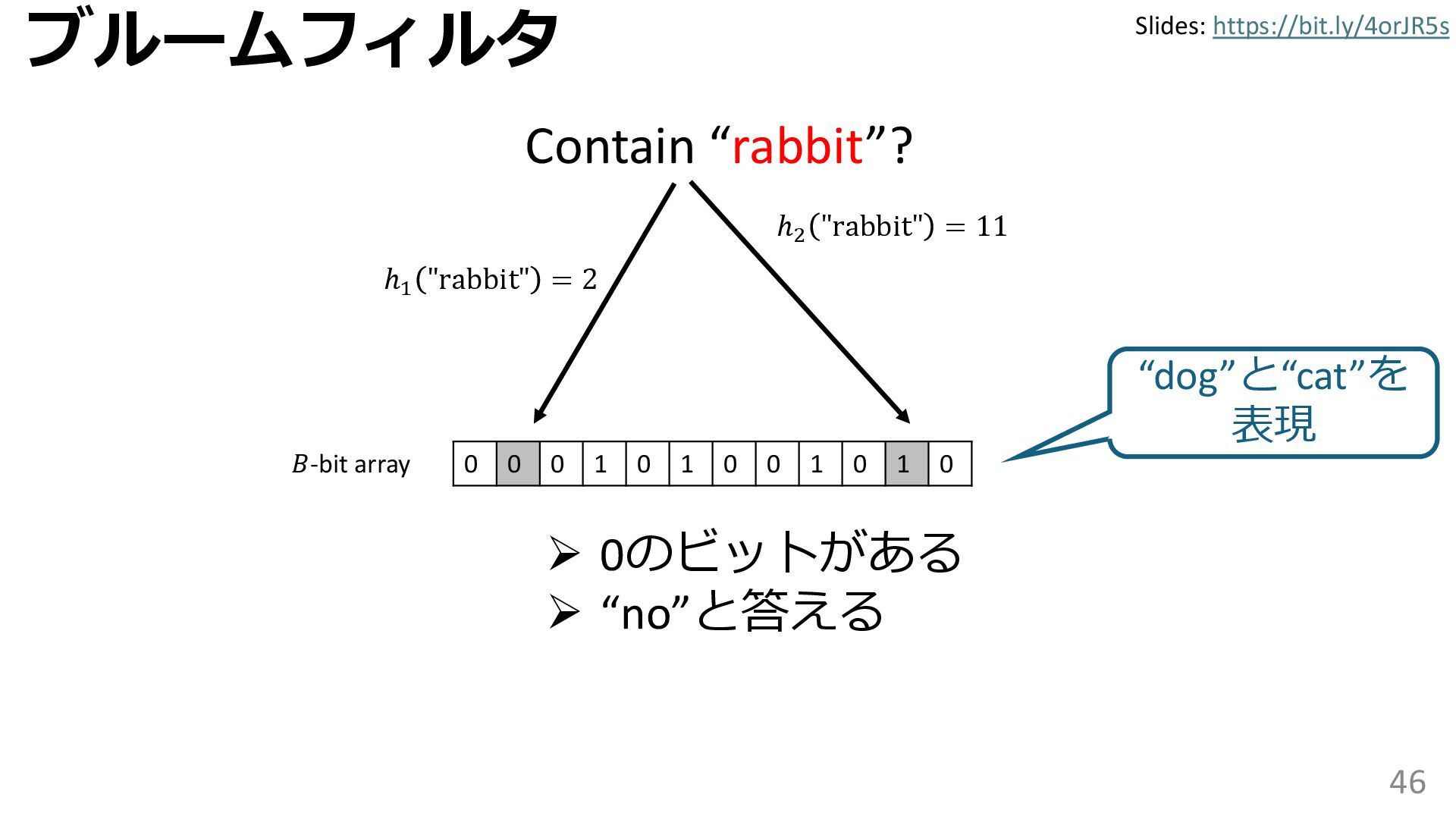
https://bit.ly/4orJR5s Slides: https://bit.ly/4orJR5s 46 ブルームフィルタ 0 0 0 1 0
1 0 0 1 0 1 0 𝐵-bit array Contain “rabbit”? ℎ1 "rabbit" = 2 ℎ2 "rabbit" = 11 ➢ 0のビットがある ➢ “no”と答える “dog”と“cat”を 表現 -
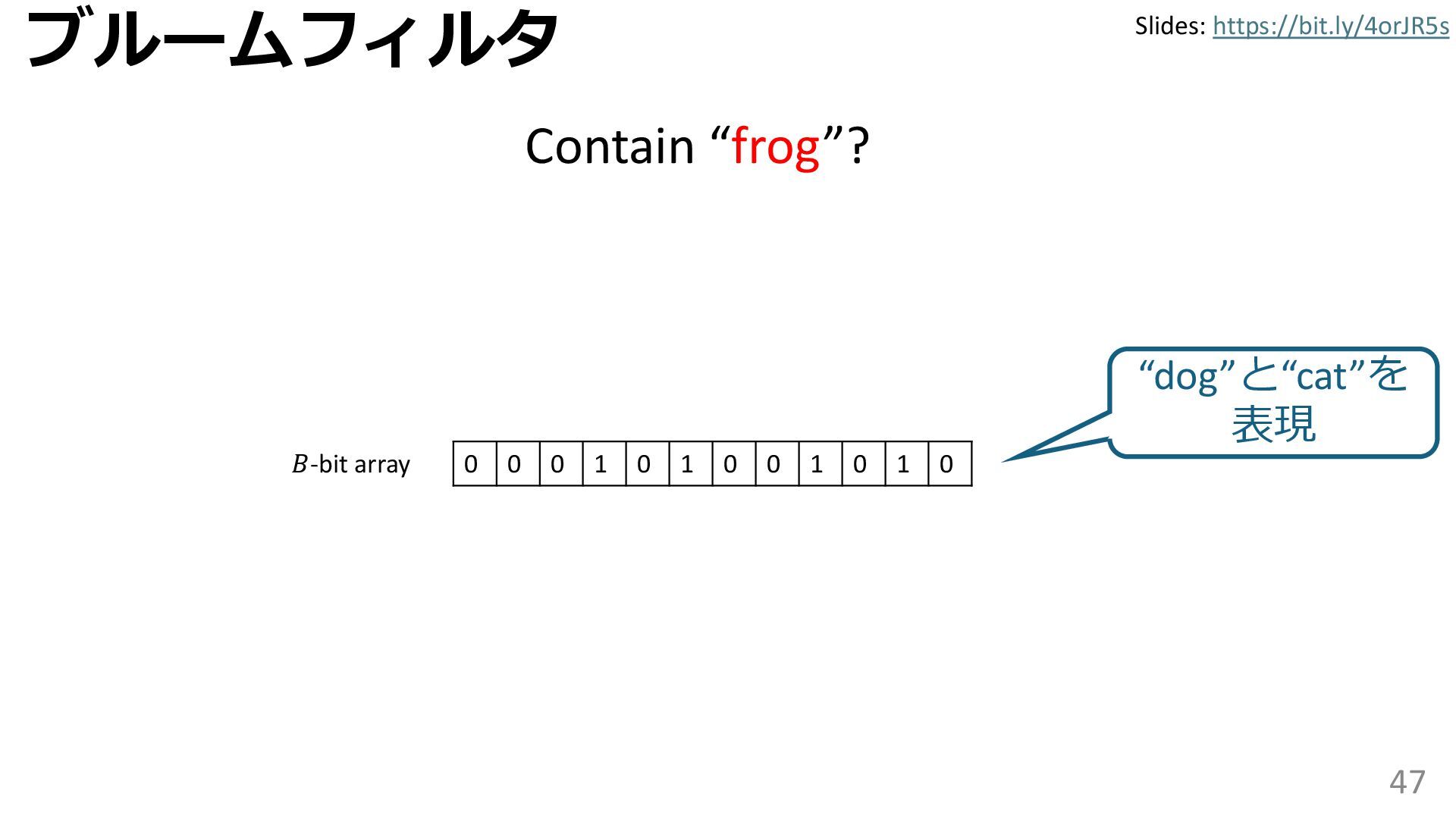
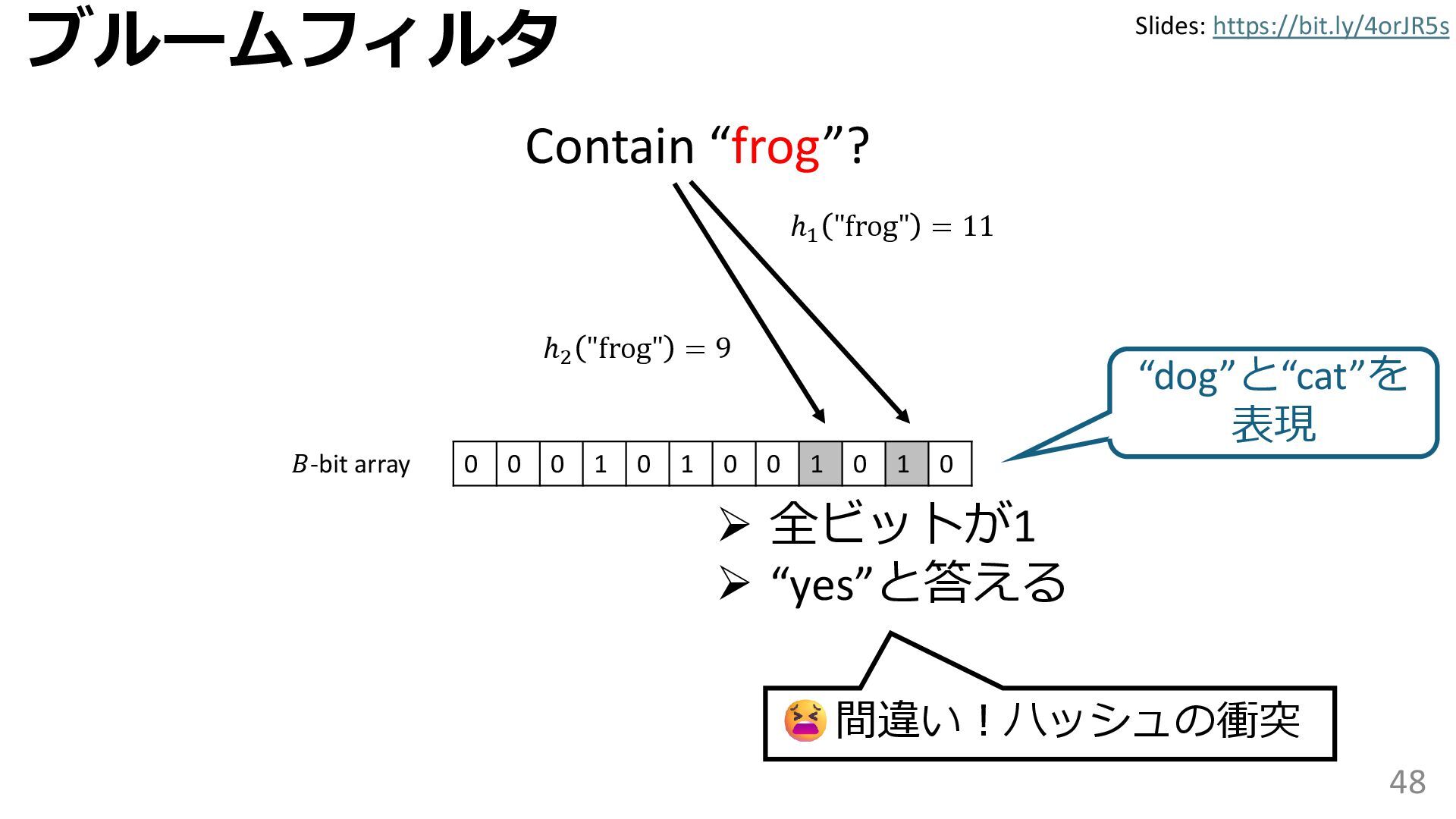
https://bit.ly/4orJR5s Slides: https://bit.ly/4orJR5s 47 ブルームフィルタ 0 0 0 1 0
1 0 0 1 0 1 0 𝐵-bit array Contain “frog”? “dog”と“cat”を 表現 -
https://bit.ly/4orJR5s Slides: https://bit.ly/4orJR5s 48 ブルームフィルタ 0 0 0 1 0
1 0 0 1 0 1 0 𝐵-bit array Contain “frog”? ℎ2 "frog" = 9 ℎ1 "frog" = 11 ➢ 全ビットが1 ➢ “yes”と答える 間違い!ハッシュの衝突 “dog”と“cat”を 表現 -
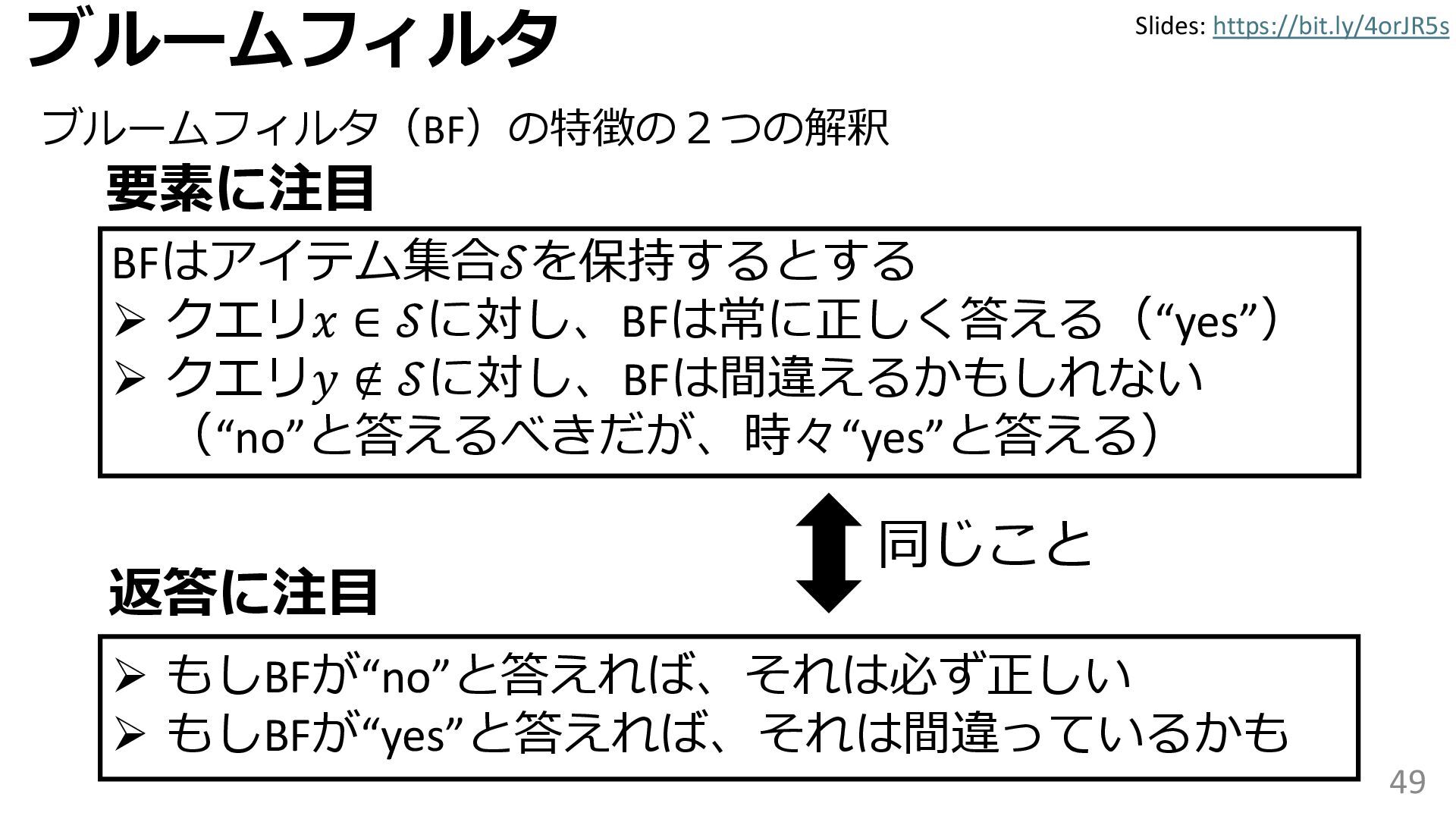
https://bit.ly/4orJR5s Slides: https://bit.ly/4orJR5s 49 ブルームフィルタ ブルームフィルタ(BF)の特長の2つの解釈 BFはアイテム集合𝒮を保持するとする ➢ クエリ𝑥 ∈
𝒮に対し、BFは常に正しく答える(“yes”) ➢ クエリ𝑦 ∉ 𝒮に対し、BFは間違えるかもしれない (“no”と答えるべきだが、時々“yes”と答える) ➢ もしBFが“no”と答えれば、それは必ず正しい ➢ もしBFが“yes”と答えれば、それは間違っているかも 要素に注目 返答に注目 同じこと -
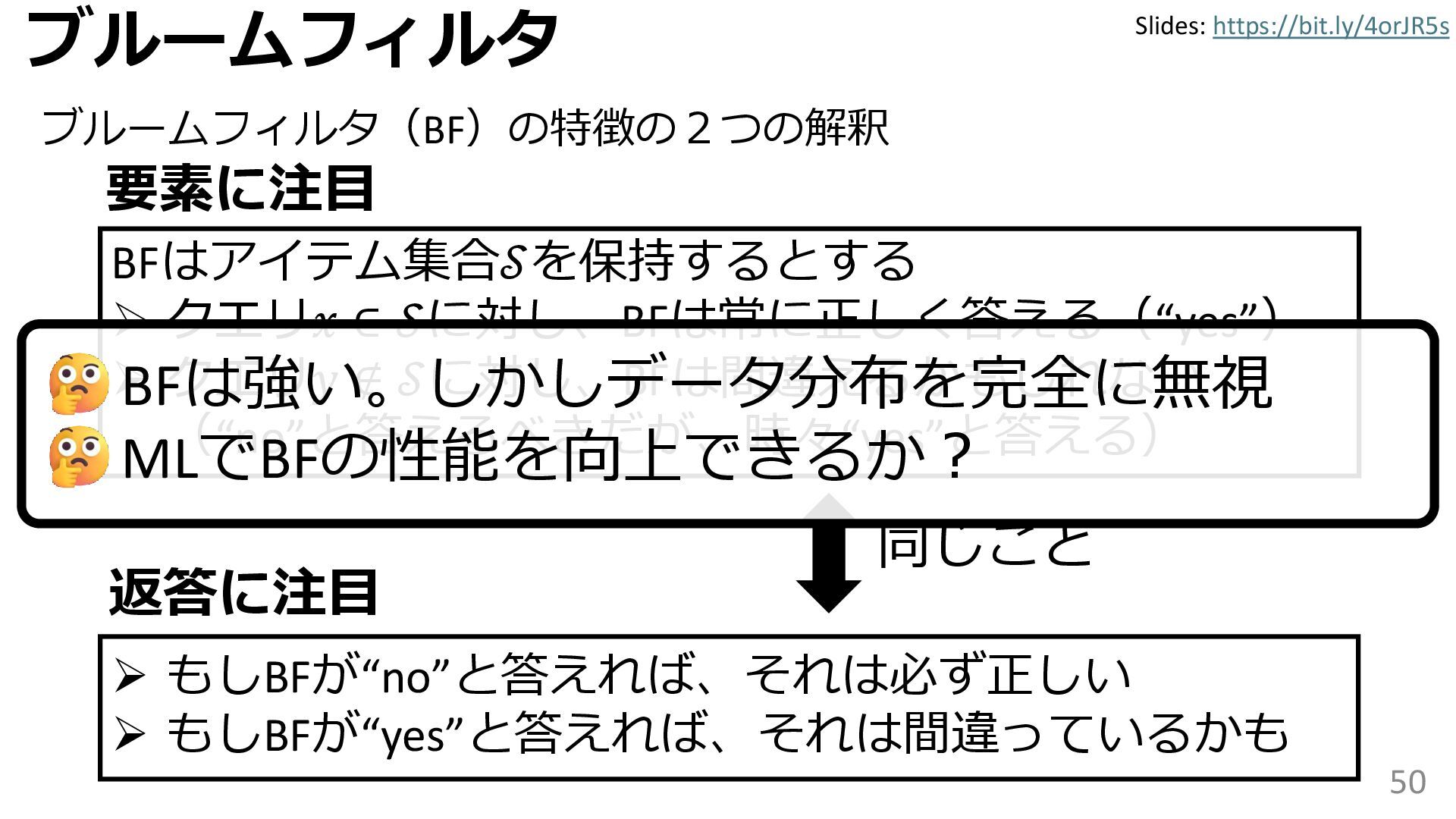
https://bit.ly/4orJR5s Slides: https://bit.ly/4orJR5s 50 ブルームフィルタ ブルームフィルタ(BF)の特長の2つの解釈 BFはアイテム集合𝒮を保持するとする ➢ クエリ𝑥 ∈
𝒮に対し、BFは常に正しく答える(“yes”) ➢ クエリ𝑦 ∉ 𝒮に対し、BFは間違えるかもしれない (“no”と答えるべきだが、時々“yes”と答える) ➢ もしBFが“no”と答えれば、それは必ず正しい ➢ もしBFが“yes”と答えれば、それは間違っているかも 要素に注目 返答に注目 同じこと BFは強い。しかしデータ分布を完全に無視 MLでBFの性能を向上できるか? -
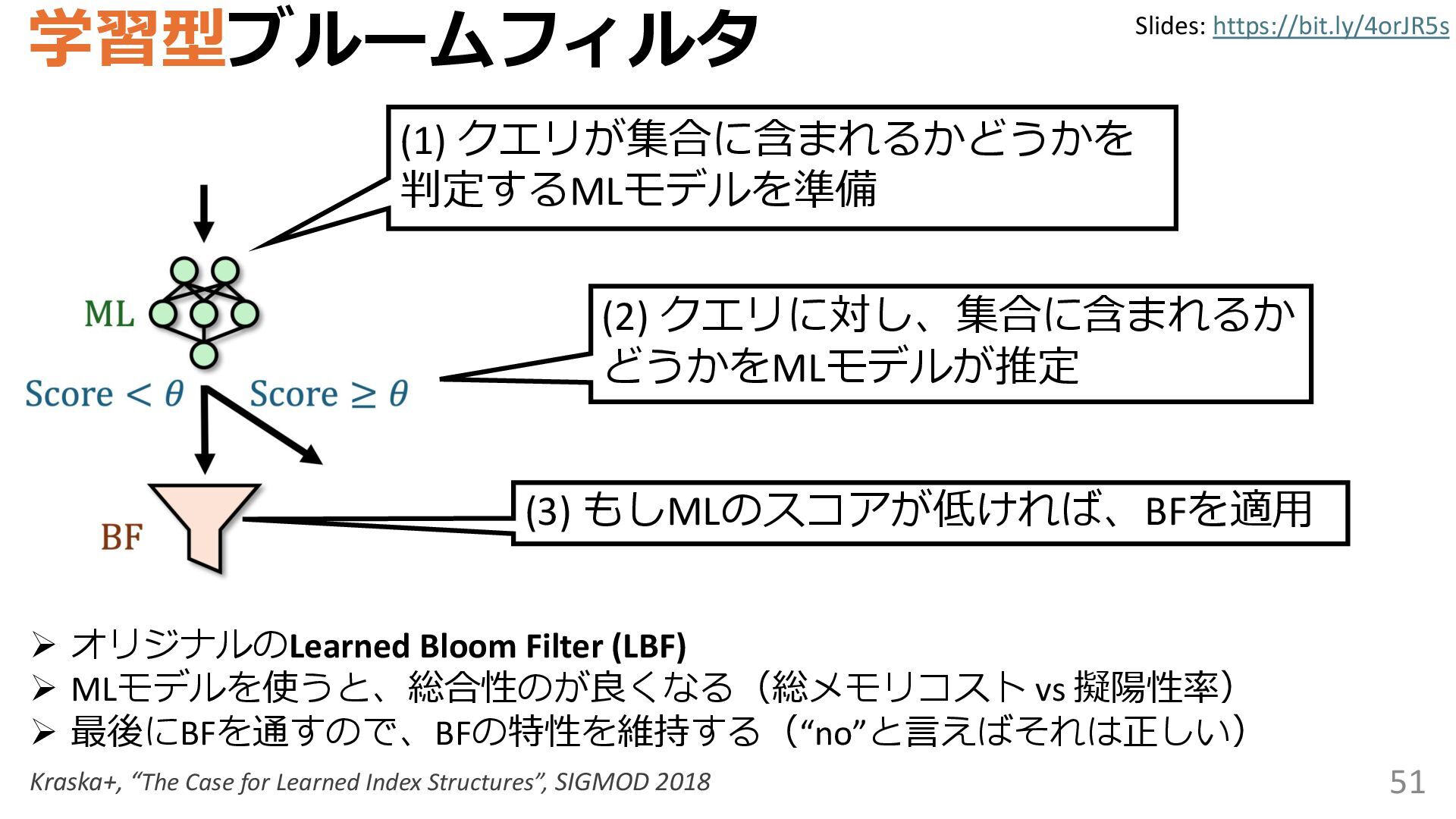
https://bit.ly/4orJR5s Slides: https://bit.ly/4orJR5s 51 学習型ブルームフィルタ Kraska+, “The Case for Learned
Index Structures”, SIGMOD 2018 (1) クエリが集合に含まれるかどうかを 判定するMLモデルを準備 (2) クエリに対し、集合に含まれるか どうかをMLモデルが推定 (3) もしMLのスコアが低ければ、BFを適用 ➢ オリジナルのLearned Bloom Filter (LBF) ➢ MLモデルを使うと、総合性能が良くなる(総メモリコスト vs 擬陽性率) ➢ 最後にBFを通すので、BFの特性を維持する(“no”と言えばそれは正しい) -
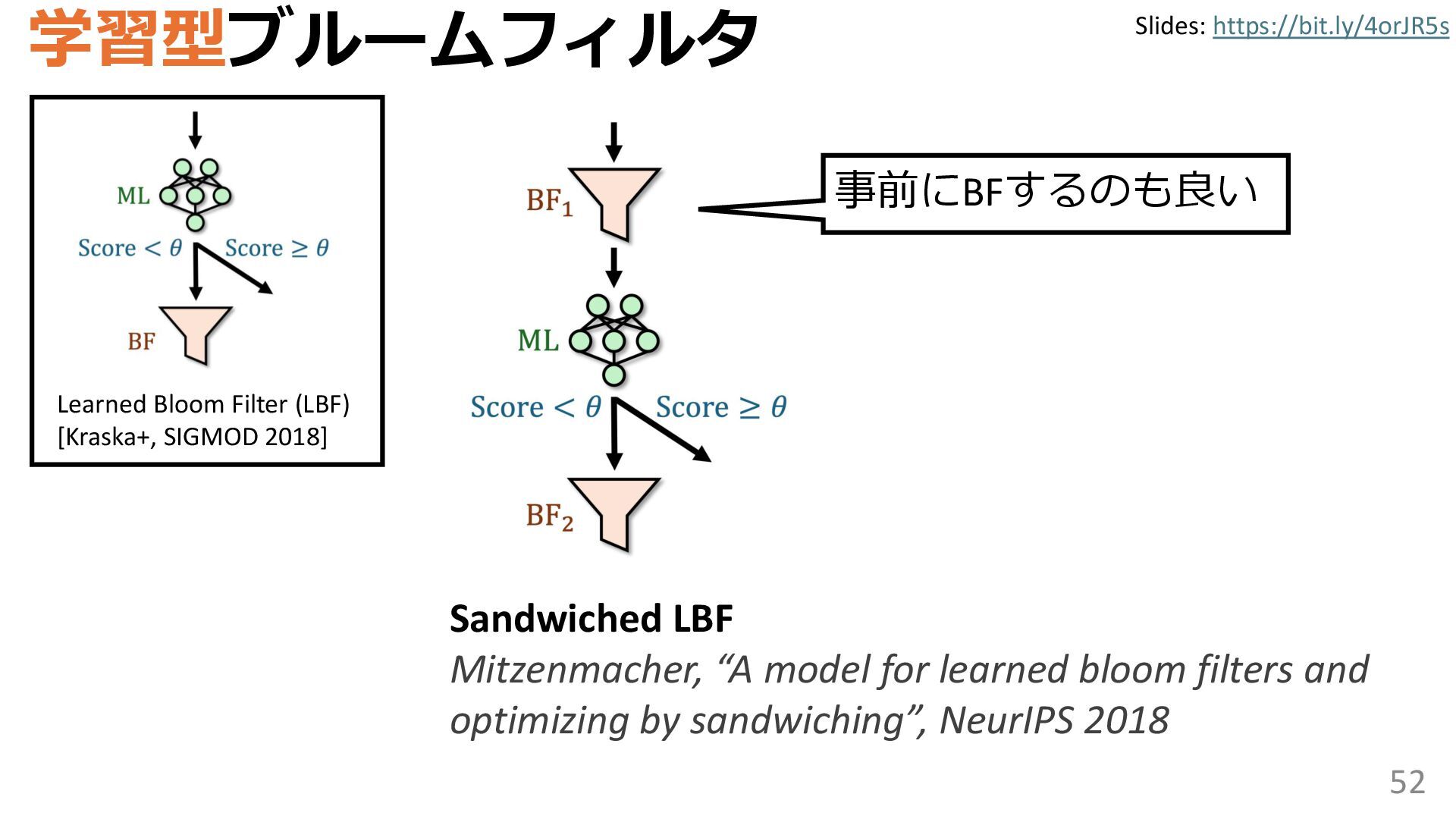
https://bit.ly/4orJR5s Slides: https://bit.ly/4orJR5s 52 学習型ブルームフィルタ Learned Bloom Filter (LBF) [Kraska+,
SIGMOD 2018] Sandwiched LBF Mitzenmacher, “A model for learned bloom filters and optimizing by sandwiching”, NeurIPS 2018 事前にBFするのも良い -
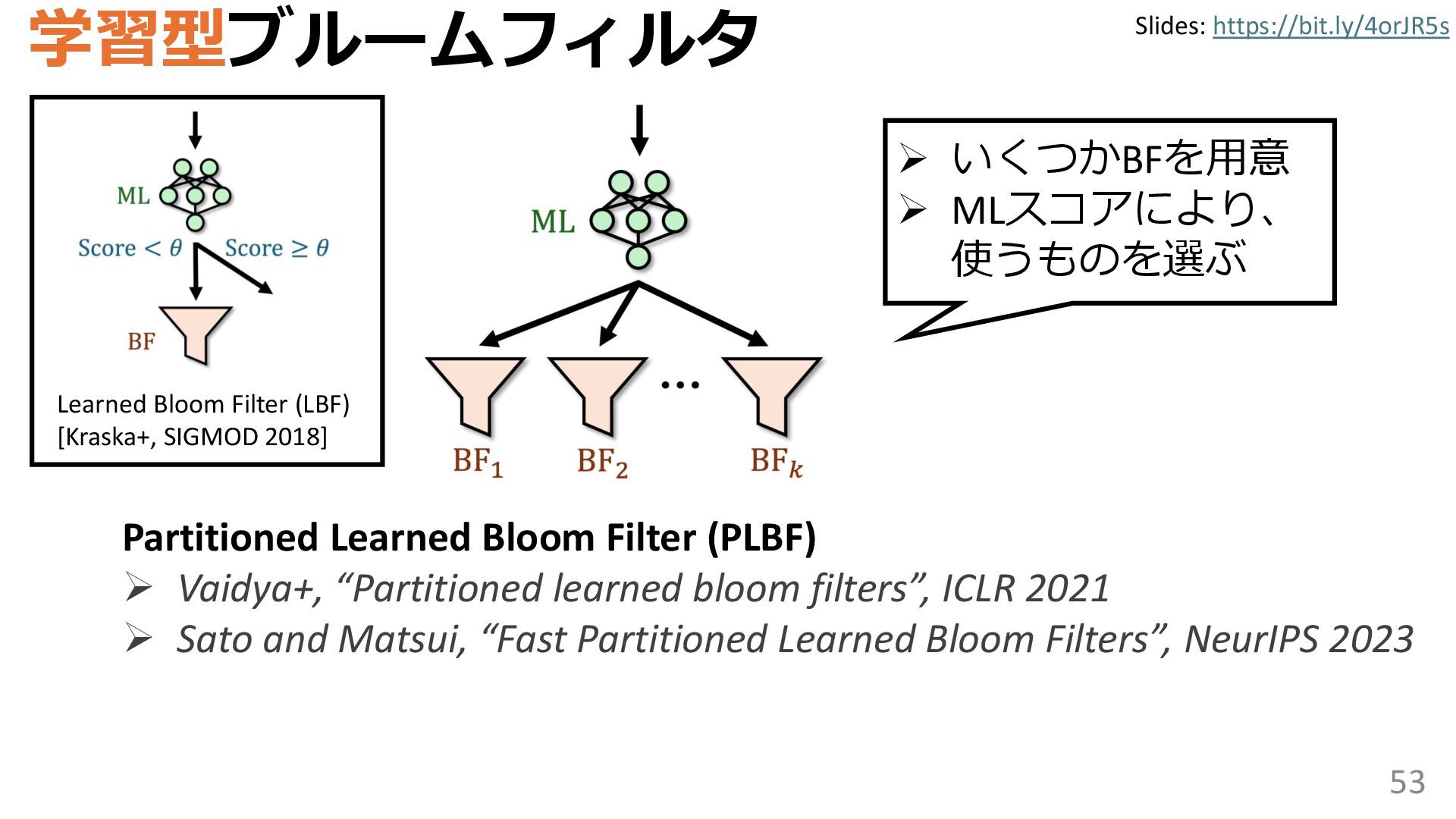
https://bit.ly/4orJR5s Slides: https://bit.ly/4orJR5s 53 学習型ブルームフィルタ Learned Bloom Filter (LBF) [Kraska+,
SIGMOD 2018] Partitioned Learned Bloom Filter (PLBF) ➢ Vaidya+, “Partitioned learned bloom filters”, ICLR 2021 ➢ Sato and Matsui, “Fast Partitioned Learned Bloom Filters”, NeurIPS 2023 ➢ いくつかBFを用意 ➢ MLスコアにより、 使うものを選ぶ -
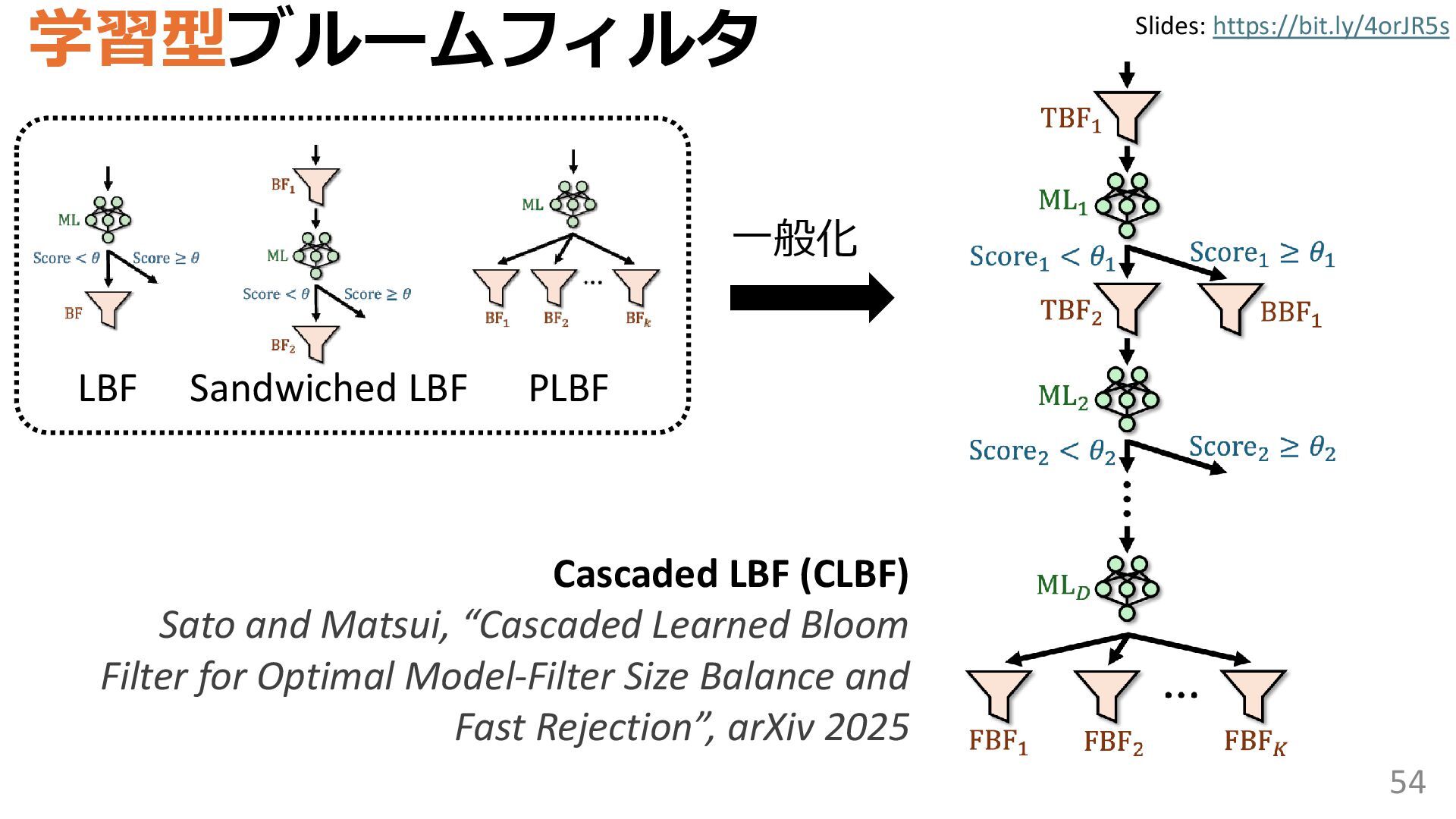
https://bit.ly/4orJR5s Slides: https://bit.ly/4orJR5s 54 学習型ブルームフィルタ LBF Sandwiched LBF PLBF 一般化
Cascaded LBF (CLBF) Sato and Matsui, “Cascaded Learned Bloom Filter for Optimal Model-Filter Size Balance and Fast Rejection”, arXiv 2025 -
https://bit.ly/4orJR5s Slides: https://bit.ly/4orJR5s 55 アウトライン 1. 一次元インデクス 2. 多次元インデクス 3.
ブルームフィルタ 4. 近似最近傍探索 5. 議論 -
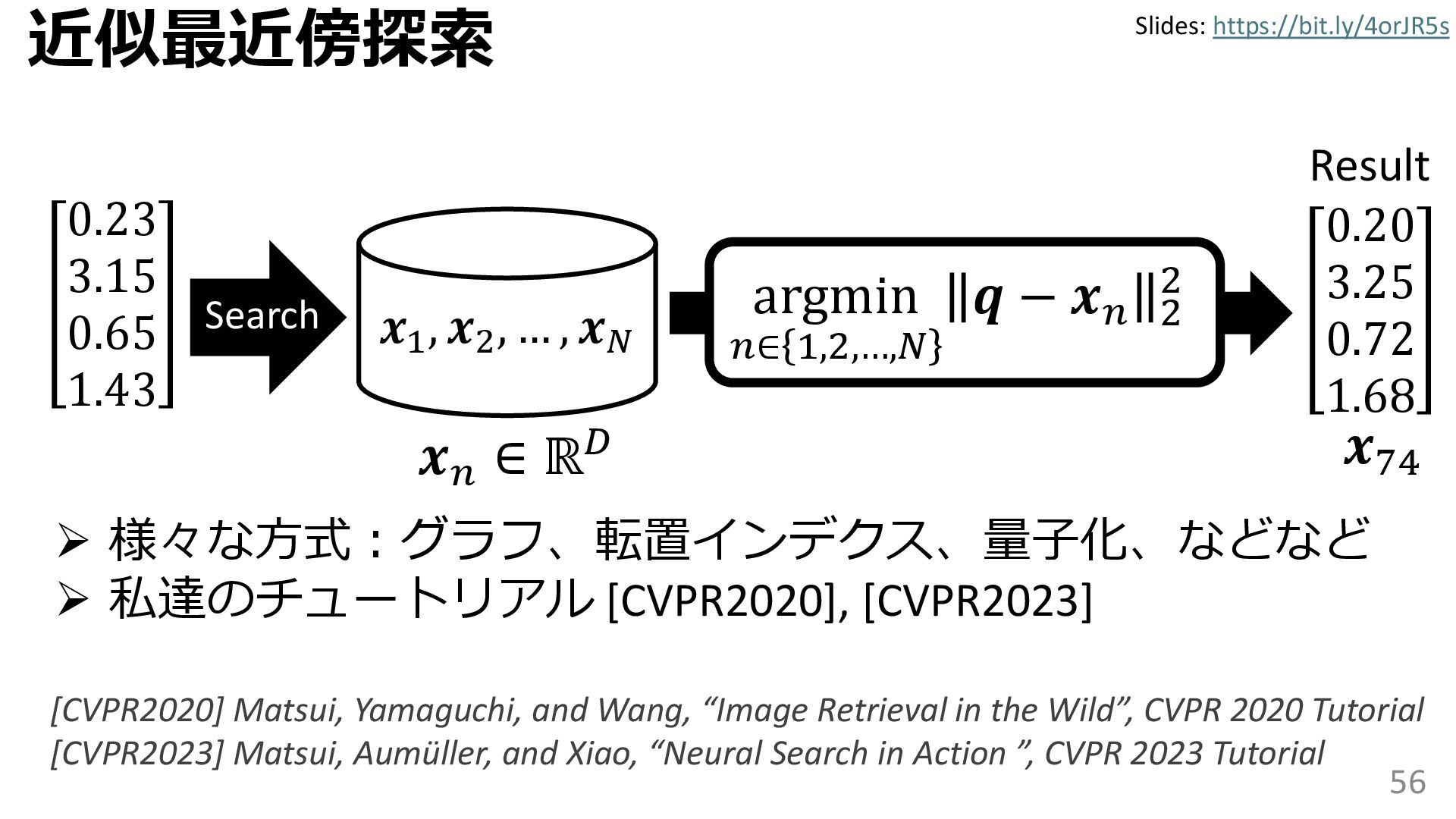
https://bit.ly/4orJR5s Slides: https://bit.ly/4orJR5s 56 近似最近傍探索 0.23 3.15 0.65 1.43 Search
0.20 3.25 0.72 1.68 𝒙74 argmin 𝑛∈ 1,2,…,𝑁 𝒒 − 𝒙𝑛 2 2 Result 𝒙1 , 𝒙2 , … , 𝒙𝑁 𝒙𝑛 ∈ ℝ𝐷 ➢ 様々な方式:グラフ、転置インデクス、量子化、などなど ➢ 私達のチュートリアル [CVPR2020], [CVPR2023] [CVPR2020] Matsui, Yamaguchi, and Wang, “Image Retrieval in the Wild”, CVPR 2020 Tutorial [CVPR2023] Matsui, Aumüller, and Xiao, “Neural Search in Action ”, CVPR 2023 Tutorial -
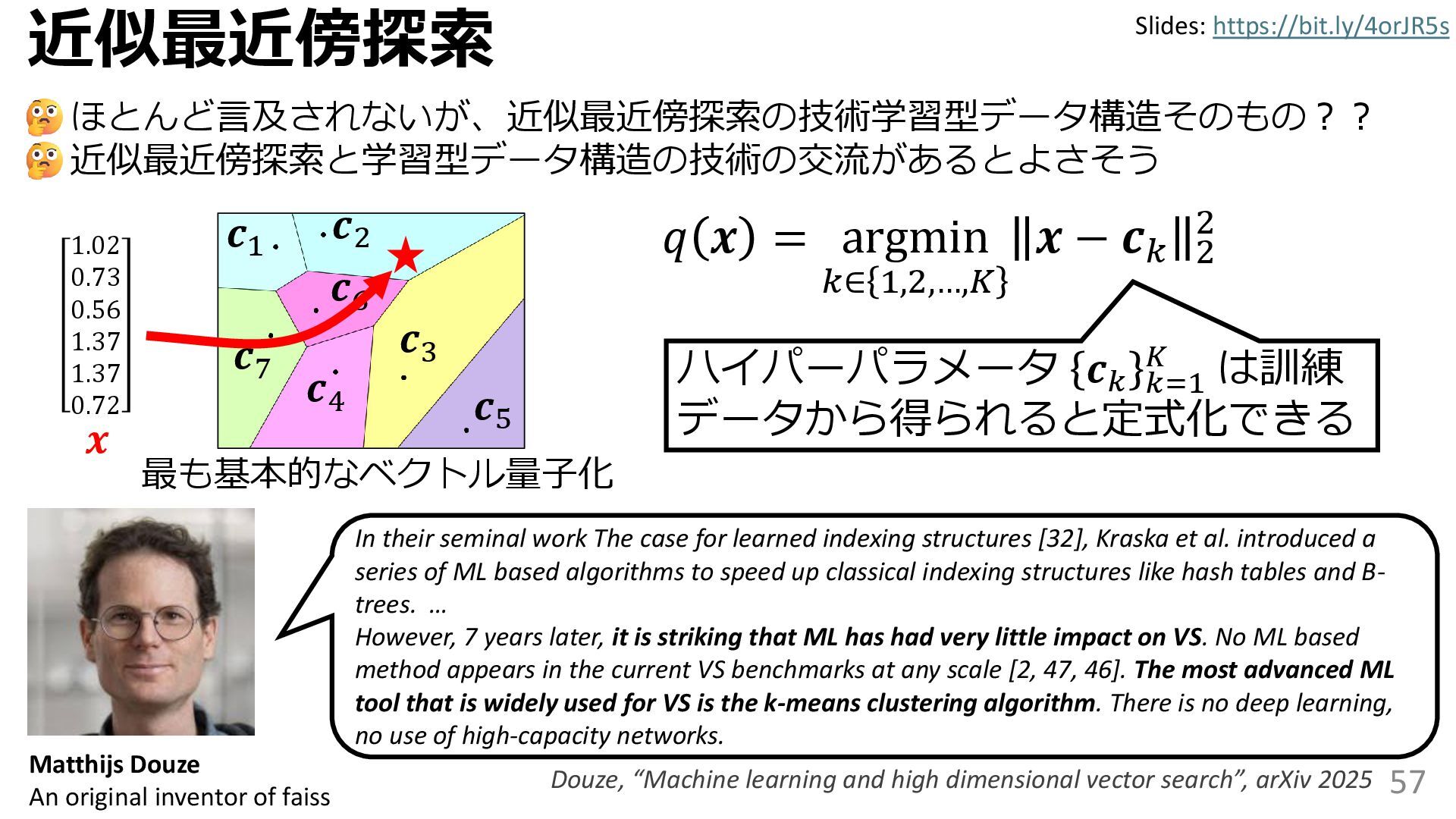
https://bit.ly/4orJR5s Slides: https://bit.ly/4orJR5s 57 近似最近傍探索 最も基本的なベクトル量子化 𝒄1 𝒄3 𝒄2 𝒄4
𝒄5 𝒄6 𝒄7 1.02 0.73 0.56 1.37 1.37 0.72 𝒙 ほとんど言及されないが、近似最近傍探索の技術学習型データ構造そのもの?? 近似最近傍探索と学習型データ構造の技術の交流があるとよさそう 𝑞 𝒙 = argmin 𝑘∈ 1,2,…,𝐾 𝒙 − 𝒄𝑘 2 2 ハイパーパラメータ 𝒄𝑘 𝑘=1 𝐾 は訓練 データから得られると定式化できる Douze, “Machine learning and high dimensional vector search”, arXiv 2025 In their seminal work The case for learned indexing structures [32], Kraska et al. introduced a series of ML based algorithms to speed up classical indexing structures like hash tables and B- trees. … However, 7 years later, it is striking that ML has had very little impact on VS. No ML based method appears in the current VS benchmarks at any scale [2, 47, 46]. The most advanced ML tool that is widely used for VS is the k-means clustering algorithm. There is no deep learning, no use of high-capacity networks. Matthijs Douze An original inventor of faiss -
https://bit.ly/4orJR5s Slides: https://bit.ly/4orJR5s 58 アウトライン 1. 一次元インデクス 2. 多次元インデクス 3.
ブルームフィルタ 4. 近似最近傍探索 5. 議論 -
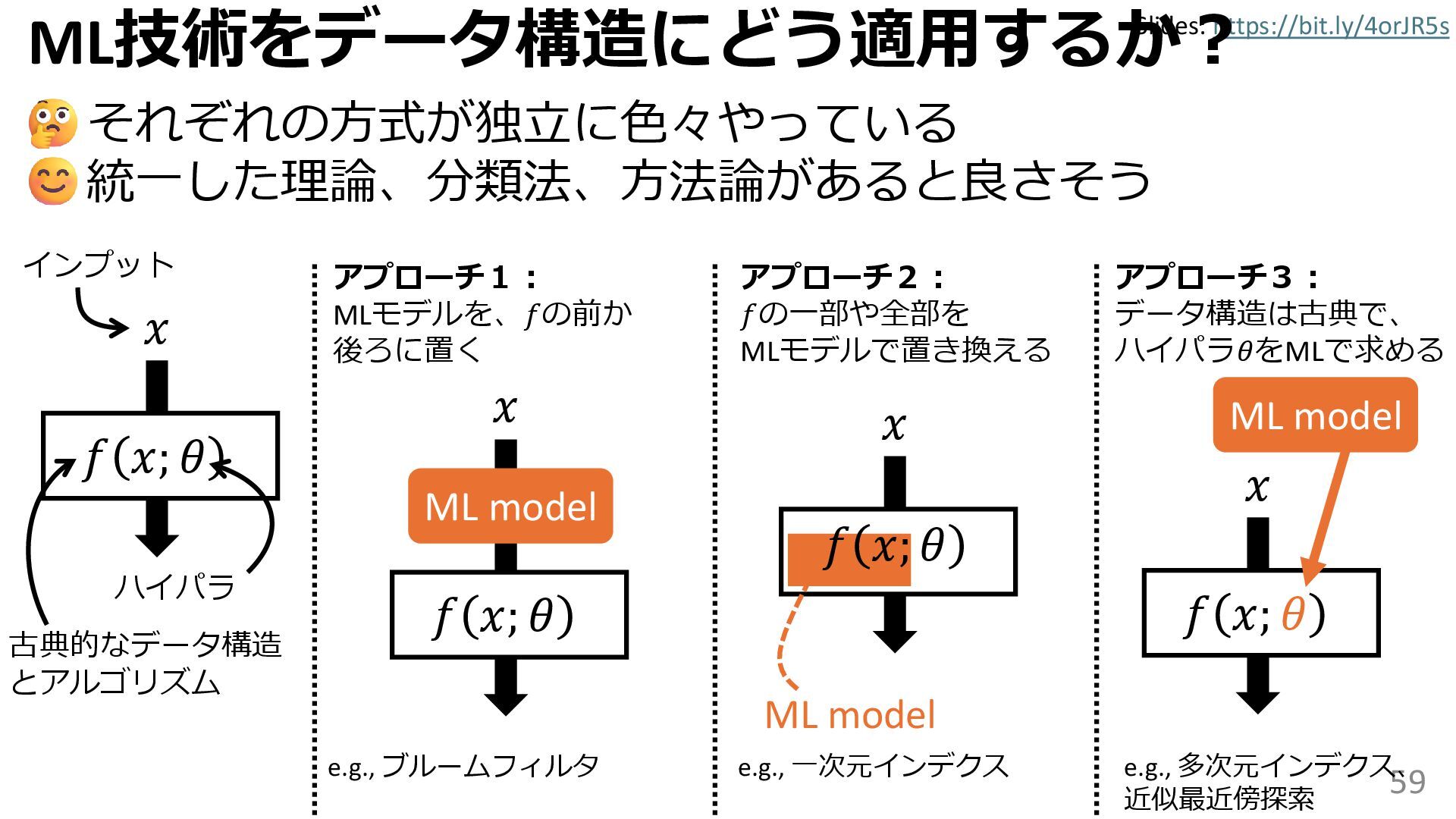
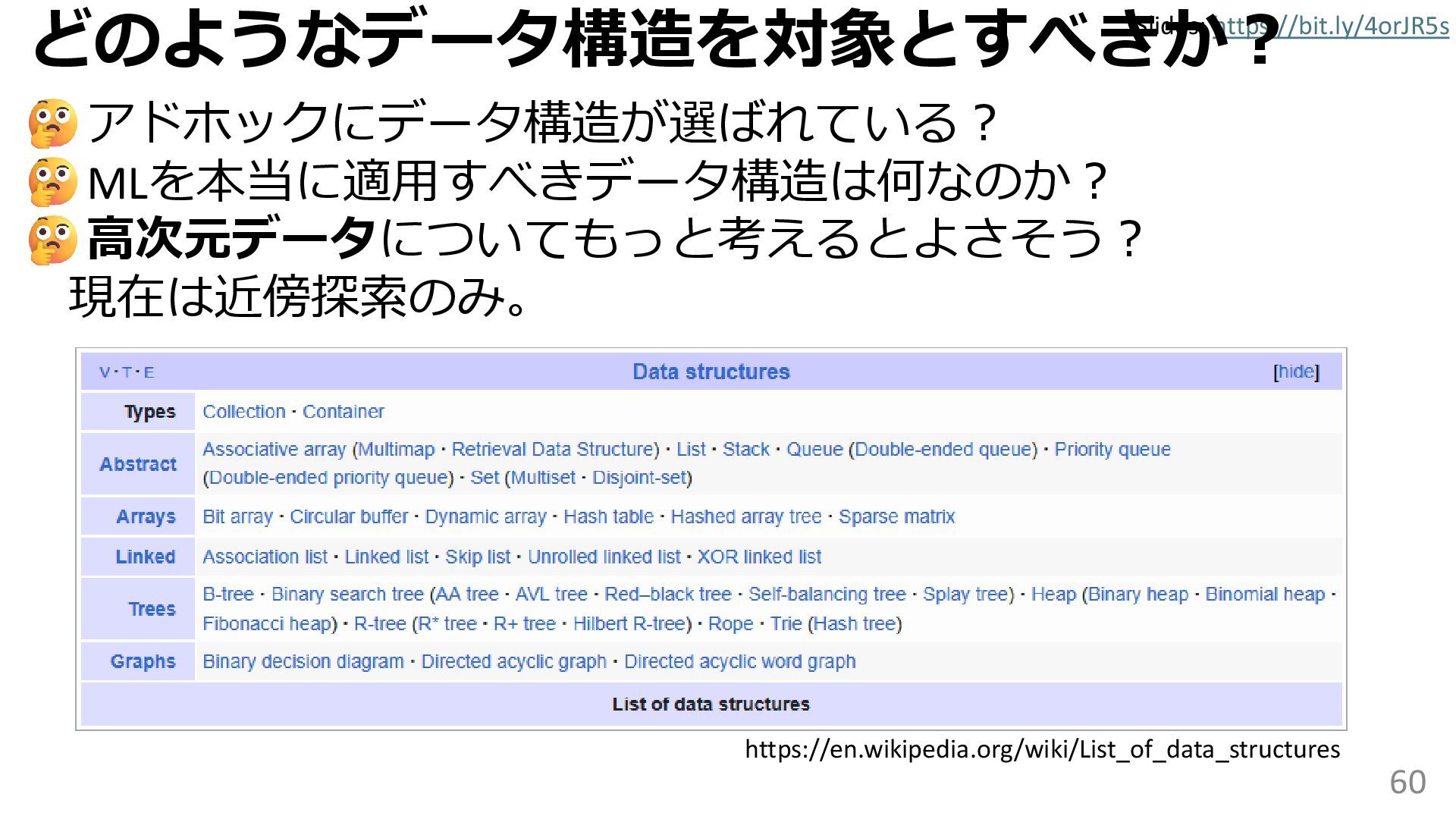
https://bit.ly/4orJR5s Slides: https://bit.ly/4orJR5s 59 ML技術をデータ構造にどう適用するか? それぞれの方式が独立に色々やっている 統一した理論、分類法、方法論があると良さそう 古典的なデータ構造 とアルゴリズム 𝑥
𝑓 𝑥; 𝜃 𝑥 𝑓 𝑥; 𝜃 ML model 𝑥 𝑓 𝑥; 𝜃 ML model 𝑥 𝑓 𝑥; 𝜃 ML model アプローチ1: MLモデルを、𝑓の前か 後ろに置く アプローチ2: 𝑓の一部や全部を MLモデルで置き換える アプローチ3: データ構造は古典で、 ハイパラ𝜃をMLで求める e.g., ブルームフィルタ e.g., 一次元インデクス e.g., 多次元インデクス、 近似最近傍探索 インプット ハイパラ -
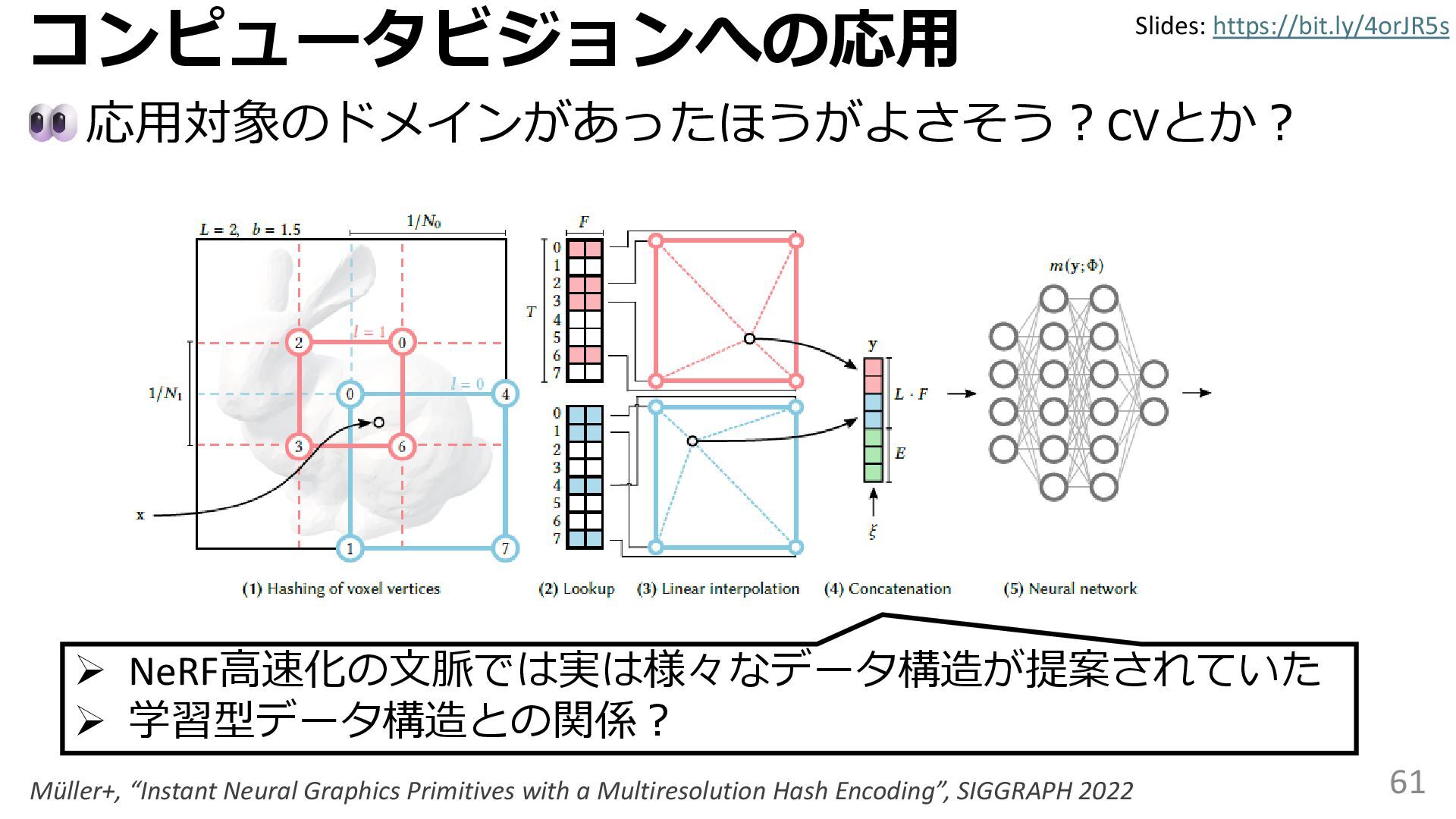
https://bit.ly/4orJR5s Slides: https://bit.ly/4orJR5s 61 コンピュータビジョンへの応用 応用対象のドメインがあったほうがよさそう?CVとか? Müller+, “Instant Neural Graphics
Primitives with a Multiresolution Hash Encoding”, SIGGRAPH 2022 ➢ NeRF高速化の文脈では実は様々なデータ構造が提案されていた ➢ 学習型データ構造との関係? -
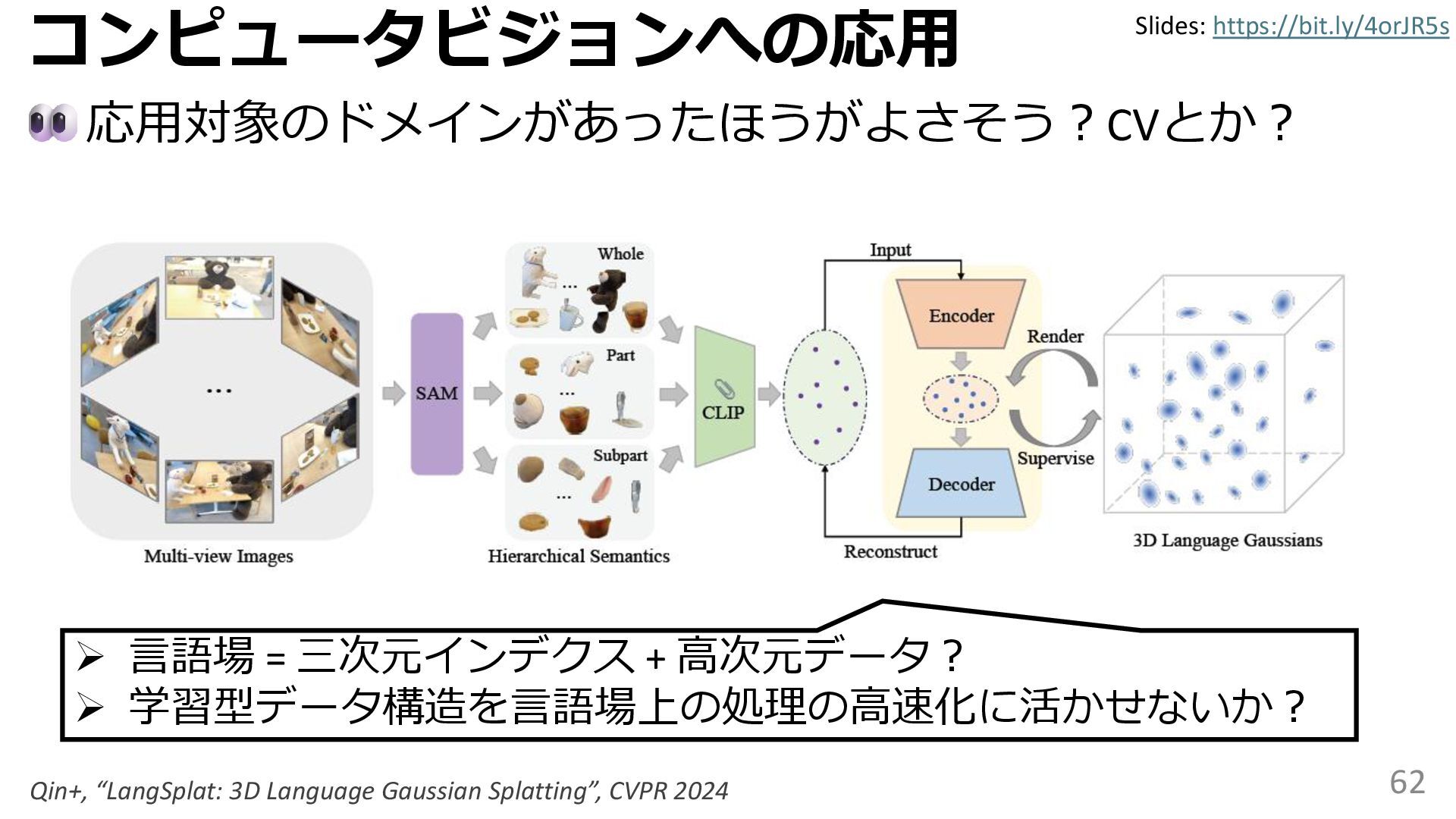
https://bit.ly/4orJR5s Slides: https://bit.ly/4orJR5s 62 Qin+, “LangSplat: 3D Language Gaussian Splatting”,
CVPR 2024 ➢ 言語場 = 三次元インデクス + 高次元データ? ➢ 学習型データ構造を言語場上の処理の高速化に活かせないか? コンピュータビジョンへの応用 応用対象のドメインがあったほうがよさそう?CVとか? -
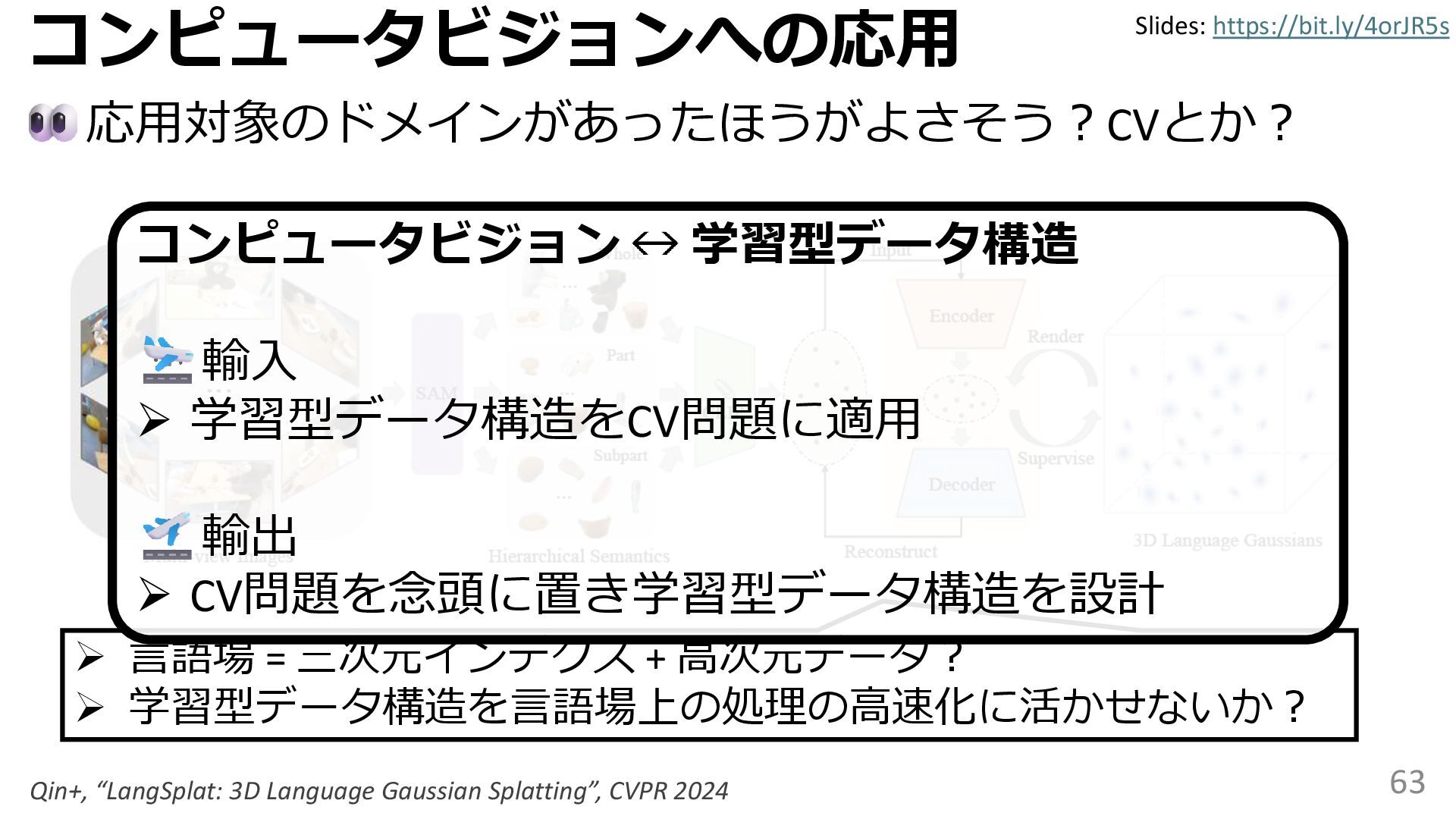
https://bit.ly/4orJR5s Slides: https://bit.ly/4orJR5s 63 Qin+, “LangSplat: 3D Language Gaussian Splatting”,
CVPR 2024 ➢ 言語場 = 三次元インデクス + 高次元データ? ➢ 学習型データ構造を言語場上の処理の高速化に活かせないか? コンピュータビジョンへの応用 応用対象のドメインがあったほうがよさそう?CVとか? コンピュータビジョン 学習型データ構造 輸入 ➢ 学習型データ構造をCV問題に適用 輸出 ➢ CV問題を念頭に置き学習型データ構造を設計 -
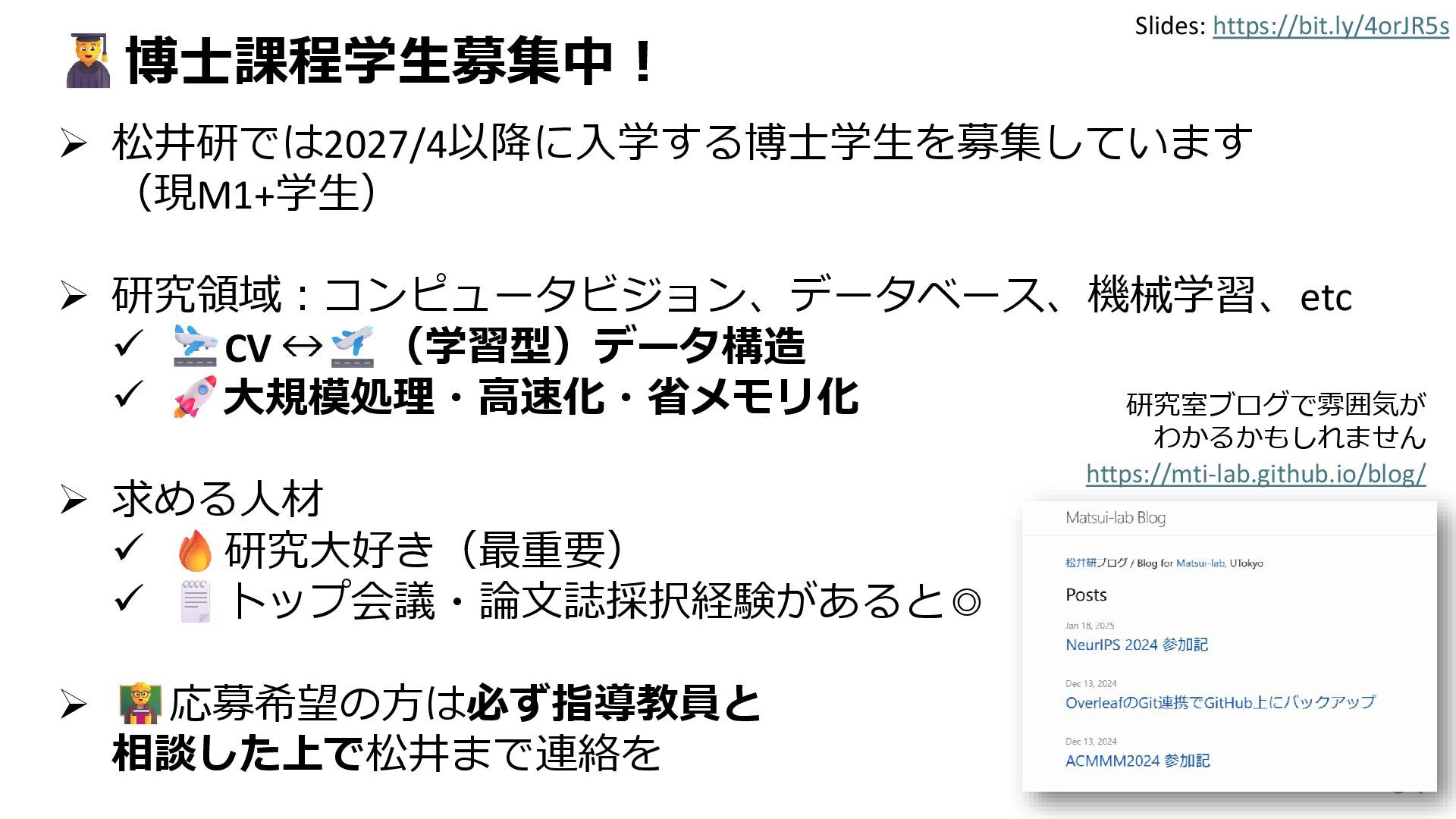
https://bit.ly/4orJR5s Slides: https://bit.ly/4orJR5s 64 博士課程学生募集中! ➢ 松井研では2027/4以降に入学する博士学生を募集しています (現M1学生) ➢ 研究領域:コンピュータビジョン、データベース、機械学習、etc
✓ CV (学習型)データ構造 ✓ 大規模処理・高速化・省メモリ化 ➢ 求める人材 ✓ 研究大好き(最重要) ✓ トップ会議・論文誌採択経験があると◎ ➢ 応募希望の方は必ず指導教員と 相談した上で松井まで連絡を 研究室ブログで雰囲気が わかるかもしれません https://mti-lab.github.io/blog/