Upgrade to Pro
— share decks privately, control downloads, hide ads and more …
Speaker Deck
Sign up for free
Menu
Search
Features
All features
Private URLs
Password Protection
Custom URLS
Scheduled publishing
Remove Branding
Restrict embedding
Deck Collections
Notes
Features
All features
Private URLs
Password Protection
Custom URLS
Scheduled publishing
Remove Branding
Restrict embedding
Deck Collections
Notes
Explore
Featured decks
Featured speakers
Programming
Technology
Storyboards
Explore
Featured decks
Featured speakers
Programming
Technology
Storyboards
Pricing
Search
Sign in
Sign up for free
Methods of Memory Management in MRI
Search
Aaron Patterson
November 16, 2016
Technology
1.2k
3
Share
Embed
Copy iframe code
Copy JS code
Copy link
Start on current slide
Methods of Memory Management in MRI
This is my RubyConf 2016 talk about Ruby's GC
Aaron Patterson
November 16, 2016
More Decks by Aaron Patterson
See All by Aaron Patterson
Faster FFI for Ruby
tenderlove
0
86
RubyKaigi 2025: Class New, A New Approach
tenderlove
0
300
RubyKaigi Dev Meeting 2025
tenderlove
1
6.4k
Speeding up Instance Variables in Ruby 3.3
tenderlove
2
600
[Feature #20425] Speeding up delegate methods
tenderlove
3
390
RailsConf 2023
tenderlove
30
1.6k
Don't @ Me! Faster Instance Variables with Object Shapes
tenderlove
1
580
RailsConf 2022 Keynote
tenderlove
2
710
Some Assembly Required
tenderlove
1
670
Other Decks in Technology
See All in Technology
AgentCoreで実践するハーネスエンジニアリング
yakumo
1
170
AI Made Us Faster at Solving the Wrong Problems
marceloancelmo
0
110
Amazon Bedrock Agents ClassicからAmazon Bedrock AgentCoreへ移行した際、ガードレール設定が2箇所に割れた話
matsunobu
0
160
検証フェーズはAIの回答を判断するための学習機会
toru_kubota
2
210
Apache Iceberg が拓く AI 時代のオープンレイクハウス
tomtanaka
0
210
行動するAIのためのオントロジー | DevRev — Encraft #26.pdf
dvrv_tknrszk
2
660
FinTech 1-2 : Overview of FinTech
ks91
PRO
0
110
企業の現実世界をグラフで写し取る
sansantech
PRO
0
230
覗いてみよう 関数型ビジュアル言語×2Dグラフィックスの世界
yohyamasaki
0
160
[2026 Oracle Technical Deep Dive] エンタープライズAIエージェントを支えるOCIソリューション。ラインナップと特徴を理解しよう! (2026年9月17日開催)
oracle4engineer
PRO
0
140
形式手法を使って仕様をコーディングしよう
mikanichinose
0
160
AI駆動開発で仕様はどこまで書くべきか? ― 人とAIの責務境界から考える開発プロセスの実践
takahiromatsui
1
280
Featured
See All Featured
実際に使うSQLの書き方 徹底解説 / pgcon21j-tutorial
soudai
PRO
203
76k
From Legacy to Launchpad: Building Startup-Ready Communities
dugsong
0
340
Navigating the moral maze — ethical principles for Al-driven product design
skipperchong
2
590
SERP Conf. Vienna - Web Accessibility: Optimizing for Inclusivity and SEO
sarafernandez
2
1.6k
A Modern Web Designer's Workflow
chriscoyier
699
190k
Why Your Marketing Sucks and What You Can Do About It - Sophie Logan
marketingsoph
0
420
A designer walks into a library…
pauljervisheath
211
25k
Design in an AI World
tapps
1
340
Embracing the Ebb and Flow
colly
88
5.2k
Conquering PDFs: document understanding beyond plain text
inesmontani
PRO
4
3.1k
Measuring & Analyzing Core Web Vitals
bluesmoon
9
1k
Designing for humans not robots
tammielis
254
26k
Transcript
Interactive Portion
Unlock your phones
Selfie Sticks
Two Purposes
Help you identify people who like fun stuff and to
have a fun time
Let you know who doesn’t like to have fun or
like fun things
Have you seen this?
None
It’s me!
None
None
None
None
None
None
Methods of Memory Management in MRI
mmmmRuby
Aaron Patterson @tenderlove PGP Fingerprint: 4CE9 1B75 A798 28E8 6B1A
A8BB 9531 70BC B4FF AFC6
None
I am from Seattle
Which is not Ohio
!
"Ohio"
h GitHub
LeGit
GitHub Certified® Engineer
Bear Metal
x tenderlove
Please call me "Aaron"
("tenderlove" is fine too)
I love cats!
Cats are the best!
None
None
None
None
None
I have stickers of my cats
I also have GitHub stickers!
I was in the news recently
None
Keyboards
None
None
New Ruby Features
Soft Typing
Dynamic Typing
Static Typing
GC
Garbage Collector
Memory Terms
Stack Heap
Heap Ruby Heap
GC in MRI
Apps in Production
Scaling Issues
Tuning Issues
What I want you to learn
If you don’t know much about GC
If you know about GC terminology
If you already know the algorithms
If you already know the new stuff
GC Algorithms (in MRI)
Two sides of a GC
Collection Algorithm
Allocation Algorithm
Introspection API
Tuning Variables
Collection Algorithm
None
None
What type is the MRI collector?
Generational Incremental Mark & Sweep
High level: What is a GC?
Tree of Objects Root A B C D a =
[ { c: 'd' } ] Ruby Array Hash String Symbol
Tree of Objects Root A B C D a =
[ { c: 'd' } ] a = nil Ruby Array Hash String Symbol
Important Words!
Root Set
Garbage
Live Data
GC’s job: Find unlinked nodes, then free them
How to find unlinked nodes
Mark & Sweep
2 distinct phases
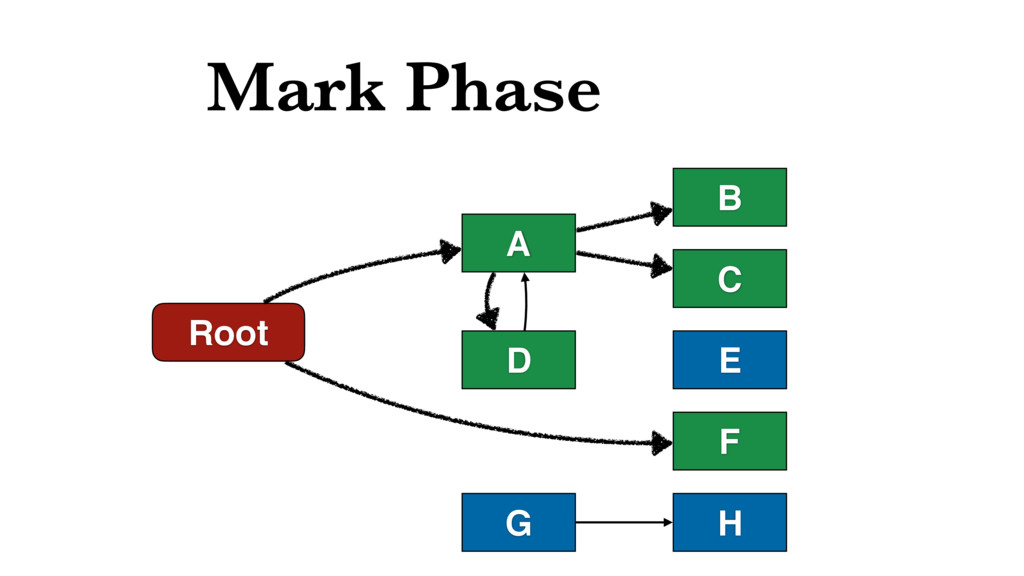
Mark Phase Root D A B C F E H
G
Mark Phase Root D A B C F E H
G
Mark Phase Root D A B C F E H
G
Mark Phase Root D A B C F E H
G
Sweep Phase Root D A B C F E H
G
Sweep Phase Root D A B C F
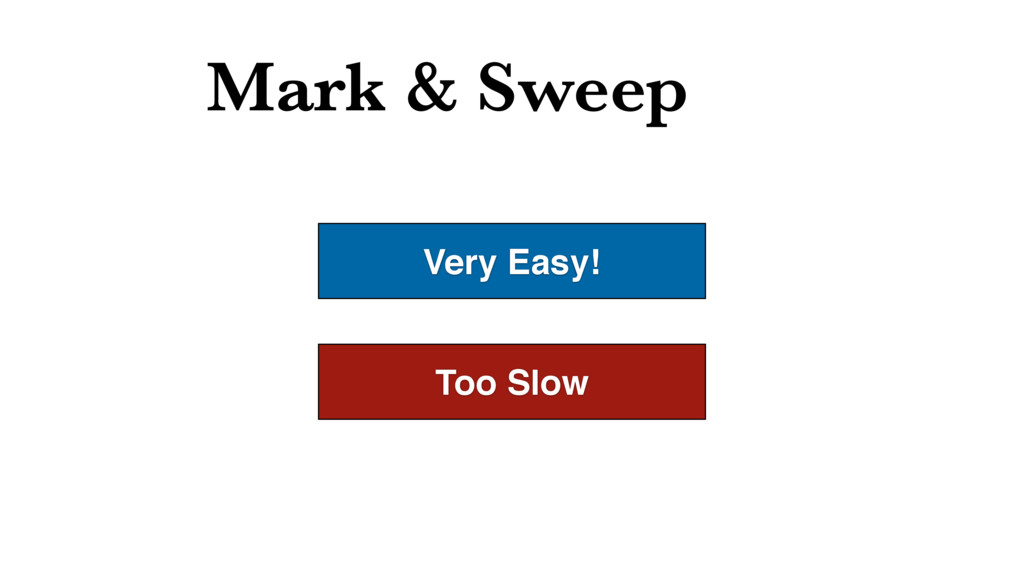
Mark & Sweep Very Easy! Too Slow
"Stop the world"
Visits every object, every time
Walk every object every time
Generational
Objects die young
Divide objects in to "old" and "new"
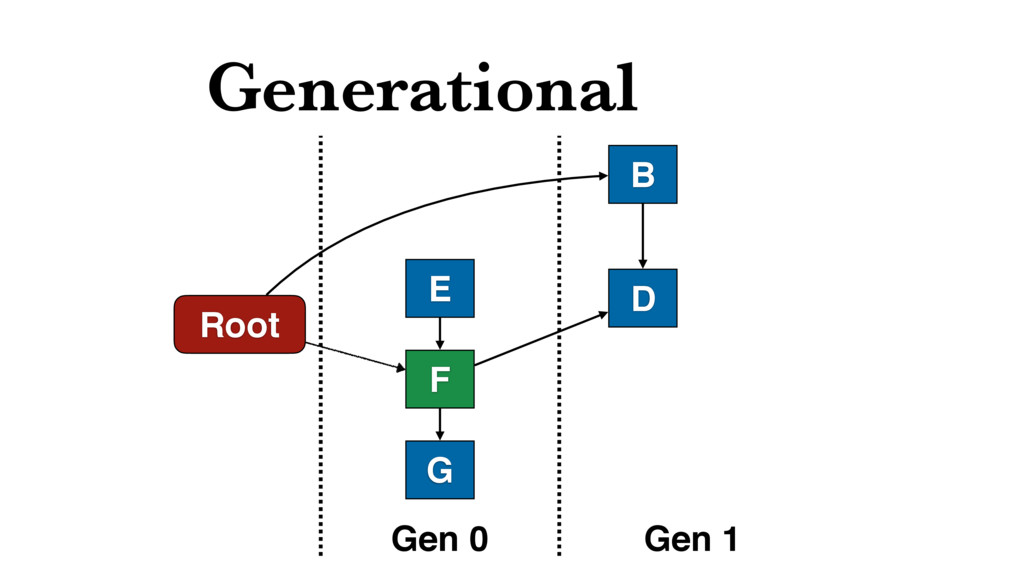
Generational Root A B D C Gen 0 Gen 1
Generational Root A B D C Gen 0 Gen 1
Generational Root A B D C Gen 0 Gen 1
Generational Root B D Gen 0 Gen 1
Generational Root B D Gen 0 Gen 1 E F
G
Generational Root B D Gen 0 Gen 1 E F
G
Generational Root B D Gen 0 Gen 1 E F
G
Generational Root B D Gen 0 Gen 1 F G
Generational Root B D Gen 0 Gen 1 F G
We didn’t have to touch "B"
One Slight Problem
Generational Root B D Gen 0 Gen 1
Generational Root B D Gen 0 Gen 1 E U
nused!
Remembered Set Root B D Gen 0 Gen 1 E
Remembered Set Root B D Gen 0 Gen 1 E
Remember!
Remembered Set Root B D Gen 0 Gen 1 E
Remembered Set Root B D Gen 0 Gen 1 E
Remembered Set Root B D Gen 0 Gen 1 E
Important Words
Write Barrier
Remembered Set
Generational Fast(er)! Not so easy
"Stop the world"
Incremental GC
Tri-Color Marking
Object Colors • White: will be collected • Black: No
reference to white objects, but reachable from the root • Gray: Reachable from root, but not yet scanned
Algorithm 1. Pick an object from the gray set and
move it to the black set 2. For each object it references, move it to the gray set 3. Repeat 1 and 2 until the gray set is empty
Tri-Color Marking Root H G F C B D A
E
Tri-Color Marking Root H G F C B D A
E
Tri-Color Marking Root H G F C B D A
E
Tri-Color Marking Root H G F C B D A
E
Tri-Color Marking Root H G F C B D A
E
None
What is the benefit?
We can interrupt steps!
Each step can be performed incrementally
Halting time is reduced
One Slight Problem
Tri-Color Marking Root F C B D A
Tri-Color Marking Root F C B D A G
Tri-Color Marking Root F C B D A G
Tri-Color Marking Root F C B D A G Write!
Important Words
Incremental
Write Barrier
Remembered Set
Minimize tracing
Decrease halting
Things our GC is not
Parallel
Real-Time
Compacting
Allocation Algorithm
None
None
Heap layout
malloc isn’t free GET IT?????
Large Chunk: Page (or Slab)
Page memory is contiguous
Each page holds a linked list
Nodes are called "slots"
Each slot is a Ruby object
Page Layout Page Ruby Object Ruby Object Ruby Object Ruby
Object Ruby Object
"Free List"
Find the first open slot!
Move to the next space in the free list
"Bump Pointer" allocation
Full Pages Object Object Object Object Page Page
"Eden" pages are searched
GC Time Object Object Object Object ☠
Important Words
Slot
Page
Eden
Tomb
Interesting Allocation Hacks
Not every object requires allocation
1 Page: 16k
1 Object: 40 bytes
Pages are "aligned"
Not `malloc` but "aligned malloc" `posix_memalign`
Choose "40" as a multiple
Start = 40 >> start = 40 => 40 >>
(start * 1).to_s(2).rjust(10, '0') => "0000101000" >> (start * 2).to_s(2).rjust(10, '0') => "0001010000" >> (start * 3).to_s(2).rjust(10, '0') => "0001111000" >> (start * 4).to_s(2).rjust(10, '0') => "0010100000" >> (start * 5).to_s(2).rjust(10, '0') => "0011001000" >> (start * 6).to_s(2).rjust(10, '0') => "0011110000" >> (start * 7).to_s(2).rjust(10, '0') => "0100011000"
"0000101000" "0001010000" "0001111000" "0010100000" "0011001000" "0011110000" "0100011000"
Use these bits to add meaning
Represent Integers Without Allocation
Encode Number 2 >> INT_FLAG = 0x1 => 1 >>
2.to_s(2) => "10" >> ((2 << 1) | INT_FLAG).to_s(2) => "101"
Decode Number 2 >> 0b101 => 5 >> 0b101 >>
1 => 2
Biggest Fixnum >> ((2 ** 64) - 1).to_s(2) => "11111111111111111111111111111111111111111111111
11111111111111111" >> ((2 ** 64) - 1).class => Bignum >> ((2 ** 63) - 1).class => Bignum >> ((2 ** 62) - 1).class => Fixnum >> ((2 ** 62)).class => Bignum
Biggest Before Heap Allocation >> ((2 ** 64) - 1).to_s(2)
=> "11111111111111111111111111111111111111111111111 11111111111111111" >> ((2 ** 64) - 1).class => Integer >> ((2 ** 63) - 1).class => Integer >> ((2 ** 62) - 1).class => Integer >> ((2 ** 62)).class => Integer R uby 2.4
Fixnums are singletons >> ((2 ** 62) - 1).object_id =>
9223372036854775807 >> ((2 ** 62) - 1).object_id => 9223372036854775807 >> ((2 ** 62)).object_id => 70213216135940 >> ((2 ** 62)).object_id => 70213216117840
Tagged Pointer
Tagged Pointers • Fixnum • Floats • True / False
/ Nil • Symbols
Allocation Problems
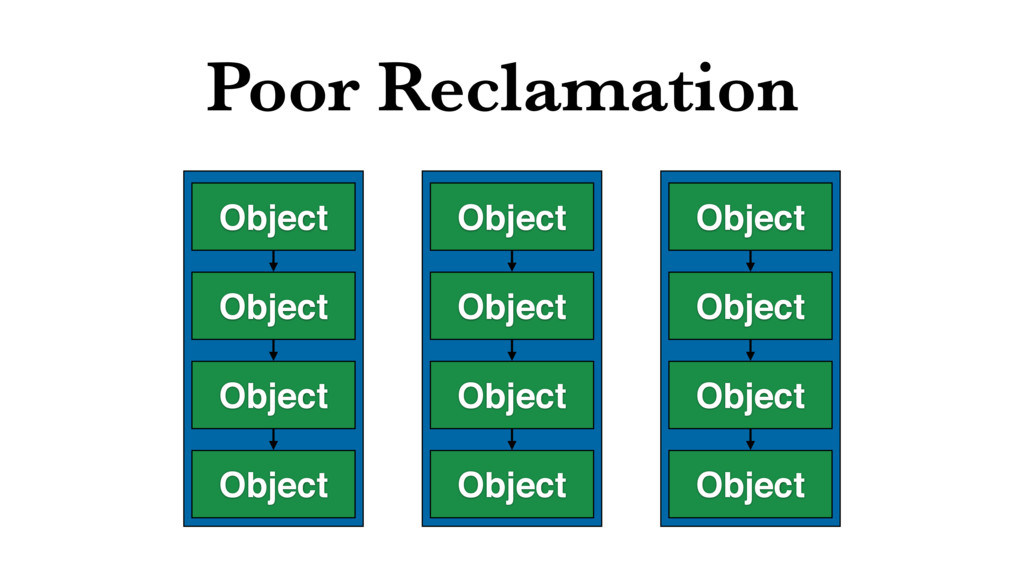
Poor Reclamation Object Object Object Object Object Object Object Object
Object Object Object Object
Poor Reclamation Object Object Object Object Object Object Object Object
NOPE
Poor Reclamation Object Object Object Object Object Object Object Object
CoW problems
1 Ruby Memory Page != 1 OS Memory Page
1 Ruby Page: 16k 1 OS Page: 4k
Object Object Object Parent Process Child Process Object
OS Copies 1 OS Page
We wrote 40 bytes, but 4kb got copied.
Solution: Group Old Objects
Two Page Types Probably Old Page Page Object Object
What is going to be old?
Probably Old class Foo end module Bar CONSTANT = Object.new
def foo "frozen string".freeze end end
Statistically Determined
Efficiently use space
Reduce GC time
CoW Friendly
GC Work G GitHub
None
None
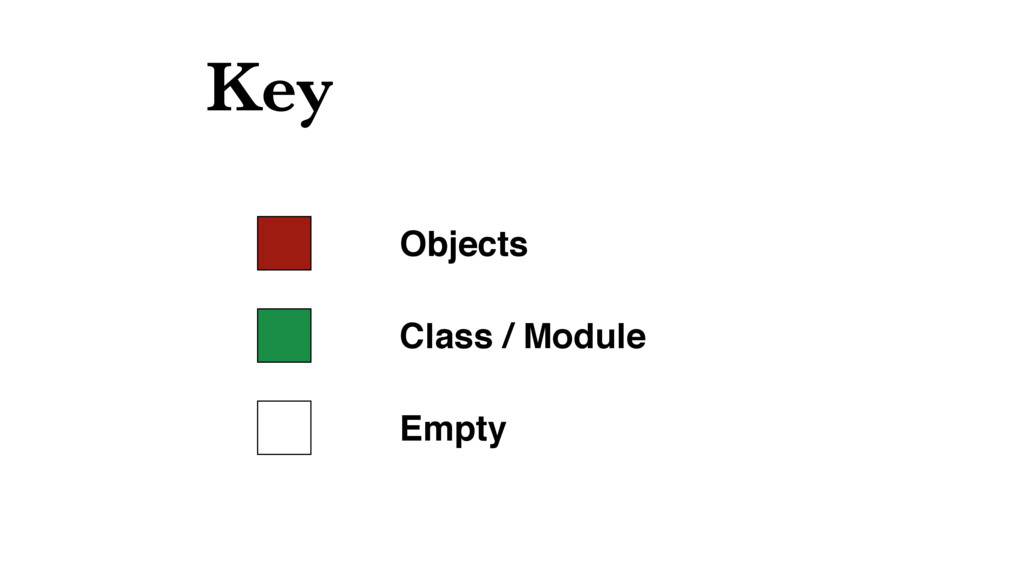
Key Objects Class / Module Empty
None
None
None
None
None
None
~17% Smaller Heap
None
github.com/ github/ruby
Future Work
Moving Objects
Poor Reclamation Object Object Object Object Object Object Object Object
NOPE YEP
Stack Scanning, Forward Pointers
GC Introspection
Seeing GC info
GC.stat {:count=>21, :heap_allocated_pages=>87, :heap_sorted_length=>87, :heap_allocatable_pages=>0, :heap_available_slots=>35460, :heap_live_slots=>35342, :heap_free_slots=>118, :heap_final_slots=>0, :heap_marked_slots=>22207,
:heap_eden_pages=>87, :heap_tomb_pages=>0, :total_allocated_pages=>87, :total_freed_pages=>0, :total_allocated_objects=>208577, :total_freed_objects=>173235, :malloc_increase_bytes=>5152, :malloc_increase_bytes_limit=>16777216, :minor_gc_count=>19, :major_gc_count=>2, :remembered_wb_unprotected_objects=>189, :remembered_wb_unprotected_objects_limit=>374, :old_objects=>21977, :old_objects_limit=>39876, :oldmalloc_increase_bytes=>485600, :oldmalloc_increase_bytes_limit=>16777216}
GC Performance
GC::Profiler >> GC::Profiler.enable => nil >> GC::Profiler.report => nil >>
GC.start => nil >> GC::Profiler.report GC 22 invokes. Index Invoke Time(sec) Use Size(byte) Total Size(byte) Total Object GC Time(ms) 1 0.143 906920 1419840 35496 3.72500000000000586198 => nil >> GC.start => nil >> GC::Profiler.report GC 23 invokes. Index Invoke Time(sec) Use Size(byte) Total Size(byte) Total Object GC Time(ms) 1 0.143 906920 1419840 35496 3.72500000000000586198 2 0.148 906920 1419840 35496 3.47800000000000864020
GC::Profiler.enable
GC::Profiler.report
Heap Inspection
ObjectSpace.dump_all
ObjectSpace.dump >> require 'objspace' => false >> x = Object.new
=> #<Object:0x007fbcd09334a8> >> ObjectSpace.dump x => "{\"address\":\"0x007fbcd09334a8\", \"type\":\"OBJECT\", \"class\": \"0x007fbcd08dd878\", \"ivars\":0, \"memsize\":40, \"flags\": {\"wb_protected\":true}}\n"
ObjectSpace.dump >> x = Object.new => #<Object:0x007fbcd0959248> >> JSON.parse(ObjectSpace.dump(x))['flags'] =>
{"wb_protected"=>true} >> GC.start => nil >> JSON.parse(ObjectSpace.dump(x))['flags'] => {"wb_protected"=>true} >> GC.start => nil >> JSON.parse(ObjectSpace.dump(x))['flags'] => {"wb_protected"=>true} >> GC.start => nil >> JSON.parse(ObjectSpace.dump(x))['flags'] => {"wb_protected"=>true, "old"=>true, "uncollectible"=>true, "marked"=>true}
Object have 3 generations
ObjectSpace
trace_object_allocations
GC Tuning
RUBY_GC_HEAP _FREE_SLOTS Number of free slots available after a GC
RUBY_GC_HEAP _INIT_SLOTS Number of free slots to initialize the GC
with
RUBY_GC_HEAP_GR OWTH_MAX_SLOTS Never grow more than this many objects
THANKS!
None


 tenderlove
 yakumo
 marceloancelmo
 matsunobu
 toru_kubota
 tomtanaka
 dvrv_tknrszk
 ks91
ks91
 sansantech
 yohyamasaki
 oracle4engineer
 mikanichinose
 takahiromatsui
 soudai
 dugsong
 skipperchong
 sarafernandez
 chriscoyier
 marketingsoph
 pauljervisheath
 tapps
tapps
 colly
colly
 inesmontani
 bluesmoon
 tammielis
































![ObjectSpace.dump >> x = Object.new => #<Object:0x007fbcd0959248> >> JSON.parse(ObjectSpace.dump(x))['flags'] =>](https://files.speakerdeck.com/presentations/3b175ac4cf4f45039c395e15c573d50e/slide_235.jpg)


