Share
Embed
Green phytoplankton - University Technological of Sydney - March 2019
Daniel Vaulot
March 22, 2019
Transcript
56 slides
-
Outline Roscoff team Eukaryotic picoplankton Green picoplankton Prasinophytes clade VII
Mamiellophyceae What's next ? 2 / 46 -
1872 - Antoine Lacaze-Duthiers CNRS and Sorbonne Université Staff: 350
Students : 1,000-2,000 per year La Station Biologique de Rosco 4 / 46 -
Scientists: 10 Staff: ~ 40 Research themes: Viruses Bacteria Cyanobacteria
Symbioses Parasitism Ecologie of Marine Plankton team (ECOMAP) http://www.sb-roscoff.fr/en/team-diversity-and-interactions-oceanic-plankton 5 / 46 -
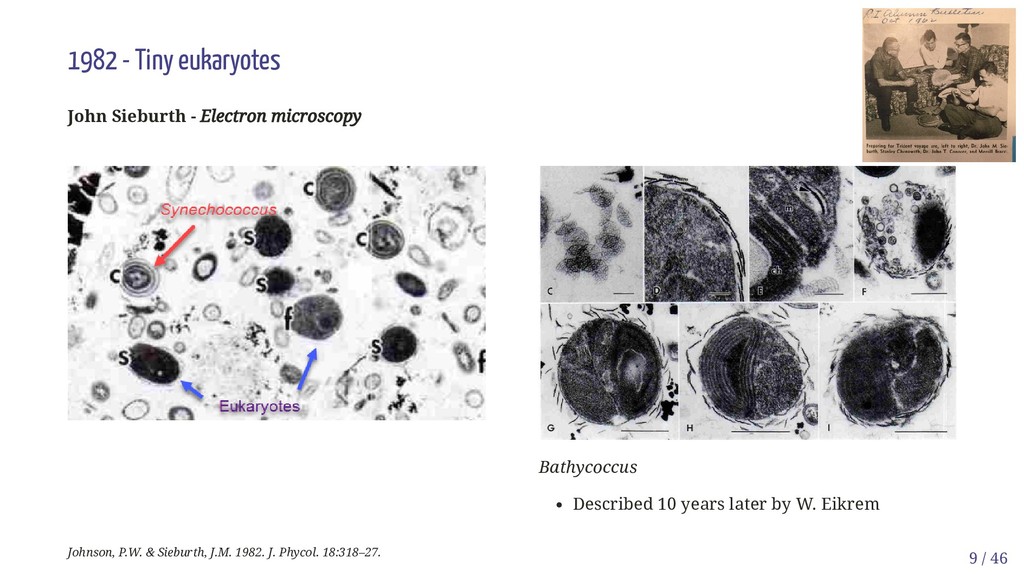
Bathycoccus Described 10 years later by W. Eikrem 1982 -
Tiny eukaryotes John Sieburth - Electron microscopy Electron microscopy Johnson, P.W. & Sieburth, J.M. 1982. J. Phycol. 18:318–27. 9 / 46 -
Pico-eukaryote diversity Many new species/classes discovered in 3 last decades
Not, F., Siano, R., Kooistra, W.H.C.F., Simon, N., Vaulot, D. & Probert, I. 2012. In Piganeau, G. [Ed.] Genomic Insights Gained into the Diversity, Biology and Evolution of Microbial Photosynthetic Eukaryotes. Elsevier. 10 / 46 -
1995 - Ostreococcus The smallest photosynthetic eukaryote (0.8 µm) Genome
deciphered in 2006 Now a biological model Chrétiennot-Dinet, M.-J., Courties, C., Vaquer, A., Neveux, J., Claustre, H., Lautier, J. & Machado, M.C. 1995. Phycologia. 34:285–92. 11 / 46 -
1999 - Bolidomonas 1.5 µm Close to diatoms phylogenetically 2011
- Triparma Group known since 1980 First isolate in 2008 Covered with silica as diatoms Confirm filiation of Bolidomonas Guillou, L., Chrétiennot-Dinet, M.-J., Medlin, L.K., Claustre, H., Loiseaux-de Goër, S. & Vaulot, D. 1999. J. Phycol. 35:368–81. Ichinomiya, M., Yoshikawa, S., Kamiya, M., Ohki, K., Takaichi, S. & Kuwata, A. 2011. J. Phycol. 47:144–51. 12 / 46 -
Green vs. Red lineages Falkowski, P.G., Katz, M.E., Knoll, A.H.,
Quigg, A., Raven, J.A., Schofield, O. & Taylor, F.J. 2004. Science. 305:354–60. 14 / 46 -
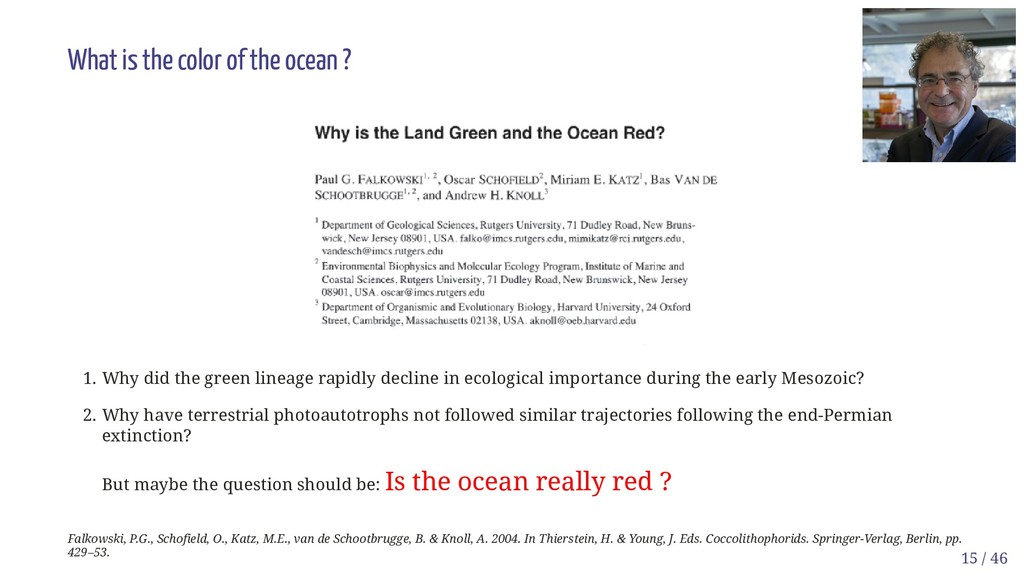
What is the color of the ocean ? 1. Why
did the green lineage rapidly decline in ecological importance during the early Mesozoic? 2. Why have terrestrial photoautotrophs not followed similar trajectories following the end-Permian extinction? 15 / 46 -
What is the color of the ocean ? 1. Why
did the green lineage rapidly decline in ecological importance during the early Mesozoic? 2. Why have terrestrial photoautotrophs not followed similar trajectories following the end-Permian extinction? But maybe the question should be: Is the ocean really red ? Falkowski, P.G., Schofield, O., Katz, M.E., van de Schootbrugge, B. & Knoll, A. 2004. In Thierstein, H. & Young, J. Eds. Coccolithophorids. Springer-Verlag, Berlin, pp. 429–53. 15 / 46 -
The green lineage Leliaert, F., Verbruggen, H. & Zechman, F.W.
2011. Bioessays. 33:683–92. 16 / 46 -
40 stations Depths: 2 Fractions: 4 sequences Tara Oceans de
Vargas, C., Audic, S., Henry, N., Decelle, J., Mahe, F., Logares, R., Lara, E. et al. 2015. Science. 348:1261605. > > 5.10 6 18 / 46 -
Build a reference database 18S rRNA GenBank sequences Tragin, M.,
Lopes dos Santos, A., Christen, R. & Vaulot, D. 2016. Perspect. Phycol. 3:141–54. 20 / 46 -
Data from OSD The green lineage represents 25% of marine
phytoplankton 21 / 46 -
Data from OSD Up to 94% ... The green lineage
represents 25% of marine phytoplankton 21 / 46 -
Data from OSD Up to 94% ... The green lineage
represents 25% of marine phytoplankton Next question: What are the shade of green ? Tragin, M. & Vaulot, D. 2018. Sci. Rep. 8:14020. 21 / 46 -
Green algae: Oceanic vs. Coastal Lopes dos Santos, A., Gourvil,
P., Tragin, M., Noël, M.-H., Decelle, J., Romac, S. & Vaulot, D. 2017. ISME J. 11:512–28. 22 / 46 -
Potter et al. 1997 - Little green balls Moon et
al. 2001 - Equatorial Pacific Prasinophytes clade VII Potter, D., Lajeunesse, T.C., Saunders, G.W. & Andersen, R.A. 1997. Biodivers. Conserv. 6:99–107. Moon-van der Staay, S.Y., De Wachter, R. & Vaulot, D. 2001. Nature. 409:607–10. 24 / 46 -
Prasinophytes clade VII dominates in oceanic waters Lopes dos Santos,
A., Gourvil, P., Tragin, M., Noël, M.-H., Decelle, J., Romac, S. & Vaulot, D. 2017. ISME J. 11:512–28. 25 / 46 -
Prasinophytes clade VII - Diversity Two major clades A, B
10 sub-clades: A1-A7, B1-B3 Clade C : Picocystis Lopes dos Santos, A., Gourvil, P., Tragin, M., Noël, M.-H., Decelle, J., Romac, S. & Vaulot, D. 2017. ISME J. 11:512–28. 26 / 46 -
clade B1 dominates in the Pacific. clade A6 dominates in
the Mediterranean Sea Prasinophytes clade VII - Niches 27 / 46 -
clade B1 dominates in the Pacific. clade A6 dominates in
the Mediterranean Sea Prasinophytes clade VII - Niches Lopes dos Santos, A., Gourvil, P., Tragin, M., Noël, M.-H., Decelle, J., Romac, S. & Vaulot, D. 2017. ISME J. 11:512–28. 27 / 46 -
Cultured strains RCC287 - Clade A3 Lopes dos Santos, A.,
Pollina, T., Gourvil, P., Corre, E., Marie, D., Garrido, J.L., Rodríguez, F. et al. 2017. Sci. Rep. 7:14019. 28 / 46 -
ITS (Internally Transcribed Spacer) Lopes dos Santos, A., Pollina, T.,
Gourvil, P., Corre, E., Marie, D., Garrido, J.L., Rodríguez, F. et al. 2017. Sci. Rep. 7:14019. 29 / 46 -
Chloropicophyceae Picocystophyceae Chloropicon: 6 species Chloroparvula: 2 species New classes,
new species Lopes dos Santos, A., Pollina, T., Gourvil, P., Corre, E., Marie, D., Garrido, J.L., Rodríguez, F. et al. 2017. Sci. Rep. 7:14019. 30 / 46 -
First genome Lemieux, C., Turmel, M. & Otis, C. 2018.
Nat. Commun. Submitted. 31 / 46 -
Mamiellophyceae Present everywhere in coastal waters, no obvious patterns. Tragin,
M. & Vaulot, D. 2018. Sci. Rep. 8:14020. 33 / 46 -
Four major genera Tragin, M. & Vaulot, D. 2019. Sci.
Rep. in press. 34 / 46 -
Five clades: O. tauri O. mediterraneus O. "lucimarinus" clade B
clade E Ostreococcus Tragin, M. & Vaulot, D. 2019. Sci. Rep. in press. 35 / 46 -
Ostreococcus Clade E has no representative in culture. Tragin, M.
& Vaulot, D. 2019. Sci. Rep. in press. 36 / 46 -
Species: Four described M. pusilla M. commoda M. bravo M.
polaris Two "candidate" sp. 1 sp. 2 Micromonas Simon, N., Foulon, E., Grulois, D., Six, C., Desdevises, Y., Latimier, M., Le Gall, F. et al. 2017. Protist. 168:612–35. 37 / 46 -
Metabarcodes: Nine clades/species M. pusilla M. commoda A1-A2 M. bravo
B1-B2 M. polaris clades B3_B5 Micromonas Tragin, M. & Vaulot, D. 2019. Sci. Rep. in press. 38 / 46 -
M. polaris only found in polar waters B5 only found
in tropical waters Micromonas Tragin, M. & Vaulot, D. 2019. Sci. Rep. in press 39 / 46 -
Genomic adaptation to the environment Bathycoccus Bathycoccus Moreau, H., Verhelst,
B., Couloux, A., Derelle, E., Rombauts, S., Grimsley, N., Van Bel, M. et al. 2012. Genome Biol. 13:R74. 41 / 46 -
Two different genomes Dispensable genes ? Genomic adaptation to the
environment Bathycoccus Bathycoccus Vannier, T., ..., Vaulot, D. et al. 2016. Sci. Rep. 6:37900. 42 / 46 -
Interactions Worden, A.Z., Follows, M.J., Giovannoni, S.J., Wilken, S., Zimmerman,
A.E. & Keeling, P.J. 2015. Science. 347:1257594. 43 / 46 -
Interactions Gérikas Ribeiro, C., Lopes dos Santos, A., Marie, D.,
Pereira Brandini, F. & Vaulot, D. 2018. ISME J. 12:1360–74. 44 / 46 -
Take home messages Green algae 25% of phytoplankton Mamiellophyceae vs.
Chloropicophyceae Patterns emerge at species/clade level What's next ? Link genomes and environmental adaptation Study interactions 45 / 46 -
Take home messages Green algae 25% of phytoplankton Mamiellophyceae vs.
Chloropicophyceae Patterns emerge at species/clade level What's next ? Link genomes and environmental adaptation Study interactions Key resources Culture Collections Reference Gene Databases Genomes 45 / 46 -
Acknowledgments EU projects PICODIV MicroB3 MACUMBA ANR projects MALINA Green
Edge Phytopol CNRS Sorbonne Université Nanyang Technological University 46 / 46