Upgrade to Pro — share decks privately, control downloads, hide ads and more …

Integrated Marketing Communications: Situationa...

Integrated Marketing Communications: Situational Analysis

Avatar for Victoria Adams

Victoria Adams

January 04, 2026
Tweet

More Decks by Victoria Adams

Other Decks in Business

Transcript

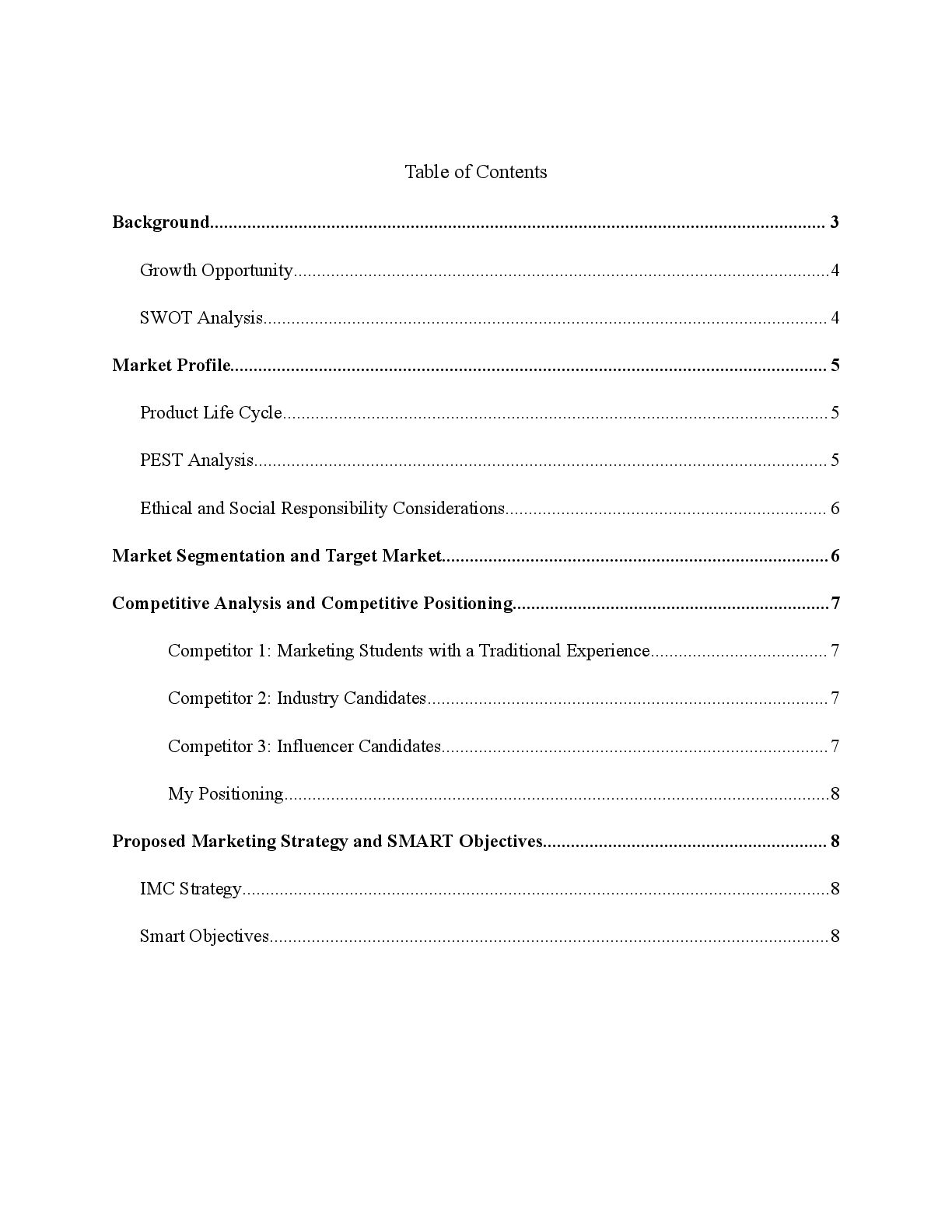
  1. Table of Contents Background.................................................................................................................................... 3 Growth Opportunity...................................................................................................................4 SWOT Analysis......................................................................................................................... 4

    Market Profile................................................................................................................................ 5 Product Life Cycle.....................................................................................................................5 PEST Analysis........................................................................................................................... 5 Ethical and Social Responsibility Considerations..................................................................... 6 Market Segmentation and Target Market...................................................................................6 Competitive Analysis and Competitive Positioning....................................................................7 Competitor 1: Marketing Students with a Traditional Experience...................................... 7 Competitor 2: Industry Candidates......................................................................................7 Competitor 3: Influencer Candidates...................................................................................7 My Positioning.....................................................................................................................8 Proposed Marketing Strategy and SMART Objectives............................................................. 8 IMC Strategy..............................................................................................................................8 Smart Objectives........................................................................................................................8
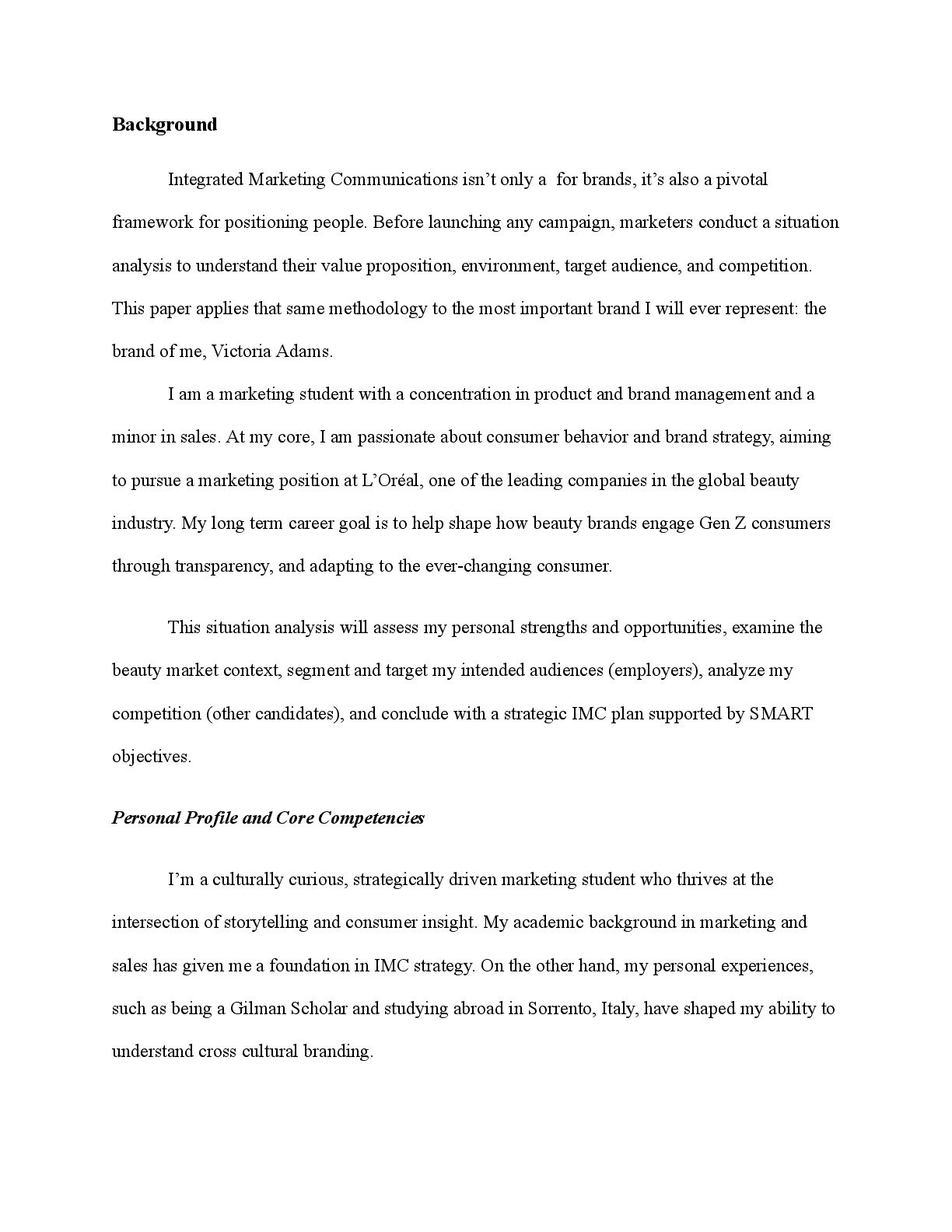
  2. Background Integrated Marketing Communications isn’t only a for brands, it’s

    also a pivotal framework for positioning people. Before launching any campaign, marketers conduct a situation analysis to understand their value proposition, environment, target audience, and competition. This paper applies that same methodology to the most important brand I will ever represent: the brand of me, Victoria Adams. I am a marketing student with a concentration in product and brand management and a minor in sales. At my core, I am passionate about consumer behavior and brand strategy, aiming to pursue a marketing position at L’Oréal, one of the leading companies in the global beauty industry. My long term career goal is to help shape how beauty brands engage Gen Z consumers through transparency, and adapting to the ever-changing consumer. This situation analysis will assess my personal strengths and opportunities, examine the beauty market context, segment and target my intended audiences (employers), analyze my competition (other candidates), and conclude with a strategic IMC plan supported by SMART objectives. Personal Profile and Core Competencies I’m a culturally curious, strategically driven marketing student who thrives at the intersection of storytelling and consumer insight. My academic background in marketing and sales has given me a foundation in IMC strategy. On the other hand, my personal experiences, such as being a Gilman Scholar and studying abroad in Sorrento, Italy, have shaped my ability to understand cross cultural branding.
  3. Through my time working for a startup beauty brand, I’ve

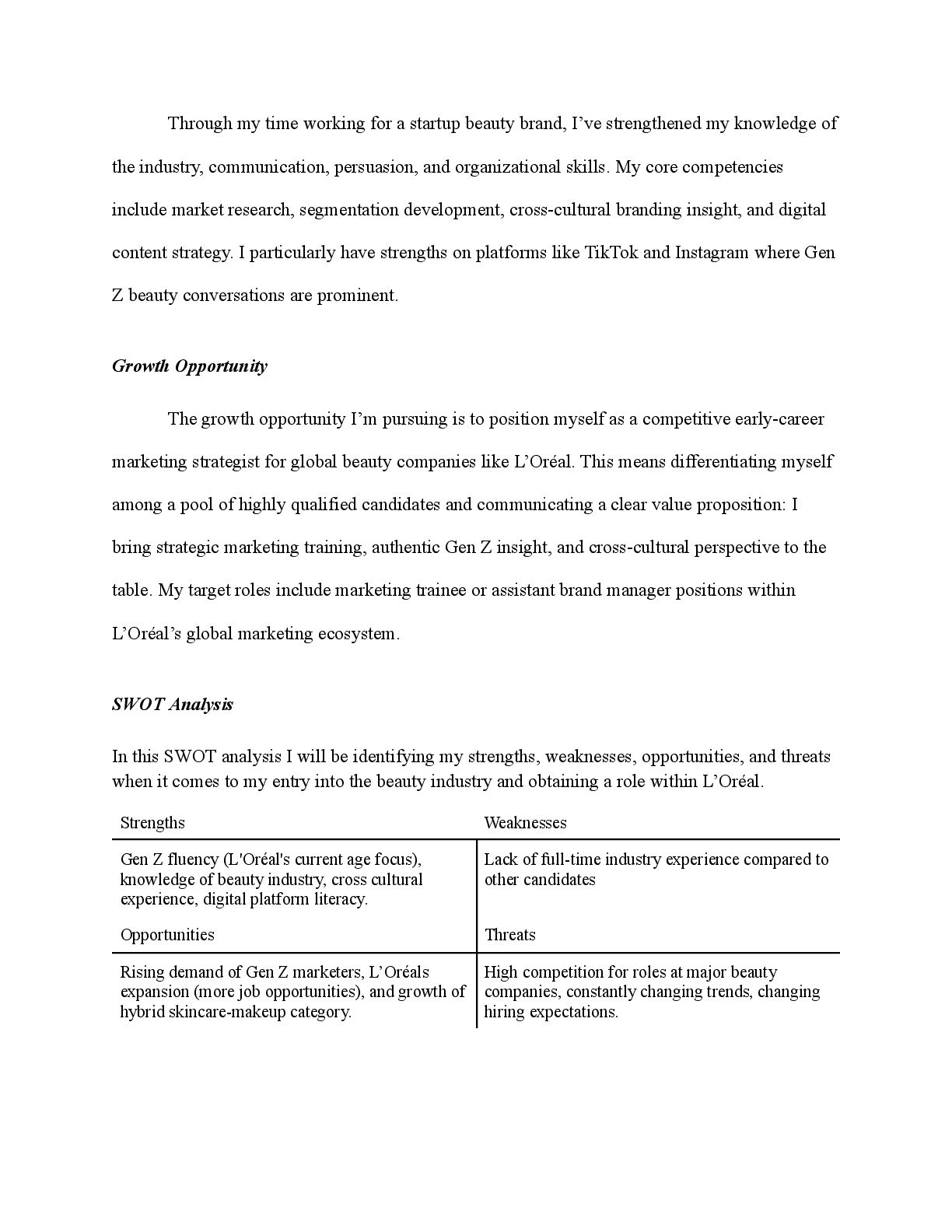
    strengthened my knowledge of the industry, communication, persuasion, and organizational skills. My core competencies include market research, segmentation development, cross-cultural branding insight, and digital content strategy. I particularly have strengths on platforms like TikTok and Instagram where Gen Z beauty conversations are prominent. Growth Opportunity ​ The growth opportunity I’m pursuing is to position myself as a competitive early-career marketing strategist for global beauty companies like L’Oréal. This means differentiating myself among a pool of highly qualified candidates and communicating a clear value proposition: I bring strategic marketing training, authentic Gen Z insight, and cross-cultural perspective to the table. My target roles include marketing trainee or assistant brand manager positions within L’Oréal’s global marketing ecosystem. SWOT Analysis In this SWOT analysis I will be identifying my strengths, weaknesses, opportunities, and threats when it comes to my entry into the beauty industry and obtaining a role within L’Oréal. Strengths Weaknesses Gen Z fluency (L'Oréal's current age focus), knowledge of beauty industry, cross cultural experience, digital platform literacy. Lack of full-time industry experience compared to other candidates Opportunities Threats Rising demand of Gen Z marketers, L’Oréals expansion (more job opportunities), and growth of hybrid skincare-makeup category. High competition for roles at major beauty companies, constantly changing trends, changing hiring expectations.
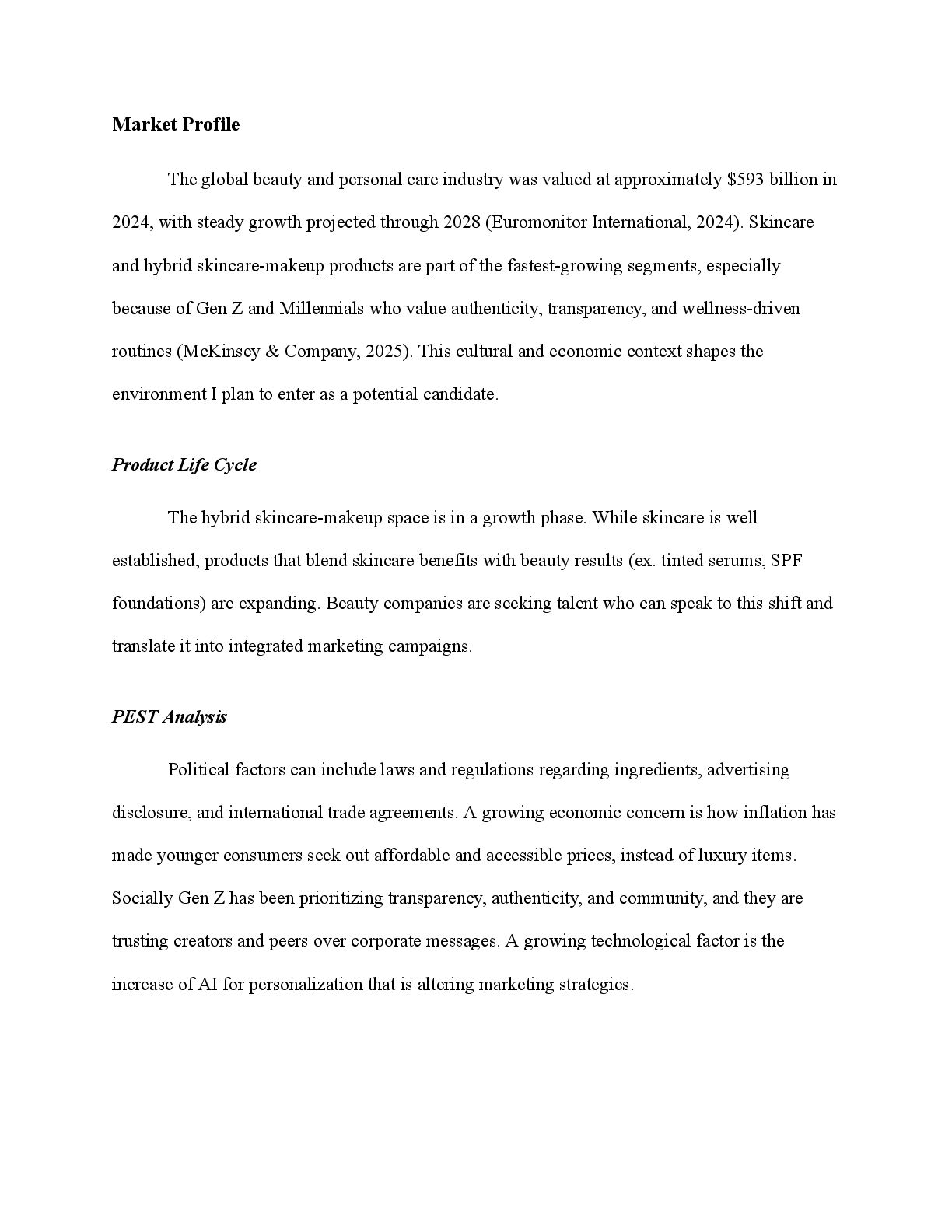
  4. Market Profile The global beauty and personal care industry was

    valued at approximately $593 billion in 2024, with steady growth projected through 2028 (Euromonitor International, 2024). Skincare and hybrid skincare-makeup products are part of the fastest-growing segments, especially because of Gen Z and Millennials who value authenticity, transparency, and wellness-driven routines (McKinsey & Company, 2025). This cultural and economic context shapes the environment I plan to enter as a potential candidate. Product Life Cycle ​ The hybrid skincare-makeup space is in a growth phase. While skincare is well established, products that blend skincare benefits with beauty results (ex. tinted serums, SPF foundations) are expanding. Beauty companies are seeking talent who can speak to this shift and translate it into integrated marketing campaigns. PEST Analysis Political factors can include laws and regulations regarding ingredients, advertising disclosure, and international trade agreements. A growing economic concern is how inflation has made younger consumers seek out affordable and accessible prices, instead of luxury items. Socially Gen Z has been prioritizing transparency, authenticity, and community, and they are trusting creators and peers over corporate messages. A growing technological factor is the increase of AI for personalization that is altering marketing strategies.
  5. Ethical and Social Responsibility Considerations ​ Gen Z expects brands,

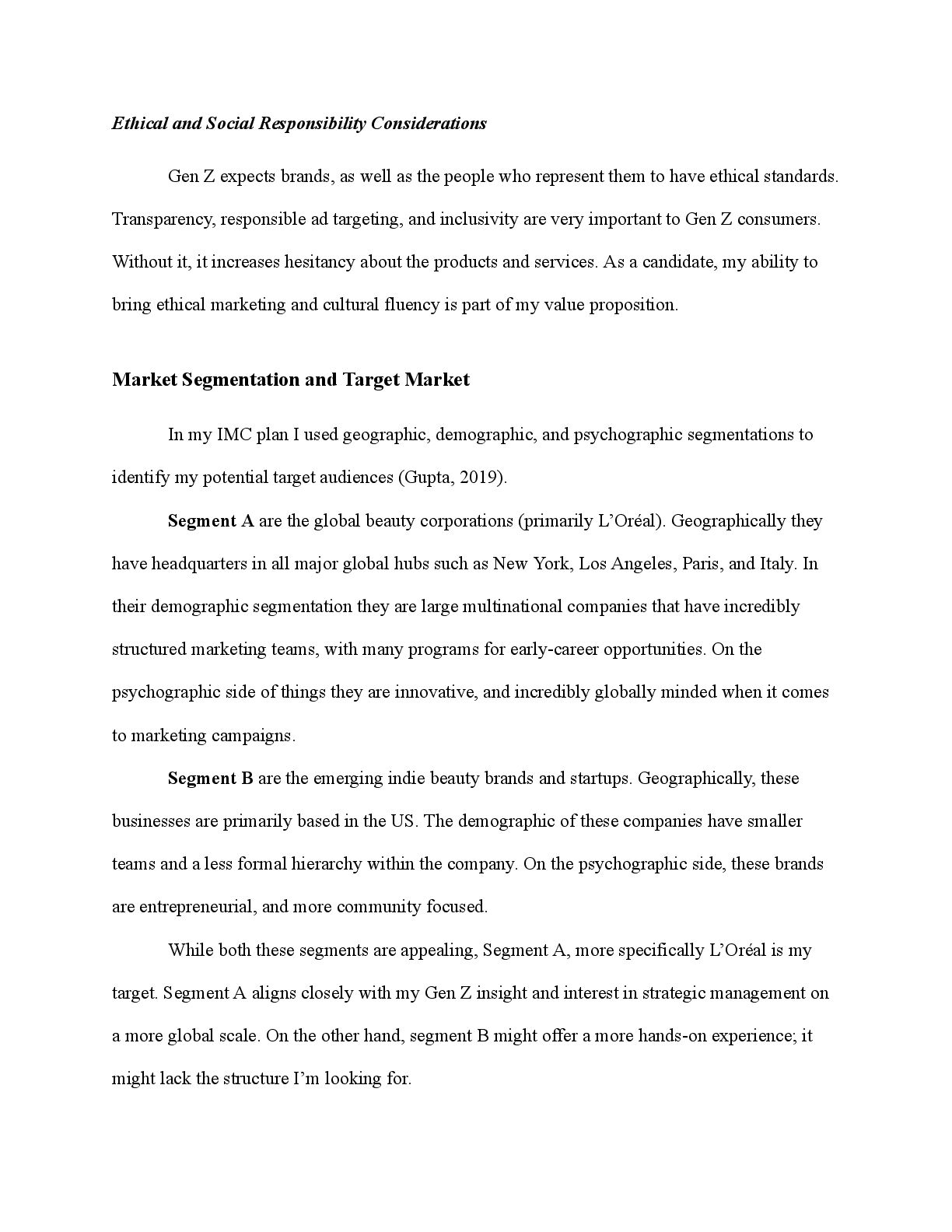
    as well as the people who represent them to have ethical standards. Transparency, responsible ad targeting, and inclusivity are very important to Gen Z consumers. Without it, it increases hesitancy about the products and services. As a candidate, my ability to bring ethical marketing and cultural fluency is part of my value proposition. Market Segmentation and Target Market In my IMC plan I used geographic, demographic, and psychographic segmentations to identify my potential target audiences (Gupta, 2019). Segment A are the global beauty corporations (primarily L’Oréal). Geographically they have headquarters in all major global hubs such as New York, Los Angeles, Paris, and Italy. In their demographic segmentation they are large multinational companies that have incredibly structured marketing teams, with many programs for early-career opportunities. On the psychographic side of things they are innovative, and incredibly globally minded when it comes to marketing campaigns. Segment B are the emerging indie beauty brands and startups. Geographically, these businesses are primarily based in the US. The demographic of these companies have smaller teams and a less formal hierarchy within the company. On the psychographic side, these brands are entrepreneurial, and more community focused. While both these segments are appealing, Segment A, more specifically L’Oréal is my target. Segment A aligns closely with my Gen Z insight and interest in strategic management on a more global scale. On the other hand, segment B might offer a more hands-on experience; it might lack the structure I’m looking for.
  6. Competitive Analysis and Competitive Positioning ​ My competitors are going

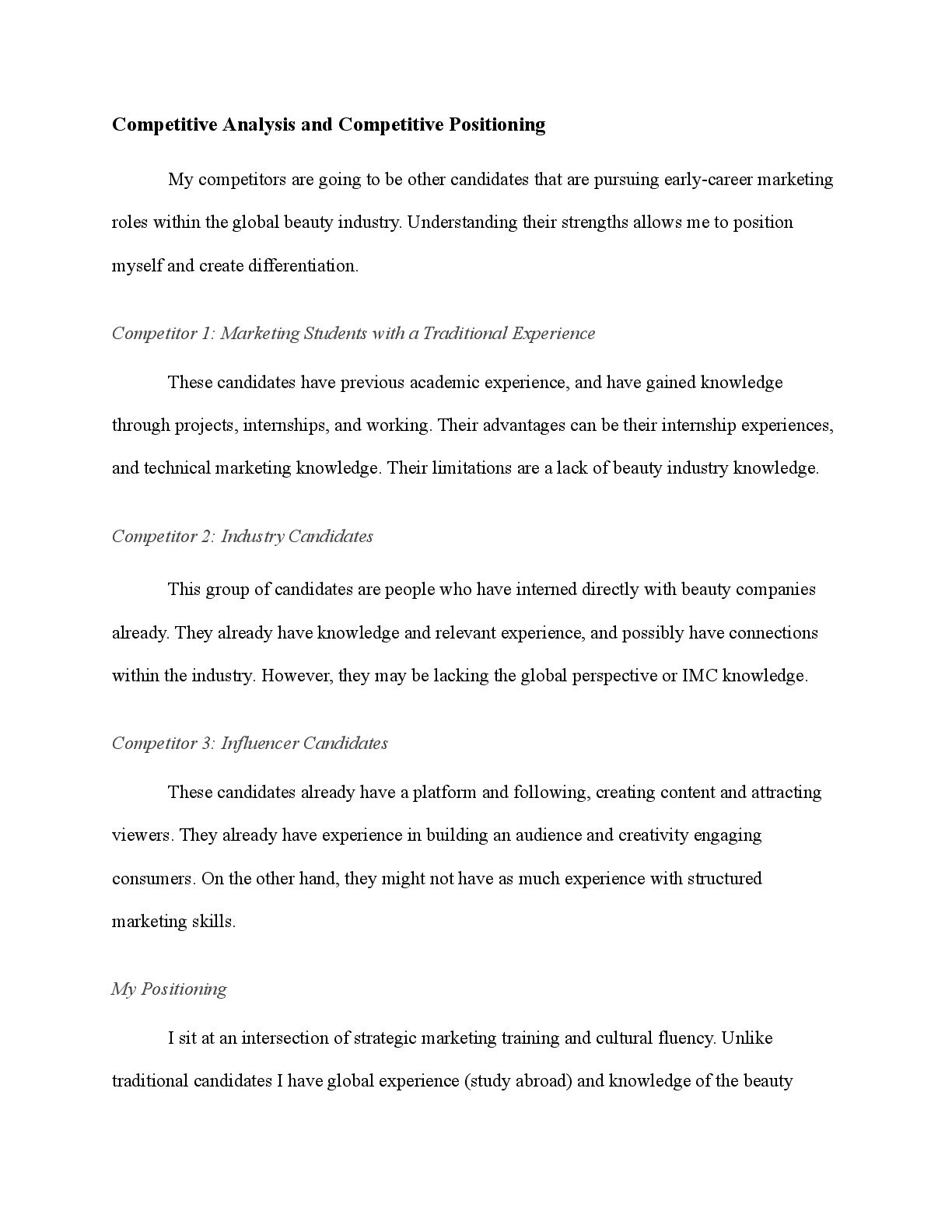
    to be other candidates that are pursuing early-career marketing roles within the global beauty industry. Understanding their strengths allows me to position myself and create differentiation. Competitor 1: Marketing Students with a Traditional Experience ​ These candidates have previous academic experience, and have gained knowledge through projects, internships, and working. Their advantages can be their internship experiences, and technical marketing knowledge. Their limitations are a lack of beauty industry knowledge. Competitor 2: Industry Candidates ​ This group of candidates are people who have interned directly with beauty companies already. They already have knowledge and relevant experience, and possibly have connections within the industry. However, they may be lacking the global perspective or IMC knowledge. Competitor 3: Influencer Candidates ​ These candidates already have a platform and following, creating content and attracting viewers. They already have experience in building an audience and creativity engaging consumers. On the other hand, they might not have as much experience with structured marketing skills. My Positioning ​ I sit at an intersection of strategic marketing training and cultural fluency. Unlike traditional candidates I have global experience (study abroad) and knowledge of the beauty
  7. industry. On top of this I have a clear idea

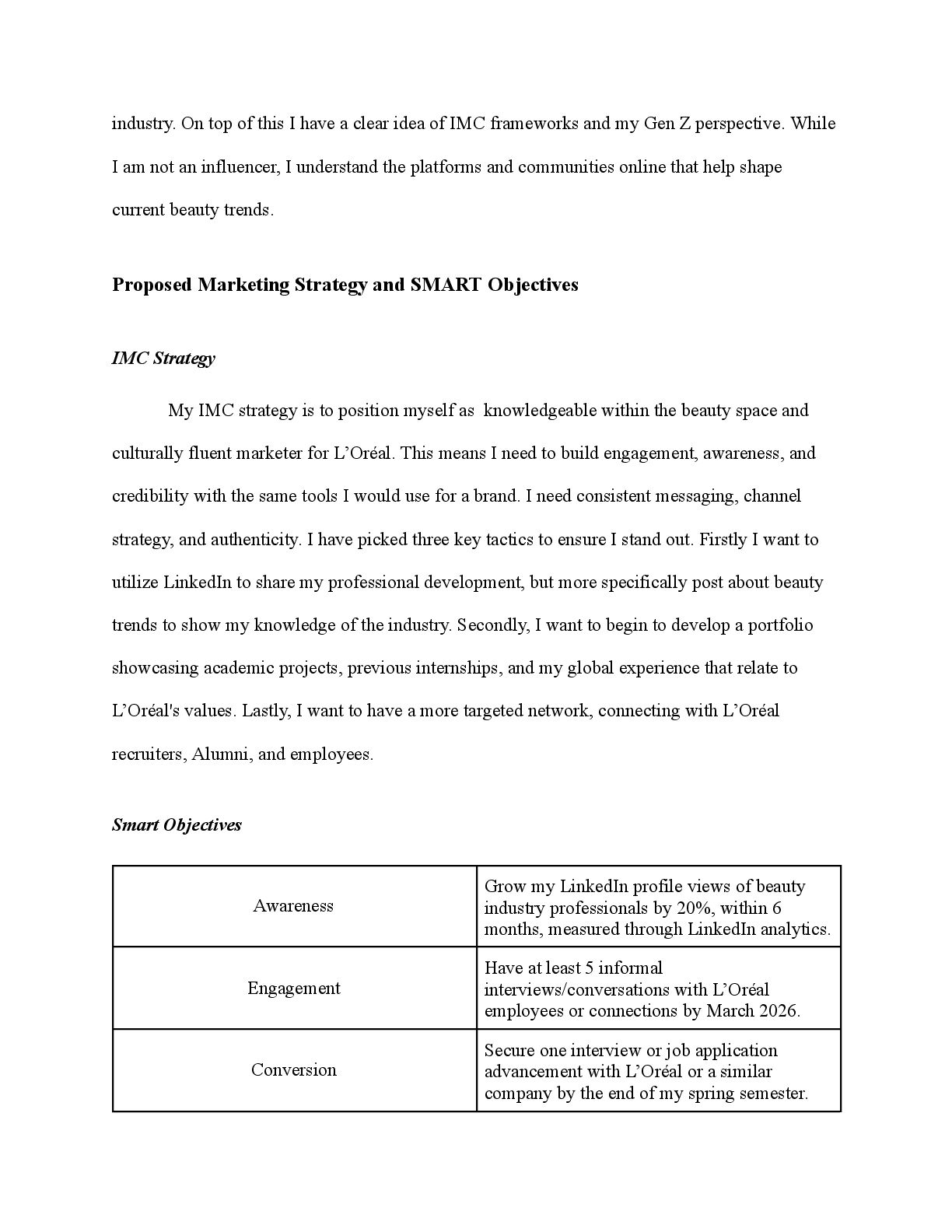
    of IMC frameworks and my Gen Z perspective. While I am not an influencer, I understand the platforms and communities online that help shape current beauty trends. Proposed Marketing Strategy and SMART Objectives IMC Strategy ​ My IMC strategy is to position myself as knowledgeable within the beauty space and culturally fluent marketer for L’Oréal. This means I need to build engagement, awareness, and credibility with the same tools I would use for a brand. I need consistent messaging, channel strategy, and authenticity. I have picked three key tactics to ensure I stand out. Firstly I want to utilize LinkedIn to share my professional development, but more specifically post about beauty trends to show my knowledge of the industry. Secondly, I want to begin to develop a portfolio showcasing academic projects, previous internships, and my global experience that relate to L’Oréal's values. Lastly, I want to have a more targeted network, connecting with L’Oréal recruiters, Alumni, and employees. Smart Objectives Awareness Grow my LinkedIn profile views of beauty industry professionals by 20%, within 6 months, measured through LinkedIn analytics. Engagement Have at least 5 informal interviews/conversations with L’Oréal employees or connections by March 2026. Conversion Secure one interview or job application advancement with L’Oréal or a similar company by the end of my spring semester.
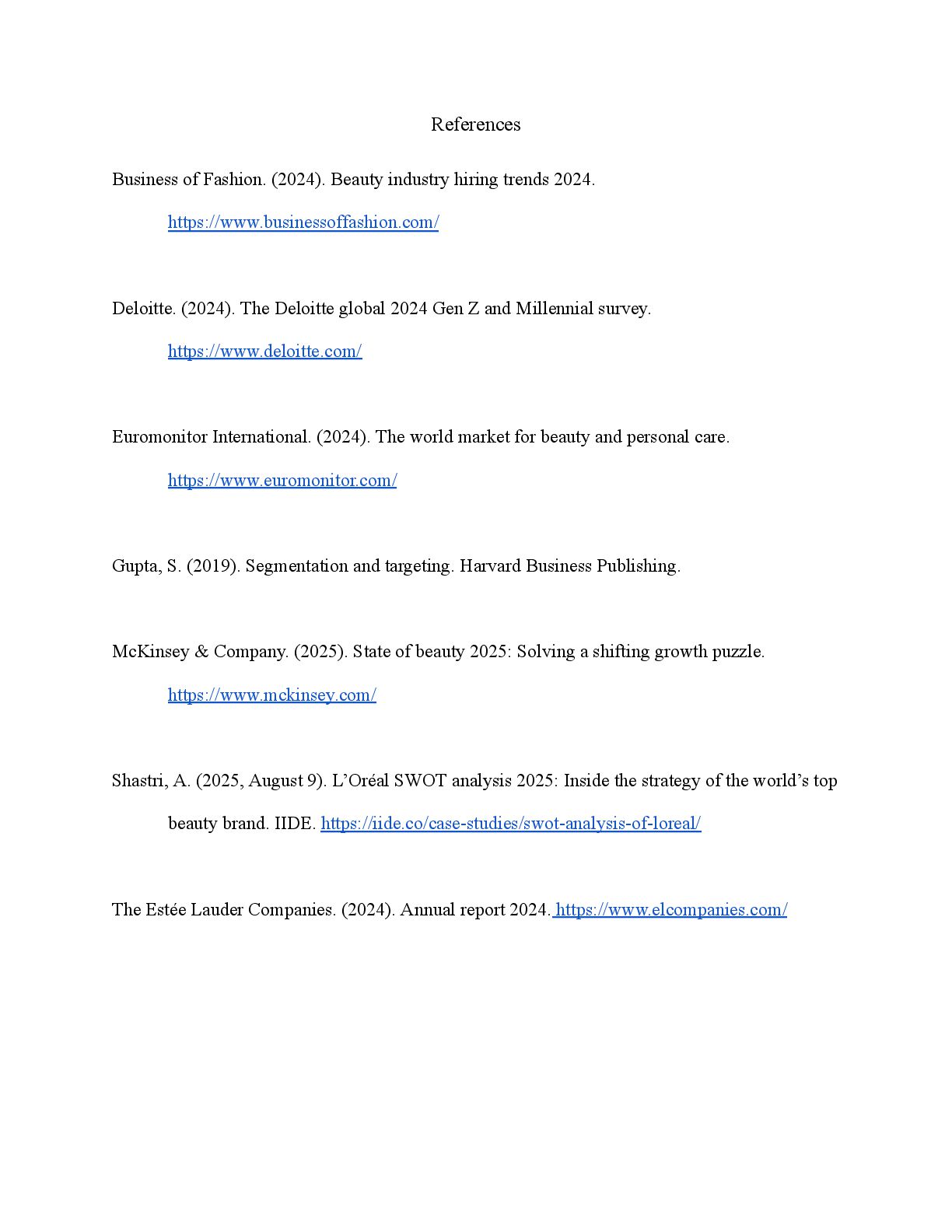
  8. References Business of Fashion. (2024). Beauty industry hiring trends 2024.

    https://www.businessoffashion.com/ Deloitte. (2024). The Deloitte global 2024 Gen Z and Millennial survey. https://www.deloitte.com/ Euromonitor International. (2024). The world market for beauty and personal care. https://www.euromonitor.com/ Gupta, S. (2019). Segmentation and targeting. Harvard Business Publishing. McKinsey & Company. (2025). State of beauty 2025: Solving a shifting growth puzzle. https://www.mckinsey.com/ Shastri, A. (2025, August 9). L’Oréal SWOT analysis 2025: Inside the strategy of the world’s top beauty brand. IIDE. https://iide.co/case-studies/swot-analysis-of-loreal/ The Estée Lauder Companies. (2024). Annual report 2024. https://www.elcompanies.com/