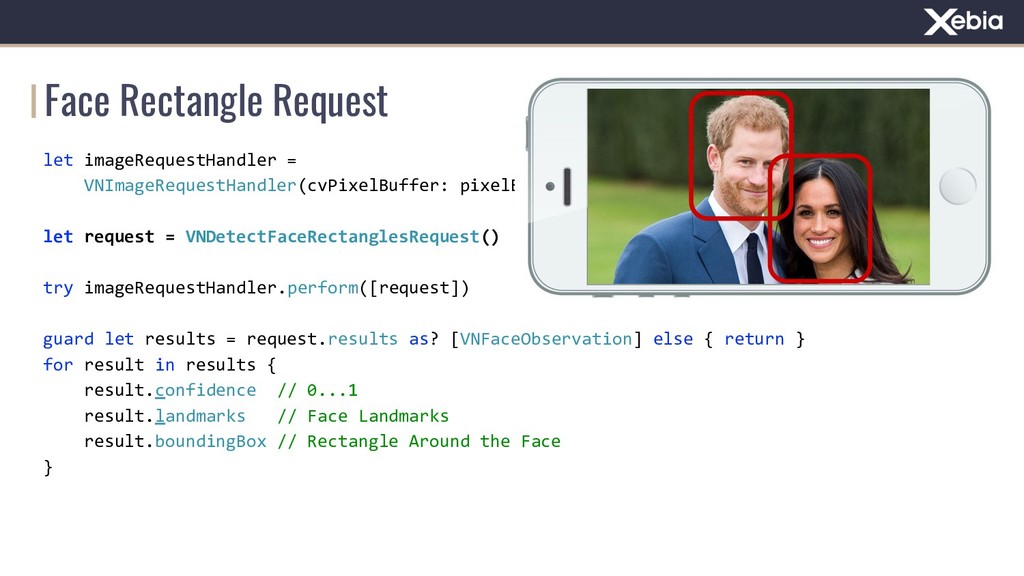
options: [:]) let request = VNDetectFaceRectanglesRequest() try imageRequestHandler.perform([request]) guard let results = request.results as? [VNFaceObservation] else { return } for result in results { result.confidence // 0...1 result.landmarks // Face Landmarks result.boundingBox // Rectangle Around the Face }
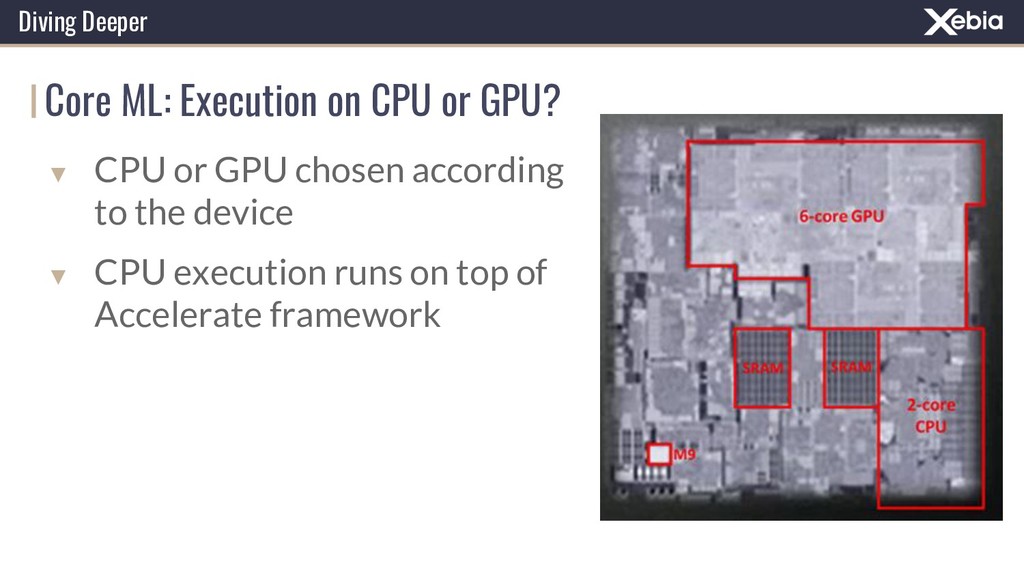
GPU or GPU chosen according to the device ▼ CPU execution runs on top of Accelerate framework ▽ Abstraction for leveraging the vector-processing capabilities of the CPU
GPU or GPU chosen according to the device ▼ CPU execution runs on top of Accelerate framework ▽ Abstraction for leveraging the vector-processing capabilities of the CPU ▼ iOS chooses for You /!\
// ... func evaluate(inputs: [MLMultiArray], outputs: [MLMultiArray]) throws { for i in 0..<inputs.count { let input = inputs[i] let output = outputs[i] assert(input.shape == output.shape) for j in 0..<input.count { let x = input[j].doubleValue let y = x * scale output[j] = NSNumber(value: y) } } } }
let targetRect = rect.transformed(to: arSceneView.frame.size) let targetRectCenter = CGPoint(x: targetRect.midX, y: targetRect.midY) guard let point = findAverageHitTest(for: targetRectCenter) else { return } let pointerNode = SCNNode.createPointerNode(text: personIdentifier) pointerNode.position = point
use DL for Face Recognition ▼ How to import a face recognition model inside a mobile app ▼ How to make use of a ML model to create an AR experience on a modern phone


 viteinfinite
 kinopeee
 panda728
.jpeg) kaseken
kaseken
 willnet
 kaityo256
 yusuga
 petamoriken
 htkym
htkym
 yuukiw00w
 glassfiber
 gonta
gonta
 kenjiyoneyama
 aleyda
 uxyall
 michielstock
 techseoconnect
 morganepeng
 emna__ayadi
 chrisshort
 denniskardys
 szymonslowik
 gr2m
gr2m
 wayneb77