Share
Embed
Nextflow at the heart of UK genomics
Presentation given at the Nextflow workshop, 22-23 November 2018, Barcelona, Spain
Vladimir Kiselev
November 23, 2018
Transcript
45 slides
-
Nextflow at the heart of UK genomics Vladimir Kiselev @wikiselev
Head of Programme Informatics Wellcome Sanger Institute -
• Cell Transcriptional Atlassing • Large scale imaging for spatial
transcriptomics • Genomics study of cell lines (HipSci) • Computational methods development Cellular Genetics programme … -
What is our team doing? • Our team provides Computational/IT
support for Cellular Genetics programme (~180 people) • We work on both upstream (processing raw data) and downstream (gaining biological insights) analysis pipelines • We interact with all of the faculty members in the programme • We move programme’s pipelines to the Cloud (Sanger introduced Flexible Compute Environment ~1.5 years ago) -
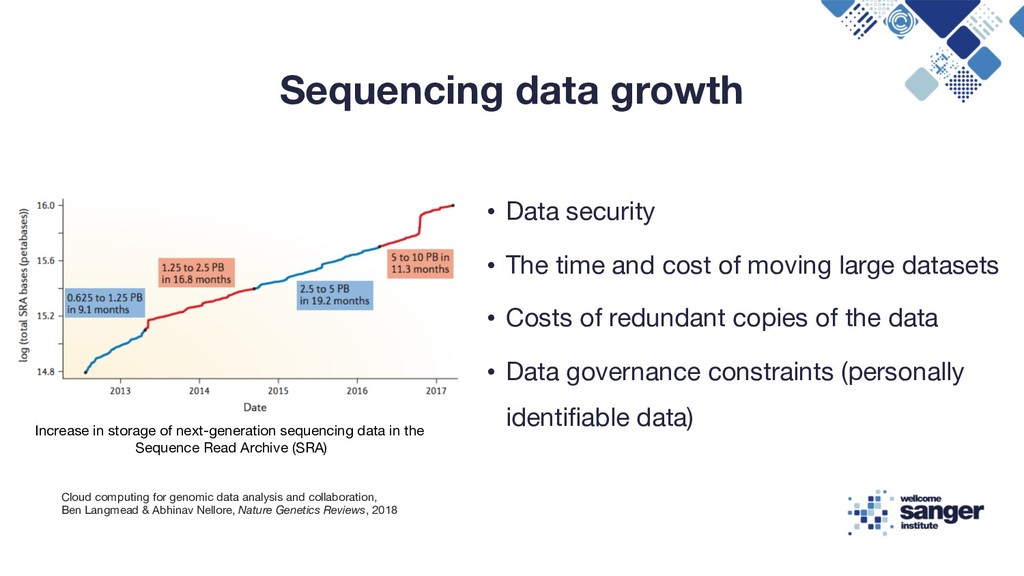
Sequencing data growth • Data security • The time and
cost of moving large datasets • Costs of redundant copies of the data • Data governance constraints (personally identifiable data) Increase in storage of next-generation sequencing data in the Sequence Read Archive (SRA) Cloud computing for genomic data analysis and collaboration, Ben Langmead & Abhinav Nellore, Nature Genetics Reviews, 2018 -
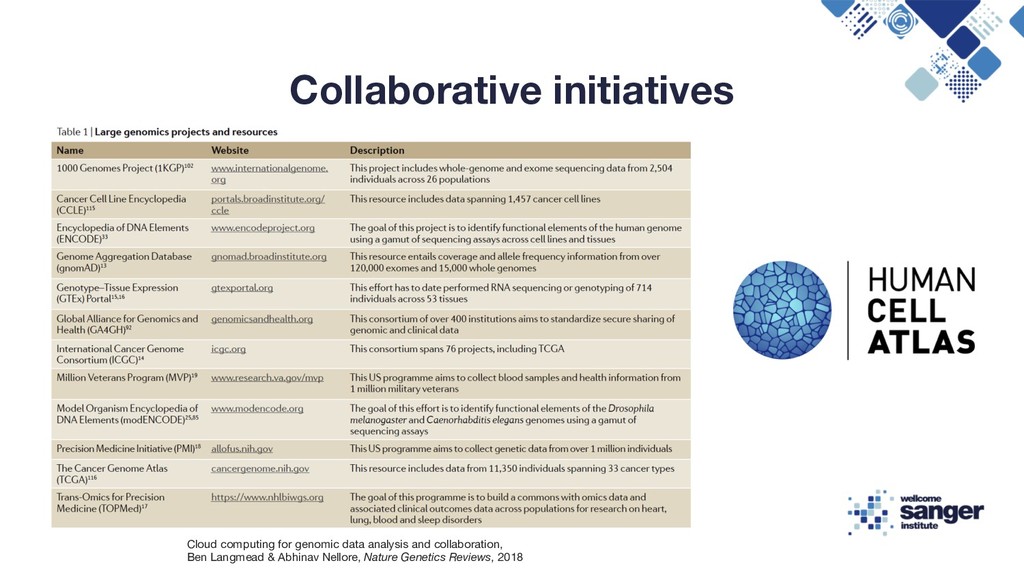
Collaborative initiatives Cloud computing for genomic data analysis and collaboration,
Ben Langmead & Abhinav Nellore, Nature Genetics Reviews, 2018 -
Reproducibility Bespoke software • Hard to run at other sites
• Dependencies problem Containers • Docker • Singularity BIDS apps: Improving ease of use, accessibility, and reproducibility of neuroimaging data analysis methods, Gorgolewski KJ et al., PLOS Computational Biology, 2017 -
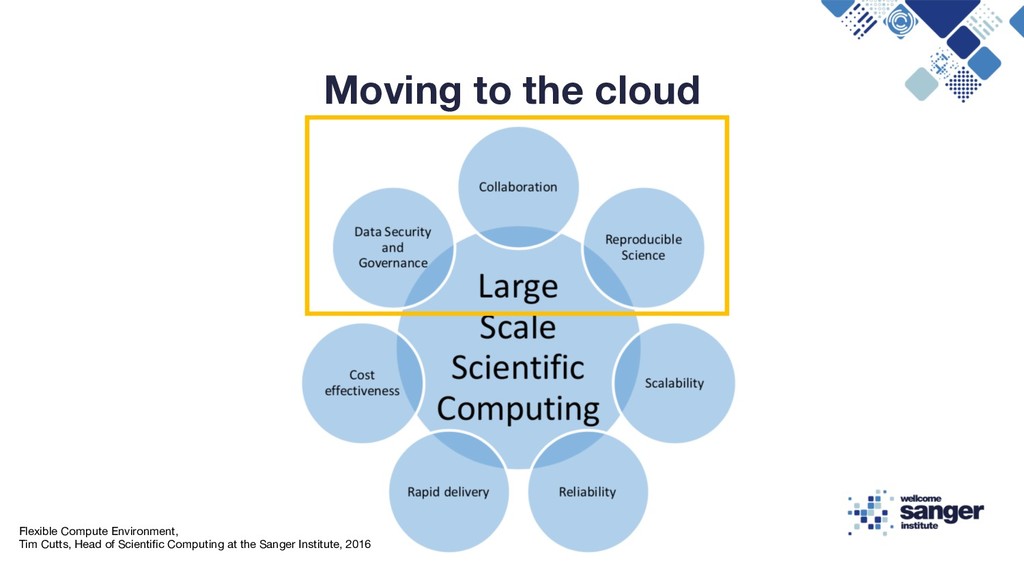
Moving to the cloud Flexible Compute Environment, Tim Cutts, Head
of Scientific Computing at the Sanger Institute, 2016 -
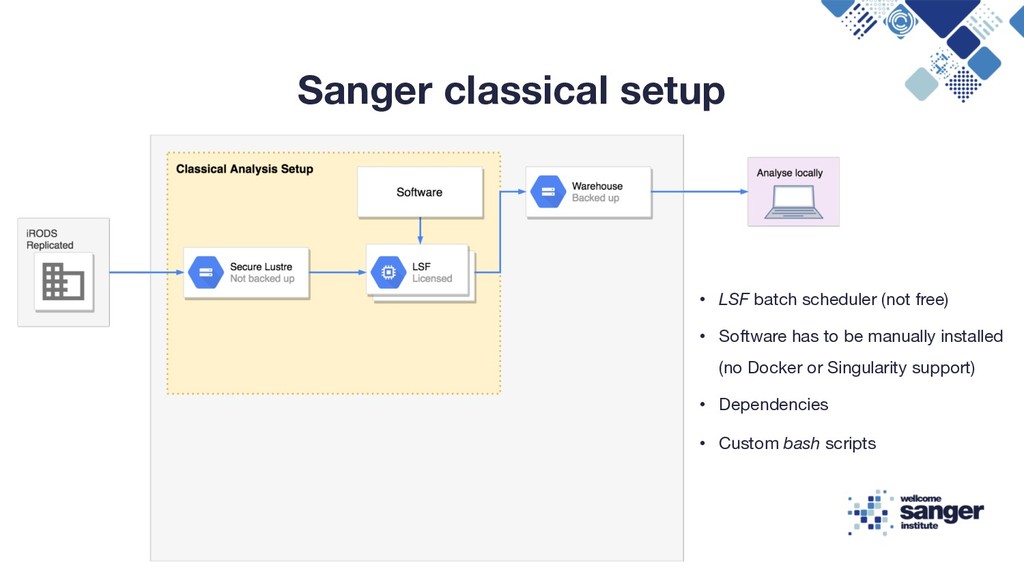
Sanger classical setup • LSF batch scheduler (not free) •
Software has to be manually installed (no Docker or Singularity support) • Dependencies • Custom bash scripts -
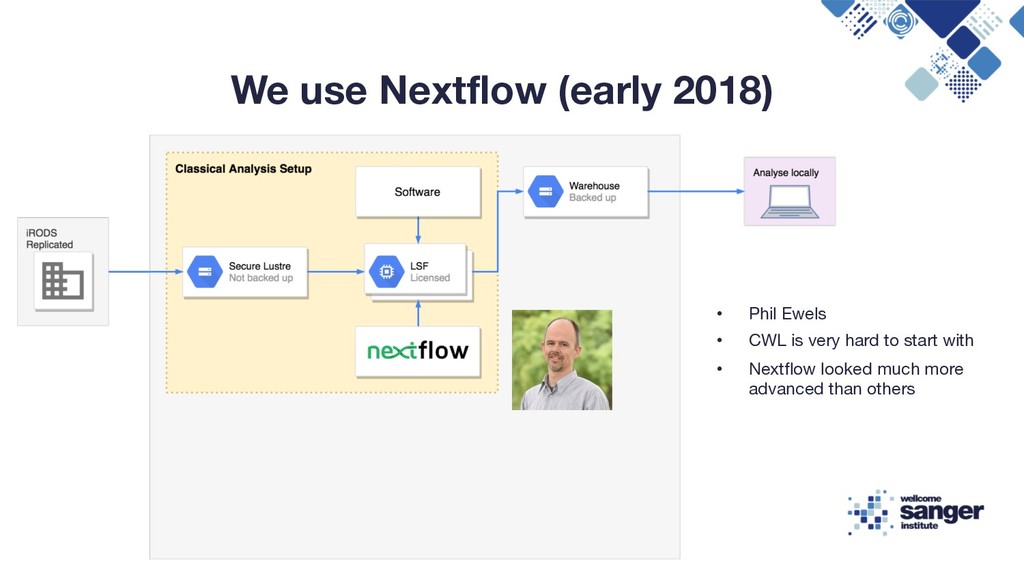
We use Nextflow (early 2018) • Phil Ewels • CWL
is very hard to start with • Nextflow looked much more advanced than others -
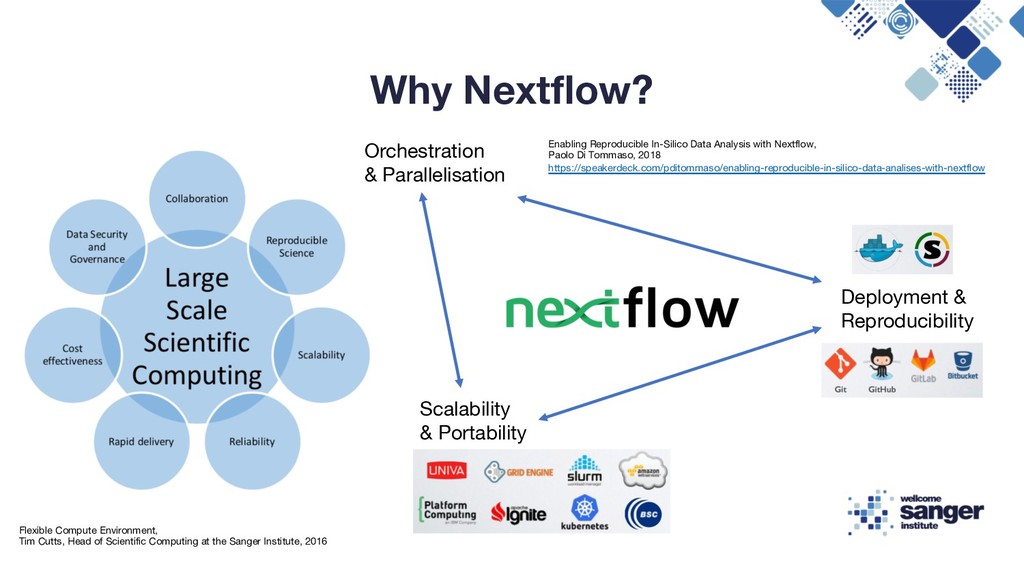
Why Nextflow? Orchestration & Parallelisation Scalability & Portability Deployment &
Reproducibility Flexible Compute Environment, Tim Cutts, Head of Scientific Computing at the Sanger Institute, 2016 Enabling Reproducible In-Silico Data Analysis with Nextflow, Paolo Di Tommaso, 2018 https://speakerdeck.com/pditommaso/enabling-reproducible-in-silico-data-analises-with-nextflow -
Our setup • Worked from scratch • Did not need
any tweaking • Software: bioconda + local installation • Run Nextflow in conda environment • iRods (that is why we forked nf-core) executor { name = 'lsf’ queueSize = 400 } process { queue = 'normal’ } -
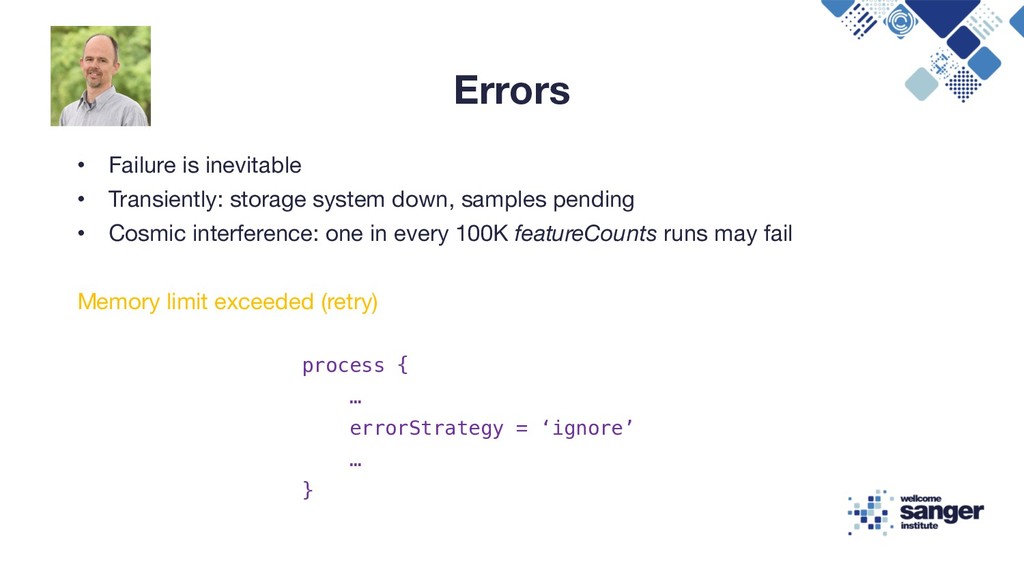
Errors • Failure is inevitable • Transiently: storage system down,
samples pending • Cosmic interference: one in every 100K featureCounts runs may fail Memory limit exceeded (retry) process { … errorStrategy = ‘ignore’ … } -
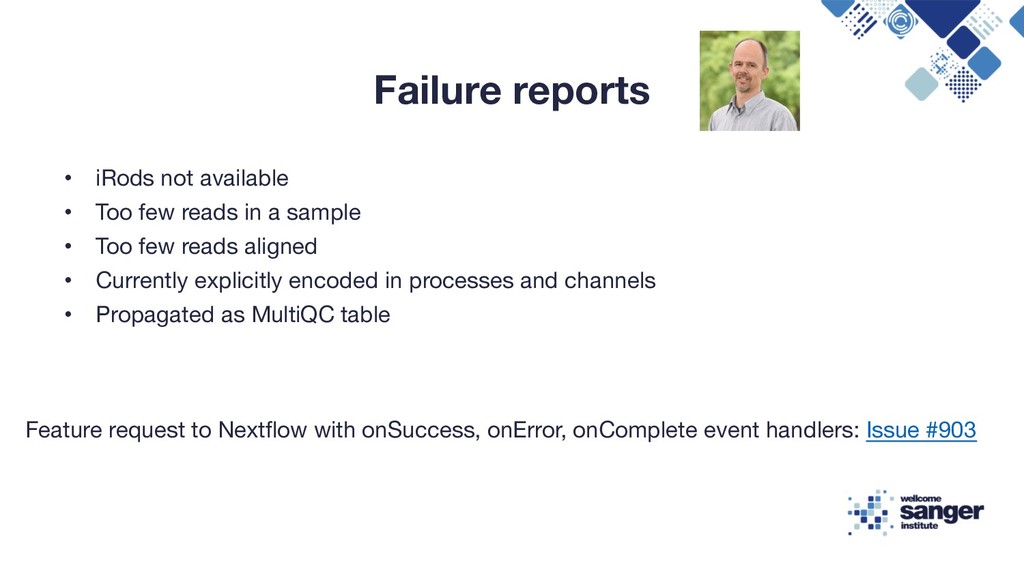
Failure reports • iRods not available • Too few reads
in a sample • Too few reads aligned • Currently explicitly encoded in processes and channels • Propagated as MultiQC table Feature request to Nextflow with onSuccess, onError, onComplete event handlers: Issue #903 -
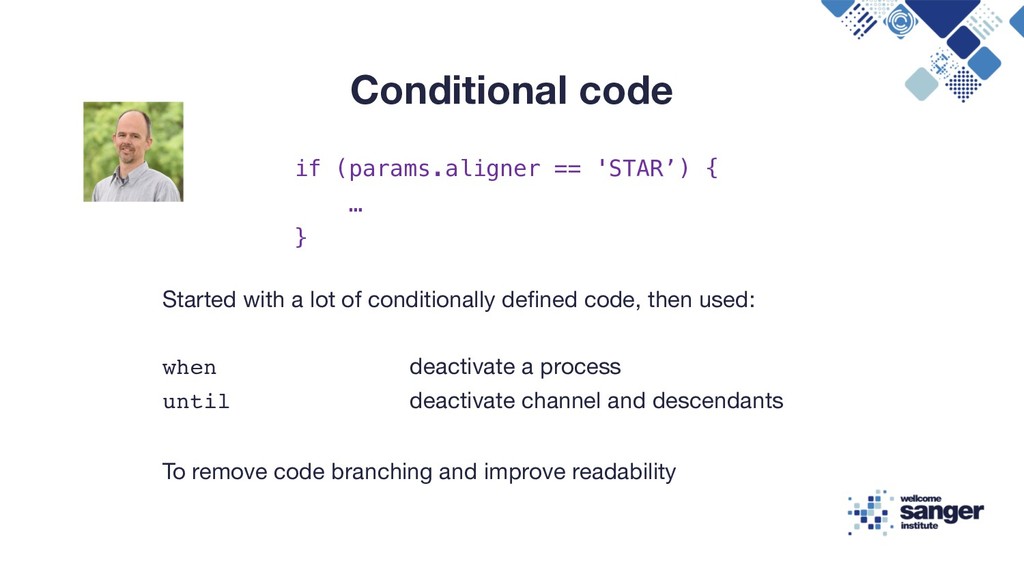
Conditional code Started with a lot of conditionally defined code,
then used: when deactivate a process until deactivate channel and descendants To remove code branching and improve readability if (params.aligner == 'STAR’) { … } -
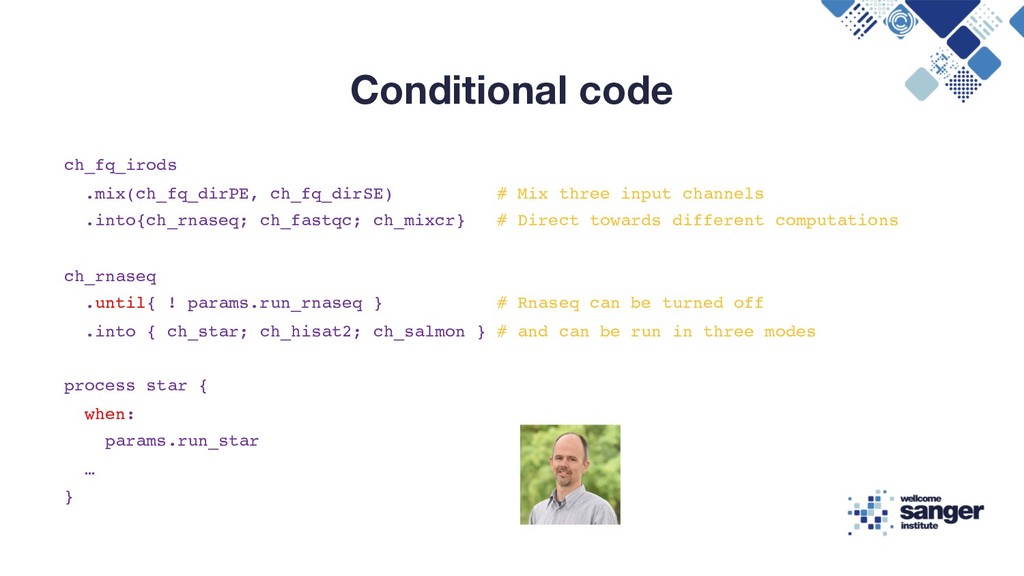
Conditional code ch_fq_irods .mix(ch_fq_dirPE, ch_fq_dirSE) # Mix three input channels
.into{ch_rnaseq; ch_fastqc; ch_mixcr} # Direct towards different computations ch_rnaseq .until{ ! params.run_rnaseq } # Rnaseq can be turned off .into { ch_star; ch_hisat2; ch_salmon } # and can be run in three modes process star { when: params.run_star … } -
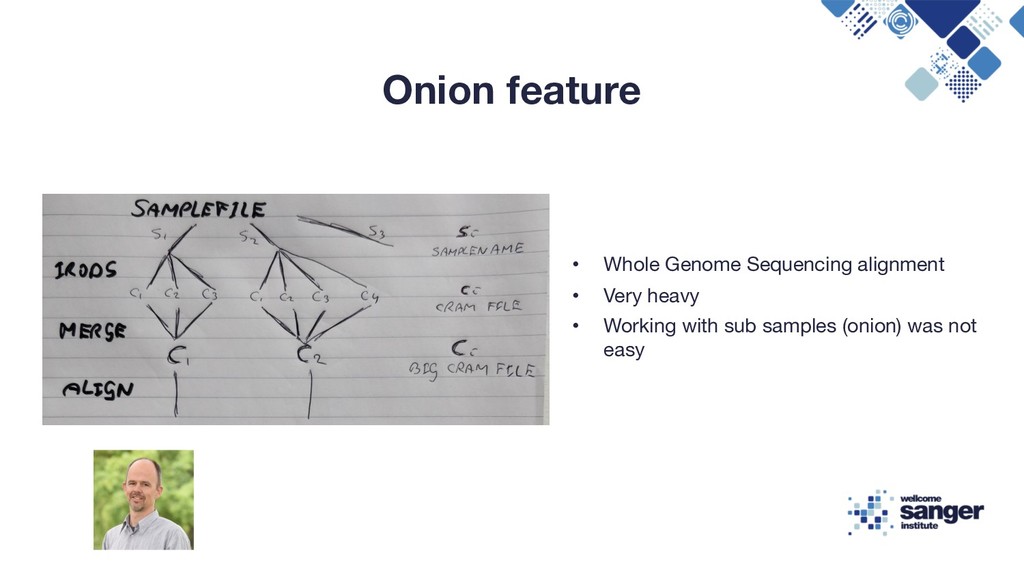
Onion feature • Whole Genome Sequencing alignment • Very heavy
• Working with sub samples (onion) was not easy -
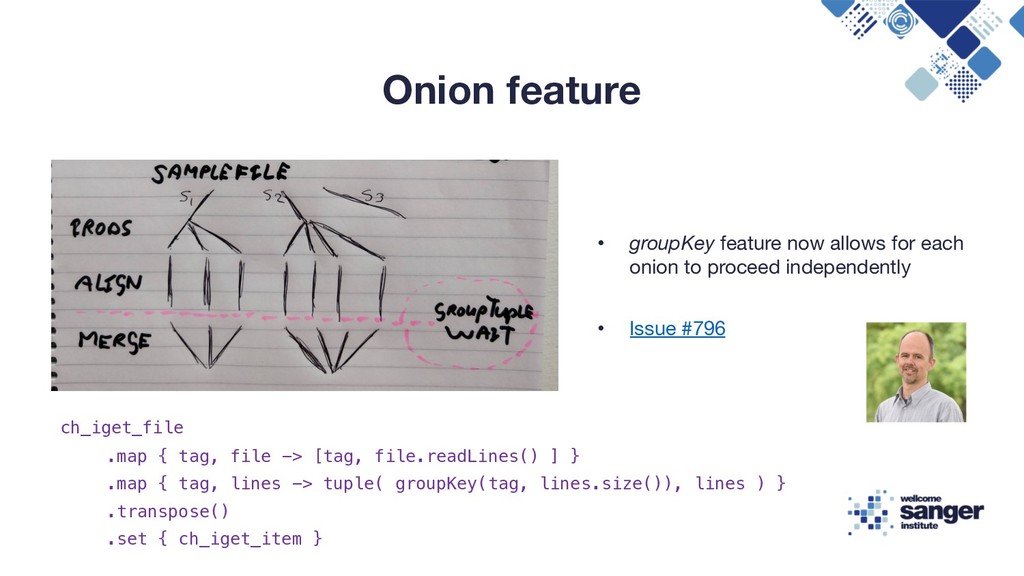
Onion feature • groupKey feature now allows for each onion
to proceed independently • Issue #796 ch_iget_file .map { tag, file -> [tag, file.readLines() ] } .map { tag, lines -> tuple( groupKey(tag, lines.size()), lines ) } .transpose() .set { ch_iget_item } -
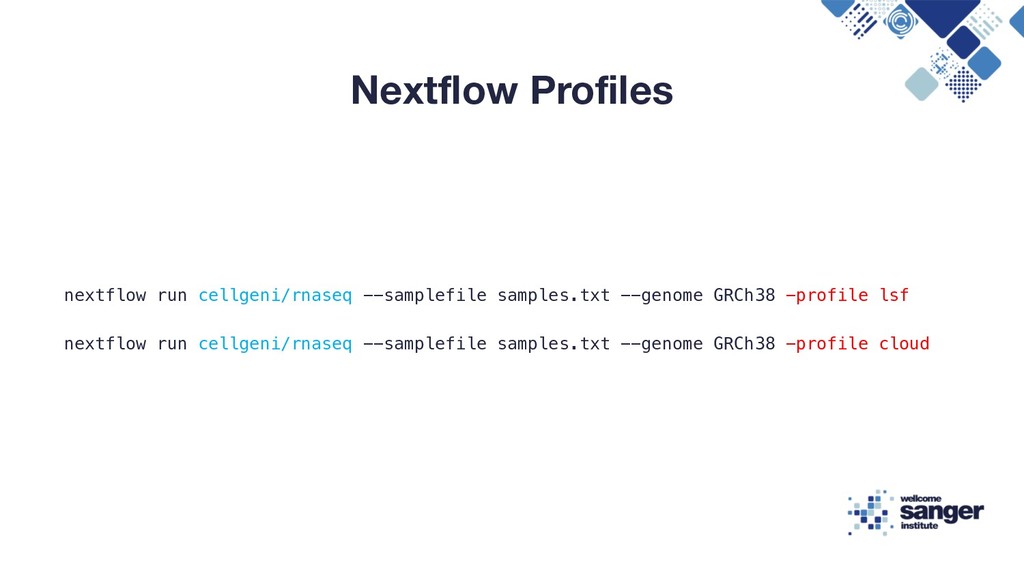
Nextflow Profiles nextflow run cellgeni/rnaseq --samplefile samples.txt --genome GRCh38 -profile
lsf nextflow run cellgeni/rnaseq --samplefile samples.txt --genome GRCh38 -profile cloud -
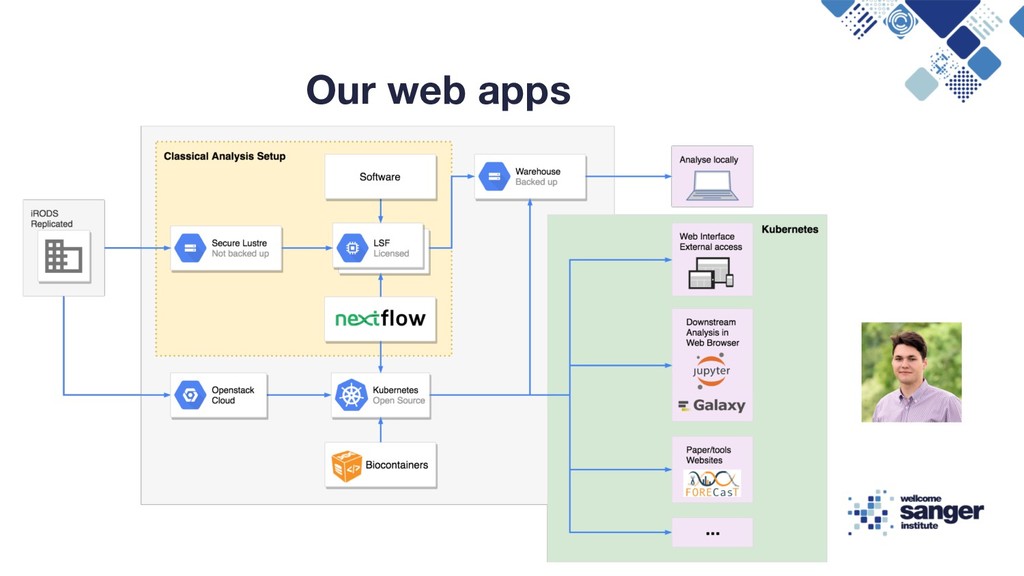
We use Kubernetes cluster on the Cloud • Kubernetes cluster
(open source) • Software in Docker containers • No dependencies problem • Scripts are encapsulated in Nextflow pipelines -
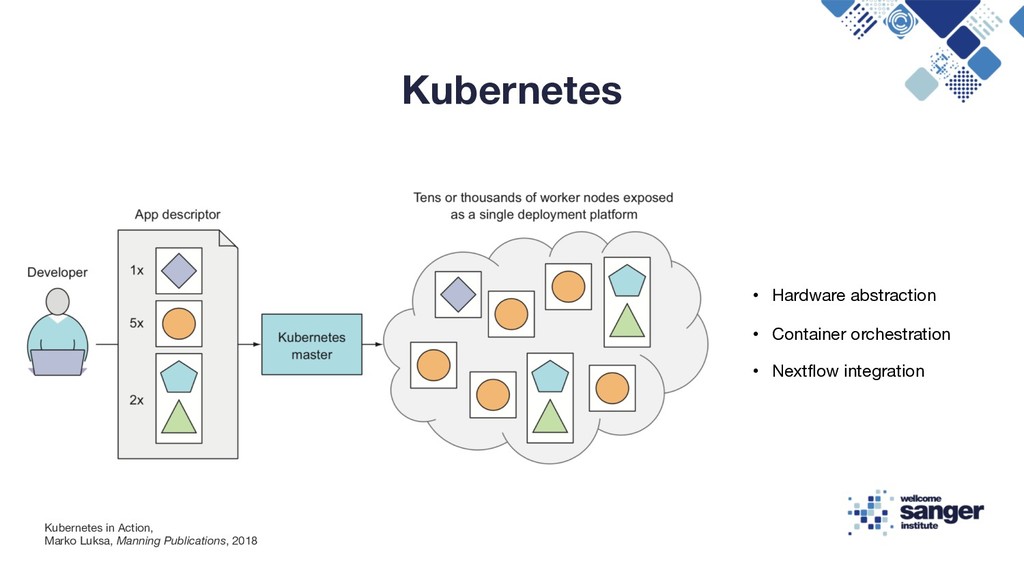
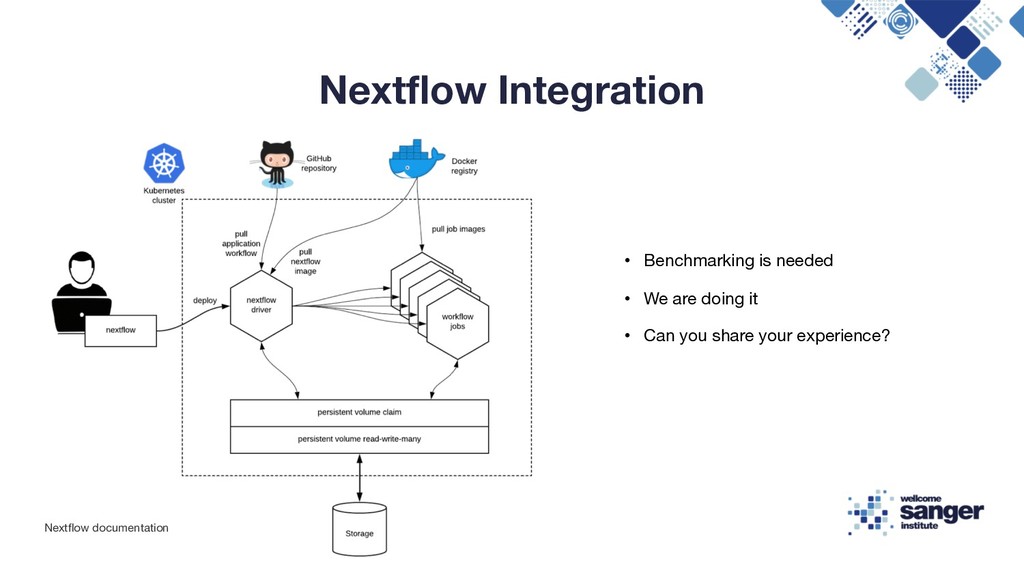
Kubernetes • Hardware abstraction • Container orchestration • Nextflow integration
Kubernetes in Action, Marko Luksa, Manning Publications, 2018 -
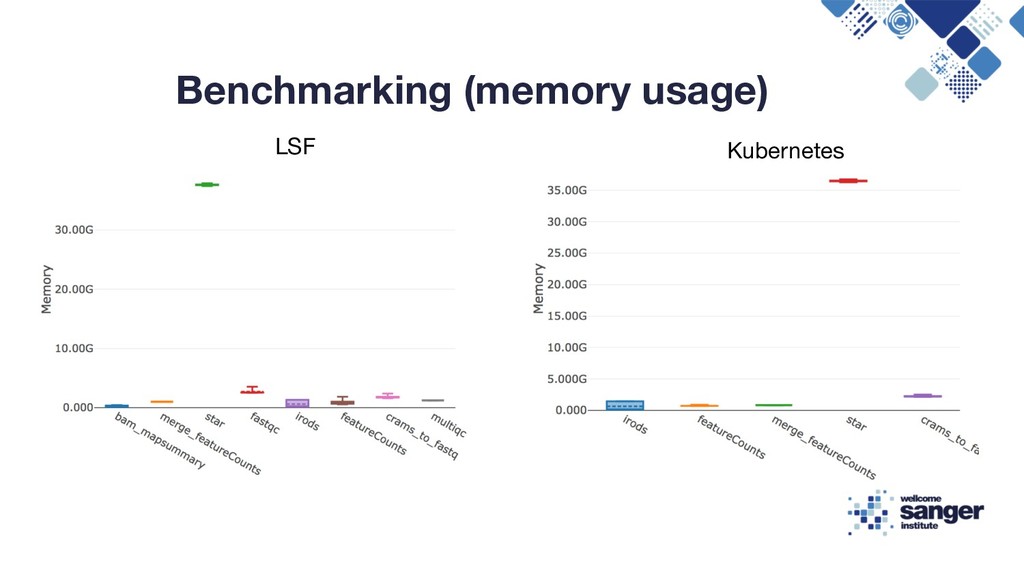
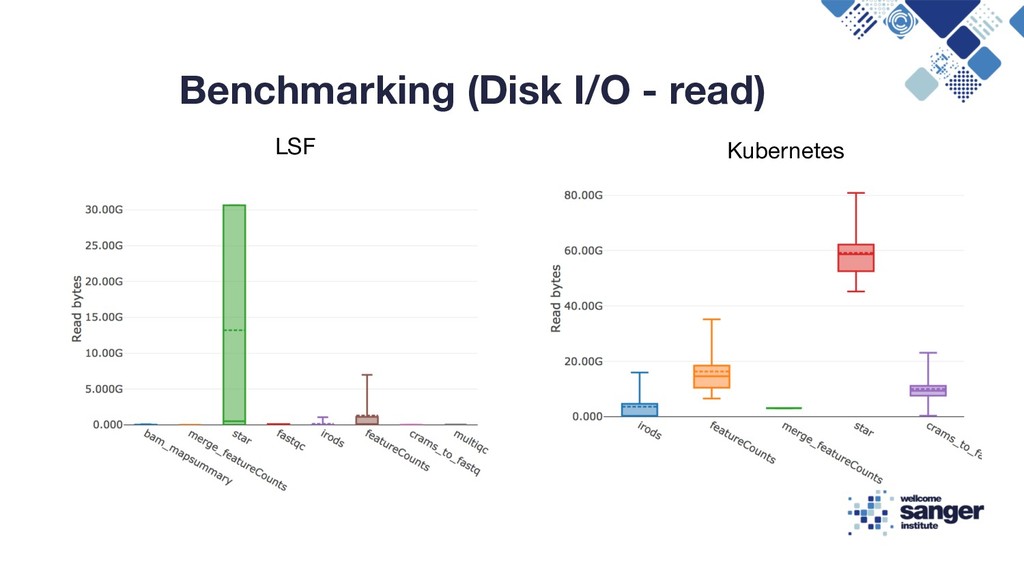
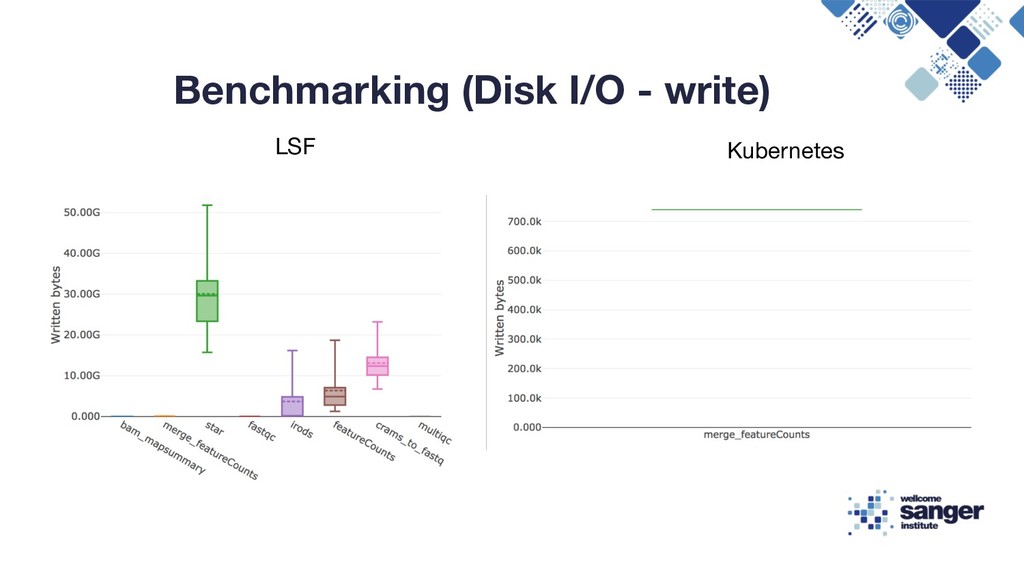
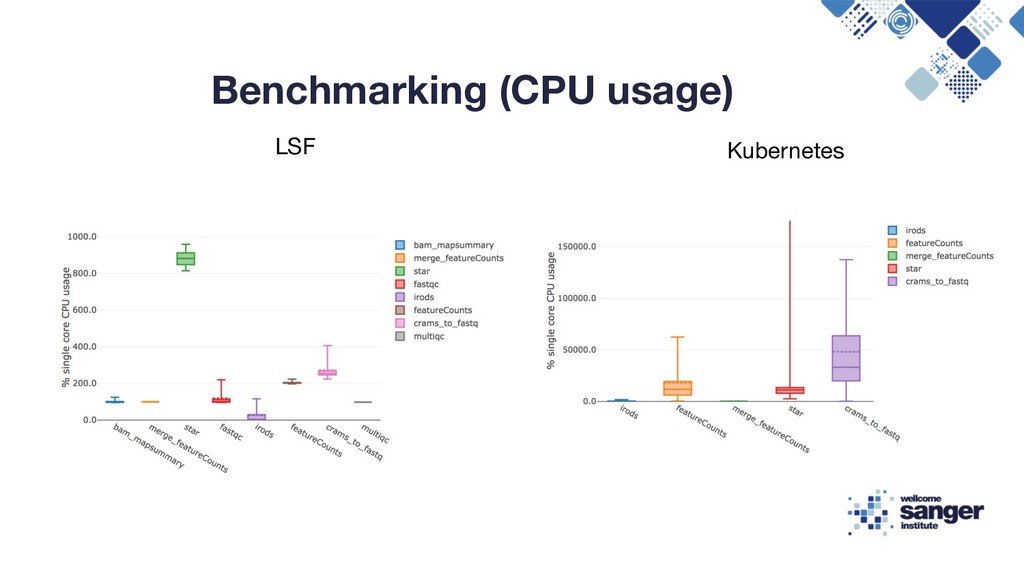
Nextflow Integration • Benchmarking is needed • We are doing
it • Can you share your experience? Nextflow documentation -
Kubernetes origins • In the early 2000s Google thinks of
a better way of deploying and managing their software/infrastructure to scale globally • In ~2004 Google developed Borg and then Omega and kept it secret until 2014 • In 2014 Google introduced Kubernetes, an open-source system based on the experience gained through Borg, Omega • Kubernetes facilitates the deployment and serving of web applications -
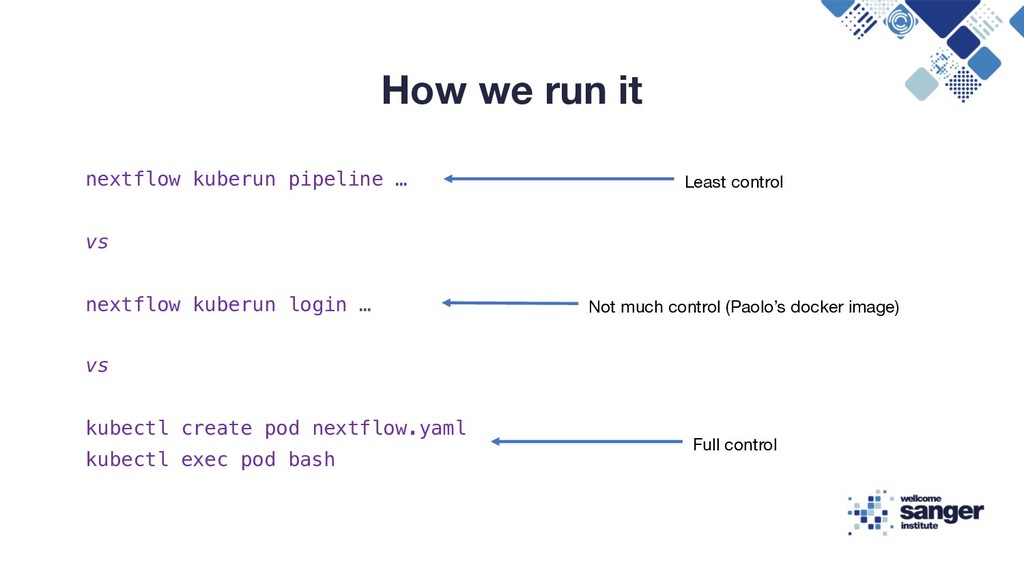
How we run it nextflow kuberun pipeline … vs nextflow
kuberun login … vs kubectl create pod nextflow.yaml kubectl exec pod bash Least control Not much control (Paolo’s docker image) Full control -
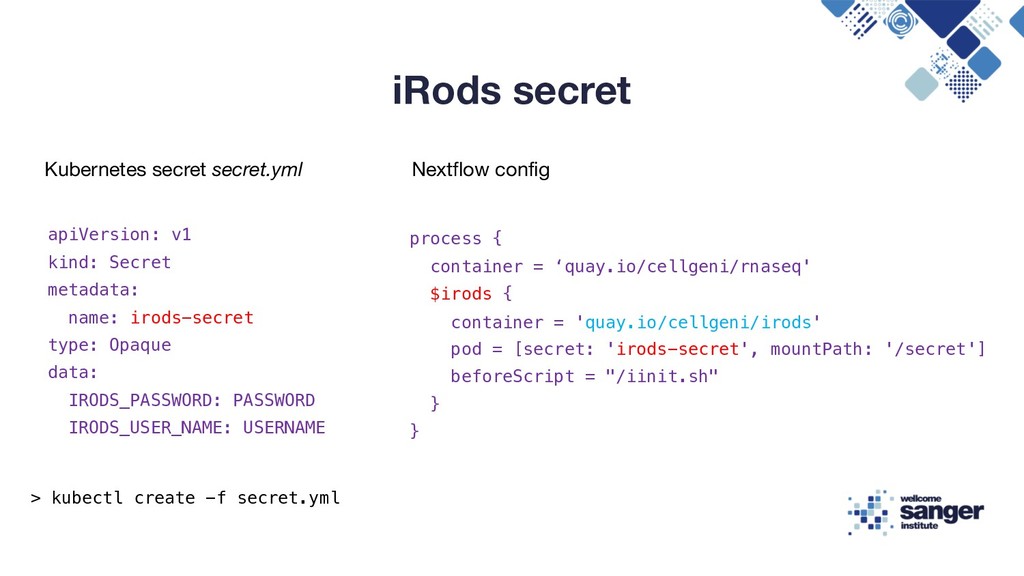
iRods secret apiVersion: v1 kind: Secret metadata: name: irods-secret type:
Opaque data: IRODS_PASSWORD: PASSWORD IRODS_USER_NAME: USERNAME > kubectl create -f secret.yml Kubernetes secret secret.yml process { container = ‘quay.io/cellgeni/rnaseq' $irods { container = 'quay.io/cellgeni/irods' pod = [secret: 'irods-secret', mountPath: '/secret'] beforeScript = "/iinit.sh" } } Nextflow config -
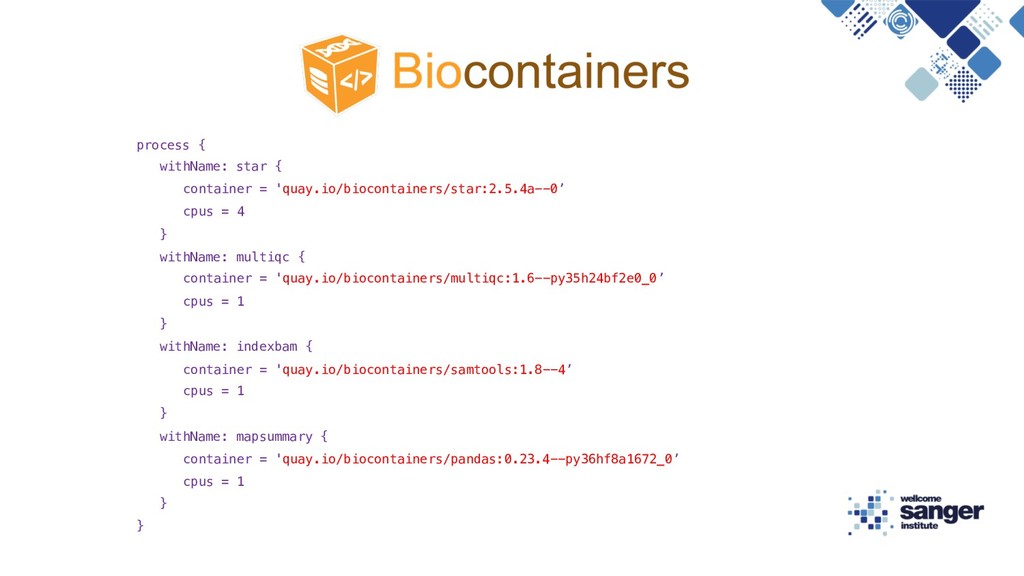
process { withName: star { container = 'quay.io/biocontainers/star:2.5.4a--0’ cpus =
4 } withName: multiqc { container = 'quay.io/biocontainers/multiqc:1.6--py35h24bf2e0_0’ cpus = 1 } withName: indexbam { container = 'quay.io/biocontainers/samtools:1.8--4’ cpus = 1 } withName: mapsummary { container = 'quay.io/biocontainers/pandas:0.23.4--py36hf8a1672_0’ cpus = 1 } } -
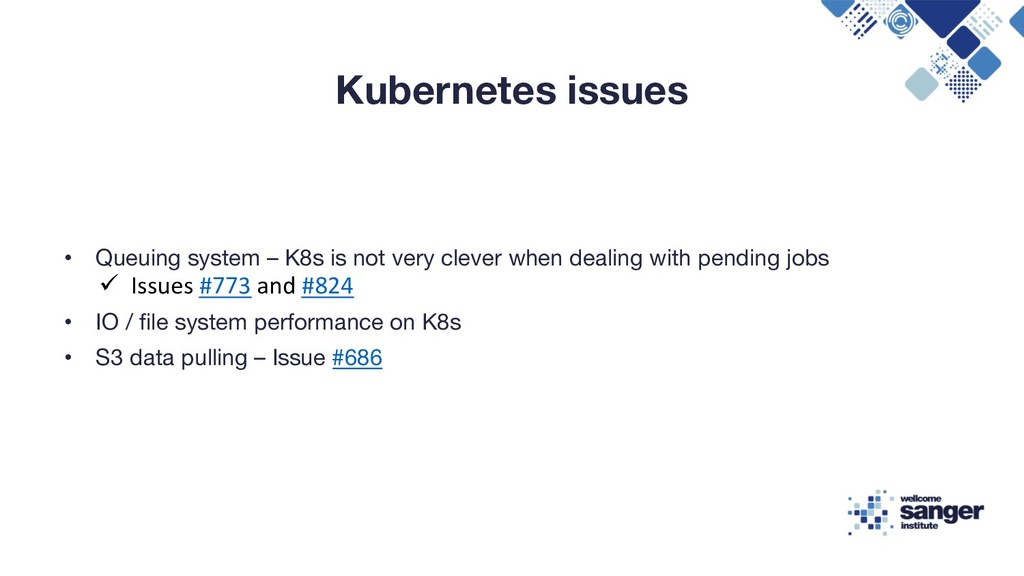
Kubernetes issues • Queuing system – K8s is not very
clever when dealing with pending jobs ü Issues #773 and #824 • IO / file system performance on K8s • S3 data pulling – Issue #686 -
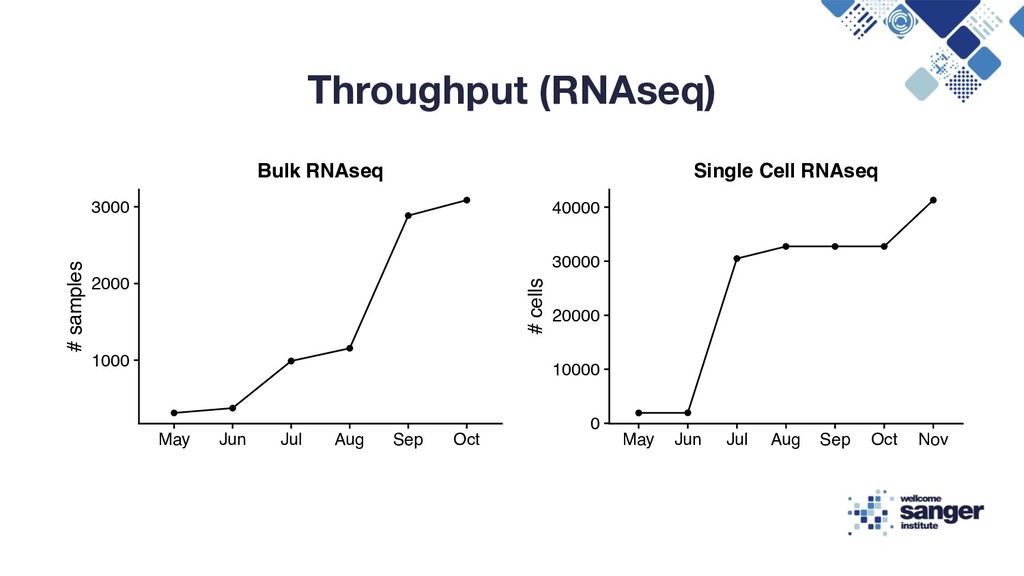
Throughput (RNAseq) 1000 2000 3000 May Jun Jul Aug Sep
Oct # samples Bulk RNAseq 0 10000 20000 30000 40000 May Jun Jul Aug Sep Oct Nov # cells Single Cell RNAseq -
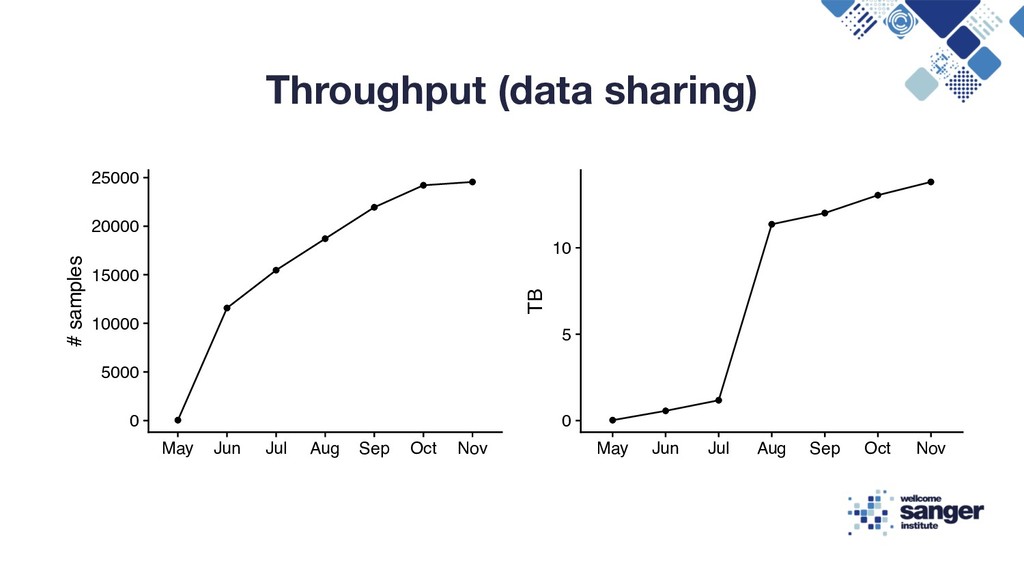
Throughput (data sharing) 0 5000 10000 15000 20000 25000 May
Jun Jul Aug Sep Oct Nov # samples 0 5 10 May Jun Jul Aug Sep Oct Nov TB -
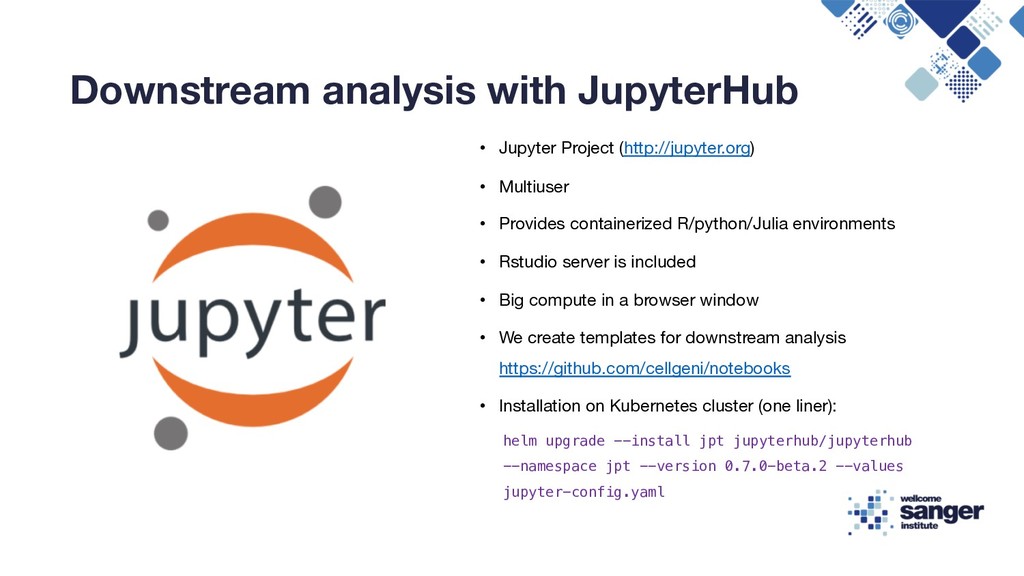
Downstream analysis with JupyterHub • Jupyter Project (http://jupyter.org) • Multiuser
• Provides containerized R/python/Julia environments • Rstudio server is included • Big compute in a browser window • We create templates for downstream analysis https://github.com/cellgeni/notebooks • Installation on Kubernetes cluster (one liner): helm upgrade --install jpt jupyterhub/jupyterhub --namespace jpt --version 0.7.0-beta.2 --values jupyter-config.yaml -
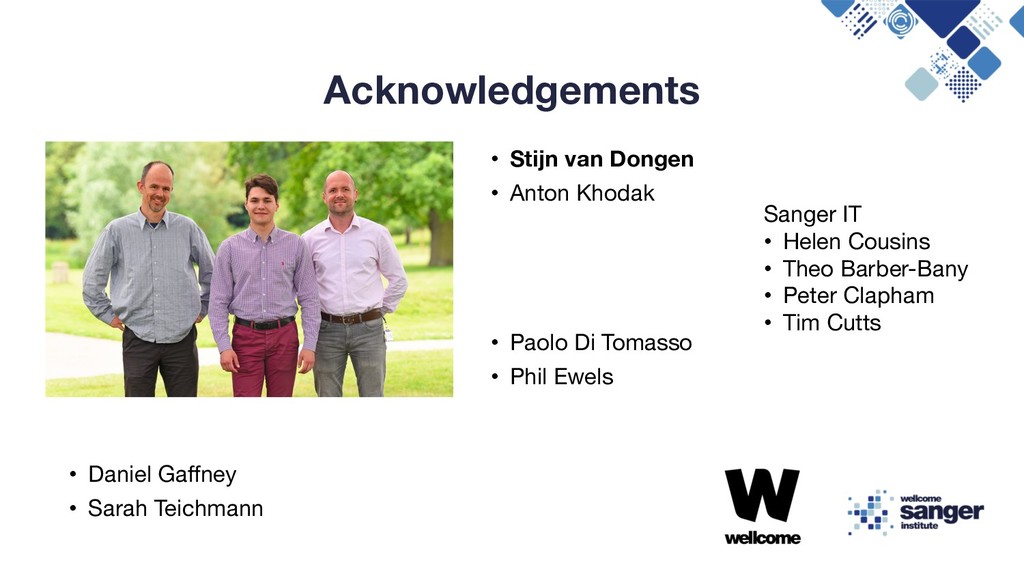
Acknowledgements Sanger IT • Helen Cousins • Theo Barber-Bany •
Peter Clapham • Tim Cutts • Stijn van Dongen • Anton Khodak • Daniel Gaffney • Sarah Teichmann • Paolo Di Tomasso • Phil Ewels