Share
Embed
Development And Operation Of Workflows, Tools And Infrastructure For Data Analysis
My presentation at Genomics and Synthetic Biology Series UK - https://www.oxfordglobal.co.uk/genomics-and-synthetic-biology-series-uk/
Vladimir Kiselev
November 09, 2018
Transcript
30 slides
-
Development And Operation Of Workflows, Tools And Infrastructure For Data
Analysis Vladimir Kiselev @wikiselev Head of Programme Informatics Wellcome Sanger Institute -
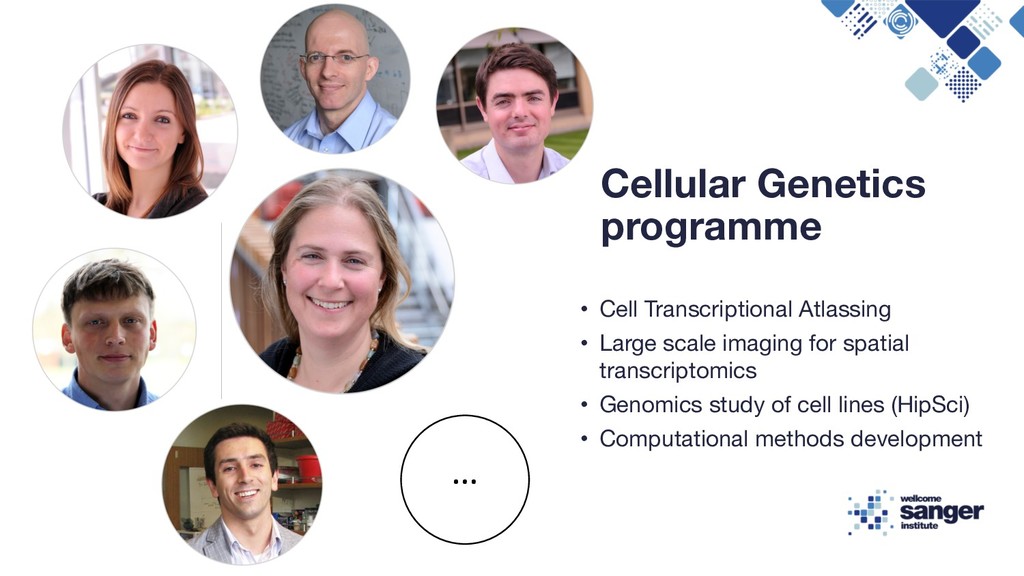
• Cell Transcriptional Atlassing • Large scale imaging for spatial
transcriptomics • Genomics study of cell lines (HipSci) • Computational methods development Cellular Genetics programme … -
What is our team doing? • Our team provides Computational/IT
support for Cellular Genetics programme (~180 people) • We work on both upstream (processing raw data) and downstream (gaining biological insights) analysis pipelines • We interact with all of the faculty members in the programme • We move programme’s pipelines to the Cloud (Sanger introduced Flexible Compute Environment ~1.5 years ago) -
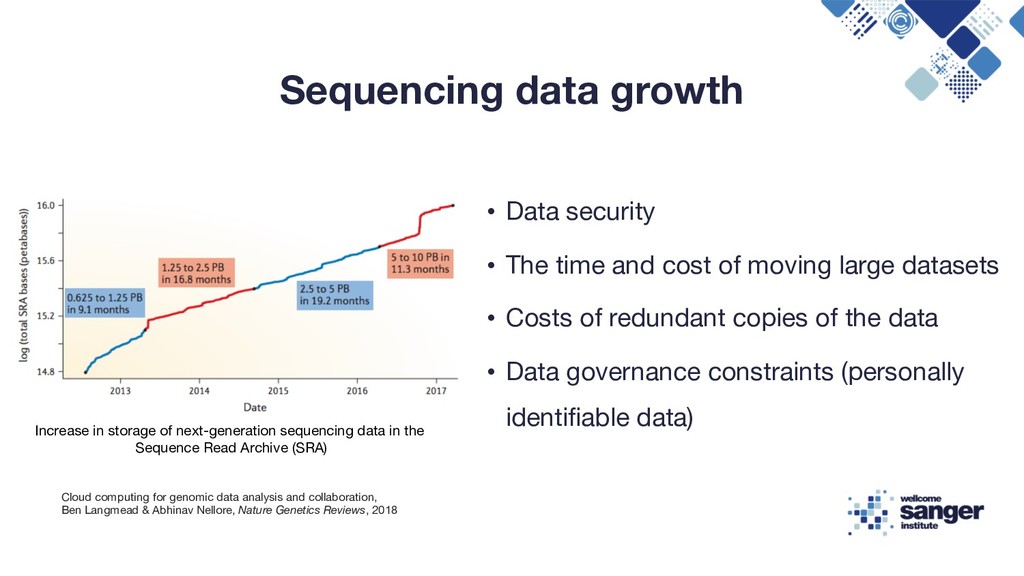
Sequencing data growth • Data security • The time and
cost of moving large datasets • Costs of redundant copies of the data • Data governance constraints (personally identifiable data) Increase in storage of next-generation sequencing data in the Sequence Read Archive (SRA) Cloud computing for genomic data analysis and collaboration, Ben Langmead & Abhinav Nellore, Nature Genetics Reviews, 2018 -
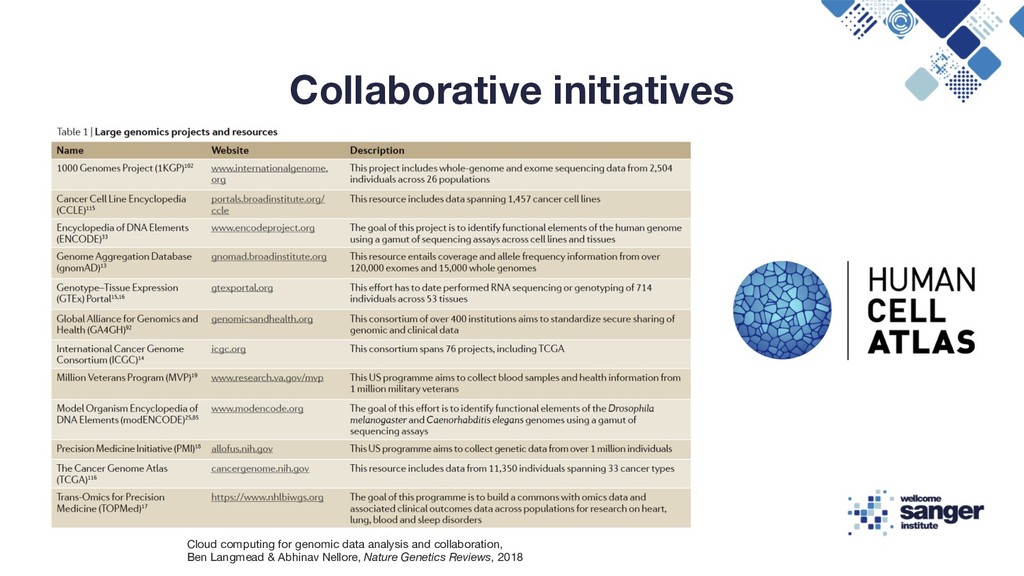
Collaborative initiatives Cloud computing for genomic data analysis and collaboration,
Ben Langmead & Abhinav Nellore, Nature Genetics Reviews, 2018 -
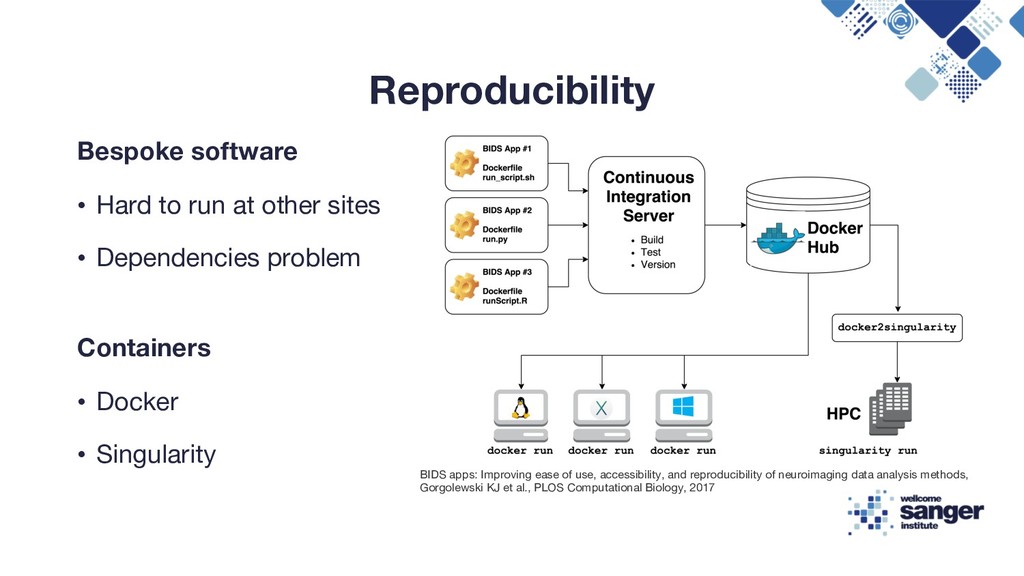
Reproducibility Bespoke software • Hard to run at other sites
• Dependencies problem Containers • Docker • Singularity BIDS apps: Improving ease of use, accessibility, and reproducibility of neuroimaging data analysis methods, Gorgolewski KJ et al., PLOS Computational Biology, 2017 -
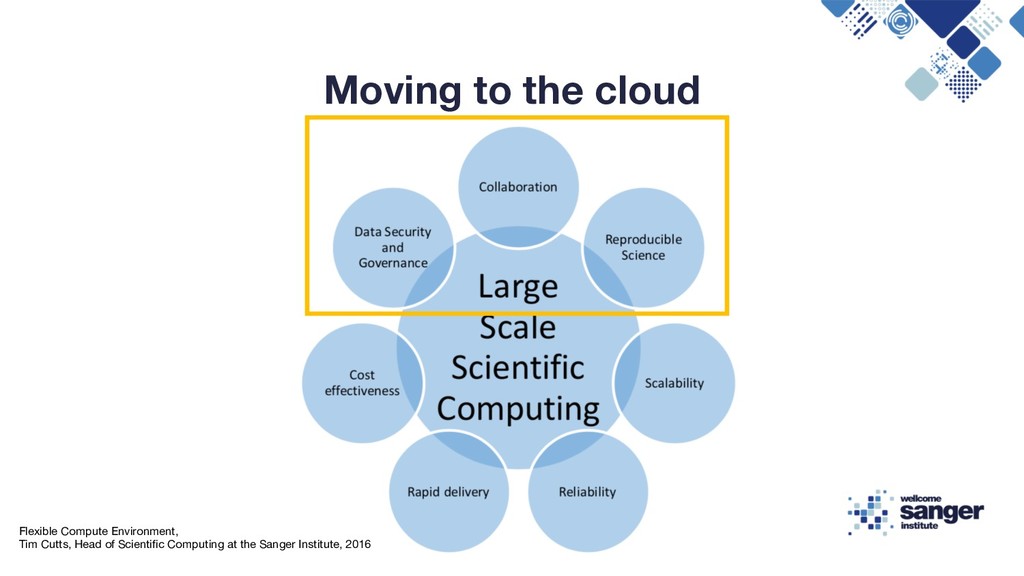
Moving to the cloud Flexible Compute Environment, Tim Cutts, Head
of Scientific Computing at the Sanger Institute, 2016 -
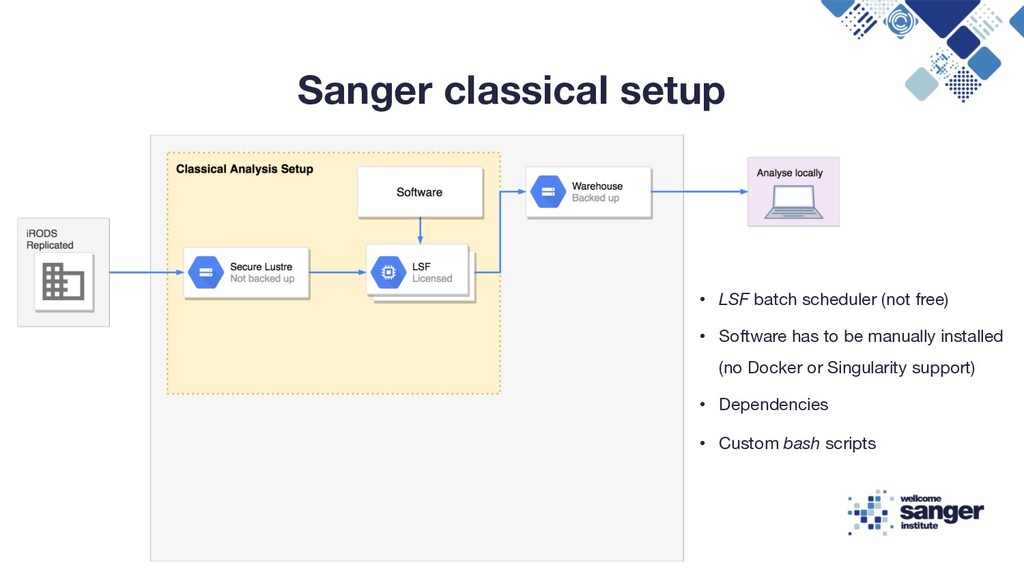
Sanger classical setup • LSF batch scheduler (not free) •
Software has to be manually installed (no Docker or Singularity support) • Dependencies • Custom bash scripts -
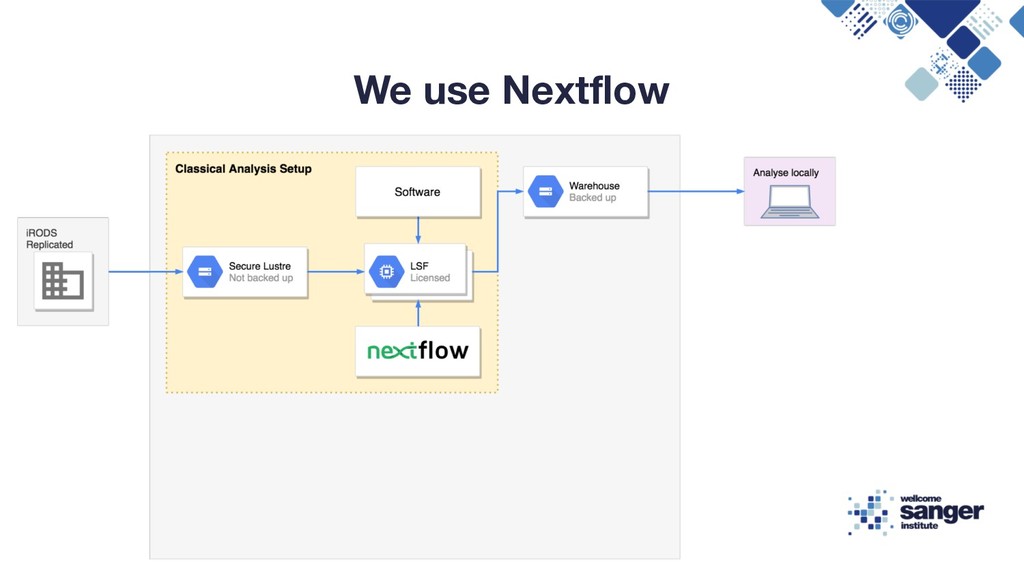
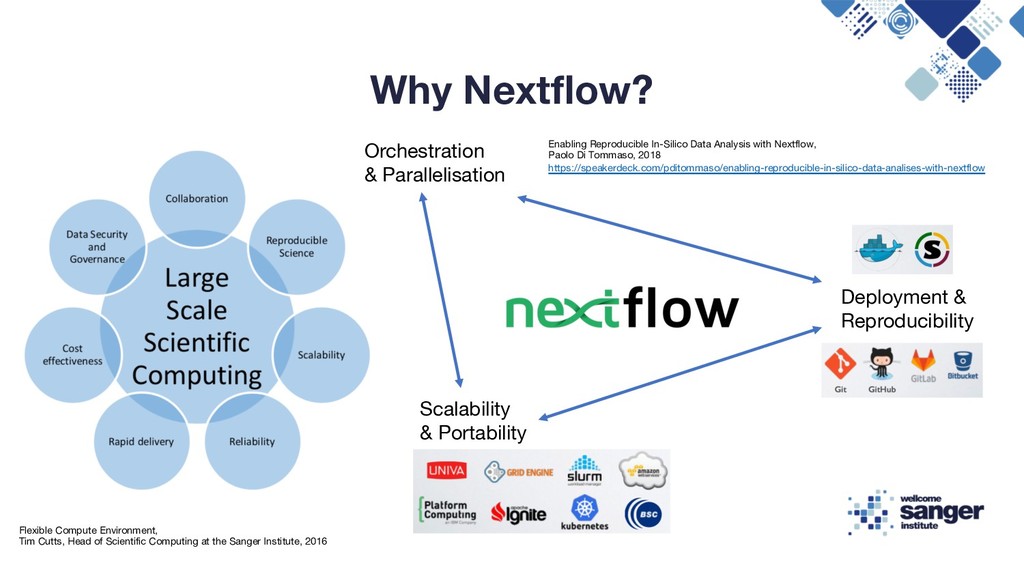
Why Nextflow? Orchestration & Parallelisation Scalability & Portability Deployment &
Reproducibility Flexible Compute Environment, Tim Cutts, Head of Scientific Computing at the Sanger Institute, 2016 Enabling Reproducible In-Silico Data Analysis with Nextflow, Paolo Di Tommaso, 2018 https://speakerdeck.com/pditommaso/enabling-reproducible-in-silico-data-analises-with-nextflow -
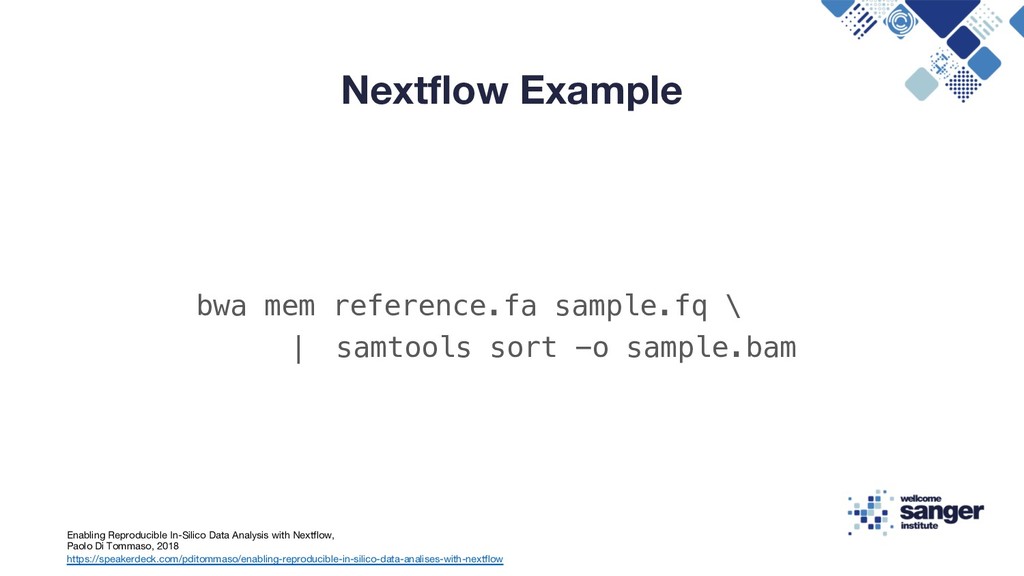
Nextflow Example bwa mem reference.fa sample.fq \ | samtools sort
-o sample.bam Enabling Reproducible In-Silico Data Analysis with Nextflow, Paolo Di Tommaso, 2018 https://speakerdeck.com/pditommaso/enabling-reproducible-in-silico-data-analises-with-nextflow -
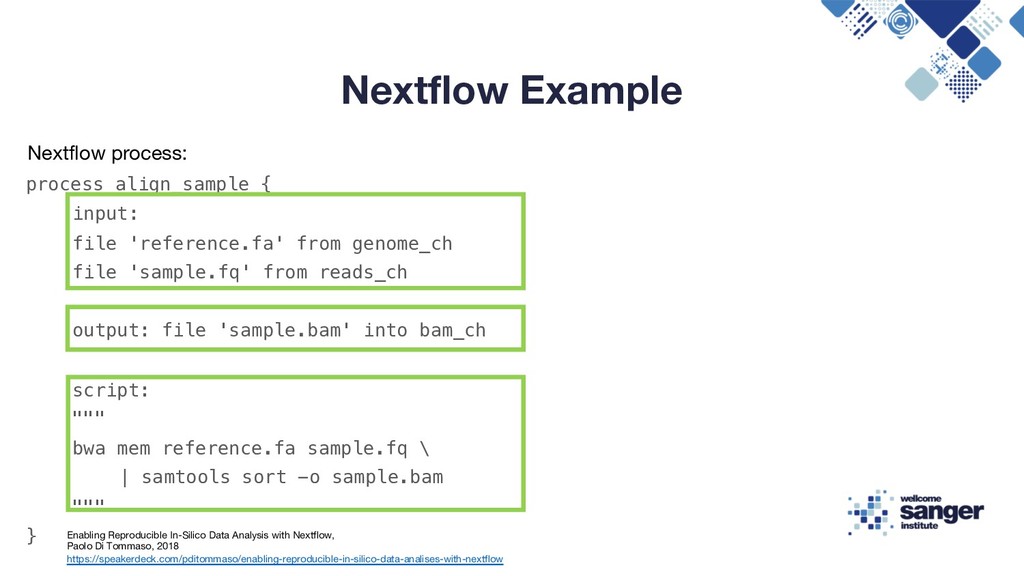
Nextflow Example process align_sample { input: file 'reference.fa' from genome_ch
file 'sample.fq' from reads_ch output: file 'sample.bam' into bam_ch script: """ bwa mem reference.fa sample.fq \ | samtools sort -o sample.bam """ } Nextflow process: Enabling Reproducible In-Silico Data Analysis with Nextflow, Paolo Di Tommaso, 2018 https://speakerdeck.com/pditommaso/enabling-reproducible-in-silico-data-analises-with-nextflow -
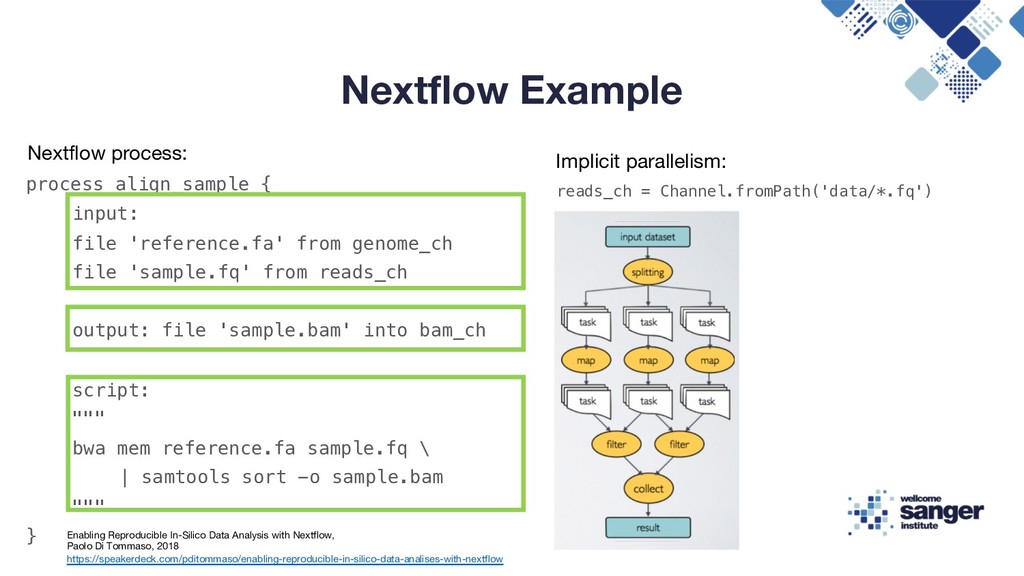
Nextflow Example process align_sample { input: file 'reference.fa' from genome_ch
file 'sample.fq' from reads_ch output: file 'sample.bam' into bam_ch script: """ bwa mem reference.fa sample.fq \ | samtools sort -o sample.bam """ } reads_ch = Channel.fromPath('data/*.fq') Implicit parallelism: Nextflow process: Enabling Reproducible In-Silico Data Analysis with Nextflow, Paolo Di Tommaso, 2018 https://speakerdeck.com/pditommaso/enabling-reproducible-in-silico-data-analises-with-nextflow -
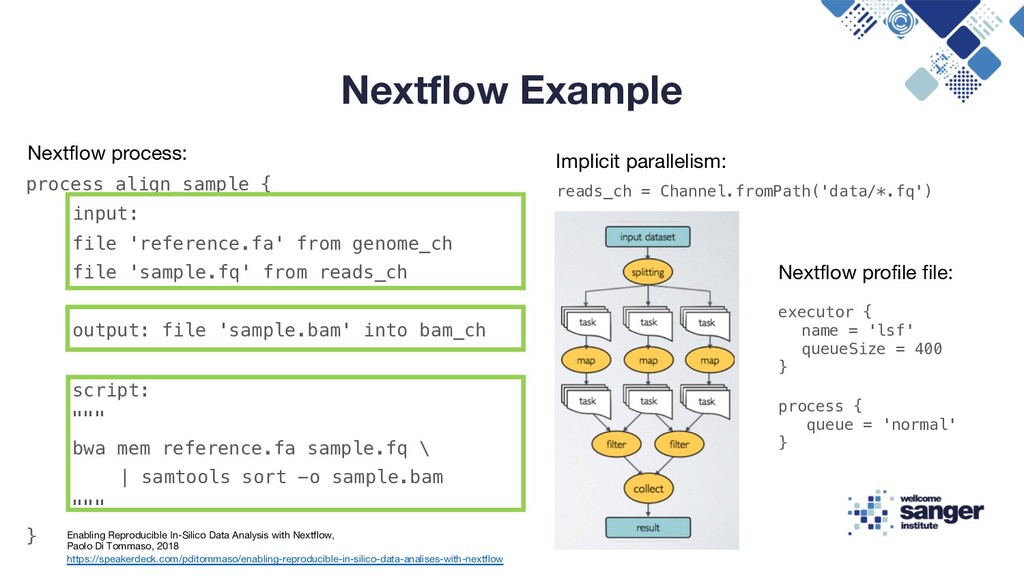
Nextflow Example process align_sample { input: file 'reference.fa' from genome_ch
file 'sample.fq' from reads_ch output: file 'sample.bam' into bam_ch script: """ bwa mem reference.fa sample.fq \ | samtools sort -o sample.bam """ } reads_ch = Channel.fromPath('data/*.fq') executor { name = 'lsf' queueSize = 400 } process { queue = 'normal' } Nextflow profile file: Implicit parallelism: Nextflow process: Enabling Reproducible In-Silico Data Analysis with Nextflow, Paolo Di Tommaso, 2018 https://speakerdeck.com/pditommaso/enabling-reproducible-in-silico-data-analises-with-nextflow -
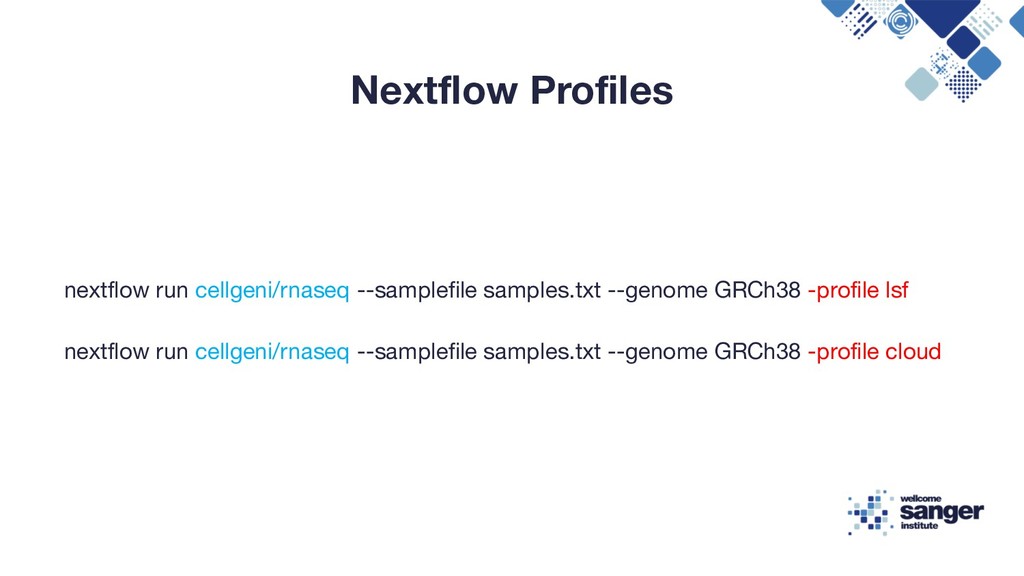
Nextflow Profiles nextflow run cellgeni/rnaseq --samplefile samples.txt --genome GRCh38 -profile
lsf nextflow run cellgeni/rnaseq --samplefile samples.txt --genome GRCh38 -profile cloud -
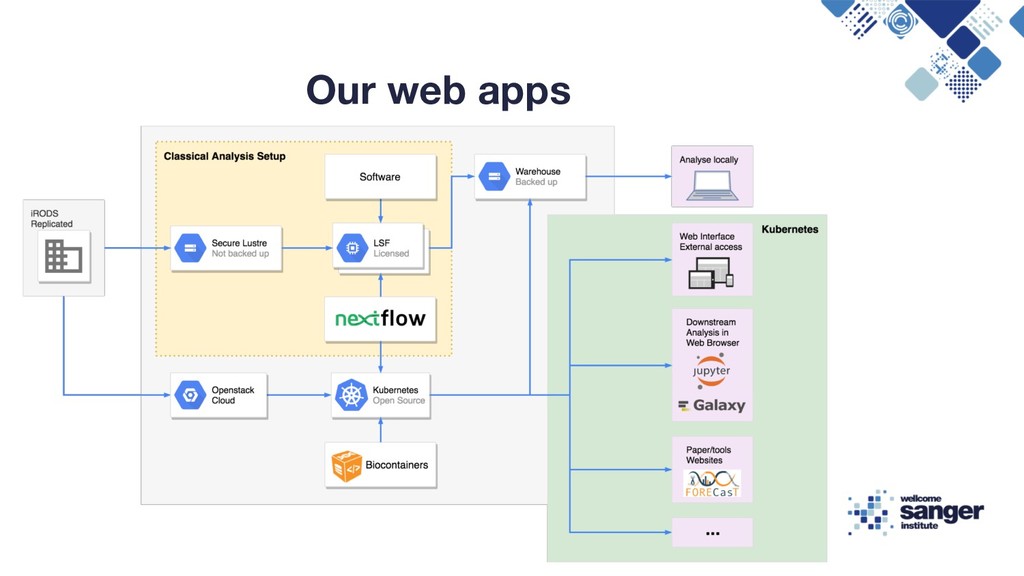
We use Kubernetes cluster on the Cloud • Kubernetes cluster
(open source) • Software in Docker containers • No dependencies problem • Scripts are encapsulated in Nextflow pipelines -
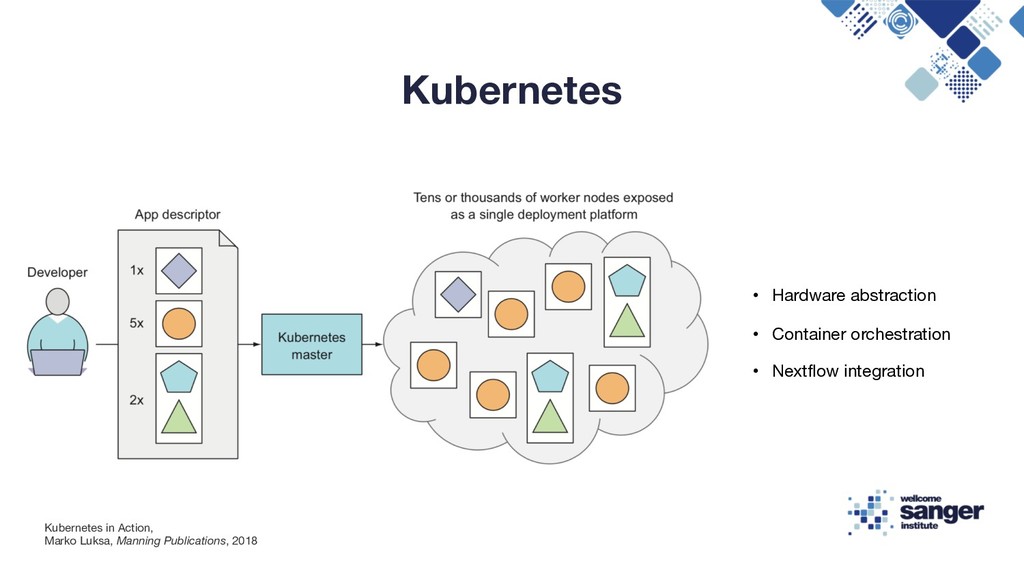
Kubernetes • Hardware abstraction • Container orchestration • Nextflow integration
Kubernetes in Action, Marko Luksa, Manning Publications, 2018 -
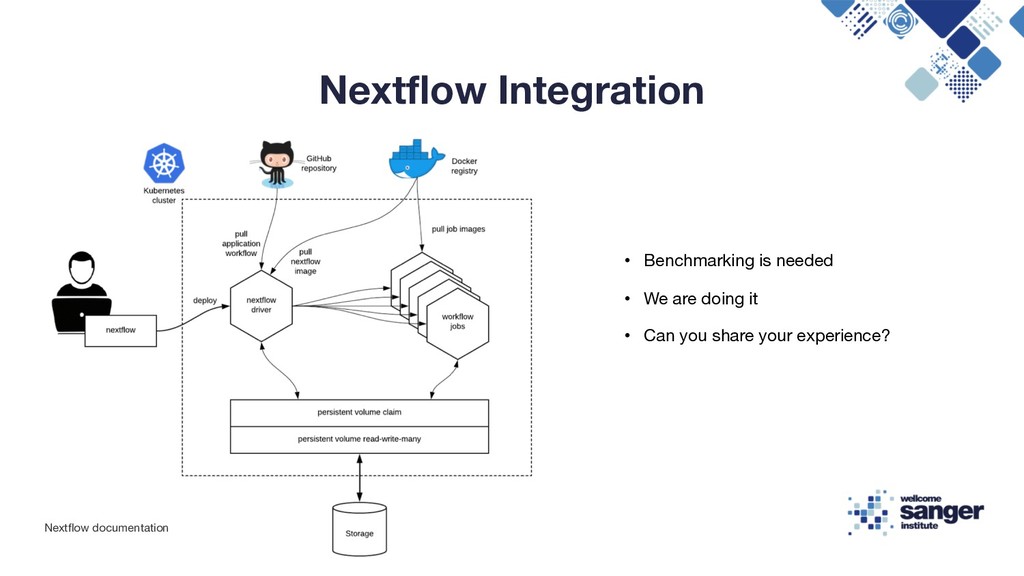
Nextflow Integration • Benchmarking is needed • We are doing
it • Can you share your experience? Nextflow documentation -
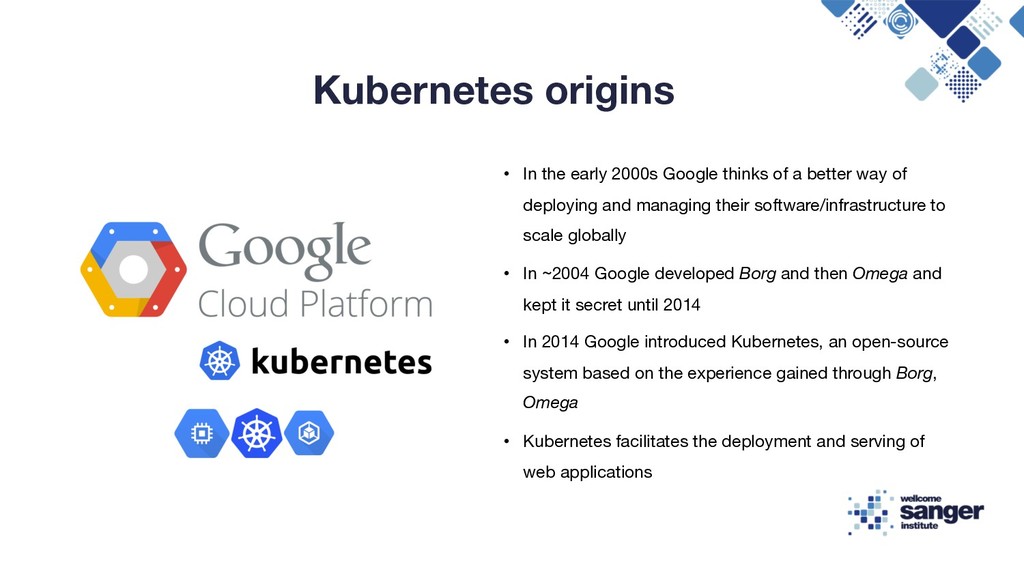
Kubernetes origins • In the early 2000s Google thinks of
a better way of deploying and managing their software/infrastructure to scale globally • In ~2004 Google developed Borg and then Omega and kept it secret until 2014 • In 2014 Google introduced Kubernetes, an open-source system based on the experience gained through Borg, Omega • Kubernetes facilitates the deployment and serving of web applications -
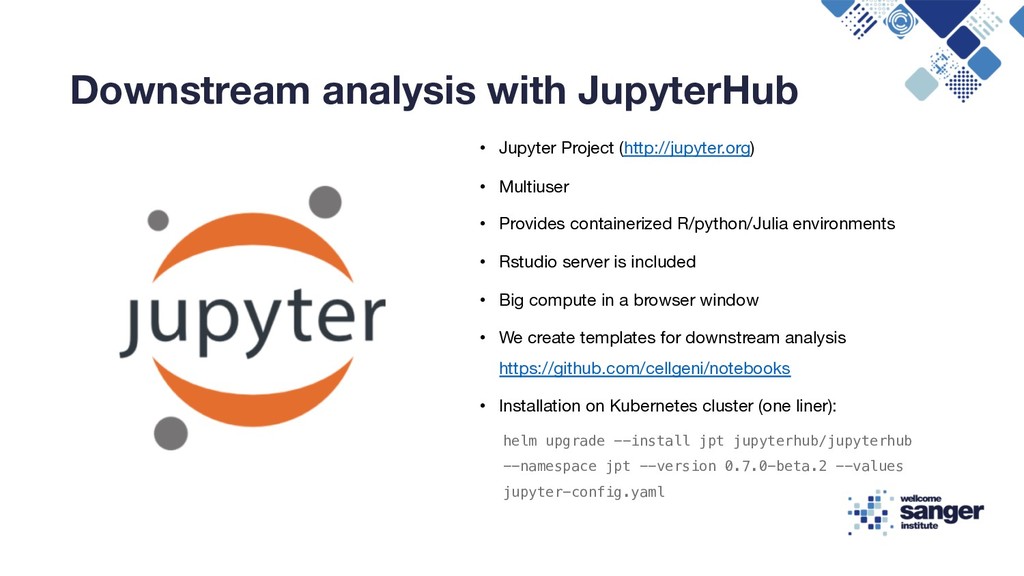
Downstream analysis with JupyterHub • Jupyter Project (http://jupyter.org) • Multiuser
• Provides containerized R/python/Julia environments • Rstudio server is included • Big compute in a browser window • We create templates for downstream analysis https://github.com/cellgeni/notebooks • Installation on Kubernetes cluster (one liner): helm upgrade --install jpt jupyterhub/jupyterhub --namespace jpt --version 0.7.0-beta.2 --values jupyter-config.yaml -
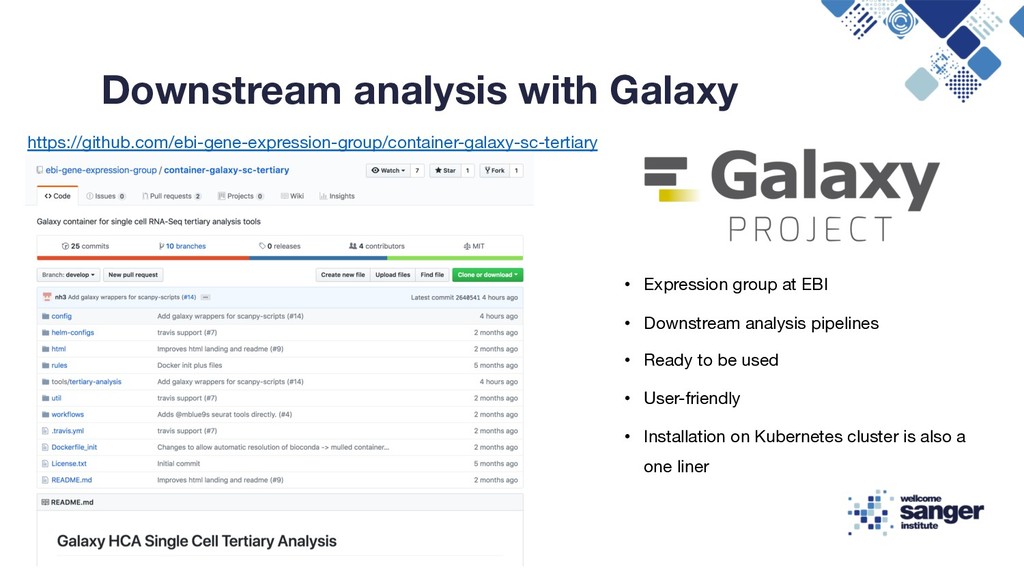
Downstream analysis with Galaxy • Expression group at EBI •
Downstream analysis pipelines • Ready to be used • User-friendly • Installation on Kubernetes cluster is also a one liner https://github.com/ebi-gene-expression-group/container-galaxy-sc-tertiary -
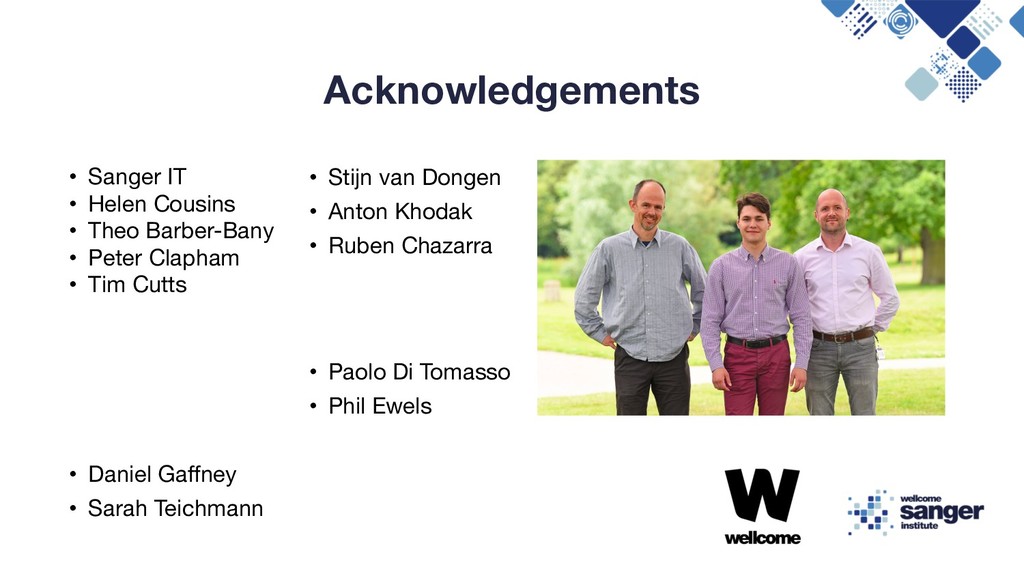
Acknowledgements • Sanger IT • Helen Cousins • Theo Barber-Bany
• Peter Clapham • Tim Cutts • Stijn van Dongen • Anton Khodak • Ruben Chazarra • Daniel Gaffney • Sarah Teichmann • Paolo Di Tomasso • Phil Ewels