eBPF for the rest of us - Golab 2023
Sponsored
·
 SiteGround - Reliable hosting with speed, security, and support you can count on.
→
SiteGround - Reliable hosting with speed, security, and support you can count on.
→

Share
Embed
eBPF for the rest of us - Golab 2023
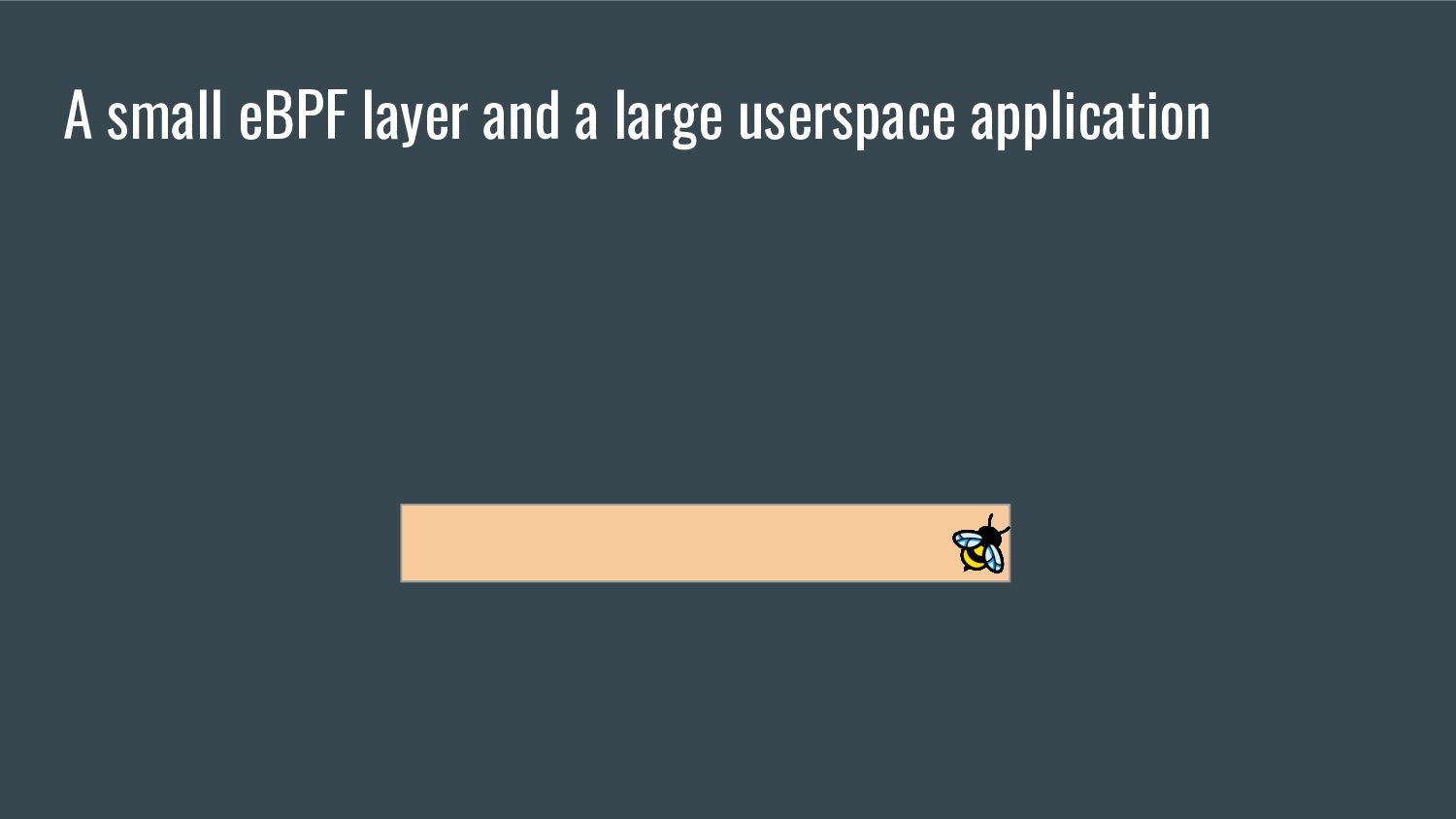
EBPF is getting popular and popular. In this talk I will reintroduce it, and will describe what is the state of the art and how we can leverage it to solve problems related to performance, security and networking.

Federico Paolinelli
November 21, 2023
Transcript
152 slides
-
Telco Network Team @ Red Hat Contributed to: - Athens
- KubeVirt - SR-IOV Network Operator - OPA Gatekeeper - OVN-Kubernetes hachyderm.io/@fedepaol - CNI Plugins @fedepaol - MetalLB [email protected] About me -
- Extended berkeley packet filter - Same thing as Javascript
was to browsers - Allows us to change the behavior of the Linux kernel What is eBPF? -
- Extended berkeley packet filter - Same thing as Javascript
was to browsers - Allows us to change the behavior of the Linux kernel in a safe and controlled way What is eBPF? -
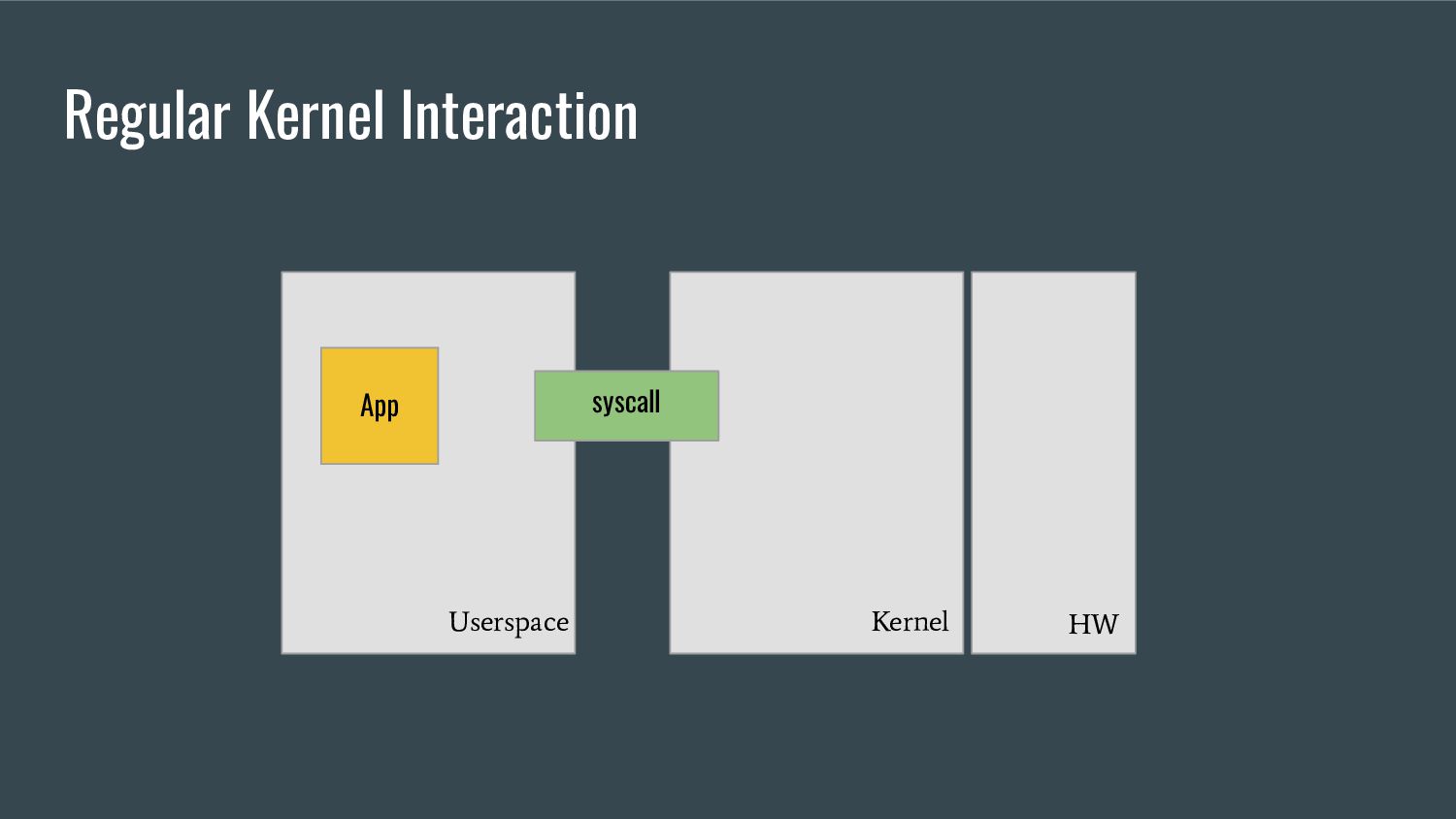
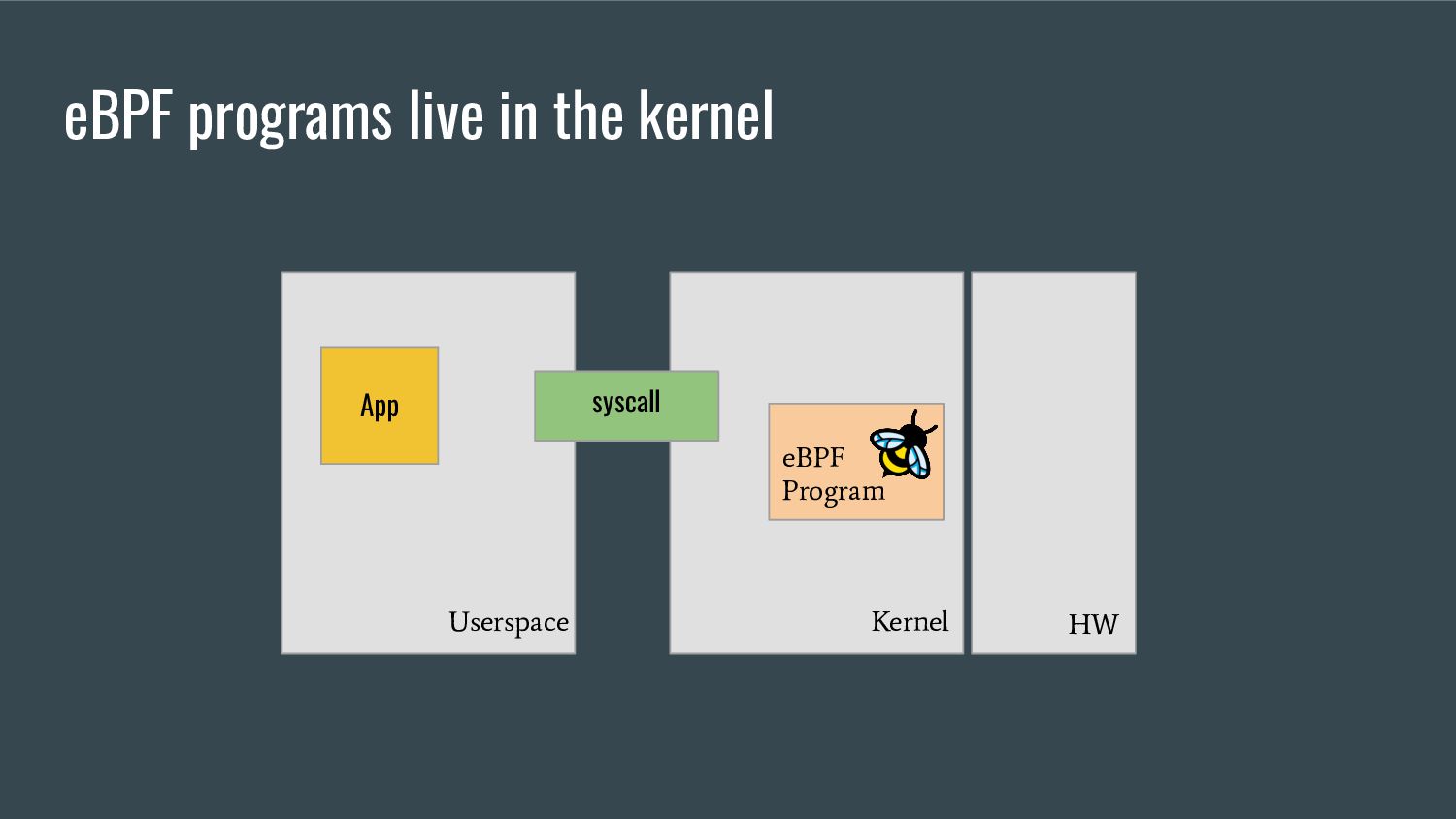
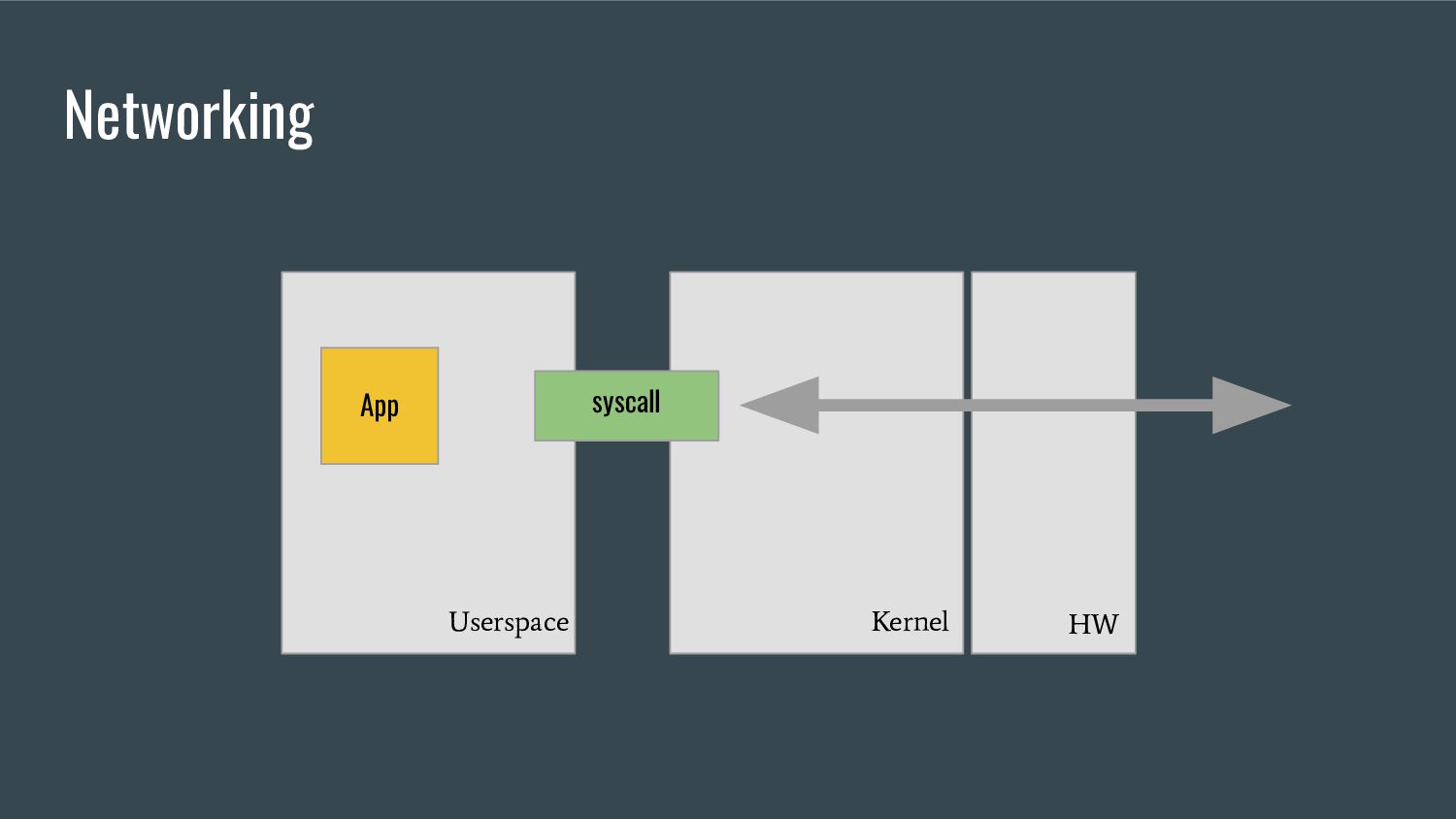
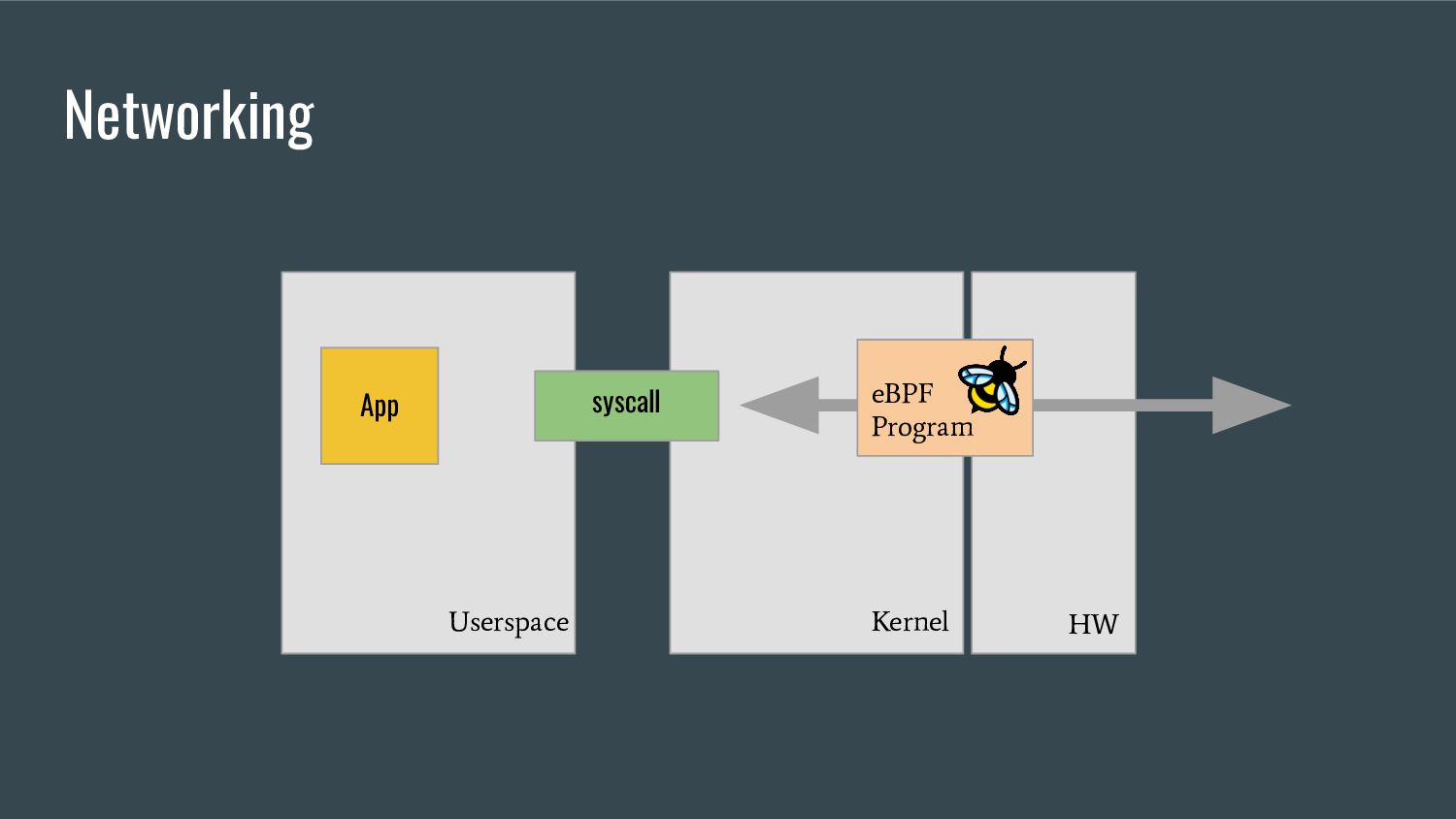
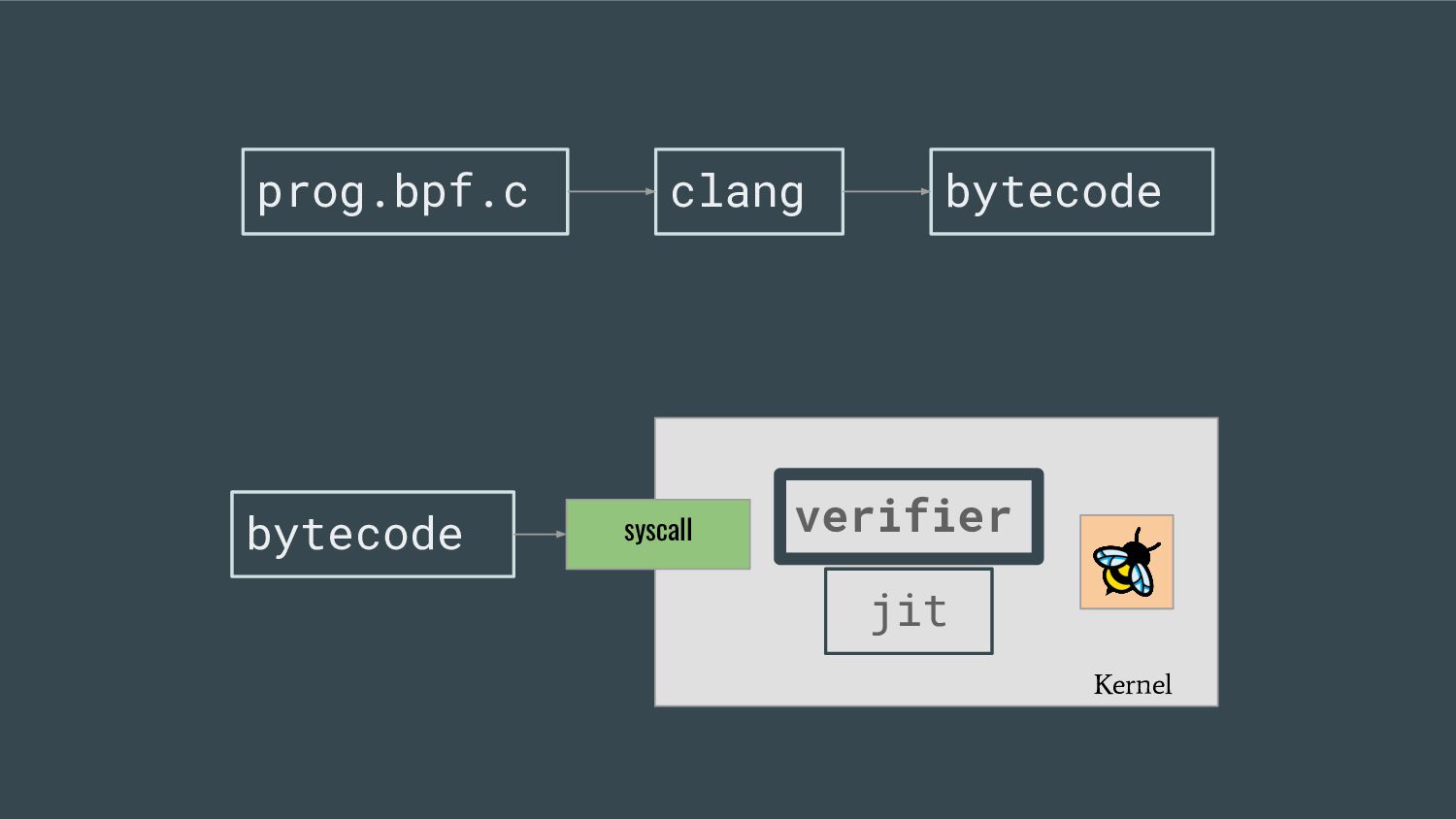
eBPF programs live in the kernel App syscall Kernel Userspace
HW eBPF Program -
- Linux kernel modules - Contributing the feature to the
kernel What are the alternatives? -
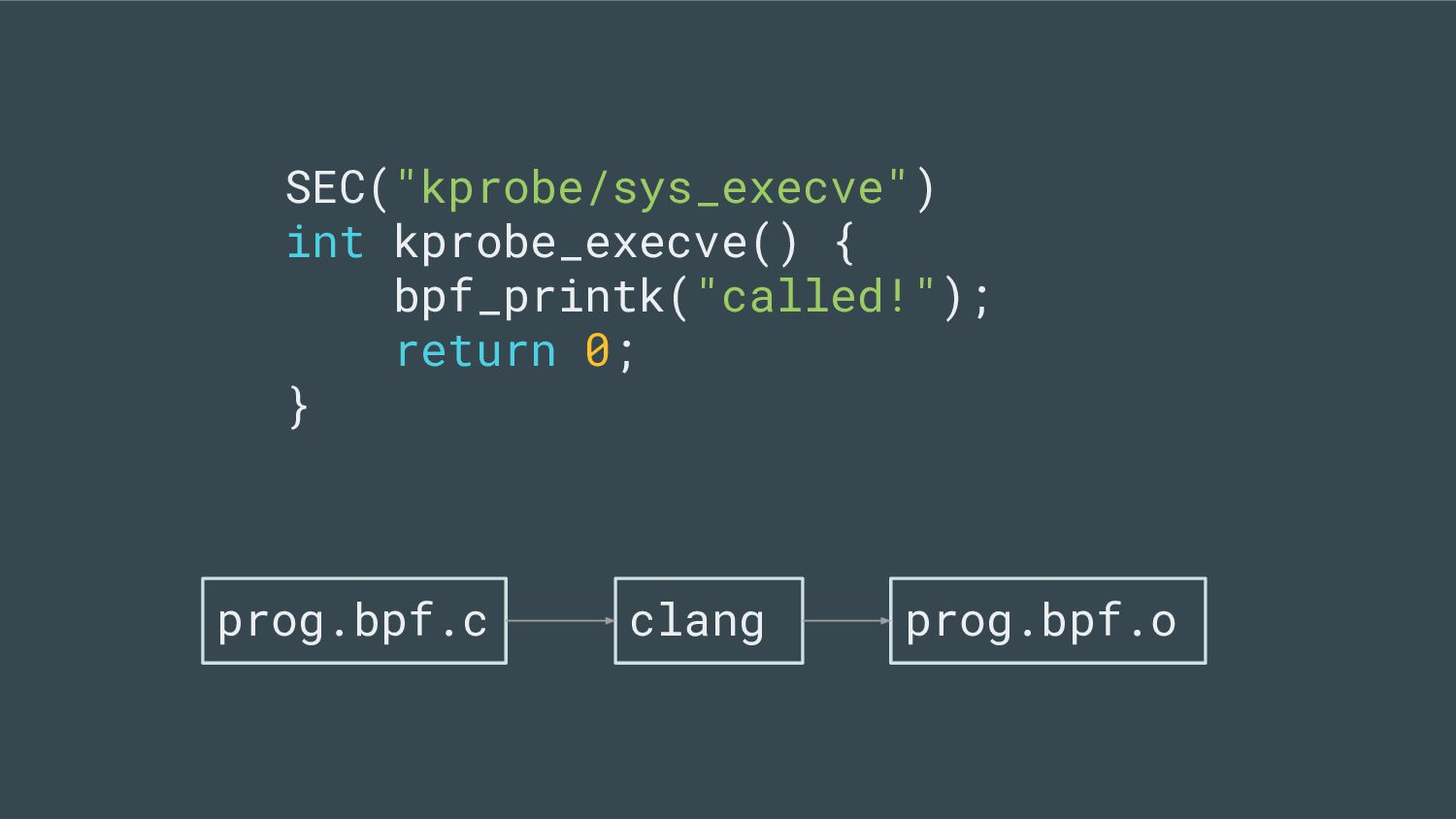
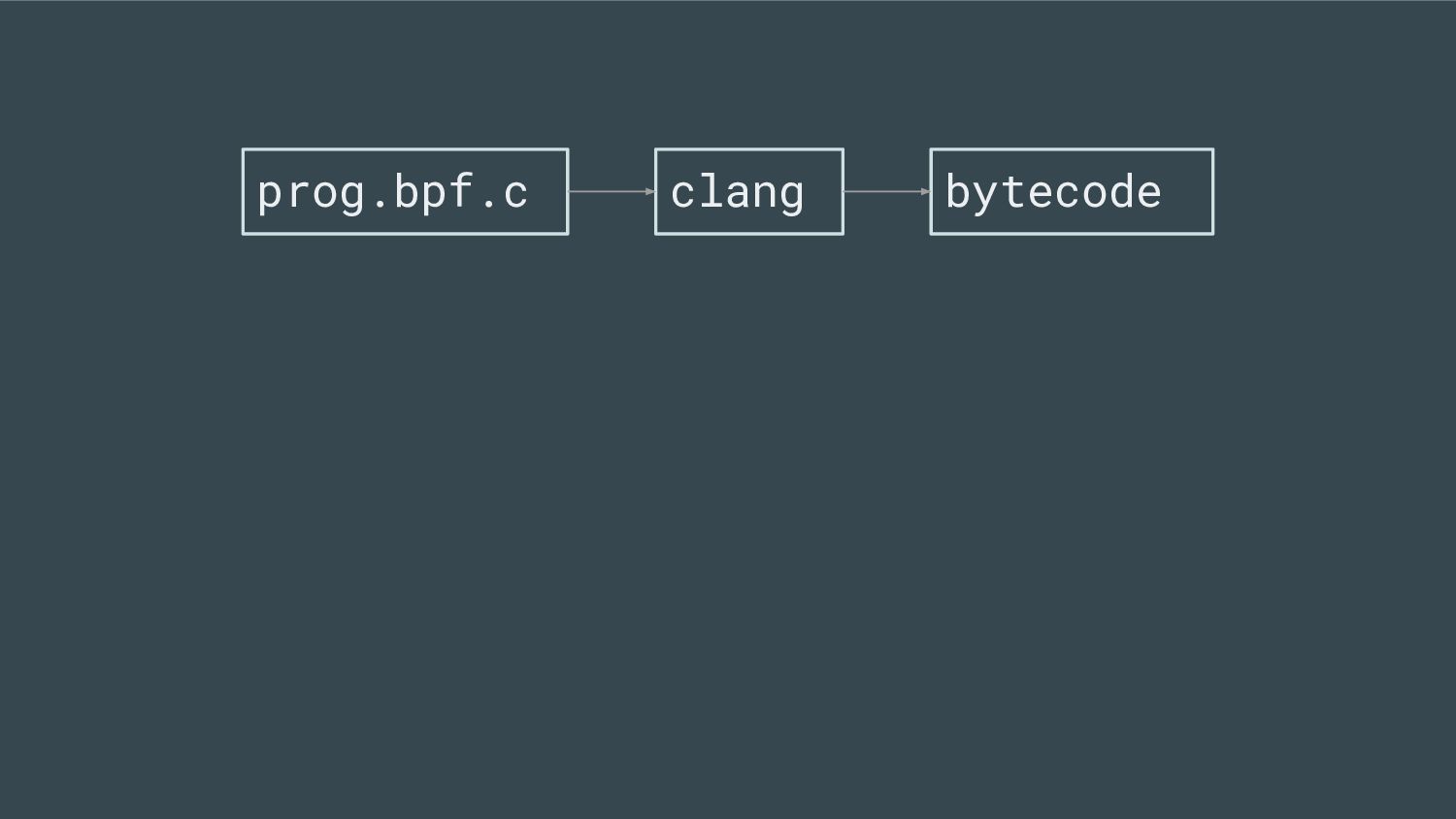
git-9348 [000] ...21 2534.887840: bpf_trace_printk: called! git-9351 [000] ...21 2534.891143:
bpf_trace_printk: called! tail-9354 [000] ...21 2534.894813: bpf_trace_printk: called! git-9355 [001] ...21 2534.894813: bpf_trace_printk: called! /sys/kernel/debug/tracing/trace_pipe execve code git bash userspace kernel -
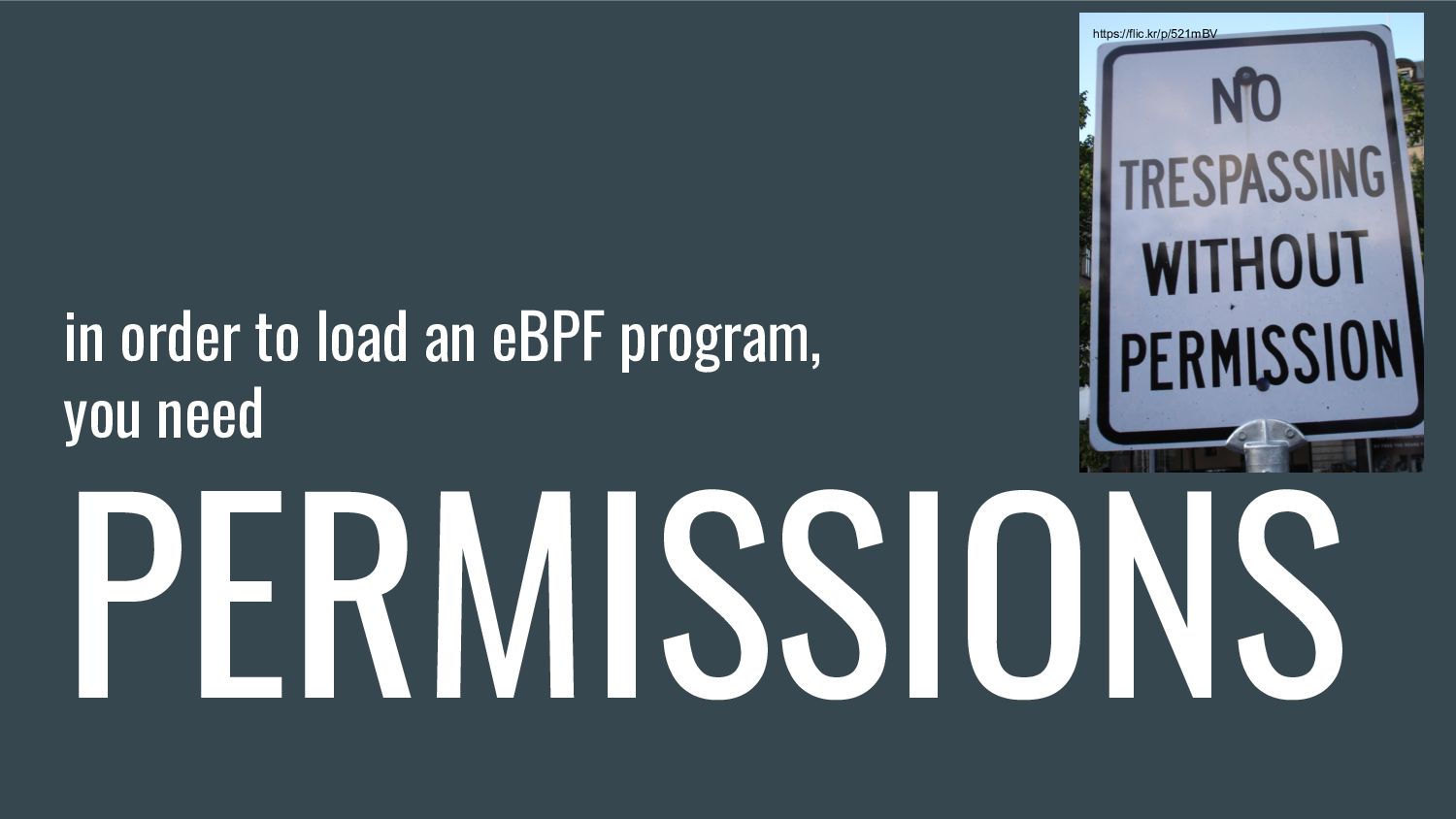
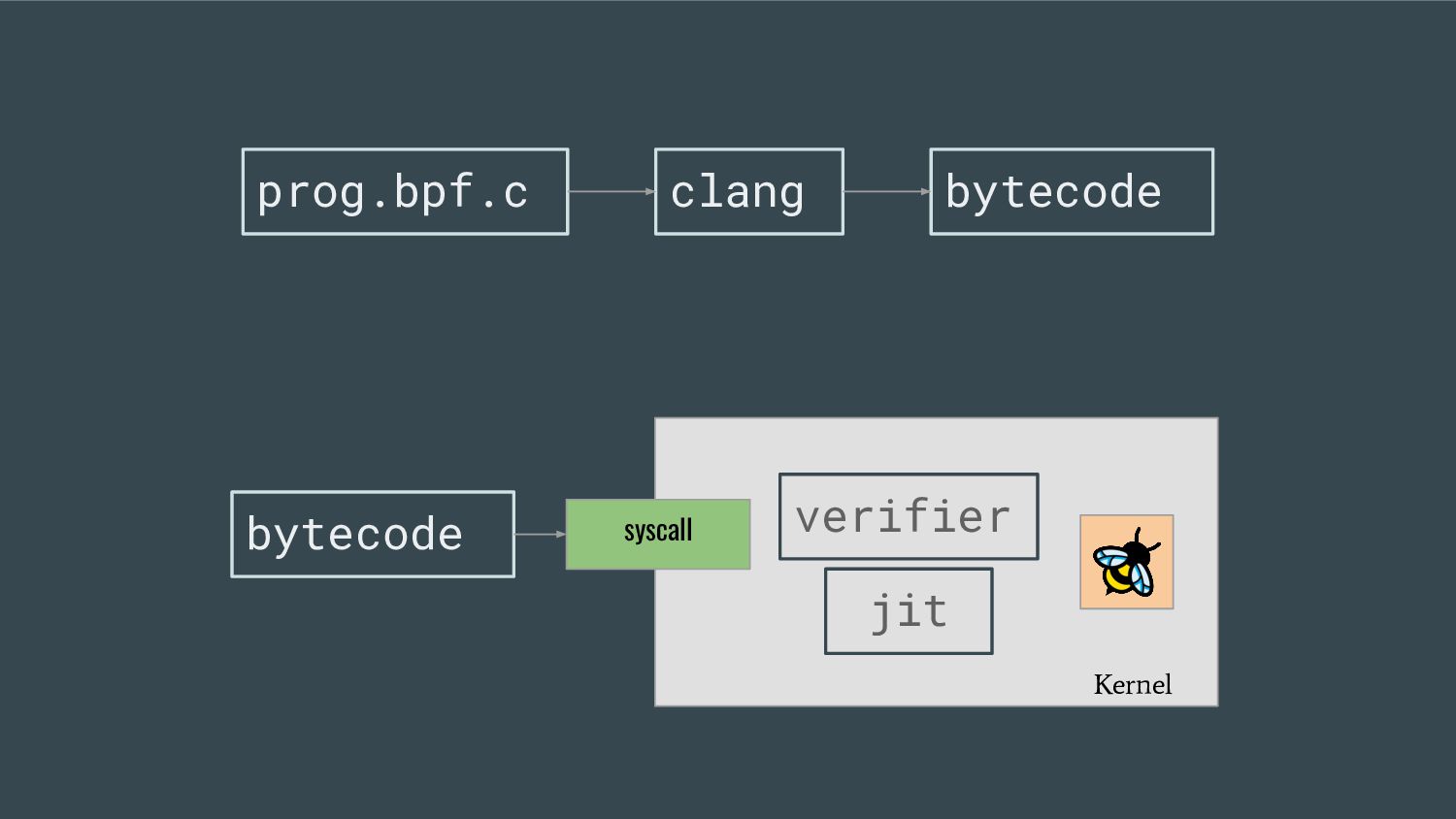
in order to load an eBPF program, you need PERMISSIONS
https://flic.kr/p/521mBV -
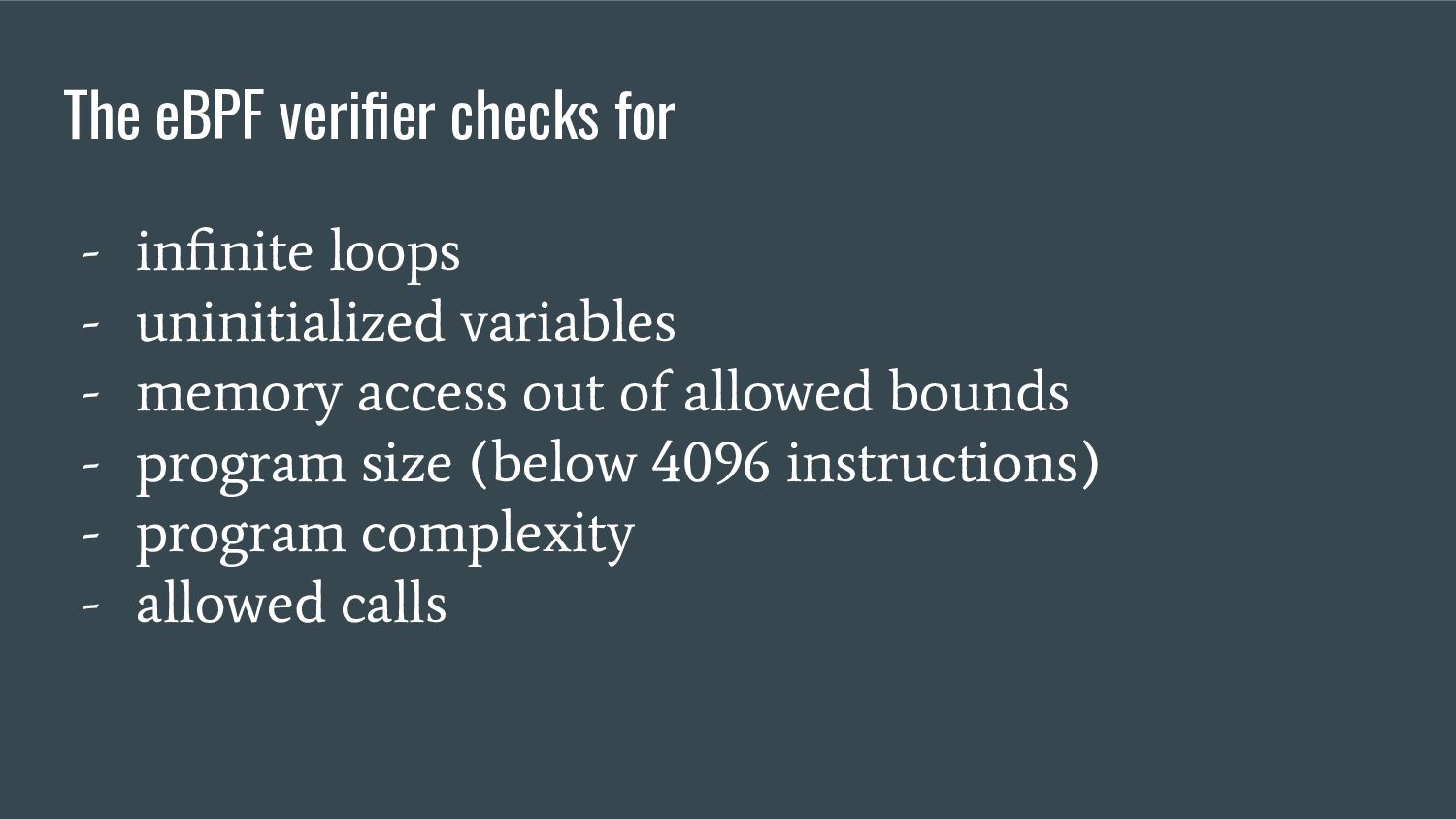
- infinite loops - uninitialized variables - memory access out
of allowed bounds - program size (below 4096 instructions) - program complexity - allowed calls The eBPF verifier checks for -
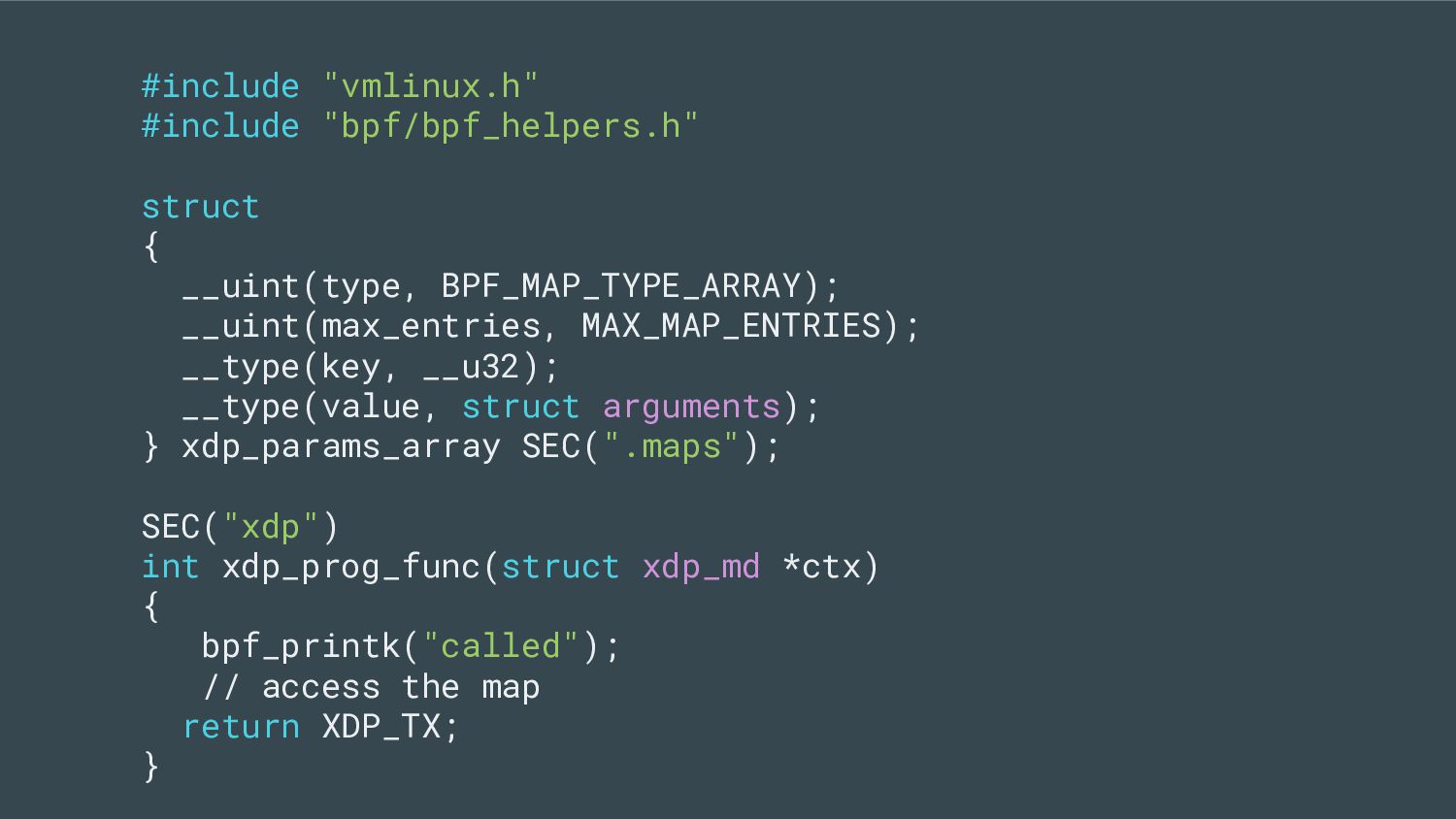
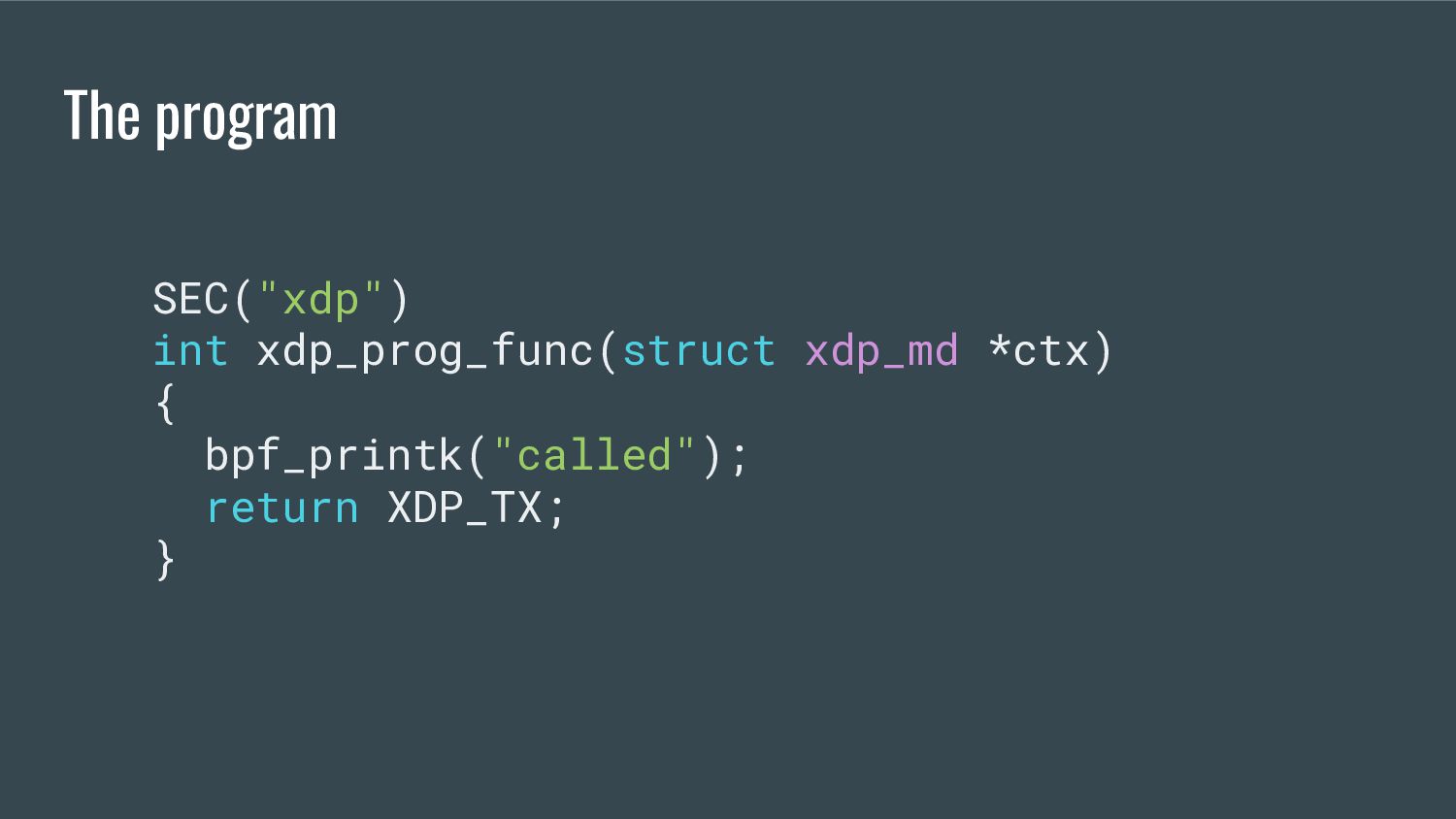
#include "vmlinux.h" #include "bpf/bpf_helpers.h" struct { __uint(type, BPF_MAP_TYPE_ARRAY); __uint(max_entries, MAX_MAP_ENTRIES);
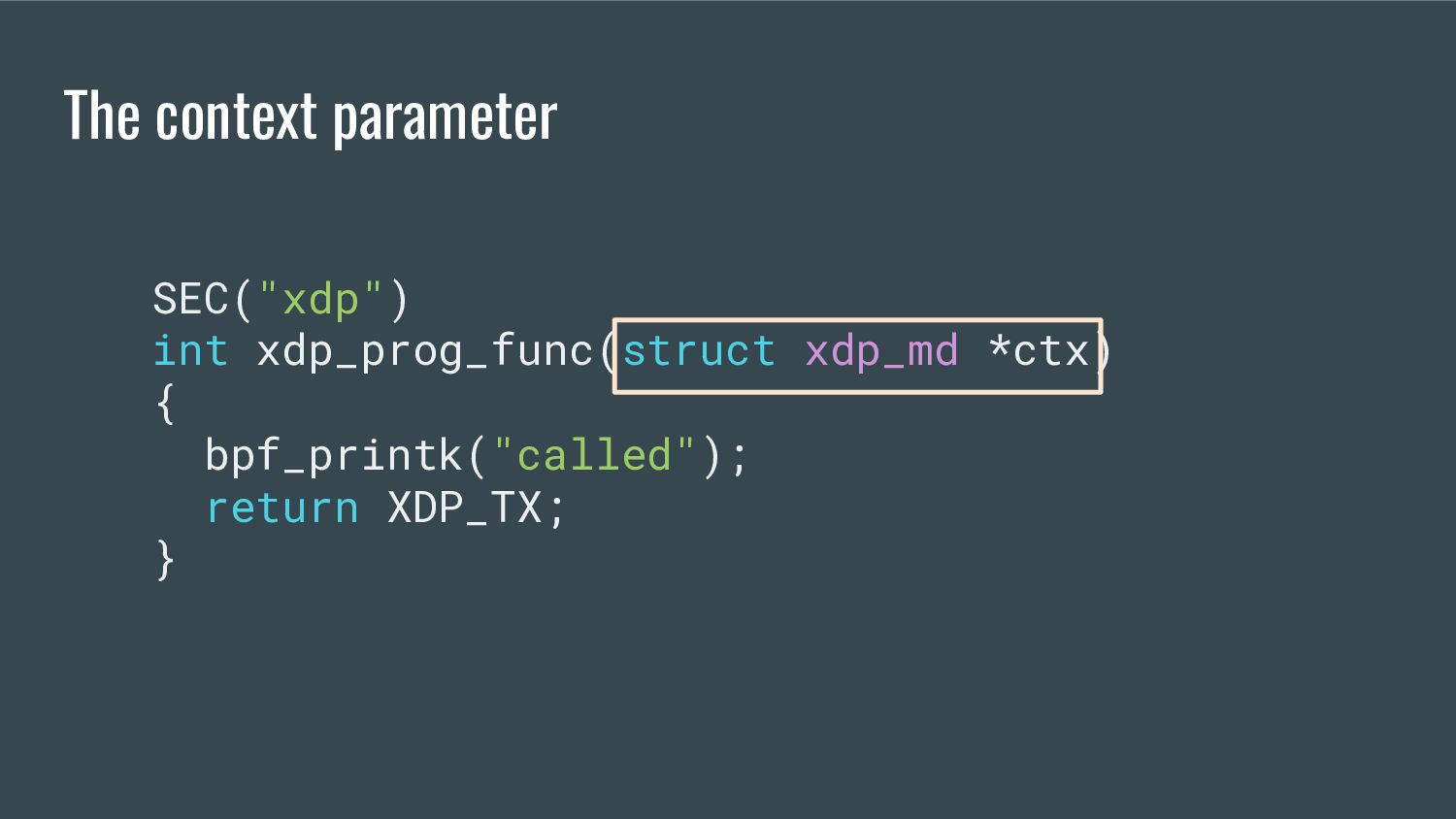
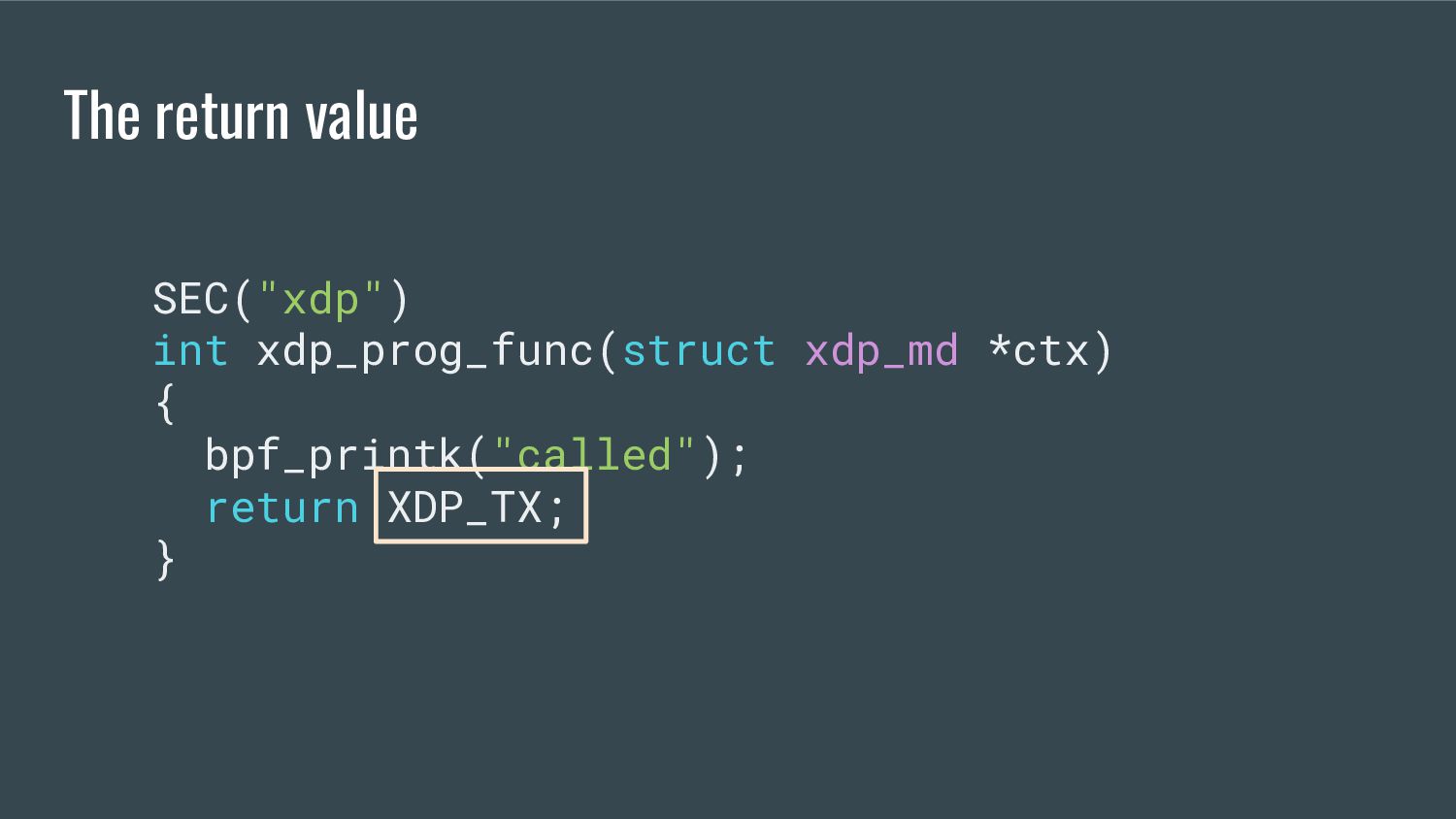
__type(key, __u32); __type(value, struct arguments); } xdp_params_array SEC(".maps"); SEC("xdp") int xdp_prog_func(struct xdp_md *ctx) { bpf_printk("called"); // access the map return XDP_TX; } -
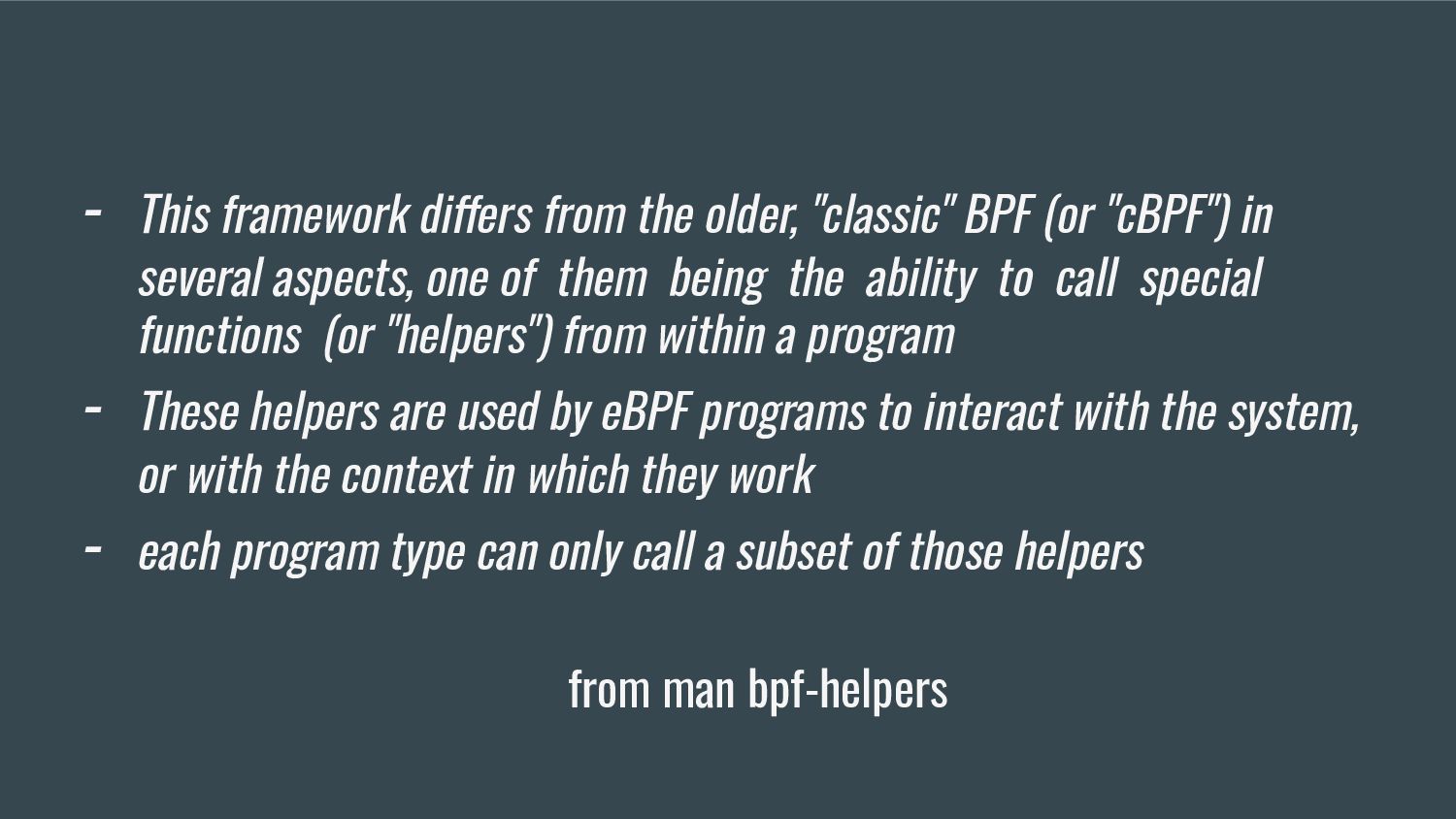
- This framework differs from the older, "classic" BPF (or
"cBPF") in several aspects, one of them being the ability to call special functions (or "helpers") from within a program - These helpers are used by eBPF programs to interact with the system, or with the context in which they work - each program type can only call a subset of those helpers from man bpf-helpers -
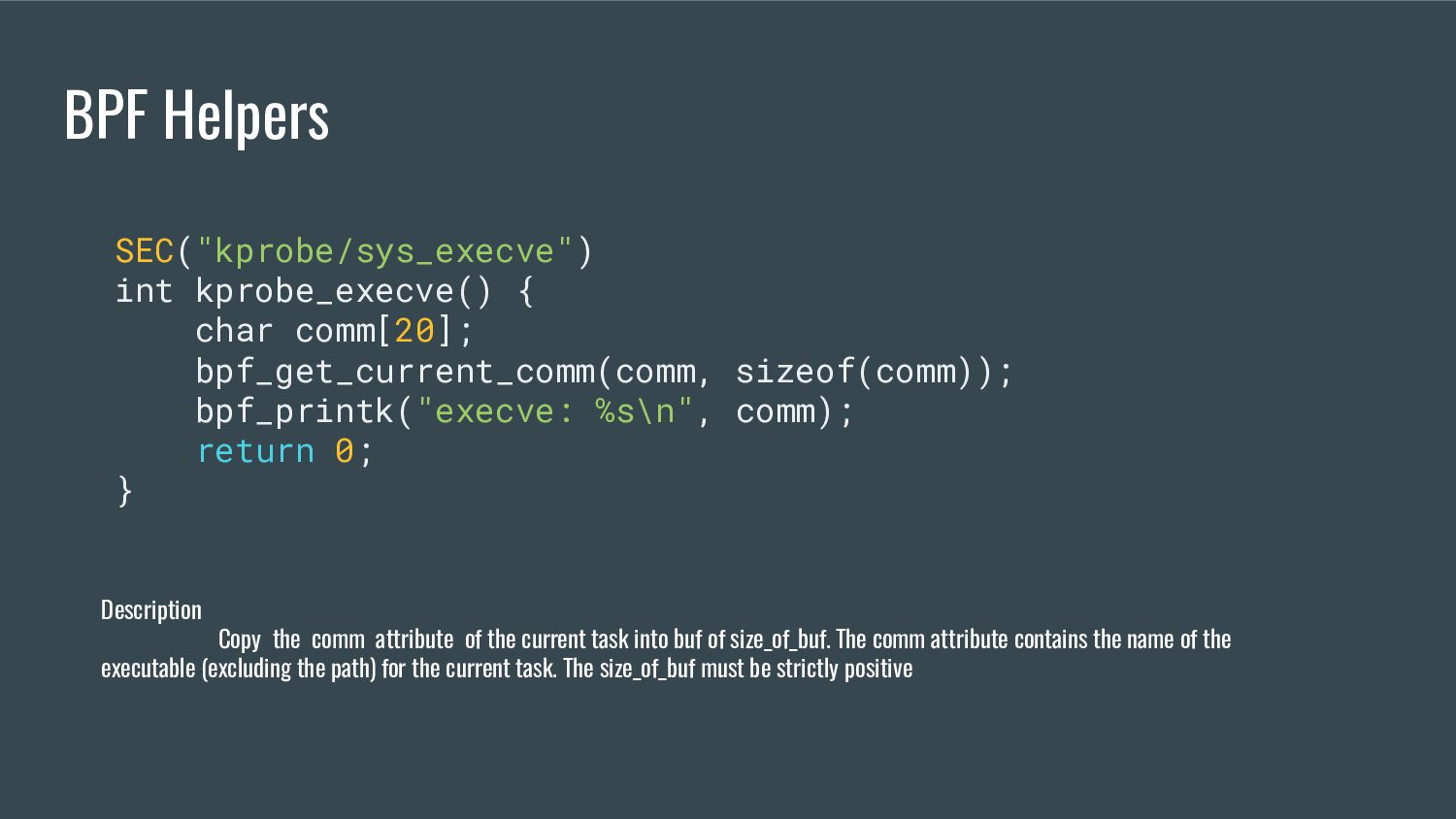
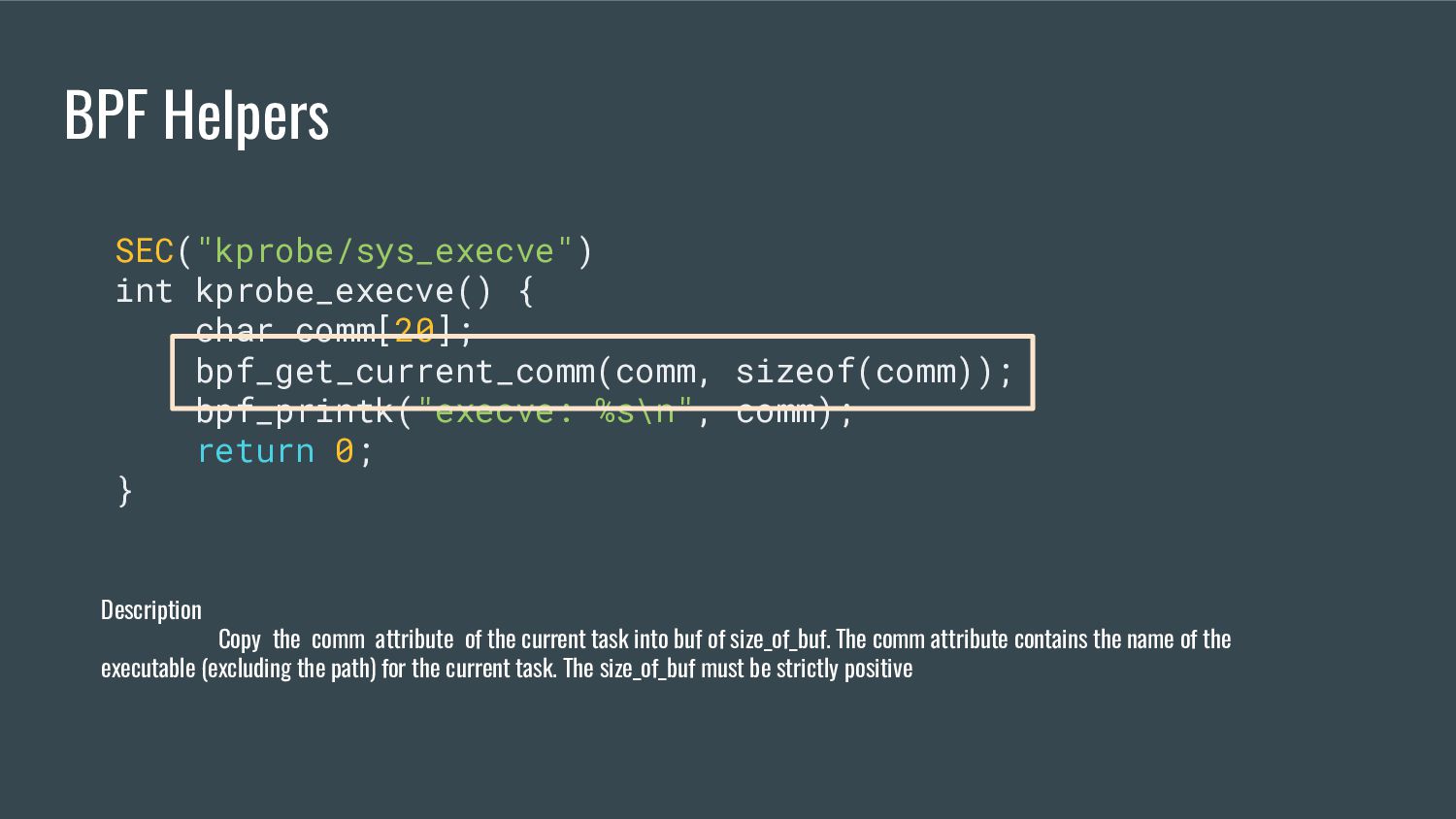
BPF Helpers Description Copy the comm attribute of the current
task into buf of size_of_buf. The comm attribute contains the name of the executable (excluding the path) for the current task. The size_of_buf must be strictly positive SEC("kprobe/sys_execve") int kprobe_execve() { char comm[20]; bpf_get_current_comm(comm, sizeof(comm)); bpf_printk("execve: %s\n", comm); return 0; } -
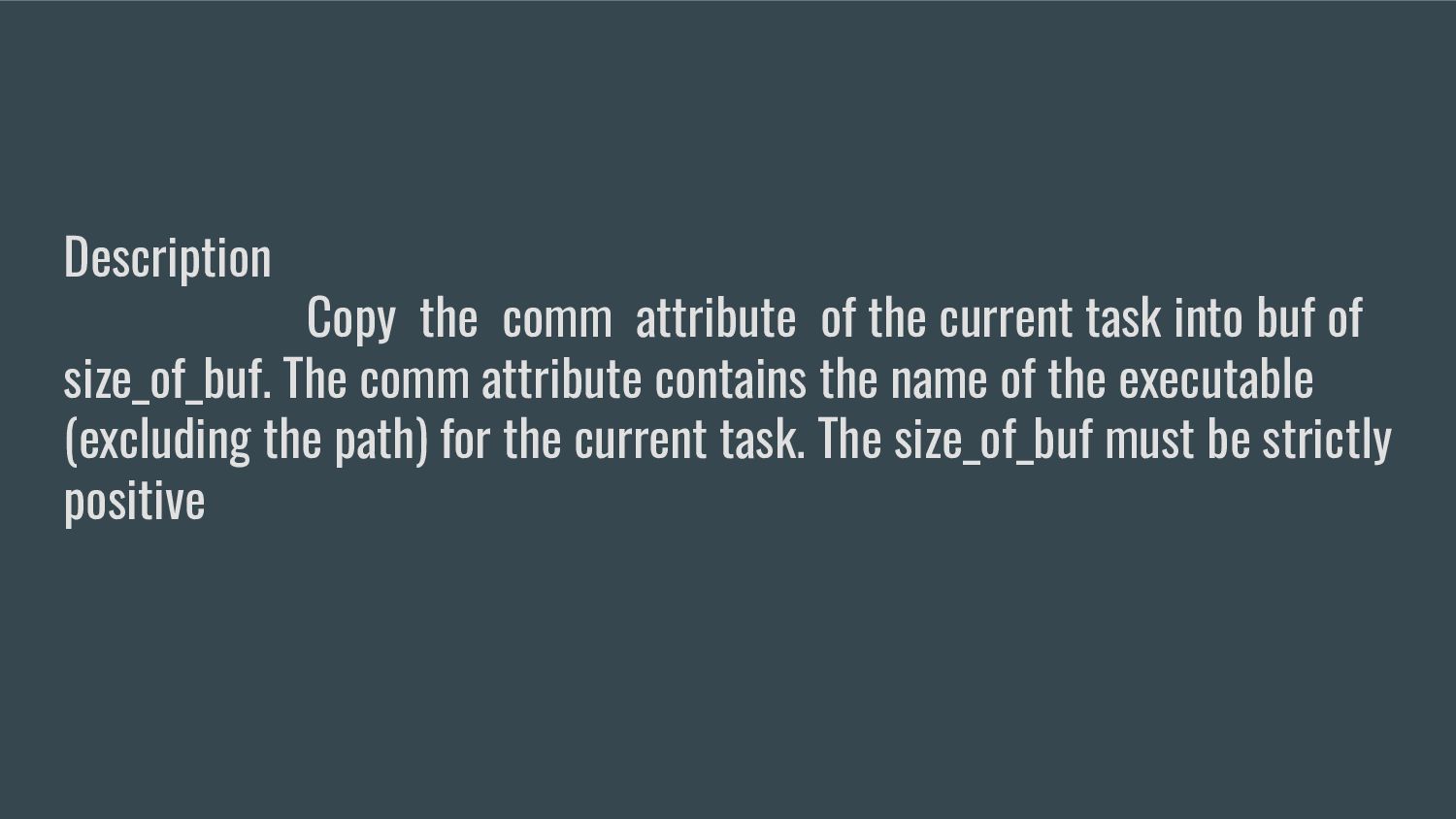
Description Copy the comm attribute of the current task into
buf of size_of_buf. The comm attribute contains the name of the executable (excluding the path) for the current task. The size_of_buf must be strictly positive -
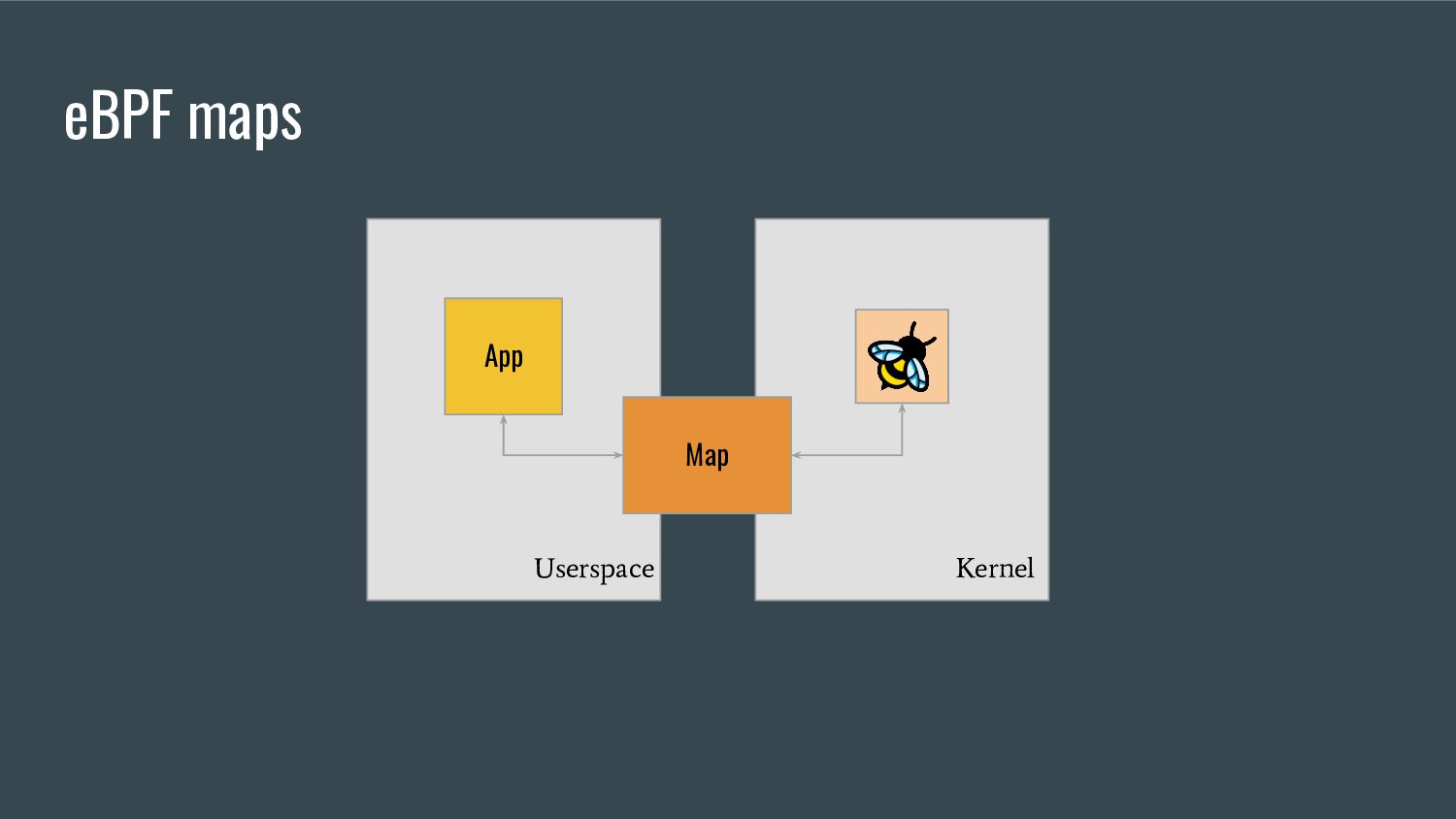
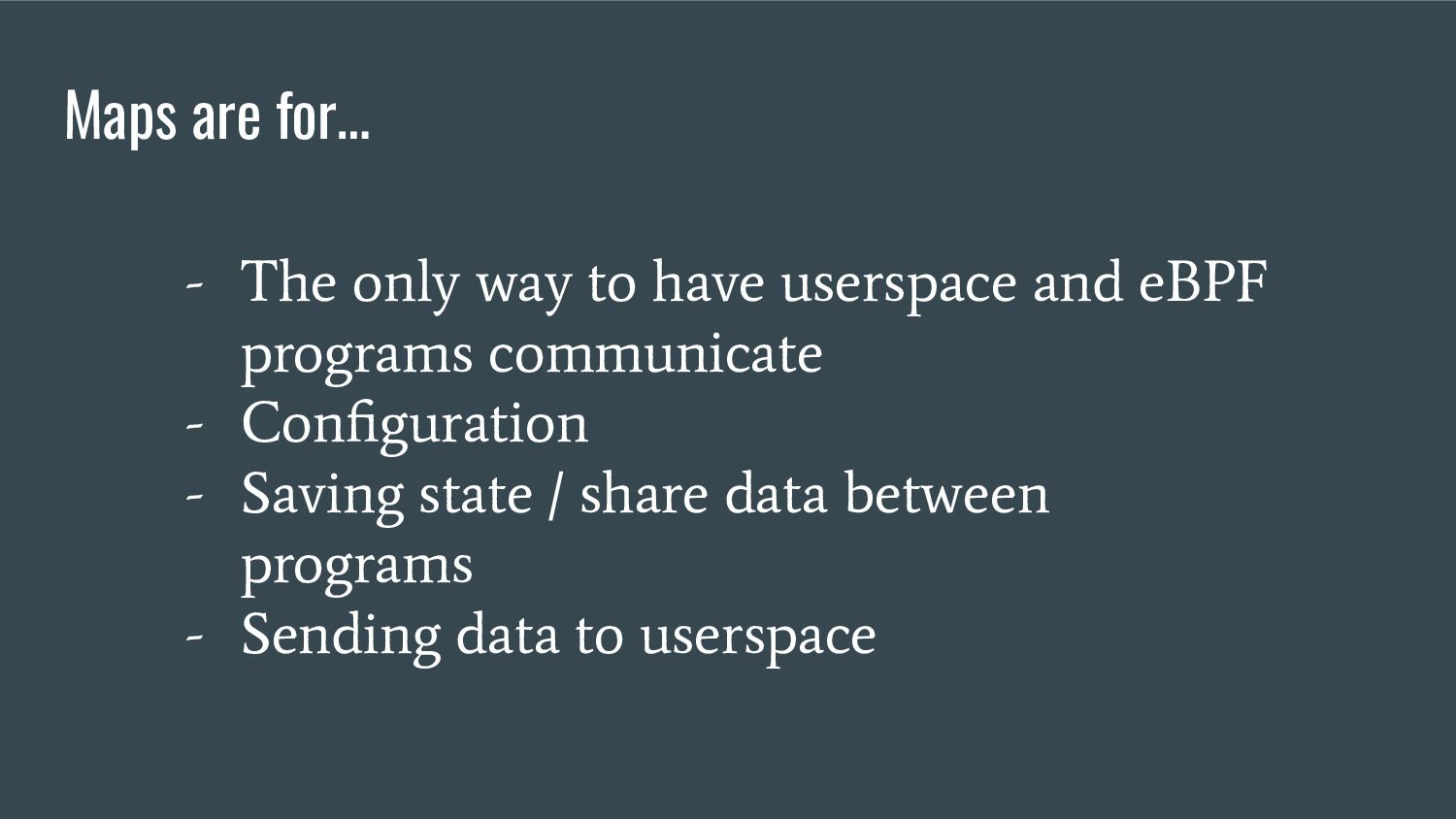
Maps are for… - The only way to have userspace
and eBPF programs communicate - Configuration - Saving state / share data between programs - Sending data to userspace -
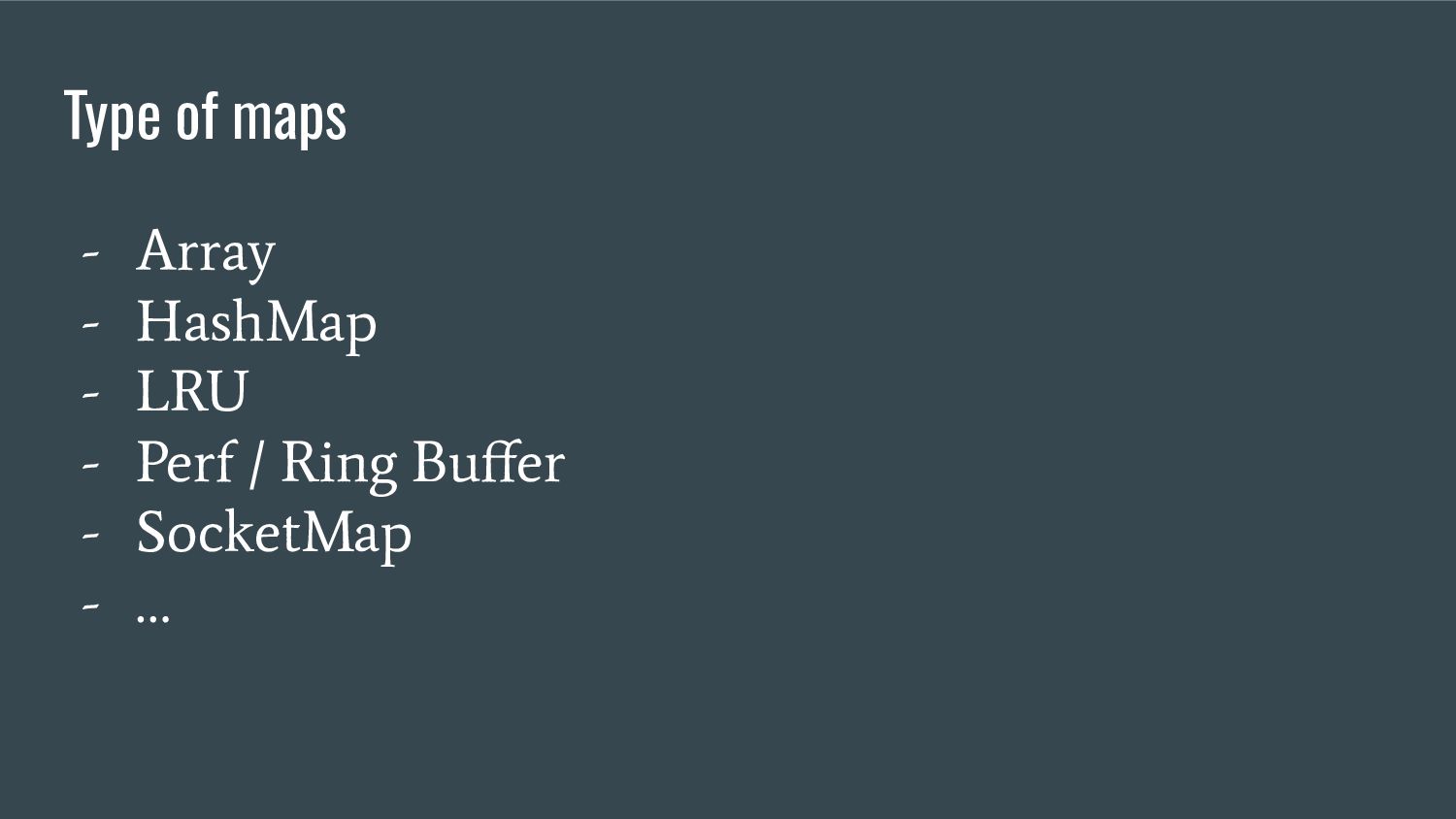
- Array - HashMap - LRU - Perf / Ring
Buffer - SocketMap - … Type of maps -
Maps - Hash Map struct command { u8 cmd[64]; };
struct{ __uint(type, BPF_MAP_TYPE_HASH); __type(key, struct command); __type(value, struct action); __uint(max_entries, 1024); } action_cmd_map SEC(".maps"); -
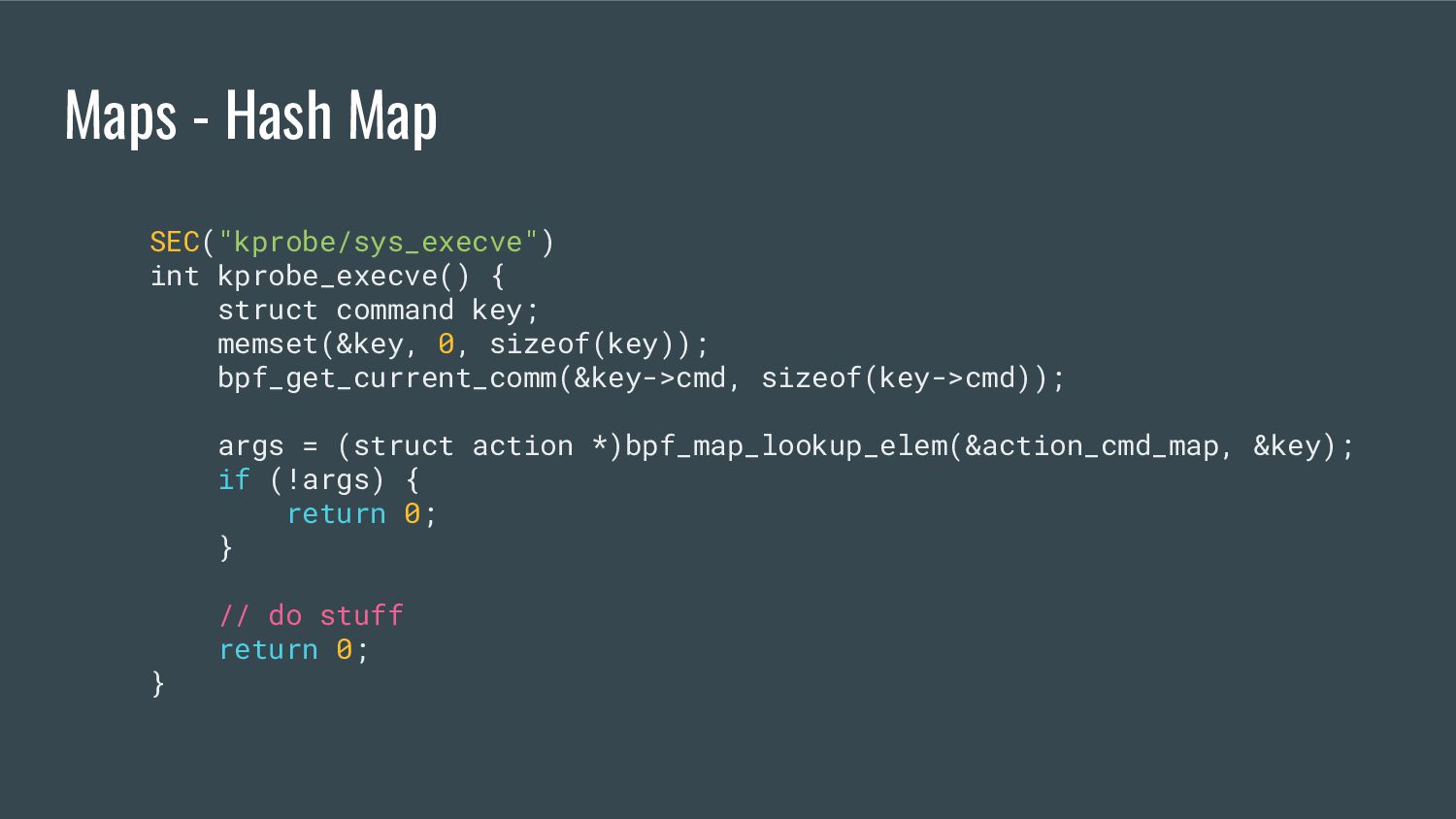
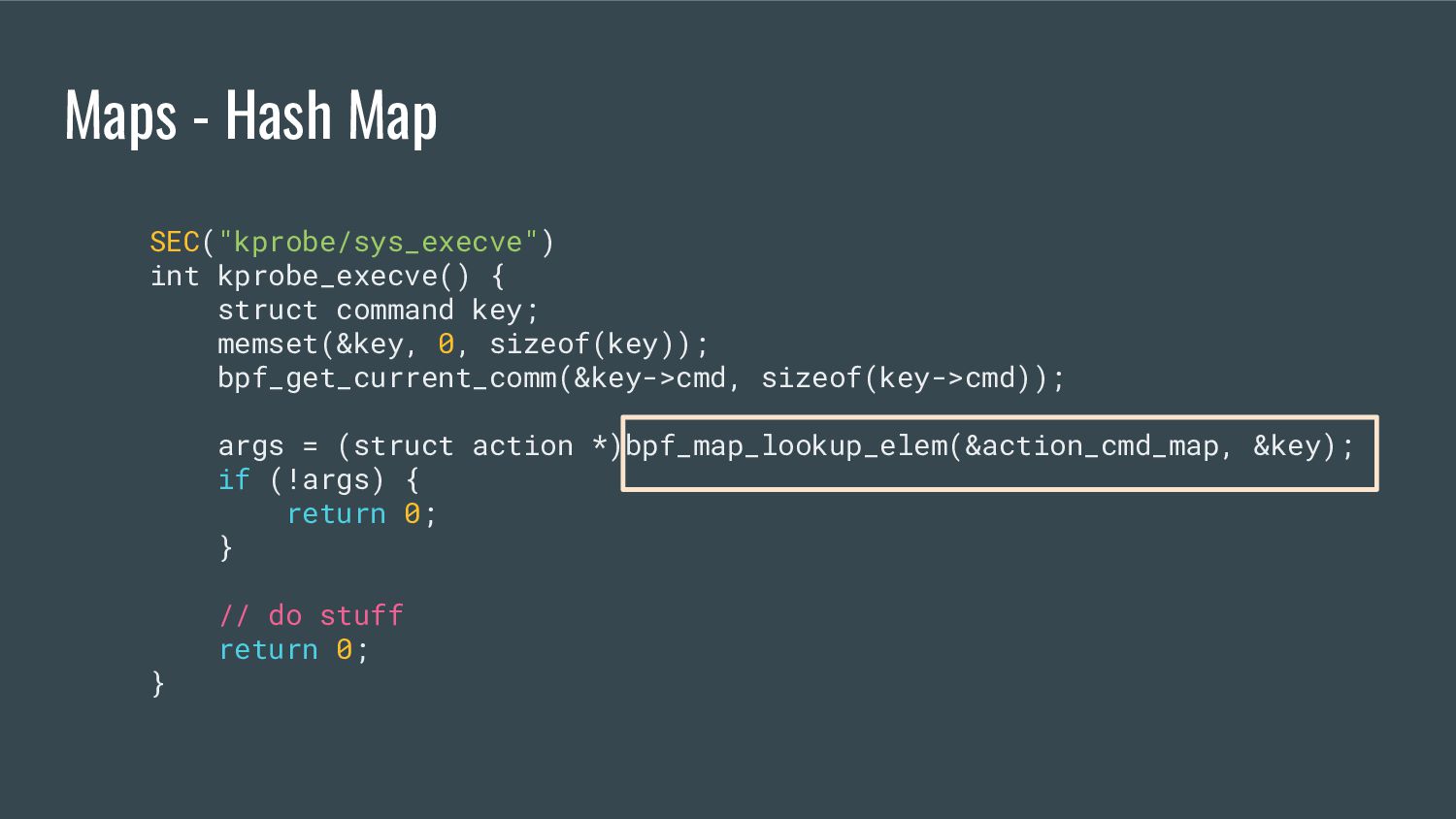
Maps - Hash Map SEC("kprobe/sys_execve") int kprobe_execve() { struct command
key; memset(&key, 0, sizeof(key)); bpf_get_current_comm(&key->cmd, sizeof(key->cmd)); args = (struct action *)bpf_map_lookup_elem(&action_cmd_map, &key); if (!args) { return 0; } // do stuff return 0; } -
Maps - Hash Map SEC("kprobe/sys_execve") int kprobe_execve() { struct command
key; memset(&key, 0, sizeof(key)); bpf_get_current_comm(&key->cmd, sizeof(key->cmd)); args = (struct action *)bpf_map_lookup_elem(&action_cmd_map, &key); if (!args) { return 0; } // do stuff return 0; } -
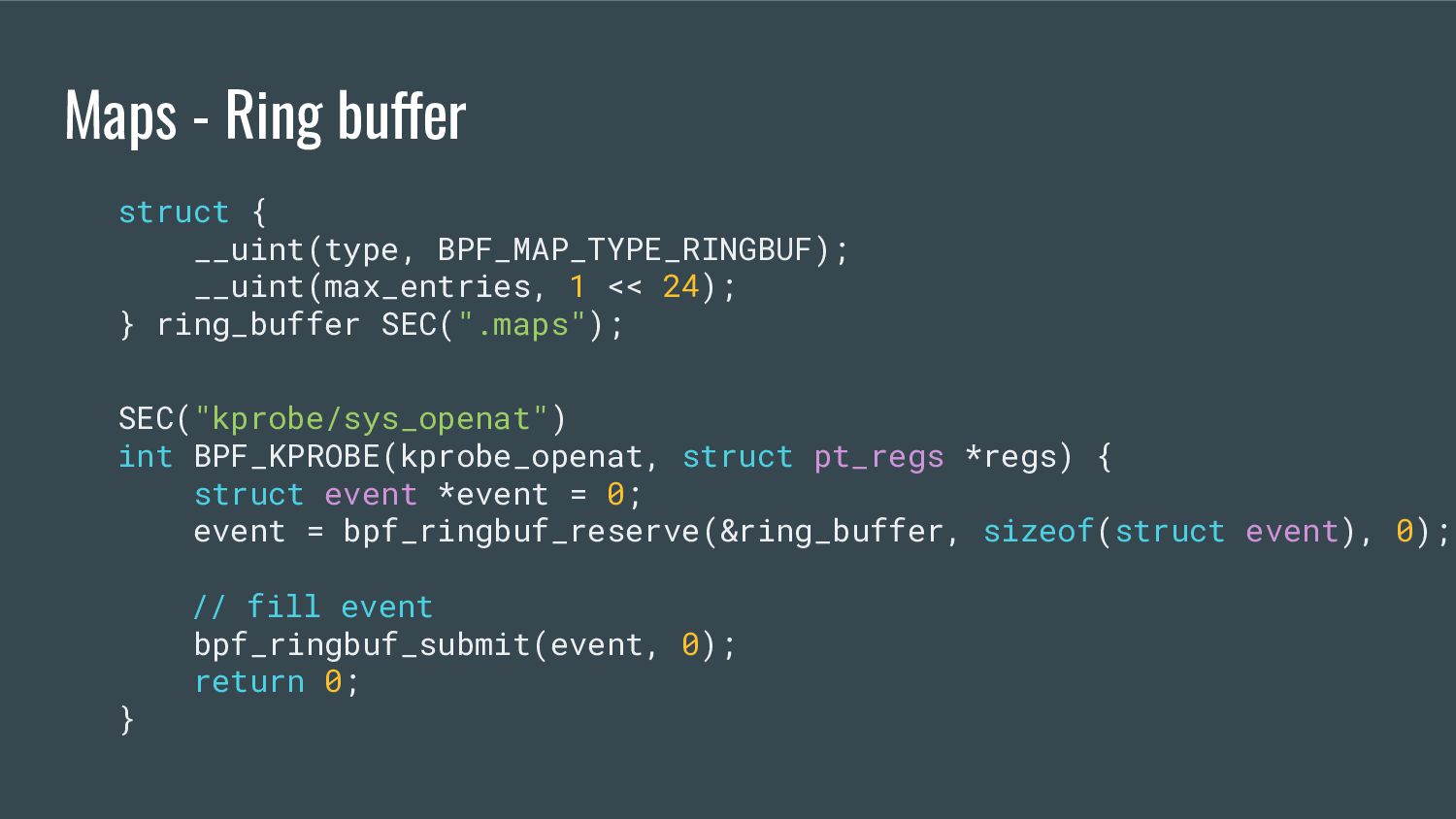
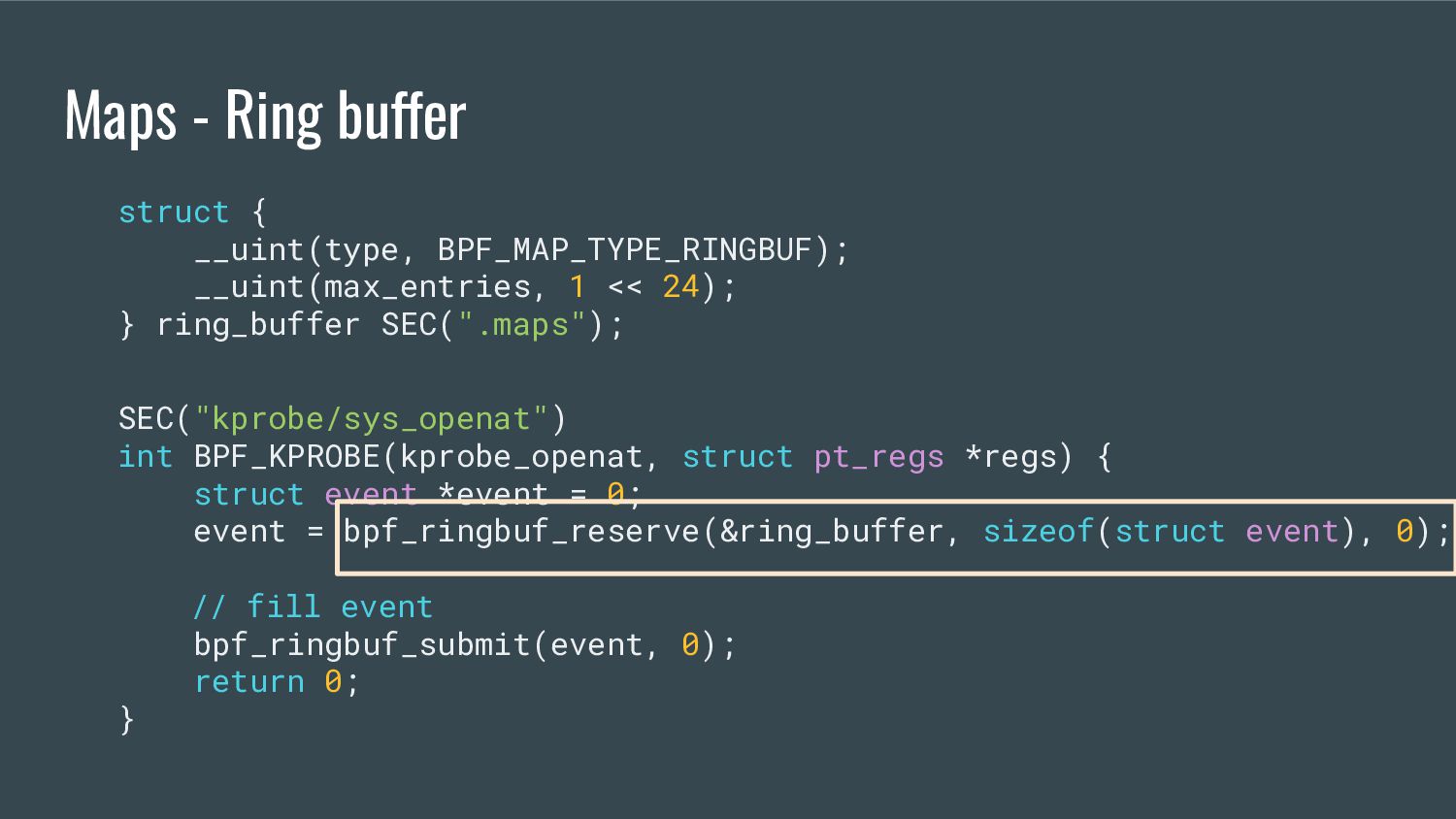
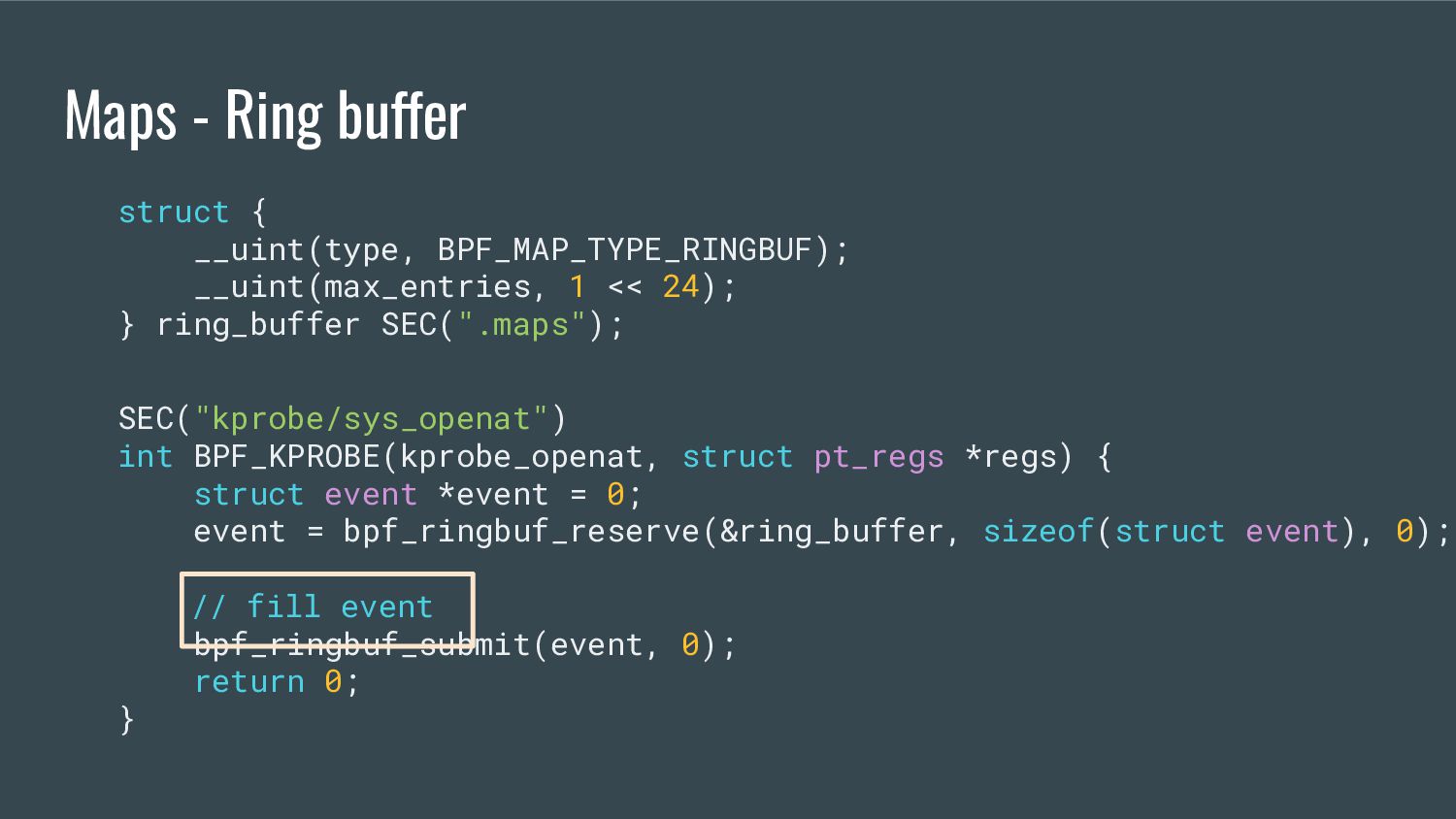
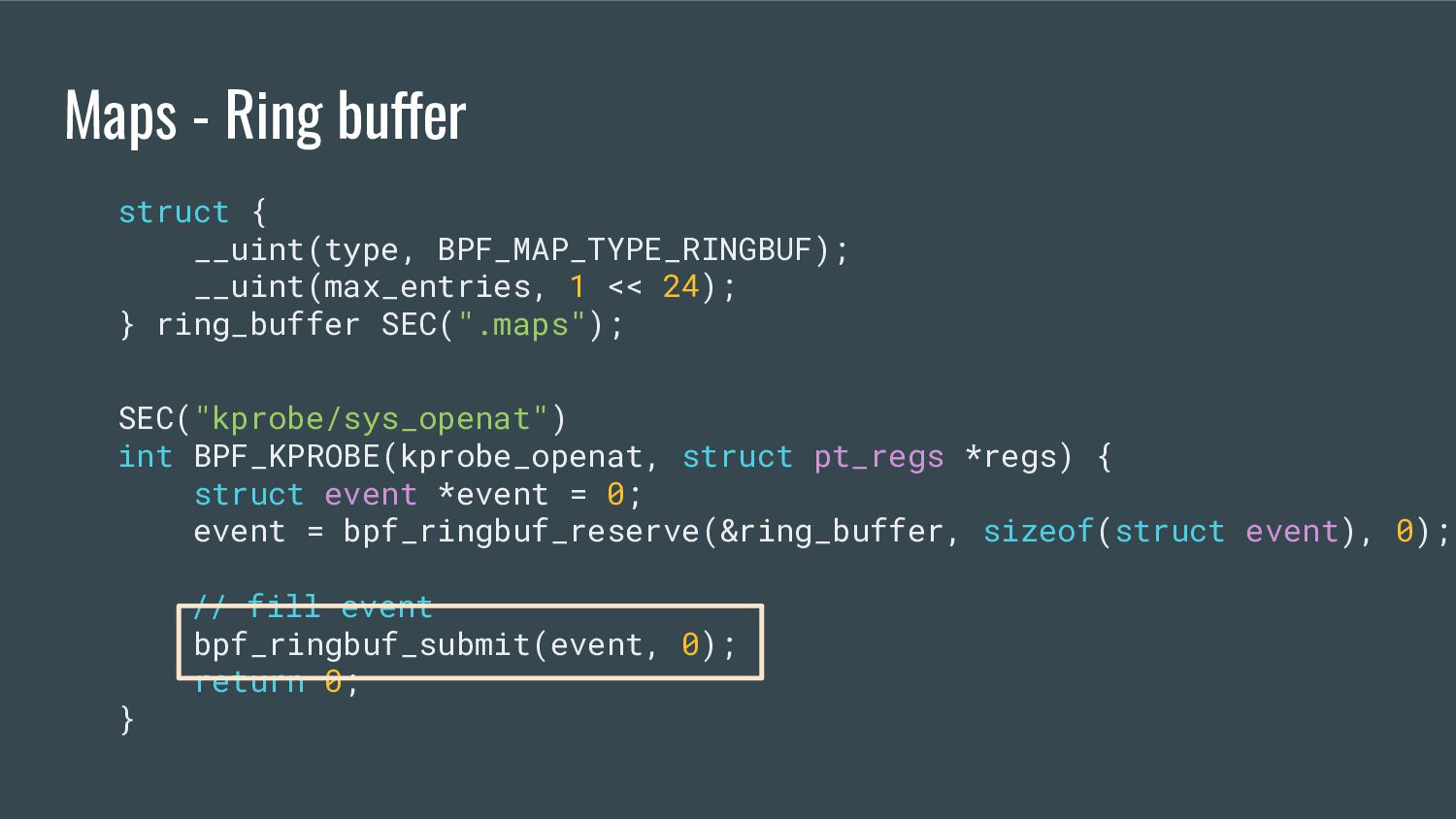
Maps - Ring buffer struct { __uint(type, BPF_MAP_TYPE_RINGBUF); __uint(max_entries, 1
<< 24); } ring_buffer SEC(".maps"); SEC("kprobe/sys_openat") int BPF_KPROBE(kprobe_openat, struct pt_regs *regs) { struct event *event = 0; event = bpf_ringbuf_reserve(&ring_buffer, sizeof(struct event), 0); // fill event bpf_ringbuf_submit(event, 0); return 0; } -
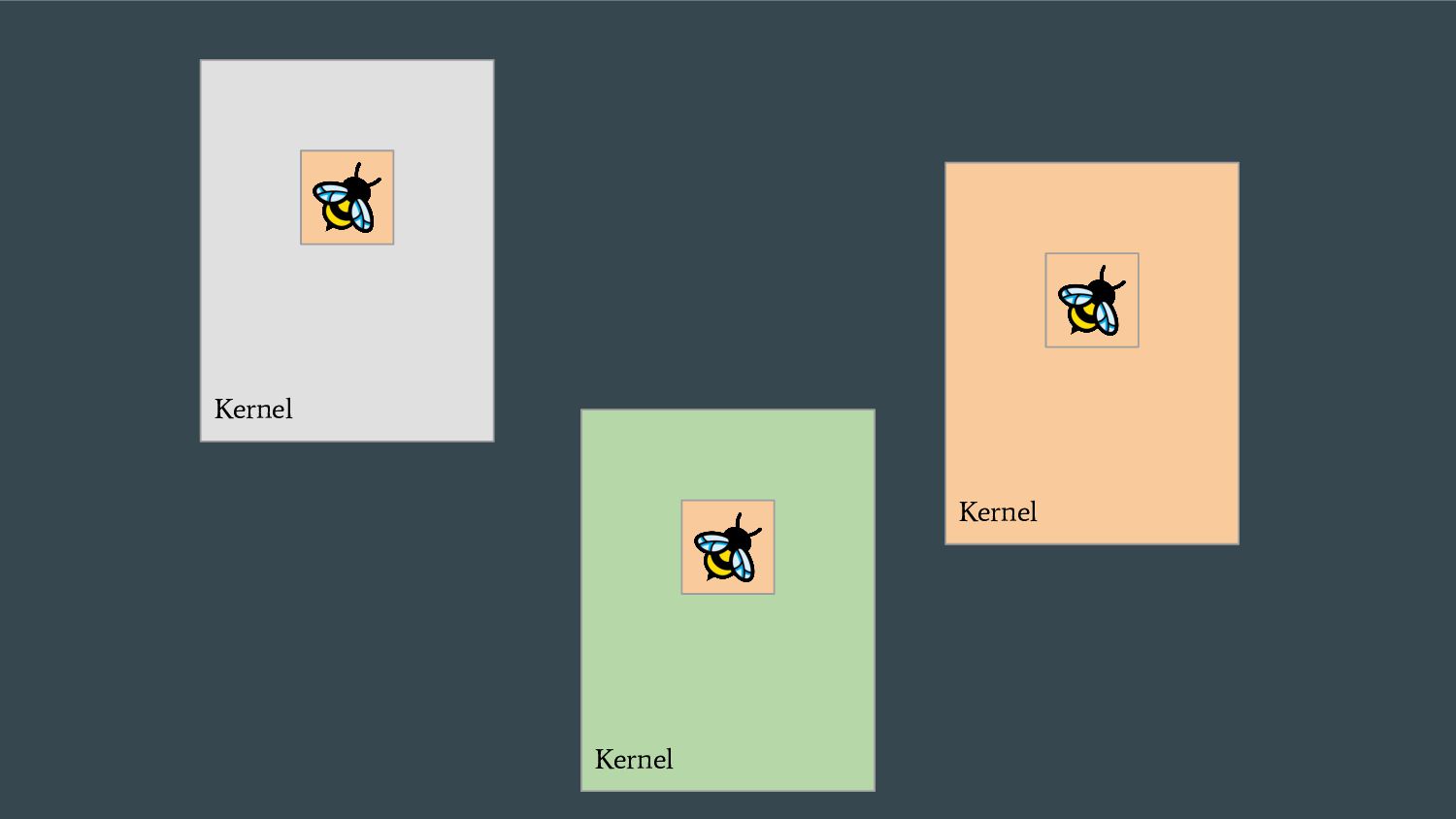
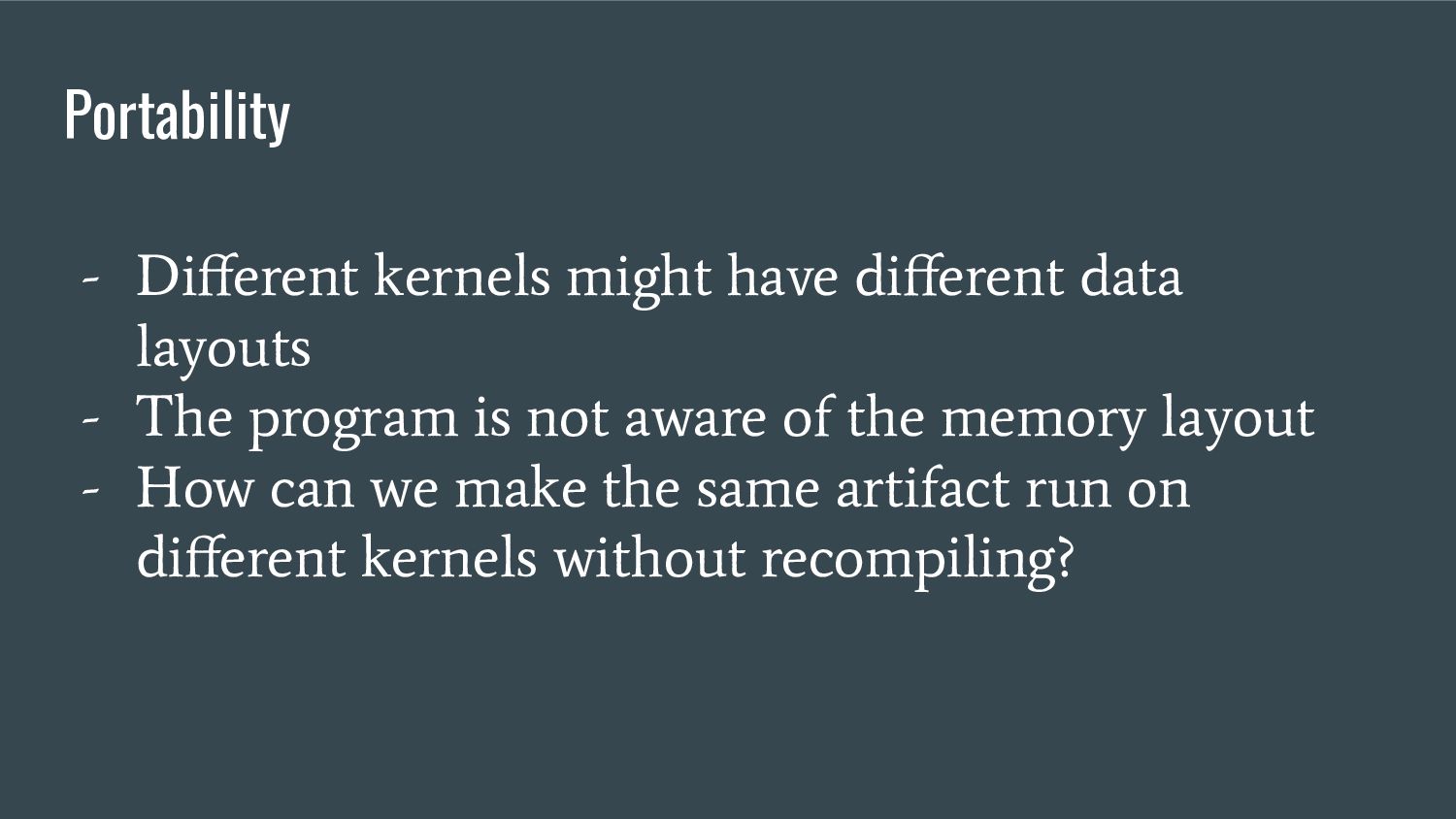
Portability - Different kernels might have different data layouts -
The program is not aware of the memory layout - How can we make the same artifact run on different kernels without recompiling? -
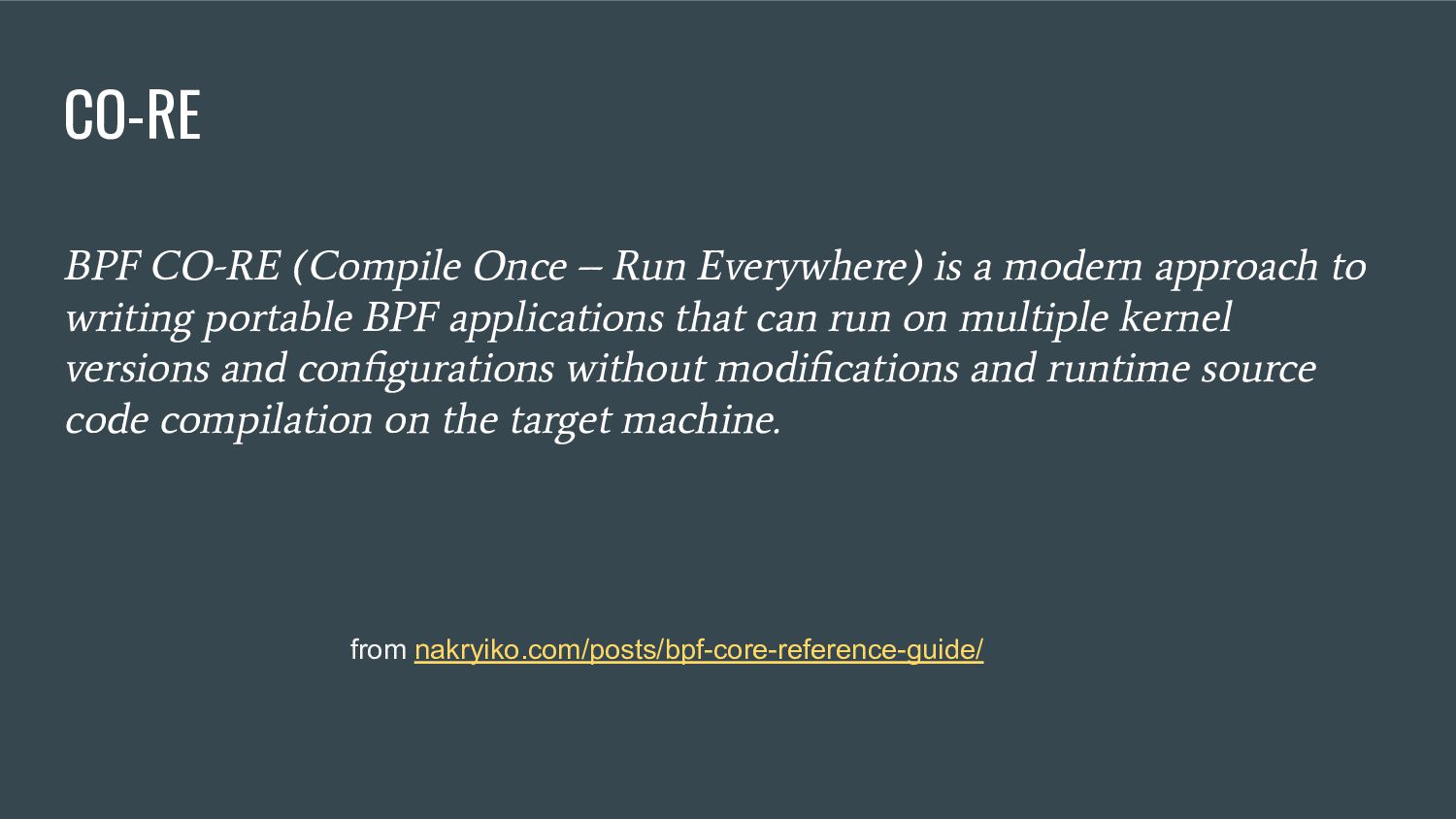
CO-RE BPF CO-RE (Compile Once – Run Everywhere) is a
modern approach to writing portable BPF applications that can run on multiple kernel versions and configurations without modifications and runtime source code compilation on the target machine. from nakryiko.com/posts/bpf-core-reference-guide/ -
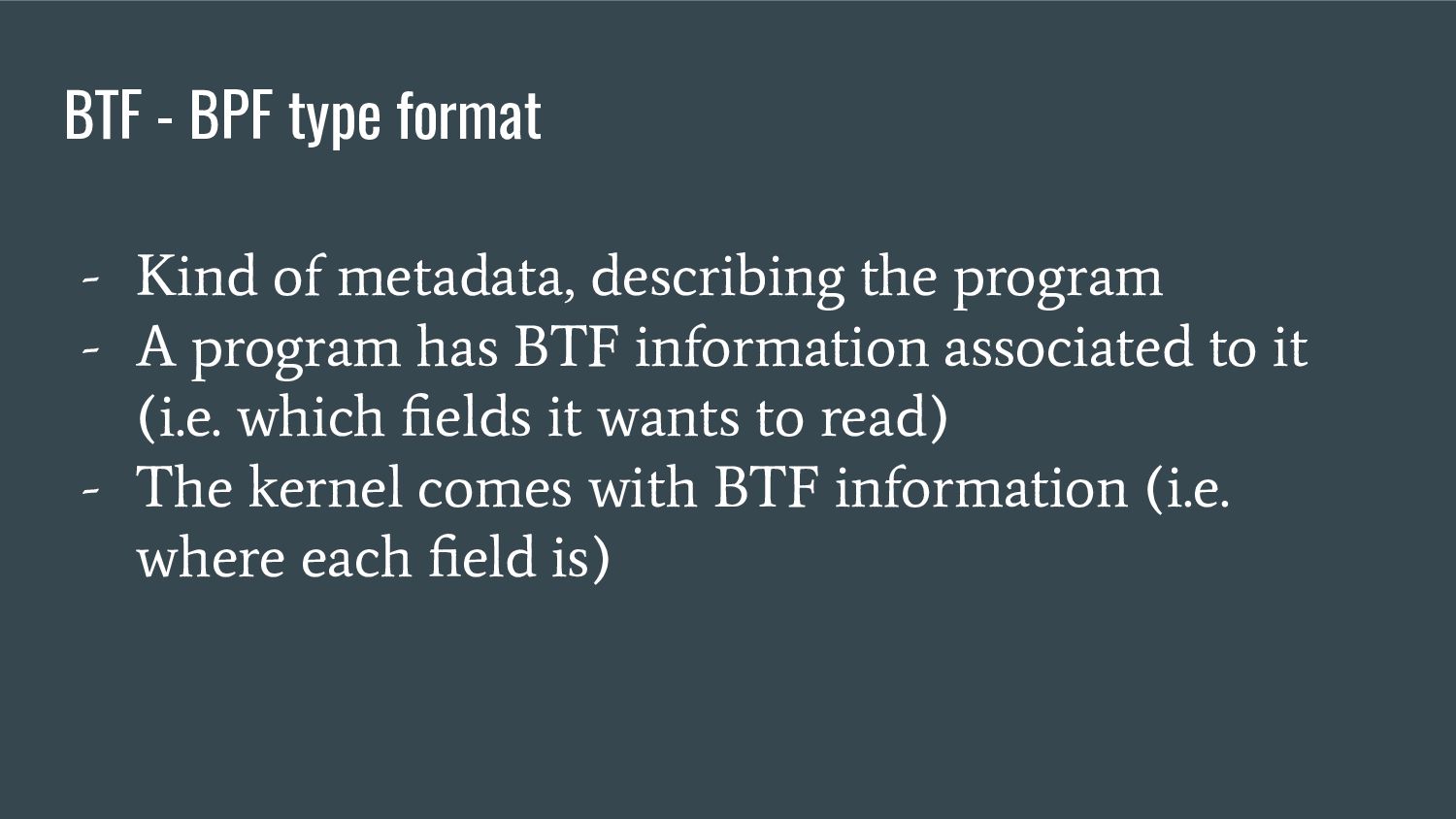
BTF - BPF type format - Kind of metadata, describing
the program - A program has BTF information associated to it (i.e. which fields it wants to read) - The kernel comes with BTF information (i.e. where each field is) -
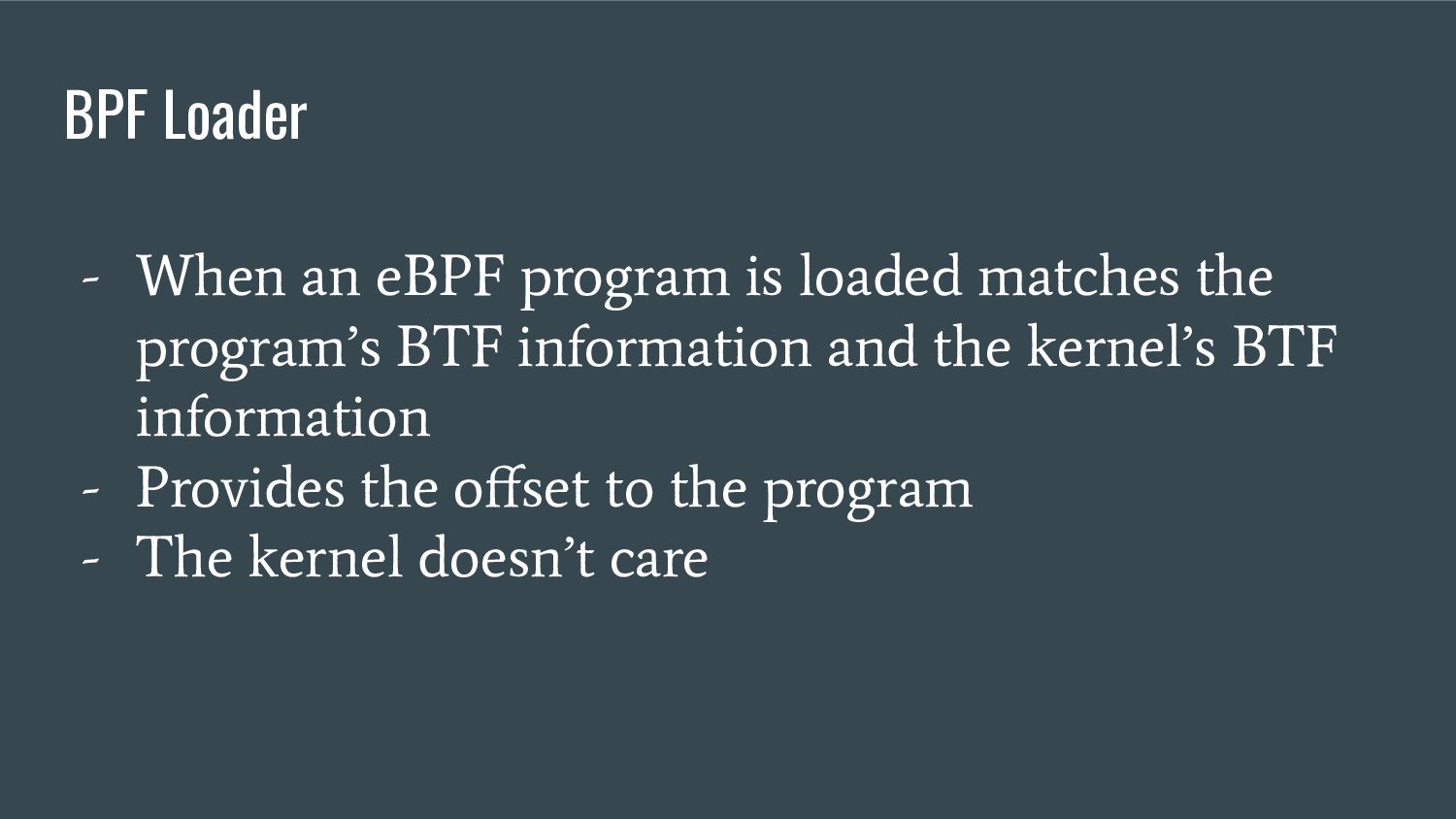
BPF Loader - When an eBPF program is loaded matches
the program’s BTF information and the kernel’s BTF information - Provides the offset to the program - The kernel doesn’t care -
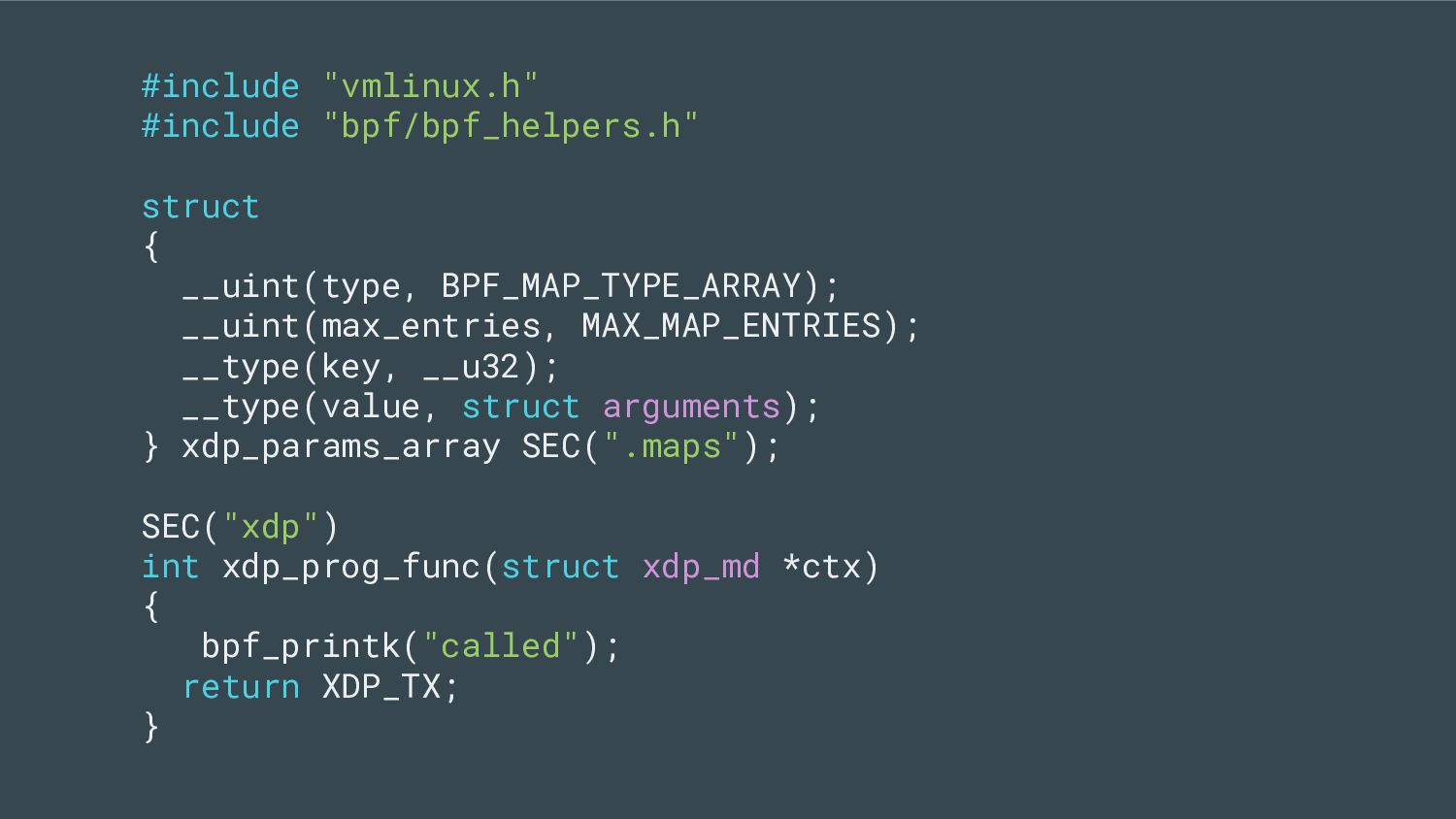
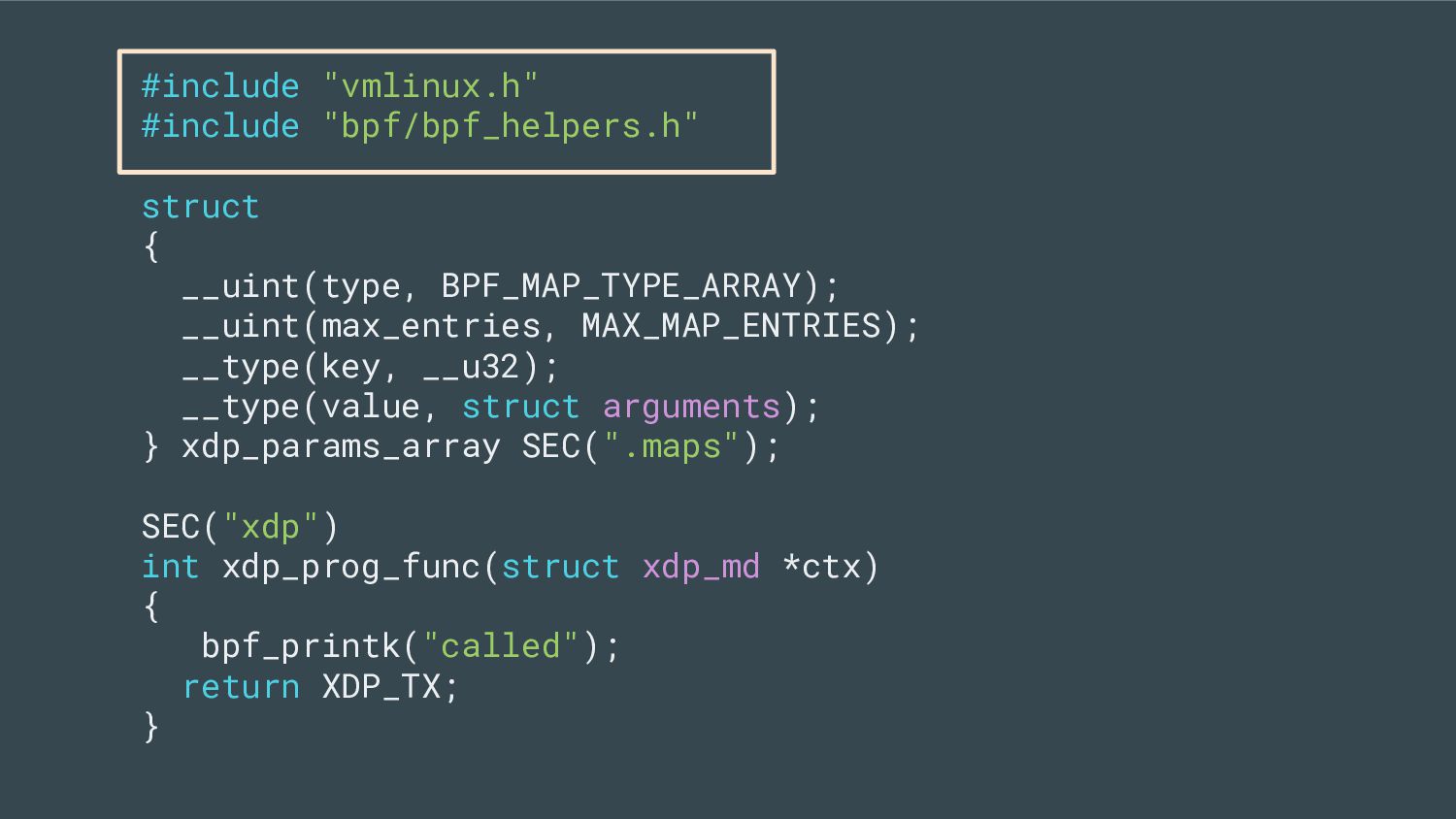
#include "vmlinux.h" #include "bpf/bpf_helpers.h" struct { __uint(type, BPF_MAP_TYPE_ARRAY); __uint(max_entries, MAX_MAP_ENTRIES);
__type(key, __u32); __type(value, struct arguments); } xdp_params_array SEC(".maps"); SEC("xdp") int xdp_prog_func(struct xdp_md *ctx) { bpf_printk("called"); return XDP_TX; } -
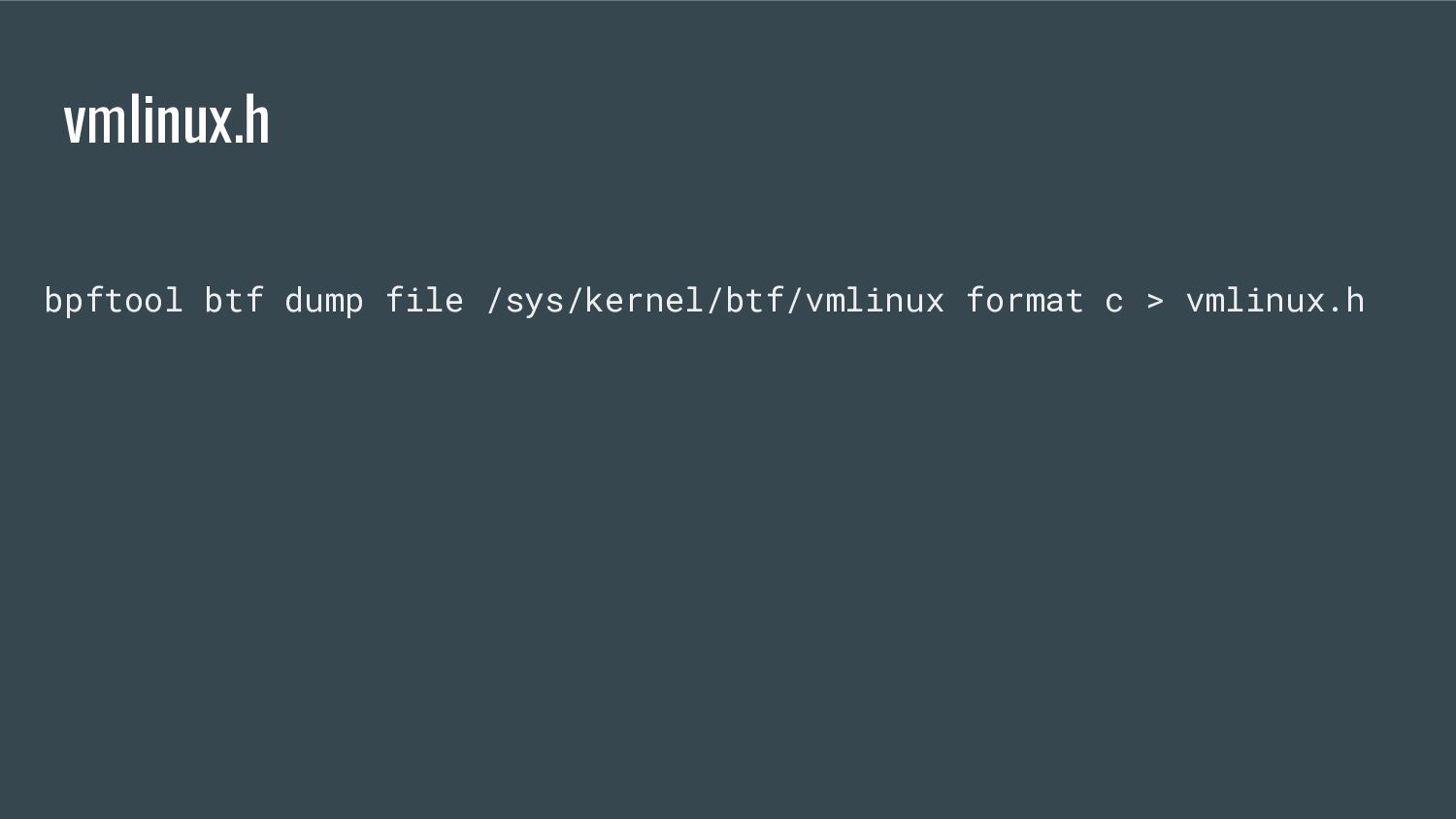
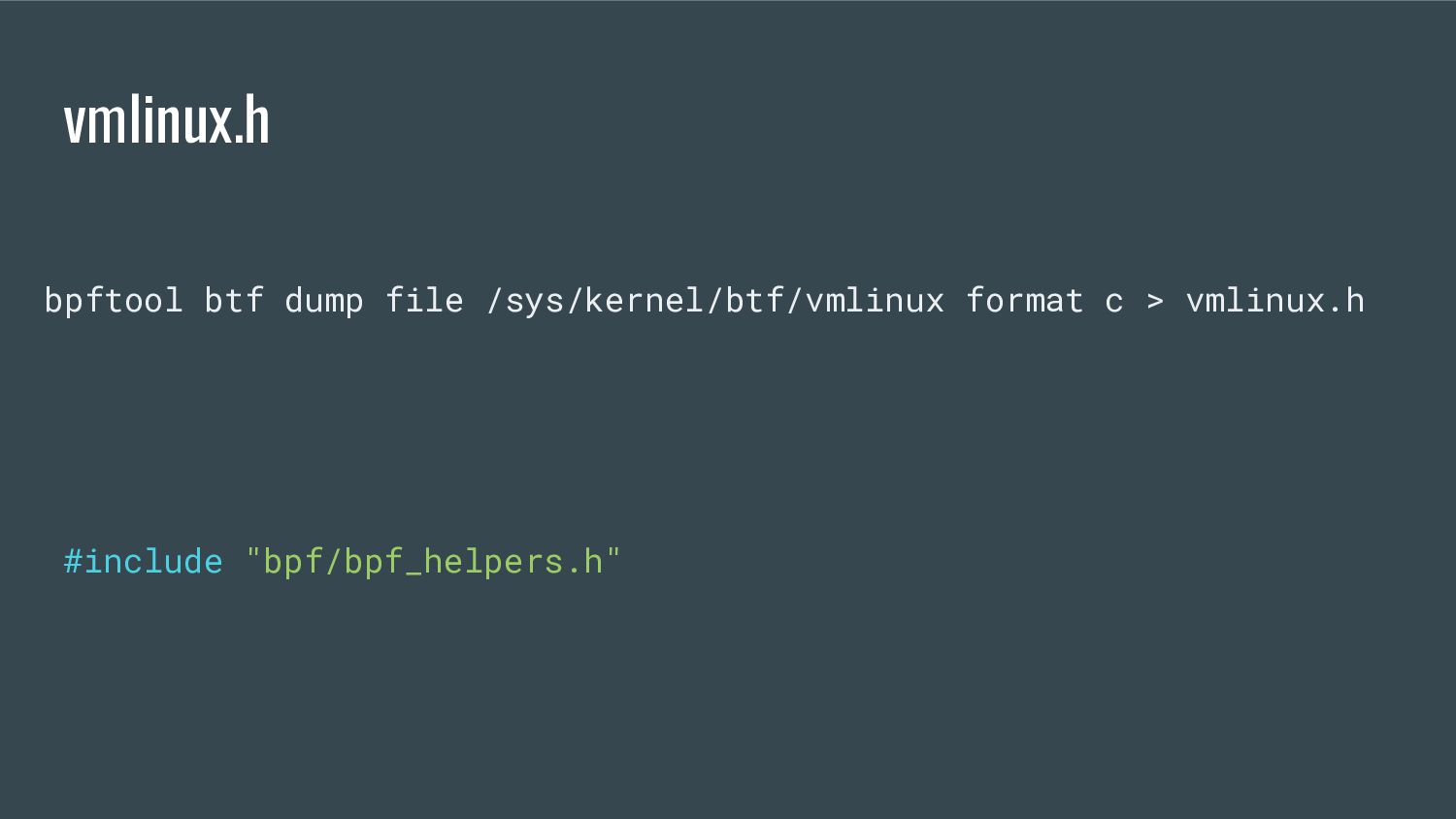
vmlinux.h bpftool btf dump file /sys/kernel/btf/vmlinux format c > vmlinux.h
#include "bpf/bpf_helpers.h" -
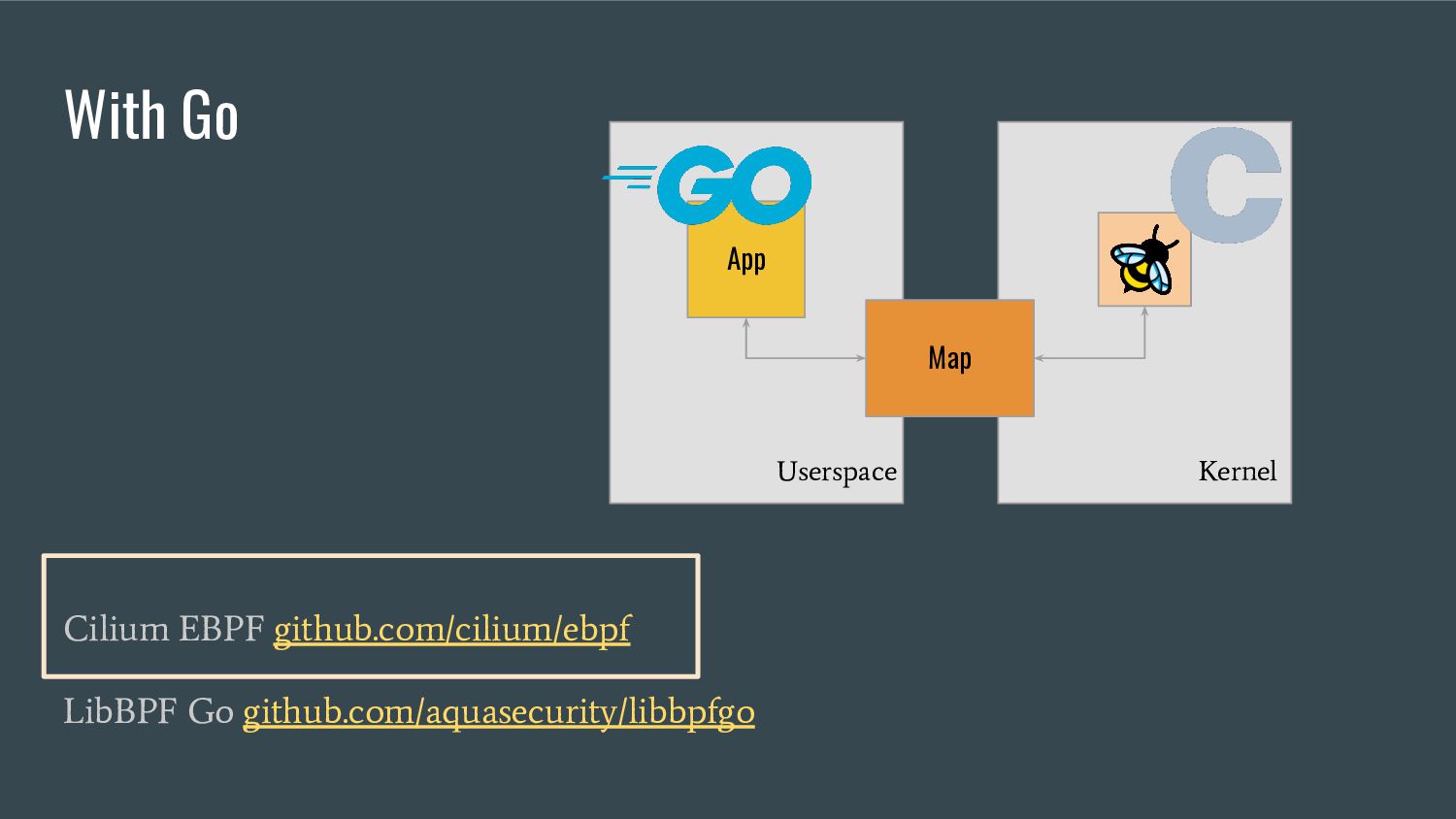
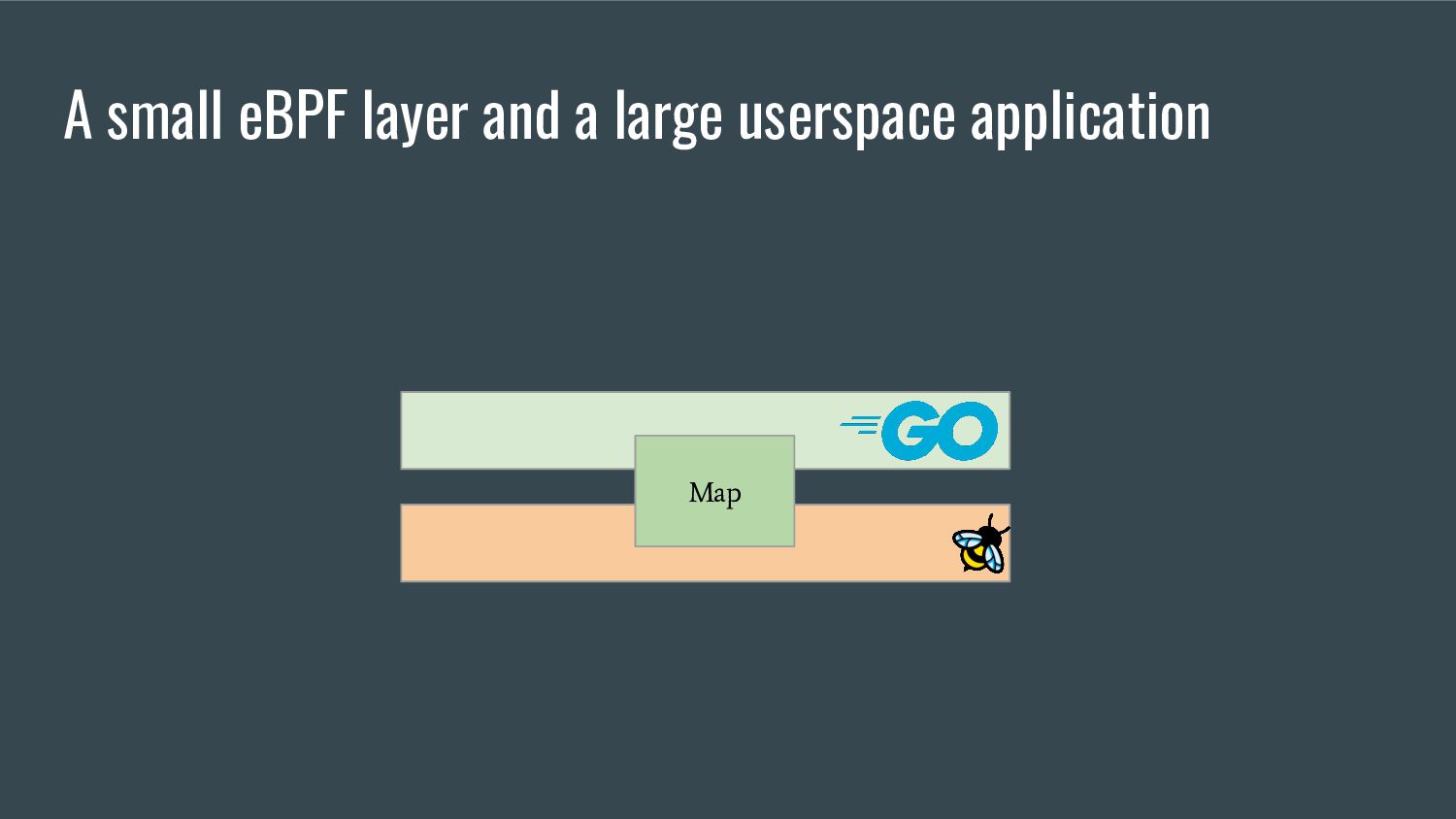
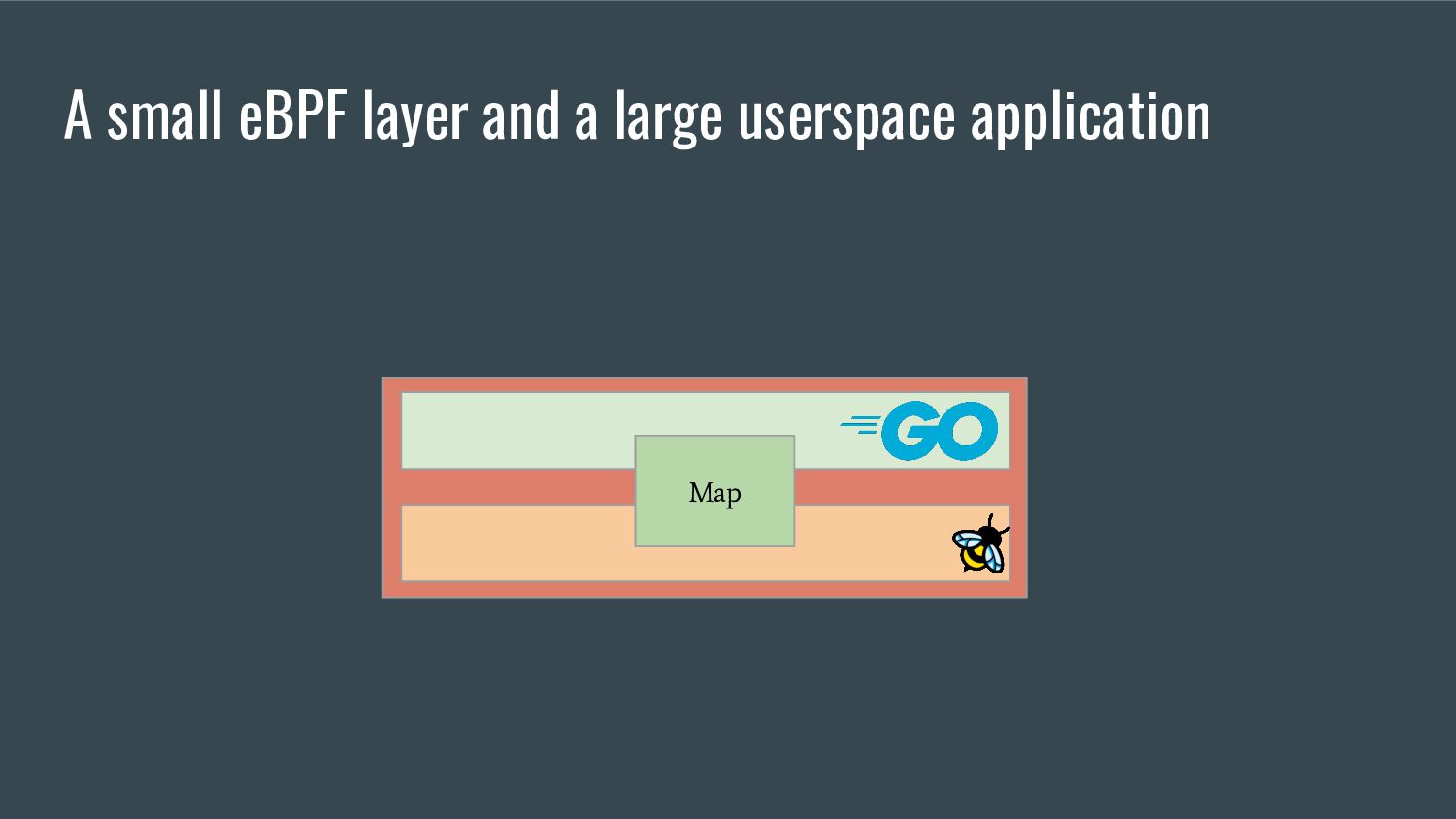
App Kernel Userspace Map With Go Cilium EBPF github.com/cilium/ebpf LibBPF
Go github.com/aquasecurity/libbpfgo -
App Kernel Userspace Map With Go Cilium EBPF github.com/cilium/ebpf LibBPF
Go github.com/aquasecurity/libbpfgo -
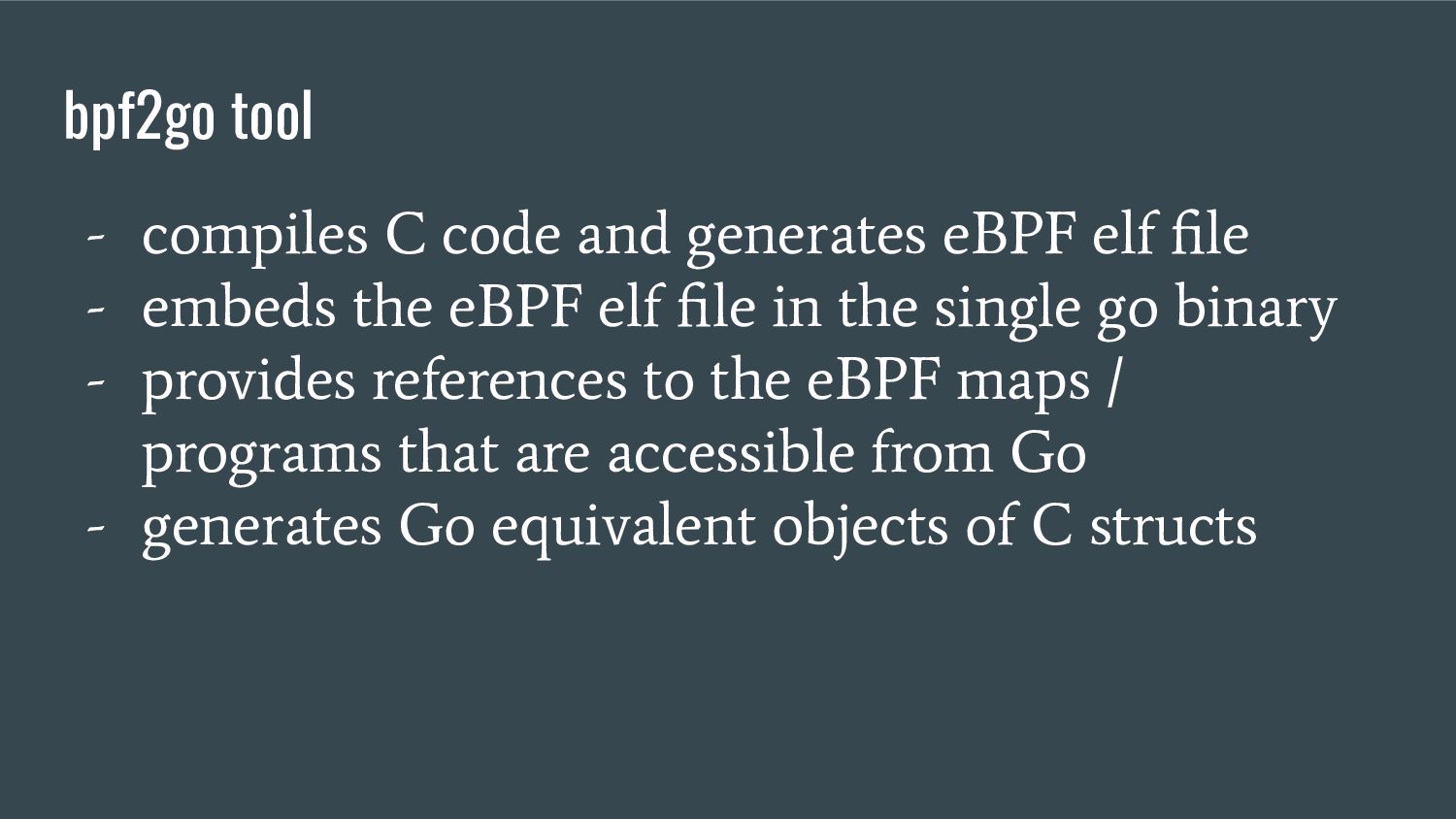
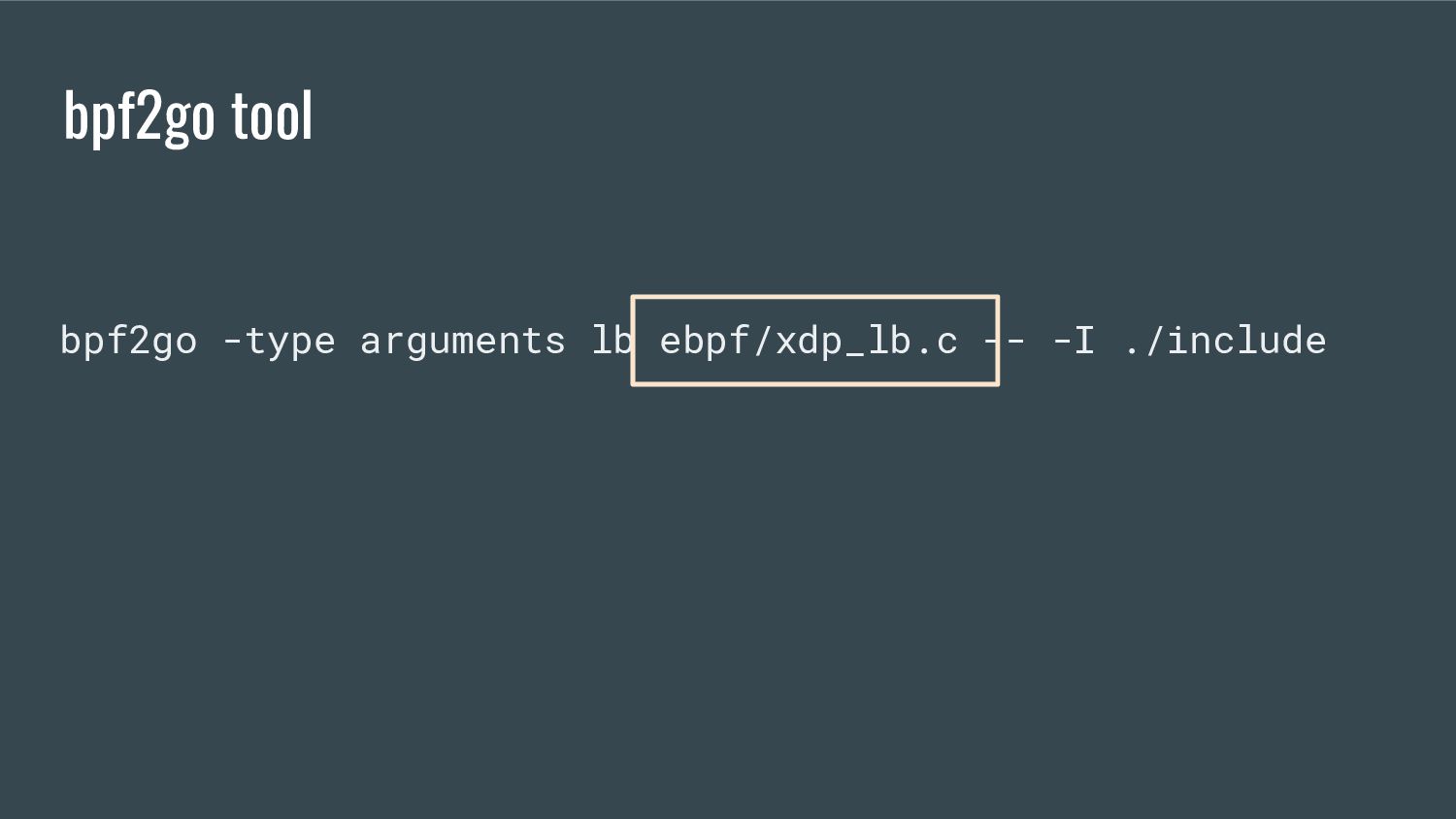
- compiles C code and generates eBPF elf file -
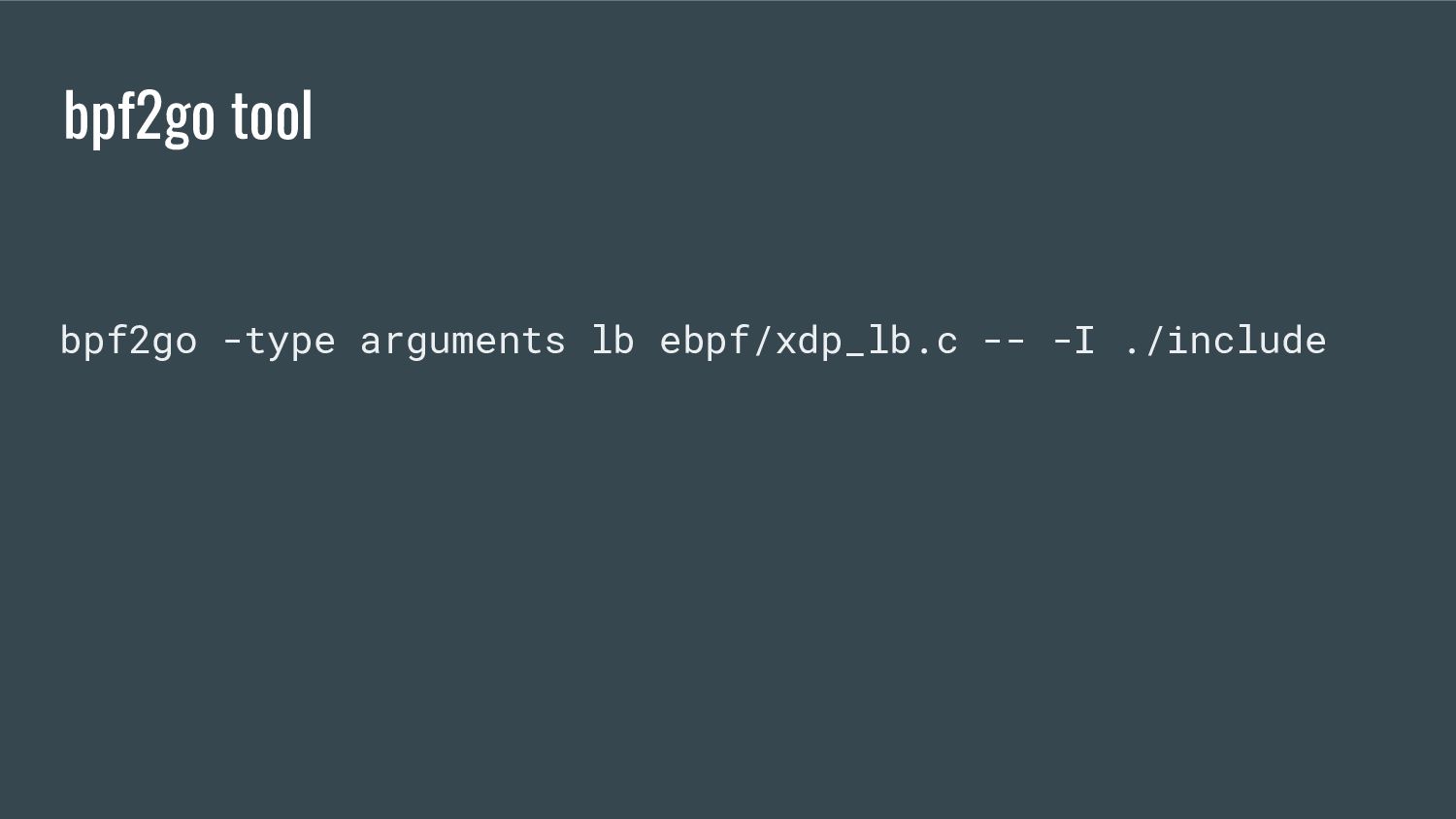
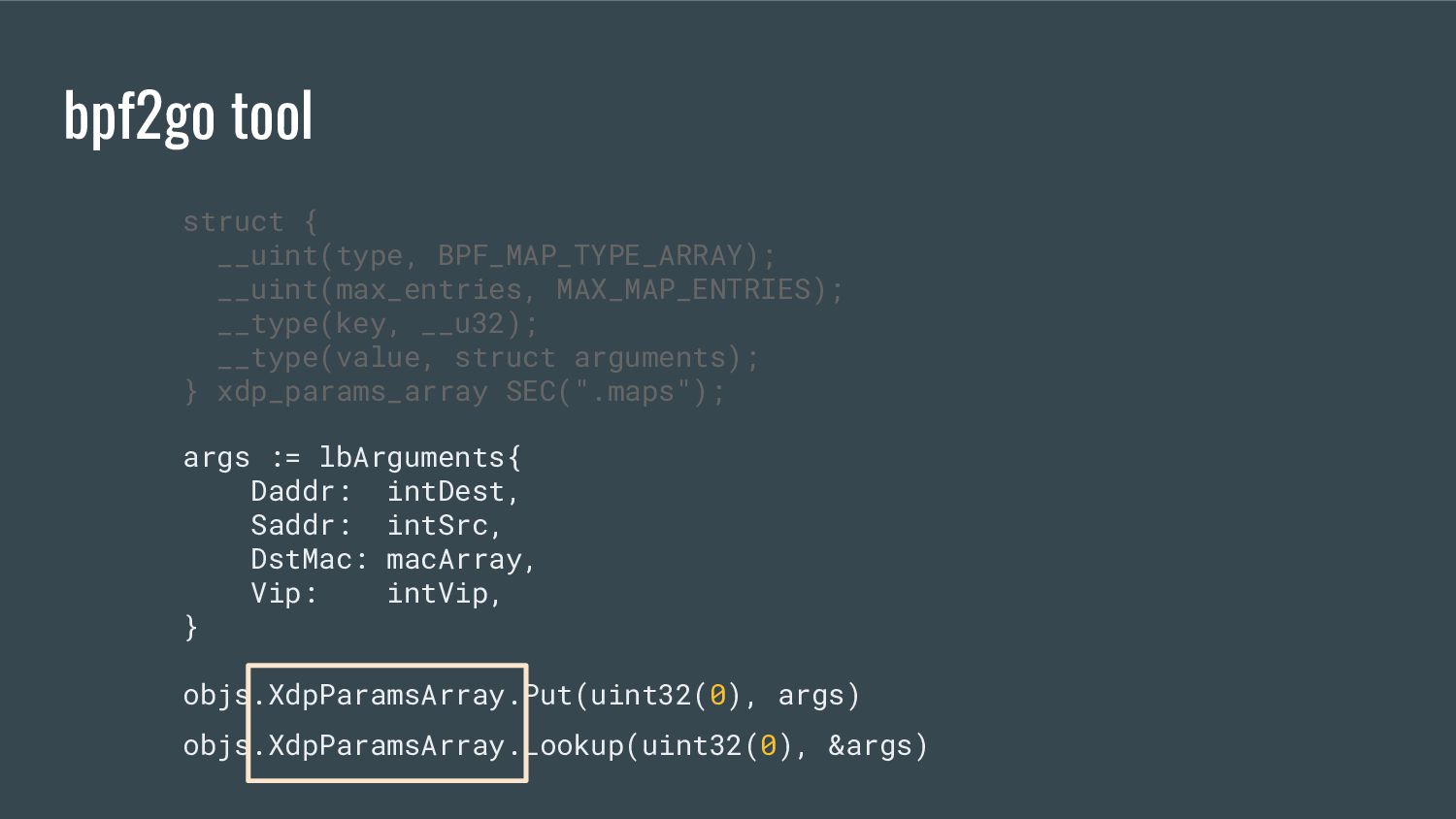
embeds the eBPF elf file in the single go binary - provides references to the eBPF maps / programs that are accessible from Go - generates Go equivalent objects of C structs bpf2go tool -
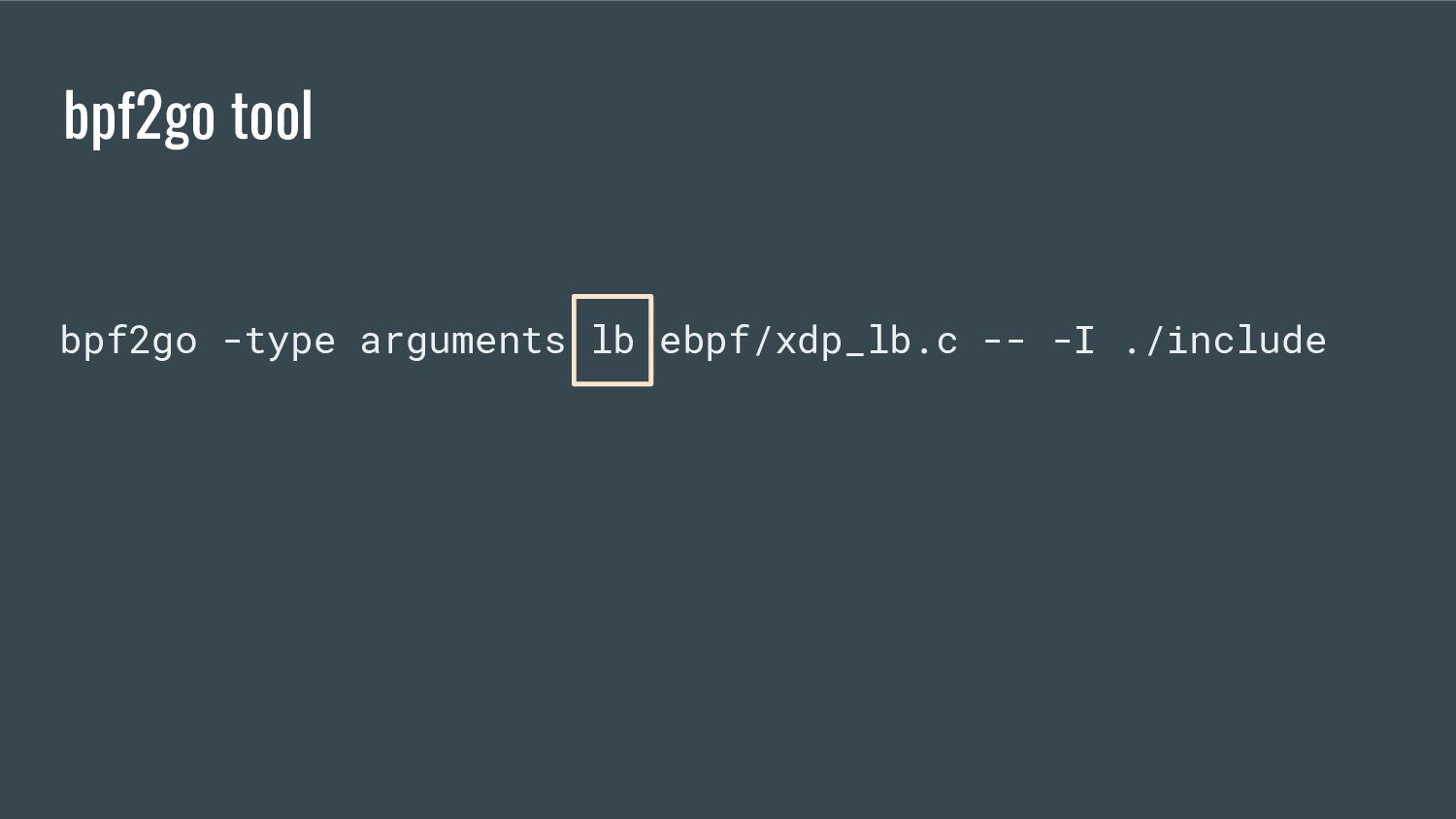
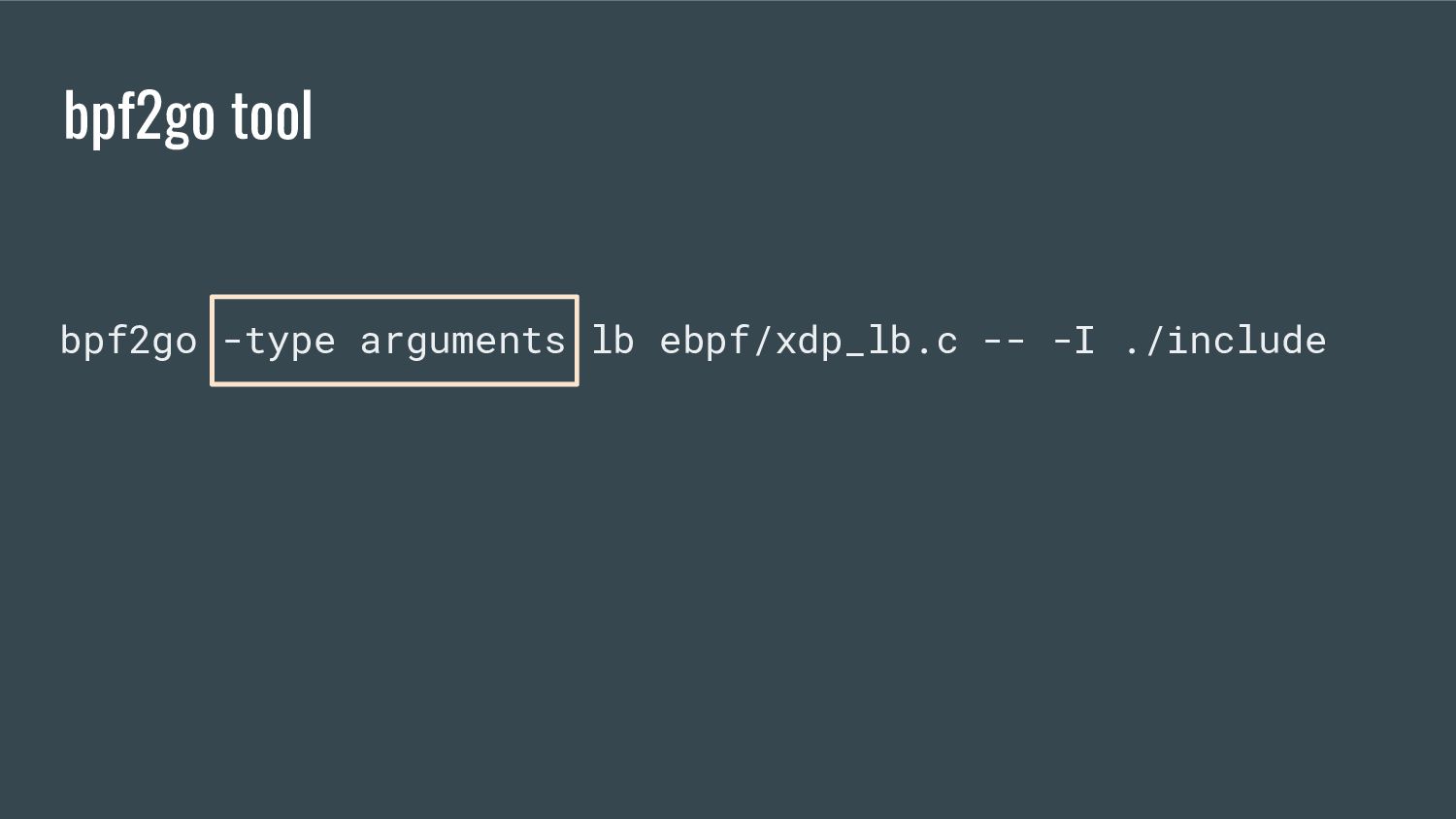
bpf2go tool struct arguments { __u8 dst_mac[6]; __u32 daddr; __u32
saddr; __u32 vip; }; type lbArguments struct { DstMac [6]uint8 _ [2]byte Daddr uint32 Saddr uint32 Vip uint32 } -
bpf2go tool struct arguments { __u8 dst_mac[6]; __u32 daddr; __u32
saddr; __u32 vip; }; type lbArguments struct { DstMac [6]uint8 _ [2]byte Daddr uint32 Saddr uint32 Vip uint32 } -
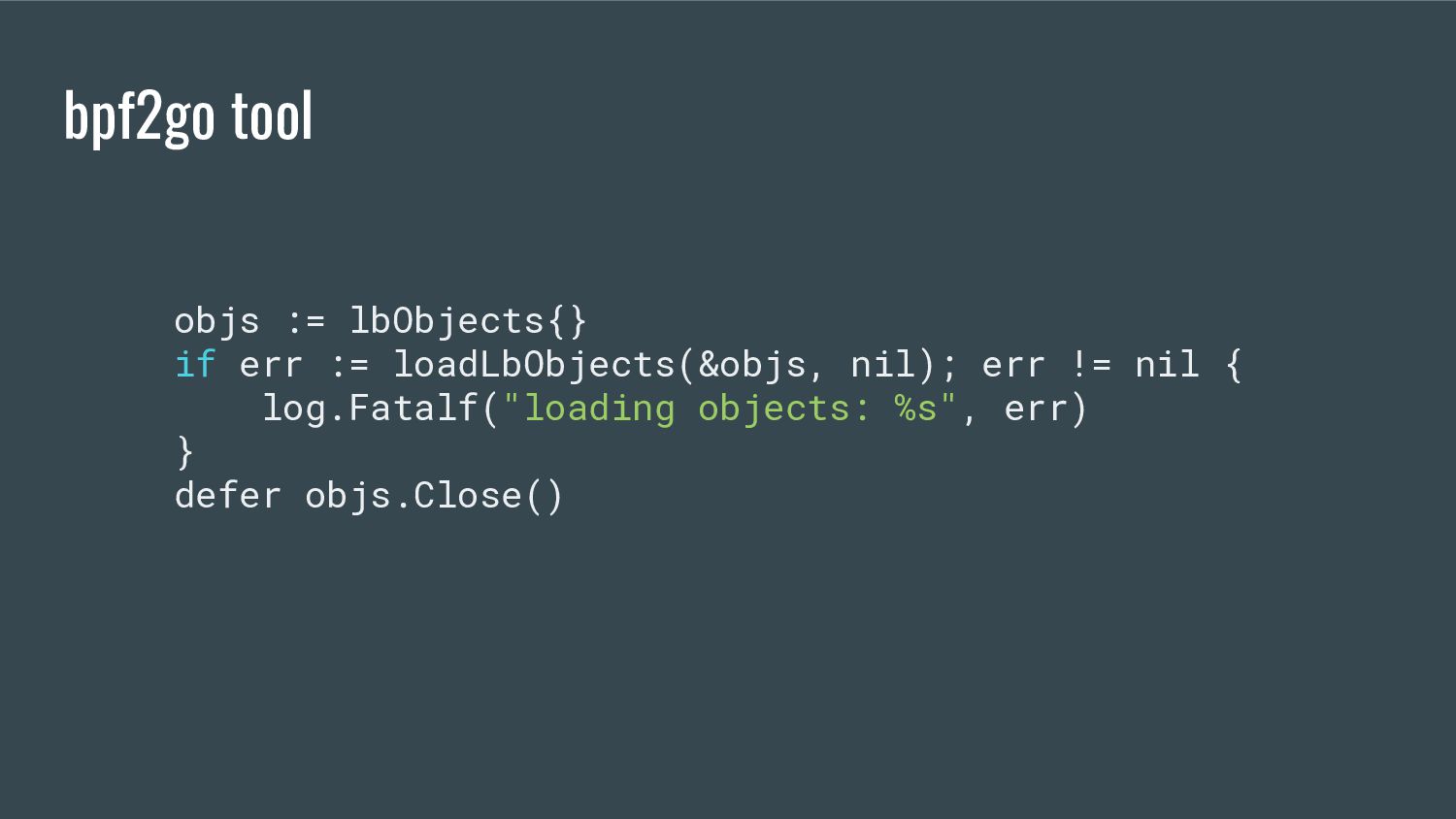
bpf2go tool objs := lbObjects{} if err := loadLbObjects(&objs, nil);
err != nil { log.Fatalf("loading objects: %s", err) } defer objs.Close() -
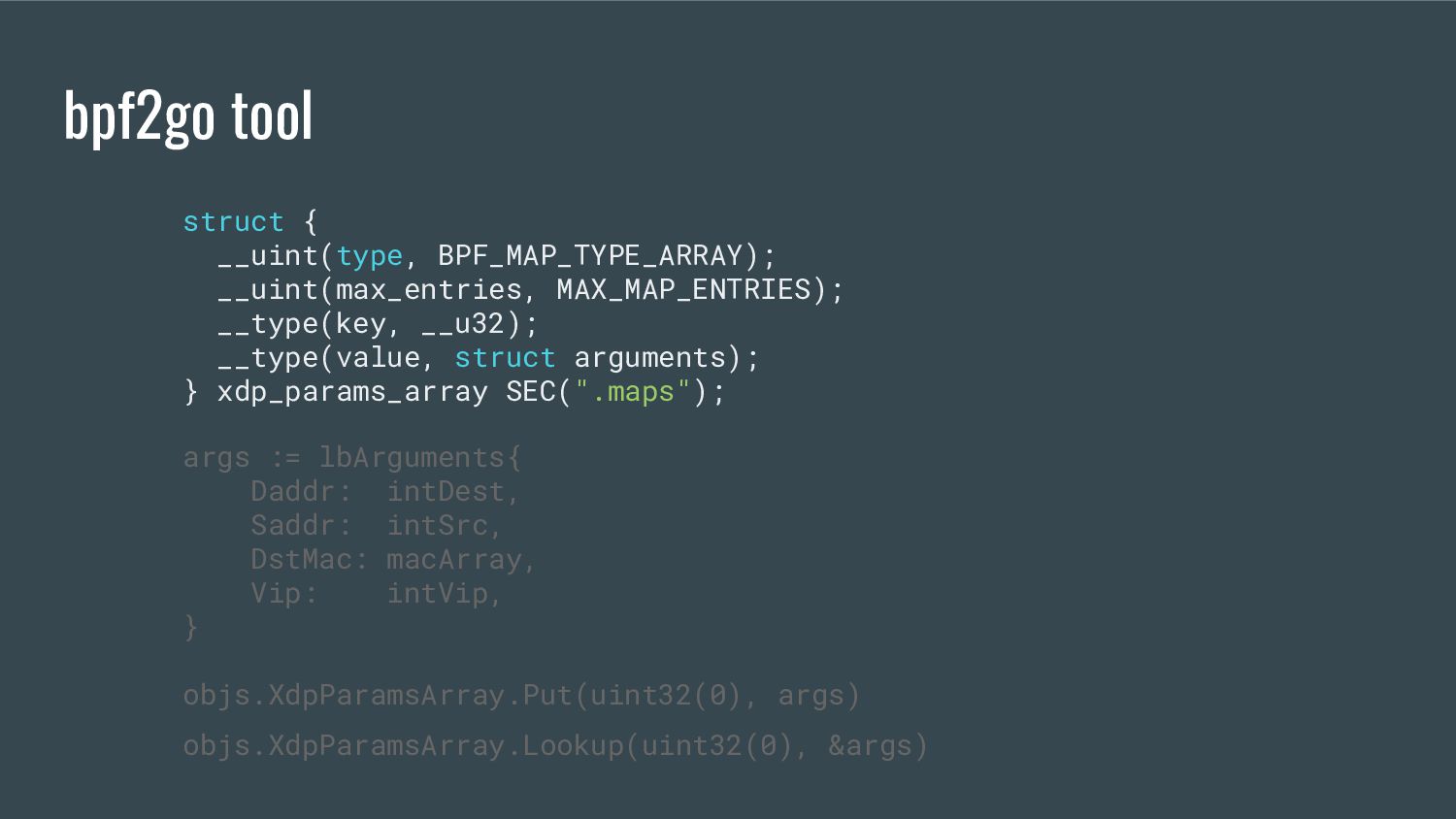
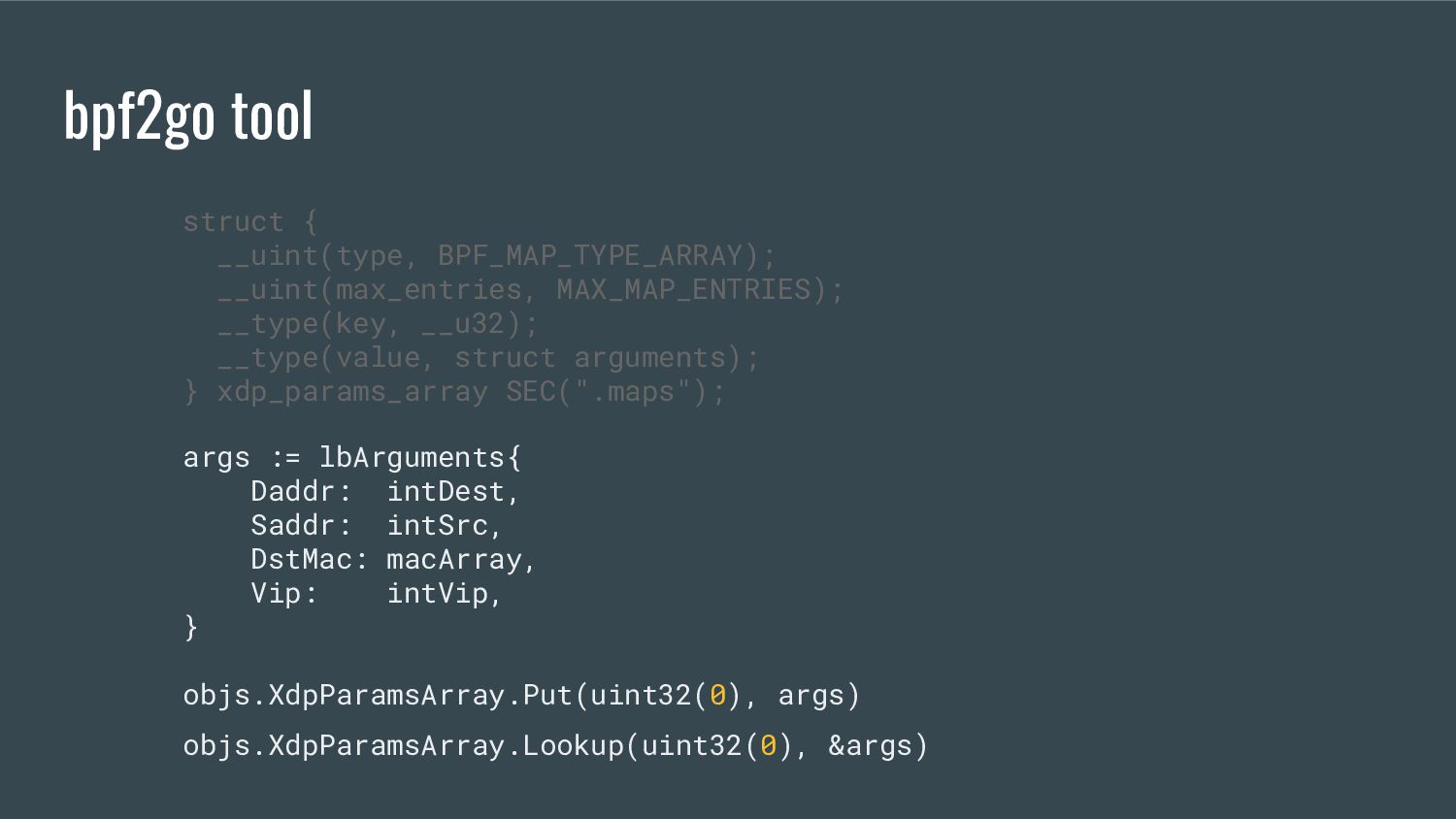
bpf2go tool args := lbArguments{ Daddr: intDest, Saddr: intSrc, DstMac:
macArray, Vip: intVip, } objs.XdpParamsArray.Put(uint32(0), args) objs.XdpParamsArray.Lookup(uint32(0), &args) struct { __uint(type, BPF_MAP_TYPE_ARRAY); __uint(max_entries, MAX_MAP_ENTRIES); __type(key, __u32); __type(value, struct arguments); } xdp_params_array SEC(".maps"); -
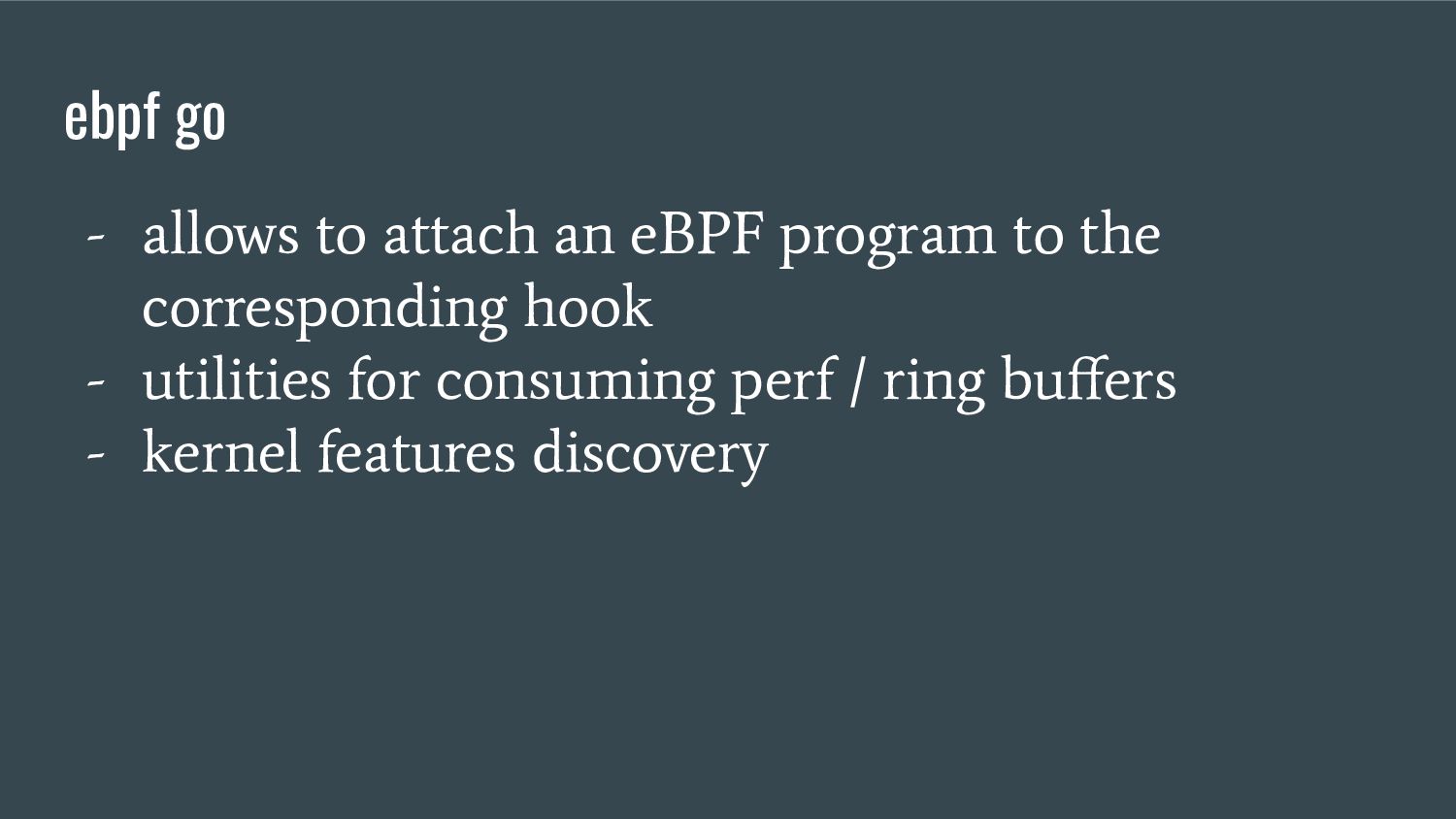
- allows to attach an eBPF program to the corresponding
hook - utilities for consuming perf / ring buffers - kernel features discovery ebpf go -
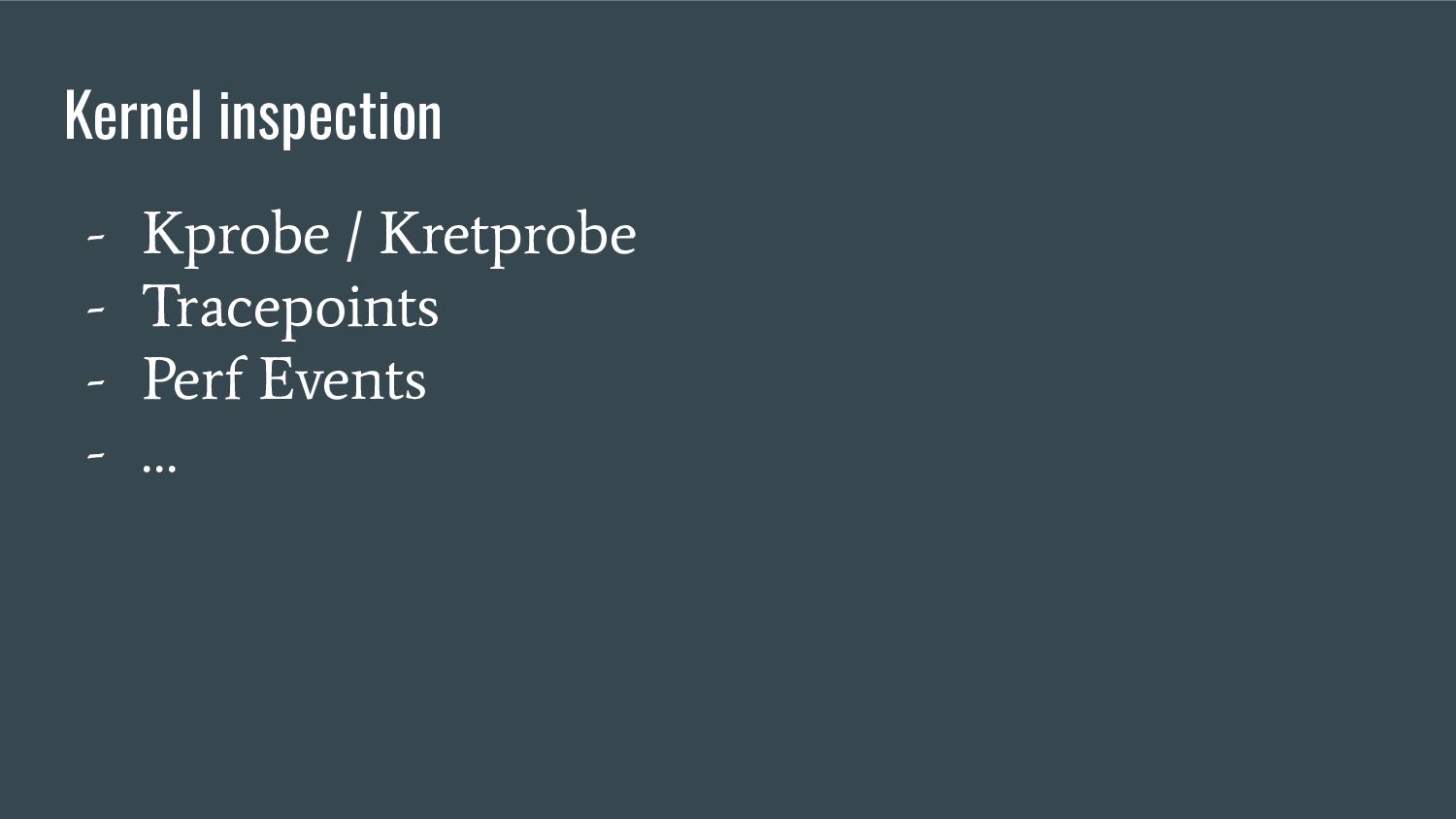
- Kprobe / Kretprobe - Tracepoints - Perf Events -
… Kernel inspection -
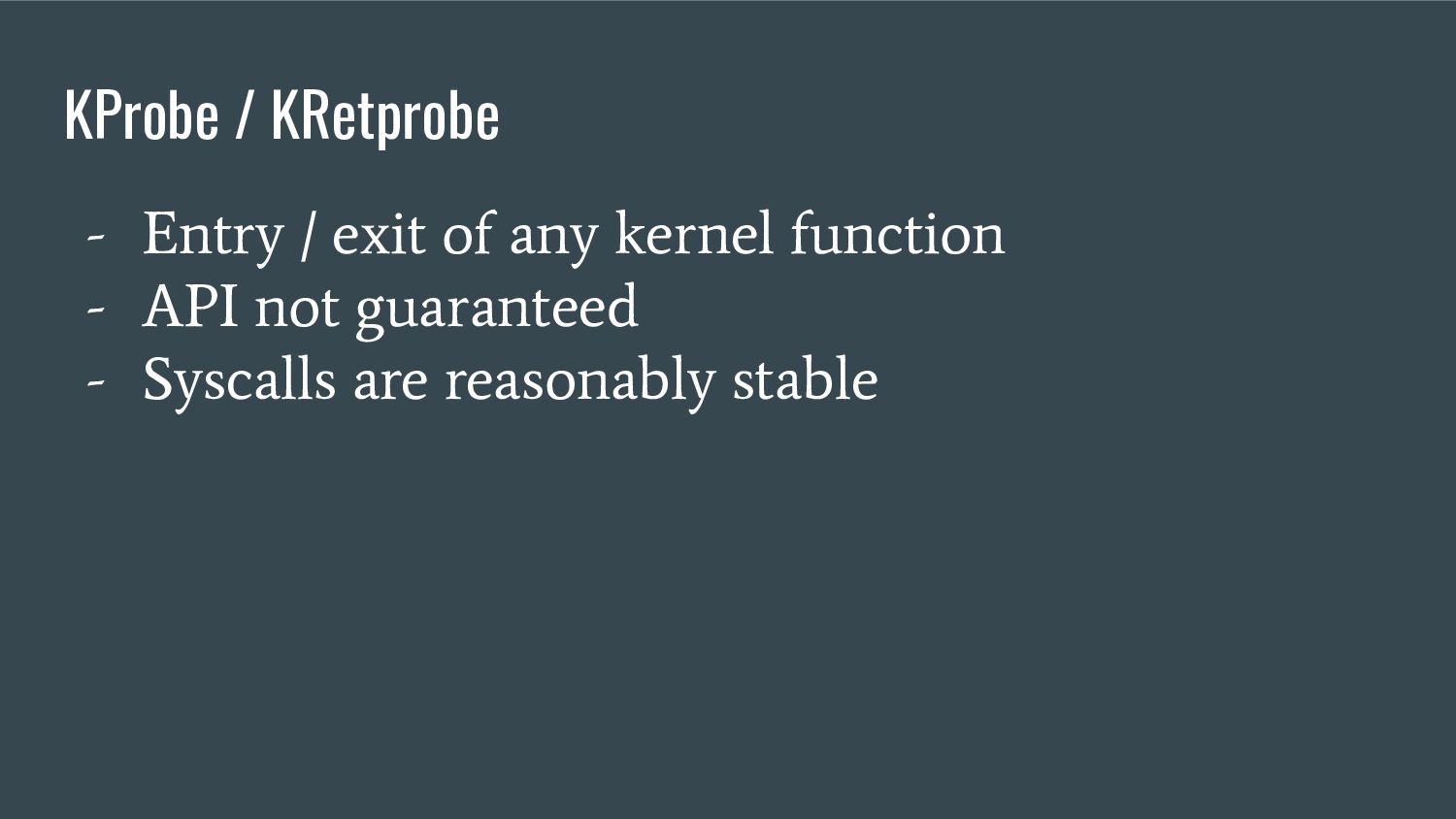
- Entry / exit of any kernel function - API
not guaranteed - Syscalls are reasonably stable KProbe / KRetprobe -
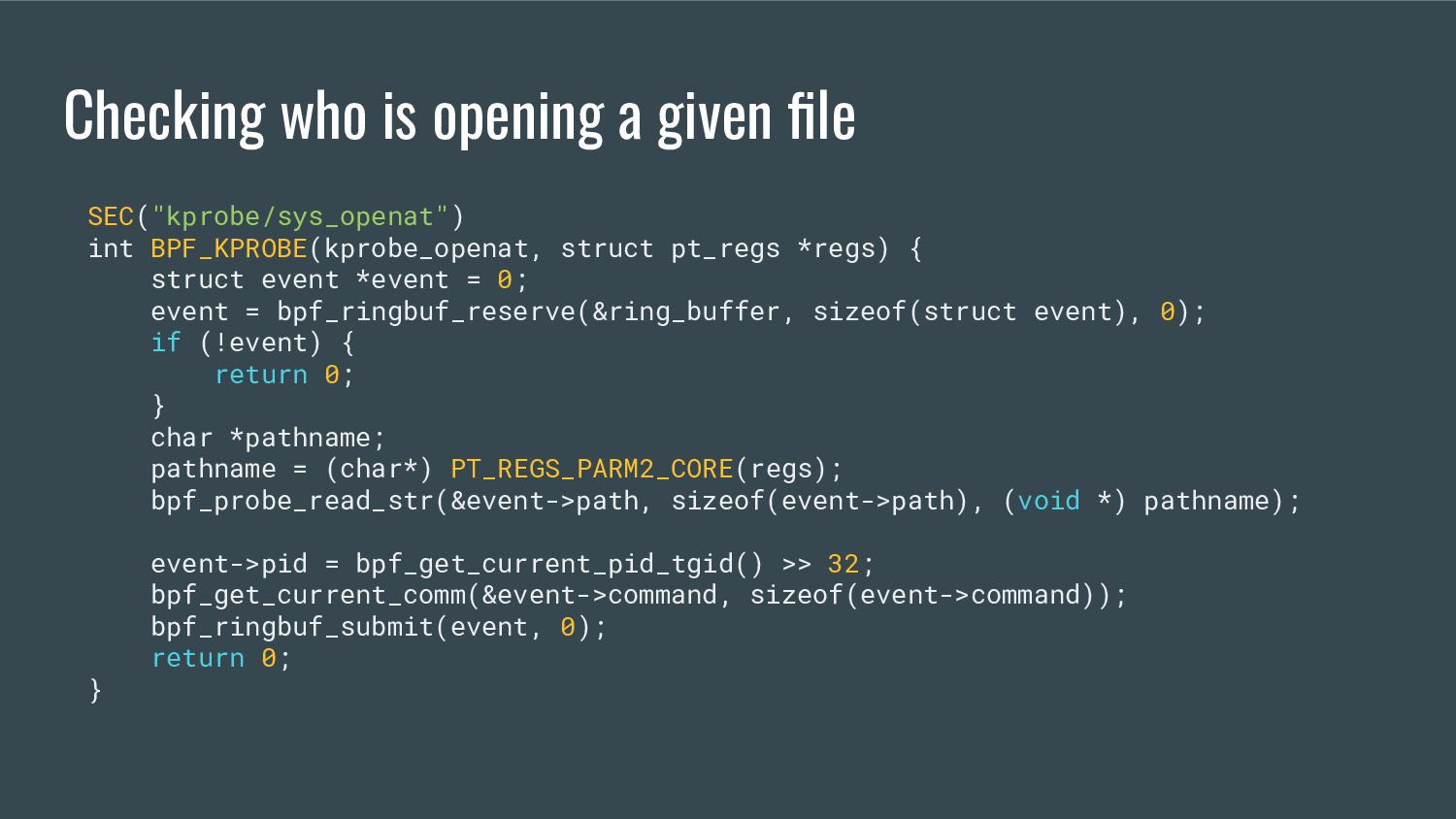
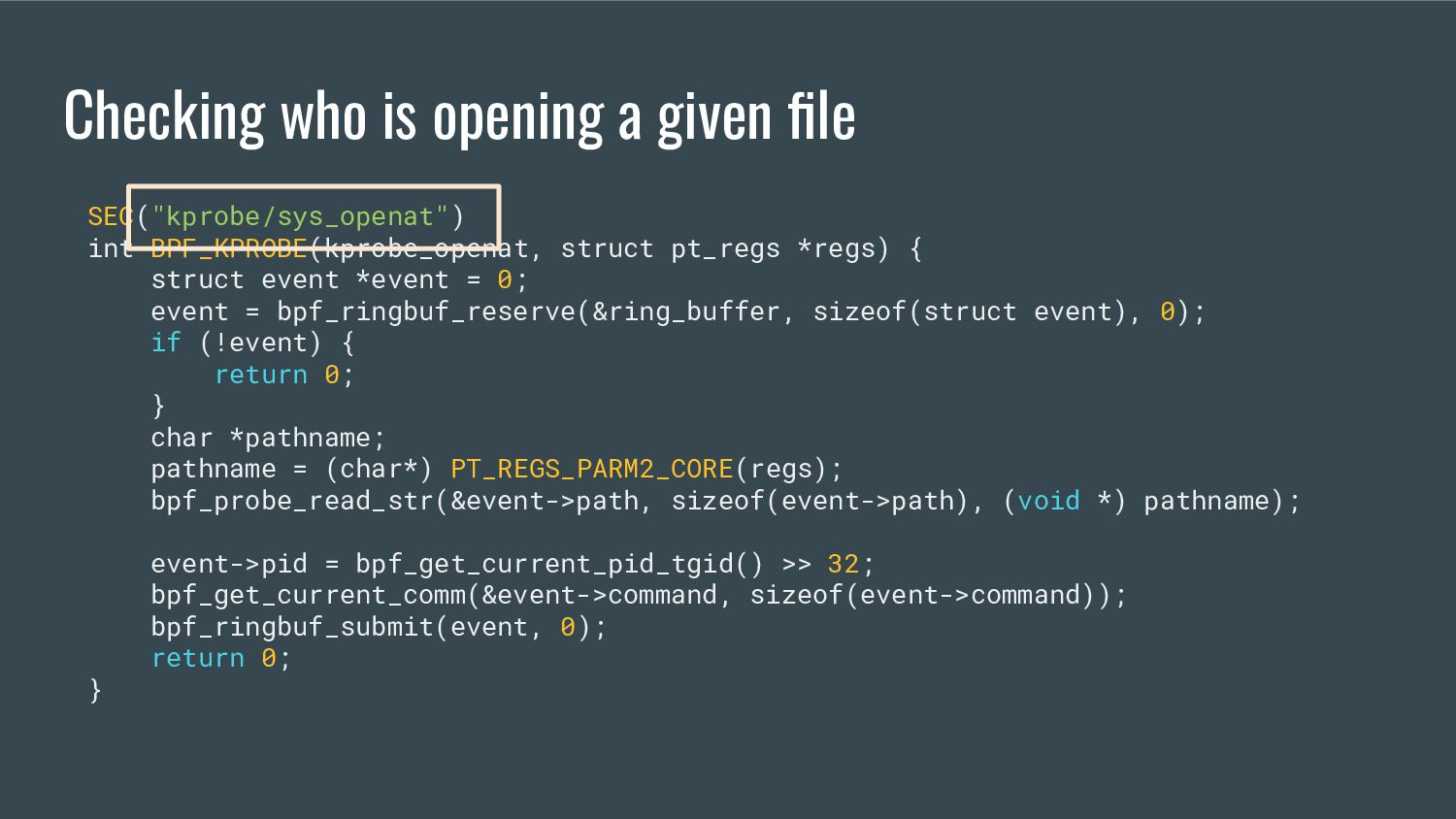
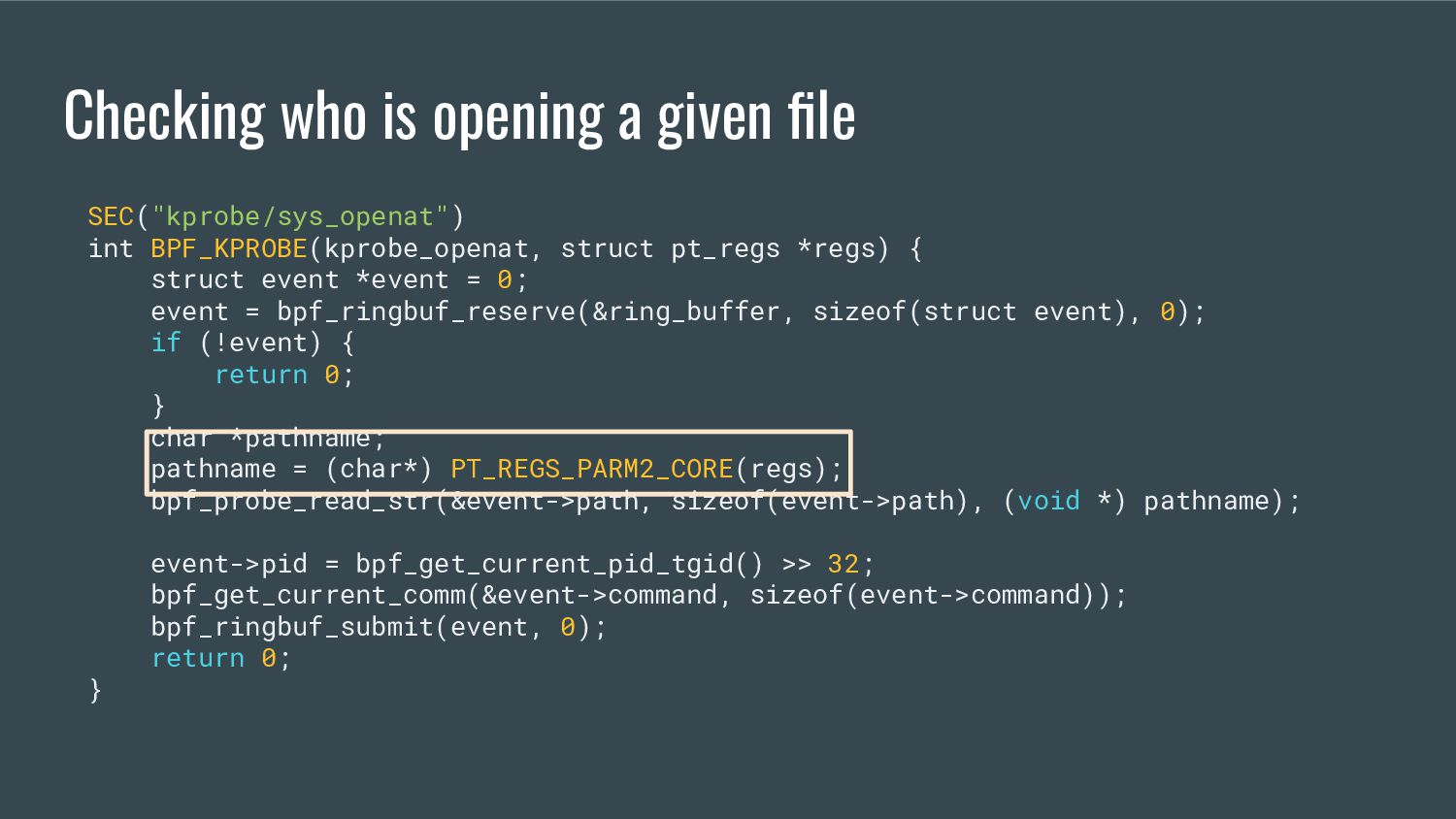
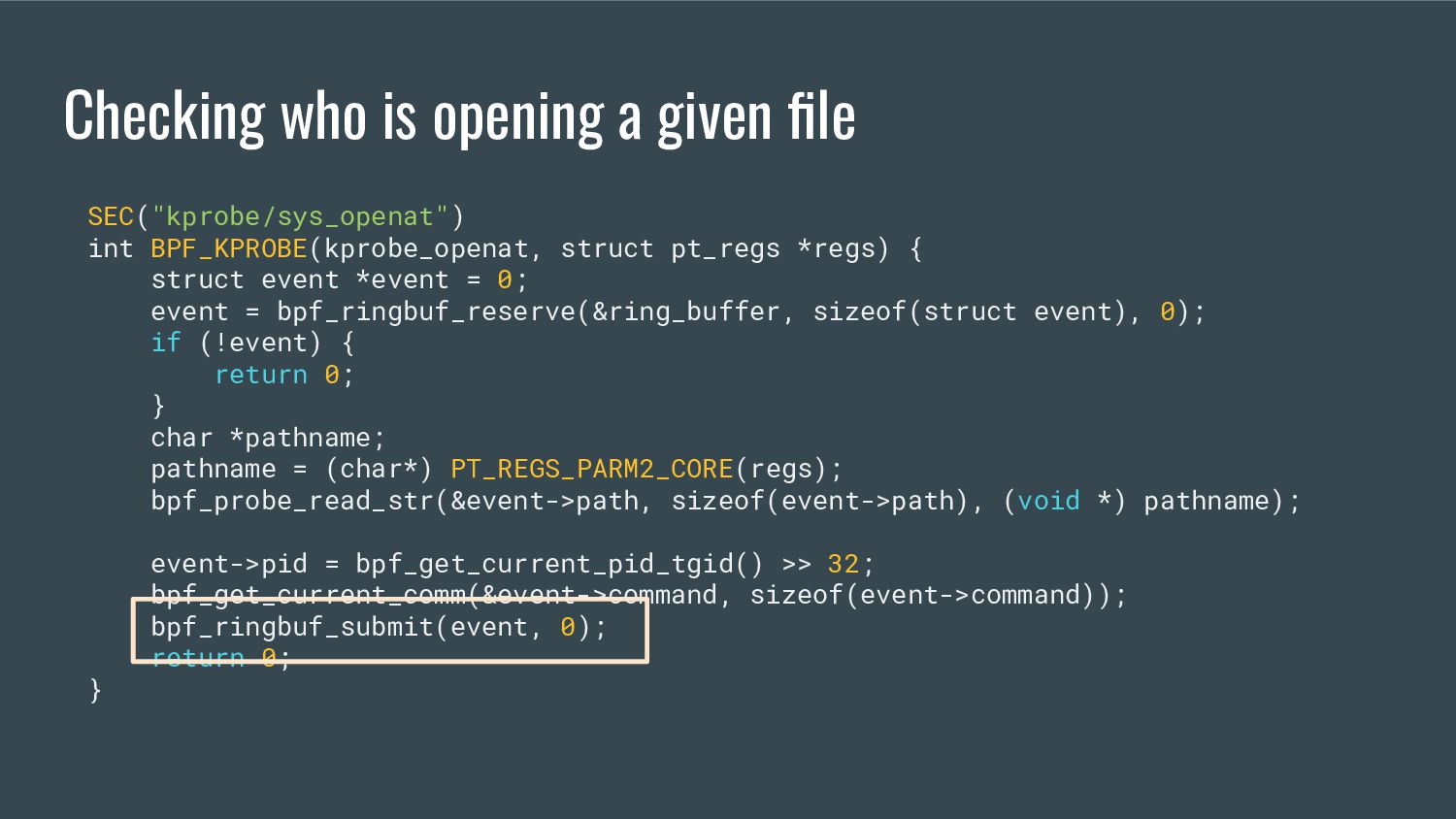
Checking who is opening a given file SEC("kprobe/sys_openat") int BPF_KPROBE(kprobe_openat,
struct pt_regs *regs) { struct event *event = 0; event = bpf_ringbuf_reserve(&ring_buffer, sizeof(struct event), 0); if (!event) { return 0; } char *pathname; pathname = (char*) PT_REGS_PARM2_CORE(regs); bpf_probe_read_str(&event->path, sizeof(event->path), (void *) pathname); event->pid = bpf_get_current_pid_tgid() >> 32; bpf_get_current_comm(&event->command, sizeof(event->command)); bpf_ringbuf_submit(event, 0); return 0; } -
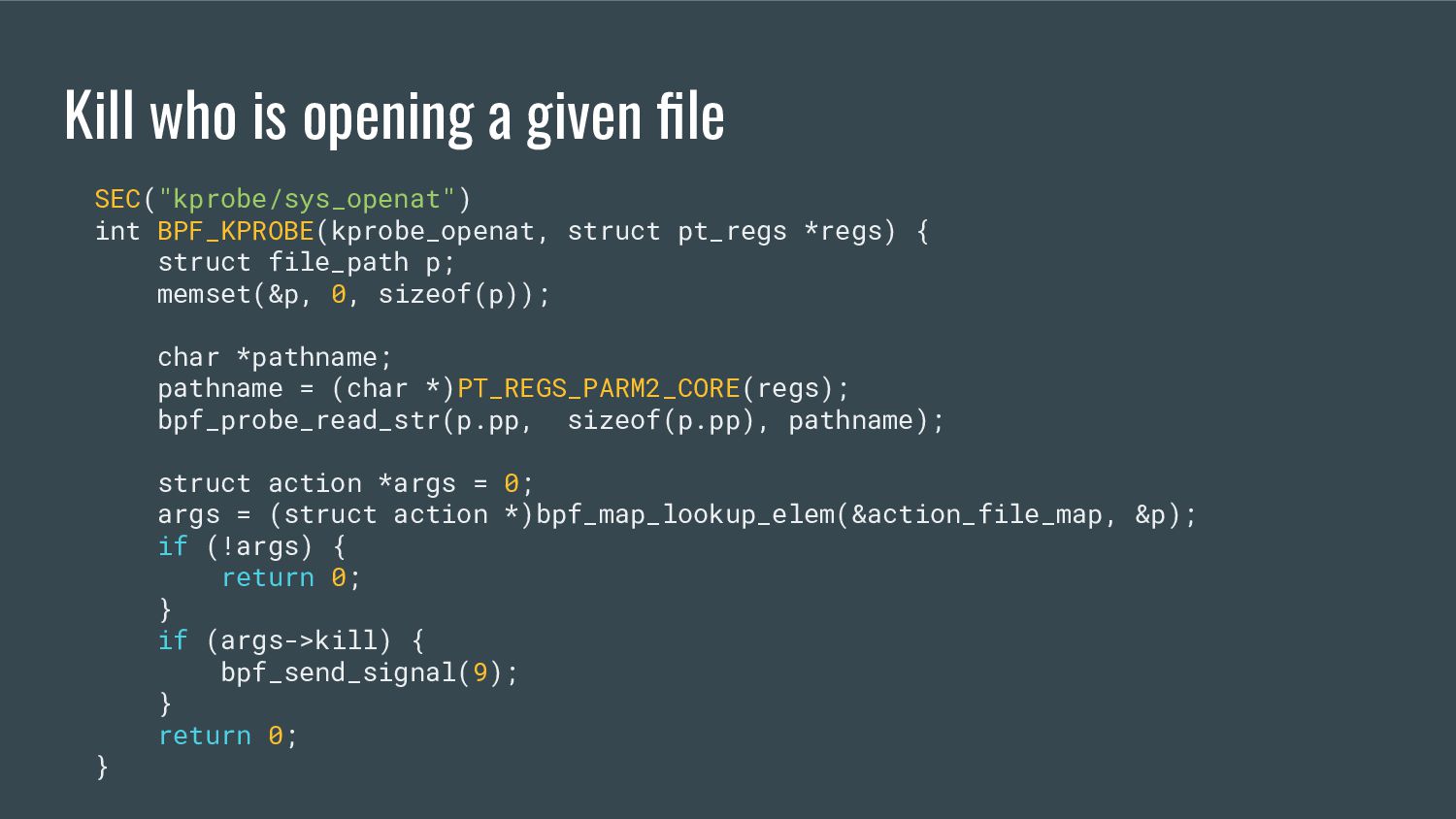
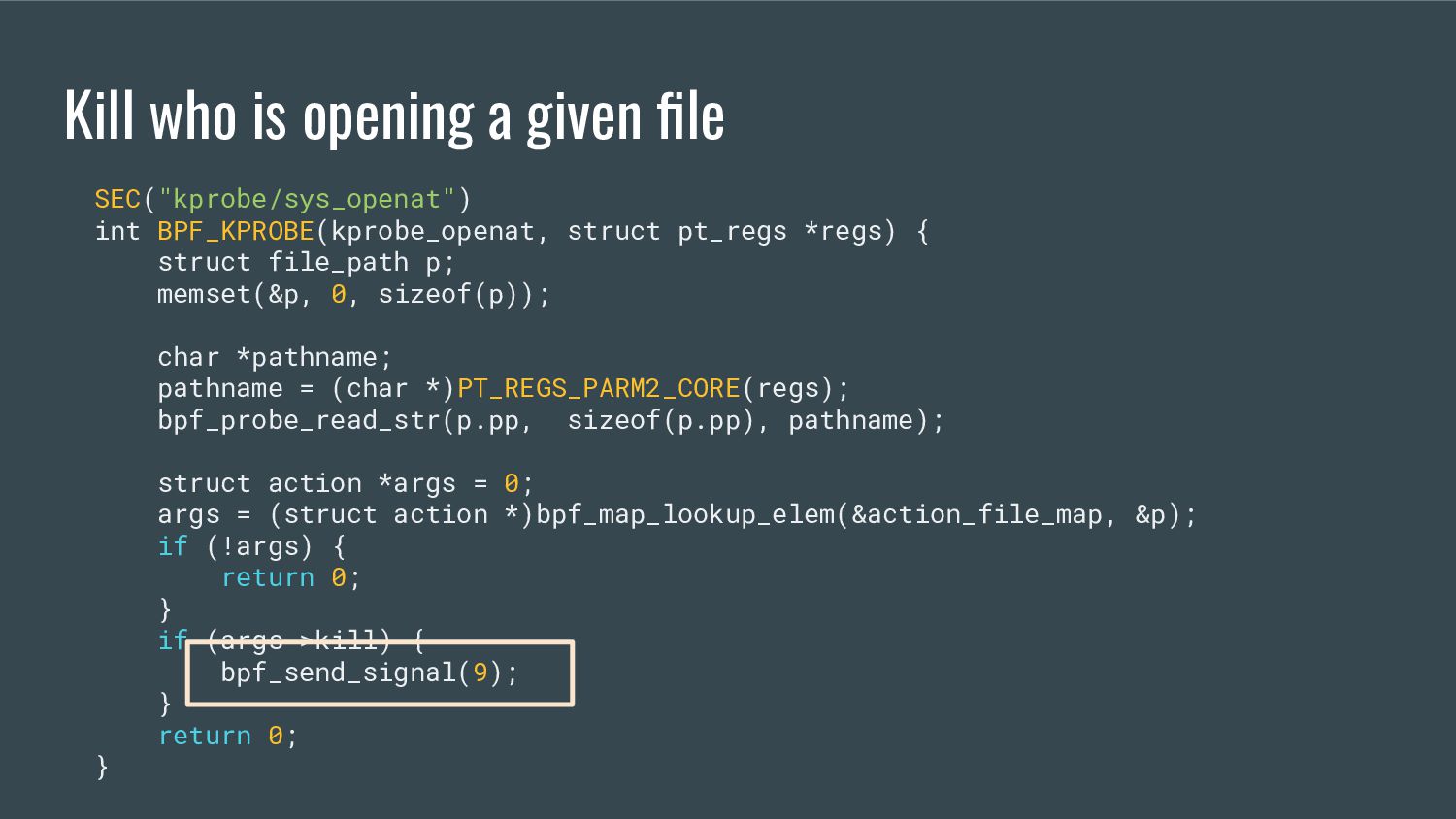
Kill who is opening a given file SEC("kprobe/sys_openat") int BPF_KPROBE(kprobe_openat,
struct pt_regs *regs) { struct file_path p; memset(&p, 0, sizeof(p)); char *pathname; pathname = (char *)PT_REGS_PARM2_CORE(regs); bpf_probe_read_str(p.pp, sizeof(p.pp), pathname); struct action *args = 0; args = (struct action *)bpf_map_lookup_elem(&action_file_map, &p); if (!args) { return 0; } if (args->kill) { bpf_send_signal(9); } return 0; } -
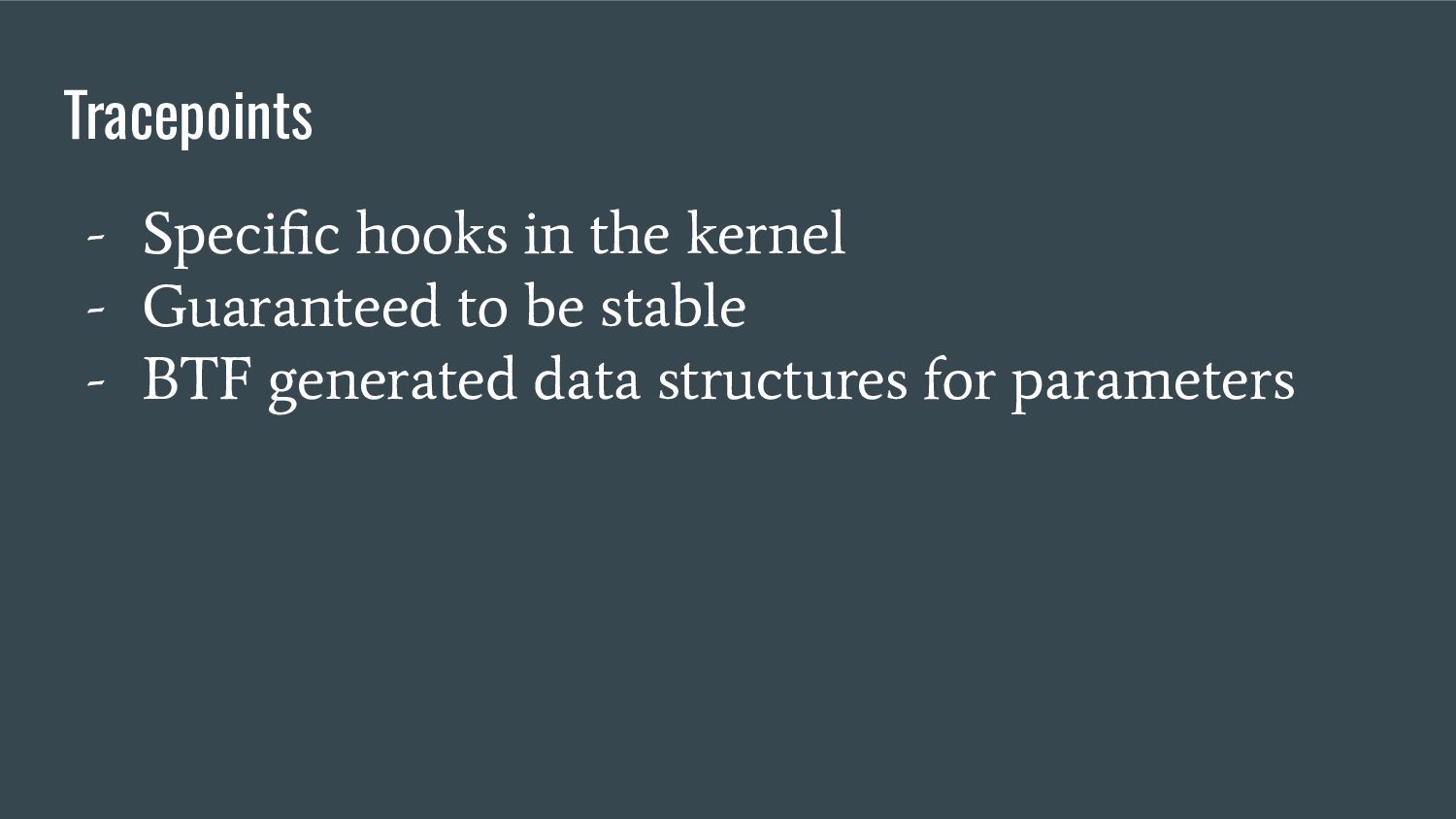
- Specific hooks in the kernel - Guaranteed to be
stable - BTF generated data structures for parameters Tracepoints -
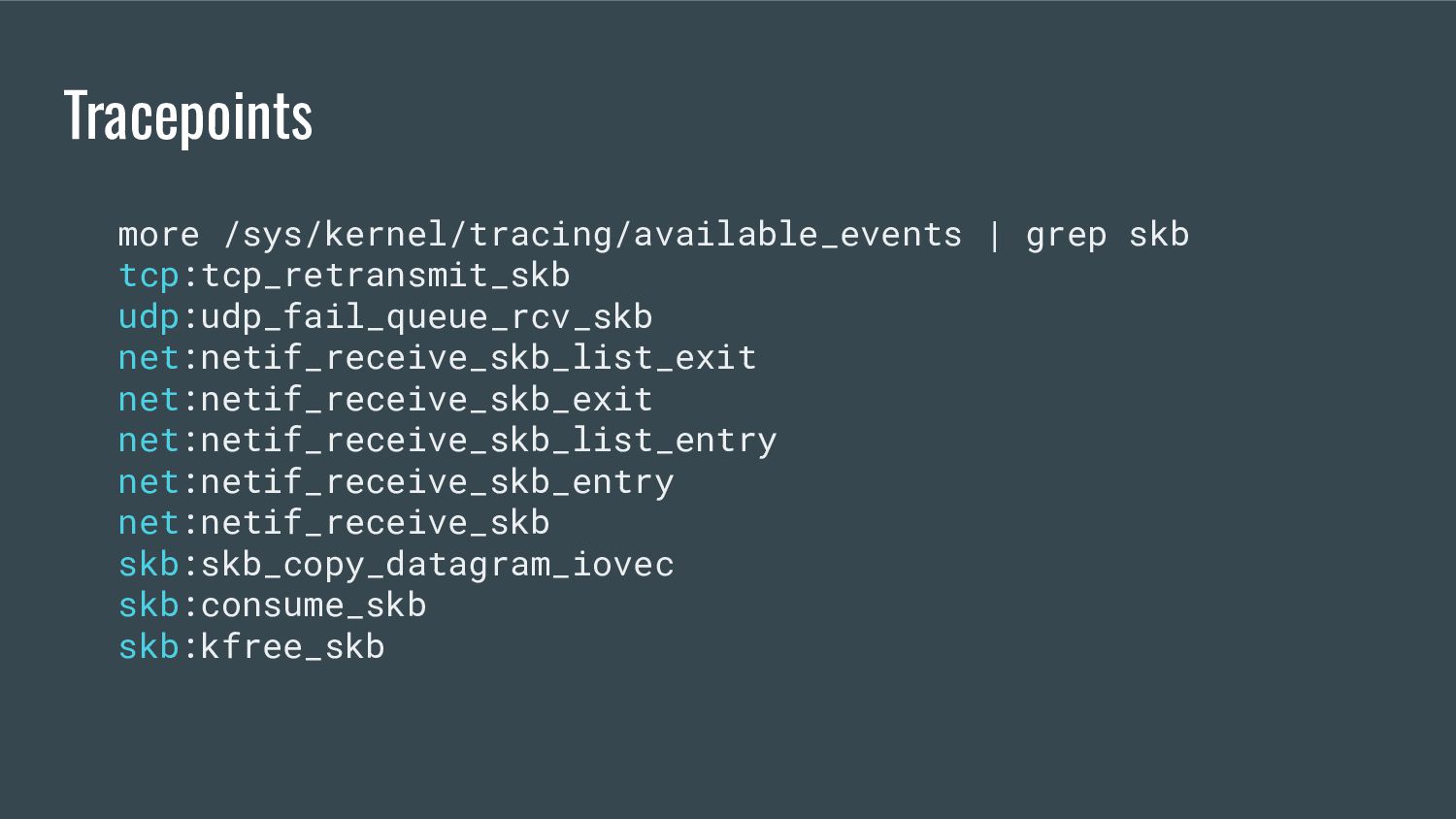
Tracepoints more /sys/kernel/tracing/available_events | grep skb tcp:tcp_retransmit_skb udp:udp_fail_queue_rcv_skb net:netif_receive_skb_list_exit net:netif_receive_skb_exit
net:netif_receive_skb_list_entry net:netif_receive_skb_entry net:netif_receive_skb skb:skb_copy_datagram_iovec skb:consume_skb skb:kfree_skb -
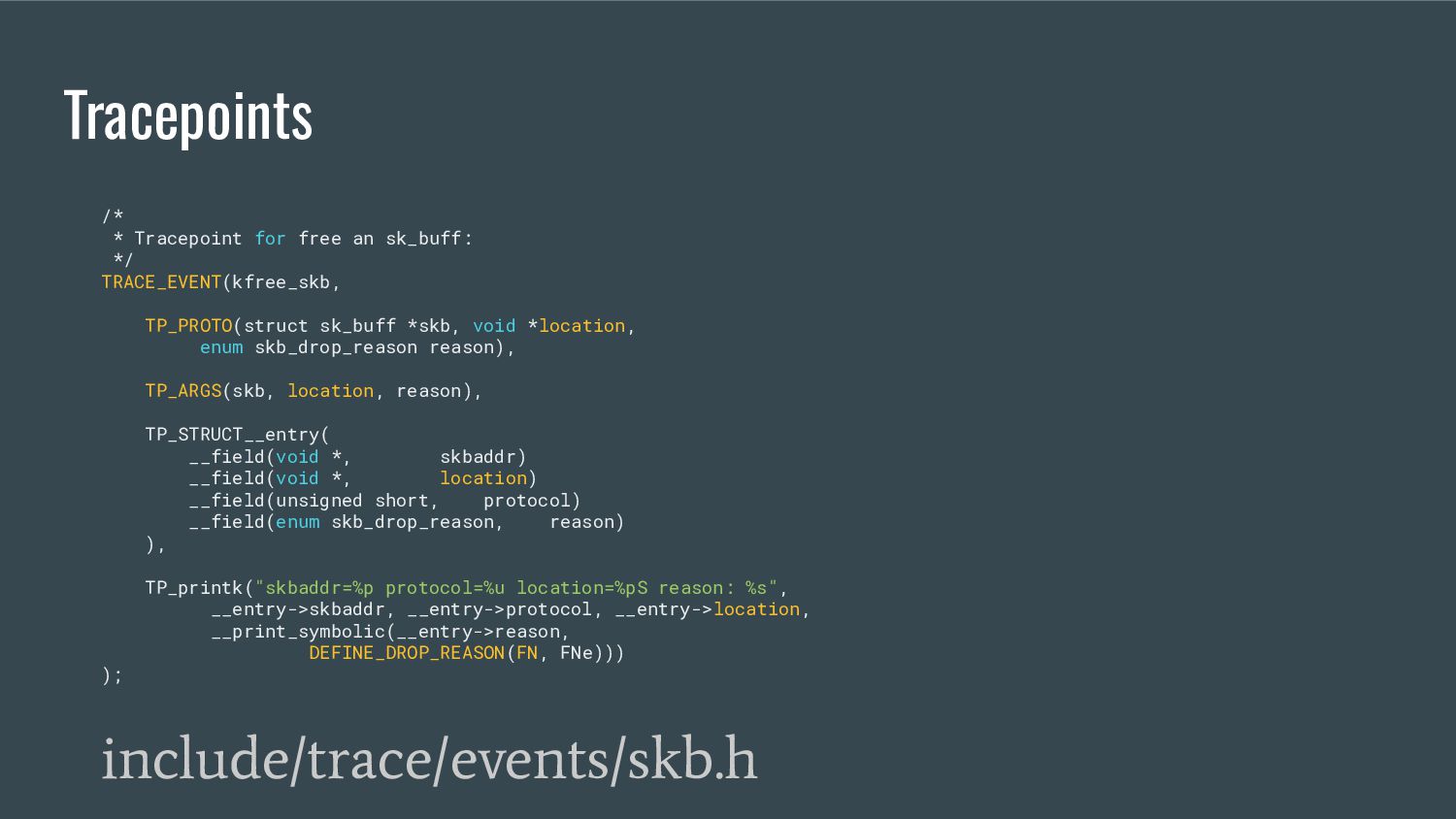
Tracepoints /* * Tracepoint for free an sk_buff: */ TRACE_EVENT(kfree_skb,
TP_PROTO(struct sk_buff *skb, void *location, enum skb_drop_reason reason), TP_ARGS(skb, location, reason), TP_STRUCT__entry( __field(void *, skbaddr) __field(void *, location) __field(unsigned short, protocol) __field(enum skb_drop_reason, reason) ), TP_printk("skbaddr=%p protocol=%u location=%pS reason: %s", __entry->skbaddr, __entry->protocol, __entry->location, __print_symbolic(__entry->reason, DEFINE_DROP_REASON(FN, FNe))) ); include/trace/events/skb.h -
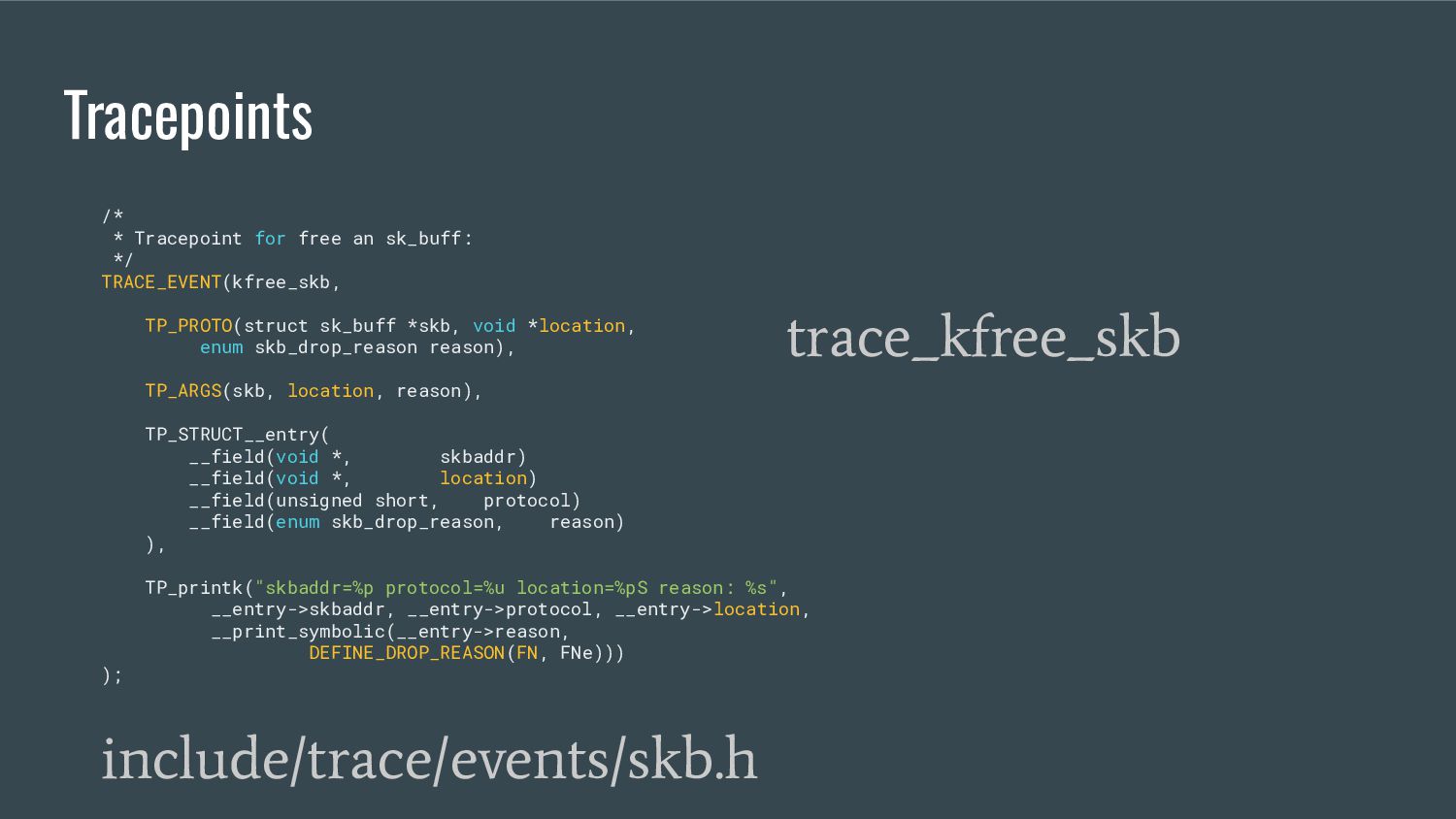
Tracepoints /* * Tracepoint for free an sk_buff: */ TRACE_EVENT(kfree_skb,
TP_PROTO(struct sk_buff *skb, void *location, enum skb_drop_reason reason), TP_ARGS(skb, location, reason), TP_STRUCT__entry( __field(void *, skbaddr) __field(void *, location) __field(unsigned short, protocol) __field(enum skb_drop_reason, reason) ), TP_printk("skbaddr=%p protocol=%u location=%pS reason: %s", __entry->skbaddr, __entry->protocol, __entry->location, __print_symbolic(__entry->reason, DEFINE_DROP_REASON(FN, FNe))) ); include/trace/events/skb.h trace_kfree_skb -
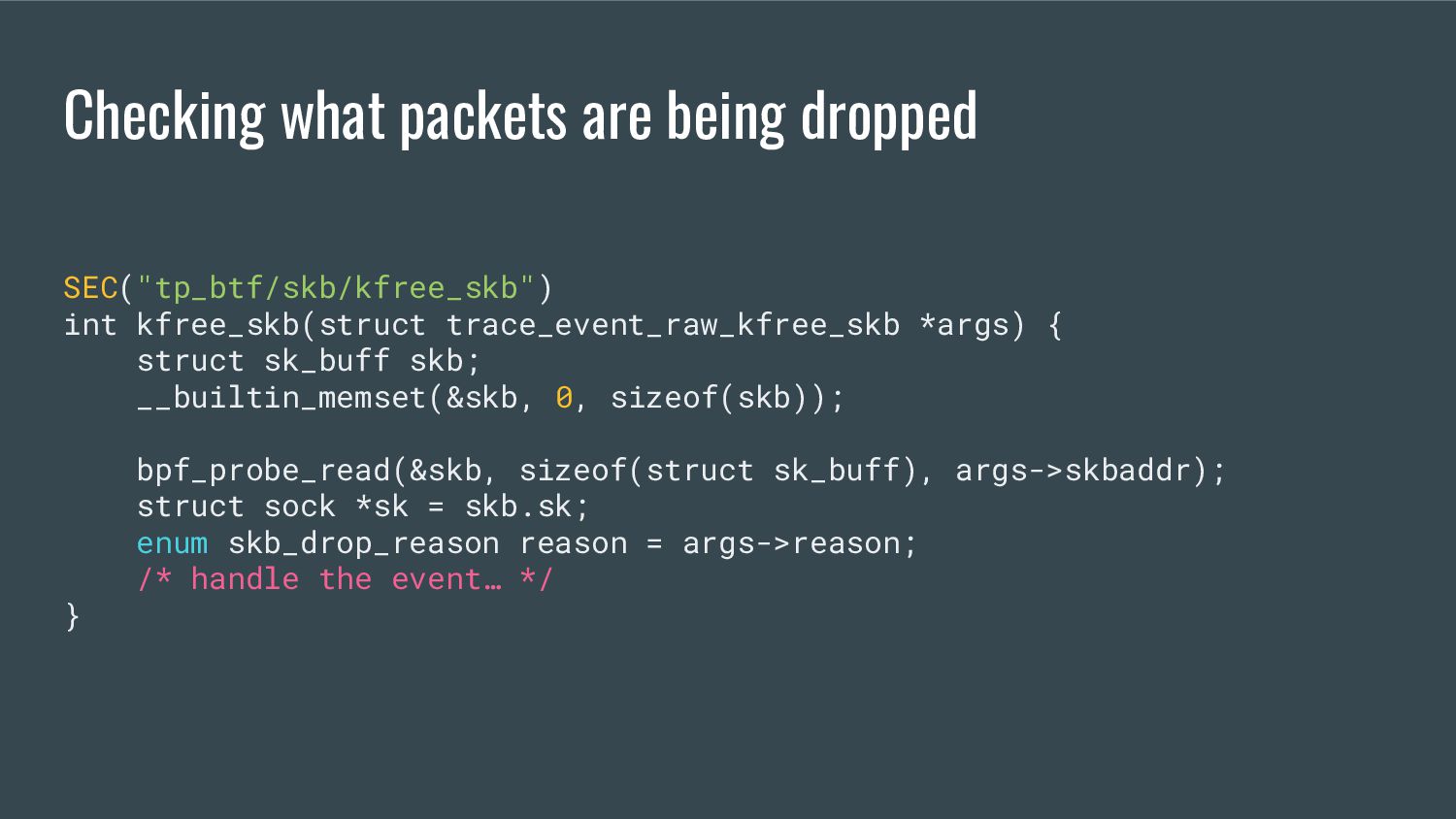
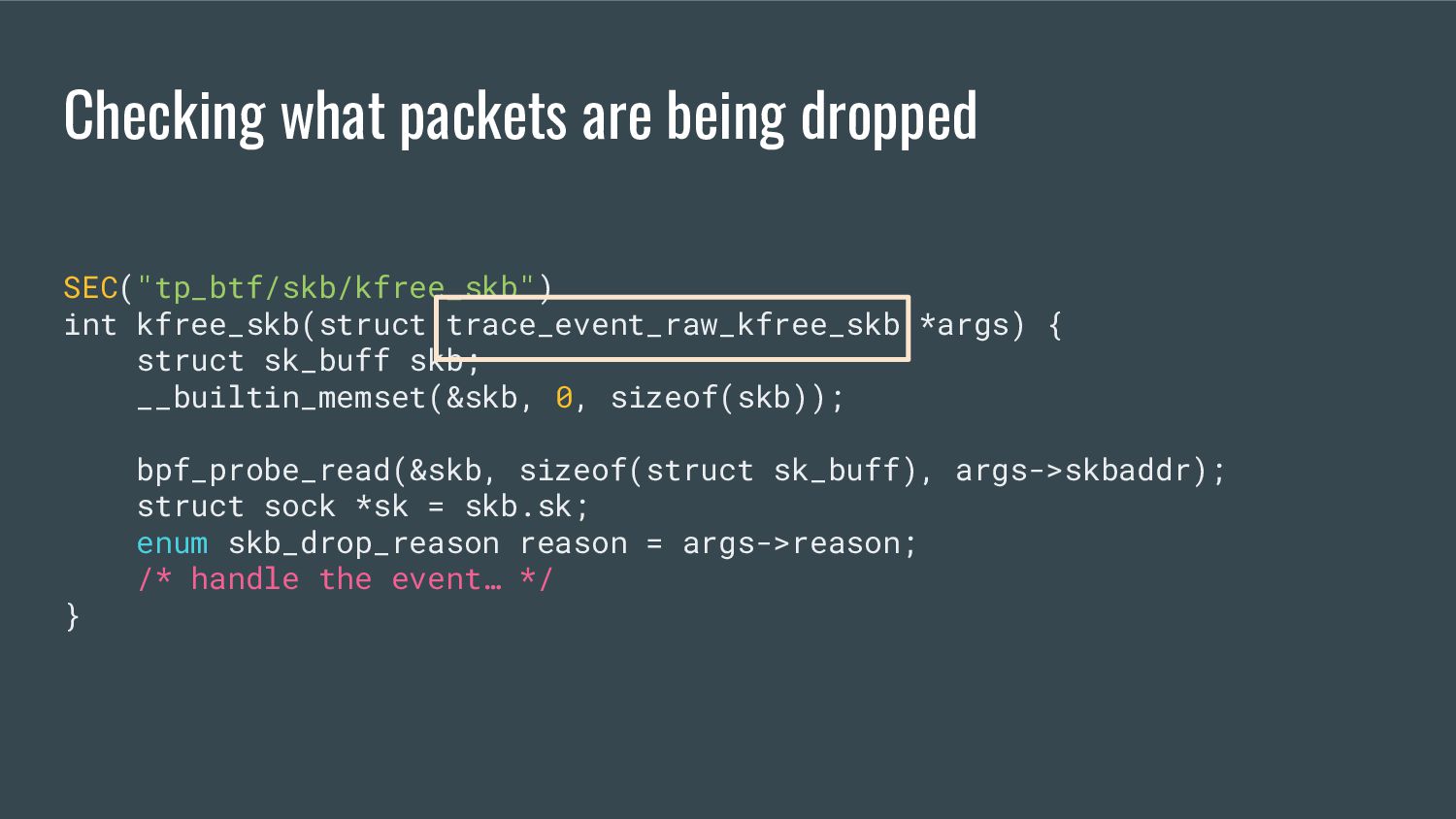
Checking what packets are being dropped SEC("tp_btf/skb/kfree_skb") int kfree_skb(struct trace_event_raw_kfree_skb
*args) { struct sk_buff skb; __builtin_memset(&skb, 0, sizeof(skb)); bpf_probe_read(&skb, sizeof(struct sk_buff), args->skbaddr); struct sock *sk = skb.sk; enum skb_drop_reason reason = args->reason; /* handle the event… */ } -
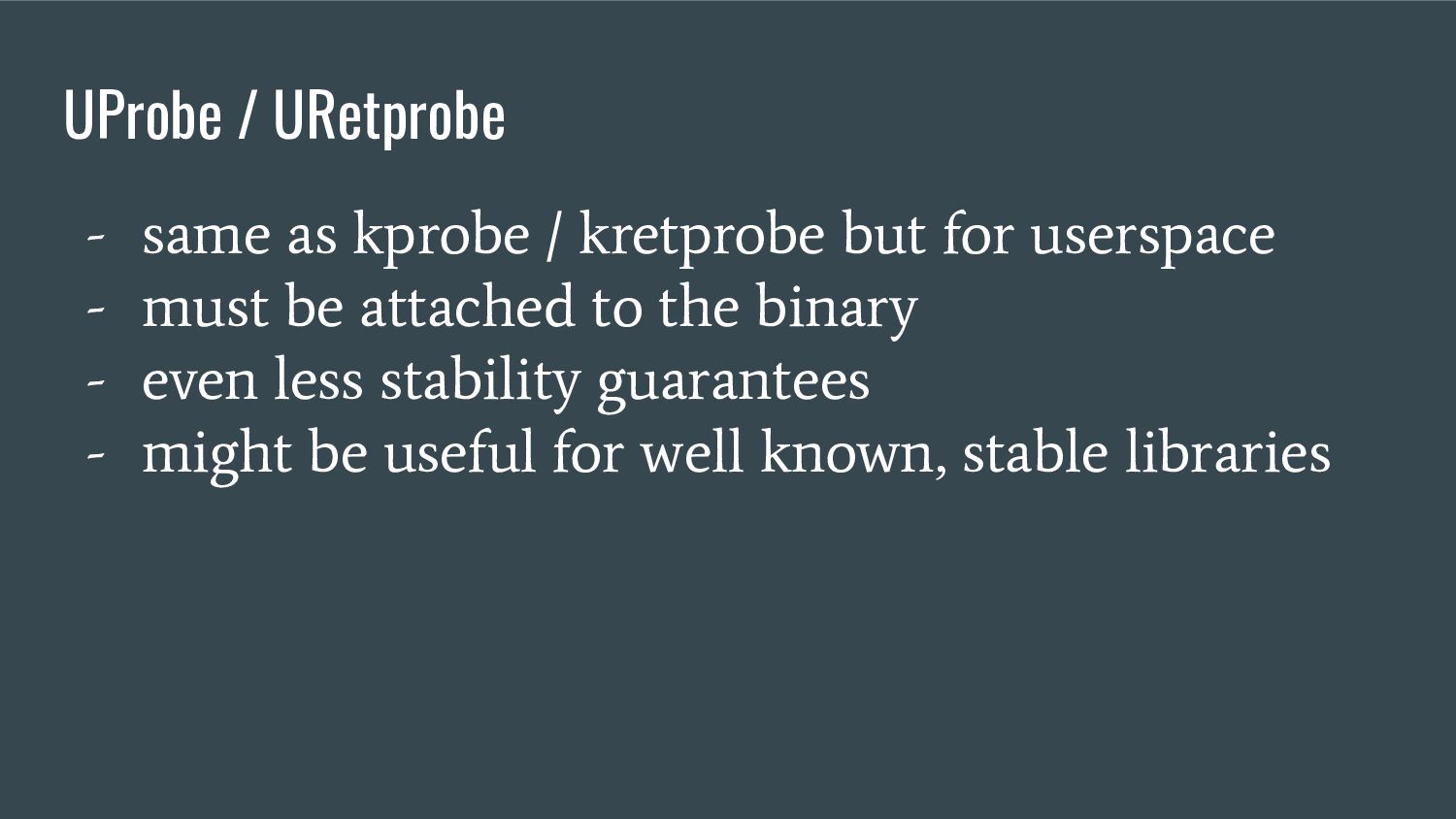
UProbe / URetprobe - same as kprobe / kretprobe but
for userspace - must be attached to the binary - even less stability guarantees - might be useful for well known, stable libraries -
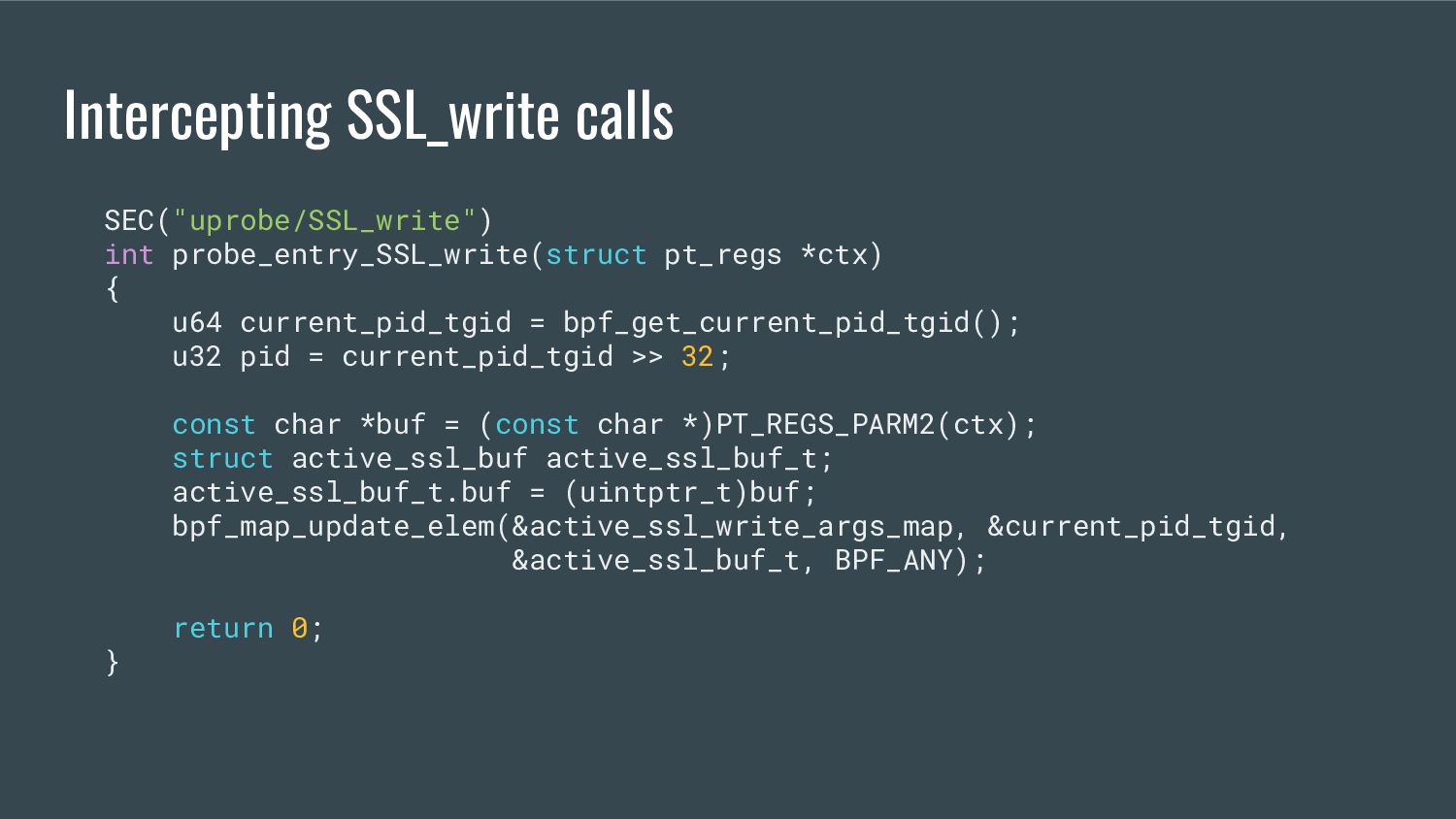
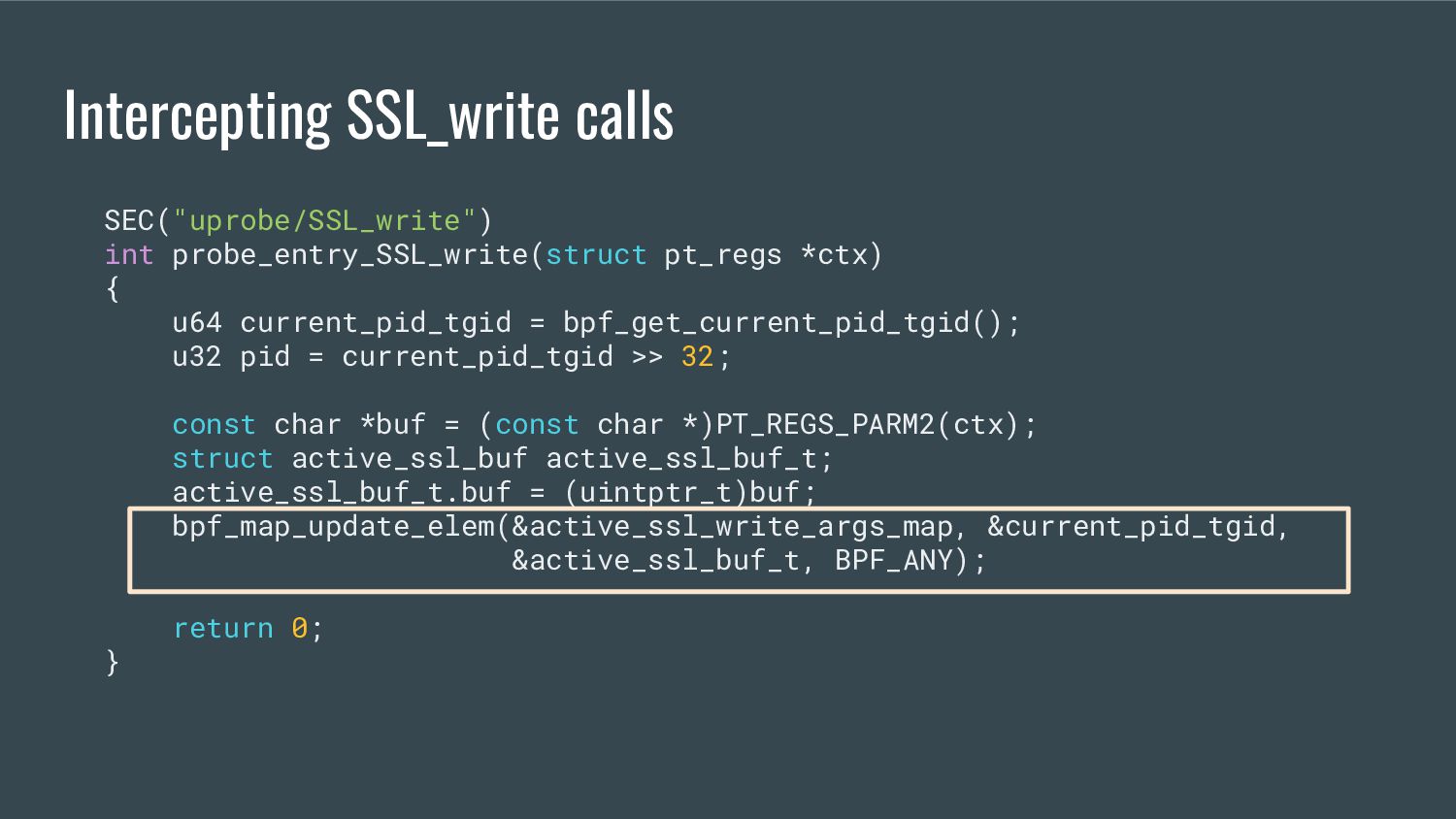
Intercepting SSL_write calls SEC("uprobe/SSL_write") int probe_entry_SSL_write(struct pt_regs *ctx) { u64
current_pid_tgid = bpf_get_current_pid_tgid(); u32 pid = current_pid_tgid >> 32; const char *buf = (const char *)PT_REGS_PARM2(ctx); struct active_ssl_buf active_ssl_buf_t; active_ssl_buf_t.buf = (uintptr_t)buf; bpf_map_update_elem(&active_ssl_write_args_map, ¤t_pid_tgid, &active_ssl_buf_t, BPF_ANY); return 0; } -
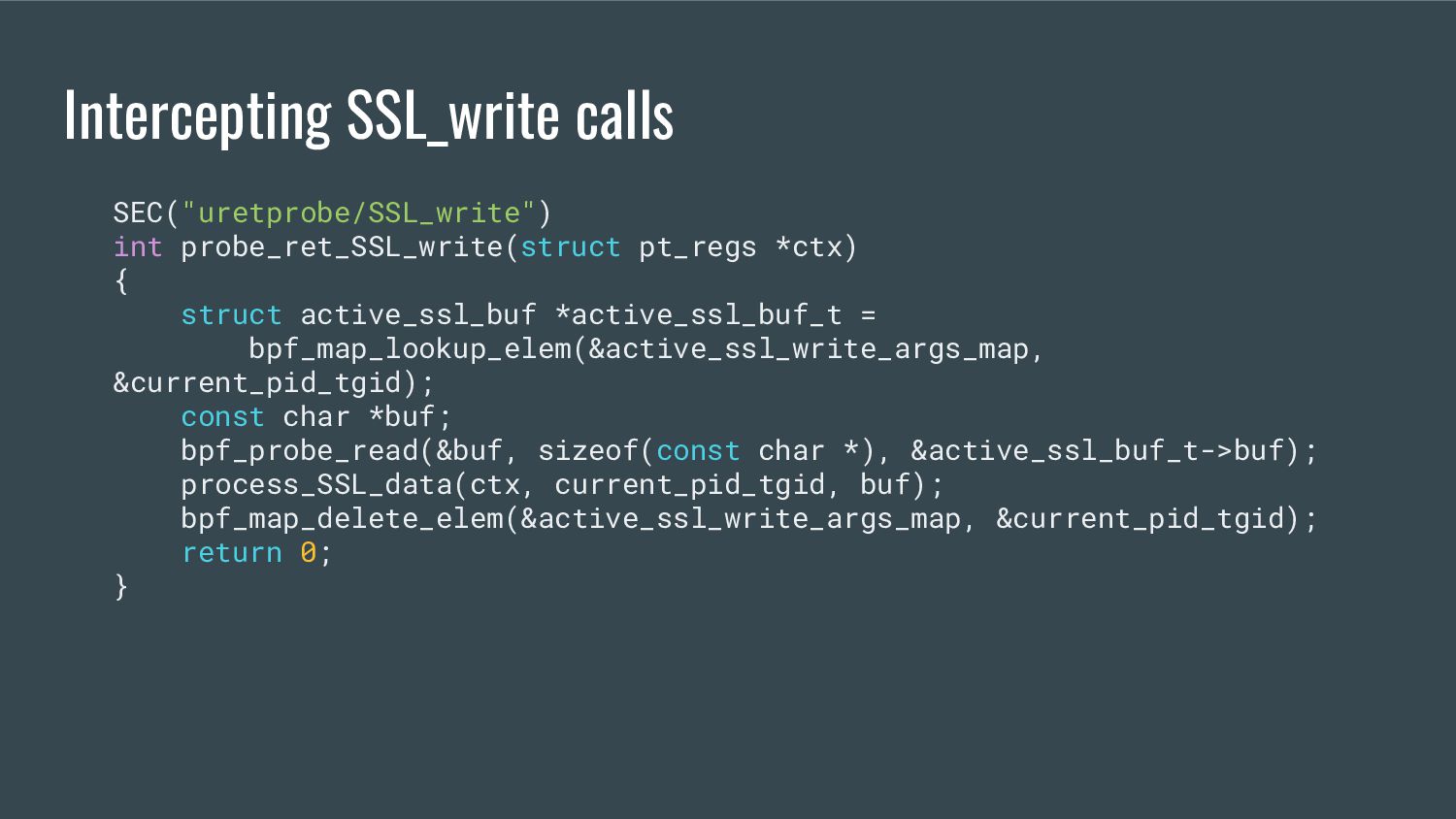
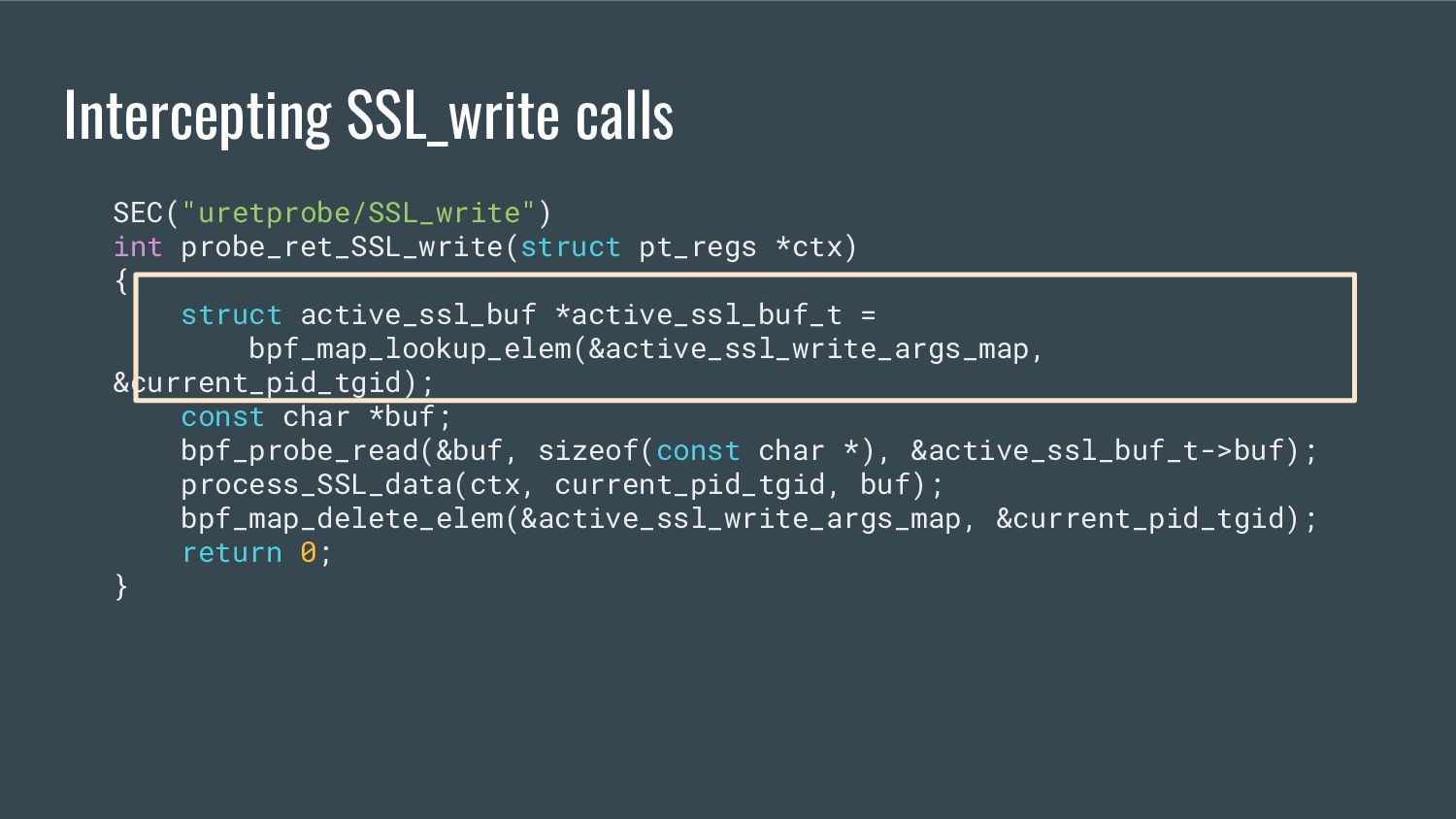
Intercepting SSL_write calls SEC("uretprobe/SSL_write") int probe_ret_SSL_write(struct pt_regs *ctx) { struct
active_ssl_buf *active_ssl_buf_t = bpf_map_lookup_elem(&active_ssl_write_args_map, ¤t_pid_tgid); const char *buf; bpf_probe_read(&buf, sizeof(const char *), &active_ssl_buf_t->buf); process_SSL_data(ctx, current_pid_tgid, buf); bpf_map_delete_elem(&active_ssl_write_args_map, ¤t_pid_tgid); return 0; } -
XDP - Express Data Path - hook for ingress packets
only - very early in the stack - can pass to the linux kernel, drop, redirect - pointer-fu to navigate the frame manually Eth Header IP Header Payload -
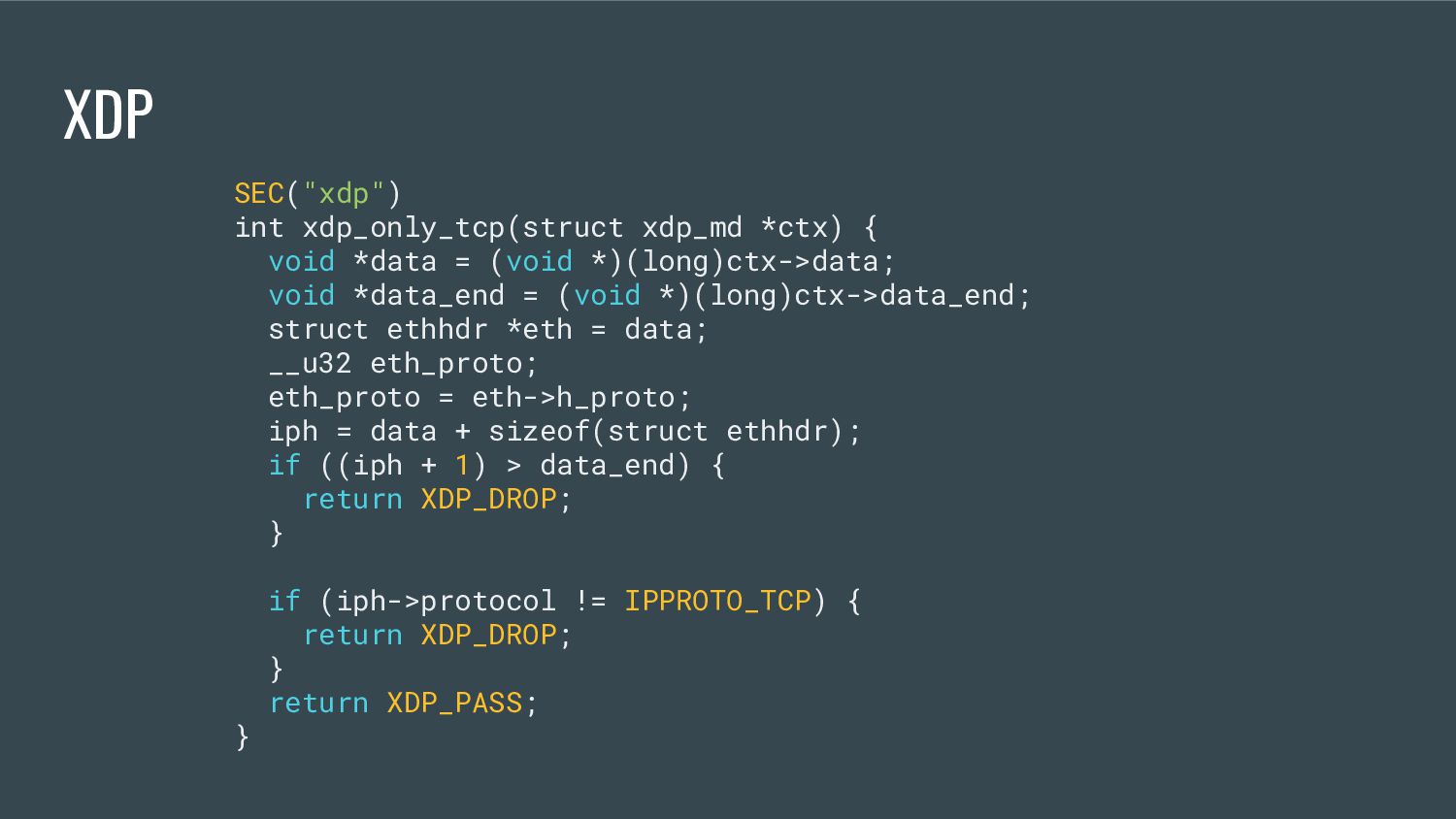
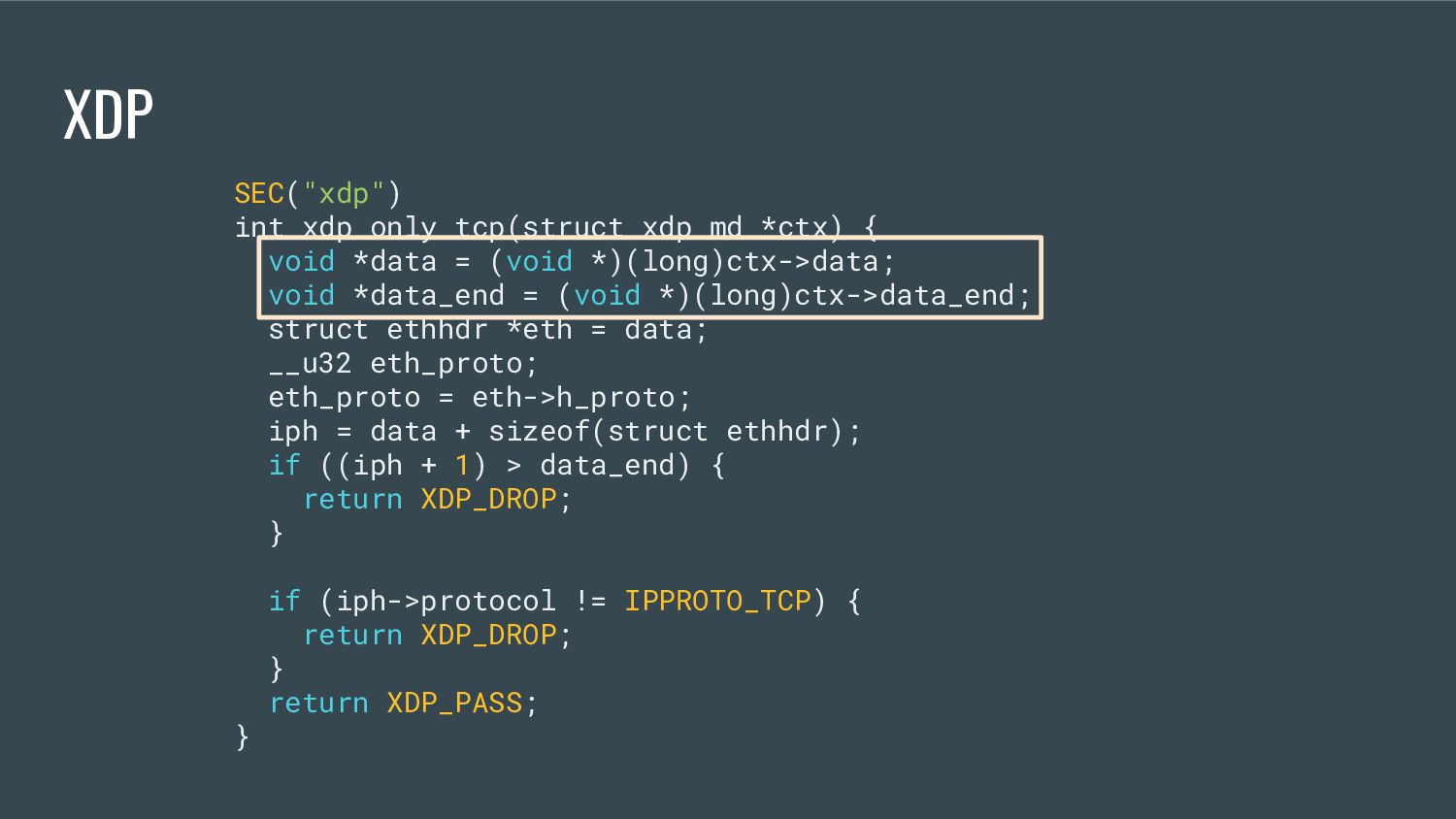
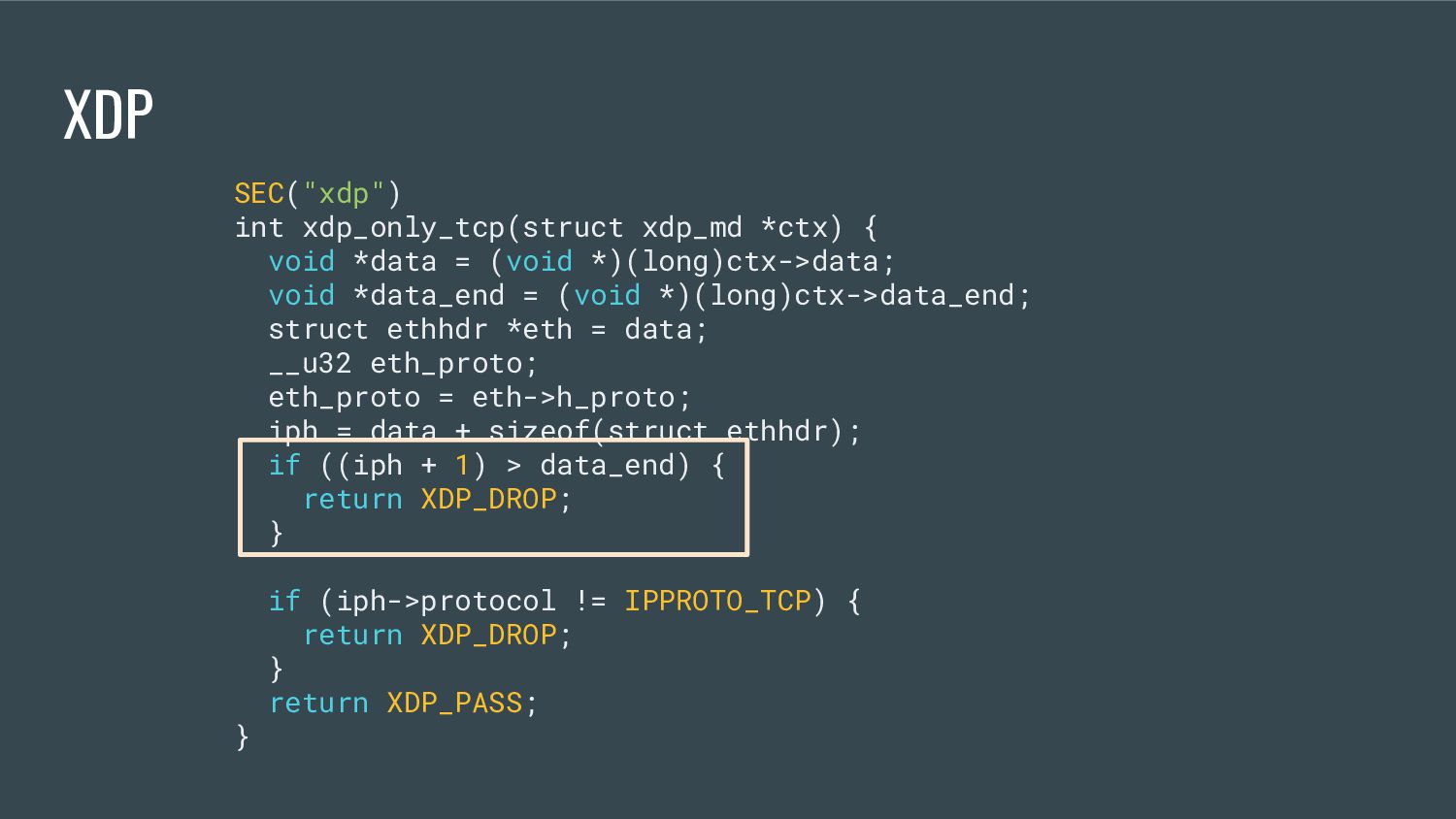
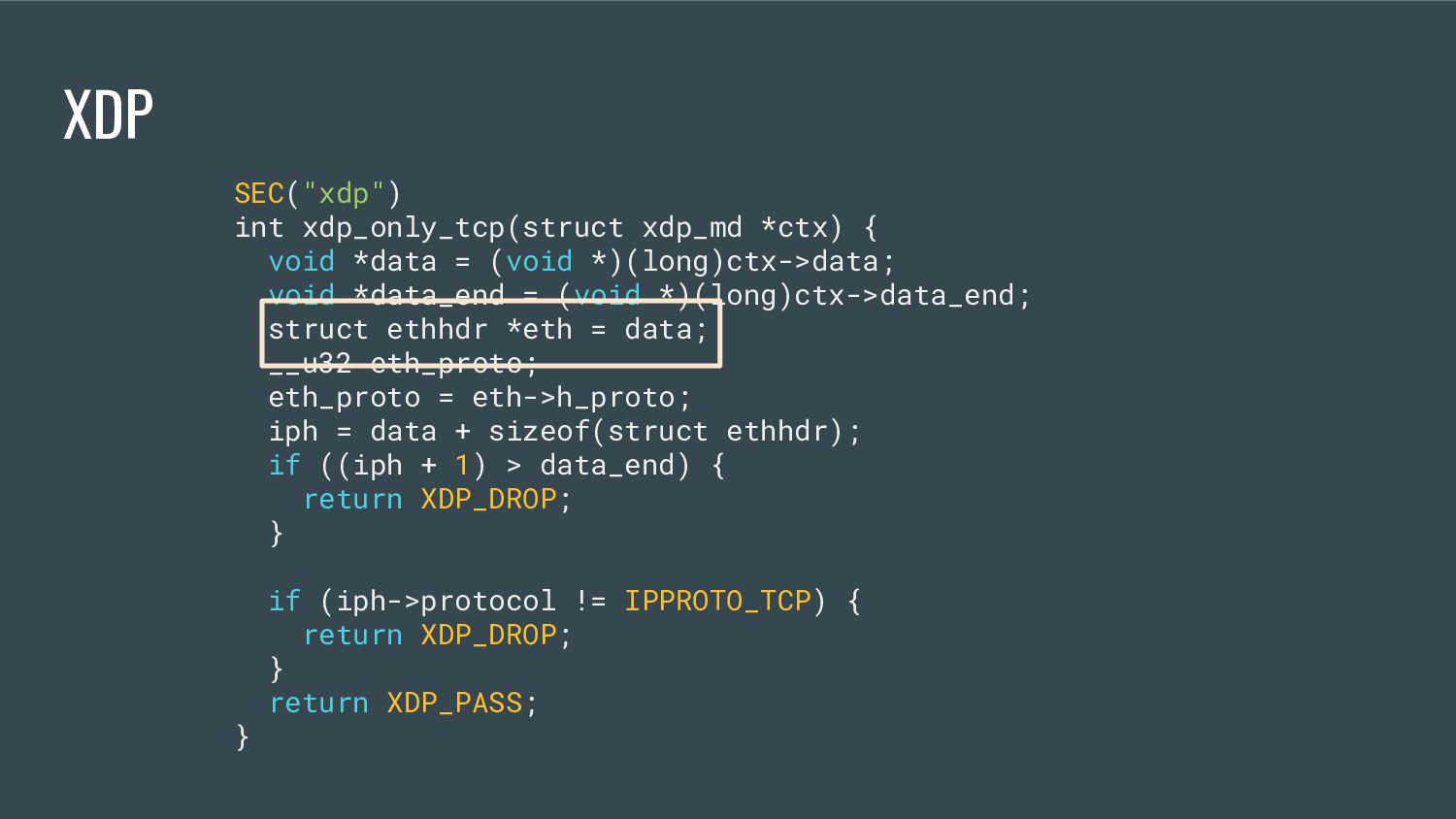
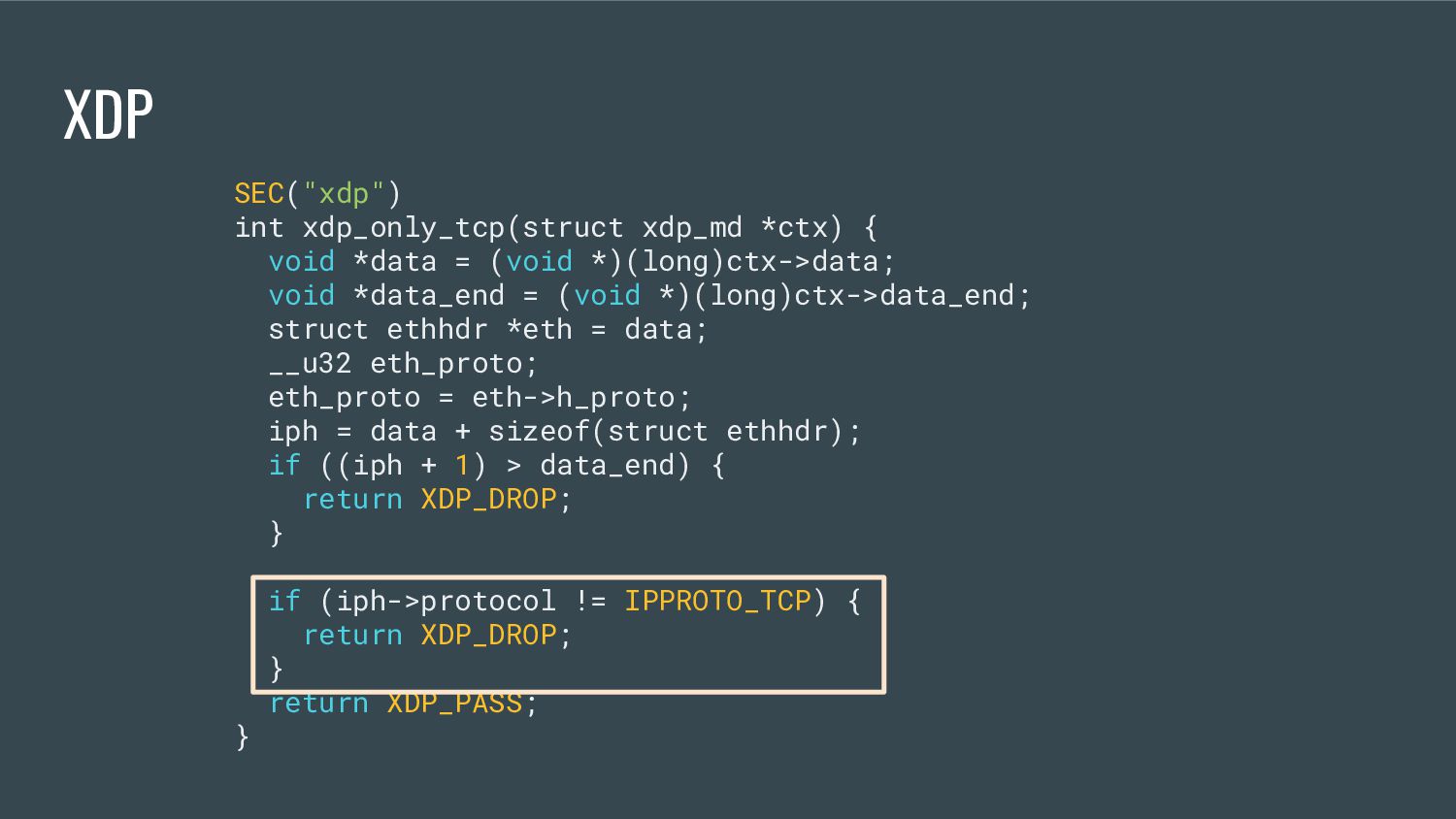
XDP SEC("xdp") int xdp_only_tcp(struct xdp_md *ctx) { void *data =
(void *)(long)ctx->data; void *data_end = (void *)(long)ctx->data_end; struct ethhdr *eth = data; __u32 eth_proto; eth_proto = eth->h_proto; iph = data + sizeof(struct ethhdr); if ((iph + 1) > data_end) { return XDP_DROP; } if (iph->protocol != IPPROTO_TCP) { return XDP_DROP; } return XDP_PASS; } -
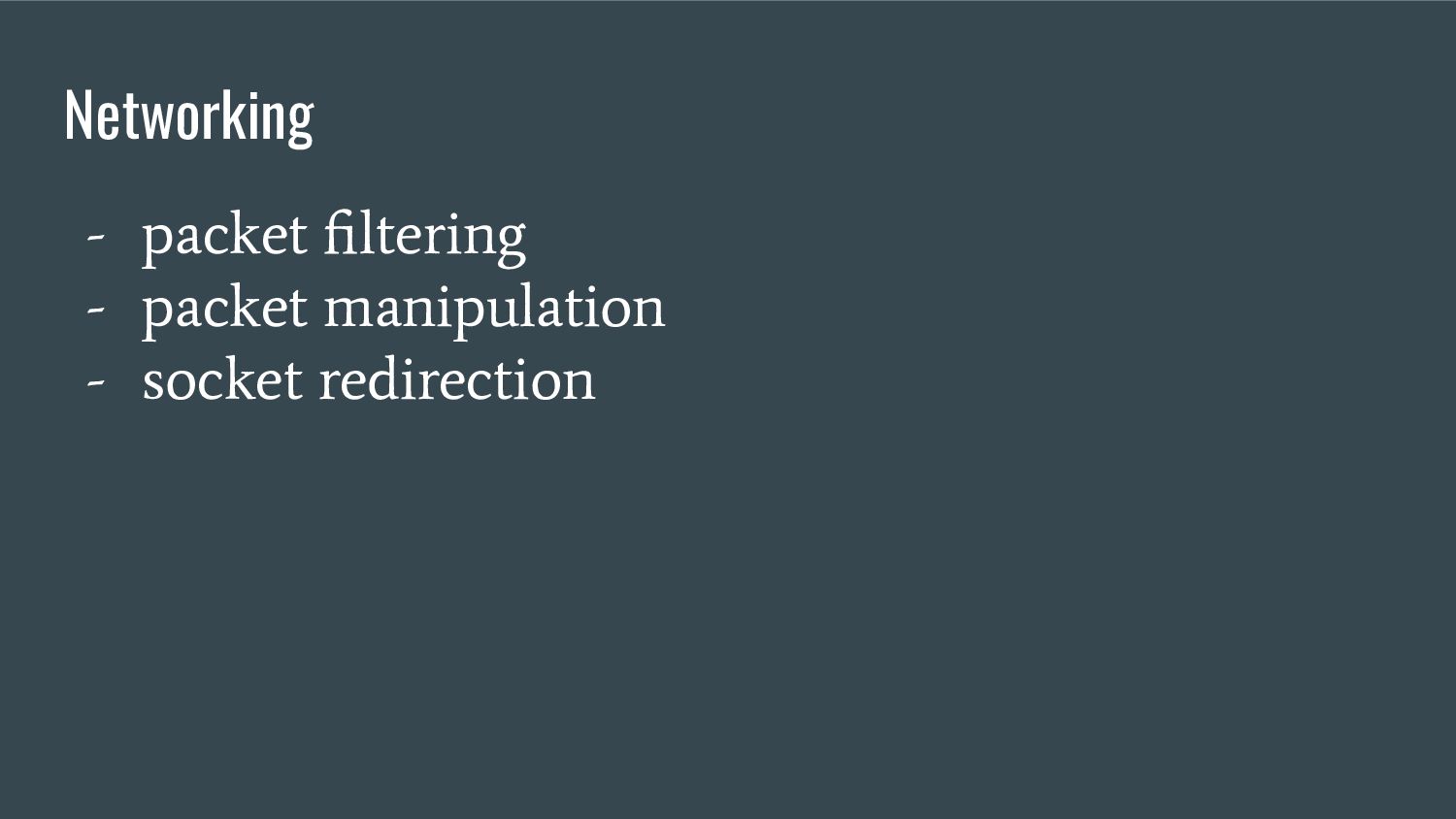
TC - Traffic Control Acton - packet filtering - packet
manipulation - works with ingress and egress - packets under the form of _sk_buff -
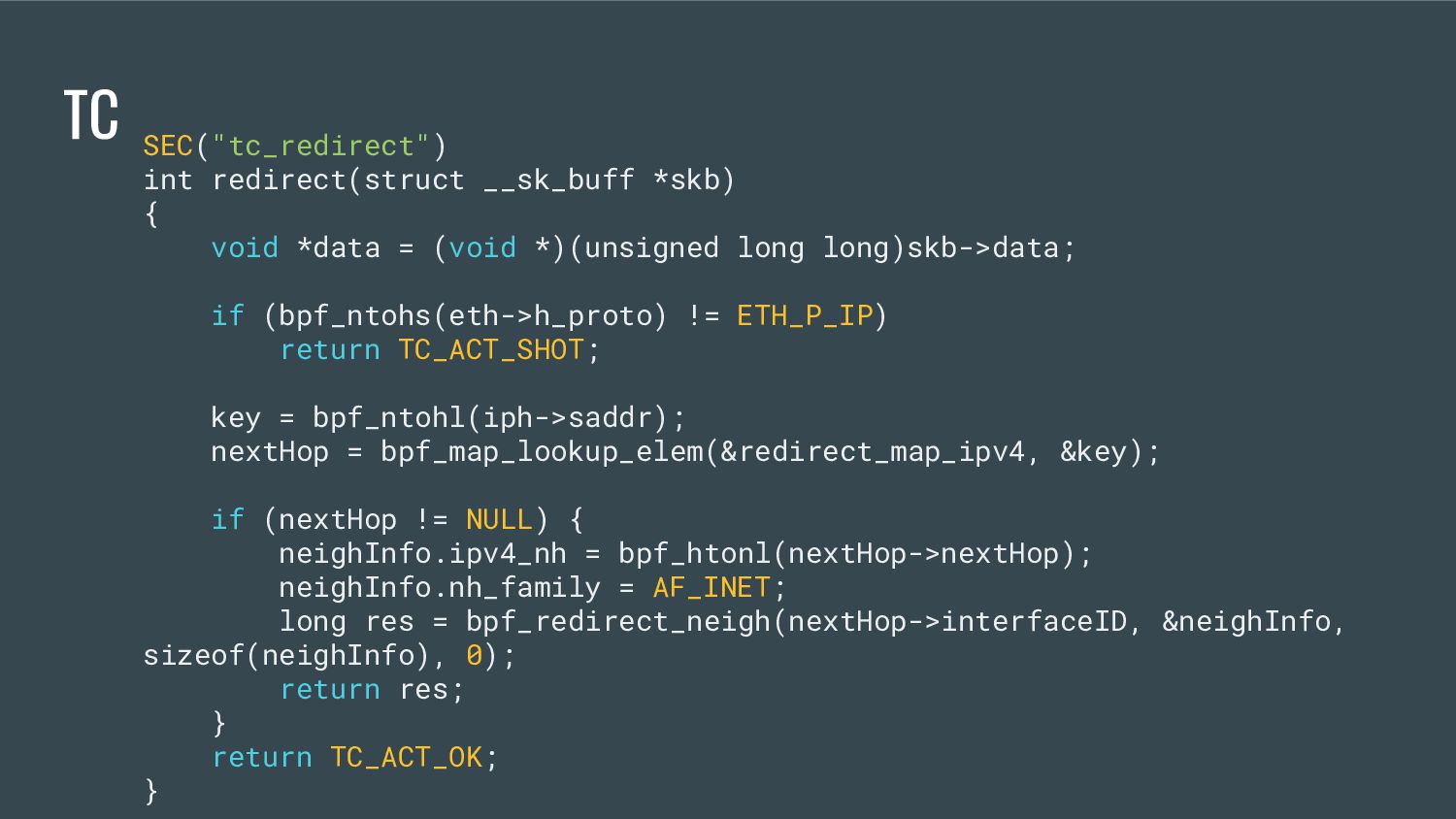
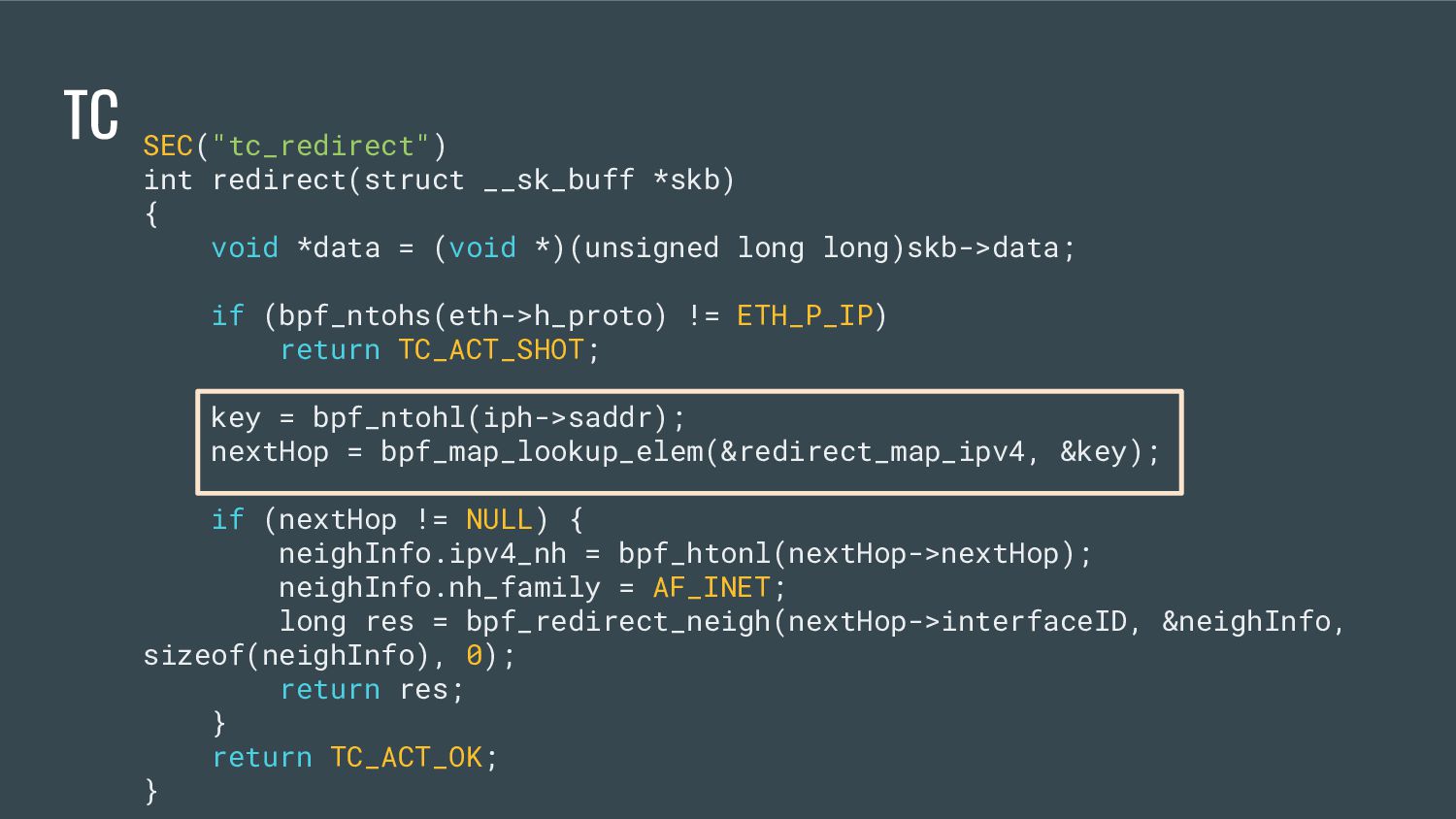
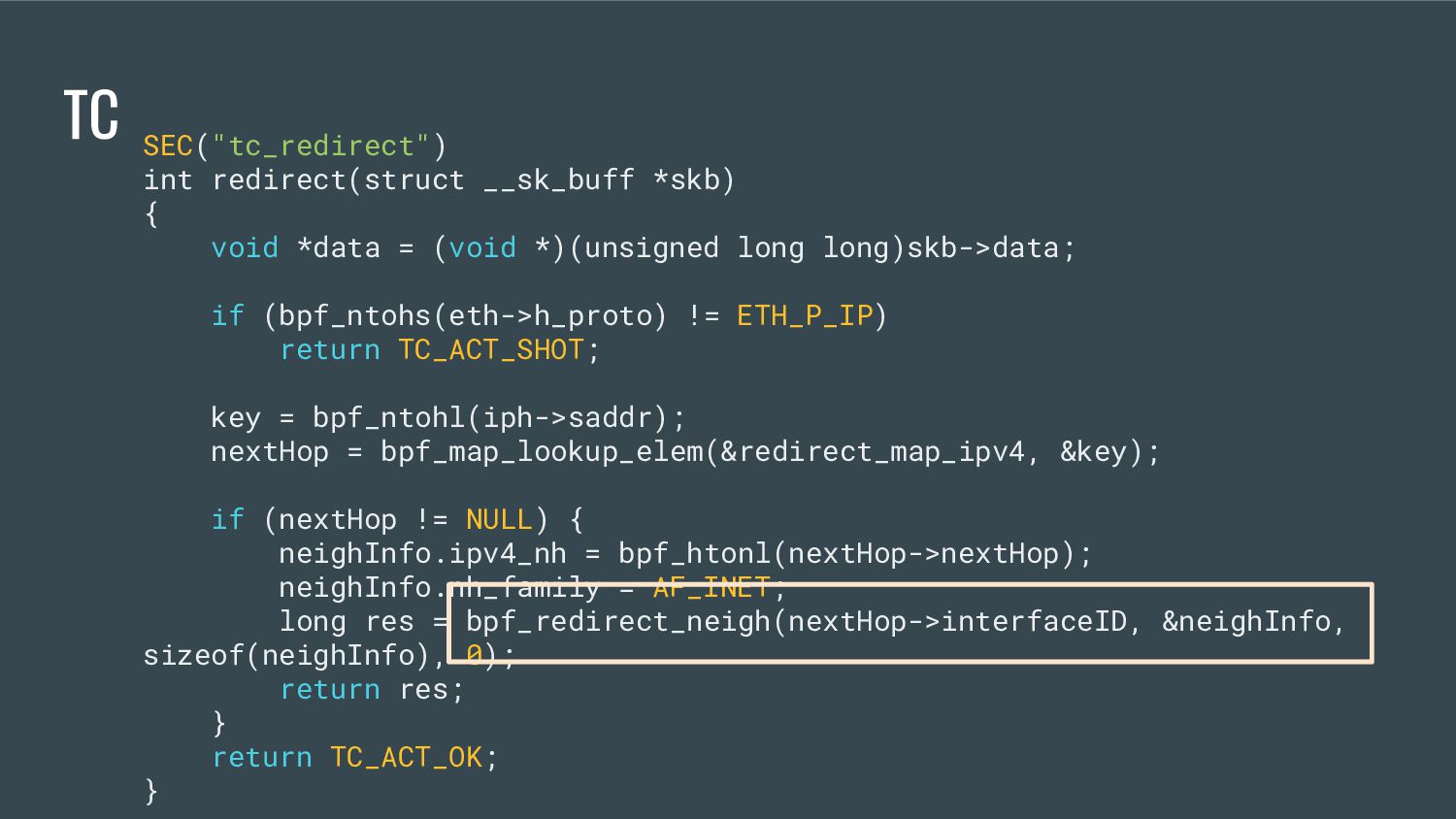
TC SEC("tc_redirect") int redirect(struct __sk_buff *skb) { void *data =
(void *)(unsigned long long)skb->data; if (bpf_ntohs(eth->h_proto) != ETH_P_IP) return TC_ACT_SHOT; key = bpf_ntohl(iph->saddr); nextHop = bpf_map_lookup_elem(&redirect_map_ipv4, &key); if (nextHop != NULL) { neighInfo.ipv4_nh = bpf_htonl(nextHop->nextHop); neighInfo.nh_family = AF_INET; long res = bpf_redirect_neigh(nextHop->interfaceID, &neighInfo, sizeof(neighInfo), 0); return res; } return TC_ACT_OK; } -
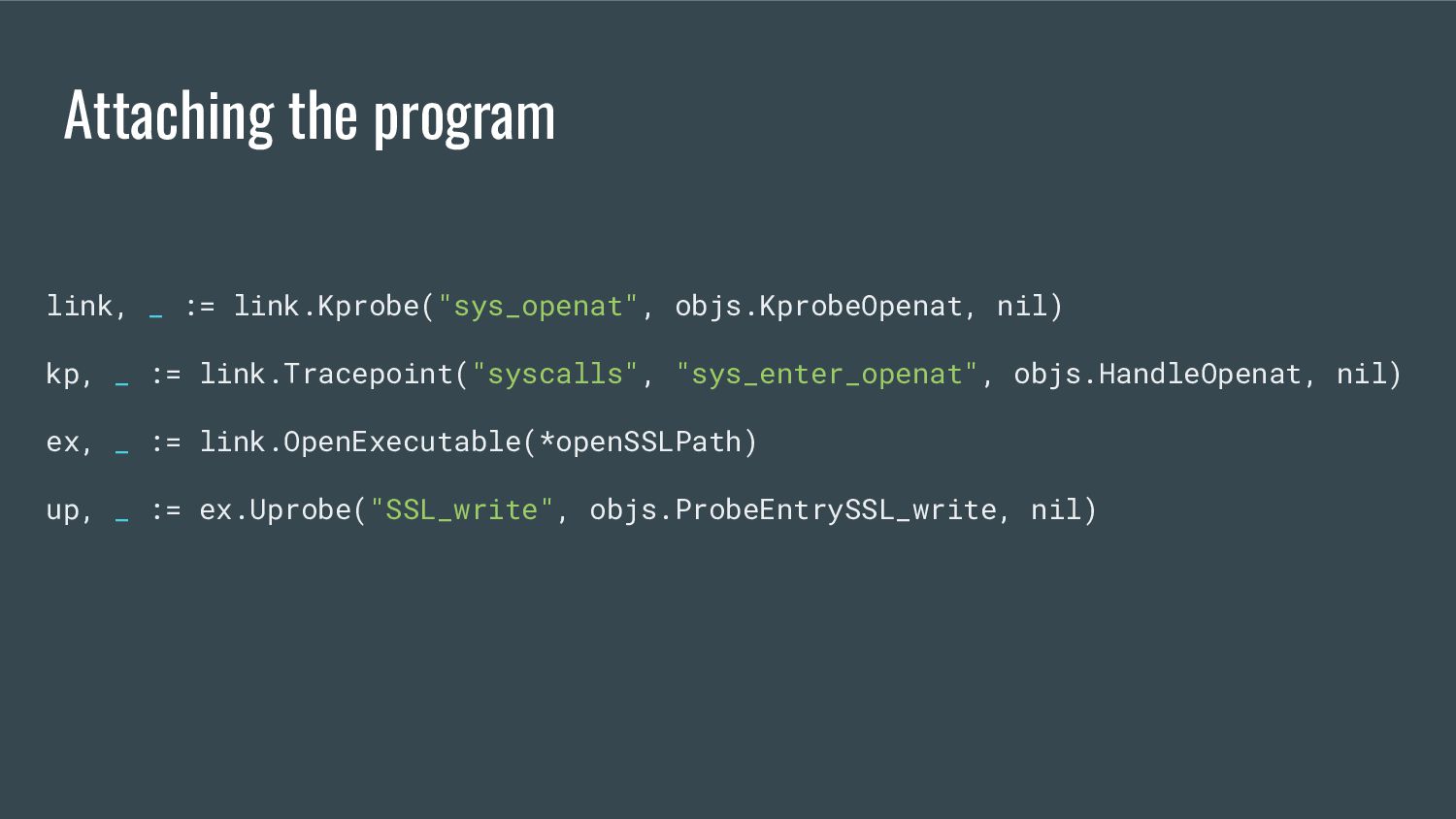
Attaching the program link, _ := link.Kprobe("sys_openat", objs.KprobeOpenat, nil) kp,
_ := link.Tracepoint("syscalls", "sys_enter_openat", objs.HandleOpenat, nil) ex, _ := link.OpenExecutable(*openSSLPath) up, _ := ex.Uprobe("SSL_write", objs.ProbeEntrySSL_write, nil) -
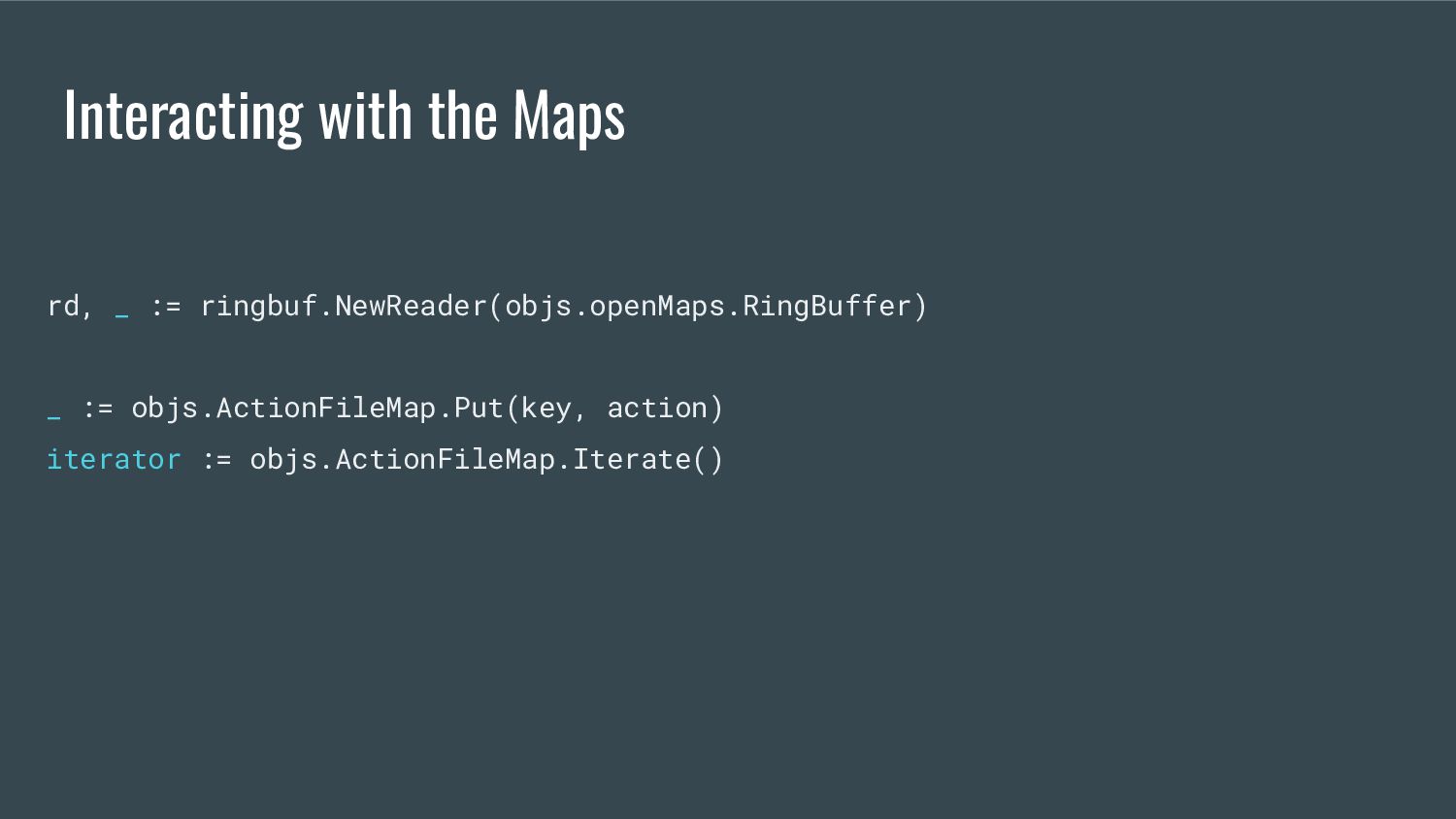
Interacting with the Maps rd, _ := ringbuf.NewReader(objs.openMaps.RingBuffer) _ :=
objs.ActionFileMap.Put(key, action) iterator := objs.ActionFileMap.Iterate() -
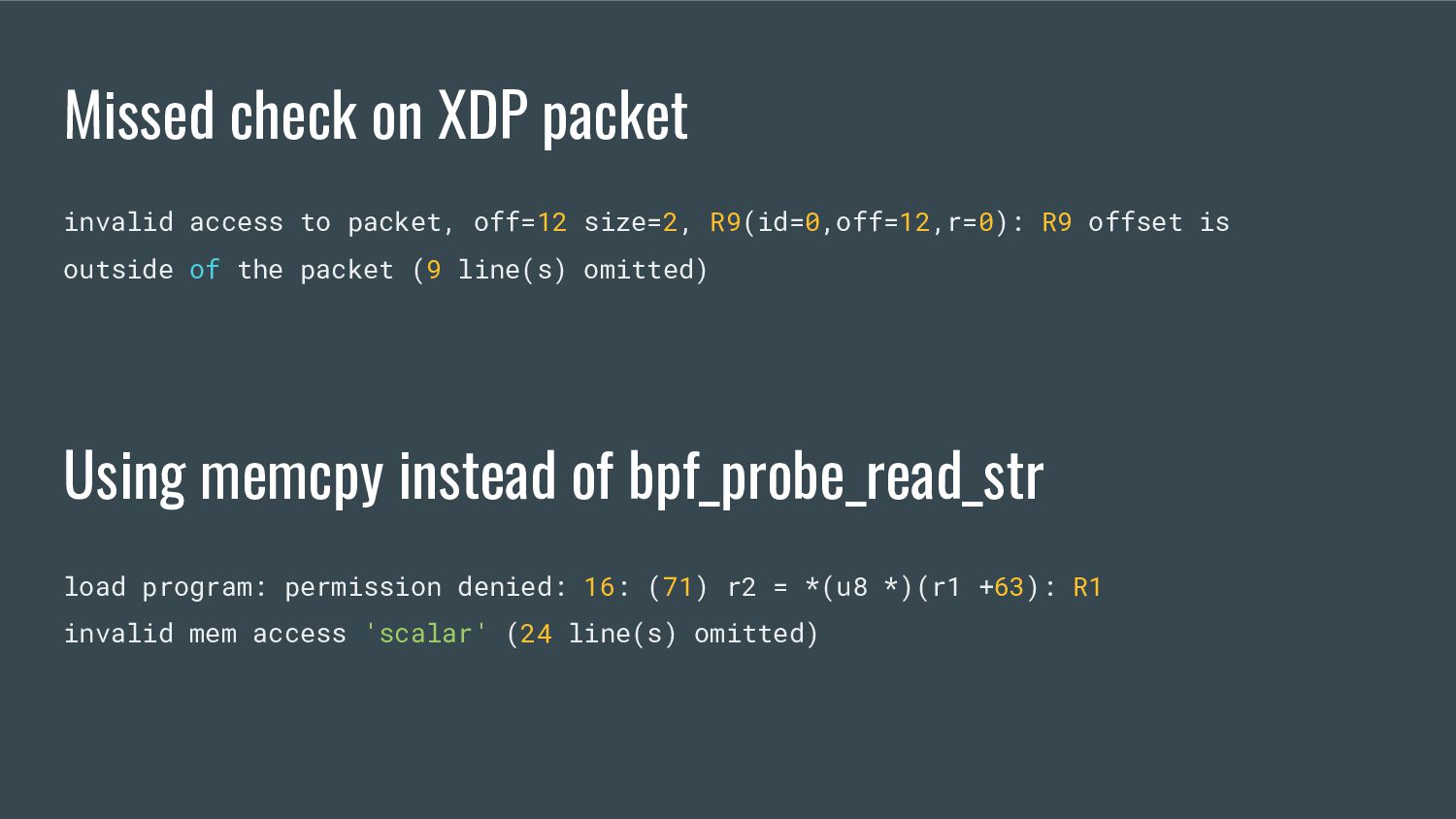
Missed check on XDP packet invalid access to packet, off=12
size=2, R9(id=0,off=12,r=0): R9 offset is outside of the packet (9 line(s) omitted) load program: permission denied: 16: (71) r2 = *(u8 *)(r1 +63): R1 invalid mem access 'scalar' (24 line(s) omitted) Using memcpy instead of bpf_probe_read_str -
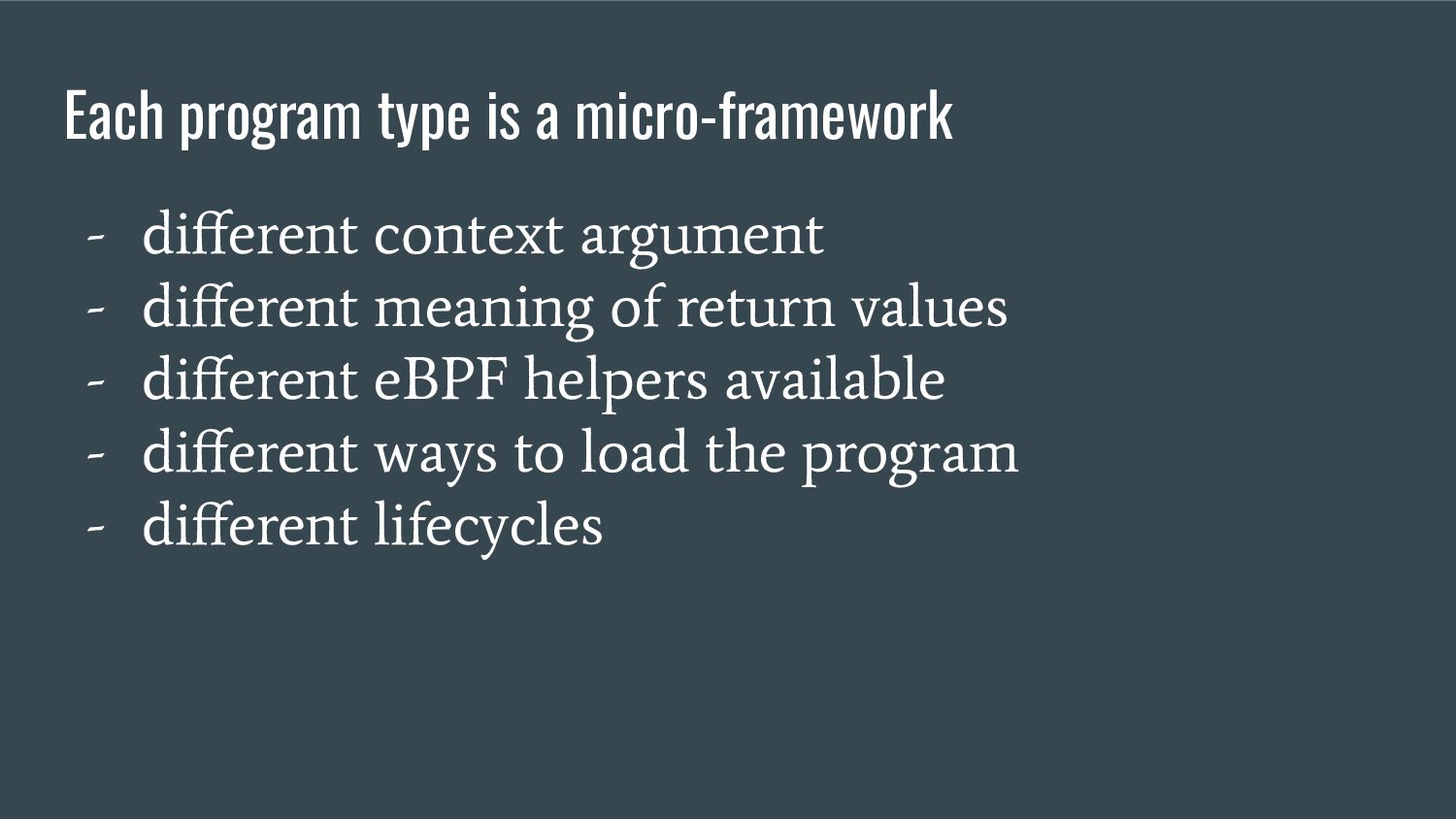
Each program type is a micro-framework - different context argument
- different meaning of return values - different eBPF helpers available - different ways to load the program - different lifecycles -
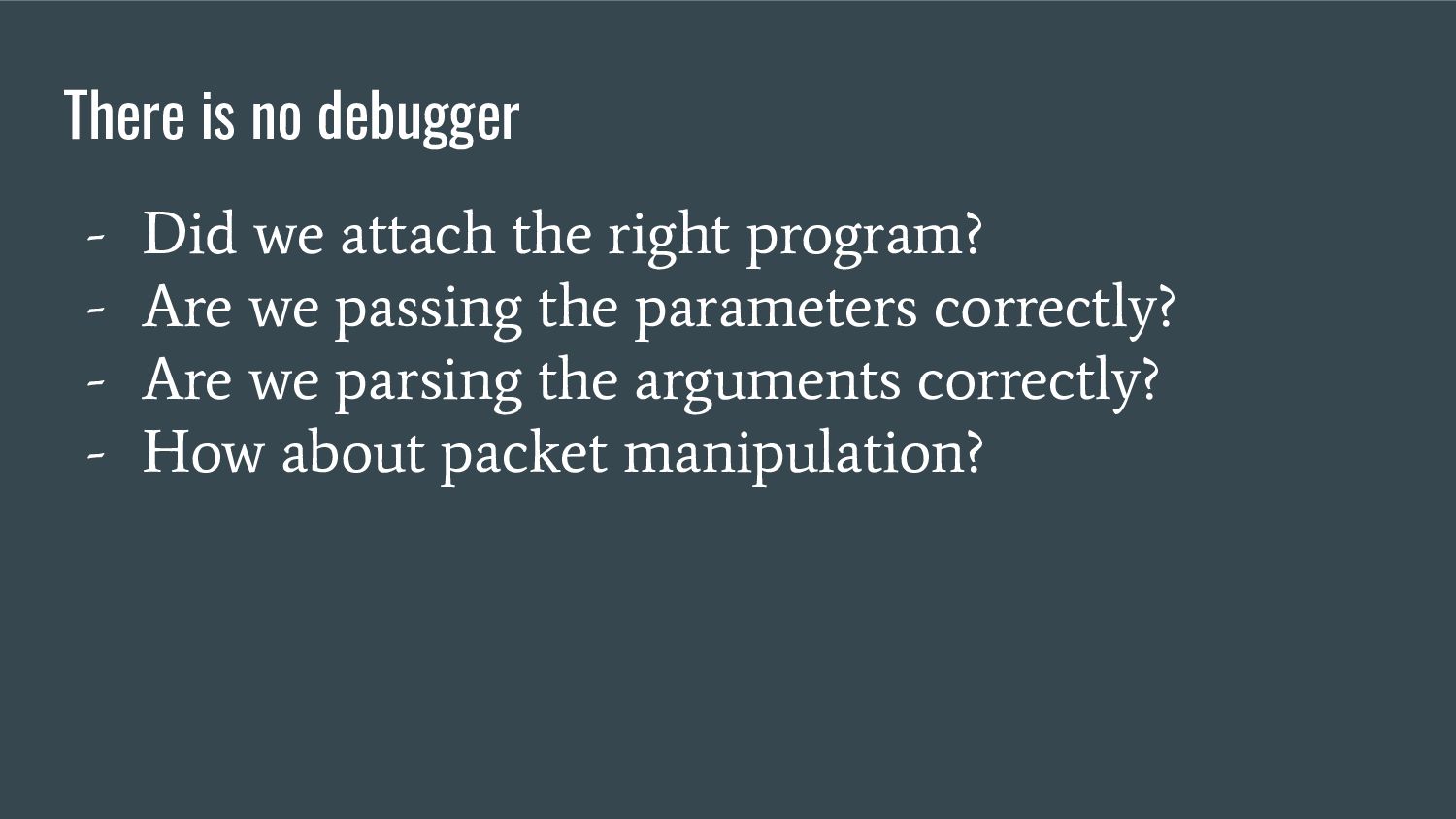
There is no debugger - Did we attach the right
program? - Are we passing the parameters correctly? - Are we parsing the arguments correctly? - How about packet manipulation? -
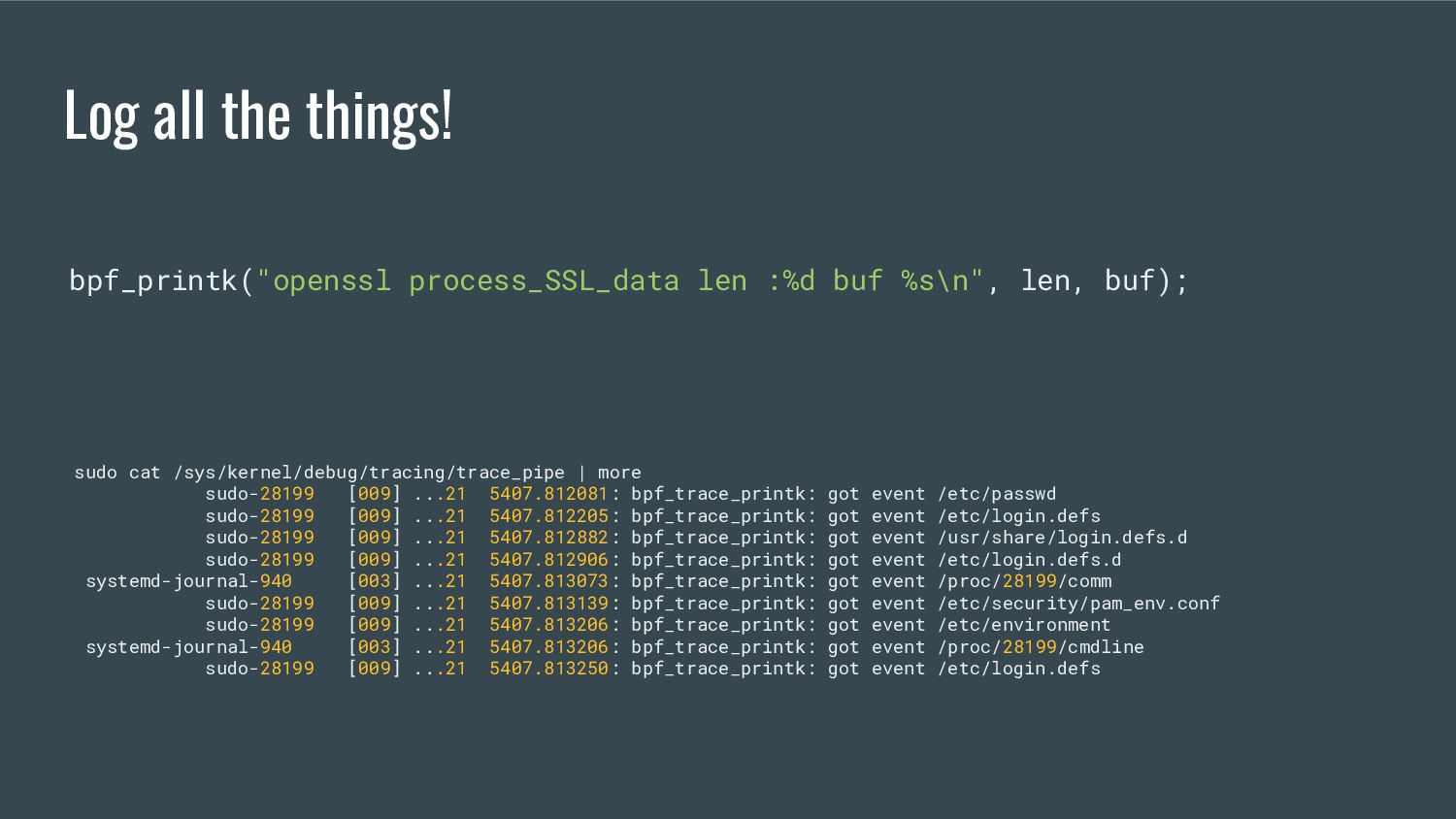
Log all the things! bpf_printk("openssl process_SSL_data len :%d buf %s\n",
len, buf); sudo cat /sys/kernel/debug/tracing/trace_pipe | more sudo-28199 [009] ...21 5407.812081: bpf_trace_printk: got event /etc/passwd sudo-28199 [009] ...21 5407.812205: bpf_trace_printk: got event /etc/login.defs sudo-28199 [009] ...21 5407.812882: bpf_trace_printk: got event /usr/share/login.defs.d sudo-28199 [009] ...21 5407.812906: bpf_trace_printk: got event /etc/login.defs.d systemd-journal-940 [003] ...21 5407.813073: bpf_trace_printk: got event /proc/28199/comm sudo-28199 [009] ...21 5407.813139: bpf_trace_printk: got event /etc/security/pam_env.conf sudo-28199 [009] ...21 5407.813206: bpf_trace_printk: got event /etc/environment systemd-journal-940 [003] ...21 5407.813206: bpf_trace_printk: got event /proc/28199/cmdline sudo-28199 [009] ...21 5407.813250: bpf_trace_printk: got event /etc/login.defs -
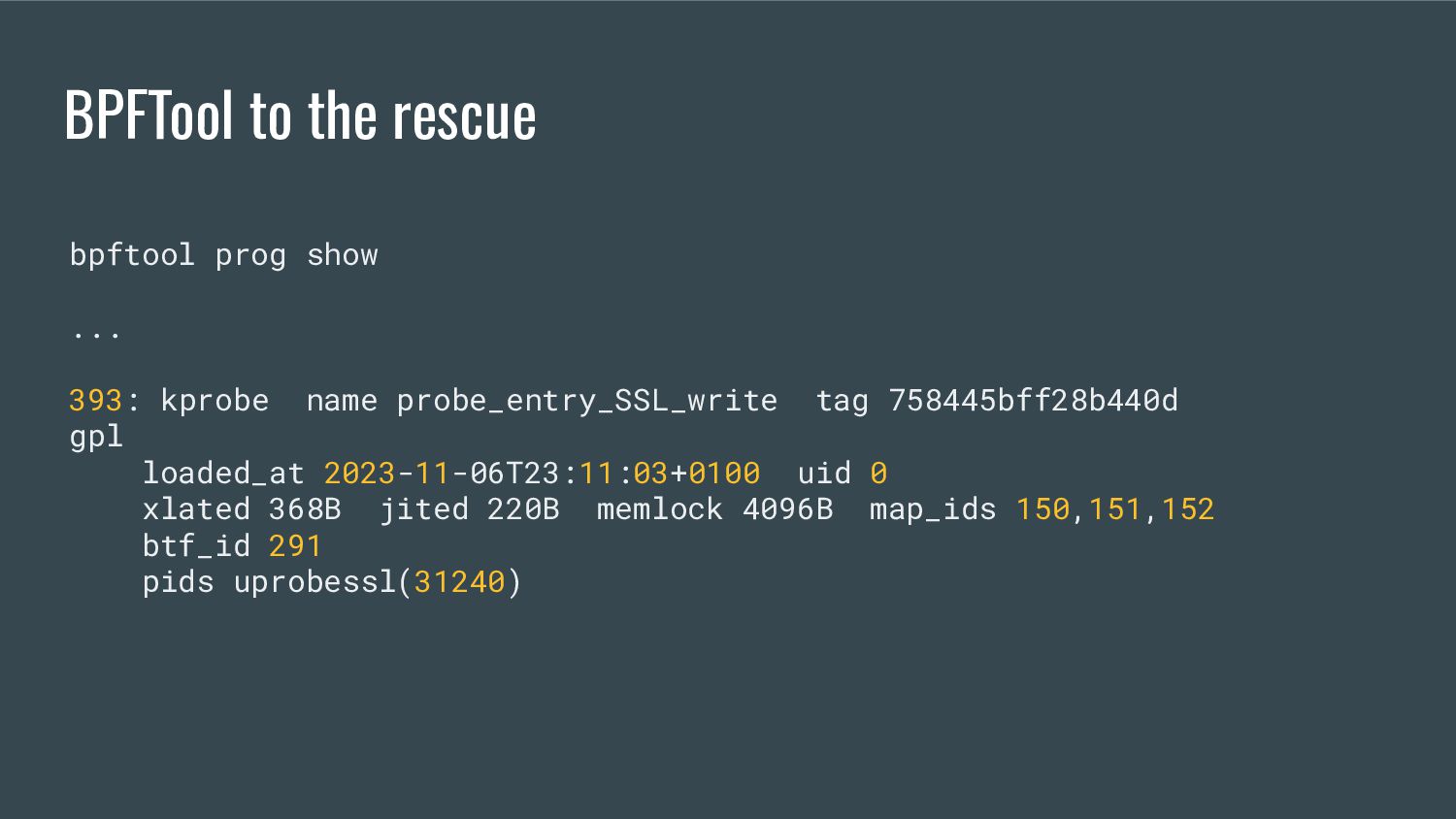
BPFTool to the rescue bpftool prog show ... 393: kprobe
name probe_entry_SSL_write tag 758445bff28b440d gpl loaded_at 2023-11-06T23:11:03+0100 uid 0 xlated 368B jited 220B memlock 4096B map_ids 150,151,152 btf_id 291 pids uprobessl(31240) -
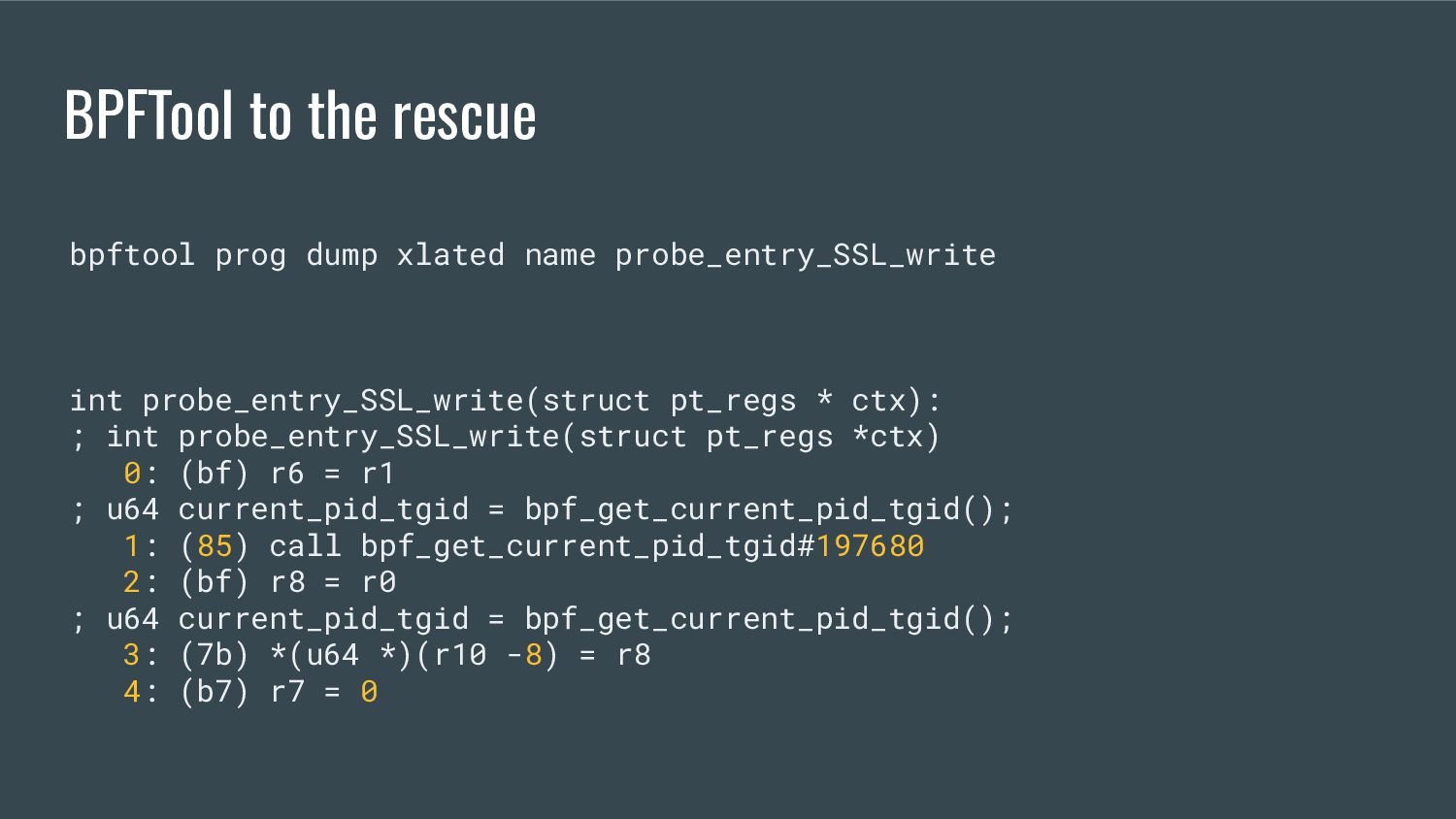
BPFTool to the rescue bpftool prog dump xlated name probe_entry_SSL_write
int probe_entry_SSL_write(struct pt_regs * ctx): ; int probe_entry_SSL_write(struct pt_regs *ctx) 0: (bf) r6 = r1 ; u64 current_pid_tgid = bpf_get_current_pid_tgid(); 1: (85) call bpf_get_current_pid_tgid#197680 2: (bf) r8 = r0 ; u64 current_pid_tgid = bpf_get_current_pid_tgid(); 3: (7b) *(u64 *)(r10 -8) = r8 4: (b7) r7 = 0 -
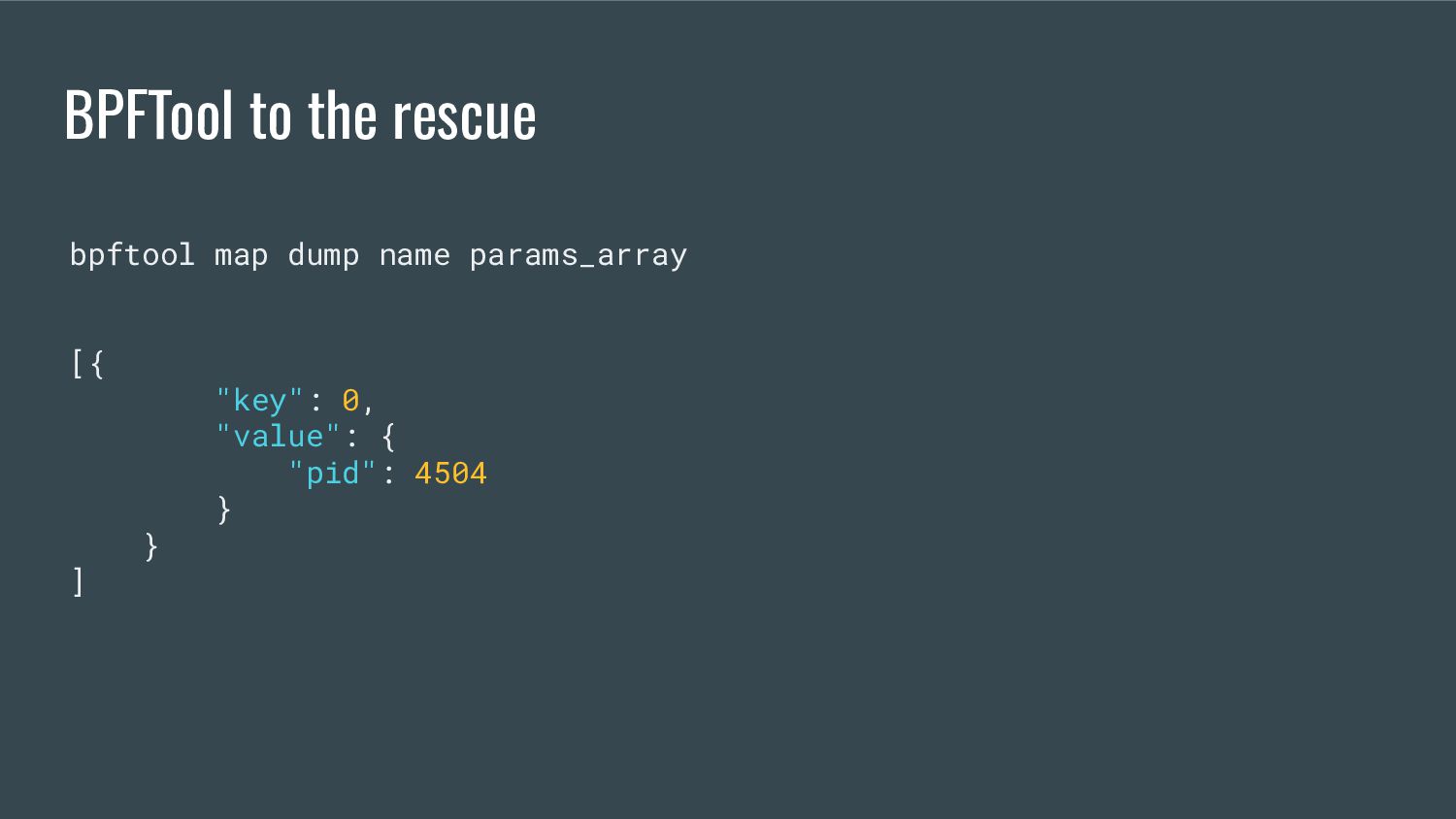
bpftool map dump name params_array [{ "key": 0, "value": {
"pid": 4504 } } ] BPFTool to the rescue -
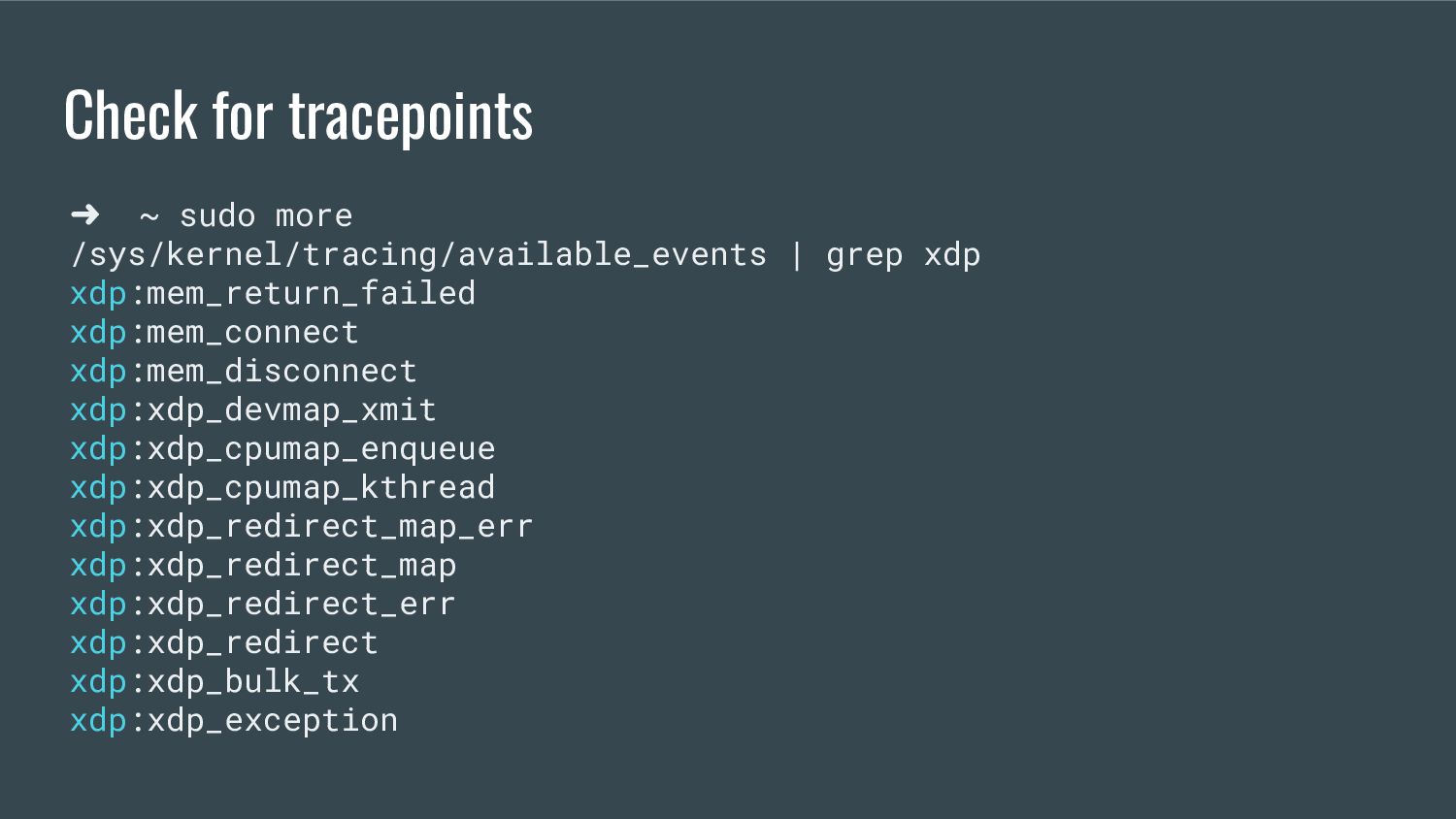
Check for tracepoints ➜ ~ sudo more /sys/kernel/tracing/available_events | grep
xdp xdp:mem_return_failed xdp:mem_connect xdp:mem_disconnect xdp:xdp_devmap_xmit xdp:xdp_cpumap_enqueue xdp:xdp_cpumap_kthread xdp:xdp_redirect_map_err xdp:xdp_redirect_map xdp:xdp_redirect_err xdp:xdp_redirect xdp:xdp_bulk_tx xdp:xdp_exception -
Check for tracepoints sudo bpftrace -e 'tracepoint:xdp:* { @cnt[probe] =
count(); }' Attaching 12 probes... ^C @cnt[tracepoint:xdp:xdp_bulk_tx]: 10 bpftrace -e \ 'tracepoint:xdp:xdp_bulk_tx{@redir_errno[-args->err] = count();}' Attaching 1 probe... ^C @redir_errno[6]: 2 -
The userspace side is in charge of - where to
attach the program - where to store the events - present the data to the user - what parameters to pass to the program -
Wrapping up - A kernel side in C, a userspace
side in Go - You need to be familiar with the kernel! - Maps as an API - Every program type is different - It’s powerful -
Wrapping up - A kernel side in C, a userspace
side in Go - You need to be familiar with the kernel! - Maps as an API - Every program type is different - It’s powerful - It’s difficult to tame -
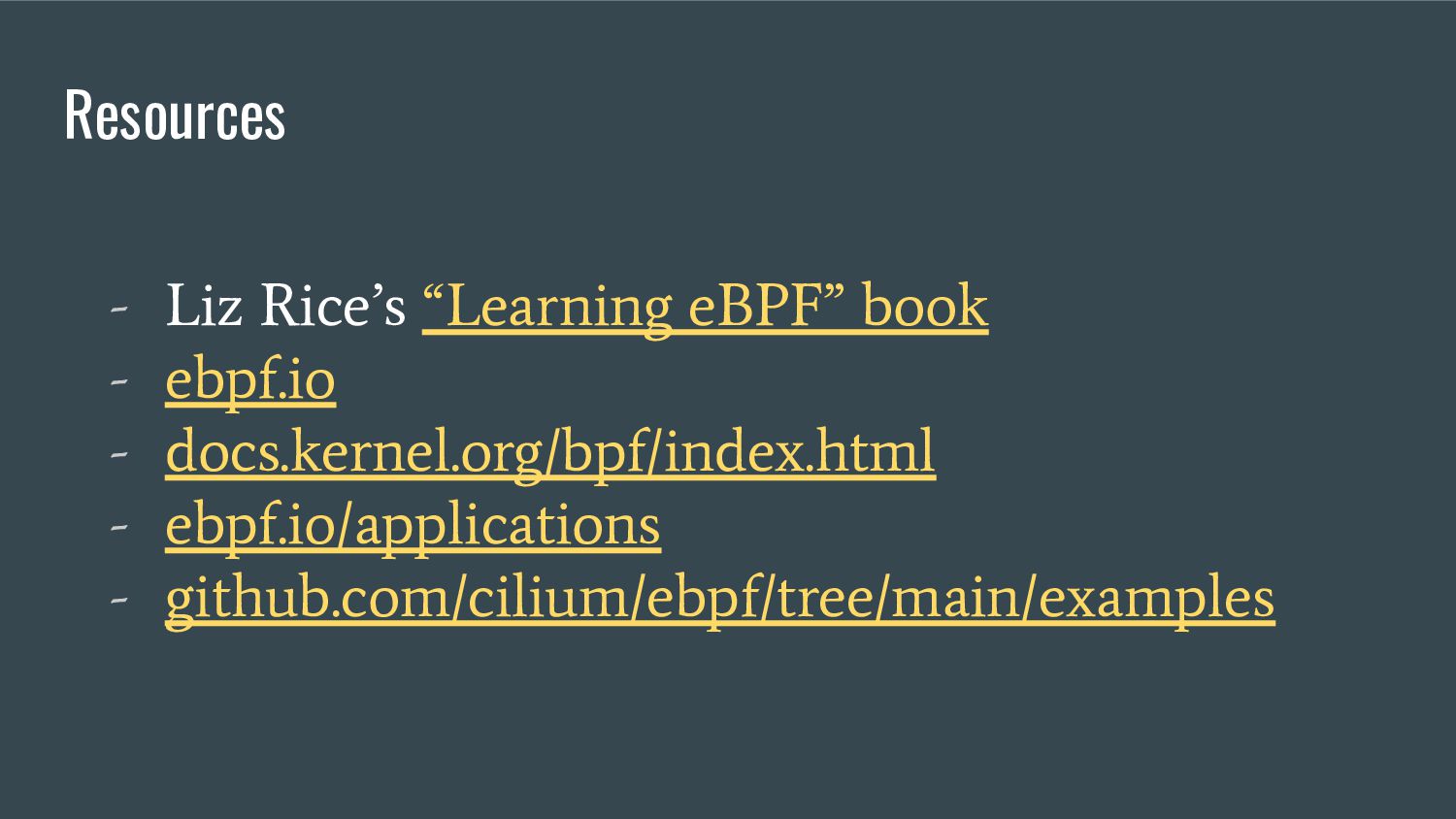
Resources - Liz Rice’s “Learning eBPF” book - ebpf.io -
docs.kernel.org/bpf/index.html - ebpf.io/applications - github.com/cilium/ebpf/tree/main/examples
 fedepaol
 _kotobuki_
 imuta
 mohab1
 yosukeyoshida
 yamakenji24
 manabuseki
 daitak
 kazatohiei
 dynamis
 azukiazusa1
 jacopen
 keitaibaraki
 nikkihalliwell
 keithpitt
 bkeepers
 trallard
 bryan
 katarinadahlin
 samanthasiow
 afnizarnur
 malarkey
 garrettdimon
 irinanazarova
 aleyda