Share
Embed
Futures and Promises in Scala 2.10
An introduction to Futures and Promises, and the "Try" type (scala.util.Try) coming in Scala 2.10. (Joint work with Philipp Haller).
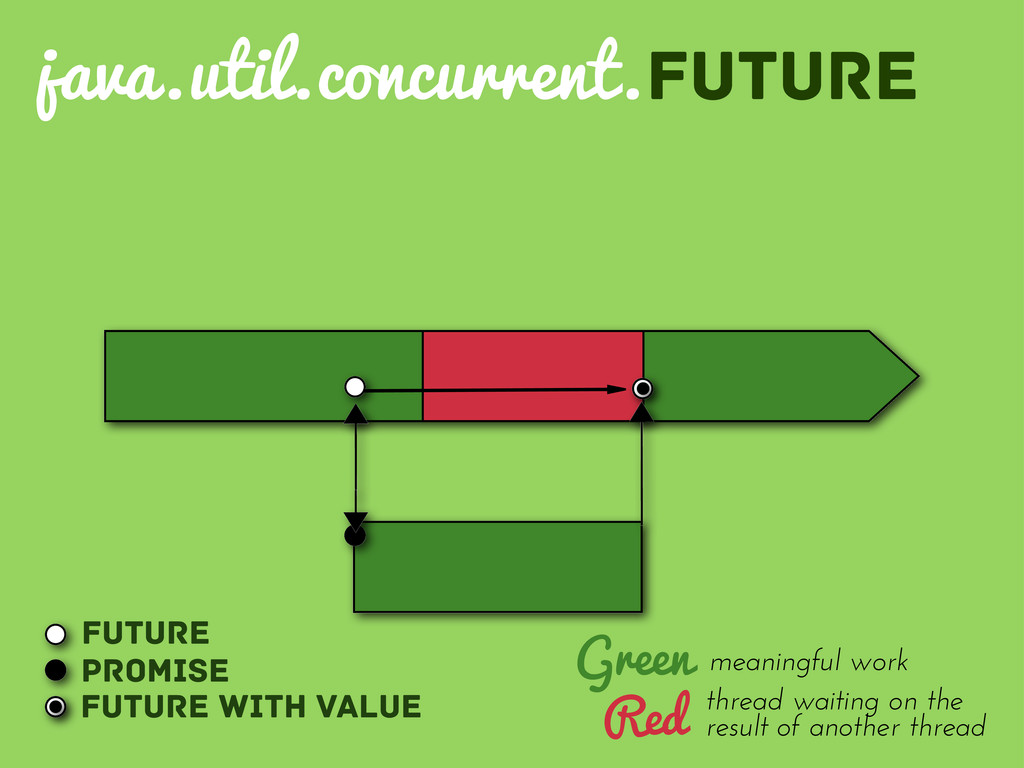
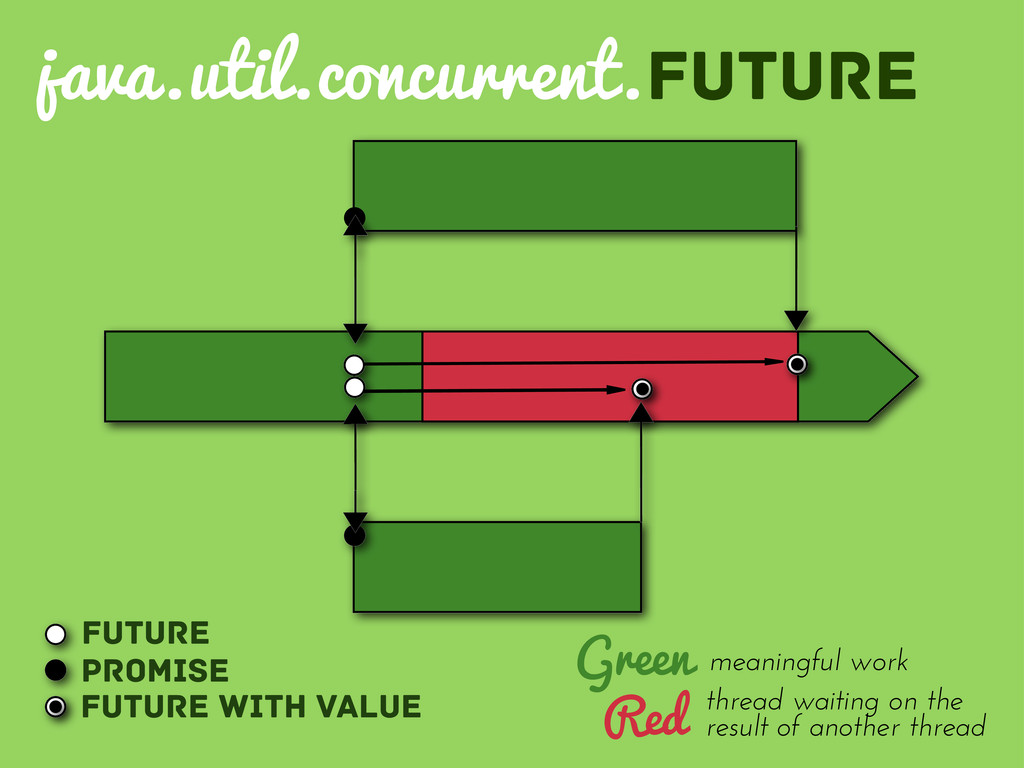
Props to Viktor Klang-- excellent java.concurrent.util.Future illustration taken from his ScalaDays 2012 talk on the same subject.

Heather Miller
August 14, 2012
Transcript
78 slides
-
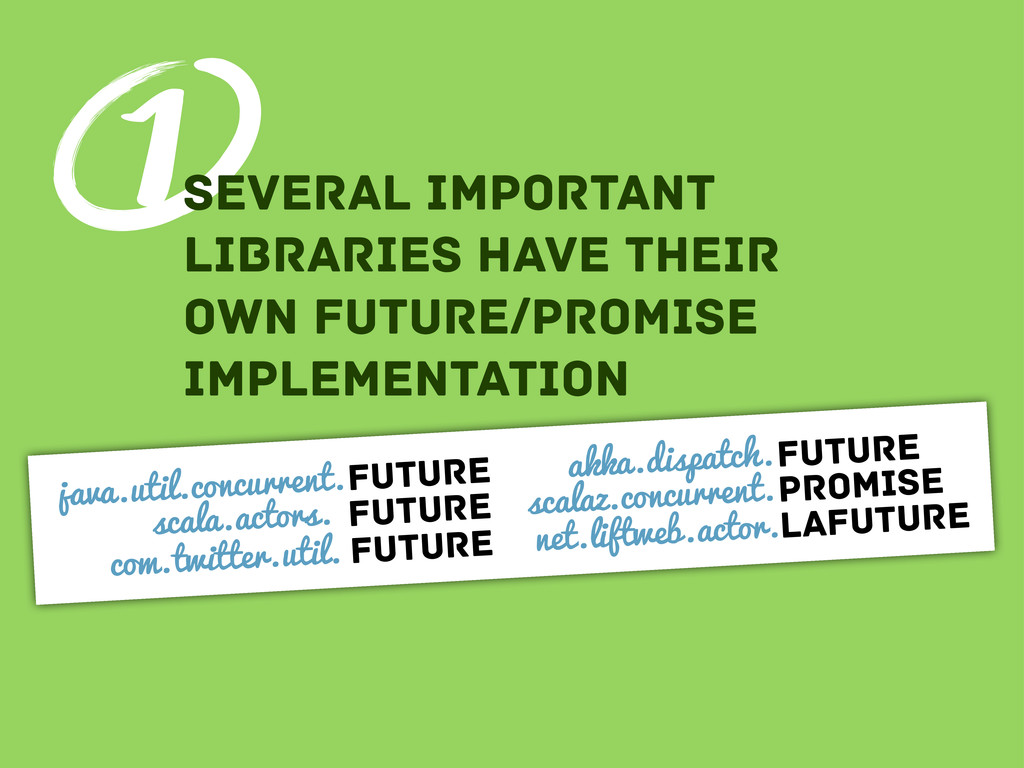
1 Several important libraries have their own future/promise implementation java.util.concurrent.
scala.actors. com.twitter.util. akka.dispatch. scalaz.concurrent. net.liftweb.actor. FUTURE FUTURE FUTURE FUTURE PROMISE LAFUTURE -
This makes it clear that... futures are an important, powerful
abstraction there’s fragmentation in the scala ecosystem no hope of interop! -
Furthermore... Java futures neither efficient nor composable 2 we could
make futures more powerful, by taking advantage of scala’s features 3 -
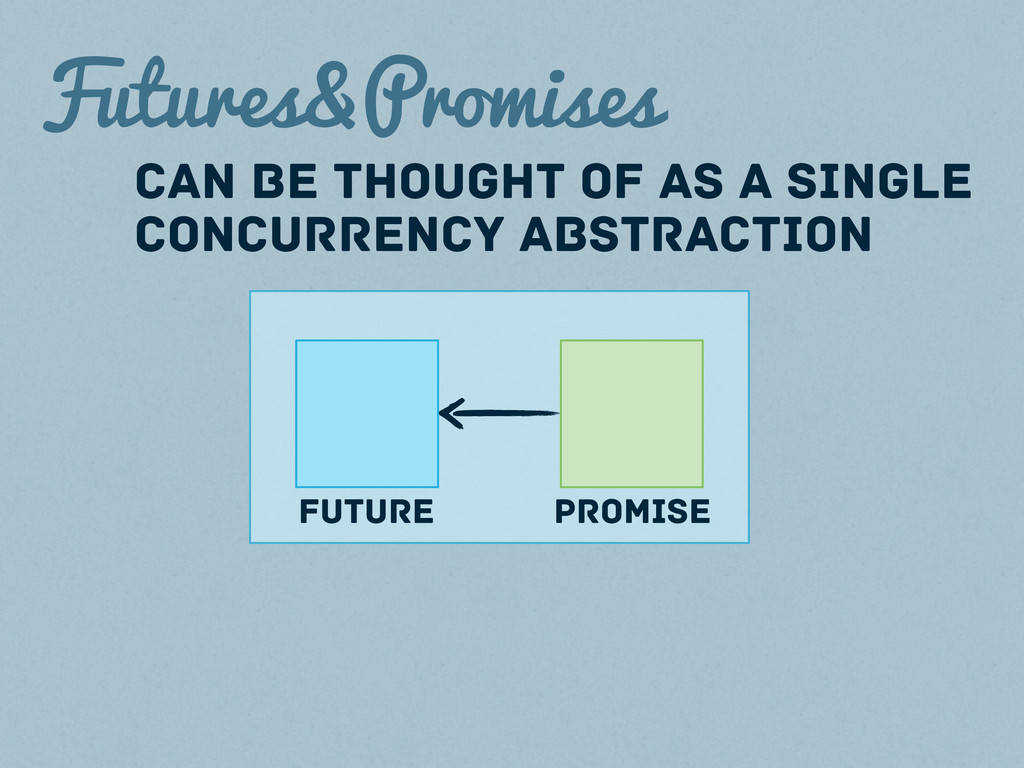
can be thought of as a single concurrency abstraction Futures&Promises
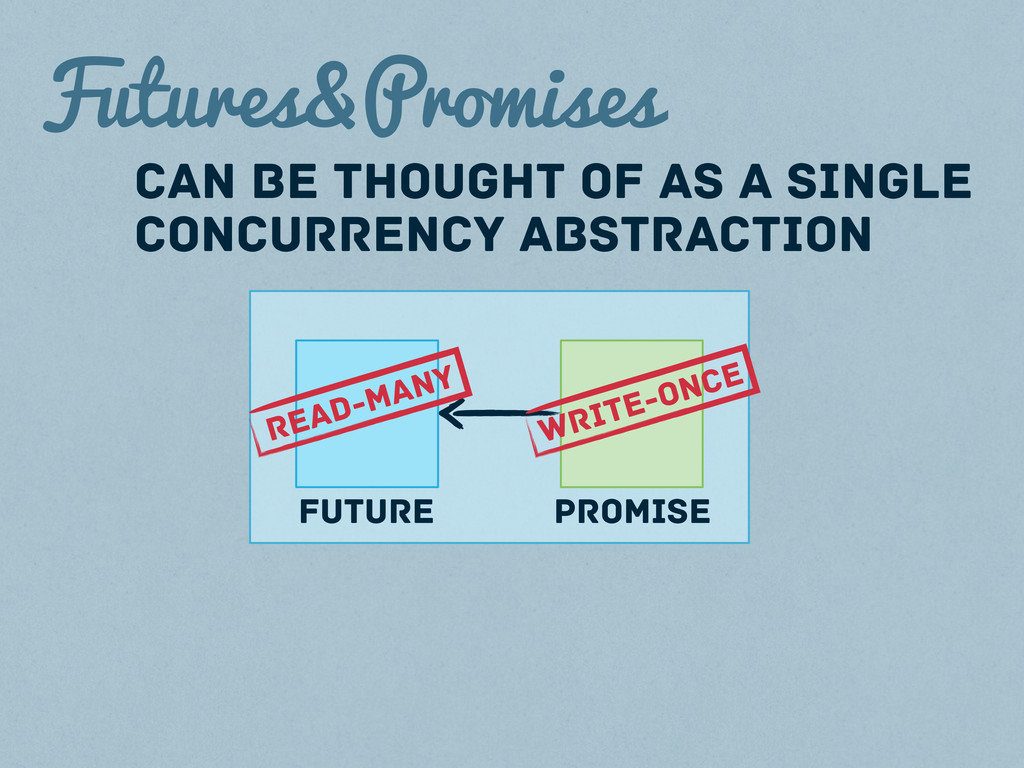
Future READ-MANY promise write-once -
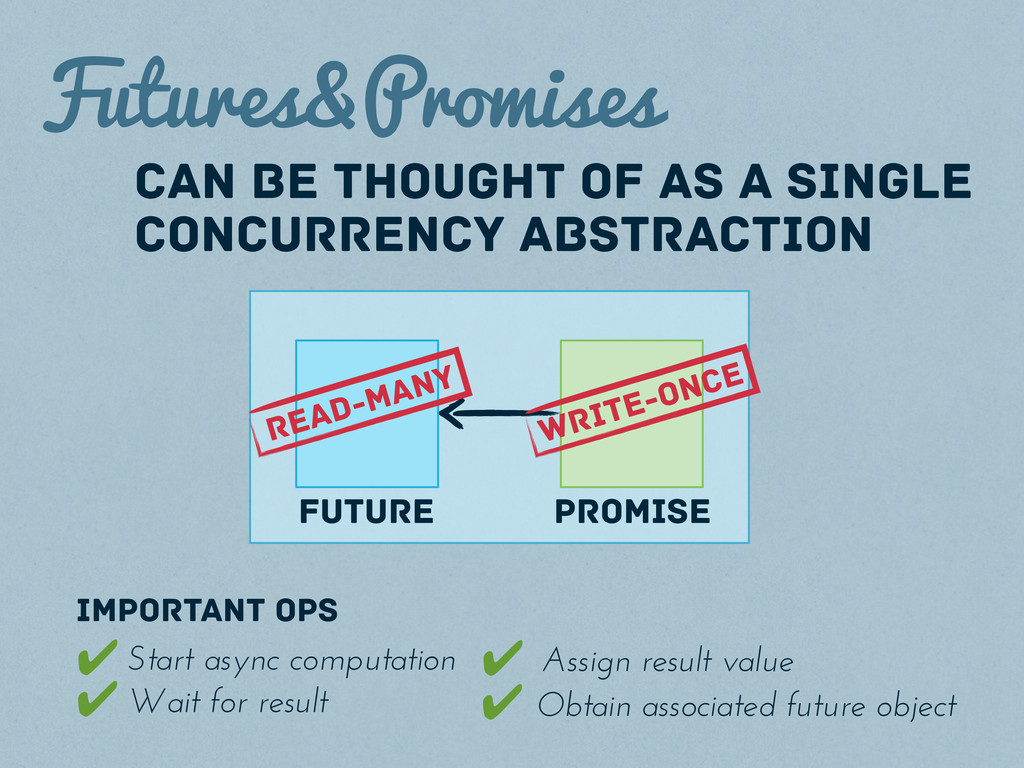
can be thought of as a single concurrency abstraction Futures&Promises
Future READ-MANY promise write-once Start async computation ✔ important ops Assign result value ✔ Wait for result ✔ Obtain associated future object ✔ -
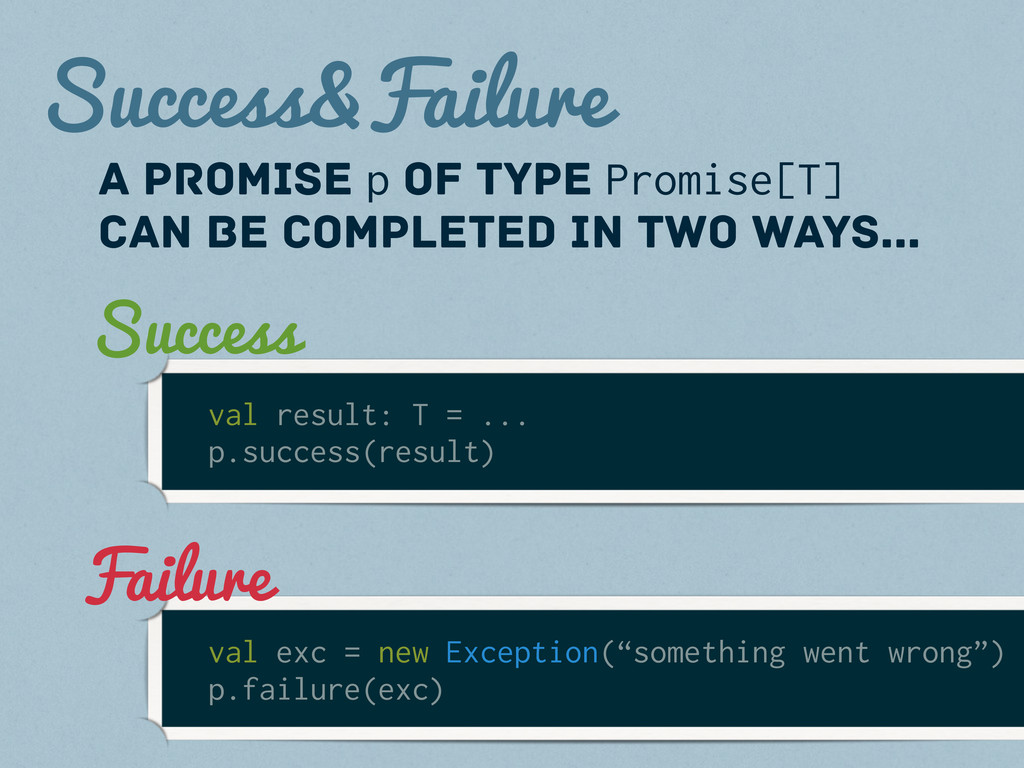
a promise p of type Promise[T] can be completed in
two ways... Success&Failure val result: T = ... p.success(result) Success val exc = new Exception(“something went wrong”) p.failure(exc) Failure -
Future Promise Future with value Green Red thread waiting on
the result of another thread meaningful work java.util.concurrent.future -
java.util.concurrent.future Future Promise Future with value Green Red thread waiting
on the result of another thread meaningful work -
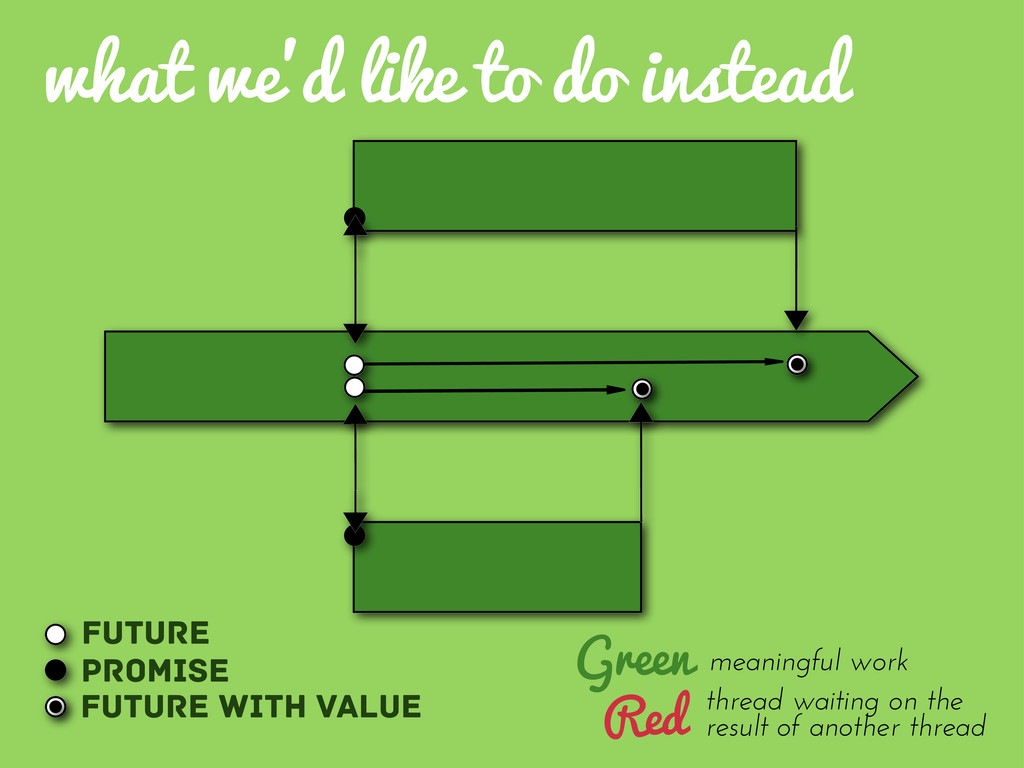
what we’d like to do instead Future Promise Future with
value Green Red thread waiting on the result of another thread meaningful work -
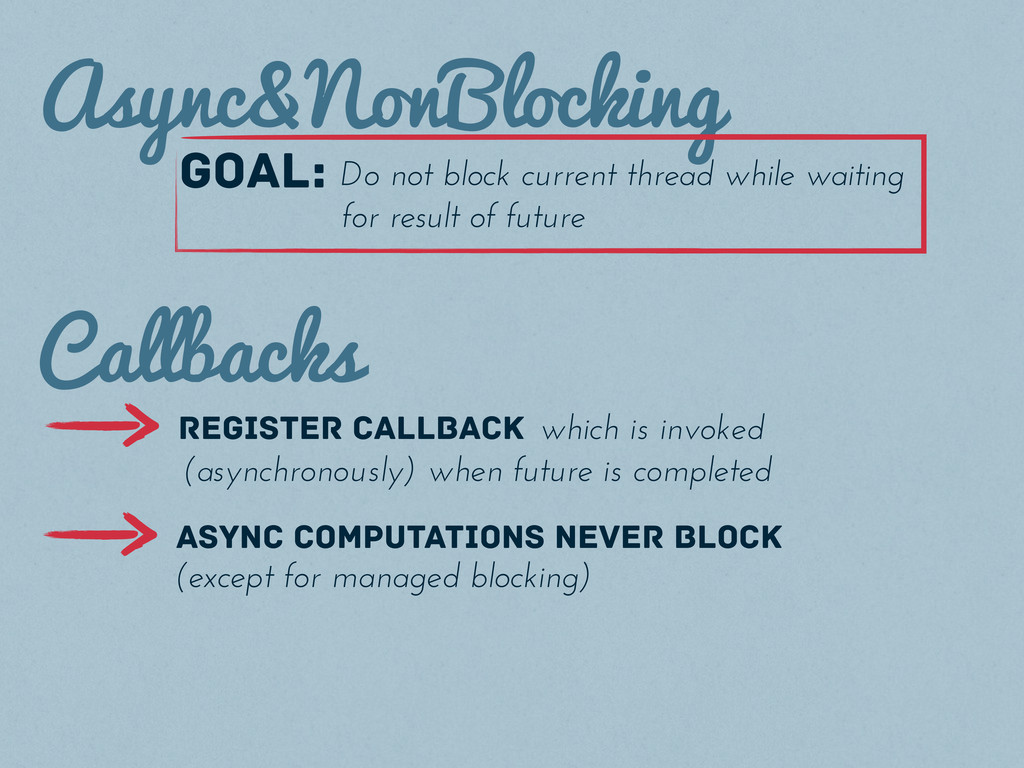
Async&NonBlocking goal: Do not block current thread while waiting for
result of future Callbacks Register callback which is invoked (asynchronously) when future is completed Async computations never block (except for managed blocking) -
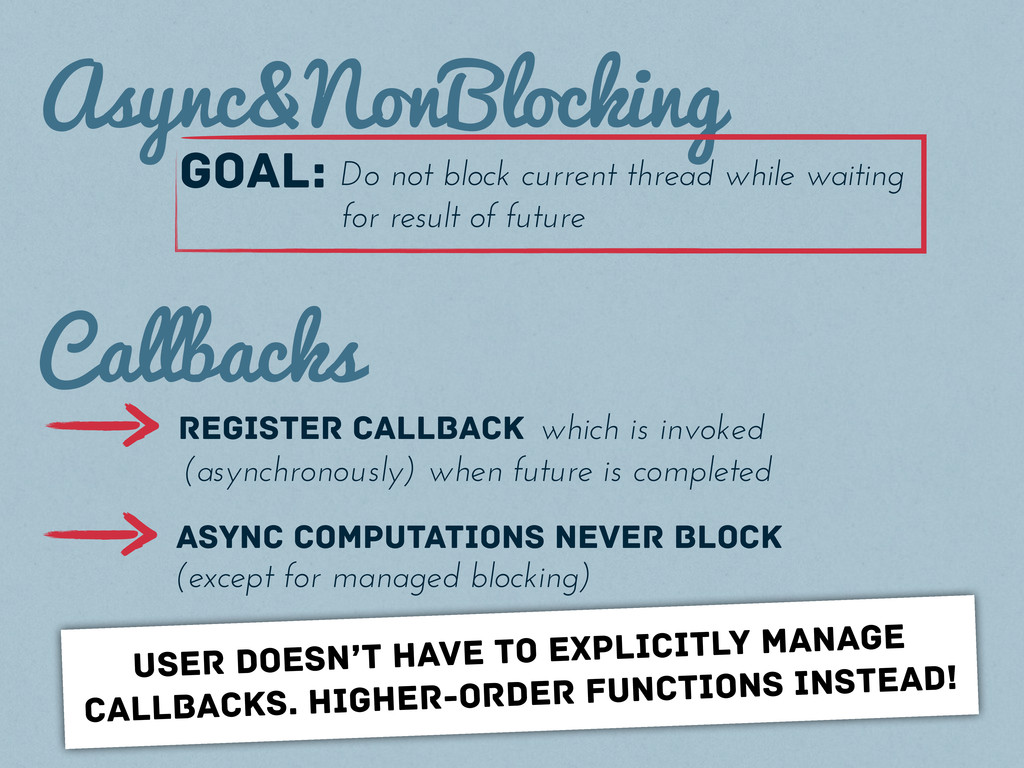
Async&NonBlocking goal: Do not block current thread while waiting for
result of future Callbacks Register callback which is invoked (asynchronously) when future is completed Async computations never block (except for managed blocking) user doesn’t have to explicitly manage callbacks. higher-order functions instead! -
Futures&Promises Promise val p = Promise[Int]() // Thread 1 Thread1
Thread2 Thread3 (create promise) example -
Futures&Promises Promise Future val p = Promise[Int]() // Thread 1
val f = p.future // Thread 1 Thread1 Thread2 Thread3 (create promise) (get reference to future) example -
Futures&Promises Promise Future val p = Promise[Int]() // Thread 1
val f = p.future // Thread 1 f onSuccess { // Thread 2 case x: Int => println(“Successful!”) } Thread1 Thread2 Thread3 onSuccess callback (create promise) (get reference to future) (register callback) example -
Futures&Promises Promise Future val p = Promise[Int]() // Thread 1
val f = p.future // Thread 1 f onSuccess { // Thread 2 case x: Int => println(“Successful!”) } Thread1 Thread2 Thread3 onSuccess callback p.success(42) // Thread 1 42 42 (create promise) (get reference to future) (register callback) (write to promise) example -
Futures&Promises Promise Future val p = Promise[Int]() // Thread 1
val f = p.future // Thread 1 f onSuccess { // Thread 2 case x: Int => println(“Successful!”) } Thread1 Thread2 Thread3 onSuccess callback p.success(42) // Thread 1 42 42 Successful! Console (create promise) (get reference to future) (register callback) (write to promise) (execute callback) // Thread example note: onSuccess callback executed even if f has already been completed at time of registration -
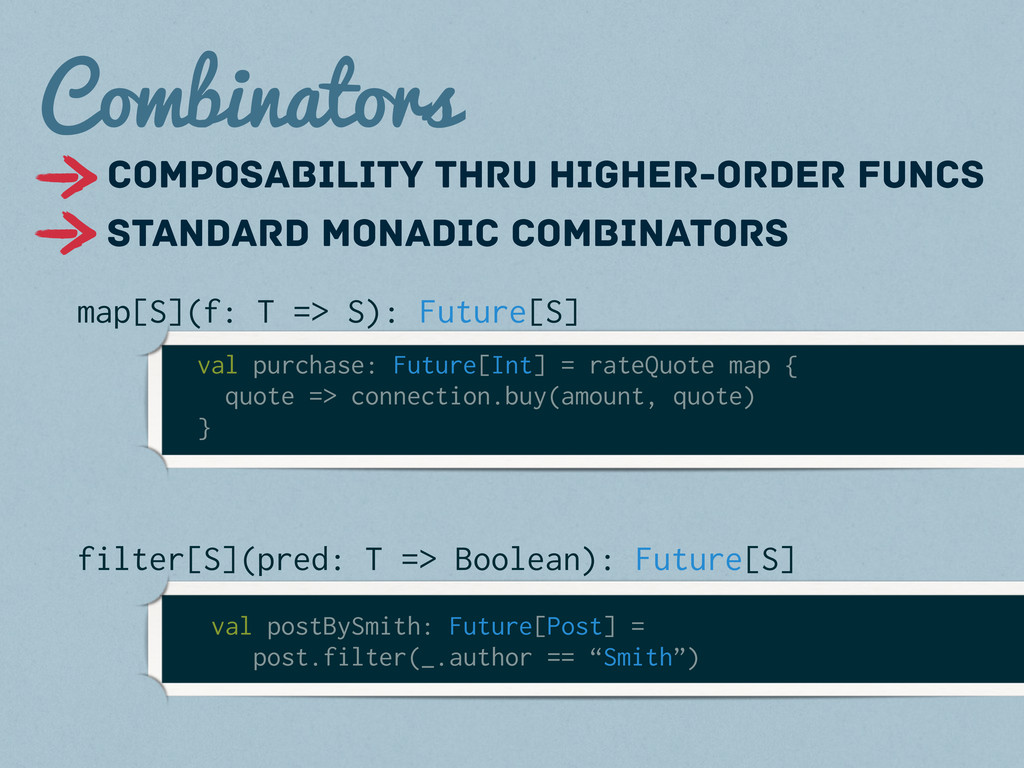
Combinators val purchase: Future[Int] = rateQuote map { quote =>
connection.buy(amount, quote) } val postBySmith: Future[Post] = post.filter(_.author == “Smith”) Composability thru higher-order funcs standard monadic combinators map[S](f: T => S): Future[S] filter[S](pred: T => Boolean): Future[S] -
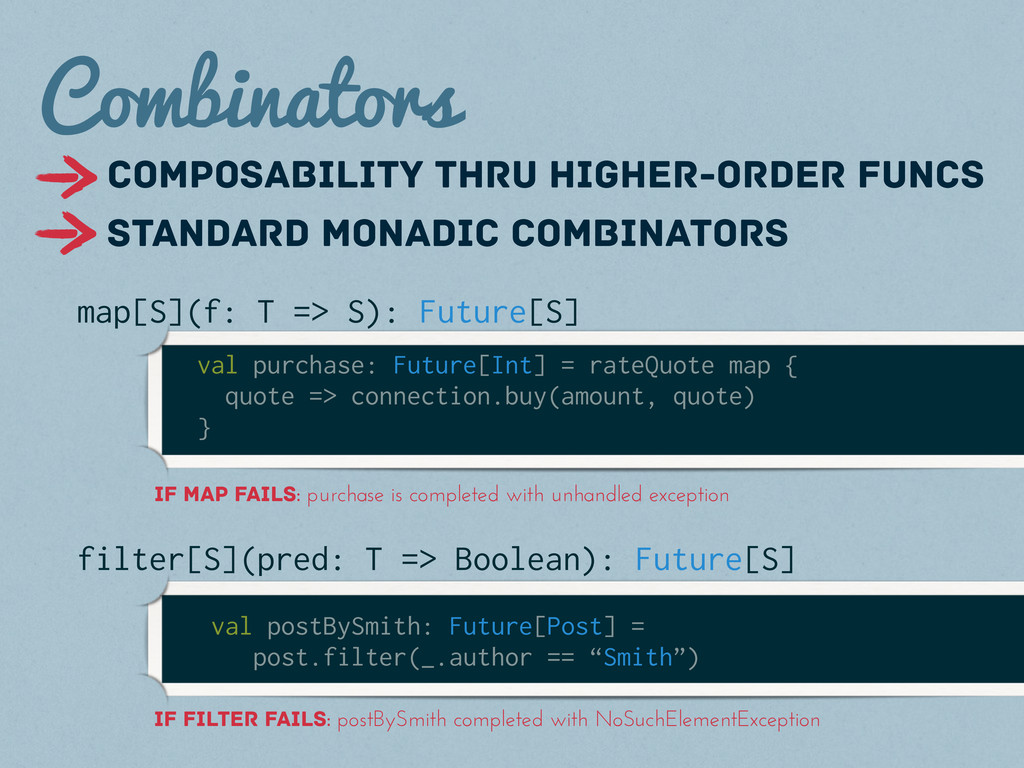
Combinators val purchase: Future[Int] = rateQuote map { quote =>
connection.buy(amount, quote) } val postBySmith: Future[Post] = post.filter(_.author == “Smith”) Composability thru higher-order funcs standard monadic combinators map[S](f: T => S): Future[S] filter[S](pred: T => Boolean): Future[S] If filter fails: postBySmith completed with NoSuchElementException If map fails: purchase is completed with unhandled exception -
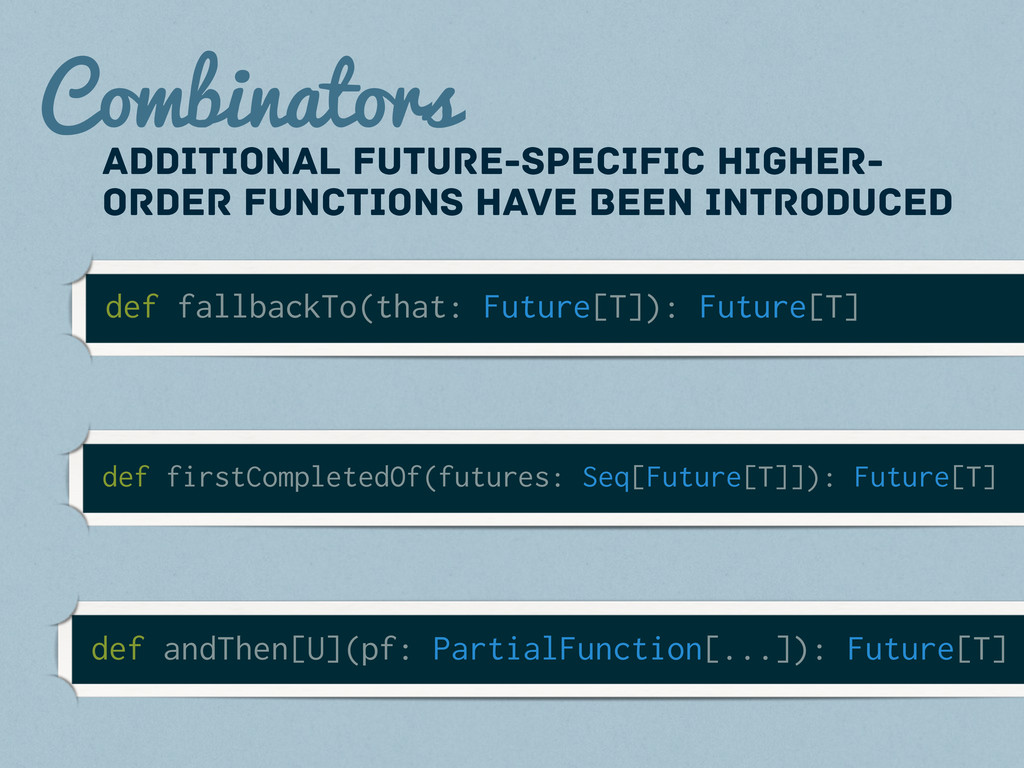
Combinators Additional future-specific higher- order functions have been introduced def
fallbackTo(that: Future[T]): Future[T] def firstCompletedOf(futures: Seq[Future[T]]): Future[T] def andThen[U](pf: PartialFunction[...]): Future[T] -
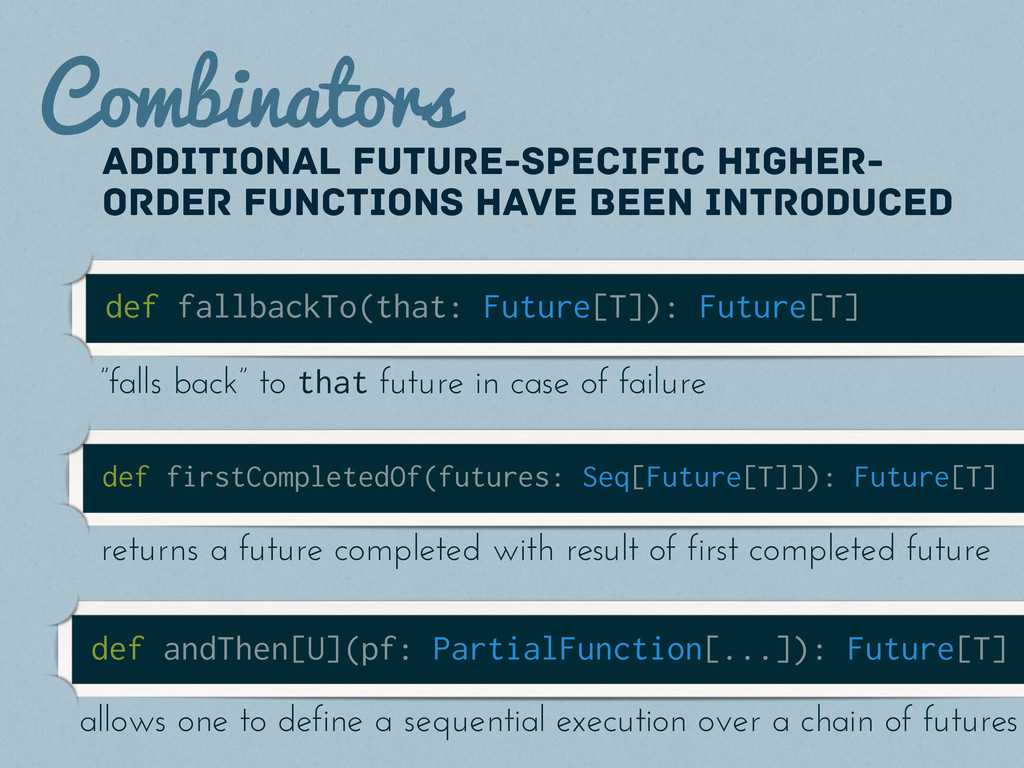
Combinators Additional future-specific higher- order functions have been introduced def
fallbackTo(that: Future[T]): Future[T] def firstCompletedOf(futures: Seq[Future[T]]): Future[T] def andThen[U](pf: PartialFunction[...]): Future[T] ”falls back” to that future in case of failure returns a future completed with result of first completed future allows one to define a sequential execution over a chain of futures -
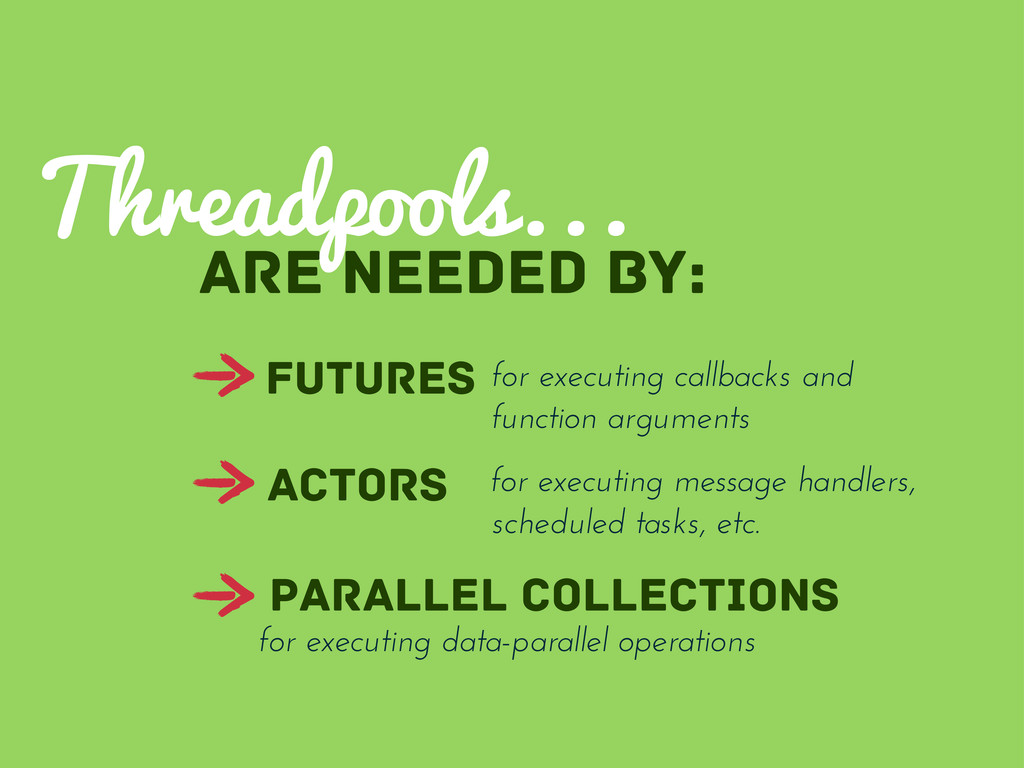
are needed by: Threadpools... futures Actors parallel collections for executing
callbacks and function arguments for executing message handlers, scheduled tasks, etc. for executing data-parallel operations -
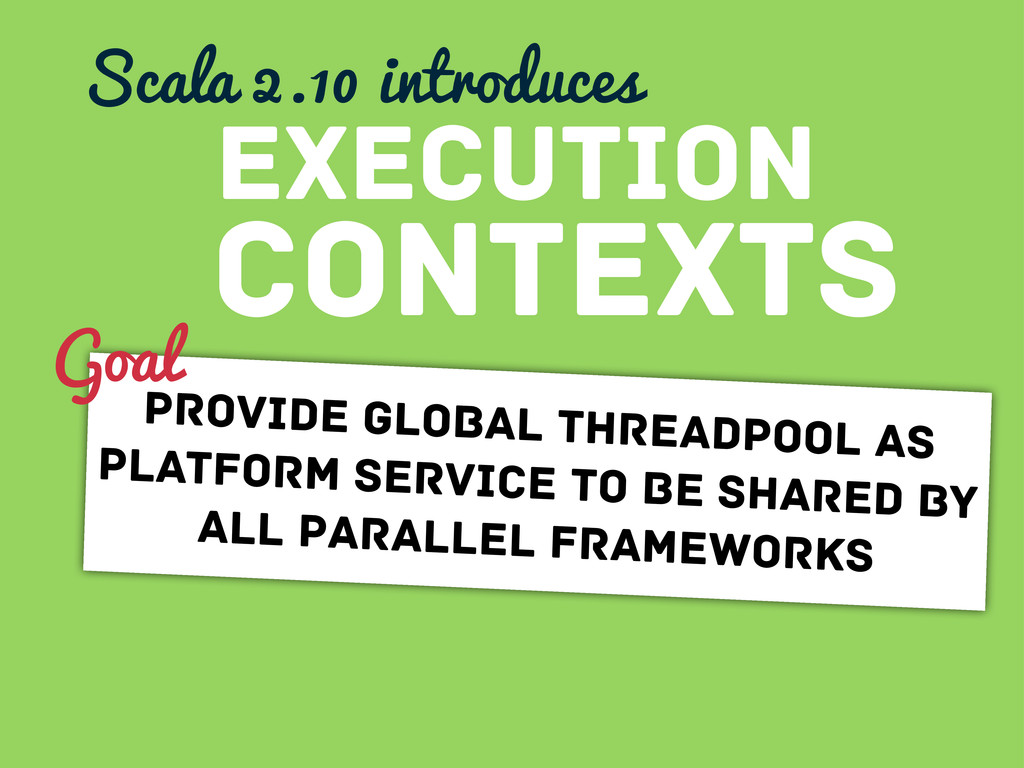
contexts Execution Scala 2.10 introduces provide global threadpool as platform
service to be shared by all parallel frameworks Goal -
contexts Execution Scala 2.10 introduces provide global threadpool as platform
service to be shared by all parallel frameworks Goal scala.concurrent package provides global ExecutionContext Default ExecutionContext backed by the most recent fork join pool (collaboration with Doug Lea, SUNY Oswego) -
Implicit Execution Ctxs def map[S](f: T => S)(implicit executor: ExecutionContext):
Future[S] def onSuccess[U](pf: PartialFunction[T, U]) (implicit executor: ExecutionContext): Unit By default, asynchronous computations are executed on the global ExecutionContext which is provided implicitly. Implicit parameters make it possible to override the default ExecutionContext: implicit val context: ExecutionContext = customExecutionContext val fut2 = fut1.filter(pred) .map(fun) -
Implicit Execution Ctxs def map[S](f: T => S)(implicit executor: ExecutionContext):
Future[S] def onSuccess[U](pf: PartialFunction[T, U]) (implicit executor: ExecutionContext): Unit By default, asynchronous computations are executed on the global ExecutionContext which is provided implicitly. Implicit parameters make it possible to override the default ExecutionContext: implicit val context: ExecutionContext = customExecutionContext val fut2 = fut1.filter(pred) .map(fun) implicit ExecutionContexts allow sharing ecs between frameworks Enables flexible selection of execution policy -
Future the implementation def map[S](f: T => S): Future[S] =
{ val p = Promise[S]() onComplete { case result => try { result match { case Success(r) => p success f(r) case Failure(t) => p failure t } } catch { case t: Throwable => p failure t } } p.future } Many operations implemented in terms of promises simplified example -
Future the implementation REAL def map[S](f: T => S)(implicit executor:
ExecutionContext): Future[S] = { val p = Promise[S]() onComplete { case result => try { result match { case Success(r) => p success f(r) case f: Failure[_] => p complete f.asInstanceOf[Failure[S]] } } catch { case NonFatal(t) => p failure t } } p.future } The real implementation (a) adds an implicit ExecutionContext, (b) avoids extra object creations, and (c) catches only non-fatal exceptions: -
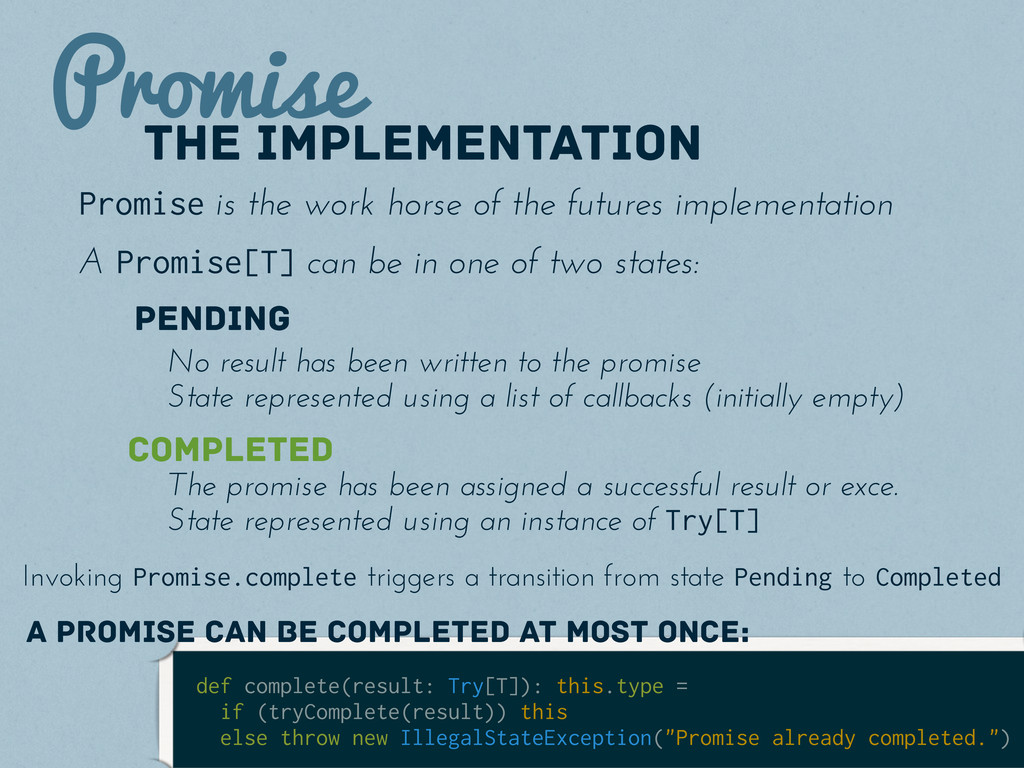
Promise the implementation Promise is the work horse of the
futures implementation def complete(result: Try[T]): this.type = if (tryComplete(result)) this else throw new IllegalStateException("Promise already completed.") A Promise[T] can be in one of two states: COMPLETED PENDING No result has been written to the promise State represented using a list of callbacks (initially empty) The promise has been assigned a successful result or exce. State represented using an instance of Try[T] Invoking Promise.complete triggers a transition from state Pending to Completed A Promise can be completed at most once: -
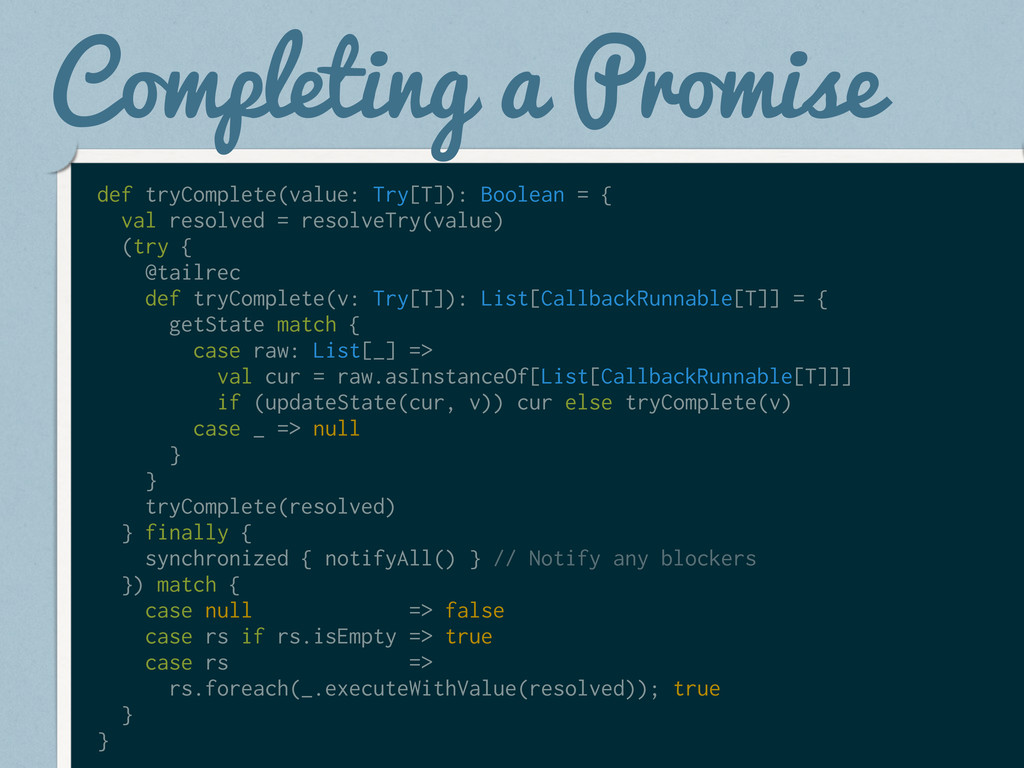
def tryComplete(value: Try[T]): Boolean = { val resolved = resolveTry(value)
(try { @tailrec def tryComplete(v: Try[T]): List[CallbackRunnable[T]] = { getState match { case raw: List[_] => val cur = raw.asInstanceOf[List[CallbackRunnable[T]]] if (updateState(cur, v)) cur else tryComplete(v) case _ => null } } tryComplete(resolved) } finally { synchronized { notifyAll() } // Notify any blockers }) match { case null => false case rs if rs.isEmpty => true case rs => rs.foreach(_.executeWithValue(resolved)); true } } Completing a Promise -
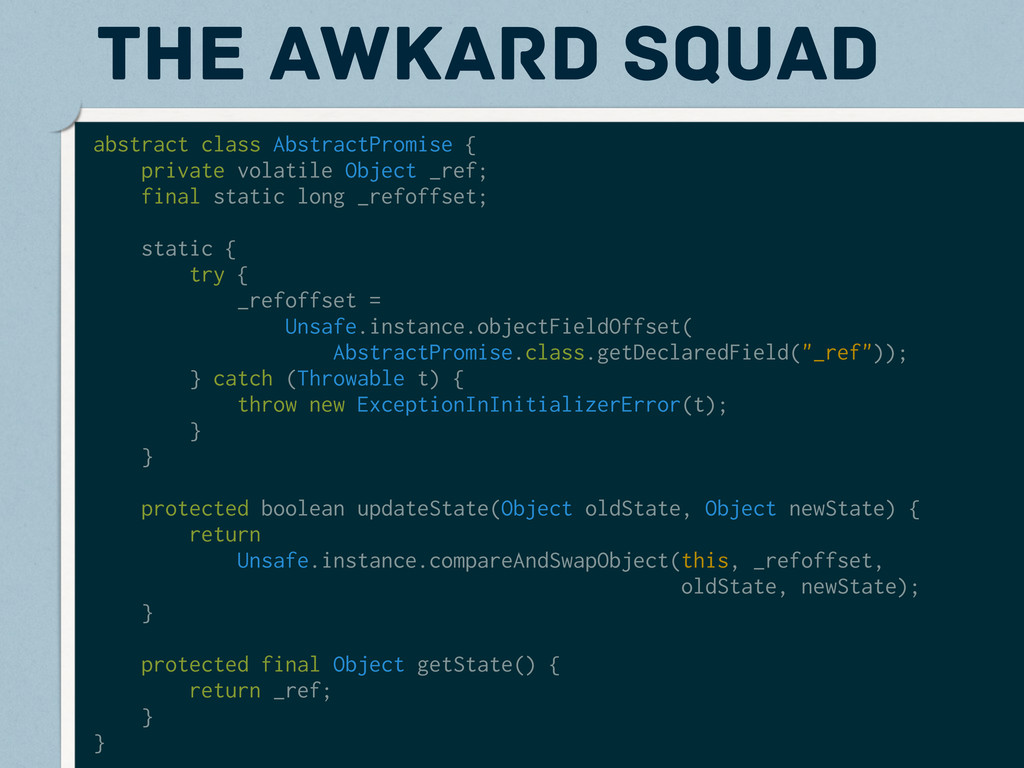
the awkard squad abstract class AbstractPromise { private volatile Object
_ref; final static long _refoffset; static { try { _refoffset = Unsafe.instance.objectFieldOffset( AbstractPromise.class.getDeclaredField("_ref")); } catch (Throwable t) { throw new ExceptionInInitializerError(t); } } protected boolean updateState(Object oldState, Object newState) { return Unsafe.instance.compareAndSwapObject(this, _refoffset, oldState, newState); } protected final Object getState() { return _ref; } } -
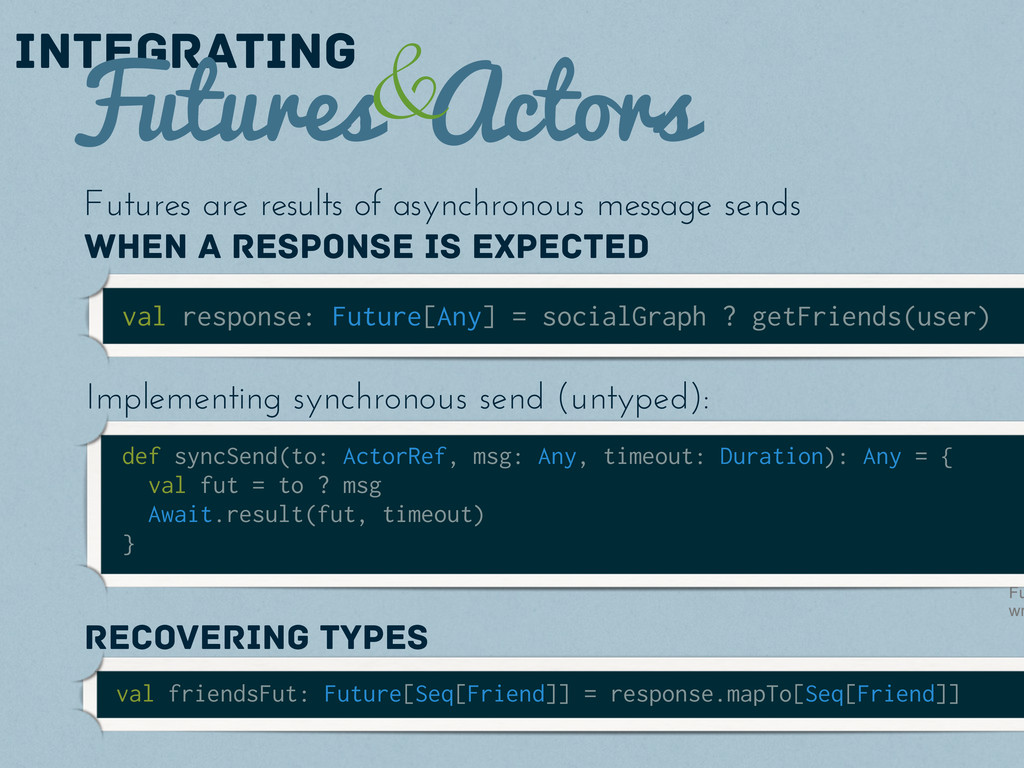
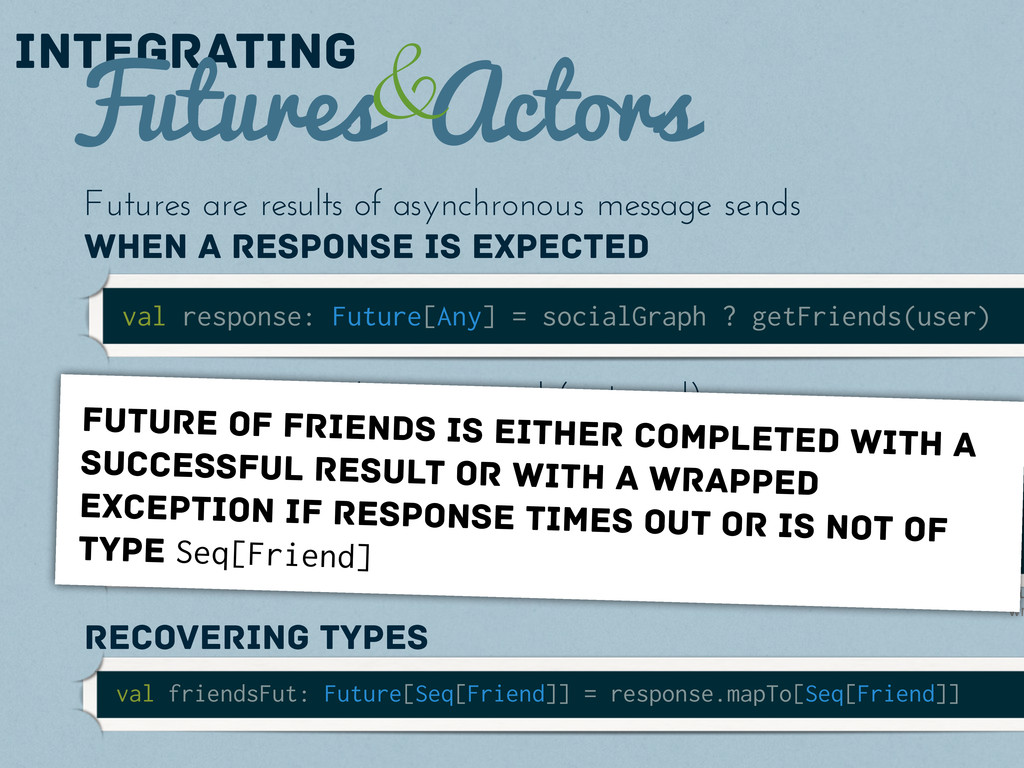
Integrating Futures Actors & Futures are results of asynchronous message
sends when a response is expected Fu wr val response: Future[Any] = socialGraph ? getFriends(user) Implementing synchronous send (untyped): def syncSend(to: ActorRef, msg: Any, timeout: Duration): Any = { val fut = to ? msg Await.result(fut, timeout) } Recovering types val friendsFut: Future[Seq[Friend]] = response.mapTo[Seq[Friend]] -
Integrating Futures Actors & Futures are results of asynchronous message
sends when a response is expected Fu wr val response: Future[Any] = socialGraph ? getFriends(user) Implementing synchronous send (untyped): def syncSend(to: ActorRef, msg: Any, timeout: Duration): Any = { val fut = to ? msg Await.result(fut, timeout) } Recovering types val friendsFut: Future[Seq[Friend]] = response.mapTo[Seq[Friend]] Future of Friends is either completed with a successful result or with a wrapped exception if response times out or is not of type Seq[Friend] -
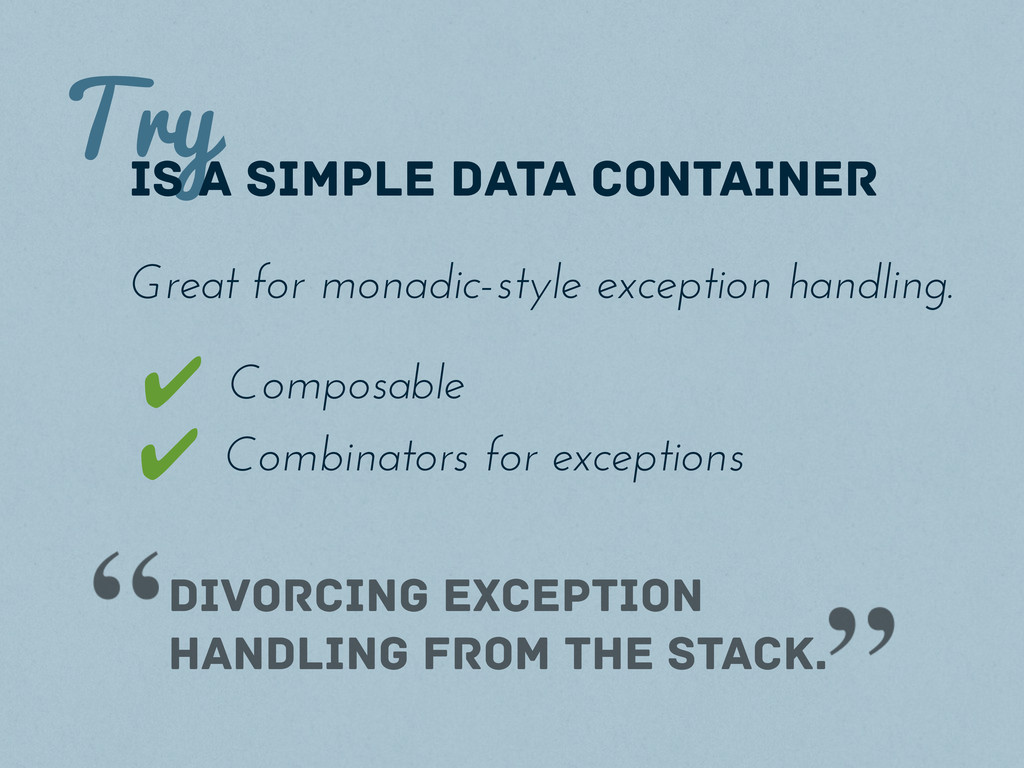
Try is a simple data container Composable ✔ Combinators for
exceptions ✔ Great for monadic-style exception handling. Divorcing exception handling from the stack. -
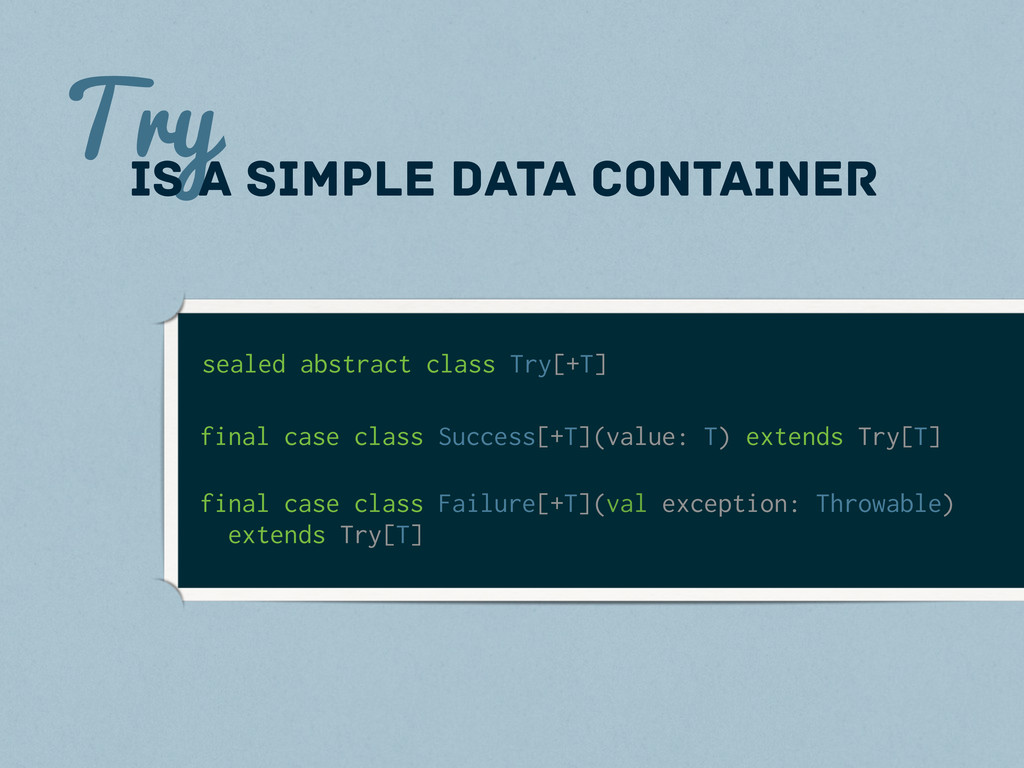
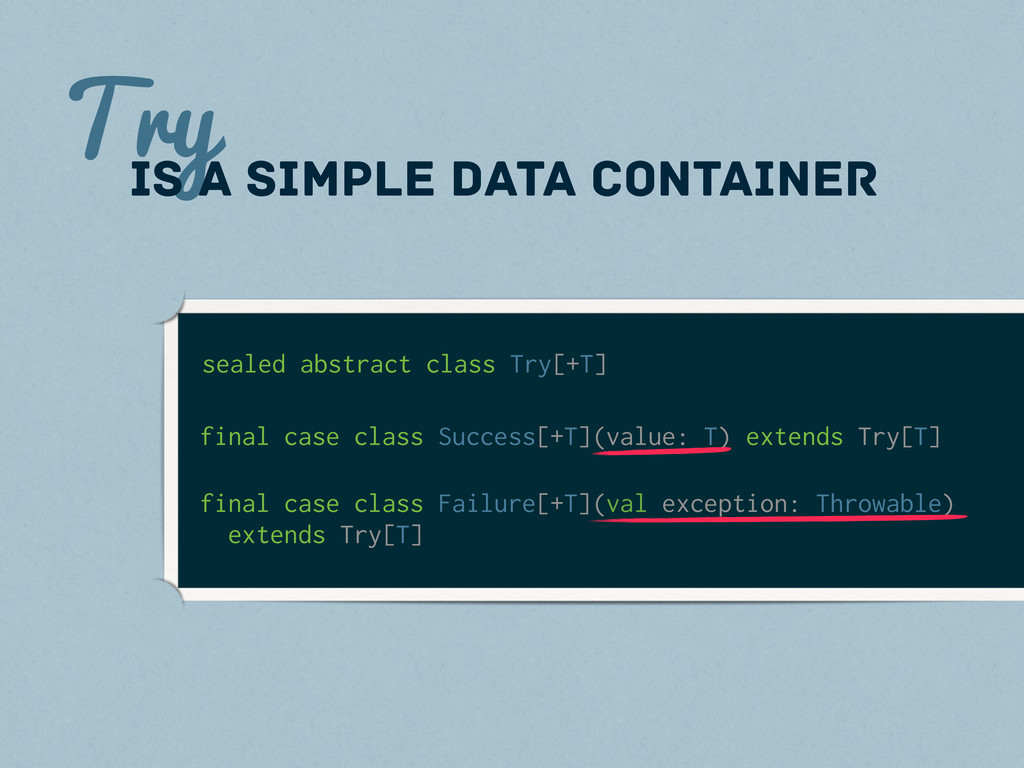
Try is a simple data container sealed abstract class Try[+T]
final case class Success[+T](value: T) extends Try[T] final case class Failure[+T](val exception: Throwable) extends Try[T] -
Try is a simple data container sealed abstract class Try[+T]
final case class Success[+T](value: T) extends Try[T] final case class Failure[+T](val exception: Throwable) extends Try[T] -
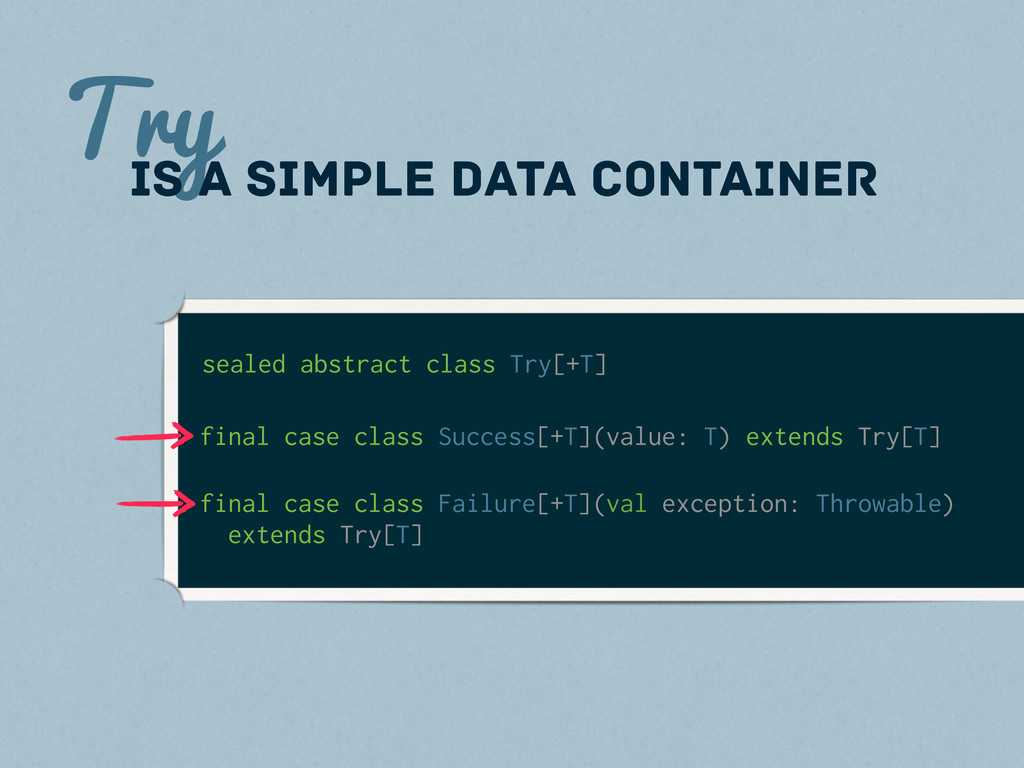
Try is a simple data container sealed abstract class Try[+T]
final case class Success[+T](value: T) extends Try[T] final case class Failure[+T](val exception: Throwable) extends Try[T] -
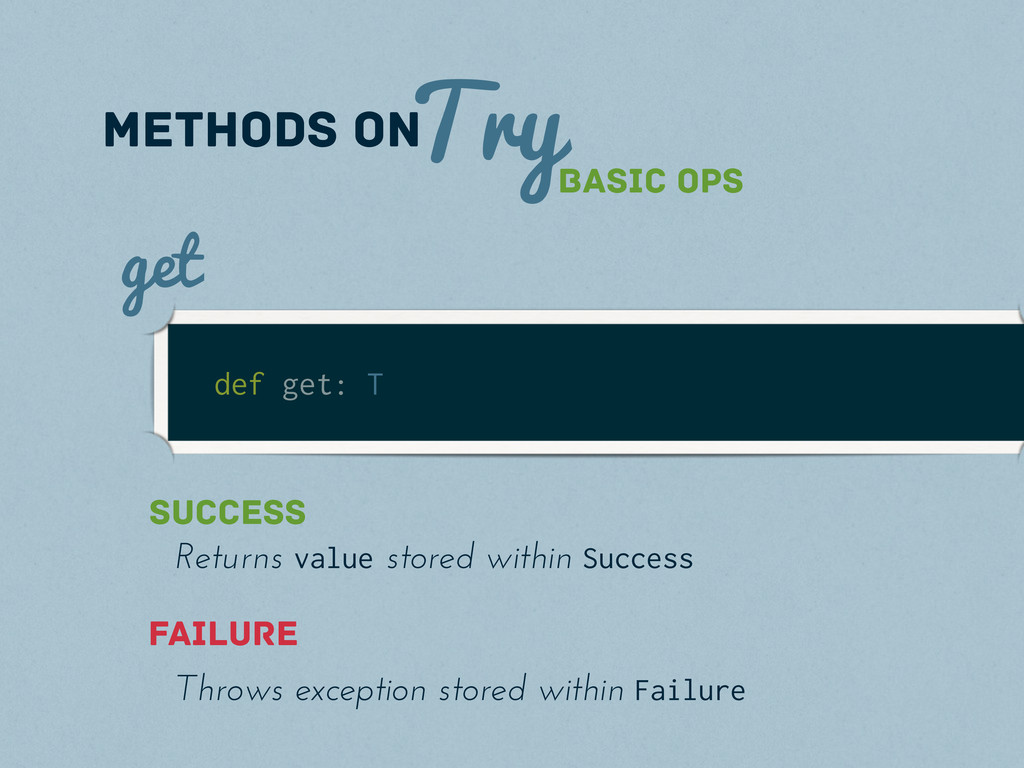
Try methods on Basic Ops def get: T get Success
Failure Returns value stored within Success Throws exception stored within Failure -
Try methods on def getOrElse[U >: T](default: => U) Success
Failure Returns value stored within Success Returns the given default argument if this is a Failure getOrElse Basic Ops -
Try methods on def orElse[U >: T](default: => Try[U]) orElse
Success Failure Returns this Try if this is a Success Returns the given default argument if this is a Failure Basic Ops -
Try methods on def map[U](f: T => U): Try[U] map
Success Failure Applies the function f to the value from Success Returns this if this is a Failure monadic Ops -
Try methods on def flatMap[U](f: T => Try[U]): Try[U] flatMap
Success Failure Applies the function f to the value from Success Returns this if this is a Failure monadic Ops -
Try methods on def filter(p: T => Boolean): Try[T] filter
Success Failure Converts this to a Failure if predicate p not satisfied. Returns this if this is a Failure monadic Ops -
Try methods on def recoverWith[U >: T](f: PartialFunction[Throwable, Try[U]]): Try[U]
recoverWith Success Failure Returns this if this is a Success Applies function f if this is a Failure. (flatMap on exptn) exception-specific Ops -
Try methods on def recover[U >: T](f: PartialFunction[Throwable, U]): Try[U]
recover Success Failure exception-specific Ops Returns this if this is a Success Applies function f if this is a Failure. (like map on exptn) -
Try methods on def transform[U](s: T => Try[U], f: Throwable
=> Try[U]): Try[U] transform Success Failure Completes this Try by applying function f if this is a Success Completes this Try by applying function f if this is a Failure exception-specific Ops -
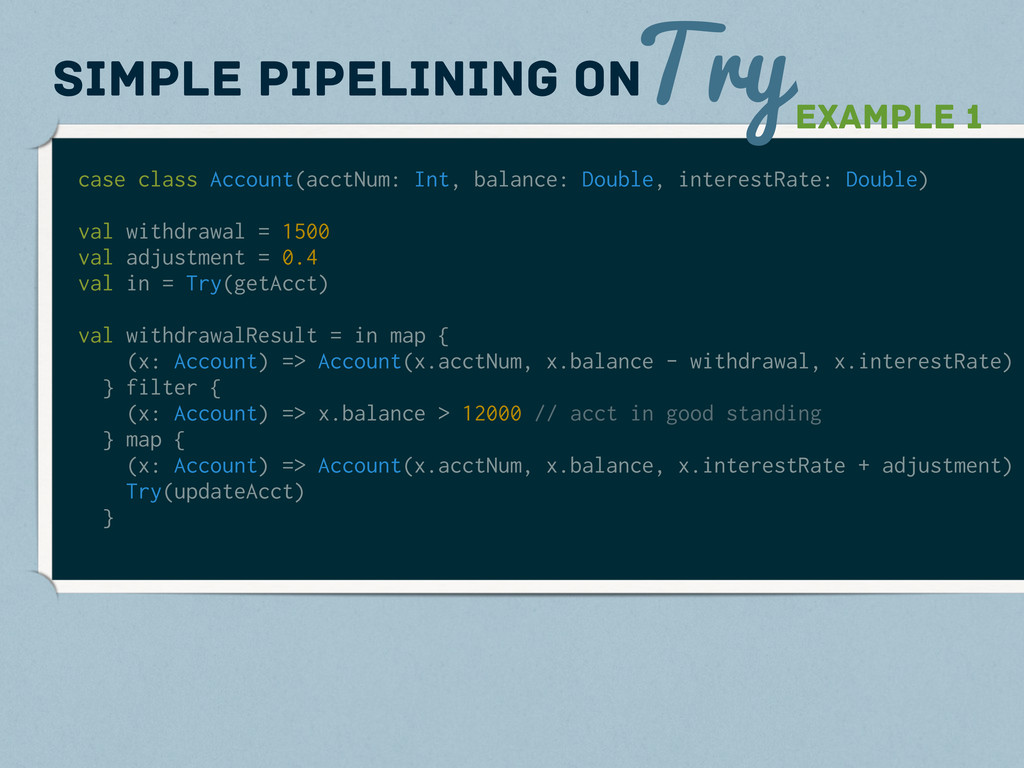
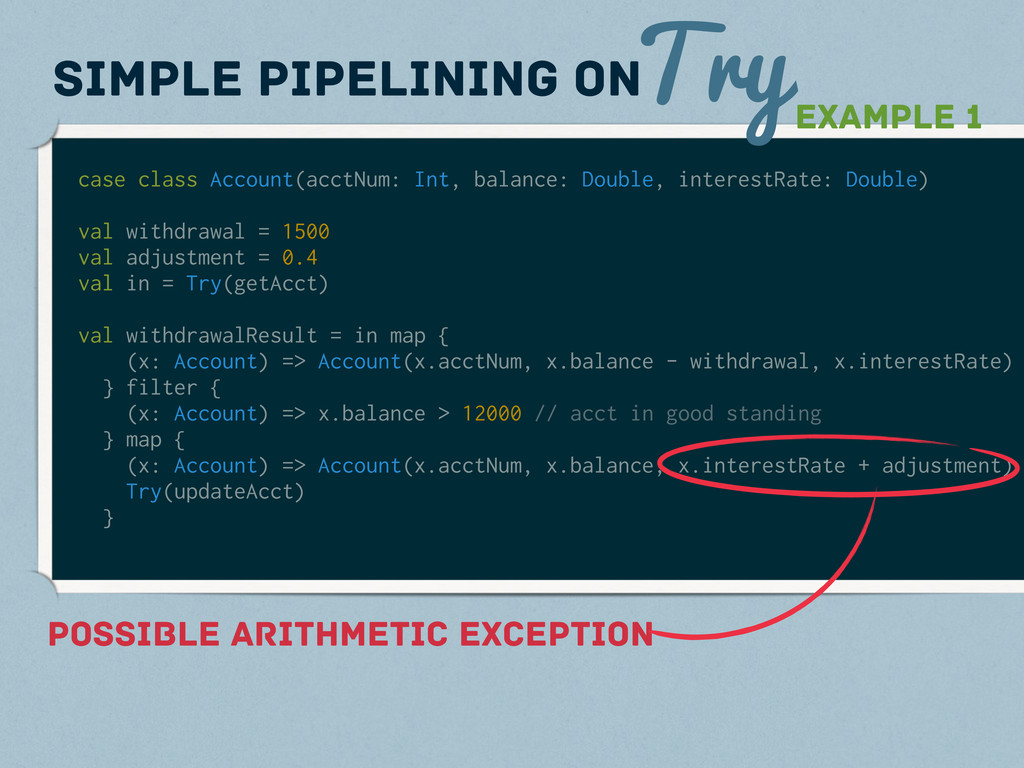
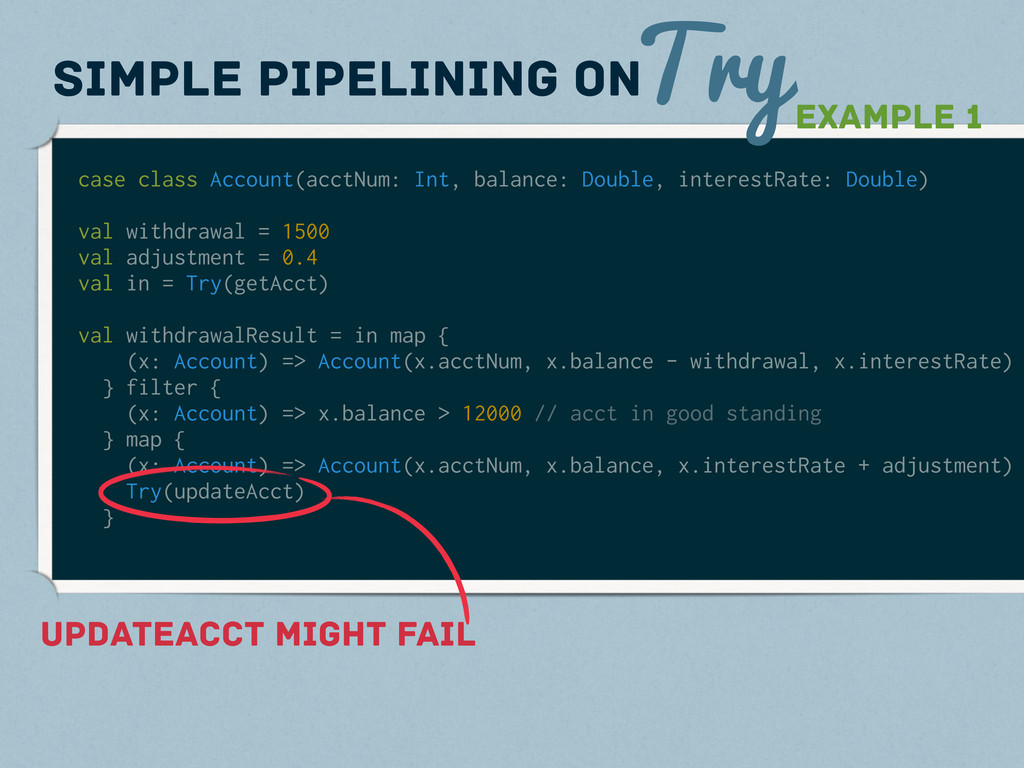
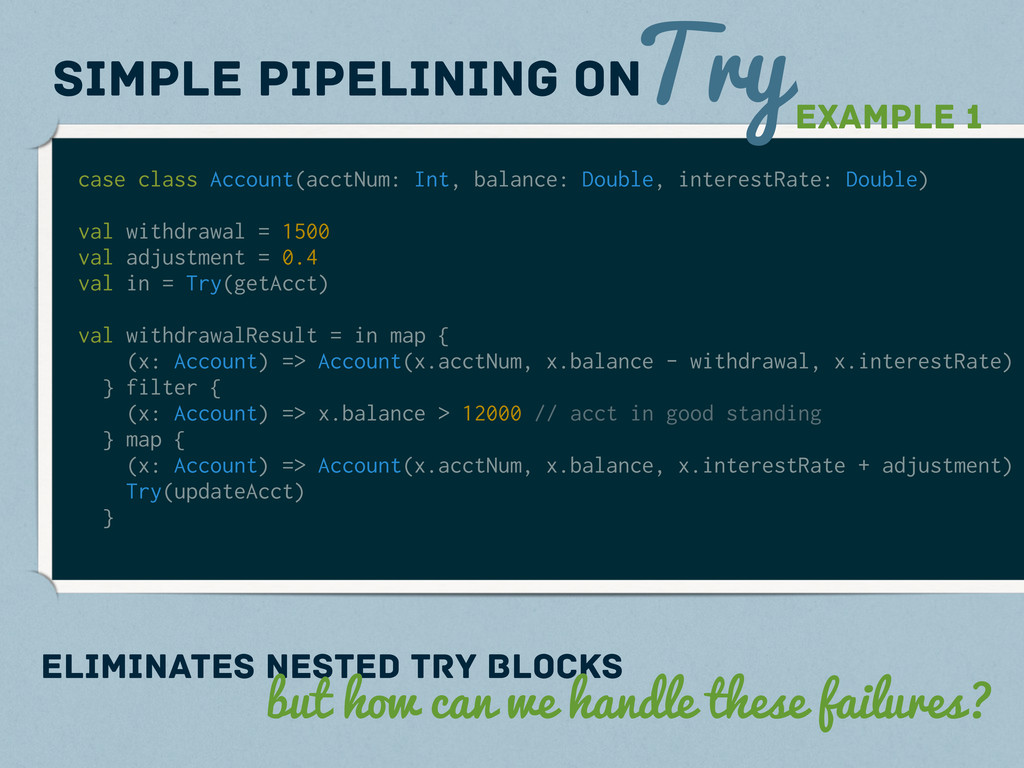
Try Simple pipelining on Example 1 case class Account(acctNum: Int,
balance: Double, interestRate: Double) val withdrawal = 1500 val adjustment = 0.4 val in = Try(getAcct) val withdrawalResult = in map { (x: Account) => Account(x.acctNum, x.balance - withdrawal, x.interestRate) } filter { (x: Account) => x.balance > 12000 // acct in good standing } map { (x: Account) => Account(x.acctNum, x.balance, x.interestRate + adjustment) Try(updateAcct) } -
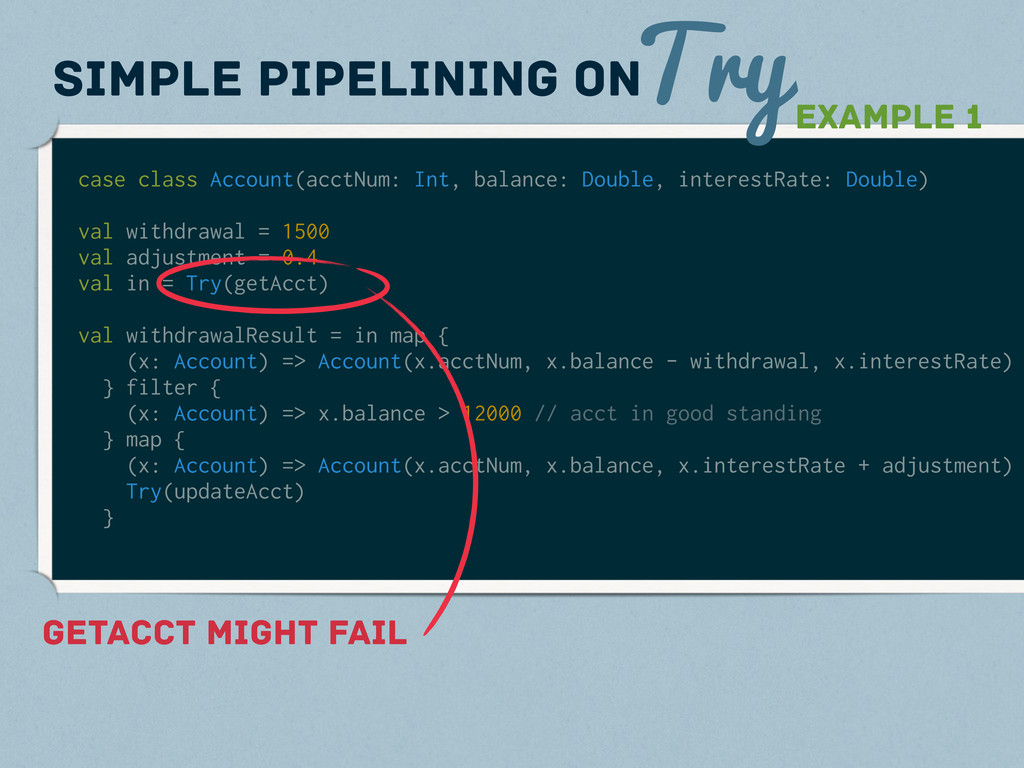
Try Simple pipelining on Example 1 case class Account(acctNum: Int,
balance: Double, interestRate: Double) val withdrawal = 1500 val adjustment = 0.4 val in = Try(getAcct) val withdrawalResult = in map { (x: Account) => Account(x.acctNum, x.balance - withdrawal, x.interestRate) } filter { (x: Account) => x.balance > 12000 // acct in good standing } map { (x: Account) => Account(x.acctNum, x.balance, x.interestRate + adjustment) Try(updateAcct) } GETACCT MIGHT FAIL -
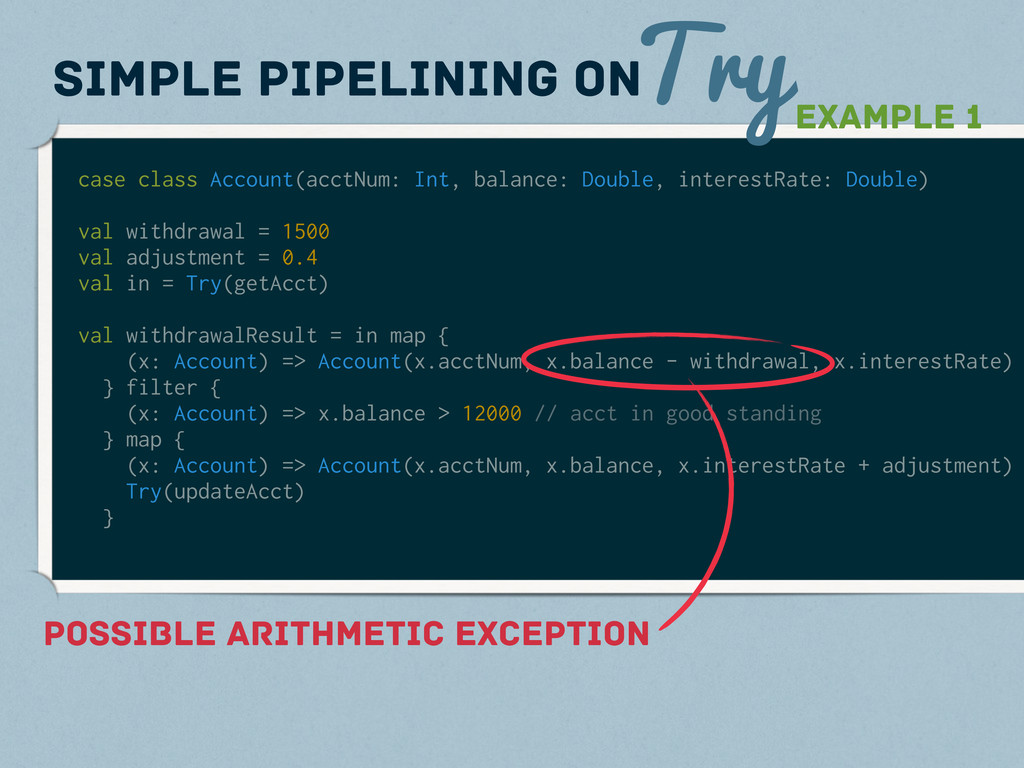
Try Simple pipelining on Example 1 case class Account(acctNum: Int,
balance: Double, interestRate: Double) val withdrawal = 1500 val adjustment = 0.4 val in = Try(getAcct) val withdrawalResult = in map { (x: Account) => Account(x.acctNum, x.balance - withdrawal, x.interestRate) } filter { (x: Account) => x.balance > 12000 // acct in good standing } map { (x: Account) => Account(x.acctNum, x.balance, x.interestRate + adjustment) Try(updateAcct) } possible arithmetic exception -
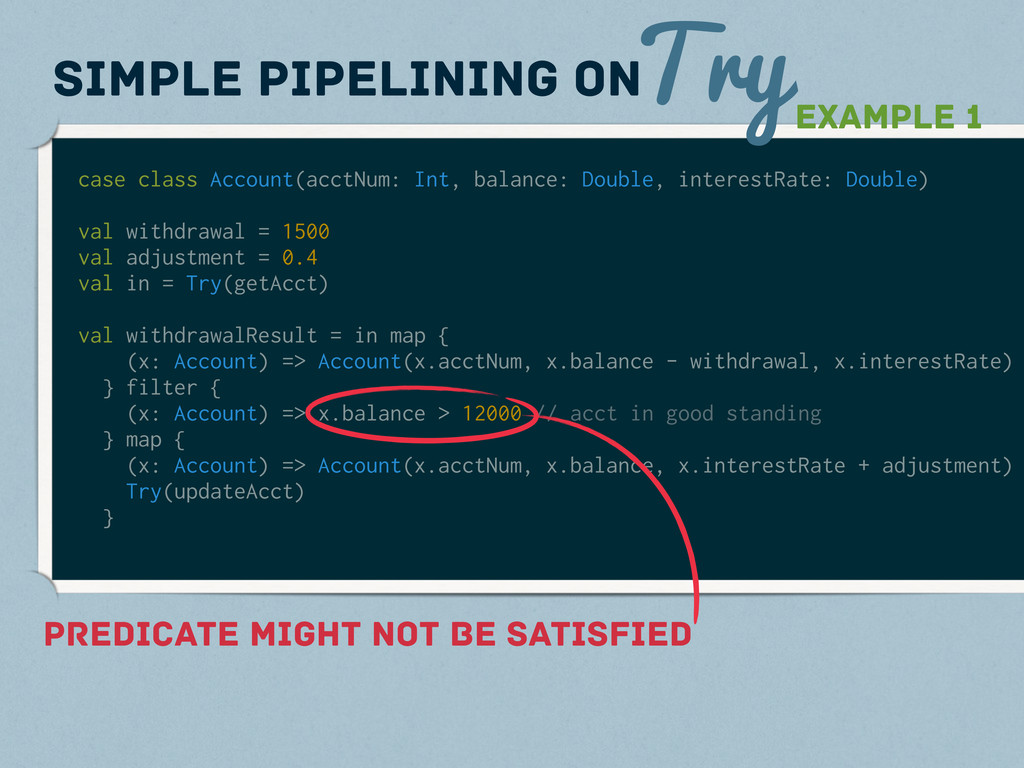
Try Simple pipelining on Example 1 case class Account(acctNum: Int,
balance: Double, interestRate: Double) val withdrawal = 1500 val adjustment = 0.4 val in = Try(getAcct) val withdrawalResult = in map { (x: Account) => Account(x.acctNum, x.balance - withdrawal, x.interestRate) } filter { (x: Account) => x.balance > 12000 // acct in good standing } map { (x: Account) => Account(x.acctNum, x.balance, x.interestRate + adjustment) Try(updateAcct) } Predicate might not be satisfied -
Try Simple pipelining on Example 1 case class Account(acctNum: Int,
balance: Double, interestRate: Double) val withdrawal = 1500 val adjustment = 0.4 val in = Try(getAcct) val withdrawalResult = in map { (x: Account) => Account(x.acctNum, x.balance - withdrawal, x.interestRate) } filter { (x: Account) => x.balance > 12000 // acct in good standing } map { (x: Account) => Account(x.acctNum, x.balance, x.interestRate + adjustment) Try(updateAcct) } possible arithmetic exception -
Try Simple pipelining on Example 1 case class Account(acctNum: Int,
balance: Double, interestRate: Double) val withdrawal = 1500 val adjustment = 0.4 val in = Try(getAcct) val withdrawalResult = in map { (x: Account) => Account(x.acctNum, x.balance - withdrawal, x.interestRate) } filter { (x: Account) => x.balance > 12000 // acct in good standing } map { (x: Account) => Account(x.acctNum, x.balance, x.interestRate + adjustment) Try(updateAcct) } UPDATEACCT MIGHT FAIL -
Try Simple pipelining on Example 1 case class Account(acctNum: Int,
balance: Double, interestRate: Double) val withdrawal = 1500 val adjustment = 0.4 val in = Try(getAcct) val withdrawalResult = in map { (x: Account) => Account(x.acctNum, x.balance - withdrawal, x.interestRate) } filter { (x: Account) => x.balance > 12000 // acct in good standing } map { (x: Account) => Account(x.acctNum, x.balance, x.interestRate + adjustment) Try(updateAcct) } Eliminates nested try blocks but how can we handle these failures? -
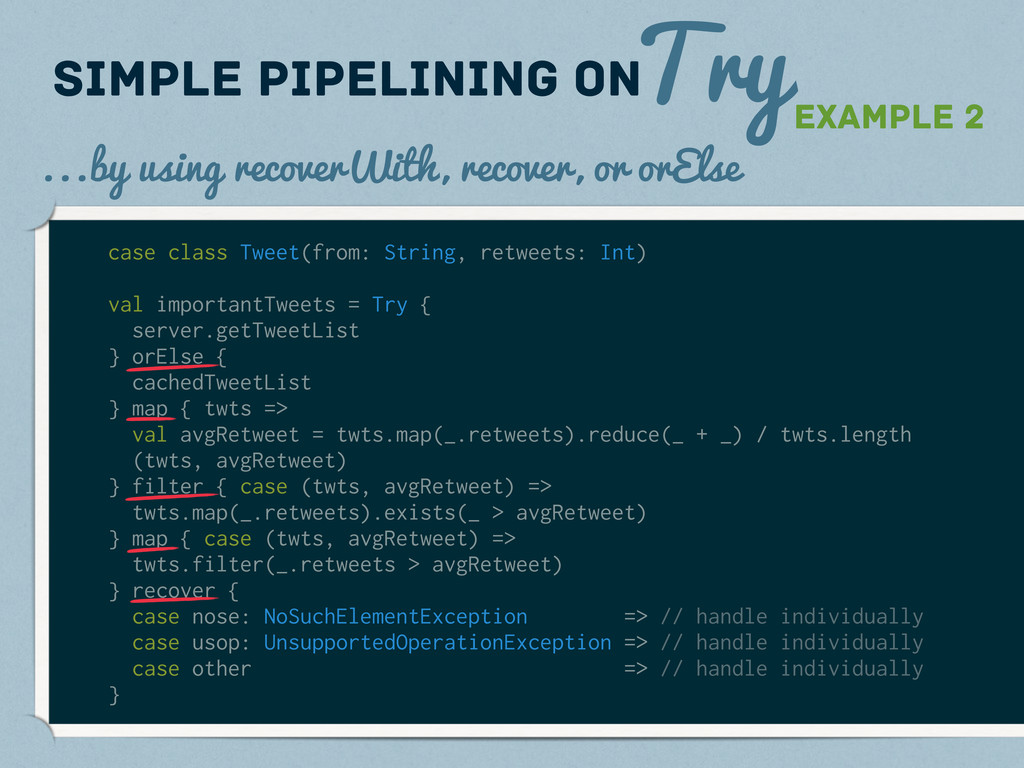
Try Simple pipelining on Example 2 ...by using recoverWith, recover,
or orElse case class Tweet(from: String, retweets: Int) val importantTweets = Try { server.getTweetList } orElse { cachedTweetList } map { twts => val avgRetweet = twts.map(_.retweets).reduce(_ + _) / twts.length (twts, avgRetweet) } filter { case (twts, avgRetweet) => twts.map(_.retweets).exists(_ > avgRetweet) } map { case (twts, avgRetweet) => twts.filter(_.retweets > avgRetweet) } recover { case nose: NoSuchElementException => // handle individually case usop: UnsupportedOperationException => // handle individually case other => // handle individually } -
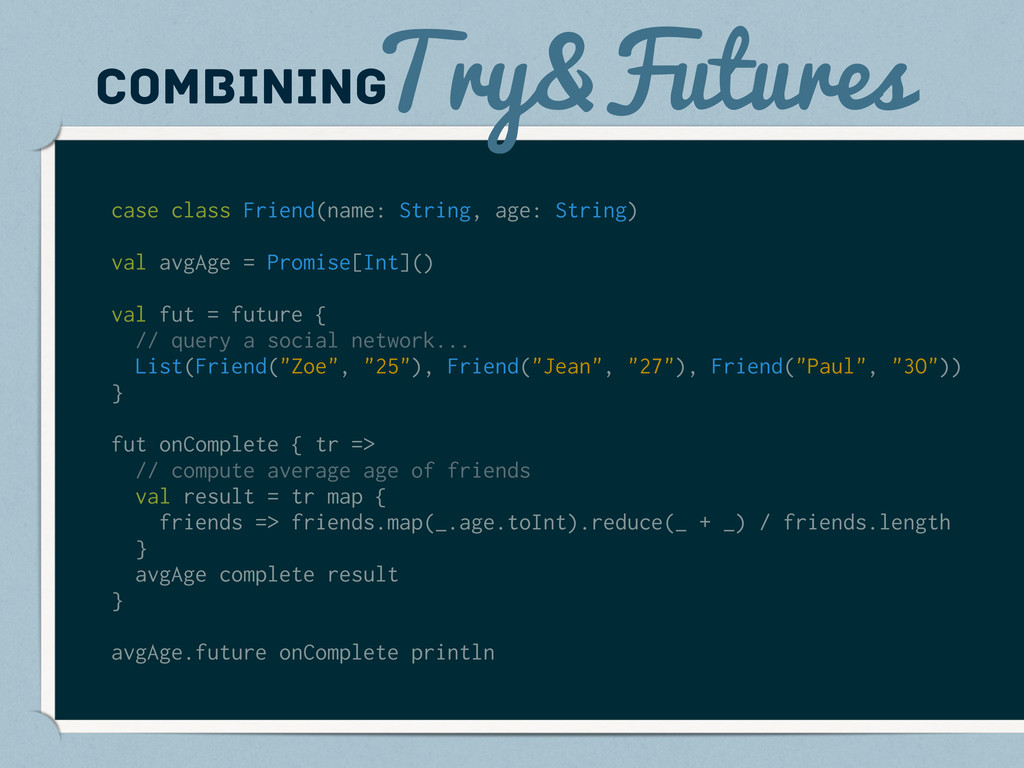
Try&Futures combining case class Friend(name: String, age: String) val avgAge
= Promise[Int]() val fut = future { // query a social network... List(Friend("Zoe", "25"), Friend("Jean", "27"), Friend("Paul", "3O")) } fut onComplete { tr => // compute average age of friends val result = tr map { friends => friends.map(_.age.toInt).reduce(_ + _) / friends.length } avgAge complete result } avgAge.future onComplete println -
Credits PHILIPP HALLER ALEX PROKOPEC VOJIN JOVANOVIC VIKTOR KLANG MARIUS
ERIKSEN HEATHER MILLER ROLAND KUHN DOUG LEA TYPESAFE TYPESAFE EPFL EPFL EPFL TYPESAFE SUNY TWITTER HAVOC PENNINGTON TYPESAFE
 heathermiller
 ivargrimstad
 takehaya
 hakkadaikon
 steliosf
 yukikurage
 aoshi
 mtsmfm
 kmkim
 yuzneri
 raeminkang
 ktombow
 keathley
 sabderemane
 tessaabrams
 signer
 jacobtomlinson
 inesmontani
 rakko
 palkan
 mongodb
 bkeepers
 cassininazir












![Futures&Promises Promise val p = Promise[Int]() // Thread 1 Thread1](https://files.speakerdeck.com/presentations/502b8d92c8139c0002027a5d/slide_26.jpg)
![Futures&Promises Promise Future val p = Promise[Int]() // Thread 1](https://files.speakerdeck.com/presentations/502b8d92c8139c0002027a5d/slide_27.jpg)
![Futures&Promises Promise Future val p = Promise[Int]() // Thread 1](https://files.speakerdeck.com/presentations/502b8d92c8139c0002027a5d/slide_28.jpg)
![Futures&Promises Promise Future val p = Promise[Int]() // Thread 1](https://files.speakerdeck.com/presentations/502b8d92c8139c0002027a5d/slide_29.jpg)
![Futures&Promises Promise Future val p = Promise[Int]() // Thread 1](https://files.speakerdeck.com/presentations/502b8d92c8139c0002027a5d/slide_30.jpg)

(implicit executor: ExecutionContext):](https://files.speakerdeck.com/presentations/502b8d92c8139c0002027a5d/slide_40.jpg)
(implicit executor: ExecutionContext):](https://files.speakerdeck.com/presentations/502b8d92c8139c0002027a5d/slide_41.jpg)
: Future[S] =](https://files.speakerdeck.com/presentations/502b8d92c8139c0002027a5d/slide_42.jpg)
(implicit executor:](https://files.speakerdeck.com/presentations/502b8d92c8139c0002027a5d/slide_43.jpg)



 Success](https://files.speakerdeck.com/presentations/502b8d92c8139c0002027a5d/slide_57.jpg)
 orElse](https://files.speakerdeck.com/presentations/502b8d92c8139c0002027a5d/slide_58.jpg)
: Try[U] map](https://files.speakerdeck.com/presentations/502b8d92c8139c0002027a5d/slide_59.jpg)
: Try[U] flatMap](https://files.speakerdeck.com/presentations/502b8d92c8139c0002027a5d/slide_60.jpg)

: Try[U]](https://files.speakerdeck.com/presentations/502b8d92c8139c0002027a5d/slide_62.jpg)
: Try[U]](https://files.speakerdeck.com/presentations/502b8d92c8139c0002027a5d/slide_63.jpg)