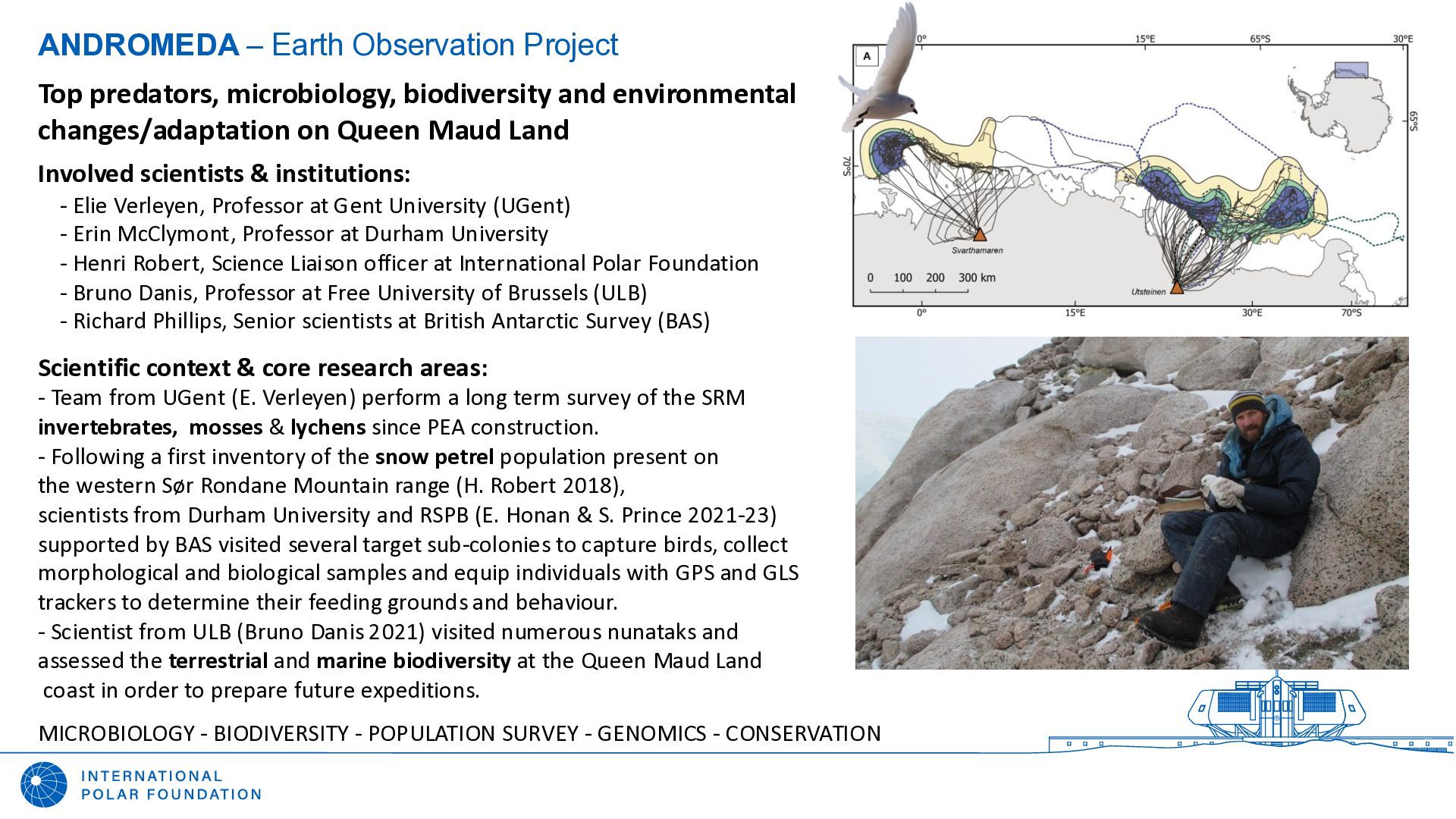
environmental changes/adaptation on Queen Maud Land Involved scientists & institutions: - Elie Verleyen, Professor at Gent University (UGent) - Erin McClymont, Professor at Durham University - Henri Robert, Science Liaison officer at International Polar Foundation - Bruno Danis, Professor at Free University of Brussels (ULB) - Richard Phillips, Senior scientists at British Antarctic Survey (BAS) Scientific context & core research areas: - Team from UGent (E. Verleyen) perform a long term survey of the SRM invertebrates, mosses & lychens since PEA construction. - Following a first inventory of the snow petrel population present on the western Sør Rondane Mountain range (H. Robert 2018), scientists from Durham University and RSPB (E. Honan & S. Prince 2021-23) supported by BAS visited several target sub-colonies to capture birds, collect morphological and biological samples and equip individuals with GPS and GLS trackers to determine their feeding grounds and behaviour. - Scientist from ULB (Bruno Danis 2021) visited numerous nunataks and assessed the terrestrial and marine biodiversity at the Queen Maud Land coast in order to prepare future expeditions. MICROBIOLOGY - BIODIVERSITY - POPULATION SURVEY - GENOMICS - CONSERVATION
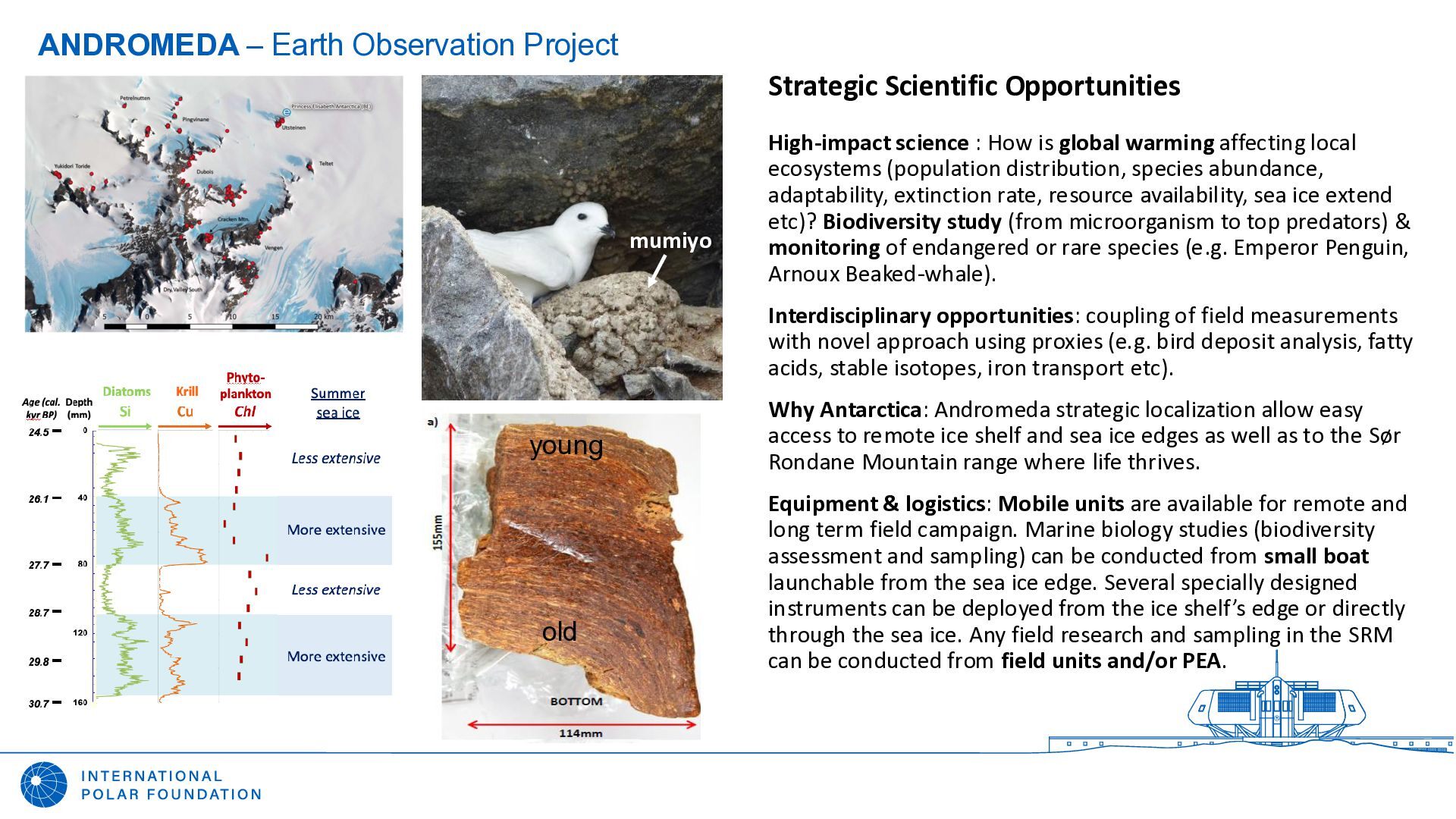
: How is global warming affecting local ecosystems (population distribution, species abundance, adaptability, extinction rate, resource availability, sea ice extend etc)? Biodiversity study (from microorganism to top predators) & monitoring of endangered or rare species (e.g. Emperor Penguin, Arnoux Beaked-whale). Interdisciplinary opportunities: coupling of field measurements with novel approach using proxies (e.g. bird deposit analysis, fatty acids, stable isotopes, iron transport etc). Why Antarctica: Andromeda strategic localization allow easy access to remote ice shelf and sea ice edges as well as to the Sør Rondane Mountain range where life thrives. Equipment & logistics: Mobile units are available for remote and long term field campaign. Marine biology studies (biodiversity assessment and sampling) can be conducted from small boat launchable from the sea ice edge. Several specially designed instruments can be deployed from the ice shelf’s edge or directly through the sea ice. Any field research and sampling in the SRM can be conducted from field units and/or PEA. mumiyo young old


 ipfevents
 shinpsan
 bonotake
 fufufukakaka
 trycycle
 sshimizu2006
 tagtag
.jpg) lychee1223
lychee1223
 hayashiyus884
 bluesmoon
 trallard
 wayneb77
 ryanjones
 katarinadahlin
 thekraken
 maltzj
 speakerdeck
 skoyamalab
 watany
 kevinliebholz
 rakko
rakko