Share
Embed
18_0711 Anti-Noise and Anti-Disturbance Properties of Differential-Algebraic Relaxation Applied to a Set-Valued Controller
Presented at the 15th International Workshop on Variable Structure Systems and Sliding Mode Control, Graz, Austria, July 11, 2018.
Its extended version is published in:
Ryo Kikuuwe: "Sliding Motion Accuracy of Proxy-Based Sliding Mode Control Subjected to Measurement Noise and Disturbance," European Journal of Control, vol.58, pp.114-122, March 2021.
http://doi.org/10.1016/j.ejcon.2020.07.005
Ryo Kikuuwe
July 11, 2018
Transcript
22 slides
-
1 Hiroshima University, Japan http://home.hiroshima-u.ac.jp/kikuuwe/ http://www.youtube.com/kikuuwe/ Ryo Kikuuwe a Anti-Noise
and Anti-Disturbance Anti-Noise and Anti-Disturbance Properties of Properties of Differential-Algebraic Relaxation Differential-Algebraic Relaxation Applied to Applied to a Set-Valued Controller a Set-Valued Controller -
2 Outline Outline [1] Overview of “Proxy-based Sliding Mode
Control” (PSMC) [2] Frequency Domain Properties [3] Time Domain Properties [4] Conclusions main results -
3 [1] [1] Overview of Overview of Proxy-based Sliding Mode
Control Proxy-based Sliding Mode Control (PSMC) (PSMC) [1] [1] Overview of Overview of Proxy-based Sliding Mode Control Proxy-based Sliding Mode Control (PSMC) (PSMC) -
4 Proxy-based Sliding Mode Control Proxy-based Sliding Mode Control (PSMC)
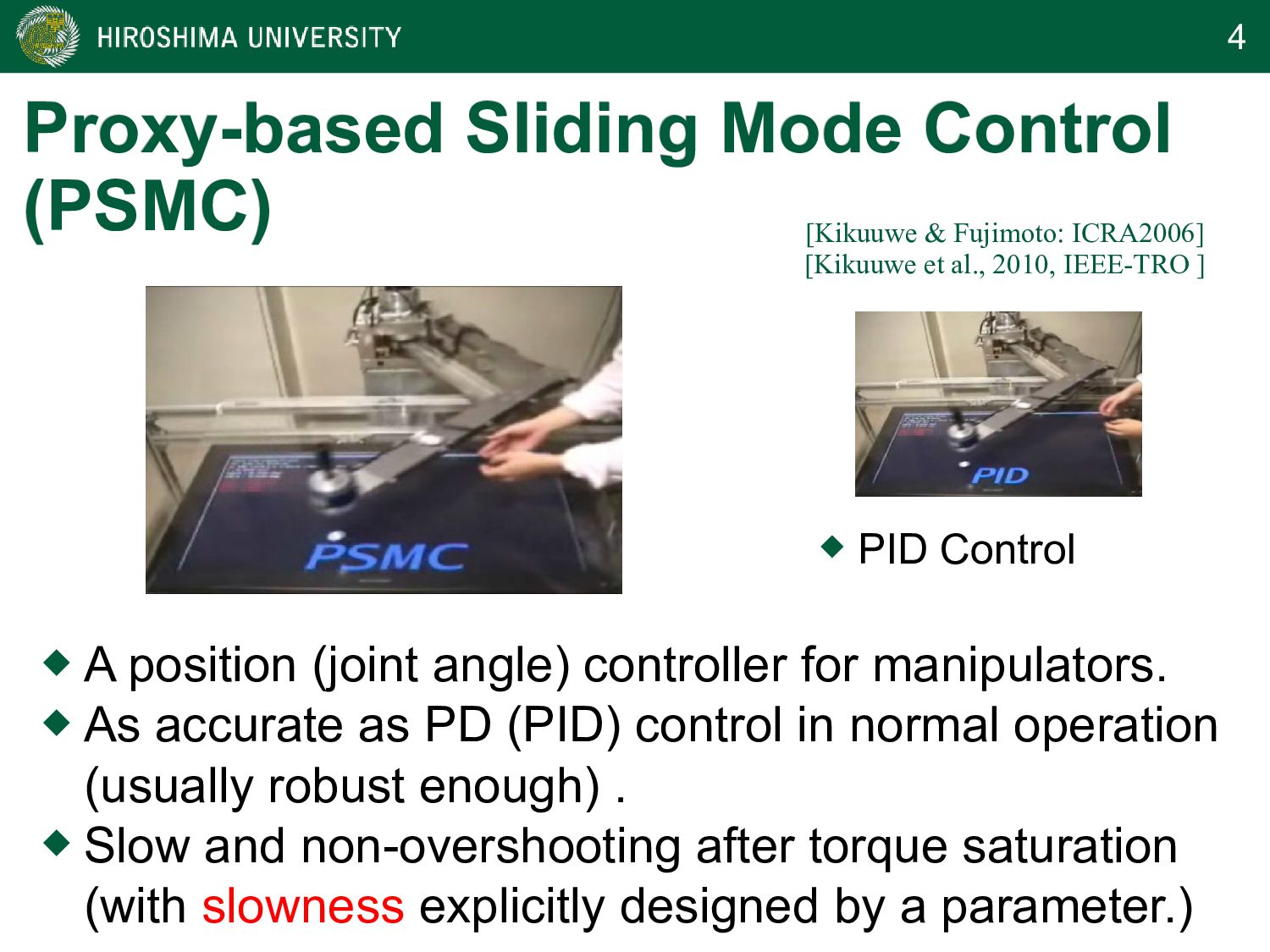
(PSMC) PID Control A position (joint angle) controller for manipulators. As accurate as PD (PID) control in normal operation (usually robust enough) . Slow and non-overshooting after torque saturation (with slowness explicitly designed by a parameter.) [Kikuuwe & Fujimoto: ICRA2006] [Kikuuwe et al., 2010, IEEE-TRO ] -
5 It’s been applied to many devices It’s been applied
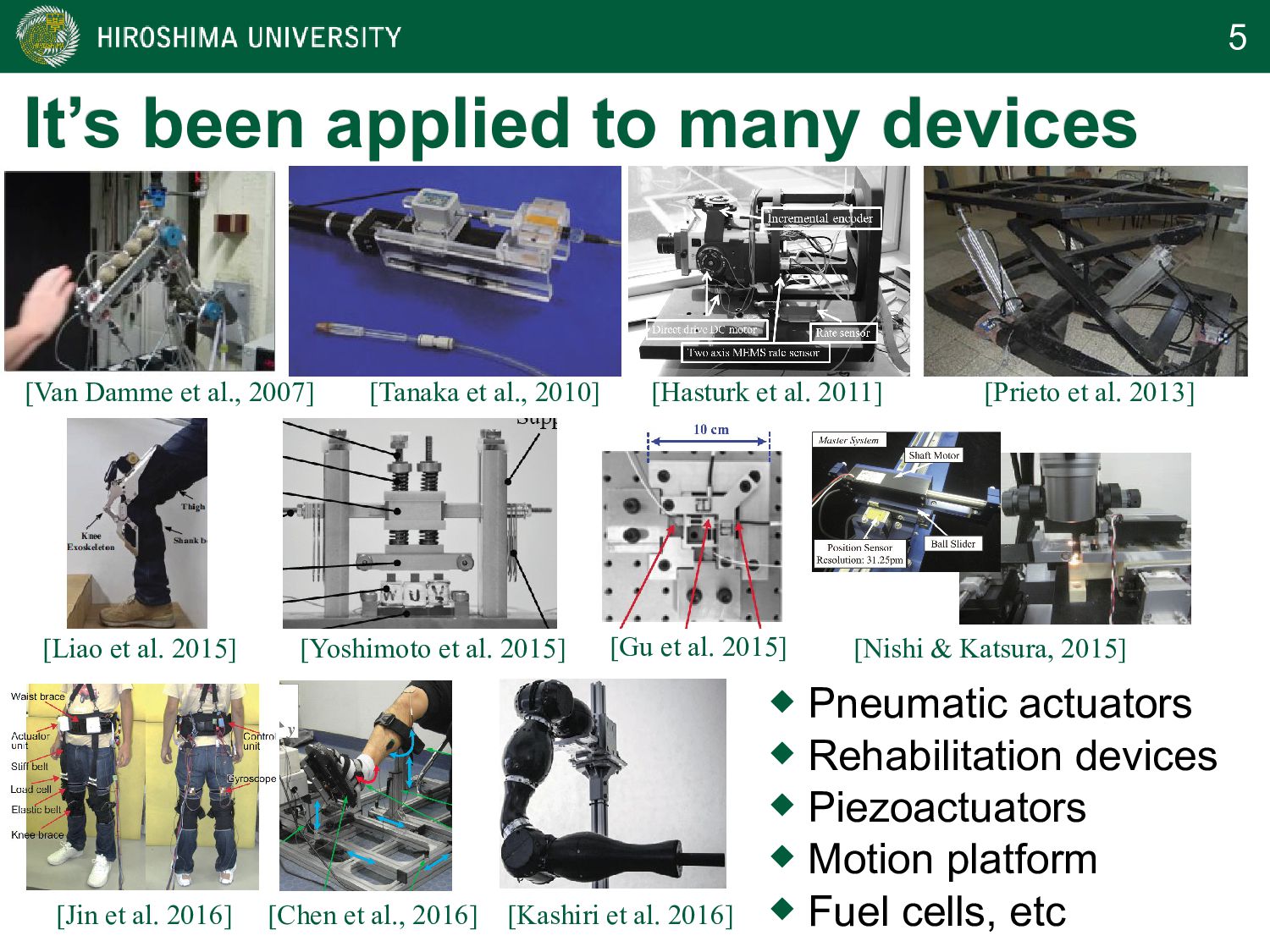
to many devices [Van Damme et al., 2007] Pneumatic actuators Rehabilitation devices Piezoactuators Motion platform Fuel cells, etc [Kashiri et al. 2016] [Jin et al. 2016] [Gu et al. 2015] [Tanaka et al., 2010] [Yoshimoto et al. 2015] [Prieto et al. 2013] [Hasturk et al. 2011] [Chen et al., 2016] [Liao et al. 2015] [Nishi & Katsura, 2015] -
6 Control law of PSMC Control law of PSMC
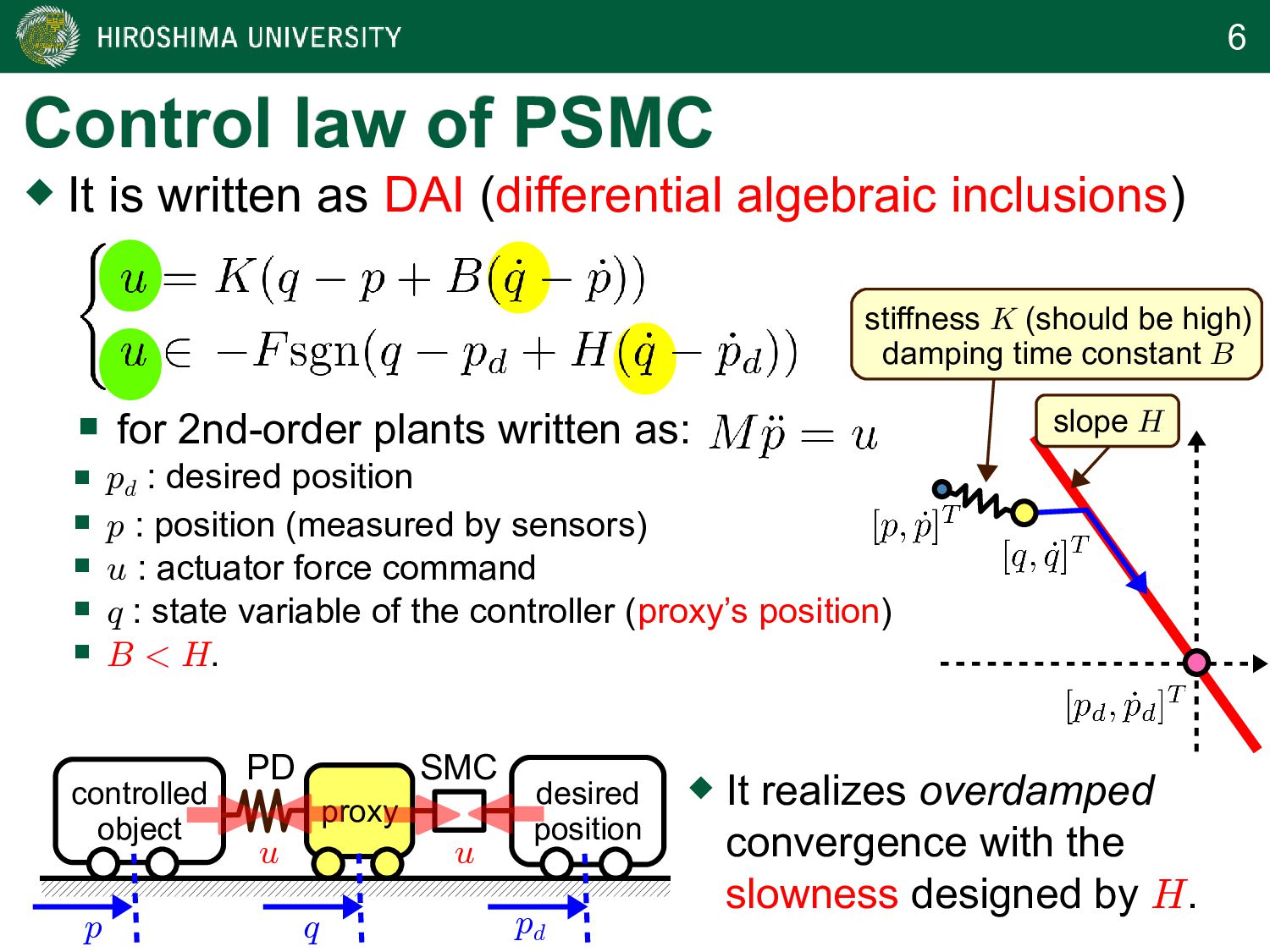
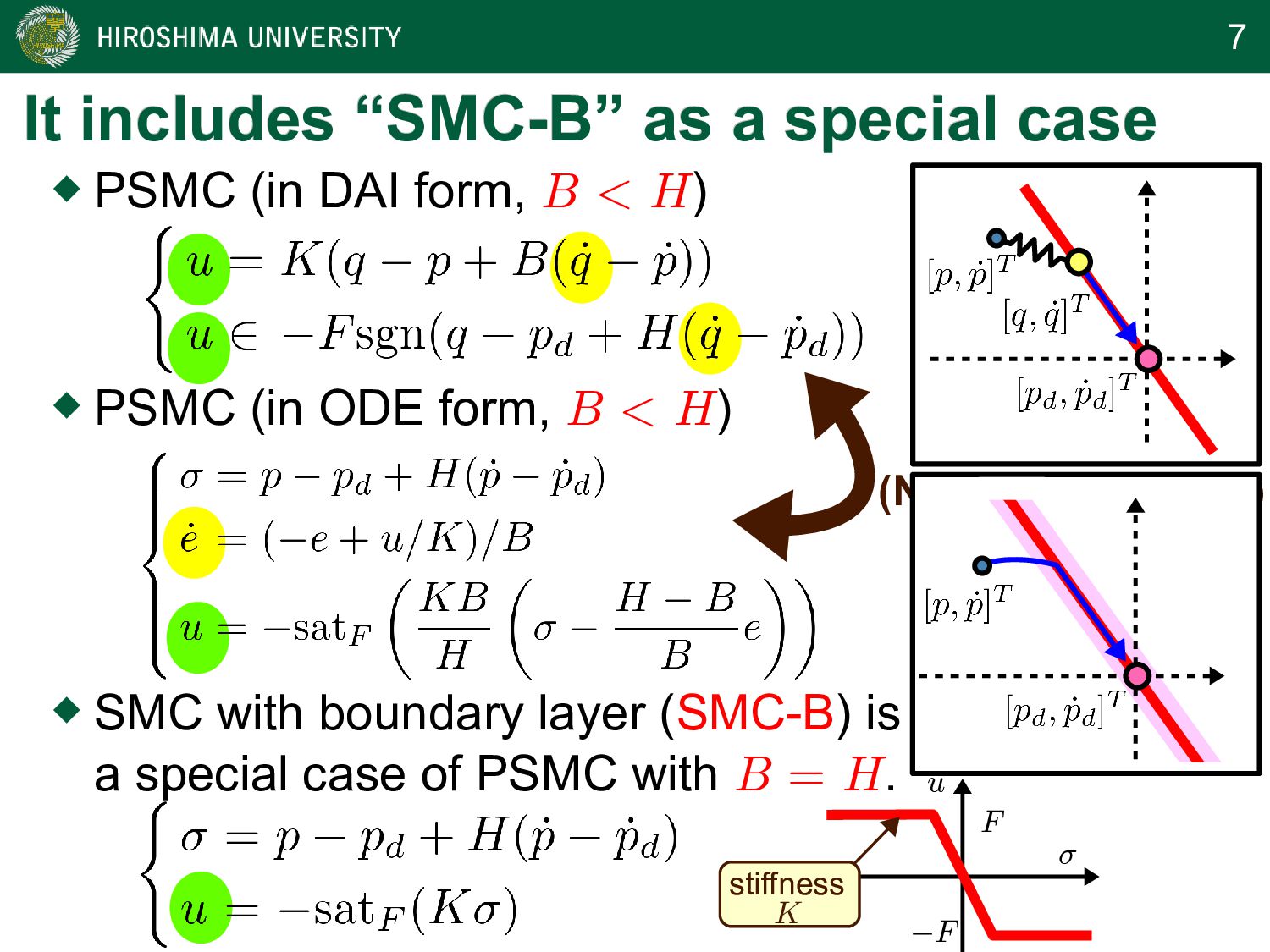
It is written as DAI (differential algebraic inclusions) for 2nd-order plants written as: pd : desired position p : position (measured by sensors) u : actuator force command q : state variable of the controller (proxy’s position) B < H. It realizes overdamped convergence with the slowness designed by H. proxy controlled object desired position SMC PD q p pd u u slope H stiffness K (should be high) damping time constant B -
7 It includes “SMC-B” as a special case It includes
“SMC-B” as a special case SMC with boundary layer (SMC-B) is a special case of PSMC with B = H. F ¡F ¾ u stiffness K PSMC (in DAI form, B < H) PSMC (in ODE form, B < H) algebraically equivalent (No approximation) -
8 Our Empirical Results in 2006 Our Empirical Results in
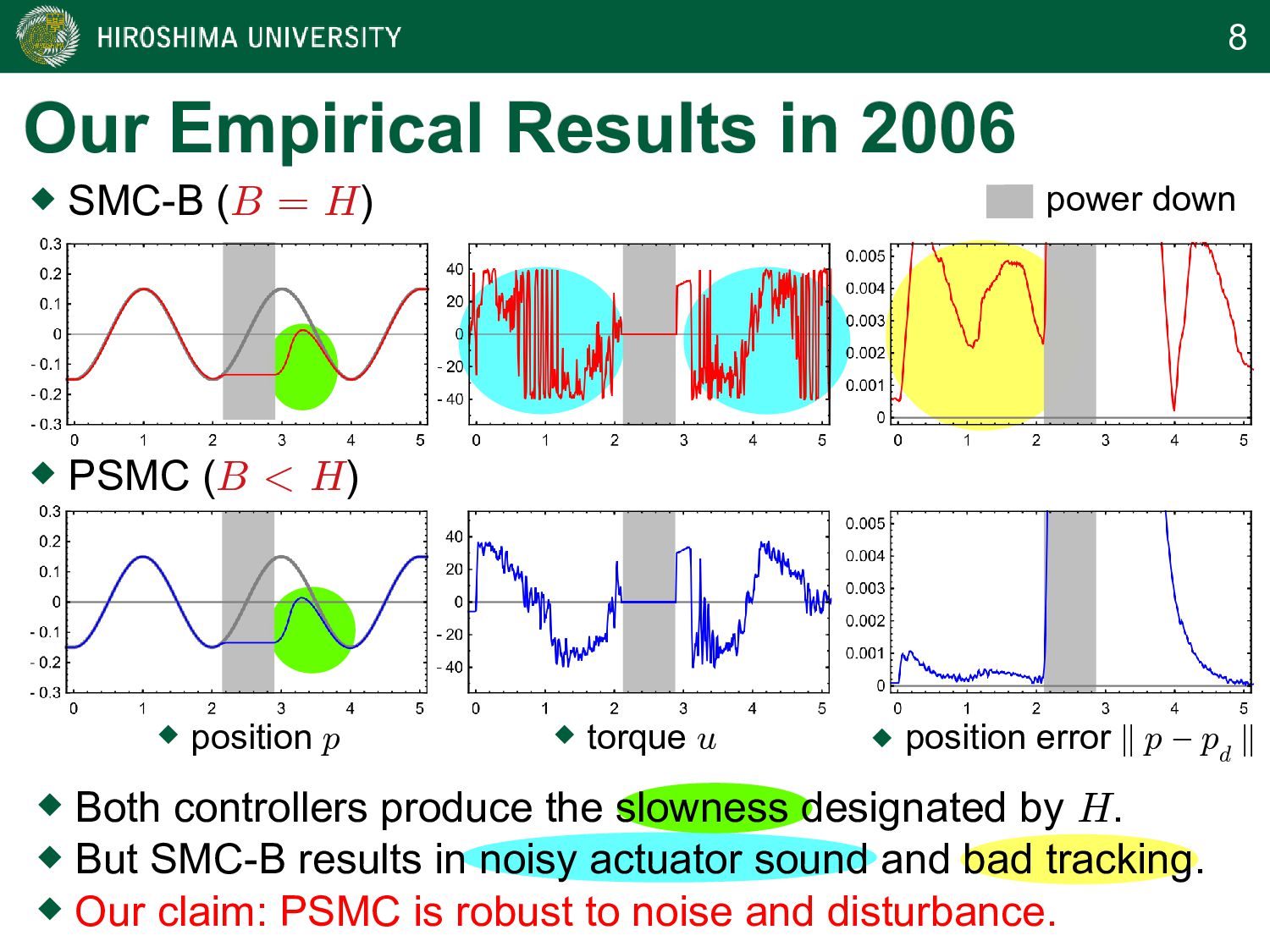
2006 Both controllers produce the slowness designated by H. But SMC-B results in noisy actuator sound and bad tracking. Our claim: PSMC is robust to noise and disturbance. SMC-B (B = H) PSMC (B < H) position p torque u position error || p - p d || power down -
9 Contribution of this paper Contribution of this paper
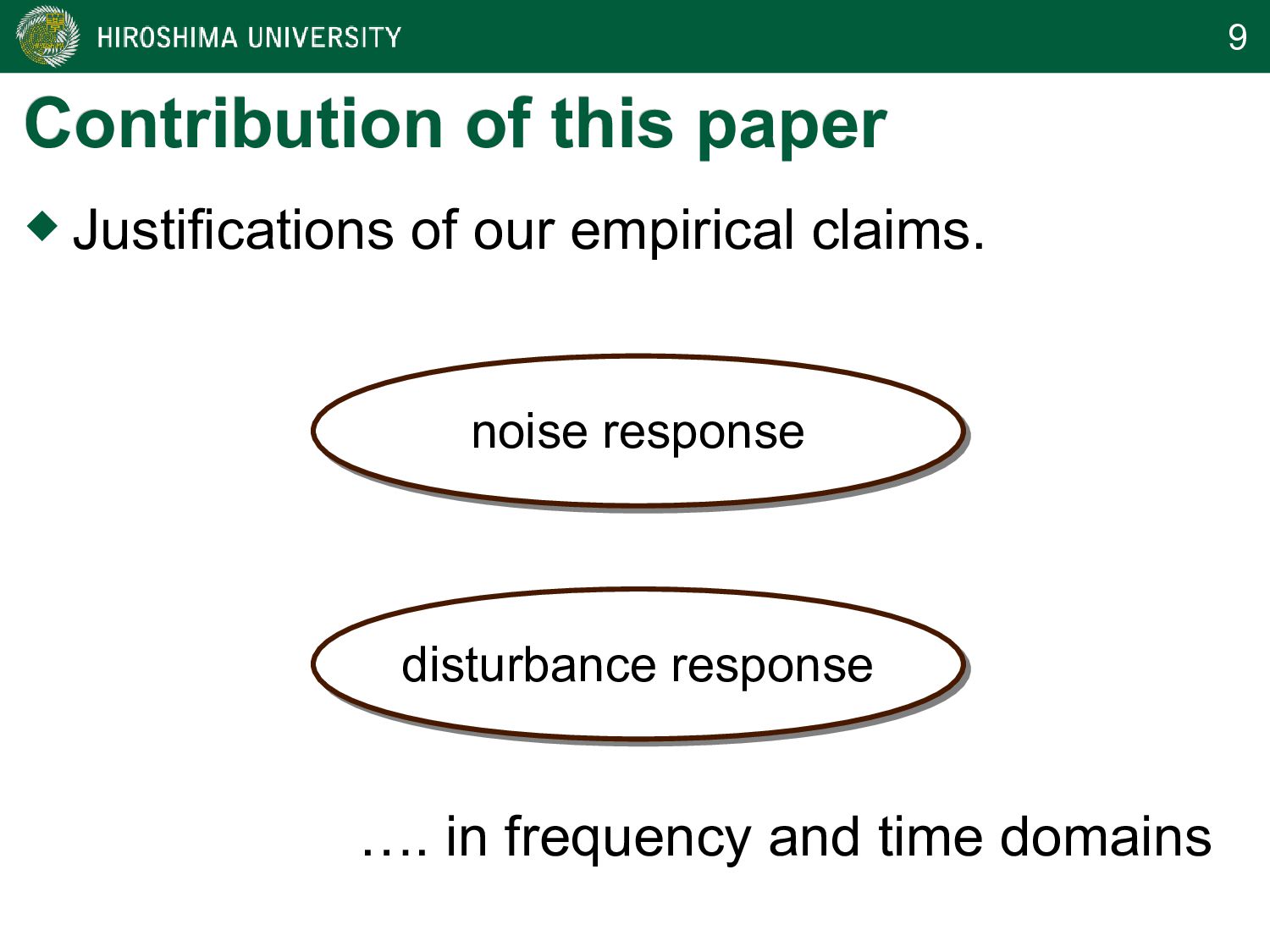
Justifications of our empirical claims. noise response noise response disturbance response disturbance response …. in frequency and time domains -
10 [2] [2] Frequency Domain Properties Frequency Domain Properties [2]
[2] Frequency Domain Properties Frequency Domain Properties -
11 Setup for Freq-Domain Analysis Setup for Freq-Domain Analysis
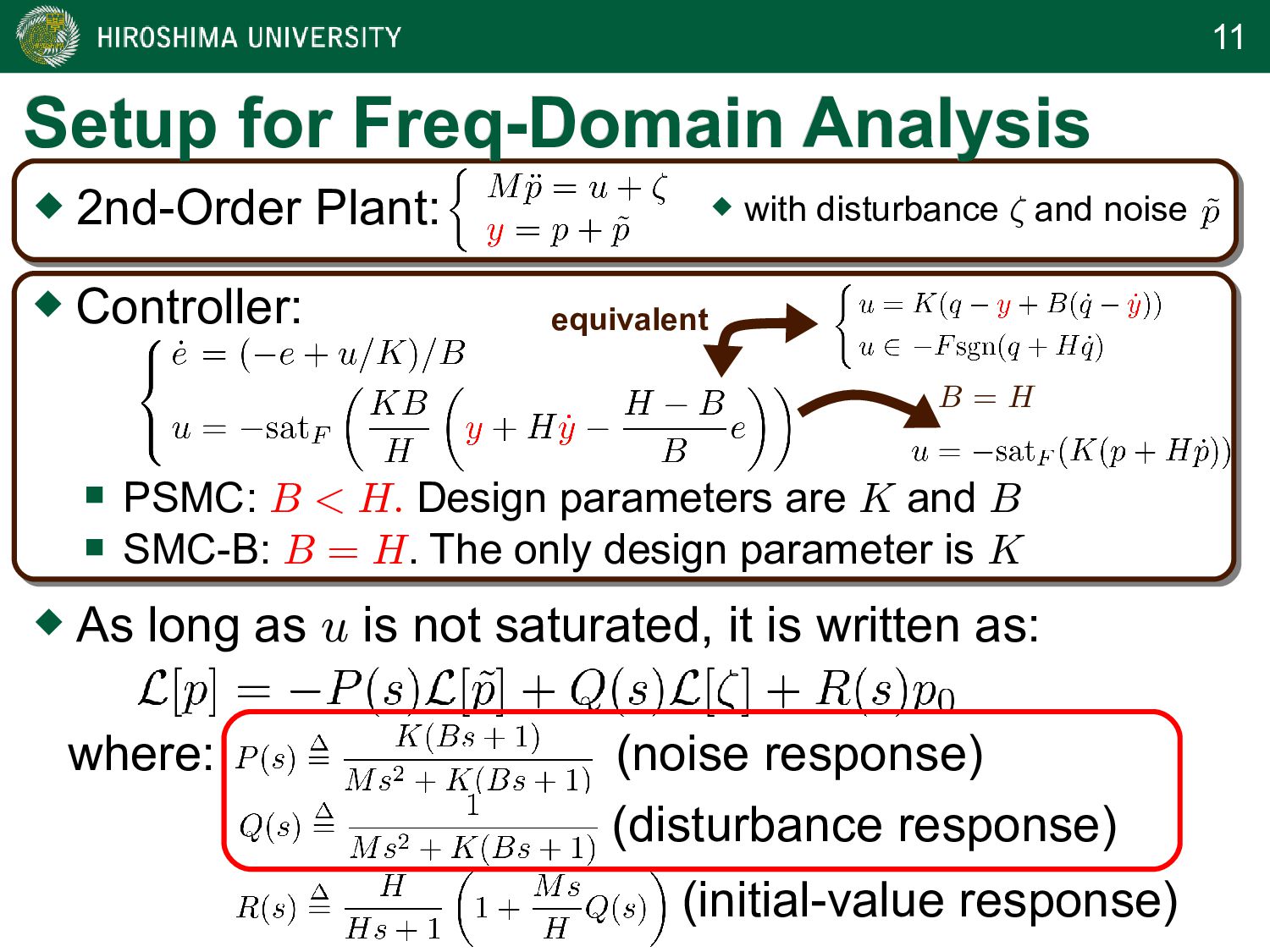
As long as u is not saturated, it is written as: 2nd-Order Plant: where: with disturbance ³ and noise PSMC: B < H: Design parameters are K and B SMC-B: B = H. The only design parameter is K Controller: B = H equivalent (noise response) (disturbance response) (initial-value response) -
12 Gain Plots: PSMC vs SMC-B Gain Plots: PSMC vs
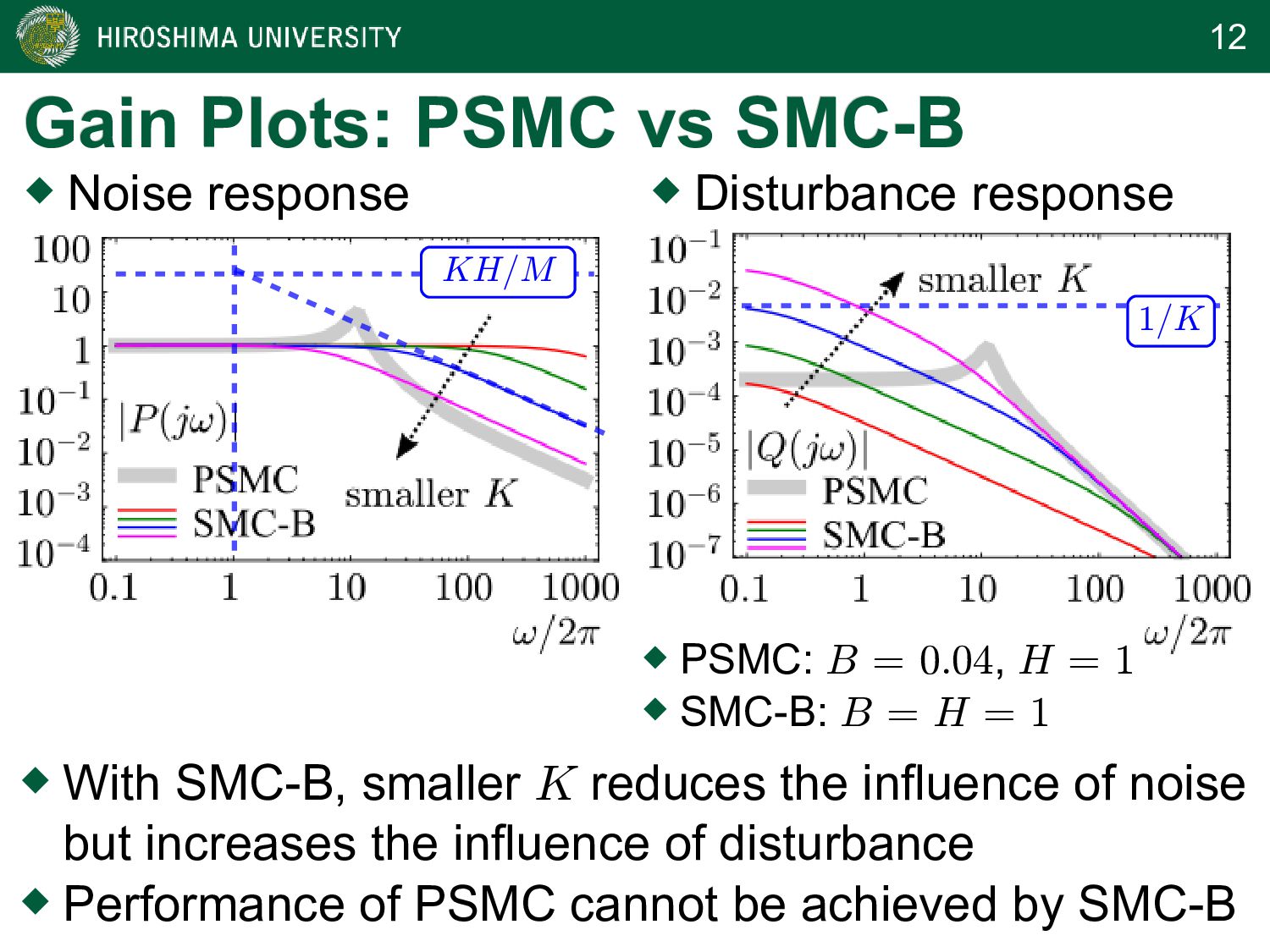
SMC-B Noise response Disturbance response With SMC-B, smaller K reduces the influence of noise but increases the influence of disturbance Performance of PSMC cannot be achieved by SMC-B PSMC: B = 0.04, H = 1 SMC-B: B = H = 1 KH/M 1/K -
13 Effects of Noise Filtering + SMC-B Effects of Noise
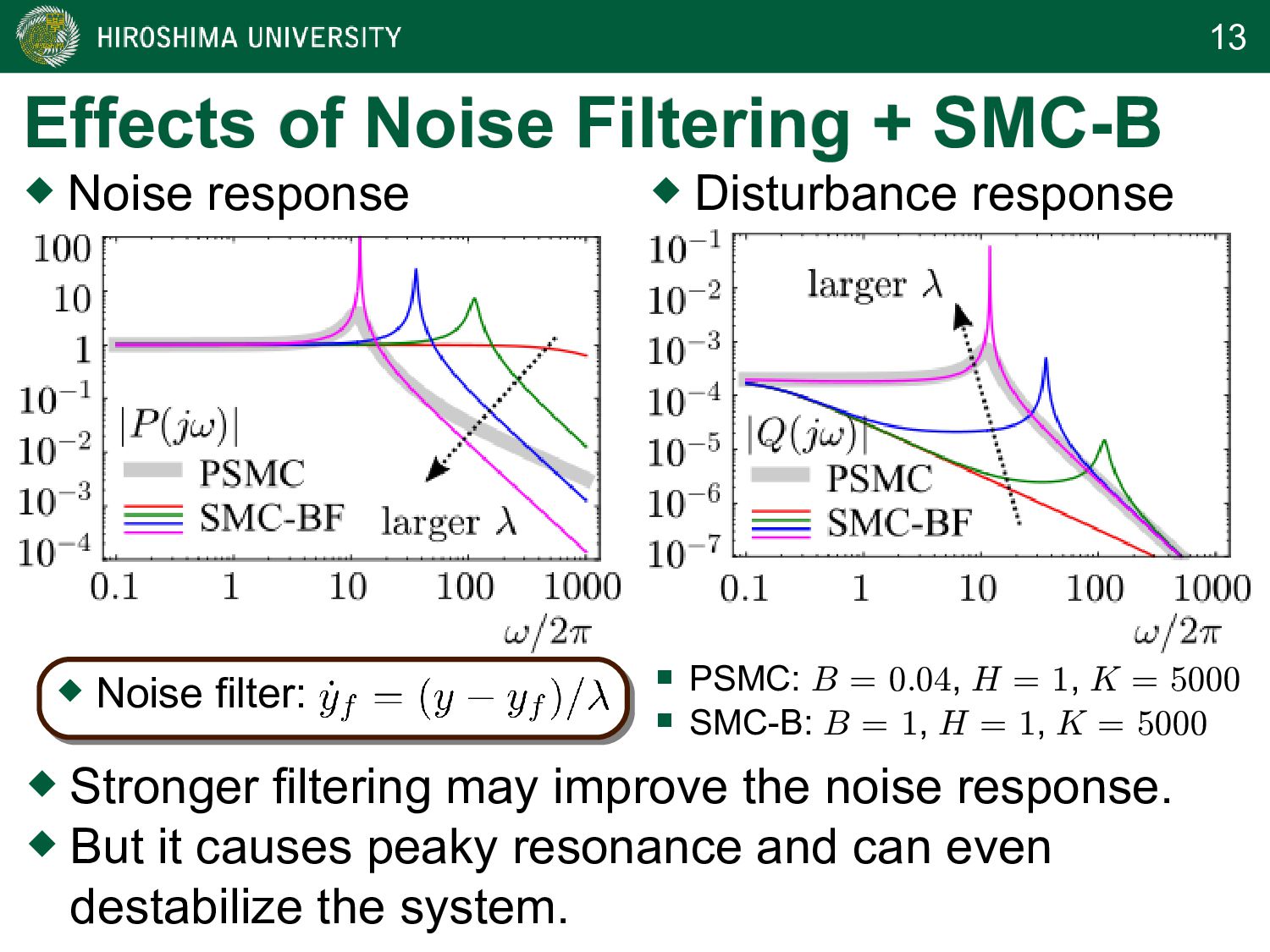
Filtering + SMC-B Stronger filtering may improve the noise response. But it causes peaky resonance and can even destabilize the system. Noise response Disturbance response PSMC: B = 0.04, H = 1, K = 5000 SMC-B: B = 1, H = 1, K = 5000 Noise filter: -
14 Summary of Freq. Domain Results Summary of Freq. Domain
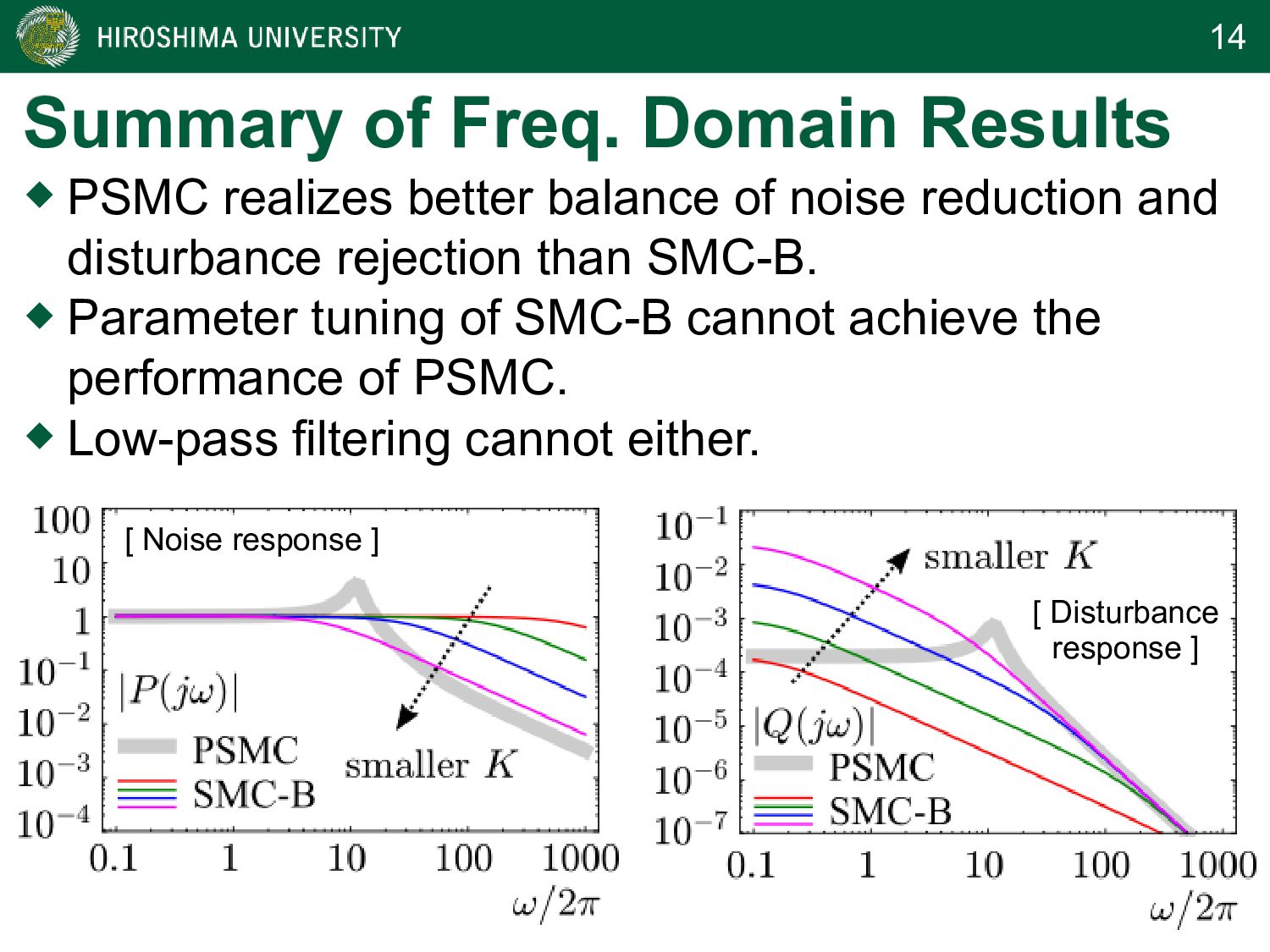
Results PSMC realizes better balance of noise reduction and disturbance rejection than SMC-B. Parameter tuning of SMC-B cannot achieve the performance of PSMC. Low-pass filtering cannot either. [ Disturbance response ] [ Noise response ] -
15 [3] [3] Time Domain Properties Time Domain Properties [3]
[3] Time Domain Properties Time Domain Properties -
16 Setup for Numerical Simulations Setup for Numerical Simulations
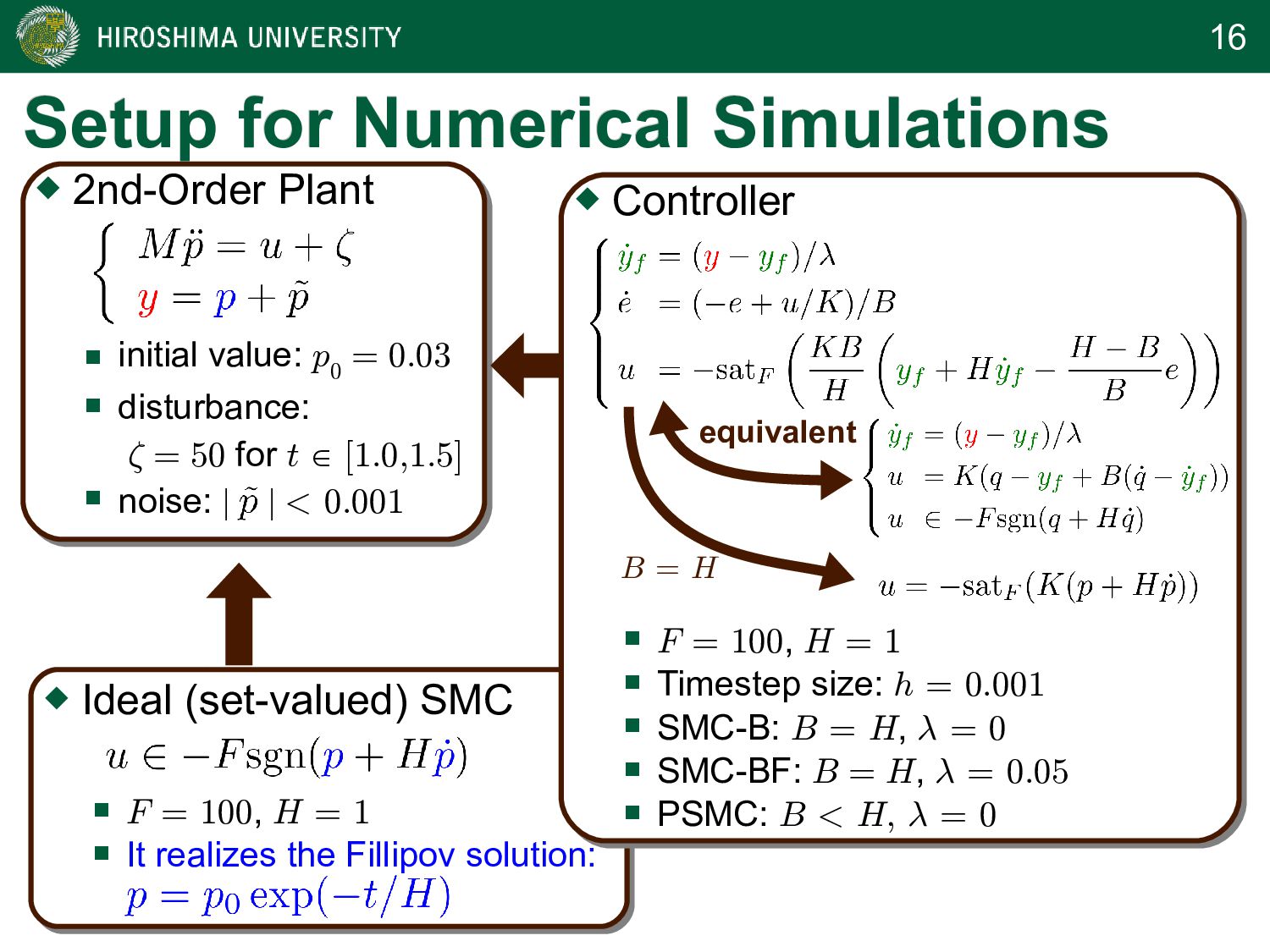
Ideal (set-valued) SMC F = 100, H = 1 It realizes the Fillipov solution: 2nd-Order Plant initial value: p 0 = 0.03 disturbance: ³ = 50 for t Î [1.0,1.5] noise: | | < 0.001 Controller F = 100, H = 1 Timestep size: h = 0.001 SMC-B: B = H, ¸ = 0 SMC-BF: B = H, ¸ = 0.05 PSMC: B < H, ¸ = 0 equivalent B = H -
17 Disturbance Response: SMC-B vs PSMC Disturbance Response: SMC-B vs
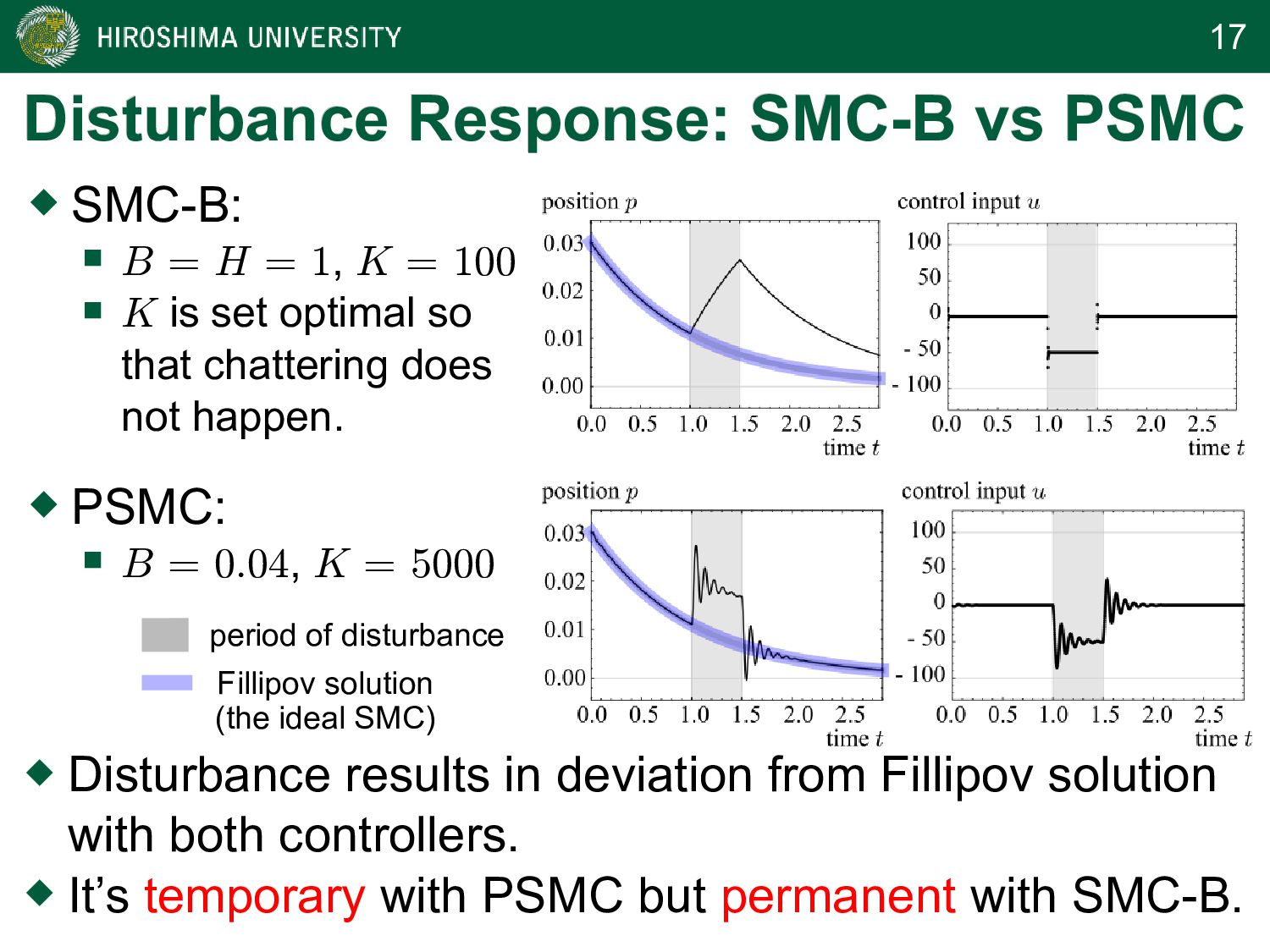
PSMC Disturbance results in deviation from Fillipov solution with both controllers. It’s temporary with PSMC but permanent with SMC-B. SMC-B: B = H = 1, K = 100 K is set optimal so that chattering does not happen. PSMC: B = 0.04, K = 5000 period of disturbance Fillipov solution (the ideal SMC) -
18 Disturbance Response: PSMC vs SMC-B Disturbance Response: PSMC vs
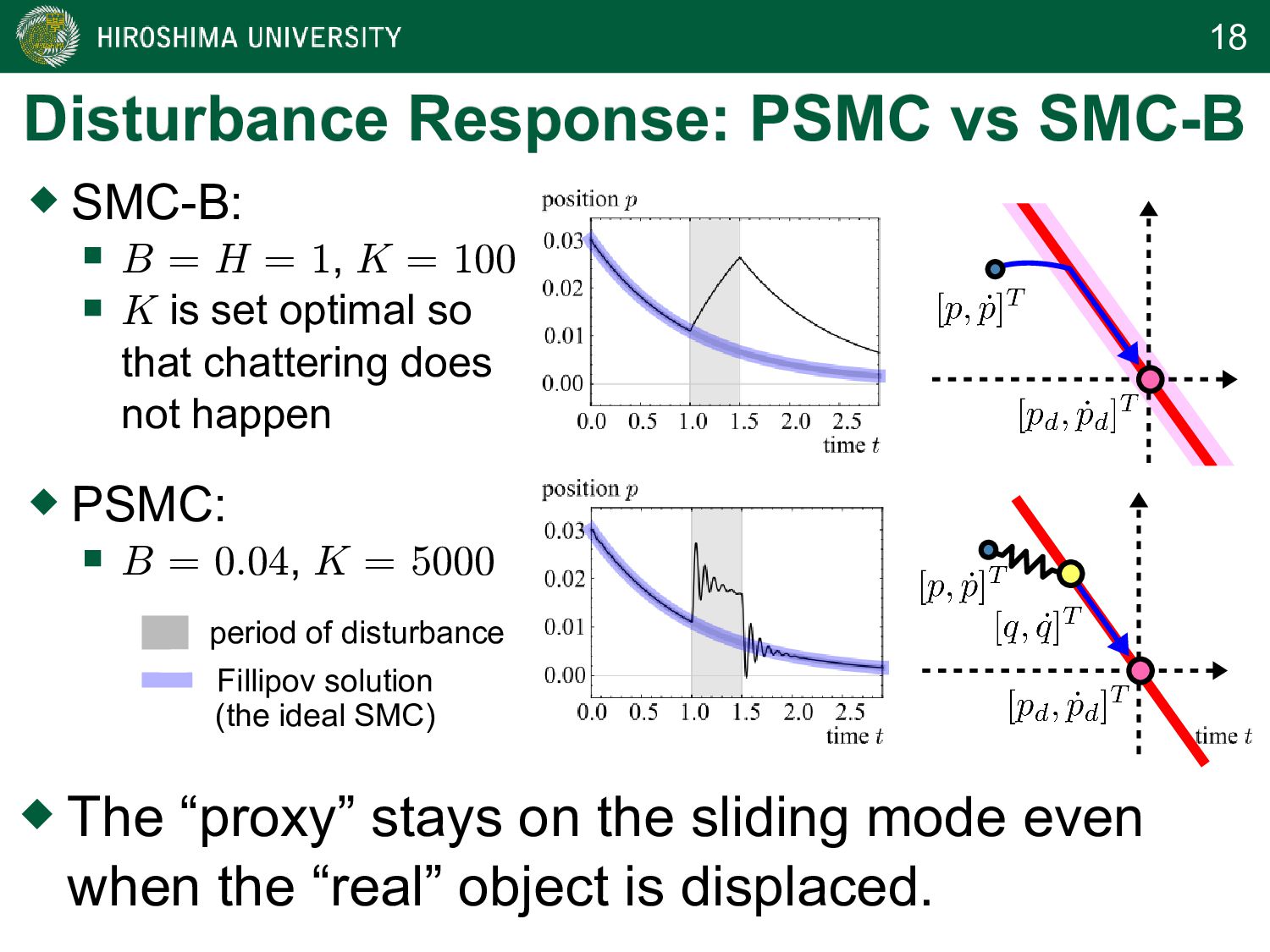
SMC-B The “proxy” stays on the sliding mode even when the “real” object is displaced. SMC-B: B = H = 1, K = 100 K is set optimal so that chattering does not happen PSMC: B = 0.04, K = 5000 period of disturbance Fillipov solution (the ideal SMC) -
19 Effects of Noise & Filtering Effects of Noise &
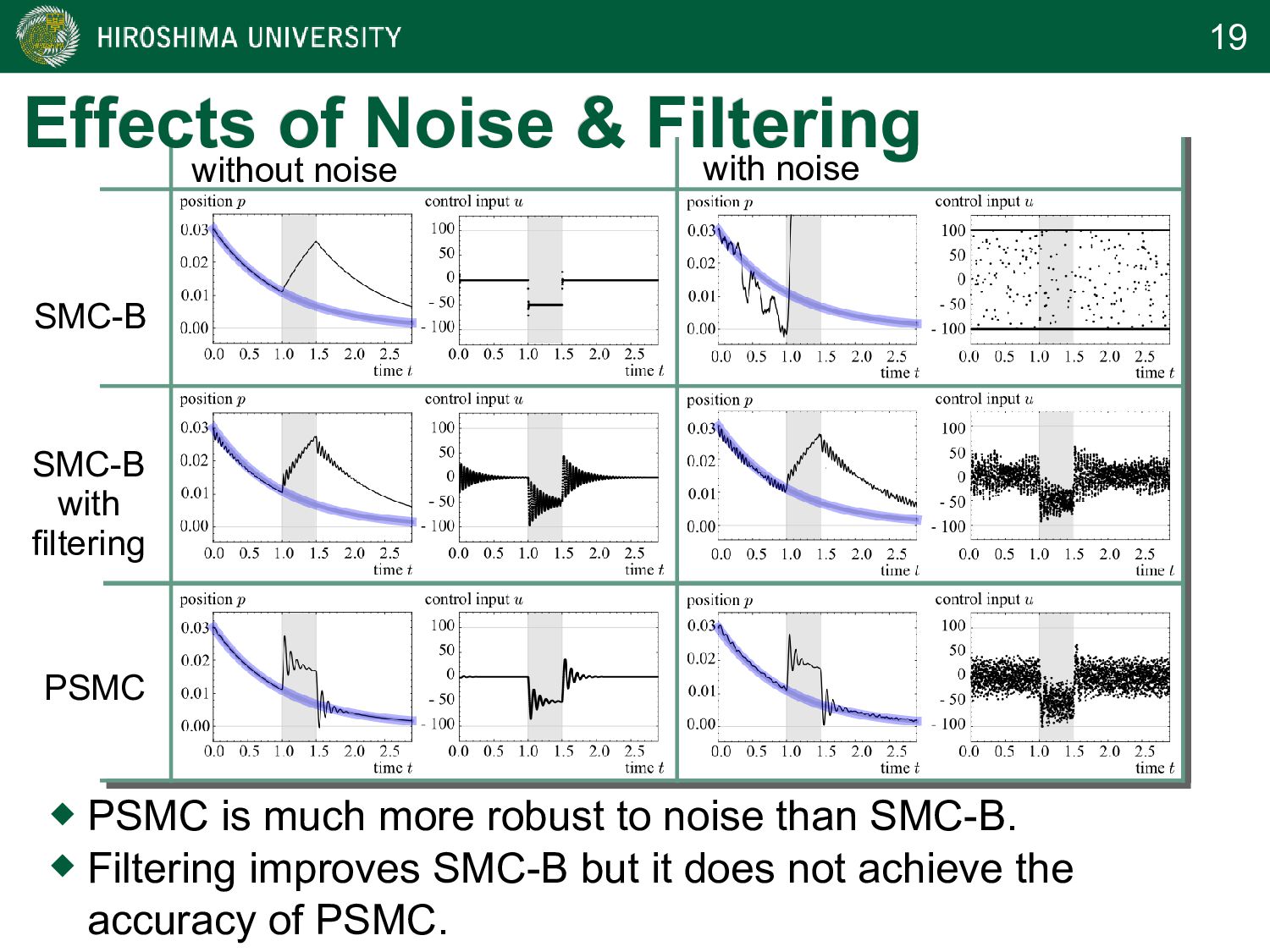
Filtering PSMC is much more robust to noise than SMC-B. Filtering improves SMC-B but it does not achieve the accuracy of PSMC. without noise SMC-B SMC-B with filtering PSMC with noise -
20 Results with Different Results with Different K K and
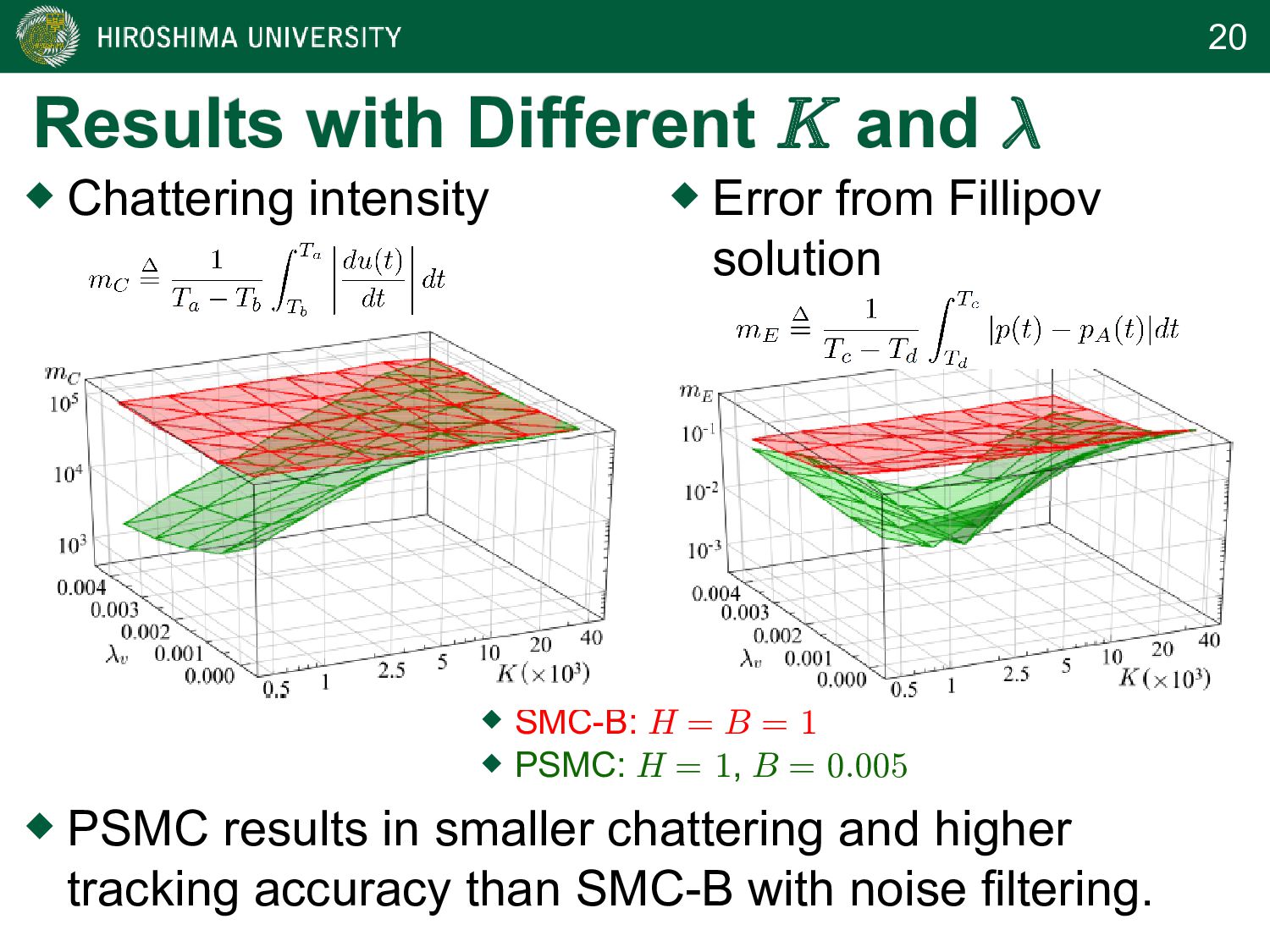
and ¸ ¸ Chattering intensity Error from Fillipov solution PSMC results in smaller chattering and higher tracking accuracy than SMC-B with noise filtering. SMC-B: H = B = 1 PSMC: H = 1, B = 0.005 -
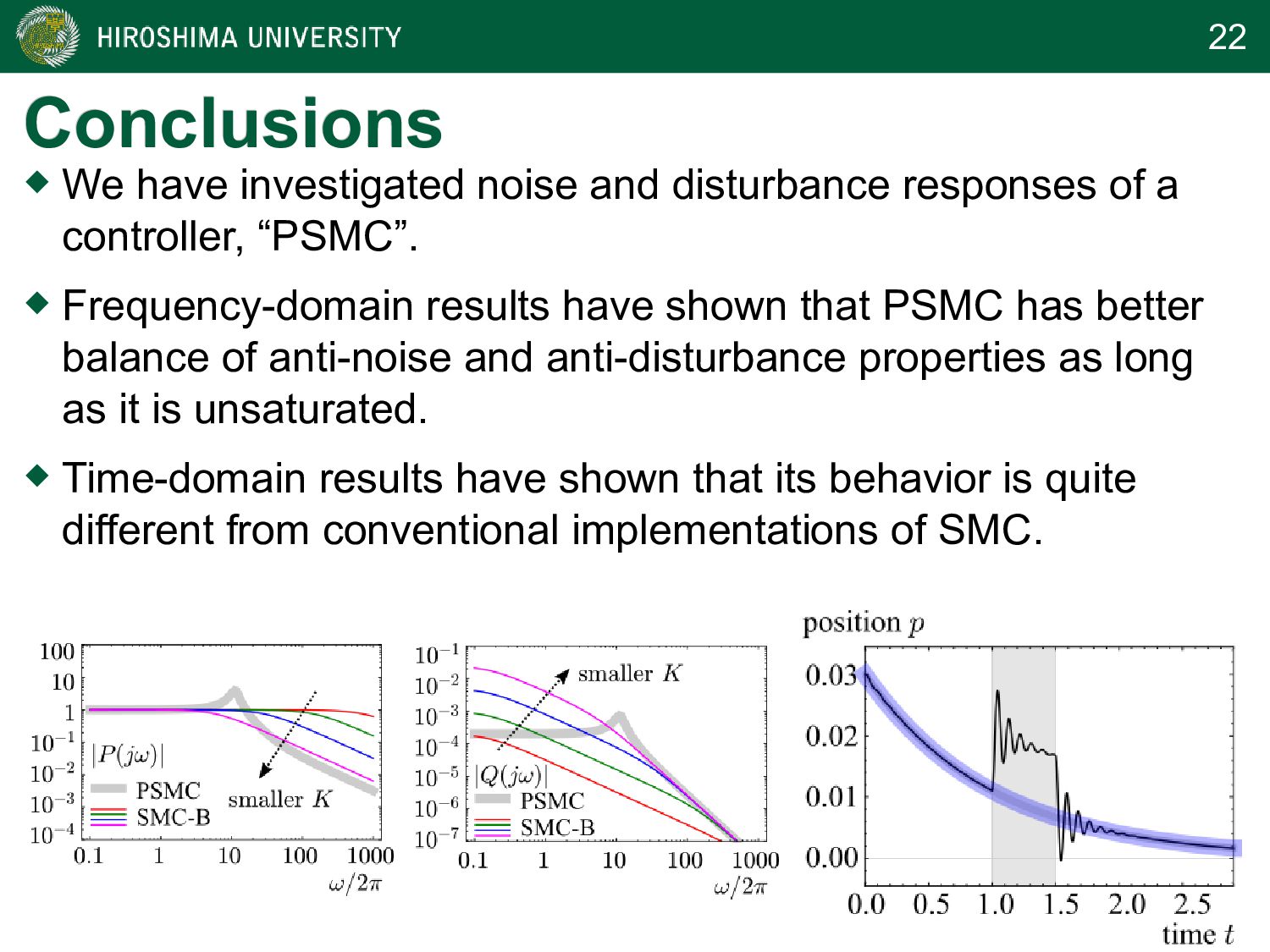
22 Conclusions Conclusions We have investigated noise and disturbance
responses of a controller, “PSMC”. Frequency-domain results have shown that PSMC has better balance of anti-noise and anti-disturbance properties as long as it is unsaturated. Time-domain results have shown that its behavior is quite different from conventional implementations of SMC.