Share
Embed
20_1025 Torque-Bounded Admittance Control Realized by a Set-valued Algebraic Feedback
Details can be found in:
Ryo Kikuuwe: "Torque-Bounded Admittance Control Realized by a Set-Valued Algebraic Feedback," IEEE Transactions on Robotics, Vol.35, No.5, pp.1136-1149, October 2019.
https://doi.org/10.1109/TRO.2019.2920069
https://home.hiroshima-u.ac.jp/kikuuwe/pub/19_tro_aut.pdf
Ryo Kikuuwe
October 25, 2020
Transcript
13 slides
-
1 A presentation for IEEE/RSJ IROS2020 Torque-Bounded Admittance Torque-Bounded Admittance
Control Realized by a Control Realized by a Set-Valued Algebraic Feedback Set-Valued Algebraic Feedback Hiroshima University, Japan Ryo Kikuuwe https://home.hiroshima-u.ac.jp/kikuuwe/ https://www.youtube.com/user/kikuuwe/ Presentation for IROS 2020 -
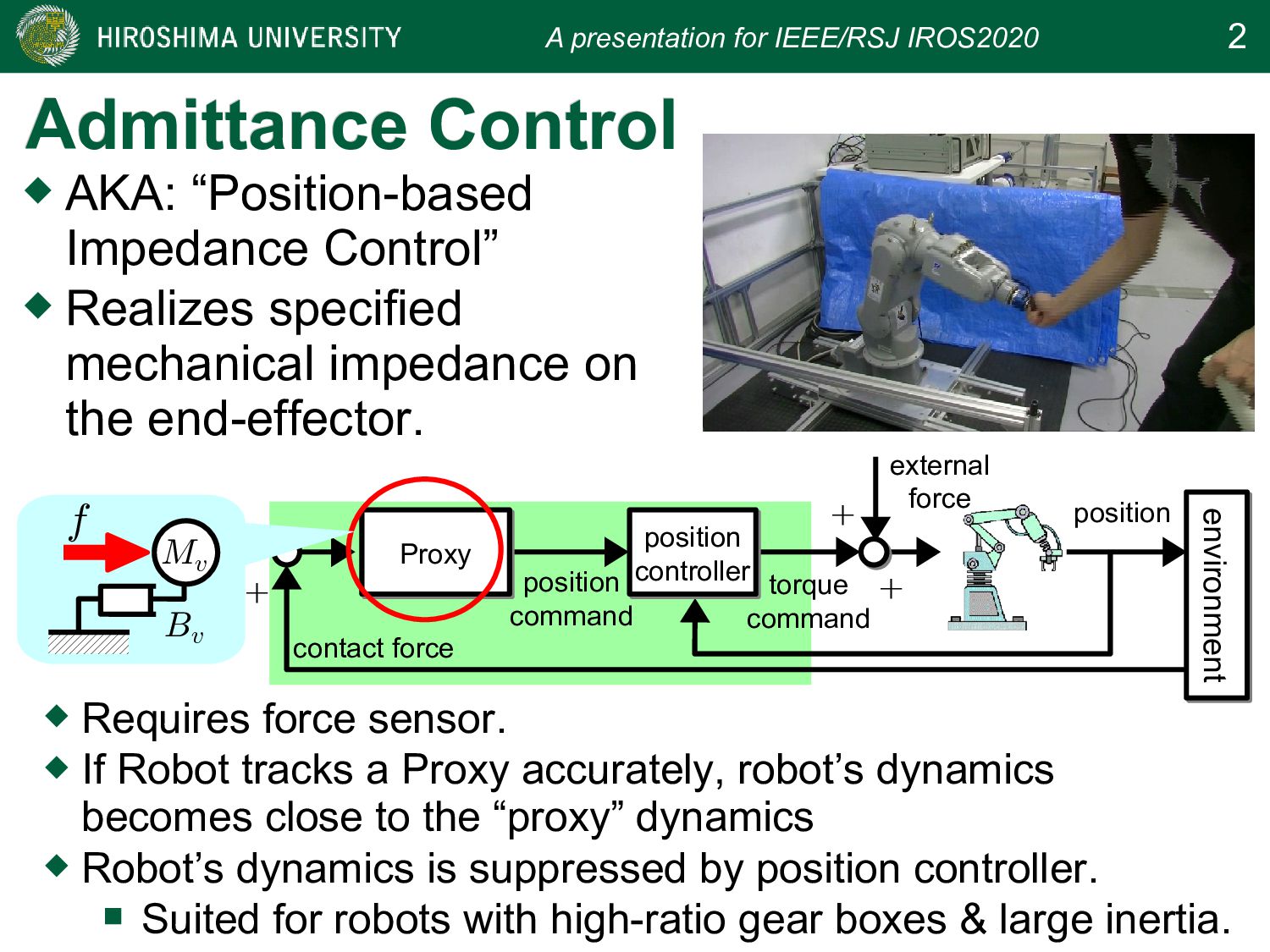
2 A presentation for IEEE/RSJ IROS2020 environment environment position contact
force position command position controller position controller torque command Proxy Proxy external force + + + Admittance Control Admittance Control AKA: “Position-based Impedance Control” Realizes specified mechanical impedance on the end-effector. f Mv Bv Requires force sensor. If Robot tracks a Proxy accurately, robot’s dynamics becomes close to the “proxy” dynamics Robot’s dynamics is suppressed by position controller. Suited for robots with high-ratio gear boxes & large inertia. -
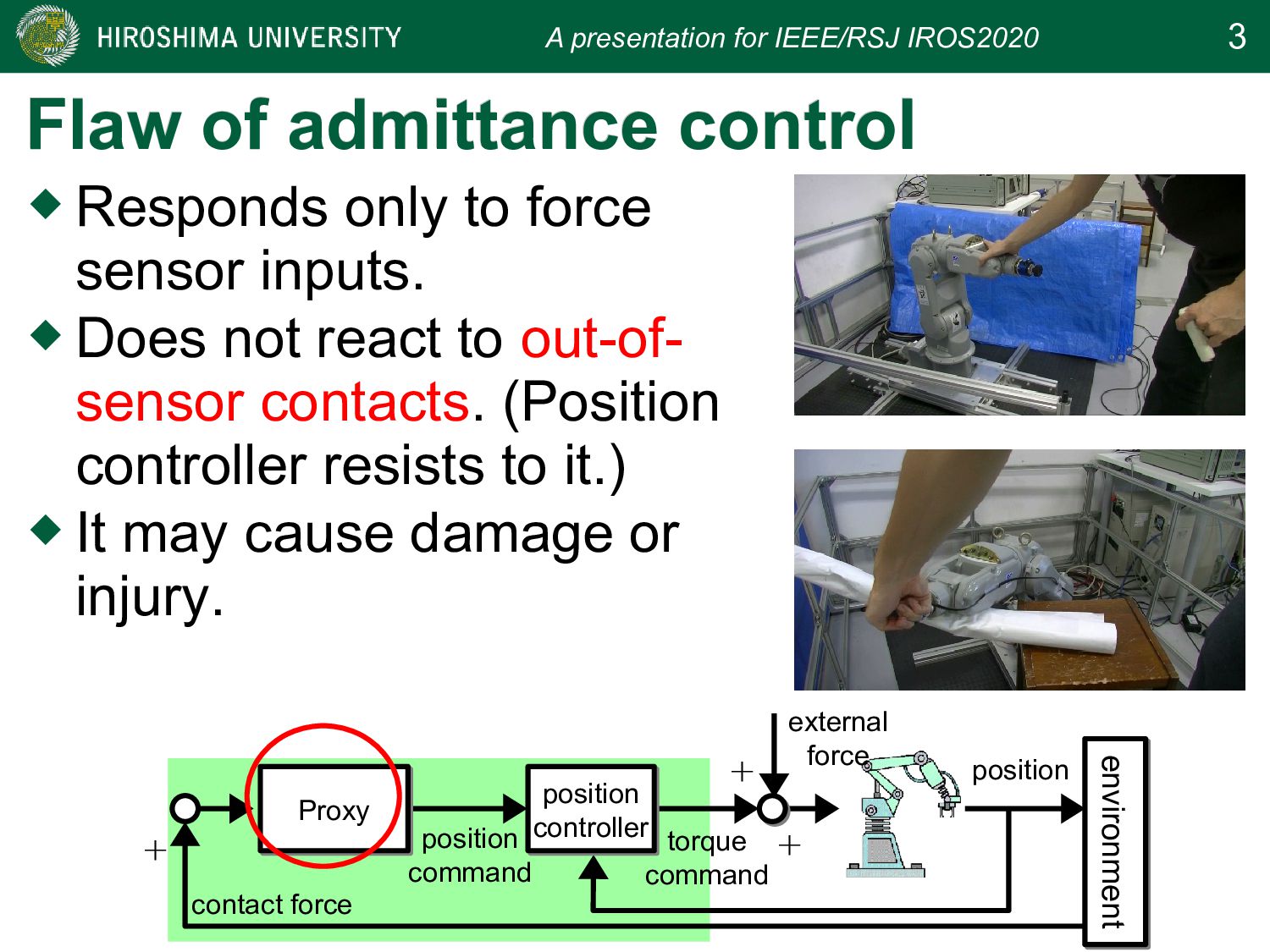
3 A presentation for IEEE/RSJ IROS2020 Flaw of admittance control
Flaw of admittance control Responds only to force sensor inputs. Does not react to out-of- sensor contacts. (Position controller resists to it.) It may cause damage or injury. environment environment position contact force position command position controller position controller torque command Proxy Proxy external force + + + -
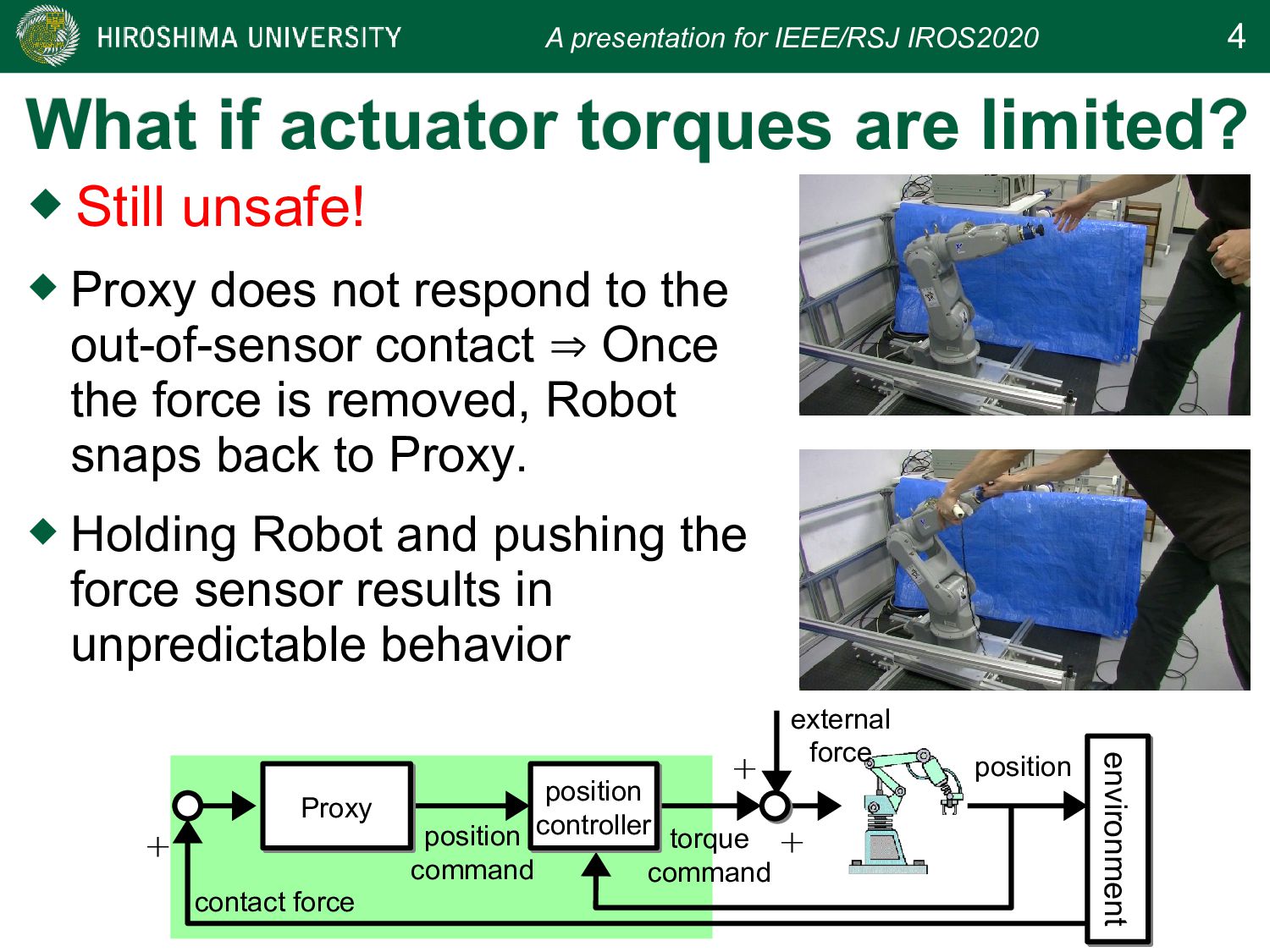
4 A presentation for IEEE/RSJ IROS2020 What if actuator torques
are limited? What if actuator torques are limited? Still unsafe! Proxy does not respond to the out-of-sensor contact Once ⇒ the force is removed, Robot snaps back to Proxy. Holding Robot and pushing the force sensor results in unpredictable behavior environment environment position contact force position command position controller position controller torque command Proxy Proxy external force + + + -
5 A presentation for IEEE/RSJ IROS2020 Contribution Contribution New
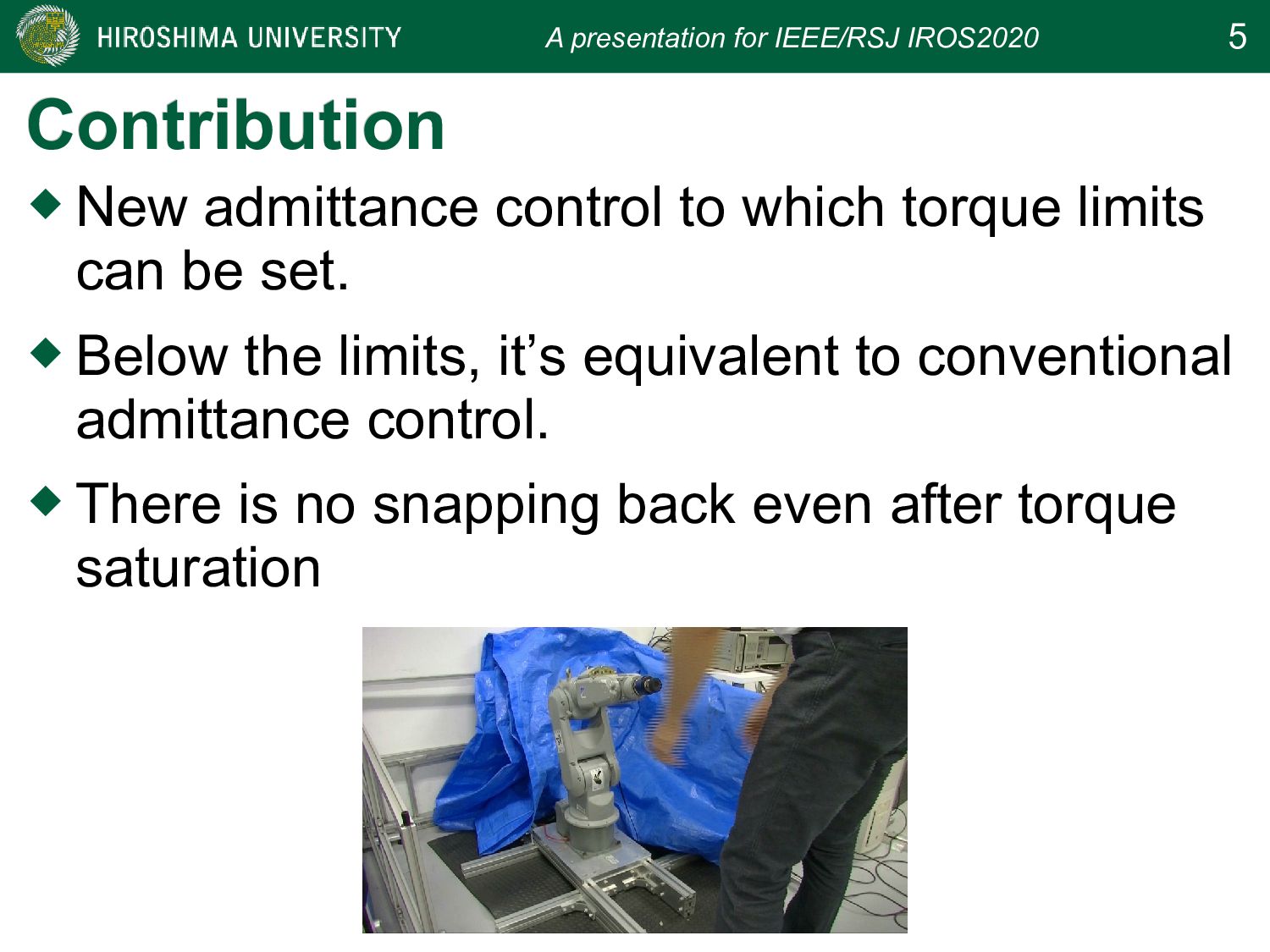
admittance control to which torque limits can be set. Below the limits, it’s equivalent to conventional admittance control. There is no snapping back even after torque saturation -
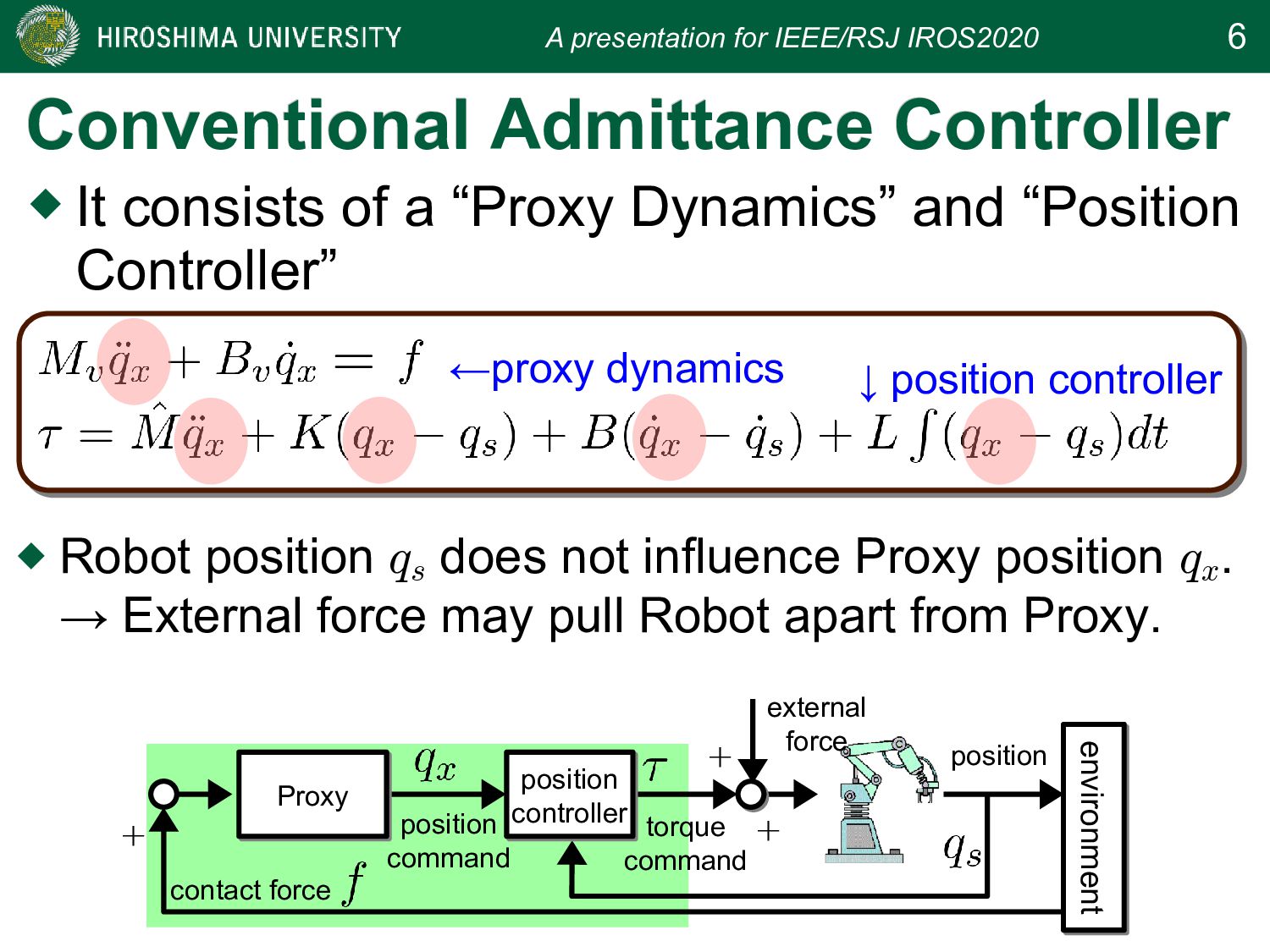
6 A presentation for IEEE/RSJ IROS2020 Conventional Admittance Controller Conventional
Admittance Controller It consists of a “Proxy Dynamics” and “Position Controller” Robot position qs does not influence Proxy position qx . → External force may pull Robot apart from Proxy. environment environment position contact force position command position controller position controller torque command Proxy Proxy external force + + + ↓ position controller ←proxy dynamics = -
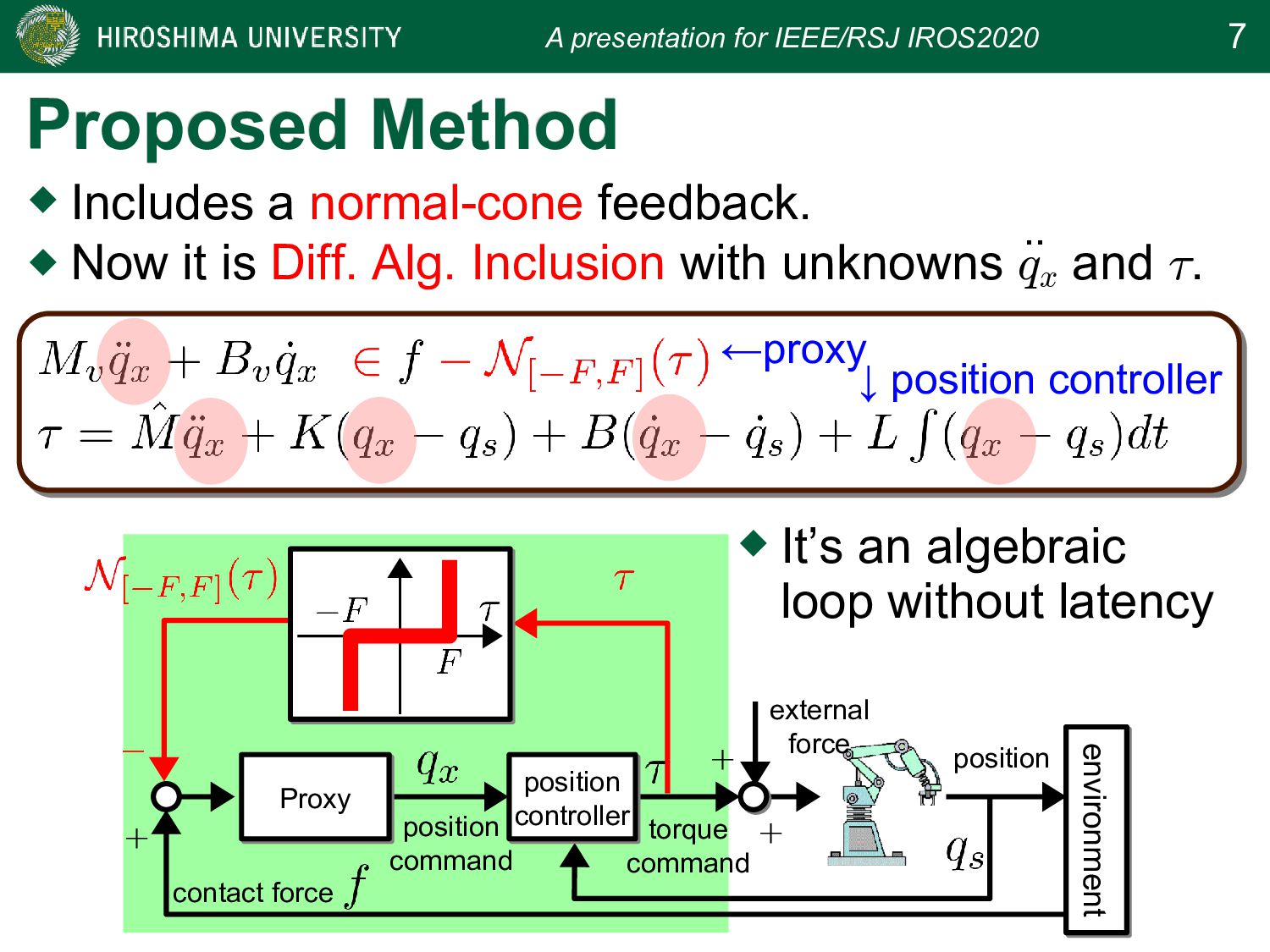
7 A presentation for IEEE/RSJ IROS2020 Proposed Method Proposed Method
Includes a normal-cone feedback. Now it is Diff. Alg. Inclusion with unknowns qx and ¿. It’s an algebraic loop without latency ←proxy .. ↓ position controller environment environment position contact force position command position controller position controller torque command Proxy Proxy external force + + + - -
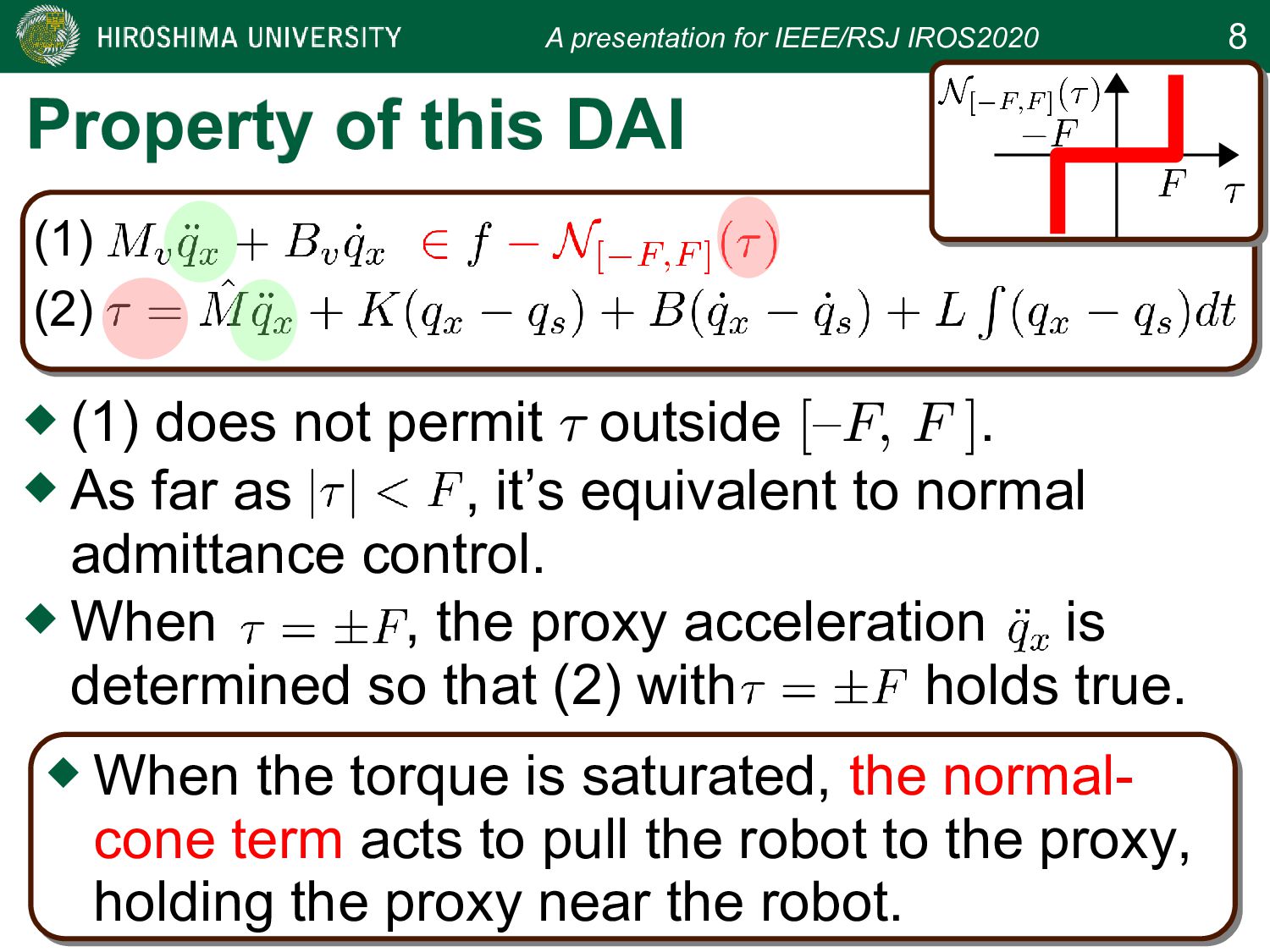
8 A presentation for IEEE/RSJ IROS2020 (1) does not
permit ¿ outside [{F, F ]. As far as , it’s equivalent to normal admittance control. When , the proxy acceleration is determined so that (2) with holds true. (2) (1) Property of this DAI Property of this DAI When the torque is saturated, the normal- cone term acts to pull the robot to the proxy, holding the proxy near the robot. -
9 A presentation for IEEE/RSJ IROS2020 Implementation to discrete time
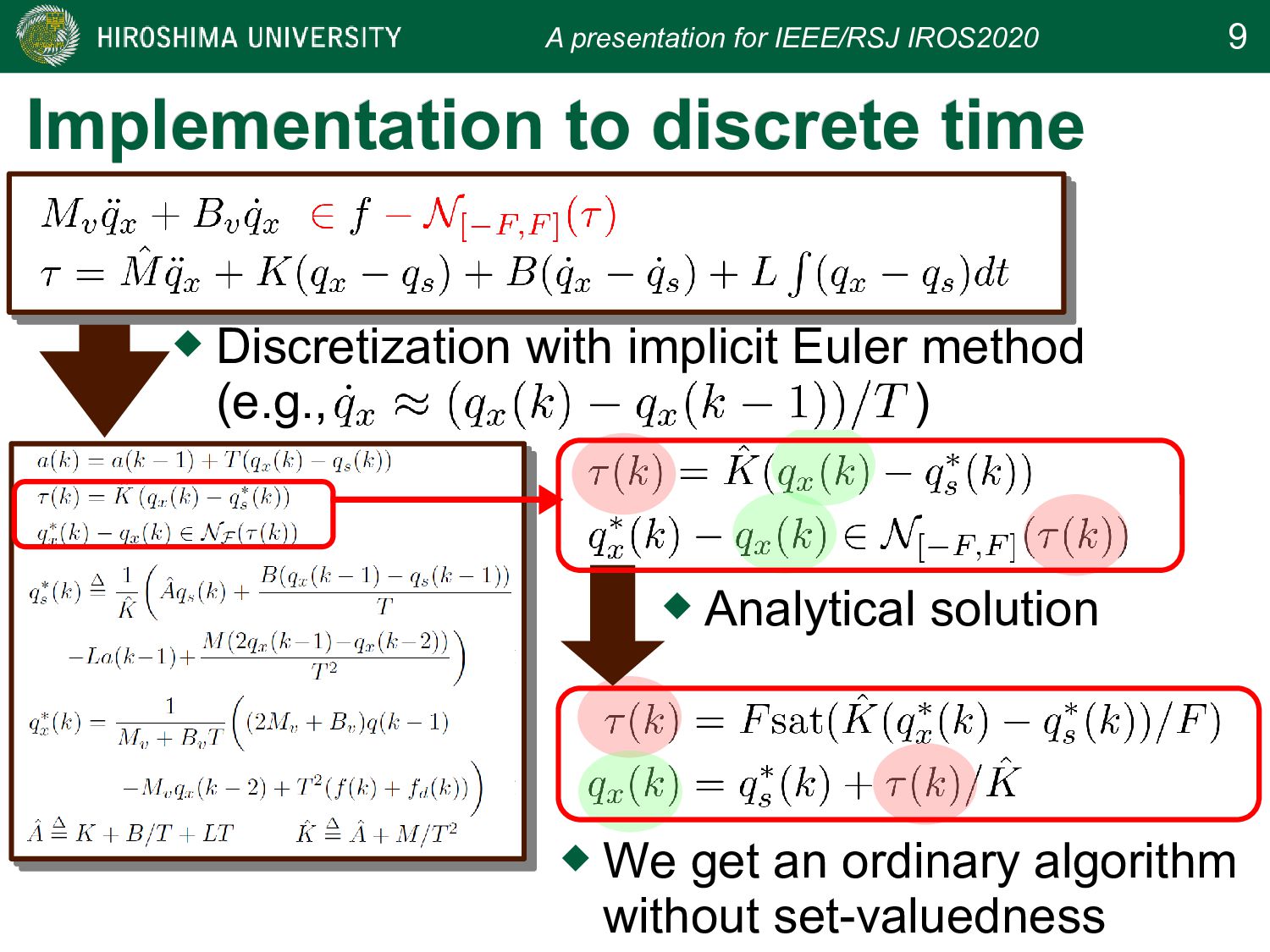
Implementation to discrete time Discretization with implicit Euler method (e.g., ) Analytical solution We get an ordinary algorithm without set-valuedness -
10 A presentation for IEEE/RSJ IROS2020 The Algorithm The Algorithm
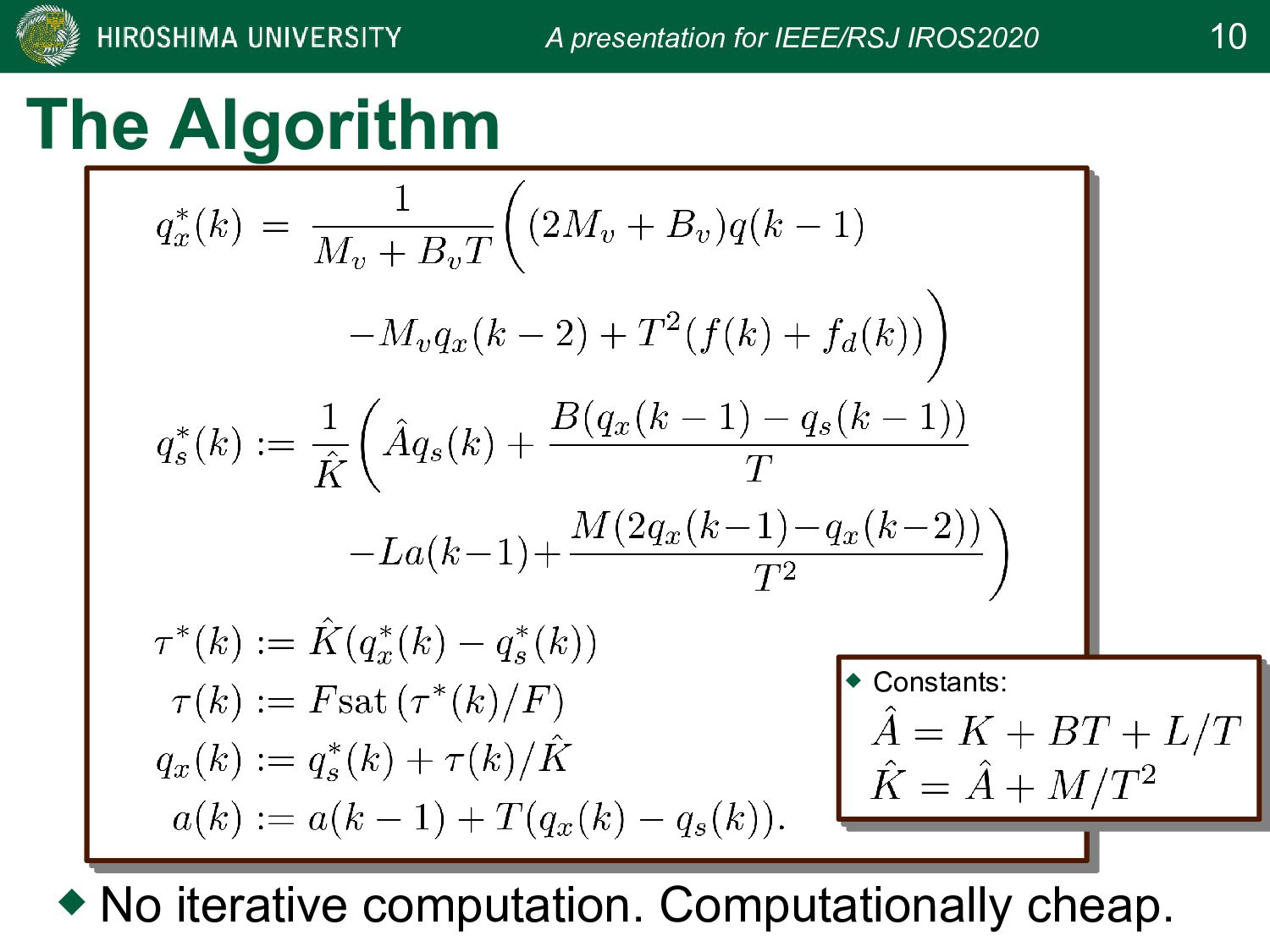
Constants: No iterative computation. Computationally cheap. -
11 A presentation for IEEE/RSJ IROS2020 Implementation Implementation New
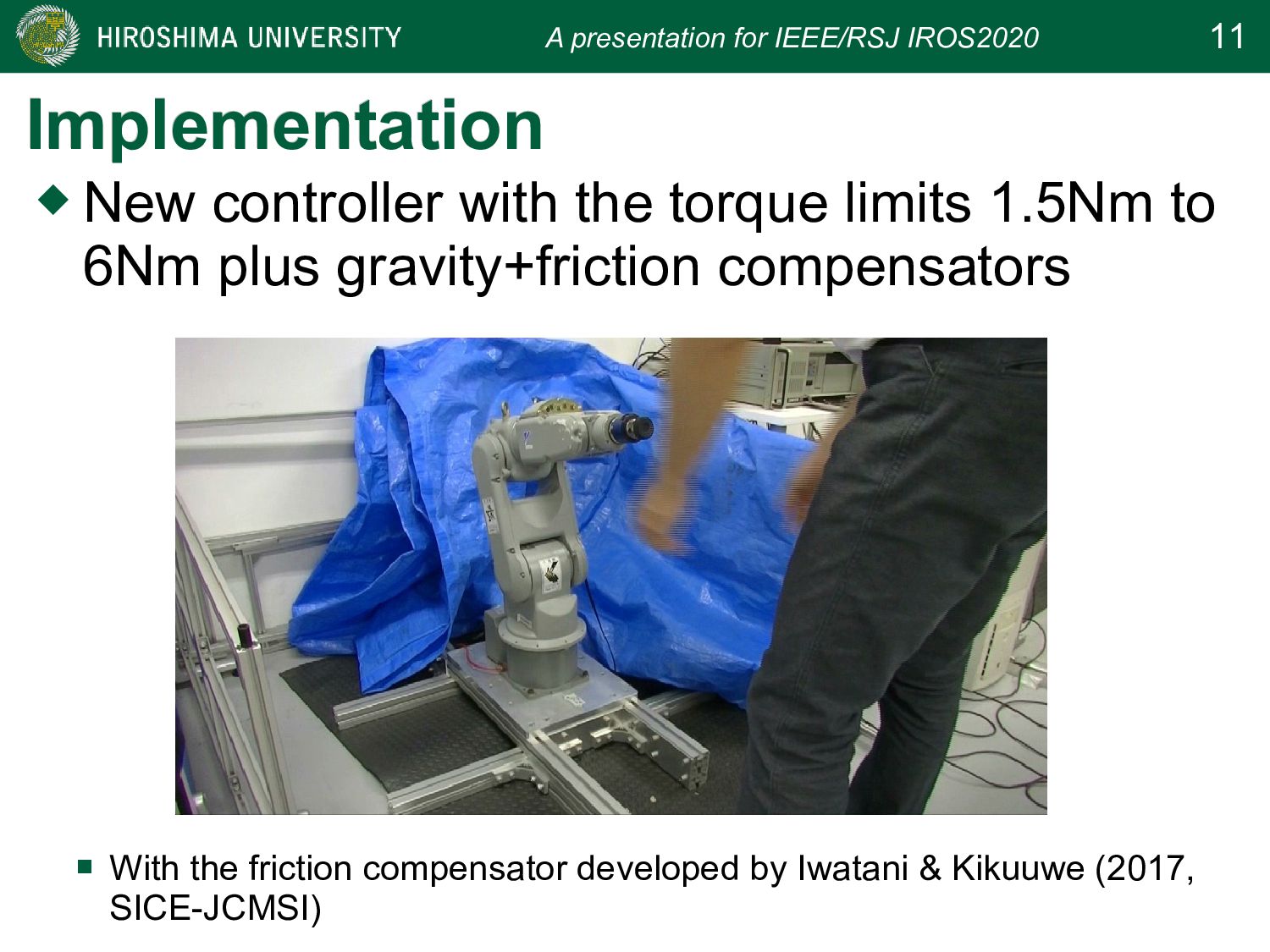
controller with the torque limits 1.5Nm to 6Nm plus gravity+friction compensators With the friction compensator developed by Iwatani & Kikuuwe (2017, SICE-JCMSI) -
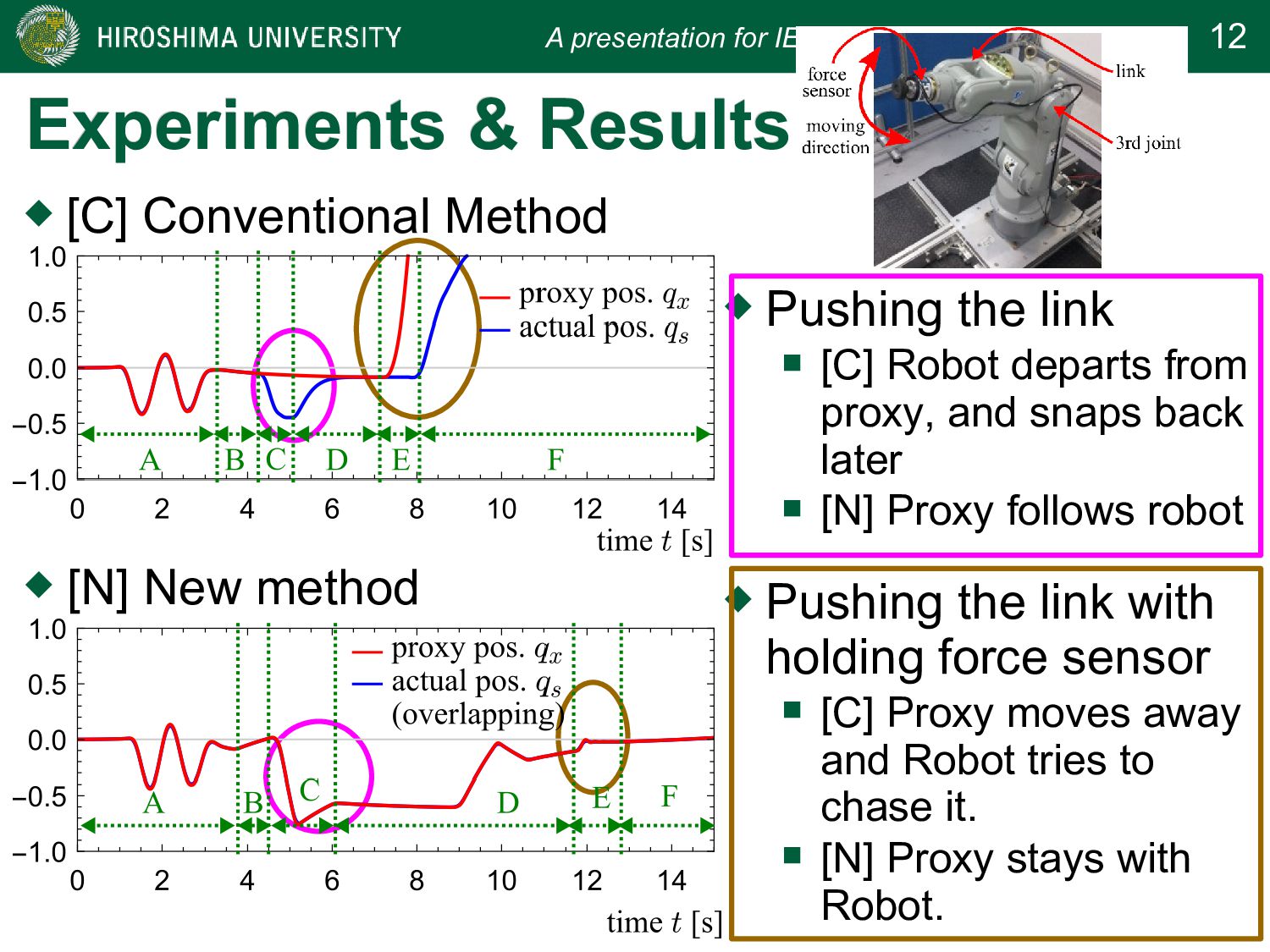
12 A presentation for IEEE/RSJ IROS2020 Pushing the link
[C] Robot departs from proxy, and snaps back later [N] Proxy follows robot Experiments & Results Experiments & Results [C] Conventional Method [N] New method Pushing the link with holding force sensor [C] Proxy moves away and Robot tries to chase it. [N] Proxy stays with Robot. -
13 A presentation for IEEE/RSJ IROS2020 Concluding Remarks Concluding Remarks
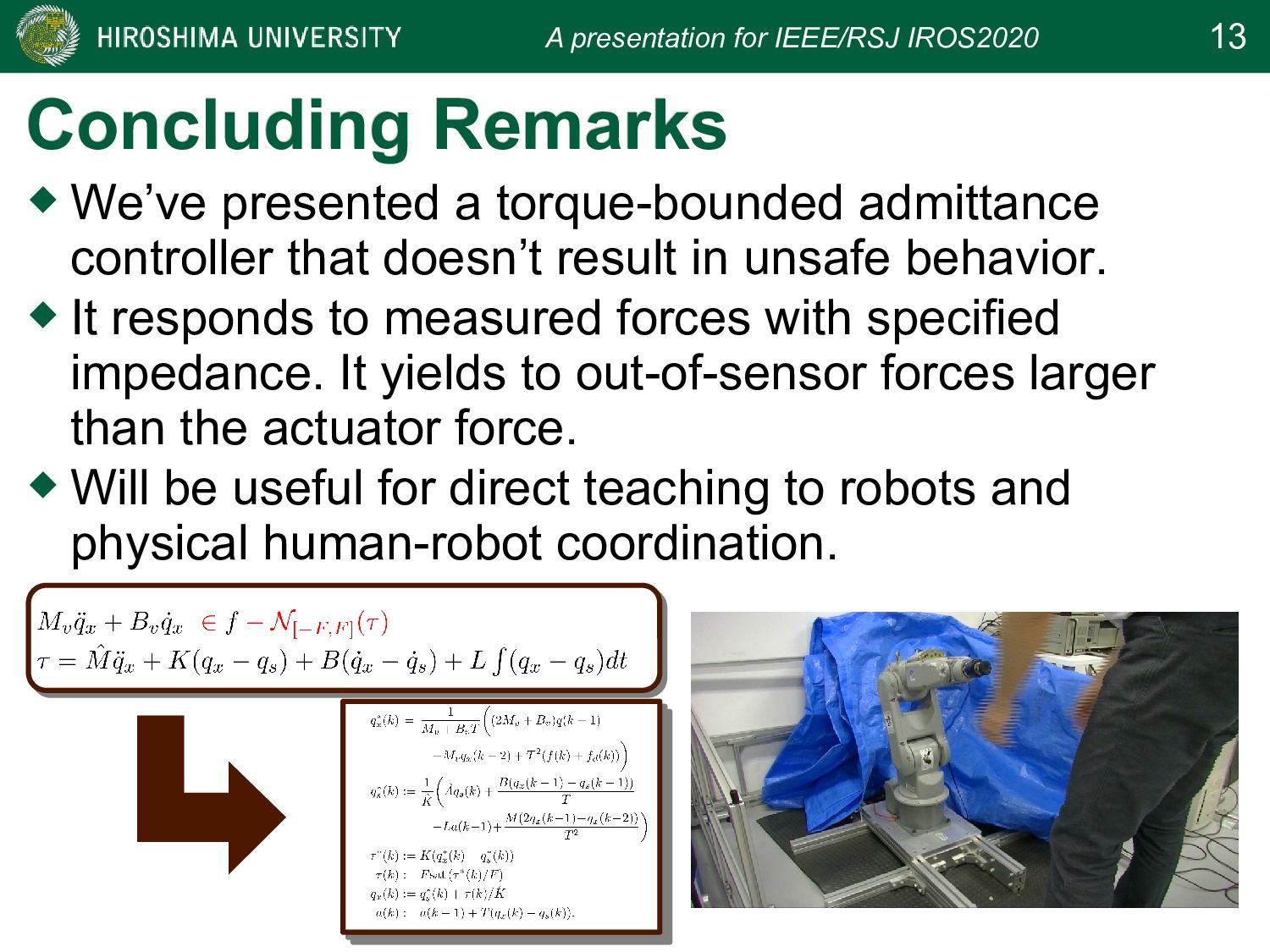
We’ve presented a torque-bounded admittance controller that doesn’t result in unsafe behavior. It responds to measured forces with specified impedance. It yields to out-of-sensor forces larger than the actuator force. Will be useful for direct teaching to robots and physical human-robot coordination.