Upgrade to Pro — share decks privately, control downloads, hide ads and more …

19_0906 A First-Order Differentiator with First...

Sponsored · Ship Features Fearlessly Turn features on and off without deploys. Used by thousands of Ruby developers. →
Ryo Kikuuwe
September 06, 2019

19_0906 A First-Order Differentiator with First-Order Sliding Mode Filtering

Presented at the 11th IFAC Symposium on Nonlinear Control Systems (NOLCOS 2019), Vienna, Austria, September 06, 2019.

Ryo Kikuuwe

September 06, 2019

Transcript

16 slides
  1. 1 https://home.hiroshima-u.ac.jp/kikuuwe/ https://www.youtube.com/user/kikuuwe/ Hiroshima Univ., Japan Ryo Kikuuwe Kyushu Univ.,

    Japan Bandung Inst. Tech., Indonesia Gyuho Byun Rainhart Pasaribu A First-Order Differentiator with A First-Order Differentiator with First-Order Sliding Mode Filtering First-Order Sliding Mode Filtering
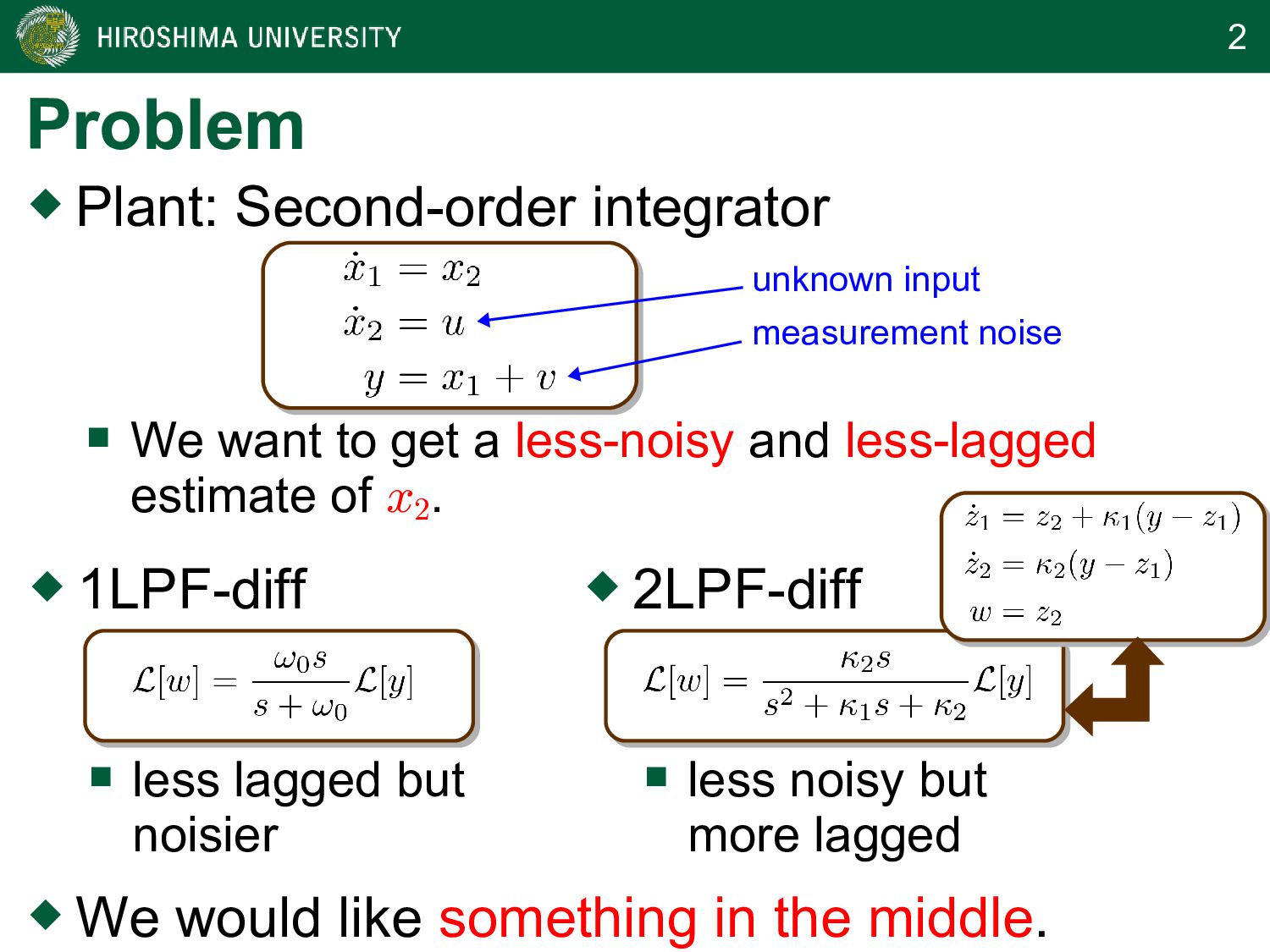
  2. 2  We would like something in the middle. Problem

    Problem  Plant: Second-order integrator  less noisy but more lagged  1LPF-diff measurement noise unknown input  We want to get a less-noisy and less-lagged estimate of x2 .  less lagged but noisier  2LPF-diff
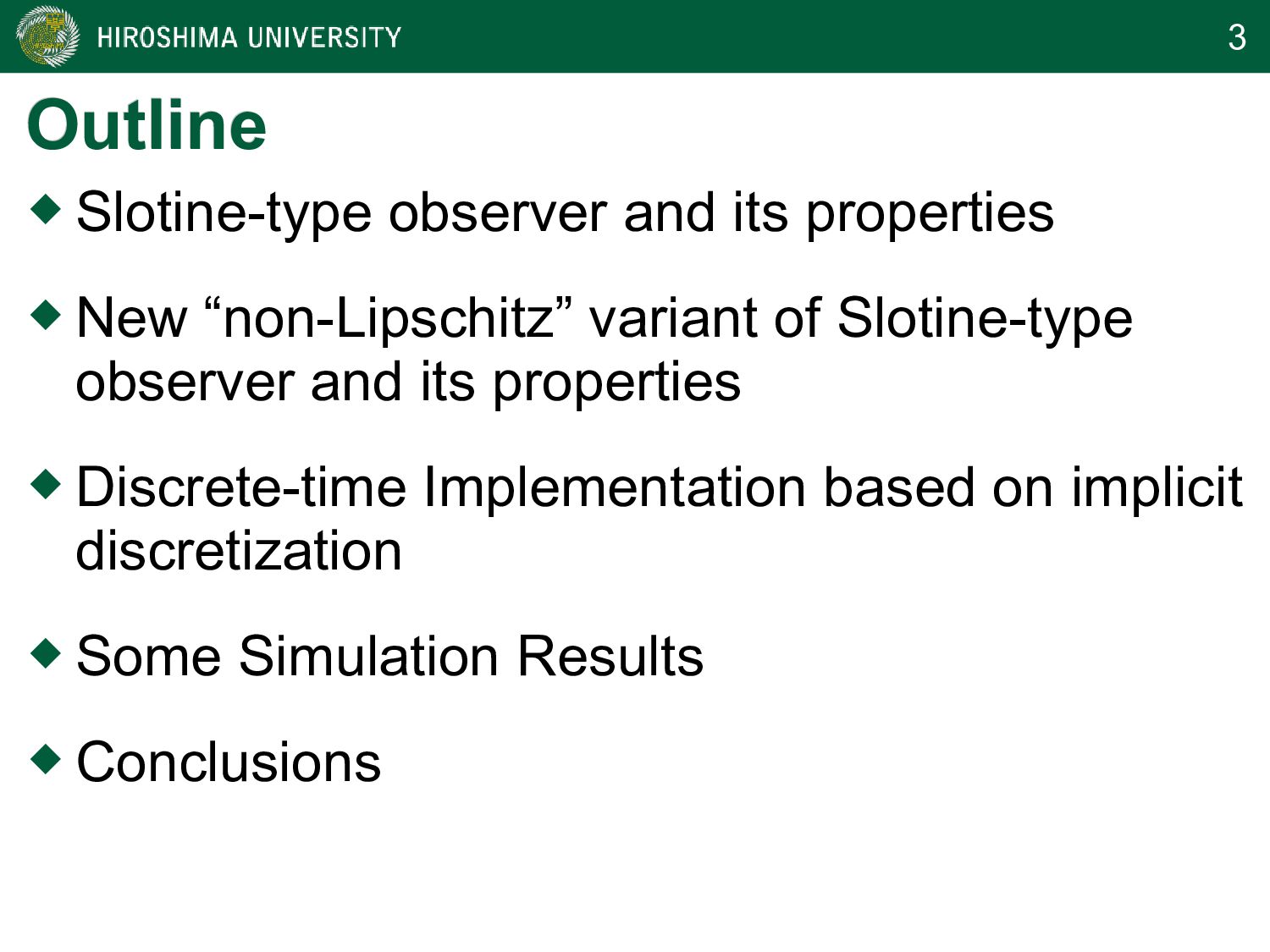
  3. 3 Outline Outline  Slotine-type observer and its properties 

    New “non-Lipschitz” variant of Slotine-type observer and its properties  Discrete-time Implementation based on implicit discretization  Some Simulation Results  Conclusions
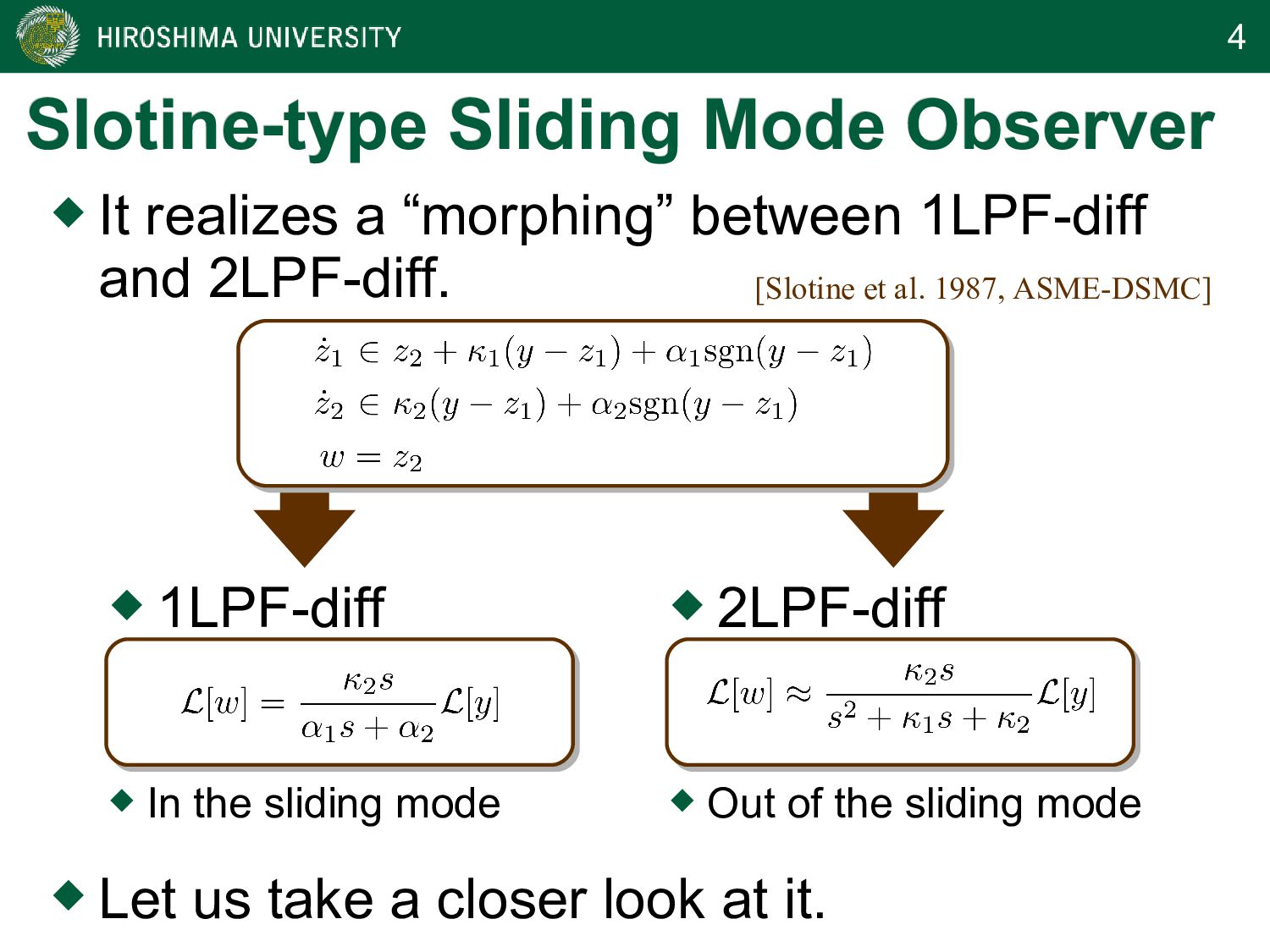
  4. 4 Slotine-type Sliding Mode Observer Slotine-type Sliding Mode Observer [Slotine

    et al. 1987, ASME-DSMC]  It realizes a “morphing” between 1LPF-diff and 2LPF-diff.  In the sliding mode  Out of the sliding mode  1LPF-diff  2LPF-diff  Let us take a closer look at it.
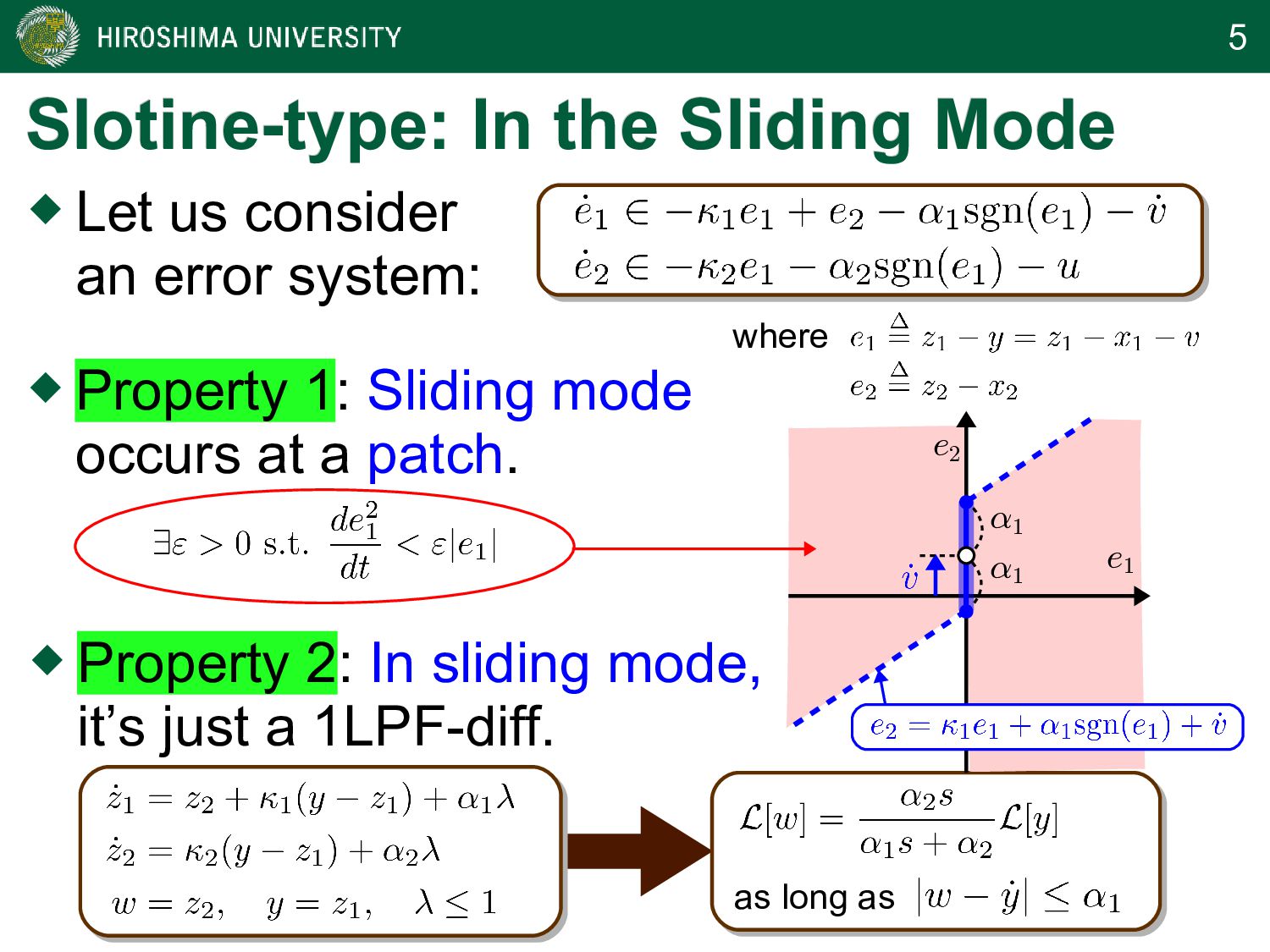
  5. 5 Slotine-type: In the Sliding Mode Slotine-type: In the Sliding

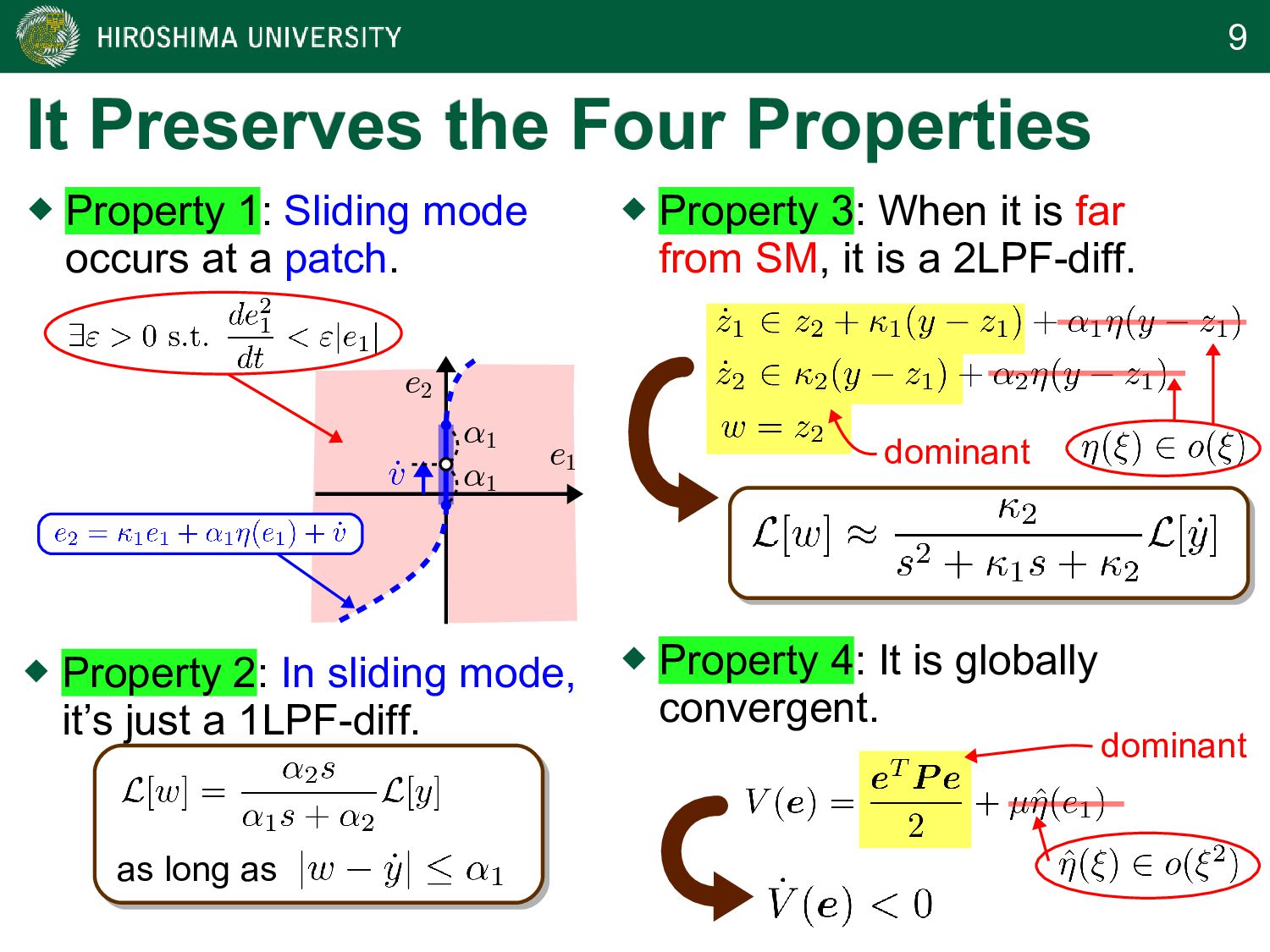
    Mode as long as e1 e2 ®1 ®1  Let us consider an error system:  Property 2: In sliding mode, it’s just a 1LPF-diff.  Property 1: Sliding mode occurs at a patch. where
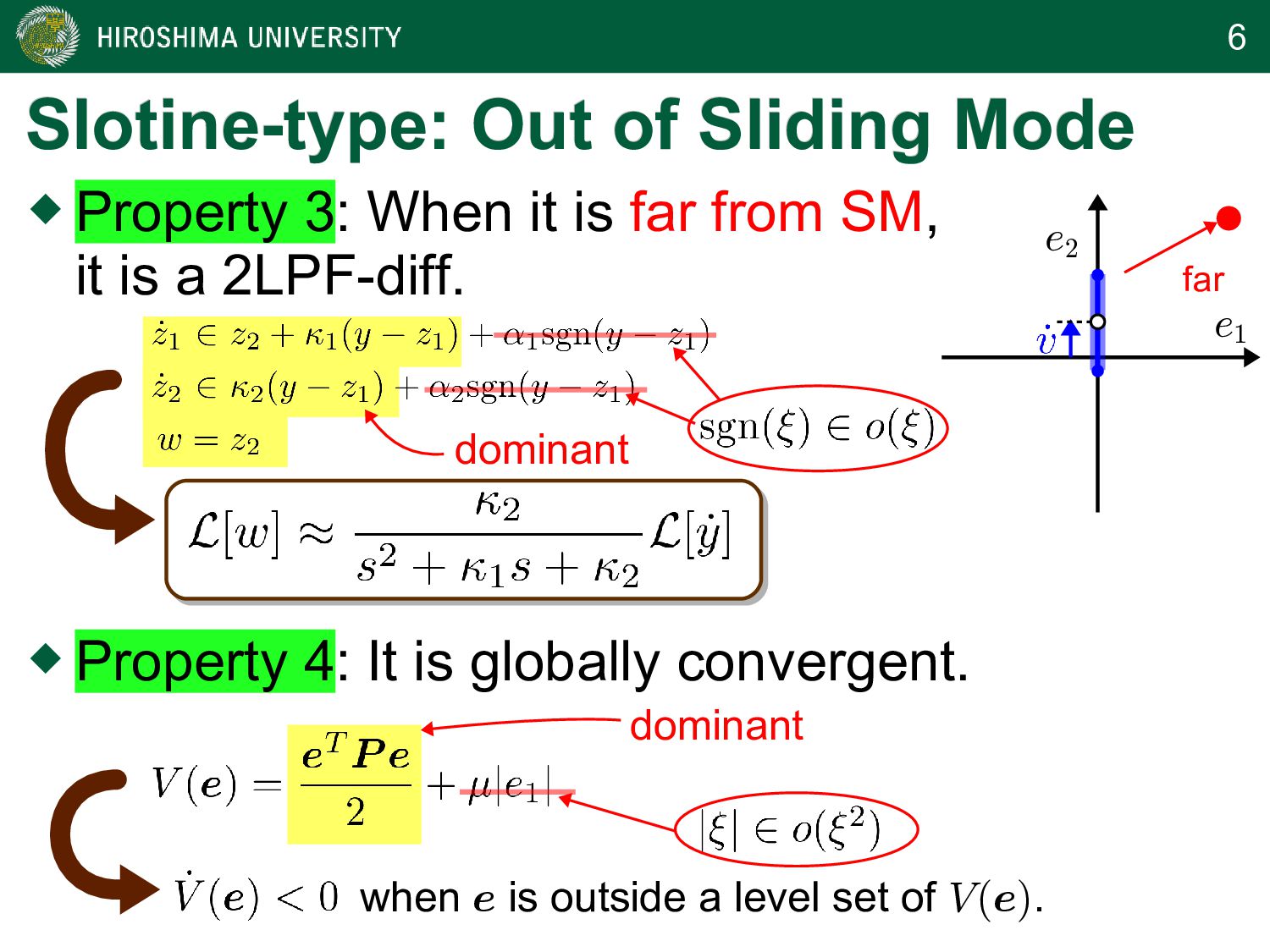
  6. 6 Slotine-type: Out of Sliding Mode Slotine-type: Out of Sliding

    Mode  Property 3: When it is far from SM, it is a 2LPF-diff.  Property 4: It is globally convergent. dominant e1 e2 far when e is outside a level set of V(e). dominant
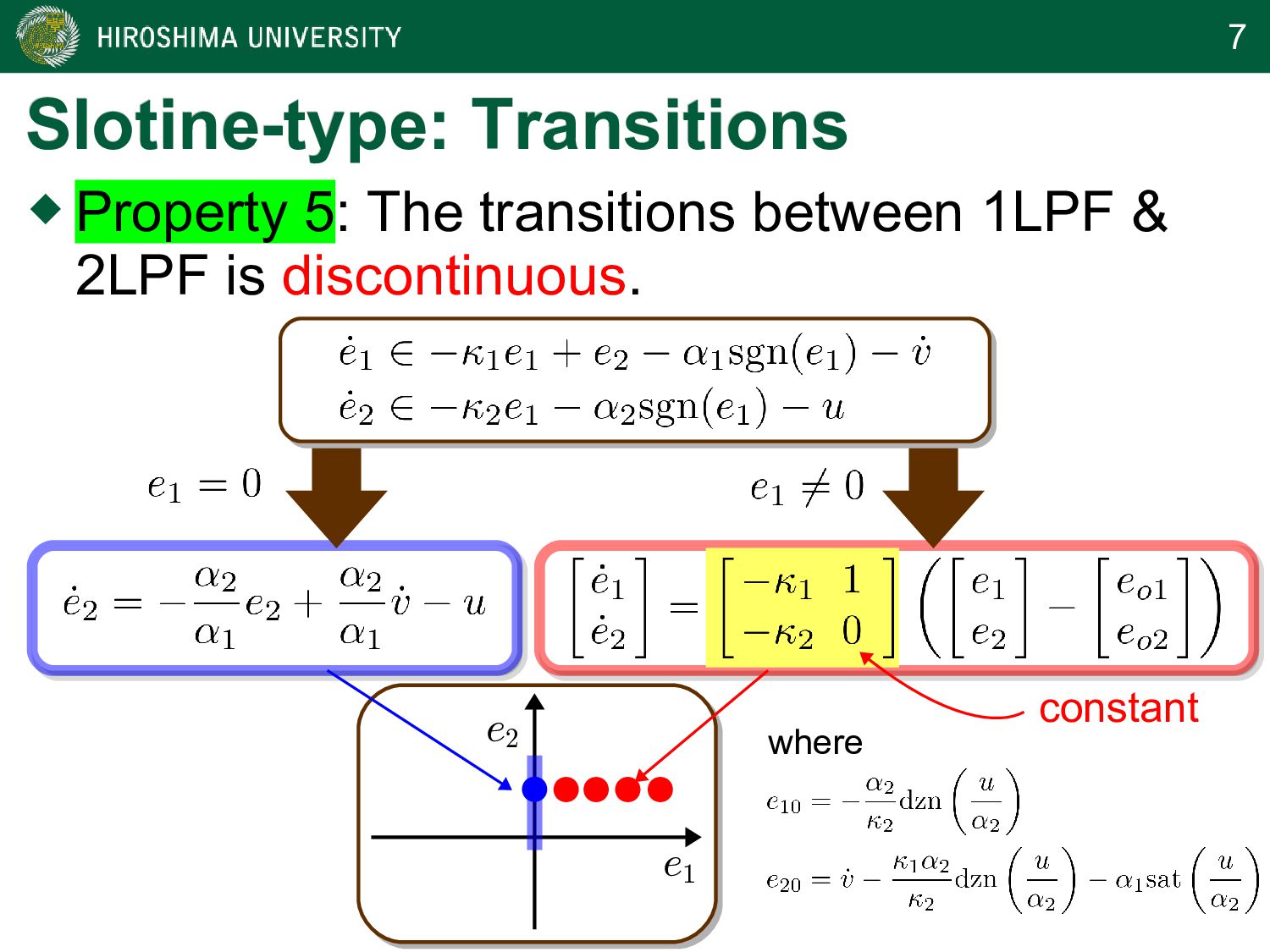
  7. 7 where Slotine-type: Transitions Slotine-type: Transitions  Property 5: The

    transitions between 1LPF & 2LPF is discontinuous. e1 e2 constant
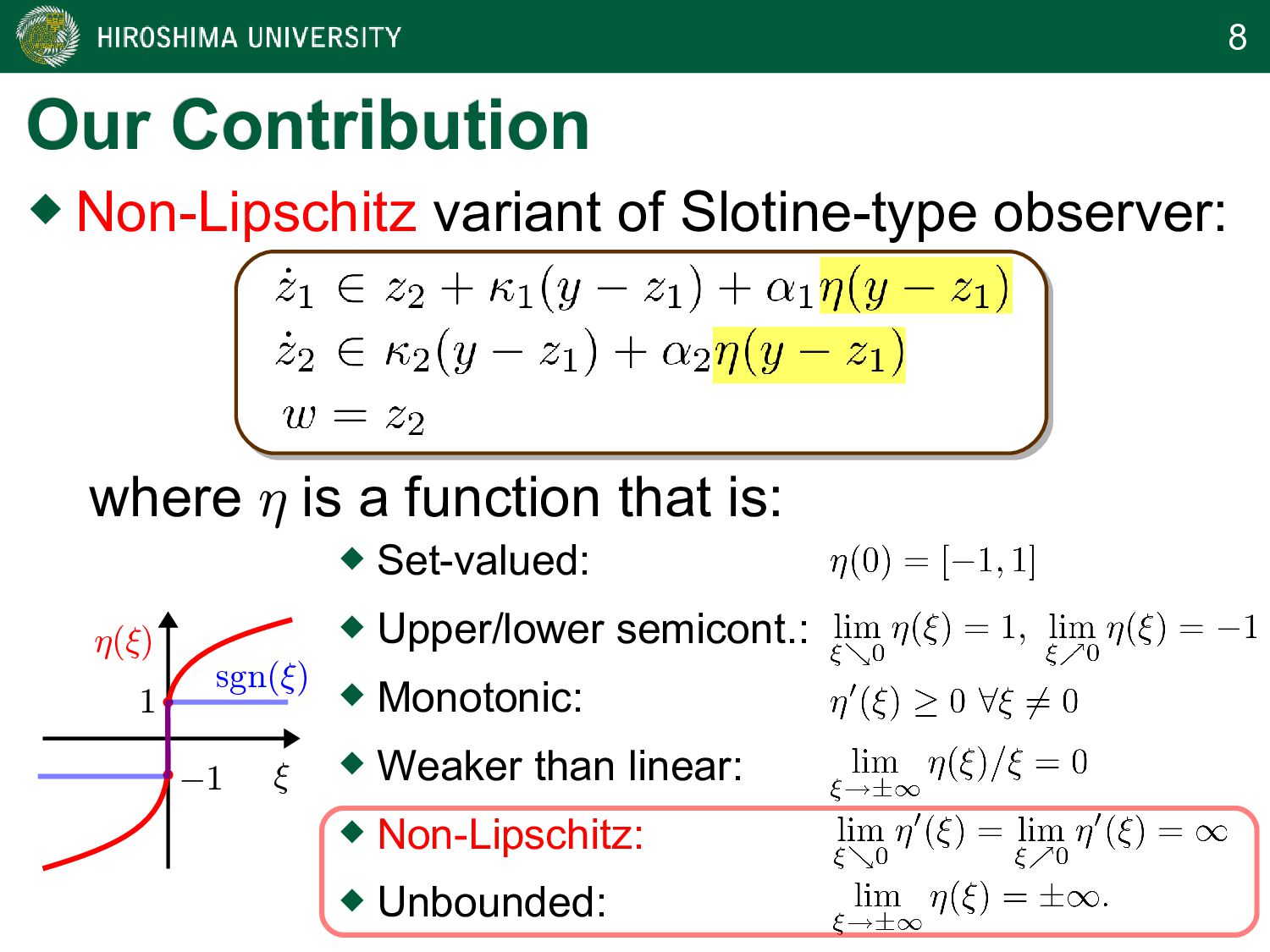
  8. 8  Set-valued:  Upper/lower semicont.:  Monotonic:  Weaker

    than linear:  Non-Lipschitz:  Unbounded: Our Contribution Our Contribution  Non-Lipschitz variant of Slotine-type observer: » ´(») 1 ¡1 sgn(») where ´ is a function that is:
  9. 9 e1 e2 ®1 ®1 It Preserves the Four Properties

    It Preserves the Four Properties as long as  Property 2: In sliding mode, it’s just a 1LPF-diff.  Property 1: Sliding mode occurs at a patch.  Property 3: When it is far from SM, it is a 2LPF-diff.  Property 4: It is globally convergent. dominant dominant
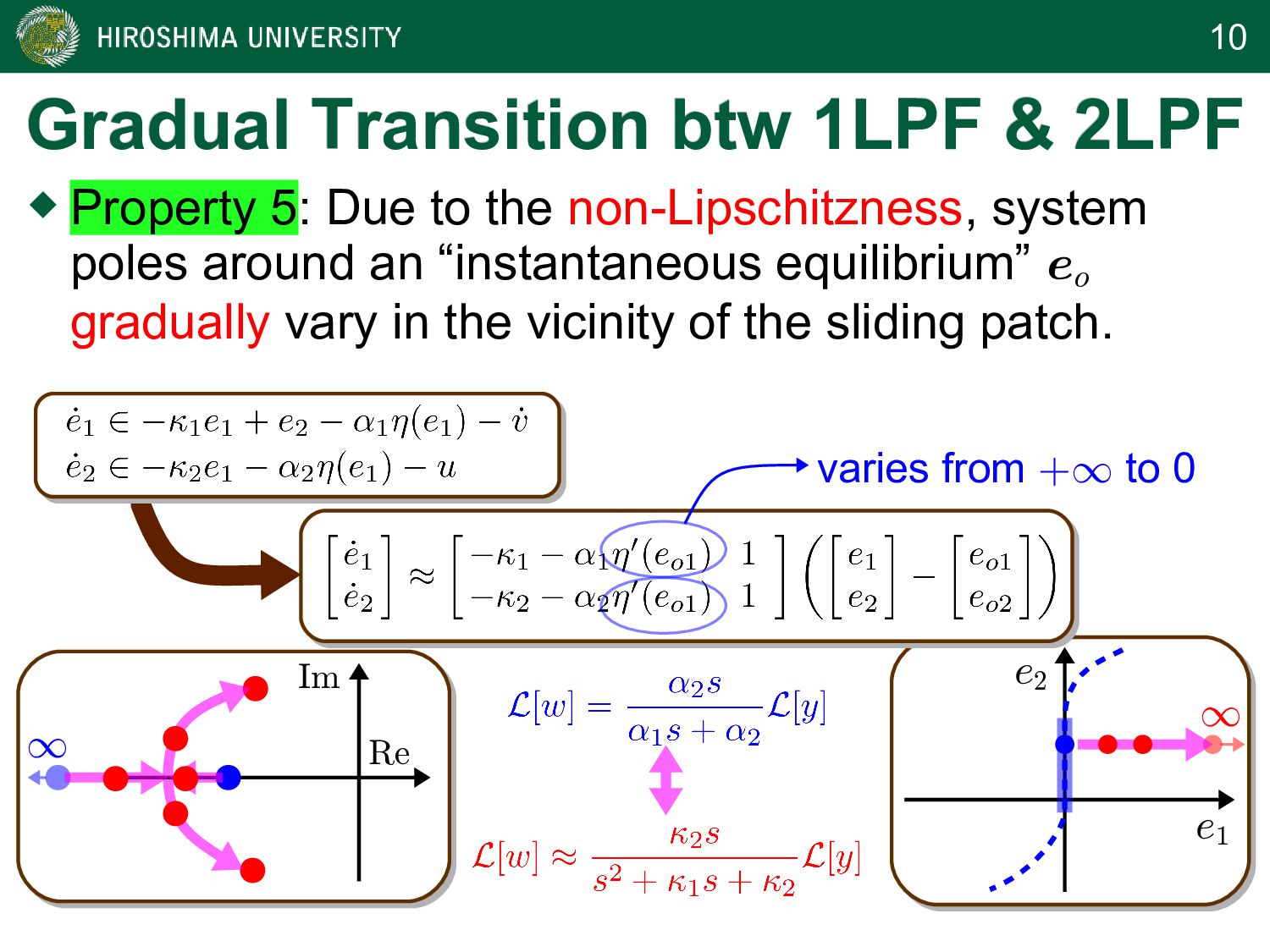
  10. 10 e1 e2 1 Gradual Transition btw 1LPF & 2LPF

    Gradual Transition btw 1LPF & 2LPF  Property 5: Due to the non-Lipschitzness, system poles around an “instantaneous equilibrium” eo gradually vary in the vicinity of the sliding patch. varies from +1 to 0 Re Im 1
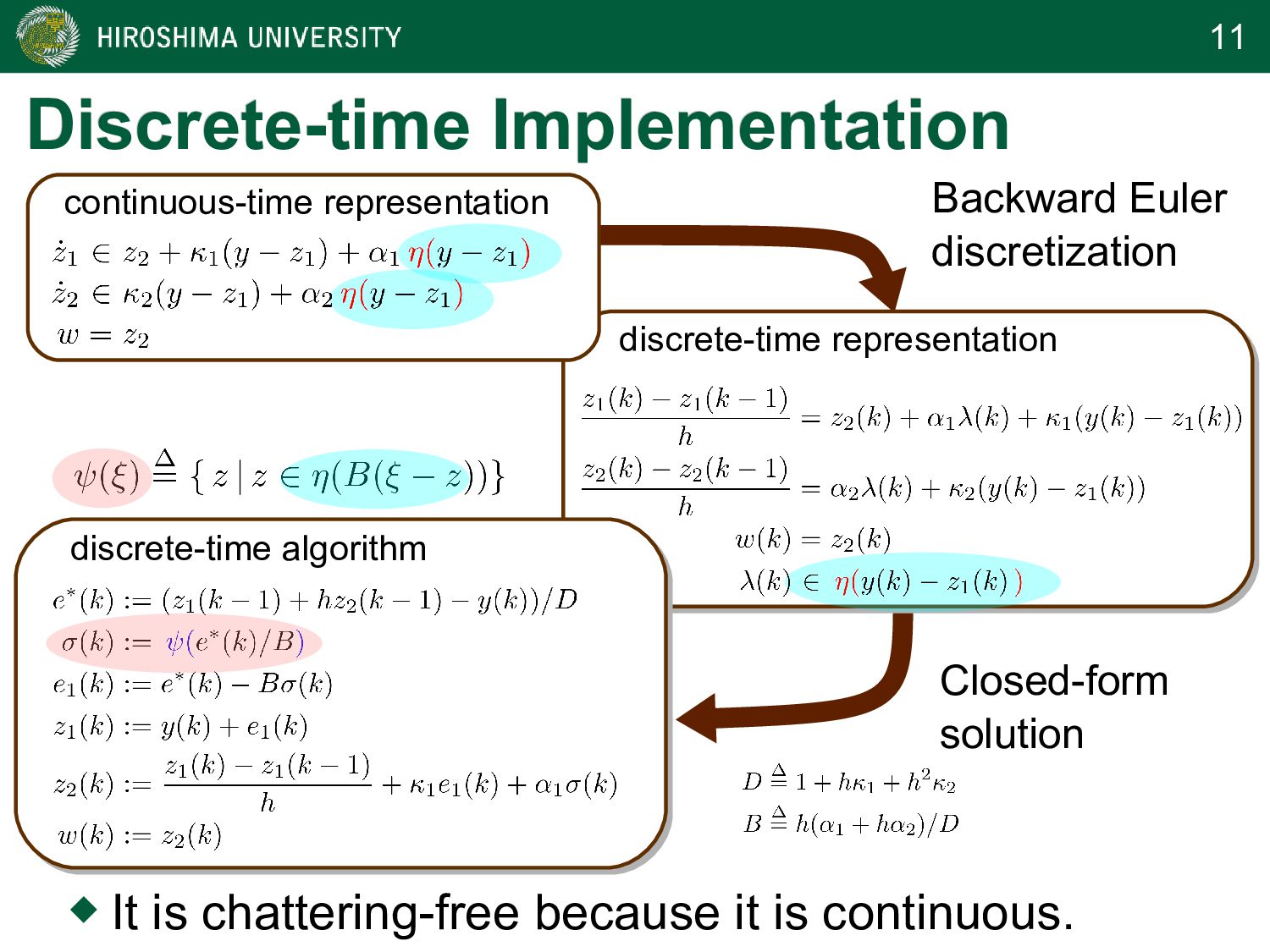
  11. 11 Discrete-time Implementation Discrete-time Implementation Backward Euler discretization discrete-time representation

    continuous-time representation discrete-time algorithm Closed-form solution  It is chattering-free because it is continuous.
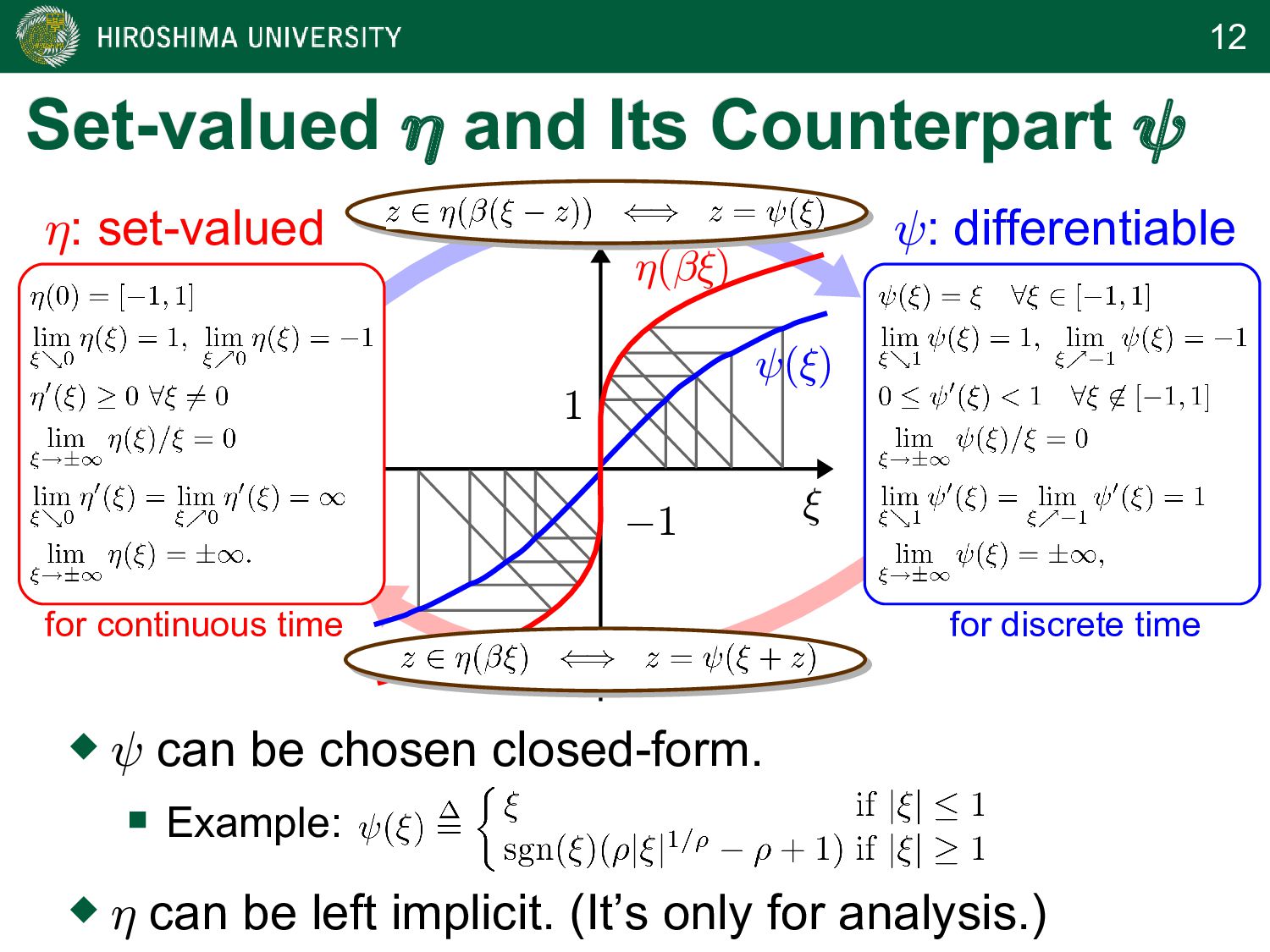
  12. 12 Set-valued Set-valued ´ ´ and Its Counterpart and Its

    Counterpart à à  à can be chosen closed-form.  Example:  ´ can be left implicit. (It’s only for analysis.) » 1 ¡1 Ã(») ´(¯») Ã: differentiable ´: set-valued for continuous time for discrete time
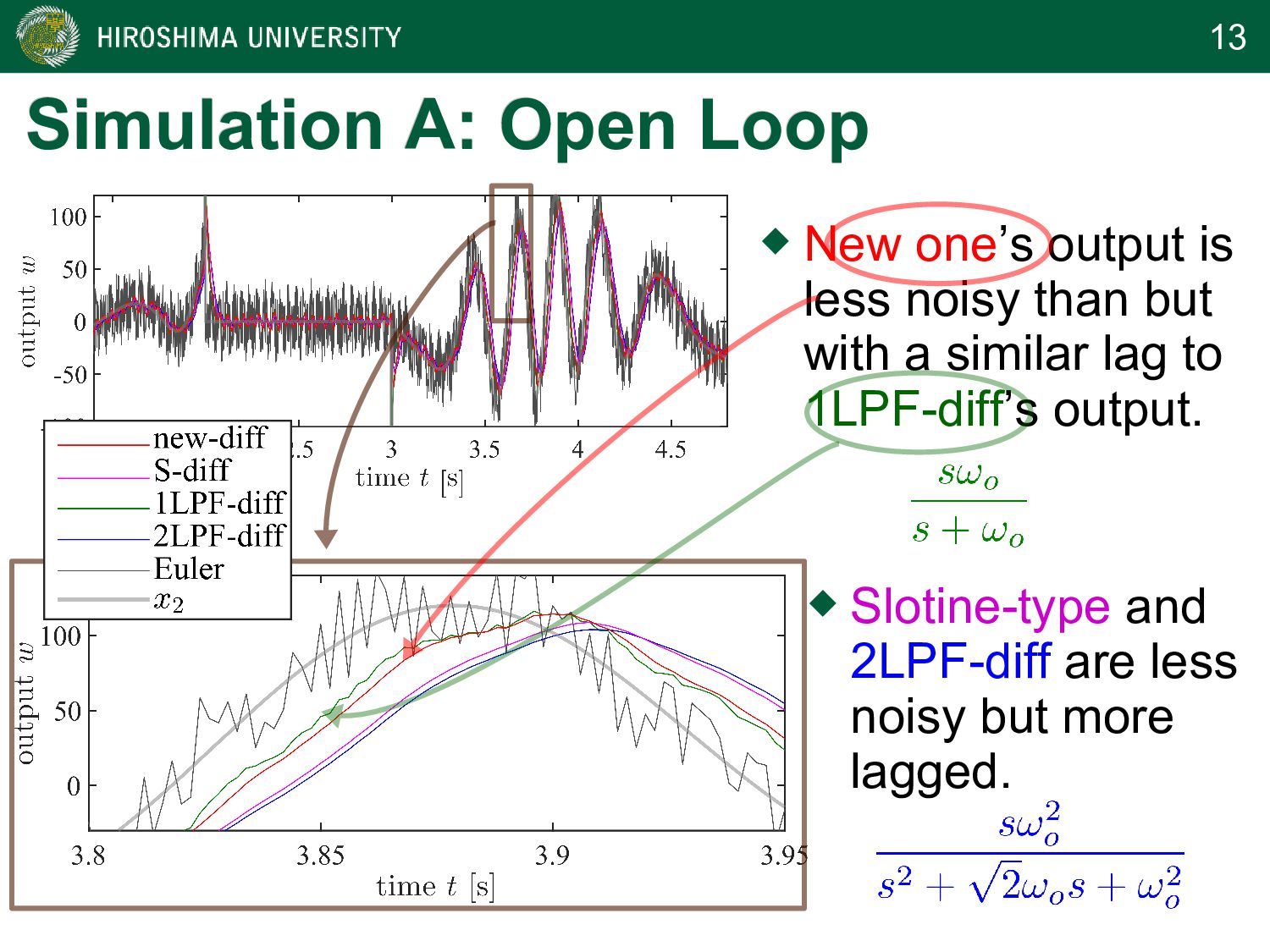
  13. 13 Simulation A: Open Loop Simulation A: Open Loop 

    New one’s output is less noisy than but with a similar lag to 1LPF-diff’s output.  Slotine-type and 2LPF-diff are less noisy but more lagged.
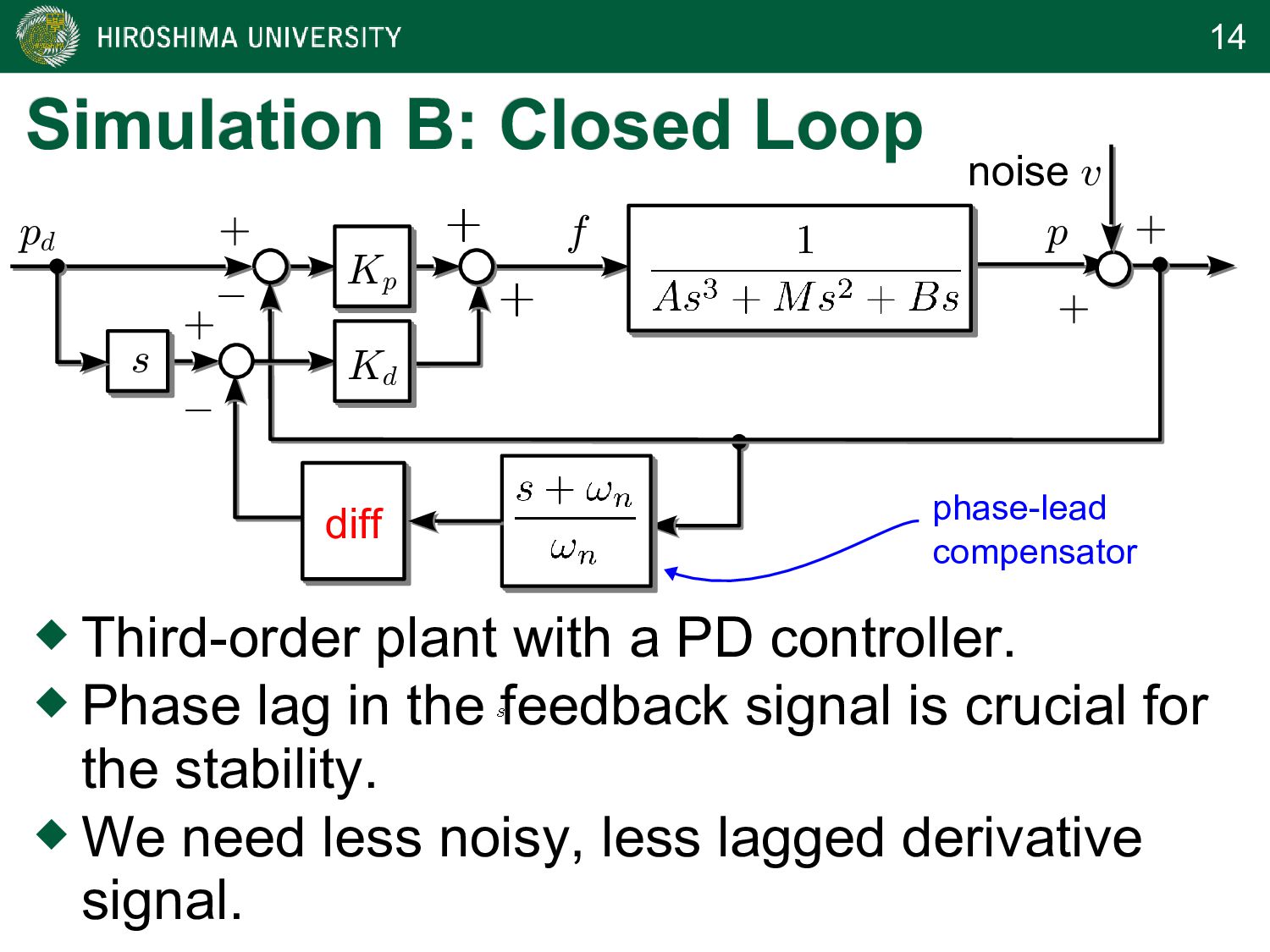
  14. 14 Simulation B: Closed Loop Simulation B: Closed Loop 

    Third-order plant with a PD controller.  Phase lag in the feedback signal is crucial for the stability.  We need less noisy, less lagged derivative signal. diff diff Kd Kp f s pd p ¡ ¡ + + + + phase-lead compensator noise v
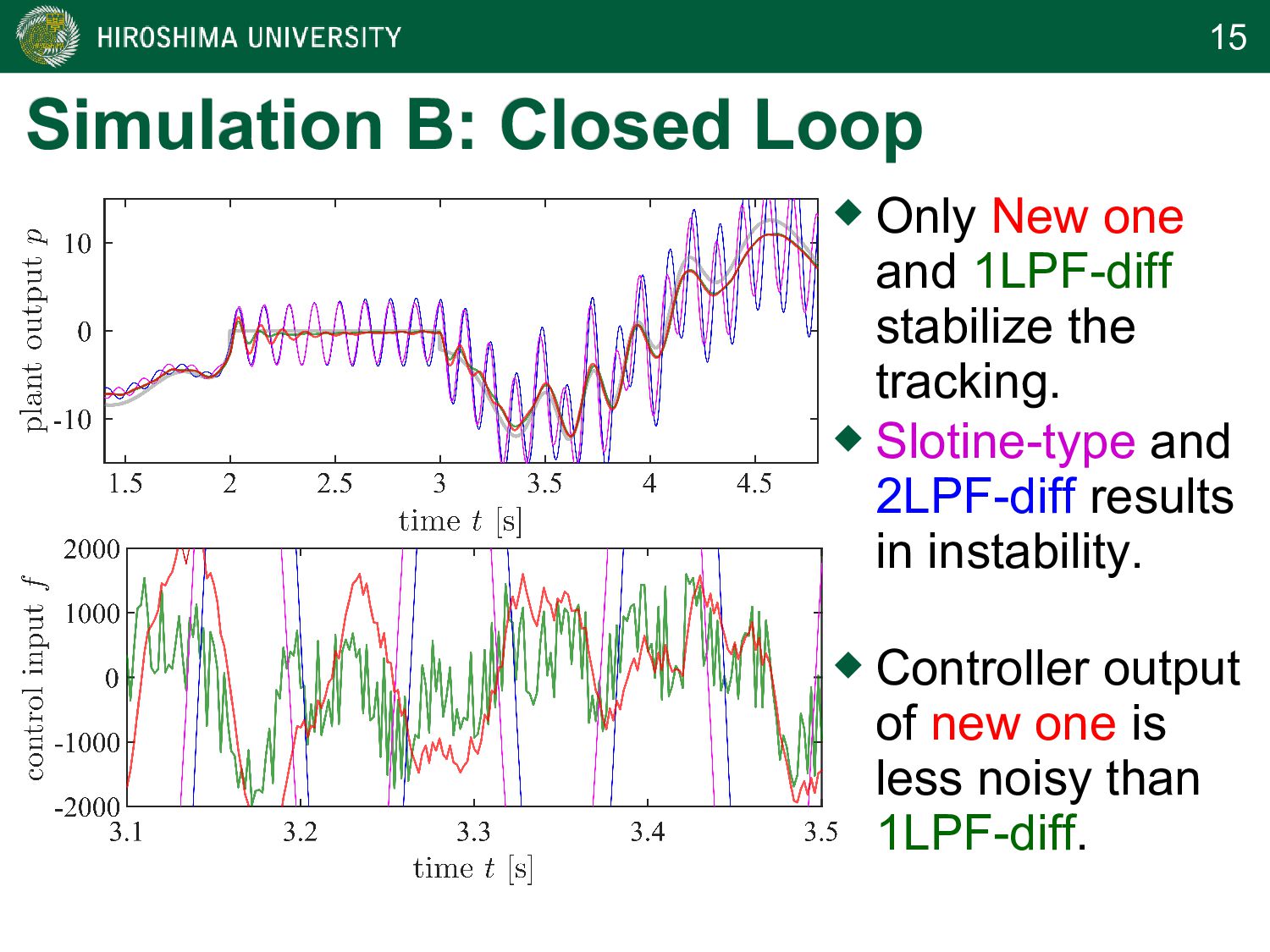
  15. 15 Simulation B: Closed Loop Simulation B: Closed Loop 

    Only New one and 1LPF-diff stabilize the tracking.  Slotine-type and 2LPF-diff results in instability.  Controller output of new one is less noisy than 1LPF-diff.
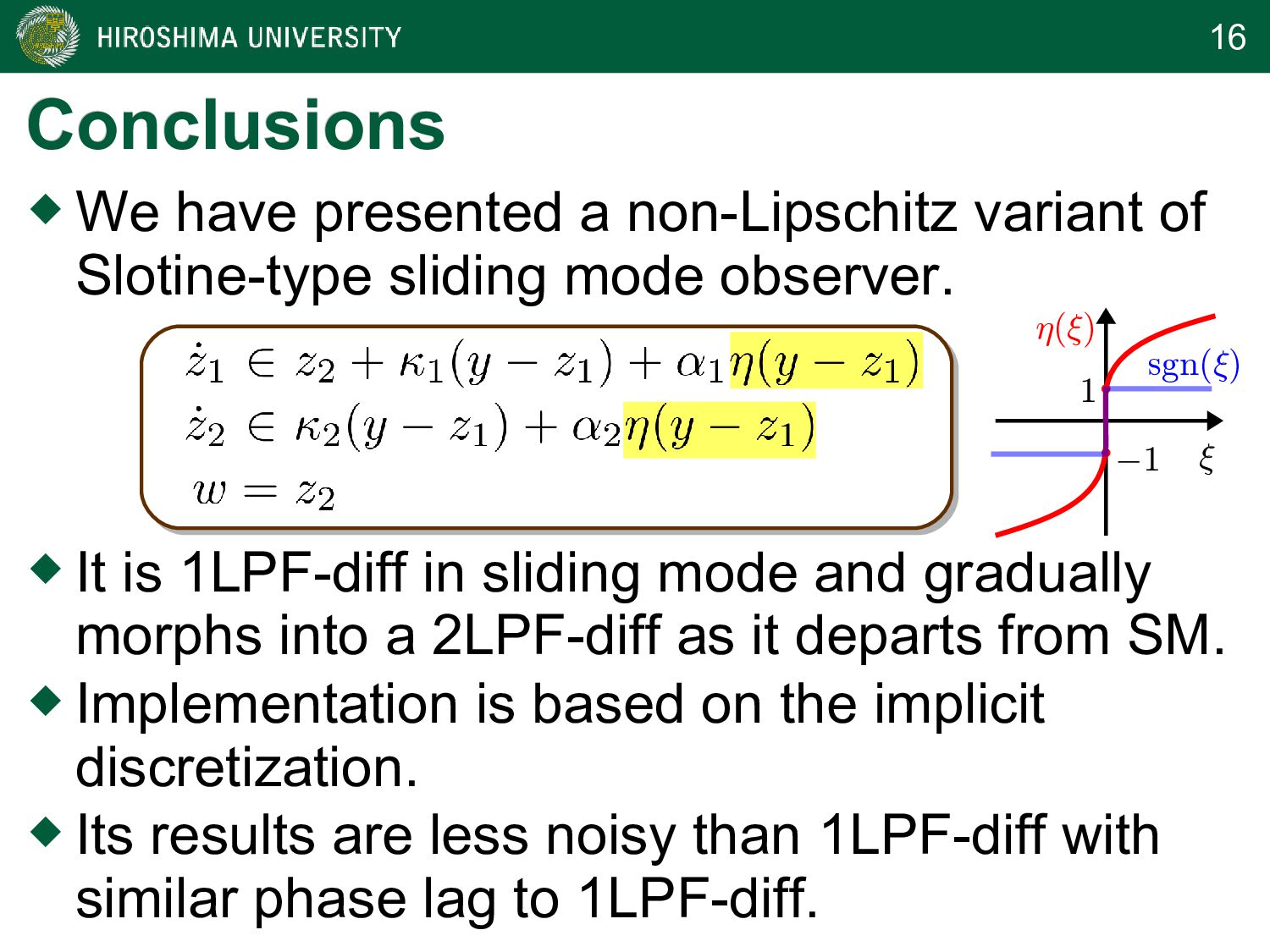
  16. 16 Conclusions Conclusions  We have presented a non-Lipschitz variant

    of Slotine-type sliding mode observer.  It is 1LPF-diff in sliding mode and gradually morphs into a 2LPF-diff as it departs from SM.  Implementation is based on the implicit discretization.  Its results are less noisy than 1LPF-diff with similar phase lag to 1LPF-diff. » ´(») 1 ¡1 sgn(»)

More Decks by Ryo Kikuuwe

Other Decks in Technology