by Stable Diffusion 3.5 AY 2026 Guide to Academic Writing Using Generative AI Workshop Digital Transformation (DX) Committee, Waseda Business School (WBS) AY 2026 Guide to Academic Writing Using Generative AI – Workshop — 2026-04-12 – p.1/17
from a supportive tool into a collaborative partner in knowledge work Today, advanced AI agents and interactive systems—such as conversational research assistants—can help structure arguments, analyze data, and even guide users through the process of drafting a master’s thesis, given appropriate inputs This transformation raises a fundamental question: What does it mean to think, analyze, and communicate at the level expected of an MBA graduate in the age of AI? Rather than replacing human capability, these technologies make it more visible—and more essential—than ever The ability to frame meaningful questions, exercise critical judgment, interpret results, and communicate insights with clarity remains at the core of academic and professional excellence This workshop is designed for students working on project research papers and professional degree theses, particularly those approaching their final stages We will explore how to engage with AI tools not merely as assistants, but as intellectual partners—leveraging them to enhance, rather than diminish, the rigor and originality of your work AY 2026 Guide to Academic Writing Using Generative AI – Workshop — 2026-04-12 – p.3/17
research paper anyway? (2) Our School’s Basic Policy on the Use of AI (currently under discussion) (3) Survey Results for March 2026 WBS Graduates (Japanese courses) (4) A live demonstration of an AI-assisted research workflow using GAMER PAT CLI (5) Questions (6) Open discussion on ethical considerations, academic integrity, and best practices AY 2026 Guide to Academic Writing Using Generative AI – Workshop — 2026-04-12 – p.4/17
let me explain using the famous “The illustrated guide to a Ph.D.” https://matt.might.net/articles/phd-school-in-pictures/ Oh, however, there are many ways to think about what research is, so make sure to always listen to what your zemi professor says! AY 2026 Guide to Academic Writing Using Generative AI – Workshop — 2026-04-12 – p.5/17
expand the knowledge of humankind as we all check to see if our new knowledge is correct Paper has a claim (new knowledge) Primary data is collected by the authors themselves to support the claim We explain the gap with the secondary data, which is the knowledge to date The above also applies to business school papers New quantitative/qualitative research, business proposal, new findings from surveys of prior cases/studies, or a combination of these AY 2026 Guide to Academic Writing Using Generative AI – Workshop — 2026-04-12 – p.6/17
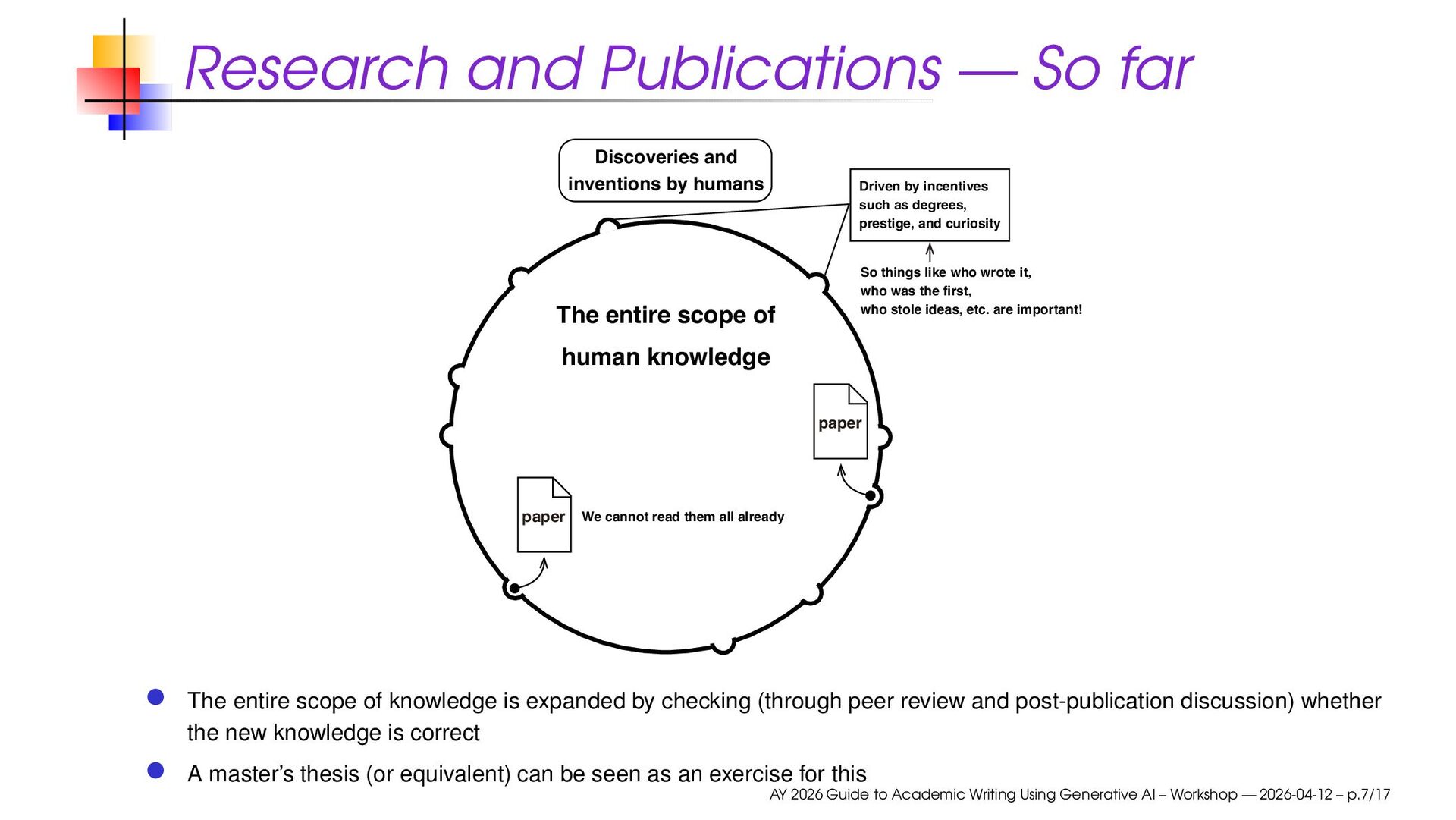
humans The entire scope of human knowledge paper paper We cannot read them all already Driven by incentives such as degrees, prestige, and curiosity ɹɹɹ So things like who wrote it, who was the first, who stole ideas, etc. are important! The entire scope of knowledge is expanded by checking (through peer review and post-publication discussion) whether the new knowledge is correct A master’s thesis (or equivalent) can be seen as an exercise for this AY 2026 Guide to Academic Writing Using Generative AI – Workshop — 2026-04-12 – p.7/17
Currently under discussion (please follow the instructions of your zemi professor) In 2023, the Vice President of Waseda University issued a statement with the following effect: We expect students to possess “robust intellect and refined sensitivity” Robust intellect : ex. ability to leverage new technologies Refined sensitivity : ex. respecting the diverse attributes and backgrounds of people from all walks of life Please be aware that if students submit papers or other work generated by AI without thoroughly reviewing them, not only will their grades be based on that material—even if it contains omissions or critical error—but they may also face disciplinary action if the submitted work is found to contain plagiarism, improper citations, or fabrication, even if such issues were unintentional AY 2026 Guide to Academic Writing Using Generative AI – Workshop — 2026-04-12 – p.8/17
A preprint has already been published Kenji Saito, Rei Tajika, Satoru Shibuya, Hiroshi Kanno, “Generative AI Use in Professional Graduate Thesis Writing: Adoption, Perceived Outcomes, and the Role of a Research-Specialized Agent,” April 3, 2026. Available at arXiv: https://arxiv.org/abs/2604.02792 This preprint was written with GAMER PAT CLI (to be demonstrated in the following section), and not a single line was written by human hands AY 2026 Guide to Academic Writing Using Generative AI – Workshop — 2026-04-12 – p.9/17
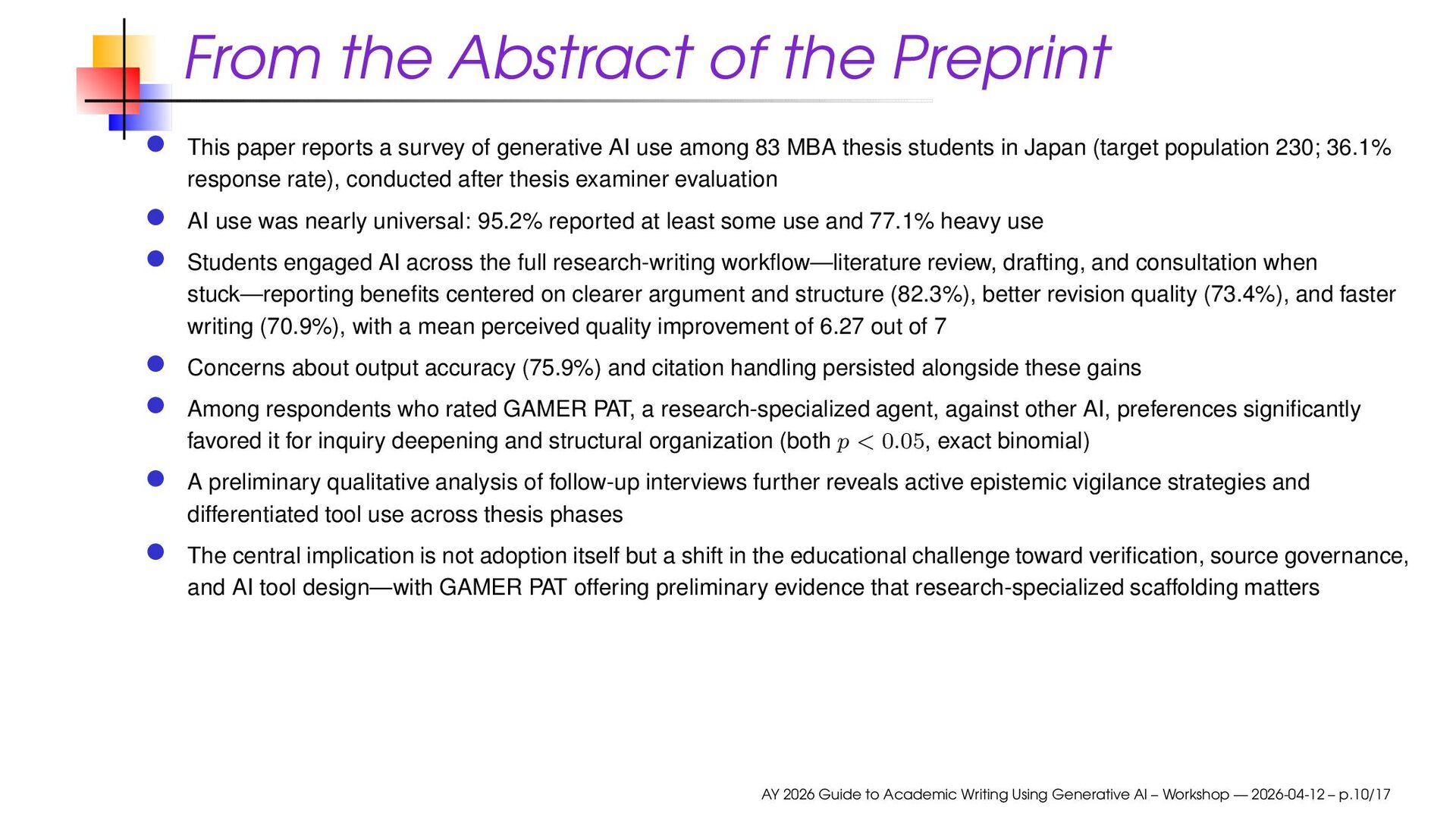
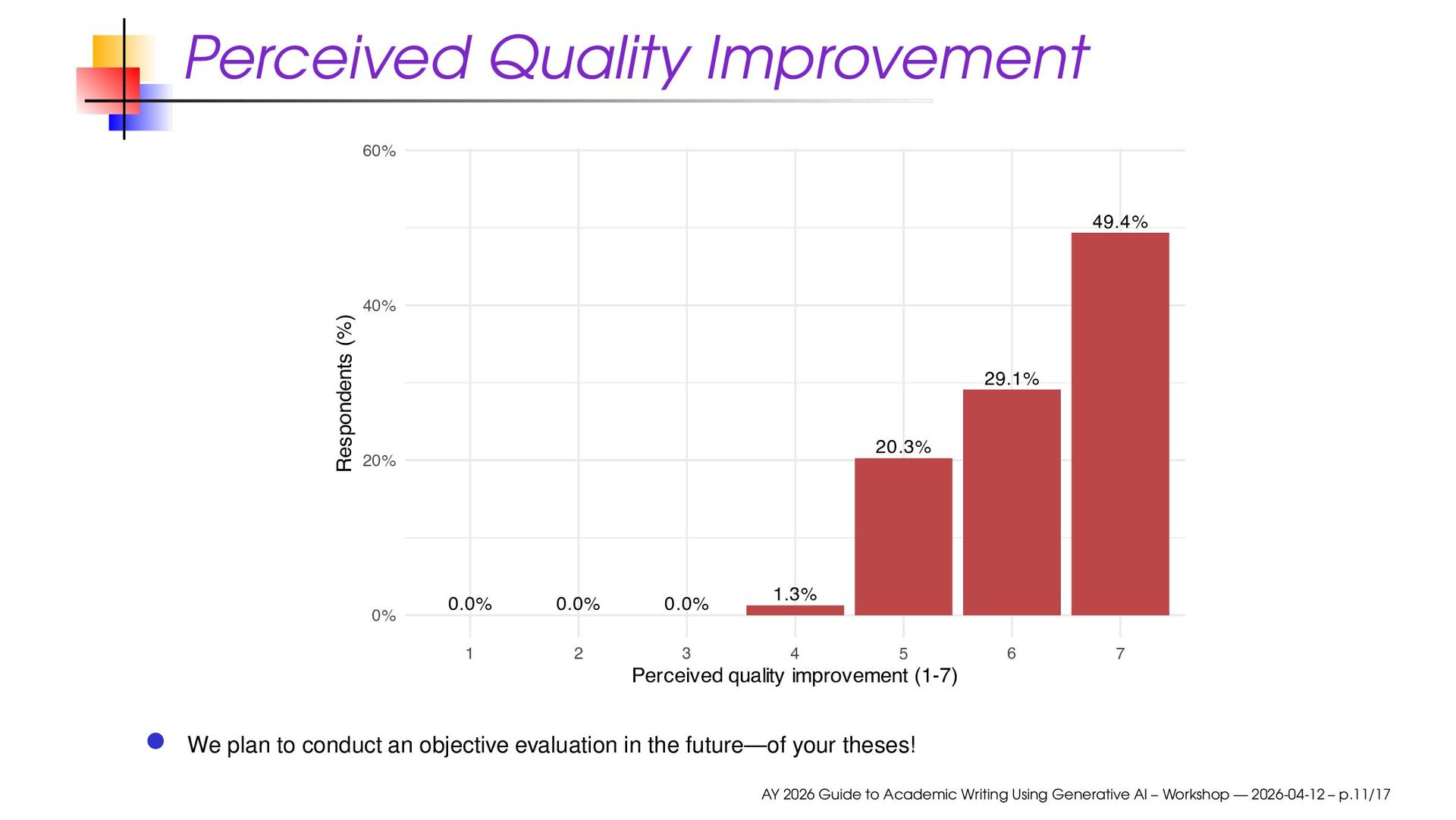
survey of generative AI use among 83 MBA thesis students in Japan (target population 230; 36.1% response rate), conducted after thesis examiner evaluation AI use was nearly universal: 95.2% reported at least some use and 77.1% heavy use Students engaged AI across the full research-writing workflow—literature review, drafting, and consultation when stuck—reporting benefits centered on clearer argument and structure (82.3%), better revision quality (73.4%), and faster writing (70.9%), with a mean perceived quality improvement of 6.27 out of 7 Concerns about output accuracy (75.9%) and citation handling persisted alongside these gains Among respondents who rated GAMER PAT, a research-specialized agent, against other AI, preferences significantly favored it for inquiry deepening and structural organization (both p < 0.05, exact binomial) A preliminary qualitative analysis of follow-up interviews further reveals active epistemic vigilance strategies and differentiated tool use across thesis phases The central implication is not adoption itself but a shift in the educational challenge toward verification, source governance, and AI tool design—with GAMER PAT offering preliminary evidence that research-specialized scaffolding matters AY 2026 Guide to Academic Writing Using Generative AI – Workshop — 2026-04-12 – p.10/17
0% 20% 40% 60% 1 2 3 4 5 6 7 Perceived quality improvement (1-7) Respondents (%) We plan to conduct an objective evaluation in the future—of your theses! AY 2026 Guide to Academic Writing Using Generative AI – Workshop — 2026-04-12 – p.11/17
GAMER PAT CLI GAMER PAT (GAme MastER, Paper Authoring Tutor) : Research as a Serious Game https://github.com/ks91/gamer-pat (being developed at WBS) Install CLI version via loglm (https://github.com/ks91/loglm) Installation Guide for Windows Users (WSL), macOS Users (Lima), and macOS Users (native) (translated “Prompt Engineering” course material at WBS) If you feed these (↑) slides into any LLM, it should provide interactive guidance You can use the web version, but you will likely need to copy and paste frequently between the window where you are writing your paper and PAT GPT : https://chatgpt.com/g/g-6857ca7d5b5c8191931357e3c5f228b7-gamer-pat-research-as-a-serious-game AY 2026 Guide to Academic Writing Using Generative AI – Workshop — 2026-04-12 – p.12/17
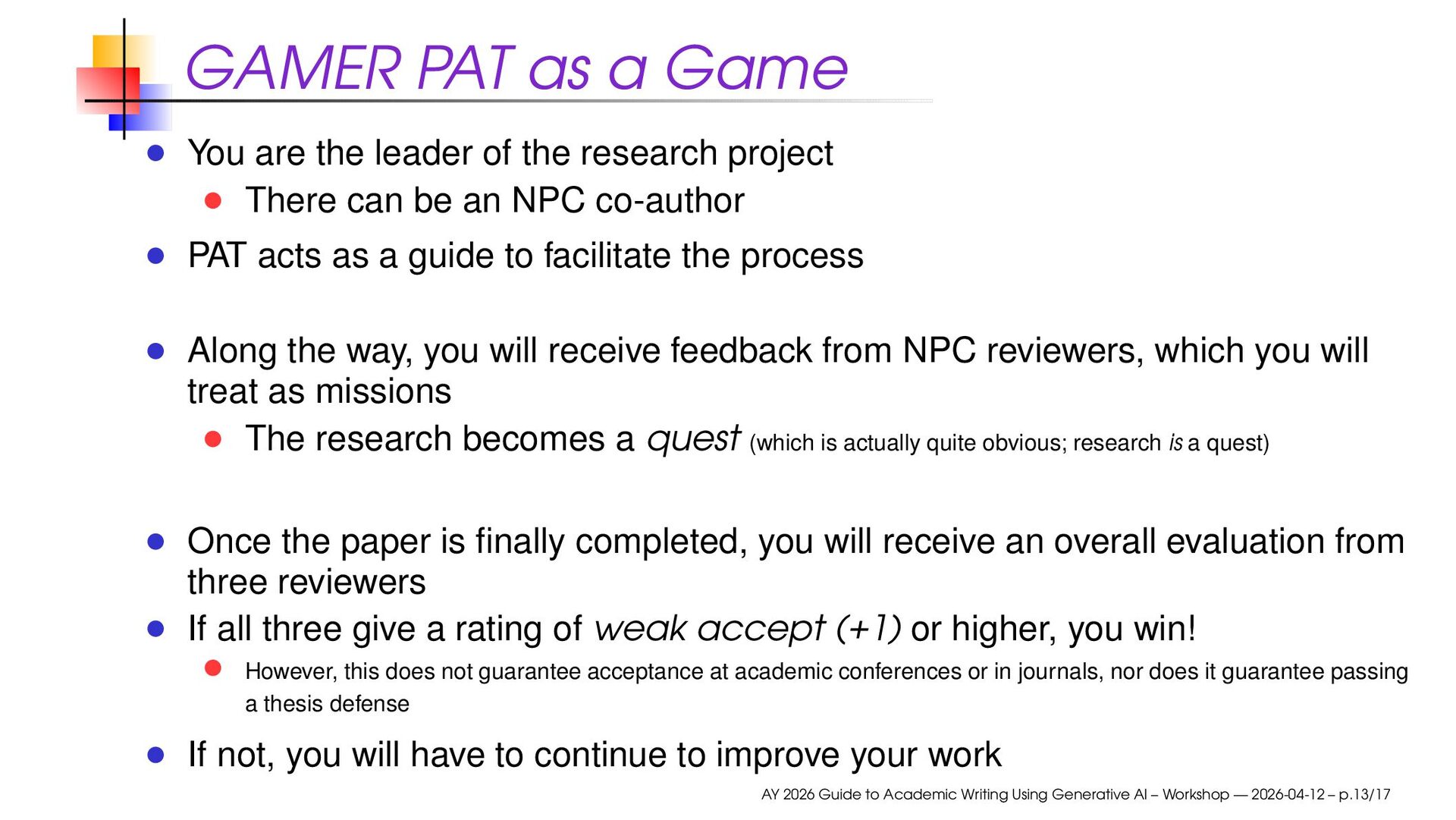
the research project There can be an NPC co-author PAT acts as a guide to facilitate the process Along the way, you will receive feedback from NPC reviewers, which you will treat as missions The research becomes a quest (which is actually quite obvious; research is a quest) Once the paper is finally completed, you will receive an overall evaluation from three reviewers If all three give a rating of weak accept (+1) or higher, you win! However, this does not guarantee acceptance at academic conferences or in journals, nor does it guarantee passing a thesis defense If not, you will have to continue to improve your work AY 2026 Guide to Academic Writing Using Generative AI – Workshop — 2026-04-12 – p.13/17
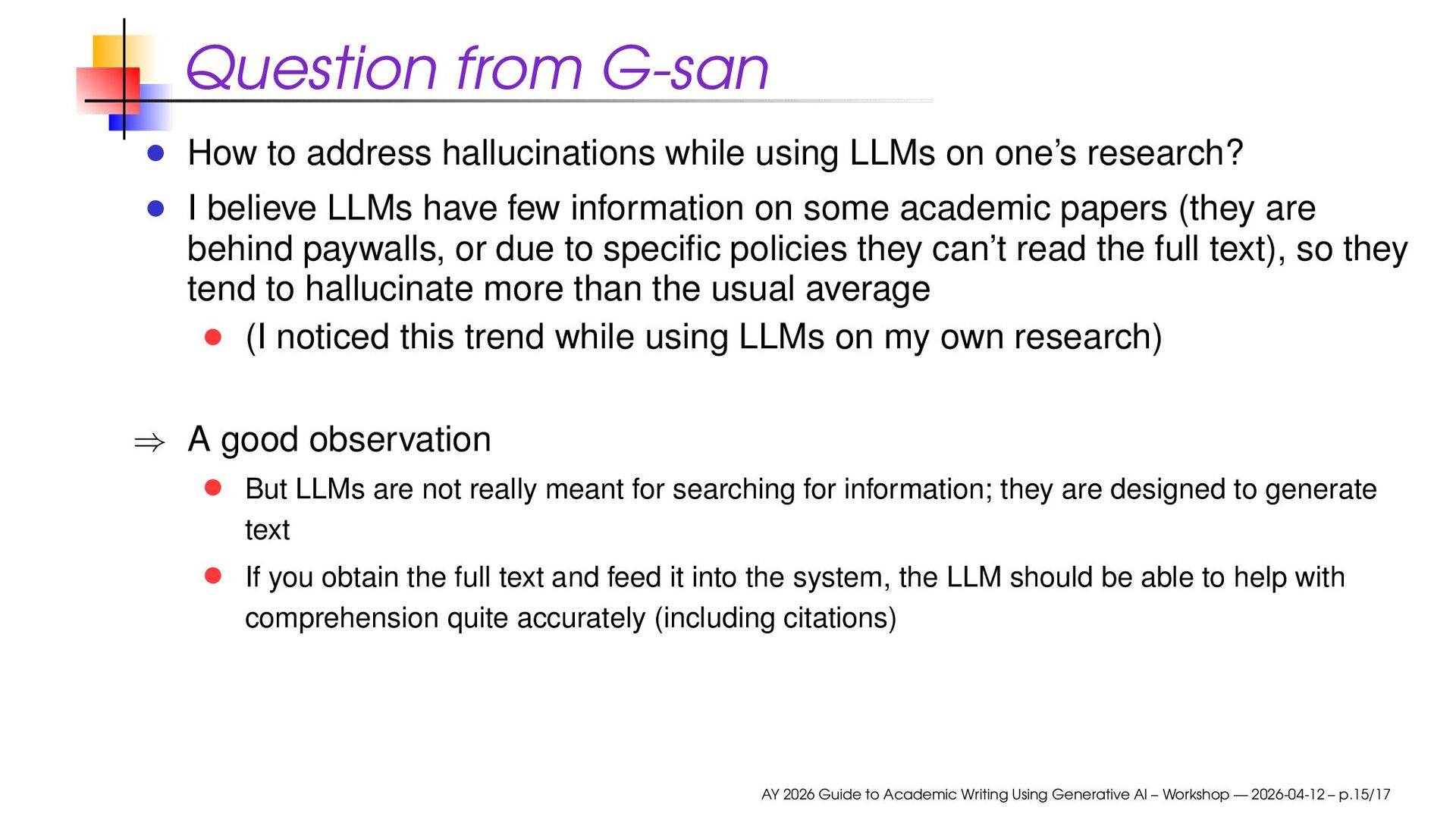
on one’s research? I believe LLMs have few information on some academic papers (they are behind paywalls, or due to specific policies they can’t read the full text), so they tend to hallucinate more than the usual average (I noticed this trend while using LLMs on my own research) ⇒ A good observation But LLMs are not really meant for searching for information; they are designed to generate text If you obtain the full text and feed it into the system, the LLM should be able to help with comprehension quite accurately (including citations) AY 2026 Guide to Academic Writing Using Generative AI – Workshop — 2026-04-12 – p.15/17
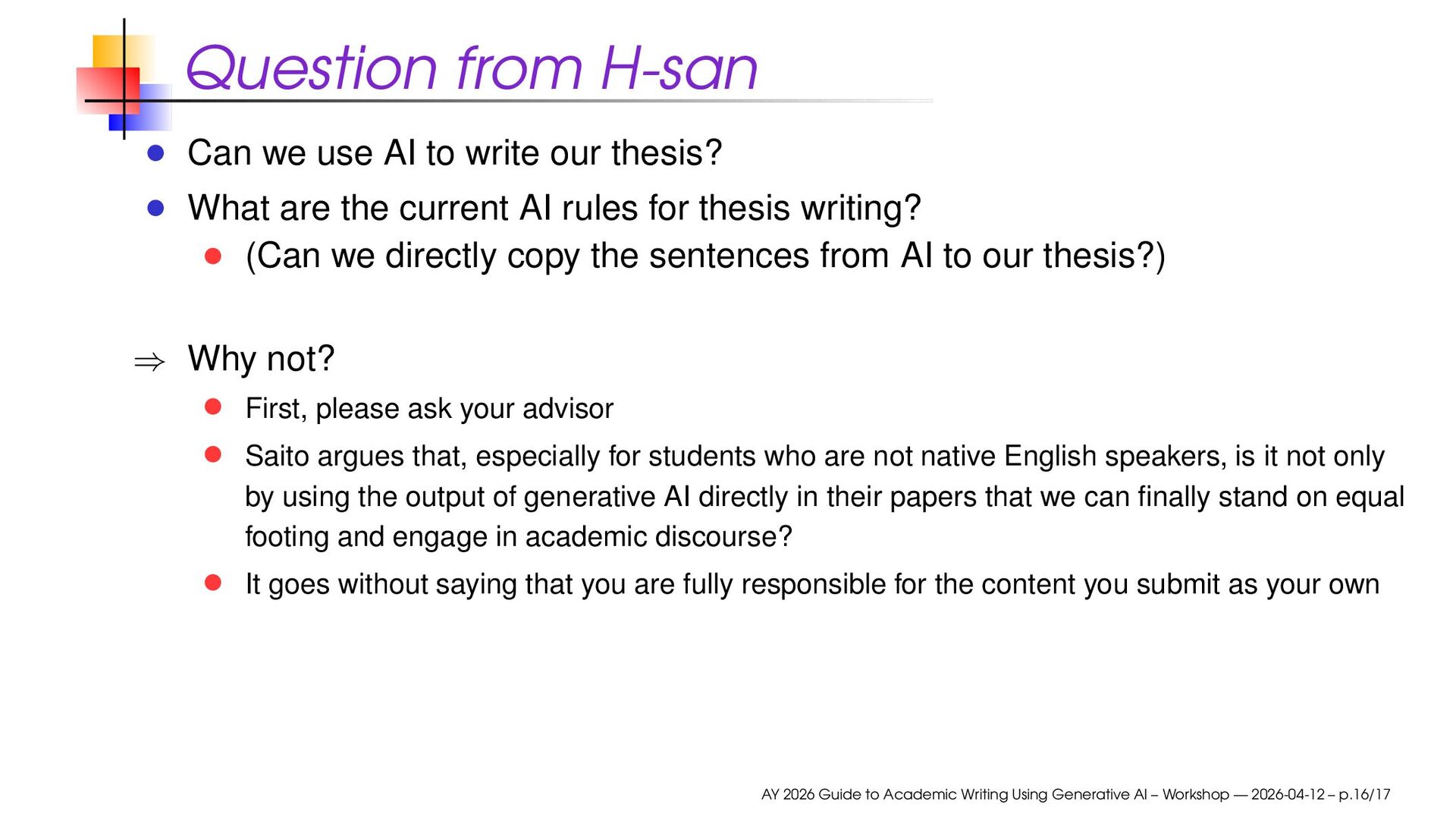
thesis? What are the current AI rules for thesis writing? (Can we directly copy the sentences from AI to our thesis?) ⇒ Why not? First, please ask your advisor Saito argues that, especially for students who are not native English speakers, is it not only by using the output of generative AI directly in their papers that we can finally stand on equal footing and engage in academic discourse? It goes without saying that you are fully responsible for the content you submit as your own AY 2026 Guide to Academic Writing Using Generative AI – Workshop — 2026-04-12 – p.16/17


 ks91
ks91
.jpg) iflection
iflection
 tsantalis
 mathbullet
 recsyslab
 signer
 rfujii
 fr0gger
 rikkabotan7
 wataruuuuu
 ayaniwa
 youten622
 addyosmani
 yeseniaperezcruz
 jnunemaker
 lauravandoore
 popppiees
 aemeredith
 ryanjones
 axbom
axbom
 akosma
 trallard
 codingconduct
 coloredviolet