Upgrade to Pro — share decks privately, control downloads, hide ads and more …

Noun Cases

Noun Cases

An easy-to-understand guide to noun cases and its types.

Avatar for Lavin S. Aziz

Lavin S. Aziz

November 01, 2026

More Decks by Lavin S. Aziz

Other Decks in Education

Transcript

  1. Noun case: shows a grammatical function of a noun and

    its relation with rest of the words in a sentence. Presentation title 2
  2. Types of Noun Case: 1-Nominative case 2-Accusative case 3-Genitive case

    4-Dative case 5-Vocative case Presentation title 3
  3. Nominative Case: Nominative case: it is also called subjective case.

    It is used when a noun functions as the subject of the sentence. E.g. Carl eats a sandwich for lunch.
  4. Accusative Case: Accusative case: it is also called objective case.

    It is used when a noun functions as the object of the sentence. E.g. Lily bought flowers. Presentation title 5
  5. Genitive Case: Genitive case: it is also called possessive case.

    It is used when a noun shows ownership or possession in the sentence. E.g. Sam’s book looks interesting.
  6. Genitive case can be divided into two types: Independent Case:

    it is not dependent on the following noun. The noun may be omitted because it can be understood from the context. E.g. the party is at John’s. Presentation title Dependent Case: it depends on the following noun because it cannot normally stand by its own. E.g. The cat’s tail is short. 7
  7. Dative Case: Dative case: it is used when a noun

    functions as the indirect object of the sentence. E.g. Elliot gave Sebastian a book. Presentation title 8
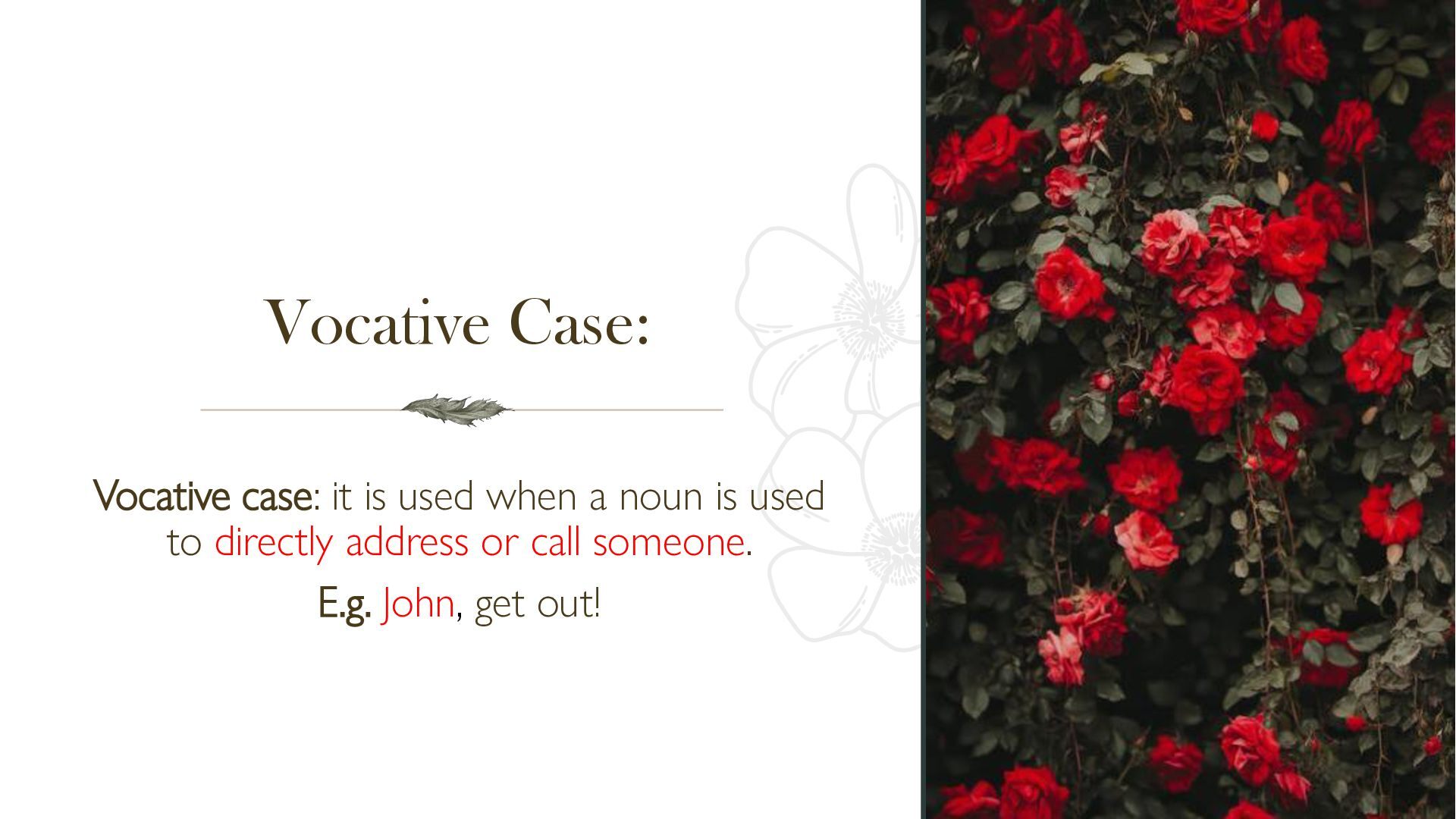
  8. Vocative Case: Vocative case: it is used when a noun

    is used to directly address or call someone. E.g. John, get out!