Upgrade to Pro — share decks privately, control downloads, hide ads and more …

The Kitakyushu Data Center's Unrelenting Effort...

Sponsored · SiteGround - Reliable hosting with speed, security, and support you can count on.

The Kitakyushu Data Center's Unrelenting Effort to Reduce Air Cooling Power Consumption

This session introduces the technical challenges tackled by facility engineers—who support our large-scale data centers from the physical layer—to reduce air conditioning power consumption.
In the data centers that support LY Corporation's services, optimizing the ever-increasing power consumption has become a crucial theme alongside ensuring stable server operation. In this session, we will introduce our initiatives to reduce air conditioning power in our data centers, sharing over a decade of accumulated know-how in free cooling (utilizing outside air) and practical examples of AI-driven automated air conditioning control. We will discuss from a facility engineer's perspective how we analyze physical environments—such as IT loads, server heat generation, air conditioning, and outside air—and how we translate this into PUE reduction. The content is designed to be easily understood, providing clear insights into facility optimization even for those without specialized knowledge of data centers or power equipment.

More Decks by LINEヤフーTech (LY Corporation Tech)

Other Decks in Technology

Transcript

  1. 2026.06.29 LY Corporation CTO Domain  West Japan DC Division Infrastructure

    CBU  Datacenter Unit Satoshi Kuboyama The Kitakyushu Data Center's Unrelenting Effort to Reduce Air Cooling Power Consumption
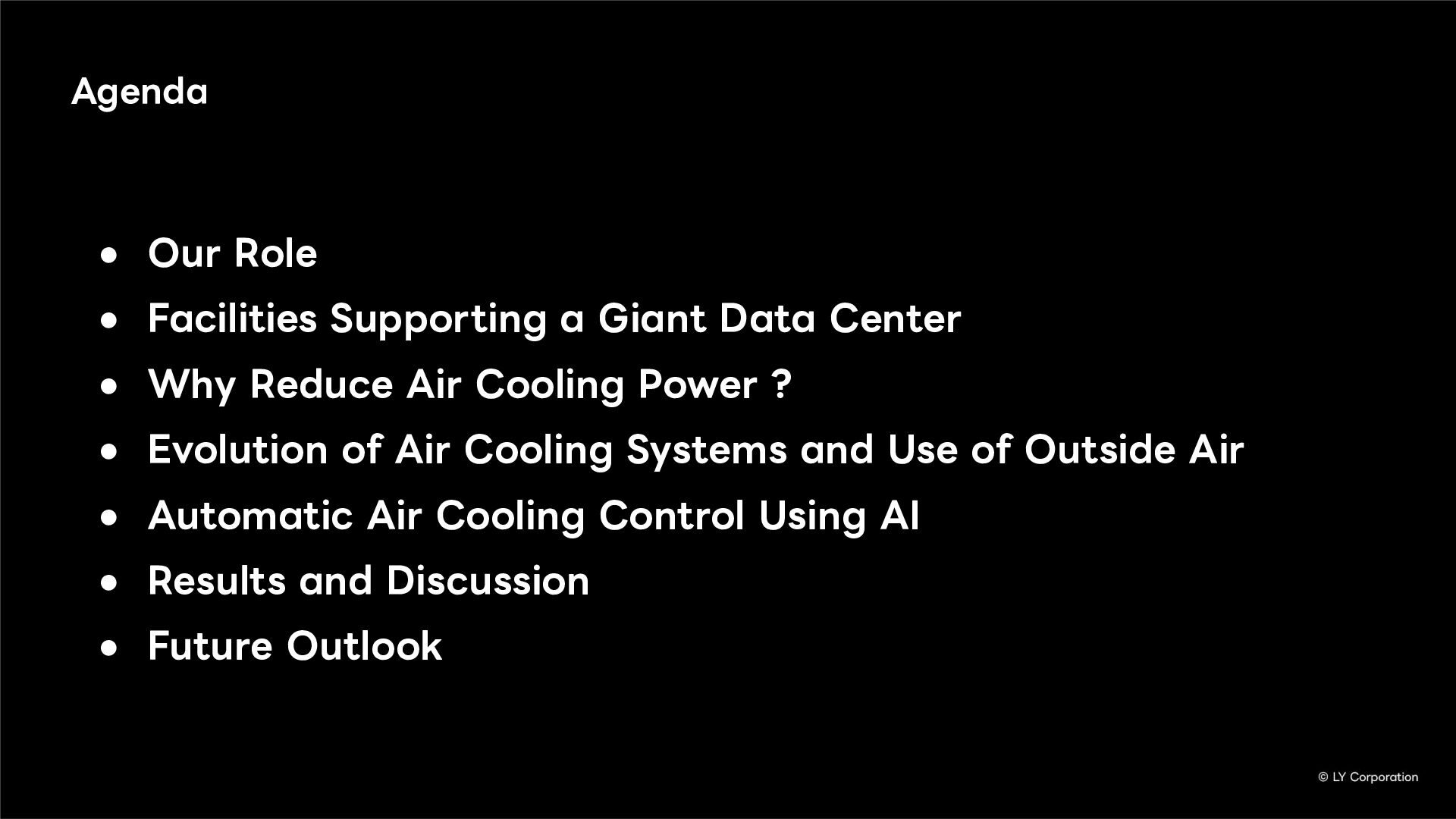
  2. Agenda • Our Role • Facilities Supporting a Giant Data

    Center • Why Reduce Air Cooling Power ? • Evolution of Air Cooling Systems and Use of Outside Air • Automatic Air Cooling Control Using AI • Results and Discussion • Future Outlook
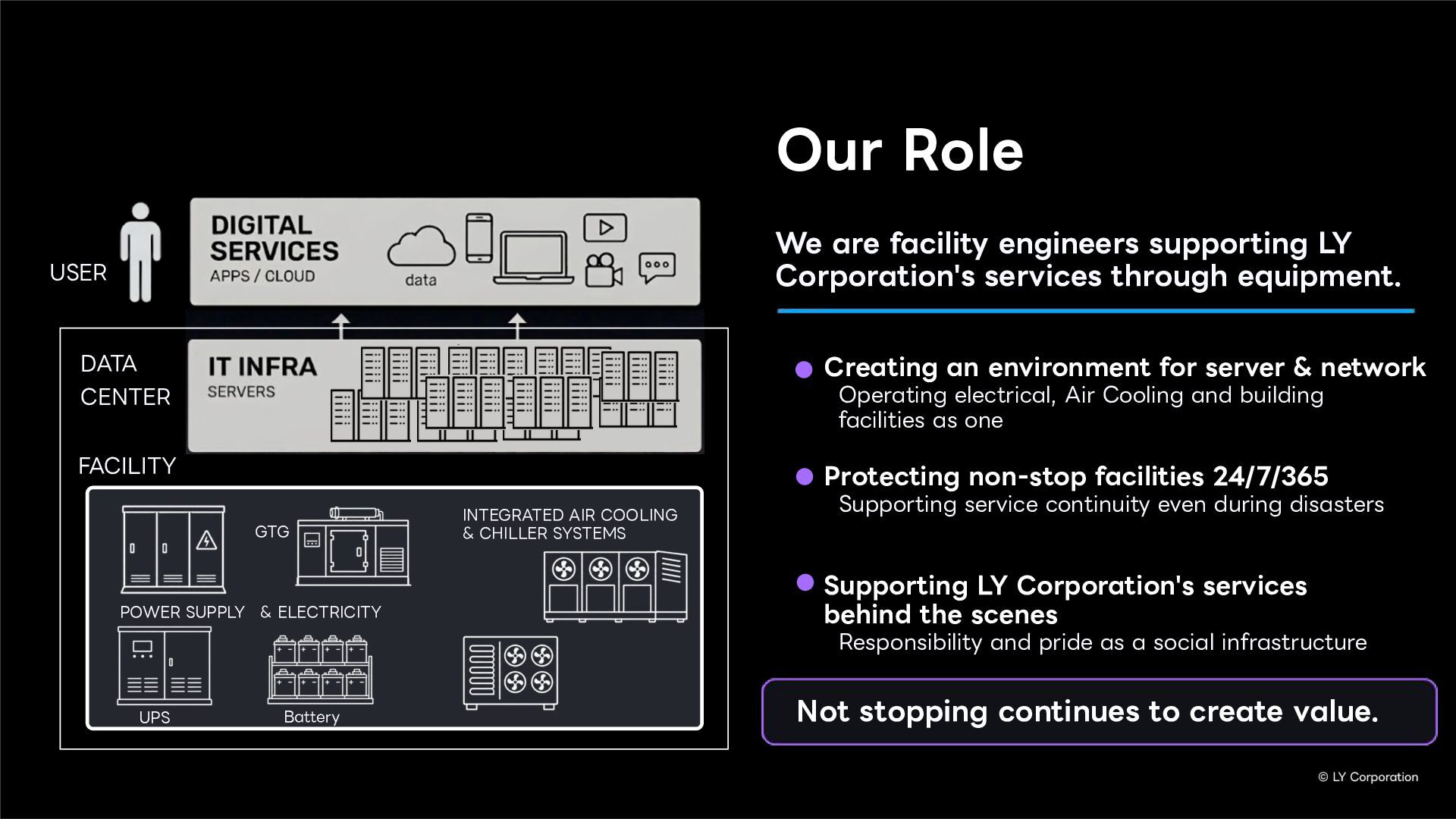
  3. Our Role We are facility engineers supporting LY Corporation's services

    through equipment.   Creating an environment for server & network    Operating electrical, Air Cooling and building    facilities as one   Protecting non-stop facilities 24/7/365    Supporting service continuity even during disasters   Supporting LY Corporation's services   behind the scenes    Responsibility and pride as a social infrastructure Not stopping continues to create value. DATA CENTER FACILITY UPS Battery INTEGRATED AIR COOLING & CHILLER SYSTEMS POWER SUPPLY & ELECTRICITY GTG USER
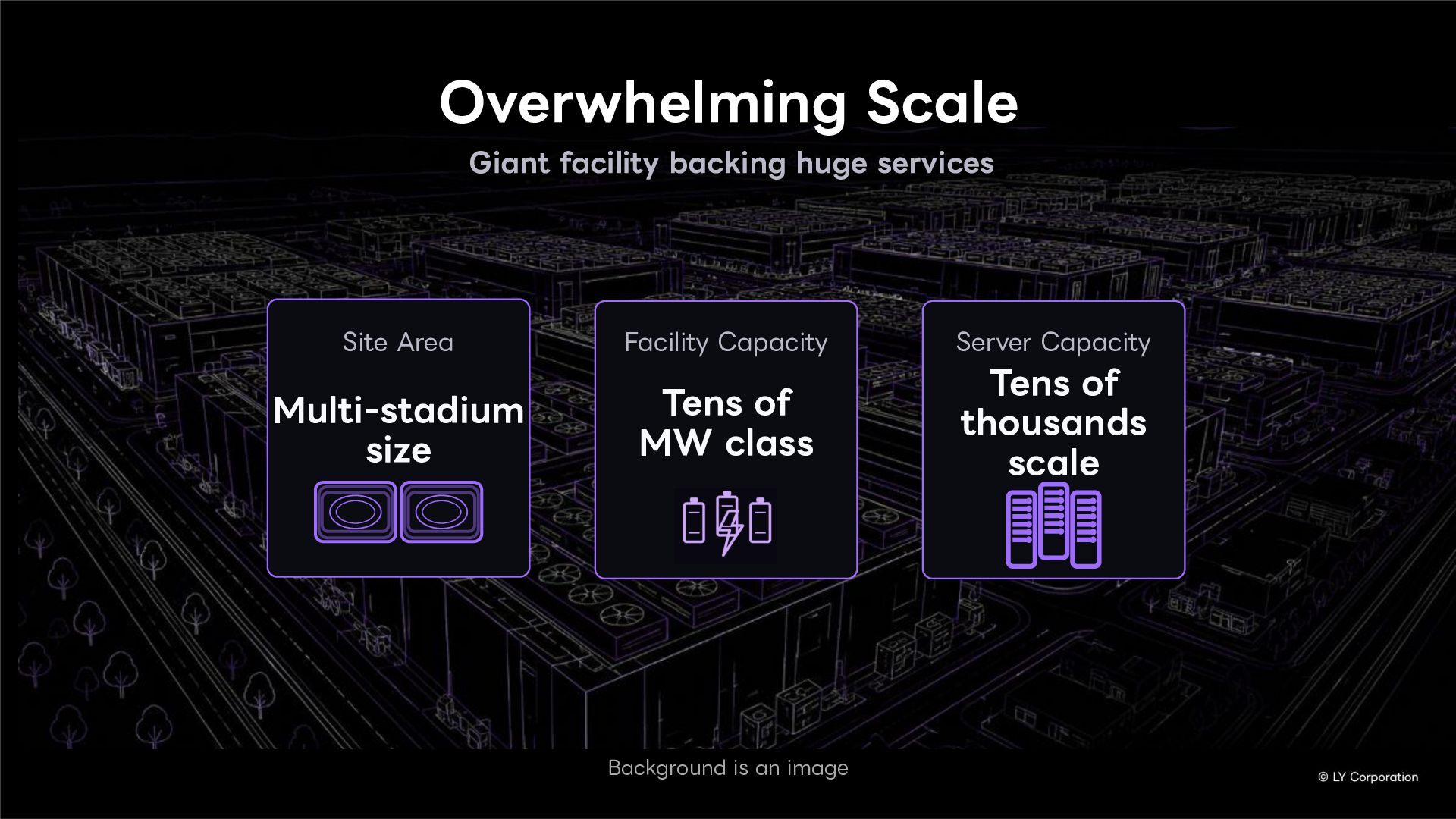
  4. Site Area Multi-stadium size Facility Capacity Tens of MW class

    Server Capacity Tens of thousands scale Giant facility backing huge services Overwhelming Scale Background is an image
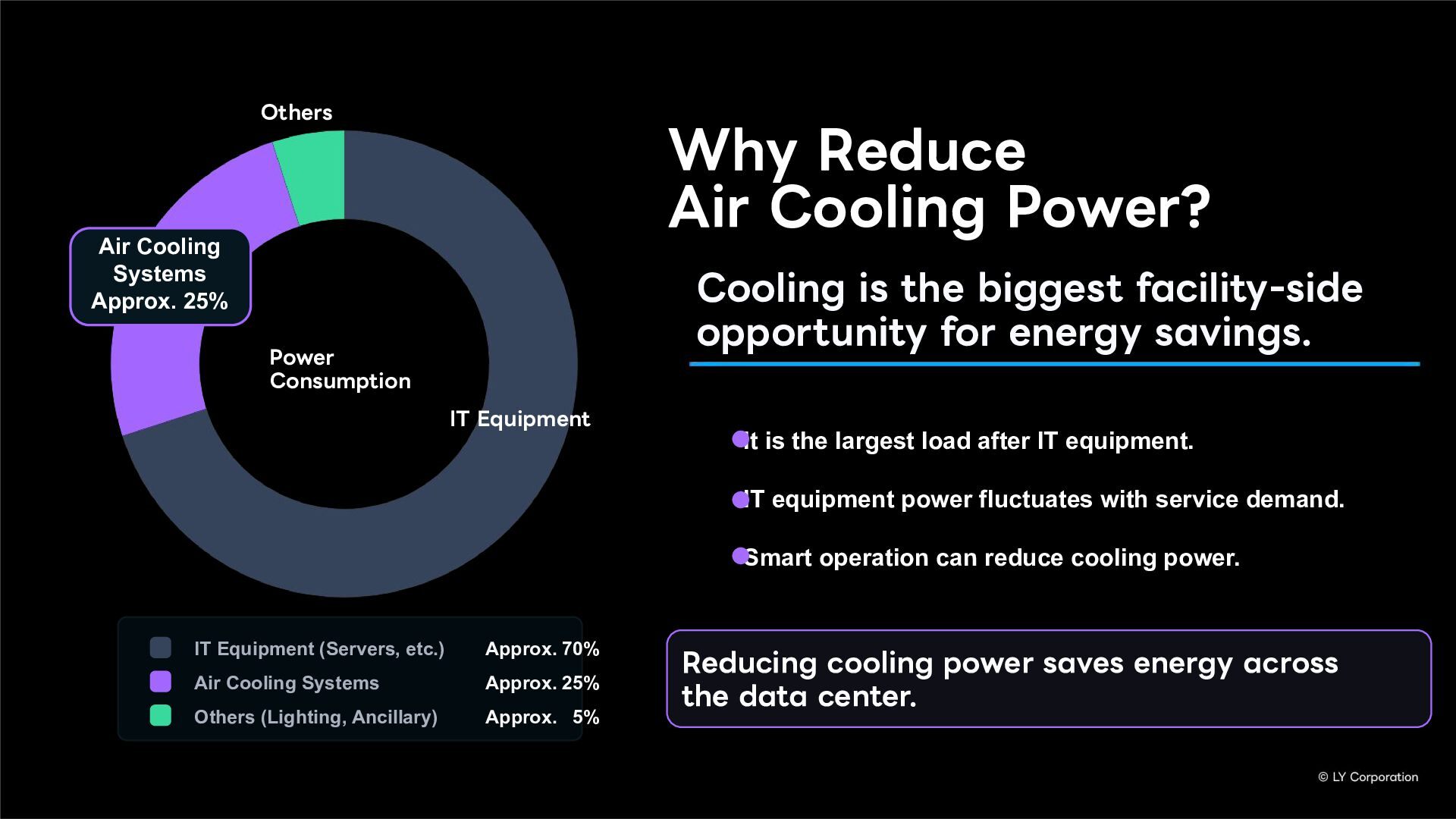
  5. Why Reduce Air Cooling Power? Cooling is the biggest facility-side

    opportunity for energy savings.    It is the largest load after IT equipment.    IT equipment power fluctuates with service demand.    Smart operation can reduce cooling power. Power Consumption Air Cooling Systems Approx. 25% IT Equipment (Servers, etc.) Approx. 70% Air Cooling Systems Approx. 25% Others (Lighting, Ancillary) Approx. 5% IT Equipment Others Reducing cooling power saves energy across the data center.
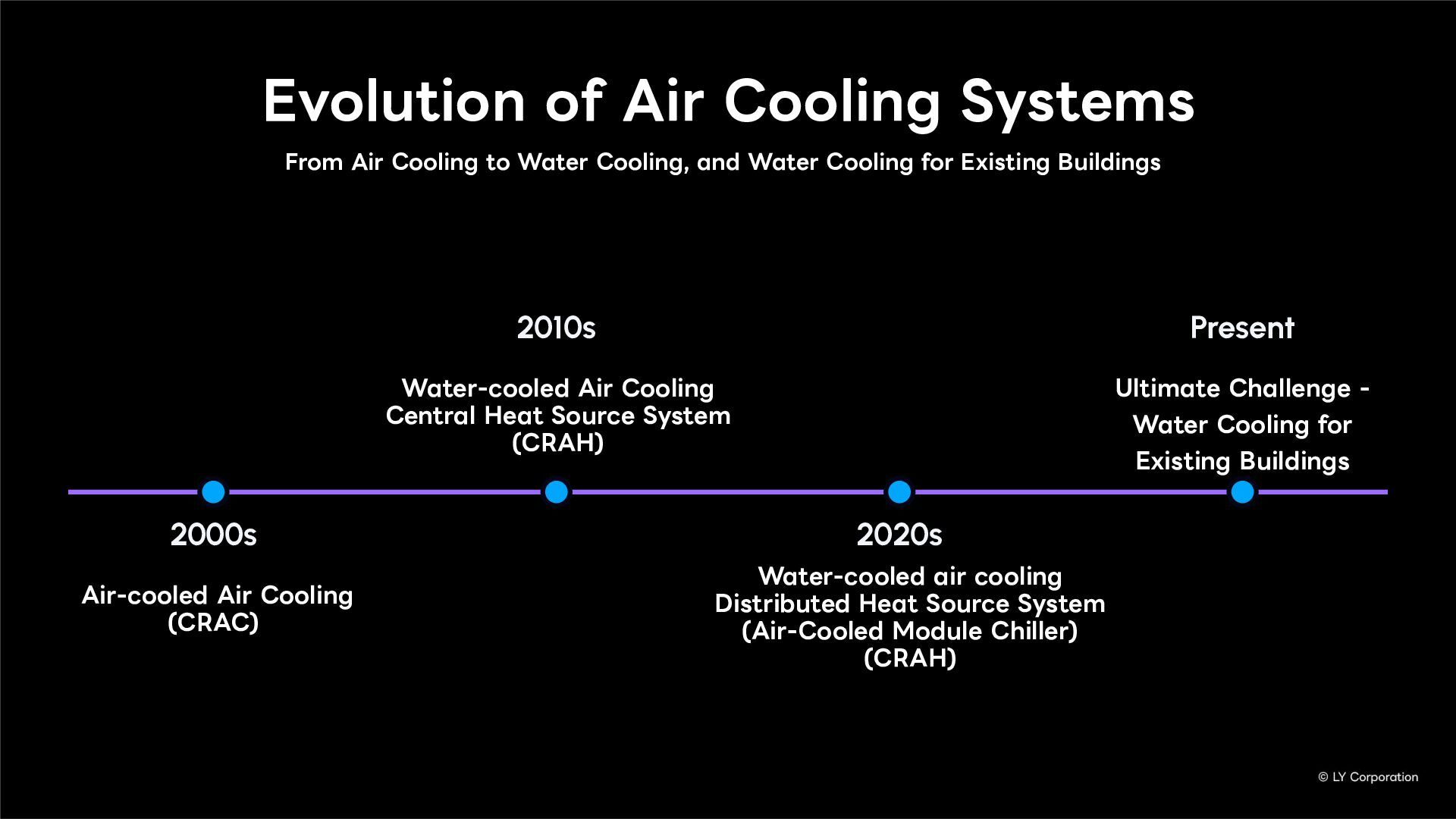
  6. Evolution of Air Cooling Systems From Air Cooling to Water

    Cooling, and Water Cooling for Existing Buildings 2010s Present 2000s Water-cooled Air Cooling Central Heat Source System (CRAH) 2020s Ultimate Challenge - Water Cooling for Existing Buildings Air-cooled Air Cooling (CRAC) Water-cooled air cooling Distributed Heat Source System (Air-Cooled Module Chiller) (CRAH)
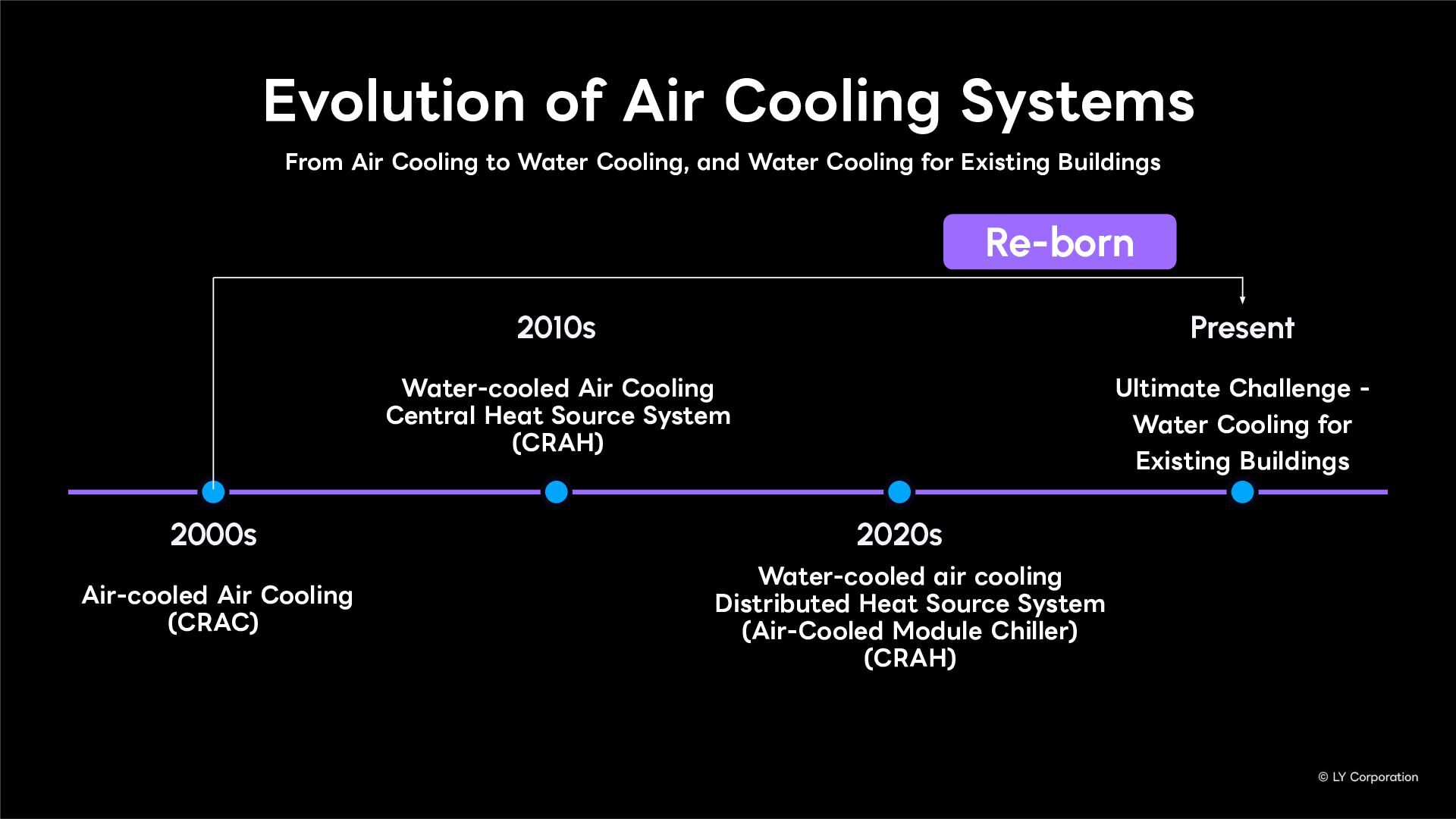
  7. Evolution of Air Cooling Systems From Air Cooling to Water

    Cooling, and Water Cooling for Existing Buildings 2010s Present 2000s Water-cooled Air Cooling Central Heat Source System (CRAH) 2020s Ultimate Challenge - Water Cooling for Existing Buildings Air-cooled Air Cooling (CRAC) Re-born Water-cooled air cooling Distributed Heat Source System (Air-Cooled Module Chiller) (CRAH)
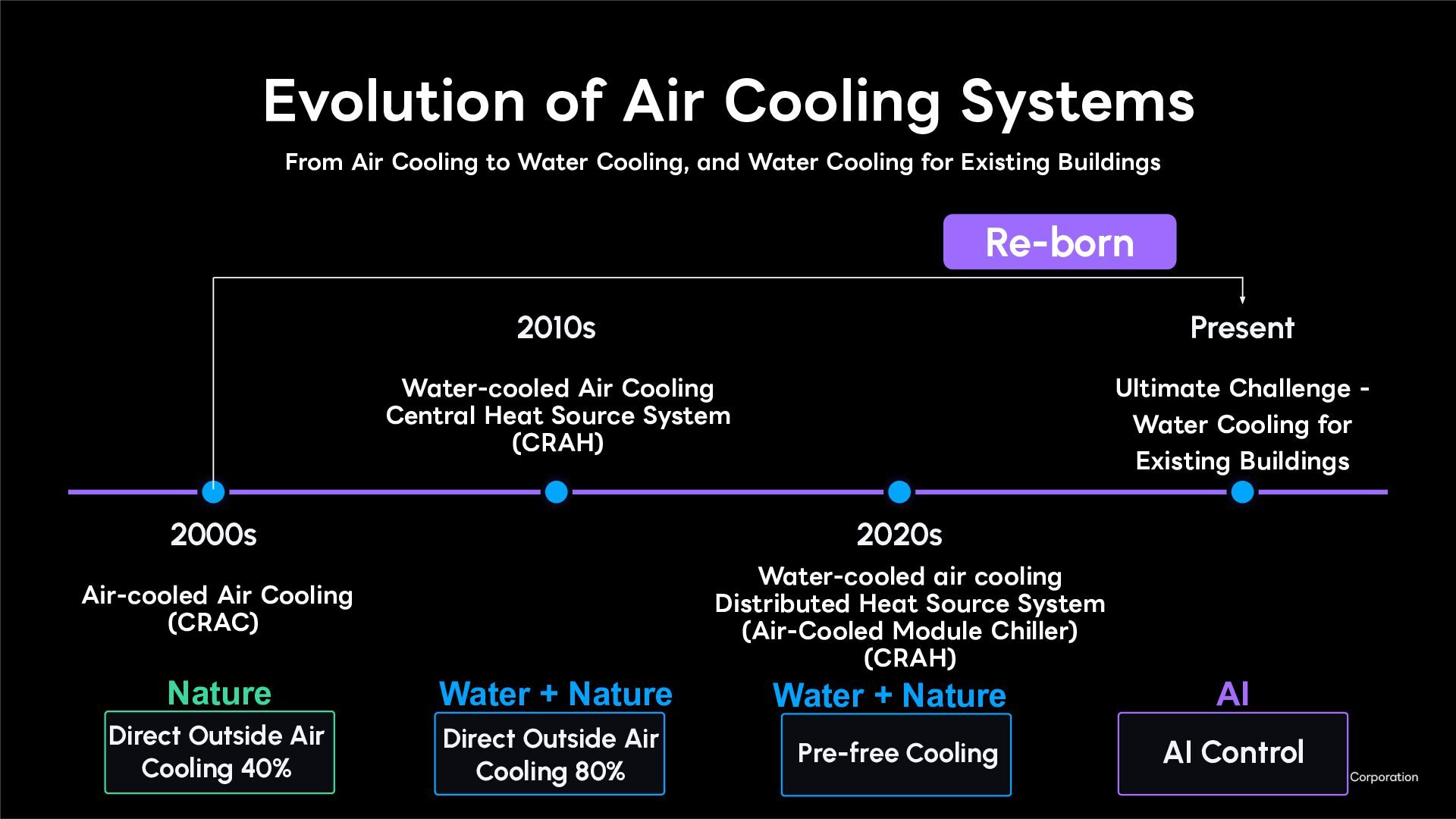
  8. Evolution of Air Cooling Systems From Air Cooling to Water

    Cooling, and Water Cooling for Existing Buildings 2010s Present 2000s Water-cooled Air Cooling Central Heat Source System (CRAH) 2020s Ultimate Challenge - Water Cooling for Existing Buildings Air-cooled Air Cooling (CRAC) Re-born Water-cooled air cooling Distributed Heat Source System (Air-Cooled Module Chiller) (CRAH) Direct Outside Air Cooling 80% Direct Outside Air Cooling 40% Pre-free Cooling AI Control AI Water + Nature Nature Water + Nature
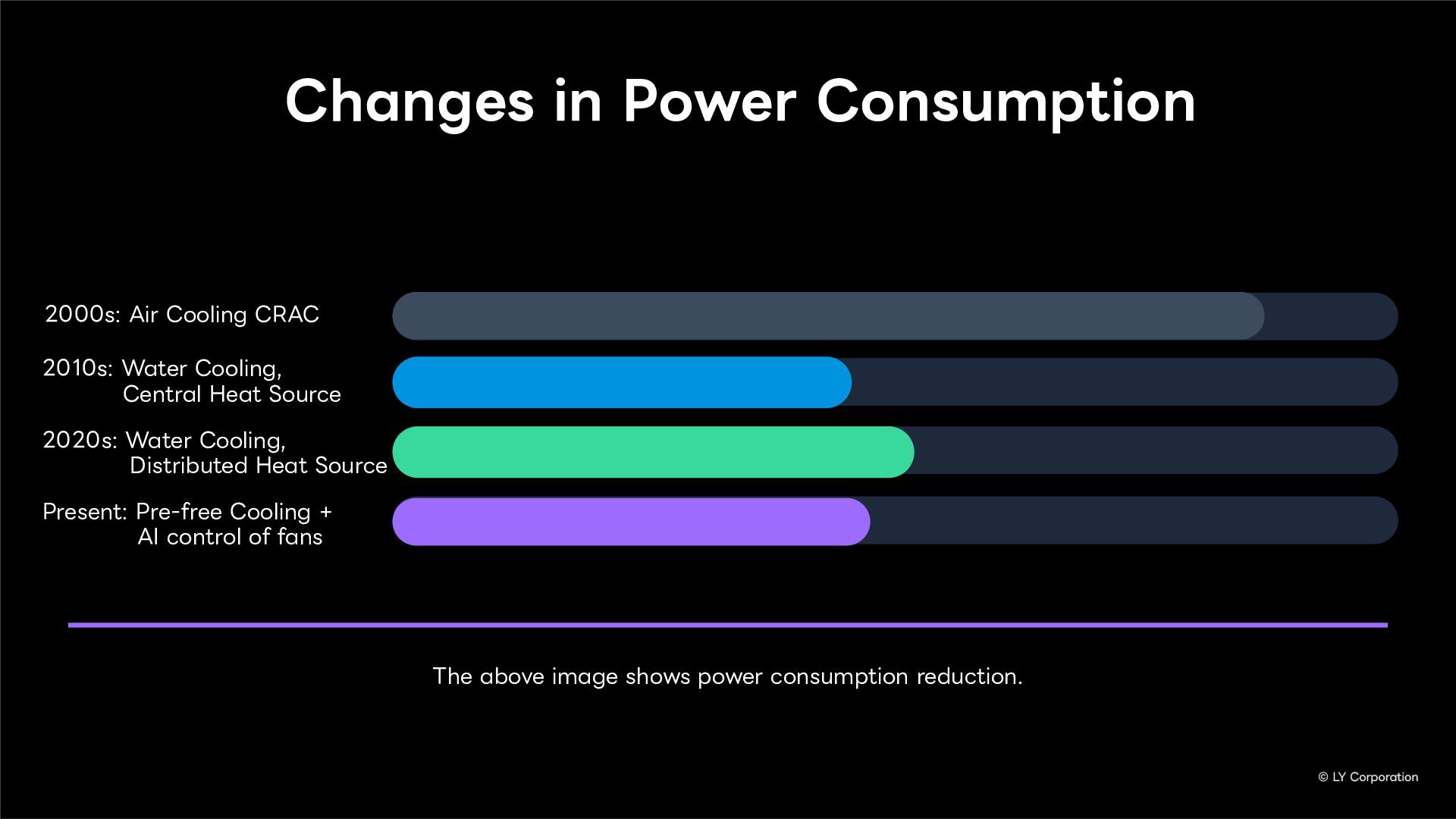
  9. Changes in Power Consumption The above image shows power consumption

    reduction. 2000s: Air Cooling CRAC 2010s: Water Cooling, Central Heat Source 2020s: Water Cooling, Distributed Heat Source Present: Pre-free Cooling + AI control of fans
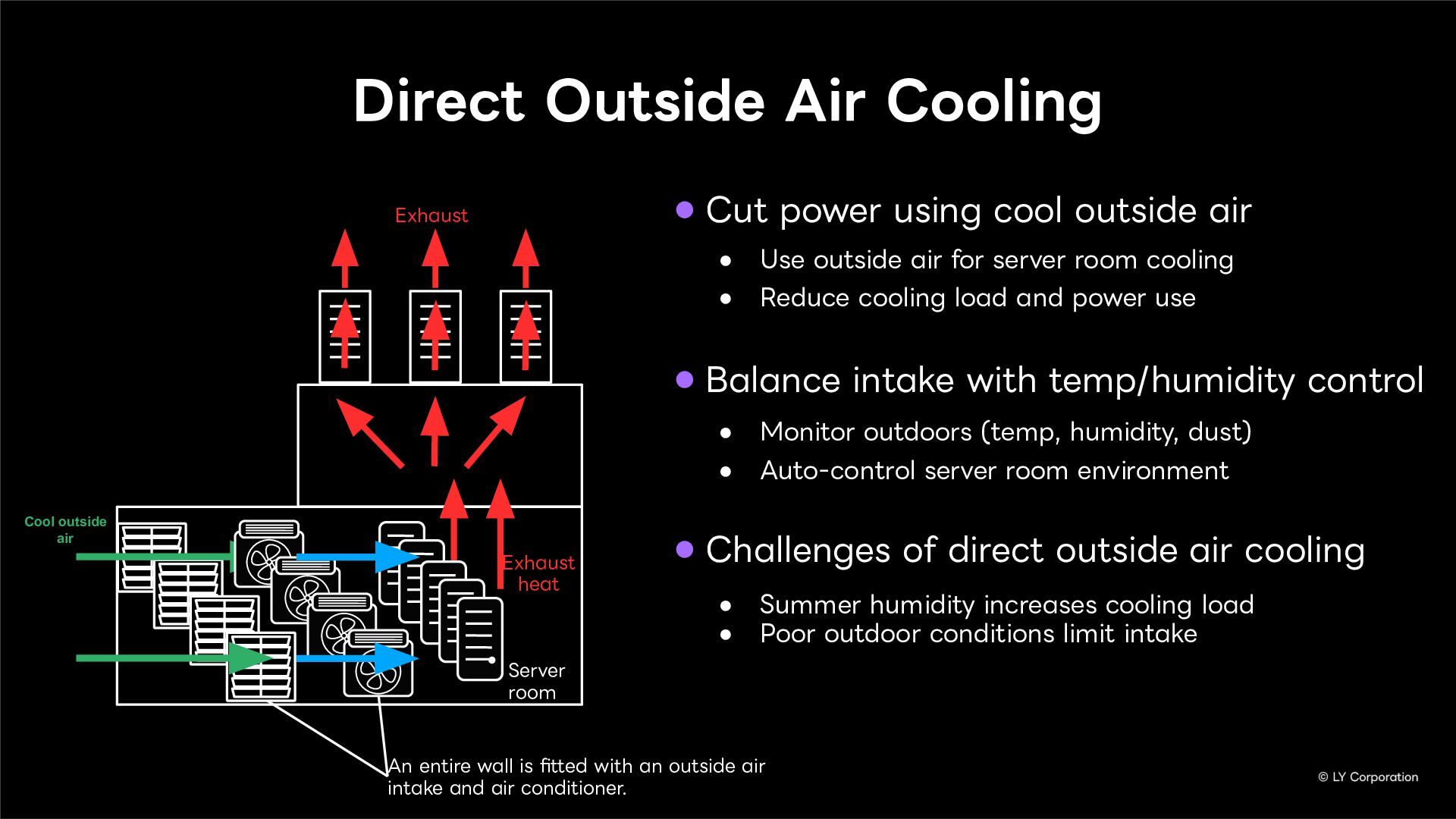
  10. Direct Outside Air Cooling Cut power using cool outside air

    • Use outside air for server room cooling • Reduce cooling load and power use Balance intake with temp/humidity control • Monitor outdoors (temp, humidity, dust) • Auto-control server room environment Challenges of direct outside air cooling • Summer humidity increases cooling load • Poor outdoor conditions limit intake An entire wall is fitted with an outside air intake and air conditioner. Exhaust heat Exhaust Cool outside air Server room
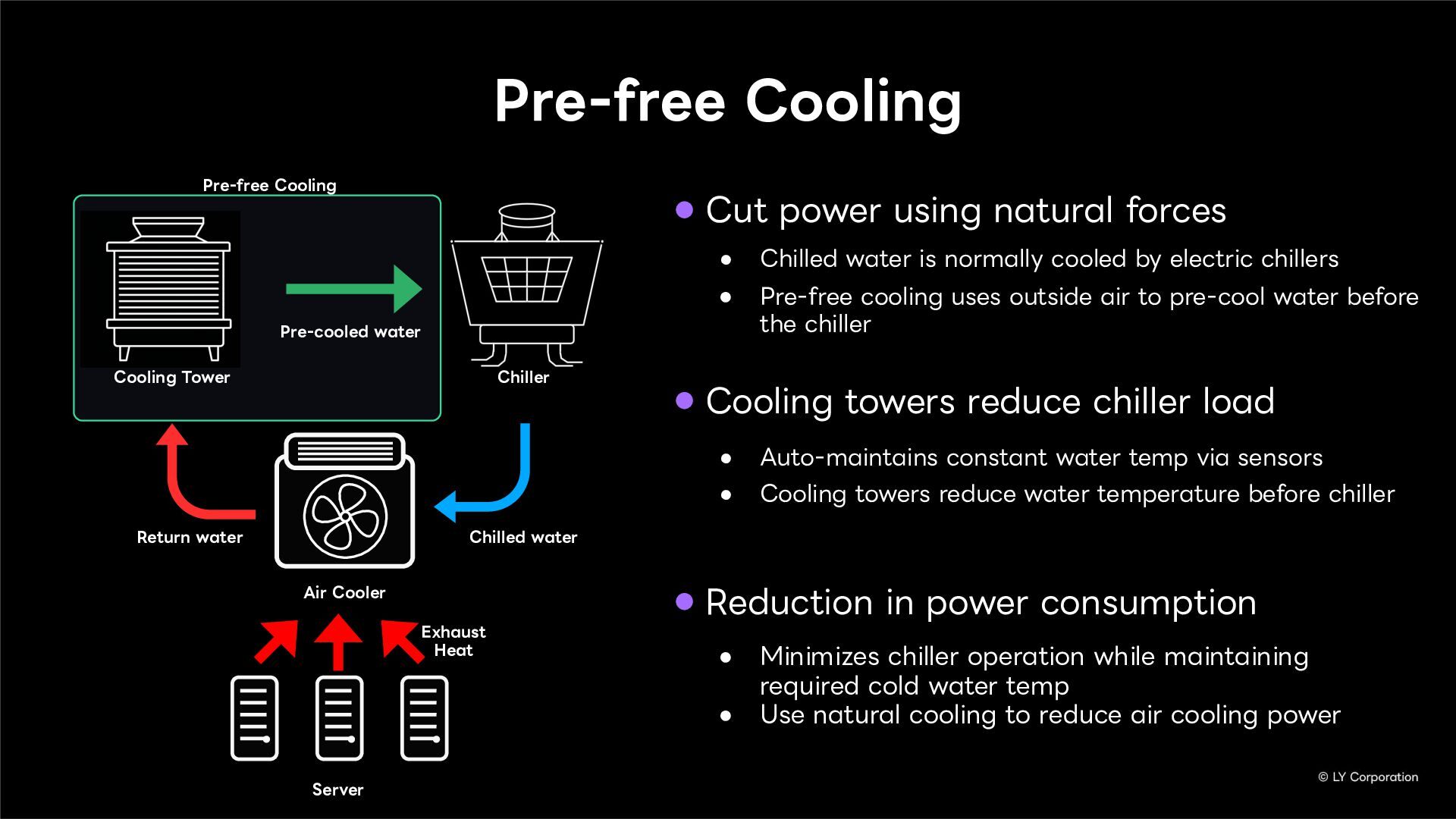
  11. Pre-free Cooling Cooling Tower Air Cooler Server Exhaust Heat Return

    water Chilled water Pre-cooled water Cut power using natural forces • Chilled water is normally cooled by electric chillers • Pre-free cooling uses outside air to pre-cool water before the chiller Cooling towers reduce chiller load • Auto-maintains constant water temp via sensors • Cooling towers reduce water temperature before chiller Reduction in power consumption • Minimizes chiller operation while maintaining required cold water temp • Use natural cooling to reduce air cooling power Pre-free Cooling Chilled water Chilled water Chiller
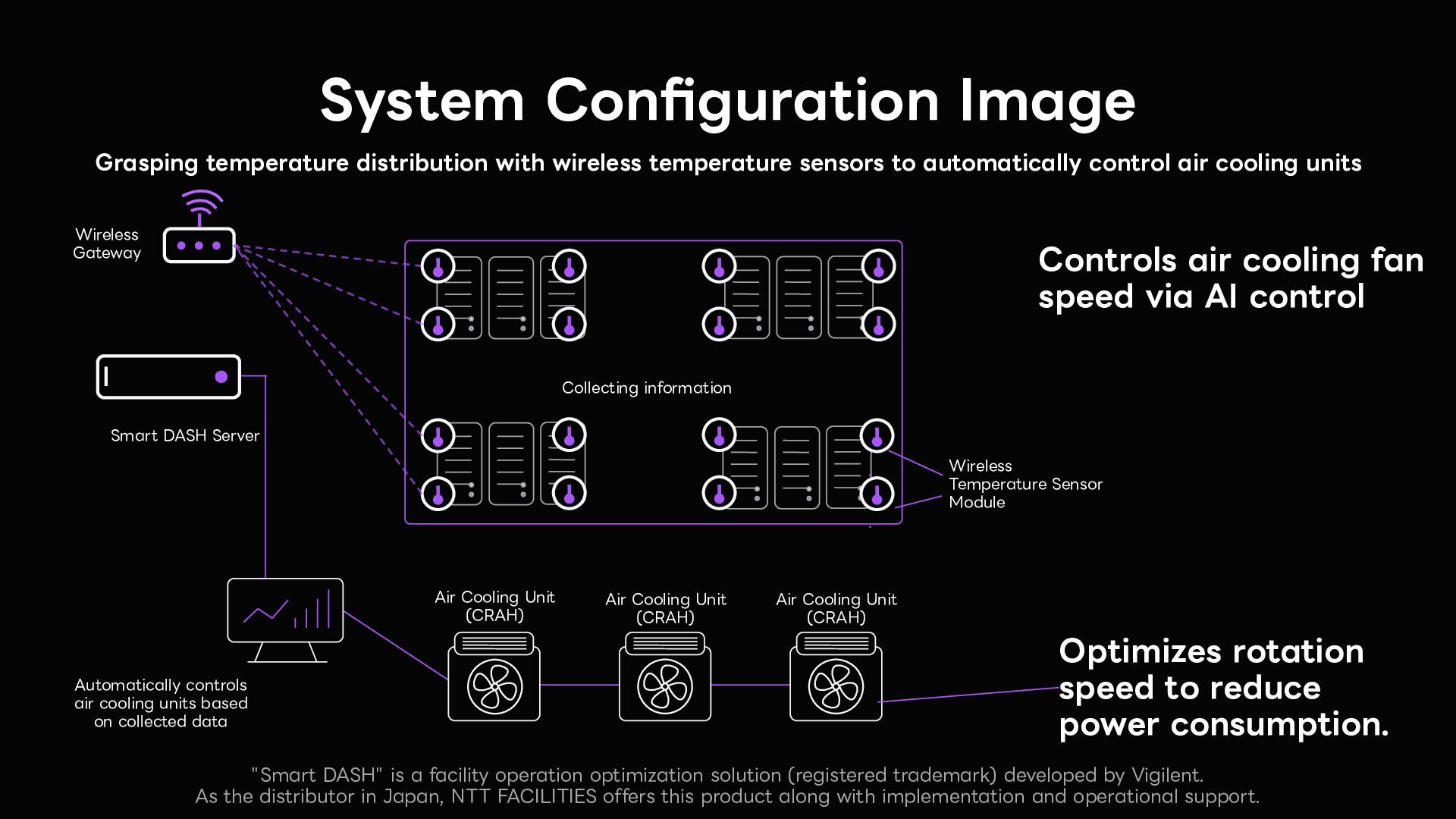
  12. Wireless Gateway Smart DASH Server Automatically controls air cooling units

    based on collected data Collecting information Wireless Temperature Sensor Module Air Cooling Unit (CRAH) System Configuration Image Optimizes rotation speed to reduce power consumption. Grasping temperature distribution with wireless temperature sensors to automatically control air cooling units Controls air cooling fan speed via AI control "Smart DASH" is a facility operation optimization solution (registered trademark) developed by Vigilent. As the distributor in Japan, NTT FACILITIES offers this product along with implementation and operational support. Air Cooling Unit (CRAH) Air Cooling Unit (CRAH)
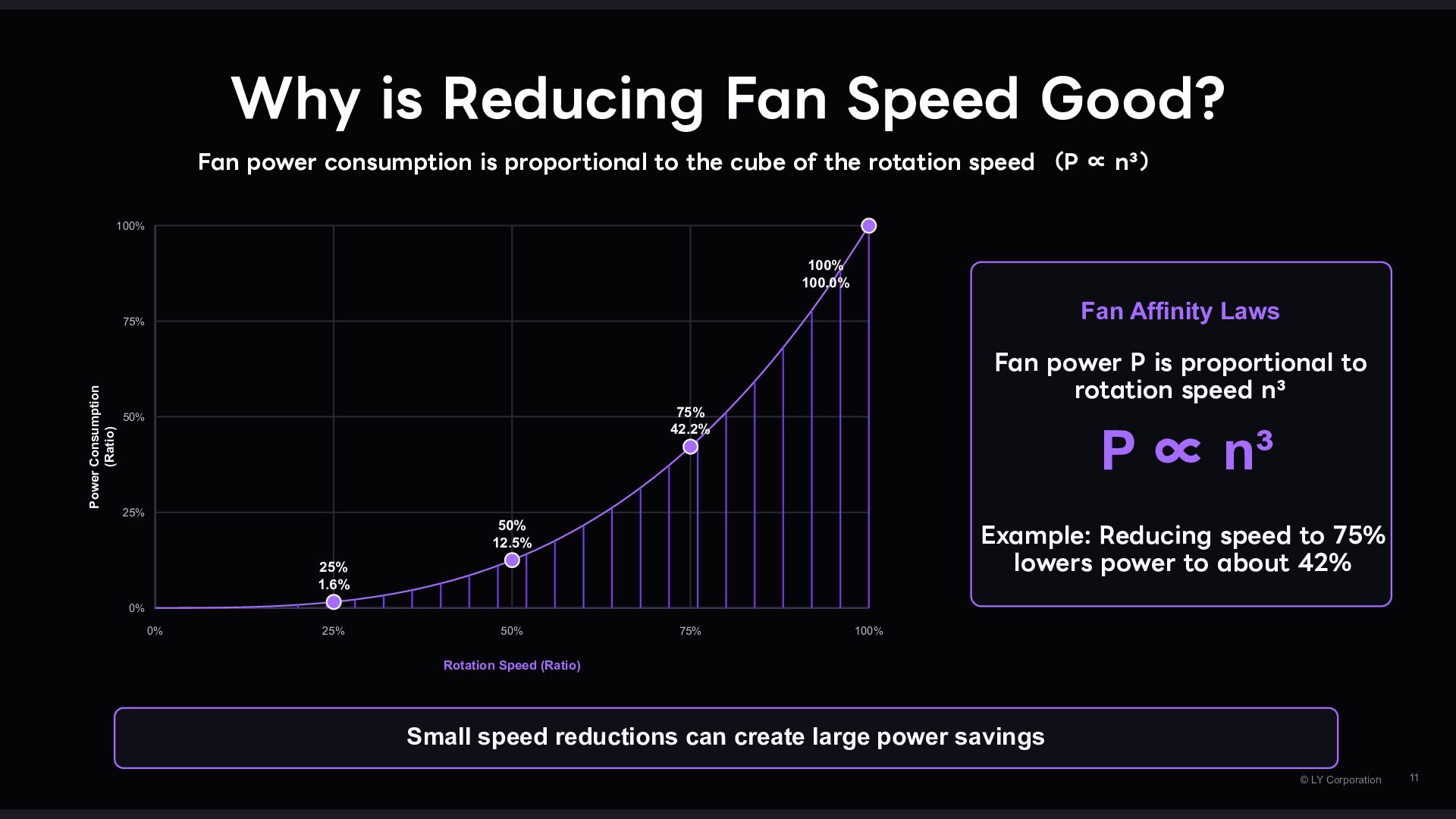
  13. 0% 0% 25% 25% 50% 50% 75% 75% 100% 100%

    25% 1.6% 50% 12.5% 75% 42.2% 100% 100.0% Rotation Speed (Ratio) Power Consumption (Ratio) Fan Affinity Laws Fan power P is proportional to rotation speed n³ P ∝ n³ Example: Reducing speed to 75% lowers power to about 42% Small speed reductions can create large power savings © LY Corporation 11 Why is Reducing Fan Speed Good? Fan power consumption is proportional to the cube of the rotation speed (P ∝ n³)
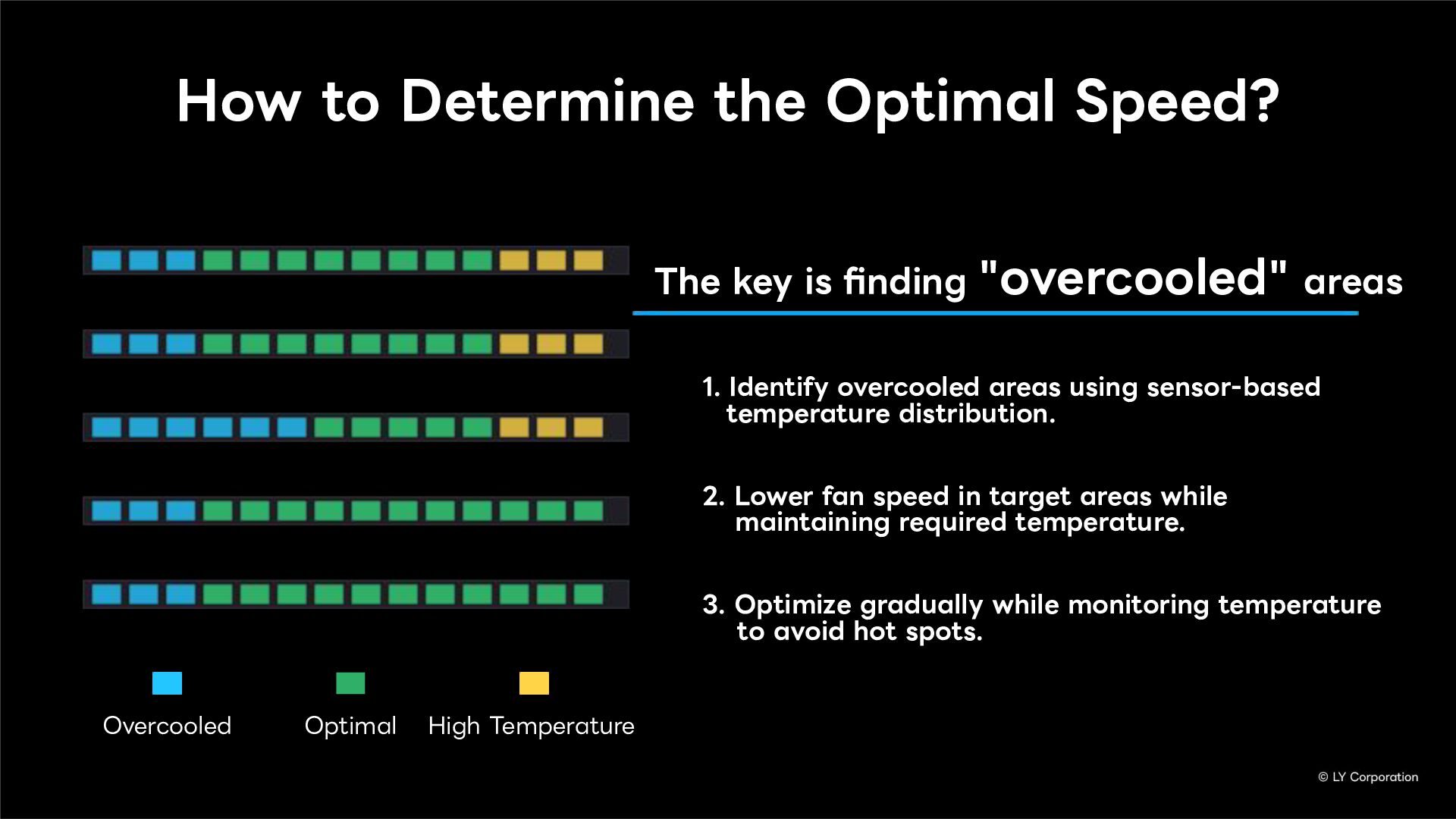
  14. How to Determine the Optimal Speed? Overcooled Optimal High Temperature

    The key is finding "overcooled" areas   1. Identify overcooled areas using sensor-based    temperature distribution.   2. Lower fan speed in target areas while     maintaining required temperature.   3. Optimize gradually while monitoring temperature to avoid hot spots.
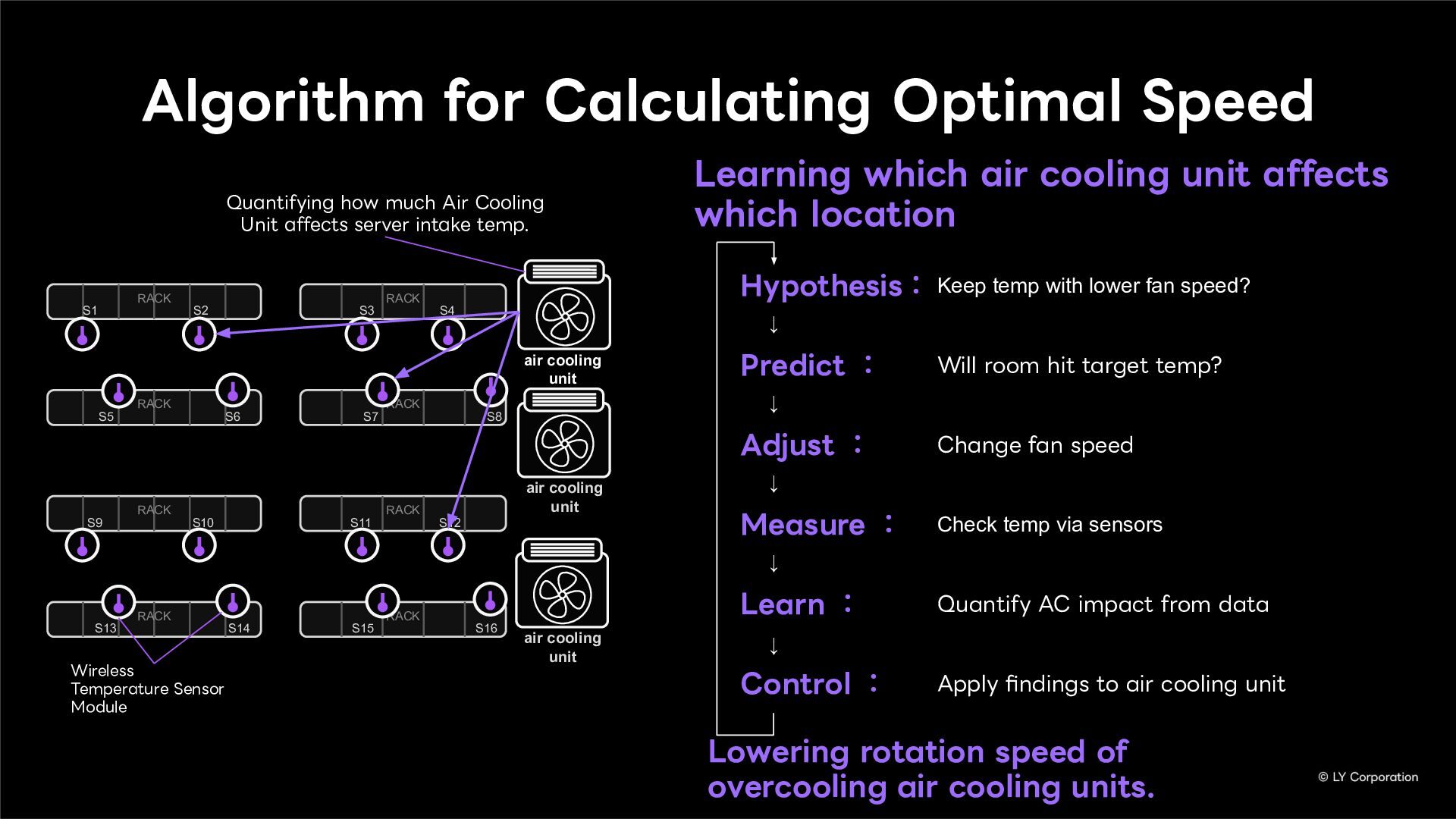
  15. Algorithm for Calculating Optimal Speed Learning which air cooling unit

    affects which location Hypothesis: Keep temp with lower fan speed? ↓ Predict : Will room hit target temp? ↓ Adjust : Change fan speed ↓ Measure : Check temp via sensors ↓ Learn : Quantify AC impact from data Control : Apply findings to air cooling unit ↓ RACK RACK RACK RACK RACK RACK RACK RACK S1 S2 S3 S4 S5 S6 S7 S8 S9 S10 S11 S12 S13 S14 S15 S16 air cooling unit air cooling unit air cooling unit Quantifying how much Air Cooling Unit affects server intake temp. Wireless Temperature Sensor Module Lowering rotation speed of overcooling air cooling units.
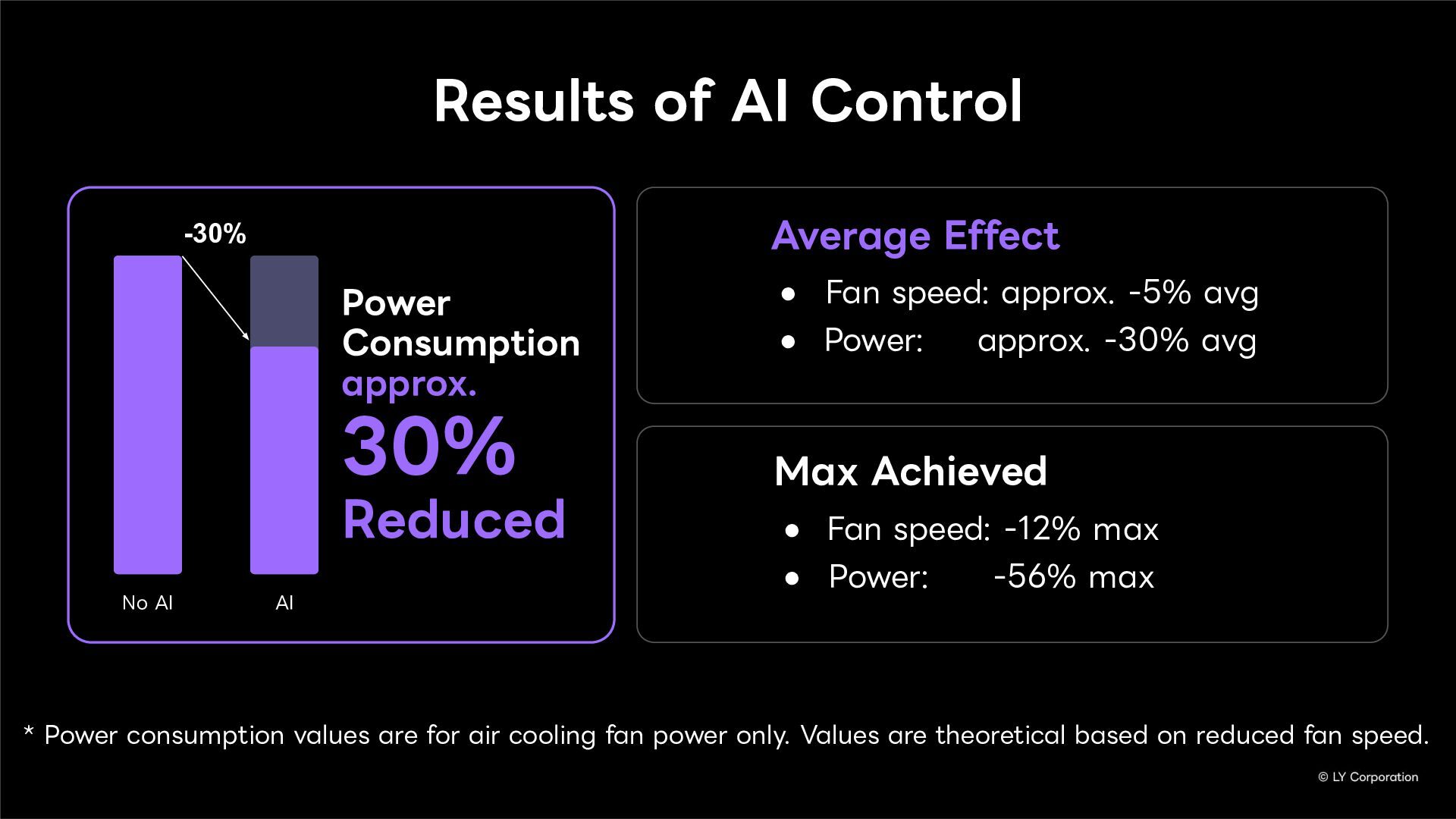
  16. Results of AI Control Power Consumption approx. 30% Reduced Average

    Effect • Fan speed: approx. -5% avg • Power: approx. -30% avg Max Achieved • Fan speed: -12% max • Power: -56% max * Power consumption values are for air cooling fan power only. Values are theoretical based on reduced fan speed. No AI AI -30%
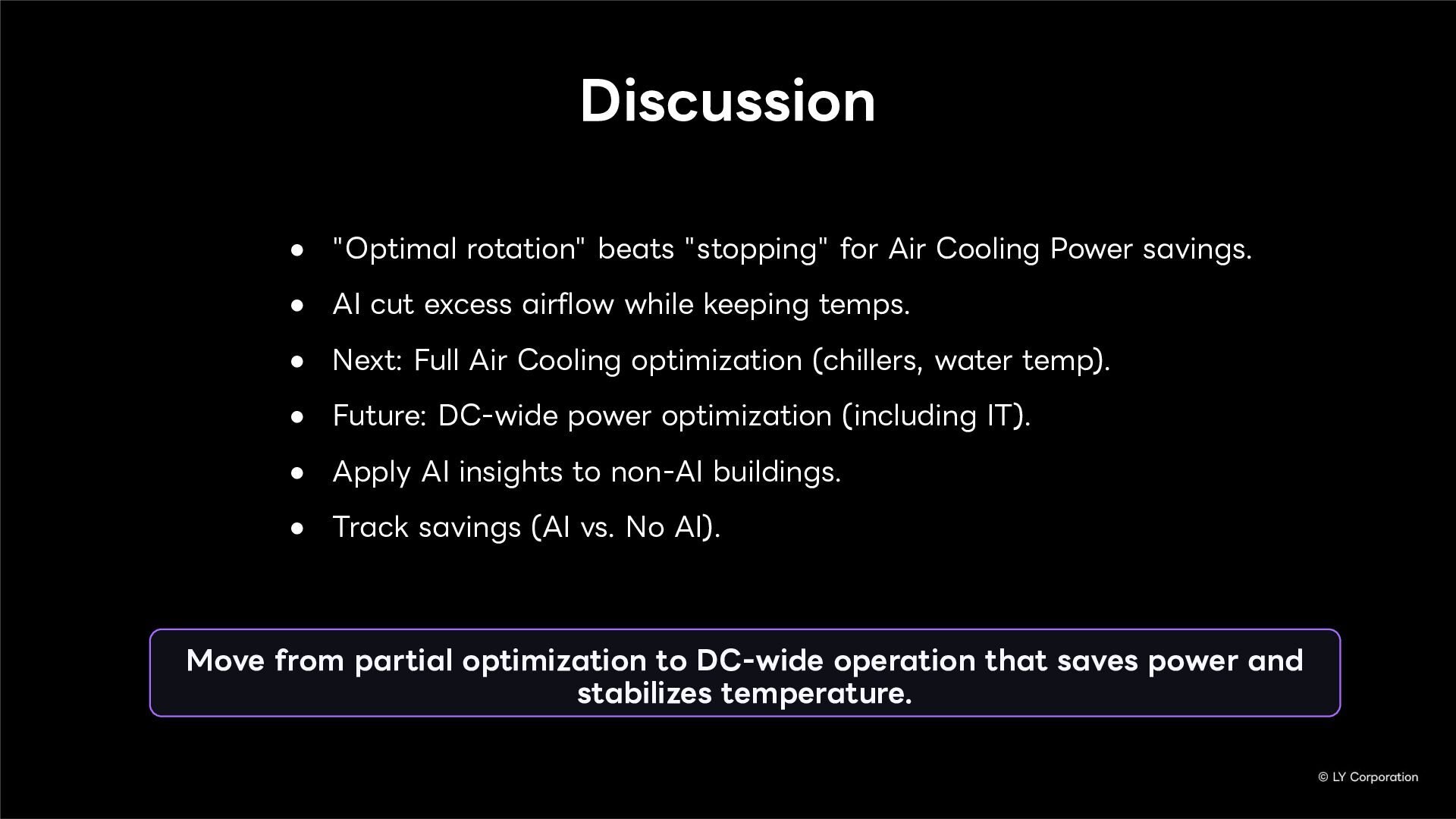
  17. Discussion • "Optimal rotation" beats "stopping" for Air Cooling Power

    savings. • AI cut excess airflow while keeping temps. • Next: Full Air Cooling optimization (chillers, water temp). • Future: DC-wide power optimization (including IT). • Apply AI insights to non-AI buildings. • Track savings (AI vs. No AI). Move from partial optimization to DC-wide operation that saves power and stabilizes temperature.
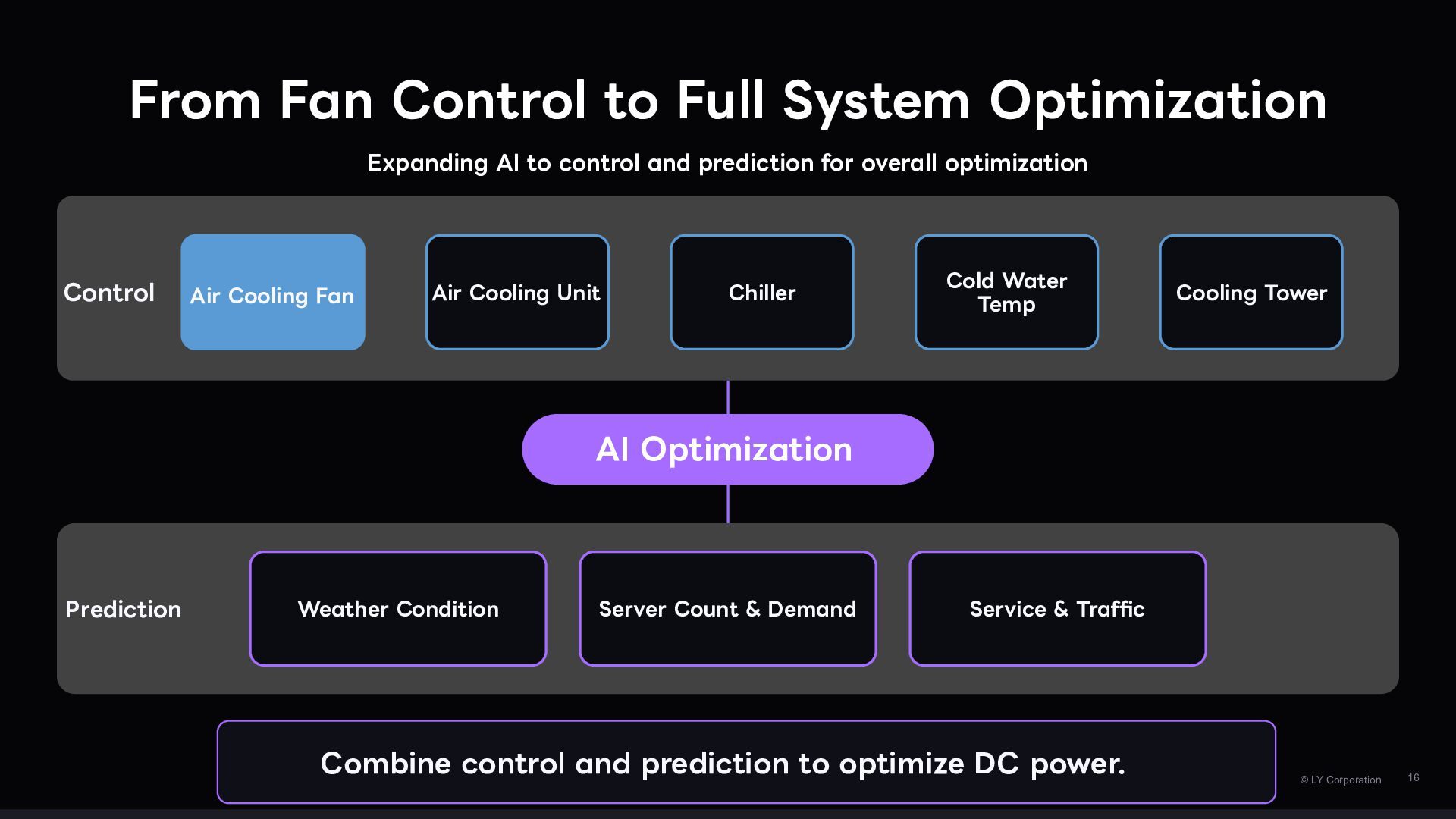
  18. Air Cooling Fan Air Cooling Unit Chiller Cold Water Temp

    Cooling Tower AI Optimization © LY Corporation 16 Weather Condition Server Count & Demand Service & Traffic Expanding AI to control and prediction for overall optimization From Fan Control to Full System Optimization Combine control and prediction to optimize DC power. Control Prediction
  19. EOP