Share
Embed
Transcript
47 slides
-
Kotlin Coroutines Mario Arias - Cake Solutions Ltd, Lunch &
Learn March 2018 @dh44t -
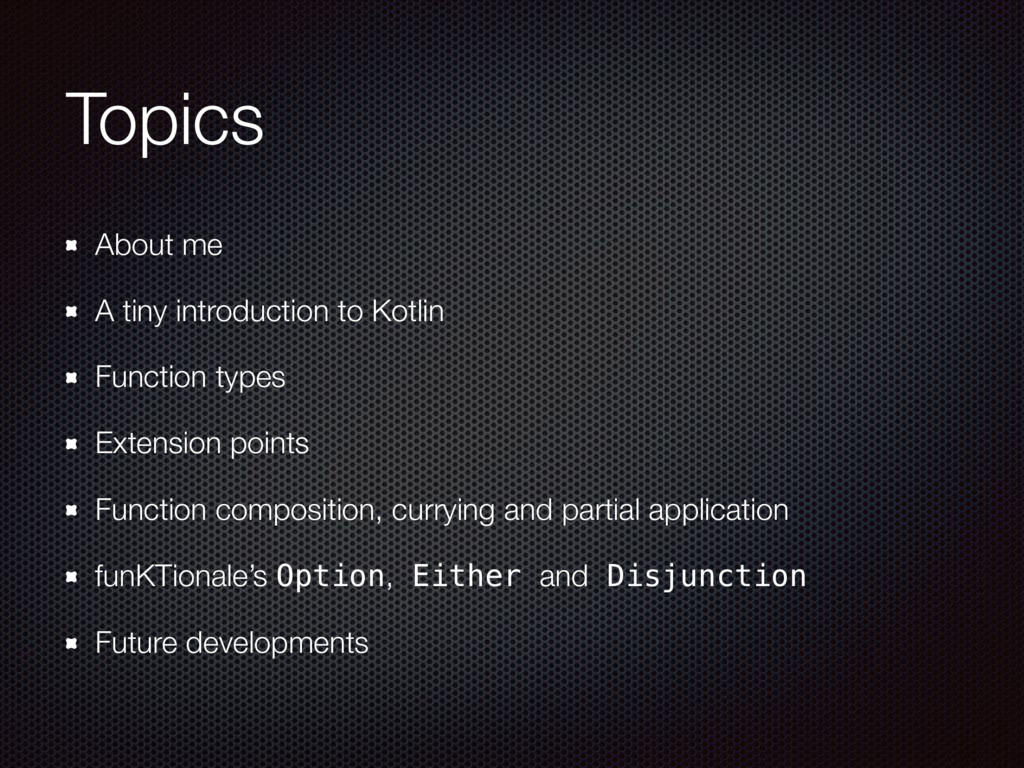
Topics About me A tiny introduction to Kotlin Function types
Extension points Function composition, currying and partial application funKTionale’s Option, Either and Disjunction Future developments -
Software Engineer at Cake Solutions 12+ years of experience with
JVM technologies Spring certified trainer 7+ years with Scala 5+ years with Kotlin funKTionale Arrow (funTKtionale + Kategory) RxKotlin original developer and former team leader Spring JDBC Kotlin support -
Features •Classes •sealed (ADT), data •Interfaces with body methods •Objects
•Companion objects •Enum •Generics •Named and default parameters -
Features II •Control structures •if else, when •do, while, for
•Expressions •Null Safety •High order functions •Delegates •Extension functions -
Null Safety package org.cakesolutions.kotlin val hello0: String = "" val
hello1: String = null //Null can not be a value of a non-null type String val hello2: String? = null val reversed0: String? = hello2?.reversed() val reversed1: String = reversed0.reversed() -
Functions /** A function that takes 1 argument. */ public
interface Function1<in P1, out R> : Function<R> { /** Invokes the function with the specified argument. */ public operator fun invoke(p1: P1): R } -
Functions II fun doWithTwoNumbers(a: Int, b: Int, f: (Int, Int)
Int): Int { return f(a, b) } fun main(args: Array<String>) { val x = doWithTwoNumbers(2, 3, { a, b a + b }) doWithTwoNumbers(x, 3) { a, b a * b } } -
Functions III Create your own control structures!! fun unless(conditional: Boolean,
body: () Unit) { if (!conditional) { body() } } fun main(args: Array<String>) { val age: Int = //Magic here! unless(age > 18) { //Play video games all day long } } -
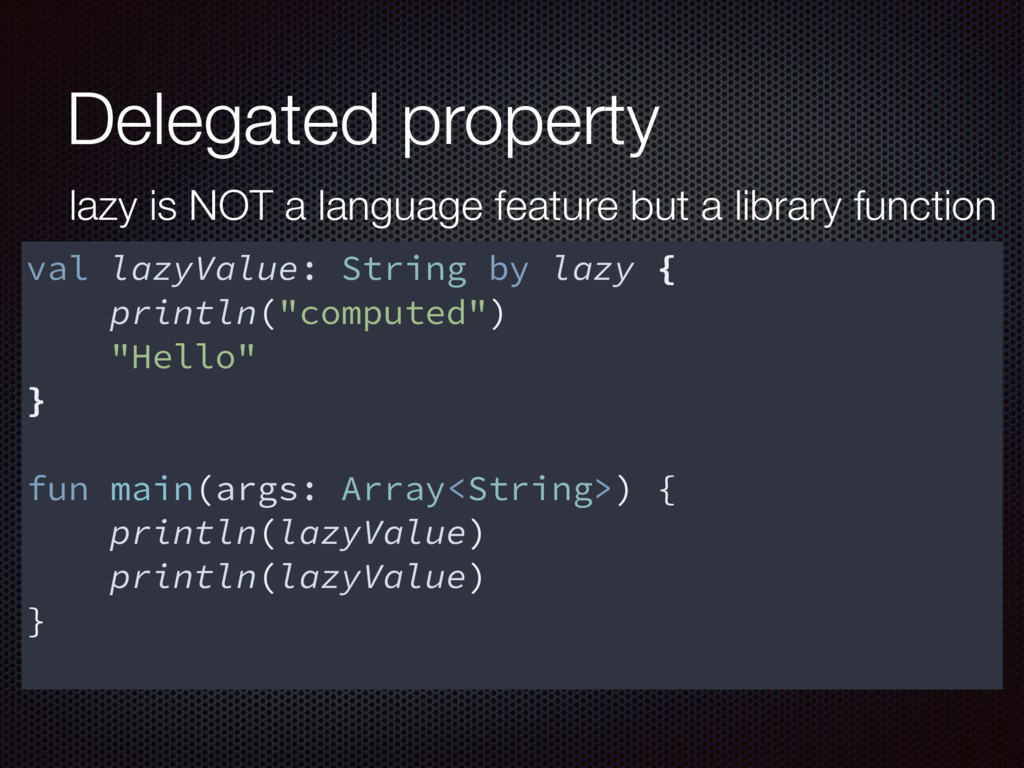
Delegated property lazy is NOT a language feature but a
library function val lazyValue: String by lazy { println("computed") "Hello" } fun main(args: Array<String>) { println(lazyValue) println(lazyValue) } -
Delegated property import kotlin.properties.Delegates class User { var name: String
by Delegates.observable("<No name>") { property, oldValue, newValue println("$oldValue $newValue") } } fun main(args: Array<String>) { val user = User() user.name = "first" user.name = "second" } -
Extension functions fun String.fromReddish() = "$this, FROM Reddish" fun main(args:
Array<String>) { println("Hello World".fromReddish()) } -
Extension functions II operator fun String.invoke(suffix: String) = "$this$suffix" fun
main(args: Array<String>) { println("This isn't a function"("")) } -
Extension functions III fun main(args: Array<String>) { val myList =
listOf(1, 2, 3, 4) //call to method reference .map(InttoString) .map { i i + i } .map(StringtoInt) .filter { it > 20 } // `it` is an implicit parameter println(myList) } -
Combine all the things!!! one-line unless from Ruby!! infix fun
(() Unit).unless(condition: Boolean) { if (!condition) { this() } } fun main(args: Array<String>) { val age: Int = //Magic { /*pay taxes*/ } unless (age < 18) } -
Inline fun <T> time(body: () T): Pair<T, Long> {
val startTime = System.currentTimeMillis() val v = body() val endTime = System.currentTimeMillis() return v to endTime - startTime } inline fun <T> inTime(body: () T): Pair<T, Long> { val startTime = System.currentTimeMillis() val v = body() val endTime = System.currentTimeMillis() return v to endTime - startTime } -
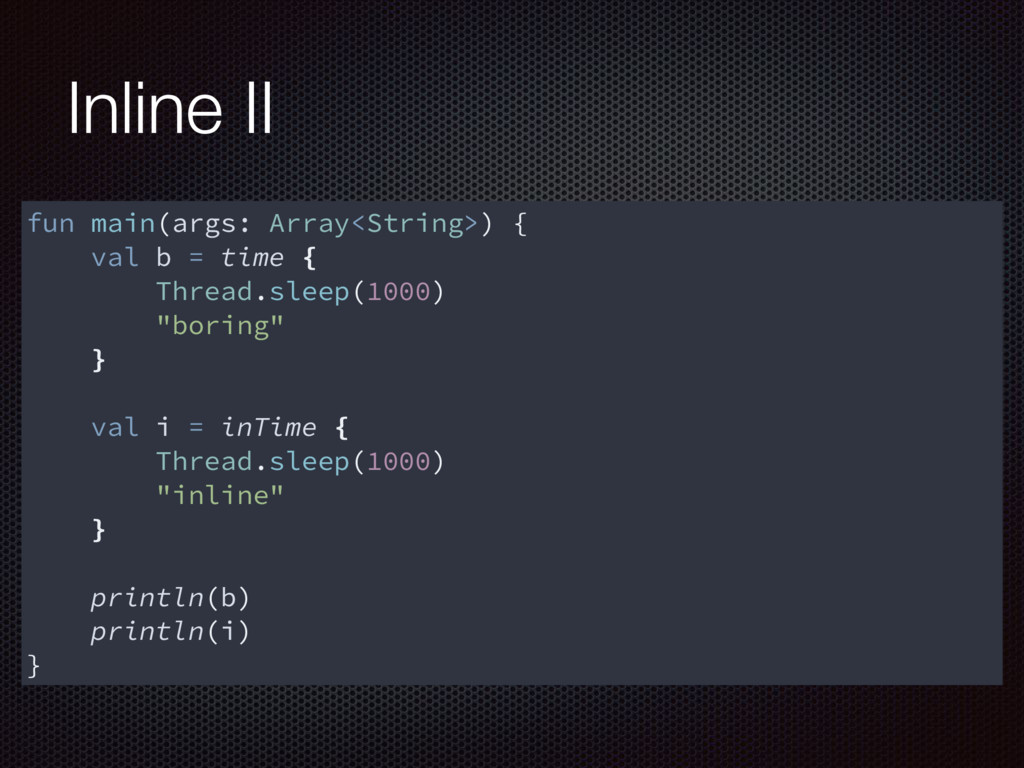
Inline II fun main(args: Array<String>) { val b = time
{ Thread.sleep(1000) "boring" } val i = inTime { Thread.sleep(1000) "inline" } println(b) println(i) } -
Inline III @NotNull public static final <T> Pair<T, Long> time(@NotNull
final Function0<? extends T> body) { Intrinsics.checkParameterIsNotNull((Object)body, "body"); final long startTime = System.currentTimeMillis(); final Object v = body.invoke(); final long endTime = System.currentTimeMillis(); return (Pair<T, Long>)TuplesKt.to(v, (Object)(endTime - startTime)); } @NotNull public static final <T> Pair<T, Long> inTime(@NotNull final Function0<? extends T> body) { Intrinsics.checkParameterIsNotNull((Object)body, "body"); final long startTime = System.currentTimeMillis(); final Object v = body.invoke(); final long endTime = System.currentTimeMillis(); return (Pair<T, Long>)TuplesKt.to(v, (Object)(endTime - startTime)); } Decompiled bytecode -
Inline IV public static final void main(@NotNull final String[] args)
{ Intrinsics.checkParameterIsNotNull((Object)args, "args"); final Pair b = time( (kotlin.jvm.functions.Function0<?>)_05_inlineKt$main$b._05_inlineKt$main$b$1.INSTANCE ); final long startTime$iv = System.currentTimeMillis(); Thread.sleep(1000L); final Object v$iv = "inline"; final long endTime$iv = System.currentTimeMillis(); final Pair i = TuplesKt.to(v$iv, (Object)(endTime$iv - startTime$iv)); System.out.println(b); System.out.println(i); } -
Inline V static final class _05_inlineKt$main$b$1 extends Lambda implements Function0<String>
{ public static final _05_inlineKt$main$b$1 INSTANCE; @NotNull public final String invoke() { Thread.sleep(1000L); return "boring"; } static { _05_inlineKt$main$b$1.INSTANCE = new _05_inlineKt$main$b$1(); } } -
Type-safe builders fun <T> logged(body: Logger.() T): T {
val log = LoggerFactory.getLogger("builder") return log.body() } fun main(args: Array<String>) { val i = logged { info("THIS is INFO") debug("THIS is DEBUG") error("THIS is ERROR") 1 + 2 } } -
DSLs class FxApp : App(FxViewclass) class FxView : View() {
override val root = vbox { label("Reddish App") button("Press me") } } fun main(args: Array<String>) { Application.launch(FxAppclass.java, *args) } -
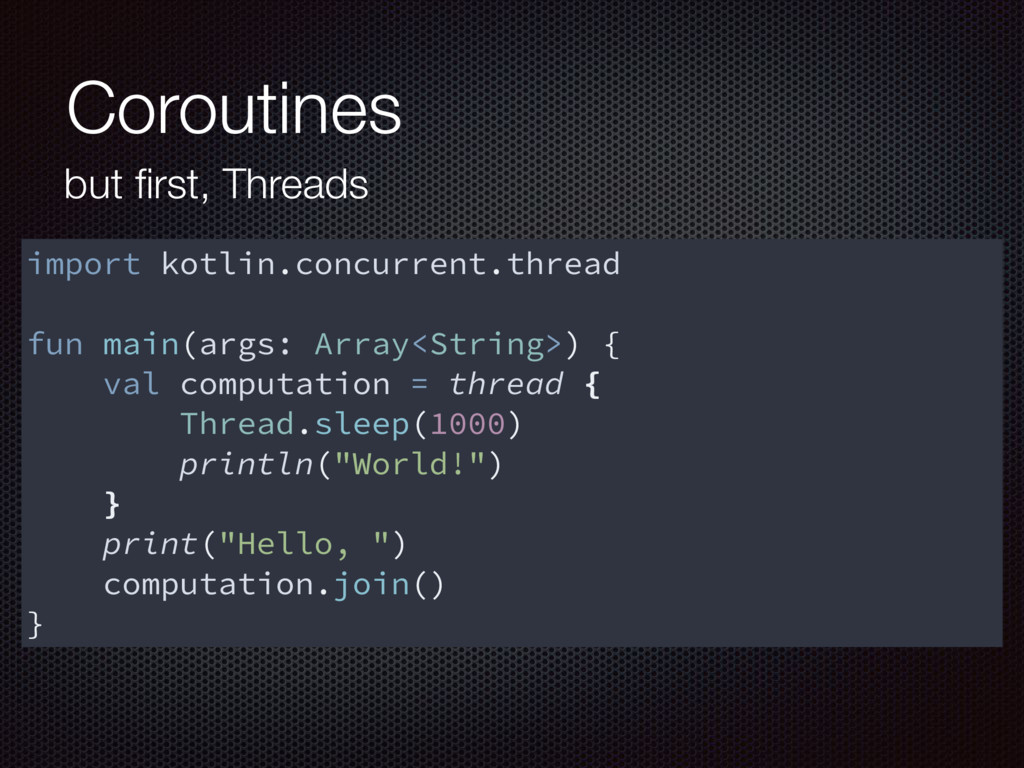
Coroutines but first, Threads import kotlin.concurrent.thread fun main(args: Array<String>) {
val computation = thread { Thread.sleep(1000) println("World!") } print("Hello, ") computation.join() } -
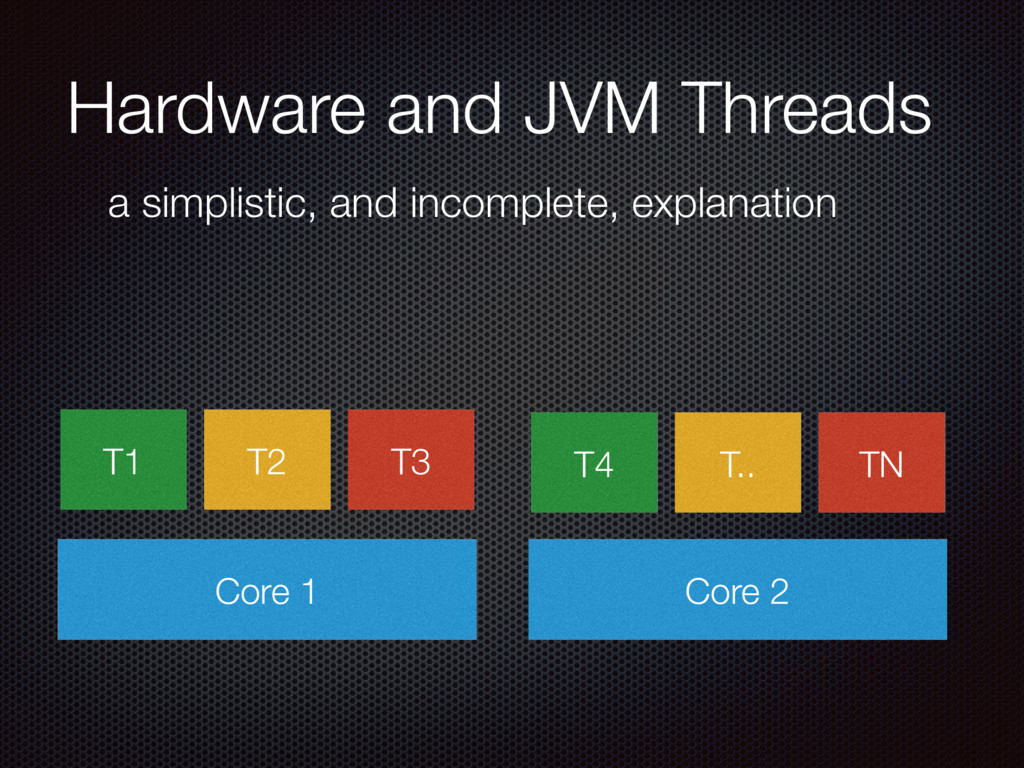
Hardware and JVM Threads a simplistic, and incomplete, explanation Core
1 T1 T2 T3 Core 2 T4 T.. TN -
Monitoring utils VisualVM class MonitorUtil { private val scanner =
Scanner(System.`in`) fun awaitEnter(){ println("Press enter to continue") scanner.nextLine() } } fun monitored(body: MonitorUtil.() Unit) { val monitor = MonitorUtil() monitor.body() monitor.awaitEnter() } -
1000 Threads fun main(args: Array<String>) = monitored { awaitEnter() //VisualVM
val threads = List(1000) { thread { Thread.sleep(1000) print('.') } } threads.forEach(Threadjoin) } -
Executors fun main(args: Array<String>) = monitored { awaitEnter() val pool
= Executors.newFixedThreadPool(128) repeat(10000) { pool.submit { Thread.sleep(1000) print('.') } } pool.shutdown() pool.awaitTermination(2, TimeUnit.SECONDS) } -
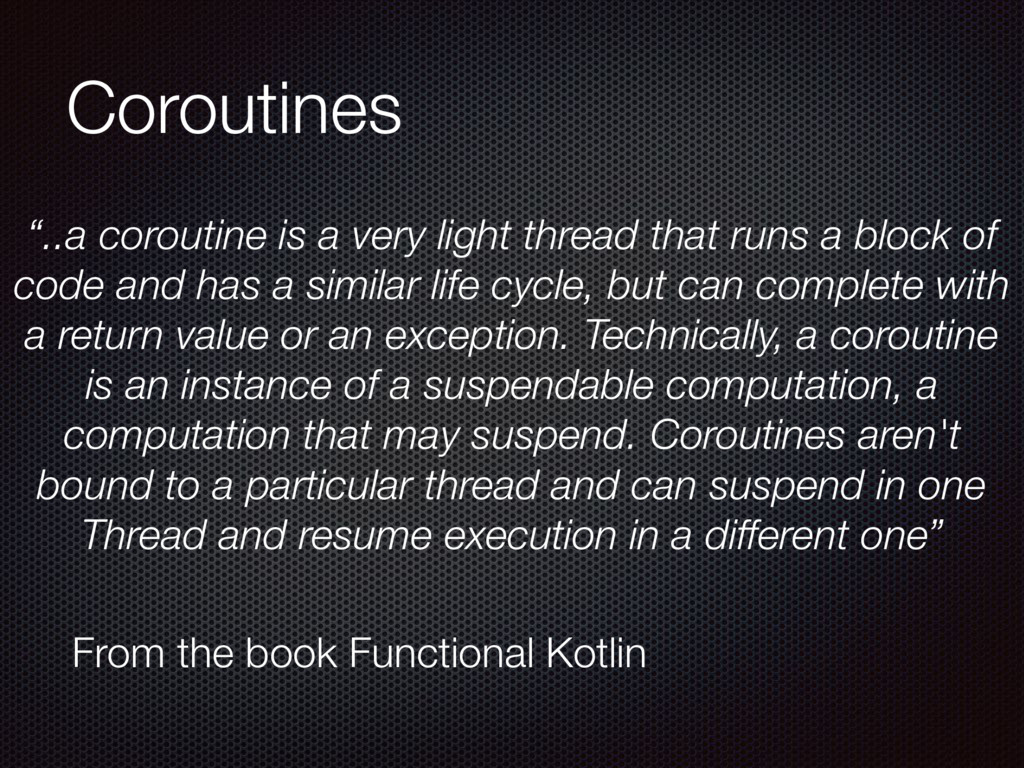
Coroutines “..a coroutine is a very light thread that runs
a block of code and has a similar life cycle, but can complete with a return value or an exception. Technically, a coroutine is an instance of a suspendable computation, a computation that may suspend. Coroutines aren't bound to a particular thread and can suspend in one Thread and resume execution in a different one” From the book Functional Kotlin -
Coroutines II Core 1 T1 T2 T3 Core 2 T4
T.. TN Coroutines -
Coroutines III import kotlinx.coroutines.experimental.delay import kotlinx.coroutines.experimental.launch import kotlinx.coroutines.experimental.runBlocking fun main(args:
Array<String>) = runBlocking { val job = launch { delay(1000) println("World!") } print("Hello, ") job.join() } -
Coroutines IV Concept Description Coroutine Light thread Suspending function A
function with a suspend modifier. It can suspend a coroutine without blocking the thread Suspending lambda A lambda function with a suspend modifier Coroutine builder A function that takes a suspending lambda Suspension point A point where a suspending function is invoked Continuation The state of a suspended coroutine at a suspension point -
Coroutines V fun main(args: Array<String>) = runBlocking { val job
= launch { delay(1000) println("World!") } print("Hello, ") job.join() } Suspension point Suspension point Suspending function Coroutine builder Coroutine builder Continuation Suspending lambda Suspending lambda Suspending function -
10000 Coroutines fun main(args: Array<String>) = monitored { awaitEnter() runBlocking
{ val jobs = List(10000) { launch { delay(1000) print(".") } } jobs.forEach { it.join() } } } -
Shared state suspend fun repeatInParallel(times: Int, block: suspend ()
Unit) { val job = launch { repeat(times) { launch(coroutineContext) { block() } } } job.join() } -
Shared state II fun main(args: Array<String>) = runBlocking { var
counter = 0 val time = measureTimeMillis { repeatInParallel(1_000_000) { counter } } println("counter = $counter") //EPIC FAIL println("time = $time") } -
Atomic Integer import java.util.concurrent.atomic.AtomicInteger fun main(args: Array<String>) = runBlocking {
val counter = AtomicInteger(0) val time = measureTimeMillis { repeatInParallel(1_000_000) { counter.incrementAndGet() } } println("counter = ${counter.get()}") println("time = $time") } -
Single thread context fun main(args: Array<String>) = runBlocking { var
counter = 0 val counterContext = newSingleThreadContext("CounterContext") val time = measureTimeMillis { repeatInParallel(1_000_000) { withContext(counterContext) { counter } } } println("counter = $counter") println("time = $time") } -
Mutex fun main(args: Array<String>) = runBlocking { var counter =
0 val mutex = Mutex() val time = measureTimeMillis { repeatInParallel(1_000_000) { mutex.withLock { counter } } } println("counter = $counter") println("time = $time") } -
Actors I sealed class CounterMsg object IncCounter : CounterMsg() class
GetCounter(val response: CompletableDeferred<Int>) : CounterMsg() fun counterActor(start: Int) = actor<CounterMsg> { var counter = start for (msg in channel) { when (msg) { is IncCounter counter is GetCounter msg.response.complete(counter) } } } -
Actors II fun main(args: Array<String>) = runBlocking { val counterActor
= counterActor(0) val time = measureTimeMillis { repeatInParallel(1_000_000) { counterActor.send(IncCounter) } } val counter = CompletableDeferred<Int>() counterActor.send(GetCounter(counter)) println("counter = ${counter.await()}") println("time = $time") } -
Other uses import arrow.core.Some fun main(args: Array<String>) { val a
= Some(1) val b = Some(2) val c = a.flatMap { x b.map { y x + y } } println("c = $c") } -
Monadic comprehension import arrow.core.Option import arrow.core.Some import arrow.core.ev import arrow.core.monad
import arrow.typeclasses.binding fun main(args: Array<String>) { val a = Some(1) val b = Some(2) val c = Option.monad().binding { val x = a.bind() val y = b.bind() x + y }.ev() println("c = $c") } continuation: flatMap continuation: map