Upgrade to Pro — share decks privately, control downloads, hide ads and more …

FY2026.6 Impact Report EN

Avatar for Mercari, Inc. Mercari, Inc.
September 16, 2026

FY2026.6 Impact Report EN

Avatar for Mercari, Inc.

Mercari, Inc.

September 16, 2026

More Decks by Mercari, Inc.

Other Decks in Business

Transcript

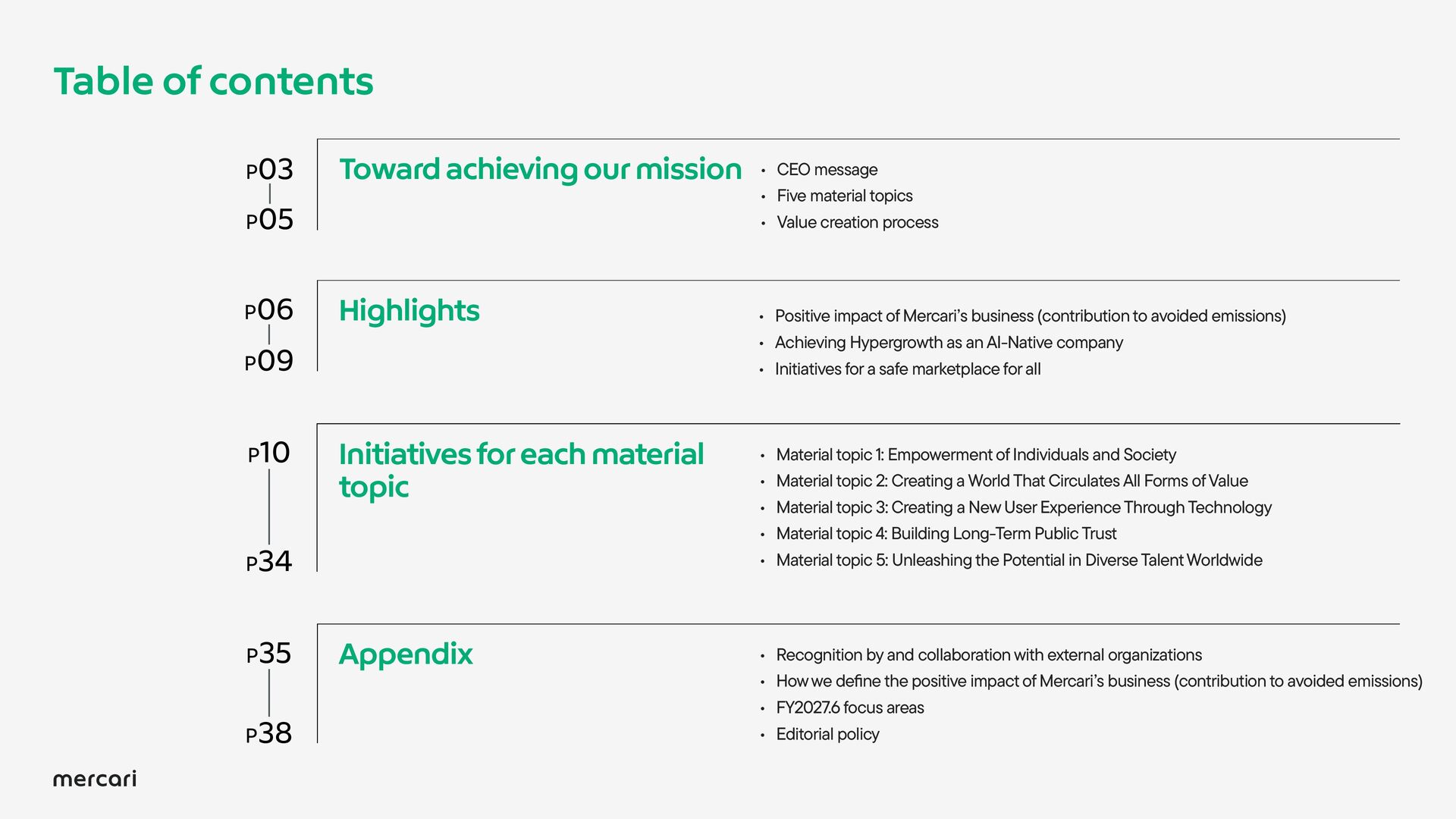
  1. Table of contents P03 Toward achieving our mission • CEO

    message • Five material topics P05 P06 • Value creation process Highlights • Achieving Hypergrowth as an AI-Native company P09 P10 • Positive impact of Mercari’s business (contribution to avoided emissions) • Initiatives for a safe marketplace for all Initiatives for each material topic • Material topic 1: Empowerment of Individuals and Society • Material topic 2: Creating a World That Circulates All Forms of Value • Material topic 3: Creating a New User Experience Through Technology • Material topic 4: Building Long-Term Public Trust P34 P35 • Material topic 5: Unleashing the Potential in Diverse Talent Worldwide Appendix • Recognition by and collaboration with external organizations • How we define the positive impact of Mercari’s business (contribution to avoided emissions) • FY2027.6 focus areas P38 • Editorial policy
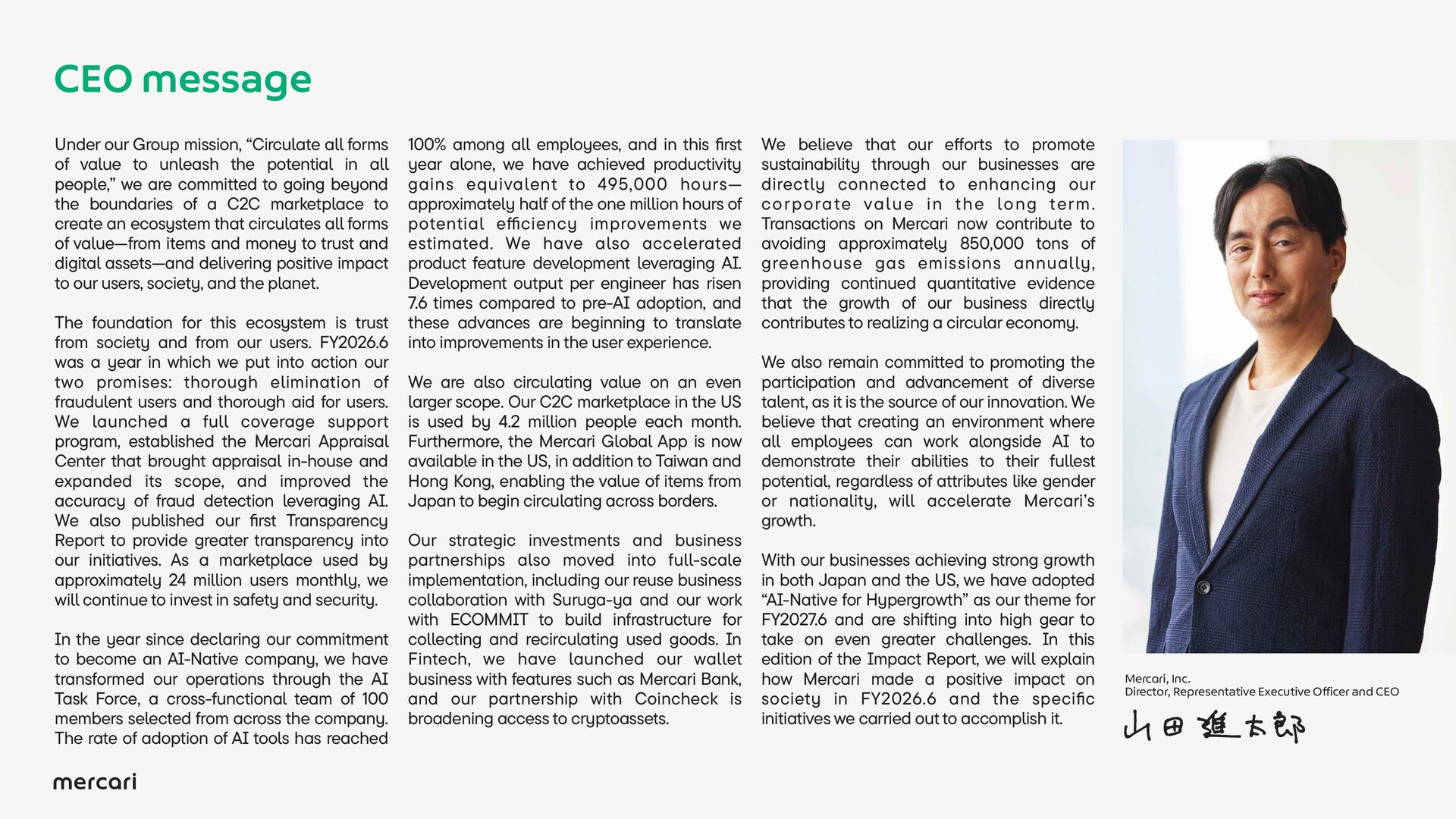
  2. CEO message Under our Group mission, “Circulate all forms of

    value to unleash the potential in all people,” we are committed to going beyond the boundaries of a C2C marketplace to create an ecosystem that circulates all forms of value—from items and money to trust and digital assets—and delivering positive impact to our users, society, and the planet. The foundation for this ecosystem is trust from society and from our users. FY2026.6 was a year in which we put into action our two promises: thorough elimination of fraudulent users and thorough aid for users. We launched a full coverage support program, established the Mercari Appraisal Center that brought appraisal in-house and expanded its scope, and improved the accuracy of fraud detection leveraging AI. We also published our first Transparency Report to provide greater transparency into our initiatives. As a marketplace used by approximately 24 million users monthly, we will continue to invest in safety and security. In the year since declaring our commitment to become an AI-Native company, we have transformed our operations through the AI Task Force, a cross-functional team of 100 members selected from across the company. The rate of adoption of AI tools has reached 100% among all employees, and in this first year alone, we have achieved productivity gains equivalent to 495,000 hours— approximately half of the one million hours of potential efficiency improvements we estimated. We have also accelerated product feature development leveraging AI. Development output per engineer has risen 7.6 times compared to pre-AI adoption, and these advances are beginning to translate into improvements in the user experience. We are also circulating value on an even larger scope. Our C2C marketplace in the US is used by 4.2 million people each month. Furthermore, the Mercari Global App is now available in the US, in addition to Taiwan and Hong Kong, enabling the value of items from Japan to begin circulating across borders. Our strategic investments and business partnerships also moved into full-scale implementation, including our reuse business collaboration with Suruga-ya and our work with ECOMMIT to build infrastructure for collecting and recirculating used goods. In Fintech, we have launched our wallet business with features such as Mercari Bank, and our partnership with Coincheck is broadening access to cryptoassets. We believe that our efforts to promote sustainability through our businesses are directly connected to enhancing our c o r p o ra te va lu e i n t h e lo n g te r m . Transactions on Mercari now contribute to avoiding approximately 850,000 tons of greenhouse gas emissions annually, providing continued quantitative evidence that the growth of our business directly contributes to realizing a circular economy. We also remain committed to promoting the participation and advancement of diverse talent, as it is the source of our innovation. We believe that creating an environment where all employees can work alongside AI to demonstrate their abilities to their fullest potential, regardless of attributes like gender or nationality, will accelerate Mercari’s growth. With our businesses achieving strong growth in both Japan and the US, we have adopted “AI-Native for Hypergrowth” as our theme for FY2027.6 and are shifting into high gear to take on even greater challenges. In this edition of the Impact Report, we will explain how Mercari made a positive impact on society in FY2026.6 and the specific initiatives we carried out to accomplish it. Mercari, Inc. Director, Representative Executive Officer and CEO
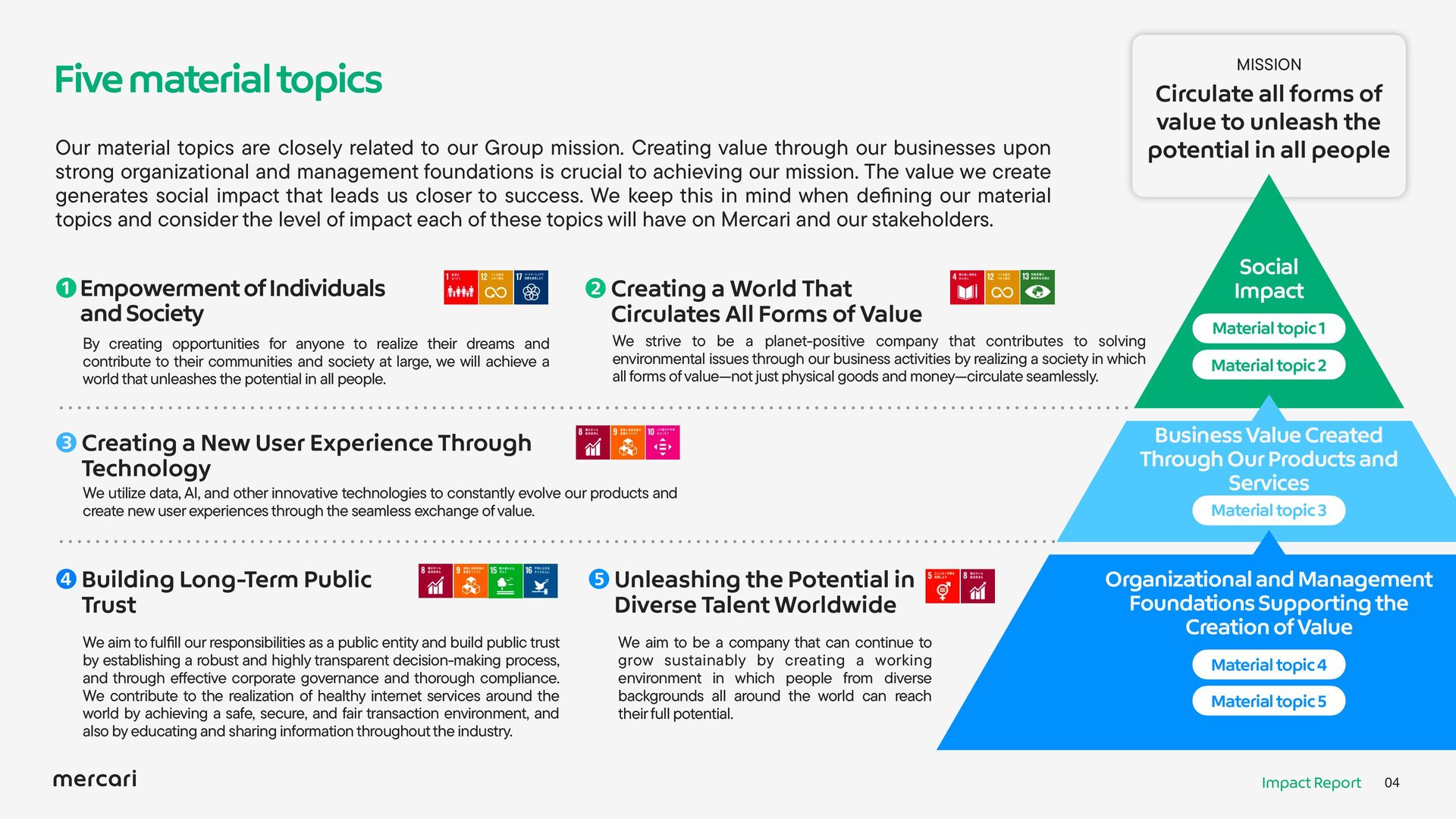
  3. MISSION Five material topics Circulate all forms of value to

    unleash the potential in all people Our material topics are closely related to our Group mission. Creating value through our businesses upon strong organizational and management foundations is crucial to achieving our mission. The value we create generates social impact that leads us closer to success. We keep this in mind when defining our material topics and consider the level of impact each of these topics will have on Mercari and our stakeholders. ❶ Empowerment of Individuals and Society By creating opportunities for anyone to realize their dreams and contribute to their communities and society at large, we will achieve a world that unleashes the potential in all people. ❷ Creating a World That Circulates All Forms of Value We strive to be a planet-positive company that contributes to solving environmental issues through our business activities by realizing a society in which all forms of value—not just physical goods and money—circulate seamlessly. ❸ Creating a New User Experience Through Technology We utilize data, AI, and other innovative technologies to constantly evolve our products and create new user experiences through the seamless exchange of value. ❹ Building Long-Term Public Trust We aim to fulfill our responsibilities as a public entity and build public trust by establishing a robust and highly transparent decision-making process, and through effective corporate governance and thorough compliance. We contribute to the realization of healthy internet services around the world by achieving a safe, secure, and fair transaction environment, and also by educating and sharing information throughout the industry. Social Impact ❺ Unleashing the Potential in Diverse Talent Worldwide We aim to be a company that can continue to grow sustainably by creating a working environment in which people from diverse backgrounds all around the world can reach their full potential. Material topic 1 Material topic 2 Business Value Created Through Our Products and Services Material topic 3 Organizational and Management Foundations Supporting the Creation of Value Material topic 4 Material topic 5 Impact Report 04
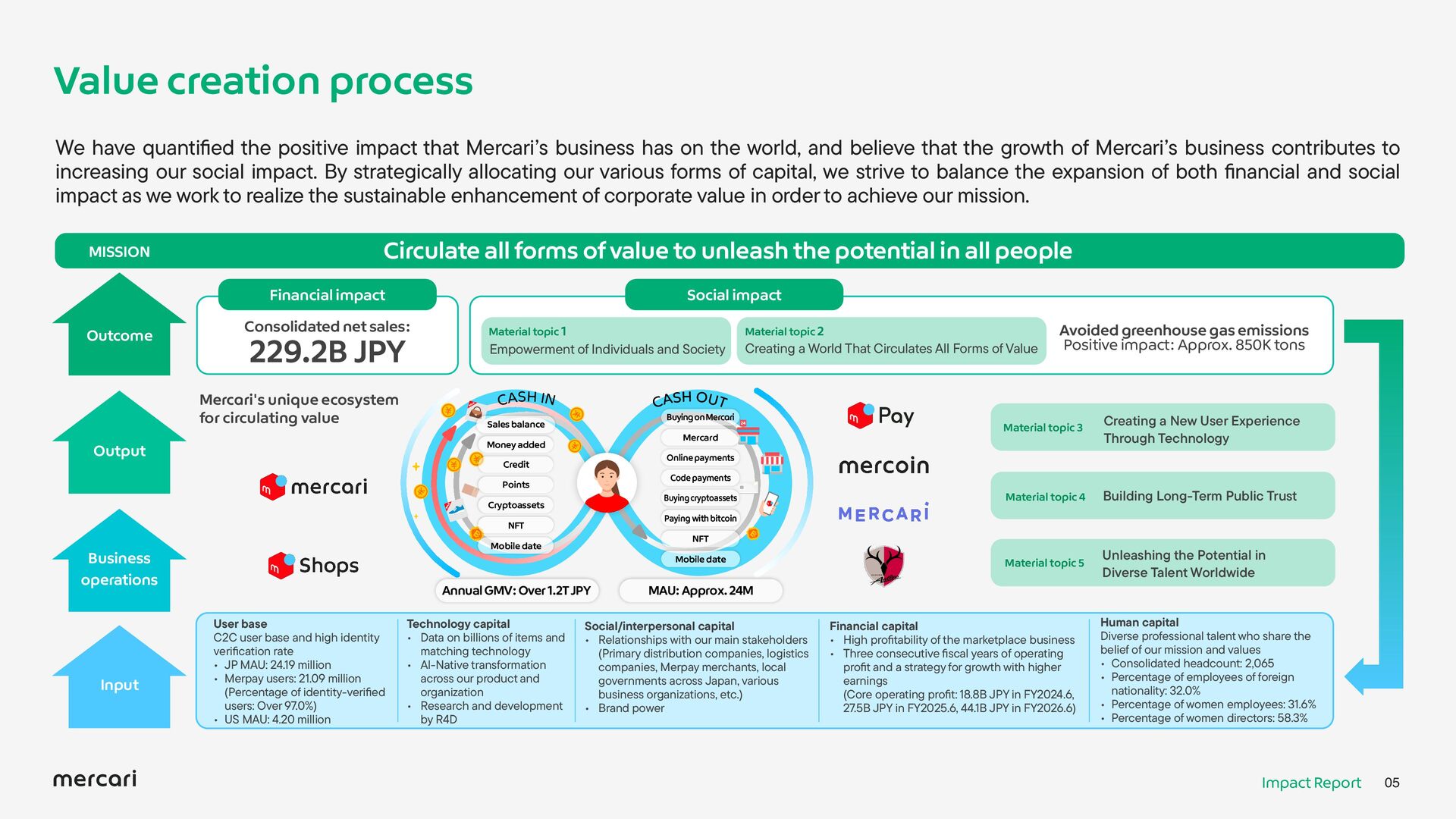
  4. Value creation process We have quantified the positive impact that

    Mercari’s business has on the world, and believe that the growth of Mercari’s business contributes to increasing our social impact. By strategically allocating our various forms of capital, we strive to balance the expansion of both financial and social impact as we work to realize the sustainable enhancement of corporate value in order to achieve our mission. MISSION Circulate all forms of value to unleash the potential in all people Financial impact Outcome Social impact Consolidated net sales: 229.2B JPY Mercari's unique ecosystem for circulating value Material topic 1 Material topic 2 Empowerment of Individuals and Society Creating a World That Circulates All Forms of Value CASH I N CASH Mercard Money added Output Buying cryptoassets Cryptoassets Input Building Long-Term Public Trust Material topic 5 Unleashing the Potential in Diverse Talent Worldwide NFT Mobile date Mobile date Annual GMV: Over 1.2T JPY Technology capital • Data on billions of items and matching technology • AI-Native transformation across our product and organization • Research and development by R4D Material topic 4 Paying with bitcoin NFT User base C2C user base and high identity verification rate • JP MAU: 24.19 million • Merpay users: 21.09 million (Percentage of identity-verified users: Over 97.0%) • US MAU: 4.20 million Creating a New User Experience Through Technology Code payments Points operations Material topic 3 Online payments Credit Business OUT Buying on Merc ri Sales balance Avoided greenhouse gas emissions Positive impact: Approx. 850K tons MAU: Approx. 24M Social/interpersonal capital • Relationships with our main stakeholders (Primary distribution companies, logistics companies, Merpay merchants, local governments across Japan, various business organizations, etc.) • Brand power Financial capital • High profitability of the marketplace business • Three consecutive fiscal years of operating profit and a strategy for growth with higher earnings (Core operating profit: 18.8B JPY in FY2024.6, 27.5B JPY in FY2025.6, 44.1B JPY in FY2026.6) Human capital Diverse professional talent who share the belief of our mission and values • Consolidated headcount: 2,065 • Percentage of employees of foreign nationality: 32.0% • Percentage of women employees: 31.6% • Percentage of women directors: 58.3% Impact Report 05
  5. Highlights: Positive impact of Mercariʼs business (contribution to avoided emissions)

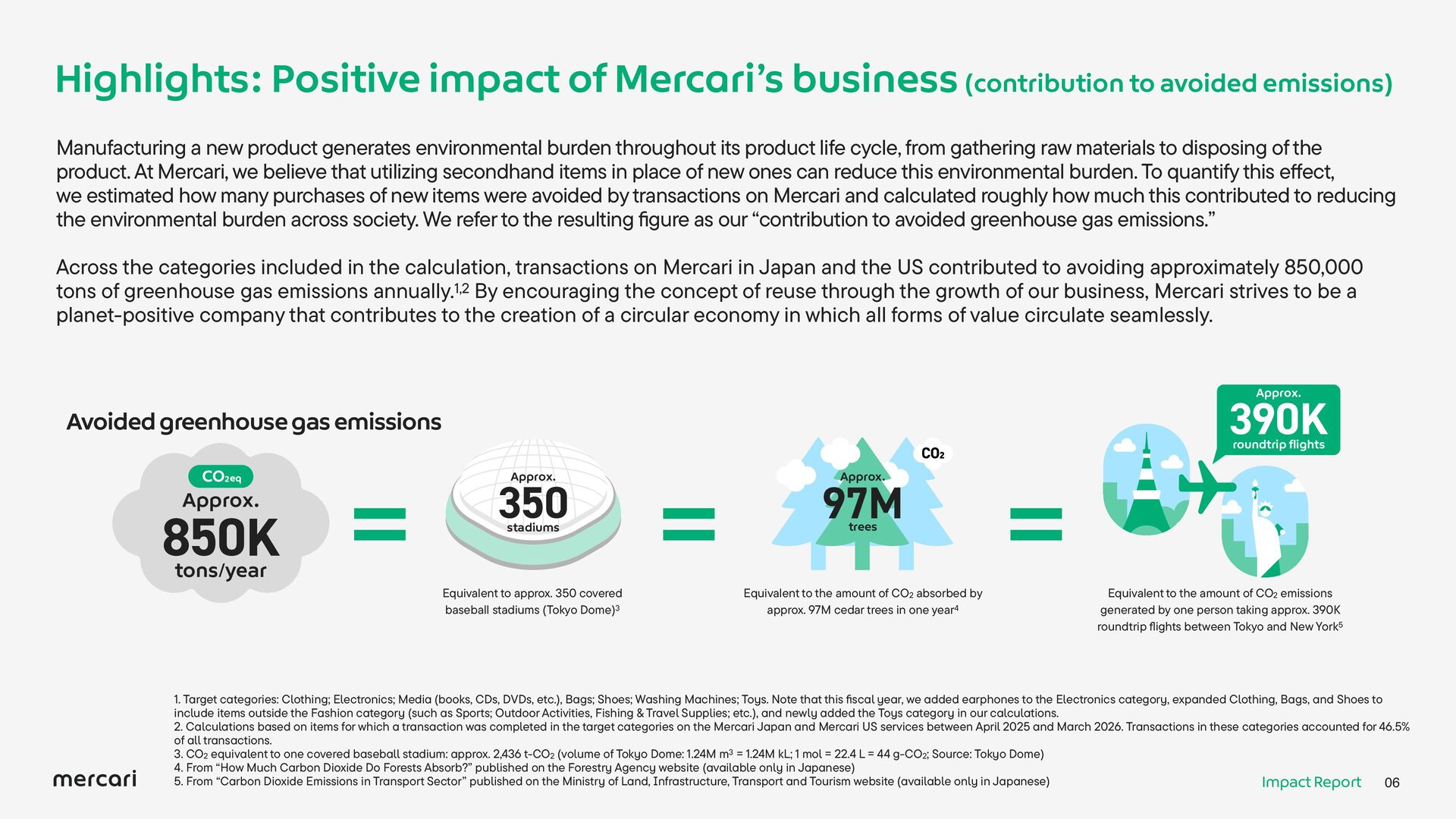
    Manufacturing a new product generates environmental burden throughout its product life cycle, from gathering raw materials to disposing of the product. At Mercari, we believe that utilizing secondhand items in place of new ones can reduce this environmental burden. To quantify this effect, we estimated how many purchases of new items were avoided by transactions on Mercari and calculated roughly how much this contributed to reducing the environmental burden across society. We refer to the resulting figure as our “contribution to avoided greenhouse gas emissions.” Across the categories included in the calculation, transactions on Mercari in Japan and the US contributed to avoiding approximately 850,000 tons of greenhouse gas emissions annually.1,2 By encouraging the concept of reuse through the growth of our business, Mercari strives to be a planet-positive company that contributes to the creation of a circular economy in which all forms of value circulate seamlessly. Approx. 390K Avoided greenhouse gas emissions roundtrip flights Approx. 850 tons/year = Approx. 350 stadiums Equivalent to approx. 350 covered baseball stadiums (Tokyo Dome)3 = Approx. 97M trees Equivalent to the amount of CO2 absorbed by approx. 97M cedar trees in one year4 = Equivalent to the amount of CO2 emissions generated by one person taking approx. 390K roundtrip flights between Tokyo and New York5 1. Target categories: Clothing; Electronics; Media (books, CDs, DVDs, etc.), Bags; Shoes; Washing Machines; Toys. Note that this fiscal year, we added earphones to the Electronics category, expanded Clothing, Bags, and Shoes to include items outside the Fashion category (such as Sports; Outdoor Activities, Fishing & Travel Supplies; etc.), and newly added the Toys category in our calculations. 2. Calculations based on items for which a transaction was completed in the target categories on the Mercari Japan and Mercari US services between April 2025 and March 2026. Transactions in these categories accounted for 46.5% of all transactions. 3. CO2 equivalent to one covered baseball stadium: approx. 2,436 t-CO2 (volume of Tokyo Dome: 1.24M m3 = 1.24M kL; 1 mol = 22.4 L = 44 g-CO2; Source: Tokyo Dome) 4. From “How Much Carbon Dioxide Do Forests Absorb?” published on the Forestry Agency website (available only in Japanese) 5. From “Carbon Dioxide Emissions in Transport Sector” published on the Ministry of Land, Infrastructure, Transport and Tourism website (available only in Japanese) Impact Report 06
  6. Highlights: Achieving Hypergrowth as an AI-Native company In FY2026.6, Mercari

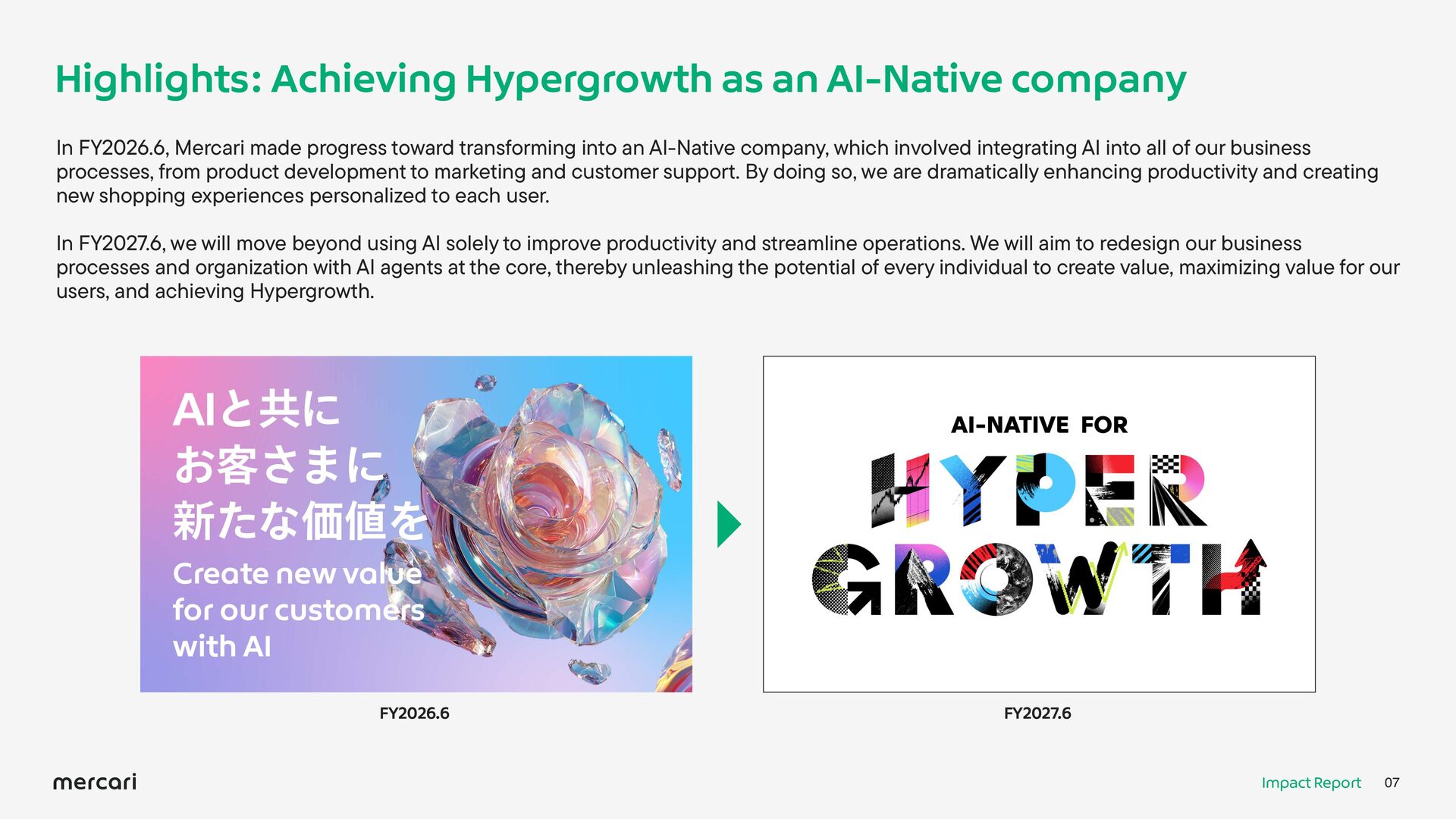
    made progress toward transforming into an AI-Native company, which involved integrating AI into all of our business processes, from product development to marketing and customer support. By doing so, we are dramatically enhancing productivity and creating new shopping experiences personalized to each user. In FY2027.6, we will move beyond using AI solely to improve productivity and streamline operations. We will aim to redesign our business processes and organization with AI agents at the core, thereby unleashing the potential of every individual to create value, maximizing value for our users, and achieving Hypergrowth. AIと共に お客さまに 新たな価値を Create new value for our customers with AI FY2026.6 FY2027.6 Impact Report 07
  7. Highlights: Achieving Hypergrowth as an AI-Native company Integrating AI into

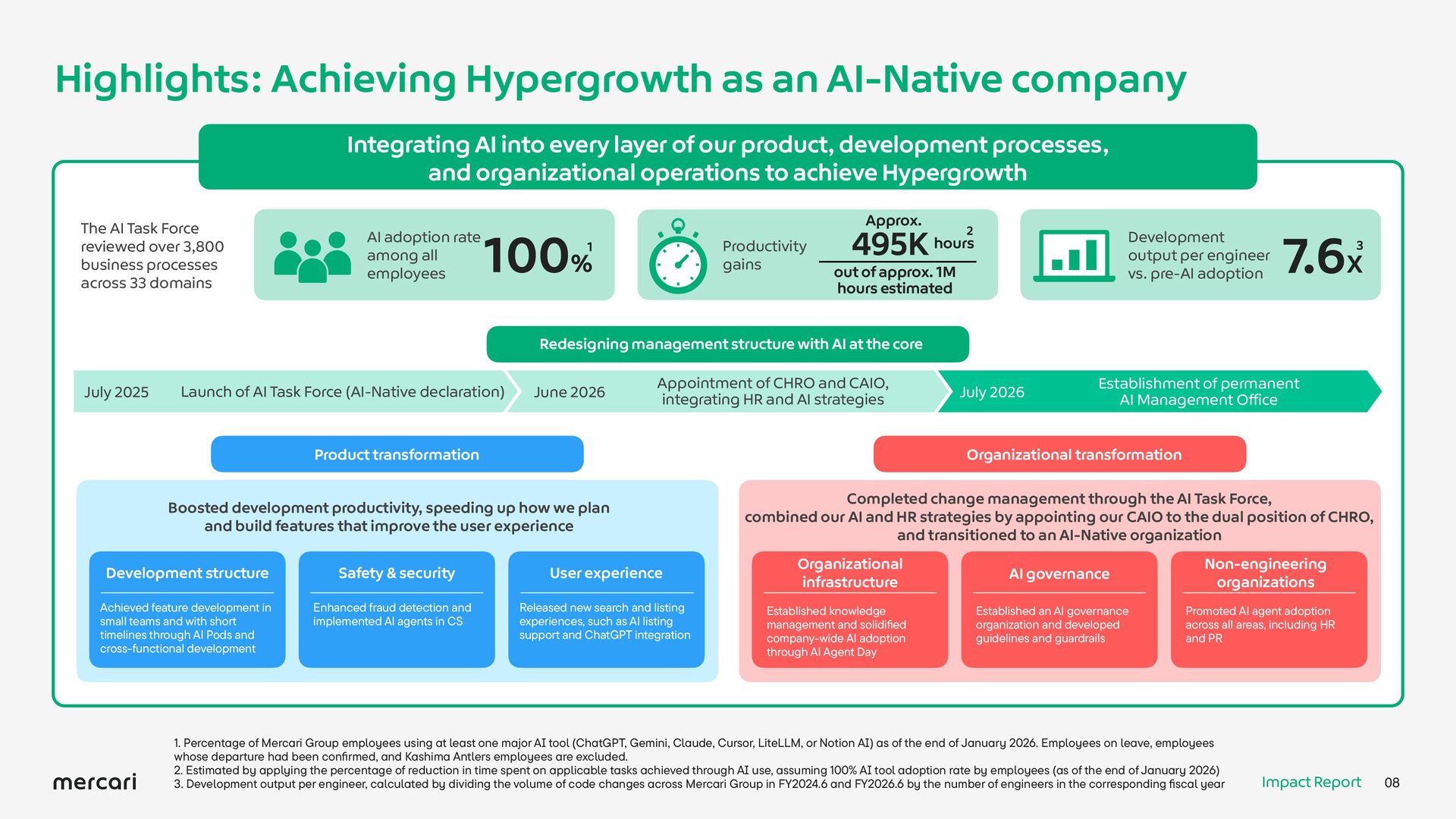
    every layer of our product, development processes, and organizational operations to achieve Hypergrowth The AI Task Force reviewed over 3,800 business processes across 33 domains Approx. AI adoption rate among all employees 100% Productivity gains 1 495K 2 Development output per engineer vs. pre-AI adoption hours out of approx. 1M hours estimated 7.6X 3 Redesigning management structure with AI at the core July 2025 Launch of AI Task Force (AI-Native declaration) June 2026 Appointment of CHRO and CAIO, integrating HR and AI strategies Product transformation July 2026 Establishment of permanent AI Management Office Organizational transformation Boosted development productivity, speeding up how we plan and build features that improve the user experience Development structure Safety & security User experience Achieved feature development in small teams and with short timelines through AI Pods and cross-functional development Enhanced fraud detection and implemented AI agents in CS Released new search and listing experiences, such as AI listing support and ChatGPT integration Completed change management through the AI Task Force, combined our AI and HR strategies by appointing our CAIO to the dual position of CHRO, and transitioned to an AI-Native organization Organizational infrastructure Established knowledge management and solidified company-wide AI adoption through AI Agent Day AI governance Non-engineering organizations Established an AI governance organization and developed guidelines and guardrails Promoted AI agent adoption across all areas, including HR and PR 1. Percentage of Mercari Group employees using at least one major AI tool (ChatGPT, Gemini, Claude, Cursor, LiteLLM, or Notion AI) as of the end of January 2026. Employees on leave, employees whose departure had been confirmed, and Kashima Antlers employees are excluded. 2. Estimated by applying the percentage of reduction in time spent on applicable tasks achieved through AI use, assuming 100% AI tool adoption rate by employees (as of the end of January 2026) 3. Development output per engineer, calculated by dividing the volume of code changes across Mercari Group in FY2024.6 and FY2026.6 by the number of engineers in the corresponding fiscal year Impact Report 08
  8. Highlights: Initiatives for a safe marketplace for all Based on

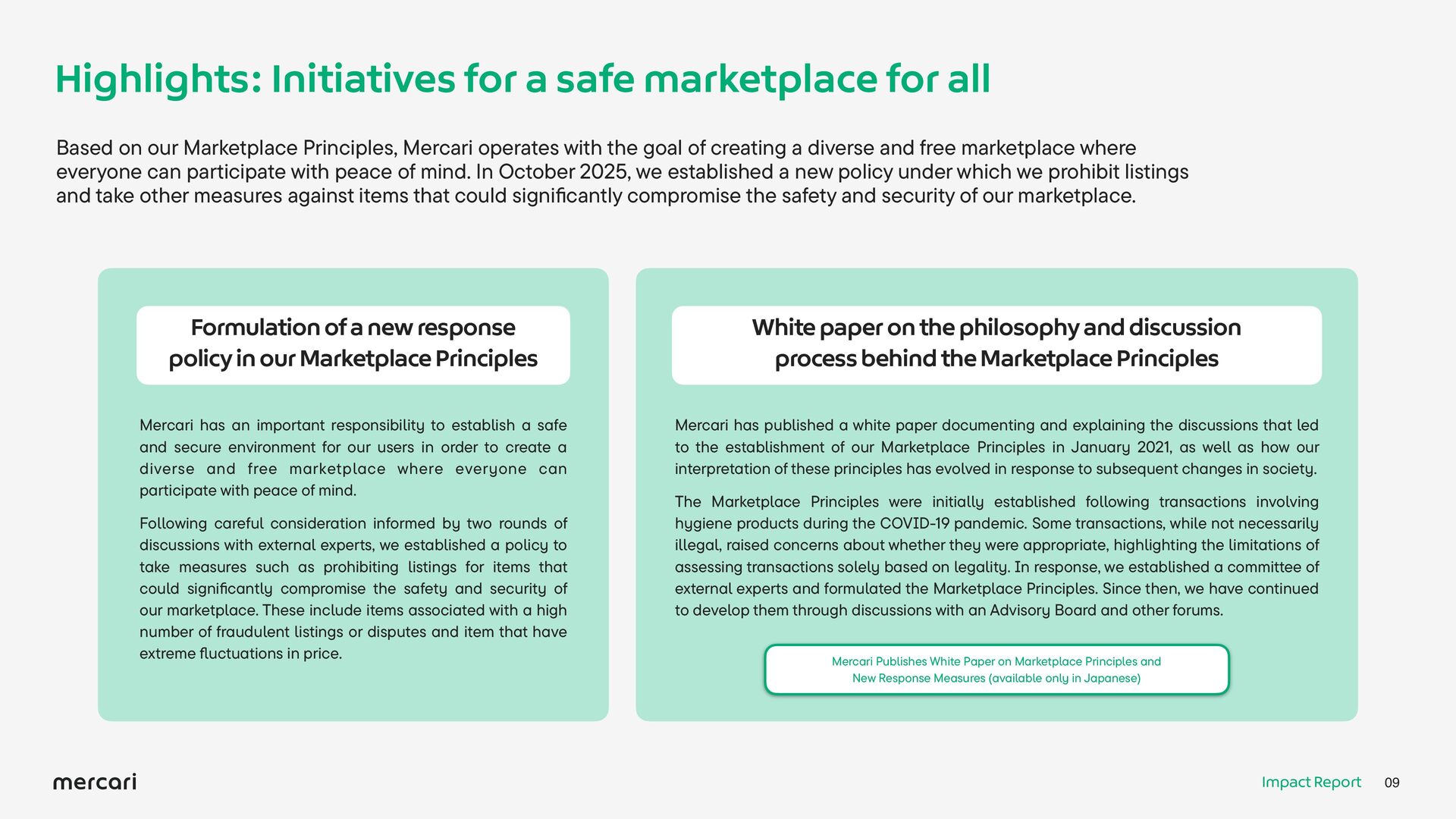
    our Marketplace Principles, Mercari operates with the goal of creating a diverse and free marketplace where everyone can participate with peace of mind. In October 2025, we established a new policy under which we prohibit listings and take other measures against items that could significantly compromise the safety and security of our marketplace. Formulation of a new response policy in our Marketplace Principles White paper on the philosophy and discussion process behind the Marketplace Principles Mercari has an important responsibility to establish a safe and secure environment for our users in order to create a diverse and free marketplace where everyone can participate with peace of mind. Mercari has published a white paper documenting and explaining the discussions that led to the establishment of our Marketplace Principles in January 2021, as well as how our interpretation of these principles has evolved in response to subsequent changes in society. Following careful consideration informed by two rounds of discussions with external experts, we established a policy to take measures such as prohibiting listings for items that could significantly compromise the safety and security of our marketplace. These include items associated with a high number of fraudulent listings or disputes and item that have extreme fluctuations in price. The Marketplace Principles were initially established following transactions involving hygiene products during the COVID-19 pandemic. Some transactions, while not necessarily illegal, raised concerns about whether they were appropriate, highlighting the limitations of assessing transactions solely based on legality. In response, we established a committee of external experts and formulated the Marketplace Principles. Since then, we have continued to develop them through discussions with an Advisory Board and other forums. Mercari Publishes White Paper on Marketplace Principles and New Response Measures (available only in Japanese) Impact Report 09
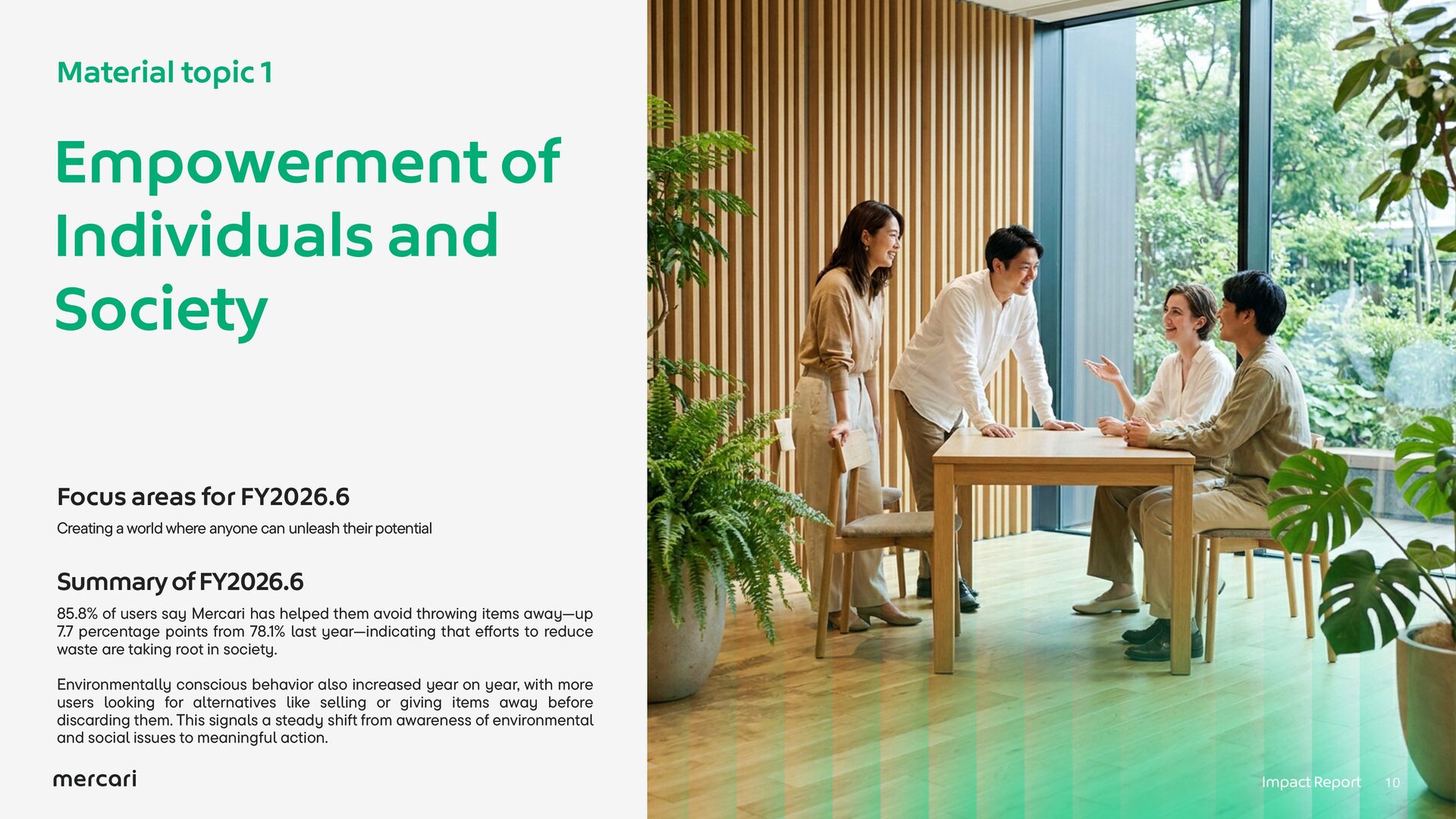
  9. Material topic 1 Empowerment of Individuals and Society Focus areas

    for FY2026.6 Creating a world where anyone can unleash their potential Summary of FY2026.6 85.8% of users say Mercari has helped them avoid throwing items away—up 7.7 percentage points from 78.1% last year—indicating that efforts to reduce waste are taking root in society. Environmentally conscious behavior also increased year on year, with more users looking for alternatives like selling or giving items away before discarding them. This signals a steady shift from awareness of environmental and social issues to meaningful action. Impact Report 10
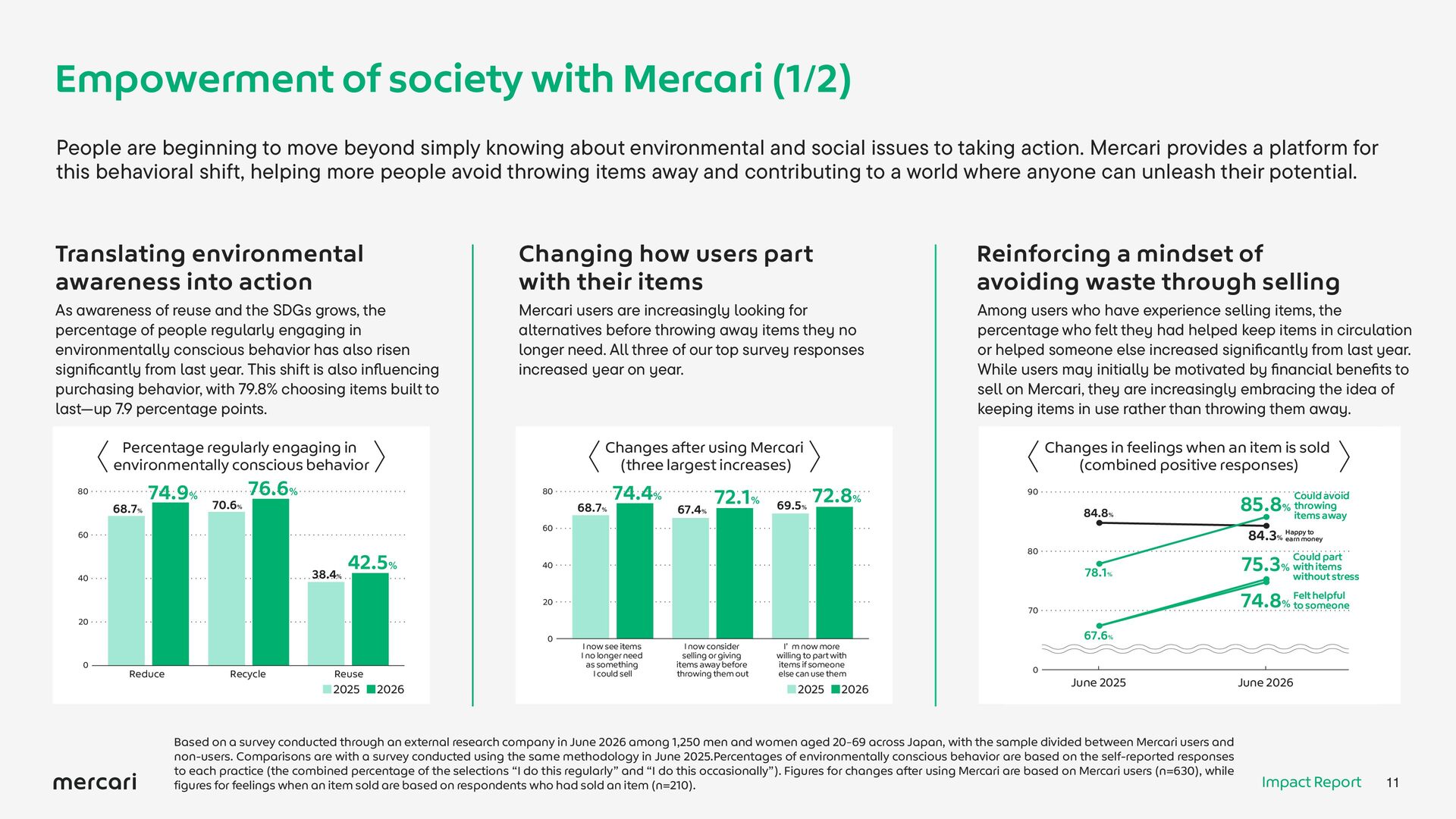
  10. Empowerment of society with Mercari (1/2) People are beginning to

    move beyond simply knowing about environmental and social issues to taking action. Mercari provides a platform for this behavioral shift, helping more people avoid throwing items away and contributing to a world where anyone can unleash their potential. Translating environmental awareness into action Changing how users part with their items Reinforcing a mindset of avoiding waste through selling As awareness of reuse and the SDGs grows, the percentage of people regularly engaging in environmentally conscious behavior has also risen significantly from last year. This shift is also influencing purchasing behavior, with 79.8% choosing items built to last—up 7.9 percentage points. Mercari users are increasingly looking for alternatives before throwing away items they no longer need. All three of our top survey responses increased year on year. Among users who have experience selling items, the percentage who felt they had helped keep items in circulation or helped someone else increased significantly from last year. While users may initially be motivated by financial benefits to sell on Mercari, they are increasingly embracing the idea of keeping items in use rather than throwing them away. Percentage regularly engaging in environmentally conscious behavior 80 68.7% 74.9% 70.6% Changes after using Merc ri (three largest increases) 76.6% 80 68.7% 74.4% 67.4% 72.1% Changes in feelings when an item is sold (combined positive responses) 72.8% 69.5 % 84.8% 60 60 38.4% 40 42.5% 40 78.1% 0 Reduce Recycle Reuse 2025 2026 I now see items I no longer need as something I could sell I now consider selling or giving items away before throwing them out Iʼ m now more willing to part with items if someone else can use them 2025 2026 Could part % with items without stress 75.3 helpful 74.8% Felt to someone 70 20 85.8 Could avoid % throwing items away to 84.3% Happy earn money 80 20 0 90 67.6% 0 June 2025 Based on a survey conducted through an external research company in June 2026 among 1,250 men and women aged 20‒69 across Japan, with the sample divided between Mercari users and non-users. Comparisons are with a survey conducted using the same methodology in June 2025.Percentages of environmentally conscious behavior are based on the self-reported responses to each practice (the combined percentage of the selections “I do this regularly” and “I do this occasionally”). Figures for changes after using Mercari are based on Mercari users (n=630), while figures for feelings when an item sold are based on respondents who had sold an item (n=210). June 2026 Impact Report 11
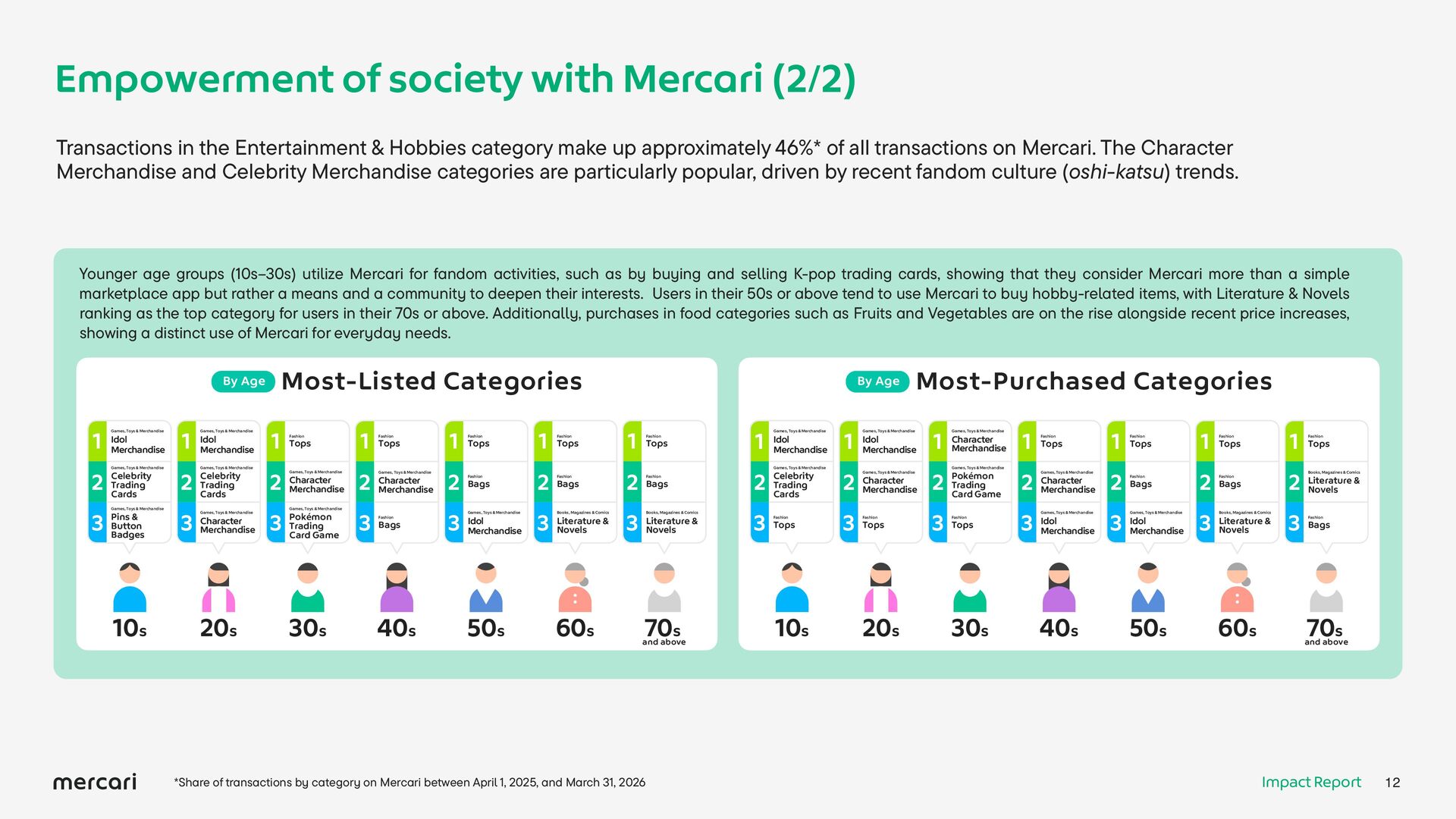
  11. Empowerment of society with Mercari (2/2) Transactions in the Entertainment

    & Hobbies category make up approximately 46%* of all transactions on Mercari. The Character Merchandise and Celebrity Merchandise categories are particularly popular, driven by recent fandom culture (oshi-katsu) trends. Younger age groups (10s–30s) utilize Mercari for fandom activities, such as by buying and selling K-pop trading cards, showing that they consider Mercari more than a simple marketplace app but rather a means and a community to deepen their interests. Users in their 50s or above tend to use Mercari to buy hobby-related items, with Literature & Novels ranking as the top category for users in their 70s or above. Additionally, purchases in food categories such as Fruits and Vegetables are on the rise alongside recent price increases, showing a distinct use of Mercari for everyday needs. By Age 1 2 3 Games, Toys & Merchandise Idol Merchandise Games, Toys & Merchandise Celebrity Trading Cards Games, Toys & Merchandise Pins & Button Badges 10s 1 2 3 Games, Toys & Merchandise Idol Merchandise Games, Toys & Merchandise Celebrity Trading Cards Games, Toys & Merchandise Character Merchandise 20s Most-Listed Categories By Age 1 Tops 1 Tops 1 Tops 1 Tops 1 Tops 1 Idol Merchandise 2 Character Merchandise 2 2 Bags 2 Bags 2 Bags 2 Celebrity Trading Cards 3 Pokémon Trading Card Game 3 3 3 3 Fashion Games, Toys & Merchandise Games, Toys & Merchandise 30s Fashion 3 Games, Toys & Merchandise Character Merchandise Fashion Bags 40s Fashion Fashion Games, Toys & Merchandise Idol Merchandise 50s Fashion Fashion Books, Magazines & Comics Literature & Novels 60s Fashion Fashion Books, Magazines & Comics Literature & Novels 70s and above *Share of transactions by category on Mercari between April 1, 2025, and March 31, 2026 Games, Toys & Merchandise Games, Toys & Merchandise Fashion Tops 10s 1 2 3 Most-Purchased Categories Games, Toys & Merchandise Idol Merchandise Games, Toys & Merchandise Character Merchandise Fashion Tops 20s 1 Character 1 Tops Merchandise 1 Tops 1 Tops 1 Tops 2 Games, Toys & Merchandise 2 Bags 2 Bags & 2 Literature Novels 3 Games, Toys & Merchandise 3 3 3 Bags Games, Toys & Merchandise 2 3 Games, Toys & Merchandise Pokémon Trading Card Game Fashion Tops 30s Fashion Character Merchandise Idol Merchandise 40s Fashion Fashion Games, Toys & Merchandise Idol Merchandise 50s Fashion Fashion Books, Magazines & Comics Fashion Books, Magazines & Comics Literature & Novels 60s Fashion 70s and above Impact Report 12
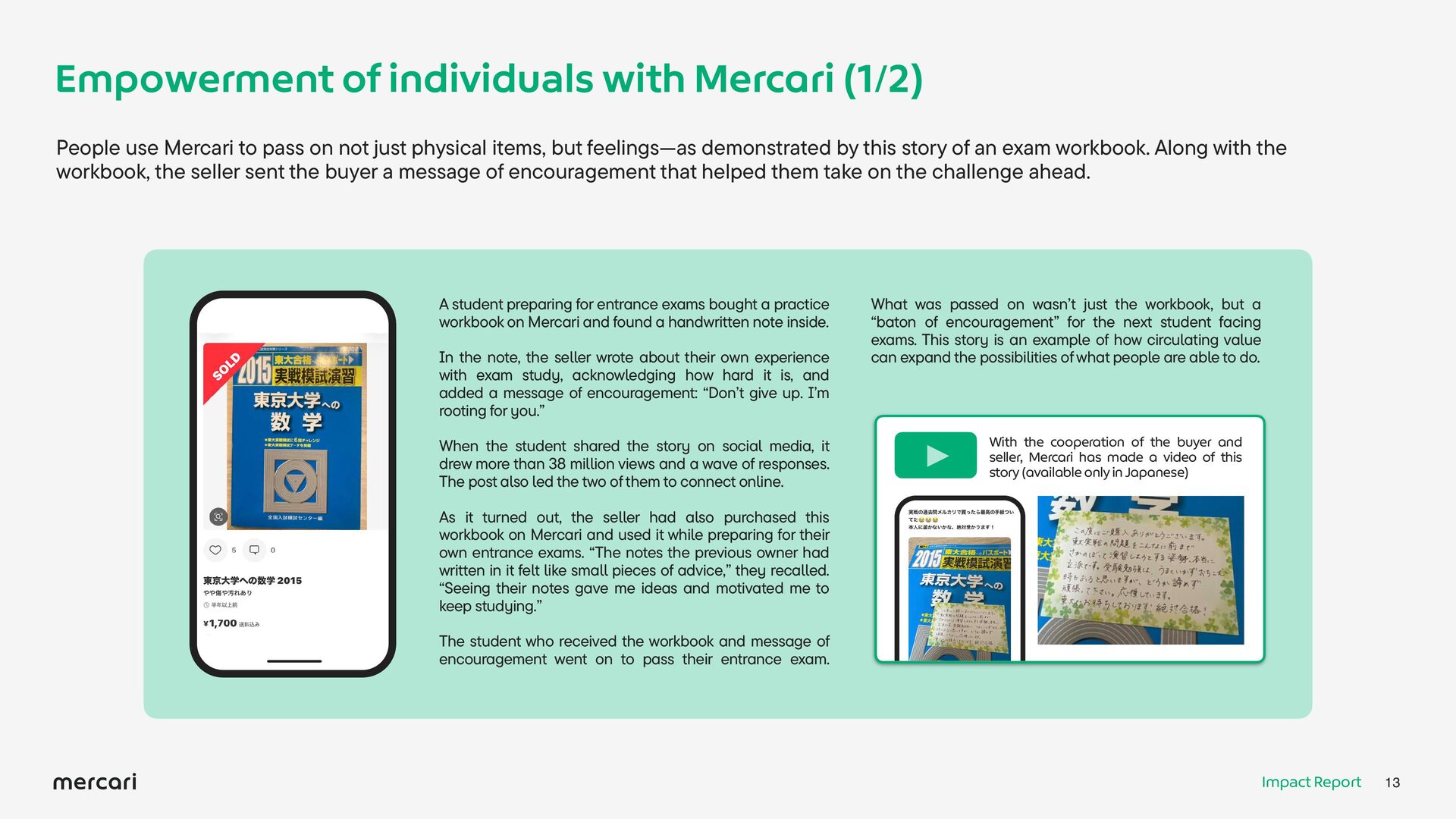
  12. Empowerment of individuals with Mercari (1/2) People use Mercari to

    pass on not just physical items, but feelings—as demonstrated by this story of an exam workbook. Along with the workbook, the seller sent the buyer a message of encouragement that helped them take on the challenge ahead. A student preparing for entrance exams bought a practice workbook on Mercari and found a handwritten note inside. In the note, the seller wrote about their own experience with exam study, acknowledging how hard it is, and added a message of encouragement: “Don’t give up. I’m rooting for you.” When the student shared the story on social media, it drew more than 38 million views and a wave of responses. The post also led the two of them to connect online. What was passed on wasn’t just the workbook, but a “baton of encouragement” for the next student facing exams. This story is an example of how circulating value can expand the possibilities of what people are able to do. With the cooperation of the buyer and seller, Mercari has made a video of this story (available only in Japanese) As it turned out, the seller had also purchased this workbook on Mercari and used it while preparing for their own entrance exams. “The notes the previous owner had written in it felt like small pieces of advice,” they recalled. “Seeing their notes gave me ideas and motivated me to keep studying.” The student who received the workbook and message of encouragement went on to pass their entrance exam. Impact Report 13
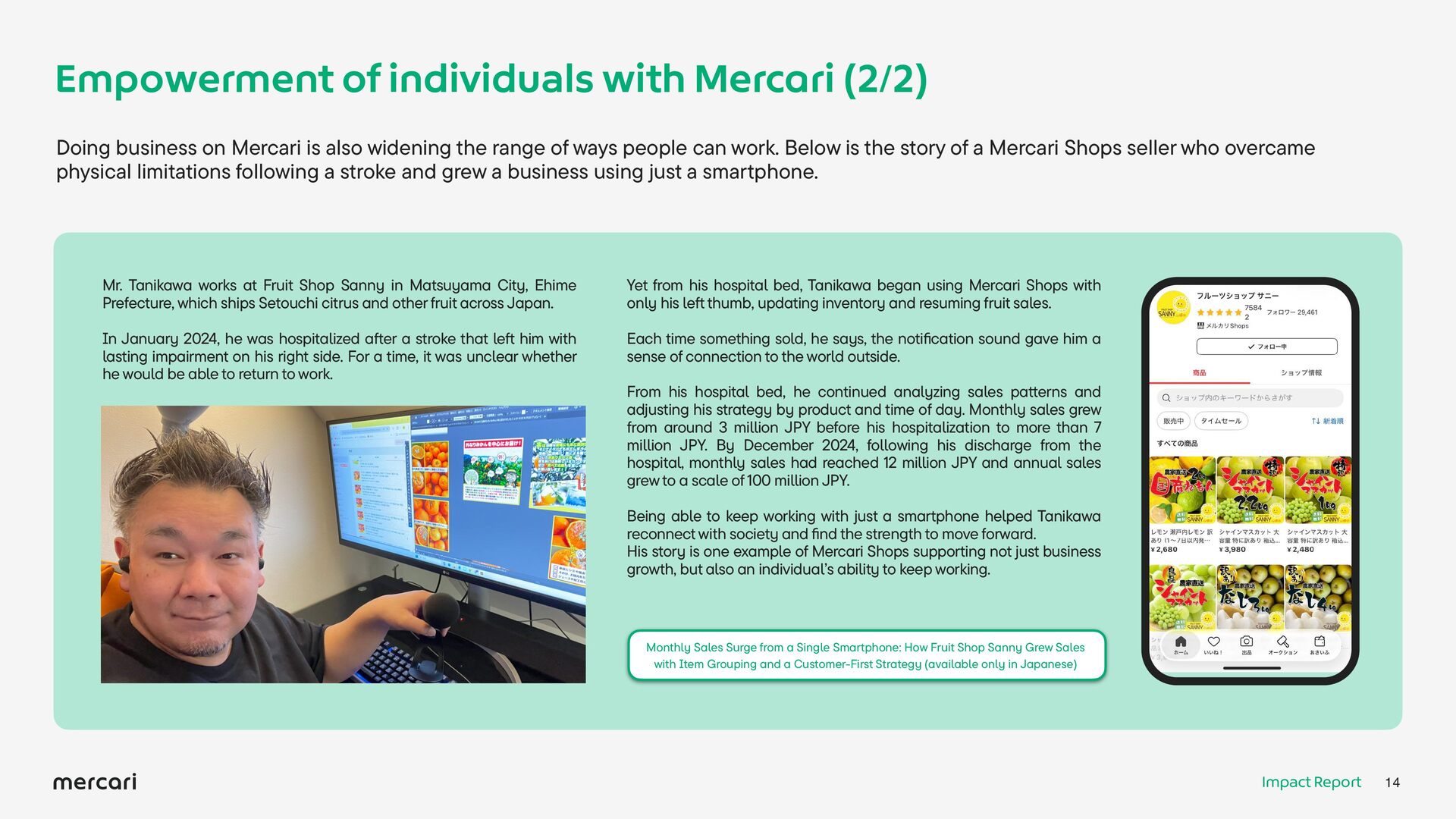
  13. Empowerment of individuals with Mercari (2/2) Doing business on Mercari

    is also widening the range of ways people can work. Below is the story of a Mercari Shops seller who overcame physical limitations following a stroke and grew a business using just a smartphone. Mr. Tanikawa works at Fruit Shop Sanny in Matsuyama City, Ehime Prefecture, which ships Setouchi citrus and other fruit across Japan. Yet from his hospital bed, Tanikawa began using Mercari Shops with only his left thumb, updating inventory and resuming fruit sales. In January 2024, he was hospitalized after a stroke that left him with lasting impairment on his right side. For a time, it was unclear whether he would be able to return to work. Each time something sold, he says, the notification sound gave him a sense of connection to the world outside. From his hospital bed, he continued analyzing sales patterns and adjusting his strategy by product and time of day. Monthly sales grew from around 3 million JPY before his hospitalization to more than 7 million JPY. By December 2024, following his discharge from the hospital, monthly sales had reached 12 million JPY and annual sales grew to a scale of 100 million JPY. Being able to keep working with just a smartphone helped Tanikawa reconnect with society and find the strength to move forward. His story is one example of Mercari Shops supporting not just business growth, but also an individual’s ability to keep working. Monthly Sales Surge from a Single Smartphone: How Fruit Shop Sanny Grew Sales with Item Grouping and a Customer-First Strategy (available only in Japanese) Impact Report 14
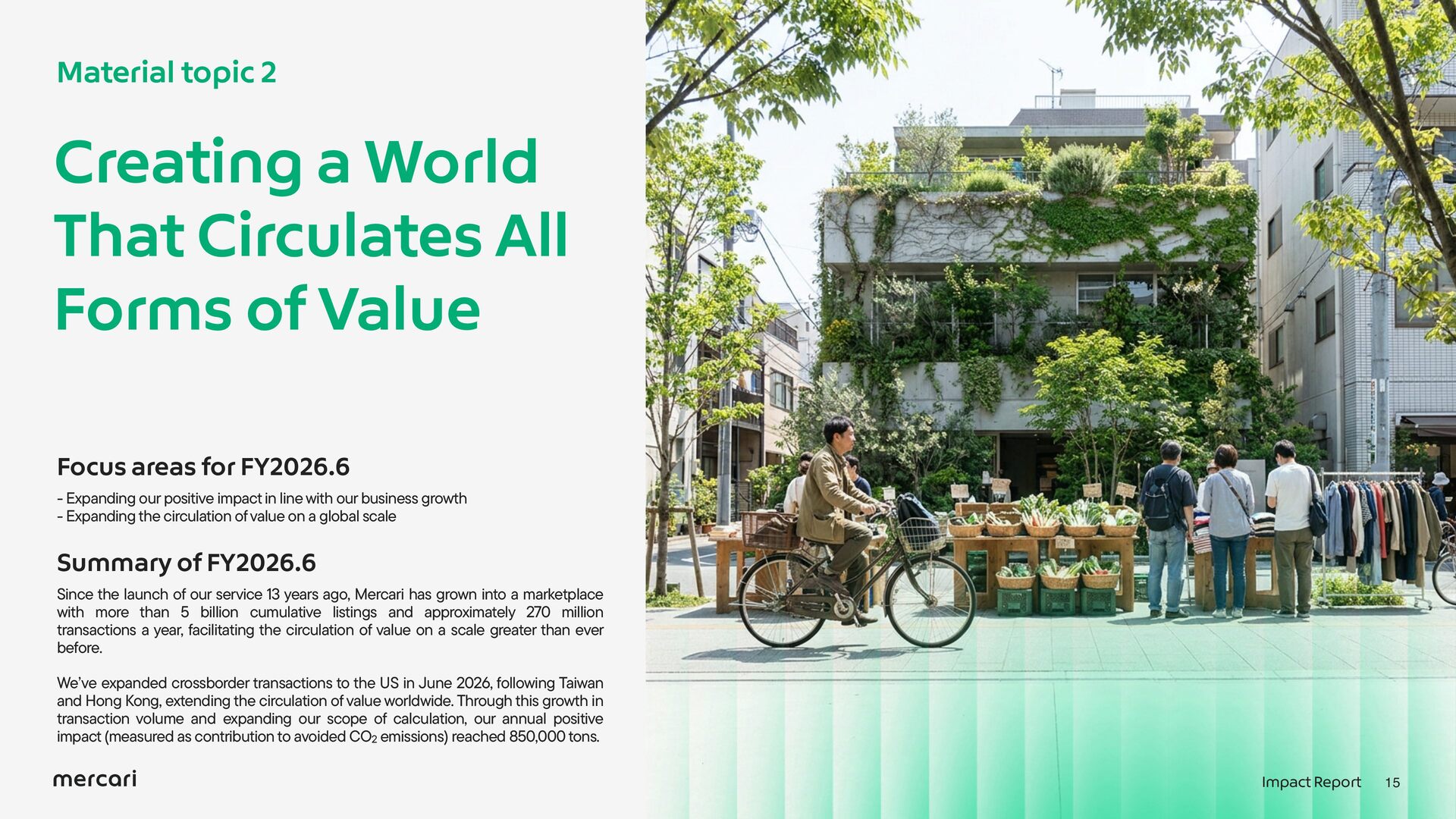
  14. Material topic 2 Creating a World That Circulates All Forms

    of Value Focus areas for FY2026.6 - Expanding our positive impact in line with our business growth - Expanding the circulation of value on a global scale Summary of FY2026.6 Since the launch of our service 13 years ago, Mercari has grown into a marketplace with more than 5 billion cumulative listings and approximately 270 million transactions a year, facilitating the circulation of value on a scale greater than ever before. We’ve expanded crossborder transactions to the US in June 2026, following Taiwan and Hong Kong, extending the circulation of value worldwide. Through this growth in transaction volume and expanding our scope of calculation, our annual positive impact (measured as contribution to avoided CO2 emissions) reached 850,000 tons. Impact Report 15
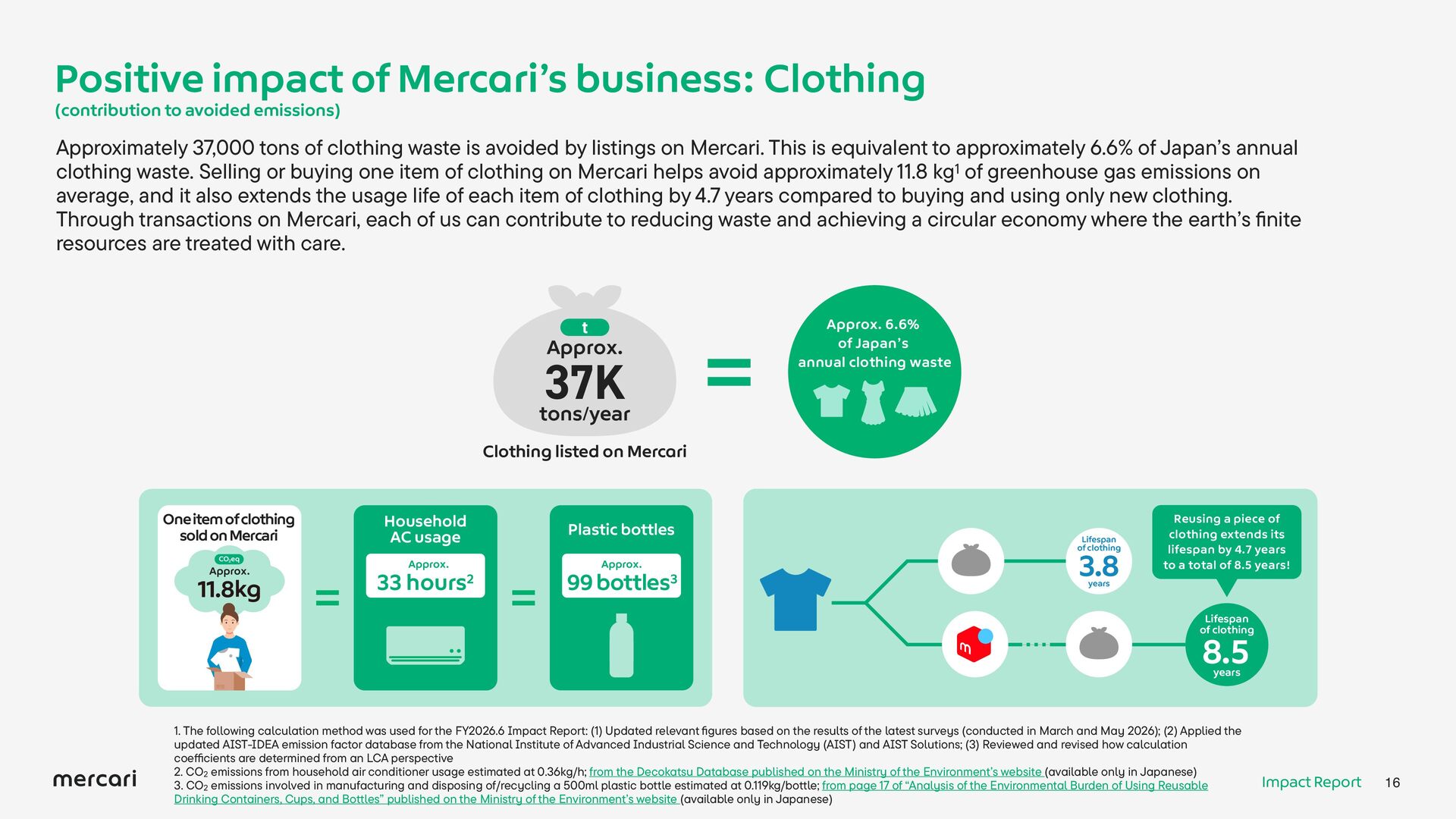
  15. Positive impact of Mercariʼs business: Clothing (contribution to avoided emissions)

    Approximately 37,000 tons of clothing waste is avoided by listings on Mercari. This is equivalent to approximately 6.6% of Japan’s annual clothing waste. Selling or buying one item of clothing on Mercari helps avoid approximately 11.8 kg1 of greenhouse gas emissions on average, and it also extends the usage life of each item of clothing by 4.7 years compared to buying and using only new clothing. Through transactions on Mercari, each of us can contribute to reducing waste and achieving a circular economy where the earth’s finite resources are treated with care. t Approx. = 37K tons/year Approx. 6.6% of Japanʼs annual clothing waste Clothing listed on Mercari One item of clothing sold on Mercari Household AC usage Plastic bottles CO2eq Approx. Approx. Approx. 11.8kg 33 hours 2 99 bottles 3 Lifespan of clothing 3.8 Reusing a piece of clothing extends its lifespan by 4.7 years to a total of 8.5 years! years Lifespan of clothing 8.5 years 1. The following calculation method was used for the FY2026.6 Impact Report: (1) Updated relevant figures based on the results of the latest surveys (conducted in March and May 2026); (2) Applied the updated AIST-IDEA emission factor database from the National Institute of Advanced Industrial Science and Technology (AIST) and AIST Solutions; (3) Reviewed and revised how calculation coefficients are determined from an LCA perspective 2. CO2 emissions from household air conditioner usage estimated at 0.36kg/h; from the Decokatsu Database published on the Ministry of the Environment’s website (available only in Japanese) 3. CO2 emissions involved in manufacturing and disposing of/recycling a 500ml plastic bottle estimated at 0.119kg/bottle; from page 17 of “Analysis of the Environmental Burden of Using Reusable Drinking Containers, Cups, and Bottles” published on the Ministry of the Environment’s website (available only in Japanese) Impact Report 16
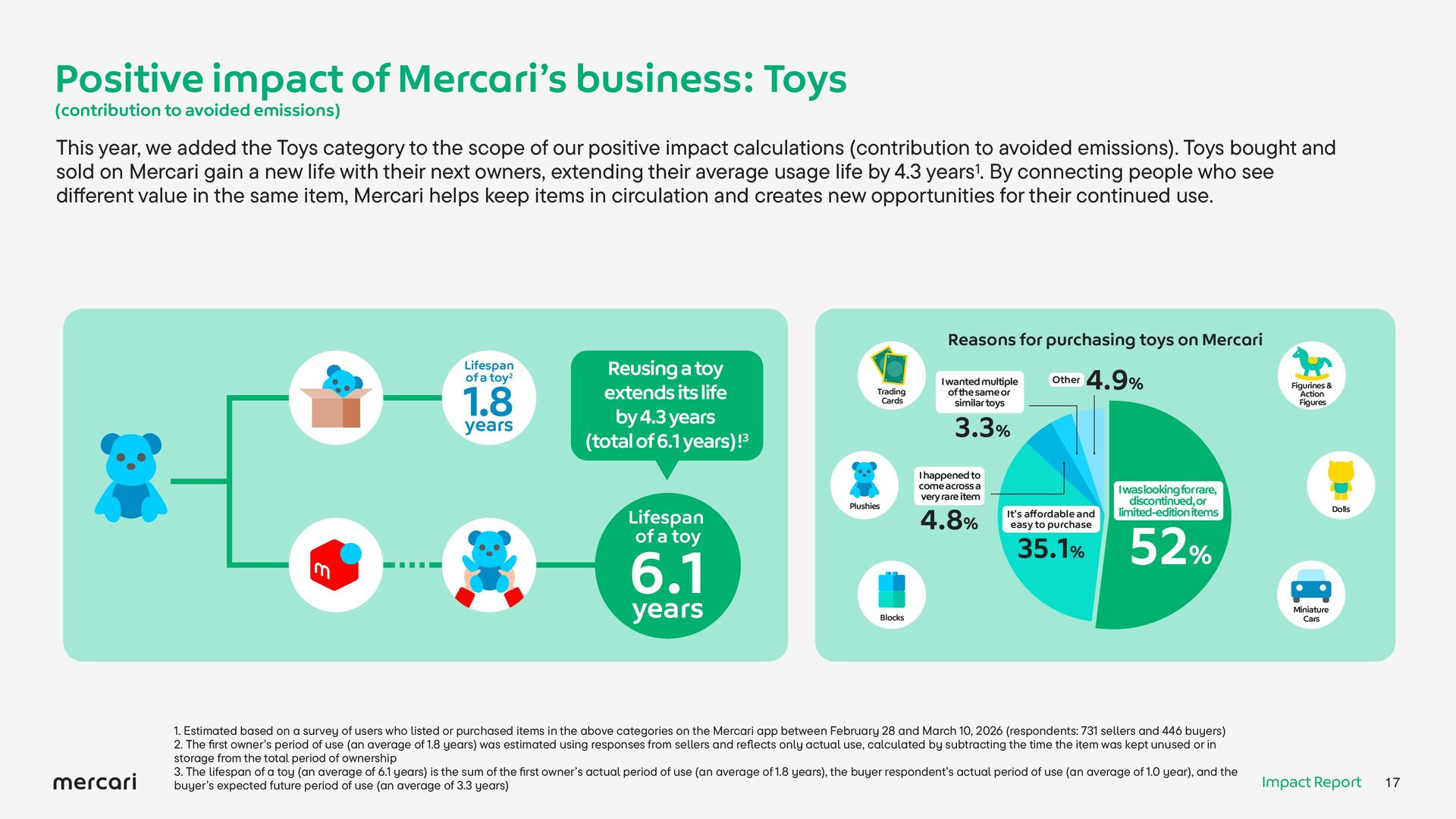
  16. Positive impact of Mercariʼs business: Toys (contribution to avoided emissions)

    This year, we added the Toys category to the scope of our positive impact calculations (contribution to avoided emissions). Toys bought and sold on Mercari gain a new life with their next owners, extending their average usage life by 4.3 years1. By connecting people who see different value in the same item, Mercari helps keep items in circulation and creates new opportunities for their continued use. Reasons for purchasing toys on Merc ri Lifespan of a toy2 1.8 years Reusing a toy extends its life by 4.3 years (total of 6.1 years)!3 Lifespan of a toy 6.1 years Trading Cards I wanted multiple of the same or similar toys Other 4.9% Figurines & Action Figures 3.3% Plushies I happened to come across a very rare item 4.8% Itʼs affordable and easy to purchase 35.1% I was looking for rare, discontinued, or limited-edition items Dolls 52% Blocks 1. Estimated based on a survey of users who listed or purchased items in the above categories on the Mercari app between February 28 and March 10, 2026 (respondents: 731 sellers and 446 buyers) 2. The first owner’s period of use (an average of 1.8 years) was estimated using responses from sellers and reflects only actual use, calculated by subtracting the time the item was kept unused or in storage from the total period of ownership 3. The lifespan of a toy (an average of 6.1 years) is the sum of the first owner’s actual period of use (an average of 1.8 years), the buyer respondent’s actual period of use (an average of 1.0 year), and the buyer’s expected future period of use (an average of 3.3 years) Miniature Cars Impact Report 17
  17. Negative impact of Mercariʼs business (greenhouse gas emissions) Amount of

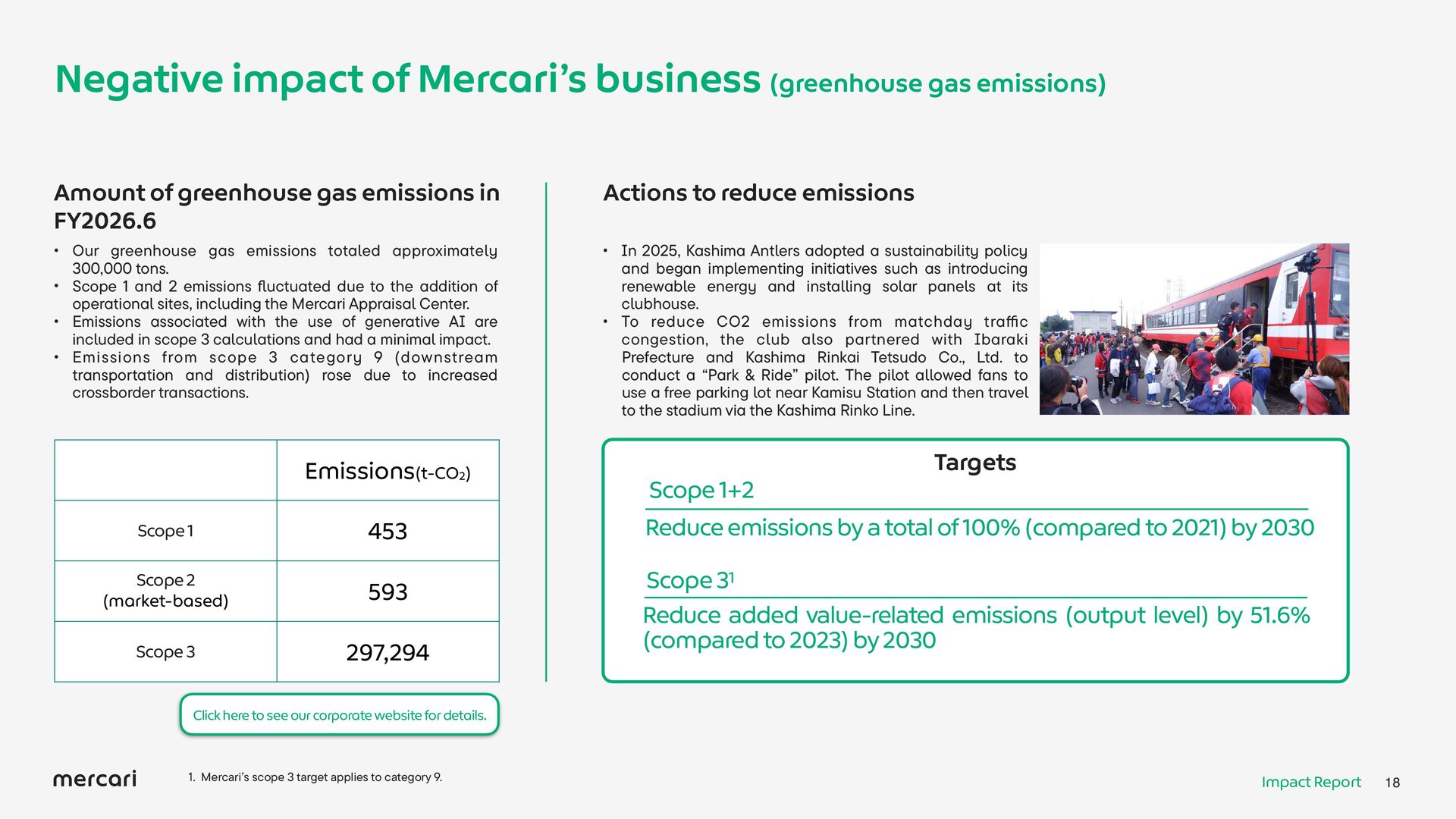
    greenhouse gas emissions in FY2026.6 Actions to reduce emissions • Our greenhouse gas emissions totaled approximately 300,000 tons. • Scope 1 and 2 emissions fluctuated due to the addition of operational sites, including the Mercari Appraisal Center. • Emissions associated with the use of generative AI are included in scope 3 calculations and had a minimal impact. • Emissions from scope 3 category 9 (downstream transportation and distribution) rose due to increased crossborder transactions. • In 2025, Kashima Antlers adopted a sustainability policy and began implementing initiatives such as introducing renewable energy and installing solar panels at its clubhouse. • To reduce CO2 emissions from matchday traffic congestion, the club also partnered with Ibaraki Prefecture and Kashima Rinkai Tetsudo Co., Ltd. to conduct a “Park & Ride” pilot. The pilot allowed fans to use a free parking lot near Kamisu Station and then travel to the stadium via the Kashima Rinko Line. Emissions(t-CO2) Scope 1 453 Scope 2 (market-based) 593 Scope 3 297,294 Targets Scope 1+2 Reduce emissions by a total of 100% (compared to 2021) by 2030 Scope 31 Reduce added value-related emissions (output level) by 51.6% (compared to 2023) by 2030 Click here to see our corporate website for details. 1. Mercari’s scope 3 target applies to category 9. Impact Report 18
  18. Expanding the circulation of all forms of value (1/2) In

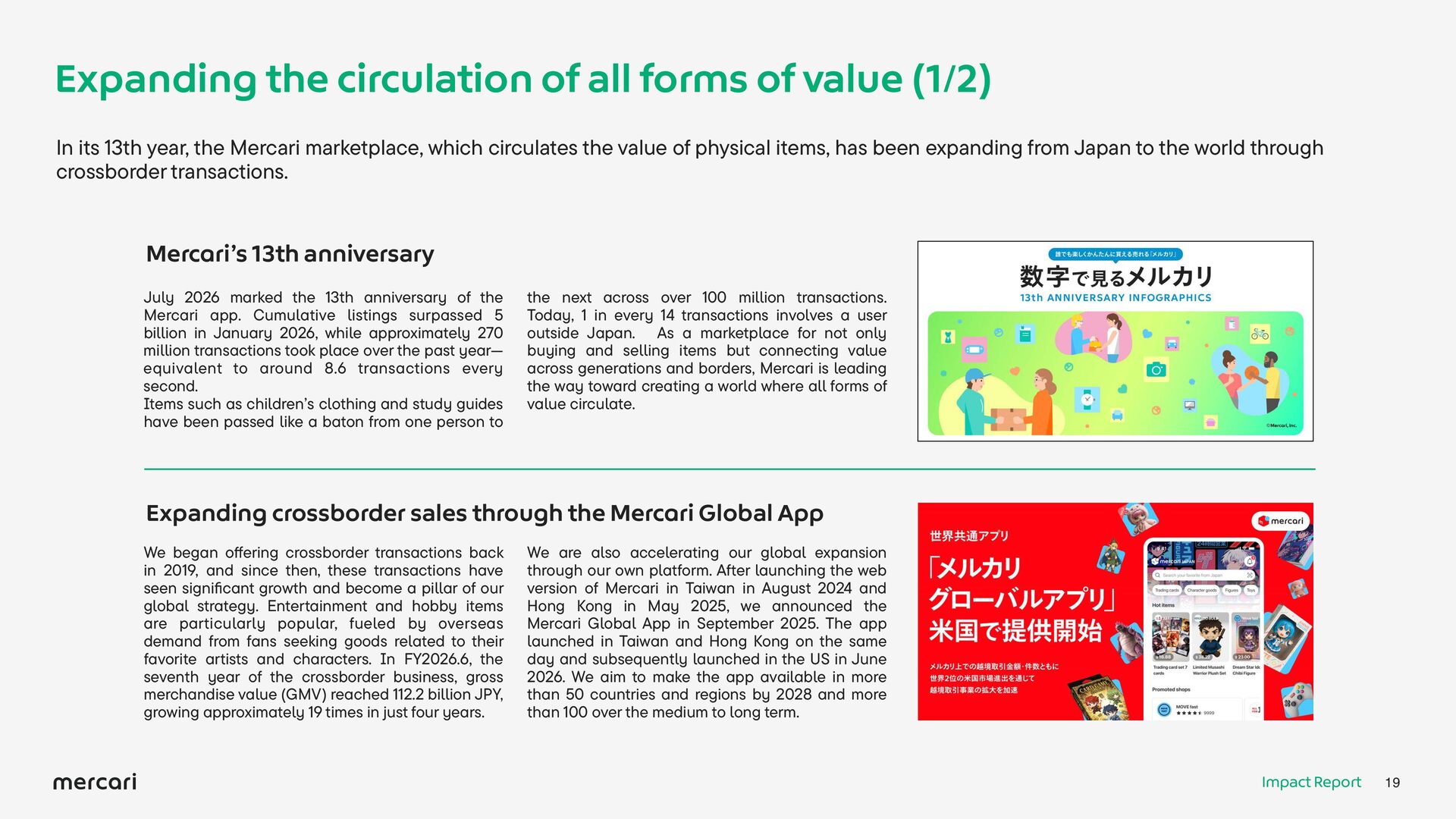
    its 13th year, the Mercari marketplace, which circulates the value of physical items, has been expanding from Japan to the world through crossborder transactions. Mercariʼs 13th anniversary July 2026 marked the 13th anniversary of the Mercari app. Cumulative listings surpassed 5 billion in January 2026, while approximately 270 million transactions took place over the past year— equivalent to around 8.6 transactions every second. Items such as children’s clothing and study guides have been passed like a baton from one person to the next across over 100 million transactions. Today, 1 in every 14 transactions involves a user outside Japan. As a marketplace for not only buying and selling items but connecting value across generations and borders, Mercari is leading the way toward creating a world where all forms of value circulate. Expanding crossborder sales through the Mercari Global App We began offering crossborder transactions back in 2019, and since then, these transactions have seen significant growth and become a pillar of our global strategy. Entertainment and hobby items are particularly popular, fueled by overseas demand from fans seeking goods related to their favorite artists and characters. In FY2026.6, the seventh year of the crossborder business, gross merchandise value (GMV) reached 112.2 billion JPY, growing approximately 19 times in just four years. We are also accelerating our global expansion through our own platform. After launching the web version of Mercari in Taiwan in August 2024 and Hong Kong in May 2025, we announced the Mercari Global App in September 2025. The app launched in Taiwan and Hong Kong on the same day and subsequently launched in the US in June 2026. We aim to make the app available in more than 50 countries and regions by 2028 and more than 100 over the medium to long term. Impact Report 19
  19. Expanding the circulation of all forms of value (2/2) Through

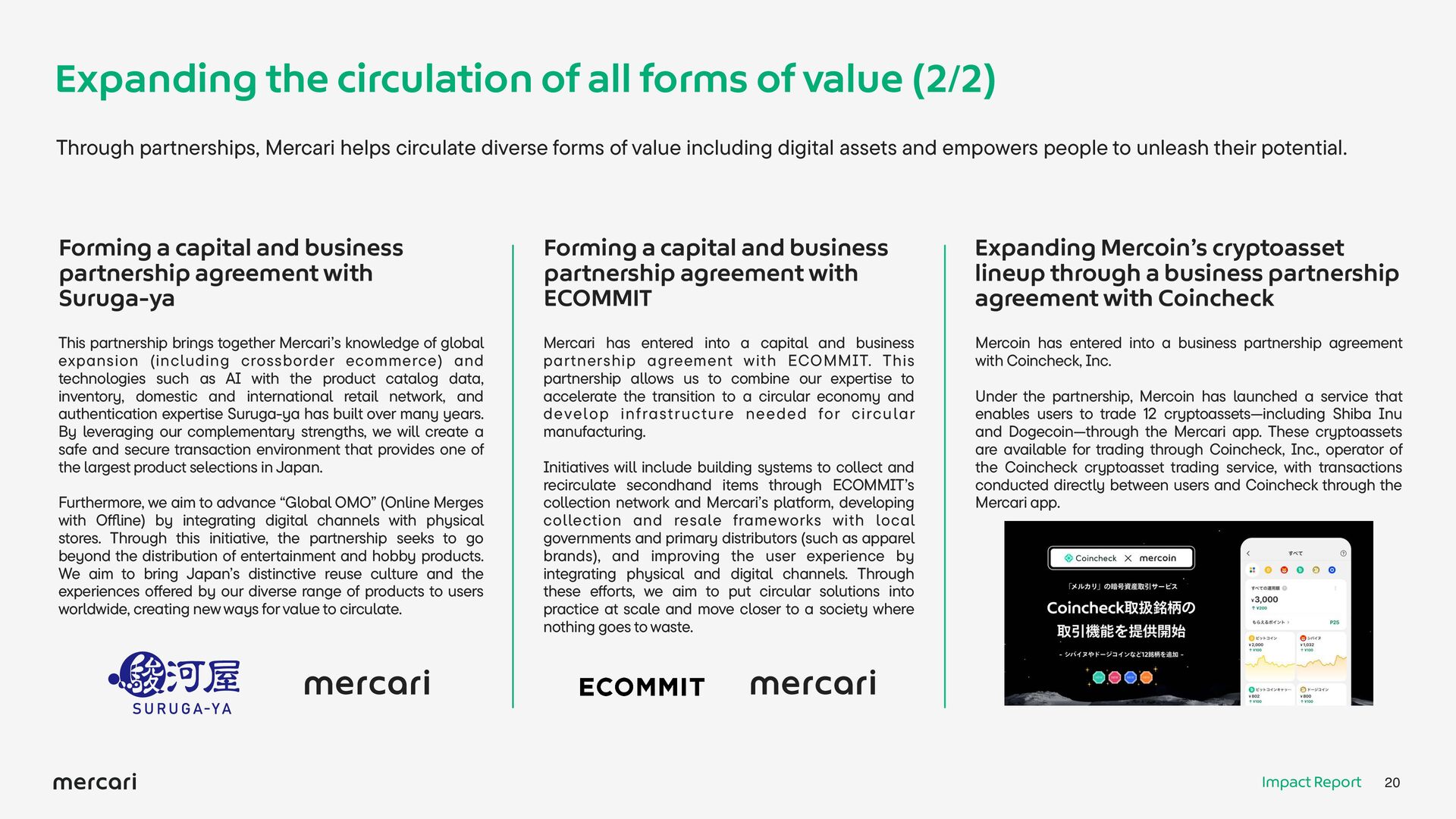
    partnerships, Mercari helps circulate diverse forms of value including digital assets and empowers people to unleash their potential. Forming a capital and business partnership agreement with Suruga-ya Forming a capital and business partnership agreement with ECOMMIT Expanding Mercoinʼs cryptoasset lineup through a business partnership agreement with Coincheck This partnership brings together Mercari’s knowledge of global expansion (including crossborder ecommerce) and technologies such as AI with the product catalog data, inventory, domestic and international retail network, and authentication expertise Suruga-ya has built over many years. By leveraging our complementary strengths, we will create a safe and secure transaction environment that provides one of the largest product selections in Japan. Mercari has entered into a capital and business partnership agreement with ECOMMIT. This partnership allows us to combine our expertise to accelerate the transition to a circular economy and develop infrastructure needed for circular manufacturing. Mercoin has entered into a business partnership agreement with Coincheck, Inc. Furthermore, we aim to advance “Global OMO” (Online Merges with Offline) by integrating digital channels with physical stores. Through this initiative, the partnership seeks to go beyond the distribution of entertainment and hobby products. We aim to bring Japan’s distinctive reuse culture and the experiences offered by our diverse range of products to users worldwide, creating new ways for value to circulate. Initiatives will include building systems to collect and recirculate secondhand items through ECOMMIT’s collection network and Mercari’s platform, developing collection and resale frameworks with local governments and primary distributors (such as apparel brands), and improving the user experience by integrating physical and digital channels. Through these efforts, we aim to put circular solutions into practice at scale and move closer to a society where nothing goes to waste. Under the partnership, Mercoin has launched a service that enables users to trade 12 cryptoassets—including Shiba Inu and Dogecoin—through the Mercari app. These cryptoassets are available for trading through Coincheck, Inc., operator of the Coincheck cryptoasset trading service, with transactions conducted directly between users and Coincheck through the Mercari app. Impact Report 20
  20. Material topic 3 Creating a New User Experience Through Technology

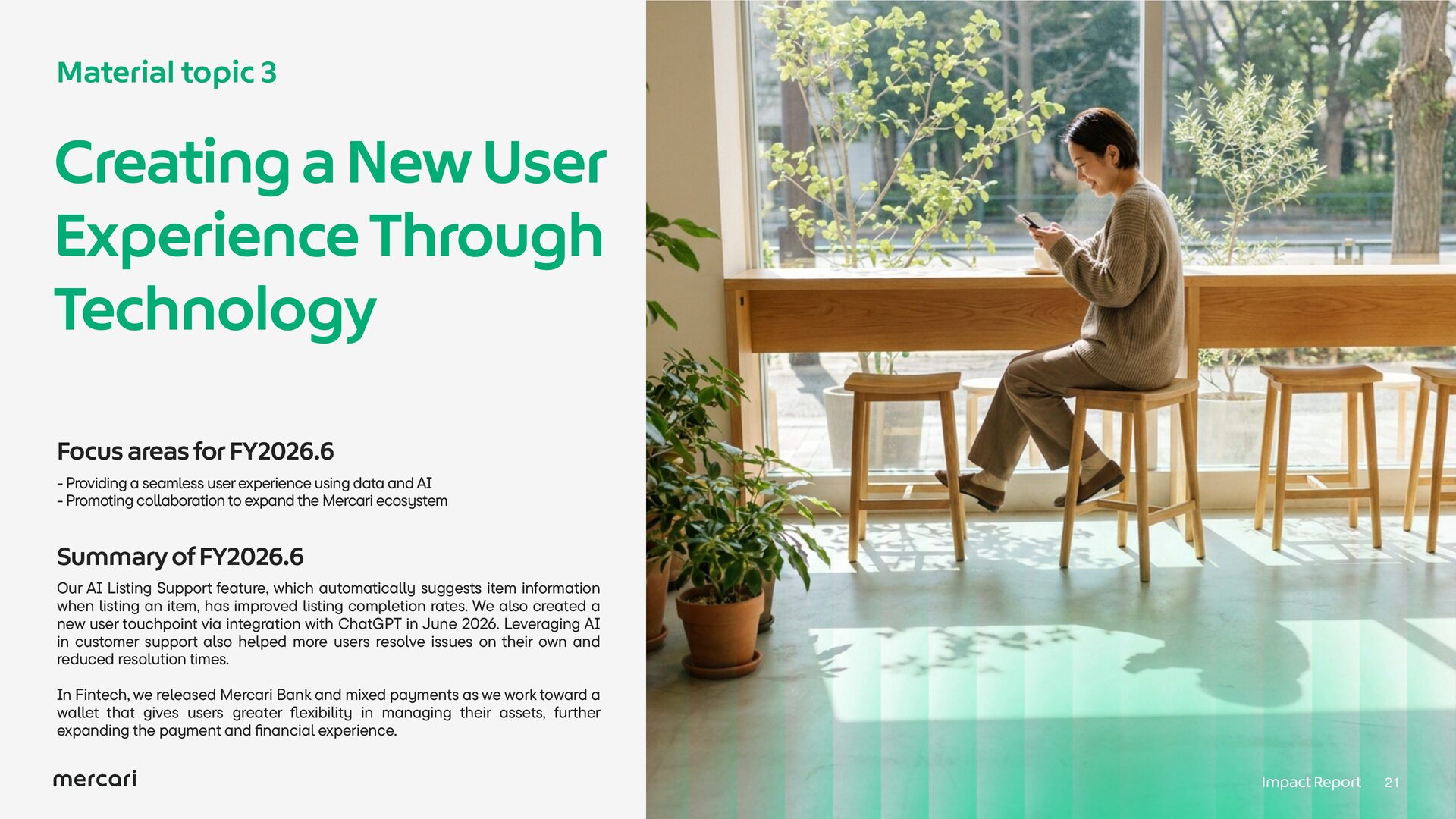
    Focus areas for FY2026.6 - Providing a seamless user experience using data and AI - Promoting collaboration to expand the Mercari ecosystem Summary of FY2026.6 Our AI Listing Support feature, which automatically suggests item information when listing an item, has improved listing completion rates. We also created a new user touchpoint via integration with ChatGPT in June 2026. Leveraging AI in customer support also helped more users resolve issues on their own and reduced resolution times. In Fintech, we released Mercari Bank and mixed payments as we work toward a wallet that gives users greater flexibility in managing their assets, further expanding the payment and financial experience. Impact Report 21
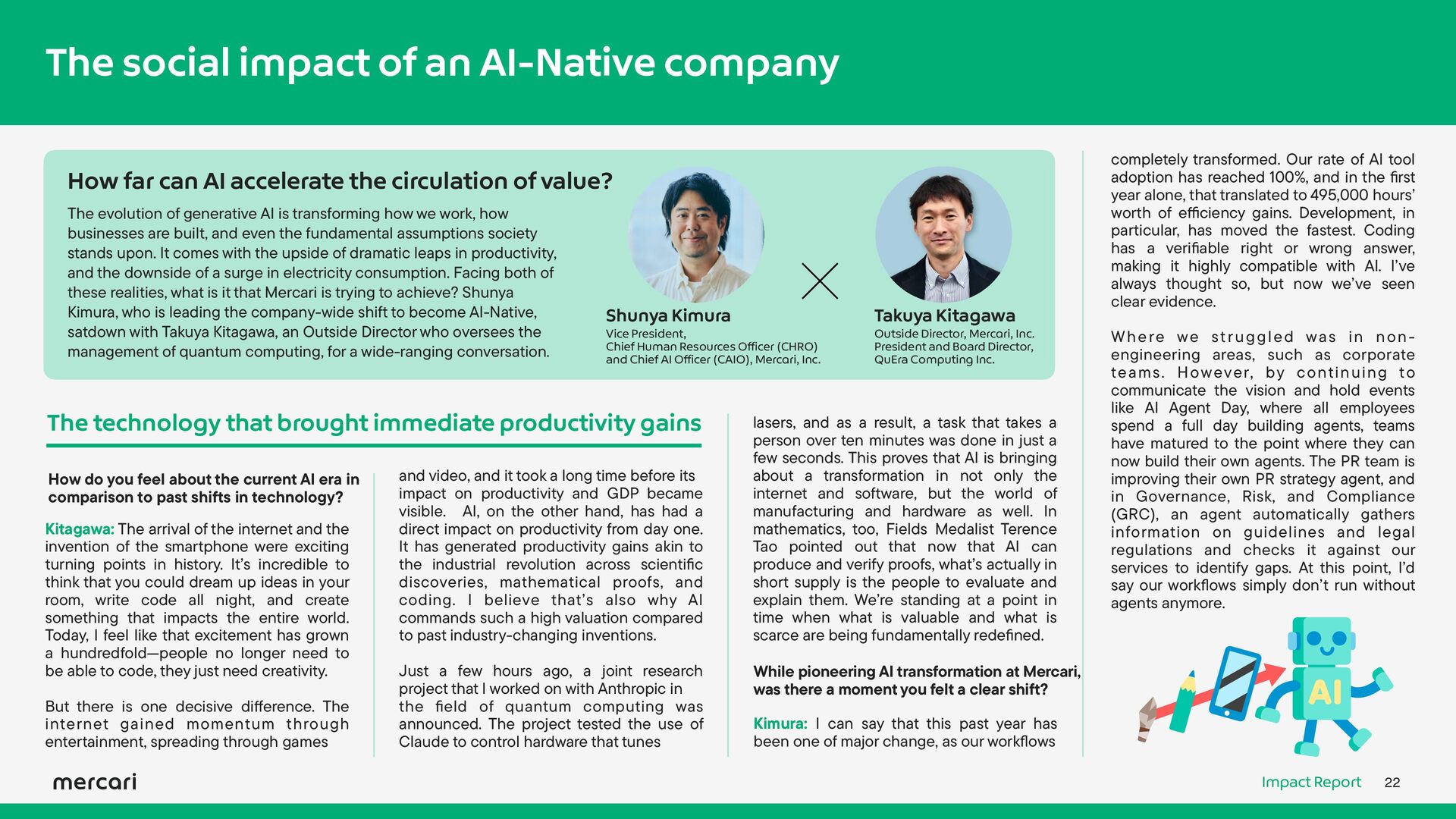
  21. The social impact of an AI-Native company How far can

    AI accelerate the circulation of value? The evolution of generative AI is transforming how we work, how businesses are built, and even the fundamental assumptions society stands upon. It comes with the upside of dramatic leaps in productivity, and the downside of a surge in electricity consumption. Facing both of these realities, what is it that Mercari is trying to achieve? Shunya Kimura, who is leading the company-wide shift to become AI-Native, satdown with Takuya Kitagawa, an Outside Director who oversees the management of quantum computing, for a wide-ranging conversation. Shunya Kimura Takuya Kitagawa Vice President, Chief Human Resources Officer (CHRO) and Chief AI Officer (CAIO), Mercari, Inc. Outside Director, Mercari, Inc. President and Board Director, QuEra Computing Inc. The technology that brought immediate productivity gains How do you feel about the current AI era in comparison to past shifts in technology? Kitagawa: The arrival of the internet and the invention of the smartphone were exciting turning points in history. It’s incredible to think that you could dream up ideas in your room, write code all night, and create something that impacts the entire world. Today, I feel like that excitement has grown a hundredfold—people no longer need to be able to code, they just need creativity. But there is one decisive difference. The internet gained momentum through entertainment, spreading through games and video, and it took a long time before its impact on productivity and GDP became visible. AI, on the other hand, has had a direct impact on productivity from day one. It has generated productivity gains akin to the industrial revolution across scientific discoveries, mathematical proofs, and coding. I believe that’s also why AI commands such a high valuation compared to past industry-changing inventions. Just a few hours ago, a joint research project that I worked on with Anthropic in the field of quantum computing was announced. The project tested the use of Claude to control hardware that tunes lasers, and as a result, a task that takes a person over ten minutes was done in just a few seconds. This proves that AI is bringing about a transformation in not only the internet and software, but the world of manufacturing and hardware as well. In mathematics, too, Fields Medalist Terence Tao pointed out that now that AI can produce and verify proofs, what’s actually in short supply is the people to evaluate and explain them. We’re standing at a point in time when what is valuable and what is scarce are being fundamentally redefined. While pioneering AI transformation at Mercari, was there a moment you felt a clear shift? completely transformed. Our rate of AI tool adoption has reached 100%, and in the first year alone, that translated to 495,000 hours’ worth of efficiency gains. Development, in particular, has moved the fastest. Coding has a verifiable right or wrong answer, making it highly compatible with AI. I’ve always thought so, but now we’ve seen clear evidence. Where we struggled was in nonengineering areas, such as corporate te a m s . H o w eve r, by c o nt i n u i n g to communicate the vision and hold events like AI Agent Day, where all employees spend a full day building agents, teams have matured to the point where they can now build their own agents. The PR team is improving their own PR strategy agent, and in Governance, Risk, and Compliance (GRC), an agent automatically gathers information on guidelines and legal regulations and checks it against our services to identify gaps. At this point, I’d say our workflows simply don’t run without agents anymore. AI Kimura: I can say that this past year has been one of major change, as our workflows Impact Report 22
  22. The social impact of an AI-Native company Donʼt look away
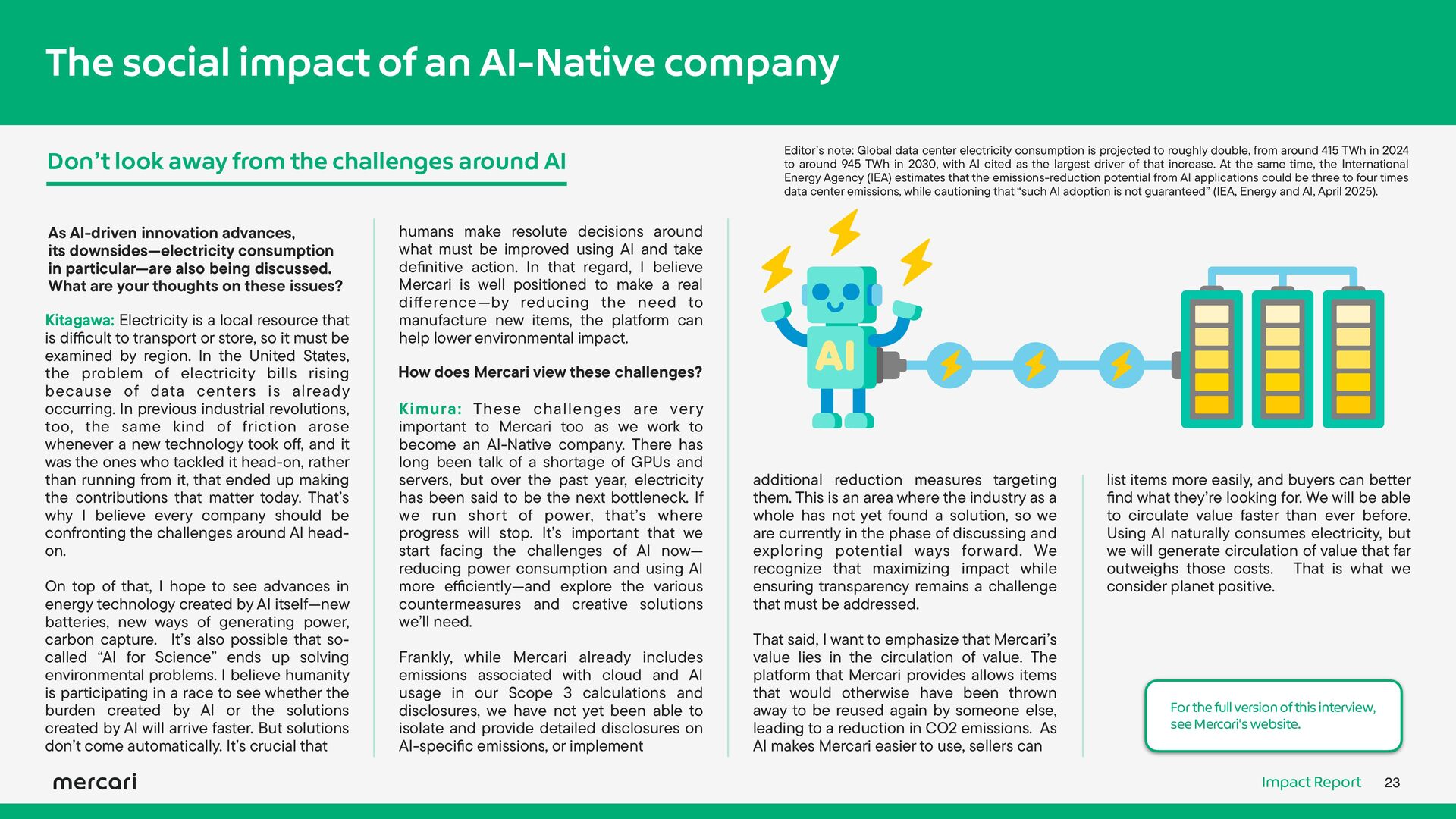
    from the challenges around AI As AI-driven innovation advances, its downsides—electricity consumption in particular—are also being discussed. What are your thoughts on these issues? Kitagawa: Electricity is a local resource that is difficult to transport or store, so it must be examined by region. In the United States, the problem of electricity bills rising because of data centers is already occurring. In previous industrial revolutions, too, the same kind of friction arose whenever a new technology took off, and it was the ones who tackled it head-on, rather than running from it, that ended up making the contributions that matter today. That’s why I believe every company should be confronting the challenges around AI headon. On top of that, I hope to see advances in energy technology created by AI itself—new batteries, new ways of generating power, carbon capture. It’s also possible that socalled “AI for Science” ends up solving environmental problems. I believe humanity is participating in a race to see whether the burden created by AI or the solutions created by AI will arrive faster. But solutions don’t come automatically. It’s crucial that humans make resolute decisions around what must be improved using AI and take definitive action. In that regard, I believe Mercari is well positioned to make a real difference—by reducing the need to manufacture new items, the platform can help lower environmental impact. How does Mercari view these challenges? Kimura: These challenges are very important to Mercari too as we work to become an AI-Native company. There has long been talk of a shortage of GPUs and servers, but over the past year, electricity has been said to be the next bottleneck. If we run short of power, that’s where progress will stop. It’s important that we start facing the challenges of AI now— reducing power consumption and using AI more efficiently—and explore the various countermeasures and creative solutions we’ll need. Frankly, while Mercari already includes emissions associated with cloud and AI usage in our Scope 3 calculations and disclosures, we have not yet been able to isolate and provide detailed disclosures on AI-specific emissions, or implement Editor’s note: Global data center electricity consumption is projected to roughly double, from around 415 TWh in 2024 to around 945 TWh in 2030, with AI cited as the largest driver of that increase. At the same time, the International Energy Agency (IEA) estimates that the emissions-reduction potential from AI applications could be three to four times data center emissions, while cautioning that “such AI adoption is not guaranteed” (IEA, Energy and AI, April 2025). AI additional reduction measures targeting them. This is an area where the industry as a whole has not yet found a solution, so we are currently in the phase of discussing and exploring potential ways forward. We recognize that maximizing impact while ensuring transparency remains a challenge that must be addressed. That said, I want to emphasize that Mercari’s value lies in the circulation of value. The platform that Mercari provides allows items that would otherwise have been thrown away to be reused again by someone else, leading to a reduction in CO2 emissions. As AI makes Mercari easier to use, sellers can list items more easily, and buyers can better find what they’re looking for. We will be able to circulate value faster than ever before. Using AI naturally consumes electricity, but we will generate circulation of value that far outweighs those costs. That is what we consider planet positive. For the full version of this interview, see Mercari's website. Impact Report 23
  23. Placing AI at the core of our products to advance

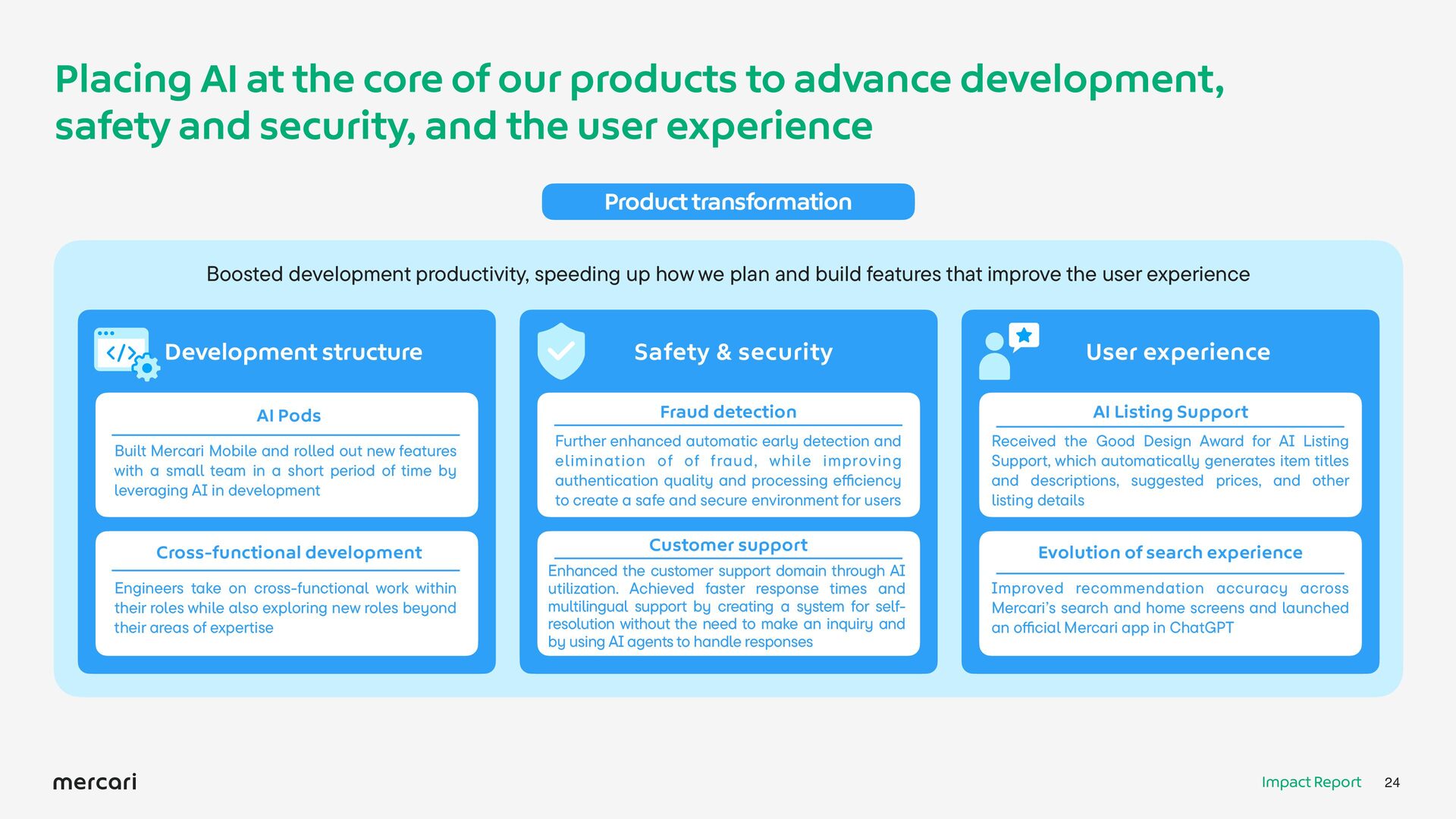
    development, safety and security, and the user experience Product transformation Boosted development productivity, speeding up how we plan and build features that improve the user experience Development structure Safety & security User experience AI Pods Fraud detection AI Listing Support Built Mercari Mobile and rolled out new features with a small team in a short period of time by leveraging AI in development Further enhanced automatic early detection and elimination of of fraud, while improving authentication quality and processing efficiency to create a safe and secure environment for users Received the Good Design Award for AI Listing Support, which automatically generates item titles and descriptions, suggested prices, and other listing details Cross-functional development Customer support Evolution of search experience Engineers take on cross-functional work within their roles while also exploring new roles beyond their areas of expertise Enhanced the customer support domain through AI utilization. Achieved faster response times and multilingual support by creating a system for selfresolution without the need to make an inquiry and by using AI agents to handle responses Improved recommendation accuracy across Mercari’s search and home screens and launched an official Mercari app in ChatGPT Impact Report 24
  24. Creating new user experiences Through the introduction of an AI-powered

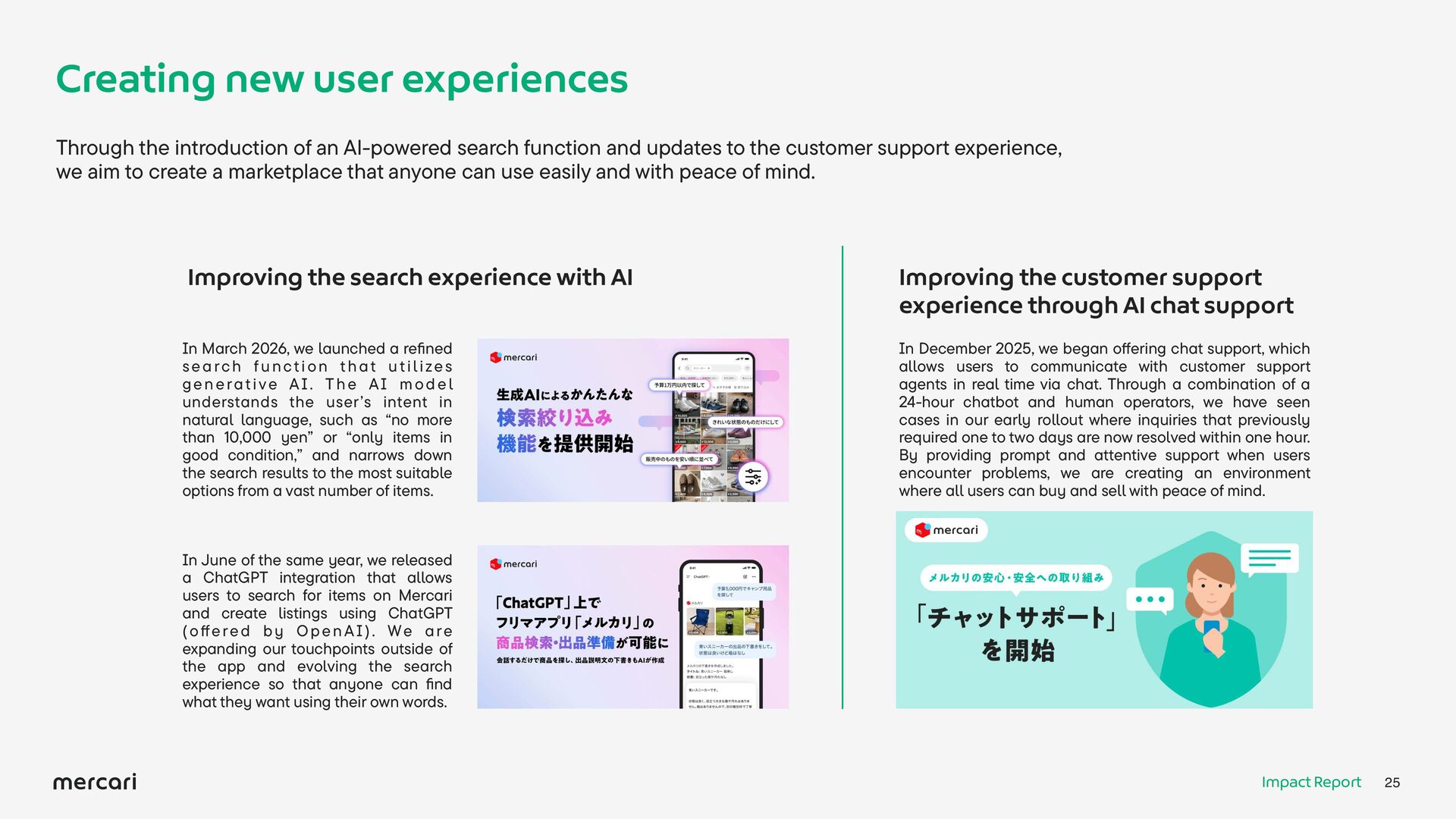
    search function and updates to the customer support experience, we aim to create a marketplace that anyone can use easily and with peace of mind. Improving the search experience with AI Improving the customer support experience through AI chat support In March 2026, we launched a refined search function that utilizes generative AI. The AI model understands the user’s intent in natural language, such as “no more than 10,000 yen” or “only items in good condition,” and narrows down the search results to the most suitable options from a vast number of items. In December 2025, we began offering chat support, which allows users to communicate with customer support agents in real time via chat. Through a combination of a 24-hour chatbot and human operators, we have seen cases in our early rollout where inquiries that previously required one to two days are now resolved within one hour. By providing prompt and attentive support when users encounter problems, we are creating an environment where all users can buy and sell with peace of mind. In June of the same year, we released a ChatGPT integration that allows users to search for items on Mercari and create listings using ChatGPT ( o ff e r e d b y O p e n A I ) . W e a r e expanding our touchpoints outside of the app and evolving the search experience so that anyone can find what they want using their own words. Impact Report 25
  25. Material topic 4 Building LongTerm Public Trust Focus areas for

    FY2026.6 - Realizing safe, secure, and fair transactions - Earning the trust of users and stakeholders (society, investors, media, etc.) - Strengthening profitability to support continuous growth Summary of FY2026.6 In July 2025, we took further steps to create a safe and secure transaction environment. This included launching a full coverage support program, enhancing our AI-powered fraud detection to reduce the rate of transaction disputes, and establishing the Mercari Appraisal Center. Under a 24-hour threat monitoring system, we maintained zero major incidents throughout the fiscal year and further strengthened security and risk management. In October 2025, we formulated a new response policy based on our Marketplace Principles. We also published a Transparency Report, making progress in disclosing the status of our initiatives. Impact Report 26
  26. The marketplace we envision We formulated our Marketplace Principles in

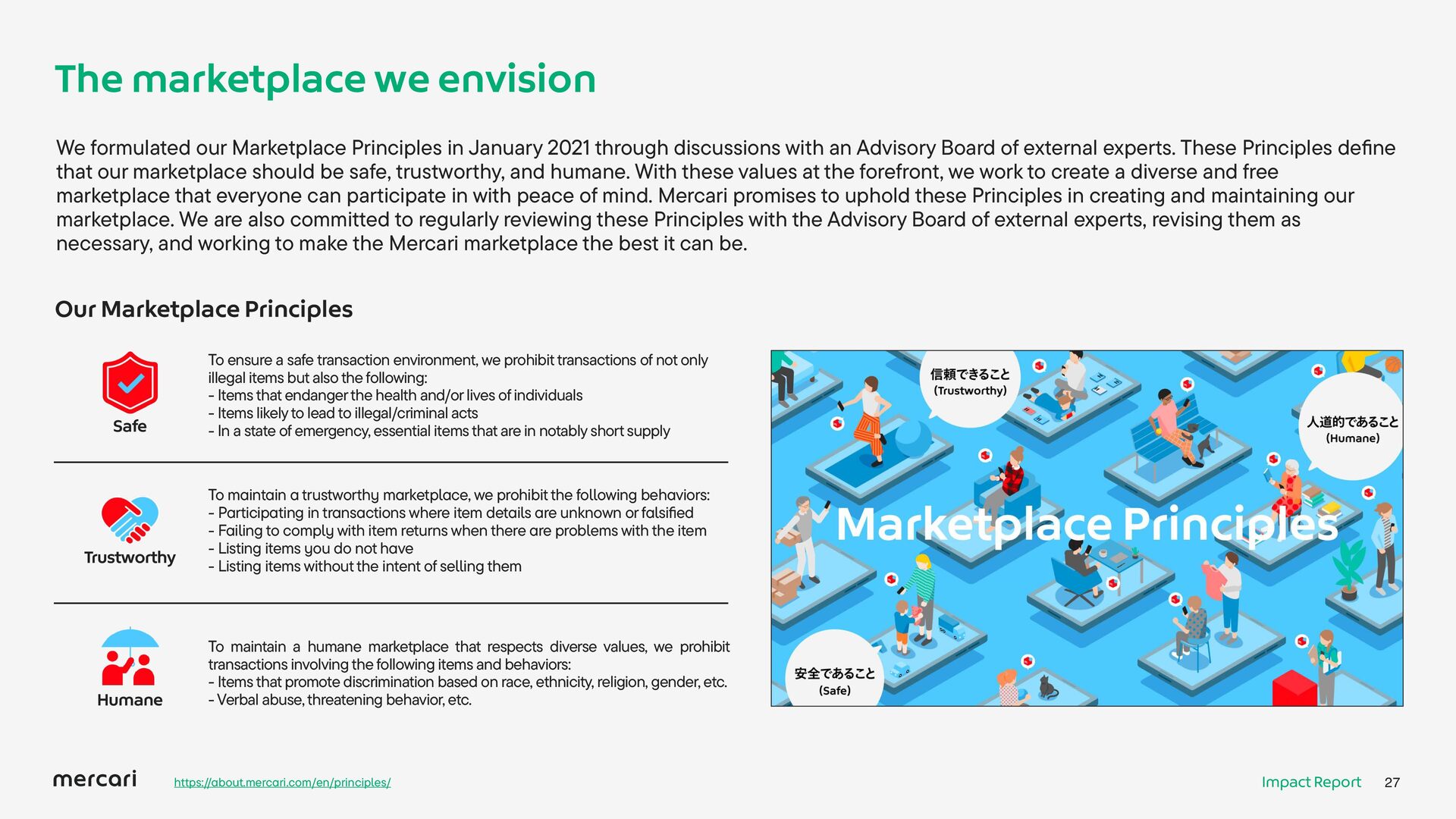
    January 2021 through discussions with an Advisory Board of external experts. These Principles define that our marketplace should be safe, trustworthy, and humane. With these values at the forefront, we work to create a diverse and free marketplace that everyone can participate in with peace of mind. Mercari promises to uphold these Principles in creating and maintaining our marketplace. We are also committed to regularly reviewing these Principles with the Advisory Board of external experts, revising them as necessary, and working to make the Mercari marketplace the best it can be. Our Marketplace Principles To ensure a safe transaction environment, we prohibit transactions of not only illegal items but also the following: - Items that endanger the health and/or lives of individuals - Items likely to lead to illegal/criminal acts - In a state of emergency, essential items that are in notably short supply Safe Trustworthy Humane To maintain a trustworthy marketplace, we prohibit the following behaviors: - Participating in transactions where item details are unknown or falsified - Failing to comply with item returns when there are problems with the item - Listing items you do not have - Listing items without the intent of selling them To maintain a humane marketplace that respects diverse values, we prohibit transactions involving the following items and behaviors: - Items that promote discrimination based on race, ethnicity, religion, gender, etc. - Verbal abuse, threatening behavior, etc. https://about.mercari.com/en/principles/ Impact Report 27
  27. The marketplace we envision Mercari operates its marketplace in line

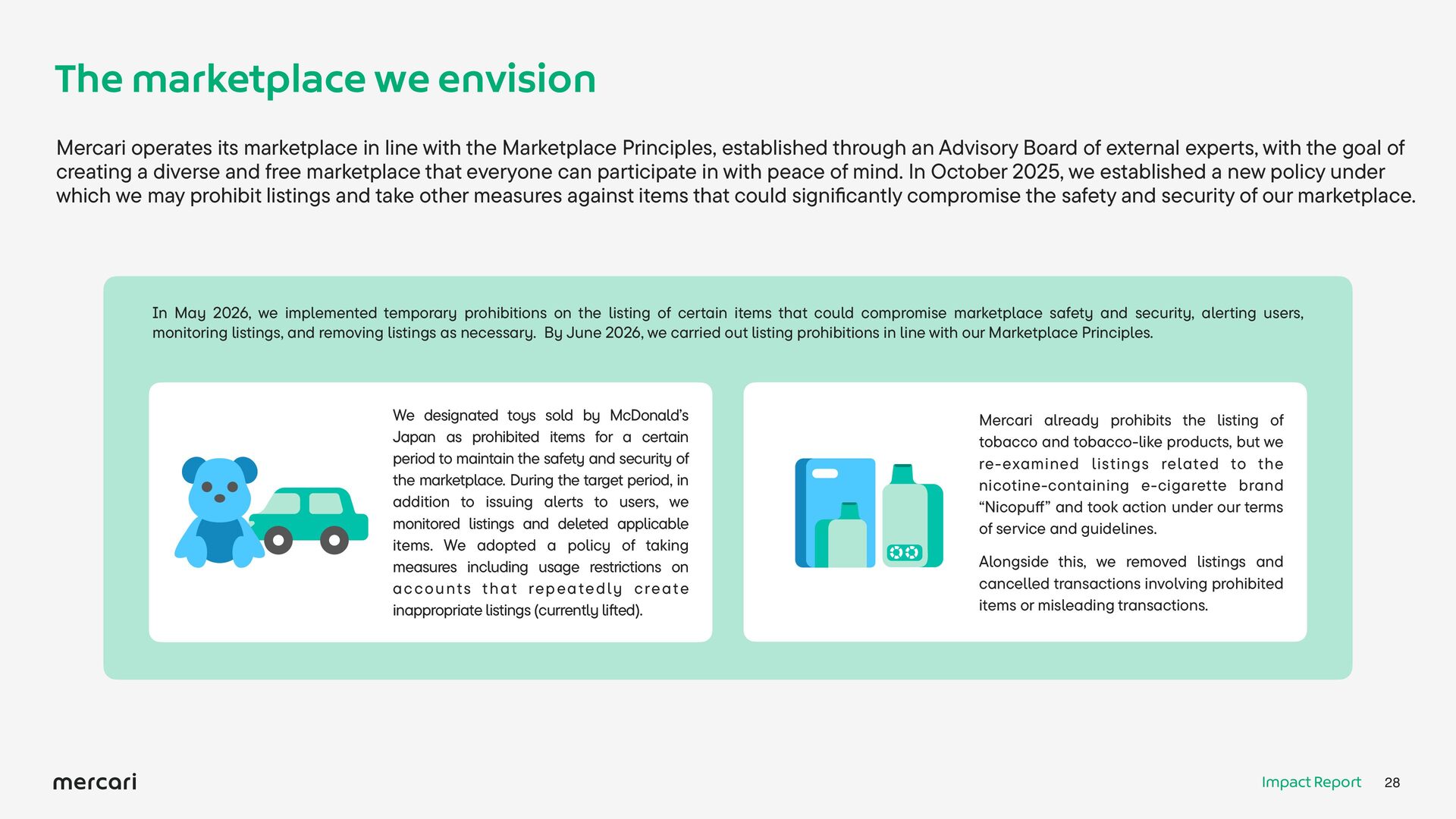
    with the Marketplace Principles, established through an Advisory Board of external experts, with the goal of creating a diverse and free marketplace that everyone can participate in with peace of mind. In October 2025, we established a new policy under which we may prohibit listings and take other measures against items that could significantly compromise the safety and security of our marketplace. In May 2026, we implemented temporary prohibitions on the listing of certain items that could compromise marketplace safety and security, alerting users, monitoring listings, and removing listings as necessary. By June 2026, we carried out listing prohibitions in line with our Marketplace Principles. We designated toys sold by McDonald’s Japan as prohibited items for a certain period to maintain the safety and security of the marketplace. During the target period, in addition to issuing alerts to users, we monitored listings and deleted applicable items. We adopted a policy of taking measures including usage restrictions on a c c o u n t s t h a t re p e a t e d l y c re a t e inappropriate listings (currently lifted). Mercari already prohibits the listing of tobacco and tobacco-like products, but we re-examined listings related to the nicotine-containing e-cigarette brand “Nicopuff” and took action under our terms of service and guidelines. Alongside this, we removed listings and cancelled transactions involving prohibited items or misleading transactions. Impact Report 28
  28. Strengthening initiatives for safety and security: Our Transparency Report We

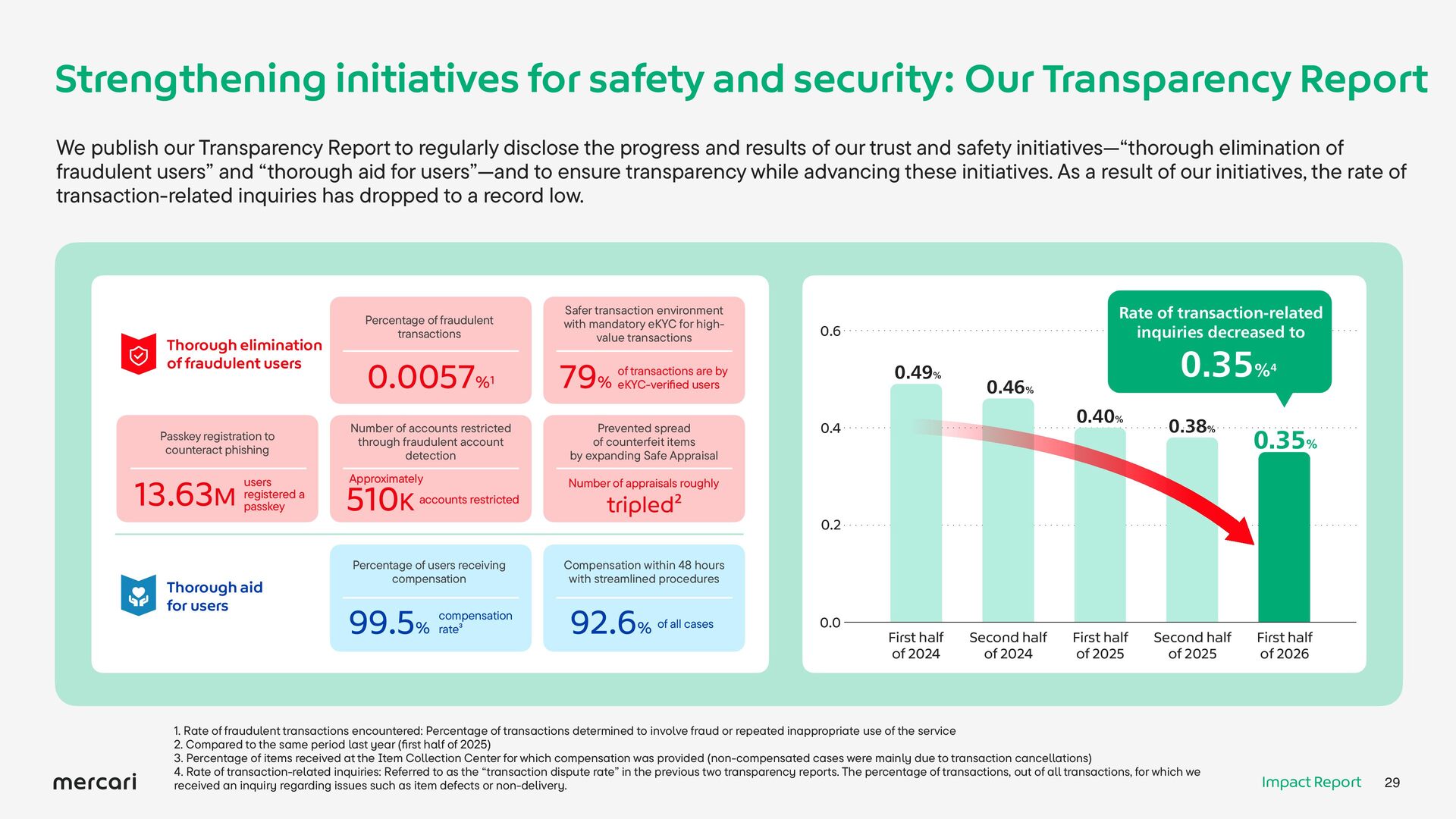
    publish our Transparency Report to regularly disclose the progress and results of our trust and safety initiatives—“thorough elimination of fraudulent users” and “thorough aid for users”—and to ensure transparency while advancing these initiatives. As a result of our initiatives, the rate of transaction-related inquiries has dropped to a record low. 不正利用者の Thorough elimination of fraudulent users 「徹底的な排除」 Passkey registration to counteract phishing 13.63M users registered a passkey お客さまの Thorough aid for users 「徹底的な救済」 Percentage of fraudulent transactions Safer transaction environment with mandatory eKYC for highvalue transactions 0.0057% 79 1 Prevented spread of counterfeit items by expanding Safe Appraisal Approximately Number of appraisals roughly 510K accounts restricted Percentage of users receiving compensation 99.5 compensation % rate³ 0.6 0.49% of transactions are by % eKYC-verified users Number of accounts restricted through fraudulent account detection tripled² Rate of transaction-related inquiries decreased to 0.35% 4 0.46% 0.40% 0.4 0.38% 0.35% 0.2 Compensation within 48 hours with streamlined procedures 92.6% of all cases 0.0 First half of 2024 Second half of 2024 First half of 2025 Second half of 2025 1. Rate of fraudulent transactions encountered: Percentage of transactions determined to involve fraud or repeated inappropriate use of the service 2. Compared to the same period last year (first half of 2025) 3. Percentage of items received at the Item Collection Center for which compensation was provided (non-compensated cases were mainly due to transaction cancellations) 4. Rate of transaction-related inquiries: Referred to as the “transaction dispute rate” in the previous two transparency reports. The percentage of transactions, out of all transactions, for which we received an inquiry regarding issues such as item defects or non-delivery. First half of 2026 Impact Report 29
  29. Strengthening collaboration with government, local governments, educational institutions, and primary

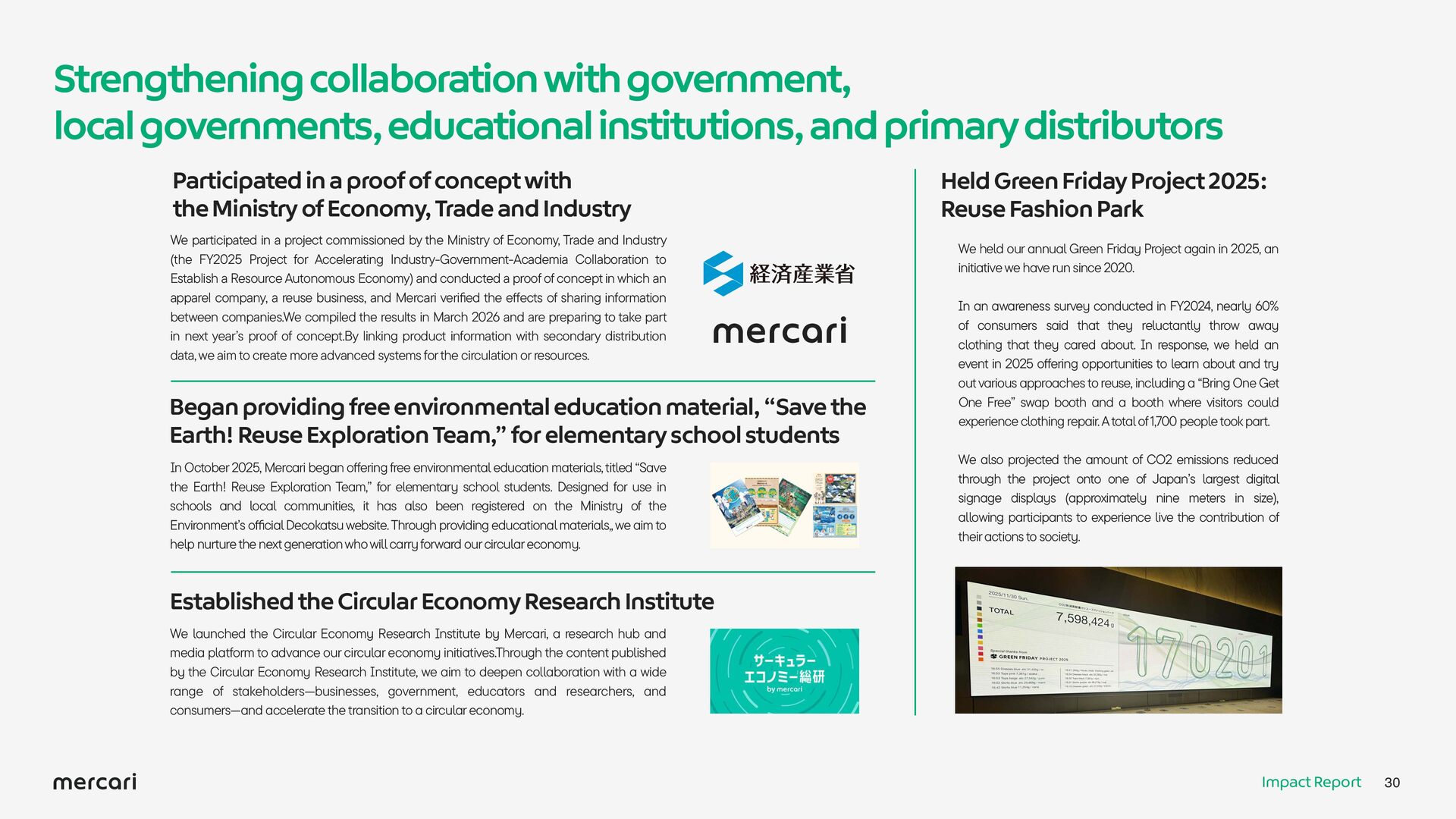
    distributors Participated in a proof of concept with the Ministry of Economy, Trade and Industry We participated in a project commissioned by the Ministry of Economy, Trade and Industry (the FY2025 Project for Accelerating Industry-Government-Academia Collaboration to Establish a Resource Autonomous Economy) and conducted a proof of concept in which an apparel company, a reuse business, and Mercari verified the effects of sharing information between companies.We compiled the results in March 2026 and are preparing to take part in next year’s proof of concept.By linking product information with secondary distribution data, we aim to create more advanced systems for the circulation or resources. Began providing free environmental education material, “Save the Earth! Reuse Exploration Team,” for elementary school students In October 2025, Mercari began offering free environmental education materials, titled “Save the Earth! Reuse Exploration Team,” for elementary school students. Designed for use in schools and local communities, it has also been registered on the Ministry of the Environment’s official Decokatsu website. Through providing educational materials,, we aim to help nurture the next generation who will carry forward our circular economy. Held Green Friday Project 2025: Reuse Fashion Park We held our annual Green Friday Project again in 2025, an initiative we have run since 2020. In an awareness survey conducted in FY2024, nearly 60% of consumers said that they reluctantly throw away clothing that they cared about. In response, we held an event in 2025 offering opportunities to learn about and try out various approaches to reuse, including a “Bring One Get One Free” swap booth and a booth where visitors could experience clothing repair. A total of 1,700 people took part. We also projected the amount of CO2 emissions reduced through the project onto one of Japan’s largest digital signage displays (approximately nine meters in size), allowing participants to experience live the contribution of their actions to society. Established the Circular Economy Research Institute We launched the Circular Economy Research Institute by Mercari, a research hub and media platform to advance our circular economy initiatives.Through the content published by the Circular Economy Research Institute, we aim to deepen collaboration with a wide range of stakeholders—businesses, government, educators and researchers, and consumers—and accelerate the transition to a circular economy. Impact Report 30
  30. Material topic 5 Unleashing the Potential in Diverse Talent Worldwide

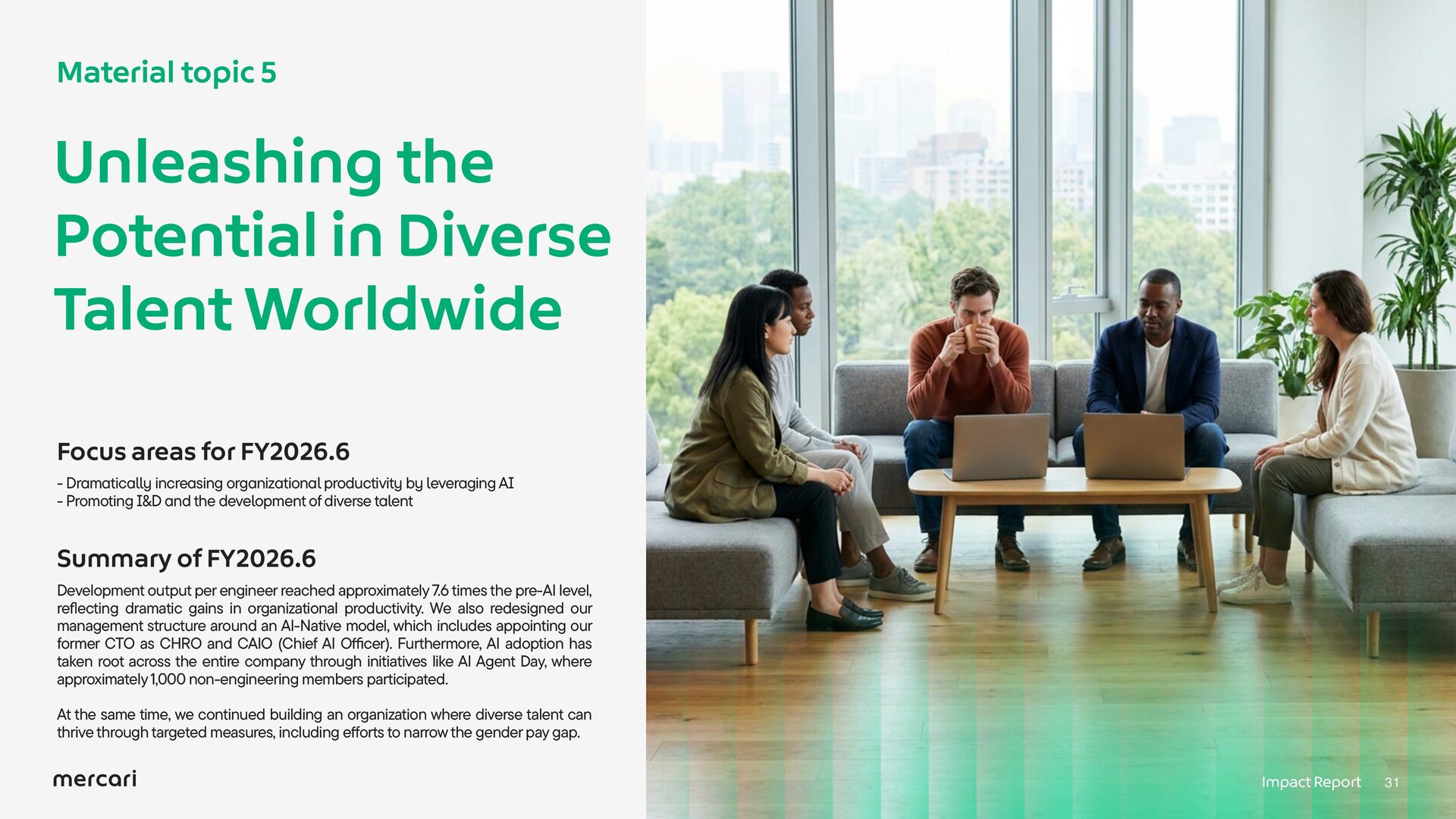
    Focus areas for FY2026.6 - Dramatically increasing organizational productivity by leveraging AI - Promoting I&D and the development of diverse talent Summary of FY2026.6 Development output per engineer reached approximately 7.6 times the pre-AI level, reflecting dramatic gains in organizational productivity. We also redesigned our management structure around an AI-Native model, which includes appointing our former CTO as CHRO and CAIO (Chief AI Officer). Furthermore, AI adoption has taken root across the entire company through initiatives like AI Agent Day, where approximately 1,000 non-engineering members participated. At the same time, we continued building an organization where diverse talent can thrive through targeted measures, including efforts to narrow the gender pay gap. Impact Report 31
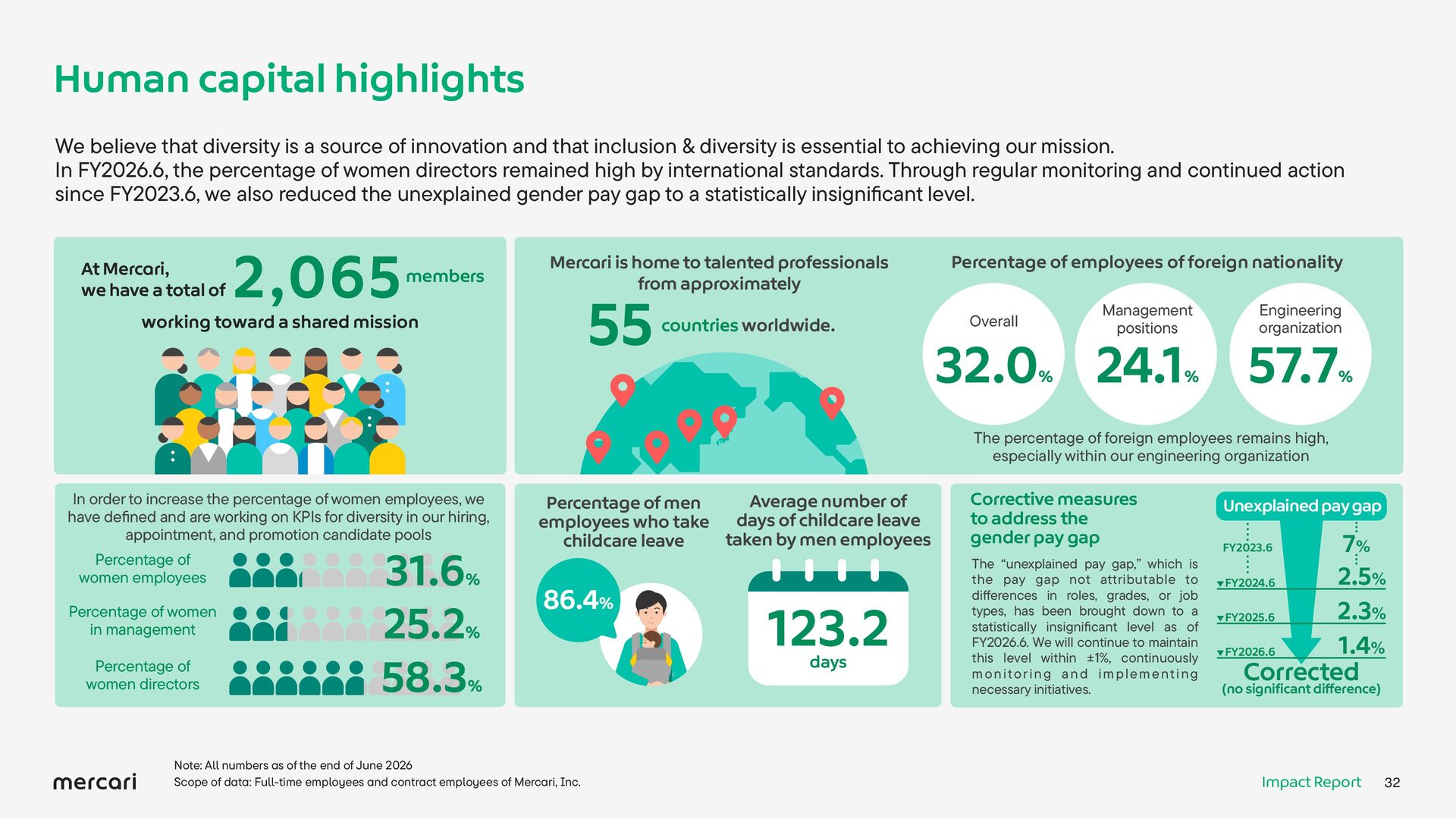
  31. Human capital highlights We believe that diversity is a source

    of innovation and that inclusion & diversity is essential to achieving our mission. In FY2026.6, the percentage of women directors remained high by international standards. Through regular monitoring and continued action since FY2023.6, we also reduced the unexplained gender pay gap to a statistically insignificant level. At Mercari, we have a total of 2,065 members Mercari is home to talented professionals from approximately 55 working toward a shared mission countries worldwide. Percentage of employees of foreign nationality Overall 32.0 % Management positions Engineering organization 24.1 57.7 % % The percentage of foreign employees remains high, especially within our engineering organization In order to increase the percentage of women employees, we have defined and are working on KPIs for diversity in our hiring, appointment, and promotion candidate pools Percentage of women employees Percentage of women in management Percentage of women directors 31.6 25.2 58.3 % Percentage of men employees who take childcare leave 86.4% % % Note: All numbers as of the end of June 2026 Scope of data: Full-time employees and contract employees of Mercari, Inc. Average number of days of childcare leave taken by men employees 123.2 days Corrective measures to address the gender pay gap The “unexplained pay gap,” which is the pay gap not attributable to differences in roles, grades, or job types, has been brought down to a statistically insignificant level as of FY2026.6. We will continue to maintain this level within ±1%, continuously monitoring and implementing necessary initiatives. Unexplained pay gap FY2023.6 FY2024.6 FY2025.6 7% 2.5% 2.3% 1.4% Corrected FY2026.6 (no significant difference) Impact Report 32
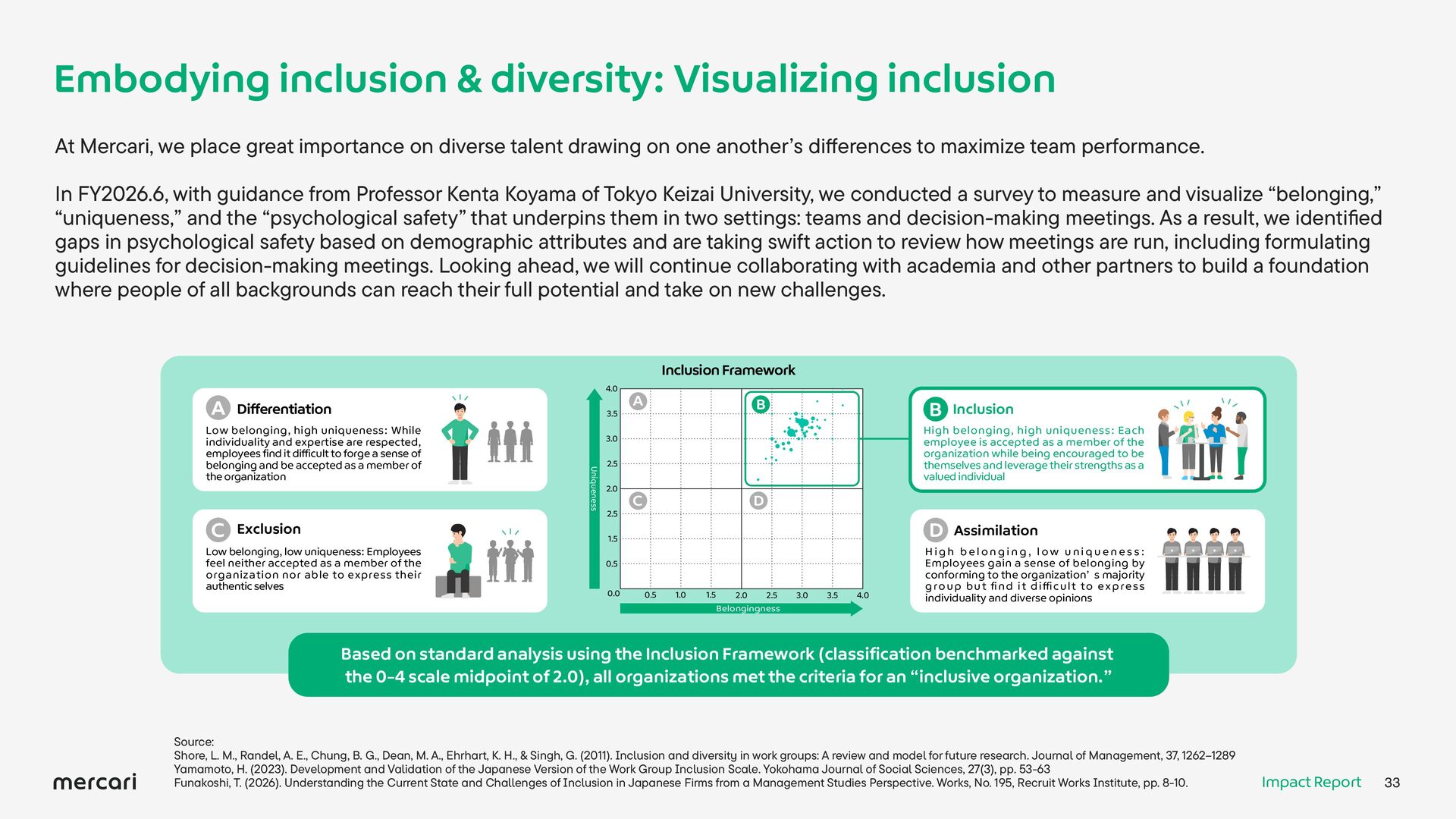
  32. Embodying inclusion & diversity: Visualizing inclusion At Mercari, we place

    great importance on diverse talent drawing on one another’s differences to maximize team performance. In FY2026.6, with guidance from Professor Kenta Koyama of Tokyo Keizai University, we conducted a survey to measure and visualize “belonging,” “uniqueness,” and the “psychological safety” that underpins them in two settings: teams and decision-making meetings. As a result, we identified gaps in psychological safety based on demographic attributes and are taking swift action to review how meetings are run, including formulating guidelines for decision-making meetings. Looking ahead, we will continue collaborating with academia and other partners to build a foundation where people of all backgrounds can reach their full potential and take on new challenges. Inclusion Framework 4.0 A Differentiation 3.5 C Exclusion Low belonging, low uniqueness: Employees feel neither accepted as a member of the organization nor able to express their authentic selves B B Inclusion High belonging, high uniqueness: Each employee is accepted as a member of the organization while being encouraged to be themselves and leverage their strengths as a valued individual 3.0 Uniqueness Low belonging, high uniqueness: While individuality and expertise are respected, employees find it difficult to forge a sense of belonging and be accepted as a member of the organization A 2.5 2.0 2.5 C D D Assimilation 1.5 0.5 0.0 0.5 1.0 1.5 2.0 2.5 Belongingness 3.0 3.5 4.0 High belonging, low uniqueness: Employees gain a sense of belonging by conforming to the organizationʼ s majority group but find it difficult to express individuality and diverse opinions Based on standard analysis using the Inclusion Framework (classification benchmarked against the 0‒4 scale midpoint of 2.0), all organizations met the criteria for an “inclusive organization.” Source: Shore, L. M., Randel, A. E., Chung, B. G., Dean, M. A., Ehrhart, K. H., & Singh, G. (2011). Inclusion and diversity in work groups: A review and model for future research. Journal of Management, 37, 1262–1289 Yamamoto, H. (2023). Development and Validation of the Japanese Version of the Work Group Inclusion Scale. Yokohama Journal of Social Sciences, 27(3), pp. 53-63 Funakoshi, T. (2026). Understanding the Current State and Challenges of Inclusion in Japanese Firms from a Management Studies Perspective. Works, No. 195, Recruit Works Institute, pp. 8-10. Impact Report 33
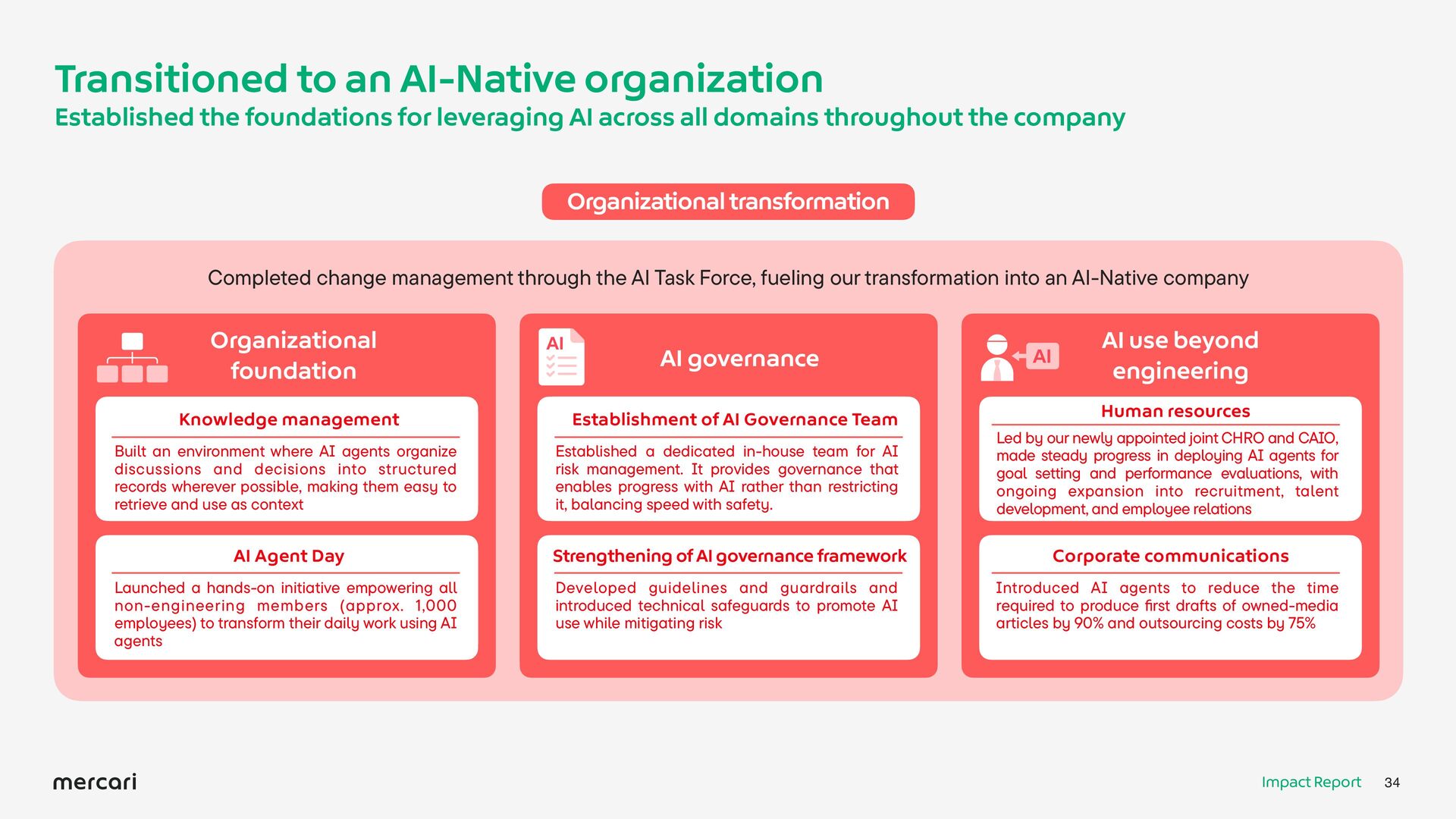
  33. Transitioned to an AI-Native organization Established the foundations for leveraging

    AI across all domains throughout the company Organizational transformation Completed change management through the AI Task Force, fueling our transformation into an AI-Native company Organizational foundation AI AI governance AI AI use beyond engineering Human resources Knowledge management Establishment of AI Governance Team Built an environment where AI agents organize discussions and decisions into structured records wherever possible, making them easy to retrieve and use as context Established a dedicated in-house team for AI risk management. It provides governance that enables progress with AI rather than restricting it, balancing speed with safety. Led by our newly appointed joint CHRO and CAIO, made steady progress in deploying AI agents for goal setting and performance evaluations, with ongoing expansion into recruitment, talent development, and employee relations AI Agent Day Strengthening of AI governance framework Corporate communications Launched a hands-on initiative empowering all non-engineering members (approx. 1,000 employees) to transform their daily work using AI agents Developed guidelines and guardrails and introduced technical safeguards to promote AI use while mitigating risk Introduced AI agents to reduce the time required to produce first drafts of owned-media articles by 90% and outsourcing costs by 75% Impact Report 34
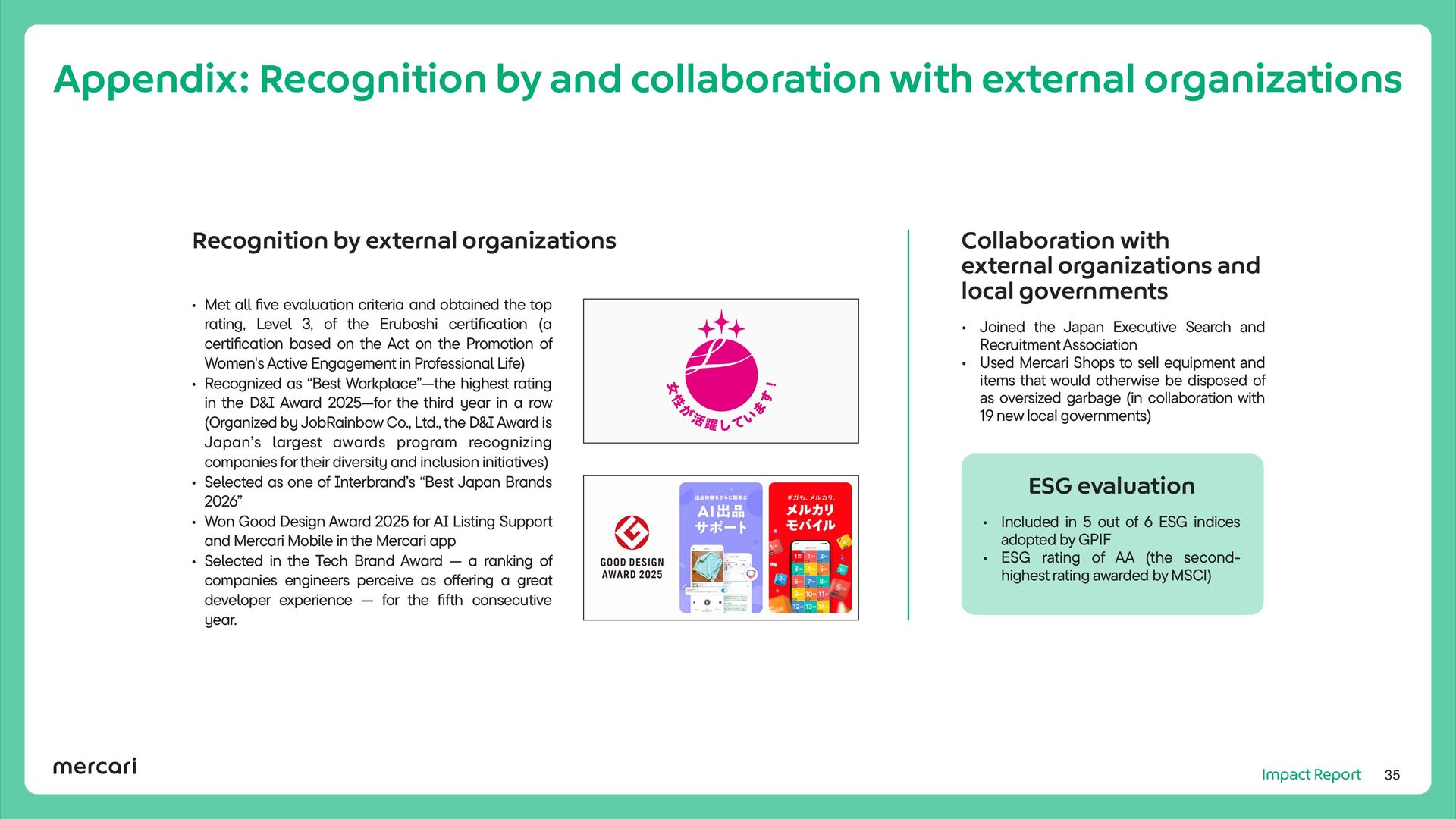
  34. Appendix: Recognition by and collaboration with external organizations Recognition by

    external organizations • Met all five evaluation criteria and obtained the top rating, Level 3, of the Eruboshi certification (a certification based on the Act on the Promotion of Women's Active Engagement in Professional Life) • Recognized as “Best Workplace”—the highest rating in the D&I Award 2025—for the third year in a row (Organized by JobRainbow Co., Ltd., the D&I Award is Japan’s largest awards program recognizing companies for their diversity and inclusion initiatives) • Selected as one of Interbrand’s “Best Japan Brands 2026” • Won Good Design Award 2025 for AI Listing Support and Mercari Mobile in the Mercari app • Selected in the Tech Brand Award — a ranking of companies engineers perceive as offering a great developer experience — for the fifth consecutive year. Collaboration with external organizations and local governments • Joined the Japan Executive Search and Recruitment Association • Used Mercari Shops to sell equipment and items that would otherwise be disposed of as oversized garbage (in collaboration with 19 new local governments) ESG evaluation • Included in 5 out of 6 ESG indices adopted by GPIF • ESG rating of AA (the secondhighest rating awarded by MSCI) Impact Report 35
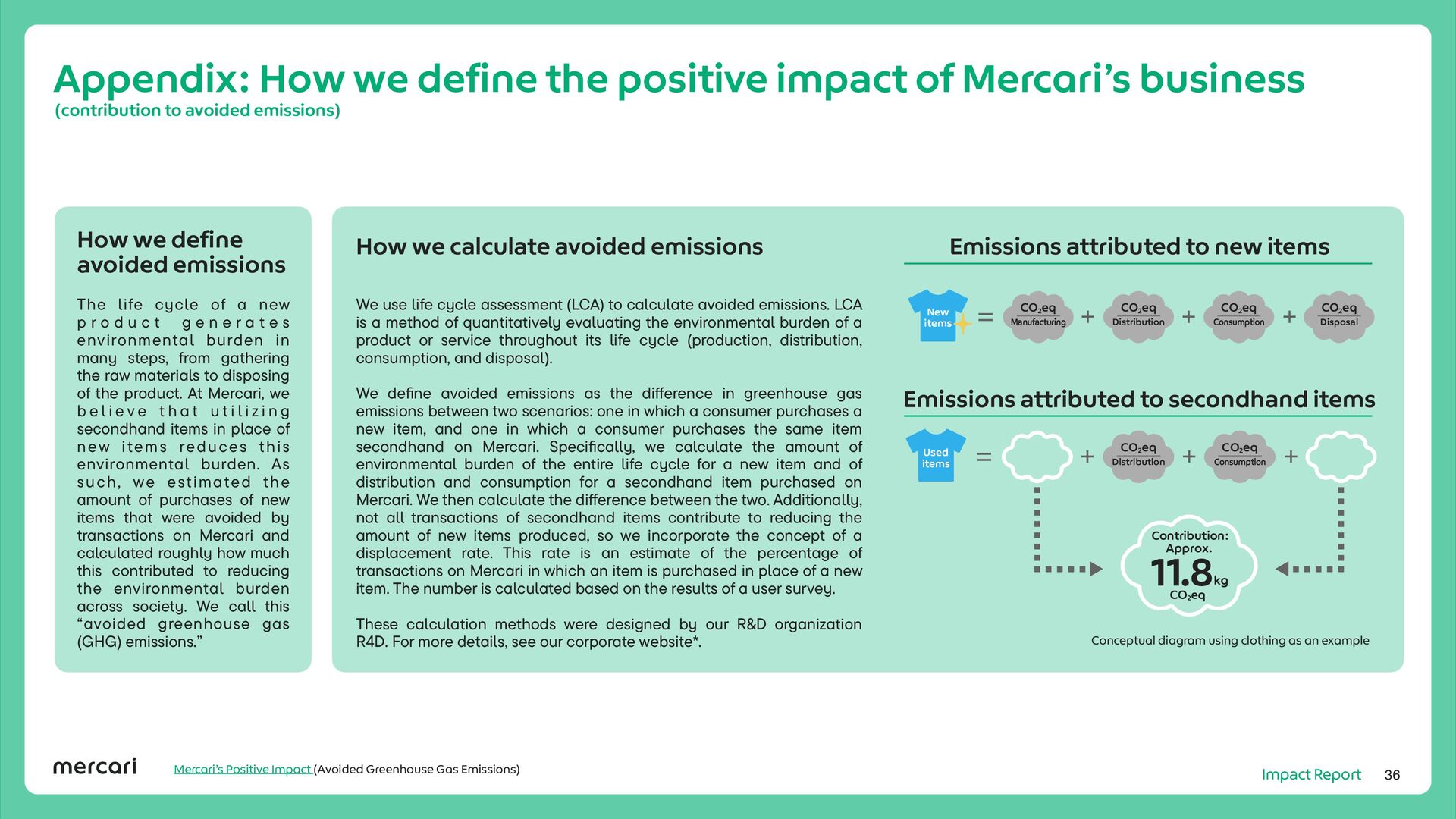
  35. Appendix: How we define the positive impact of Mercariʼs business

    (contribution to avoided emissions) How we define avoided emissions How we calculate avoided emissions The life cycle of a new product generates environmental burden in many steps, from gathering the raw materials to disposing of the product. At Mercari, we believe that utilizing secondhand items in place of n e w i t e m s re d u c e s t h i s environmental burden. As s u c h , w e e st i m a te d t h e amount of purchases of new items that were avoided by transactions on Mercari and calculated roughly how much this contributed to reducing the environmental burden across society. We call this “avoided greenhouse gas (GHG) emissions.” We use life cycle assessment (LCA) to calculate avoided emissions. LCA is a method of quantitatively evaluating the environmental burden of a product or service throughout its life cycle (production, distribution, consumption, and disposal). We define avoided emissions as the difference in greenhouse gas emissions between two scenarios: one in which a consumer purchases a new item, and one in which a consumer purchases the same item secondhand on Mercari. Specifically, we calculate the amount of environmental burden of the entire life cycle for a new item and of distribution and consumption for a secondhand item purchased on Mercari. We then calculate the difference between the two. Additionally, not all transactions of secondhand items contribute to reducing the amount of new items produced, so we incorporate the concept of a displacement rate. This rate is an estimate of the percentage of transactions on Mercari in which an item is purchased in place of a new item. The number is calculated based on the results of a user survey. These calculation methods were designed by our R&D organization R4D. For more details, see our corporate website*. Mercariʼs Positive Impact (Avoided Greenhouse Gas Emissions) Emissions attributed to new items New items CO2eq Manufacturing CO2eq CO2eq Distribution Consumption CO2eq Disposal Emissions attributed to secondhand items Used items CO2eq CO2eq Distribution Consumption Contribut ion: Approx. 11.8 CO2eq kg Conceptual diagram using clothing as an example Impact Report 36
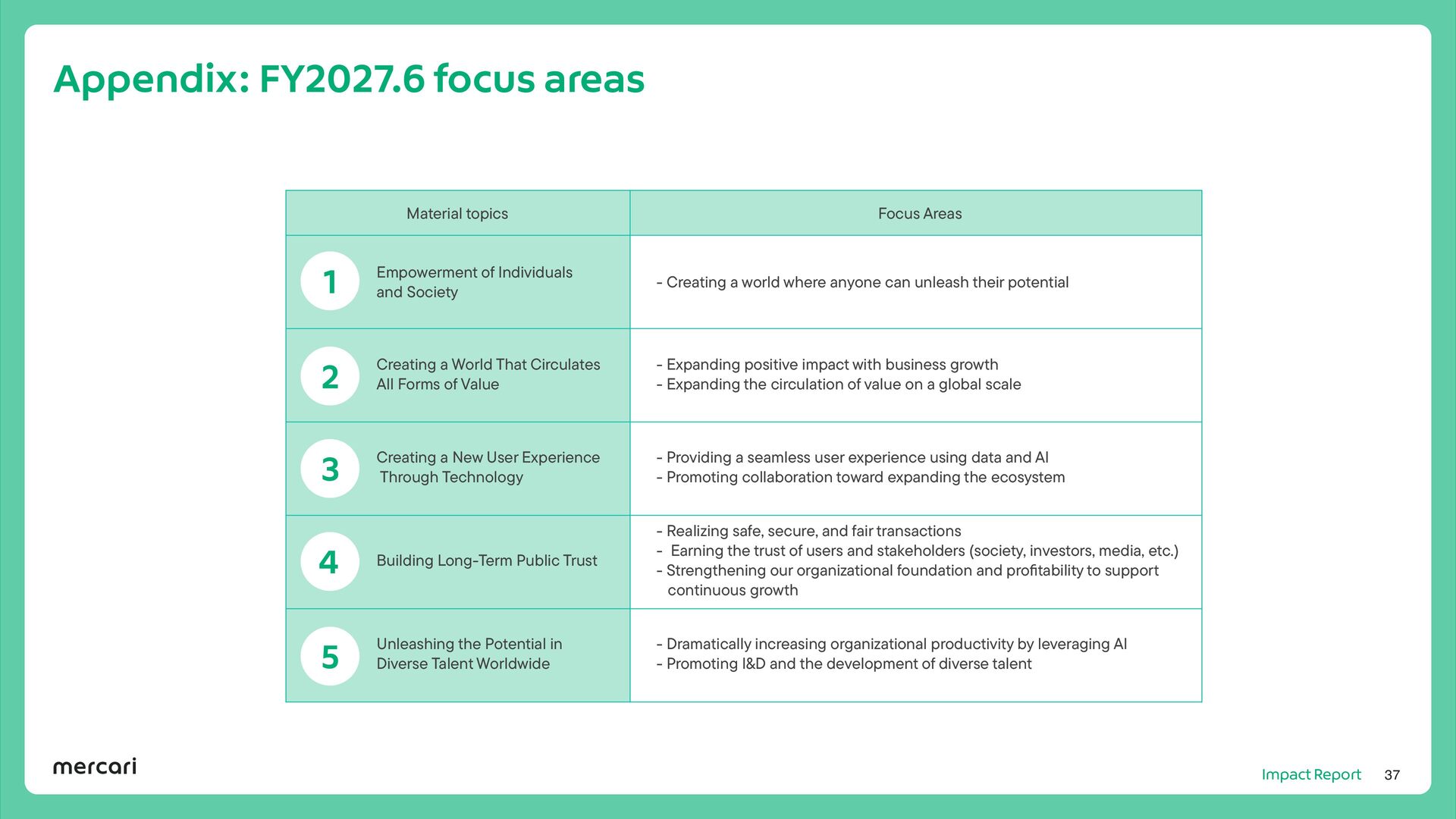
  36. Appendix: FY2027.6 focus areas Material topics Focus Areas 1 Empowerment

    of Individuals and Society - Creating a world where anyone can unleash their potential 2 Creating a World That Circulates All Forms of Value - Expanding positive impact with business growth - Expanding the circulation of value on a global scale 3 Creating a New User Experience Through Technology - Providing a seamless user experience using data and AI - Promoting collaboration toward expanding the ecosystem 4 Building Long-Term Public Trust - Realizing safe, secure, and fair transactions - Earning the trust of users and stakeholders (society, investors, media, etc.) - Strengthening our organizational foundation and profitability to support continuous growth 5 Unleashing the Potential in Diverse Talent Worldwide - Dramatically increasing organizational productivity by leveraging AI - Promoting I&D and the development of diverse talent Impact Report 37
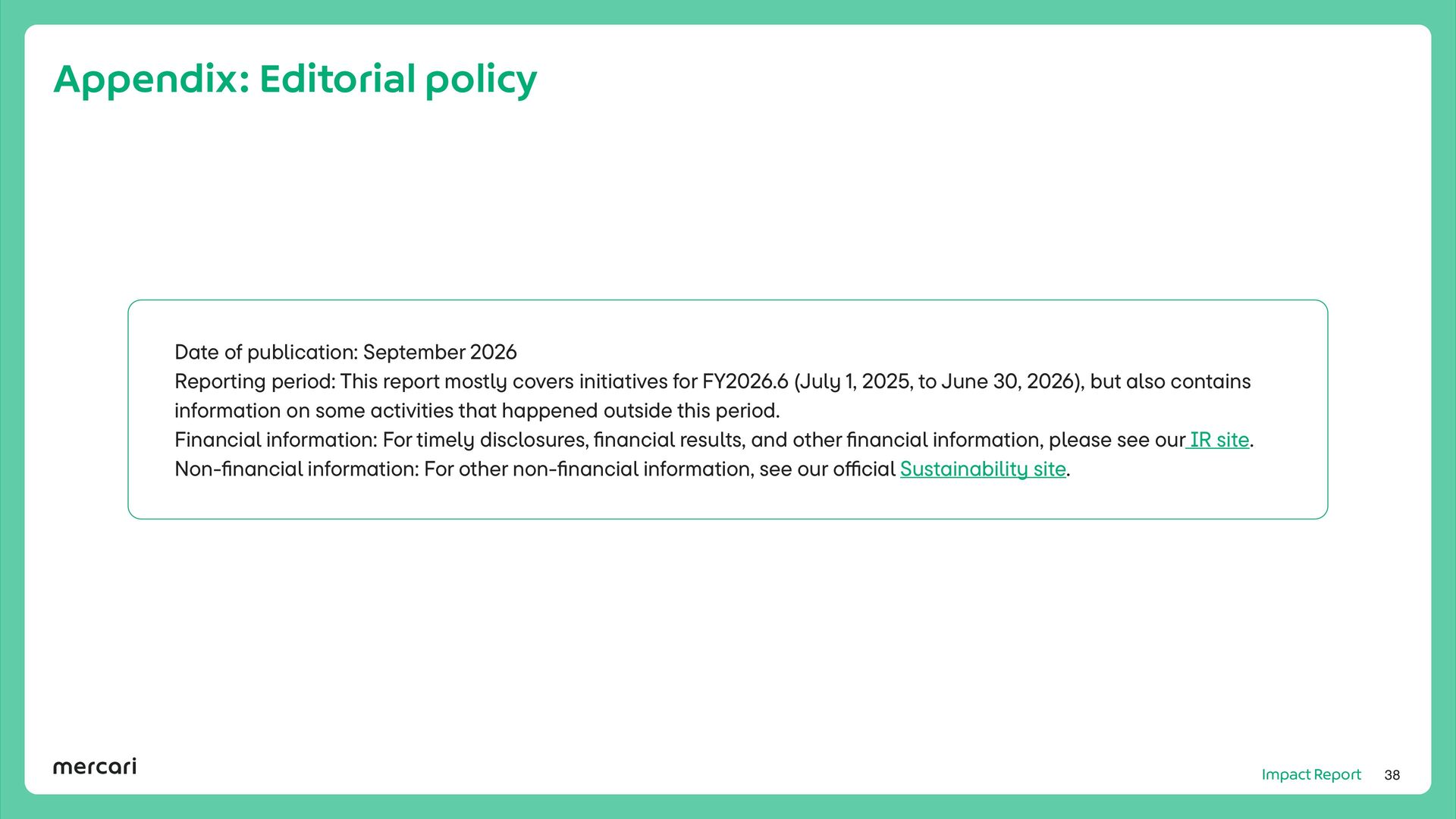
  37. Appendix: Editorial policy Date of publication: September 2026 Reporting period:

    This report mostly covers initiatives for FY2026.6 (July 1, 2025, to June 30, 2026), but also contains information on some activities that happened outside this period. Financial information: For timely disclosures, financial results, and other financial information, please see our IR site. Non-financial information: For other non-financial information, see our official Sustainability site. Impact Report 38
  38. Mercari, Inc. Impact Report Mercari, Inc. Disclaimer This material has

    been prepared based on information gathered at the time of its preparation and is not in any way intended as a commitment to future implementation. This document is an English translation of the original Japanese language document and has been prepared solely for reference purposes. No warranties or assurances are given regarding the accuracy or completeness of this English translation. In the event of any discrepancy between this English translation and the original Japanese language document, the original Japanese language document shall prevail in all respects. Roppongi Hills Mori Tower 6-10-1 Roppongi Minato-ku, Tokyo 106-6125, Japan © Mercari, Inc.