Share
Embed
様々なユースケースに利用できる "パスキー" の 導入事例の紹介とUXの課題解説 @ DroidKaigi 2023
下記イベントの発表資料です。
https://2023.droidkaigi.jp/timetable/493289/
ritou
September 15, 2023
Transcript
52 slides
-
Use Cases of 'Passkey' and the Challenges in UX ༷ʑͳϢʔεέʔεʹར༻Ͱ͖Δ
"ύεΩʔ" ͷ ಋೖࣄྫͷհͱUXͷ՝ղઆ Ryo Ito (@ritou) DroidKaigi 2023ʢ2023/09/15 15:00-15:40ʣ -
Ryo Ito (@ritou) • Engineer at MIXI, Inc. • Evangelist
at OpenID Foundation Japan 2 -
Today’s GOAL To understand: • The overview of Passkey •
Two typical use cases of Passkey and their required features • UX challenges when introducing Passkey into consumer services • The relationship between Passkey and ID Federation 3 -
Rough Overview of User Authentication • Password authentication is vulnerable
• Generation of hard-to-guess strings • Memorization of multiple passwords • Countermeasures against phishing • Risks of leaks from services and secondary damage • Passkey authentication solves these challenges 5 -
The Current Status of User Authentication • Human-managed credential management
is vulnerable • System-managed credential management is required • Use of a password manager solves most problems, but it's dif fi cult to make it mandatory • Passkey assumes system-managed credential management and can enforce it on users 6 -
FIDO, FIDO2, Passkey • FIDO • Security Using Public Key
Cryptography • Usability Using Local Authentication 7 -
FIDO, FIDO2, Passkey • FIDO • Security Using Public Key
Cryptography • Usability Using Local Authentication 8 -
FIDO, FIDO2, Passkey • FIDO2 • WebAuthn API + CTAP
for Web Application • Phishing Resistance Through Browser Mediation 9 -
FIDO, FIDO2, Passkey • Passkey : FIDO Credentials for Password-less
Authentication • Device-bounded credentials + Multi-device credentials • Device-bounded : Security Key, Platform Authenticator without key synchronization • Platform Authenticator with key synchronization in Platform Account • External Password Manager 10 -
FIDO, FIDO2, Passkey • Passkey : FIDO Credentials for Password-less
Authentication • Device-bounded credentials + Multi-device credentials • Device-bounded : Security Key, Platform Authenticator without key synchronization • Platform Authenticator with key synchronization in Platform Account • External Password Manager 11 -
Use Cases • SignIn: Primary or optional authentication methods •
Re-Authentication 14 -
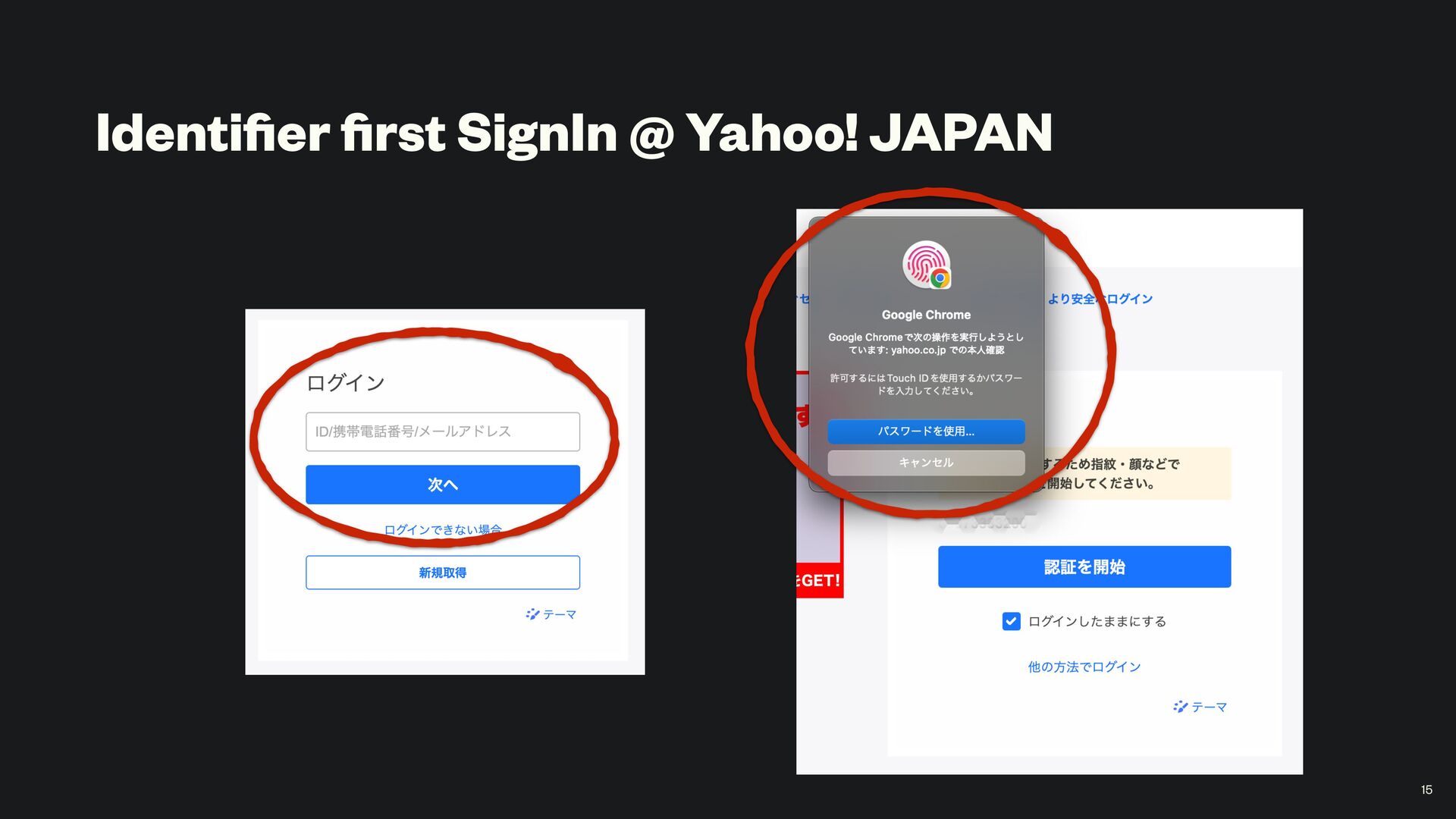
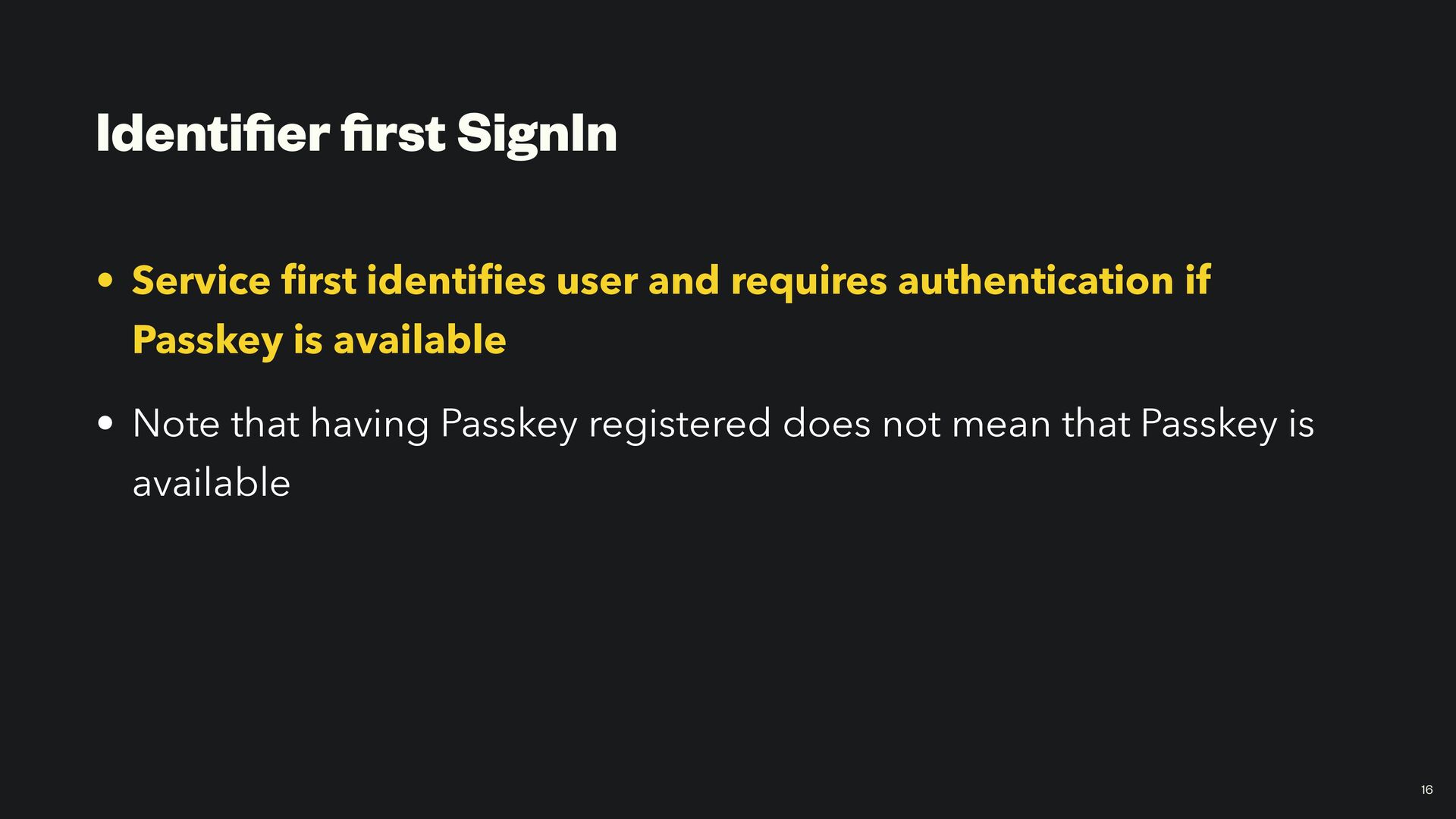
Identi fi er fi rst SignIn • Service fi rst
identi fi es user and requires authentication if Passkey is available • Note that having Passkey registered does not mean that Passkey is available 16 -
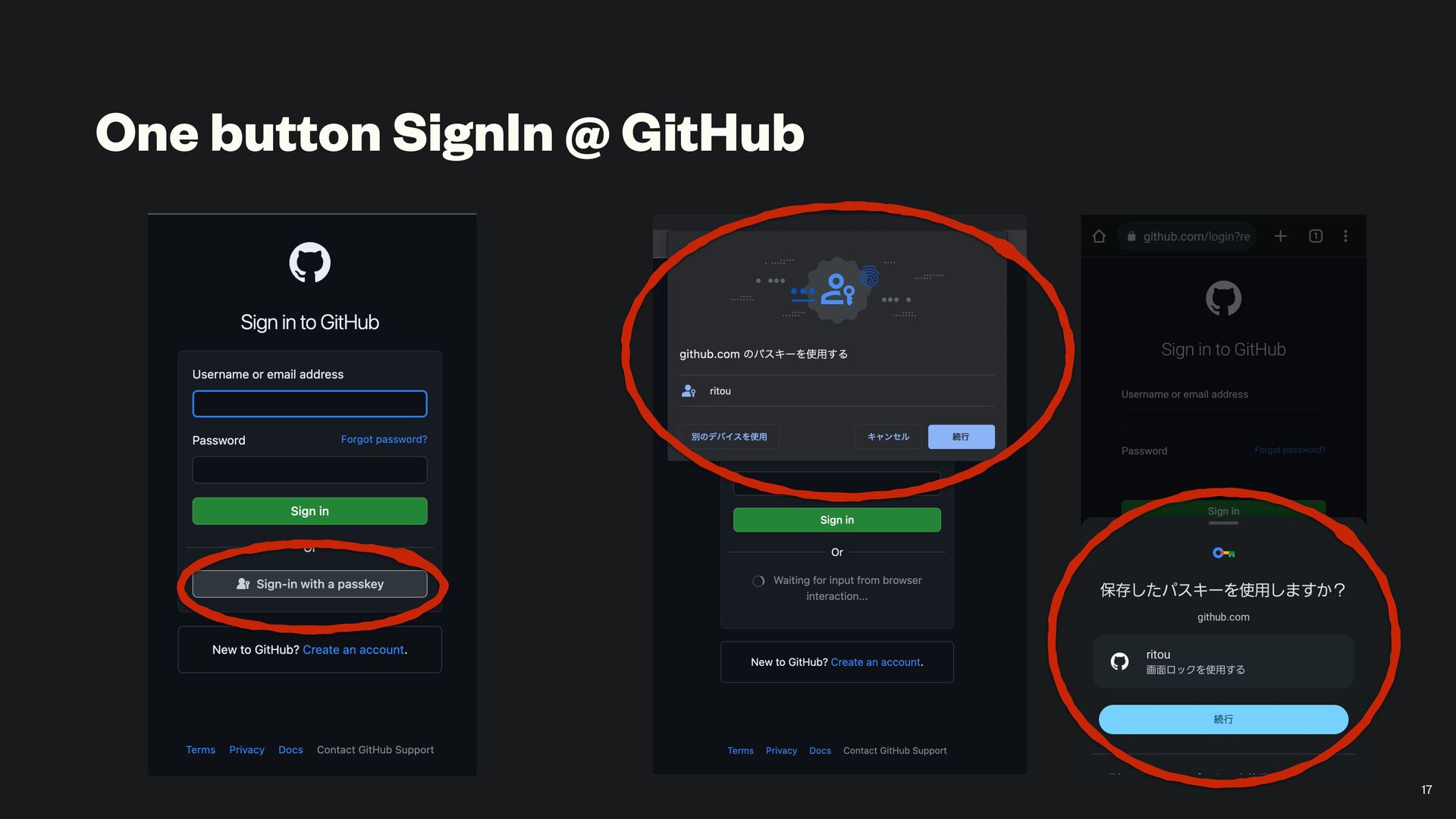
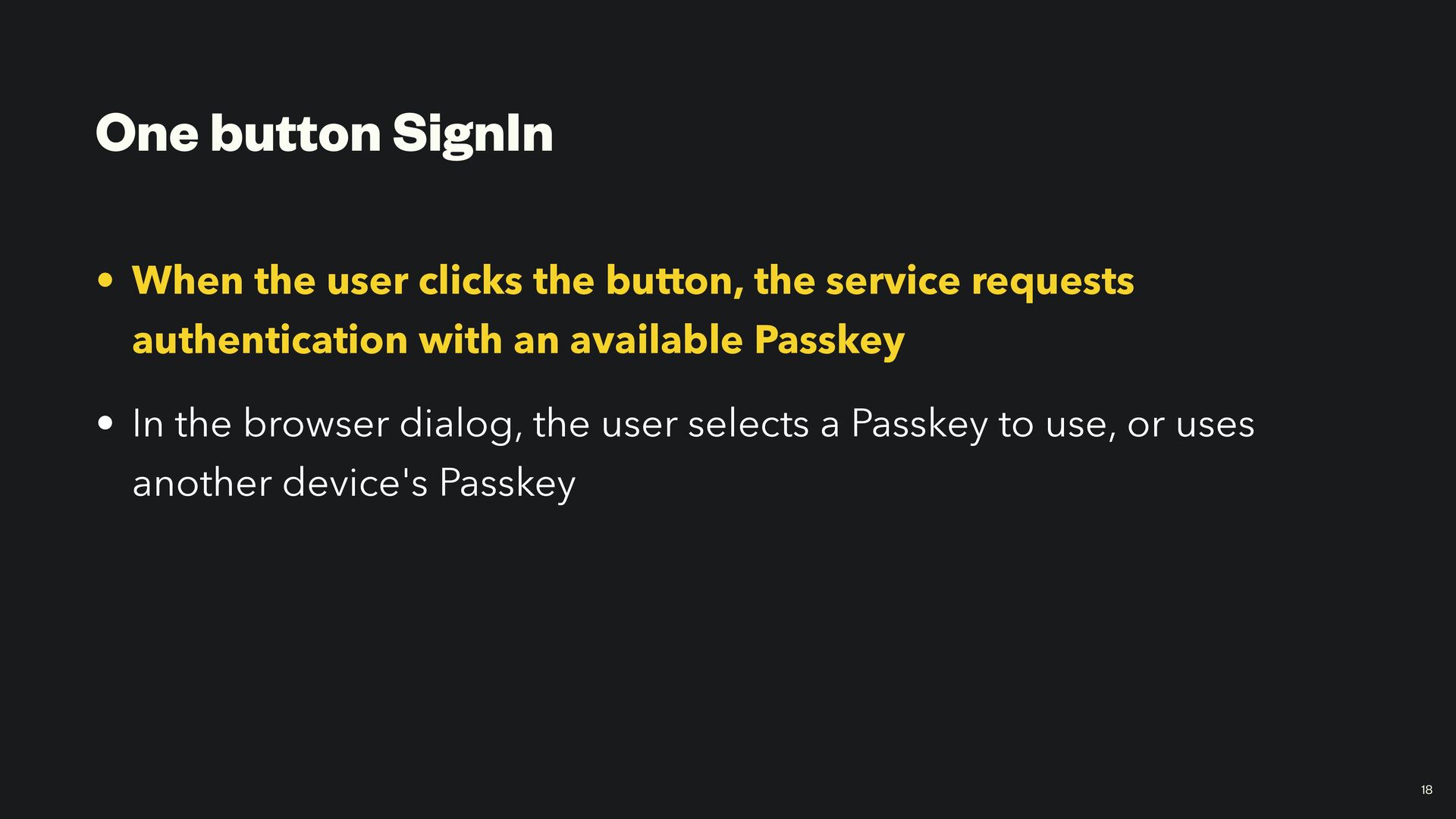
One button SignIn • When the user clicks the button,
the service requests authentication with an available Passkey • In the browser dialog, the user selects a Passkey to use, or uses another device's Passkey 18 -
Auto fi ll (Conditional UI) • Browser displays the available
Passkeys near the HTML input form or when focused, and the user selects from them or uses another device's Passkey • Passkey available with the same UX as password suggestions by Password Manager 21 -
Hybrid transport • If the device requesting authentication and a
nearby mobile device are connected via BLE, the mobile device's Passkey can be used • A UX that requires multiple Hybrid fl ows is too bad. It is also important to seamlessly require Passkey registration for each device 23 -
Use Cases • SignIn: Primary or optional authentication methods •
Re-Authentication 24 -
Re-Authentication • To protect speci fi c services • Credential
Management • Personal Information Management • Payment services • Fine-tuned Session Management • Expired Session • High-risk environment • Credential updated in another session • Low AAL(Authentication Assurance Level) 26 -
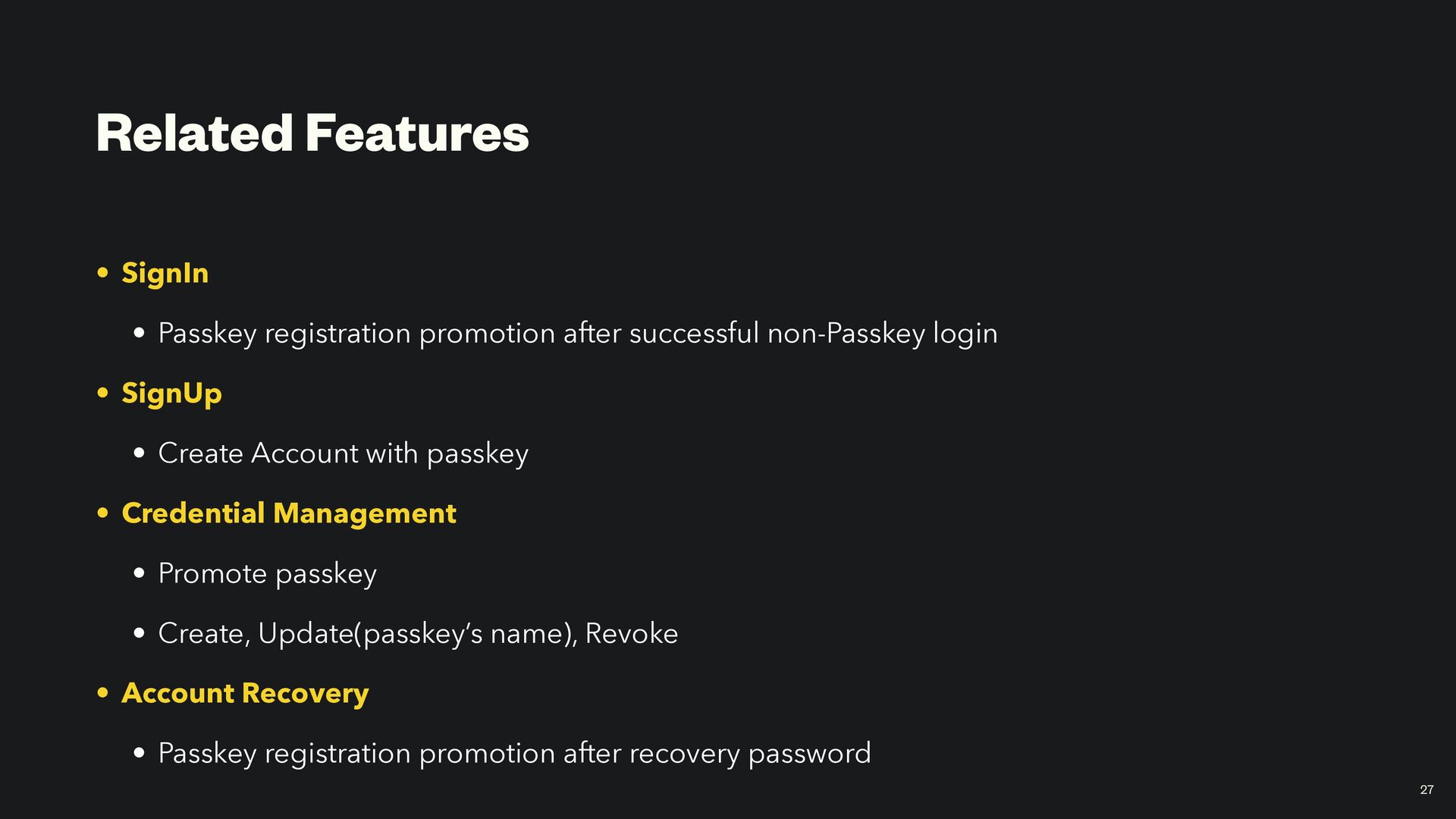
Related Features • SignIn • Passkey registration promotion after successful
non-Passkey login • SignUp • Create Account with passkey • Credential Management • Promote passkey • Create, Update(passkey’s name), Revoke • Account Recovery • Passkey registration promotion after recovery password 27 -
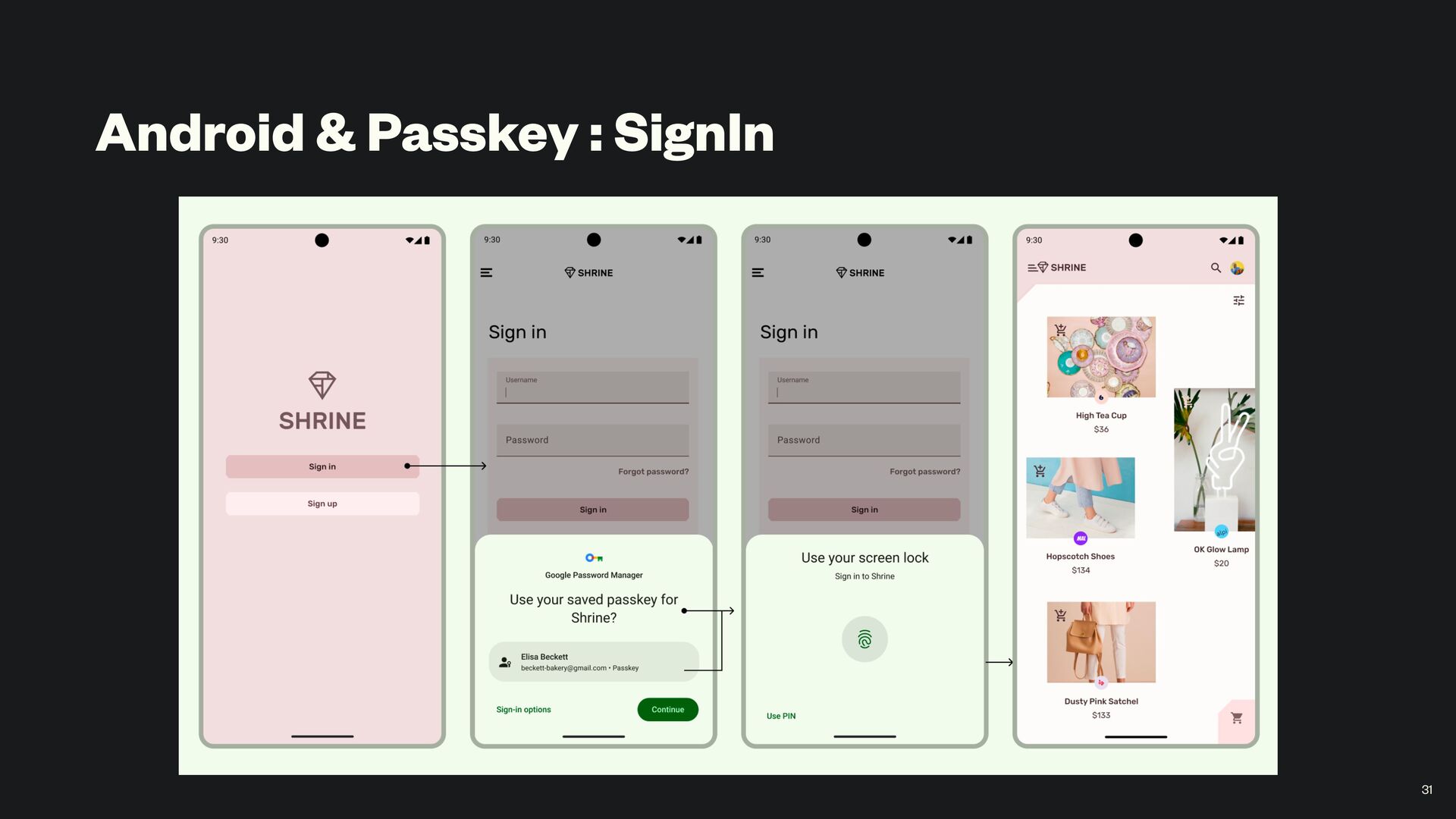
Native Support or Web Application integration • Native Support •
Utilizing functions/libraries provided for app developers from each platform • https://developer.android.com/training/sign-in/passkeys • Native apps can provide a similar UX using the same credentials as web apps • https://developer.android.com/design/ui/mobile/guides/patterns/passkeys • Web Application integration • Requesting passkey authentication in web browser • Dependent on browser usage patterns and support status 29 -
Native Support or Web Application integration • Native Support •
Utilizing functions/libraries provided for app developers from each platform • Native apps can provide a similar UX using the same credentials as web apps • Web Application integration • Requesting passkey authentication in web browser • Dependent on browser usage patterns and support status 34 -
Challenges for registration • User Veri fi cation at passkey
registration • More seamless Passkey registration is required (so that Google automatically generates a passkey when you log in to your Android device) 36 -
Challenges for Authentication • Unfriendly error screen "No passkey available."
• It is the RP that needs this error • One-way Hybrid Transport • Fallback authentication method required 37 -
Challenges for Recovery • Best practices for passkey recovery •
Two passkey registrations are dif fi cult • Self-recovery through eKYC and ID Federation 38 -
Challenges for Credential Management • Delete and update passkeys synchronized
with Authenticator and RP • Unavailable passkey listed in Auto fi ll • Username not synchronized 39 -
Features of ID Federation • Simpli fi ed new account
registration • Achieves a single sign-on-like user experience (UX) in authentication • Shares attribute information of the IdP account with the Relying Party (RP) under appropriate consent (such as pro fi le information, email, etc.) 41 -
Weaknesses of ID Federation • Services and users who do
not want to use a speci fi c IdP and wish to avoid privacy issues that could arise from consolidating identities • Impact when the IdP account is unavailable (due to outages or account BAN) • Re-authentication requirements are de fi ned in speci fi cations, but are rarely implemented in toC IdPs 42 -
Passkey without ID Federation • Implementing secure and convenient authentication
equivalent to IdP • Avoiding privacy issues by not integrating with IdP 43 -
Passkey @ Identity Provider • Protecting high-value accounts • Providing
security and convenience to RP”s” 44 -
Passkey @ Relying Party • Applying Passkeys to the weaknesses
of ID Federation • Alternative measures when Federation is unavailable • Re-authentication • Applying ID Federation to the weaknesses of Passkeys • Federation w/ Platform Accounts as a recovery method for Passkeys 45 -
Passkey @ Relying Party • Applying Passkeys to the weaknesses
of ID Federation • Alternative measures when Federation is unavailable • Re-authentication • Applying ID Federation to the weaknesses of Passkeys • Federation w/ Platform Accounts as a recovery method for Passkeys 46 -
Overview Passkey is a mechanism that allows users to manage
their FIDO credentials through the system. It offers the security of public key cryptography along with the convenience of local authentication, and it is evolving to support cross-device and cross-platform use. 48 -
Use Cases • For the sign-in UX, the service needs
to choose from several patterns to match the existing sign-in UX. • Passkey can be used for re-authentication to protect speci fi c functions and for fi ne-tuned session management. 49 -
Challenges of Passkey • For Passkey to be widely adopted,
it needs to be easier and less stressful to register. • For users who are not familiar with Passkey, it's essential to reduce error messages and guide them toward fallback options or recovery methods. • Information that might be changed, like usernames, should be simultaneously updated in both the RP and the Authenticator, and unnecessary Passkeys should be deleted at the same time. 50 -
Passkey and ID Federation • IdP can increase the security
and convenience of federated RPs by using Passkey. • RP combines ID federation and Passkey to compensate for each other's weaknesses. 51