Share
Embed
Code and Memory Optimisation Tricks
Presentation by Evgeny Muralev at DevGamm2016 conference
#programming #software #IT #gamedev
Sperasoft
October 03, 2016
Transcript
57 slides
-
About me • Software engineer at Sperasoft • Worked on
code for EA Sports games (FIFA, NFL, Madden); Now Ubisoft AAA title • Indie game developer in my free time -
Our Clients Electronic Arts Riot Games Wargaming BioWare Ubisoft Disney
Sony Our Projects Dragon Age: Inquisition FIFA 14 SIMS 4 Mass Effect 2 League of Legends Grand Theft Auto V About us Our Office Locations USA Poland Russia The Facts Founded in 2004 300+ employees Sperasoft on-line sperasoft.com linkedin.com/company/sperasoft twitter.com/sperasoft facebook.com/sperasoft -
Agenda • Brief architecture overview • Optimizing for data cache
• Optimizing branches (and I-cache) -
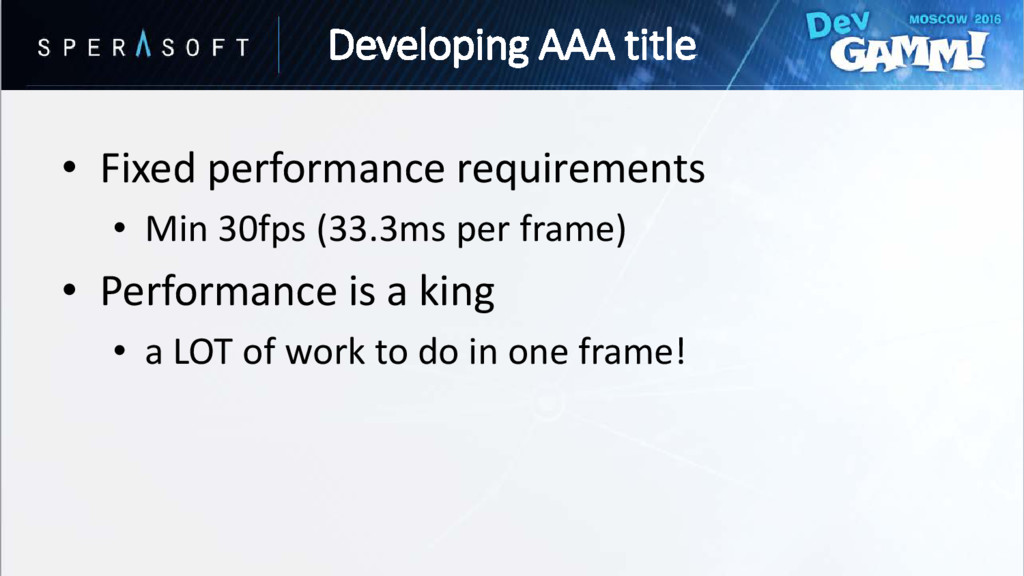
Developing AAA title • Fixed performance requirements • Min 30fps
(33.3ms per frame) • Performance is a king • a LOT of work to do in one frame! -
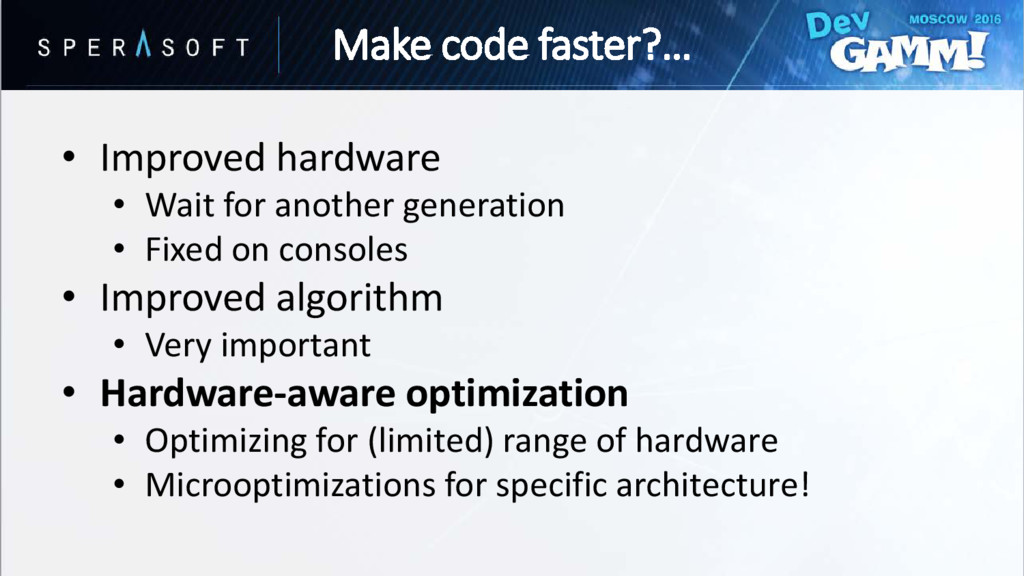
Make code faster?… • Improved hardware • Wait for another
generation • Fixed on consoles • Improved algorithm • Very important • Hardware-aware optimization • Optimizing for (limited) range of hardware • Microoptimizations for specific architecture! -
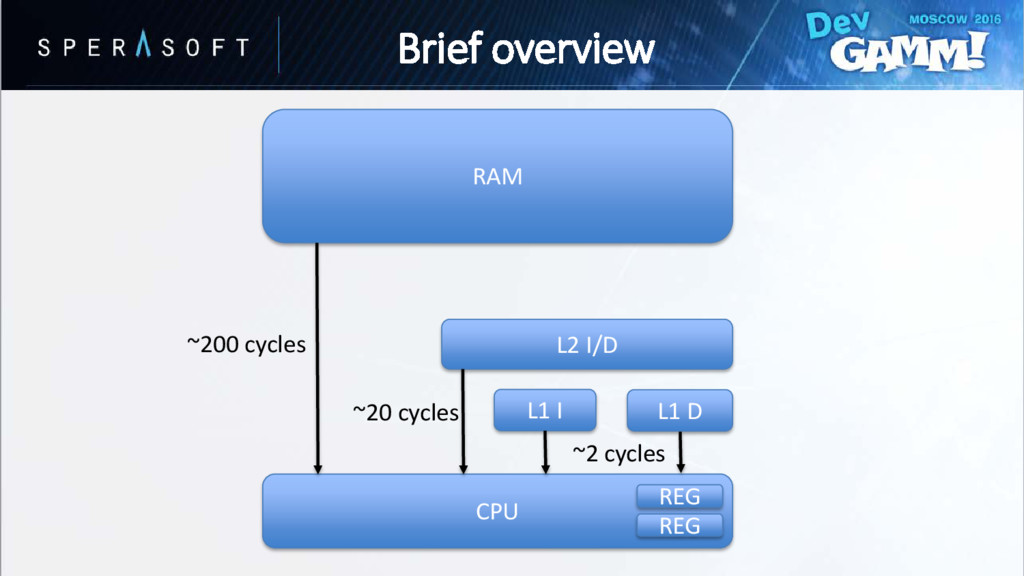
Brief overview CPU REG L1 I L1 D L2 I/D
RAM REG ~2 cycles ~20 cycles ~200 cycles -
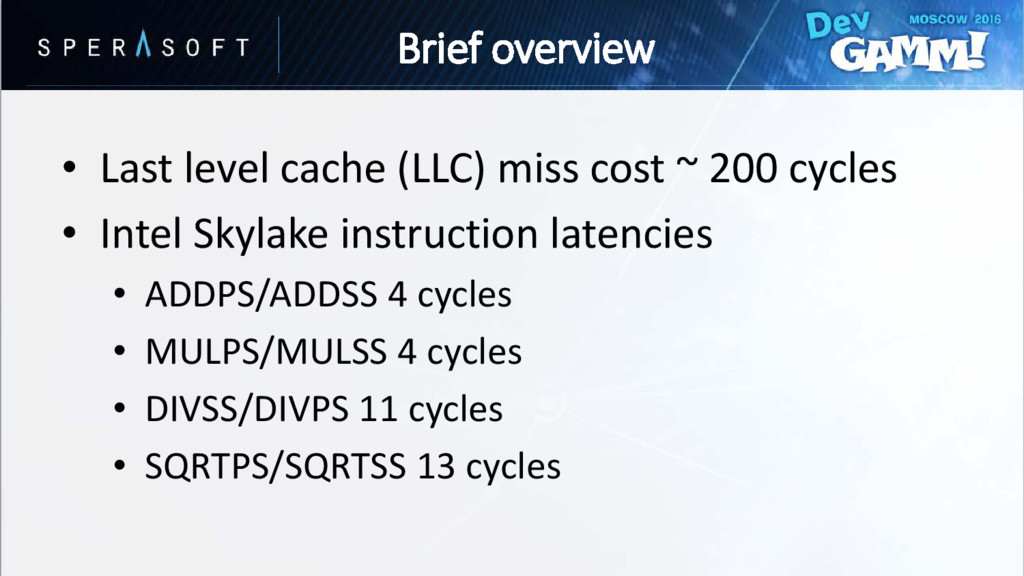
• Last level cache (LLC) miss cost ~ 200 cycles
• Intel Skylake instruction latencies • ADDPS/ADDSS 4 cycles • MULPS/MULSS 4 cycles • DIVSS/DIVPS 11 cycles • SQRTPS/SQRTSS 13 cycles Brief overview -
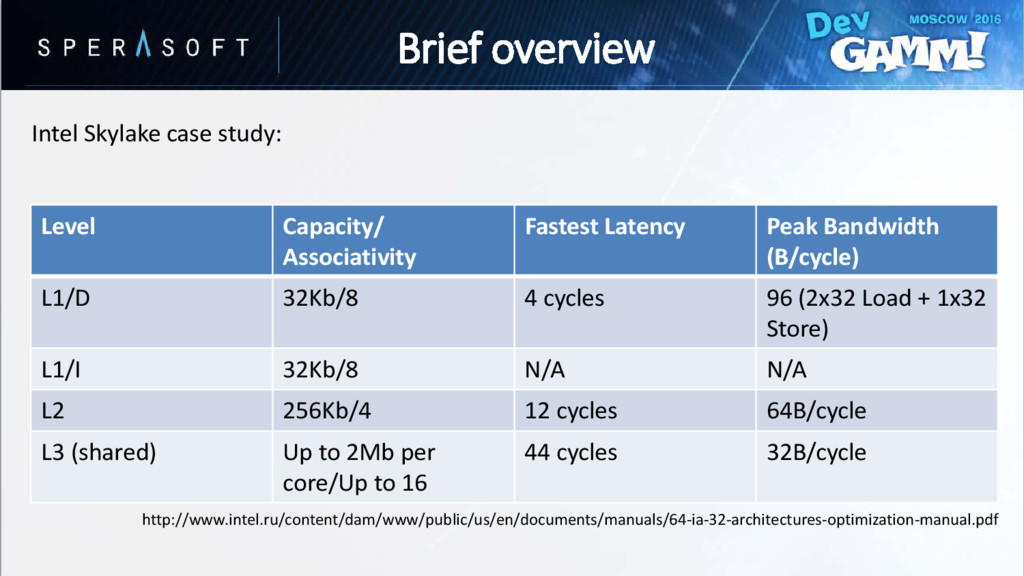
Intel Skylake case study: Level Capacity/ Associativity Fastest Latency Peak
Bandwidth (B/cycle) L1/D 32Kb/8 4 cycles 96 (2x32 Load + 1x32 Store) L1/I 32Kb/8 N/A N/A L2 256Kb/4 12 cycles 64B/cycle L3 (shared) Up to 2Mb per core/Up to 16 44 cycles 32B/cycle http://www.intel.ru/content/dam/www/public/us/en/documents/manuals/64-ia-32-architectures-optimization-manual.pdf Brief overview -
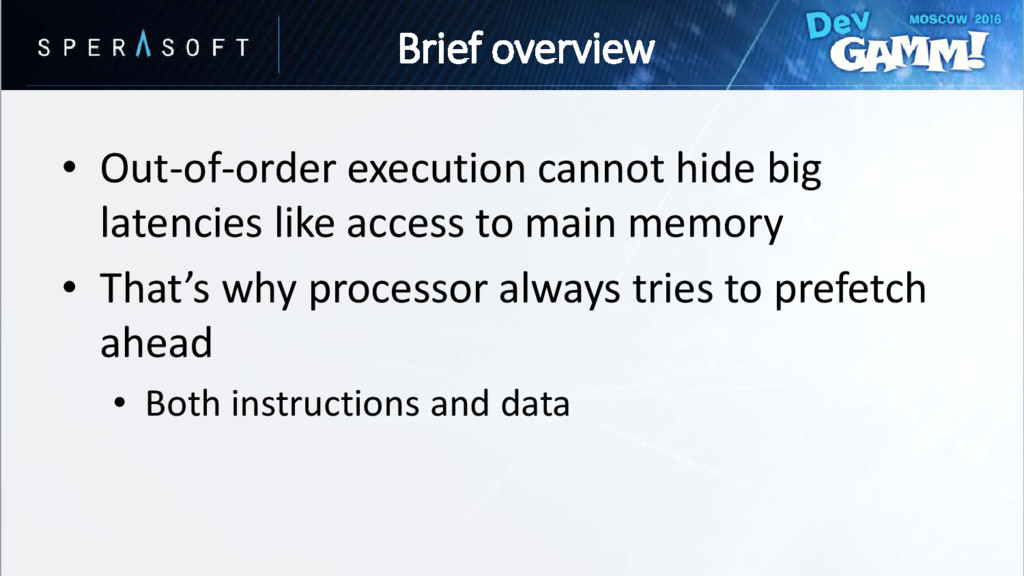
• Out-of-order execution cannot hide big latencies like access to
main memory • That’s why processor always tries to prefetch ahead • Both instructions and data Brief overview -
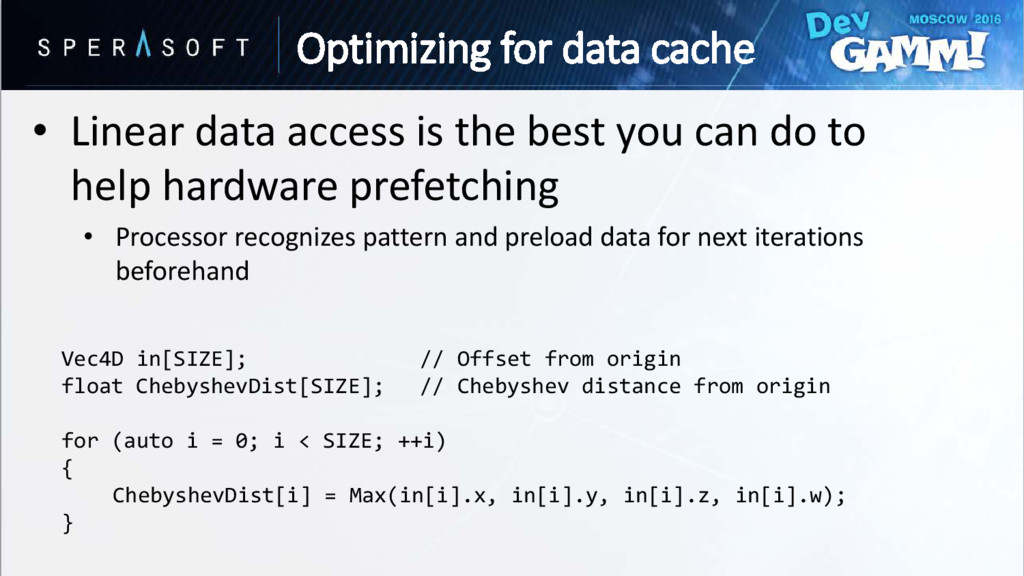
• Linear data access is the best you can do
to help hardware prefetching • Processor recognizes pattern and preload data for next iterations beforehand Vec4D in[SIZE]; // Offset from origin float ChebyshevDist[SIZE]; // Chebyshev distance from origin for (auto i = 0; i < SIZE; ++i) { ChebyshevDist[i] = Max(in[i].x, in[i].y, in[i].z, in[i].w); } Optimizing for data cache -
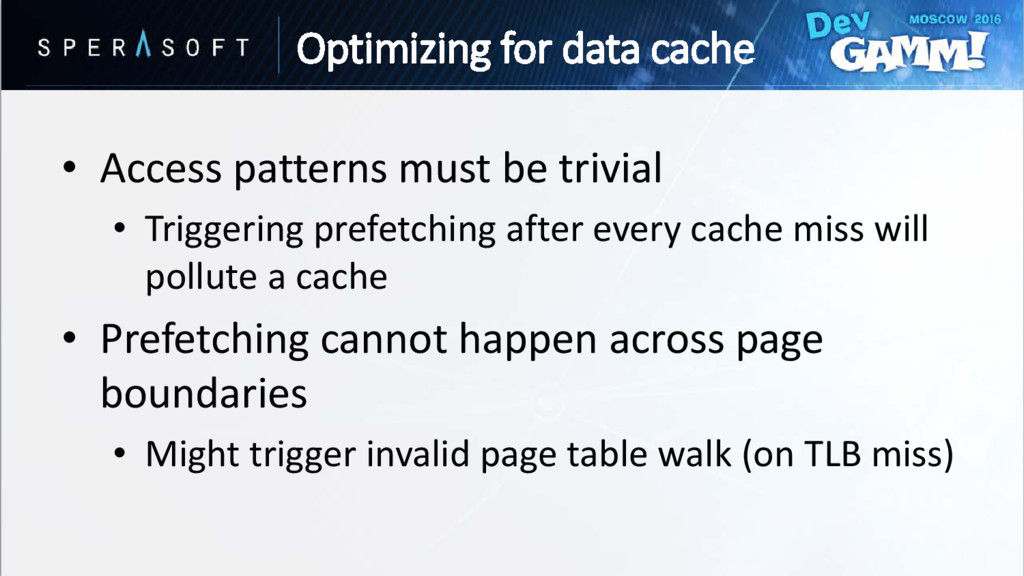
• Access patterns must be trivial • Triggering prefetching after
every cache miss will pollute a cache • Prefetching cannot happen across page boundaries • Might trigger invalid page table walk (on TLB miss) Optimizing for data cache -
• What about traversal of pointer-based data structures? • Spoiler:
It sucks Optimizing for data cache -
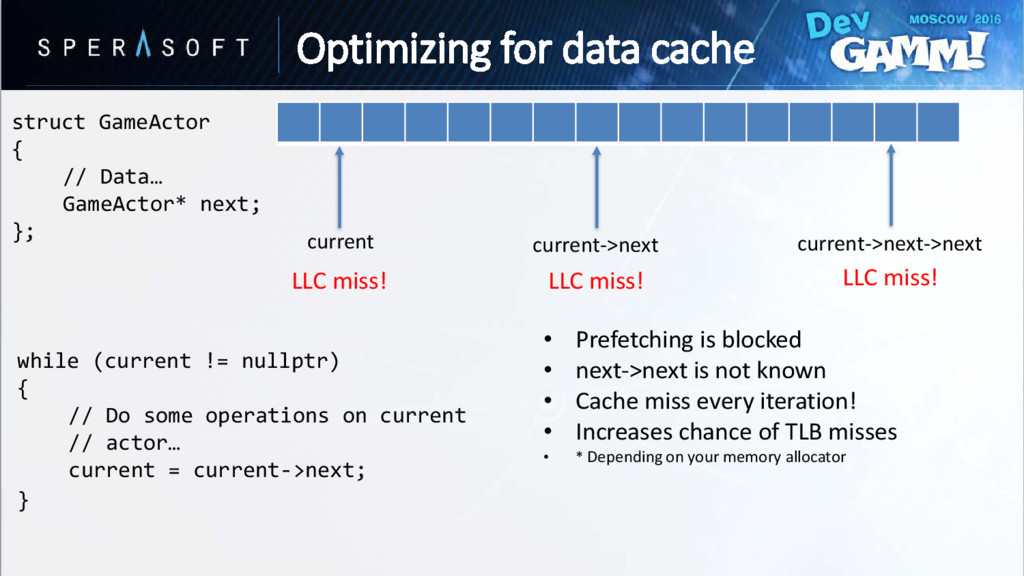
• Prefetching is blocked • next->next is not known •
Cache miss every iteration! • Increases chance of TLB misses • * Depending on your memory allocator current current->next->next current->next struct GameActor { // Data… GameActor* next; }; while (current != nullptr) { // Do some operations on current // actor… current = current->next; } LLC miss! LLC miss! LLC miss! Optimizing for data cache -
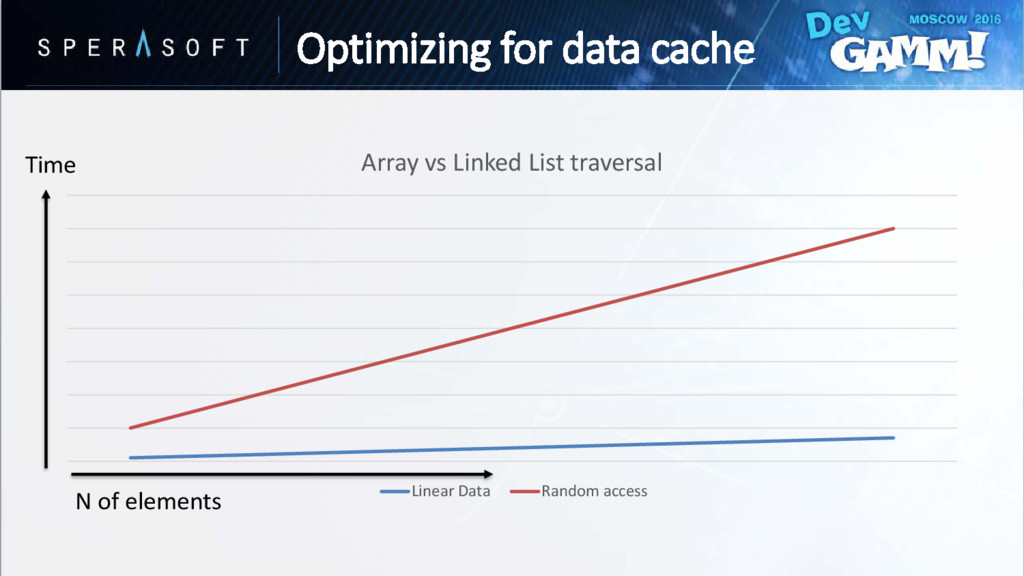
Array vs Linked List traversal Linear Data Random access Optimizing
for data cache Time N of elements -
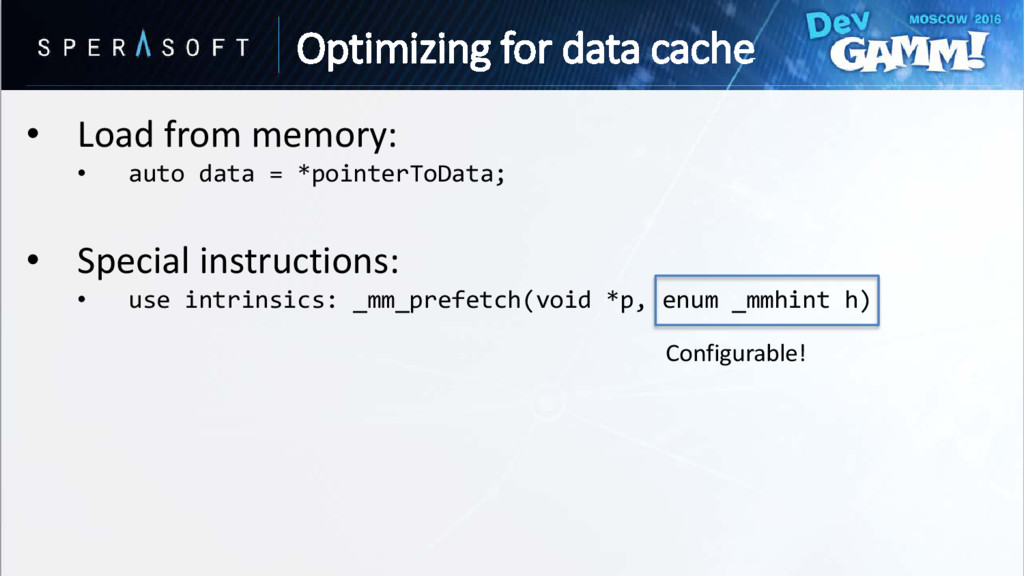
• Load from memory: • auto data = *pointerToData; •
Special instructions: • use intrinsics: _mm_prefetch(void *p, enum _mmhint h) Configurable! Optimizing for data cache -
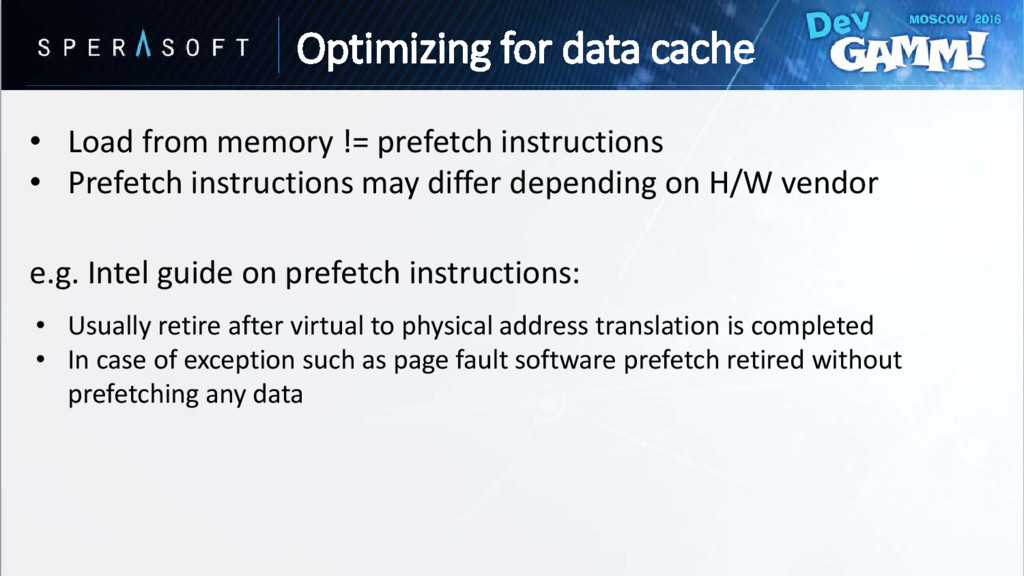
• Usually retire after virtual to physical address translation is
completed • In case of exception such as page fault software prefetch retired without prefetching any data e.g. Intel guide on prefetch instructions: • Load from memory != prefetch instructions • Prefetch instructions may differ depending on H/W vendor Optimizing for data cache -
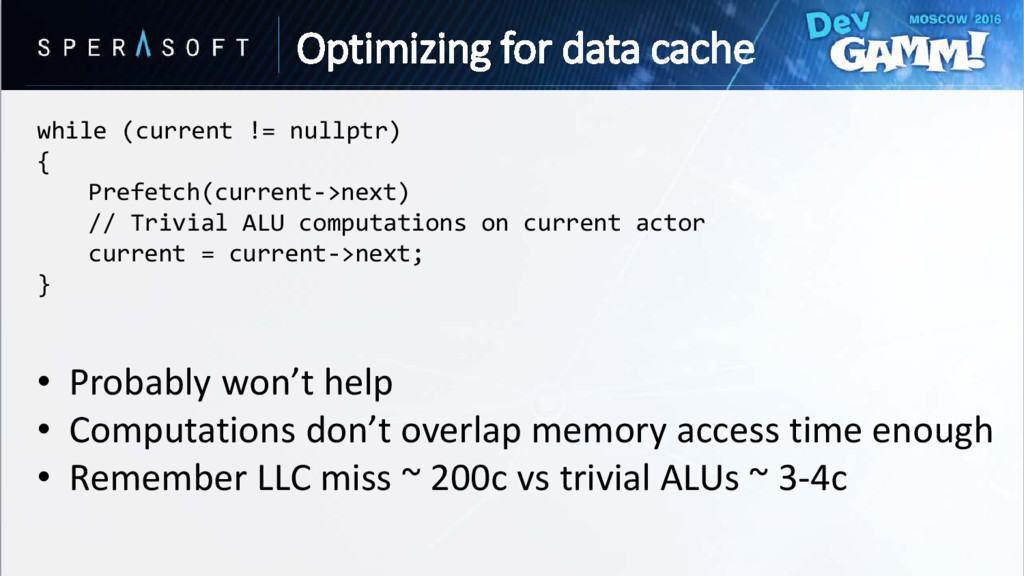
• Probably won’t help • Computations don’t overlap memory access
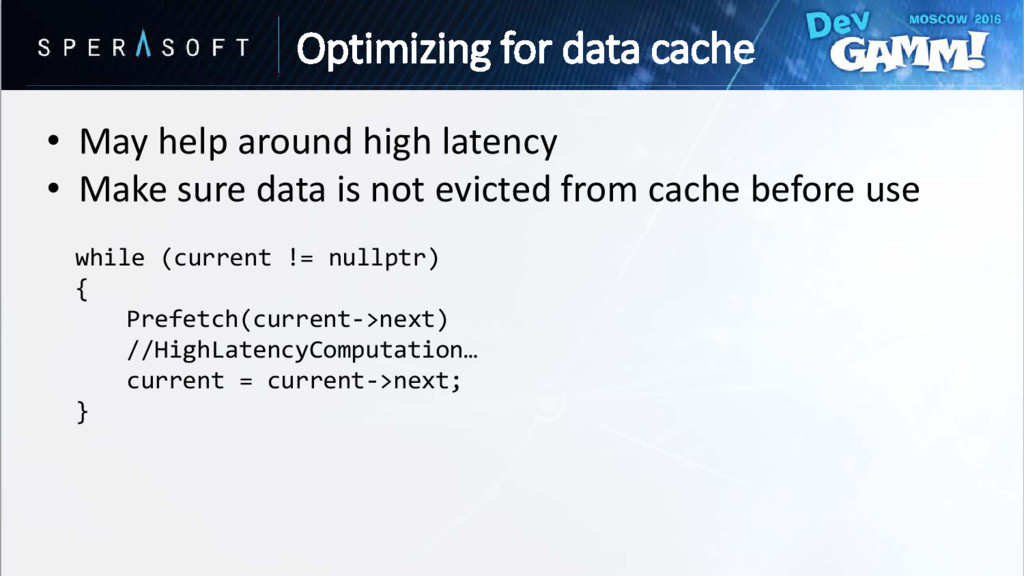
time enough • Remember LLC miss ~ 200c vs trivial ALUs ~ 3-4c while (current != nullptr) { Prefetch(current->next) // Trivial ALU computations on current actor current = current->next; } Optimizing for data cache -
while (current != nullptr) { Prefetch(current->next) //HighLatencyComputation… current = current->next;
} • May help around high latency • Make sure data is not evicted from cache before use Optimizing for data cache -
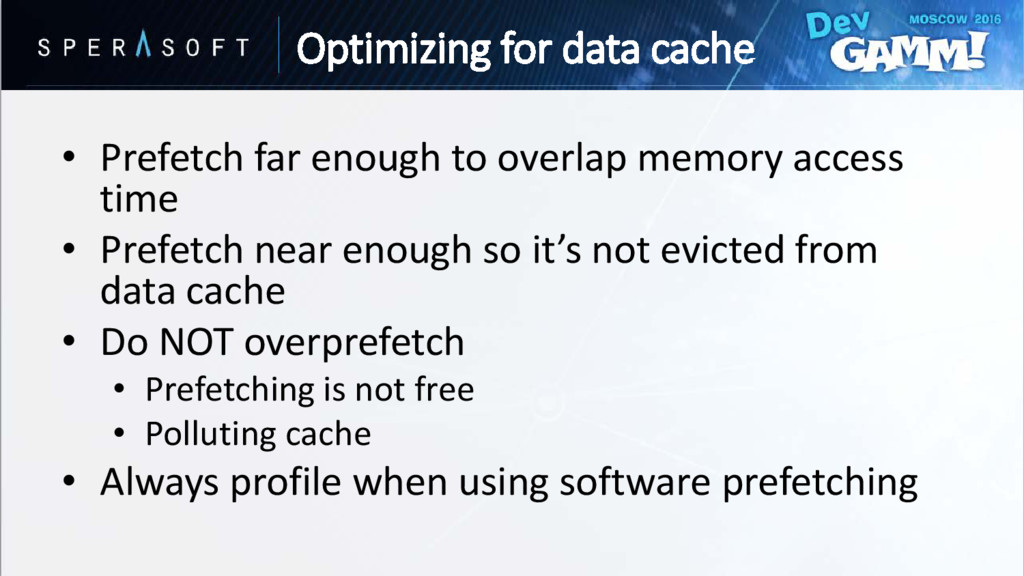
• Prefetch far enough to overlap memory access time •
Prefetch near enough so it’s not evicted from data cache • Do NOT overprefetch • Prefetching is not free • Polluting cache • Always profile when using software prefetching Optimizing for data cache -
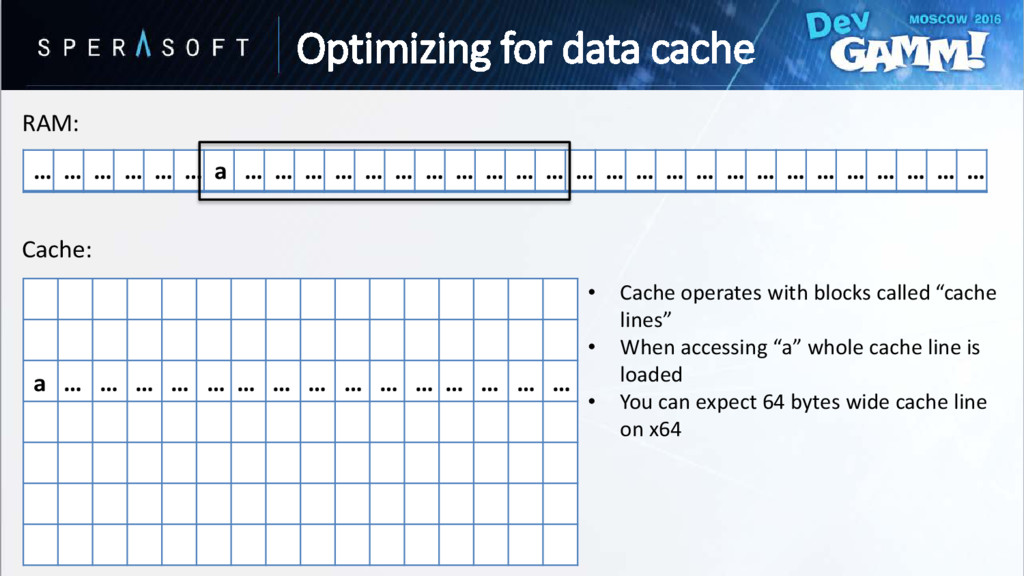
RAM: … … … … … … a … …
… … … … … … … … … … … … … … … … … … … … … … … Cache: • Cache operates with blocks called “cache lines” • When accessing “a” whole cache line is loaded • You can expect 64 bytes wide cache line on x64 a … … … … … … … … … … … … … … … Optimizing for data cache -
struct FooBonus { float fooBonus; float otherData[15]; }; // For
every character… // Assume we have array<FooBonus> structs; float Sum{0.0f}; for (auto i = 0; i < SIZE; ++i) { Actor->Total += FooArray[i].fooBonus; } Example of poor data layout: Optimizing for data cache -
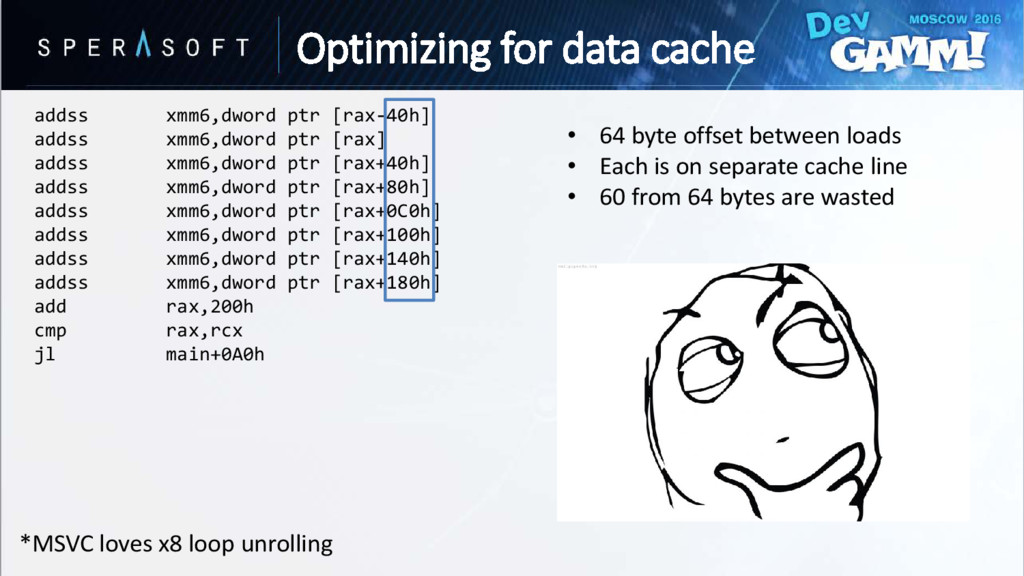
• 64 byte offset between loads • Each is on
separate cache line • 60 from 64 bytes are wasted addss xmm6,dword ptr [rax-40h] addss xmm6,dword ptr [rax] addss xmm6,dword ptr [rax+40h] addss xmm6,dword ptr [rax+80h] addss xmm6,dword ptr [rax+0C0h] addss xmm6,dword ptr [rax+100h] addss xmm6,dword ptr [rax+140h] addss xmm6,dword ptr [rax+180h] add rax,200h cmp rax,rcx jl main+0A0h *MSVC loves x8 loop unrolling Optimizing for data cache -
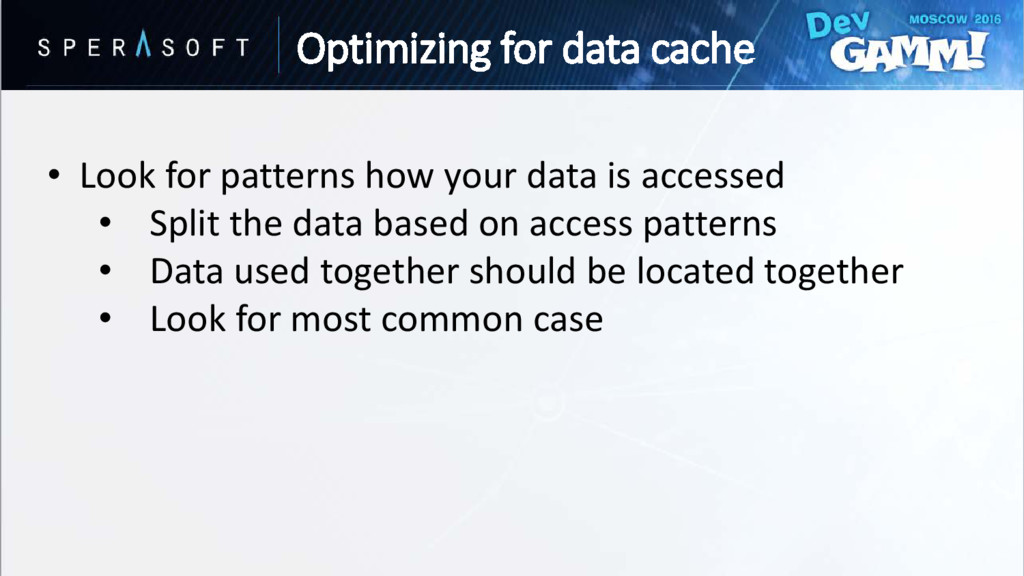
• Look for patterns how your data is accessed •
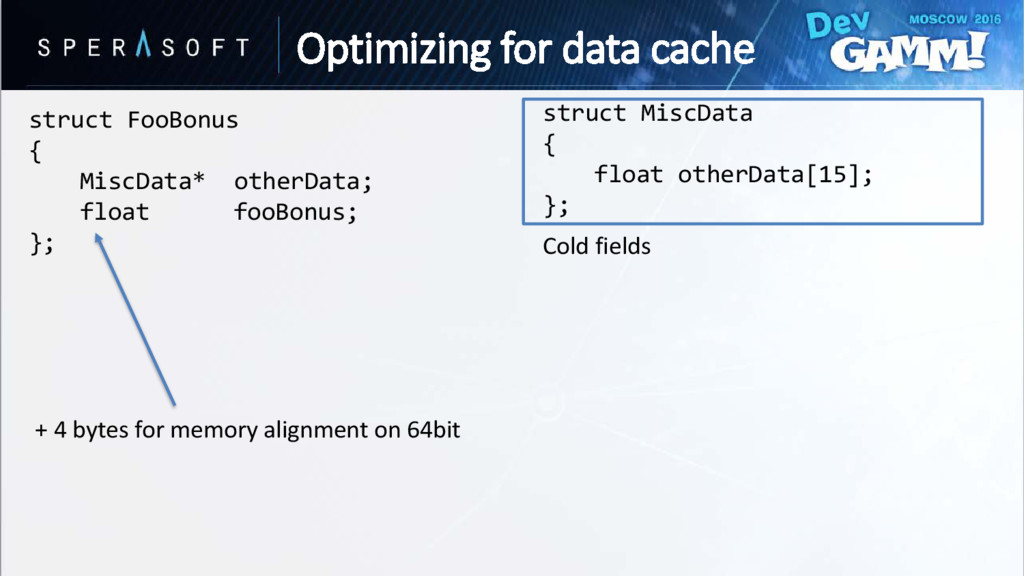
Split the data based on access patterns • Data used together should be located together • Look for most common case Optimizing for data cache -
Cold fields struct FooBonus { MiscData* otherData; float fooBonus; };
struct MiscData { float otherData[15]; }; Optimizing for data cache + 4 bytes for memory alignment on 64bit -
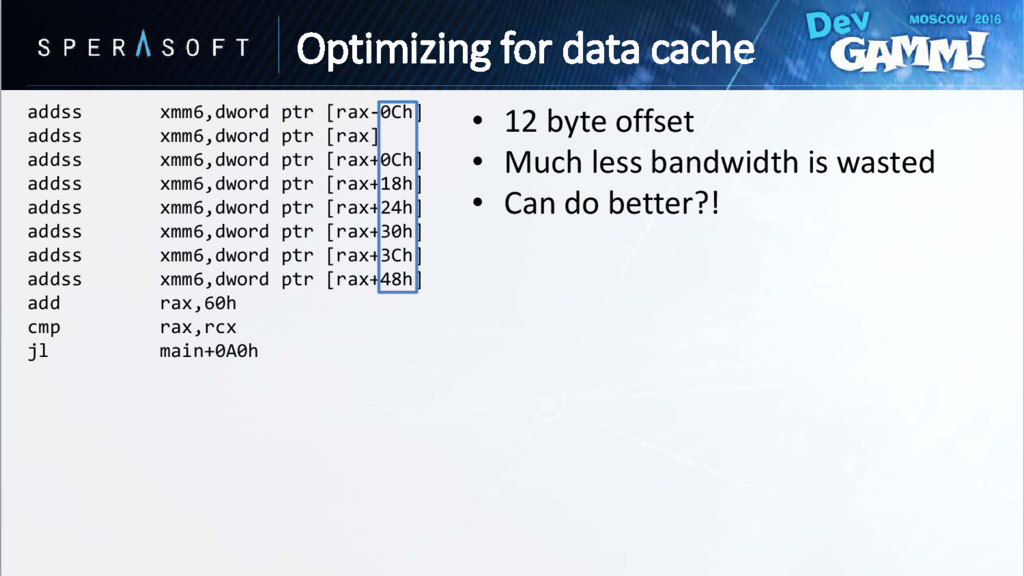
• 12 byte offset • Much less bandwidth is wasted
• Can do better?! addss xmm6,dword ptr [rax-0Ch] addss xmm6,dword ptr [rax] addss xmm6,dword ptr [rax+0Ch] addss xmm6,dword ptr [rax+18h] addss xmm6,dword ptr [rax+24h] addss xmm6,dword ptr [rax+30h] addss xmm6,dword ptr [rax+3Ch] addss xmm6,dword ptr [rax+48h] add rax,60h cmp rax,rcx jl main+0A0h Optimizing for data cache -
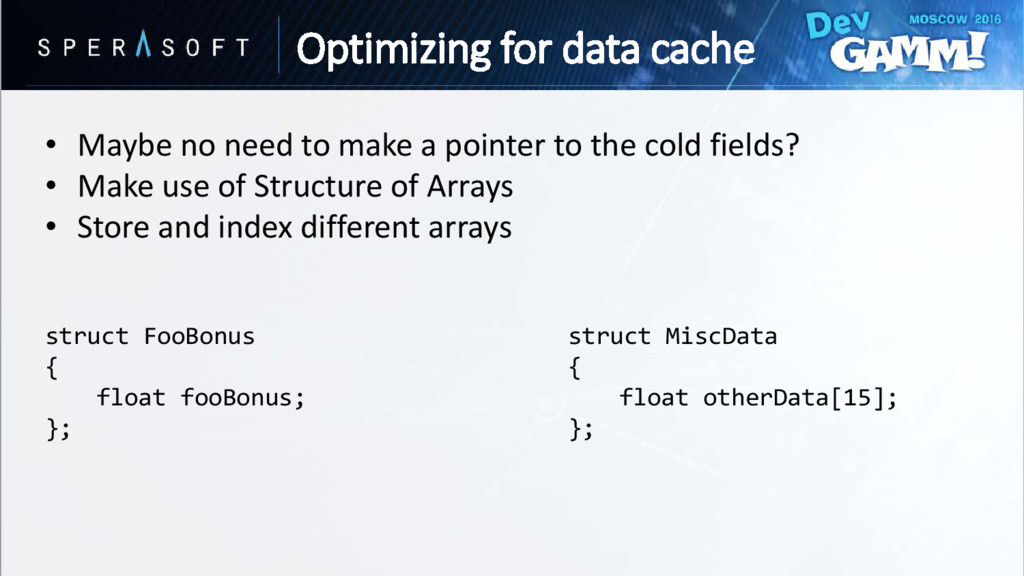
• Maybe no need to make a pointer to the
cold fields? • Make use of Structure of Arrays • Store and index different arrays struct FooBonus { float fooBonus; }; struct MiscData { float otherData[15]; }; Optimizing for data cache -
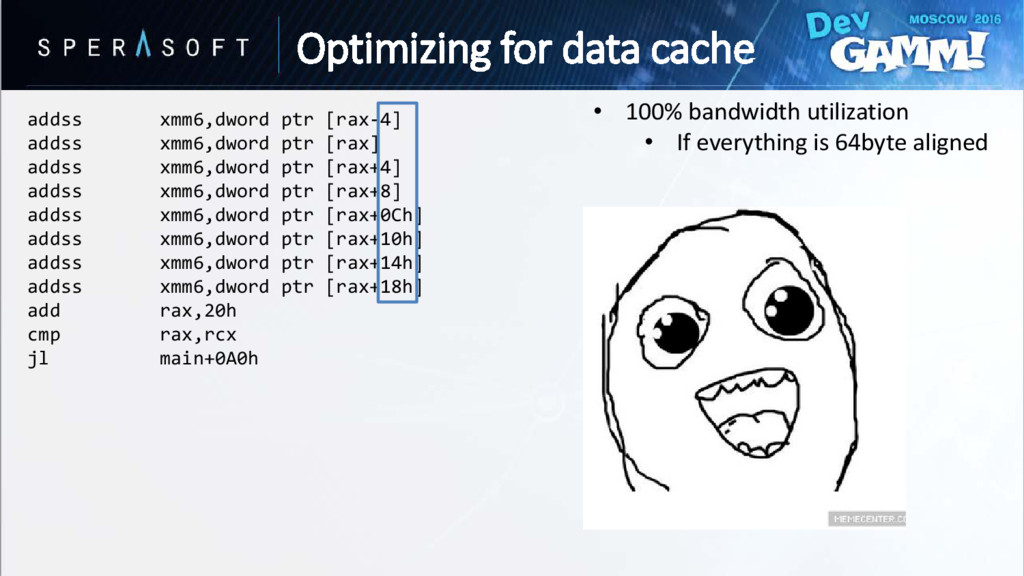
• 100% bandwidth utilization • If everything is 64byte aligned
addss xmm6,dword ptr [rax-4] addss xmm6,dword ptr [rax] addss xmm6,dword ptr [rax+4] addss xmm6,dword ptr [rax+8] addss xmm6,dword ptr [rax+0Ch] addss xmm6,dword ptr [rax+10h] addss xmm6,dword ptr [rax+14h] addss xmm6,dword ptr [rax+18h] add rax,20h cmp rax,rcx jl main+0A0h Optimizing for data cache -
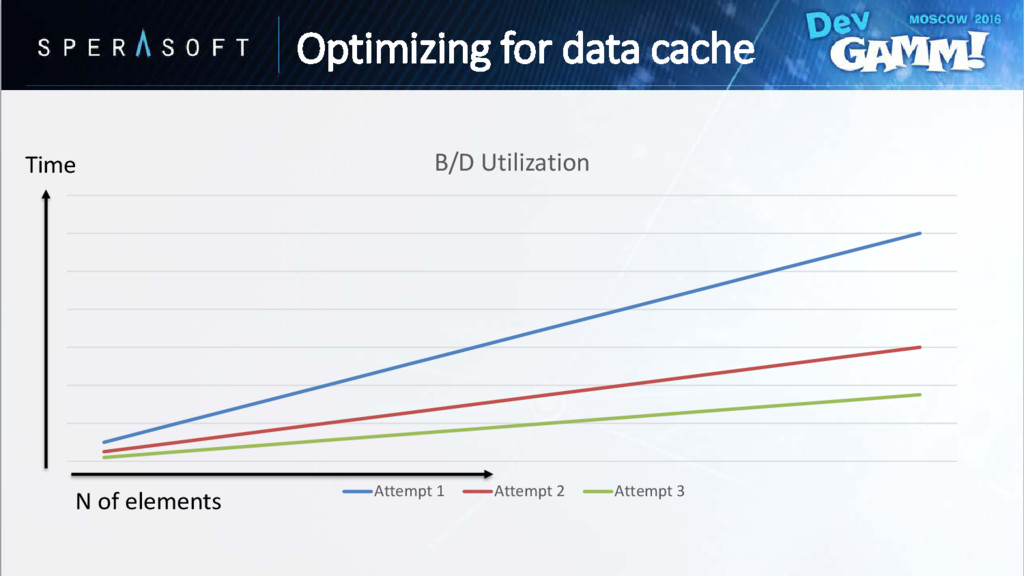
B/D Utilization Attempt 1 Attempt 2 Attempt 3 Optimizing for
data cache Time N of elements -
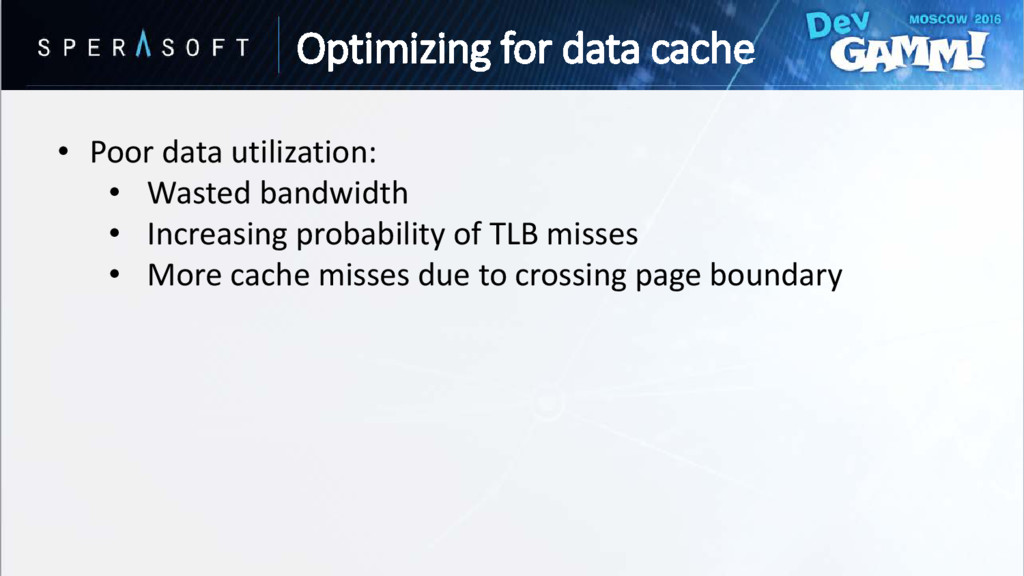
• Poor data utilization: • Wasted bandwidth • Increasing probability
of TLB misses • More cache misses due to crossing page boundary Optimizing for data cache -
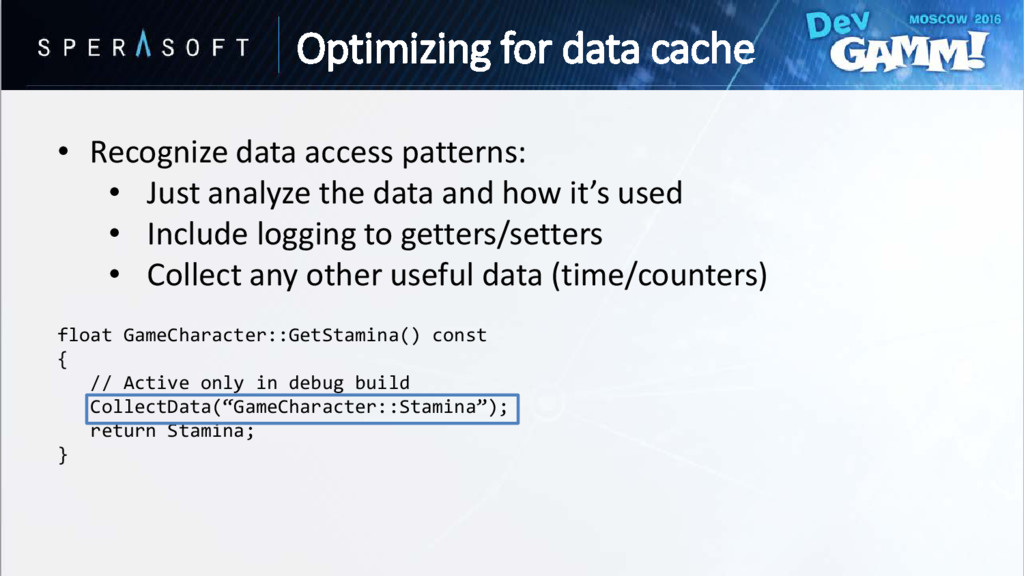
• Recognize data access patterns: • Just analyze the data
and how it’s used • Include logging to getters/setters • Collect any other useful data (time/counters) float GameCharacter::GetStamina() const { // Active only in debug build CollectData(“GameCharacter::Stamina”); return Stamina; } Optimizing for data cache -
• What to consider: • What data is accessed together
• How often data is accessed? • From where it’s accessed? Optimizing for data cache -
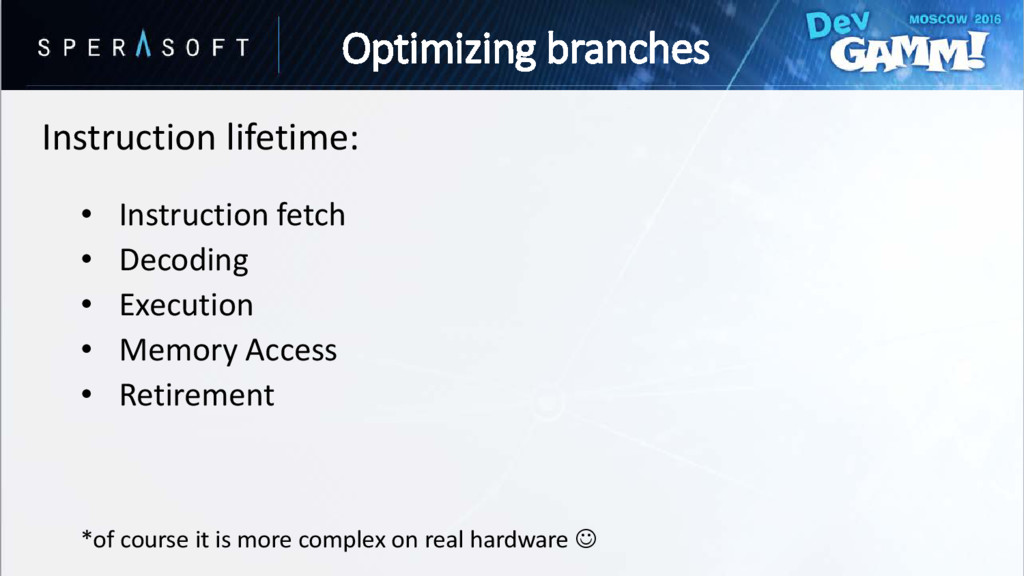
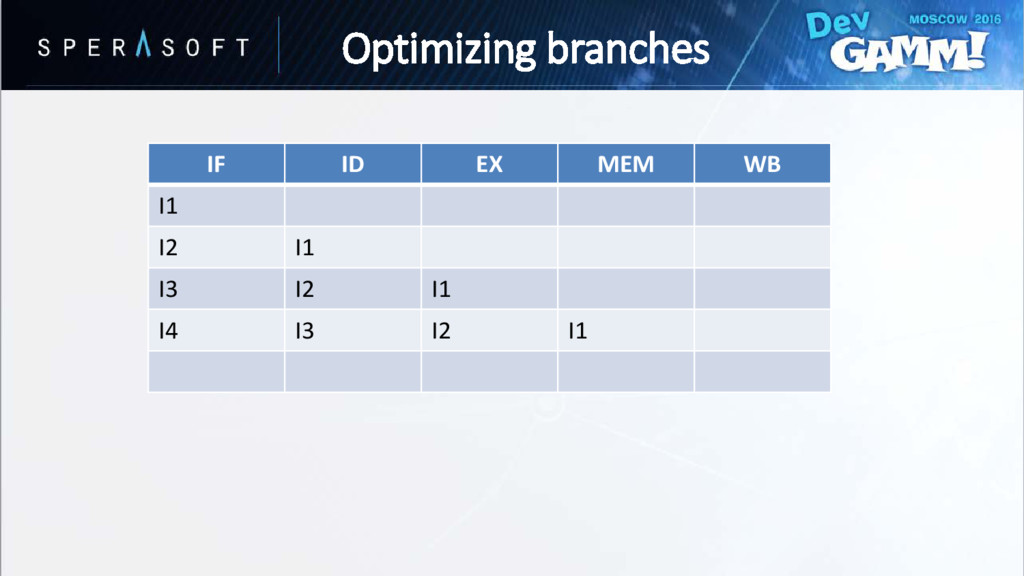
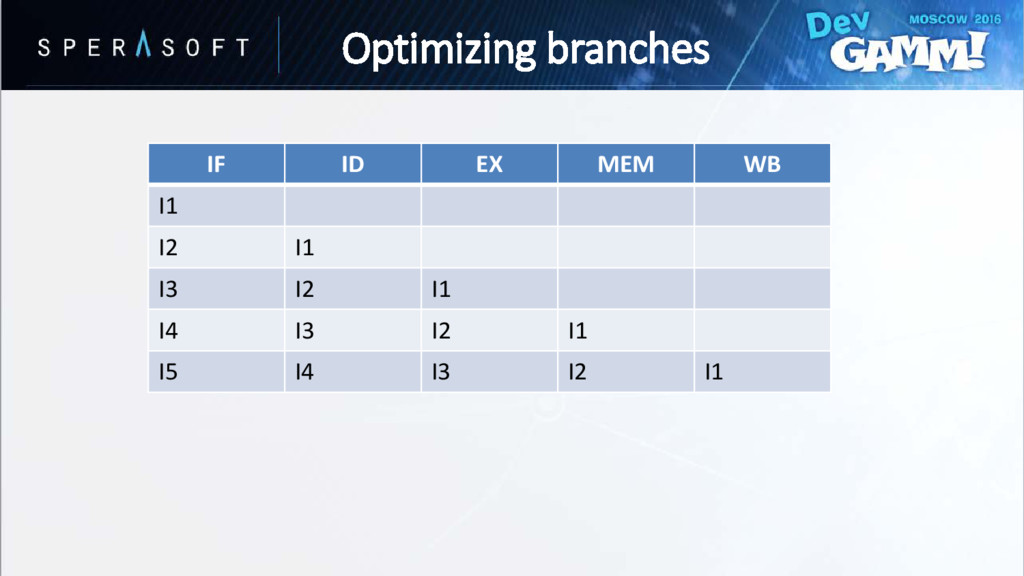
• Instruction fetch • Decoding • Execution • Memory Access
• Retirement *of course it is more complex on real hardware Optimizing branches Instruction lifetime: -
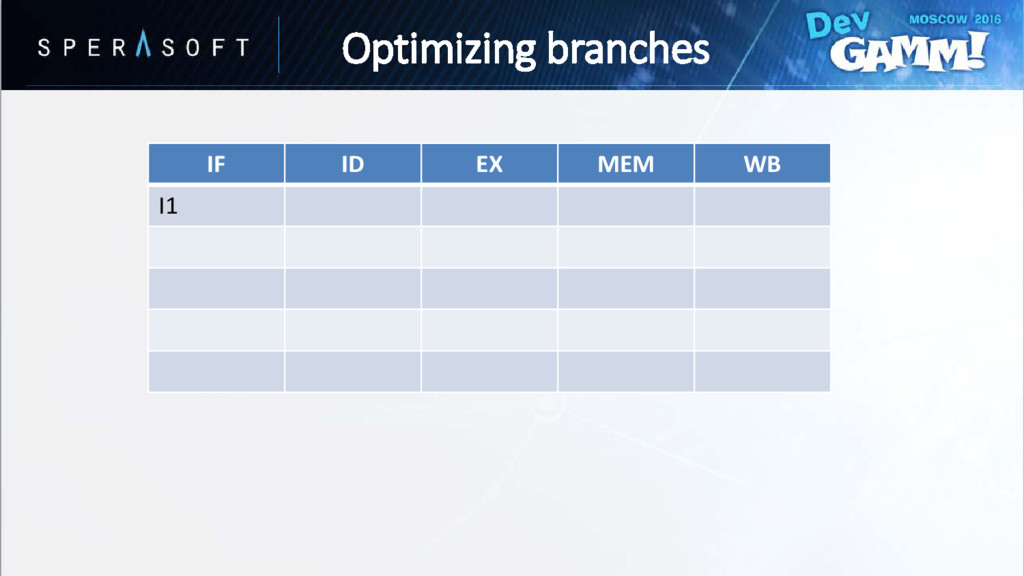
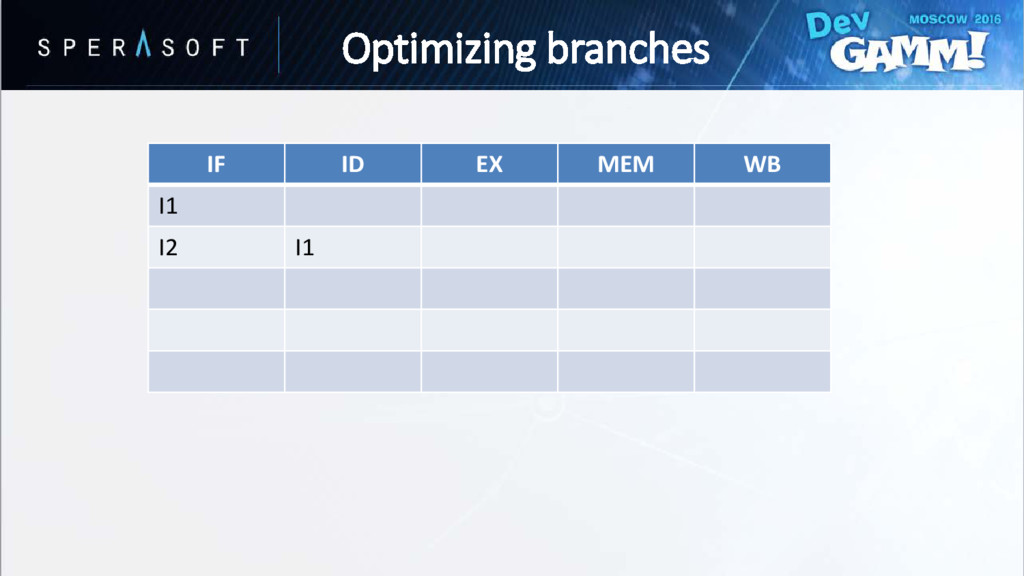
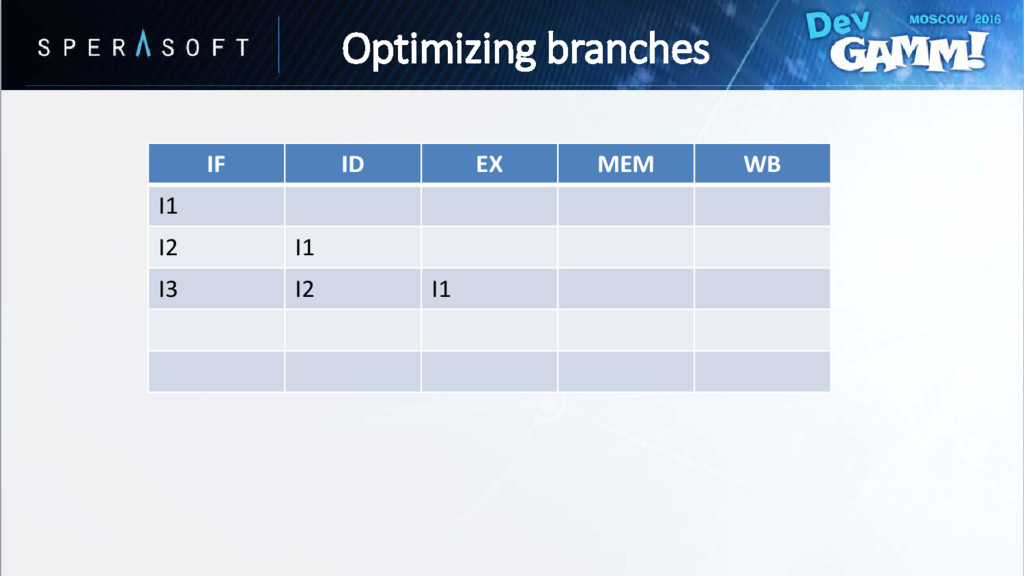
IF ID EX MEM WB I1 I2 I1 I3 I2
I1 Optimizing branches -
IF ID EX MEM WB I1 I2 I1 I3 I2
I1 I4 I3 I2 I1 Optimizing branches -
IF ID EX MEM WB I1 I2 I1 I3 I2
I1 I4 I3 I2 I1 I5 I4 I3 I2 I1 Optimizing branches -
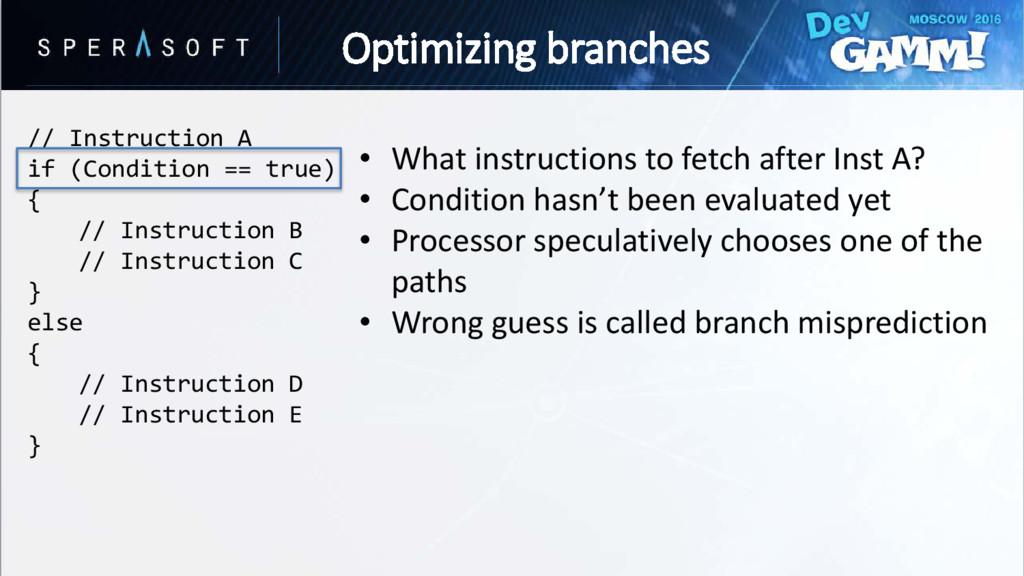
• What instructions to fetch after Inst A? • Condition
hasn’t been evaluated yet • Processor speculatively chooses one of the paths • Wrong guess is called branch misprediction // Instruction A if (Condition == true) { // Instruction B // Instruction C } else { // Instruction D // Instruction E } Optimizing branches -
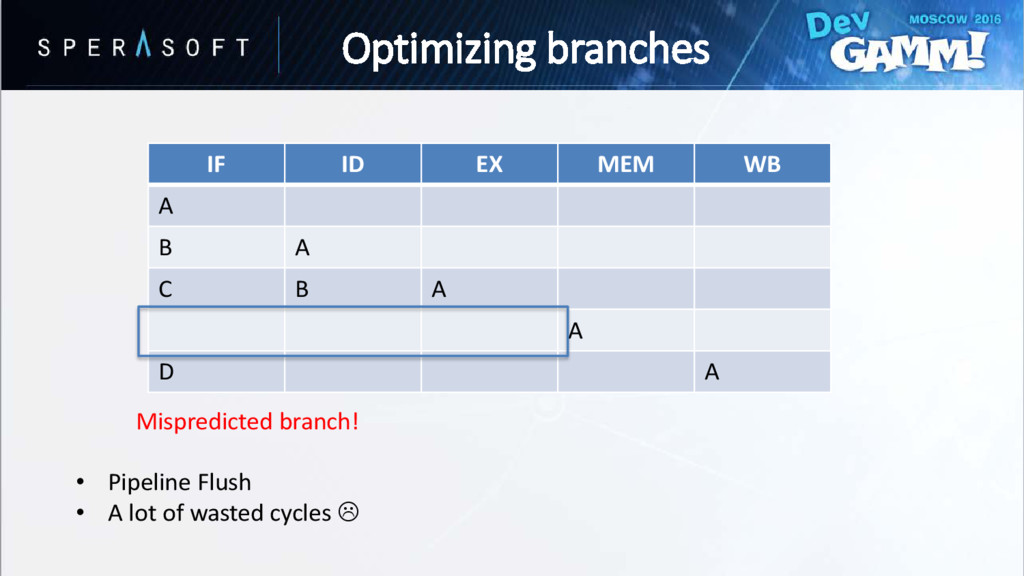
IF ID EX MEM WB A B A C B
A A D A • Pipeline Flush • A lot of wasted cycles Mispredicted branch! Optimizing branches -
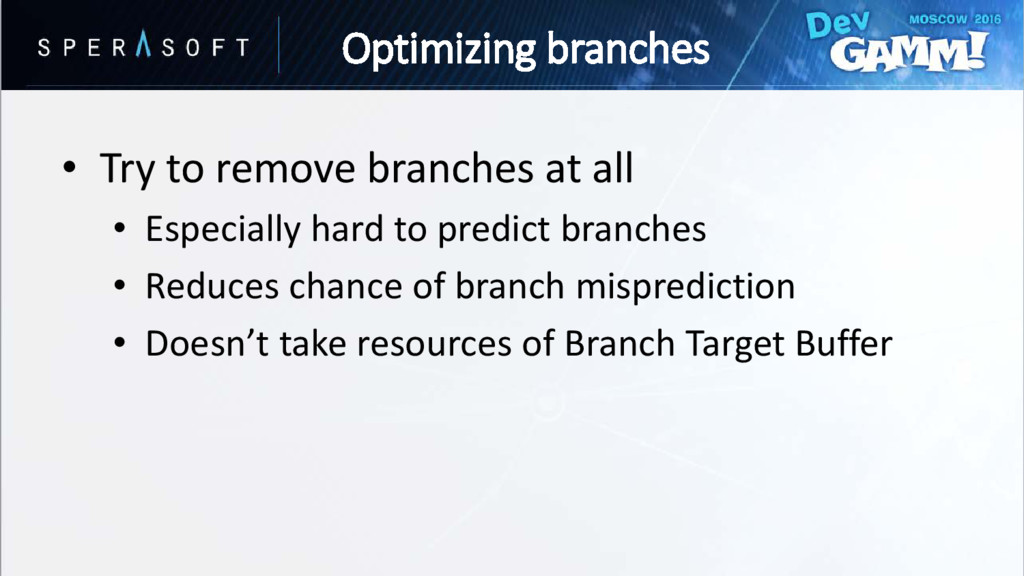
• Try to remove branches at all • Especially hard
to predict branches • Reduces chance of branch misprediction • Doesn’t take resources of Branch Target Buffer Optimizing branches -
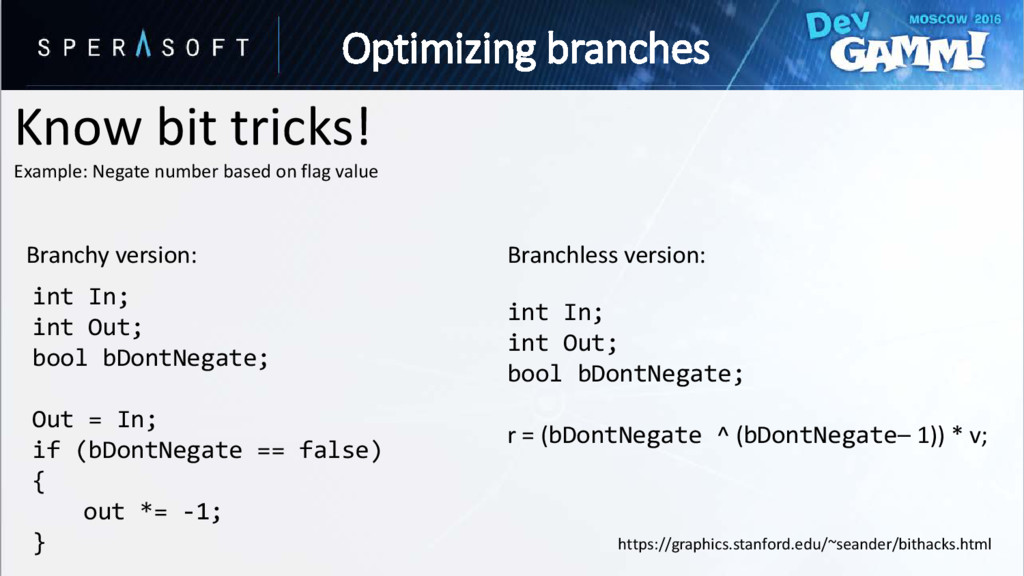
Know bit tricks! Example: Negate number based on flag value
int In; int Out; bool bDontNegate; r = (bDontNegate ^ (bDontNegate– 1)) * v; int In; int Out; bool bDontNegate; Out = In; if (bDontNegate == false) { out *= -1; } Branchy version: Branchless version: https://graphics.stanford.edu/~seander/bithacks.html Optimizing branches -
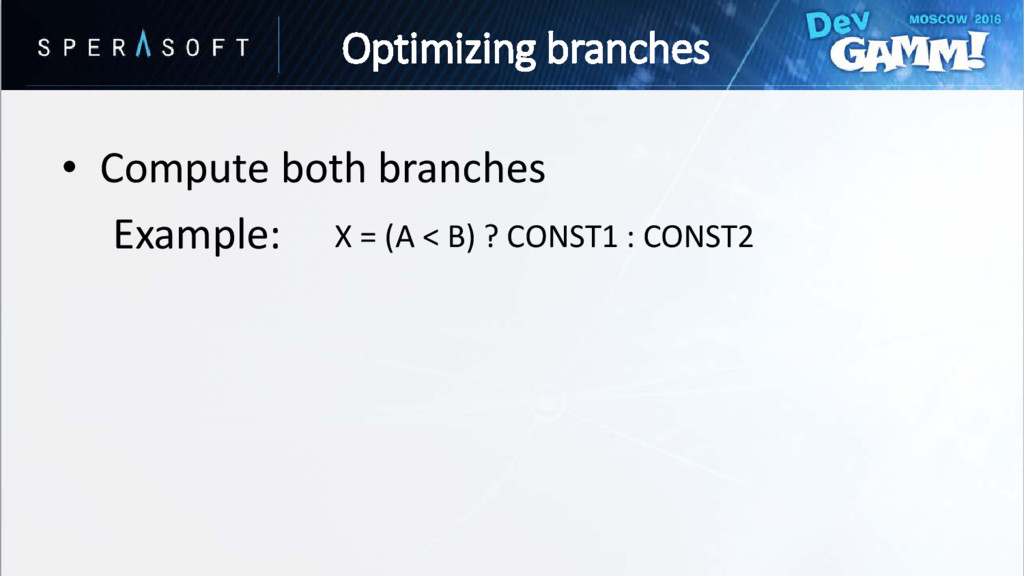
• Compute both branches Example: X = (A < B)
? CONST1 : CONST2 Optimizing branches -
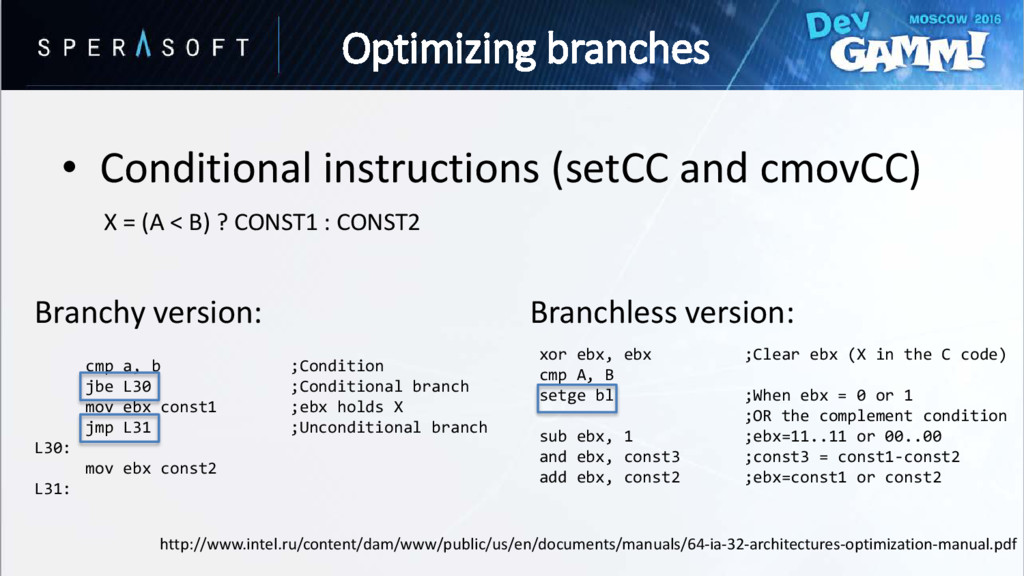
• Conditional instructions (setCC and cmovCC) cmp a, b ;Condition
jbe L30 ;Conditional branch mov ebx const1 ;ebx holds X jmp L31 ;Unconditional branch L30: mov ebx const2 L31: X = (A < B) ? CONST1 : CONST2 xor ebx, ebx ;Clear ebx (X in the C code) cmp A, B setge bl ;When ebx = 0 or 1 ;OR the complement condition sub ebx, 1 ;ebx=11..11 or 00..00 and ebx, const3 ;const3 = const1-const2 add ebx, const2 ;ebx=const1 or const2 Branchy version: Branchless version: http://www.intel.ru/content/dam/www/public/us/en/documents/manuals/64-ia-32-architectures-optimization-manual.pdf Optimizing branches -
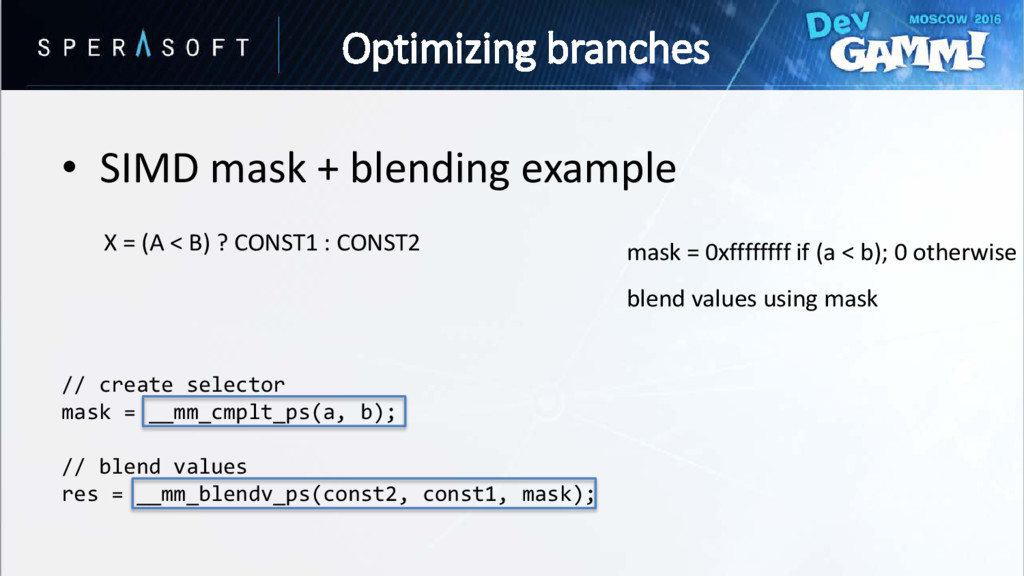
• SIMD mask + blending example X = (A <
B) ? CONST1 : CONST2 // create selector mask = __mm_cmplt_ps(a, b); // blend values res = __mm_blendv_ps(const2, const1, mask); mask = 0xffffffff if (a < b); 0 otherwise blend values using mask Optimizing branches -
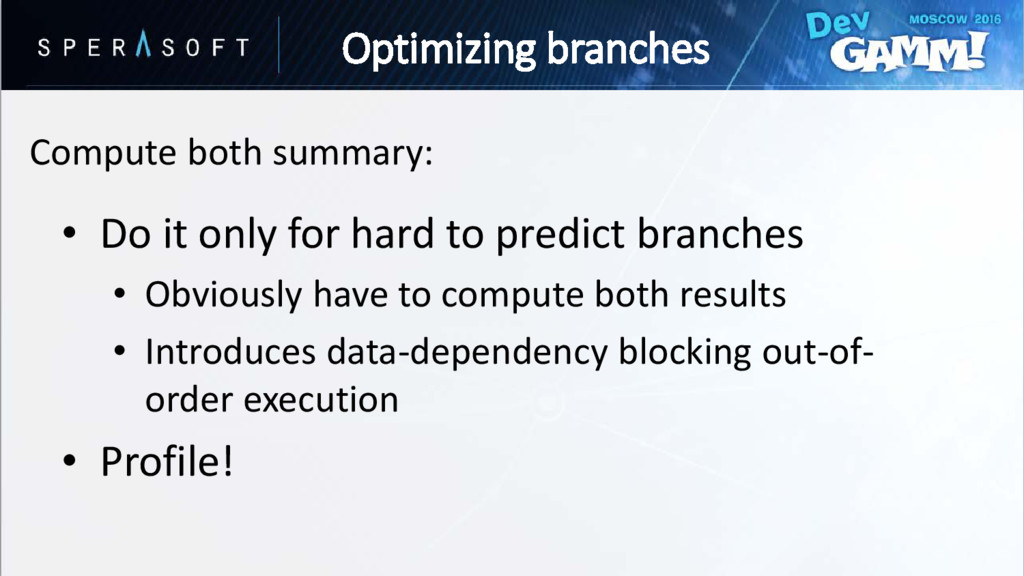
• Do it only for hard to predict branches •
Obviously have to compute both results • Introduces data-dependency blocking out-of- order execution • Profile! Compute both summary: Optimizing branches -
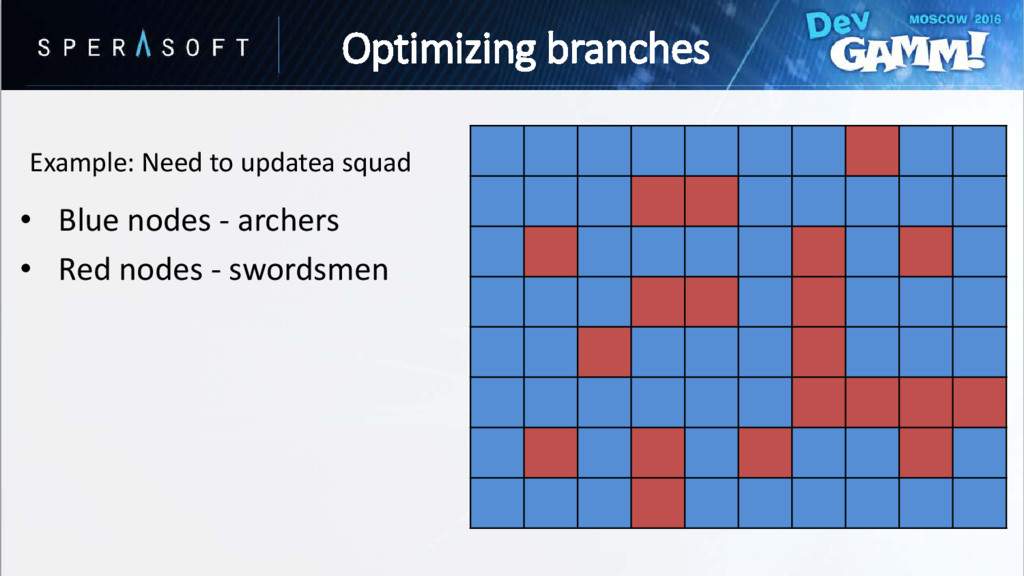
• Blue nodes - archers • Red nodes - swordsmen
Optimizing branches Example: Need to updatea squad -
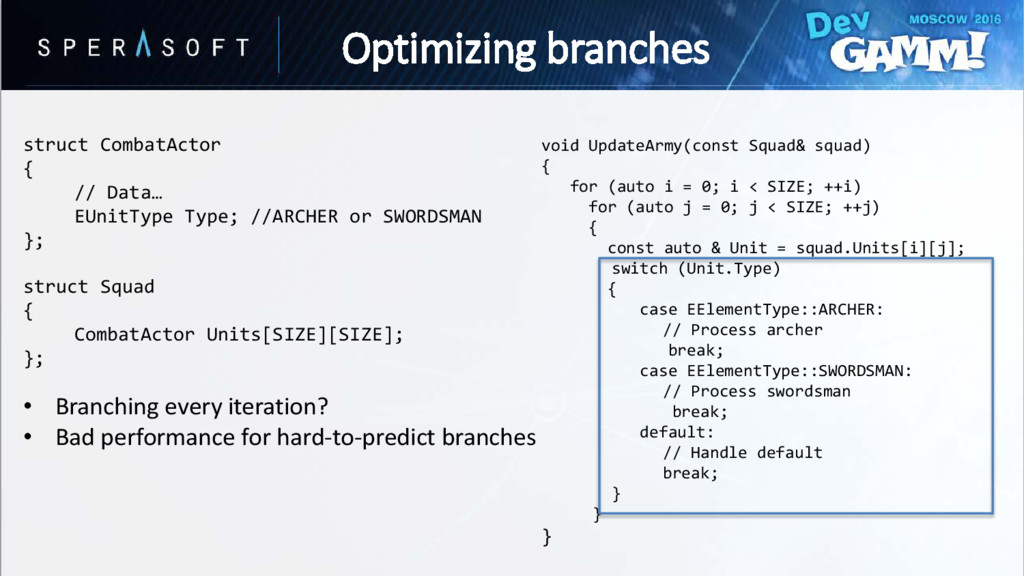
struct CombatActor { // Data… EUnitType Type; //ARCHER or SWORDSMAN
}; struct Squad { CombatActor Units[SIZE][SIZE]; }; void UpdateArmy(const Squad& squad) { for (auto i = 0; i < SIZE; ++i) for (auto j = 0; j < SIZE; ++j) { const auto & Unit = squad.Units[i][j]; switch (Unit.Type) { case EElementType::ARCHER: // Process archer break; case EElementType::SWORDSMAN: // Process swordsman break; default: // Handle default break; } } } • Branching every iteration? • Bad performance for hard-to-predict branches Optimizing branches -
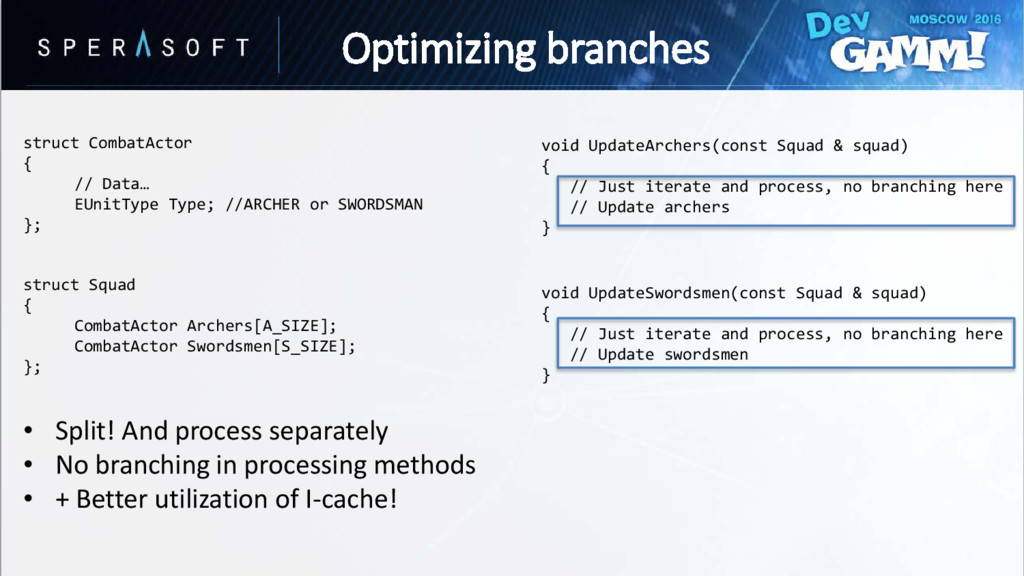
struct CombatActor { // Data… EUnitType Type; //ARCHER or SWORDSMAN
}; struct Squad { CombatActor Archers[A_SIZE]; CombatActor Swordsmen[S_SIZE]; }; void UpdateArchers(const Squad & squad) { // Just iterate and process, no branching here // Update archers } • Split! And process separately • No branching in processing methods • + Better utilization of I-cache! void UpdateSwordsmen(const Squad & squad) { // Just iterate and process, no branching here // Update swordsmen } Optimizing branches -
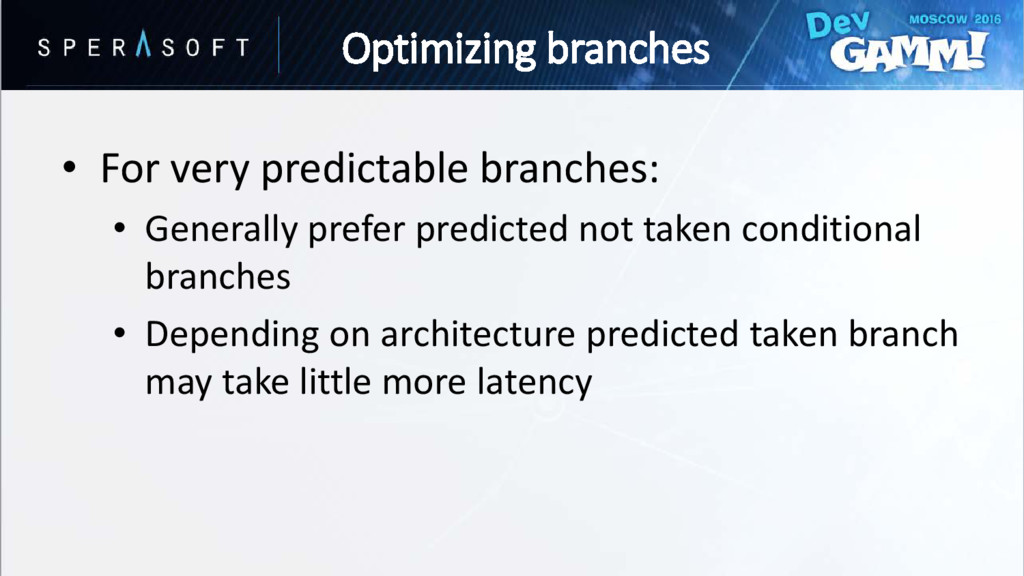
• For very predictable branches: • Generally prefer predicted not
taken conditional branches • Depending on architecture predicted taken branch may take little more latency Optimizing branches -
; function prologue cmp dword ptr [data], 0 je END
; set of some ALU instructions… ;… END: ; function epilogue ; function prologue cmp dword ptr [data], 0 jne COMP jmp END COMP: ; set of some ALU instructions… ;… END: ; function epilogue • Imagine cmp dword ptr [data], 0 – likely to evaluate to “false” • Prefer predicted not taken Predicted not taken Predicted taken Optimizing branches -
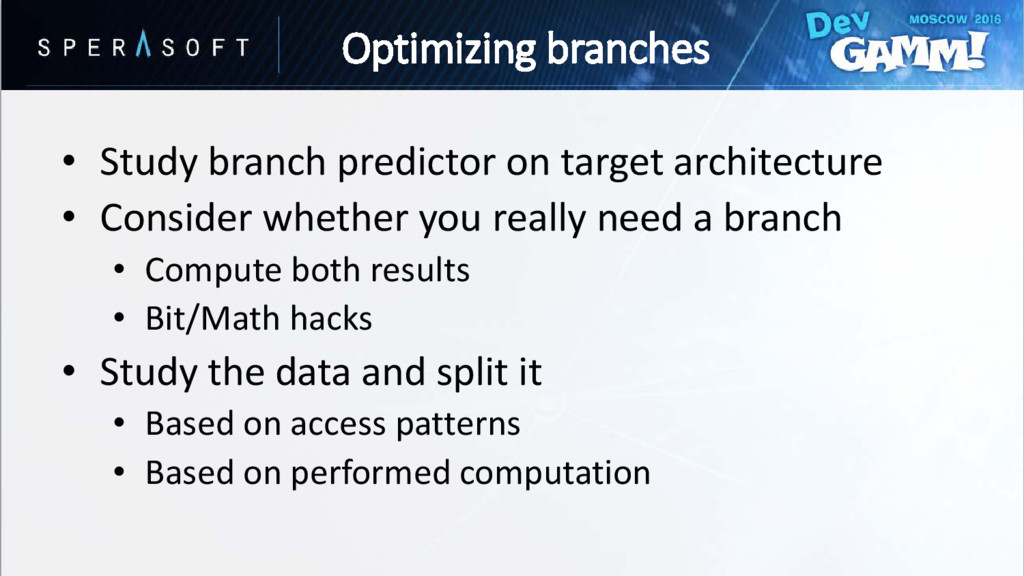
• Study branch predictor on target architecture • Consider whether
you really need a branch • Compute both results • Bit/Math hacks • Study the data and split it • Based on access patterns • Based on performed computation Optimizing branches -
Conclusion • Know your hardware • Architecture matters! • Design
code around data, not abstractions • Hardware is a real thing -
Resources • http://www.agner.org/optimize/microarchitecture.pdf • https://people.freebsd.org/~lstewart/articles/cpumemory.pdf • http://support.amd.com/TechDocs/47414_15h_sw_opt_guide.pdf • http://www.intel.ru/content/dam/www/public/us/en/documents/manual s/64-ia-32-architectures-optimization-manual.pdf
• https://graphics.stanford.edu/~seander/bithacks.html