Share
Embed
From Prediction to Understanding: Causal Discovery for Data Science and AI Applications
EcoSta2026
Shohei SHIMIZU
August 08, 2026
Transcript
18 slides
-
EcoSta2026 From Prediction to Understanding: Causal Discovery for Data Science
and AI Applications Shohei Shimizu Univ. Osaka, Shiga Univ & RIKEN -
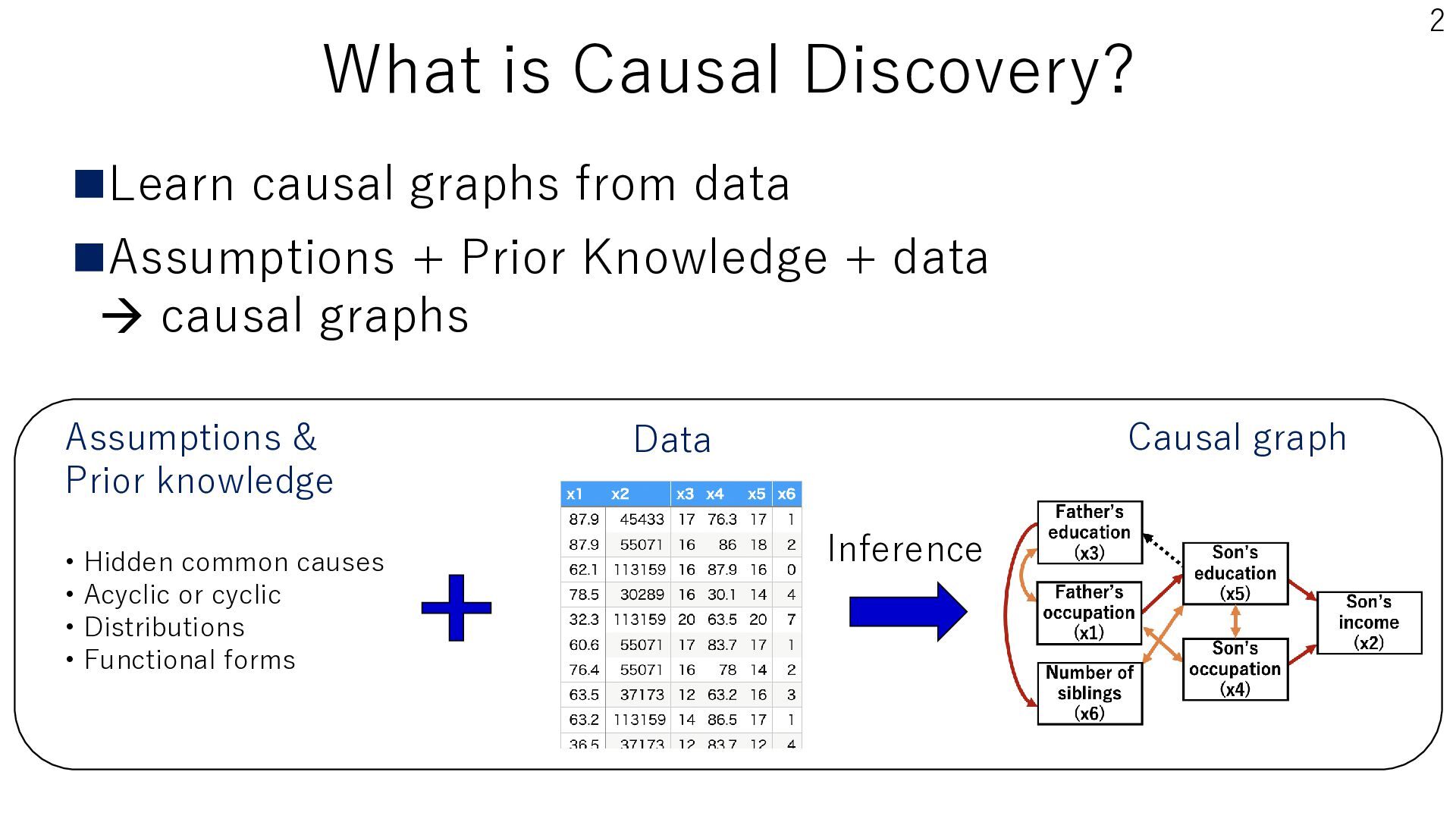
What is Causal Discovery? ◼Learn causal graphs from data ◼Assumptions
+ Prior Knowledge + data → causal graphs Assumptions & Prior knowledge • Hidden common causes • Acyclic or cyclic • Distributions • Functional forms Causal graph Data Inference 2 -
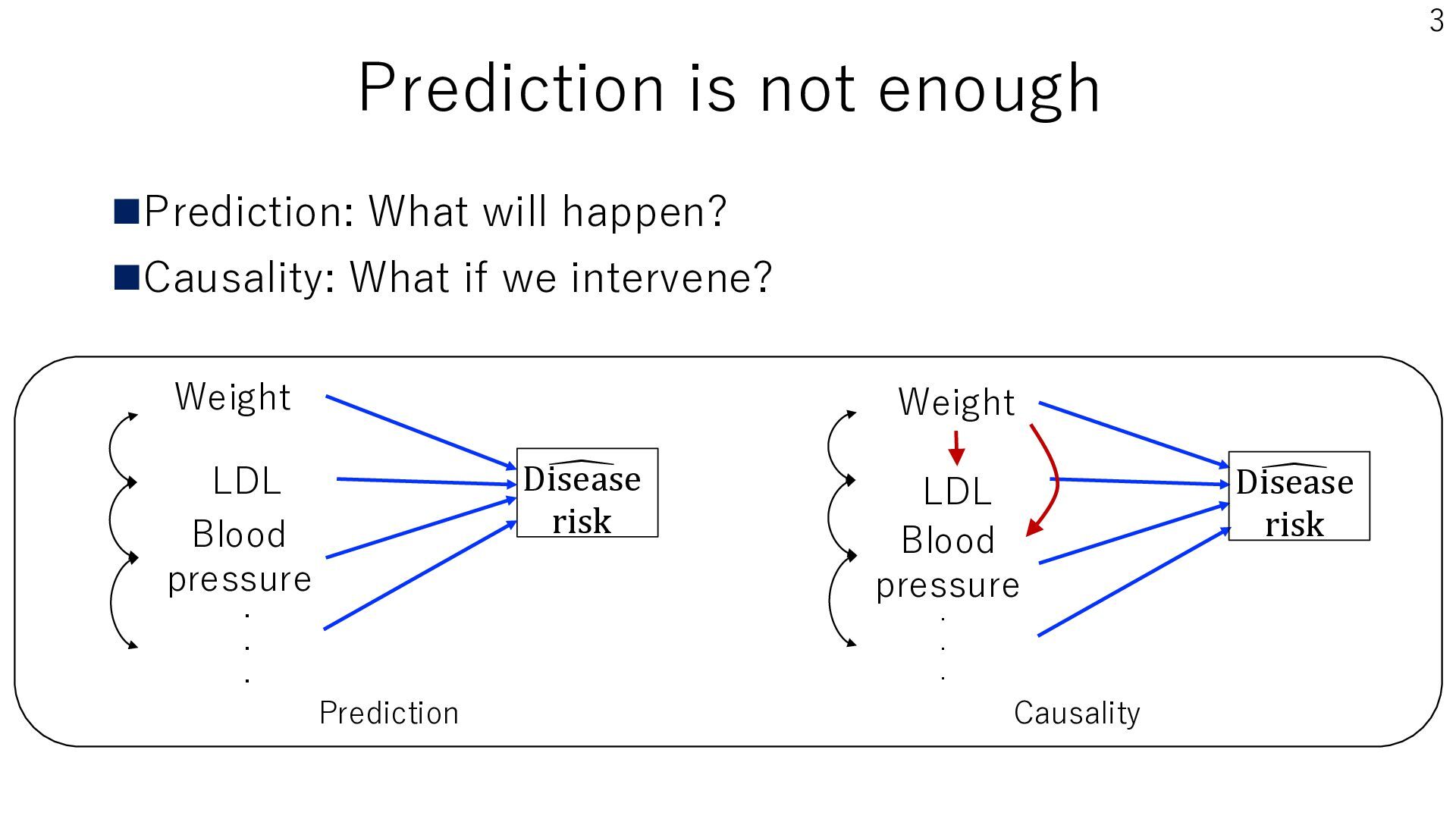
3 Prediction is not enough ◼Prediction: What will happen? ◼Causality:
What if we intervene? Weight Weight Disease risk LDL Blood pressure . . . LDL Blood pressure . . . Prediction Causality Disease risk -
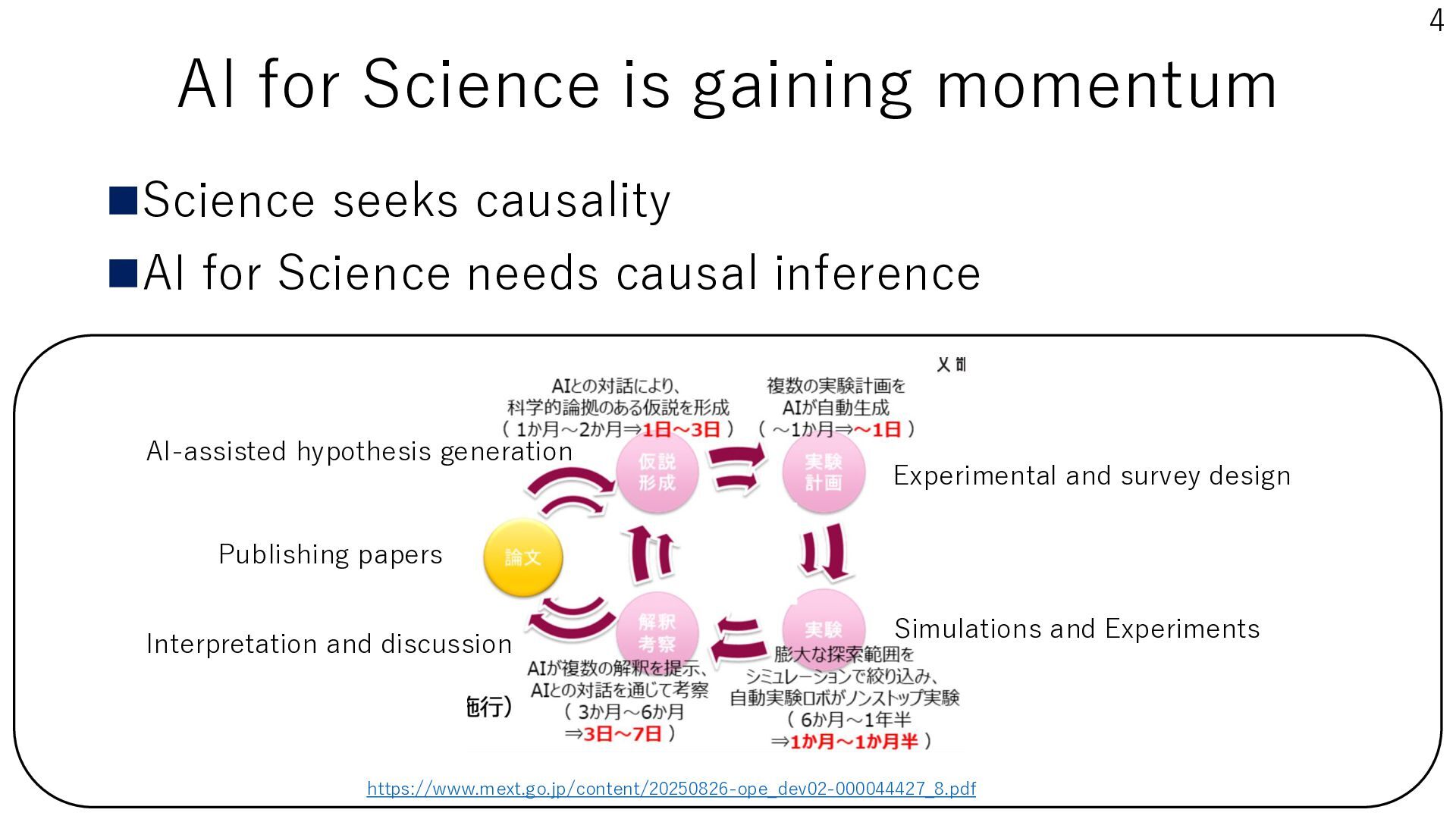
4 AI for Science is gaining momentum ◼Science seeks causality
◼AI for Science needs causal inference AI-assisted hypothesis generation Experimental and survey design Publishing papers Interpretation and discussion Simulations and Experiments https://www.mext.go.jp/content/20250826-ope_dev02-000044427_8.pdf -
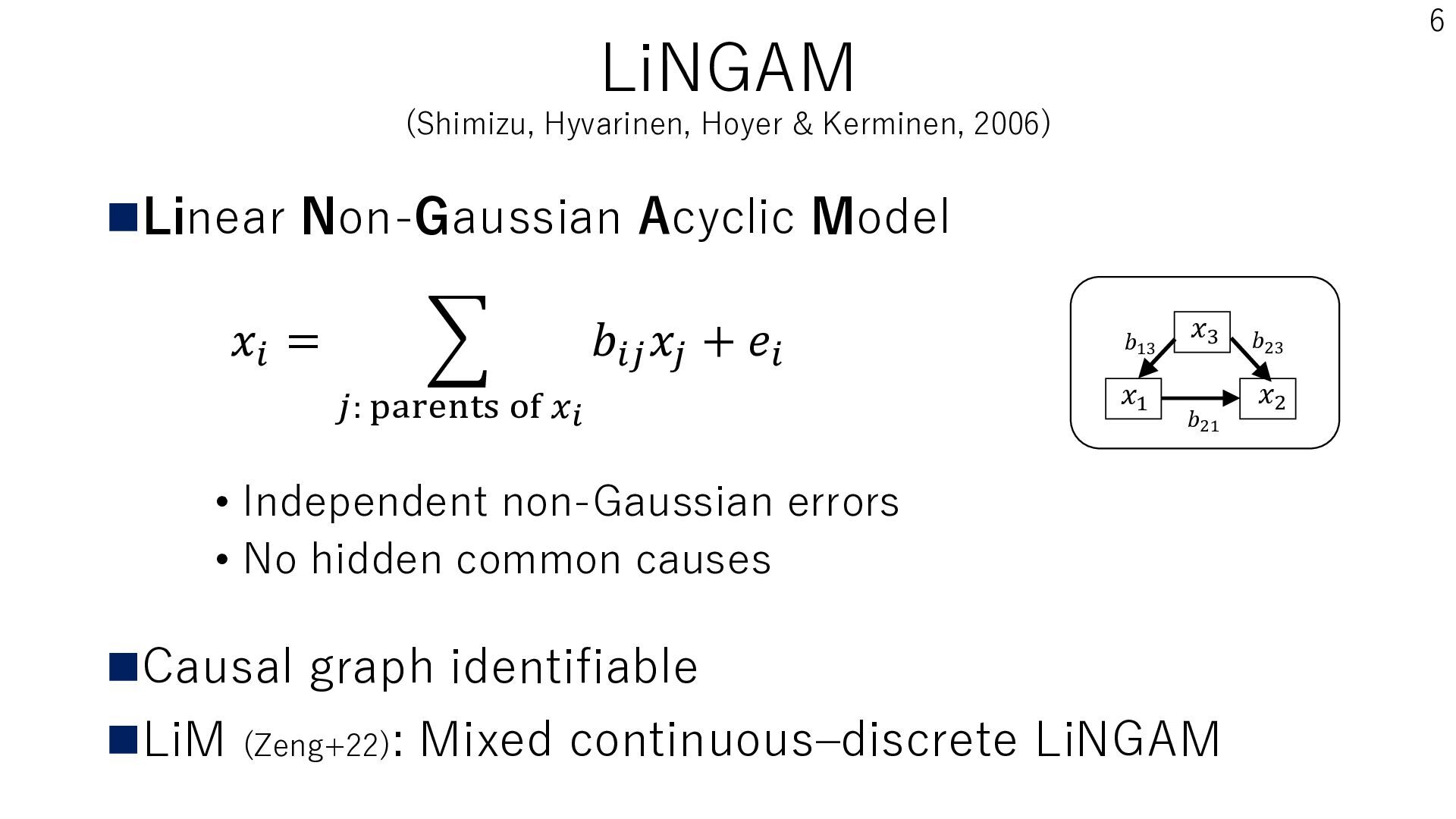
6 LiNGAM (Shimizu, Hyvarinen, Hoyer & Kerminen, 2006) ◼Linear Non-Gaussian
Acyclic Model 𝑥𝑖 = 𝑏𝑖𝑗 𝑥𝑗 + 𝑒𝑖 𝑗: parents of 𝑥𝑖 𝑏13 𝑥1 𝑥3 𝑏21 • Independent non-Gaussian errors • No hidden common causes ◼Causal graph identifiable ◼LiM (Zeng+22): Mixed continuous–discrete LiNGAM 𝑏23 𝑥2 -
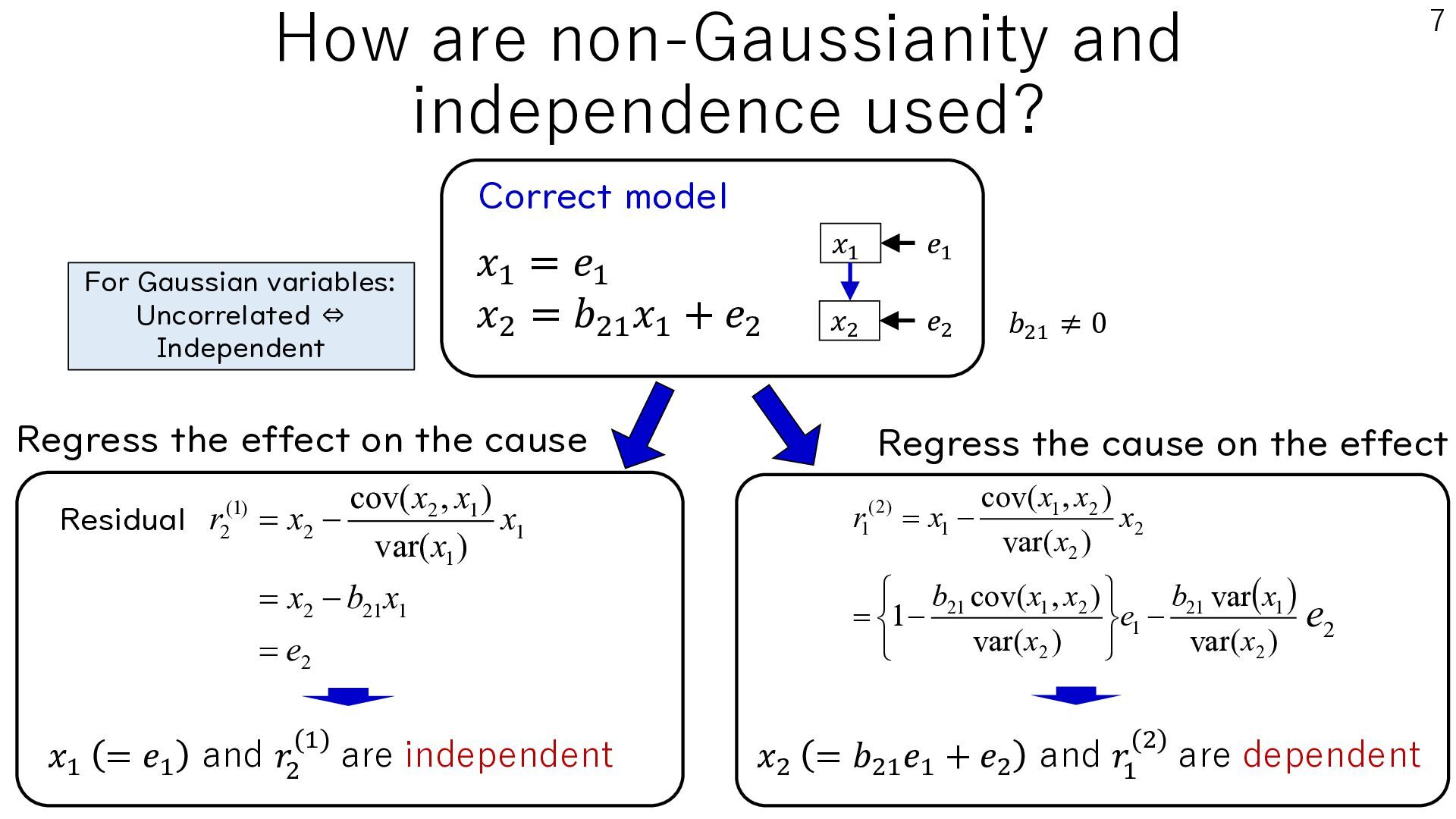
How are non-Gaussianity and independence used? 7 Correct model For
Gaussian variables: Uncorrelated ⇔ Independent 𝑥1 = 𝑒1 𝑥2 = 𝑏21 𝑥1 + 𝑒2 Regress the effect on the cause (1) 2 Residual r cov( x2 , x1 ) = x2 − x1 var( x1 ) = x2 − b21 x1 = e2 (1) 𝑥1 = 𝑒1 and 𝑟2 are independent 𝑥1 𝑒1 𝑥2 𝑒2 𝑏21 ≠ 0 Regress the cause on the effect r1( 2 ) = x1 − cov( x1 , x2 ) x2 var( x2 ) b21 cov( x1 , x2 ) b21 var( x1 ) = 1 − e2 e1 − var( x2 ) var( x2 ) (2) 𝑥2 = 𝑏21 𝑒1 + 𝑒2 and 𝑟1 are dependent -
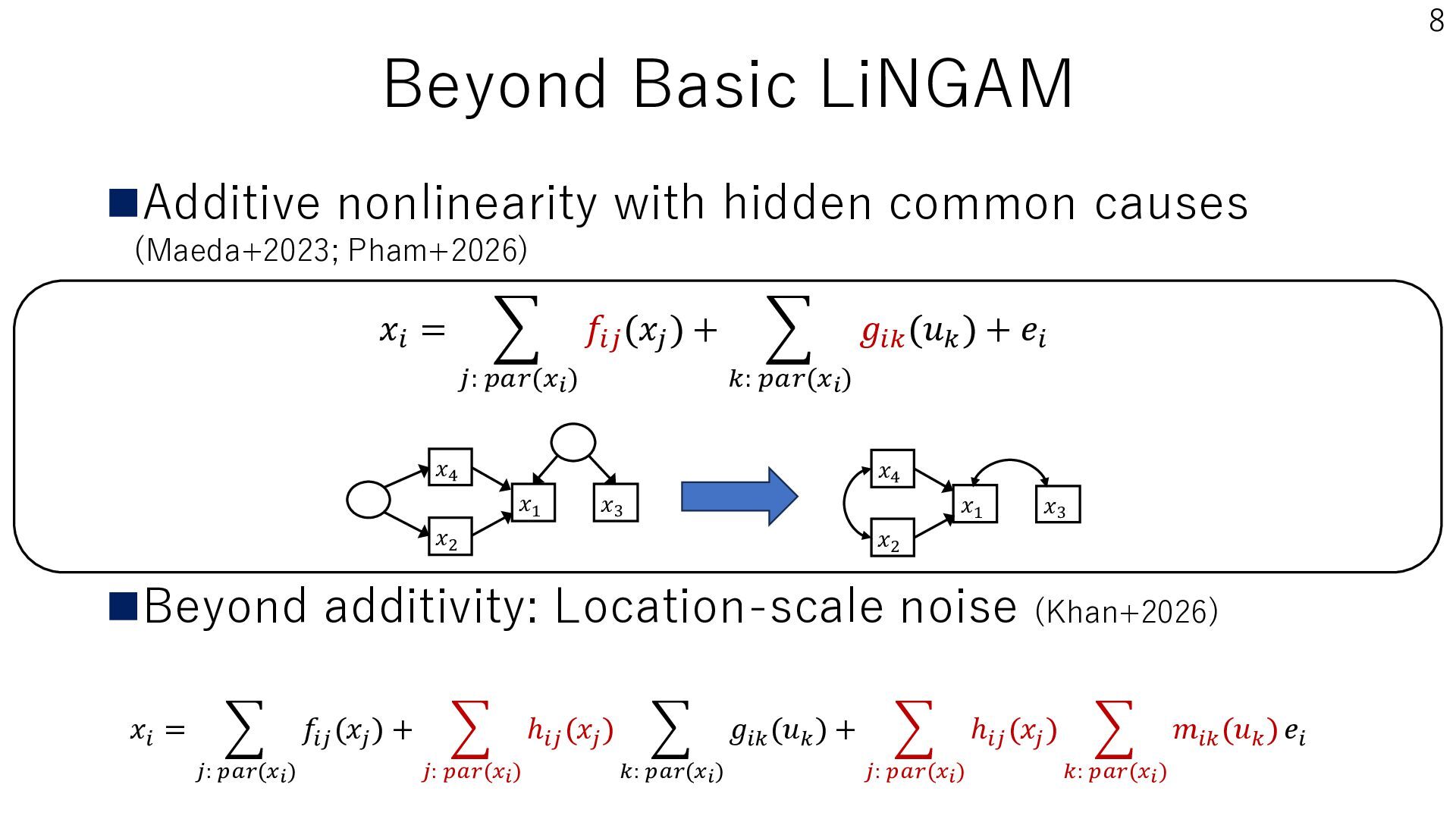
8 Beyond Basic LiNGAM ◼Additive nonlinearity with hidden common causes
(Maeda+2023; Pham+2026) 𝑥𝑖 = 𝑓𝑖𝑗 (𝑥𝑗 ) + 𝑗: 𝑝𝑎𝑟(𝑥𝑖 ) 𝑔𝑖𝑘 (𝑢𝑘 ) + 𝑒𝑖 𝑘: 𝑝𝑎𝑟(𝑥𝑖 ) 𝑥4 𝑥4 𝑥1 𝑥3 𝑥1 𝑥2 𝑥3 𝑥2 ◼Beyond additivity: Location-scale noise (Khan+2026) 𝑥𝑖 = 𝑗: 𝑝𝑎𝑟(𝑥𝑖 ) 𝑓𝑖𝑗 (𝑥𝑗 ) + 𝑗: 𝑝𝑎𝑟(𝑥𝑖 ) ℎ𝑖𝑗 (𝑥𝑗 ) 𝑘: 𝑝𝑎𝑟(𝑥𝑖 ) 𝑔𝑖𝑘 (𝑢𝑘 ) + 𝑗: 𝑝𝑎𝑟(𝑥𝑖 ) ℎ𝑖𝑗 (𝑥𝑗 ) 𝑘: 𝑝𝑎𝑟(𝑥𝑖 ) 𝑚𝑖𝑘 (𝑢𝑘 ) 𝑒𝑖 -
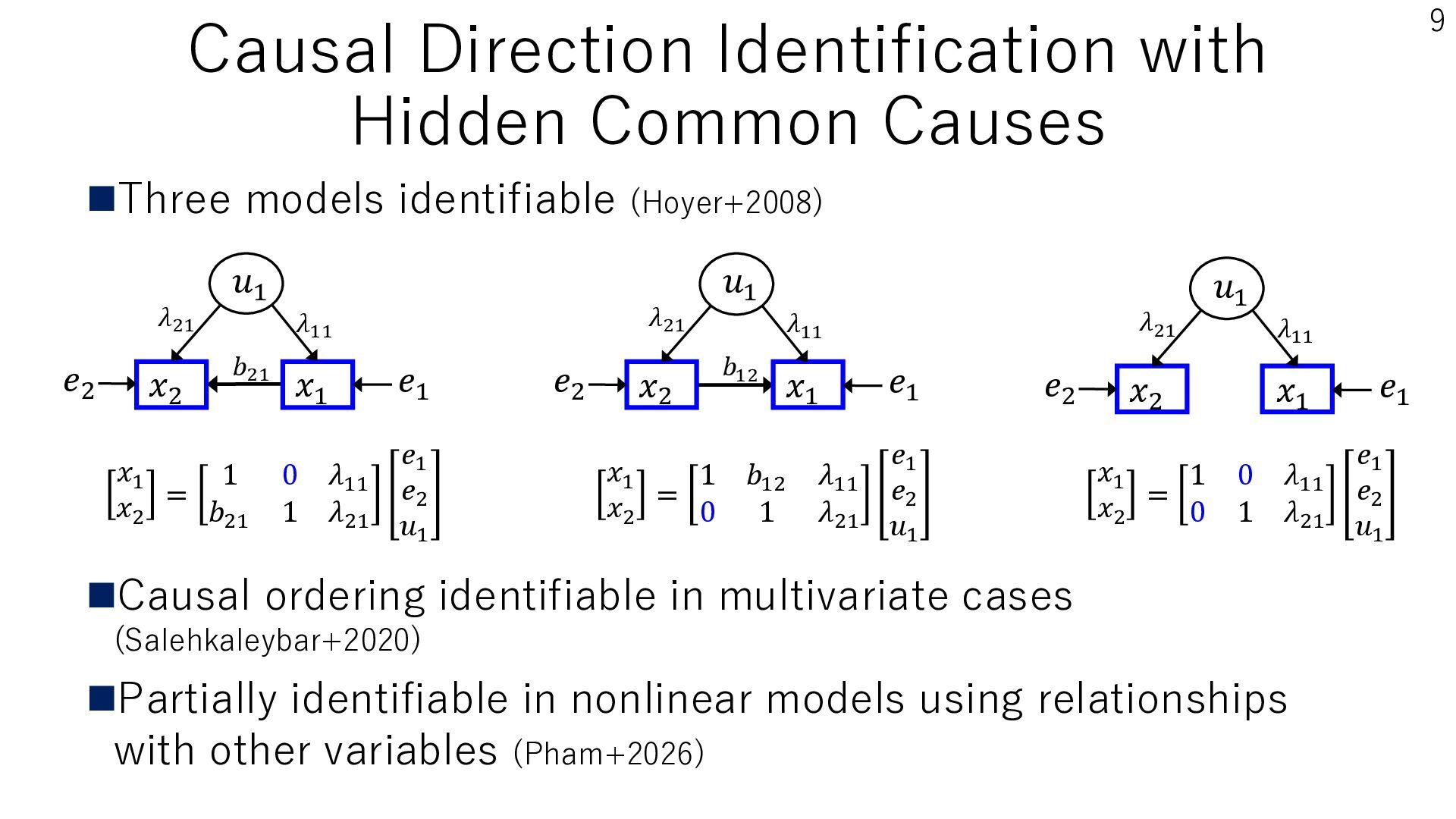
9 Causal Direction Identification with Hidden Common Causes ◼Three models
identifiable (Hoyer+2008) 𝜆21 𝑒2 𝑥2 𝑢1 𝜆21 𝜆11 𝑏21 𝑥1 1 𝑥2 = 𝑏21 𝑥1 𝑒1 𝑒 0 𝜆11 𝑒1 2 1 𝜆21 𝑢 1 𝑒2 𝑥2 𝑢1 𝜆21 𝜆11 𝑏12 𝑥1 𝑥1 1 𝑏12 𝑥2 = 0 1 𝑒1 𝑒2 𝑒 𝜆11 𝑒1 2 𝜆21 𝑢 1 𝑥2 𝑢1 𝜆11 𝑥1 𝑒1 𝑒 𝑥1 1 0 𝜆11 𝑒1 𝑥2 = 0 1 𝜆21 2 𝑢1 ◼Causal ordering identifiable in multivariate cases (Salehkaleybar+2020) ◼Partially identifiable in nonlinear models using relationships with other variables (Pham+2026) -
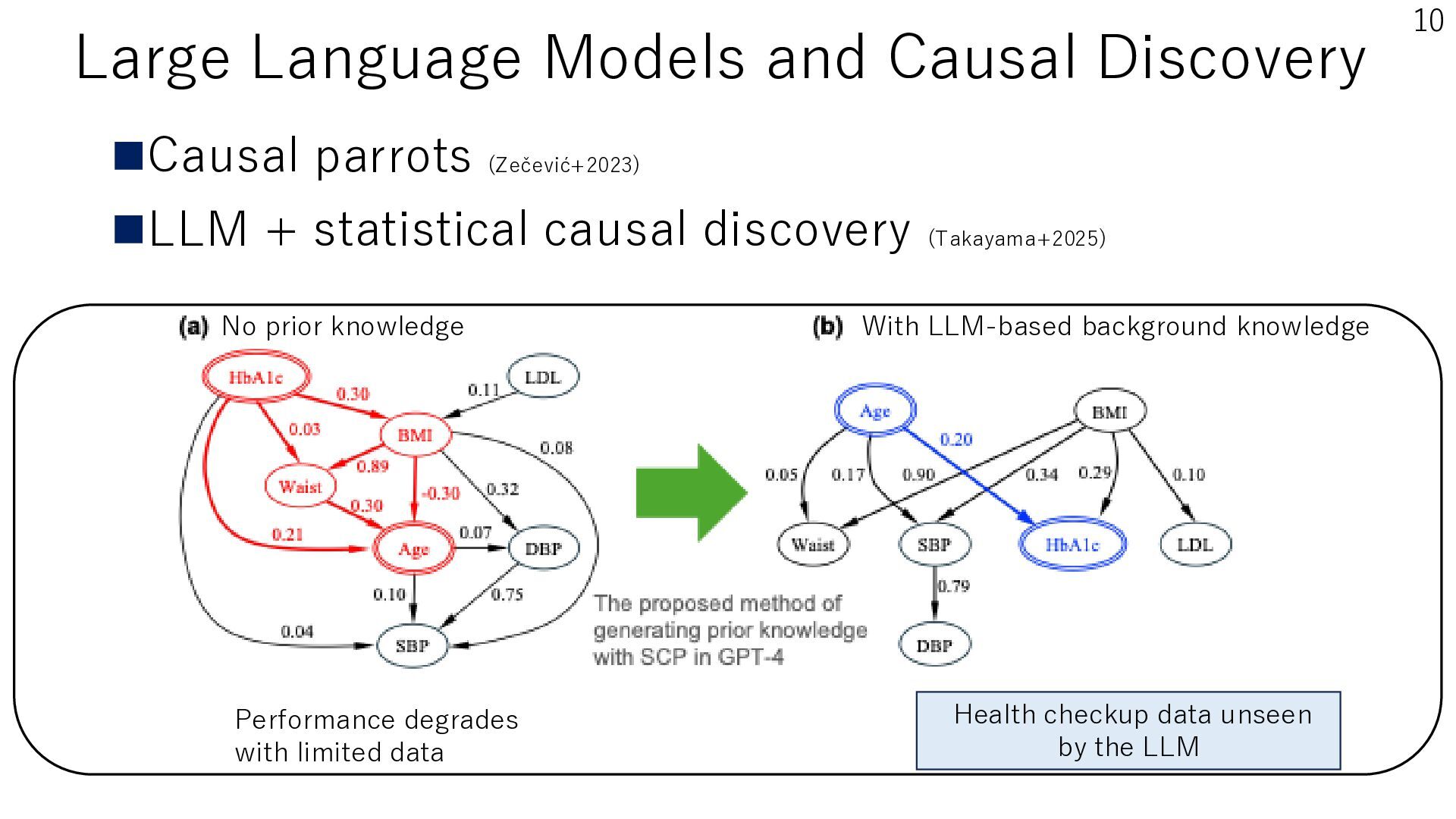
Large Language Models and Causal Discovery ◼Causal parrots (Zečević+2023) ◼LLM
+ statistical causal discovery (Takayama+2025) No prior knowledge Performance degrades with limited data With LLM-based background knowledge Health checkup data unseen by the LLM 10 -
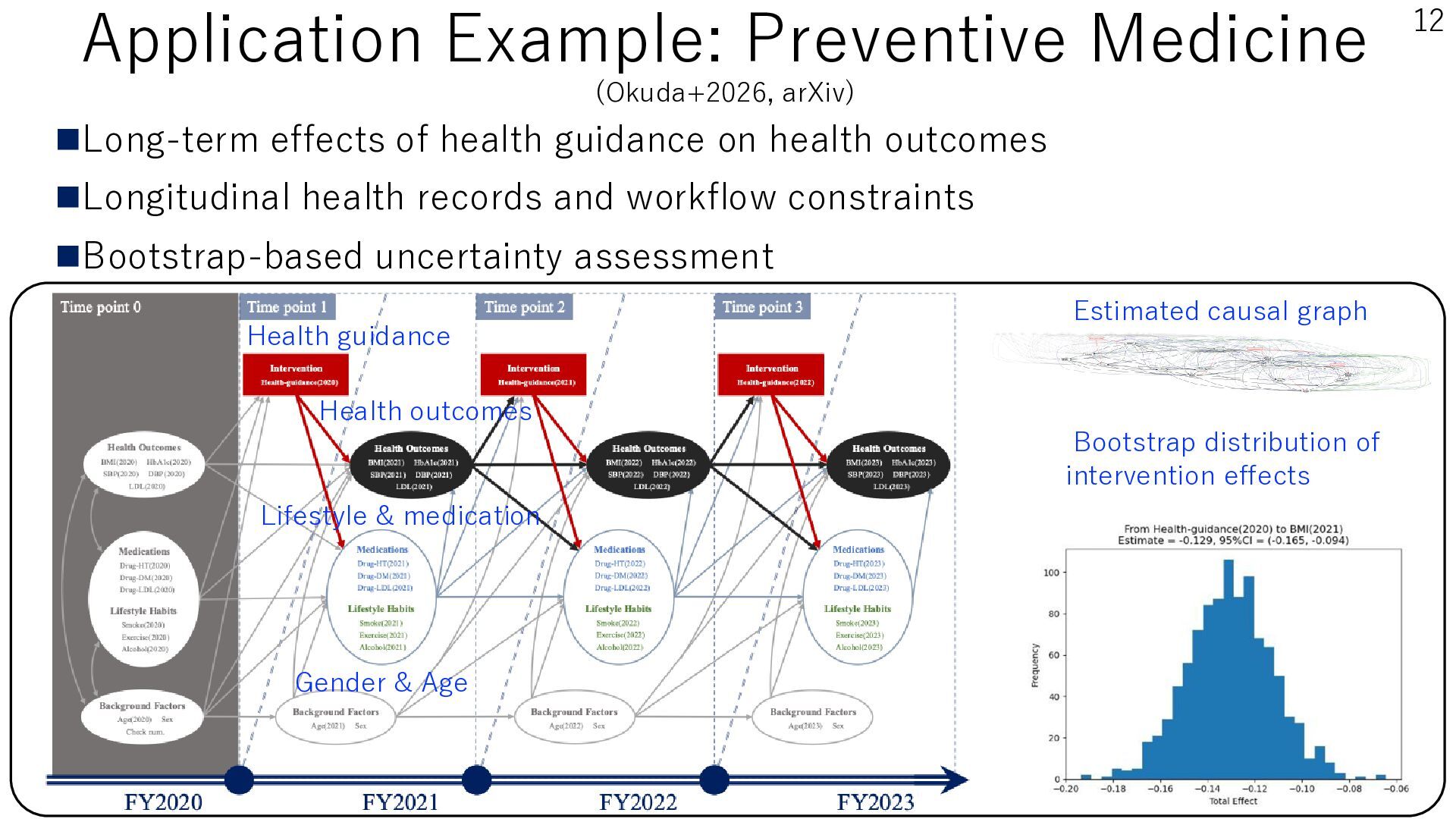
Application Example: Preventive Medicine (Okuda+2026, arXiv) ◼Long-term effects of health
guidance on health outcomes ◼Longitudinal health records and workflow constraints ◼Bootstrap-based uncertainty assessment Health guidance Estimated causal graph Health outcomes Bootstrap distribution of intervention effects Lifestyle & medication Gender & Age 12 -
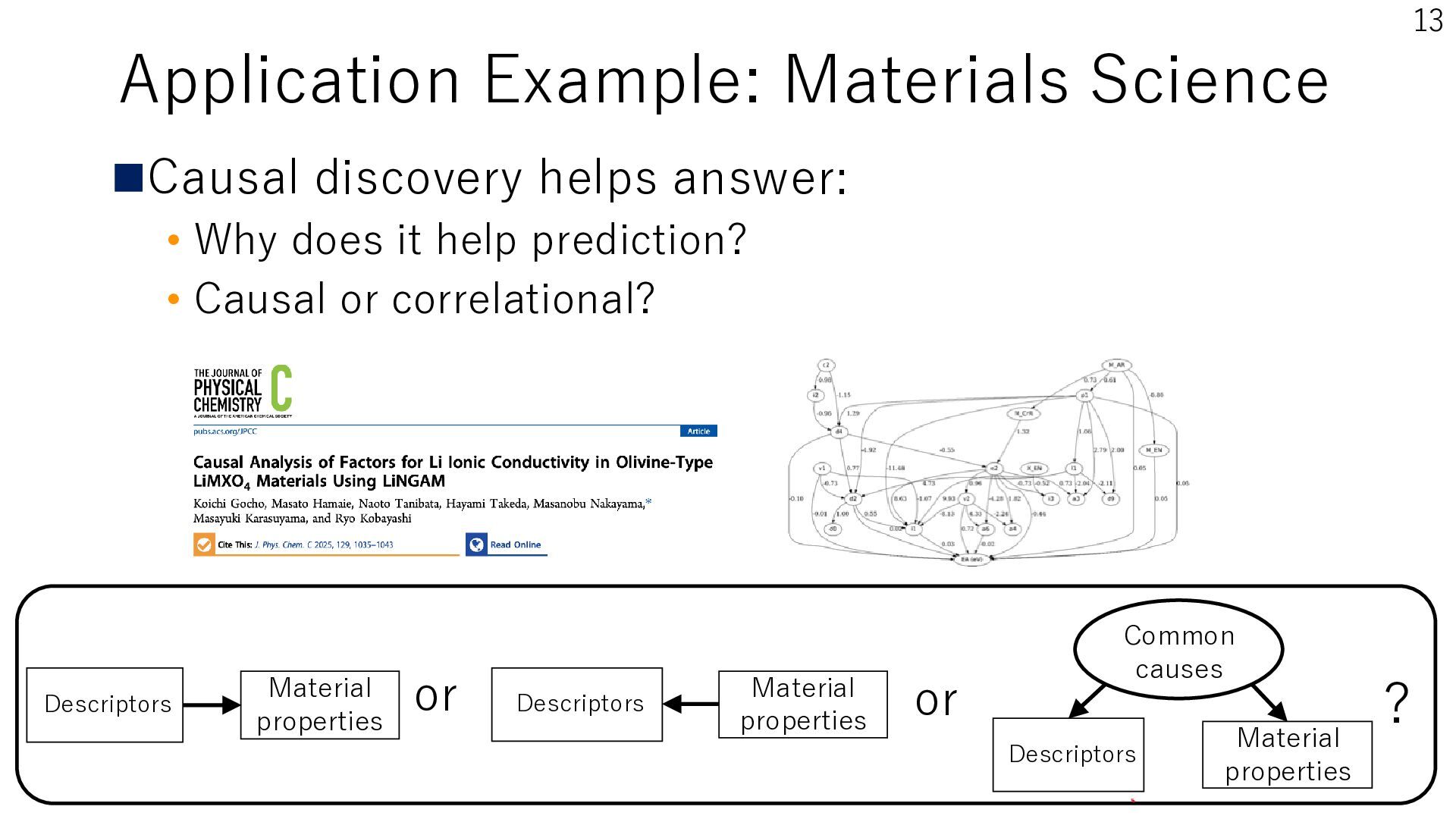
13 Application Example: Materials Science ◼Causal discovery helps answer: •
Why does it help prediction? • Causal or correlational? Descriptors Material properties or Descriptors Material properties or Common causes Descriptors Material properties ? -
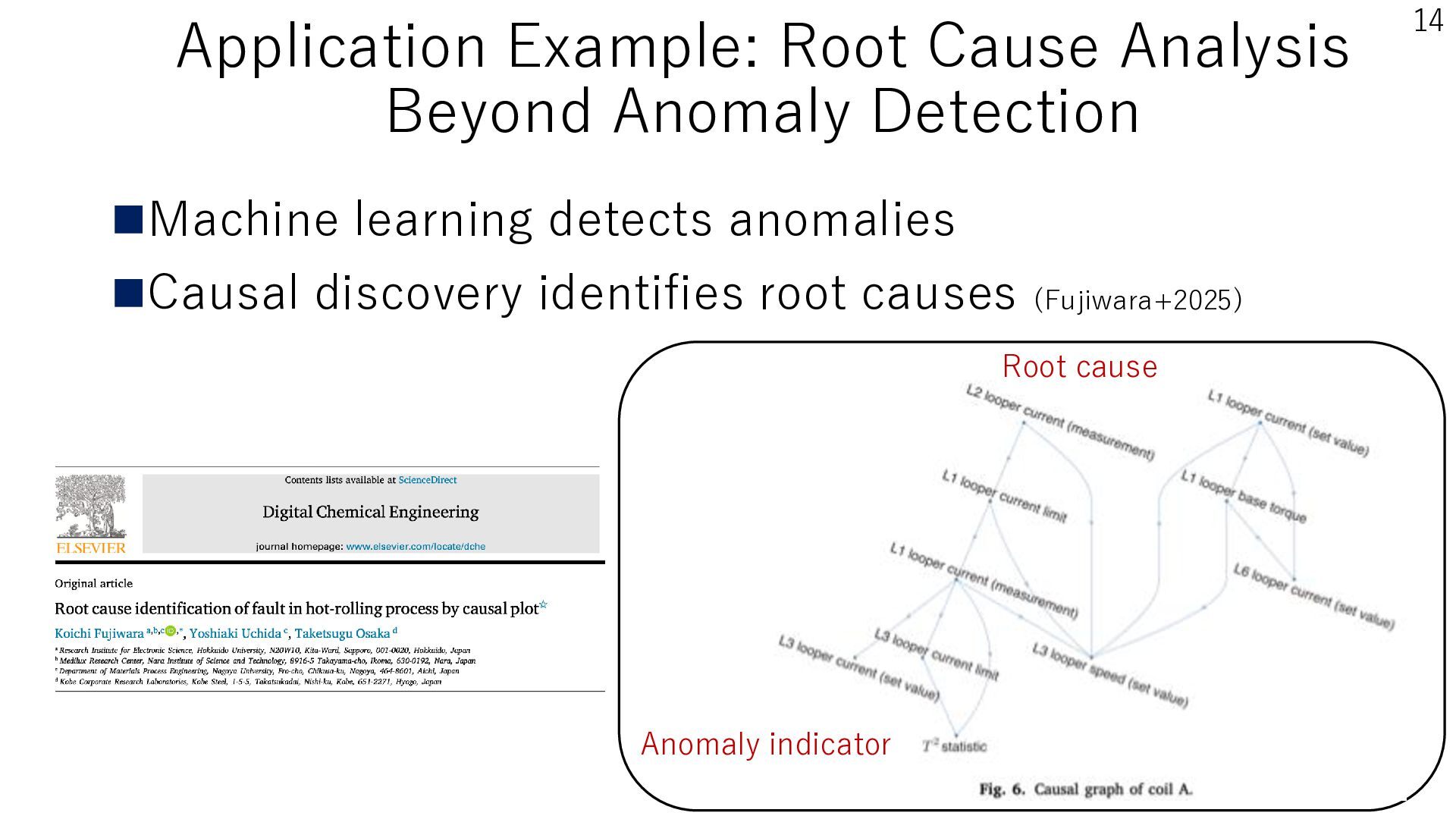
Application Example: Root Cause Analysis Beyond Anomaly Detection ◼Machine learning
detects anomalies ◼Causal discovery identifies root causes (Fujiwara+2025) Root cause Anomaly indicator 14 -
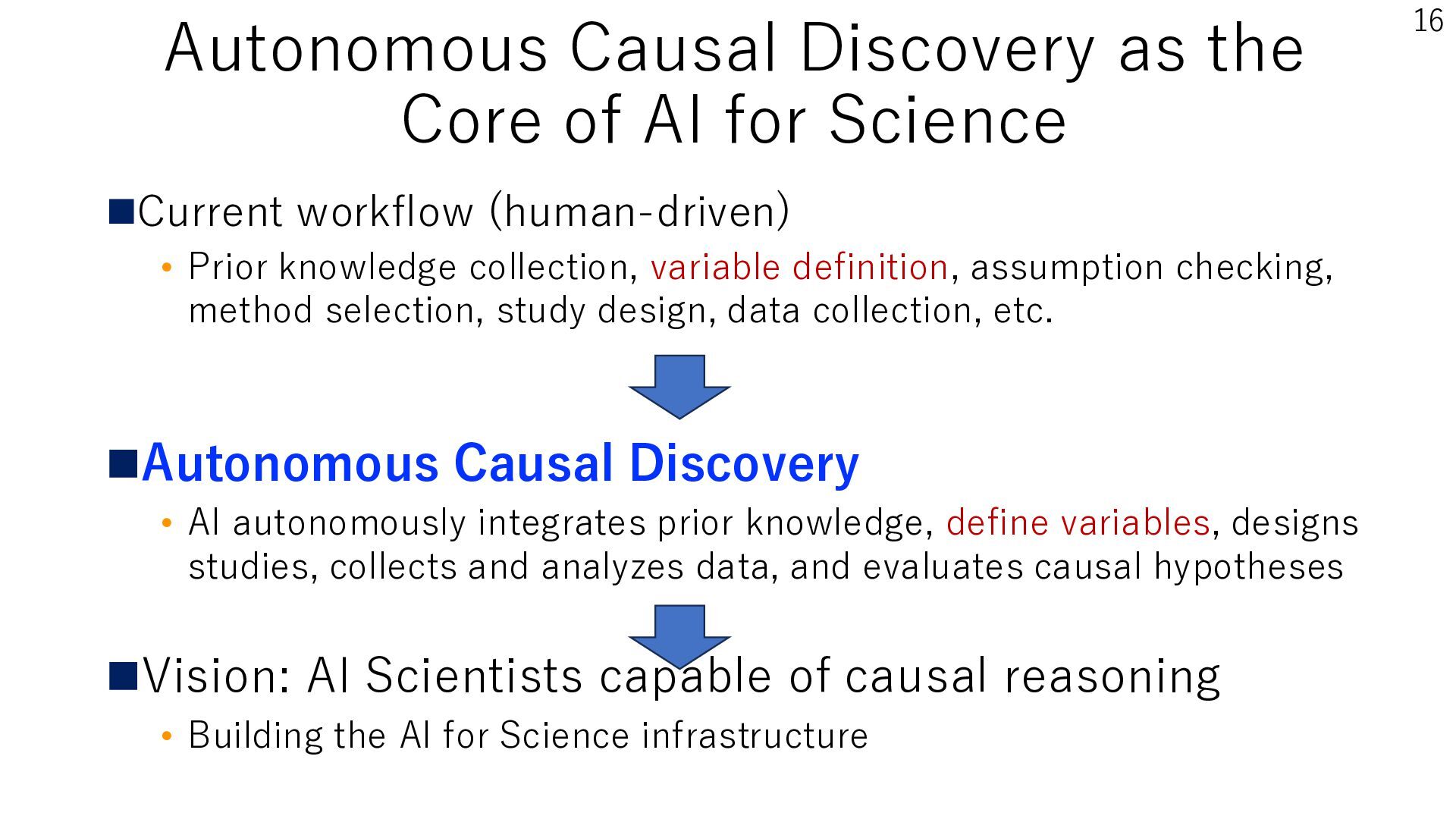
Autonomous Causal Discovery as the Core of AI for Science
◼Current workflow (human-driven) • Prior knowledge collection, variable definition, assumption checking, method selection, study design, data collection, etc. ◼Autonomous Causal Discovery • AI autonomously integrates prior knowledge, define variables, designs studies, collects and analyzes data, and evaluates causal hypotheses ◼Vision: AI Scientists capable of causal reasoning • Building the AI for Science infrastructure 16 -
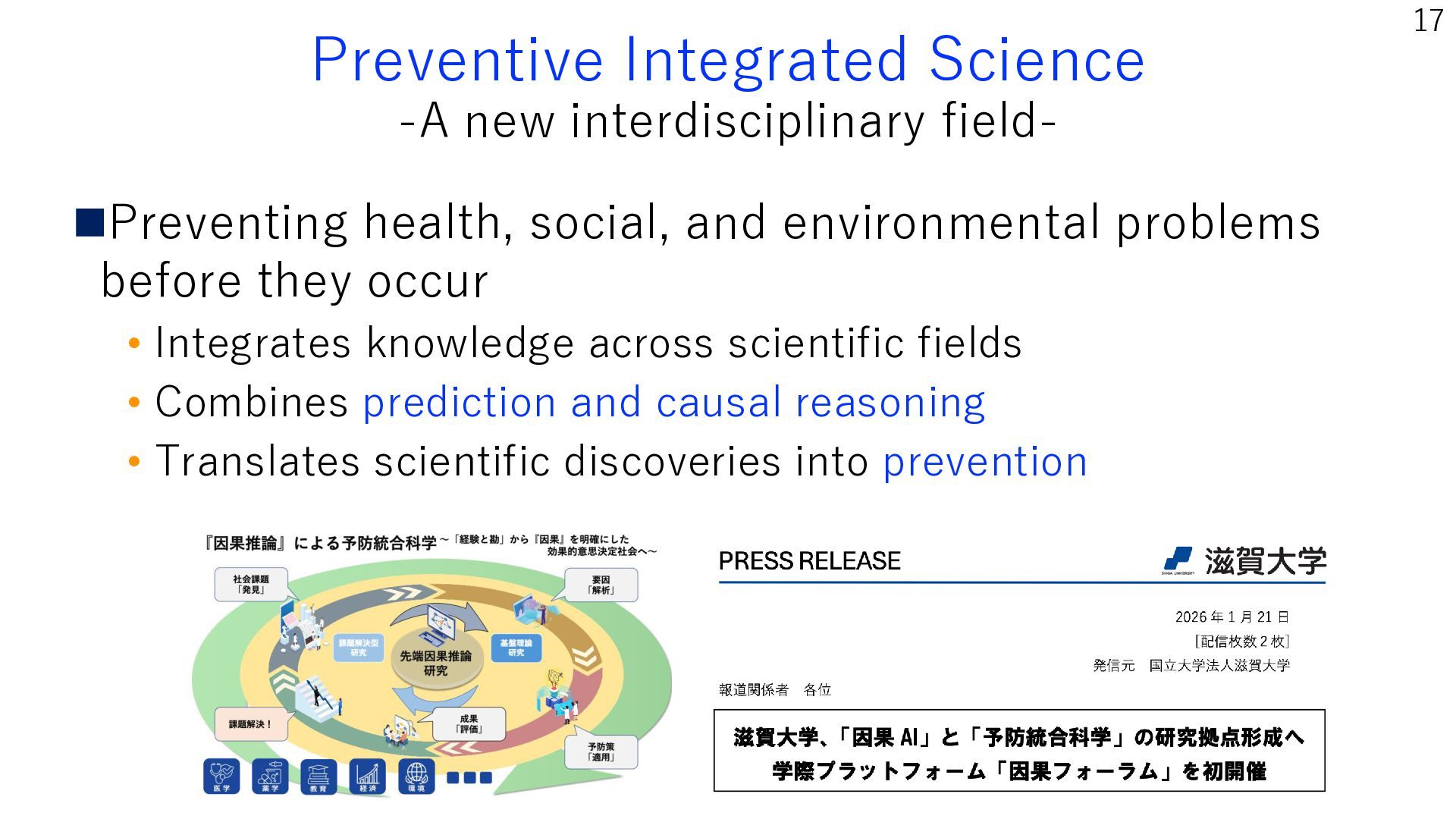
Preventive Integrated Science -A new interdisciplinary field◼Preventing health, social, and
environmental problems before they occur • Integrates knowledge across scientific fields • Combines prediction and causal reasoning • Translates scientific discoveries into prevention 17 -
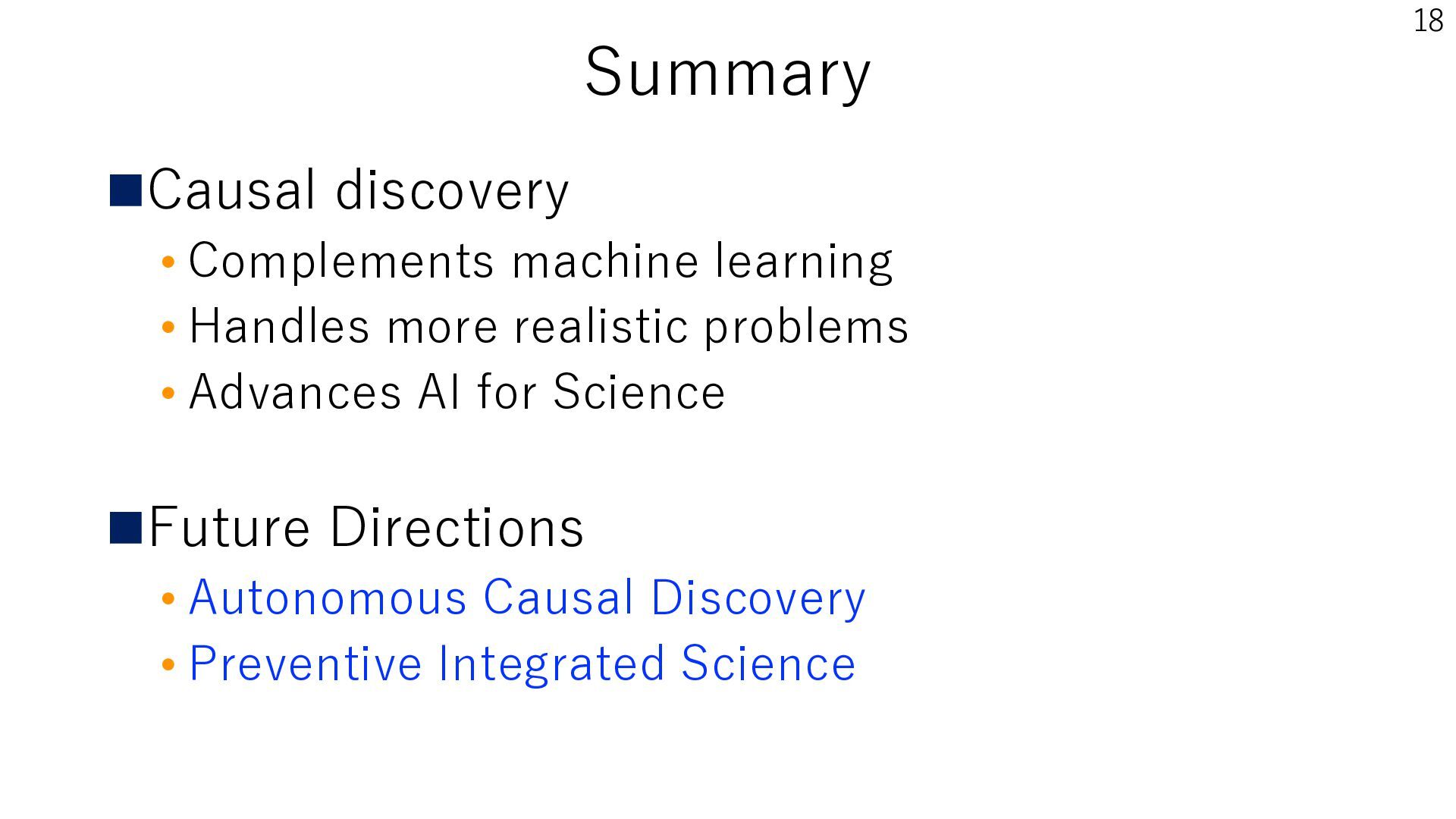
18 Summary ◼Causal discovery • Complements machine learning • Handles
more realistic problems • Advances AI for Science ◼Future Directions • Autonomous Causal Discovery • Preventive Integrated Science