What do auto(un)boxing, specialization and valu...
Sponsored
·
 Your Podcast. Everywhere. Effortlessly.
Share. Educate. Inspire. Entertain. You do you. We'll handle the rest.
→
Your Podcast. Everywhere. Effortlessly.
Share. Educate. Inspire. Entertain. You do you. We'll handle the rest.
→

Share
Embed
What do auto(un)boxing, specialization and value classes have in common?
Late Data Layout presentation at the Scala Bay Area Meetup (thanks Vlad Patryshev!): What do auto(un)boxing, specialization and value classes have in common?
The recording is available on youtube:
https://www.youtube.com/watch?v=HPqNmaAUAJc
Project website: http://scala-miniboxing.org

Vlad Ureche
August 01, 2014
Transcript
276 slides
-
scala-miniboxing.org 1st of August 2014 Scala Bay Area Meetup Linkedin
HQ, Mountain View -
scala-miniboxing.org Vlad URECHE PhD student in the Scala Team @
EPFL Miniboxing guy. Also worked on specialization, the backend and scaladoc. @ @VladUreche @VladUreche [email protected] -
scala-miniboxing.org What do auto(un)boxing, specialization and value classes have in
common? What are they? -
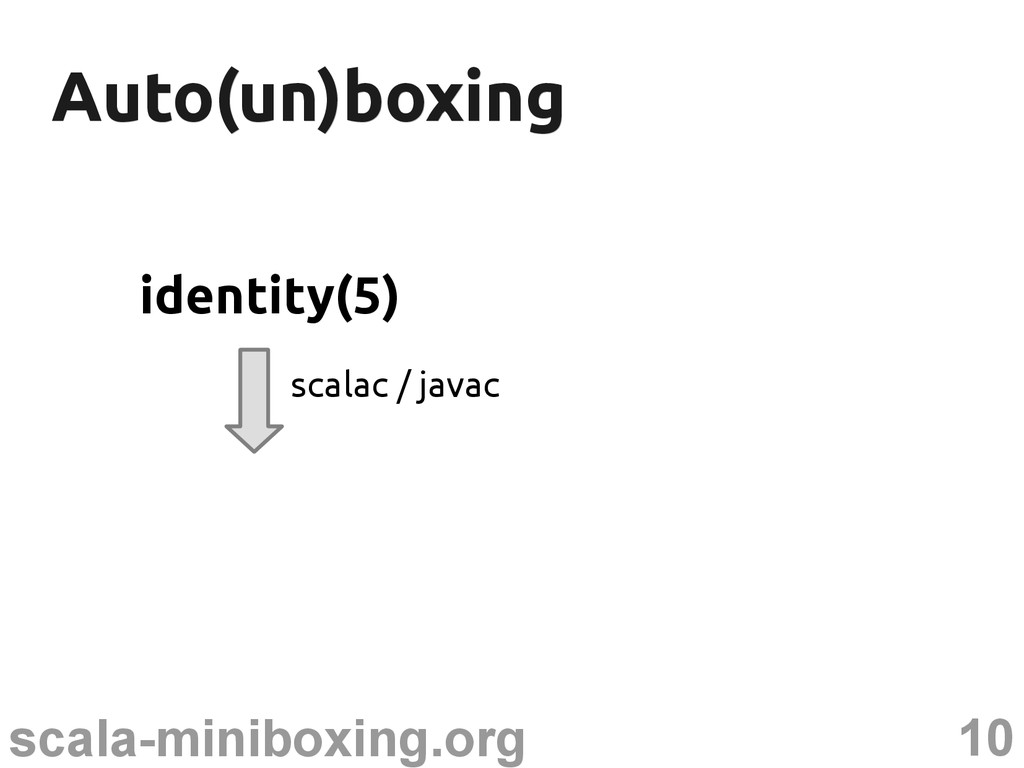
7 scala-miniboxing.org Auto(un)boxing Auto(un)boxing def identity[T](t: T): T = t
def identity(t: Object): Object = t scalac / javac -
8 scala-miniboxing.org Auto(un)boxing Auto(un)boxing def identity[T](t: T): T = t
def identity(t: Object): Object = t The process is called erasure, and is the simplest translation of generics to bytecode. scalac / javac -
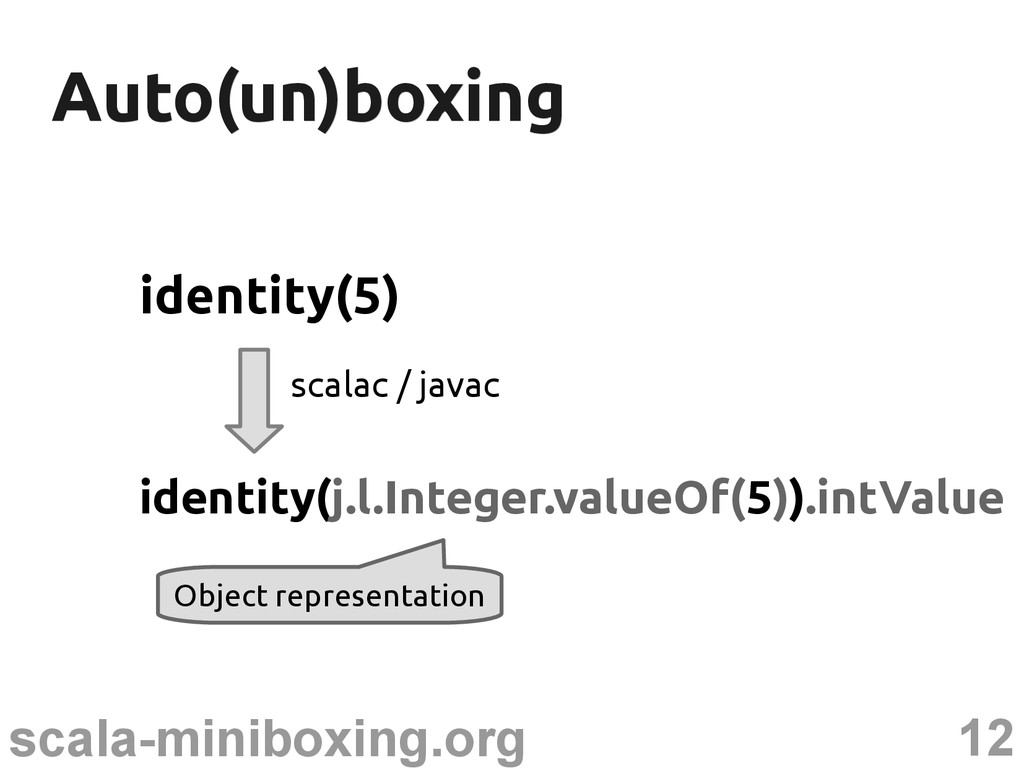
13 scala-miniboxing.org Auto(un)boxing Auto(un)boxing identity(5) identity(j.l.Integer.valueOf(5)).intValue scalac / javac inflates
heap requirements Object representation -
14 scala-miniboxing.org Auto(un)boxing Auto(un)boxing identity(5) identity(j.l.Integer.valueOf(5)).intValue scalac / javac produces
garbage inflates heap requirements Object representation -
15 scala-miniboxing.org Auto(un)boxing Auto(un)boxing identity(5) identity(j.l.Integer.valueOf(5)).intValue scalac / javac produces
garbage inflates heap requirements indirect (slow) access to the value Object representation -
16 scala-miniboxing.org Auto(un)boxing Auto(un)boxing identity(5) identity(j.l.Integer.valueOf(5)).intValue scalac / javac produces
garbage breaks locality guarantees inflates heap requirements indirect (slow) access to the value Object representation -
18 scala-miniboxing.org Auto(un)boxing Auto(un)boxing val five: Int = 5 scala.Int
behaves like an object (has methods, can be used with generics) -
19 scala-miniboxing.org Auto(un)boxing Auto(un)boxing val five: Int = 5 scalac
scala.Int behaves like an object (has methods, can be used with generics) -
20 scala-miniboxing.org Auto(un)boxing Auto(un)boxing val five: Int = 5 val
five: int = 5 scalac scala.Int behaves like an object (has methods, can be used with generics) -
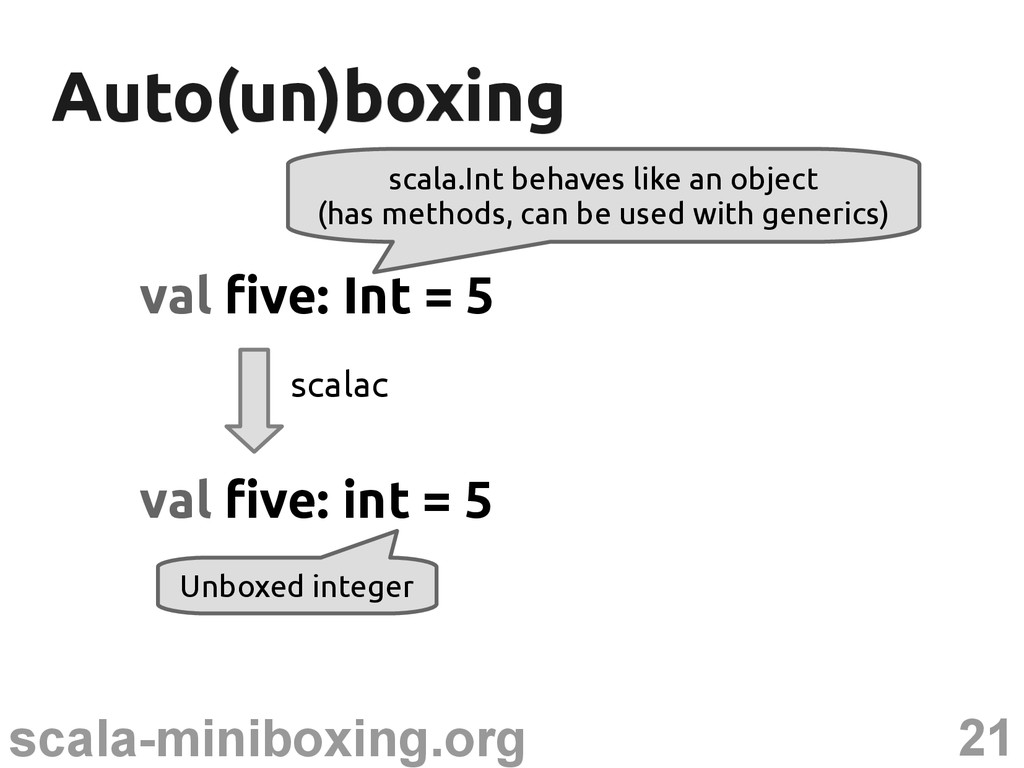
21 scala-miniboxing.org Auto(un)boxing Auto(un)boxing val five: Int = 5 val
five: int = 5 scalac Unboxed integer scala.Int behaves like an object (has methods, can be used with generics) -
22 scala-miniboxing.org Auto(un)boxing Auto(un)boxing val five: Int = 5 val
five: int = 5 scalac Unboxed integer five + 3 scala.Int behaves like an object (has methods, can be used with generics) -
23 scala-miniboxing.org Auto(un)boxing Auto(un)boxing val five: Int = 5 val
five: int = 5 scalac Unboxed integer five + 3 scalac scala.Int behaves like an object (has methods, can be used with generics) -
24 scala-miniboxing.org Auto(un)boxing Auto(un)boxing val five: Int = 5 val
five: int = 5 scalac Unboxed integer five + 3 five + 3 scalac scala.Int behaves like an object (has methods, can be used with generics) -
25 scala-miniboxing.org Auto(un)boxing Auto(un)boxing val five: Int = 5 val
five: int = 5 scalac Unboxed integer five + 3 five + 3 scalac Unboxed addition scala.Int behaves like an object (has methods, can be used with generics) -
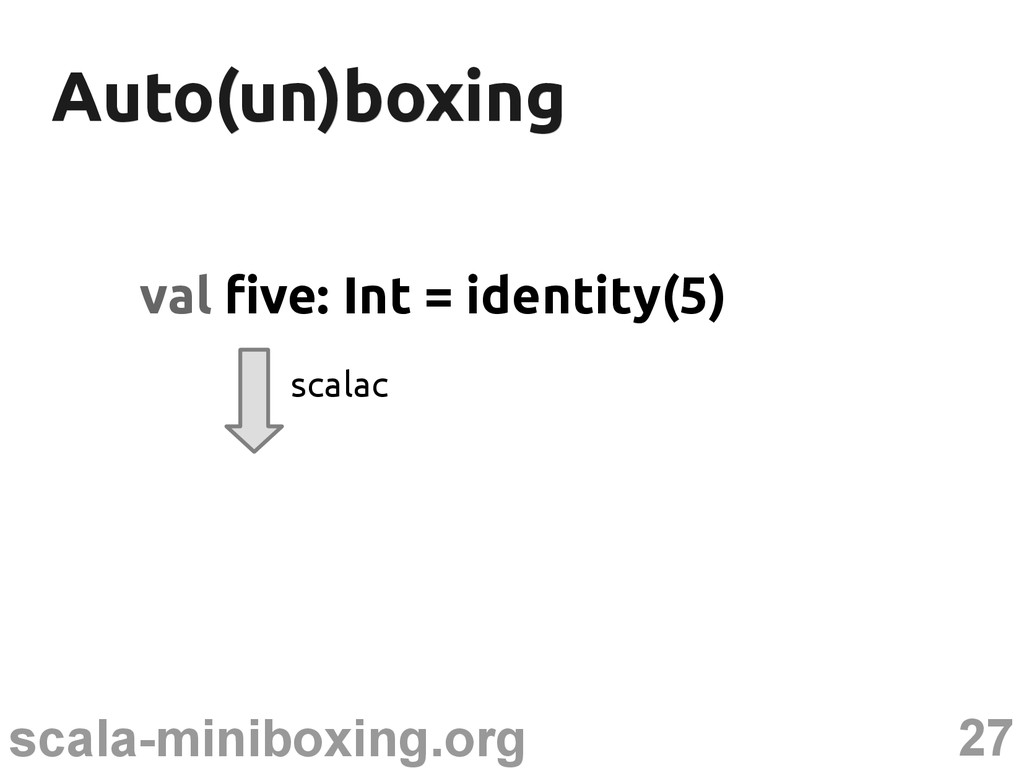
29 scala-miniboxing.org Auto(un)boxing Auto(un)boxing val five: Int = identity(5) val
five: int = identity(I.valueOf(5)).intValue scalac -
30 scala-miniboxing.org Auto(un)boxing Auto(un)boxing val five: Int = identity(5) val
five: int = identity(I.valueOf(5)).intValue scalac Boxing coercion -
31 scala-miniboxing.org Auto(un)boxing Auto(un)boxing val five: Int = identity(5) val
five: int = identity(I.valueOf(5)).intValue scalac Boxing coercion Unboxing coercion -
34 scala-miniboxing.org Auto(un)boxing Auto(un)boxing scala.Int int • fast access •
no garbage collection • locality -
35 scala-miniboxing.org Auto(un)boxing Auto(un)boxing scala.Int int • fast access •
no garbage collection • locality • indirect access • object allocation • and thus garbage collection • no locality guarantees • compatible with erased generics java.lang.Integer -
36 scala-miniboxing.org Auto(un)boxing Auto(un)boxing scala.Int int • fast access •
no garbage collection • locality • indirect access • object allocation • and thus garbage collection • no locality guarantees • compatible with erased generics java.lang.Integer incompatible → coercions -
40 scala-miniboxing.org Specialization Specialization def identity[T](t: T): T = t
def identity(t: Object): Object = t specialization -
41 scala-miniboxing.org Specialization Specialization def identity[T](t: T): T = t
def identity(t: Object): Object = t specialization def identity_Z(t: bool): bool = t -
42 scala-miniboxing.org Specialization Specialization def identity[T](t: T): T = t
def identity(t: Object): Object = t specialization def identity_Z(t: bool): bool = t def identity_C(t: char): char = t -
43 scala-miniboxing.org Specialization Specialization def identity[T](t: T): T = t
def identity(t: Object): Object = t specialization def identity_Z(t: bool): bool = t def identity_C(t: char): char = t … (7 other variants) -
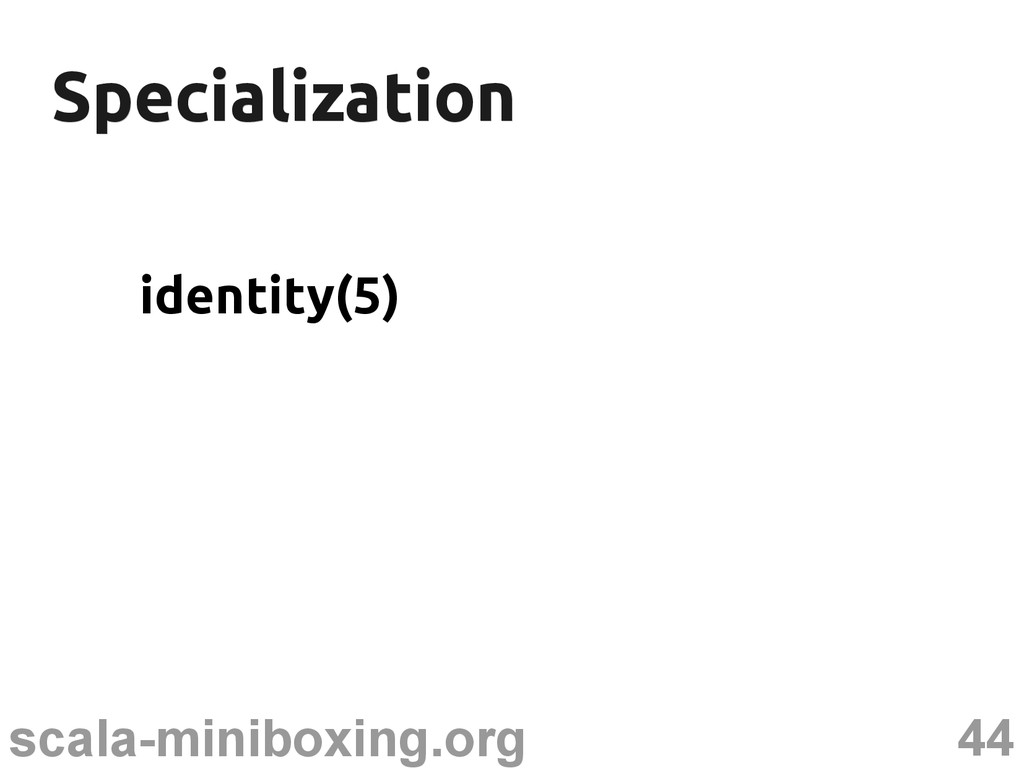
47 scala-miniboxing.org Specialization Specialization identity(5) identity_I(5) specialization The variant of
identity specialized for int -
48 scala-miniboxing.org Specialization Specialization identity(5) identity_I(5) specialization The variant of
identity specialized for int // no boxing! -
51 scala-miniboxing.org Specialization Specialization def tupled[T1, T2](t1: T1, t2: T2)
... // 100 methods (102) specialization -
52 scala-miniboxing.org Specialization Specialization def tupled[T1, T2](t1: T1, t2: T2)
... // 100 methods (102) specialization -
53 scala-miniboxing.org Specialization Specialization def tupled[T1, T2](t1: T1, t2: T2)
... // 100 methods (102) specialization Can we do something about this? -
54 scala-miniboxing.org Specialization Specialization def tupled[T1, T2](t1: T1, t2: T2)
... // 100 methods (102) specialization Can we do something about this? -
57 scala-miniboxing.org Miniboxing Miniboxing def identity[T](t: T): T = t
def identity(t: Object): Object = t miniboxing -
58 scala-miniboxing.org Miniboxing Miniboxing def identity[T](t: T): T = t
def identity(t: Object): Object = t miniboxing def identity_M(..., t: long): long = t -
59 scala-miniboxing.org Miniboxing Miniboxing def identity[T](t: T): T = t
def identity(t: Object): Object = t miniboxing def identity_M(..., t: long): long = t long encodes all primitive types -
60 scala-miniboxing.org Miniboxing Miniboxing def identity[T](t: T): T = t
def identity(t: Object): Object = t miniboxing def identity_M(..., t: long): long = t Only 2n variants long encodes all primitive types -
65 scala-miniboxing.org Miniboxing Miniboxing identity(3) identity_M(..., int2minibox(3)) miniboxing Coercion The
miniboxed variant of identity -
69 scala-miniboxing.org Miniboxing Miniboxing T long • preferred encoding •
fallback encoding • compatible with • method calls • supertypes • erased generics T (erased to Object) -
70 scala-miniboxing.org Miniboxing Miniboxing T long • preferred encoding •
fallback encoding • compatible with • method calls • supertypes • erased generics T (erased to Object) incompatible → coercions -
73 scala-miniboxing.org Value Classes Value Classes def abs(c: Complex): Double
= ... value class transformation -
74 scala-miniboxing.org Value Classes Value Classes def abs(c: Complex): Double
= ... def abs(c_re: Double, c_im: Double): Double = ... value class transformation -
75 scala-miniboxing.org Value Classes Value Classes def abs(c: Complex): Double
= ... def abs(c_re: Double, c_im: Double): Double = ... value class transformation No object created! -
77 scala-miniboxing.org Value Classes Value Classes val c: Complex =
Complex(2,1) value class transformation -
78 scala-miniboxing.org Value Classes Value Classes val c: Complex =
Complex(2,1) val c_re: Double = 2 val c_im: Double = 1 value class transformation -
79 scala-miniboxing.org Value Classes Value Classes val c: Complex =
Complex(2,1) val c_re: Double = 2 val c_im: Double = 1 value class transformation No object created! -
81 scala-miniboxing.org Value Classes Value Classes val a: Any =
c value class transformation -
82 scala-miniboxing.org Value Classes Value Classes val a: Any =
c val a: Object = new Complex(c_re, c_im) value class transformation -
83 scala-miniboxing.org Value Classes Value Classes val a: Any =
c val a: Object = new Complex(c_re, c_im) value class transformation Coercion! -
86 scala-miniboxing.org Value Classes Value Classes value class structure (by-val)
• preferred encoding -
87 scala-miniboxing.org Value Classes Value Classes value class structure (by-val)
• preferred encoding • fallback encoding • compatible with • supertypes • erased generics class (by-ref) -
88 scala-miniboxing.org Value Classes Value Classes value class structure (by-val)
• preferred encoding • fallback encoding • compatible with • supertypes • erased generics class (by-ref) incompatible → coercions -
scala-miniboxing.org What do auto(un)boxing, specialization and value classes have in
common? Multi-stage programs too, but we won't go there! -
92 scala-miniboxing.org Auto(un)boxing Auto(un)boxing scala.Int int • fast access •
no garbage collection • locality • indirect access • garbage collection • and object allocation • no locality guarantees • compatible with erased generics java.lang.Integer incompatible → coercions -
93 scala-miniboxing.org Miniboxing Miniboxing T long • preferred encoding •
fallback encoding • compatible with • method calls • supertypes • erased generics T (erased to Object) incompatible → coercions -
94 scala-miniboxing.org Value Classes Value Classes value class structure (by-val)
• preferred encoding • fallback encoding • compatible with • supertypes • erased generics class (by-ref) incompatible → coercions -
scala-miniboxing.org What do auto(un)boxing, specialization and value classes have in
common? Starting from a high-level concept: -
scala-miniboxing.org What do auto(un)boxing, specialization and value classes have in
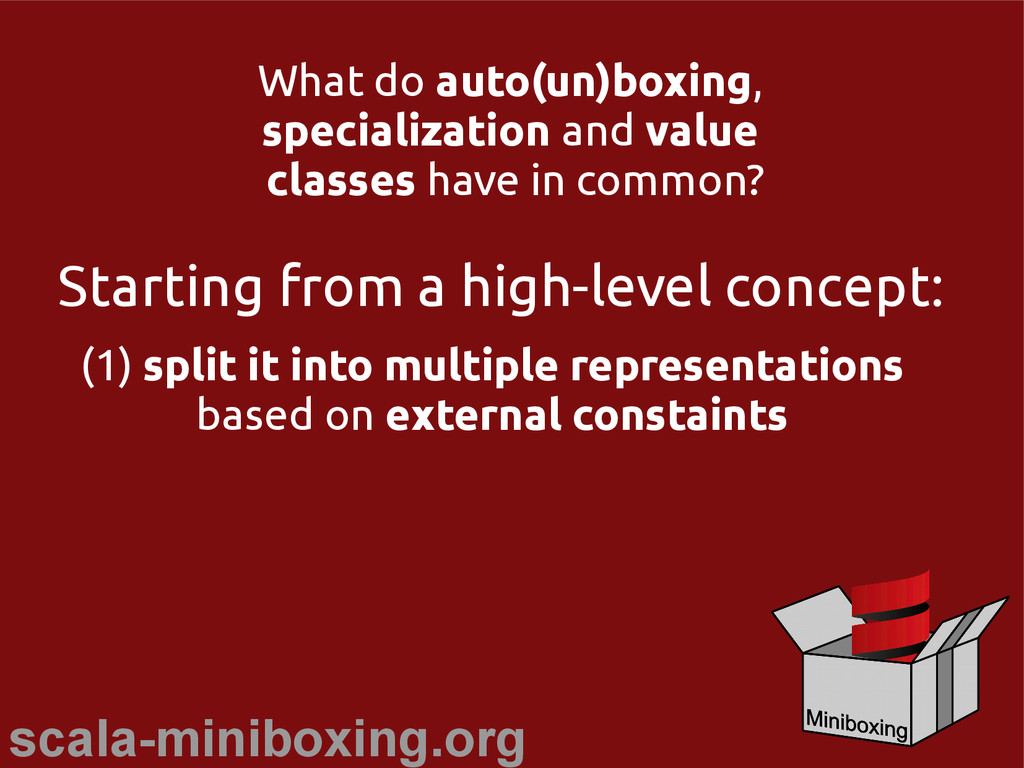
common? Starting from a high-level concept: (1) split it into multiple representations based on external constaints -
scala-miniboxing.org What do auto(un)boxing, specialization and value classes have in
common? Starting from a high-level concept: (1) split it into multiple representations based on external constaints (2) introduce the necessary coercions when the representation has to be converted -
scala-miniboxing.org What do auto(un)boxing, specialization and value classes have in
common? Why is this important? The transformation Benchmark Conclusion -
scala-miniboxing.org What do auto(un)boxing, specialization and value classes have in
common? Why is this important? The transformation Benchmark Conclusion -
106 scala-miniboxing.org Late Data Layout (LDL) Late Data Layout (LDL)
concept repr. 1 repr. 2 -
107 scala-miniboxing.org Late Data Layout (LDL) Late Data Layout (LDL)
concept repr. 1 … repr. n repr. 2 -
108 scala-miniboxing.org Late Data Layout (LDL) Late Data Layout (LDL)
concept repr. 1 … repr. n repr. 2 Constraints from the interaction with other language features: • generics • subtyping • virtual dispatch • DSL semantics (staging) -
109 scala-miniboxing.org Late Data Layout (LDL) Late Data Layout (LDL)
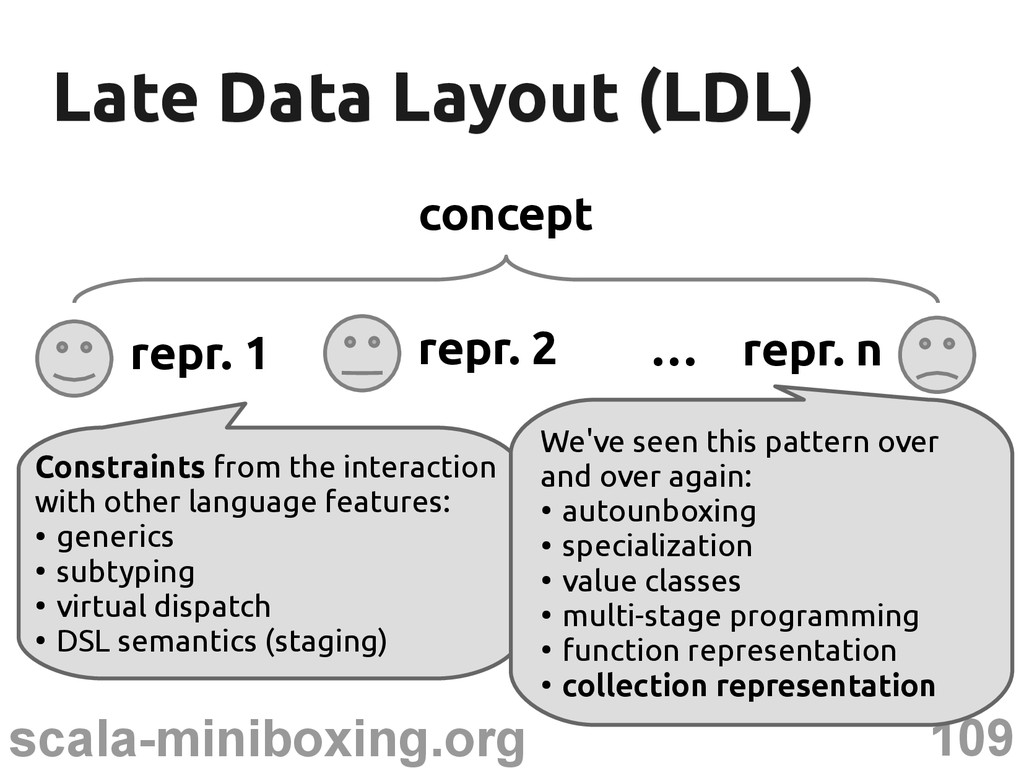
concept repr. 1 … repr. n repr. 2 Constraints from the interaction with other language features: • generics • subtyping • virtual dispatch • DSL semantics (staging) We've seen this pattern over and over again: • autounboxing • specialization • value classes • multi-stage programming • function representation • collection representation -
111 scala-miniboxing.org Collection Representation Collection Representation List[T] Stream[T] • preferred
encoding • for pure comprehensions -
112 scala-miniboxing.org Collection Representation Collection Representation List[T] Stream[T] • preferred
encoding • for pure comprehensions • for impure comprehensions • more expensive (needs to be materialized at each step) List[T] -
113 scala-miniboxing.org Collection Representation Collection Representation List[T] Stream[T] • preferred
encoding • for pure comprehensions • for impure comprehensions • more expensive (needs to be materialized at each step) List[T] incompatible → coercions -
114 scala-miniboxing.org Collection Representation Collection Representation val c = List(1,2,3)
val d = c.map(_+1).filter(_%2==0) val c = List(1,2,3) val d = c.map(_+1).filter(_%2==0) -
115 scala-miniboxing.org Collection Representation Collection Representation val c = List(1,2,3)
val d = c.map(_+1).filter(_%2==0) Materialized list val c = List(1,2,3) val d = c.map(_+1).filter(_%2==0) -
116 scala-miniboxing.org Collection Representation Collection Representation val c = List(1,2,3)
val d = c.map(_+1).filter(_%2==0) Materialized list Materialized list val c = List(1,2,3) val d = c.map(_+1).filter(_%2==0) -
117 scala-miniboxing.org Collection Representation Collection Representation val c = List(1,2,3)
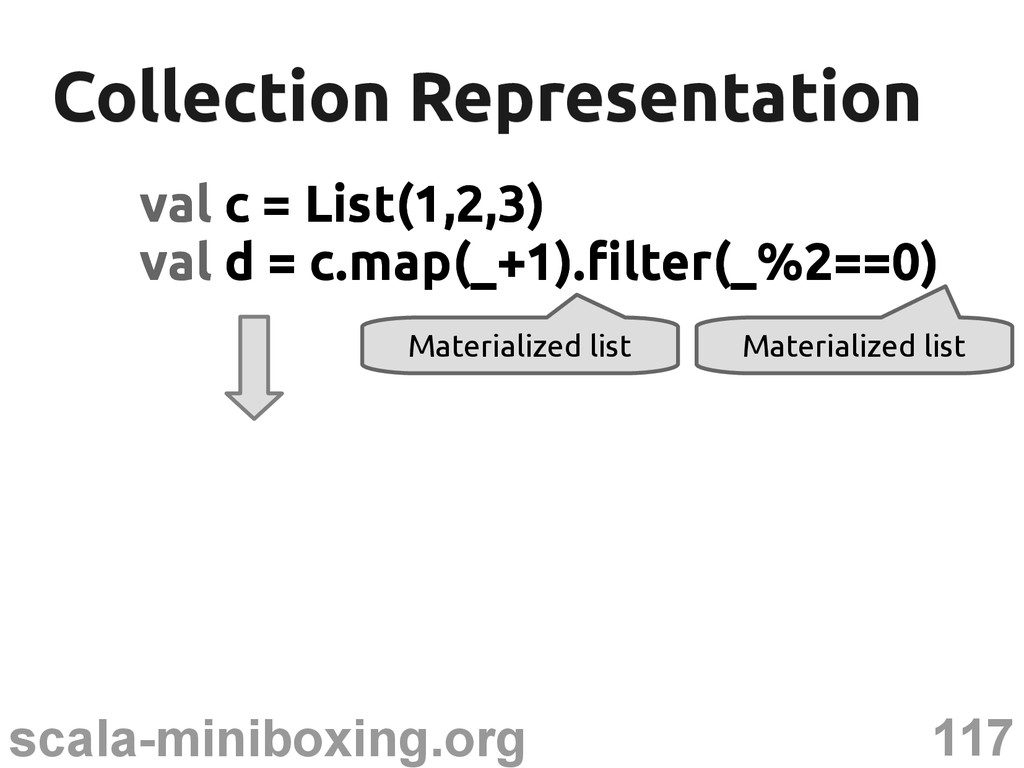
val d = c.map(_+1).filter(_%2==0) Materialized list Materialized list val c = List(1,2,3) val d = c.map(_+1).filter(_%2==0) -
118 scala-miniboxing.org Collection Representation Collection Representation val c = List(1,2,3)
val d = c.map(_+1).filter(_%2==0) Materialized list Materialized list val c: Stream[Int] = List(1,2,3).toStream val c = List(1,2,3) val d = c.map(_+1).filter(_%2==0) -
119 scala-miniboxing.org Collection Representation Collection Representation val c = List(1,2,3)
val d = c.map(_+1).filter(_%2==0) Materialized list Materialized list val c: Stream[Int] = List(1,2,3).toStream val d: Stream[Int] = c.map(_+1).filter(_%2==0) val c = List(1,2,3) val d = c.map(_+1).filter(_%2==0) -
120 scala-miniboxing.org Collection Representation Collection Representation val c = List(1,2,3)
val d = c.map(_+1).filter(_%2==0) Materialized list Materialized list val c: Stream[Int] = List(1,2,3).toStream val d: Stream[Int] = c.map(_+1).filter(_%2==0) val c = List(1,2,3) val d = c.map(_+1).filter(_%2==0) No materialization! -
123 scala-miniboxing.org <Your Use Case> <Your Use Case> <concept> repr.
1 … repr. n repr. 2 -
124 scala-miniboxing.org <Your Use Case> <Your Use Case> <concept> repr.
1 … repr. n repr. 2 Can LDL help you? -
125 scala-miniboxing.org <Your Use Case> <Your Use Case> <concept> repr.
1 … repr. n repr. 2 Can LDL help you? It may not be a perfect fit, but let's give it a shot! -
scala-miniboxing.org What do auto(un)boxing, specialization and value classes have in
common? Why is this important? The transformation Benchmark Conclusion -
scala-miniboxing.org What do auto(un)boxing, specialization and value classes have in
common? Why is this important? The transformation Benchmark Conclusion -
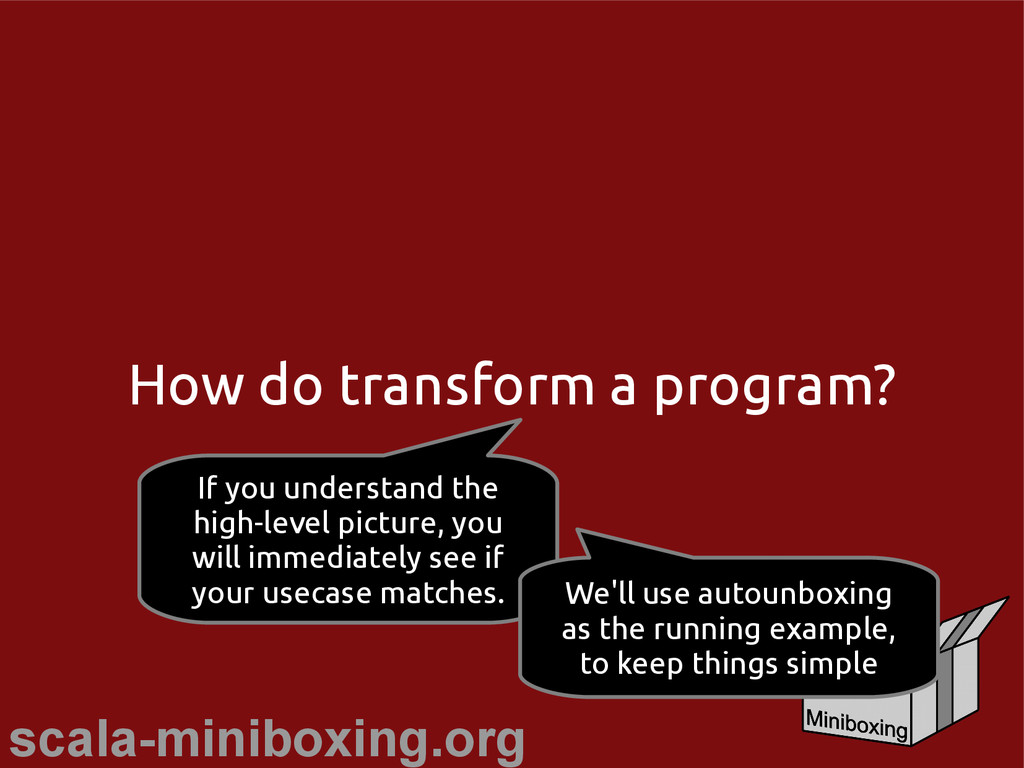
scala-miniboxing.org How do transform a program? If you understand the
high-level picture, you will immediately see if your usecase matches. -
scala-miniboxing.org How do transform a program? If you understand the
high-level picture, you will immediately see if your usecase matches. We'll use autounboxing as the running example, to keep things simple -
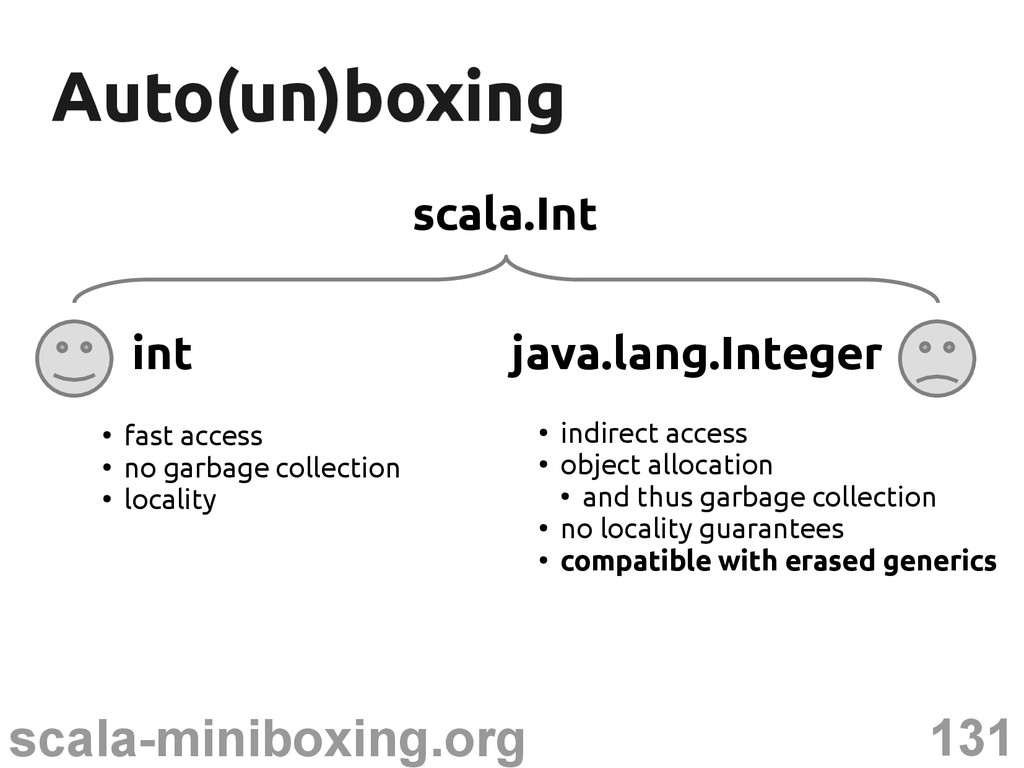
131 scala-miniboxing.org Auto(un)boxing Auto(un)boxing scala.Int int • fast access •
no garbage collection • locality • indirect access • object allocation • and thus garbage collection • no locality guarantees • compatible with erased generics java.lang.Integer -
132 scala-miniboxing.org Auto(un)boxing Auto(un)boxing scala.Int int • fast access •
no garbage collection • locality • indirect access • object allocation • and thus garbage collection • no locality guarantees • compatible with erased generics java.lang.Integer incompatible → coercions -
134 scala-miniboxing.org Naive transformation Naive transformation val x: Int =
List[Int](1, 2, 3).head val y: List[Int] = List[Int](x) naive unboxing -
135 scala-miniboxing.org Naive transformation Naive transformation val x: Int =
List[Int](1, 2, 3).head val y: List[Int] = List[Int](x) val x: int = List[Int](1, 2, 3).head val y: List[Int] = List[Int](x) naive unboxing -
136 scala-miniboxing.org Naive transformation Naive transformation val x: Int =
List[Int](1, 2, 3).head val y: List[Int] = List[Int](x) val x: int = List[Int](1, 2, 3).head val y: List[Int] = List[Int](x) naive unboxing representation mismatch: expected: int found: Int -
137 scala-miniboxing.org Naive transformation Naive transformation val x: Int =
List[Int](1, 2, 3).head val y: List[Int] = List[Int](x) val x: int = List[Int](1, 2, 3).head val y: List[Int] = List[Int](x) naive unboxing representation mismatch: expected: int found: Int representation mismatch: expected: Int found: int -
138 scala-miniboxing.org Naive transformation Naive transformation • naively replacing representations
– leads to mismatches – which are hard to recover (impossible for value classes and miniboxing) • we need coercions between representations -
140 scala-miniboxing.org Syntax-based Syntax-based • when transforming a value –
coerce the definition right-hand side – coerce all references to it -
142 scala-miniboxing.org Syntax-based Syntax-based val x: Int = List[Int](1, 2,
3).head syntax-based unboxing -
143 scala-miniboxing.org Syntax-based Syntax-based val x: Int = List[Int](1, 2,
3).head val x: int = syntax-based unboxing -
144 scala-miniboxing.org Syntax-based Syntax-based val x: Int = List[Int](1, 2,
3).head val x: int = unbox(List[Int](1, 2, 3).head) syntax-based unboxing -
145 scala-miniboxing.org Syntax-based Syntax-based val x: Int = List[Int](1, 2,
3).head val x: int = unbox(List[Int](1, 2, 3).head) syntax-based unboxing There are no references to x, so there's nothing else to do. -
146 scala-miniboxing.org Syntax-based Syntax-based val x: Int = List[Int](1, 2,
3).head val x: int = unbox(List[Int](1, 2, 3).head) syntax-based unboxing There are no references to x, so there's nothing else to do. -
147 scala-miniboxing.org Syntax-based Syntax-based val x: Int = List[Int](1, 2,
3).head val y: Int = x -
148 scala-miniboxing.org Syntax-based Syntax-based val x: Int = List[Int](1, 2,
3).head val y: Int = x Transform one by one -
149 scala-miniboxing.org Syntax-based Syntax-based val x: Int = List[Int](1, 2,
3).head val y: Int = x syntax-based unboxing Transform one by one -
150 scala-miniboxing.org Syntax-based Syntax-based val x: Int = List[Int](1, 2,
3).head val y: Int = x val x: int = unbox(List[Int](1, 2, 3).head) syntax-based unboxing Transform one by one -
151 scala-miniboxing.org Syntax-based Syntax-based val x: Int = List[Int](1, 2,
3).head val y: Int = x val x: int = unbox(List[Int](1, 2, 3).head) val y: Int = box(x) syntax-based unboxing Transform one by one -
152 scala-miniboxing.org Syntax-based Syntax-based val x: int = unbox(List[Int](1, 2,
3).head) val y: Int = box(x) -
153 scala-miniboxing.org Syntax-based Syntax-based val x: int = unbox(List[Int](1, 2,
3).head) val y: Int = box(x) syntax-based unboxing -
154 scala-miniboxing.org Syntax-based Syntax-based val x: int = unbox(List[Int](1, 2,
3).head) val y: Int = box(x) val x: int = unbox(List[Int](1, 2, 3).head) val y: int = syntax-based unboxing -
155 scala-miniboxing.org Syntax-based Syntax-based val x: int = unbox(List[Int](1, 2,
3).head) val y: Int = box(x) val x: int = unbox(List[Int](1, 2, 3).head) val y: int = unbox(box(x)) syntax-based unboxing -
156 scala-miniboxing.org Syntax-based Syntax-based val x: int = unbox(List[Int](1, 2,
3).head) val y: Int = box(x) val x: int = unbox(List[Int](1, 2, 3).head) val y: int = unbox(box(x)) syntax-based unboxing suboptimal -
158 scala-miniboxing.org Peephole Optimization Peephole Optimization val y: int =
unbox(box(x)) peephole -
159 scala-miniboxing.org Peephole Optimization Peephole Optimization val y: int =
unbox(box(x)) val y: int = x peephole -
160 scala-miniboxing.org Peephole Optimization Peephole Optimization val y: int =
unbox(box(x)) val y: int = x peephole -
161 scala-miniboxing.org Peephole Optimization Peephole Optimization val y: int =
unbox(box(x)) val y: int = x peephole Okay, let's add the peephole transformation in the pipeline. -
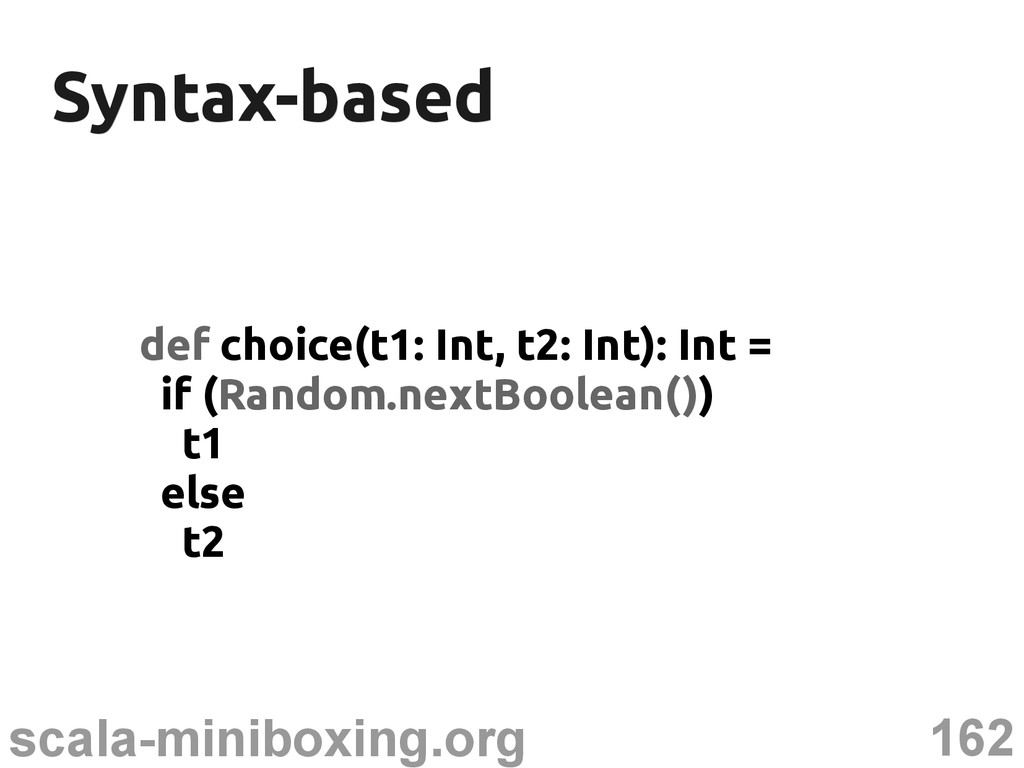
162 scala-miniboxing.org Syntax-based Syntax-based def choice(t1: Int, t2: Int): Int
= if (Random.nextBoolean()) t1 else t2 -
163 scala-miniboxing.org Syntax-based Syntax-based def choice(t1: Int, t2: Int): Int
= if (Random.nextBoolean()) t1 else t2 Transform one by one -
164 scala-miniboxing.org Syntax-based Syntax-based def choice(t1: int, t2: Int): Int
= if (Random.nextBoolean()) box(t1) else t2 -
165 scala-miniboxing.org Syntax-based Syntax-based def choice(t1: int, t2: int): Int
= if (Random.nextBoolean()) box(t1) else box(t2) -
166 scala-miniboxing.org Syntax-based Syntax-based def choice(t1: int, t2: int): Int
= if (Random.nextBoolean()) box(t1) else box(t2) Anything missing? -
167 scala-miniboxing.org Syntax-based Syntax-based def choice(t1: int, t2: int): int
= unbox(if (Random.nextBoolean()) box(t1) else box(t2)) -
168 scala-miniboxing.org Syntax-based Syntax-based def choice(t1: int, t2: int): int
= unbox(if (Random.nextBoolean()) box(t1) else box(t2)) -
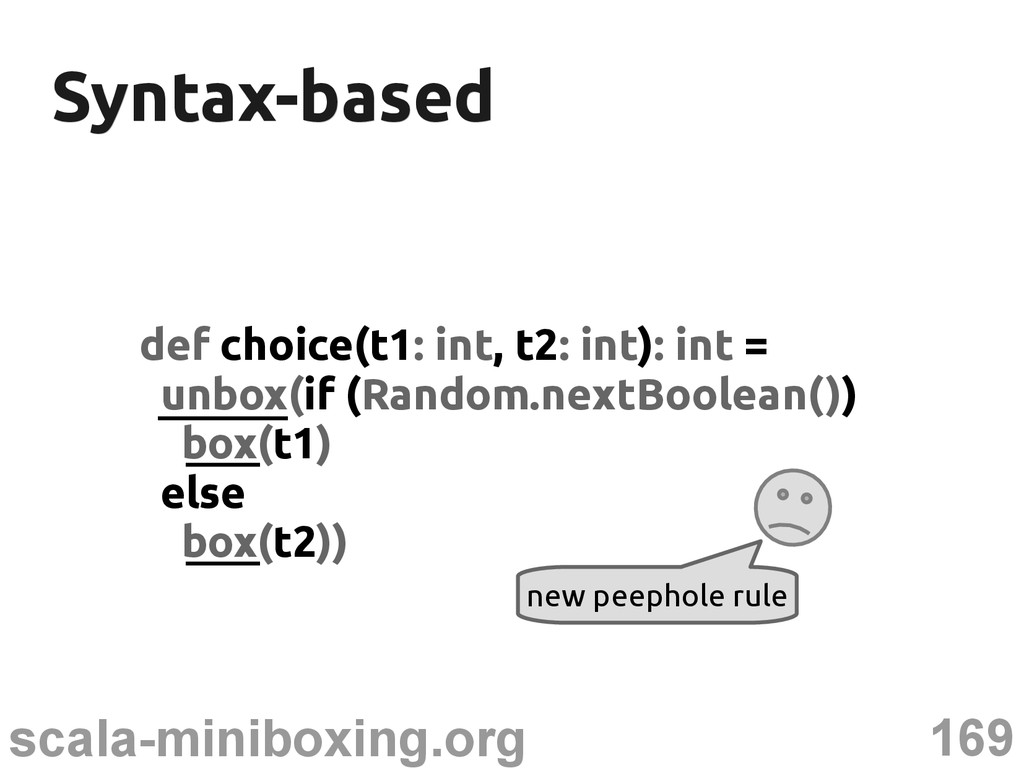
169 scala-miniboxing.org Syntax-based Syntax-based def choice(t1: int, t2: int): int
= unbox(if (Random.nextBoolean()) box(t1) else box(t2)) new peephole rule -
170 scala-miniboxing.org Syntax-based Syntax-based def choice(t1: int, t2: int): int
= unbox(if (Random.nextBoolean()) box(t1) else box(t2)) new peephole rule sink outside coercions into the if branches -
171 scala-miniboxing.org Syntax-based Syntax-based def choice(t1: int, t2: int): int
= if (Random.nextBoolean()) unbox(box(t1)) else unbox(box(t2)) -
172 scala-miniboxing.org Syntax-based Syntax-based def choice(t1: int, t2: int): int
= if (Random.nextBoolean()) unbox(box(t1)) else unbox(box(t2)) -
173 scala-miniboxing.org Syntax-based Syntax-based def choice(t1: int, t2: int): int
= if (Random.nextBoolean()) t1 else t2 -
174 scala-miniboxing.org Syntax-based Syntax-based def choice(t1: int, t2: int): int
= if (Random.nextBoolean()) t1 else t2 complicated -
175 scala-miniboxing.org Syntax-based Syntax-based • peephole transformation does not scale
– needs multiple rules for each node – needs successive rewriting => slow – impossible to guarantee optimality -
177 scala-miniboxing.org Type-based transformation Type-based transformation • propagate representation information
– into the type system (based on annotated types) – let the type system propagate this information -
178 scala-miniboxing.org Type-based transformation Type-based transformation • re-typechecking the tree
– exposes inconsistencies in the representation – so we introduce coercions • only when representations don't match -
179 scala-miniboxing.org Type-based transformation Type-based transformation • three-stage mechanism –
inject annotate the values to be unboxed → – coerce introduce coercion markers → – commit commit to the alternative representations → -
180 scala-miniboxing.org Type-based transformation Type-based transformation Warning! Throughout the presentation
we'll be writing annotations written before types (e.g. “@unboxed Int”), although in the Scala syntax they are written after the type (e.g.“Int @unboxed”). This makes it easier to read the types aloud. -
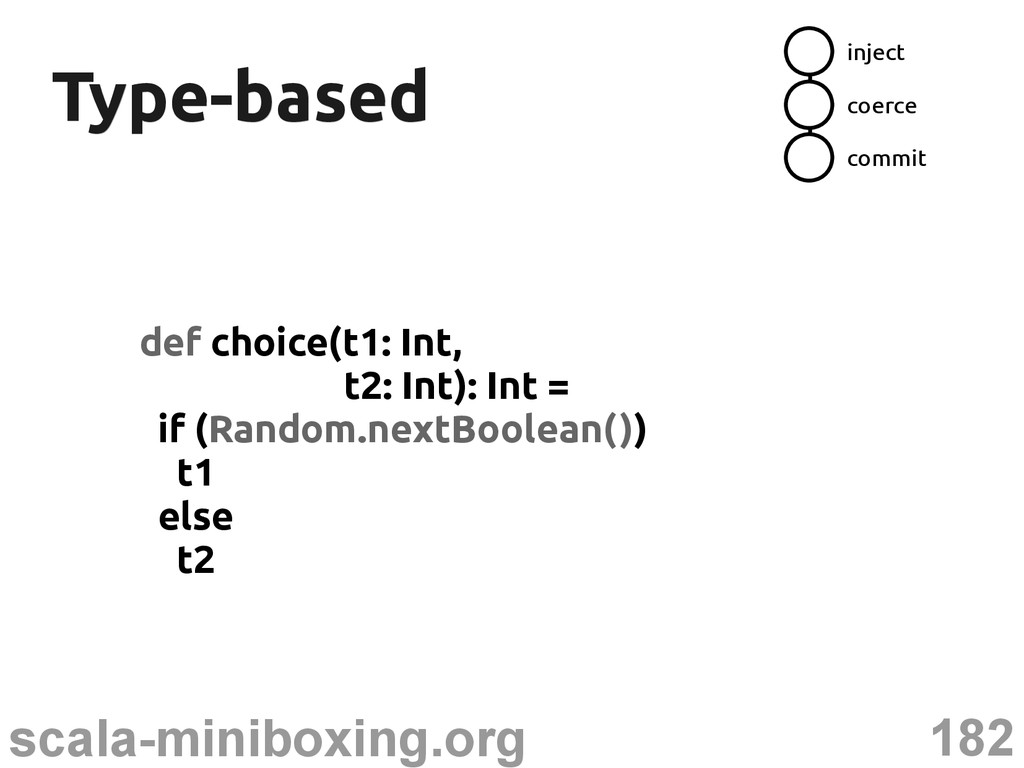
182 scala-miniboxing.org Type-based Type-based def choice(t1: Int, t2: Int): Int
= if (Random.nextBoolean()) t1 else t2 inject coerce commit -
183 scala-miniboxing.org Type-based Type-based def choice(t1: Int, t2: Int): Int
= if (Random.nextBoolean()) t1 else t2 inject coerce commit -
184 scala-miniboxing.org Type-based Type-based def choice(t1: @unboxed Int, t2: @unboxed
Int): @unboxed Int = if (Random.nextBoolean()) t1 else t2 inject coerce commit -
185 scala-miniboxing.org Type-based Type-based def choice(t1: @unboxed Int, t2: @unboxed
Int): @unboxed Int = if (Random.nextBoolean()) t1 else t2 inject coerce commit configurable introduction of annotations based on external constraints -
186 scala-miniboxing.org Type-based Type-based def choice(t1: @unboxed Int, t2: @unboxed
Int): @unboxed Int = if (Random.nextBoolean()) t1 else t2 inject coerce commit -
187 scala-miniboxing.org Type-based Type-based def choice(t1: @unboxed Int, t2: @unboxed
Int): @unboxed Int = if (Random.nextBoolean()) t1 else t2 inject coerce commit -
188 scala-miniboxing.org Type-based Type-based def choice(t1: @unboxed Int, t2: @unboxed
Int): @unboxed Int = if (Random.nextBoolean()) t1 else t2 inject coerce commit -
189 scala-miniboxing.org Type-based Type-based def choice(t1: @unboxed Int, t2: @unboxed
Int): @unboxed Int = if (Random.nextBoolean()) t1 else t2 inject coerce commit the rhs expression must be of type @unboxed Int -
190 scala-miniboxing.org Type-based Type-based def choice(t1: @unboxed Int, t2: @unboxed
Int): @unboxed Int = if (Random.nextBoolean()) t1 else t2 inject coerce commit : @unboxed Int the rhs expression must be of type @unboxed Int -
191 scala-miniboxing.org Type-based Type-based def choice(t1: @unboxed Int, t2: @unboxed
Int): @unboxed Int = if (Random.nextBoolean()) t1 else t2 inject coerce commit : @unboxed Int expected type (part of local type inference) the rhs expression must be of type @unboxed Int -
192 scala-miniboxing.org Type-based Type-based def choice(t1: @unboxed Int, t2: @unboxed
Int): @unboxed Int = if (Random.nextBoolean()) t1 else t2 inject coerce commit : Boolean -
193 scala-miniboxing.org Type-based Type-based def choice(t1: @unboxed Int, t2: @unboxed
Int): @unboxed Int = if (Random.nextBoolean()) t1 else t2 inject coerce commit : Boolean matches: expected: Boolean found: Boolean -
194 scala-miniboxing.org Type-based Type-based def choice(t1: @unboxed Int, t2: @unboxed
Int): @unboxed Int = if (Random.nextBoolean()) t1 else t2 inject coerce commit : @unboxed Int -
195 scala-miniboxing.org Type-based Type-based def choice(t1: @unboxed Int, t2: @unboxed
Int): @unboxed Int = if (Random.nextBoolean()) t1 else t2 inject coerce commit : @unboxed Int matches: expected: @unboxed Int found: @unboxed Int -
196 scala-miniboxing.org Type-based Type-based def choice(t1: @unboxed Int, t2: @unboxed
Int): @unboxed Int = if (Random.nextBoolean()) t1 else t2 inject coerce commit : @unboxed Int -
197 scala-miniboxing.org Type-based Type-based def choice(t1: @unboxed Int, t2: @unboxed
Int): @unboxed Int = if (Random.nextBoolean()) t1 else t2 inject coerce commit matches: ... : @unboxed Int -
198 scala-miniboxing.org Type-based Type-based def choice(t1: @unboxed Int, t2: @unboxed
Int): @unboxed Int = if (Random.nextBoolean()) t1 else t2 inject coerce commit -
199 scala-miniboxing.org Type-based Type-based def choice(t1: @unboxed Int, t2: @unboxed
Int): @unboxed Int = if (Random.nextBoolean()) t1 else t2 inject coerce commit all okay, next phase -
200 scala-miniboxing.org Type-based Type-based def choice(t1: @unboxed Int, t2: @unboxed
Int): @unboxed Int = if (Random.nextBoolean()) t1 else t2 inject coerce commit -
201 scala-miniboxing.org Type-based Type-based def choice(t1: @unboxed Int, t2: @unboxed
Int): @unboxed Int = if (Random.nextBoolean()) t1 else t2 inject coerce commit Replace: @unboxed Int → int (not showing Int → j.l.Integer) -
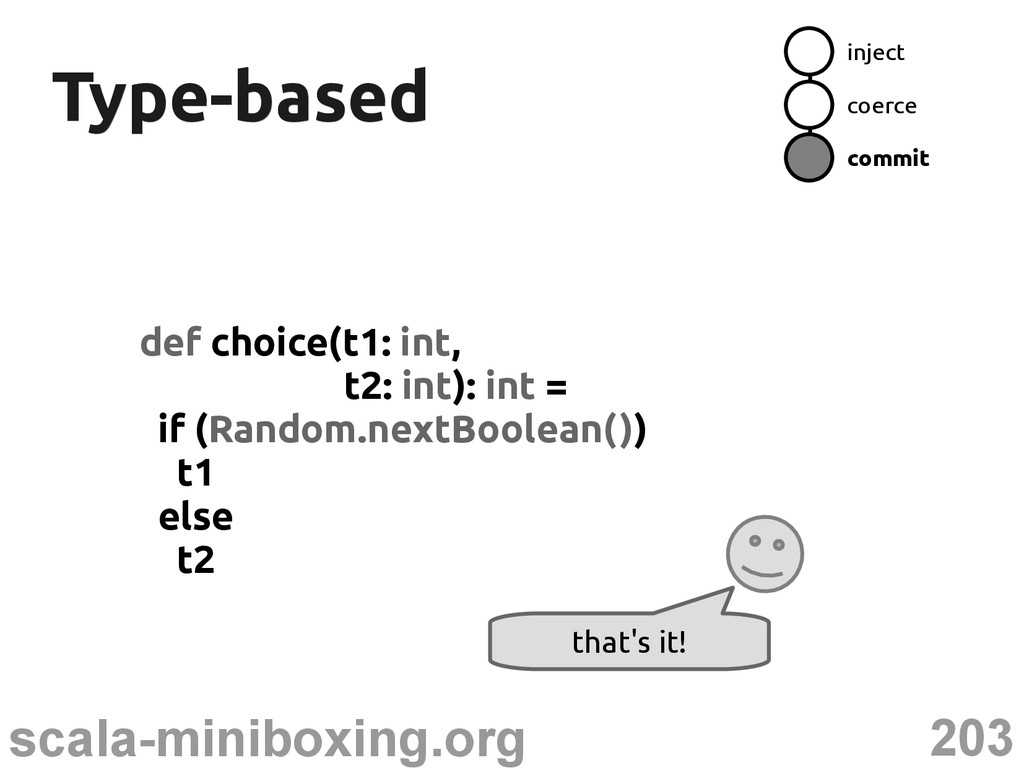
202 scala-miniboxing.org Type-based Type-based def choice(t1: int, t2: int): int
= if (Random.nextBoolean()) t1 else t2 inject coerce commit -
203 scala-miniboxing.org Type-based Type-based def choice(t1: int, t2: int): int
= if (Random.nextBoolean()) t1 else t2 inject coerce commit that's it! -
204 scala-miniboxing.org Type-based transformation Type-based transformation • three-stage mechanism –
inject: add annotations – coerce: add coercions (based on the annotations) – commit: final representation semantics -
205 scala-miniboxing.org Type-based transformation Type-based transformation • Scalac's erasure –
similar transformation – less flexible (no annotations) – entangled with other transformations • we took what's good – and allowed the transformation to work on other usecases as well -
206 scala-miniboxing.org Type-based transformation Type-based transformation • why do this?
– at the core of: • miniboxing (http://scala-miniboxing.org) • value classes plugin (https://github.com/miniboxing/value-plugin) • multi-stage plugin (https://github.com/miniboxing/staging-plugin) • <your transformation here> -
207 scala-miniboxing.org Type-based transformation Type-based transformation • why do this?
– at the core of: • miniboxing (http://scala-miniboxing.org) • value classes plugin (https://github.com/miniboxing/value-plugin) • multi-stage plugin (https://github.com/miniboxing/staging-plugin) • <your transformation here> most important one -
209 scala-miniboxing.org Consistency Consistency inject coerce commit • representations become
explicit in types – representation mismatches • become type mismatches • are exposed by the type system – mismatches lead to coercions • explicit bridges between representations • are introduced automatically – regardless of the representations • at a meta-level -
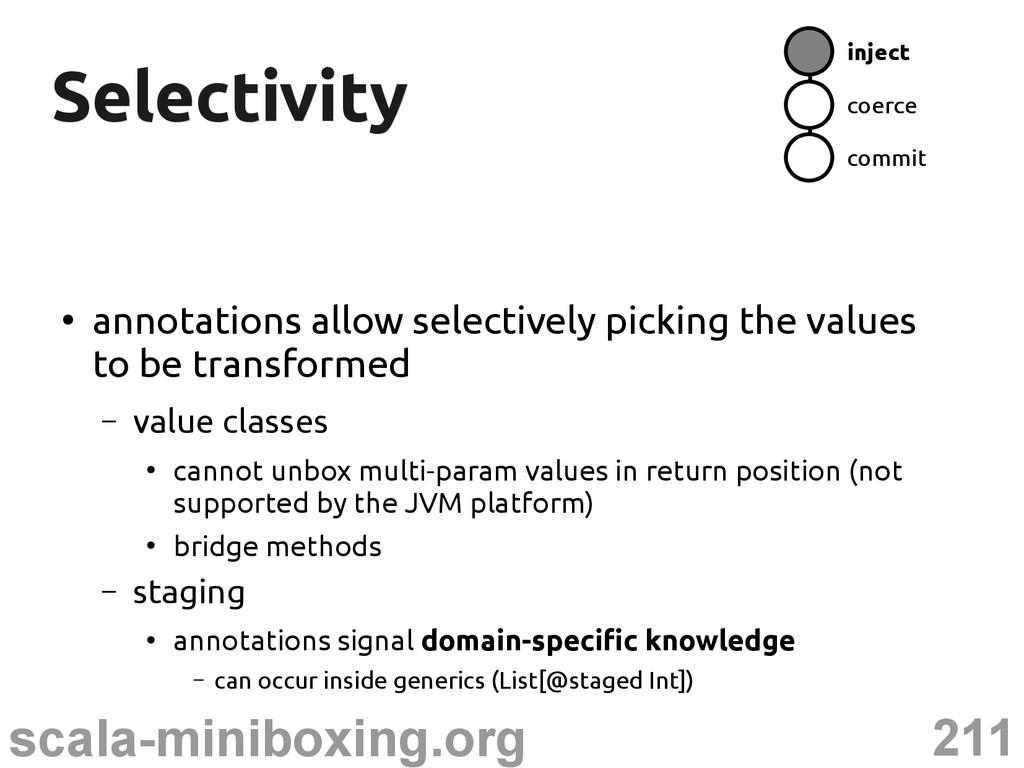
211 scala-miniboxing.org Selectivity Selectivity inject coerce commit • annotations allow
selectively picking the values to be transformed – value classes • cannot unbox multi-param values in return position (not supported by the JVM platform) • bridge methods – staging • annotations signal domain-specific knowledge – can occur inside generics (List[@staged Int]) -
212 scala-miniboxing.org Selectivity Selectivity def choice(t1: Int, t2: Int): Int
= if (Random.nextBoolean()) t1 else t2 inject coerce commit -
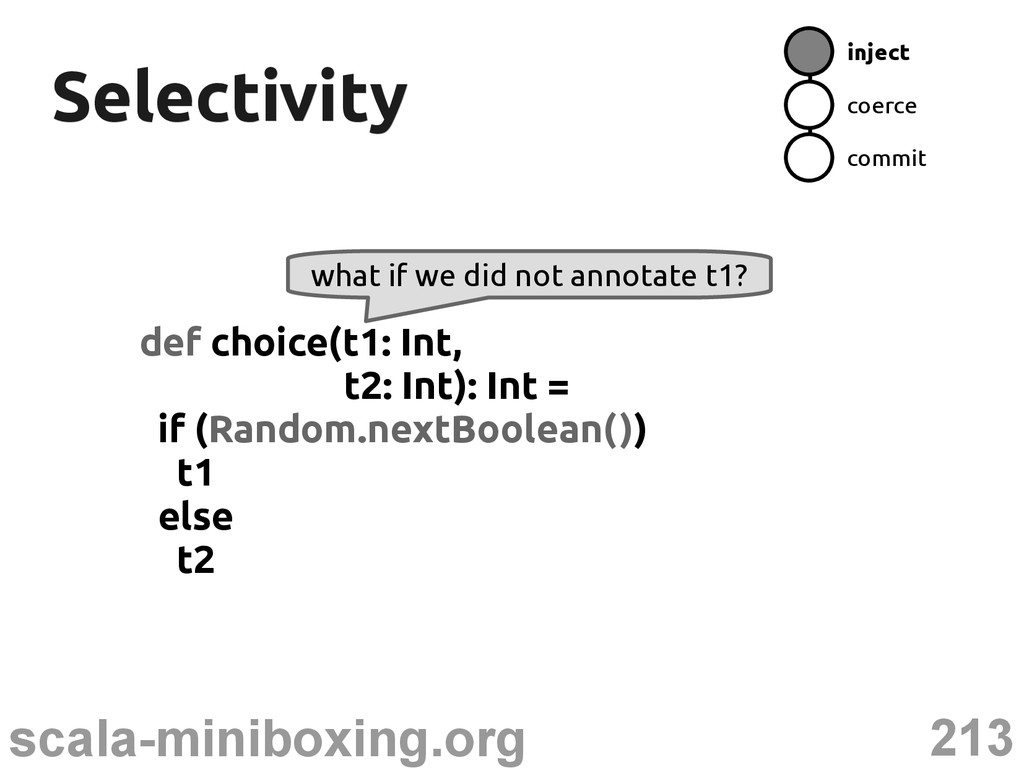
213 scala-miniboxing.org Selectivity Selectivity def choice(t1: Int, t2: Int): Int
= if (Random.nextBoolean()) t1 else t2 inject coerce commit what if we did not annotate t1? -
214 scala-miniboxing.org Selectivity Selectivity def choice(t1: Int, t2: @unboxed Int):
@unboxed Int = if (Random.nextBoolean()) t1 else t2 inject coerce commit what if we did not annotate t1? -
215 scala-miniboxing.org Selectivity Selectivity def choice(t1: Int, t2: @unboxed Int):
@unboxed Int = if (Random.nextBoolean()) t1 else t2 inject coerce commit : @unboxed Int -
216 scala-miniboxing.org Selectivity Selectivity def choice(t1: Int, t2: @unboxed Int):
@unboxed Int = if (Random.nextBoolean()) t1 else t2 inject coerce commit : @unboxed Int -
217 scala-miniboxing.org Selectivity Selectivity def choice(t1: Int, t2: @unboxed Int):
@unboxed Int = if (Random.nextBoolean()) t1 else t2 inject coerce commit : @unboxed Int mismatch: expected: @unboxed Int found: Int -
218 scala-miniboxing.org Selectivity Selectivity def choice(t1: Int, t2: @unboxed Int):
@unboxed Int = if (Random.nextBoolean()) t1 else t2 inject coerce commit : @unboxed Int mismatch: expected: @unboxed Int found: Int coercion -
219 scala-miniboxing.org Selectivity Selectivity def choice(t1: Int, t2: @unboxed Int):
@unboxed Int = if (Random.nextBoolean()) unbox(t1) else t2 inject coerce commit -
220 scala-miniboxing.org Selectivity Selectivity def choice(t1: Int, t2: @unboxed Int):
@unboxed Int = if (Random.nextBoolean()) unbox(t1) else t2 inject coerce commit -
221 scala-miniboxing.org Selectivity Selectivity def choice(t1: Int, t2: int): int
= if (Random.nextBoolean()) t1.intValue else t2 inject coerce commit -
223 scala-miniboxing.org Optimality Optimality def choice(t1: Int, t2: @unboxed Int):
@unboxed Int = if (Random.nextBoolean()) unbox(t1) else t2 inject coerce commit -
224 scala-miniboxing.org Optimality Optimality def choice(t1: Int, t2: @unboxed Int):
@unboxed Int = if (Random.nextBoolean()) unbox(t1) else t2 inject coerce commit -
225 scala-miniboxing.org Optimality Optimality def choice(t1: Int, t2: @unboxed Int):
@unboxed Int = if (Random.nextBoolean()) unbox(t1) else t2 inject coerce commit Coercions are sunk in the tree → excute only if necessary -
scala-miniboxing.org Miniboxing Value Classes* Multi-stage Programming* Use cases Type-based LDL
transformation * early prototypes -
227 scala-miniboxing.org LDL for miniboxing LDL for miniboxing def tupled[T1,
T2](t1: T1, t2: T2) = ... -
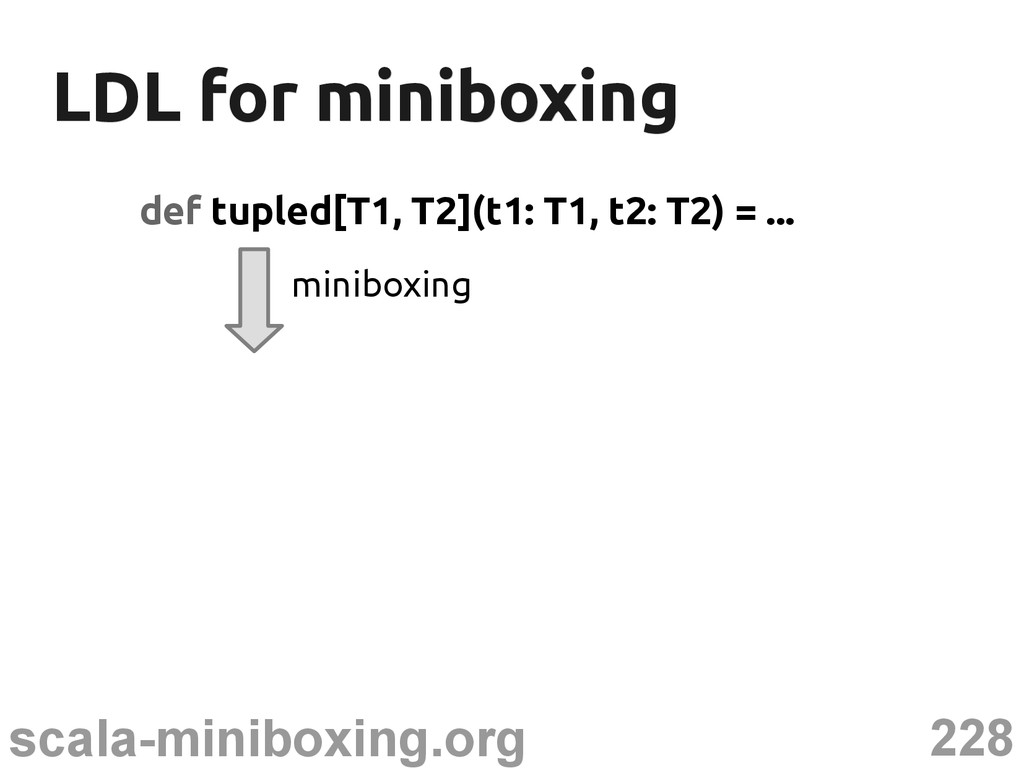
228 scala-miniboxing.org LDL for miniboxing LDL for miniboxing def tupled[T1,
T2](t1: T1, t2: T2) = ... miniboxing -
229 scala-miniboxing.org LDL for miniboxing LDL for miniboxing def tupled[T1,
T2](t1: T1, t2: T2) = ... miniboxing first: duplicate body -
230 scala-miniboxing.org LDL for miniboxing LDL for miniboxing def tupled[T1,
T2](t1: T1, t2: T2) = ... miniboxing def tupled[T1, T2](t1: T1, t2: T2) = … first: duplicate body -
231 scala-miniboxing.org LDL for miniboxing LDL for miniboxing def tupled[T1,
T2](t1: T1, t2: T2) = ... miniboxing def tupled[T1, T2](t1: T1, t2: T2) = … def tupled_ML[T1, T2](..., t1: T1, t2: T2) = … first: duplicate body -
232 scala-miniboxing.org LDL for miniboxing LDL for miniboxing def tupled[T1,
T2](t1: T1, t2: T2) = ... miniboxing def tupled[T1, T2](t1: T1, t2: T2) = … def tupled_ML[T1, T2](..., t1: T1, t2: T2) = … def tupled_LM[T1, T2](..., t1: T1, t2: T2) = … first: duplicate body -
233 scala-miniboxing.org LDL for miniboxing LDL for miniboxing def tupled[T1,
T2](t1: T1, t2: T2) = ... miniboxing def tupled[T1, T2](t1: T1, t2: T2) = … def tupled_ML[T1, T2](..., t1: T1, t2: T2) = … def tupled_LM[T1, T2](..., t1: T1, t2: T2) = … def tupled_MM[T1, T2](..., t1: T1, t2: T2) = … first: duplicate body -
234 scala-miniboxing.org LDL for miniboxing LDL for miniboxing def tupled[T1,
T2](t1: T1, t2: T2) = ... miniboxing def tupled[T1, T2](t1: T1, t2: T2) = … def tupled_ML[T1, T2](..., t1: T1, t2: T2) = … def tupled_LM[T1, T2](..., t1: T1, t2: T2) = … def tupled_MM[T1, T2](..., t1: T1, t2: T2) = … first: duplicate body second: adapt it -
235 scala-miniboxing.org LDL for miniboxing LDL for miniboxing def tupled[T1,
T2](t1: T1, t2: T2) = ... miniboxing def tupled[T1, T2](t1: T1, t2: T2) = … def tupled_ML[T1, T2](..., t1: @long T1, t2: T2) = … def tupled_LM[T1, T2](..., t1: T1, t2: @long T2) = … def tupled_MM[T1, T2](..., t1: @long T1, t2: @long T2) = * @long is used instead of @storage[Long] second: adapt it first: duplicate body -
236 scala-miniboxing.org LDL for miniboxing LDL for miniboxing def tupled[T1,
T2](t1: T1, t2: T2) = ... miniboxing def tupled[T1, T2](t1: T1, t2: T2) = … def tupled_ML[T1, T2](..., t1: @long T1, t2: T2) = … def tupled_LM[T1, T2](..., t1: T1, t2: @long T2) = … def tupled_MM[T1, T2](..., t1: @long T1, t2: @long T2) = * @long is used instead of @storage[Long] second: adapt it using the transformation first: duplicate body -
237 scala-miniboxing.org LDL for miniboxing LDL for miniboxing def tupled[T1,
T2](t1: T1, t2: T2) = ... miniboxing def tupled[T1, T2](t1: T1, t2: T2) = … def tupled_ML[T1, T2](..., t1: @long T1, t2: T2) = … def tupled_LM[T1, T2](..., t1: T1, t2: @long T2) = … def tupled_MM[T1, T2](..., t1: @long T1, t2: @long T2) = * @long is used instead of @storage[Long] second: adapt it using the transformation first: duplicate body body gets adapted** -
scala-miniboxing.org Miniboxing Value Classes* Multi-stage Programming* Use cases Type-based LDL
transformation * early prototypes -
239 scala-miniboxing.org LDL for value classes LDL for value classes
def abs(c: @unboxed Complex): Double = ... -
240 scala-miniboxing.org LDL for value classes LDL for value classes
def abs(c: @unboxed Complex): Double = ... value class plugin (commit phase) -
241 scala-miniboxing.org LDL for value classes LDL for value classes
def abs(c: @unboxed Complex): Double = ... value class plugin (commit phase) def abs(c_re: Double, c_im: Double): Double = ... -
242 scala-miniboxing.org LDL for value classes LDL for value classes
def abs(c: @unboxed Complex): Double = ... value class plugin (commit phase) def abs(c_re: Double, c_im: Double): Double = ... -
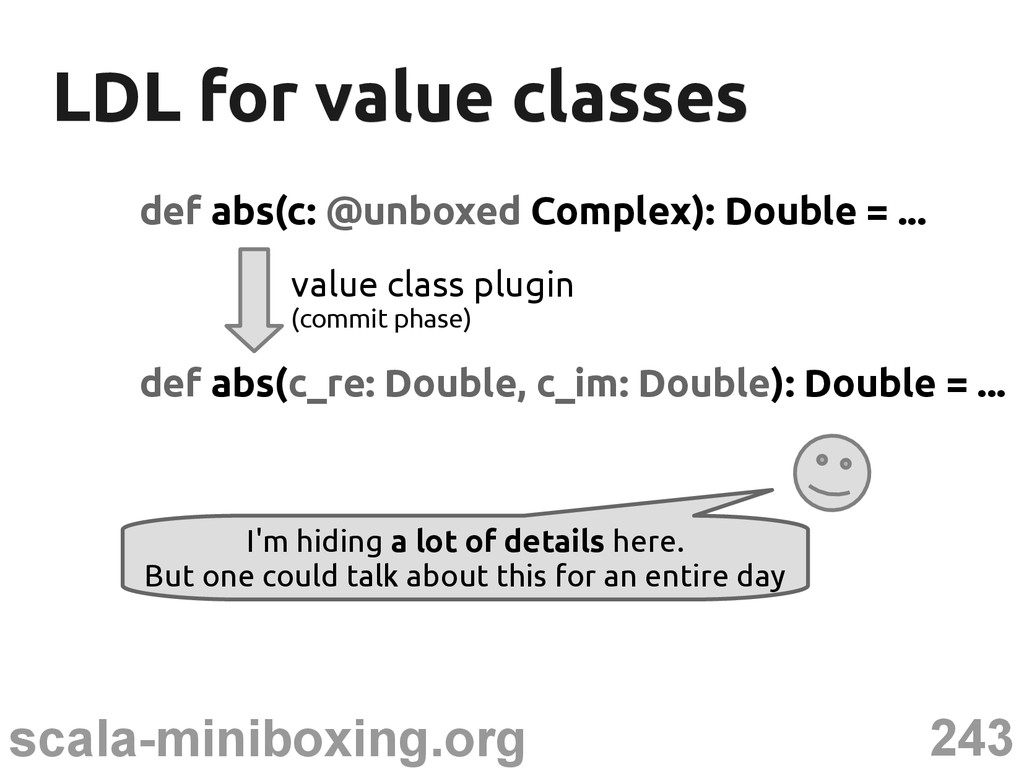
243 scala-miniboxing.org LDL for value classes LDL for value classes
def abs(c: @unboxed Complex): Double = ... value class plugin (commit phase) def abs(c_re: Double, c_im: Double): Double = ... I'm hiding a lot of details here. But one could talk about this for an entire day -
244 scala-miniboxing.org LDL for value classes LDL for value classes
def abs(c: @unboxed Complex): Double = ... value class plugin (commit phase) def abs(c_re: Double, c_im: Double): Double = ... I'm hiding a lot of details here. But one could talk about this for an entire day The one is @xeno-by! He implemented this :) -
scala-miniboxing.org Miniboxing Value Classes* Multi-stage Programming* Use cases Type-based LDL
transformation * early prototypes -
scala-miniboxing.org Miniboxing Value Classes* Multi-stage Programming* Use cases Type-based LDL
transformation We won't go into it today, but see github.com/miniboxing/staging-plugin * early prototypes -
scala-miniboxing.org What do auto(un)boxing, specialization and value classes have in
common? Why is this important? The transformation Benchmark Conclusion -
scala-miniboxing.org What do auto(un)boxing, specialization and value classes have in
common? Why is this important? The transformation Benchmark Conclusion -
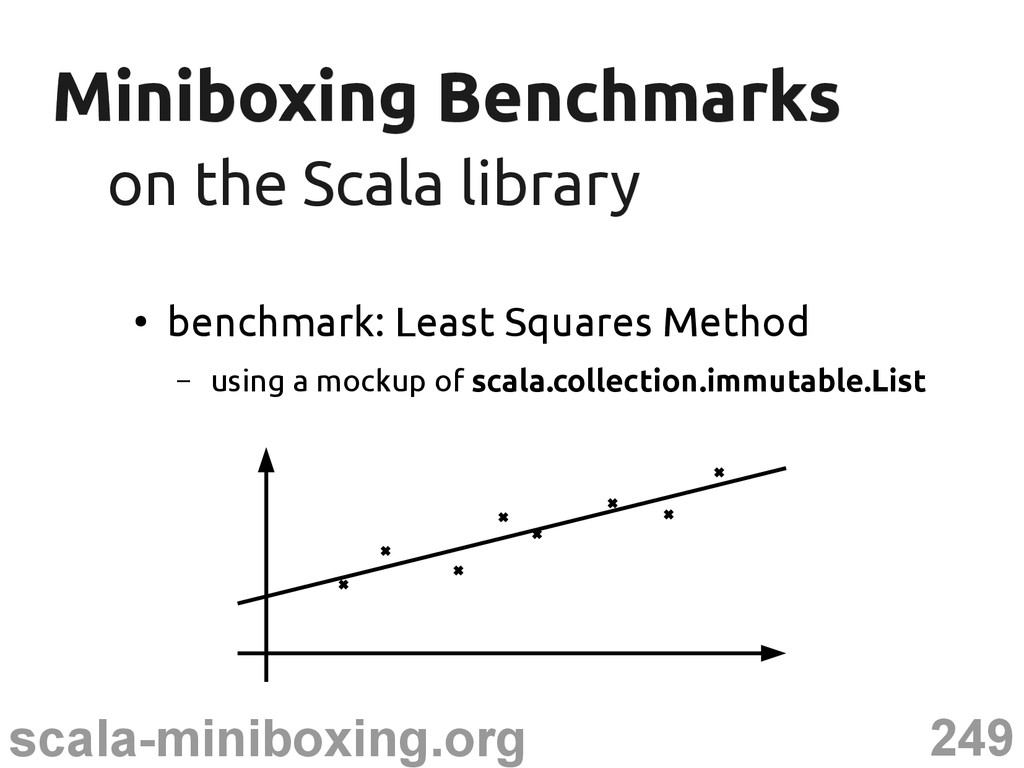
249 scala-miniboxing.org Miniboxing Benchmarks Miniboxing Benchmarks on the Scala library
on the Scala library • benchmark: Least Squares Method – using a mockup of scala.collection.immutable.List -
250 scala-miniboxing.org Miniboxing Benchmarks Miniboxing Benchmarks on the Scala library
on the Scala library • work with Aymeric Genet (github: @MelodyLucid) • mock-up of Scala linked List – Tuples – Traversable/TraversableLike – Iterator/Iterable/IterableLike – LinearSeqOptimized – Builder/CanBuildFrom • FunctionX has a nice story -
251 scala-miniboxing.org Miniboxing Benchmarks Miniboxing Benchmarks on the Scala library
on the Scala library • FunctionX from the Scala library – specialized – no way to call from miniboxed code without boxing slow → • MiniboxedFunctionX benchmarked ← – miniboxed, call without coercing – added automatically with another LDL cycle • MyFunctionX benchmarked ← – miniboxed, call without coercing – added by hand to the library -
253 scala-miniboxing.org Miniboxing Benchmarks Miniboxing Benchmarks on the Scala library
on the Scala library 30%-45% faster -
254 scala-miniboxing.org Miniboxing Benchmarks Miniboxing Benchmarks on the Scala library
on the Scala library 30%-45% faster On a non-contiguous data structure -
255 scala-miniboxing.org Miniboxing Benchmarks Miniboxing Benchmarks on the Scala library
(with GC) on the Scala library (with GC) -
256 scala-miniboxing.org Miniboxing Benchmarks Miniboxing Benchmarks on the Scala library
(with GC) on the Scala library (with GC) 3x faster On a non-contiguous data structure -
scala-miniboxing.org What do auto(un)boxing, specialization and value classes have in
common? Why is this important? The transformation Benchmark Conclusion -
scala-miniboxing.org What do auto(un)boxing, specialization and value classes have in
common? Why is this important? The transformation Benchmark Conclusion ` -
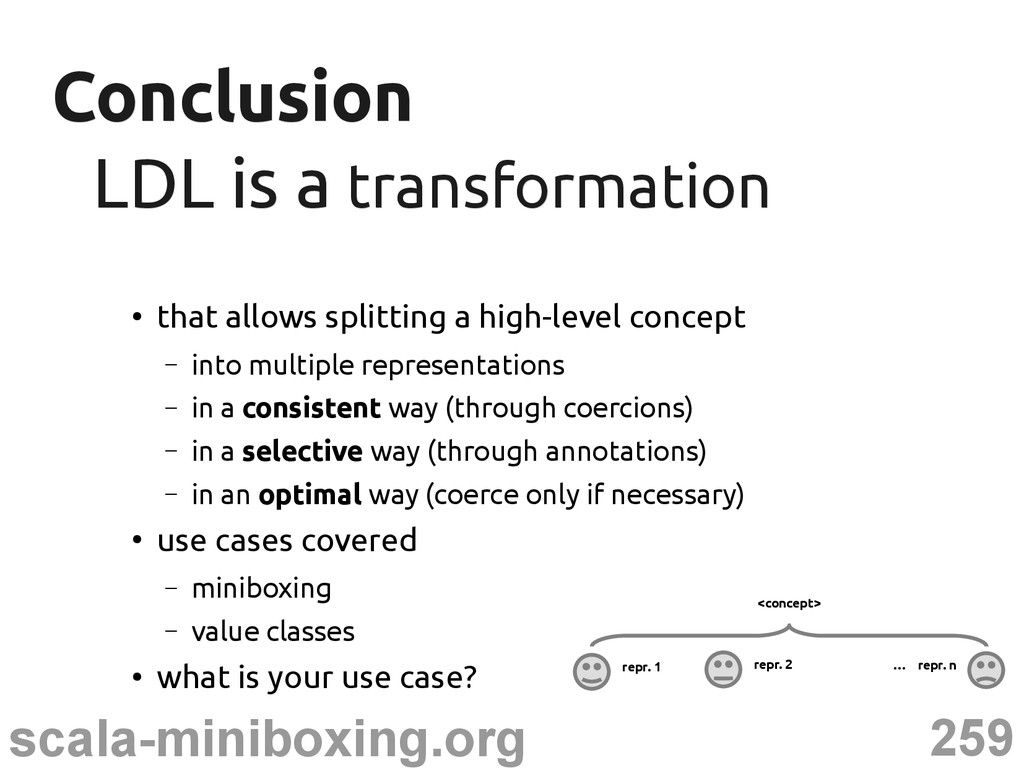
259 scala-miniboxing.org Conclusion Conclusion LDL is a LDL is a
transformation transformation • that allows splitting a high-level concept – into multiple representations – in a consistent way (through coercions) – in a selective way (through annotations) – in an optimal way (coerce only if necessary) • use cases covered – miniboxing – value classes • what is your use case? <concept> repr. 1 … repr. n repr. 2 -
scala-miniboxing.org Credits and Thank you-s • Cristian Talau - developed
the initial prototype, as a semester project • Eugene Burmako - the value class plugin based on the LDL transformation • Aymeric Genet - developing collection-like benchmarks for the miniboxing plugin • Martin Odersky, for his patient guidance • Eugene Burmako, for trusting the idea enough to develop the value-plugin based on the LDL transformation • Iulian Dragos, for his work on specialization and many explanations • Miguel Garcia, for his original insights that spawned the miniboxing idea • Michel Schinz, for his wonderful comments and enlightening ACC course • Andrew Myers and Roland Ducournau for the discussions we had and the feedback provided • Heather Miller for the eye-opening discussions we had • Vojin Jovanovic, Sandro Stucki, Manohar Jonalagedda and the whole LAMP laboratory in EPFL for the extraordinary atmosphere • Adriaan Moors, for the miniboxing name which stuck :)) • Thierry Coppey, Vera Salvisberg and George Nithin, who patiently listened to many presentations and provided valuable feedback • Grzegorz Kossakowski, for the many brainstorming sessions on specialization • Erik Osheim, Tom Switzer and Rex Kerr for their guidance on the Scala community side • OOPSLA paper and artifact reviewers, who reshaped the paper with their feedback • Sandro, Vojin, Nada, Heather, Manohar - reviews and discussions on the LDL paper • Hubert Plociniczak for the type notation in the LDL paper • Denys Shabalin, Dmitry Petrashko for their patient reviews of the LDL paper Special thanks to the Scala Community for their support! (@StuHood, @vpatryshev and everyone else!) -
261 scala-miniboxing.org Conclusion Conclusion LDL is a LDL is a
transformation transformation • that allows splitting a high-level concept – into multiple representations – in a consistent way (through coercions) – in a selective way (through annotations) – in an optimal way (coerce only if necessary) • use cases covered – miniboxing – value classes • what is your use case? <concept> repr. 1 … repr. n repr. 2 -
scala-miniboxing.org ScalaTeam @ EPFL • Dependent Object Types calculus –
core type system of the dotty compiler – Nada Amin/Tiark Rompf https://github.com/TiarkRompf/minidot https://github.com/lampepfl/dotty -
scala-miniboxing.org ScalaTeam @ EPFL • YinYang multi-stage macro-based frontend –
replacement for scala-virtualized – Vojin Jovanovic/Sandro Stucki + others https://github.com/vjovanov/yin-yang -
scala-miniboxing.org ScalaTeam @ EPFL • Scala.js backend – compiles Scala
to JavaScript – Sébastien Doeraene/Tobias Schlatter + others http://www.scala-js.org/ www -
scala-miniboxing.org ScalaTeam @ EPFL • Staged Parser-combinators – fast parser
combinators through staging – Manohar Jonnalagedda + others https://github.com/manojo/experiments -
scala-miniboxing.org ScalaTeam @ EPFL • Pickling framework and Spores –
support for distributed programming – Heather Miller/Philipp Haller + others https://github.com/scala/pickling https://github.com/heathermiller/spores -
scala-miniboxing.org ScalaTeam @ EPFL • dotty – experimental compiler based
on DOT – Martin Odersky/Dmitry Petrashko/Samuel Grütter/Tobias Schlatter + others https://github.com/lampepfl/dotty -
scala-miniboxing.org ScalaTeam @ EPFL • scala.meta metaprogramming support – Improved
reflection, macros, and many more – Eugene Burmako/Denys Shabalin + others http://scalameta.org/ www -
scala-miniboxing.org ScalaTeam @ EPFL • miniboxing specialization – LDL transformation
– Vlad Ureche/Aymeric Genêt + others http://scala-miniboxing.org/ www -
scala-miniboxing.org ScalaTeam @ EPFL • scaladyno plugin – giving Scala
a dynamic language look and feel – Cédric Bastin/Vlad Ureche https://github.com/scaladyno/scaladyno-plugin -
scala-miniboxing.org ScalaTeam @ EPFL • ScalaBlitz optimization framework – macro-based
collection optimization – Dmitry Petrashko/Aleksandar Prokopec http://scala-blitz.github.io/ www -
scala-miniboxing.org ScalaTeam @ EPFL • Type debugger for Scala –
debugging aid for Scala type errors – Hubert Plociniczak http://lampwww.epfl.ch/~plocinic/ type-debugger-tutorial/ www -
scala-miniboxing.org ScalaTeam @ EPFL • ScalaMeter benchmarking framework – google
caliper for scala – Aleksandar Prokopec http://scalameter.github.io/ www -
scala-miniboxing.org ScalaTeam @ EPFL • the new scalac backend –
good performance gains – Miguel Garcia • on the job market right now http://magarciaepfl.github.io/scala/ www @ [email protected] -
scala-miniboxing.org 1st of August 2014 Scala Bay Area Meetup Linkedin
HQ, Mountain View Thank you!
 vladureche
 minodriven
 miccheng
 kinakomoti321
 leegeunhyeok
 steliosf
 itsmedreamwalker
 kmars0605
 sodainc
 yasunori0418
 kumaiu
 cclai999
 sylph01
 katarinadahlin
 mclloyd
 palkan
 csswizardry
 aarron
 cassininazir
 honzajavorek
 scottboms
 samlambert
 lemiorhan
 skipperchong



: T = t](https://files.speakerdeck.com/presentations/4362d420fca50131fb2522d9fe90f8a5/slide_4.jpg)
: T = t](https://files.speakerdeck.com/presentations/4362d420fca50131fb2522d9fe90f8a5/slide_5.jpg)
: T = t](https://files.speakerdeck.com/presentations/4362d420fca50131fb2522d9fe90f8a5/slide_6.jpg)
: T = t](https://files.speakerdeck.com/presentations/4362d420fca50131fb2522d9fe90f8a5/slide_7.jpg)








: T = t](https://files.speakerdeck.com/presentations/4362d420fca50131fb2522d9fe90f8a5/slide_37.jpg)
: T = t](https://files.speakerdeck.com/presentations/4362d420fca50131fb2522d9fe90f8a5/slide_38.jpg)
: T = t](https://files.speakerdeck.com/presentations/4362d420fca50131fb2522d9fe90f8a5/slide_39.jpg)
: T = t](https://files.speakerdeck.com/presentations/4362d420fca50131fb2522d9fe90f8a5/slide_40.jpg)
: T = t](https://files.speakerdeck.com/presentations/4362d420fca50131fb2522d9fe90f8a5/slide_41.jpg)
: T = t](https://files.speakerdeck.com/presentations/4362d420fca50131fb2522d9fe90f8a5/slide_42.jpg)


](https://files.speakerdeck.com/presentations/4362d420fca50131fb2522d9fe90f8a5/slide_48.jpg)
](https://files.speakerdeck.com/presentations/4362d420fca50131fb2522d9fe90f8a5/slide_49.jpg)
](https://files.speakerdeck.com/presentations/4362d420fca50131fb2522d9fe90f8a5/slide_50.jpg)
](https://files.speakerdeck.com/presentations/4362d420fca50131fb2522d9fe90f8a5/slide_51.jpg)
](https://files.speakerdeck.com/presentations/4362d420fca50131fb2522d9fe90f8a5/slide_52.jpg)
](https://files.speakerdeck.com/presentations/4362d420fca50131fb2522d9fe90f8a5/slide_53.jpg)
: T = t](https://files.speakerdeck.com/presentations/4362d420fca50131fb2522d9fe90f8a5/slide_54.jpg)
: T = t](https://files.speakerdeck.com/presentations/4362d420fca50131fb2522d9fe90f8a5/slide_55.jpg)
: T = t](https://files.speakerdeck.com/presentations/4362d420fca50131fb2522d9fe90f8a5/slide_56.jpg)
: T = t](https://files.speakerdeck.com/presentations/4362d420fca50131fb2522d9fe90f8a5/slide_57.jpg)
: T = t](https://files.speakerdeck.com/presentations/4362d420fca50131fb2522d9fe90f8a5/slide_58.jpg)
: T = t](https://files.speakerdeck.com/presentations/4362d420fca50131fb2522d9fe90f8a5/slide_59.jpg)