Scaling Your Node.JS API Like a Boss
 Your Podcast. Everywhere. Effortlessly.
Share. Educate. Inspire. Entertain. You do you. We'll handle the rest.
→

Share
Scaling Your Node.JS API Like a Boss
________
Video of the Presentation Is Available Here »»
https://www.youtube.com/watch?v=Ogjb60Fg10A
________
It’s one thing to create a sample RESTful API using Node.js (maybe utilizing the cluster module to distribute the load), but it’s quite another to horizontally scale your architecture to hundreds of thousands of concurrent connections while trying to ensure redundancy and high availability. Knowing how to scale is important, but more important than that is knowing when to scale.
Volkan Özçelik explores what it takes to create a real-life, scalable, highly available, and highly responsive Node.js application. Volkan will also explain how to store the application state in its own cluster and why it matters.
Volkan outlines how to choose the container architecture for your (virtual) machines, how you can roll out updates to service without disrupting the users, and how you fail gracefully when things on a node go haywire. He also covers tracking down memory leaks and coming up with short-term (i.e., restarting your nodes when they become too beefy) and long-term (i.e., actually spotting where the leaks are and fixing them) solutions to address them.
When you dive deeper and deeper into the rabbit hole, you soon realize that scalability is a tough job that requires careful planning and consideration. The bottom line is that designing any system to scale is a never-ending adventure, and there is no limit on how deep you can dive.

volkan
Transcript
291 slides
-
NODE JS API your …like a boss Scaling http://bit.ly/nodejs-rocks Volkan
Özçelik March, 7, 2016 http://volkan.io/ @linkibol v0lkan -
About Me • Volkan Özçelik — JavaScript Lover & Performance
Freak • Current: • Technical Lead @ Cisco • Before: • Mobile Frontend Engineer @ Jive Software • VP of Technology @ grou.ps (now GymGroups) • CTO @ cember.net (acquired by Xing ) • Chase Me: @linkibol v0lkan -
Agenda • Node’s Strengths and Weaknesses • Tweaking Our OS
• Throughput, Concurrency, Latency • Scale a Real-Life Node App -
How do I Architect a Scalable and Consistent Node.JS
API with Manageable Complexity? In a Nutshell… -
How do I Architect a Scalable and Consistent Node.JS
API with Manageable Complexity? In a Nutshell… -
How do I Architect a Scalable and Consistent Node.JS
API with Manageable Complexity? In a Nutshell… -
Don’t Fight Windmills • Keep things simpler. • Build something
that’s good enough for your purpose. • Solve for the problems that are actually on your plate. -
• Monitor All The Things • Collect Metrics • Form
a Hypothesis • Gather Evidence • Validate Your Hypothesis • Take Corrective Action If Needed Don’t Invent Problems That You Don’t Have (Yet) -
Goals • Minimize Client Response Time • Maximize Resource Efficiency
on the Server Hint: Leave 50% of the memory unused (for taking core dumps) -
High-Level Topology of an API Service API Service Load Balancer
SSL Termination Load Balancing API Gateway Authentication Authorization Token Exchange Rate Limiting … HTTP Proxy Clients -
High-Level Topology of an API Service API Service Load Balancer
SSL Termination Load Balancing API Gateway Authentication Authorization Token Exchange Rate Limiting … HTTP Proxy Clients -
Show Love to Functions • Accept JavaScript’s functional and composable
nature. • Avoid `this` and avoid `new` — You’ll thank me later. • Create Focused, Independent, Reusable, and Testable Modules. -
“OO leads to anger; Anger leads to hate; Hate leads
to suffering!” Embrace the Difference -
Node.JS Is Perfect For… • IO-Heavy Applications • Data-Intensive Realtime
Apps • RESTful / API-Driven (Micro)services • Streams • Queued (Lazy) Writes • Processing data on-the-fly https://github.com/libuv/libuv -
Node.JS Is not For… • Serving Static Files • CPU-bound
Applications • Creating a Monolithic Infrastructure -
Node.JS is not a Swiss Army Knife • Load Balancing
➡ haproxy | NGINX | ELB ( http://www.haproxy.org/ | http://nginx.org/ | http://aws.amazon.com ) • SSL Termination ➡ stud ( https://github.com/bumptech/stud ) • GZIP Compression ➡ NGINX | haproxy • Serving Static Assets ➡ CDN | NGINX | Varnish ( https://www.varnish-cache.org/ ) -
Know Your Bottlenecks • Node.JS serves really well as a
highly concurrent networking app. • Node.JS is very sensitive to memory leaks and blocking code. • 99% of the time you will be IO-bound. -
Know the Ecosystem • Do Not Ignore The Ecosystem •
Follow Community News and Updates • Attend to Conferences (like this one) • Know Your Tools and Use Them -
Even More Tweaks Do NOT alter anything that you don’t
know! * See https://www.frozentux.net/ipsysctl-tutorial/ipsysctl-tutorial.html and http://www.tldp.org/LDP/solrhe/Securing-Optimizing-Linux-RH-Edition-v1.3/ for more info. -
Common Threats • XSS / CSRF • Input Validation Attack
• DoS / ReDoS • Request Size * Securing Node.JS is not different from securing any other web app. See also: https://www.owasp.org/index.php/Category:OWASP_Top_Ten_Project -
Do Not Run Node.JS As Root useradd -mrU web mkdir
/opt/web-app chown web /opt/web-app cd /opt/web-app su web node app.js firewall-cmd --permanent --zone=public --add-port=3000/tcp Also, always run Node.JS behind a reverse proxy! -
restify http tcp ab -n 10000 -c 100 http://app:8000/hello containers/000-simple-app-restify
containers/001-simple-app-http containers/002-simple-app-tcp -
ab -n 10000 -c 100 http://app:8000/hello Tested on MacBook Pro,
2.4 GHz Intel Core i5, 16 GB 1600 MHz DDR3 Going Bare Bones -
Is It Worth It? • You Can Go Bare-Bones for
Maximum Throughput • Tradeoff: • Harder to maintain • More complex code • Error prone • Lots of edge cases • Harder to use additional tooling -
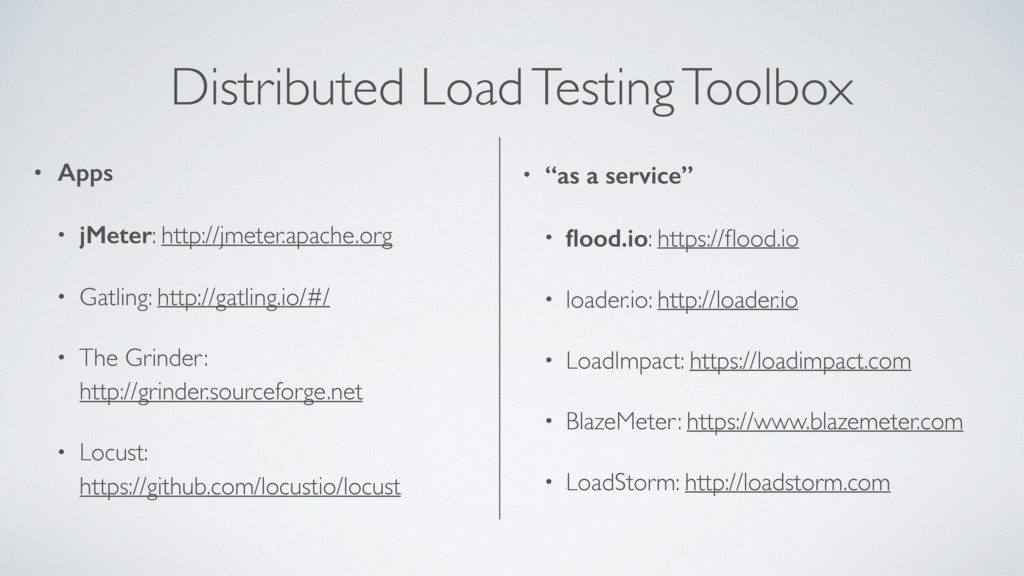
Distributed Load Testing Toolbox • Apps • jMeter: http://jmeter.apache.org •
Gatling: http://gatling.io/#/ • The Grinder: http://grinder.sourceforge.net • Locust: https://github.com/locustio/locust • “as a service” • flood.io: https://flood.io • loader.io: http://loader.io • LoadImpact: https://loadimpact.com • BlazeMeter: https://www.blazemeter.com • LoadStorm: http://loadstorm.com -
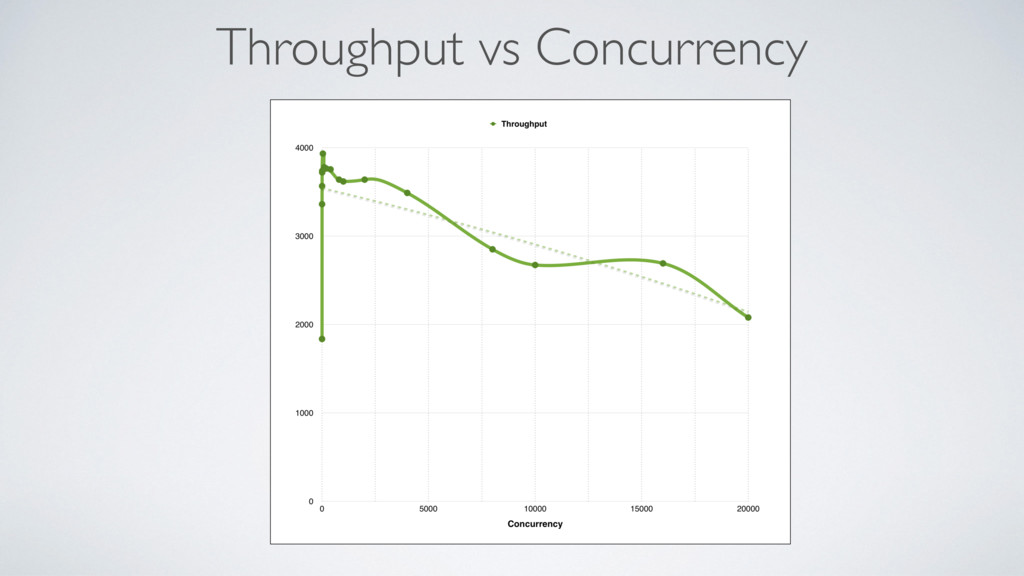
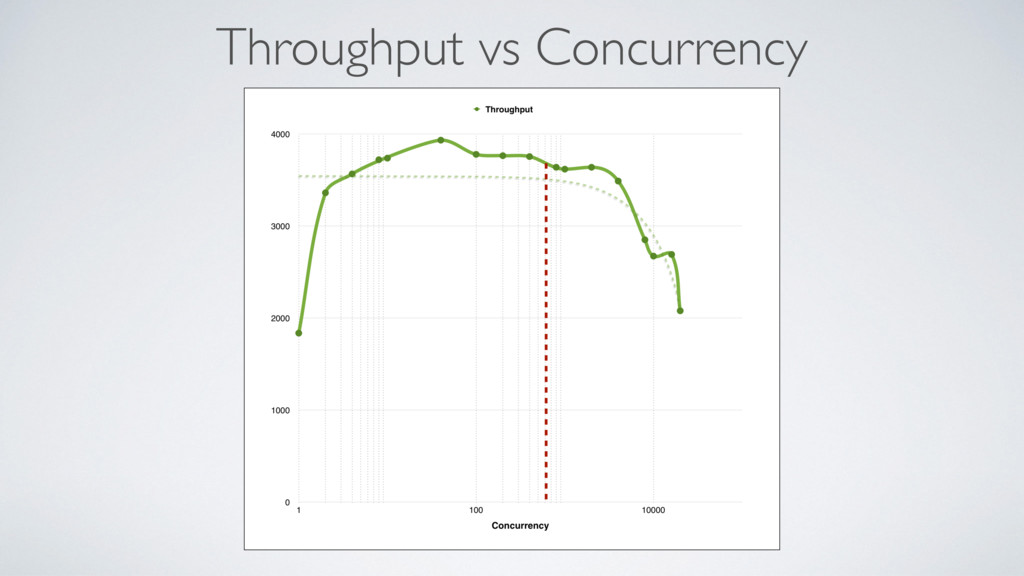
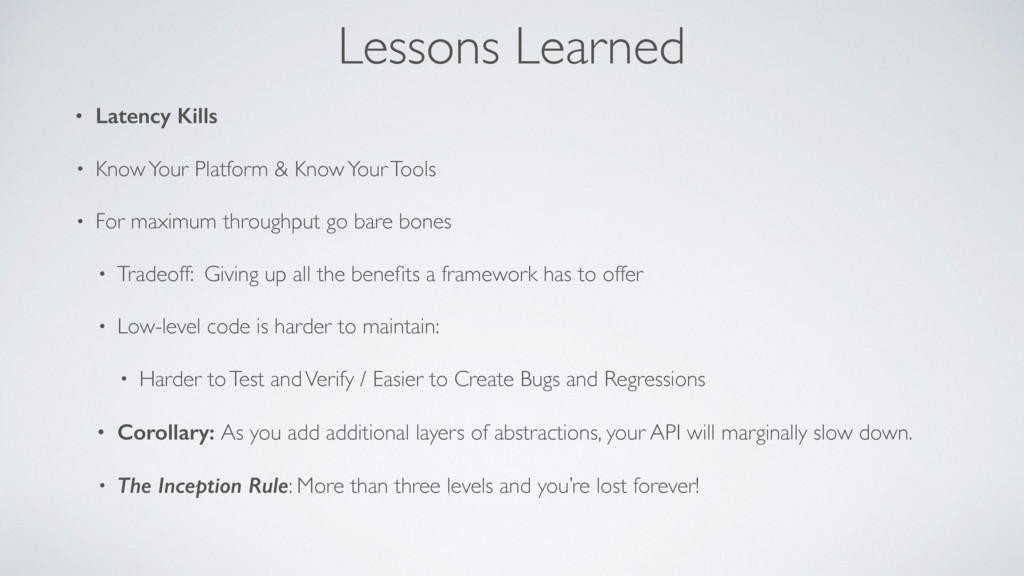
Lessons Learned • Latency Kills • Know Your Platform &
Know Your Tools • For maximum throughput go bare bones • Tradeoff: Giving up all the benefits a framework has to offer • Low-level code is harder to maintain: • Harder to Test and Verify / Easier to Create Bugs and Regressions • Corollary: As you add additional layers of abstractions, your API will marginally slow down. • The Inception Rule: More than three levels and you’re lost forever! -
Perf Before Scale • Rule #1: Avoid premature optimization.
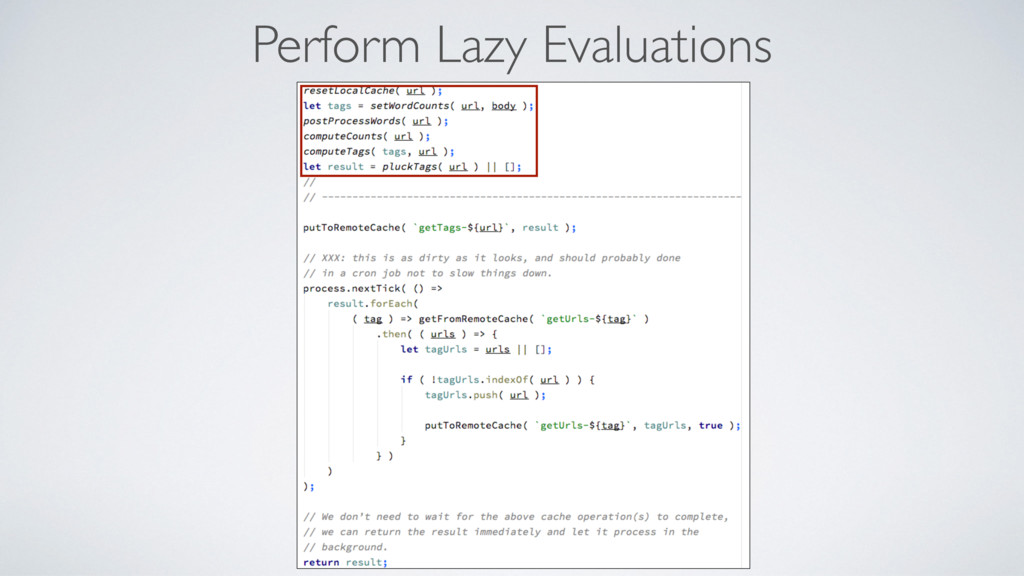
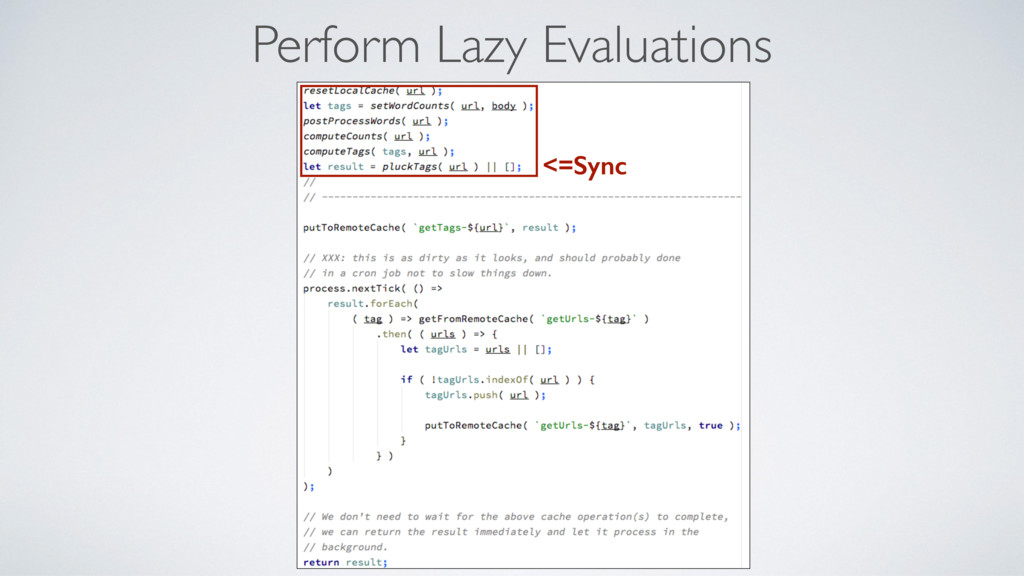
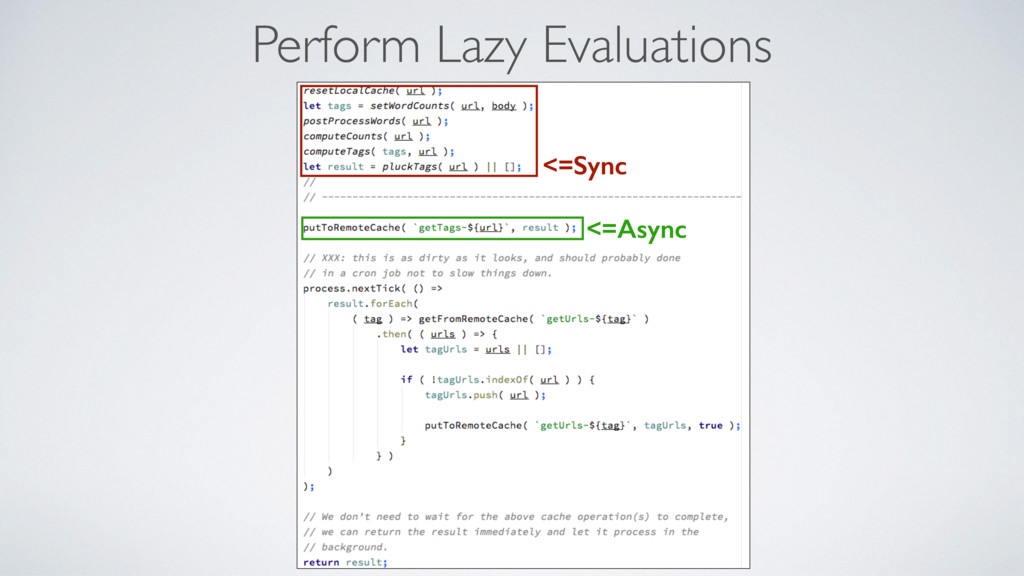
Do measurements, and optimize what matters. • Tweak Your System for High Performance • Cache All The Things • Cache at every level. • The fastest API response is no response at all. • Delegate Long-Running/CPU-Intensive(*) Operations • Be Lazy Whenever Possible -
You can’t optim ize w hat you don’t m easure.
Optimization -
Things to Watch Out For • Always Keep an Eye
on the Event Loop • Your API Service may Become CPU-Bound • External API Calls Can Be a Bottleneck • Track Heap Usage Over Time • Implement Sanity Checks • Implement Circuit Breakers • Have an Upper Bound for Concurrency -
Things to Watch Out For • Is the app running
and functional? • Is the app overloaded? • How many errors have been raised so far? • Is the app performant (throughput, memory utilization, concurrency)? • Is my cluster healthy? • How many times do forks restored? • Are all clustered forks alive and okay? -
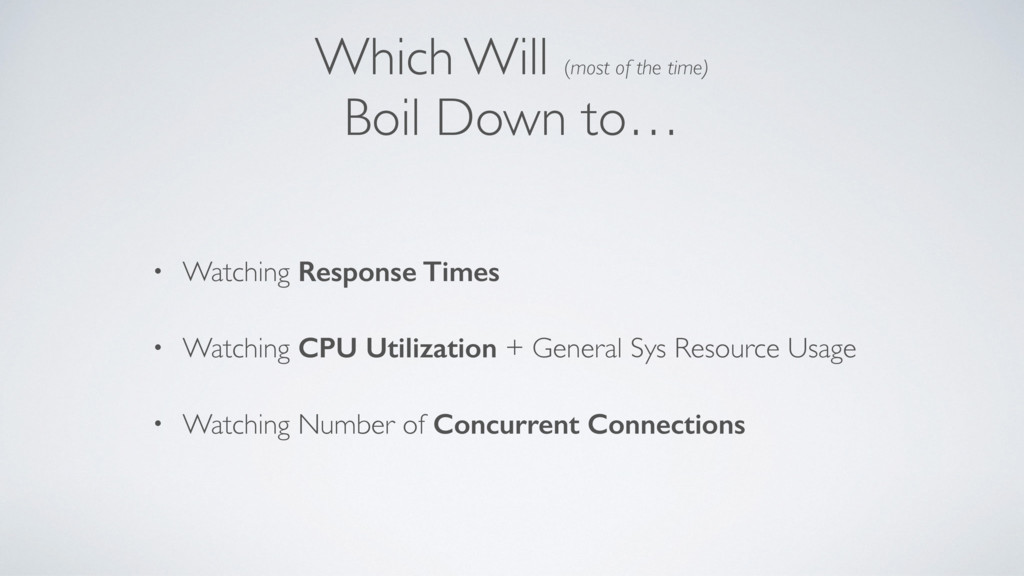
Which Will (most of the time) Boil Down to… •
Watching Response Times • Watching CPU Utilization + General Sys Resource Usage • Watching Number of Concurrent Connections -
Types of Compilers in v8 • Generic Compiler • Optimizing
Compiler (Crankshaft) • Can Be Two or More Orders of Magnitude Faster See also: * https://wingolog.org/archives/2011/07/05/v8-a-tale-of-two-compilers * http://thibaultlaurens.github.io/javascript/2013/04/29/how-the-v8-engine-works/ * http://www.html5rocks.com/en/tutorials/speed/v8/ -
X-Ray View Into the v8 Compiler node --trace_opt --trace_deopt
--allow-natives-syntax test.js; • console.log(%HasFastProperties(obj)) • console.log(%GetOptimizationStatus(fn)) https://github.com/Nathanaela/v8-natives -
X-Ray View Into the v8 Compiler node --trace_opt --trace_deopt
--allow-natives-syntax test.js; • console.log(%HasFastProperties(obj)) • console.log(%GetOptimizationStatus(fn)) https://github.com/Nathanaela/v8-natives -
Optimize Hot Code Paths Only (Unless You Have a Solid
Evidence to Do Otherwise) -
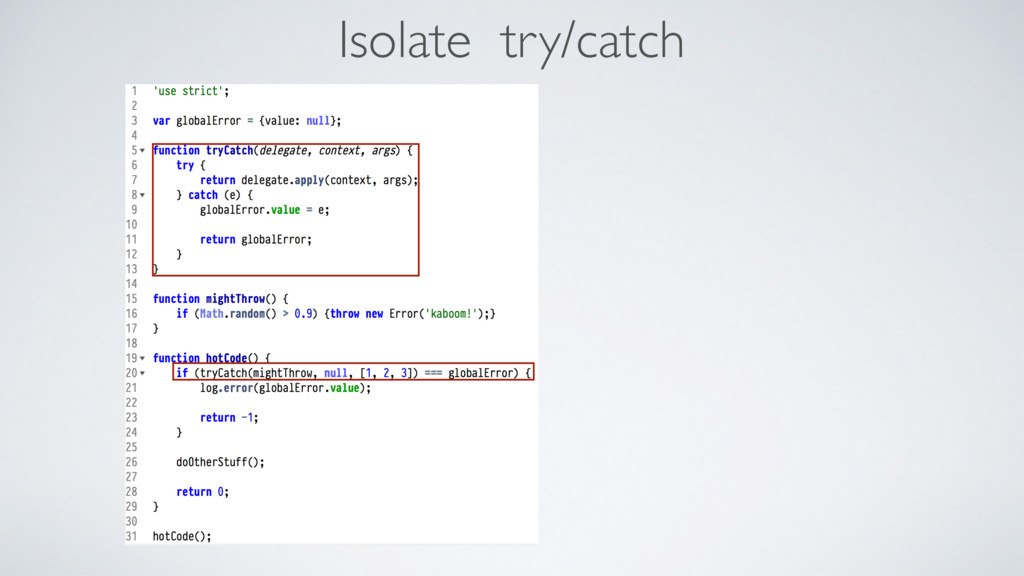
v8 Optimization Killers • Using debugger anywhere within the function.
• Using eval anywhere within the function. • Using with anywhere within the function. • Using try/catch anywhere within the function. * ~via https://github.com/petkaantonov/bluebird/wiki/Optimization-killers -
Let’s Create Something Real • An API that… • Auto-suggest
tags, given a url • Lists related URLs, given a tag -
API Service Internet Bastion Simulated by an NGINX static web
server * Fetch HTML off of websites * Simplify and convert the HTML to plain text * Do NLP/Tokenization on the plain text * Create tags as a result test API Initial Topology -
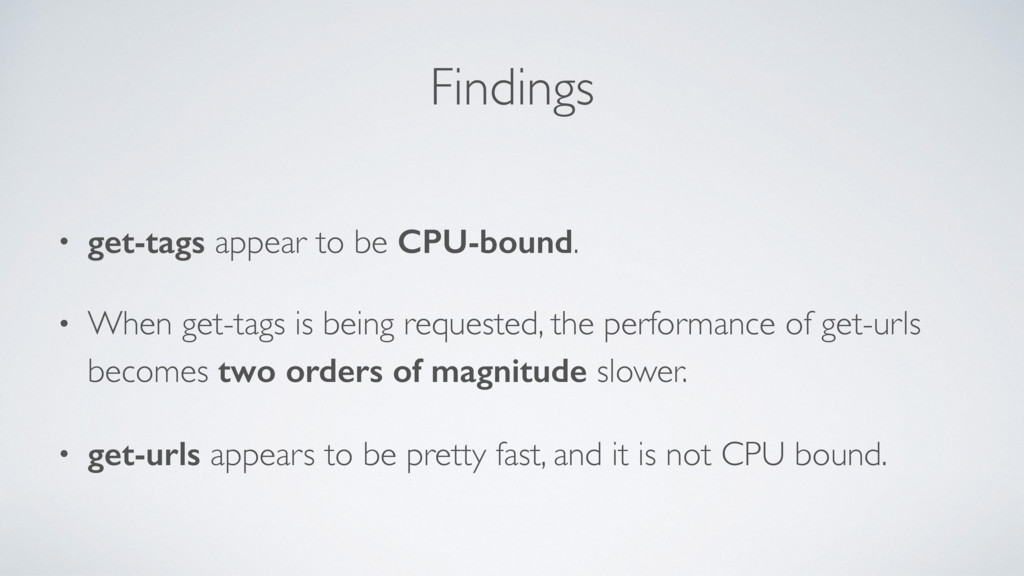
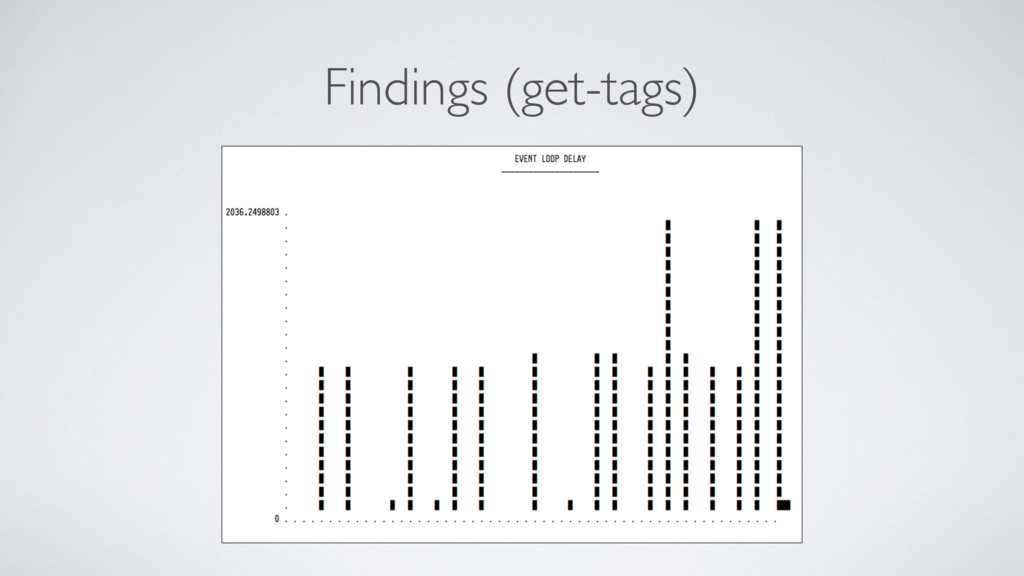
Findings • get-tags appear to be CPU-bound. • When get-tags
is being requested, the performance of get-urls becomes two orders of magnitude slower. • get-urls appears to be pretty fast, and it is not CPU bound. -
How Can We Be Sure? • Add probes (DTrace, XTrace…
etc) to trace what’s happening. • Create a REPL to check the app at runtime. containers/004-demo-w-instrumentation -
Creating a REPL • You Can Expose Internal State via
an API and/or a CLI/REPL • vantage: https://github.com/dthree/vantage • kang: https://github.com/davepacheco/kang • repl server: https://nodejs.org/api/repl.html • Expose Additional Logging Info at Runtime (in systems that support it) • bunyan -p ( https://github.com/trentm/node-bunyan ) -
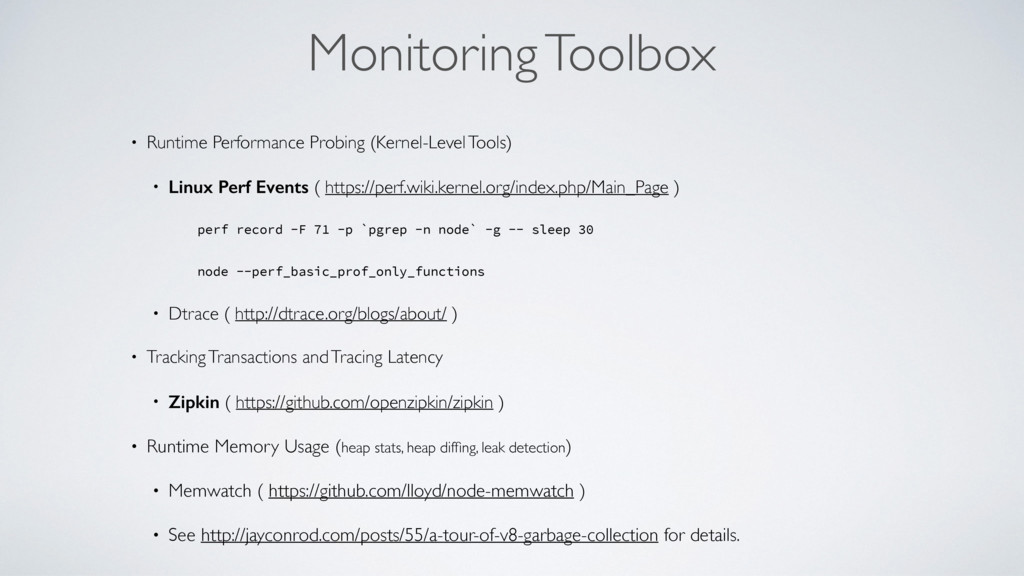
Monitoring Toolbox • Runtime Performance Probing (Kernel-Level Tools) • Linux
Perf Events ( https://perf.wiki.kernel.org/index.php/Main_Page ) perf record -F 71 -p `pgrep -n node` -g -- sleep 30 node --perf_basic_prof_only_functions • Dtrace ( http://dtrace.org/blogs/about/ ) • Tracking Transactions and Tracing Latency • Zipkin ( https://github.com/openzipkin/zipkin ) • Runtime Memory Usage (heap stats, heap diffing, leak detection) • Memwatch ( https://github.com/lloyd/node-memwatch ) • See http://jayconrod.com/posts/55/a-tour-of-v8-garbage-collection for details. -
Monitoring Toolbox • Monitoring “as a service” • nodetime https://nodetime.com/
• newrelic http://newrelic.com/nodejs • strongloop https://strongloop.com/node-js/performance-monitoring/ • keymetrics https://keymetrics.io/ • appdynamics https://www.appdynamics.com/nodejs/ • … -
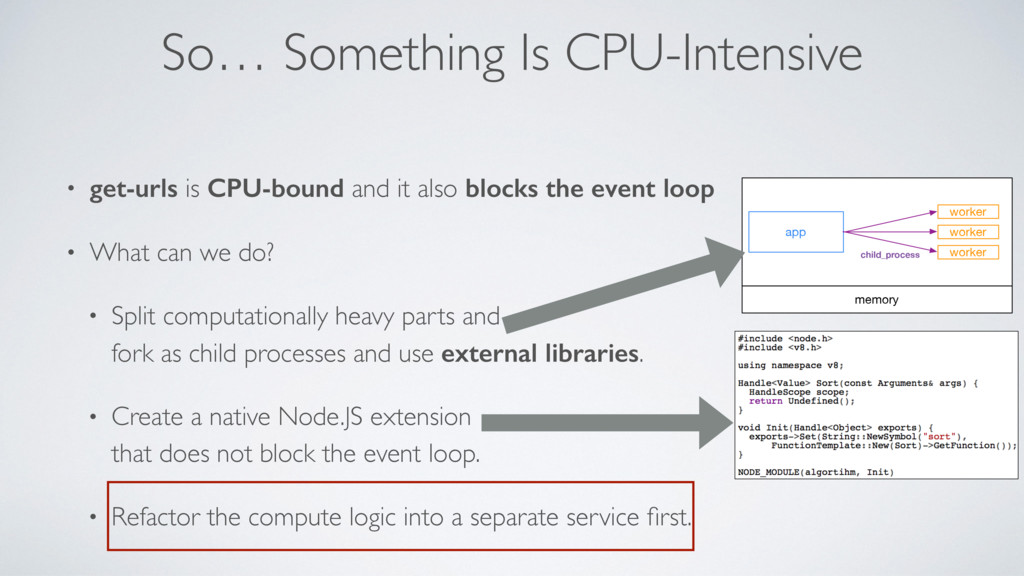
So… Something Is CPU-Intensive • get-urls is CPU-bound and it
also blocks the event loop • What can we do? • Split computationally heavy parts and fork as child processes and use external libraries. • Create a native Node.JS extension that does not block the event loop. • Refactor the compute logic into a separate service first. -
So… Something Is CPU-Intensive • get-urls is CPU-bound and it
also blocks the event loop • What can we do? • Split computationally heavy parts and fork as child processes and use external libraries. • Create a native Node.JS extension that does not block the event loop. • Refactor the compute logic into a separate service first. app memory worker worker worker child_process -
Split App and Compute Nodes Compute Service API Service Message
Bus rabbitmq, zeromq, resque etc. see also http://queues.io/ * * containers/005-demo-split-compute -
Message Bus Topologies P C Send/Listen P C1 C2 Worker
Queue X C1 PubSub P C2 -
Message Bus Topologies P C Send/Listen P C1 C2 Worker
Queue X C1 PubSub P C2 -
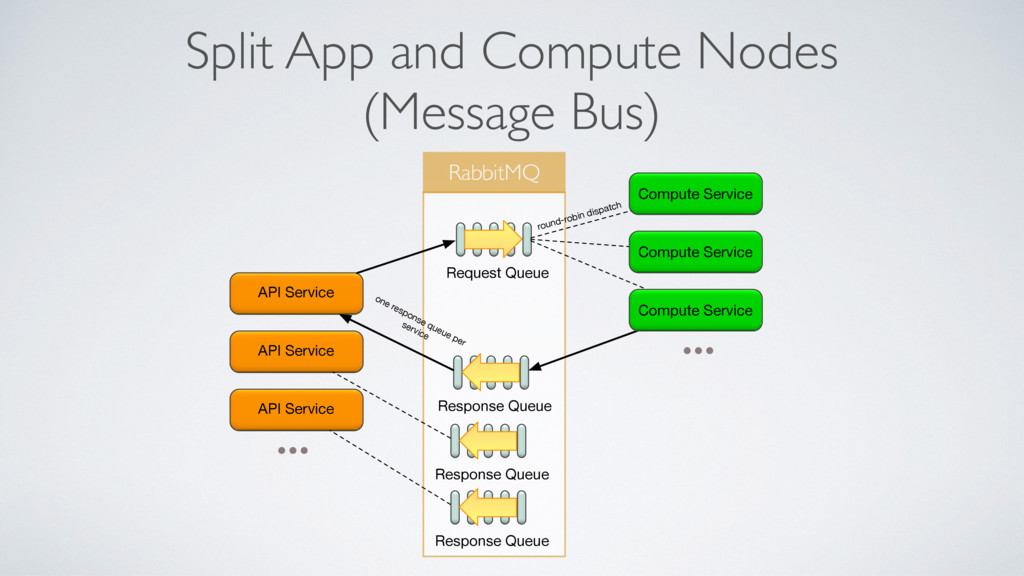
Split App and Compute Nodes (Message Bus) RabbitMQ Request Queue
Response Queue API Service Compute Service API Service API Service … … Compute Service one response queue per service round-robin dispatch Compute Service Response Queue Response Queue -
Split App and Compute Nodes (Message Bus) RabbitMQ Request Queue
Response Queue API Service Compute Service API Service API Service … … Compute Service one response queue per service round-robin dispatch Compute Service Response Queue Response Queue -
Split App and Compute Nodes (Message Bus) RabbitMQ Request Queue
Response Queue API Service Compute Service API Service API Service … … Compute Service one response queue per service round-robin dispatch Compute Service Response Queue Response Queue -
Split App and Compute Nodes (Message Bus) RabbitMQ Request Queue
Response Queue API Service Compute Service API Service API Service … … Compute Service one response queue per service round-robin dispatch Compute Service Response Queue Response Queue -
Split App and Compute Nodes (Message Bus) RabbitMQ Request Queue
Response Queue API Service Compute Service API Service API Service … … Compute Service one response queue per service round-robin dispatch Compute Service Response Queue Response Queue -
Split App and Compute Nodes (Message Bus) RabbitMQ Request Queue
Response Queue API Service Compute Service API Service API Service … … Compute Service one response queue per service round-robin dispatch Compute Service Response Queue Response Queue -
Aggregate and Rotate Your Log Files Log Aggregator Compute Service
memory API Service memory Message Bus containers/006-demo-eventbus-logaggr -
Aggregate and Rotate Your Log Files Log Aggregator Compute Service
memory API Service memory Message Bus containers/006-demo-eventbus-logaggr -
Aggregate and Rotate Your Log Files Log Aggregator Compute Service
memory API Service memory Message Bus containers/006-demo-eventbus-logaggr -
Use a Decent Logger • Bunyan ( https://github.com/trentm/node-bunyan ) •
Winston ( https://github.com/winstonjs/winston ) • Log4JS ( https://github.com/nomiddlename/log4js-node ) -
What to Log • Authentication & Authorization • Session Management
• Method Entry Points • Errors and Weird Events • Specific Events (startup, shutdown, slowdown etc.) • High-Risk Functionalities (payments, privileges, admins etc) -
Log Analysis Toolbox • Loggly ( https://www.loggly.com/ ) • ELK
Stack ( https://www.elastic.co/products ) • Nagios Log Server ( https://www.nagios.com/products/nagios-log-server/ ) • Splunk ( http://www.splunk.com/en_us/homepage.html ) • … -
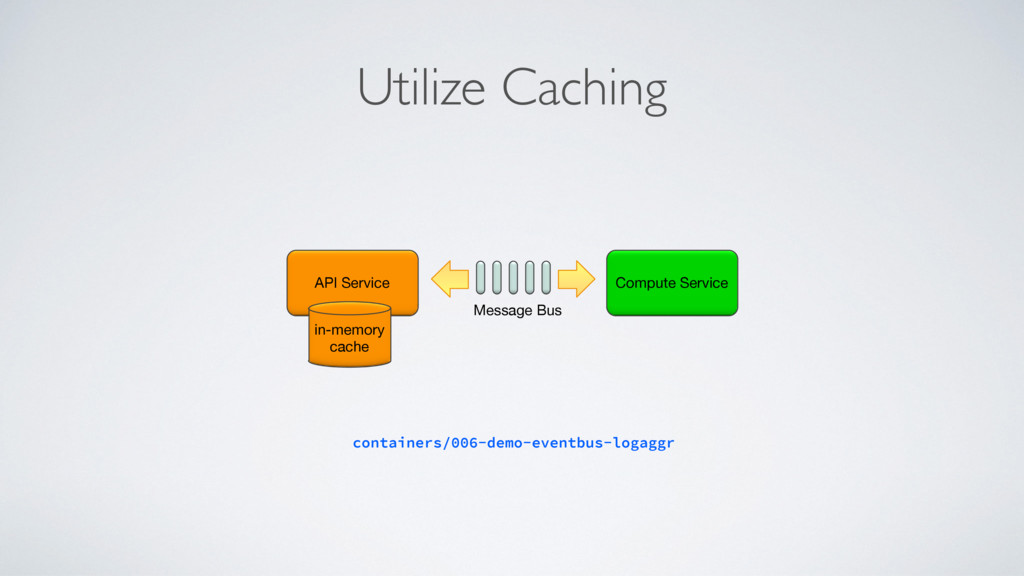
Utilize Caching Compute Service API Service in-memory cache Message Bus
containers/006-demo-eventbus-logaggr -
Utilize Caching Compute Service API Service in-memory cache Message Bus
containers/006-demo-eventbus-logaggr -
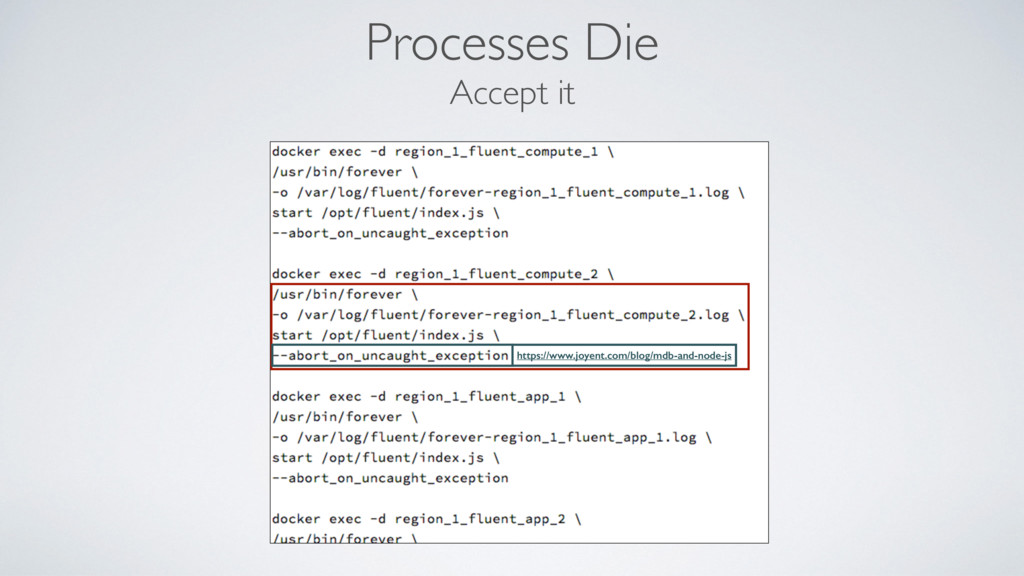
Processes Die Accept it No system is %100 resilient. Every
crash is important. Every Exception is Important Too: Adopt a “Zero Exception Policy” -
Keep It Running •forever ( https://github.com/foreverjs/forever ) •pm2 ( https://github.com/Unitech/pm2
) •upstart ( http://upstart.ubuntu.com/ ) •systemd ( https://www.wikiwand.com/en/Systemd ) -
Node.JS Debugging Myths • Debugging and Profiling in Node.JS is
Hard • Debugging and Profiling in Node.JS is Immature • You Cannot Debug or Profile a Live Production Node.JS App -
Debugging • Live Debugging (using a REPL) • Remote Debugging
(Node Inspector https://github.com/node-inspector/node-inspector, WebStorm https://www.jetbrains.com/webstorm/, Cloud9 IDE https://c9.io/) • Post-Mortem Debugging (MDB: https://github.com/joyent/mdb_v8) -
Debugging • Live Debugging (using a REPL) • Remote Debugging
(Node Inspector https://github.com/node-inspector/node-inspector, WebStorm https://www.jetbrains.com/webstorm/, Cloud9 IDE https://c9.io/) • Post-Mortem Debugging (MDB: https://github.com/joyent/mdb_v8) -
Debugging • Live Debugging (using a REPL) • Remote Debugging
(Node Inspector https://github.com/node-inspector/node-inspector, WebStorm https://www.jetbrains.com/webstorm/, Cloud9 IDE https://c9.io/) • Post-Mortem Debugging (MDB: https://github.com/joyent/mdb_v8) -
Debugging • Live Debugging (using a REPL) • Remote Debugging
(Node Inspector https://github.com/node-inspector/node-inspector, WebStorm https://www.jetbrains.com/webstorm/, Cloud9 IDE https://c9.io/) • Post-Mortem Debugging (MDB: https://github.com/joyent/mdb_v8) -
Debugging • Live Debugging (using a REPL) • Remote Debugging
(Node Inspector https://github.com/node-inspector/node-inspector, WebStorm https://www.jetbrains.com/webstorm/, Cloud9 IDE https://c9.io/) • Post-Mortem Debugging (MDB: https://github.com/joyent/mdb_v8) -
Flame Graphs & Core Dumps • Core Dumps • Can
Be Created When Node.JS Crashes ( --abort_on_uncaught_exception ) • Can Be Created at Runtime ( using gcore * ) • Flame Graphs • You Can Use dtrace + stackvis to generate them ** • You Can Use perf events + Flame Graphs Tool to generate them *** http://man7.org/linux/man-pages/man1/gcore.1.html * http://blog.nodejs.org/2012/04/25/profiling-node-js/ ** http://yunong.io/2015/11/23/generating-node-js-flame-graphs/ *** -
Debugging (Profiling) • Use Kernel Level Tools • DTrace (Solaris,
BSD), perf (Linux), and XPerf (Windows) • Can be used in production • Use the v8 Profiler • Not quite suitable for production -
v8 Profiler • node --v8-options | grep gc — node
--v8-options | grep '\-\-trace' • `node --perf_basic_prof_only_functions .` => for perf events (new in Node 5) • `node --expose_gc --trace_gc --trace_gc_object_stats --trace_gc_verbose --gc_global .` => traces to the console • `node --prof --log_timer_events --track_gc_object_stats --log_internal-timer_events --no-use-inlining .` => creates a perf log file * See also: http://www.chromium.org/developers/creating-v8-profiling-timeline-plots -
Help the Debugger • Always Name Your Functions • Don’t
let the errors go unhandled. • Emit “error” events instead of throwing exceptions. • Use an error library: • https://github.com/davepacheco/node-verror • Put a descriptive message before raising an error. -
Help the Debugger • Always Name Your Functions • Don’t
let the errors go unhandled. • Emit “error” events instead of throwing exceptions. • Use an error library: • https://github.com/davepacheco/node-verror • Put a descriptive message before raising an error. -
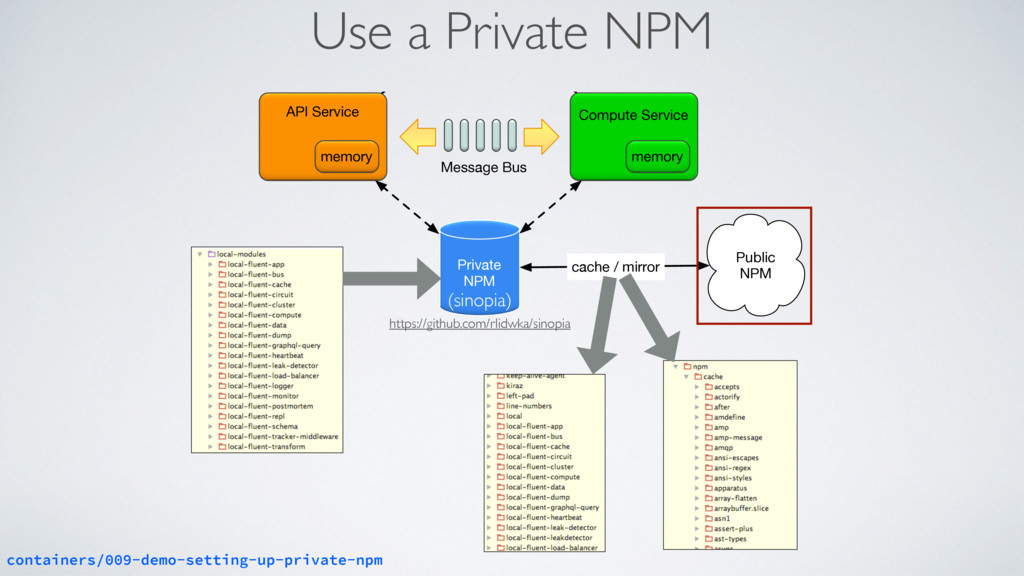
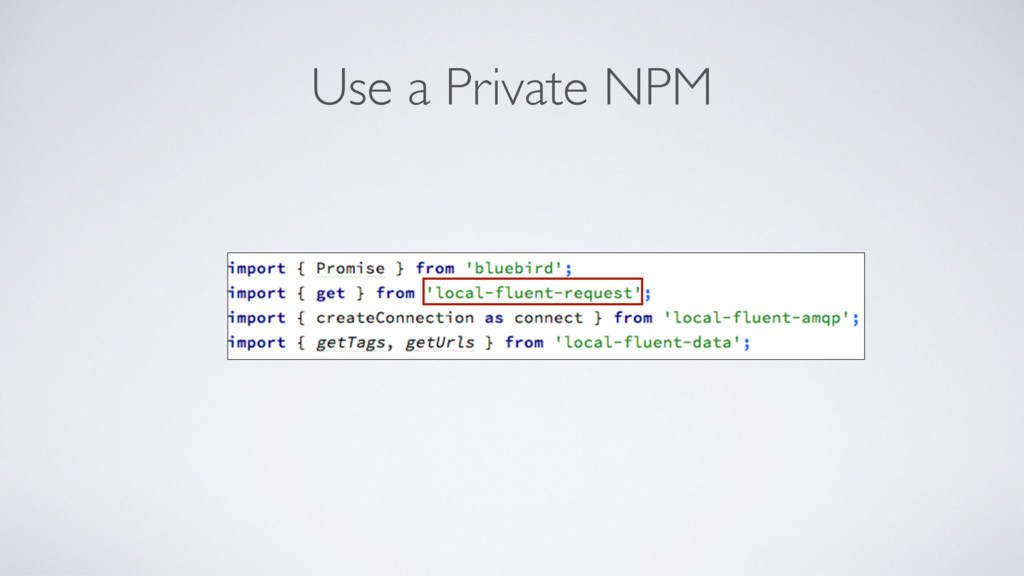
Use a Private NPM Log Aggregator Compute Service memory API
Service memory Message Bus Private NPM Public NPM cache / mirror containers/009-demo-setting-up-private-npm (sinopia) https://github.com/rlidwka/sinopia -
Use a Private NPM Log Aggregator Compute Service memory API
Service memory Message Bus Private NPM Public NPM cache / mirror containers/009-demo-setting-up-private-npm (sinopia) https://github.com/rlidwka/sinopia -
Use a Private NPM Log Aggregator Compute Service memory API
Service memory Message Bus Private NPM Public NPM cache / mirror containers/009-demo-setting-up-private-npm (sinopia) https://github.com/rlidwka/sinopia -
Use a Private NPM Log Aggregator Compute Service memory API
Service memory Message Bus Private NPM Public NPM cache / mirror containers/009-demo-setting-up-private-npm (sinopia) https://github.com/rlidwka/sinopia -
Use a Private NPM Log Aggregator Compute Service memory API
Service memory Message Bus Private NPM Public NPM cache / mirror containers/009-demo-setting-up-private-npm (sinopia) https://github.com/rlidwka/sinopia -
Use a Private NPM Log Aggregator Compute Service memory API
Service memory Message Bus Private NPM Public NPM cache / mirror containers/009-demo-setting-up-private-npm (sinopia) https://github.com/rlidwka/sinopia -
Use a Private NPM Log Aggregator Compute Service memory API
Service memory Message Bus Private NPM Public NPM cache / mirror containers/009-demo-setting-up-private-npm (sinopia) https://github.com/rlidwka/sinopia -
Use a Private NPM Log Aggregator Compute Service memory API
Service memory Message Bus Private NPM Public NPM cache / mirror containers/009-demo-setting-up-private-npm (sinopia) https://github.com/rlidwka/sinopia -
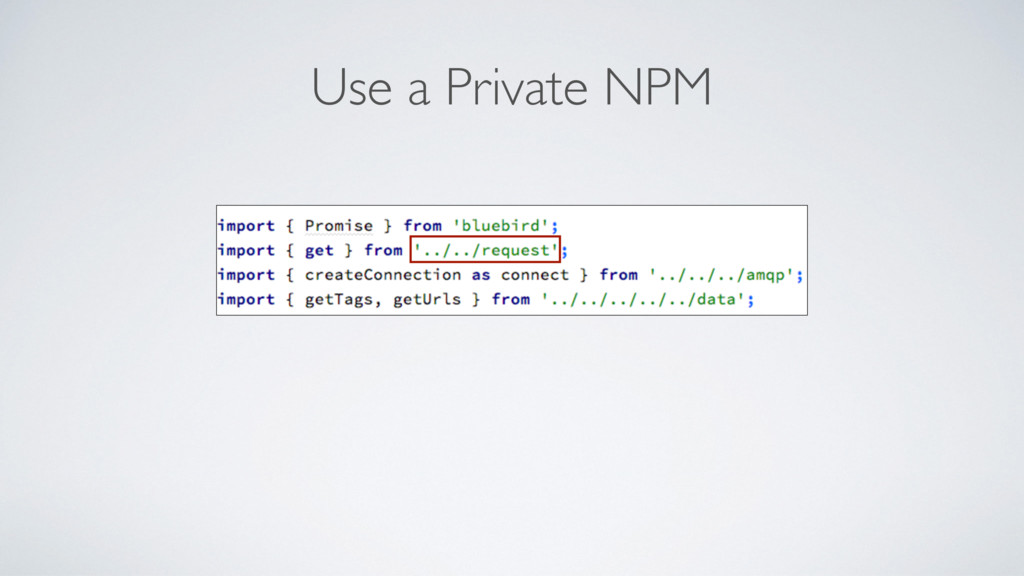
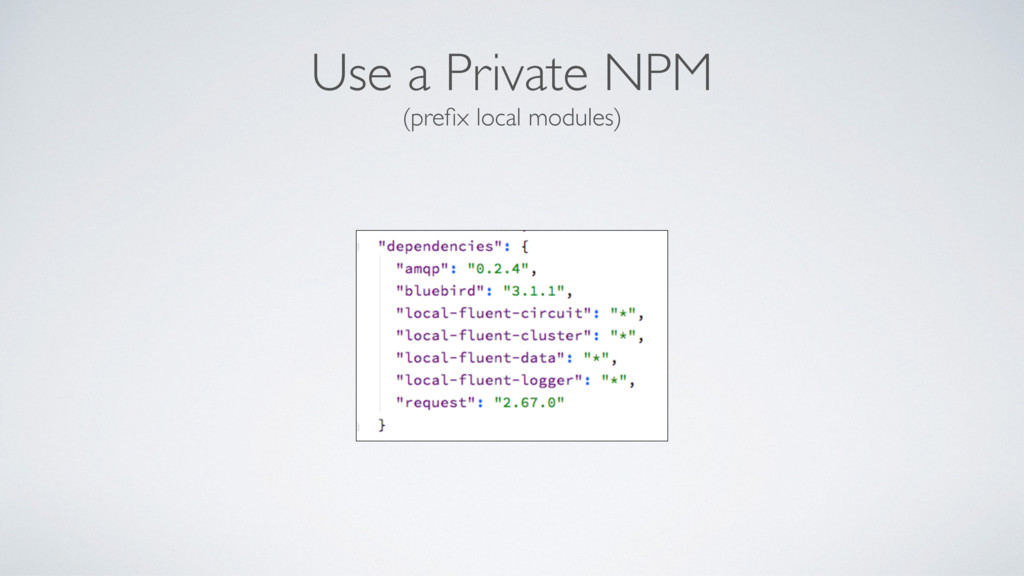
Use a Private NPM • Promotes modularization and code re-use.
• Modules are cached, hence faster to install. • You can continue your work, even when public registry goes offline. • Makes refactoring and testing easier. • No more “../../../..”s! -
Clustering containers/010-cluster * See http://docs.libuv.org/en/v1.x/threadpool.html https://nikhilm.github.io/uvbook/processes.html https://nikhilm.github.io/uvbook/threads.html for how the
dark magic works internally. * See also https://strongloop.com/strongblog/whats-new-in-node-js-v0-12-cluster-round-robin-load-balancing/ for how the load balancing between processes in the cluster module evolved over time; and see https://github.com/nodejs/node-v0.x-archive/commit/e72cd41 for the Round-Robin cluster load balancing algorithm. -
Clustering app memory app app app * See https://strongloop.com/strongblog/whats-new-in-node-js-v0-12-cluster-round-robin-load-balancing/ how
the load balancing between processes in the cluster module evolved over time; and see https://github.com/nodejs/node-v0.x-archive/commit/e72cd41 for the Round-Robin cluster load balancing algorithm. -
Is Bigger Always Better? ultra mega super box with bazillion
cores regular box -
How Many Workers Per VM? two to four cores per
VM is an ideal balance m a s t e r child_process child_process child_process child_process -
Is Bigger Always Better? OR you can use lightweight single-CPU
containers and a LB in lieu of clustering lightweight container lightweight container Load Balancer lightweight container lightweight container <-single core <-single core <-single core <-single core -
Cluster The Services VM 2 Compute Service Compute Service cluster
API Service API Service cluster VM 1 Message Bus -
Circuit Breaker closed fail (under threshold) open fail (reached threshold)
checking… timer (exponential backoff) fail success See http://www.amazon.com/gp/product/0978739213 and http://martinfowler.com/bliki/CircuitBreaker.html (503: Server Busy) (200: OK) -
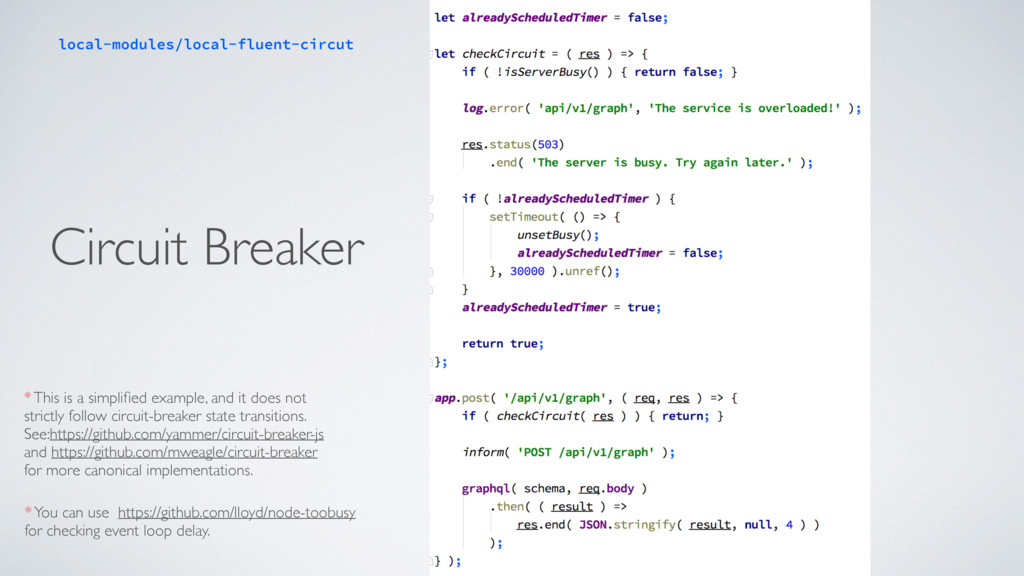
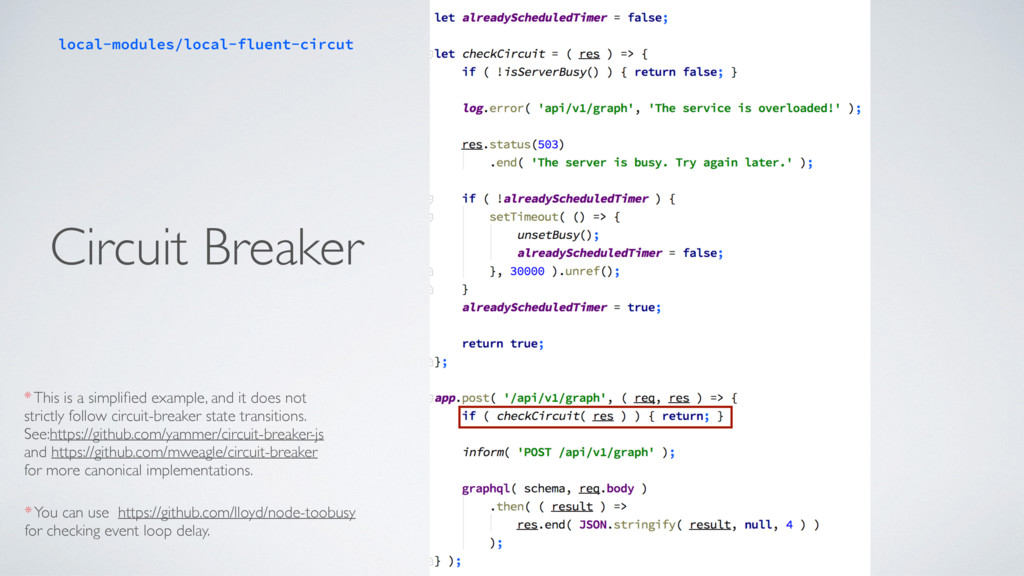
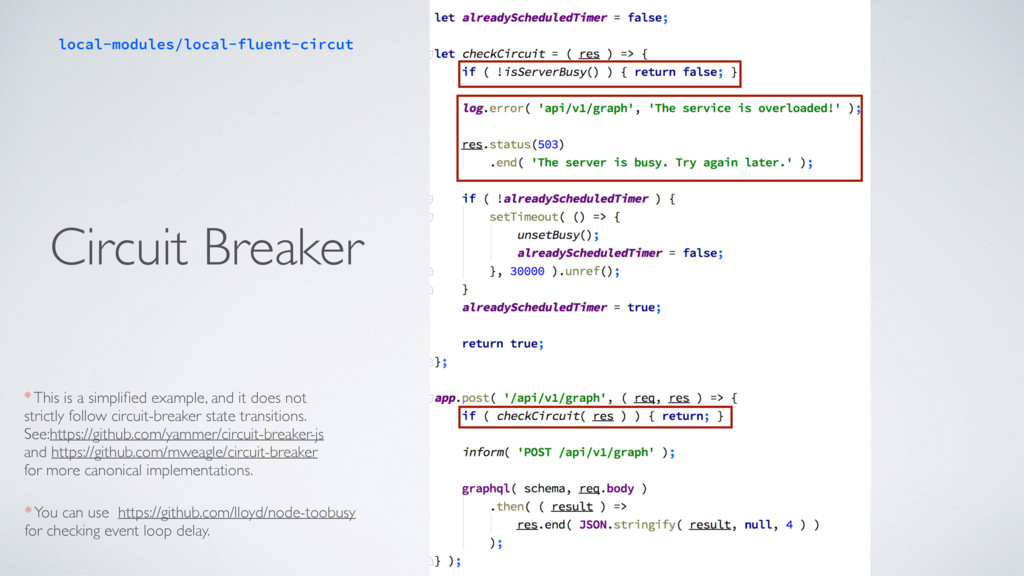
Circuit Breaker * This is a simplified example, and it
does not strictly follow circuit-breaker state transitions. See:https://github.com/yammer/circuit-breaker-js and https://github.com/mweagle/circuit-breaker for more canonical implementations. local-modules/local-fluent-circut * You can use https://github.com/lloyd/node-toobusy for checking event loop delay. -
Circuit Breaker • Can be used with any kind of
metric. • You can use to “rate limit” your API. • Useful when you depend on other APIs that might fail. -
Where Were We? VM 2 Compute Service Compute Service cluster
API Service API Service cluster VM 1 Message Bus -
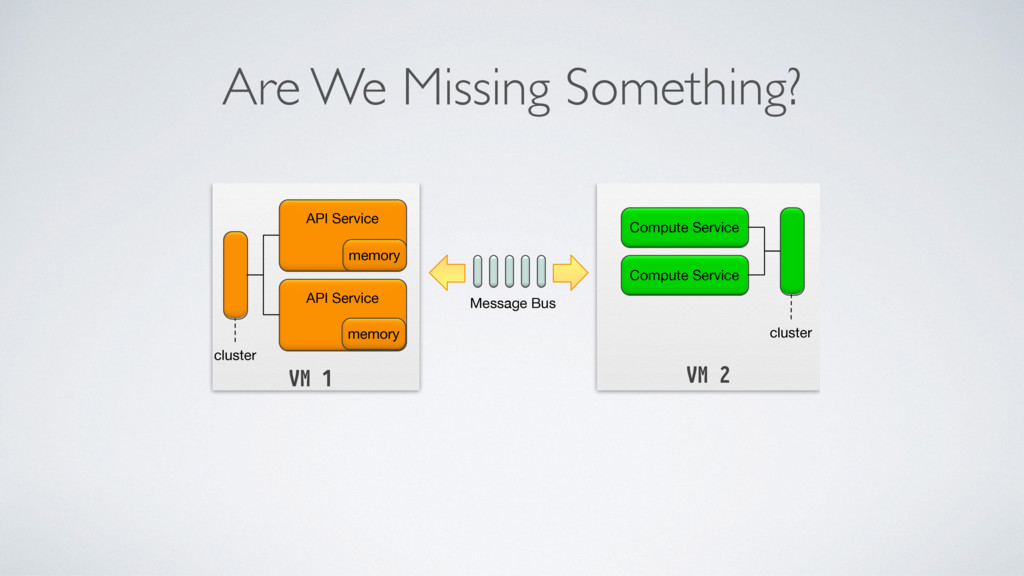
VM 2 Compute Service Compute Service cluster API Service API
Service cluster VM 1 Message Bus memory memory Are We Missing Something? -
VM 2 Compute Service Compute Service cluster API Service API
Service cluster VM 1 Message Bus memory memory Are We Missing Something? -
VM 2 Compute Service Compute Service cluster API Service API
Service cluster VM 1 Message Bus memory memory Are We Missing Something? -
Move the State Information Out VM 2 Compute Service Compute
Service cluster redis API Service API Service redis cluster VM 1 Message Bus containers/011-sharing-memory • Use redis to solve session affinity. • Use token-based authentication with JWT to handle authentication ( https://scotch.io/tutorials/the-ins-and-outs-of-token-based-authentication ). -
Add a Load-Balancer Compute Service Compute Service cluster redis API
Service API Service redis cluster Compute Service Compute Service cluster API Service API Service cluster Load Balancer Message Bus containers/012-bounce -
Add a Load-Balancer Compute Service Compute Service cluster redis API
Service API Service redis cluster Compute Service Compute Service cluster API Service API Service cluster Load Balancer Message Bus containers/012-bounce -
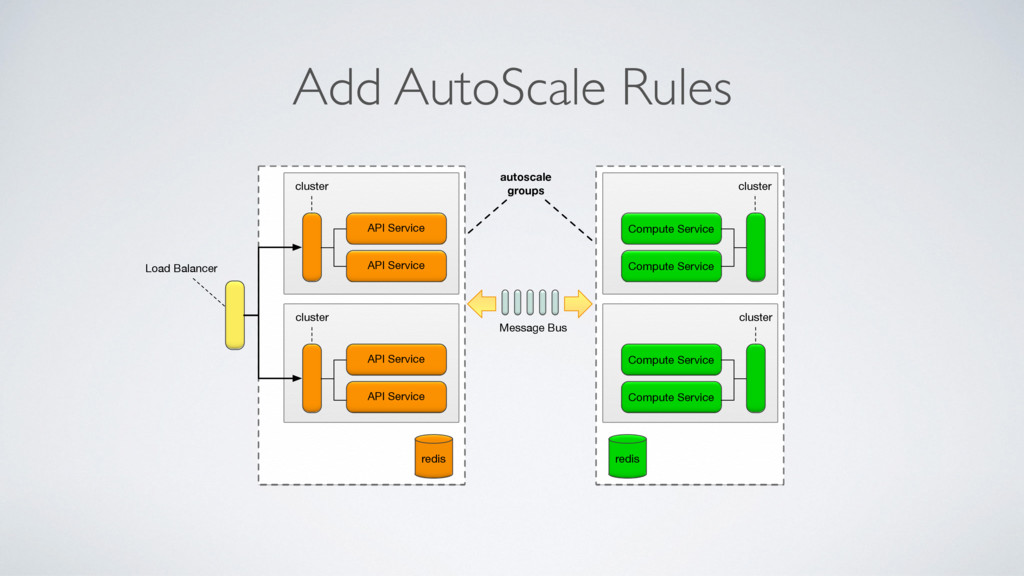
Add AutoScale Rules autoscale groups Compute Service Compute Service cluster
redis API Service API Service redis cluster Compute Service Compute Service cluster API Service API Service cluster Load Balancer Message Bus -
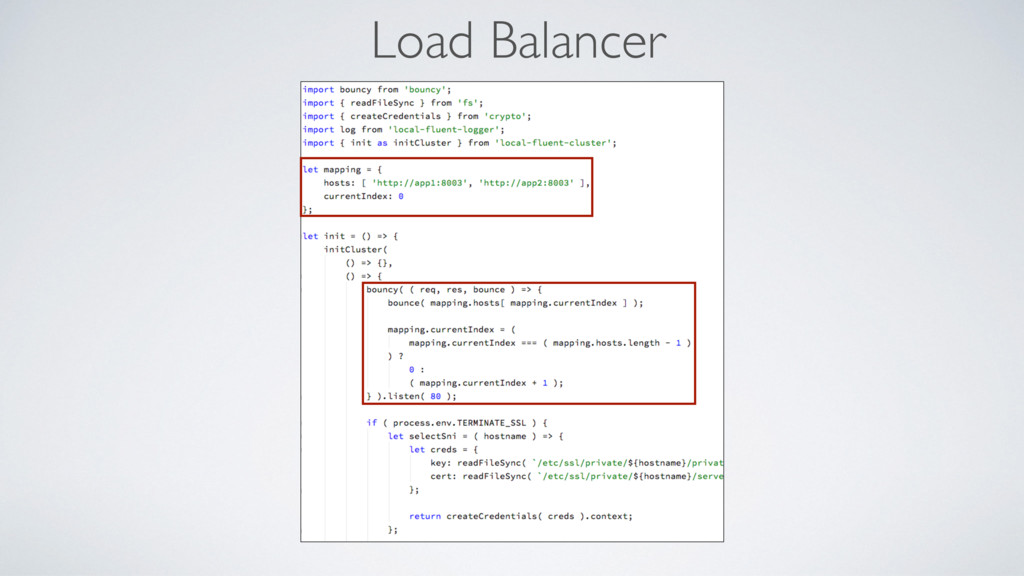
Load Balancing Options • Load Balancing as a Service (AWS,
Rackspace…) • Hardware Load Balancer (Cisco CEF, Barracuda, etc…) • Software Load Balancer • NGINX • HAProxy • home grown -
Wait! Aren’t These Actually Microservices? API app compute app worker
worker worker child_process API app c l u s t e r c l u s t e r compute app worker worker worker child_process API app compute app worker worker worker child_process API app c l u s t e r c l u s t e r compute app worker worker worker child_process broker load balancer Internet message bus redis redis … … -
API app compute app worker worker worker child_process API app
c l u s t e r c l u s t e r compute app worker worker worker child_process API app compute app worker worker worker child_process API app c l u s t e r c l u s t e r compute app worker worker worker child_process broker load balancer Internet message bus redis redis … … API μ-Service Wait! Aren’t These Actually Microservices? -
API app compute app worker worker worker child_process API app
c l u s t e r c l u s t e r compute app worker worker worker child_process API app compute app worker worker worker child_process API app c l u s t e r c l u s t e r compute app worker worker worker child_process broker load balancer Internet message bus redis redis … … API μ-Service Compute μ-Service Wait! Aren’t These Actually Microservices? * See Also: http://martinfowler.com/articles/microservice-trade-offs.html http://highscalability.com/blog/2014/4/8/microservices-not-a-free-lunch.html https://rclayton.silvrback.com/failing-at-microservices -
That Means You’ve Become Famous Scalability Will Be the Least
of Your Concerns What If I Reach The Scalability Limits Within a Region? -
Multiple Regions Region 1 Compute Service Compute Service redis API
Service API Service redis Compute Service Compute Service API Service API Service LB Region 2 Compute Service Compute Service redis API Service API Service redis Compute Service Compute Service API Service API Service LB Round-Robin DNS The Internet Message Bus Message Bus containers/013-round-robin -
Multiple Regions Load Balancer Load Balancer Region 1 Compute Service
Compute Service redis API Service API Service redis Compute Service Compute Service API Service API Service LB Region 2 Compute Service Compute Service redis API Service API Service redis Compute Service Compute Service API Service API Service LB replication replication Round-Robin DNS The Internet Message Bus Message Bus -
You Can Add More Region 1 Compute AutoScale Group API
AutoScale Group LB LB DNS The Internet Message Bus Region 2 Compute AutoScale Group API AutoScale Group Message Bus … Region N Compute AutoScale Group API AutoScale Group Message Bus LB -
How Do I Manage All This Infrastructure? This is Getting
Out of Hand! Region 1 Compute AutoScale Group API AutoScale Group LB LB DNS The Internet Message Bus Region 2 Compute AutoScale Group API AutoScale Group Message Bus … Region N Compute AutoScale Group API AutoScale Group Message Bus LB -
• No Hard-Coded IP Addresses in Config Files • Let
DNS do What it Does Best • Use Environment Variables for Infrastructure Management • Converge Your Infrastructure Using a Central Service • Salt Cloud ( https://docs.saltstack.com/en/develop/topics/cloud/index.html ) • AWS CloudFormation ( https://aws.amazon.com/cloudformation/ ) • Chef ( https://www.chef.io/ ) • Puppet ( https://puppetlabs.com/ ) • Ansible ( http://www.ansible.com/ ) • Service Discovery • Consul ( https://www.consul.io/ ) Configuration Management Tips -
CI / CD • Use a CI / CD Pipeline
• Show Love to Test-Driven Development • Don’t Forget Functional Tests and Integration Tests -
Continuously Keep Your Code In Ship Shape • ESLint (
http://eslint.org ) • CodeClimate ( https://codeclimate.com/features ) • GreenKeeper ( http://greenkeeper.io ) • npm scripts (instead of Grunt or Gulp — YMMV) ( https://docs.npmjs.com/misc/scripts ) • npm outdated ( https://docs.npmjs.com/cli/outdated ) • git pre-commit hooks ( https://github.com/observing/pre-commit ) • [ hint: Install your development dependencies (such as eslint, babel, gulp, etc) locally, (not globally)! ] -
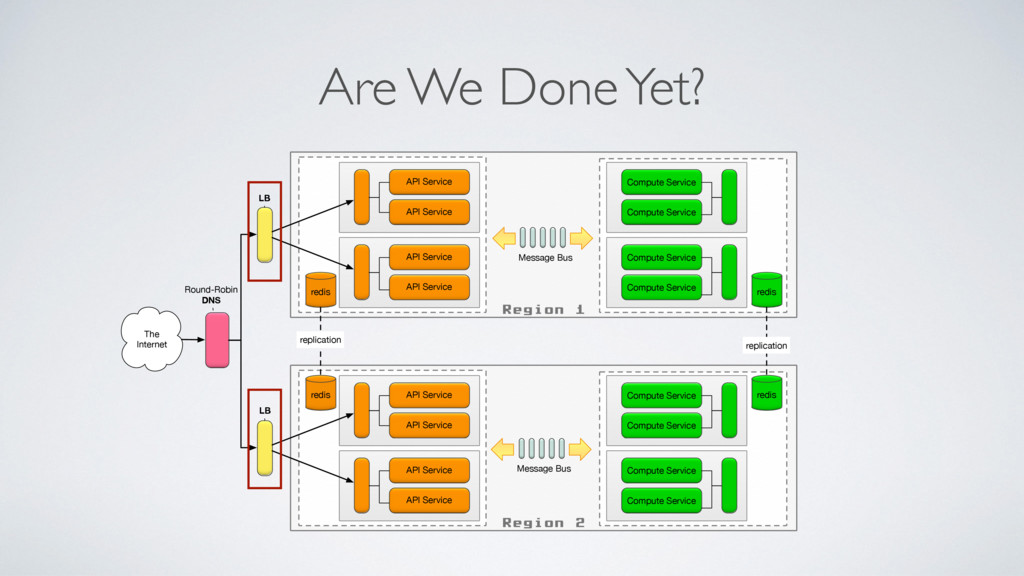
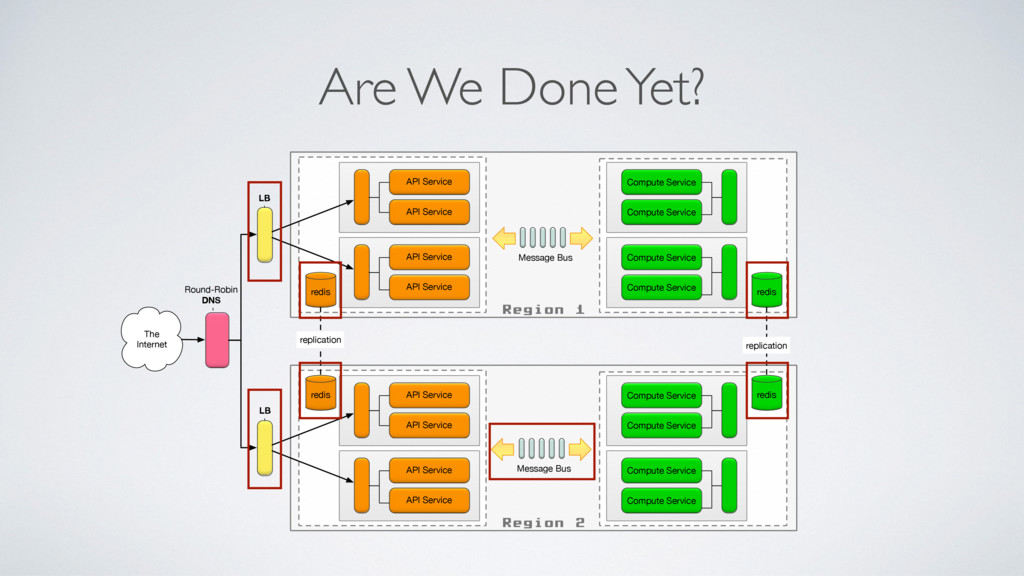
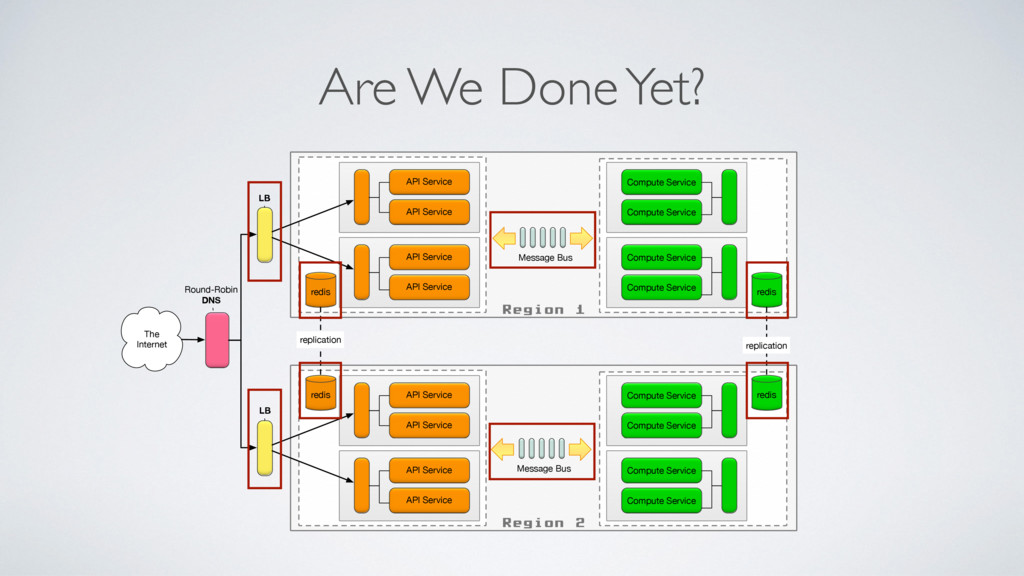
Are We Done Yet? Load Balancer Load Balancer Region 1
Compute Service Compute Service redis API Service API Service redis Compute Service Compute Service API Service API Service LB Region 2 Compute Service Compute Service redis API Service API Service redis Compute Service Compute Service API Service API Service LB replication replication Round-Robin DNS The Internet Message Bus Message Bus -
Making the Load Balancer HA * see also: https://www.wikiwand.com/en/Virtual_Router_Redundancy_Protocol Load
Balancer client Load Balancer Load Balancer client keepalived active failover -
Making the Load Balancer HA * see also: https://www.wikiwand.com/en/Virtual_Router_Redundancy_Protocol Load
Balancer client Load Balancer Load Balancer client keepalived active failover -
Making the Load Balancer Highly Available • round-robin DNS •
https://www.wikiwand.com/en/Round-robin_DNS • heartbeat • https://www.wikiwand.com/en/Heartbeat_(computing) • keepalived • http://keepalived.org/ * You can use these tools to make any component HA. -
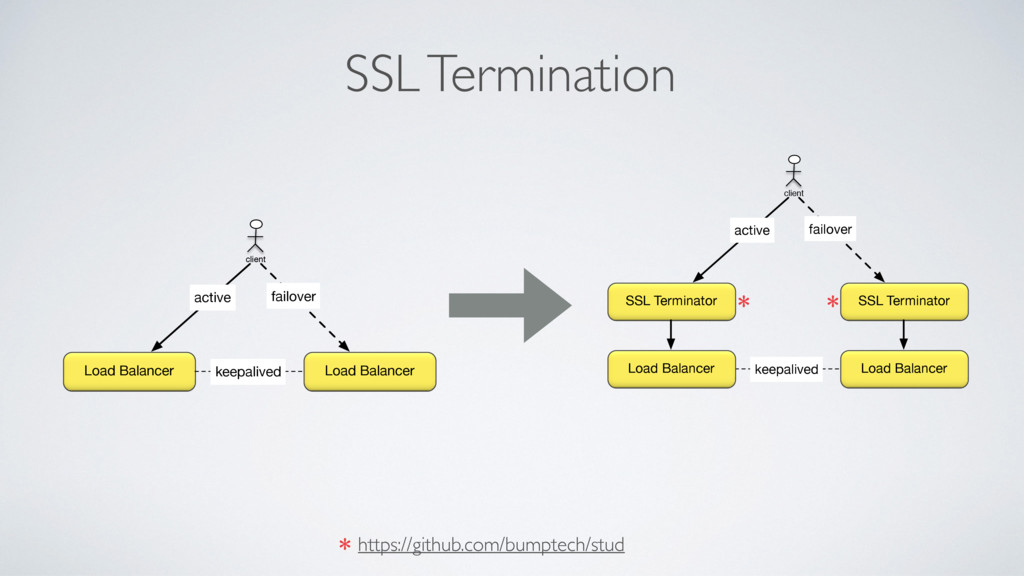
SSL Termination * * * https://github.com/bumptech/stud Load Balancer Load Balancer
client keepalived active failover SSL Terminator SSL Terminator client keepalived active failover Load Balancer Load Balancer -
SSL Termination * * * https://github.com/bumptech/stud Load Balancer Load Balancer
client keepalived active failover SSL Terminator SSL Terminator client keepalived active failover Load Balancer Load Balancer -
SSL Termination * * * https://github.com/bumptech/stud Load Balancer Load Balancer
client keepalived active failover SSL Terminator SSL Terminator client keepalived active failover Load Balancer Load Balancer -
Make Redis and RabbitMQ Redundant redis redis (master) redis (read
replica) redis (read replica) redis (read replica) redis (master) redis (read replica) redis (read replica) redis (read replica) round-robin DNS This will also increase throughput as a side benefit. See http://redis.io/topics/replication and http://redis.io/topics/ cluster-tutorial. You can also use a managed “memory as a service” solution. See also https://www.rabbitmq.com/ha.html for how a similar queue mirroring is implemented for a RabbitMQ cluster. And similarly, you can use a managed “queue as a service” solution to ease your pain ;) -
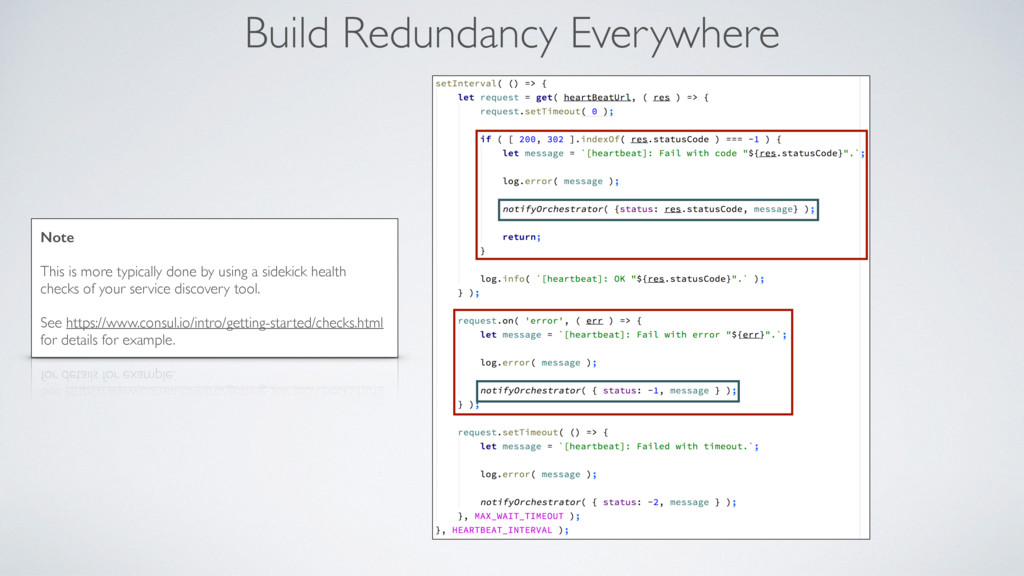
Build Redundancy Everywhere Note This is more typically done by
using a sidekick health checks of your service discovery tool. See https://www.consul.io/intro/getting-started/checks.html for details for example. -
Build Redundancy Everywhere Note This is more typically done by
using a sidekick health checks of your service discovery tool. See https://www.consul.io/intro/getting-started/checks.html for details for example. -
Build Redundancy Everywhere Note This is more typically done by
using a sidekick health checks of your service discovery tool. See https://www.consul.io/intro/getting-started/checks.html for details for example. -
Build Redundancy Everywhere Note This is more typically done by
using a sidekick health checks of your service discovery tool. See https://www.consul.io/intro/getting-started/checks.html for details for example. -
Build Redundancy Everywhere Note This is more typically done by
using a sidekick health checks of your service discovery tool. See https://www.consul.io/intro/getting-started/checks.html for details for example. -
Build Redundancy Everywhere Note This is more typically done by
using a sidekick health checks of your service discovery tool. See https://www.consul.io/intro/getting-started/checks.html for details for example. -
Build Redundancy Everywhere Note This is more typically done by
using a sidekick health checks of your service discovery tool. See https://www.consul.io/intro/getting-started/checks.html for details for example. -
Torture Your System • Try Chaos Monkey • https://github.com/Netflix/SimianArmy/wiki/Chaos-Monkey •
Randomly send `kill -9` to Processes • Randomly Knock a Server Offline • Intentionally Run Out of Disk Space • Take an entire data center down -
Summary Stateless is Better than Stateful Eventual Consistency Build Redundancy
Everywhere! Startup Fast, Shut Down Gracefully Solve Problems That Actually Exist -
Summary Never Assume, Always Measure Perf Before Scale Infrastructure is
Code; Automate It! Keep Configuration Details in Environment Variables Show Love to DNS -
Summary • Know Your Ecosystem • Know Your Tools •
Use Tools, not Rules! -
Scale 2 ∞ & 㱺 Region 1 Compute AutoScale Group
API AutoScale Group LB LB DNS The Internet Message Bus Region 2 Compute AutoScale Group API AutoScale Group Message Bus … Region N Compute AutoScale Group API AutoScale Group Message Bus LB API Service Internet Bastion Simulated by an NGINX static web server * Fetch HTML off of websites * Simplify and convert the HTML to plain text * Do NLP/Tokenization on the plain text * Create tags as a result test API
 volkan
 takuyay0ne
 kworkdev
 jacopen
 shadowhat
 fj_yoshimura_kosuke
 knwoop
 bitkey
 oracle4engineer
 torounit
 kazatohiei
 say_no_w
 swdtkuy
 lfama
 tapps
 tmiket
 chriscoyier
 addyosmani
 charlesmeaden
 aarron
 skipperchong
 honzajavorek
 codingconduct
 stephaniewalter
 reverentgeek