2025 ReSAKSS - Moving the Technology Frontiers in African Agrifood Systems: Lessons from Latin America: Dr. Valeria Piñeiro
Dr. Valeria Piñeiro, Regional Representative of the Latin America and Caribbean region and Senior Research Coordinator, Markets, Trade and Institutions Unit, IFPRI
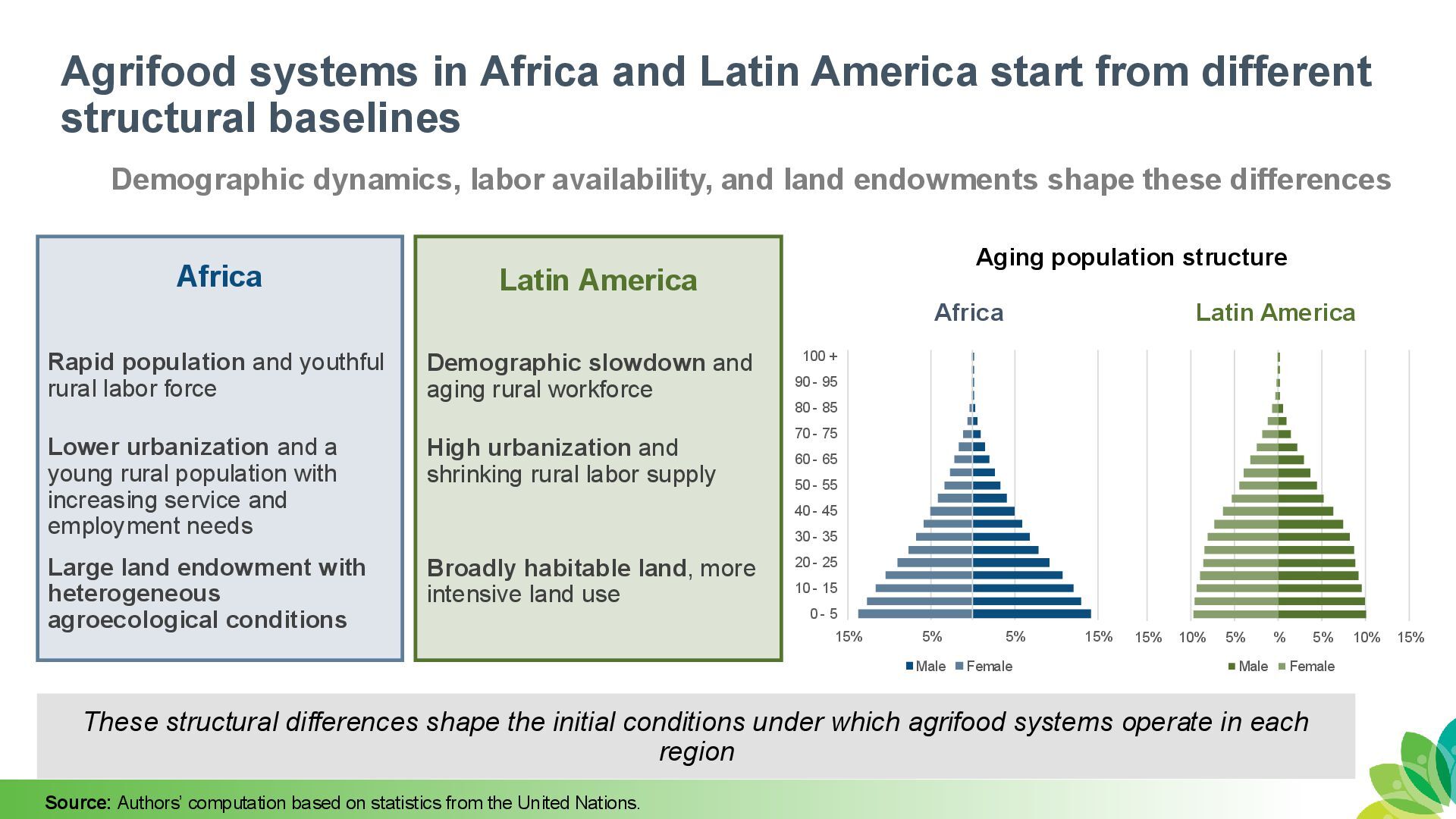
structural baselines Demographic dynamics, labor availability, and land endowments shape these differences Africa Latin America Rapid population and youthful rural labor force Demographic slowdown and aging rural workforce Lower urbanization and a young rural population with increasing service and employment needs High urbanization and shrinking rural labor supply Large land endowment with heterogeneous agroecological conditions Broadly habitable land, more intensive land use These structural differences shape the initial conditions under which agrifood systems operate in each region 15% 5% 5% 15% 0 - 5 10 - 15 20 - 25 30 - 35 40 - 45 50 - 55 60 - 65 70 - 75 80 - 85 90 - 95 100 + Male Female 15% 10% 5% % 5% 10% 15% Male Female Africa Latin America Aging population structure Source: Authors’ computation based on statistics from the United Nations.
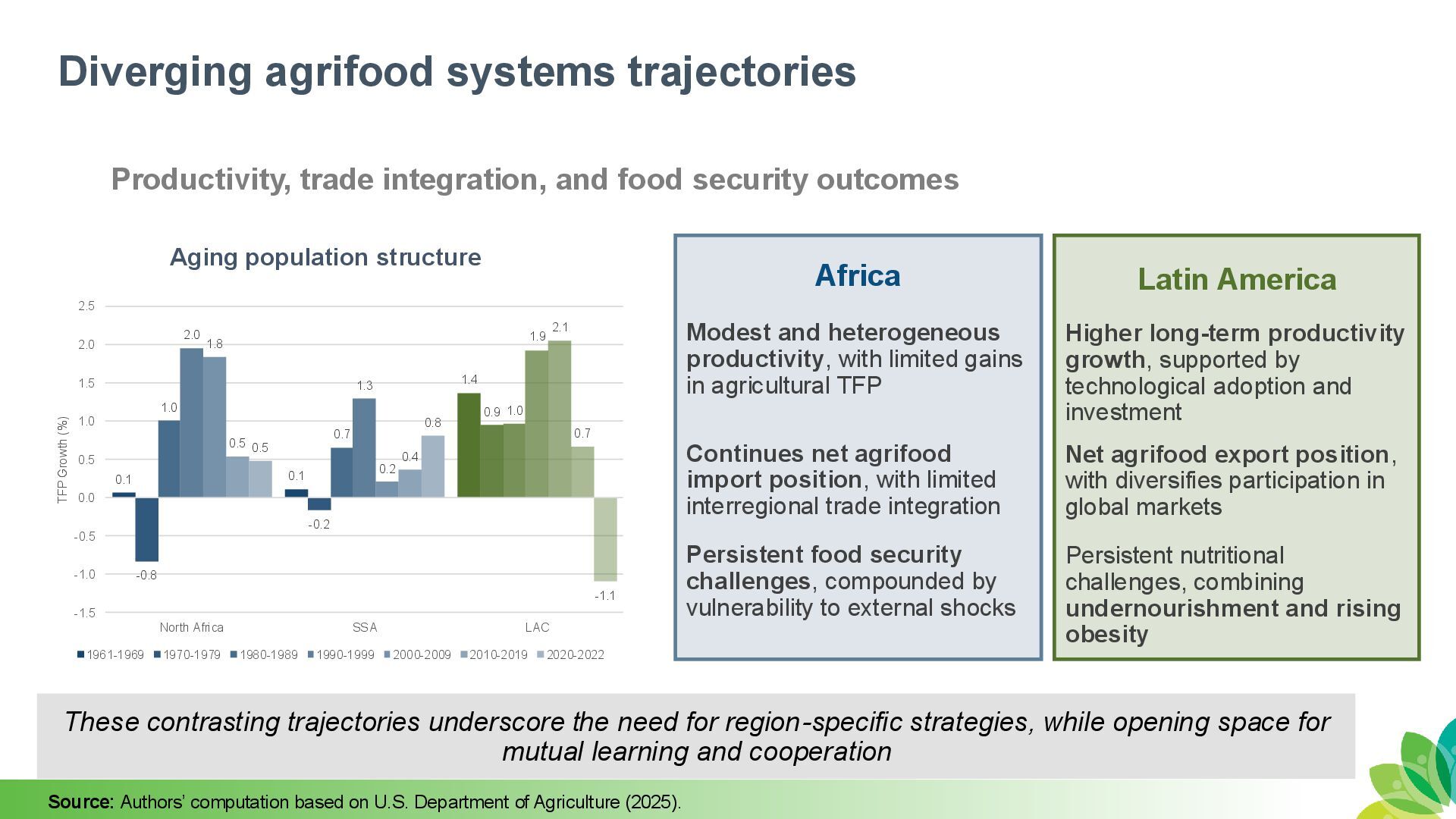
outcomes Africa Latin America Modest and heterogeneous productivity, with limited gains in agricultural TFP Higher long-term productivity growth, supported by technological adoption and investment Continues net agrifood import position, with limited interregional trade integration Net agrifood export position, with diversifies participation in global markets Persistent food security challenges, compounded by vulnerability to external shocks Persistent nutritional challenges, combining undernourishment and rising obesity 0.1 0.1 1.4 -0.8 -0.2 0.9 1.0 0.7 1.0 2.0 1.3 1.9 1.8 0.2 2.1 0.5 0.4 0.7 0.5 0.8 -1.1 -1.5 -1.0 -0.5 0.0 0.5 1.0 1.5 2.0 2.5 North Africa SSA LAC TFP Growth (%) 1961-1969 1970-1979 1980-1989 1990-1999 2000-2009 2010-2019 2020-2022 Aging population structure These contrasting trajectories underscore the need for region-specific strategies, while opening space for mutual learning and cooperation Source: Authors’ computation based on U.S. Department of Agriculture (2025).
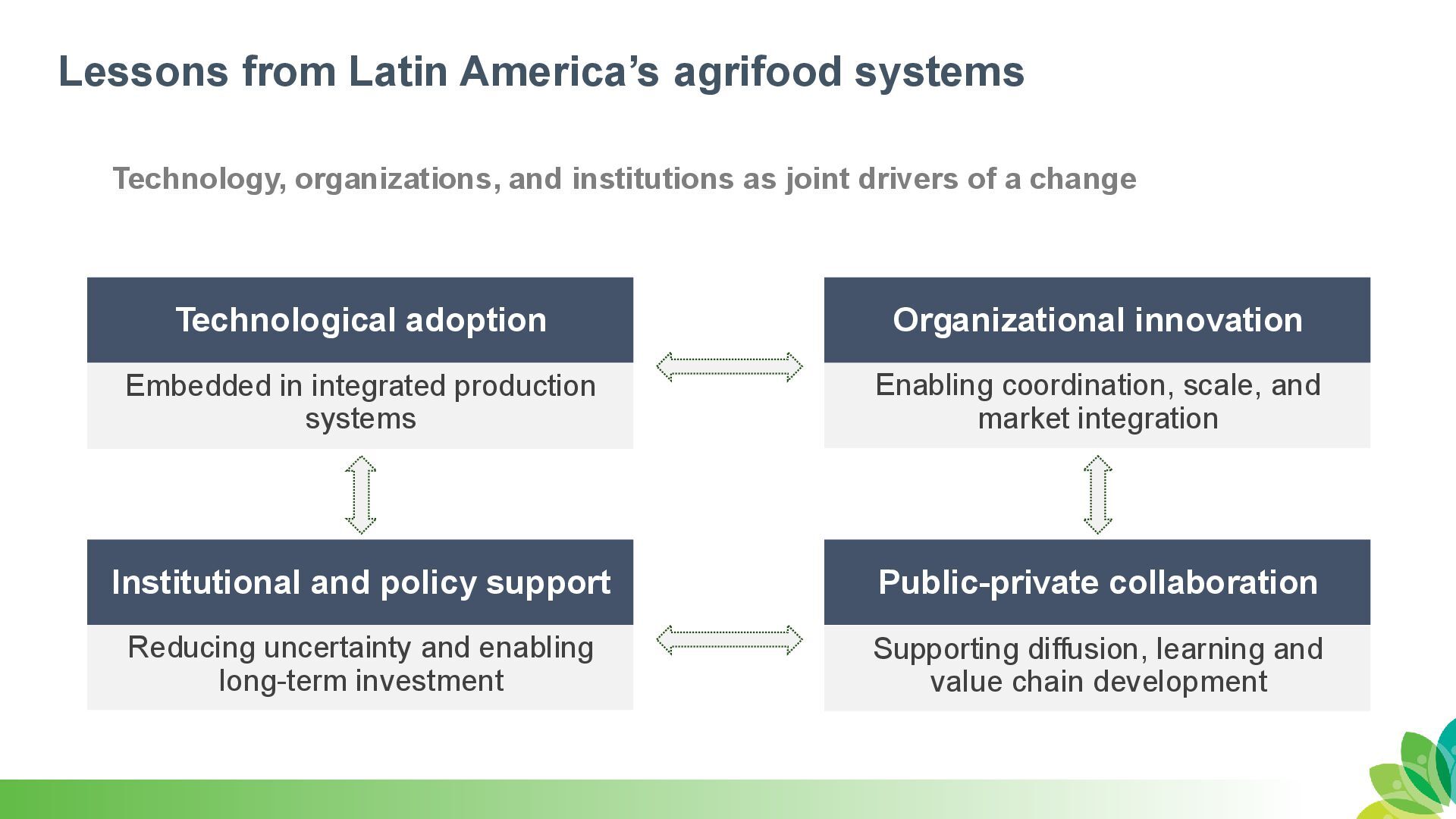
as joint drivers of a change Embedded in integrated production systems Reducing uncertainty and enabling long-term investment Enabling coordination, scale, and market integration Supporting diffusion, learning and value chain development Technological adoption Institutional and policy support Organizational innovation Public-private collaboration
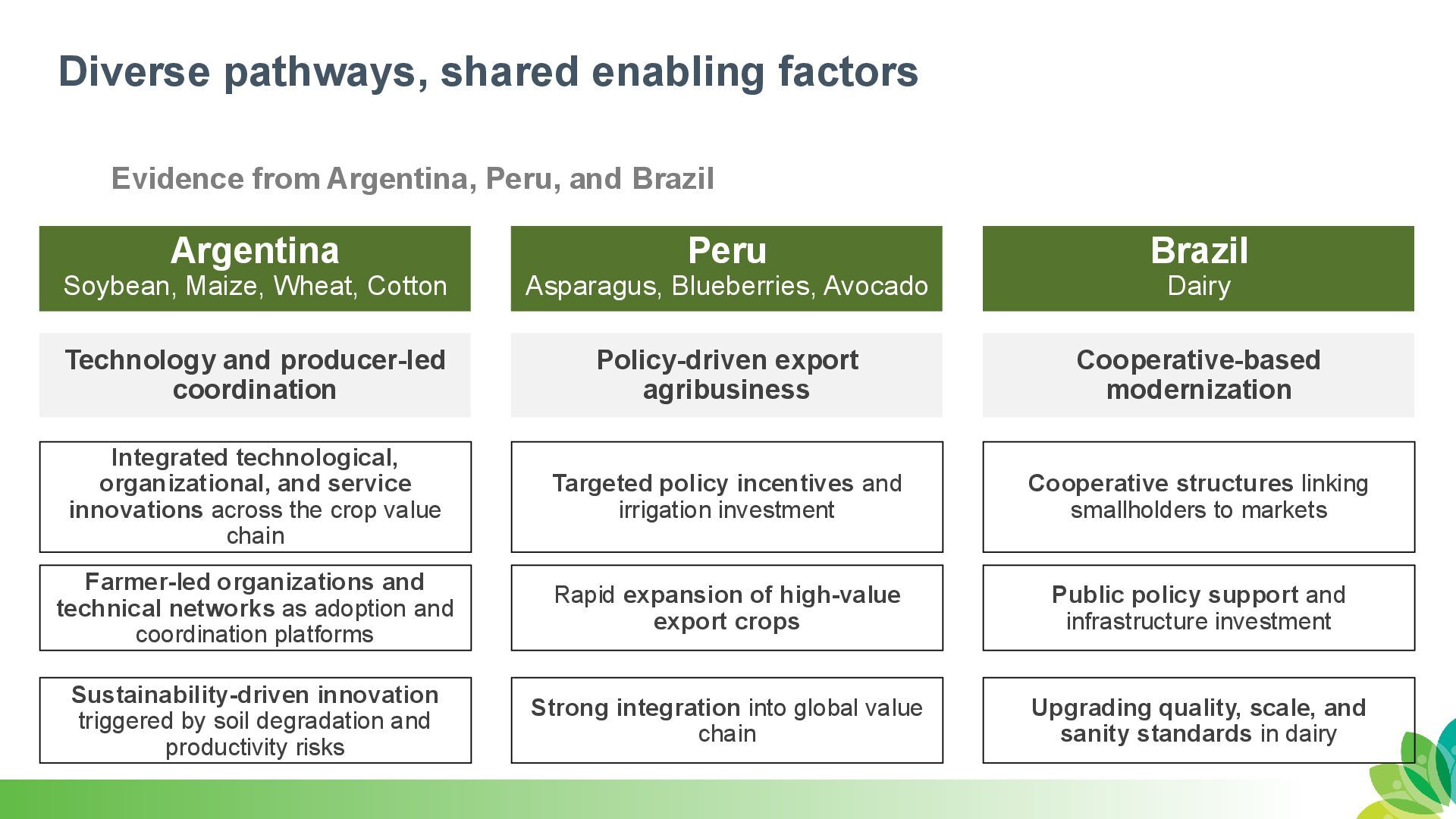
Brazil Argentina Soybean, Maize, Wheat, Cotton Peru Asparagus, Blueberries, Avocado Technology and producer-led coordination Policy-driven export agribusiness Brazil Dairy Cooperative-based modernization Integrated technological, organizational, and service innovations across the crop value chain Targeted policy incentives and irrigation investment Cooperative structures linking smallholders to markets Sustainability-driven innovation triggered by soil degradation and productivity risks Strong integration into global value chain Upgrading quality, scale, and sanity standards in dairy Farmer-led organizations and technical networks as adoption and coordination platforms Rapid expansion of high-value export crops Public policy support and infrastructure investment
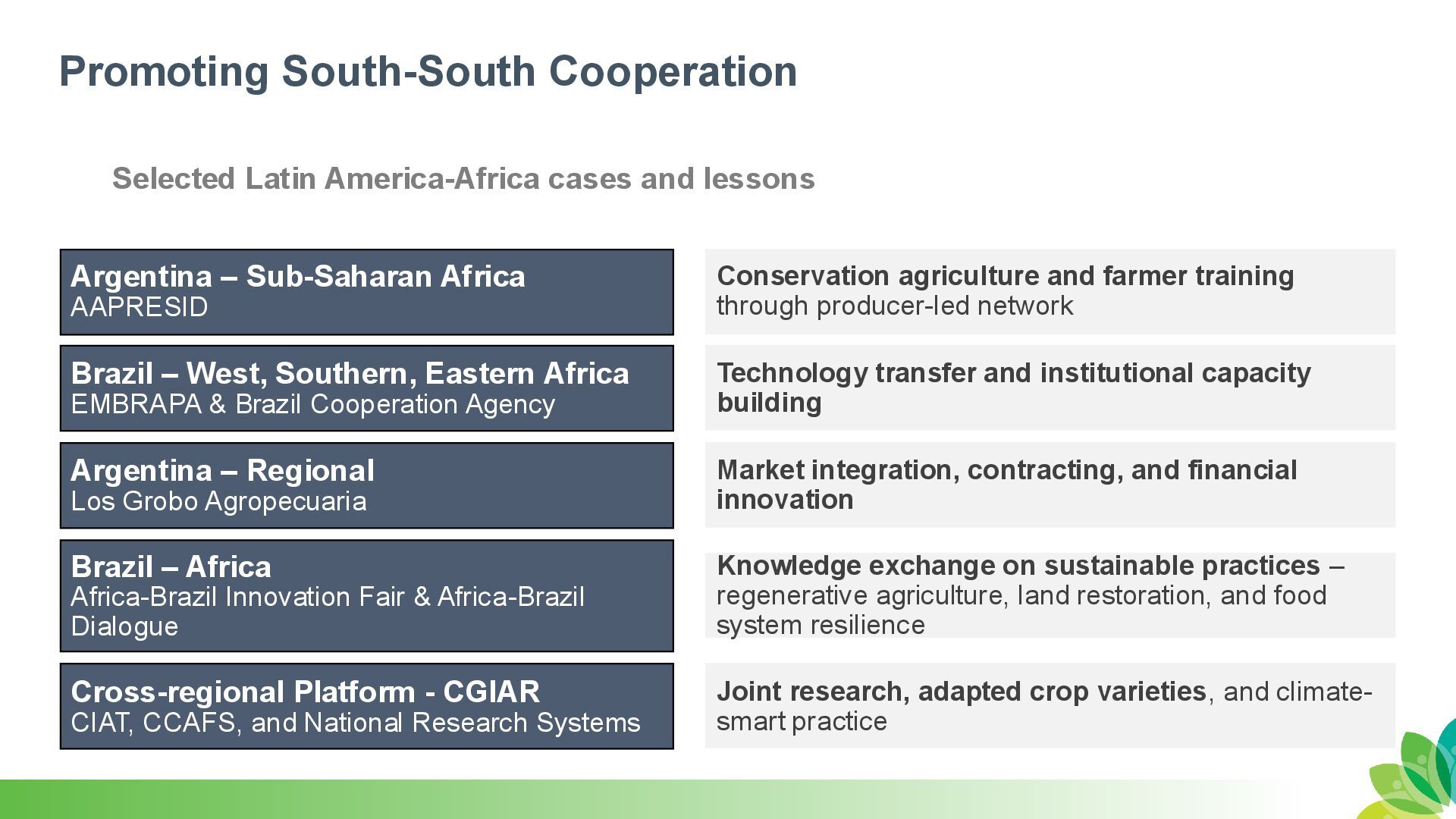
– Sub-Saharan Africa AAPRESID Brazil – West, Southern, Eastern Africa EMBRAPA & Brazil Cooperation Agency Argentina – Regional Los Grobo Agropecuaria Brazil – Africa Africa-Brazil Innovation Fair & Africa-Brazil Dialogue Cross-regional Platform - CGIAR CIAT, CCAFS, and National Research Systems Conservation agriculture and farmer training through producer-led network Technology transfer and institutional capacity building Market integration, contracting, and financial innovation Joint research, adapted crop varieties, and climate- smart practice Knowledge exchange on sustainable practices – regenerative agriculture, land restoration, and food system resilience
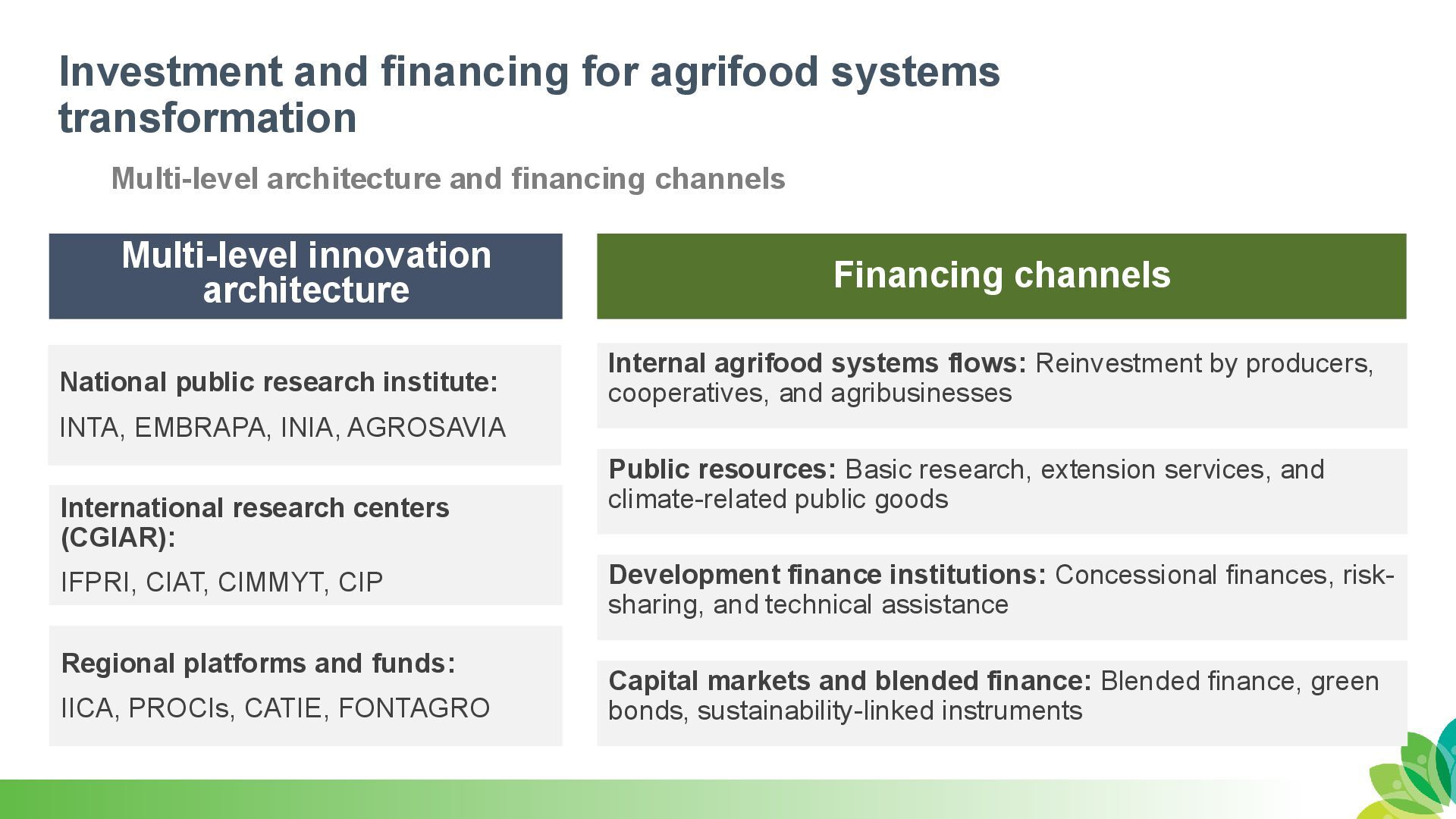
financing channels Multi-level innovation architecture Financing channels National public research institute: INTA, EMBRAPA, INIA, AGROSAVIA Internal agrifood systems flows: Reinvestment by producers, cooperatives, and agribusinesses International research centers (CGIAR): IFPRI, CIAT, CIMMYT, CIP Public resources: Basic research, extension services, and climate-related public goods Regional platforms and funds: IICA, PROCIs, CATIE, FONTAGRO Development finance institutions: Concessional finances, risk- sharing, and technical assistance Capital markets and blended finance: Blended finance, green bonds, sustainability-linked instruments
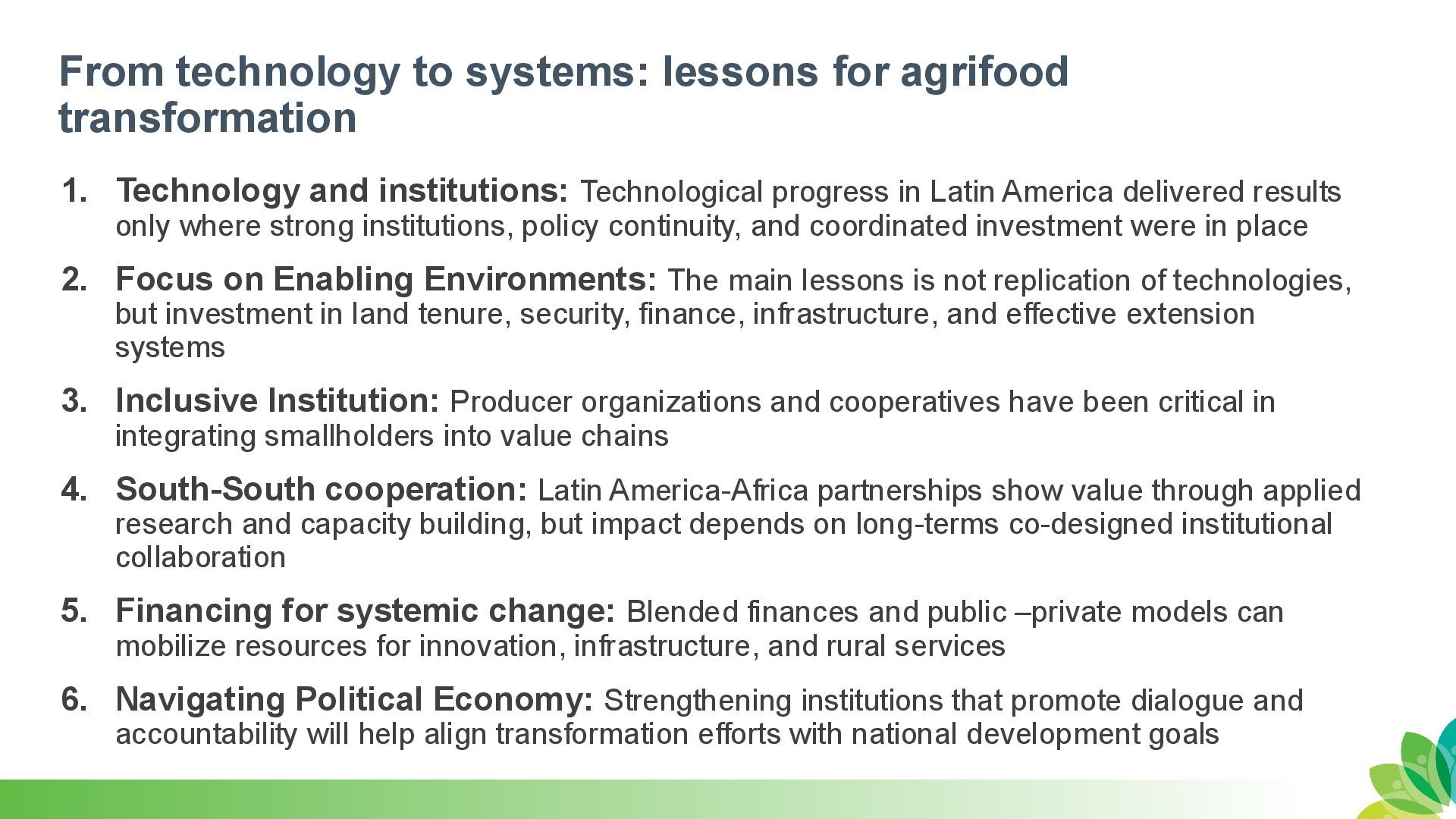
and institutions: Technological progress in Latin America delivered results only where strong institutions, policy continuity, and coordinated investment were in place 2. Focus on Enabling Environments: The main lessons is not replication of technologies, but investment in land tenure, security, finance, infrastructure, and effective extension systems 3. Inclusive Institution: Producer organizations and cooperatives have been critical in integrating smallholders into value chains 4. South-South cooperation: Latin America-Africa partnerships show value through applied research and capacity building, but impact depends on long-terms co-designed institutional collaboration 5. Financing for systemic change: Blended finances and public –private models can mobilize resources for innovation, infrastructure, and rural services 6. Navigating Political Economy: Strengthening institutions that promote dialogue and accountability will help align transformation efforts with national development goals


 akademiya2063
 kzmssk
 yuukit
 hariby
 imai448
 butchi
 mickey_0226
 sazimai
 junkurihara
 rikkabotan7
 shunk031
.png) satai
satai
 thirion
 eileencodes
 nwiizo
 techseoconnect
 bcantrill
 csswizardry
 kevinliebholz
 lemiorhan
 inesmontani
 andyhume
 colly
colly