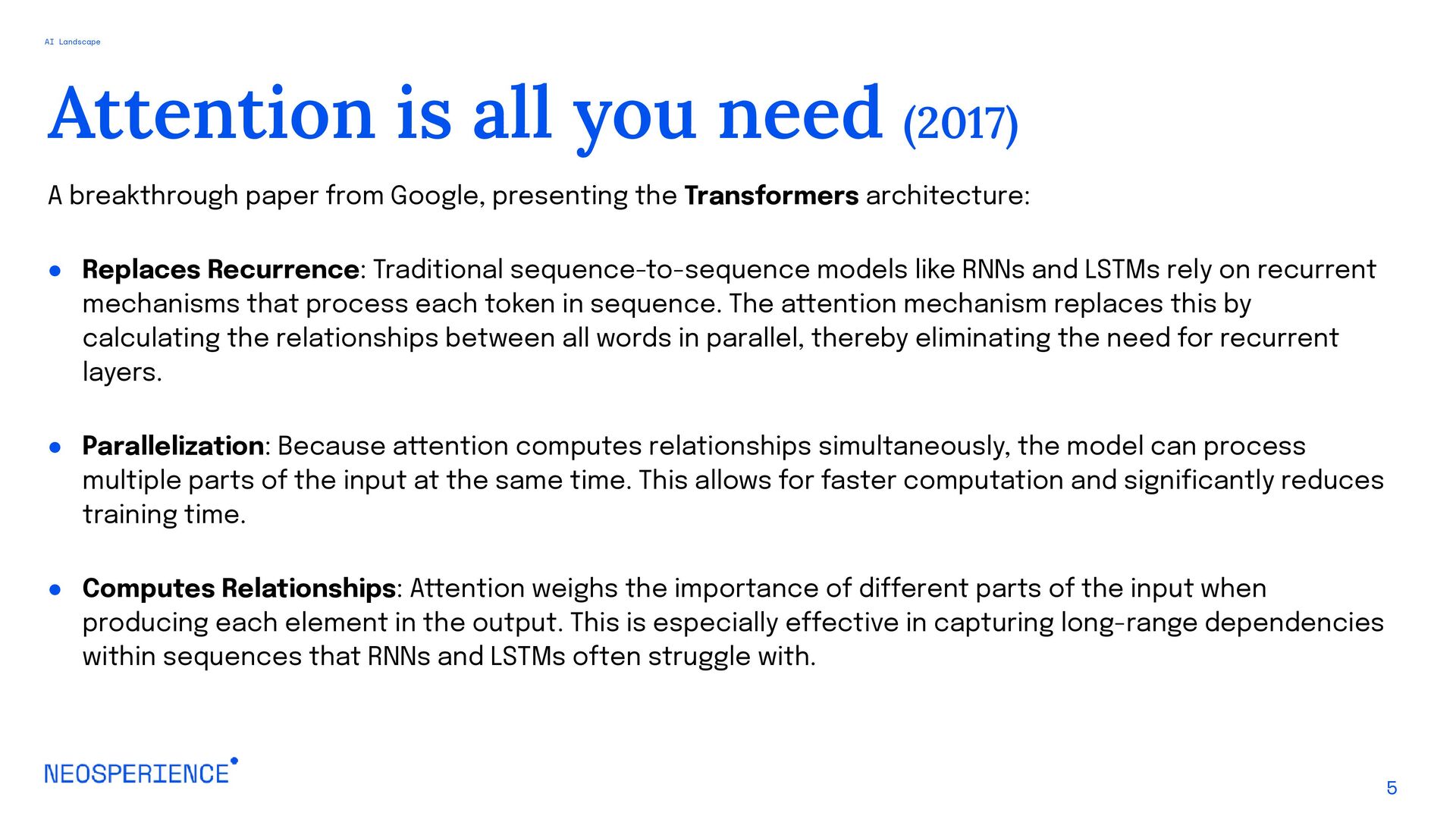
Replaces Recurrence: Traditional sequence-to-sequence models like RNNs and LSTMs rely on recurrent mechanisms that process each token in sequence. The attention mechanism replaces this by calculating the relationships between all words in parallel, thereby eliminating the need for recurrent layers. • Parallelization: Because attention computes relationships simultaneously, the model can process multiple parts of the input at the same time. This allows for faster computation and significantly reduces training time. • Computes Relationships: Attention weighs the importance of different parts of the input when producing each element in the output. This is especially effective in capturing long-range dependencies within sequences that RNNs and LSTMs often struggle with. 5 Attention is all you need (2017) AI Landscape
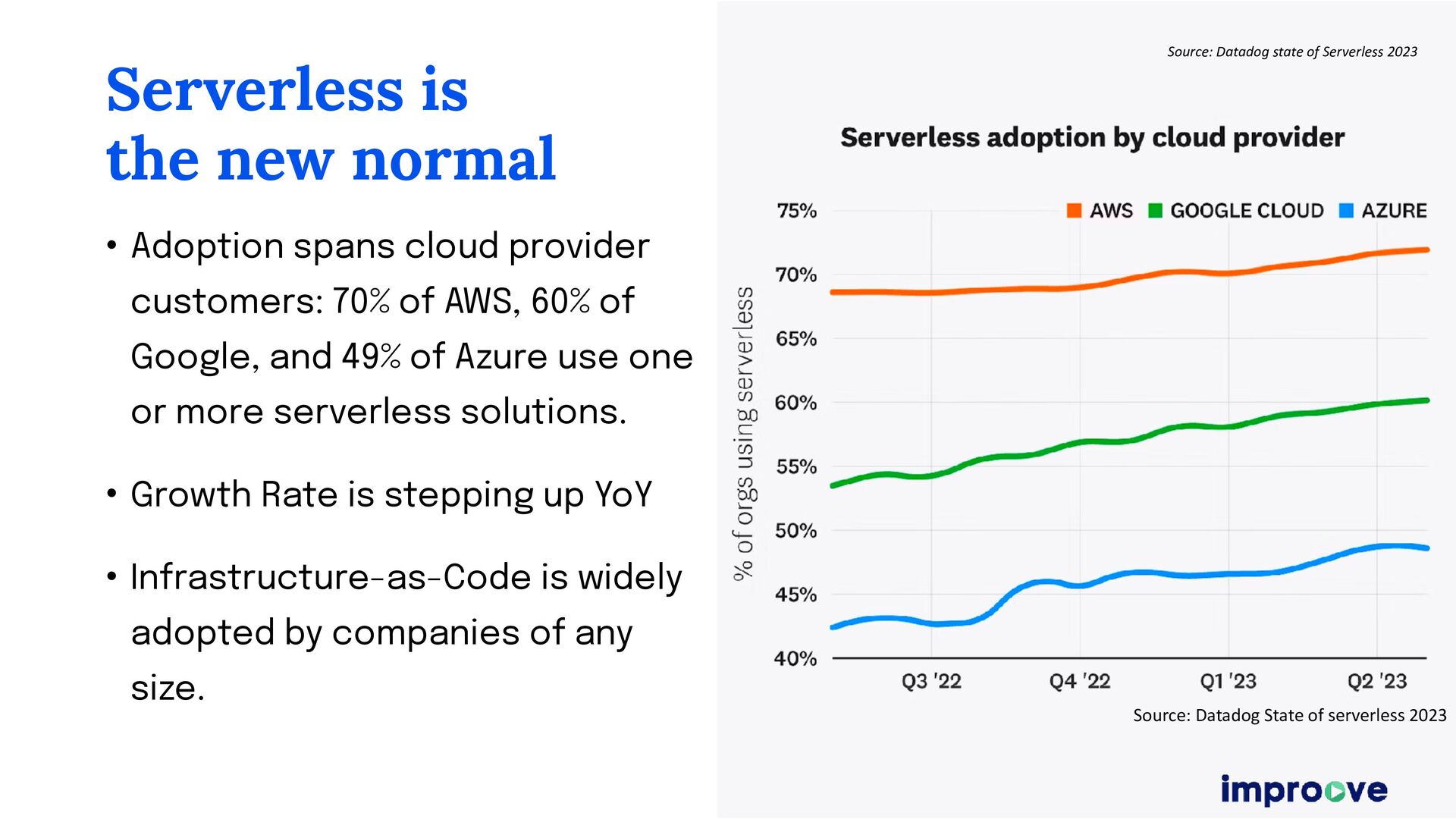
customers: 70% of AWS, 60% of Google, and 49% of Azure use one or more serverless solutions. • Growth Rate is stepping up YoY • Infrastructure-as-Code is widely adopted by companies of any size. Source: Datadog State of serverless 2023 Source: Datadog state of Serverless 2023
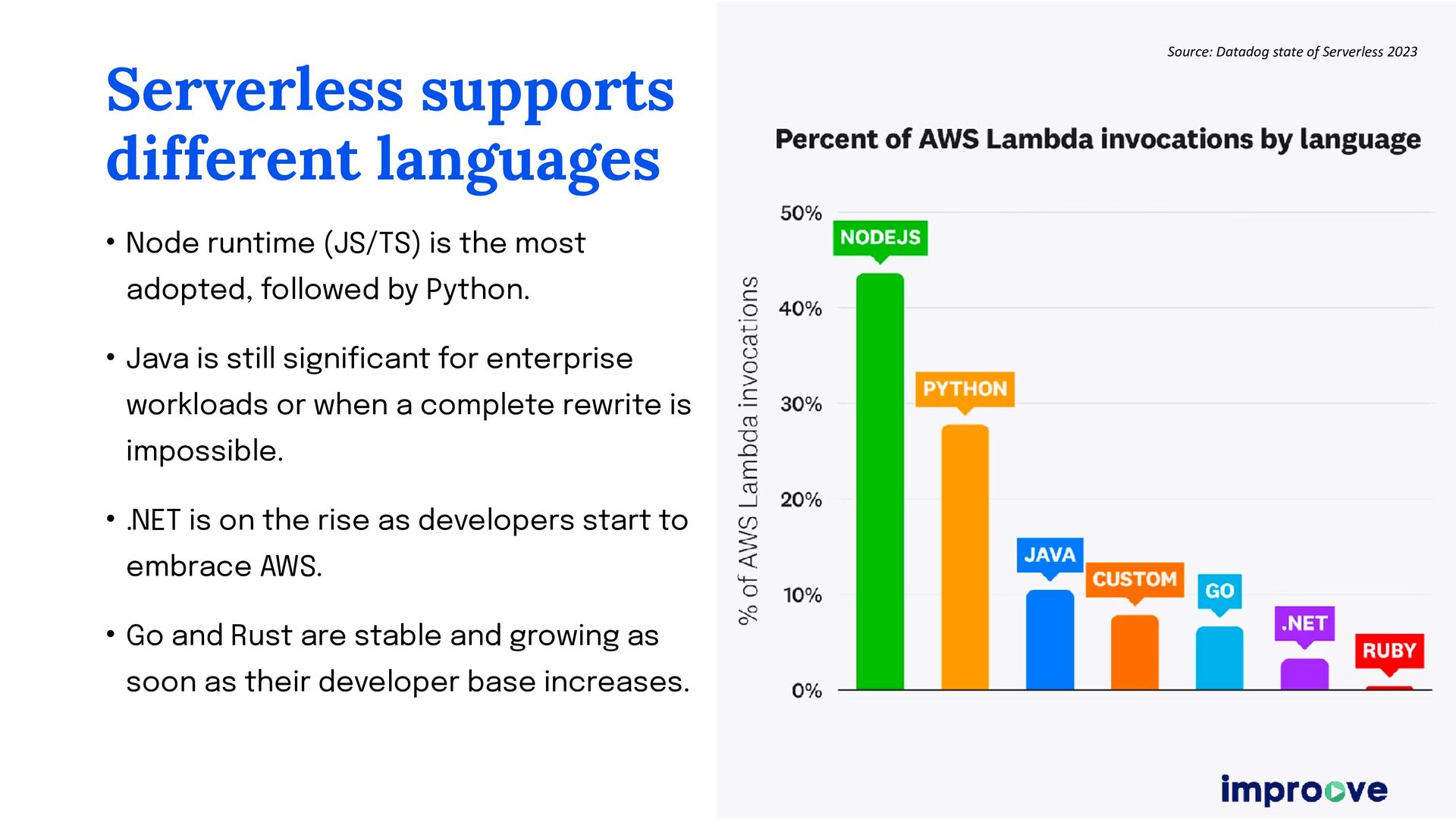
most adopted, followed by Python. • Java is still significant for enterprise workloads or when a complete rewrite is impossible. • .NET is on the rise as developers start to embrace AWS. • Go and Rust are stable and growing as soon as their developer base increases. Source: Datadog state of Serverless 2023
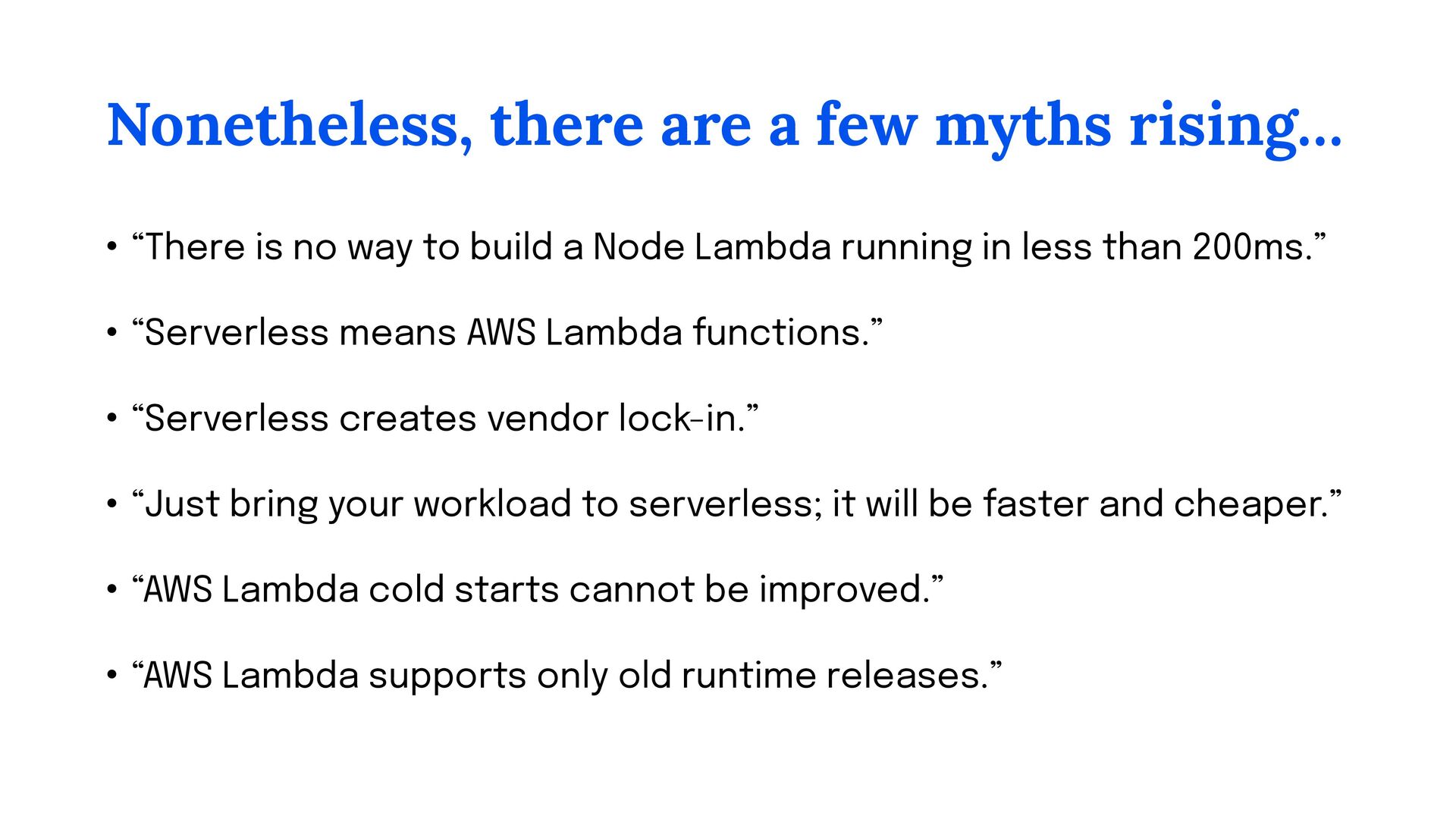
no way to build a Node Lambda running in less than 200ms.” • “Serverless means AWS Lambda functions.” • “Serverless creates vendor lock-in.” • “Just bring your workload to serverless; it will be faster and cheaper.” • “AWS Lambda cold starts cannot be improved.” • “AWS Lambda supports only old runtime releases.”
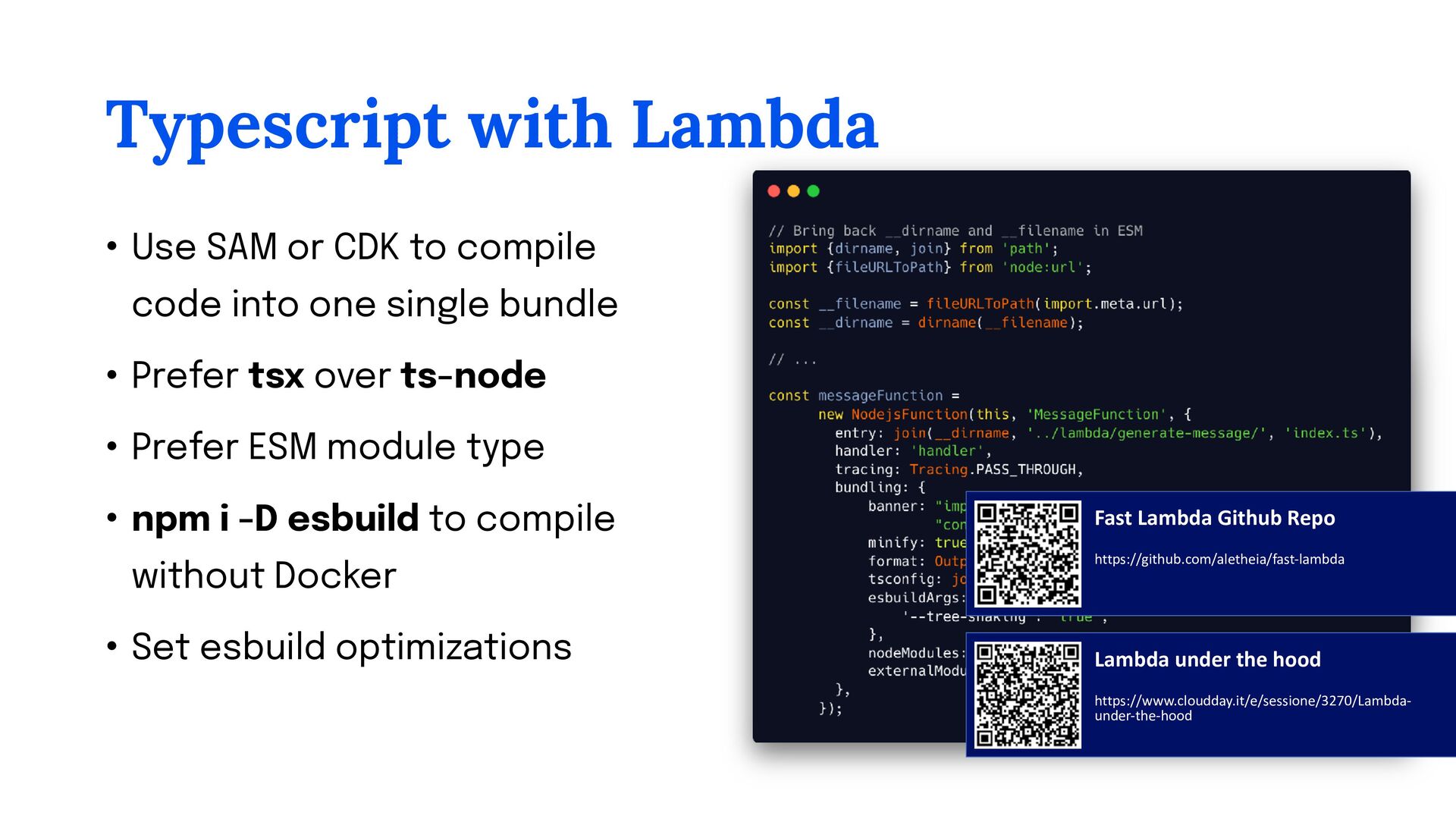
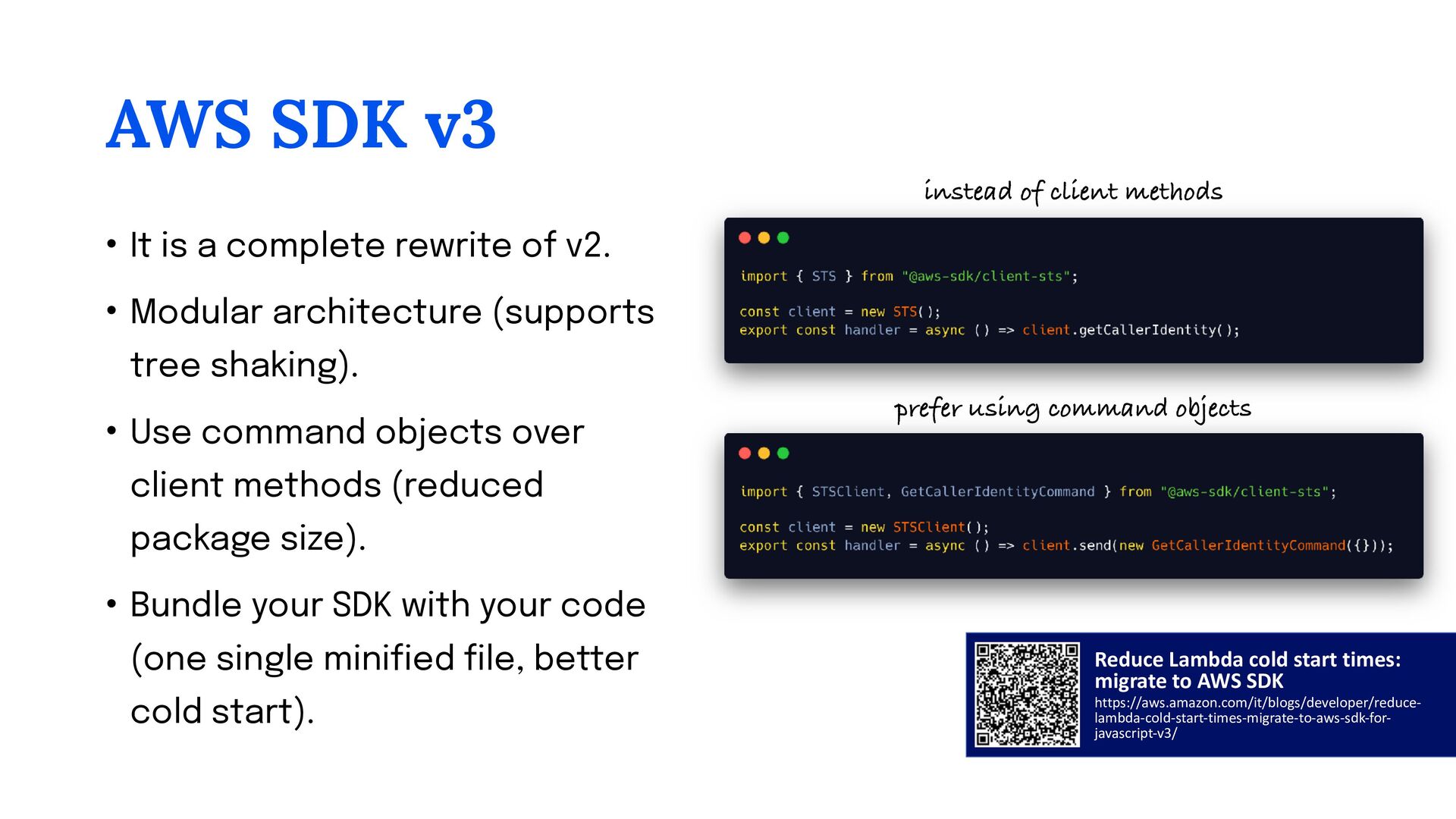
code into one single bundle • Prefer tsx over ts-node • Prefer ESM module type • npm i -D esbuild to compile without Docker • Set esbuild optimizations Lambda under the hood https://www.cloudday.it/e/sessione/3270/Lambda- under-the-hood Fast Lambda Github Repo https://github.com/aletheia/fast-lambda
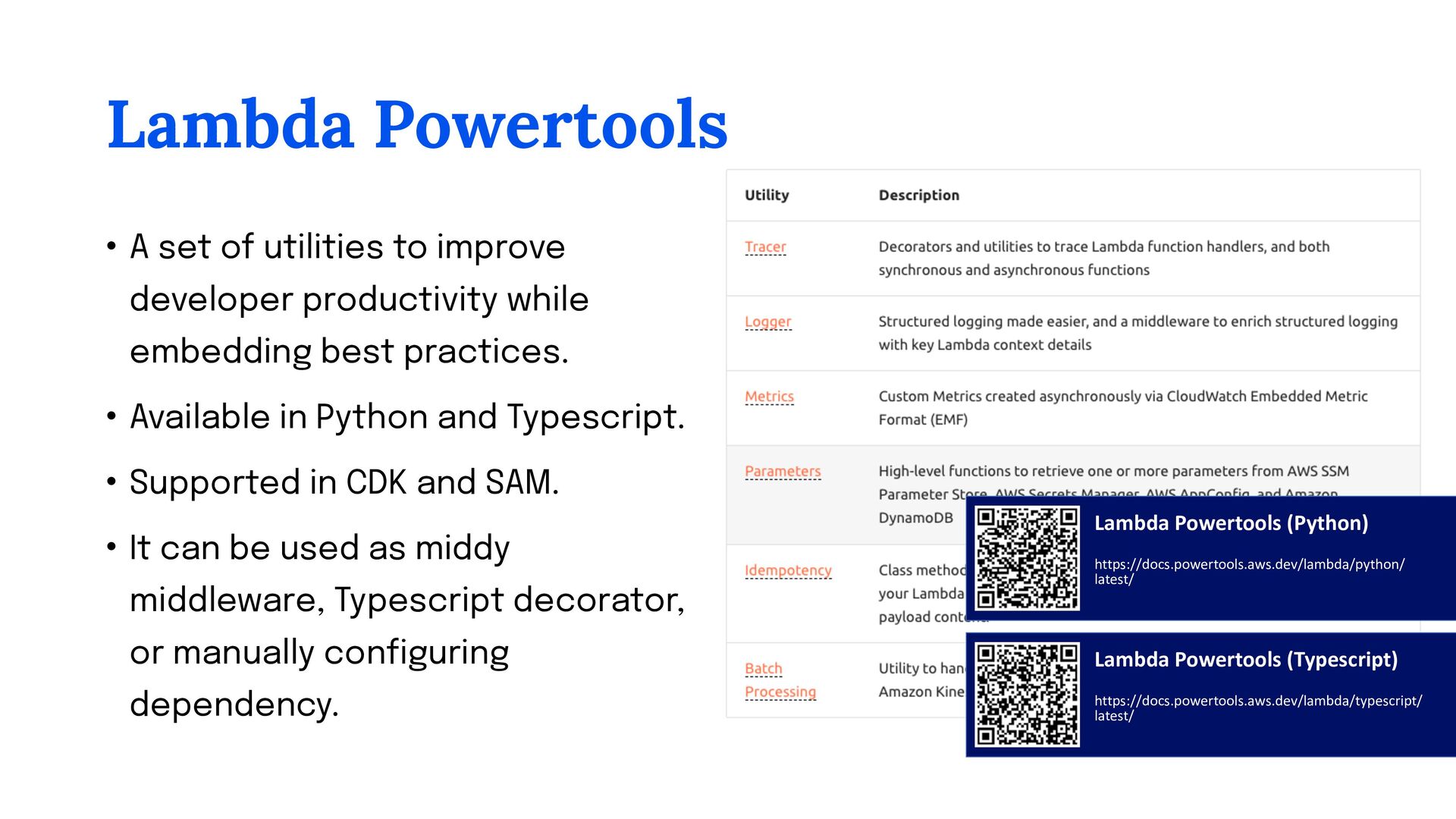
productivity while embedding best practices. • Available in Python and Typescript. • Supported in CDK and SAM. • It can be used as middy middleware, Typescript decorator, or manually configuring dependency. Lambda Powertools (Typescript) https://docs.powertools.aws.dev/lambda/typescript/ latest/ Lambda Powertools (Python) https://docs.powertools.aws.dev/lambda/python/ latest/
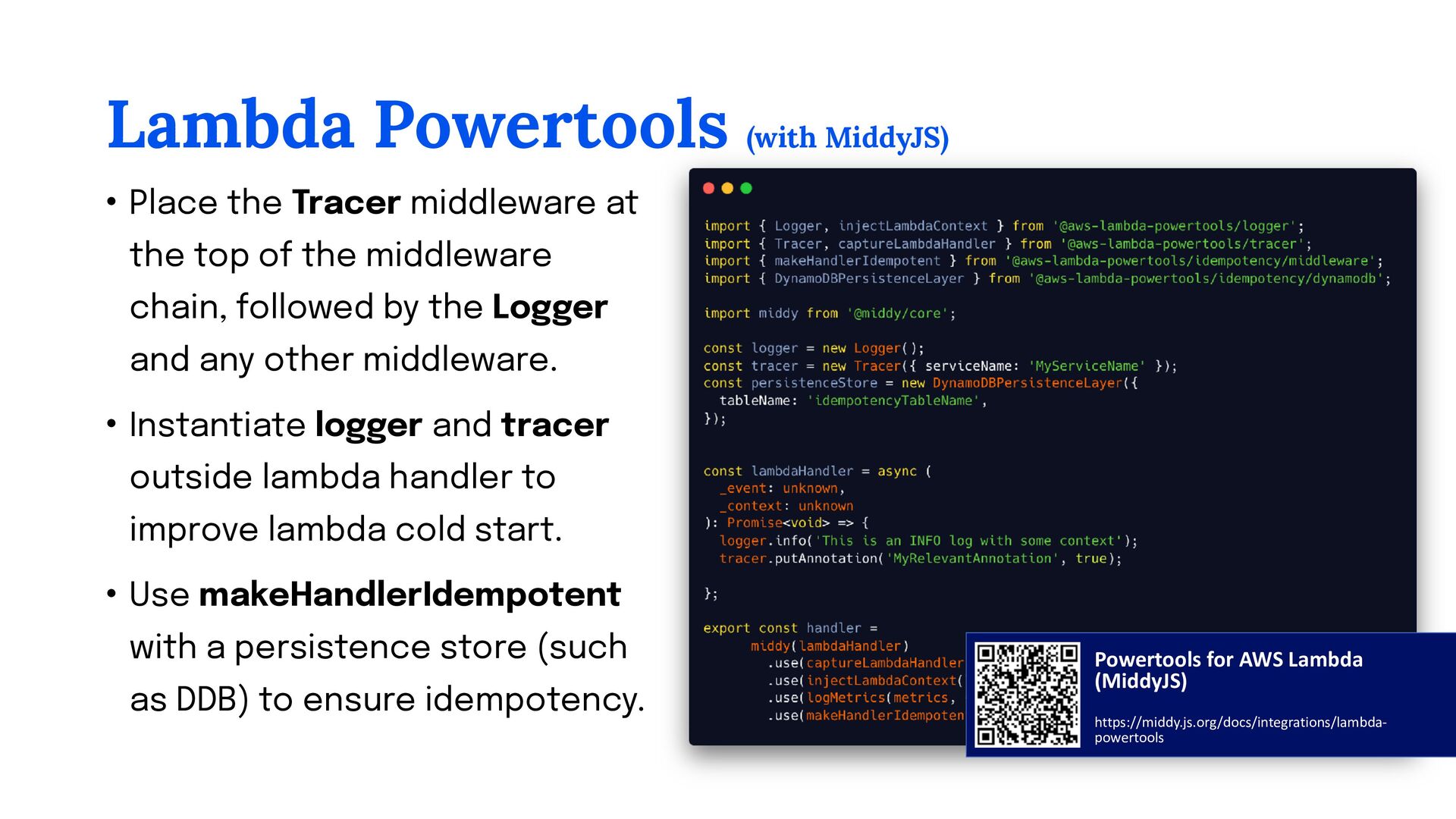
the top of the middleware chain, followed by the Logger and any other middleware. • Instantiate logger and tracer outside lambda handler to improve lambda cold start. • Use makeHandlerIdempotent with a persistence store (such as DDB) to ensure idempotency. Powertools for AWS Lambda (MiddyJS) https://middy.js.org/docs/integrations/lambda- powertools
• Private API and Regional API to be available within a VPC and deployed to a specific AWS Region. • Swagger Schema validation. Integrations • Private integration: integrate with a resource not accessible to the public internet through VPC Link • AWS Service Integration
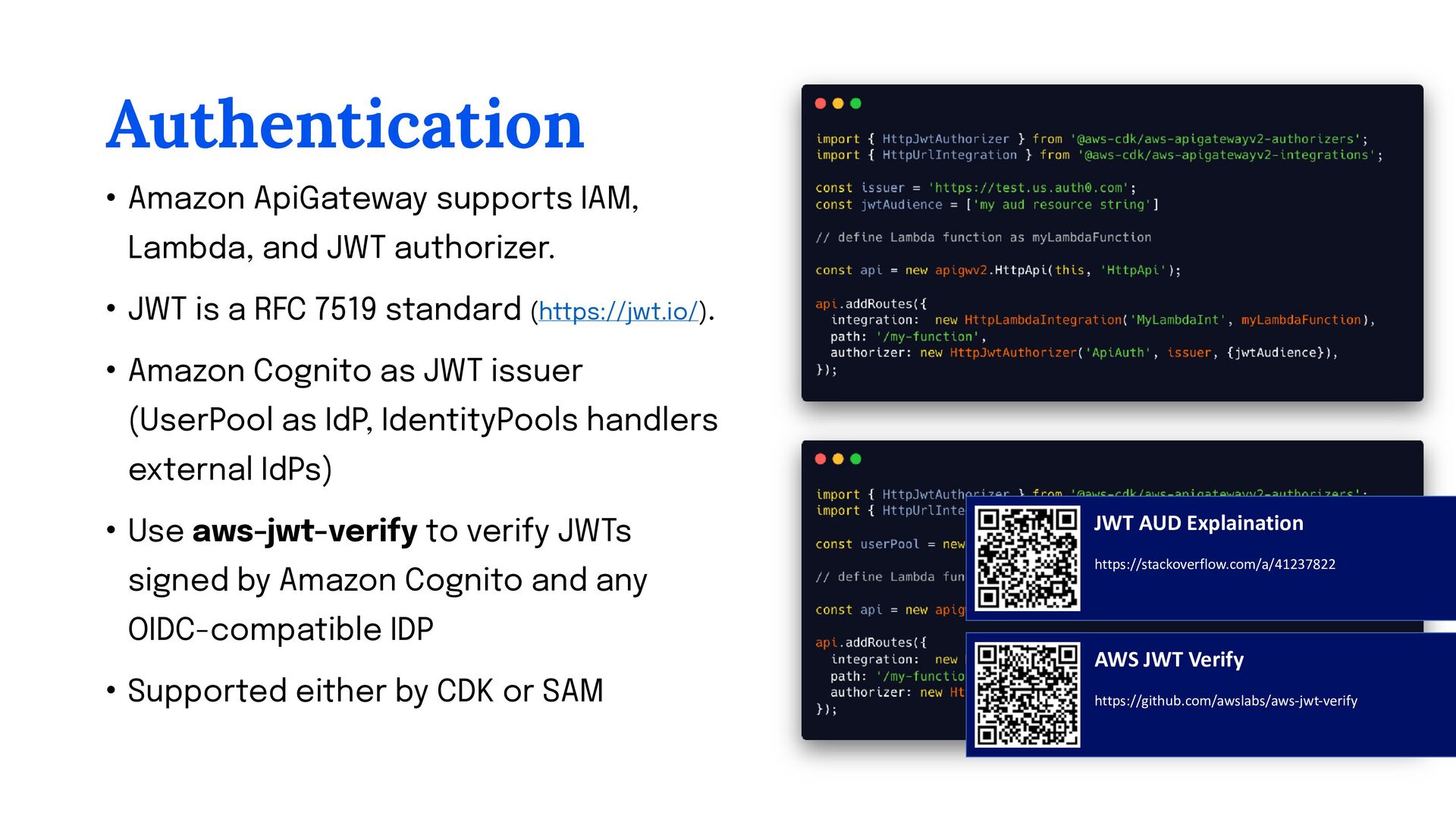
• JWT is a RFC 7519 standard (https://jwt.io/). • Amazon Cognito as JWT issuer (UserPool as IdP, IdentityPools handlers external IdPs) • Use aws-jwt-verify to verify JWTs signed by Amazon Cognito and any OIDC-compatible IDP • Supported either by CDK or SAM AWS JWT Verify https://github.com/awslabs/aws-jwt-verify JWT AUD Explaination https://stackoverflow.com/a/41237822
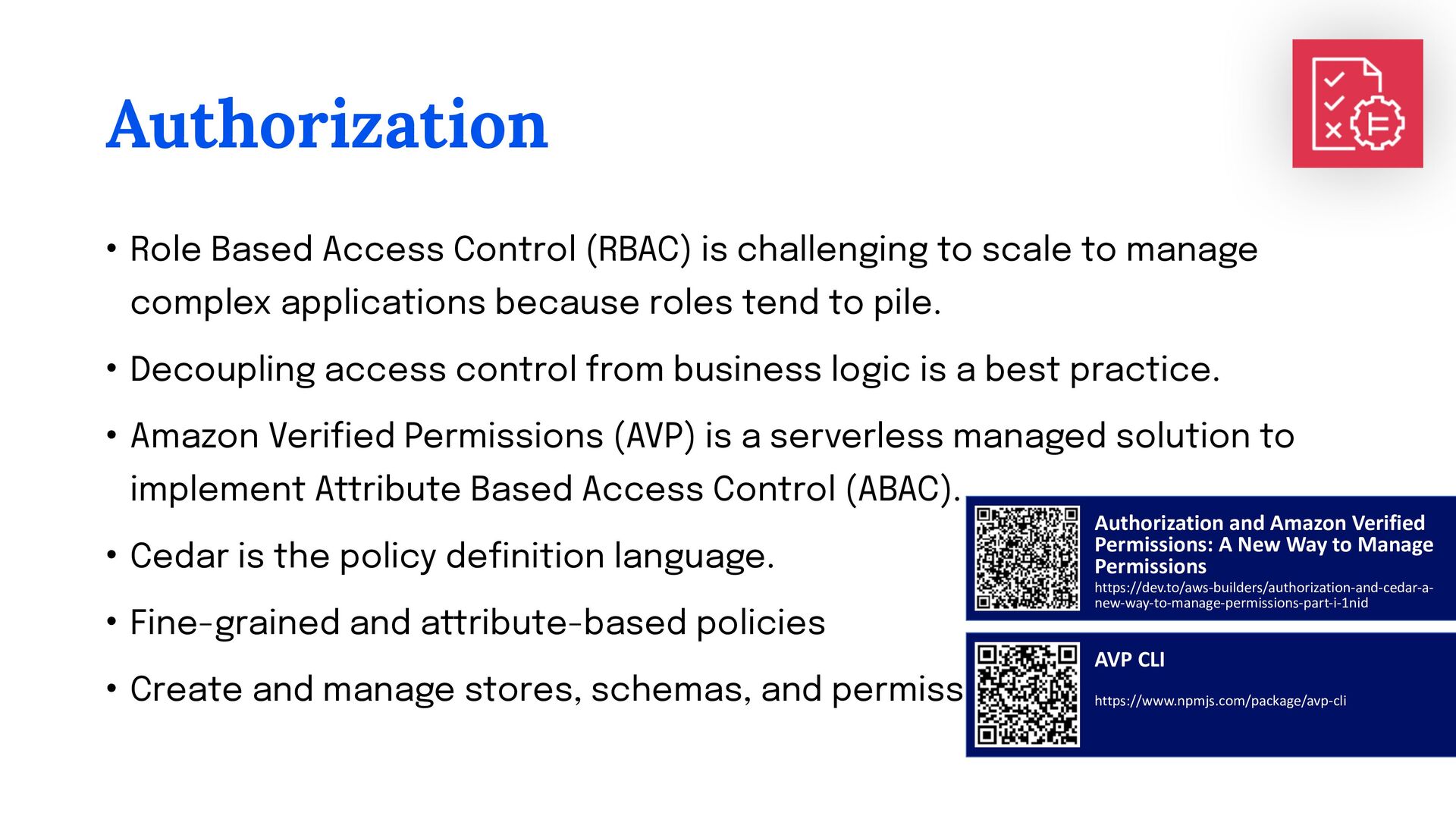
scale to manage complex applications because roles tend to pile. • Decoupling access control from business logic is a best practice. • Amazon Verified Permissions (AVP) is a serverless managed solution to implement Attribute Based Access Control (ABAC). • Cedar is the policy definition language. • Fine-grained and attribute-based policies • Create and manage stores, schemas, and permissions with avp-cli. AVP CLI https://www.npmjs.com/package/avp-cli Authorization and Amazon Verified Permissions: A New Way to Manage Permissions https://dev.to/aws-builders/authorization-and-cedar-a- new-way-to-manage-permissions-part-i-1nid
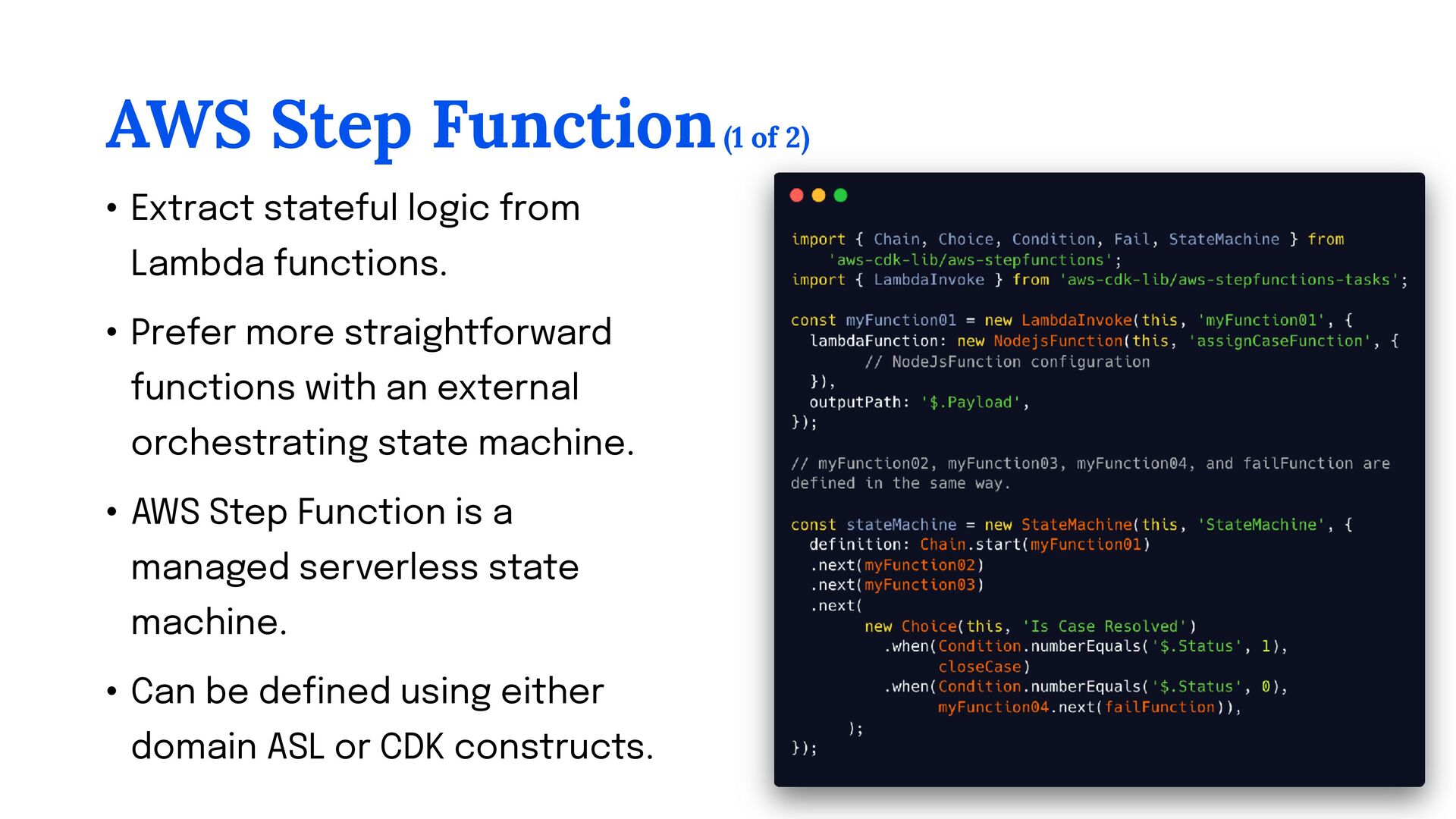
from Lambda functions. • Prefer more straightforward functions with an external orchestrating state machine. • AWS Step Function is a managed serverless state machine. • Can be defined using either domain ASL or CDK constructs.
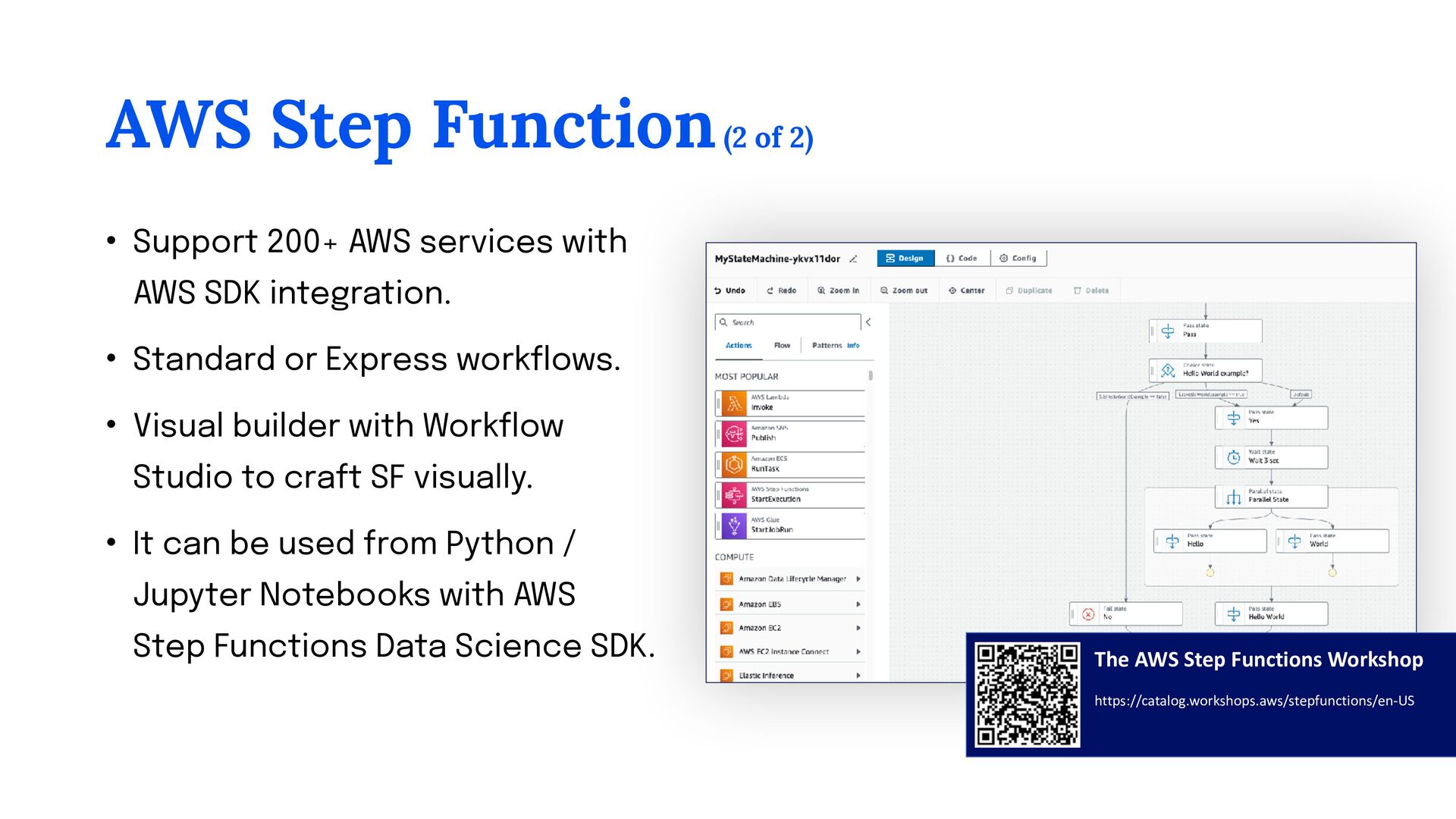
services with AWS SDK integration. • Standard or Express workflows. • Visual builder with Workflow Studio to craft SF visually. • It can be used from Python / Jupyter Notebooks with AWS Step Functions Data Science SDK. The AWS Step Functions Workshop https://catalog.workshops.aws/stepfunctions/en-US
and update with GraphQL mutations. • Pack multiple responses into one single client-tailored payload. • Resolvers to HTTP, AWS Lambda, Amazon Aurora, Amazon DynamoDB, and Amazon OpenSearch Service. • JS resolvers to resources (with limitations). • Producers publish data to AppSync. • Clients subscribe to channels to receive updates.
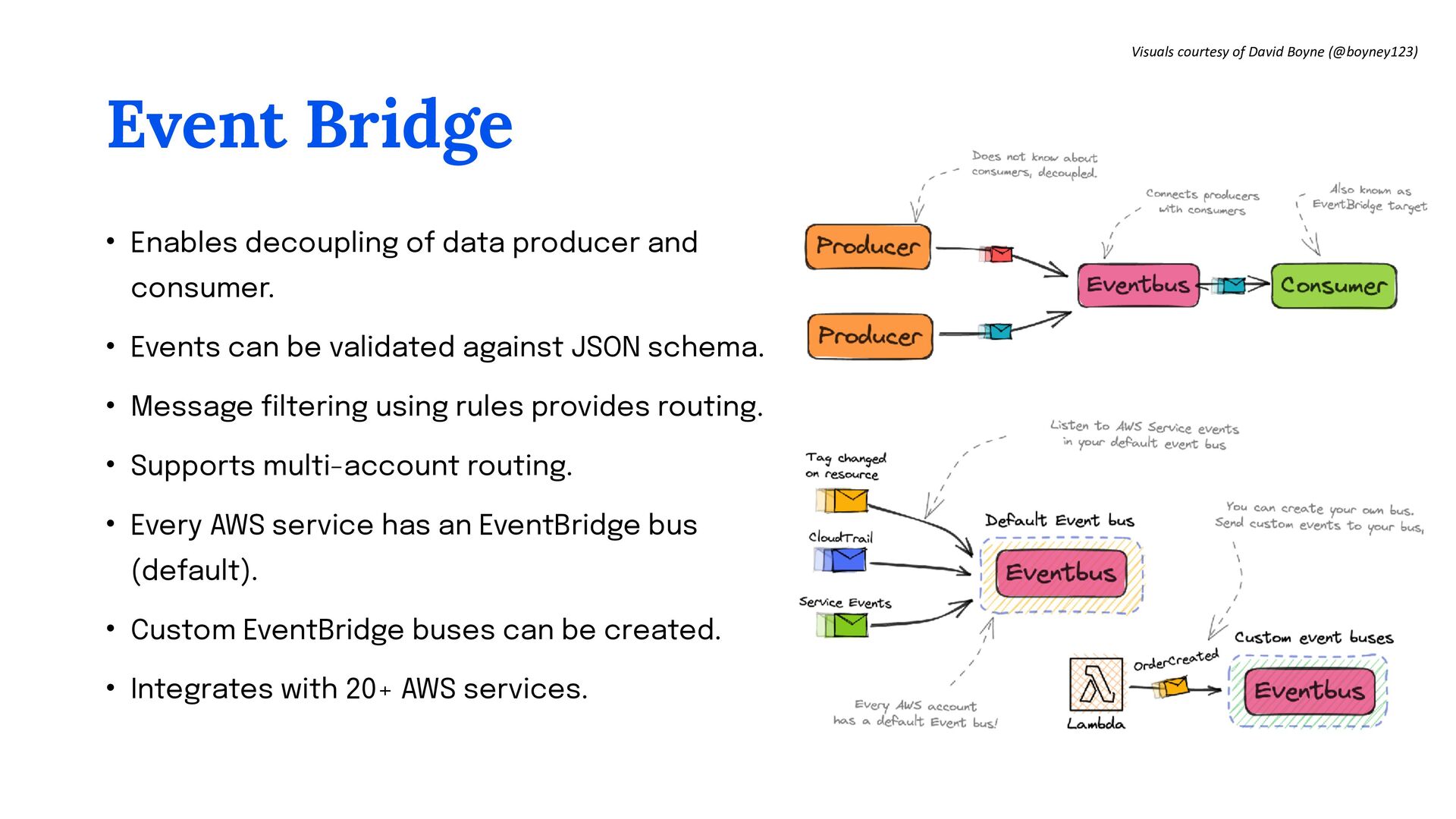
• Events can be validated against JSON schema. • Message filtering using rules provides routing. • Supports multi-account routing. • Every AWS service has an EventBridge bus (default). • Custom EventBridge buses can be created. • Integrates with 20+ AWS services. Visuals courtesy of David Boyne (@boyney123)
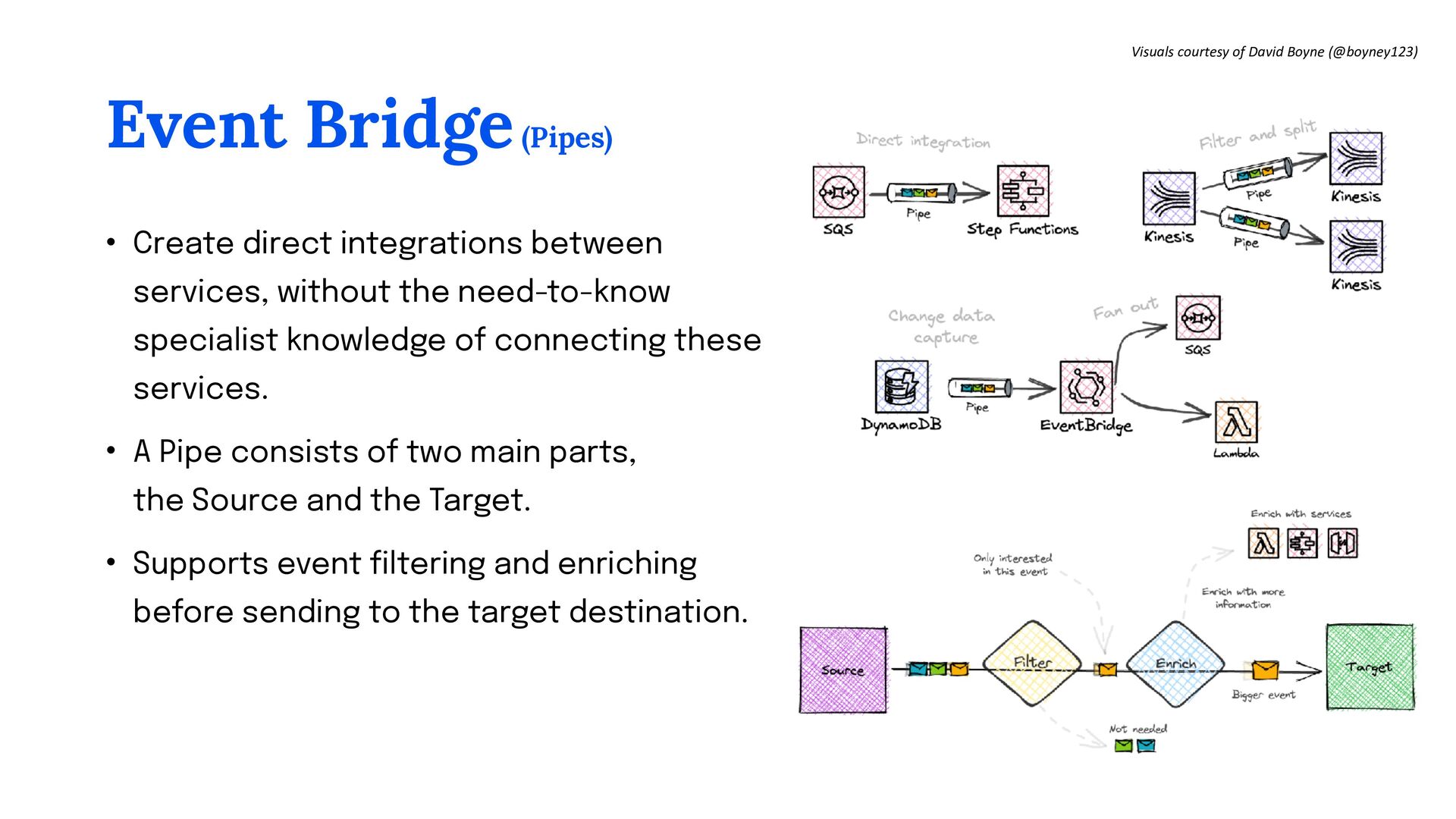
the need-to-know specialist knowledge of connecting these services. • A Pipe consists of two main parts, the Source and the Target. • Supports event filtering and enriching before sending to the target destination. Visuals courtesy of David Boyne (@boyney123)
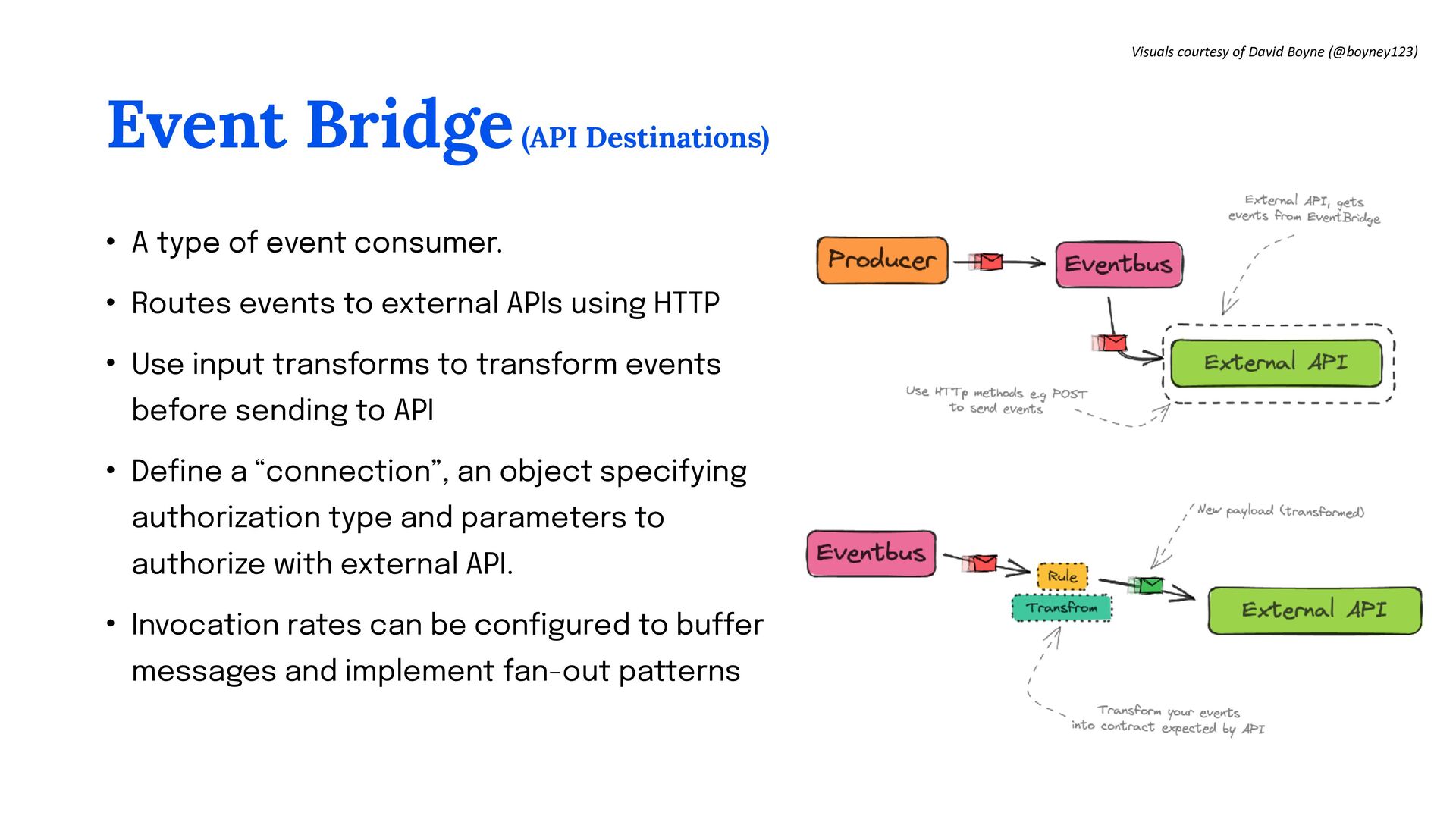
• Routes events to external APIs using HTTP • Use input transforms to transform events before sending to API • Define a “connection”, an object specifying authorization type and parameters to authorize with external API. • Invocation rates can be configured to buffer messages and implement fan-out patterns Visuals courtesy of David Boyne (@boyney123)
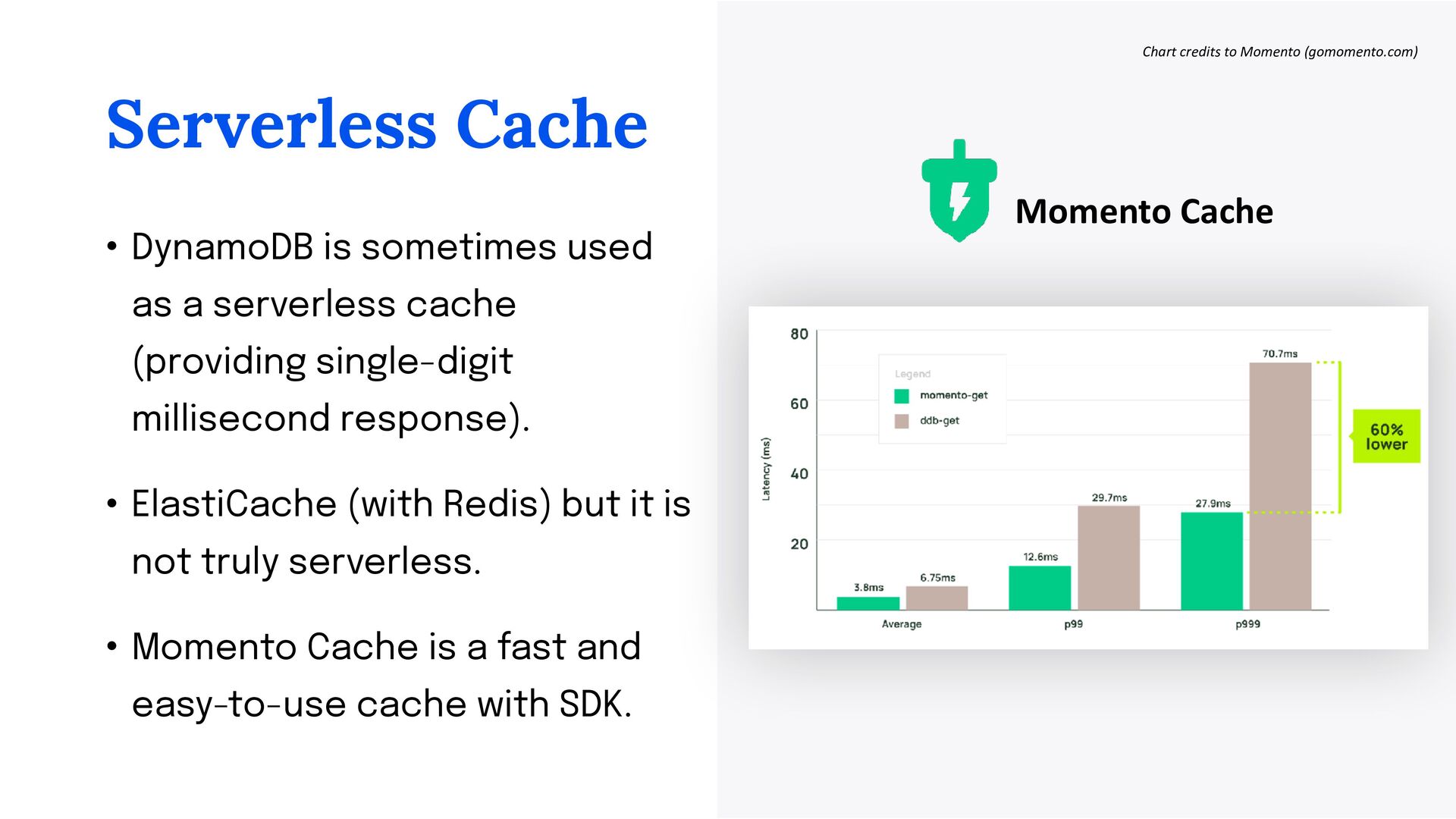
cache (providing single-digit millisecond response). • ElastiCache (with Redis) but it is not truly serverless. • Momento Cache is a fast and easy-to-use cache with SDK. Momento Cache Chart credits to Momento (gomomento.com)
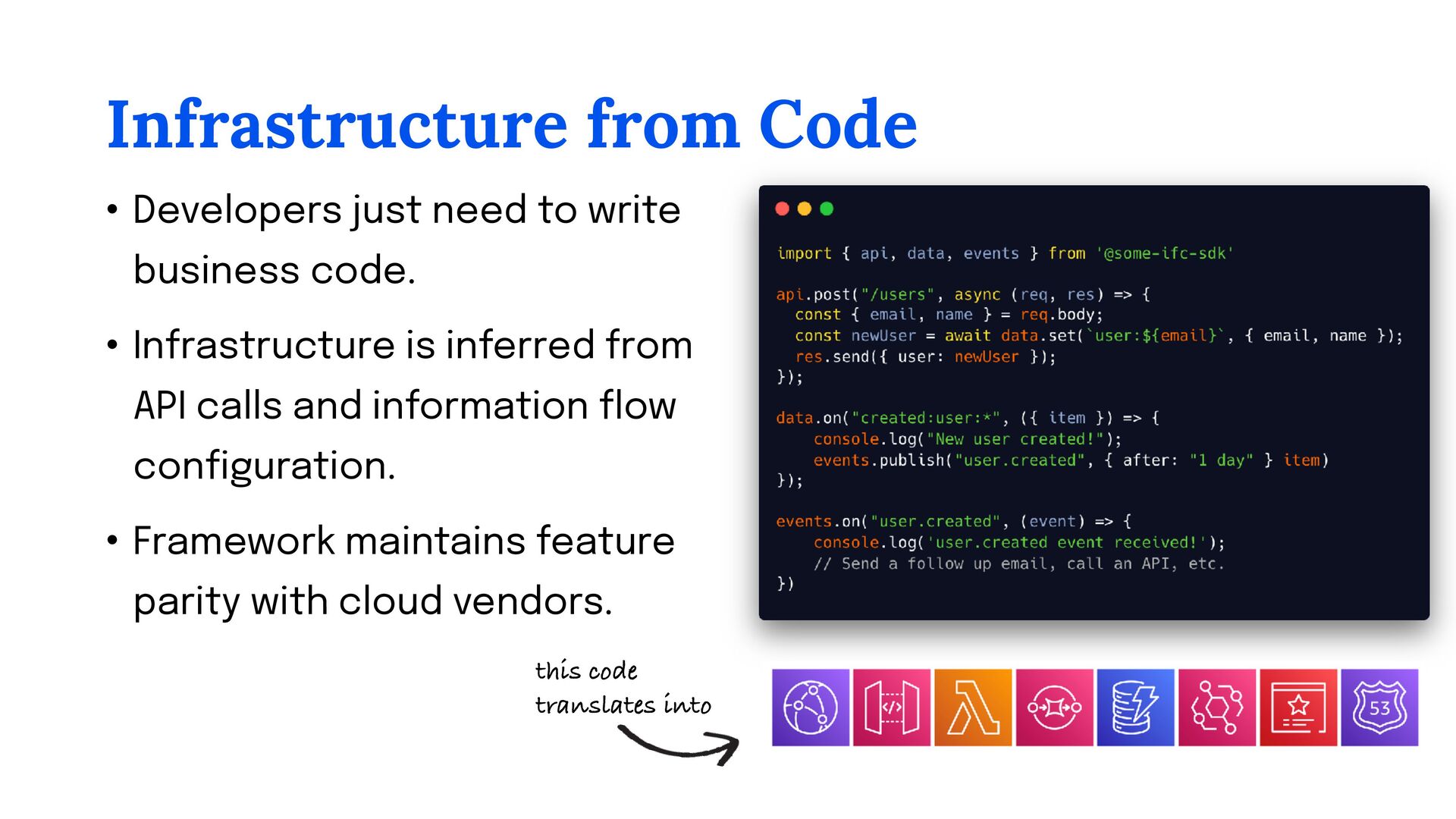
code. • Infrastructure is inferred from API calls and information flow configuration. • Framework maintains feature parity with cloud vendors. this code translates into
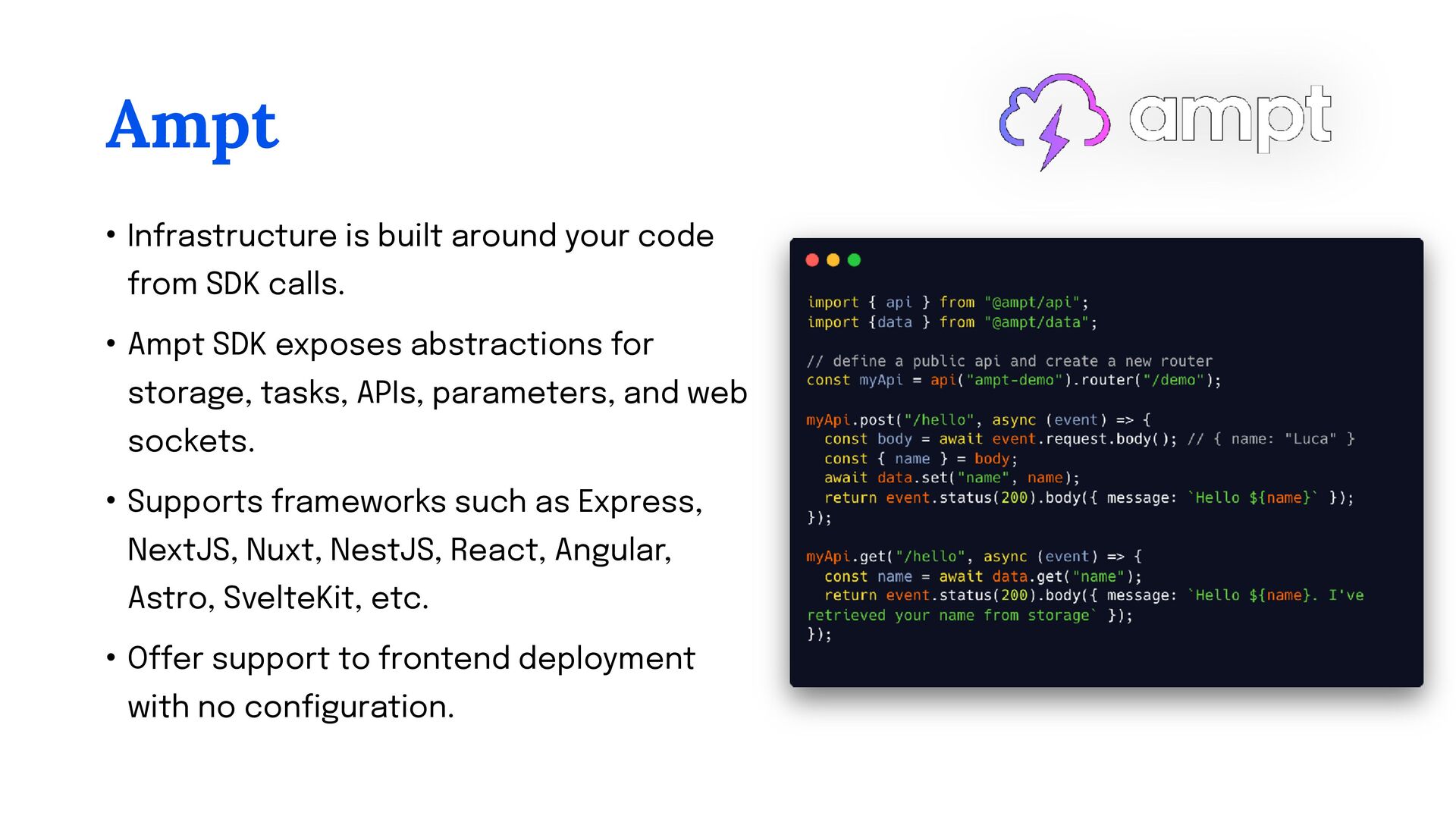
calls. • Ampt SDK exposes abstractions for storage, tasks, APIs, parameters, and web sockets. • Supports frameworks such as Express, NextJS, Nuxt, NestJS, React, Angular, Astro, SvelteKit, etc. • Offer support to frontend deployment with no configuration.
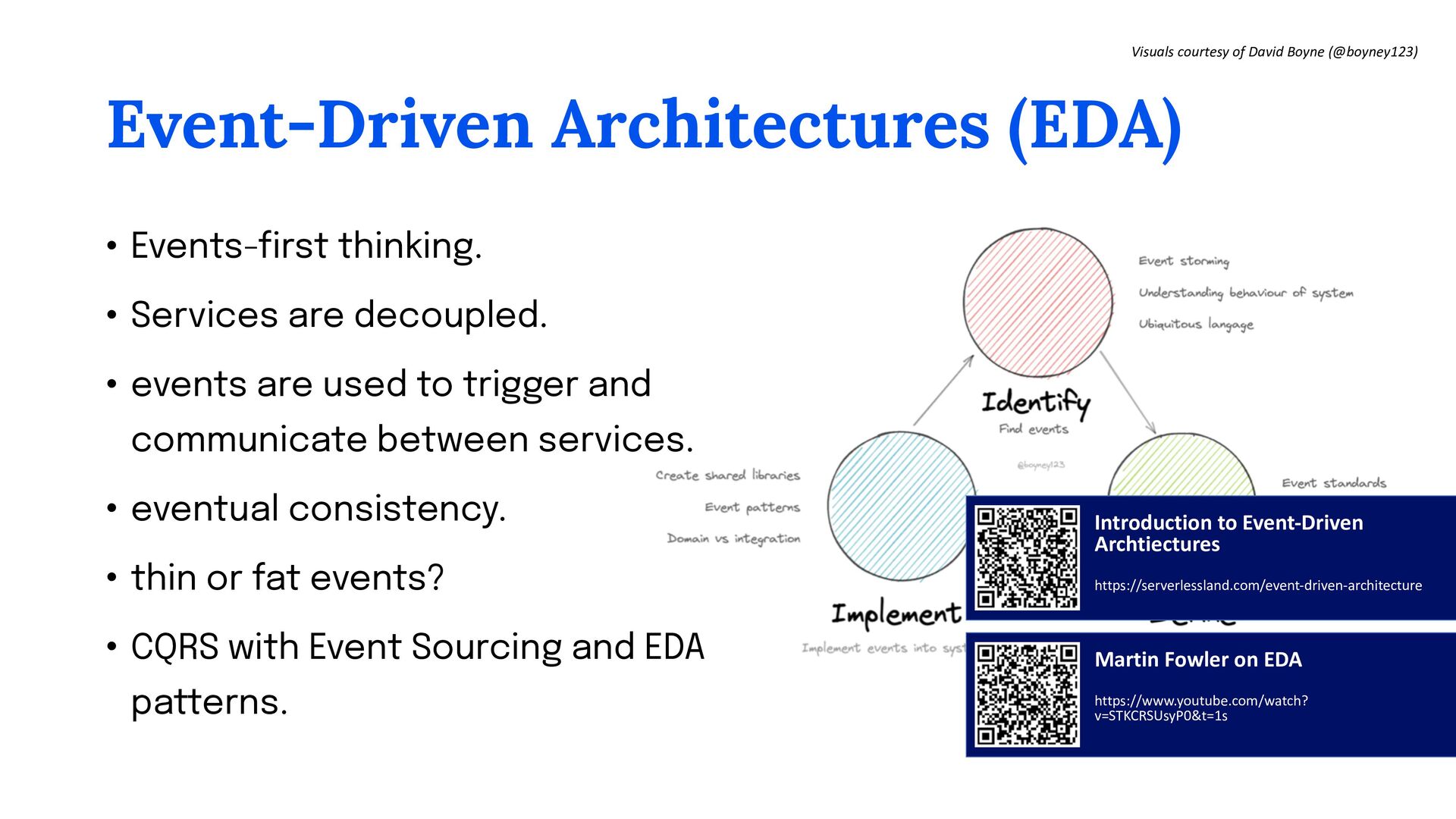
• events are used to trigger and communicate between services. • eventual consistency. • thin or fat events? • CQRS with Event Sourcing and EDA patterns. Martin Fowler on EDA https://www.youtube.com/watch? v=STKCRSUsyP0&t=1s Introduction to Event-Driven Archtiectures https://serverlessland.com/event-driven-architecture Visuals courtesy of David Boyne (@boyney123)


 aletheia
 nayuts
 toru_kubota
 naruoga
 oracle4engineer
 vivion
 dtunkelang
 ks91
ks91
 soudai
 mochizuki875
 ymiya55
 ichiki1023
 furuton
 danielanewman
 mkilby
 kevinliebholz
 palkan
 morganepeng
 schroneko
 skoyamalab
 addyosmani
 tessaabrams
 inesmontani
 tamaranovitovic
 jonrohan