Upgrade to Pro — share decks privately, control downloads, hide ads and more …

The Tiniest Durable Agent

Sponsored · Ship Features Fearlessly Turn features on and off without deploys. Used by thousands of Ruby developers.

The Tiniest Durable Agent

AI agents are easy to demo and still hard to operate in production. You can build a working agent in a few lines of code, but the moment you care about crashes, retries, state, identity, or observability, things get complicated fast.

This talk shows how to build the tiniest durable agent in 10 lines of code, an agent that can fail, restart, and resume without losing its mind. We’ll look at what actually makes an agent production-ready, why most agent frameworks fall apart under real-world conditions, and how durability changes the way agents should be designed.

In 15 minutes, you’ll see how a small amount of agent code, combined with durable execution and externalized infrastructure concerns, turns a fragile demo into something you can actually run in prod. All done with Dapr.

Avatar for Bilgin Ibryam

Bilgin Ibryam

May 09, 2026

More Decks by Bilgin Ibryam

Other Decks in Technology

Transcript

  1. 2 • Product Manager at Diagrid • Working on https://dapr.io

    • Former Architect at Red Hat • Author and blogger ◦ Camel Design Patterns ◦ Kubernetes Patterns ◦ Prompt Patterns (WIP) X @bibryam Bilgin Ibryam
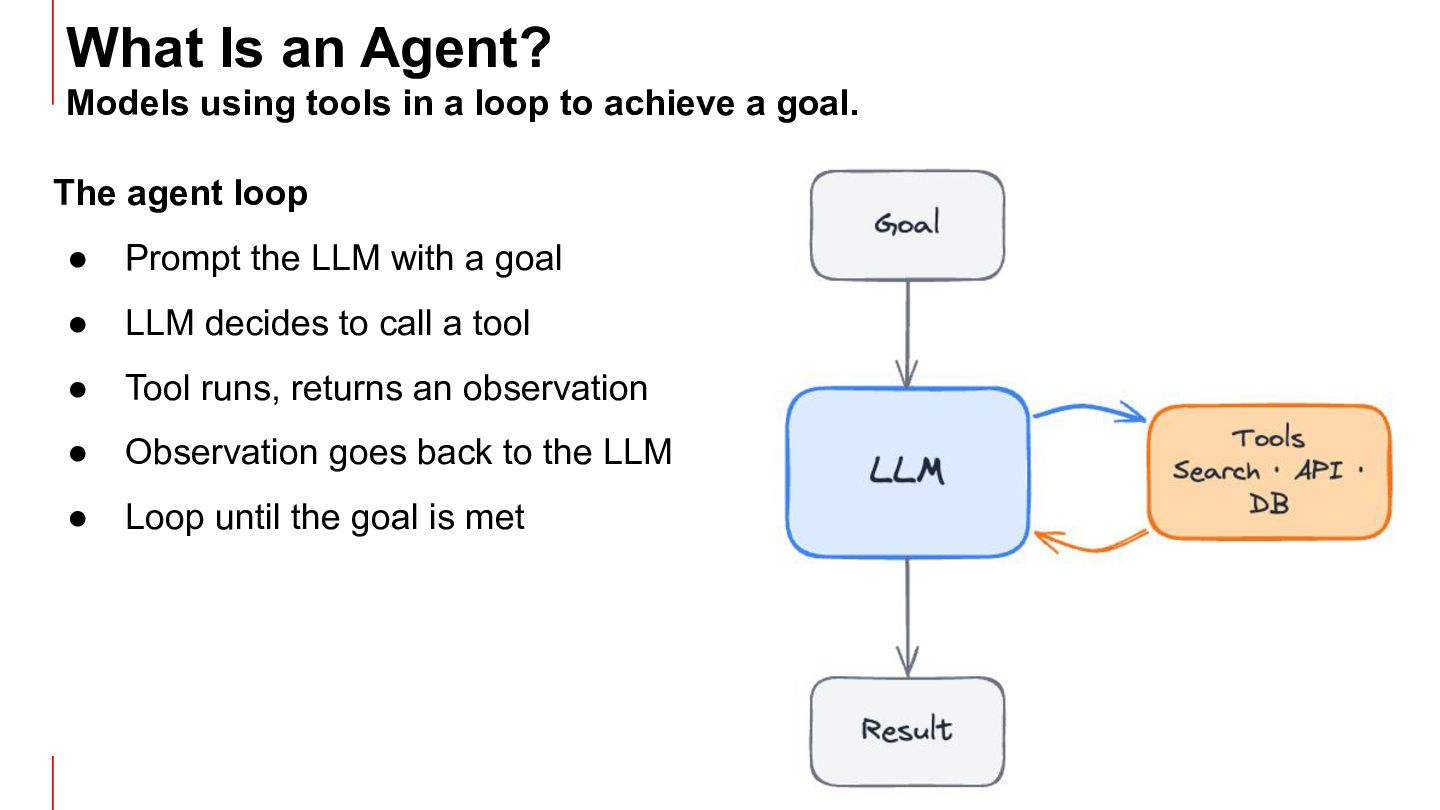
  2. The agent loop • Prompt the LLM with a goal

    • LLM decides to call a tool • Tool runs, returns an observation • Observation goes back to the LLM • Loop until the goal is met What Is an Agent? Models using tools in a loop to achieve a goal.
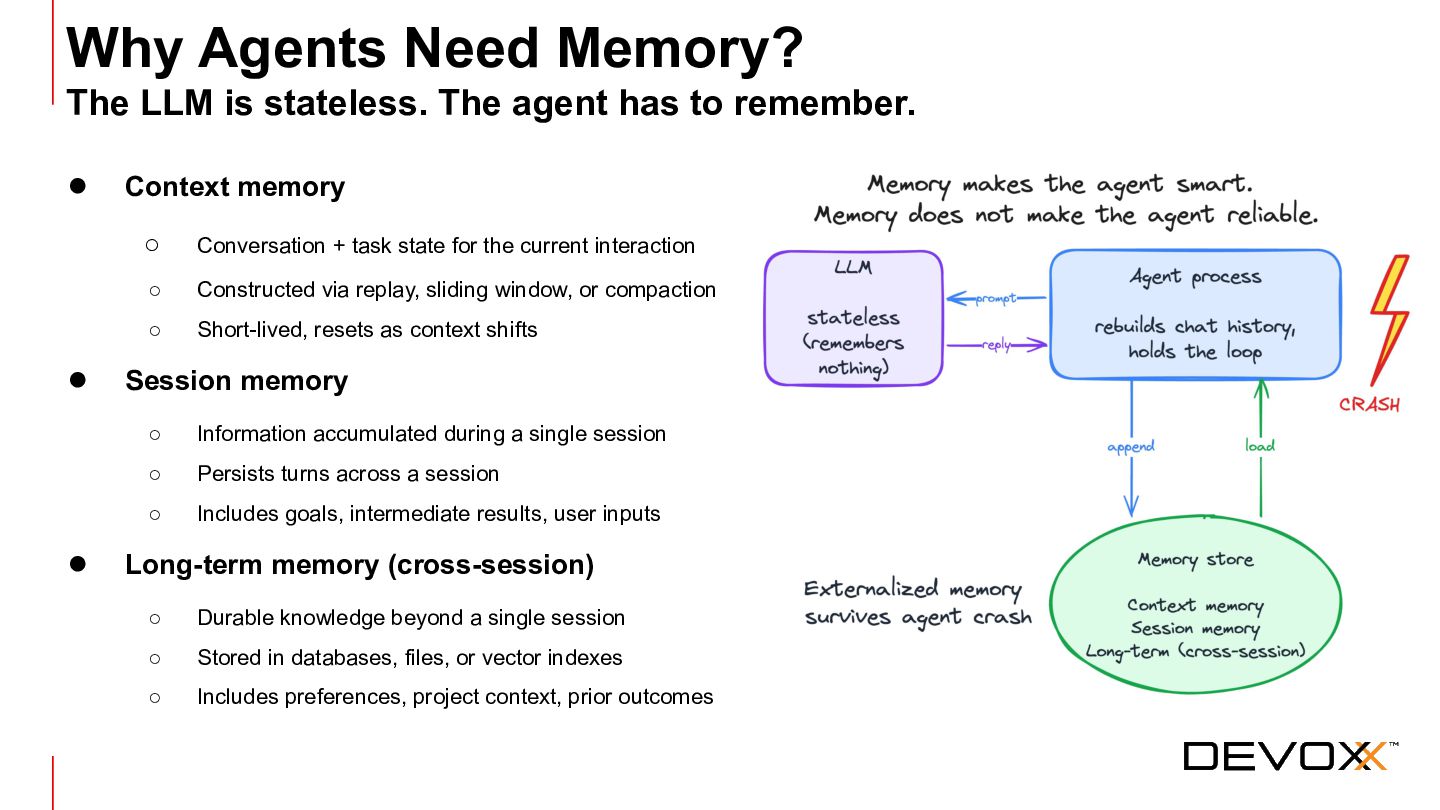
  3. • Context memory ◦ Conversation + task state for the

    current interaction ◦ Constructed via replay, sliding window, or compaction ◦ Short-lived, resets as context shifts • Session memory ◦ Information accumulated during a single session ◦ Persists turns across a session ◦ Includes goals, intermediate results, user inputs • Long-term memory (cross-session) ◦ Durable knowledge beyond a single session ◦ Stored in databases, files, or vector indexes ◦ Includes preferences, project context, prior outcomes Why Agents Need Memory? The LLM is stateless. The agent has to remember.
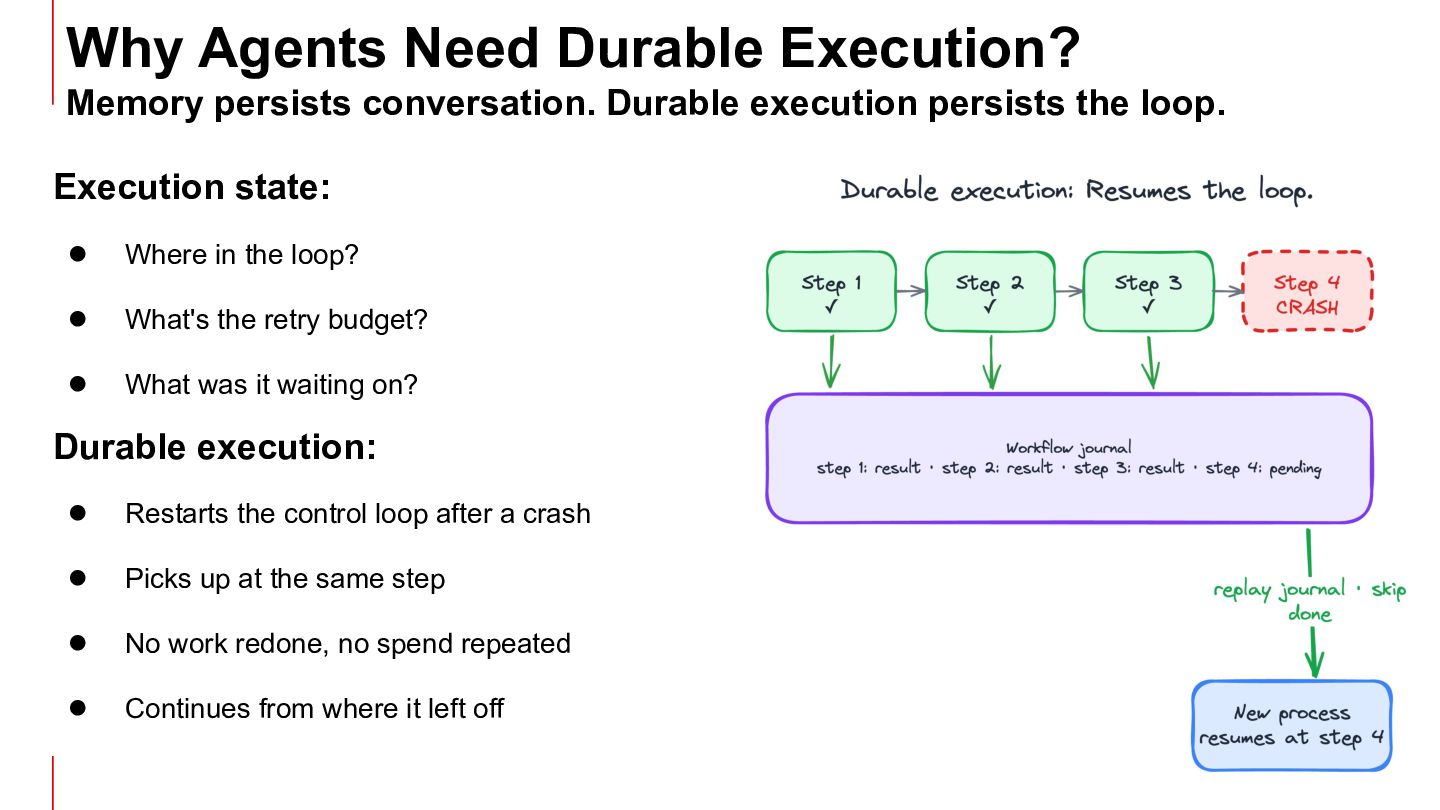
  4. Execution state: • Where in the loop? • What's the

    retry budget? • What was it waiting on? Durable execution: • Restarts the control loop after a crash • Picks up at the same step • No work redone, no spend repeated • Continues from where it left off Why Agents Need Durable Execution? Memory persists conversation. Durable execution persists the loop.
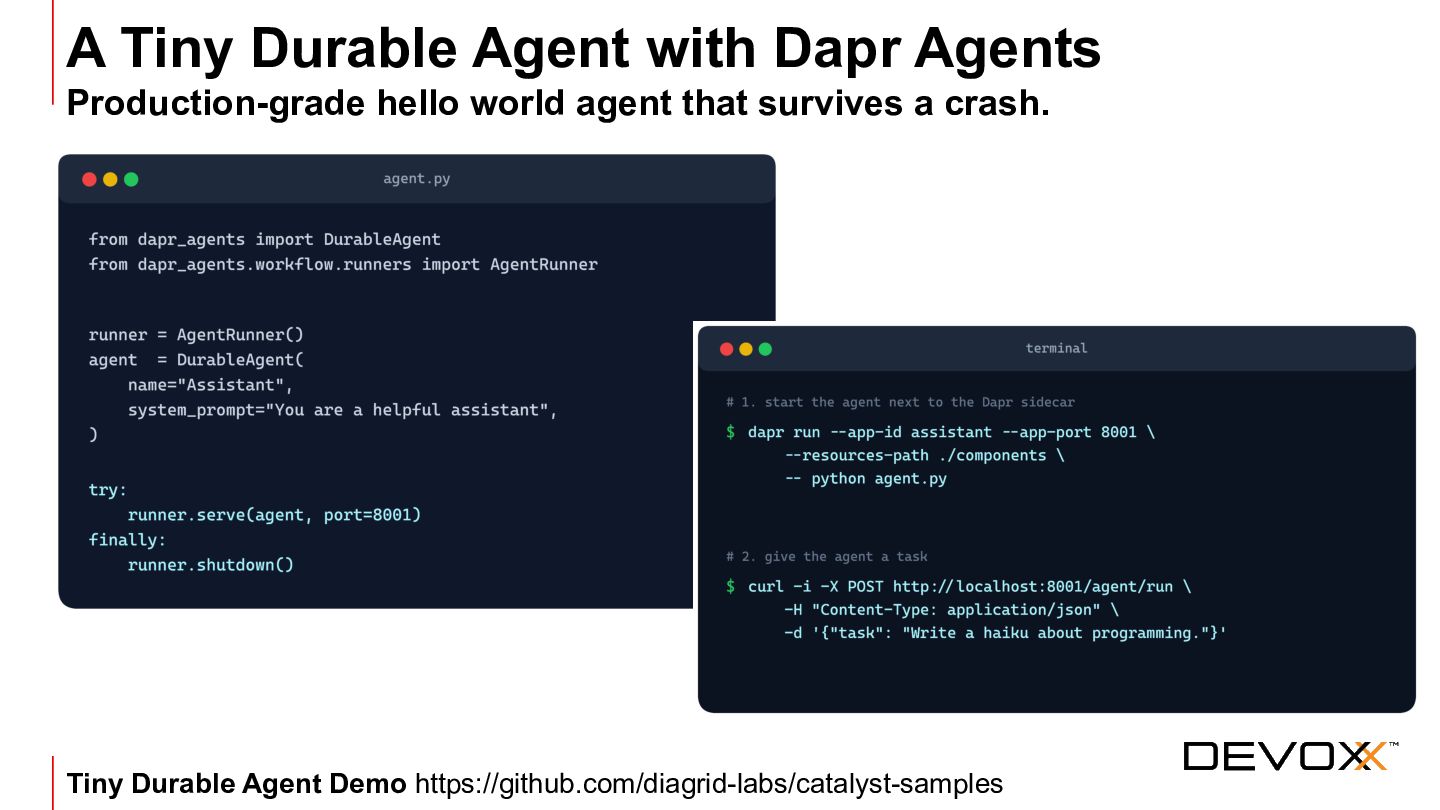
  5. A Tiny Durable Agent with Dapr Agents Production-grade hello world

    agent that survives a crash. Tiny Durable Agent Demo https://github.com/diagrid-labs/catalyst-samples
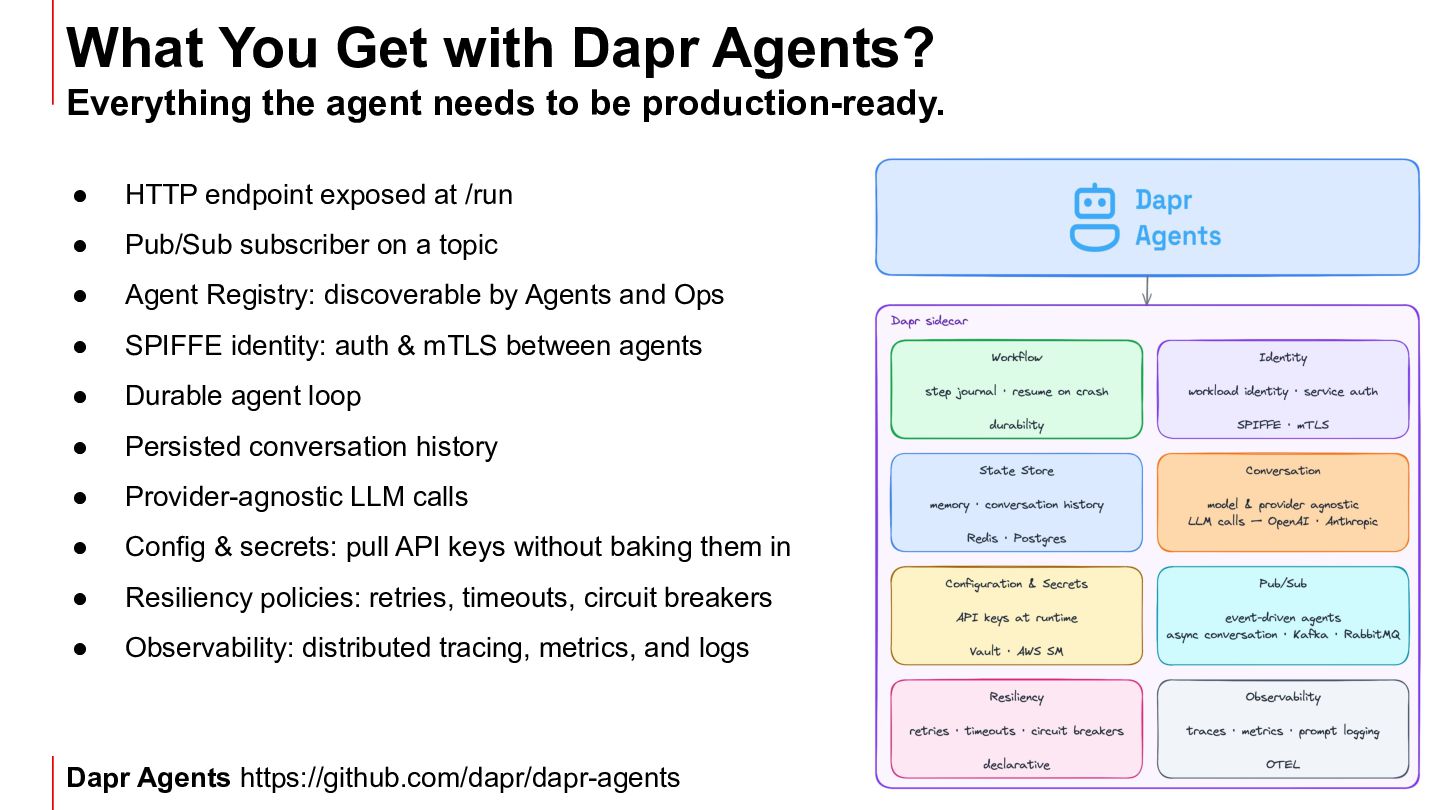
  6. What You Get with Dapr Agents? Everything the agent needs

    to be production-ready. • HTTP endpoint exposed at /run • Pub/Sub subscriber on a topic • Agent Registry: discoverable by Agents and Ops • SPIFFE identity: auth & mTLS between agents • Durable agent loop • Persisted conversation history • Provider-agnostic LLM calls • Config & secrets: pull API keys without baking them in • Resiliency policies: retries, timeouts, circuit breakers • Observability: distributed tracing, metrics, and logs Dapr Agents https://github.com/dapr/dapr-agents
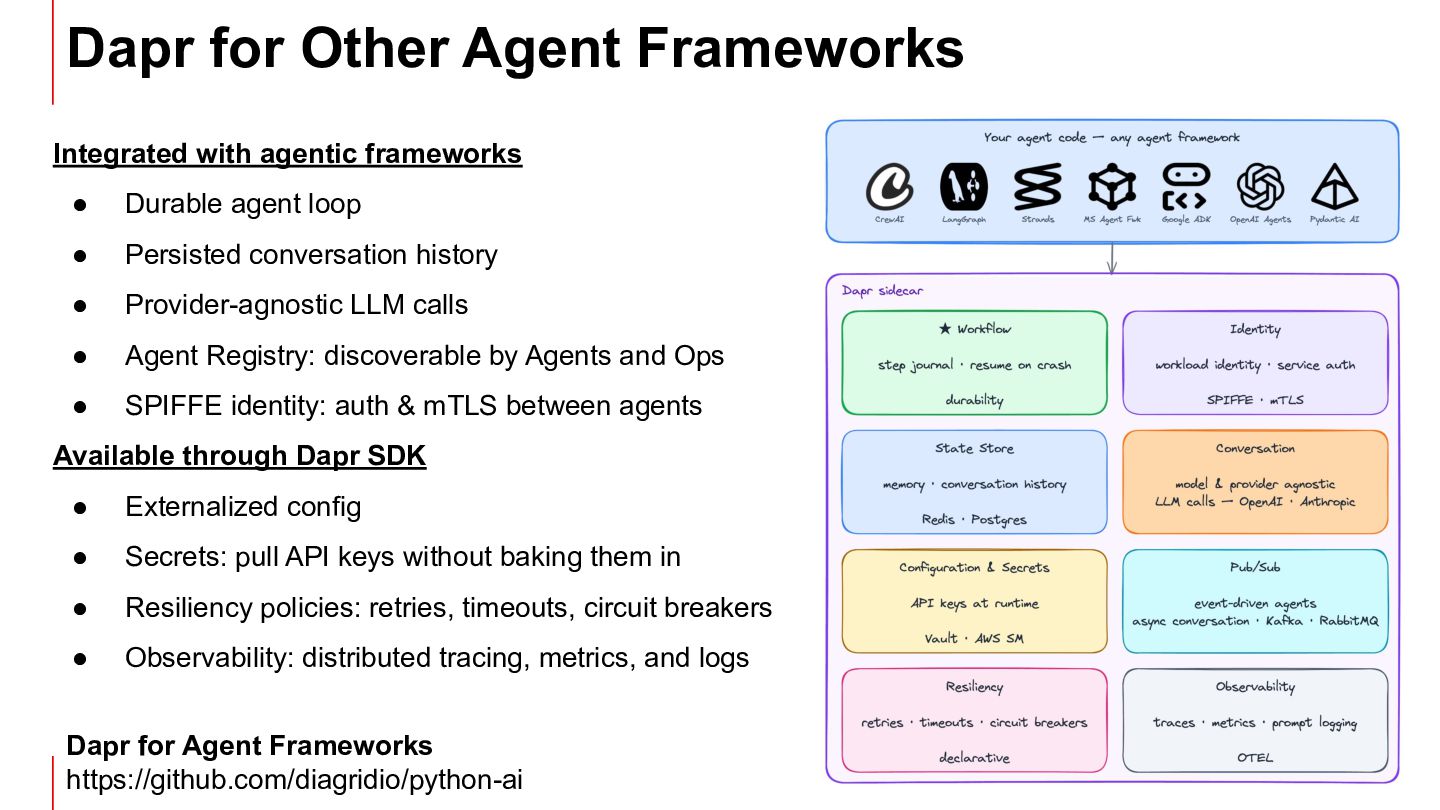
  7. Integrated with agentic frameworks • Durable agent loop • Persisted

    conversation history • Provider-agnostic LLM calls • Agent Registry: discoverable by Agents and Ops • SPIFFE identity: auth & mTLS between agents Available through Dapr SDK • Externalized config • Secrets: pull API keys without baking them in • Resiliency policies: retries, timeouts, circuit breakers • Observability: distributed tracing, metrics, and logs Dapr for Other Agent Frameworks Dapr for Agent Frameworks https://github.com/diagridio/python-ai
  8. Durability is the floor, not the ceiling. Identity, observability: that's

    where production agents actually lives. Takeaway