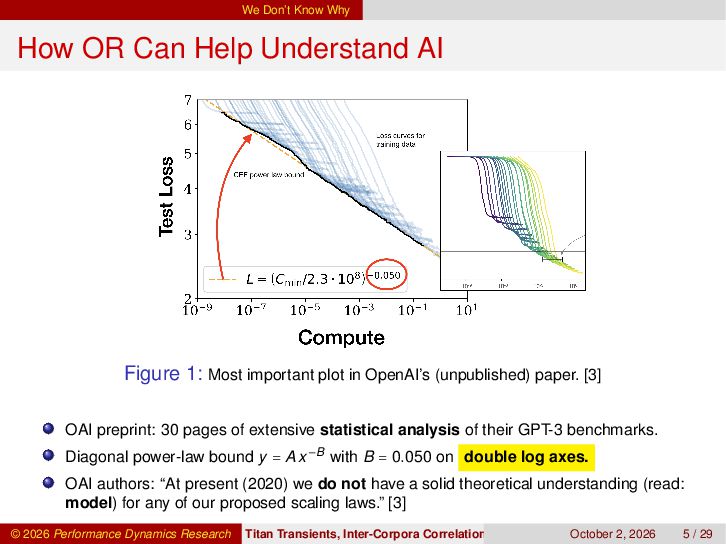
While benchmarking its ChatGPT LLMs internally, OpenAI researchers noticed
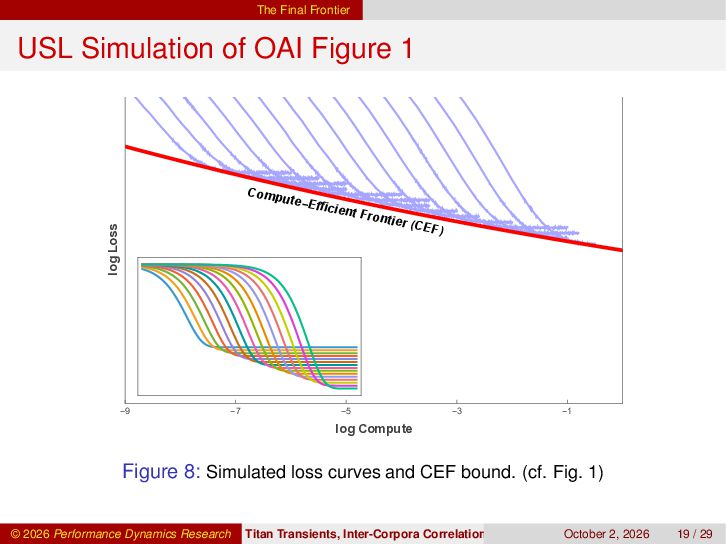
that after a significant amount of computational effort on a given size LLM, there was no improvement in Test Loss error reduction. Instead, the loss curve takes on a reverse-S shape or sigmoidal characteristic where the loss eventually remains constant at the foot of the S.
To combat this limitation, larger LLM instances—containing decades more neu-
ral net connections—were invoked to further reduce the Test Loss. However, that resulted in a sequence of successively lower sigmoidal curves that appear to fall on a descending line, which they called the ”compute-efficient frontier” (CEF). The CEF bound raised concerns that it might constitute a universal constraint on the scalability of all LLM systems.
This talk presents a model of LLM computational dynamics, based on the Univer-
sal Scalability Law, that provides a framework for understanding the CEF. The USL defines bistable minima in the tokenized neural net landscape.
This talk explains:
1. Why all training loss curves have a sigmoidal characteristic
2. Why the observed CEF constraint exists
3. What the CEF correlation means for LLM scalability
More details have been published in reference [1].


 drqz
drqz
.png) satai
satai
 microbaseinc
 kanekomasahiro
 ontheslope
 izumiyama_lab
 nttcom
 chck
chck
 kinoue_smarthr
 youten622
 rfujii
 gpeyre
 tamaranovitovic
 sachag
 seathinner
 eileencodes
 paigeccino
 schlessera
 lindahogenes
 akihiro_kokubo
 yeseniaperezcruz
 keavy
keavy
 lfama
lfama
 jonyablonski
![Bistable Queues Universal Scalability Law or USL X(N) Out[ ]](https://files.speakerdeck.com/presentations/dada6c9afef54b60a3e88648eab275e7/slide_8.jpg)
![Bistable Queues USL Bistable Queue Out[ ] = Figure 3:](https://files.speakerdeck.com/presentations/dada6c9afef54b60a3e88648eab275e7/slide_9.jpg)
![Bistable Queues Out[ ] = Take the difference of red](https://files.speakerdeck.com/presentations/dada6c9afef54b60a3e88648eab275e7/slide_10.jpg)
![Bistable Queues Drift (b) Out[ ] = N Take the](https://files.speakerdeck.com/presentations/dada6c9afef54b60a3e88648eab275e7/slide_11.jpg)
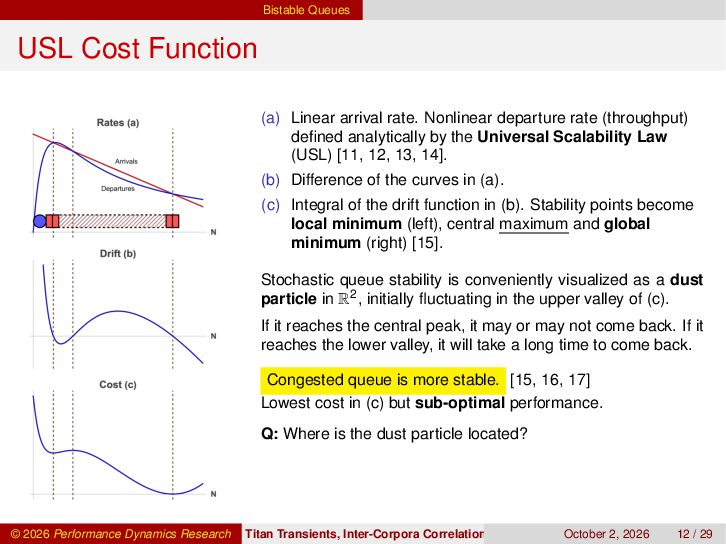
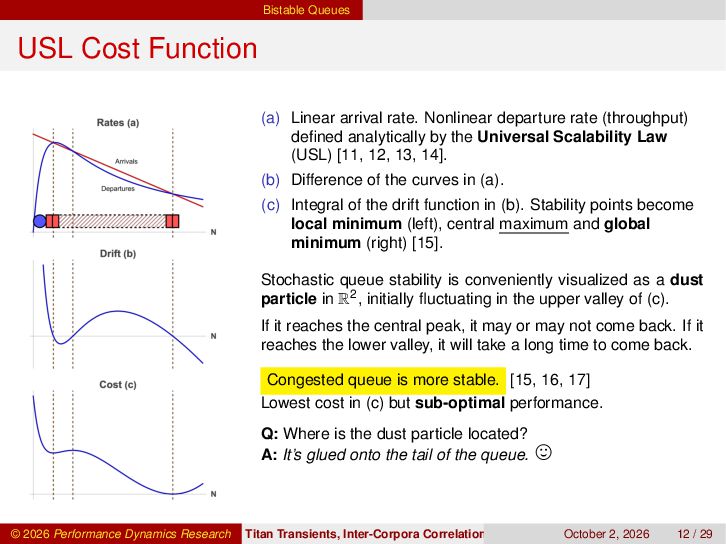
![Bistable Queues Cost (c) Out[ ] = N Nonlinear cost](https://files.speakerdeck.com/presentations/dada6c9afef54b60a3e88648eab275e7/slide_12.jpg)
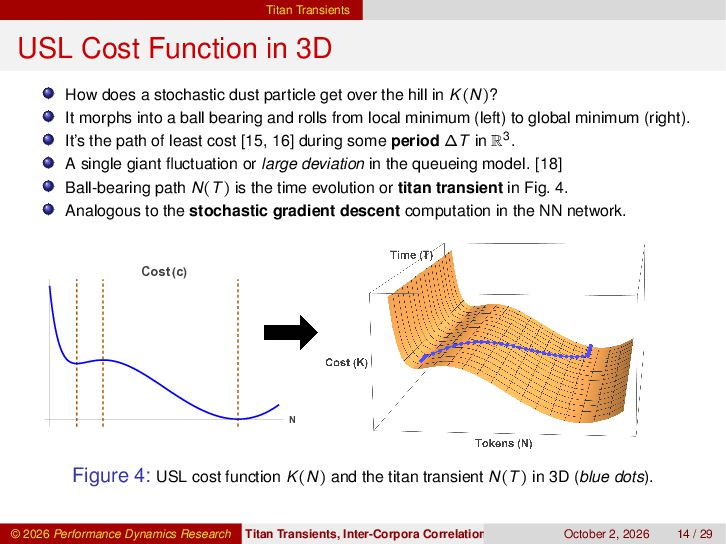
![Titan Transients Titan Transient in 3D Out[ ] = Figure](https://files.speakerdeck.com/presentations/dada6c9afef54b60a3e88648eab275e7/slide_17.jpg)
![The Final Frontier USL Compute Frontier Out[ ] = Figure](https://files.speakerdeck.com/presentations/dada6c9afef54b60a3e88648eab275e7/slide_19.jpg)
![The Final Frontier OAI Figure 1 Explained Out[ ] =](https://files.speakerdeck.com/presentations/dada6c9afef54b60a3e88648eab275e7/slide_20.jpg)
![Conclusion Zipf’s Law ZipfLaw(x) 0.30 [ ] = PwrLaw(1.5, x)](https://files.speakerdeck.com/presentations/dada6c9afef54b60a3e88648eab275e7/slide_25.jpg)
![References References I [1] N.J. Gunther, “Titan Transients and LLM](https://files.speakerdeck.com/presentations/dada6c9afef54b60a3e88648eab275e7/slide_32.jpg)
![References References II [15] N.J. Gunther, “Path Integrals for Computers,”](https://files.speakerdeck.com/presentations/dada6c9afef54b60a3e88648eab275e7/slide_33.jpg)