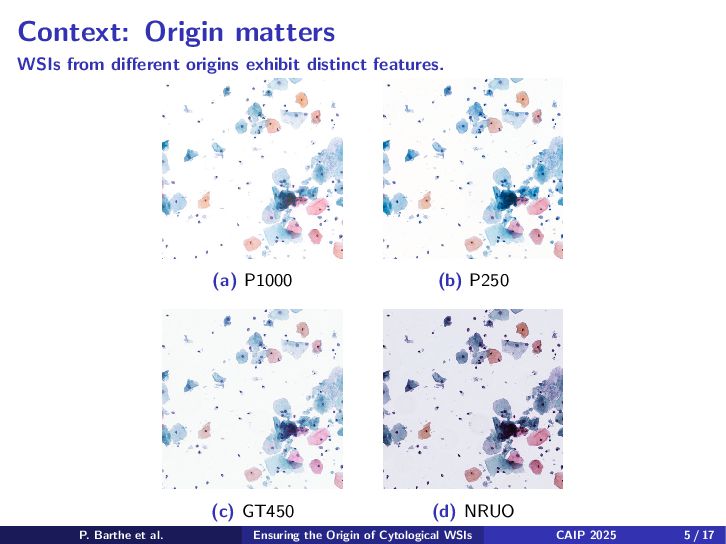
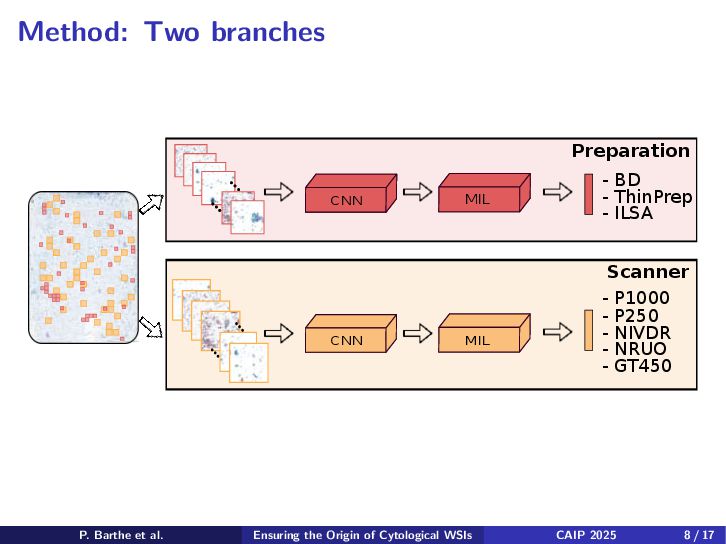
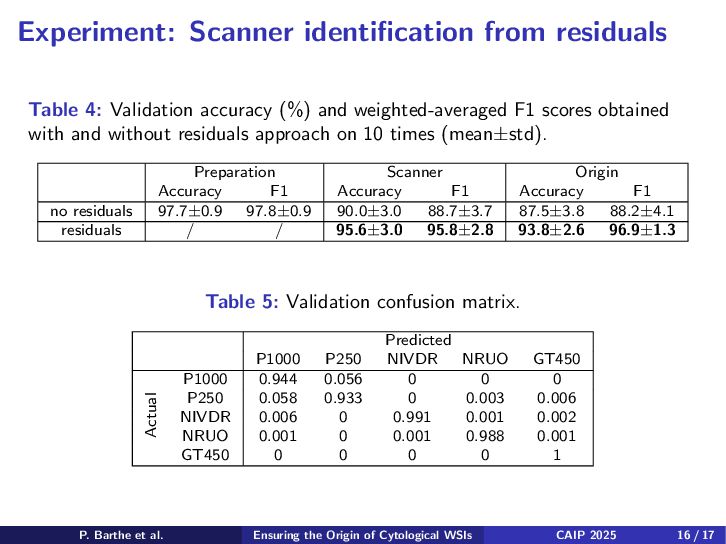
and Scanner Detection Paul Barthe1,2 Romain Brixtel1 Mathieu Fontaine1 Arnaud Renouf1 S´ ebastien Bougleux2 Olivier L´ ezoray2 Datexim, Caen, France1 Universit´ e Caen Normandie, ENSICAEN, CNRS, GREYC, Caen, France2 21st International Conference in Computer Analysis of Images and Patterns, September 2025 P. Barthe et al. Ensuring the Origin of Cytological WSIs CAIP 2025 1 / 17
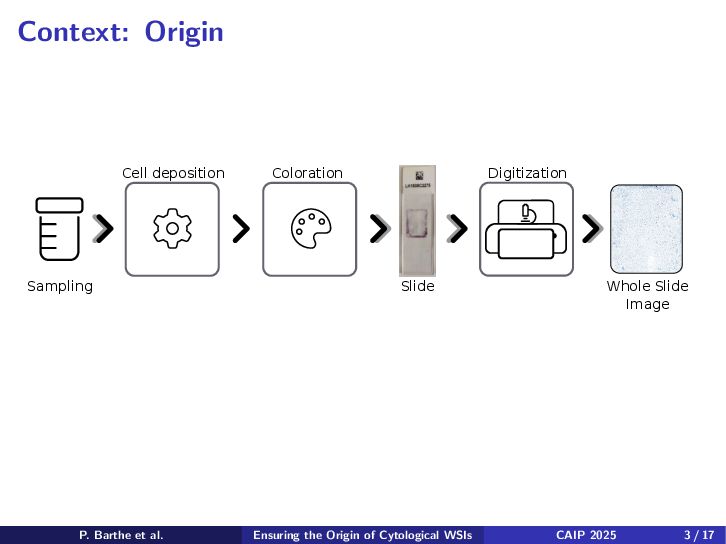
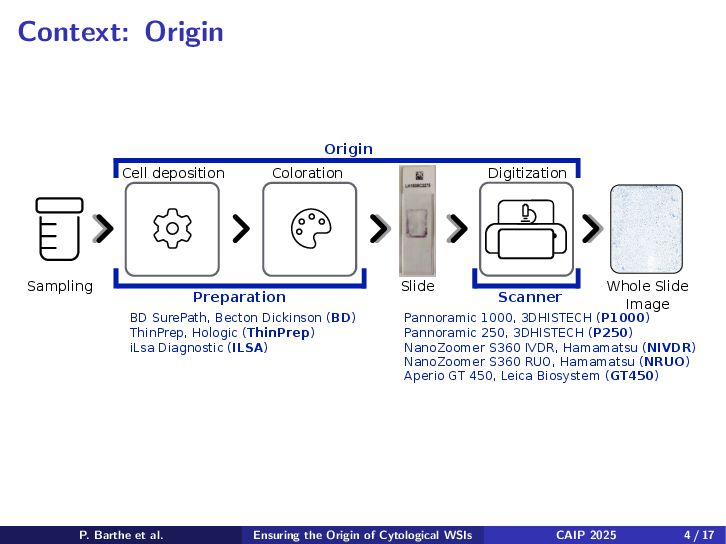
Machine learning models are usually trained for a specific origin. Problem: At inference, how can we ensure that a WSI is suitable for a model ? Put differently: How can we ensure that a WSI comes from the correct origin ? P. Barthe et al. Ensuring the Origin of Cytological WSIs CAIP 2025 6 / 17
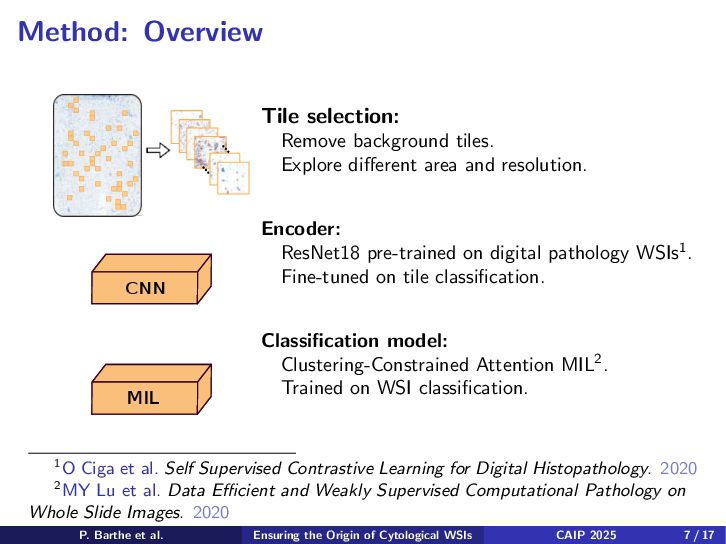
different area and resolution. Encoder: ResNet18 pre-trained on digital pathology WSIs1. Fine-tuned on tile classification. Classification model: Clustering-Constrained Attention MIL2. Trained on WSI classification. 1O Ciga et al. Self Supervised Contrastive Learning for Digital Histopathology. 2020 2MY Lu et al. Data Efficient and Weakly Supervised Computational Pathology on Whole Slide Images. 2020 P. Barthe et al. Ensuring the Origin of Cytological WSIs CAIP 2025 7 / 17
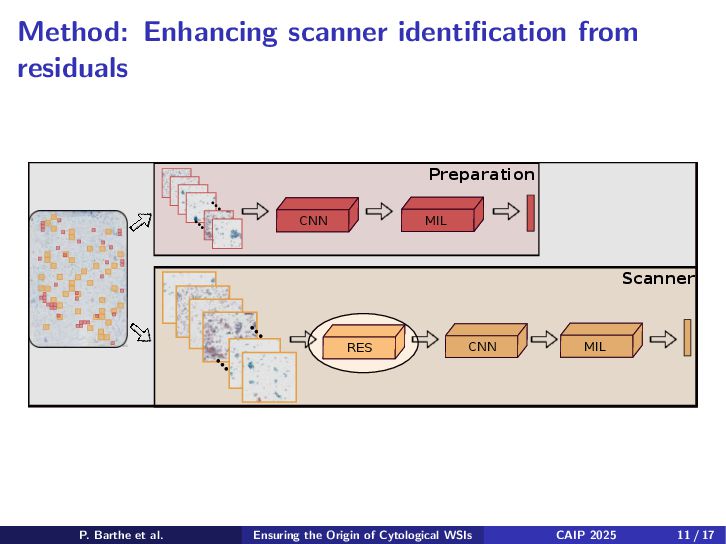
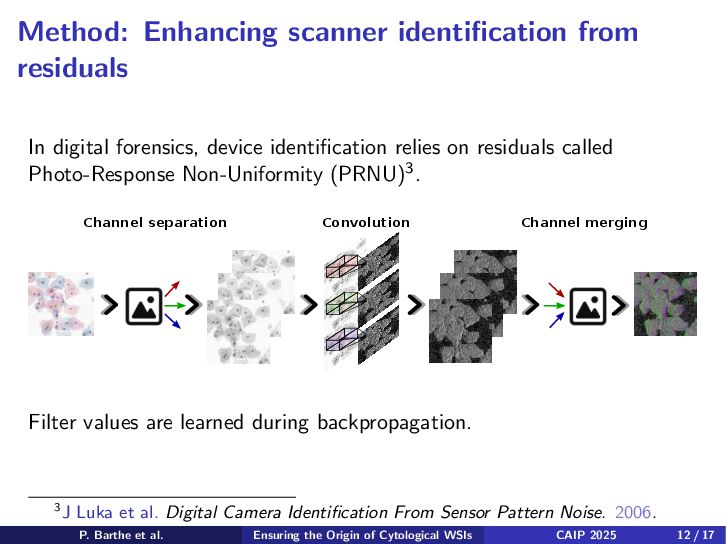
identification relies on residuals called Photo-Response Non-Uniformity (PRNU)3. Channel separation Channel merging Convolution Filter values are learned during backpropagation. 3J Luka et al. Digital Camera Identification From Sensor Pattern Noise. 2006. P. Barthe et al. Ensuring the Origin of Cytological WSIs CAIP 2025 12 / 17
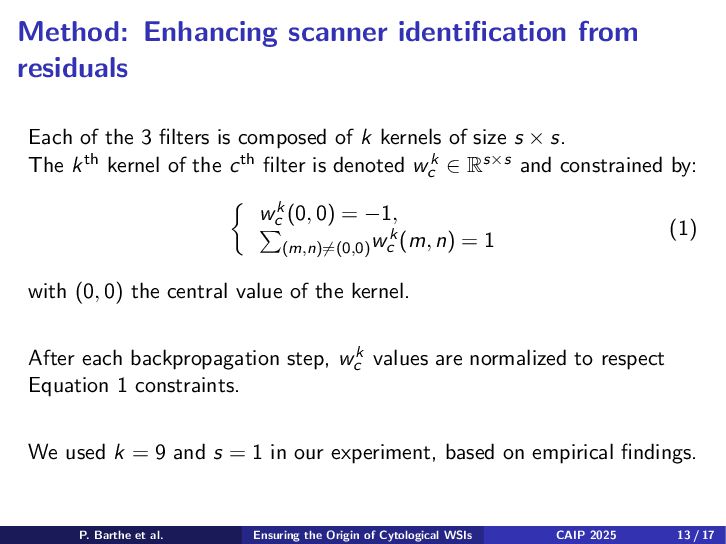
filters is composed of k kernels of size s × s. The kth kernel of the cth filter is denoted wk c ∈ Rs×s and constrained by: wk c (0 , 0) = −1 , (m , n)̸=(0 , 0) wk c (m , n) = 1 (1) with (0 , 0) the central value of the kernel. After each backpropagation step, wk c values are normalized to respect Equation 1 constraints. We used k = 9 and s = 1 in our experiment, based on empirical findings. P. Barthe et al. Ensuring the Origin of Cytological WSIs CAIP 2025 13 / 17
detection works. Perspectives: How to handle new origins ? Is there a correlation between machine learning performances and origin detection ? P. Barthe et al. Ensuring the Origin of Cytological WSIs CAIP 2025 17 / 17
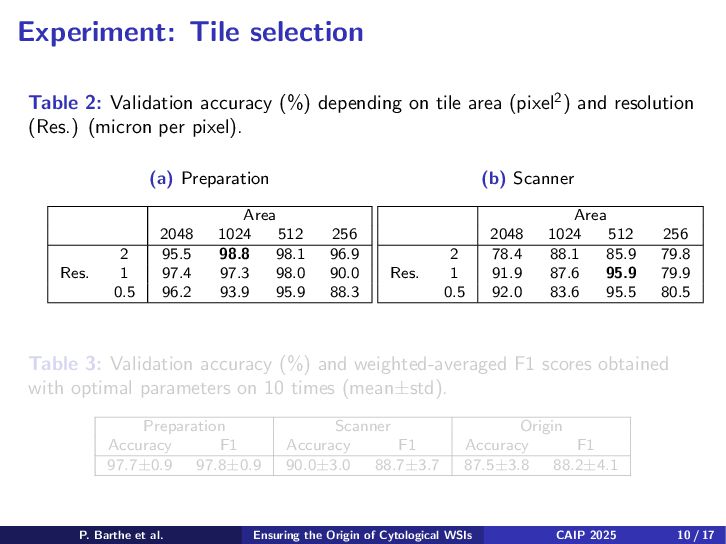
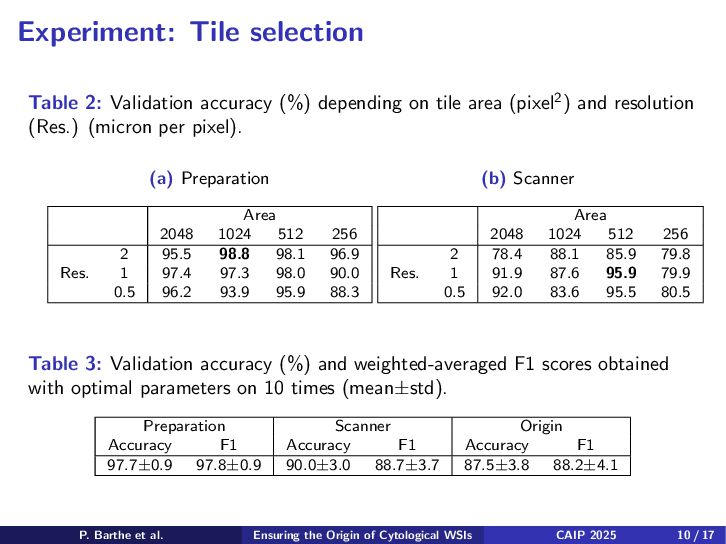
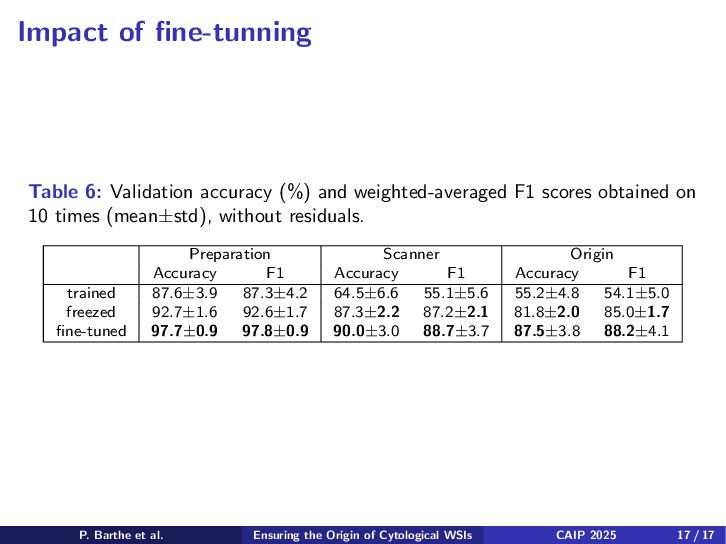
F1 scores obtained on 10 times (mean±std), without residuals. Preparation Scanner Origin Accuracy F1 Accuracy F1 Accuracy F1 trained 87.6±3.9 87.3±4.2 64.5±6.6 55.1±5.6 55.2±4.8 54.1±5.0 freezed 92.7±1.6 92.6±1.7 87.3±2.2 87.2±2.1 81.8±2.0 85.0±1.7 fine-tuned 97.7±0.9 97.8±0.9 90.0±3.0 88.7±3.7 87.5±3.8 88.2±4.1 P. Barthe et al. Ensuring the Origin of Cytological WSIs CAIP 2025 17 / 17
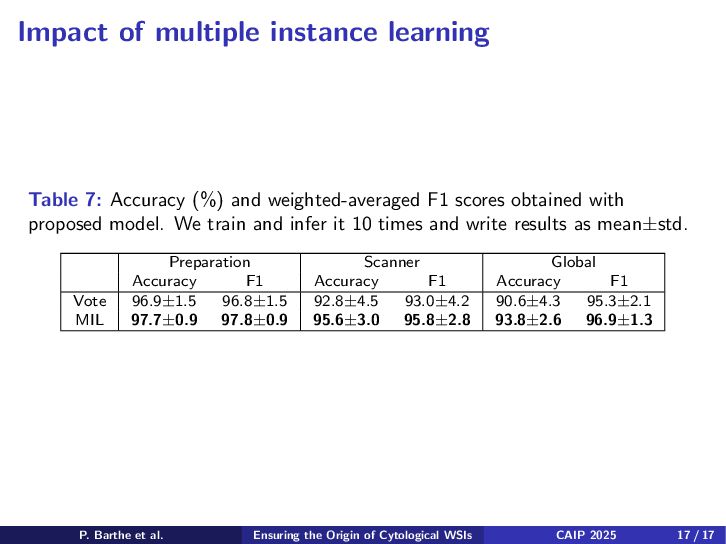
weighted-averaged F1 scores obtained with proposed model. We train and infer it 10 times and write results as mean±std. Preparation Scanner Global Accuracy F1 Accuracy F1 Accuracy F1 Vote 96.9±1.5 96.8±1.5 92.8±4.5 93.0±4.2 90.6±4.3 95.3±2.1 MIL 97.7±0.9 97.8±0.9 95.6±3.0 95.8±2.8 93.8±2.6 96.9±1.3 P. Barthe et al. Ensuring the Origin of Cytological WSIs CAIP 2025 17 / 17


 lezoray
 nzw0301
 fkske
fkske
 polipoli
 mikimhk
 dk999
dk999
 youten622
 institutdelelevage
.png) satai
satai
 yukiar
 signer
 xspa2012
 ks91
ks91
 tammielis
 skipperchong
 morganepeng
 rakko
rakko
 ipullrank
 marktimemedia
 holman
 mkilby
 frankvandijk
 iamctodd