Share
Embed
Transcript
15 slides
-
LEARNING TO MERGE SUPERPIXELS Olivier LÉZORAY Université Caen Normandie, ENSICAEN,
Normandie Univ, GREYC UMR 6072, Caen, FRANCE [email protected] https://lezoray.users.greyc.fr -
Outline 1. Motivation 2. Proposed Method (SNSM) 3. Experiments &
Results 4. Conclusion O. Lézoray et al.– EAAAI 2026 Learning to merge superpixels 2 / 15 -
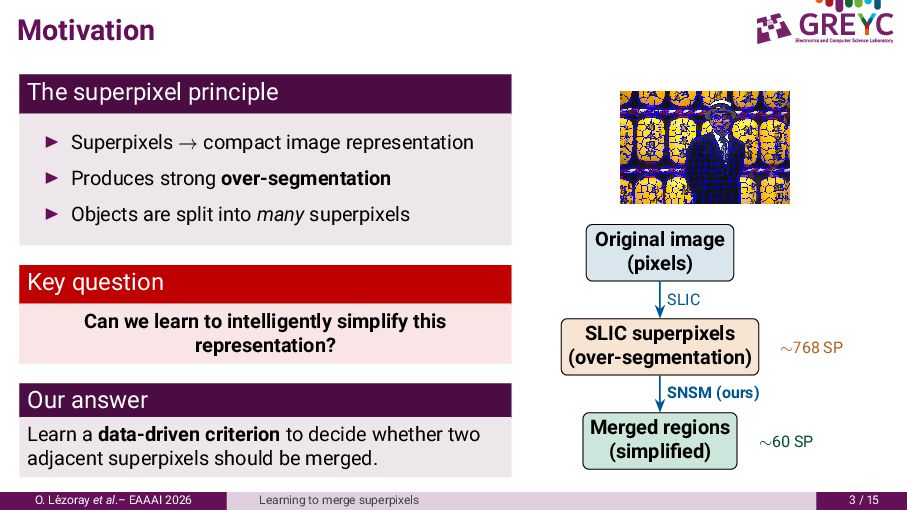
Motivation The superpixel principle ▶ Superpixels → compact image representation
▶ Produces strong over-segmentation ▶ Objects are split into many superpixels Original image (pixels) Key question SLIC Can we learn to intelligently simplify this representation? ∼768 SP SNSM (ours) Our answer Learn a data-driven criterion to decide whether two adjacent superpixels should be merged. O. Lézoray et al.– EAAAI 2026 SLIC superpixels (over-segmentation) Learning to merge superpixels Merged regions (simplified) ∼60 SP 3 / 15 -
Limits of Existing Approaches Method Limitation Heuristics [Barcelos, 2024] Manual
thresholds, poor generalization across textures Square patches [Huang, 2024] Pixels outside both superpixels are included Average pooling [Liu, 2018] Discards internal feature diversity of superpixels SNSM (ours) NetVLAD + siamese, fully learned ▶ Existing methods rely on hand-crafted rules or lose structural information ▶ Our approach replaces heuristics with learned pairwise affinities Region Adjacency Graph: green = mergeable, red = not mergeable O. Lézoray et al.– EAAAI 2026 Learning to merge superpixels 4 / 15 -
Outline 1. Motivation 2. Proposed Method (SNSM) 3. Experiments &
Results 4. Conclusion O. Lézoray et al.– EAAAI 2026 Learning to merge superpixels 5 / 15 -
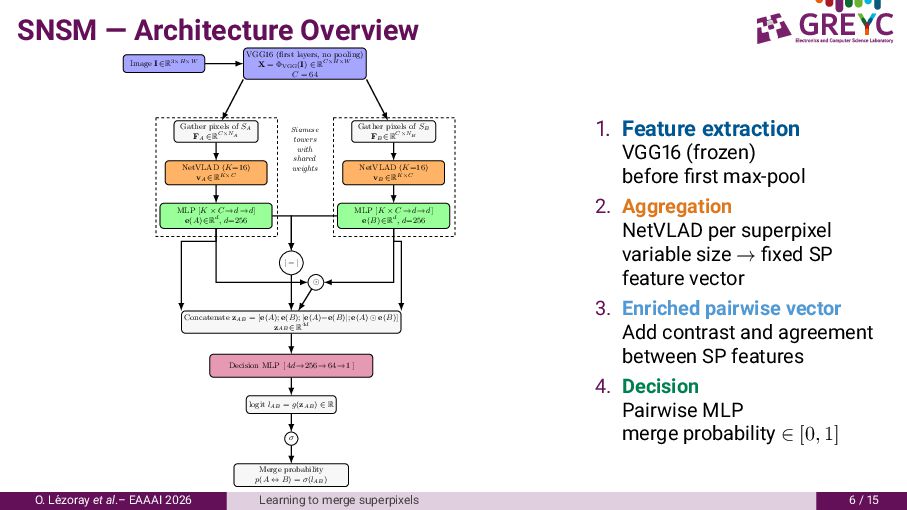
SNSM — Architecture Overview Image I ∈ R3×H×W VGG16 (first
layers, no pooling) X = ΦVGG (I) ∈ RC×H×W C = 64 Gather pixels of SA FA ∈ RC×NA Siamese towers with shared weights NetVLAD (K=16) vA ∈ RK×C MLP [K × C → d → d] e(A) ∈ Rd , d=256 Gather pixels of SB FB ∈ RC×NB NetVLAD (K=16) vB ∈ RK×C MLP [K × C → d → d] e(B) ∈ Rd , d=256 |−| ⊙ Concatenate zAB = [e(A); e(B); |e(A)−e(B)|; e(A) ⊙ e(B)] zAB ∈ R4d Decision MLP [ 4d → 256 → 64 → 1 ] logit lAB = g(zAB ) ∈ R σ 1. Feature extraction VGG16 (frozen) before first max-pool 2. Aggregation NetVLAD per superpixel variable size → fixed SP feature vector 3. Enriched pairwise vector Add contrast and agreement between SP features 4. Decision Pairwise MLP merge probability ∈ [0, 1] Merge probability p(A ↔ B) = σ(lAB ) O. Lézoray et al.– EAAAI 2026 Learning to merge superpixels 6 / 15 -
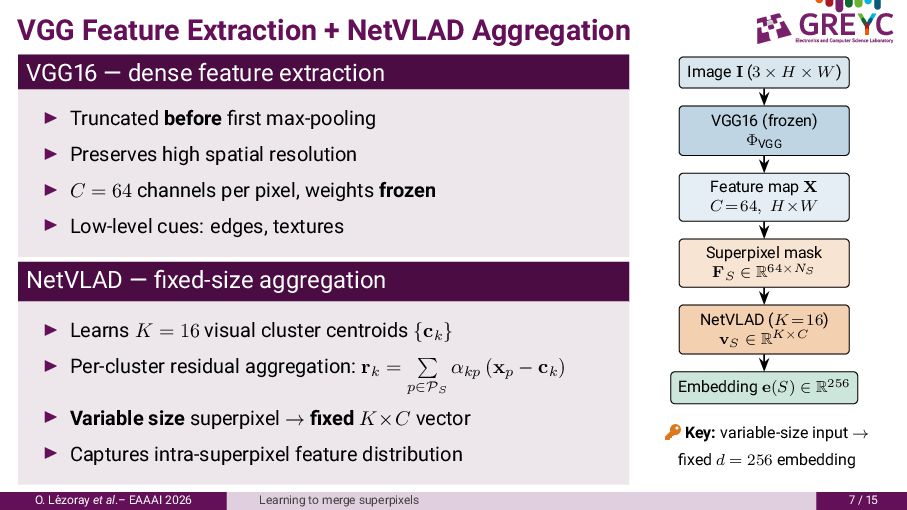
VGG Feature Extraction + NetVLAD Aggregation VGG16 — dense feature
extraction Image I (3 × H × W ) ▶ Truncated before first max-pooling VGG16 (frozen) ΦVGG ▶ Preserves high spatial resolution ▶ C = 64 channels per pixel, weights frozen Feature map X C = 64, H ×W ▶ Low-level cues: edges, textures Superpixel mask FS ∈ R64×NS NetVLAD — fixed-size aggregation ▶ Learns K = 16 visual cluster centroids {ck } P ▶ Per-cluster residual aggregation: rk = αkp (xp − ck ) p∈PS ▶ Variable size superpixel → fixed K ×C vector ▶ Captures intra-superpixel feature distribution O. Lézoray et al.– EAAAI 2026 Learning to merge superpixels NetVLAD (K = 16) vS ∈ RK×C Embedding e(S) ∈ R256 ø Key: variable-size input → fixed d = 256 embedding 7 / 15 -
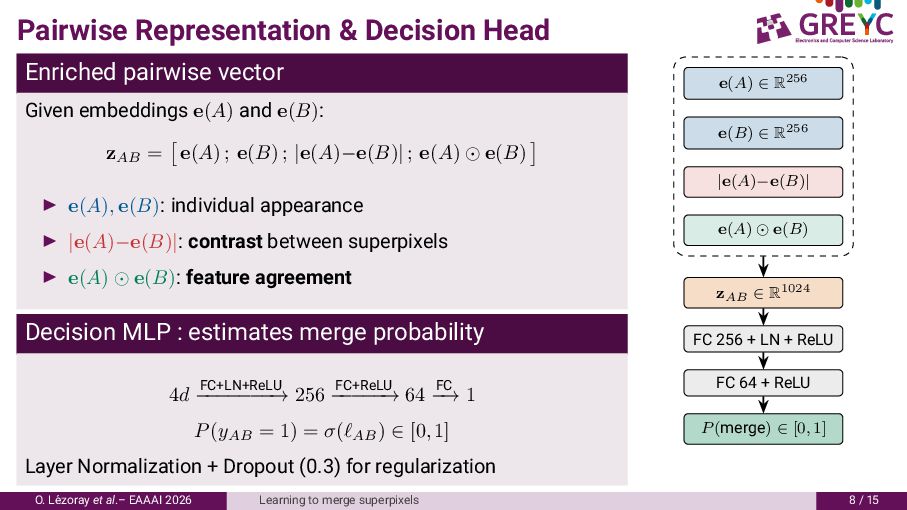
Pairwise Representation & Decision Head Enriched pairwise vector e(A) ∈
R256 Given embeddings e(A) and e(B): zAB = e(A) ; e(B) ; |e(A)−e(B)| ; e(A) ⊙ e(B) e(B) ∈ R256 |e(A)−e(B)| ▶ e(A), e(B): individual appearance ▶ |e(A)−e(B)|: contrast between superpixels ▶ e(A) ⊙ e(B): feature agreement zAB ∈ R1024 Decision MLP : estimates merge probability FC+LN+ReLU FC+ReLU e(A) ⊙ e(B) FC 4d −−−−−−−→ 256 −−−−−→ 64 −→ 1 P (yAB = 1) = σ(ℓAB ) ∈ [0, 1] FC 256 + LN + ReLU FC 64 + ReLU P (merge) ∈ [0, 1] Layer Normalization + Dropout (0.3) for regularization O. Lézoray et al.– EAAAI 2026 Learning to merge superpixels 8 / 15 -
Outline 1. Motivation 2. Proposed Method (SNSM) 3. Experiments &
Results 4. Conclusion O. Lézoray et al.– EAAAI 2026 Learning to merge superpixels 9 / 15 -
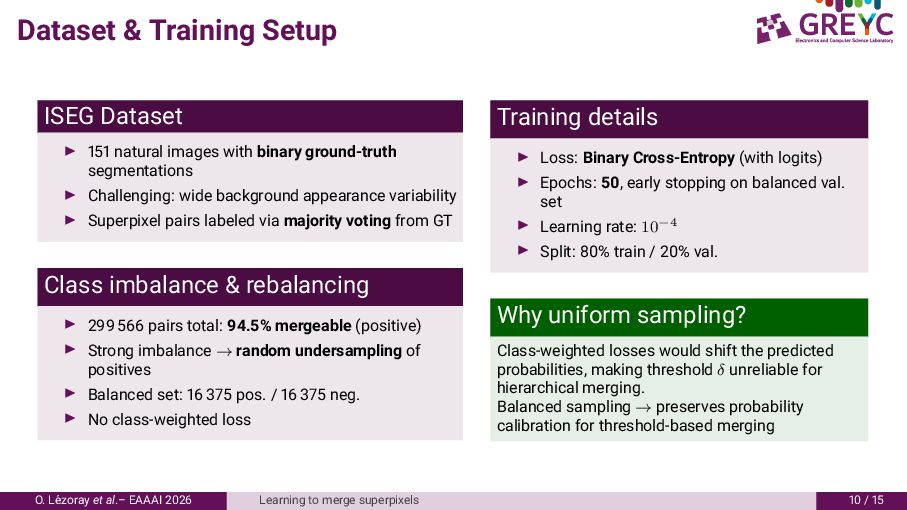
Dataset & Training Setup ISEG Dataset Training details ▶ 151
natural images with binary ground-truth segmentations ▶ Challenging: wide background appearance variability ▶ Superpixel pairs labeled via majority voting from GT ▶ Loss: Binary Cross-Entropy (with logits) ▶ Epochs: 50, early stopping on balanced val. set ▶ Learning rate: 10−4 ▶ Split: 80% train / 20% val. Class imbalance & rebalancing ▶ 299 566 pairs total: 94.5% mergeable (positive) ▶ Strong imbalance → random undersampling of positives ▶ Balanced set: 16 375 pos. / 16 375 neg. ▶ No class-weighted loss O. Lézoray et al.– EAAAI 2026 Learning to merge superpixels Why uniform sampling? Class-weighted losses would shift the predicted probabilities, making threshold δ unreliable for hierarchical merging. Balanced sampling → preserves probability calibration for threshold-based merging 10 / 15 -
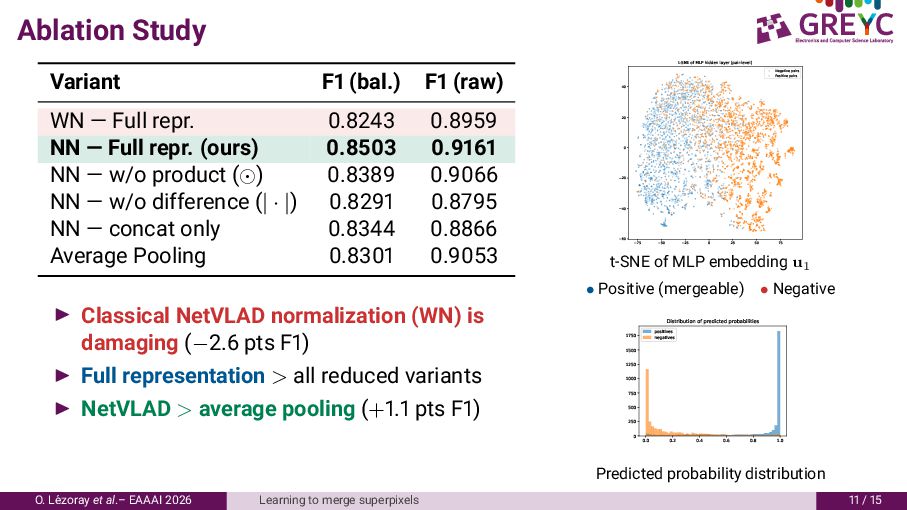
Ablation Study t-SNE of MLP hidden layer (pair-level) Variant F1
(bal.) F1 (raw) WN — Full repr. NN — Full repr. (ours) NN — w/o product (⊙) NN — w/o difference (| · |) NN — concat only Average Pooling 0.8243 0.8503 0.8389 0.8291 0.8344 0.8301 0.8959 0.9161 0.9066 0.8795 0.8866 0.9053 Negative pairs Positive pairs 40 20 0 20 40 60 75 50 25 0 25 50 75 t-SNE of MLP embedding u1 • Positive (mergeable) • Negative ▶ Classical NetVLAD normalization (WN) is damaging (−2.6 pts F1) ▶ Full representation > all reduced variants Distribution of predicted probabilities positives negatives 1750 1500 1250 1000 750 ▶ NetVLAD > average pooling (+1.1 pts F1) 500 250 0 0.0 0.2 0.4 0.6 0.8 1.0 Predicted probability distribution O. Lézoray et al.– EAAAI 2026 Learning to merge superpixels 11 / 15 -
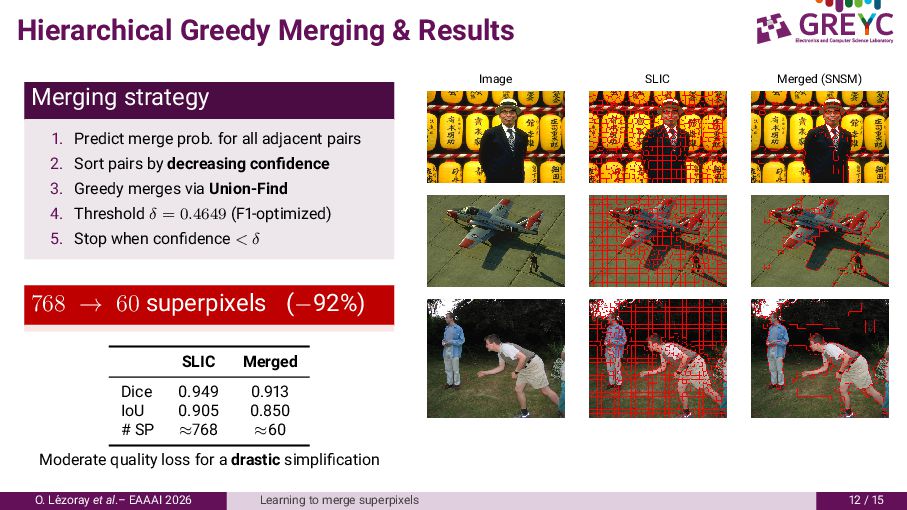
Hierarchical Greedy Merging & Results Image SLIC Merged (SNSM) Merging
strategy 1. Predict merge prob. for all adjacent pairs 2. Sort pairs by decreasing confidence 3. Greedy merges via Union-Find 4. Threshold δ = 0.4649 (F1-optimized) 5. Stop when confidence < δ 768 → 60 superpixels (−92%) Dice IoU # SP SLIC Merged 0.949 0.905 ≈768 0.913 0.850 ≈60 Moderate quality loss for a drastic simplification O. Lézoray et al.– EAAAI 2026 Learning to merge superpixels 12 / 15 -
Outline 1. Motivation 2. Proposed Method (SNSM) 3. Experiments &
Results 4. Conclusion O. Lézoray et al.– EAAAI 2026 Learning to merge superpixels 13 / 15 -
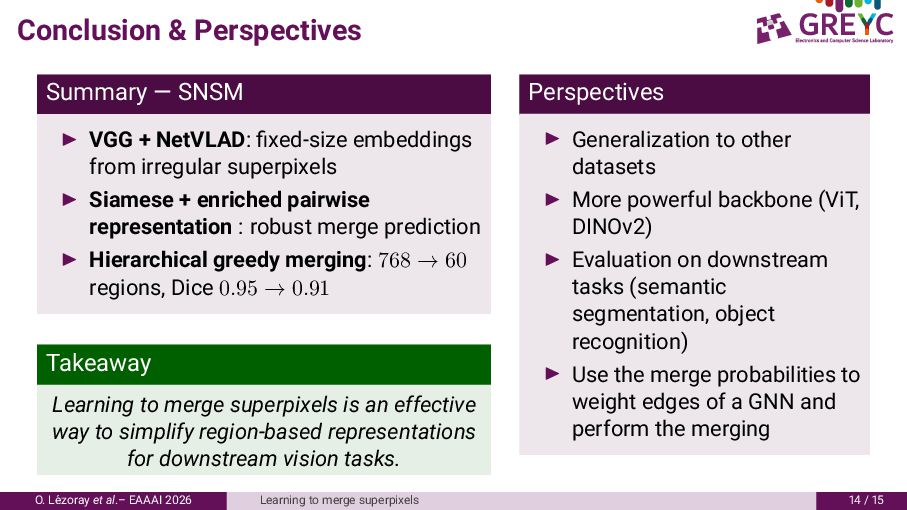
Conclusion & Perspectives Summary — SNSM Perspectives ▶ VGG +
NetVLAD: fixed-size embeddings from irregular superpixels ▶ Siamese + enriched pairwise representation : robust merge prediction ▶ Hierarchical greedy merging: 768 → 60 regions, Dice 0.95 → 0.91 Takeaway Learning to merge superpixels is an effective way to simplify region-based representations for downstream vision tasks. O. Lézoray et al.– EAAAI 2026 Learning to merge superpixels ▶ Generalization to other datasets ▶ More powerful backbone (ViT, DINOv2) ▶ Evaluation on downstream tasks (semantic segmentation, object recognition) ▶ Use the merge probabilities to weight edges of a GNN and perform the merging 14 / 15 -
The End O. Lézoray et al.– EAAAI 2026 Learning to
merge superpixels 15 / 15