Upgrade to Pro
— share decks privately, control downloads, hide ads and more …
Speaker Deck
Sign up for free
Menu
Search
Features
All features
Private URLs
Password Protection
Custom URLS
Scheduled publishing
Remove Branding
Restrict embedding
Deck Collections
Notes
Features
All features
Private URLs
Password Protection
Custom URLS
Scheduled publishing
Remove Branding
Restrict embedding
Deck Collections
Notes
Explore
Featured decks
Featured speakers
Programming
Technology
Storyboards
Explore
Featured decks
Featured speakers
Programming
Technology
Storyboards
Pricing
Search
Sign in
Sign up for free
How to Dissect a Muppet: The Structure of Trans...
Search
hajime kiyama
August 31, 2023
120
0
Share
Embed
Copy iframe code
Copy JS code
Copy link
Start on current slide
How to Dissect a Muppet: The Structure of Transformer Embedding Spaces
Japanese explanation
hajime kiyama
August 31, 2023
More Decks by hajime kiyama
See All by hajime kiyama
通時的な類似度行列に基づく単語の意味変化の分析
rudorudo11
0
390
Idiosyncrasies in Large Language Models
rudorudo11
0
86
People who frequently use ChatGPT for writing tasks are accurate and robust detectors of AI-generated text
rudorudo11
0
330
Analyzing Continuous Semantic Shifts with Diachronic Word Similarity Matrices.
rudorudo11
0
260
Using Synchronic Definitions and Semantic Relations to Classify Semantic Change Types
rudorudo11
0
120
Analyzing Semantic Change through Lexical Replacements
rudorudo11
0
390
意味変化分析に向けた単語埋め込みの時系列パターン分析
rudorudo11
1
240
Bridging Continuous and Discrete Spaces: Interpretable Sentence Representation Learning via Compositional Operations
rudorudo11
0
360
Word Sense Extension
rudorudo11
0
160
Featured
See All Featured
Exploring anti-patterns in Rails
aemeredith
4
540
Templates, Plugins, & Blocks: Oh My! Creating the theme that thinks of everything
marktimemedia
31
2.9k
Unlocking the hidden potential of vector embeddings in international SEO
frankvandijk
0
1k
Rebuilding a faster, lazier Slack
samanthasiow
85
9.7k
Ruling the World: When Life Gets Gamed
codingconduct
0
410
Responsive Adventures: Dirty Tricks From The Dark Corners of Front-End
smashingmag
254
22k
SEO for Brand Visibility & Recognition
aleyda
0
4.8k
Reflections from 52 weeks, 52 projects
jeffersonlam
356
22k
Building a Scalable Design System with Sketch
lauravandoore
464
34k
Navigating the Design Leadership Dip - Product Design Week Design Leaders+ Conference 2024
apolaine
2
480
Lightning talk: Run Django tests with GitHub Actions
sabderemane
0
300
Dealing with People You Can't Stand - Big Design 2015
cassininazir
367
27k
Transcript
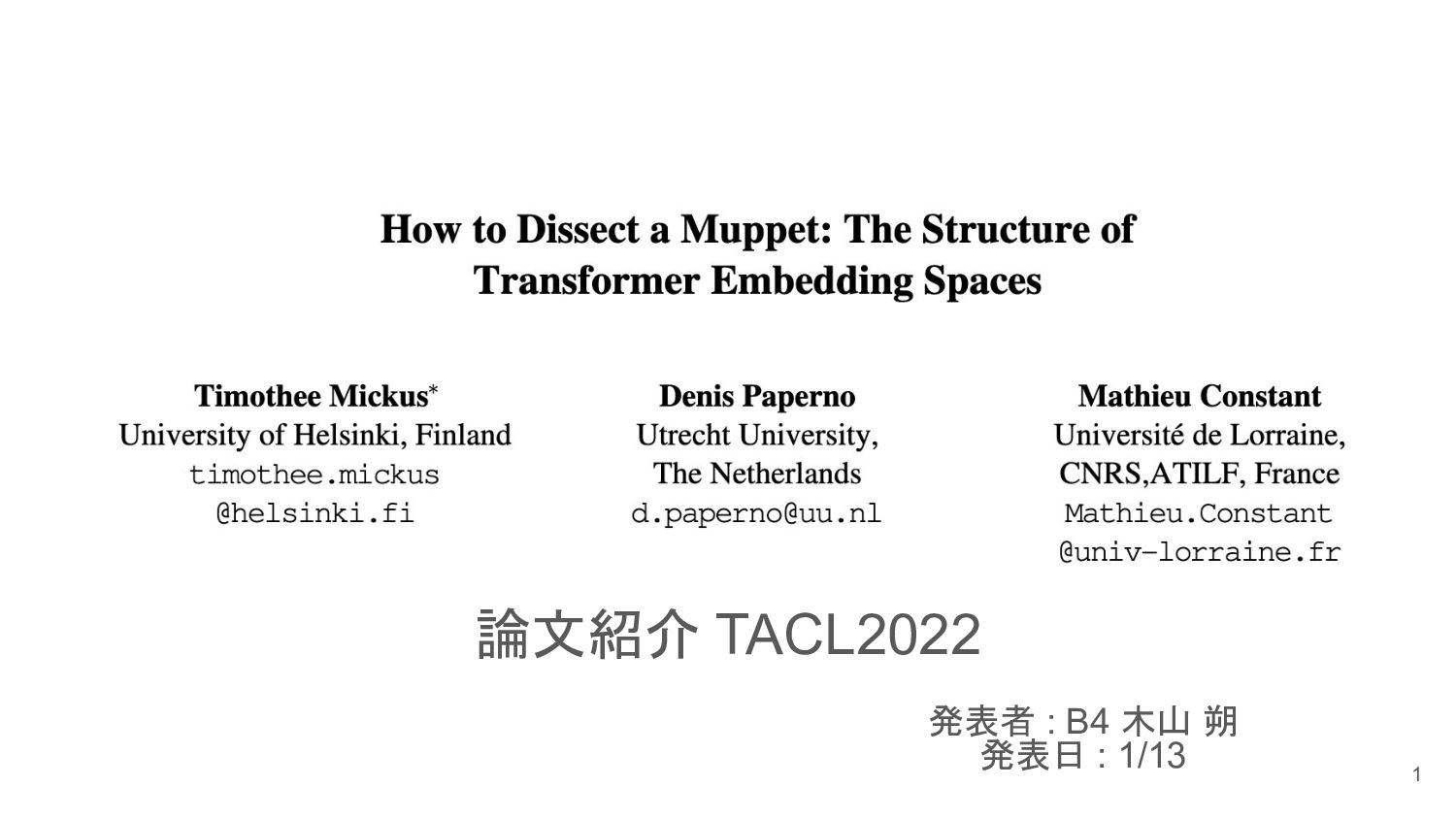
論文紹介 TACL2022 発表者 : B4 木山 朔 発表日 : 1/13
1
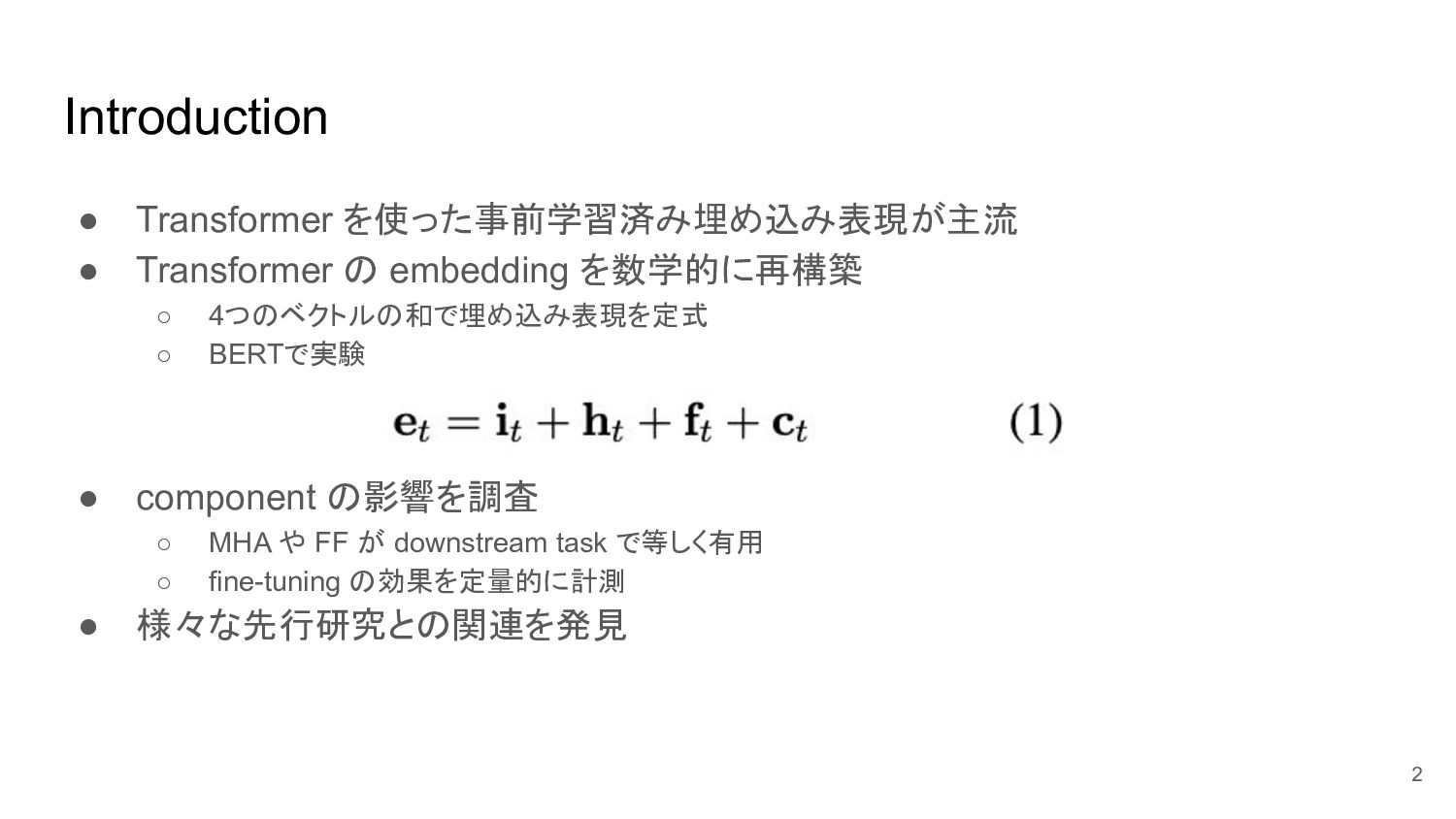
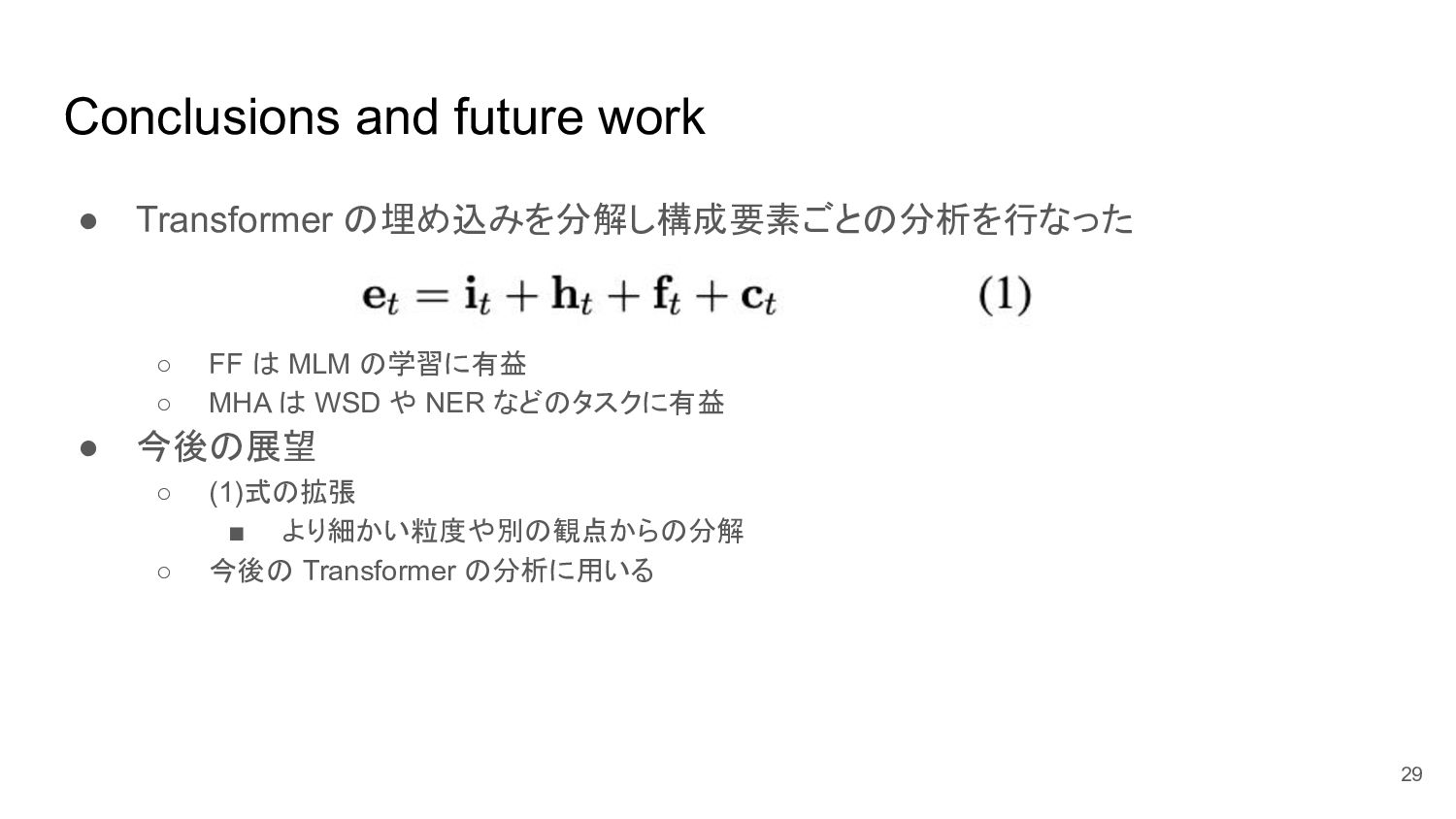
Introduction • Transformer を使った事前学習済み埋め込み表現が主流 • Transformer の embedding を数学的に再構築 ◦
4つのベクトルの和で埋め込み表現を定式 ◦ BERTで実験 • component の影響を調査 ◦ MHA や FF が downstream task で等しく有用 ◦ fine-tuning の効果を定量的に計測 • 様々な先行研究との関連を発見 2
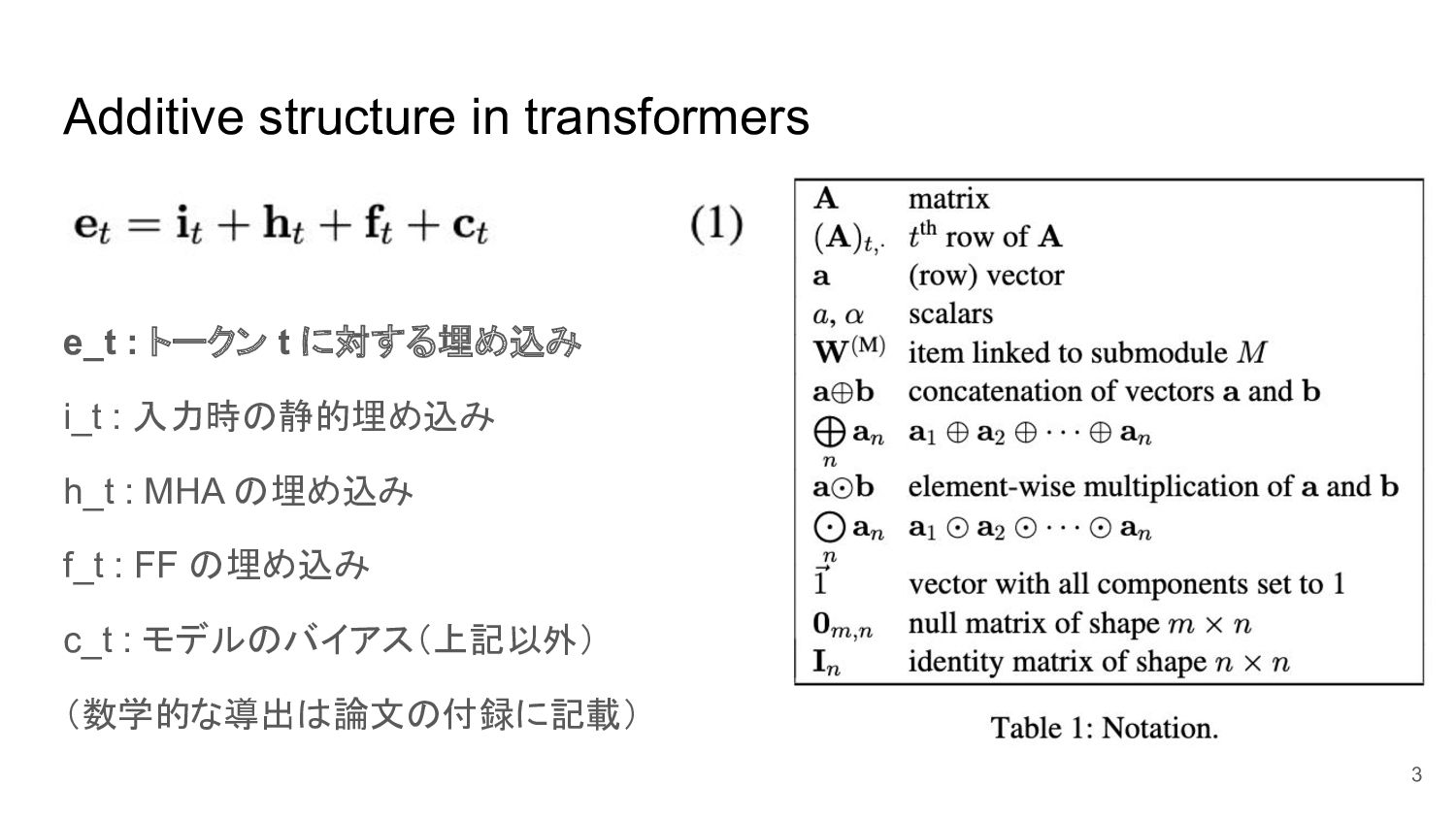
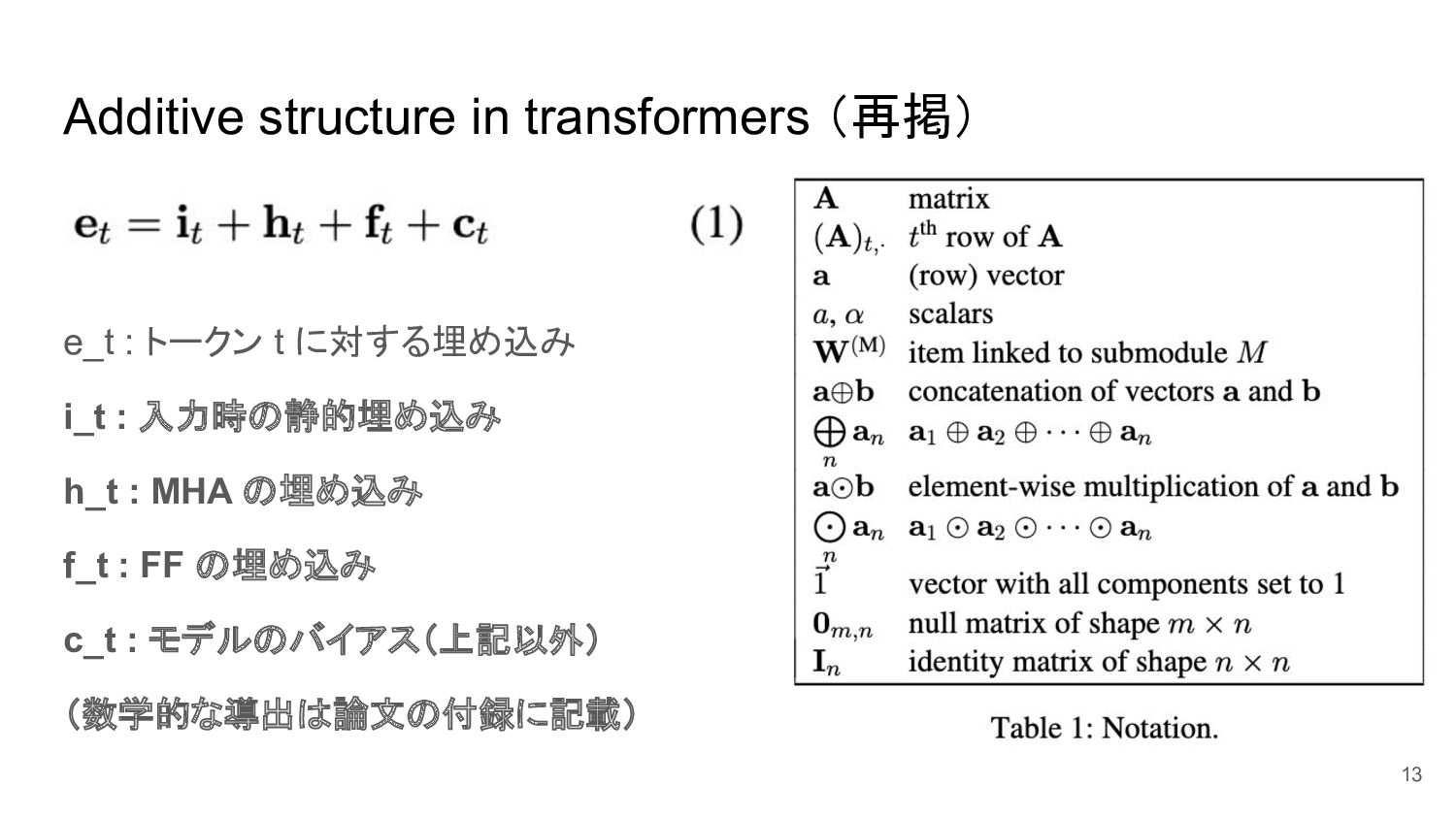
Additive structure in transformers e_t : トークン t に対する埋め込み i_t
: 入力時の静的埋め込み h_t : MHA の埋め込み f_t : FF の埋め込み c_t : モデルのバイアス(上記以外) (数学的な導出は論文の付録に記載) 3
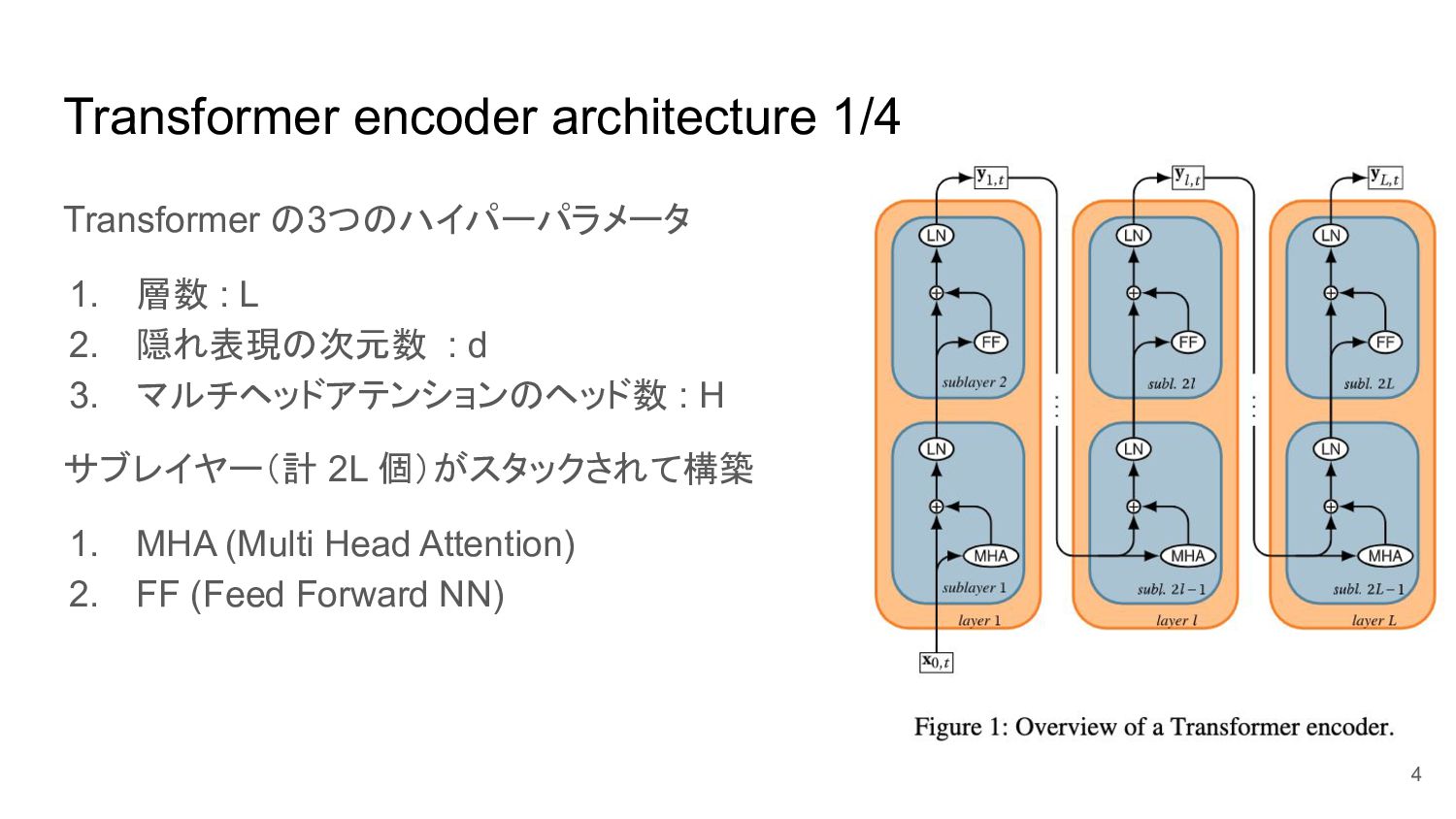
Transformer encoder architecture 1/4 Transformer の3つのハイパーパラメータ 1. 層数 : L
2. 隠れ表現の次元数 : d 3. マルチヘッドアテンションのヘッド数 : H サブレイヤー(計 2L 個)がスタックされて構築 1. MHA (Multi Head Attention) 2. FF (Feed Forward NN) 4
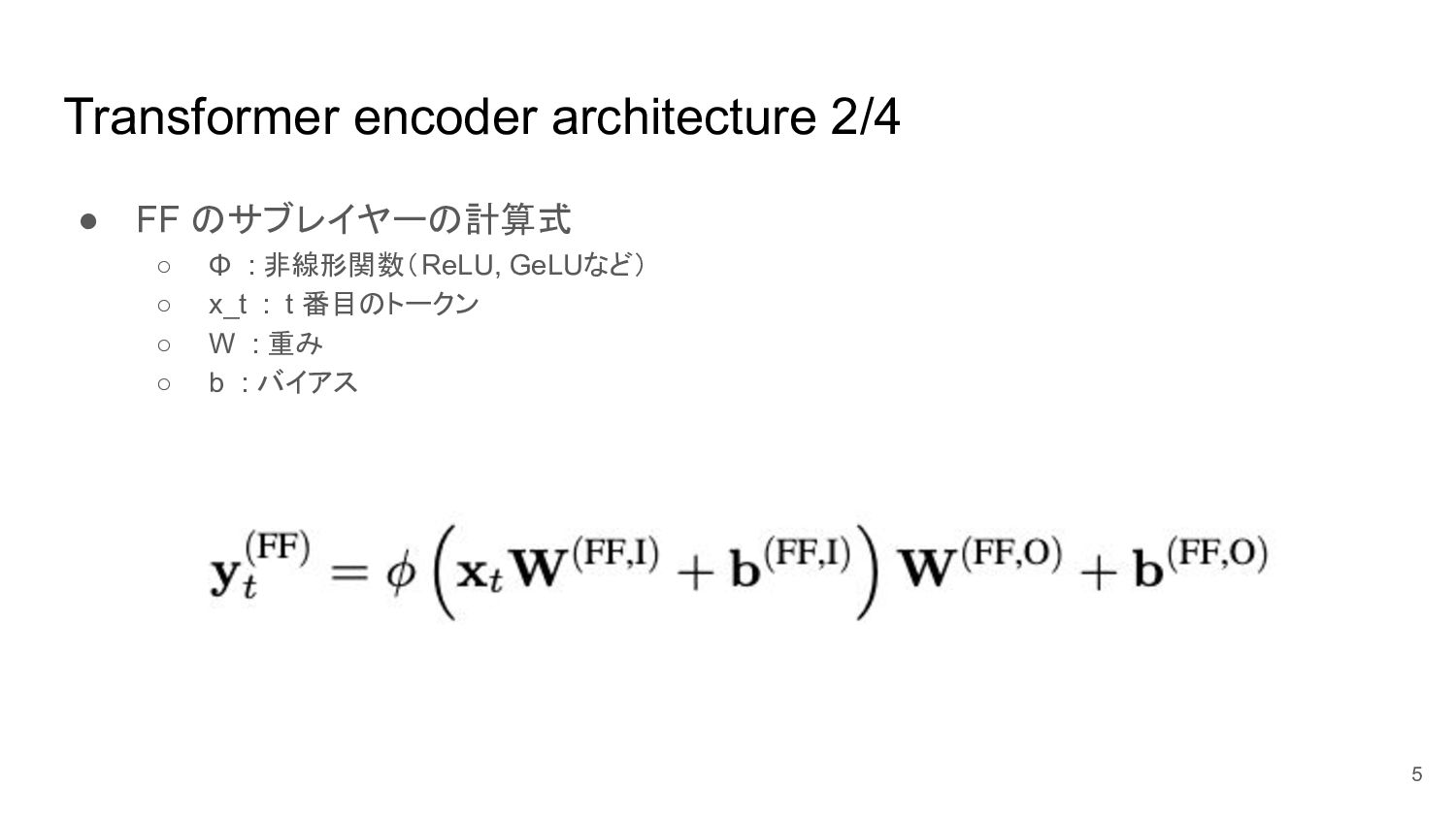
Transformer encoder architecture 2/4 • FF のサブレイヤーの計算式 ◦ Φ :
非線形関数(ReLU, GeLUなど) ◦ x_t : t 番目のトークン ◦ W : 重み ◦ b : バイアス 5
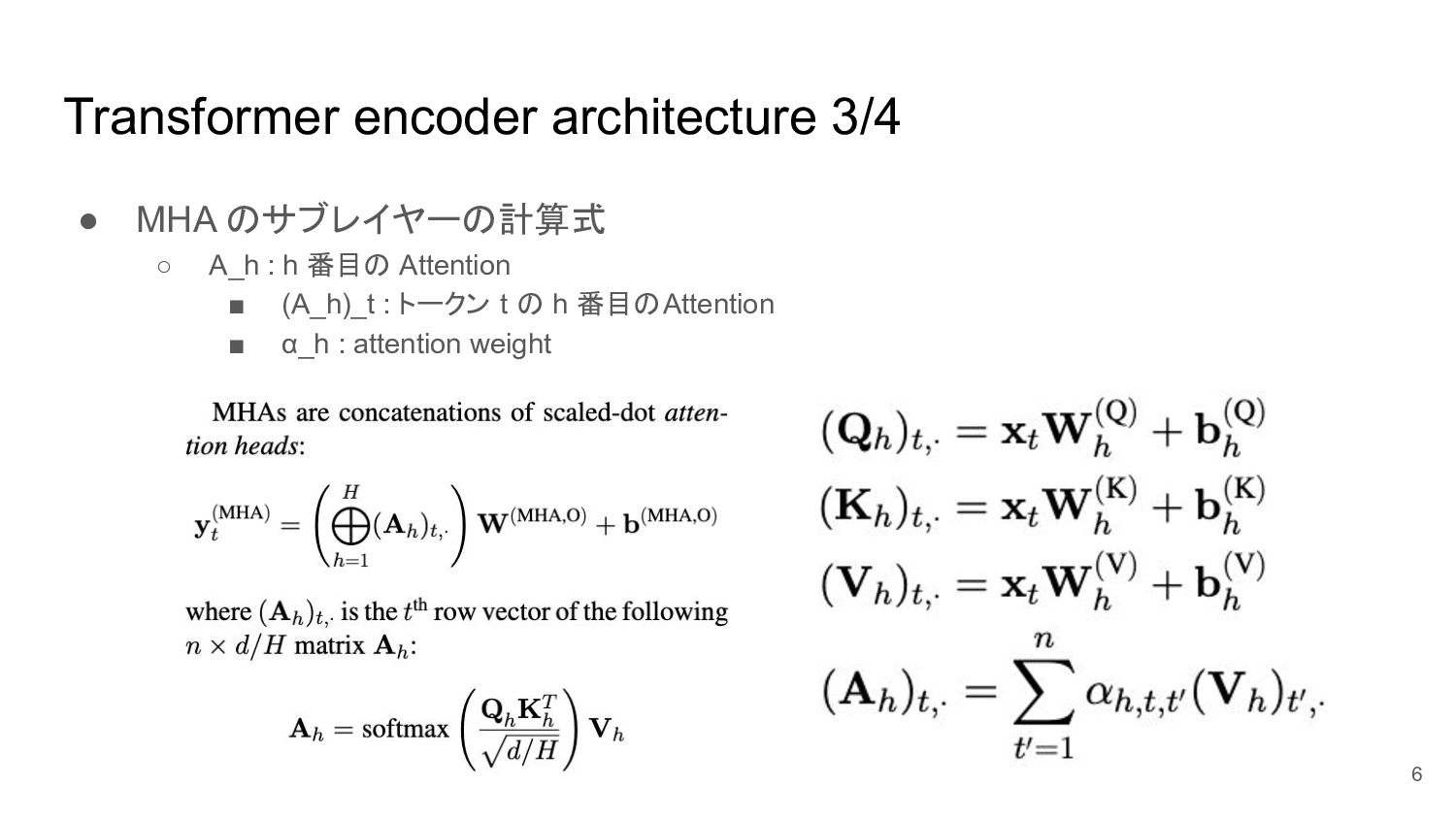
Transformer encoder architecture 3/4 • MHA のサブレイヤーの計算式 ◦ A_h :
h 番目の Attention ▪ (A_h)_t : トークン t の h 番目のAttention ▪ α_h : attention weight 6
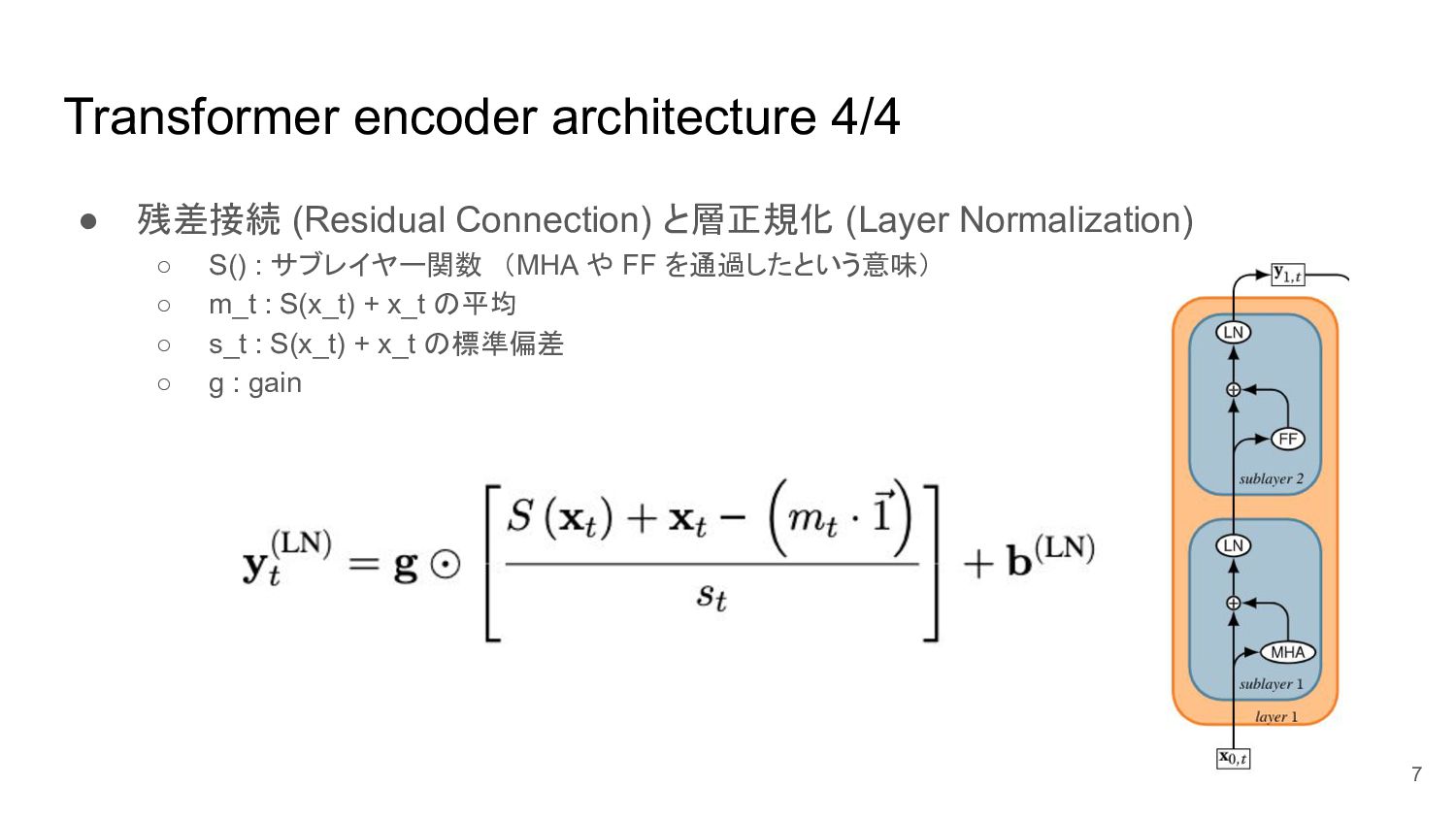
Transformer encoder architecture 4/4 • 残差接続 (Residual Connection) と層正規化 (Layer
Normalization) ◦ S() : サブレイヤー関数 (MHA や FF を通過したという意味) ◦ m_t : S(x_t) + x_t の平均 ◦ s_t : S(x_t) + x_t の標準偏差 ◦ g : gain 7
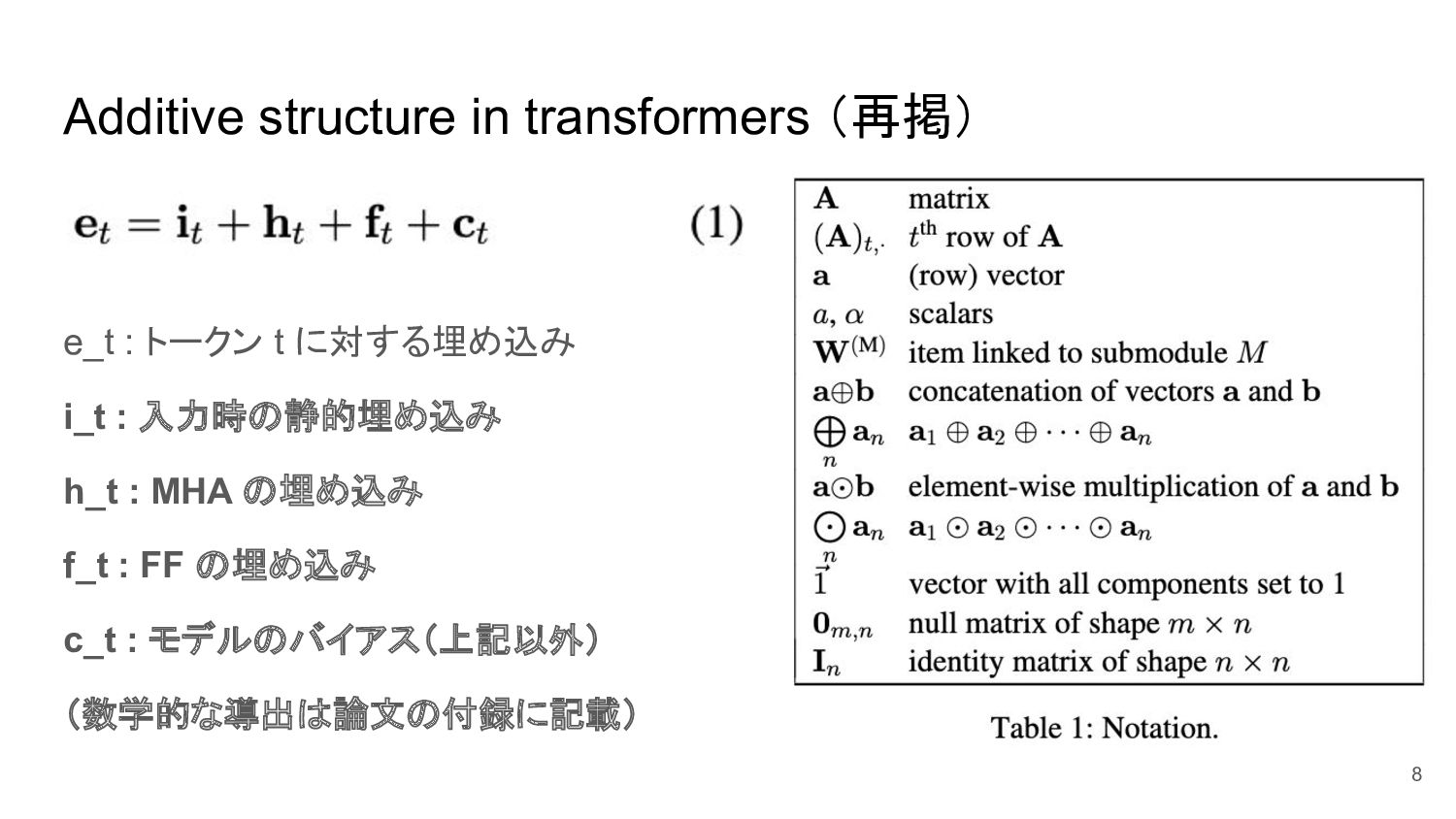
Additive structure in transformers (再掲) e_t : トークン t に対する埋め込み
i_t : 入力時の静的埋め込み h_t : MHA の埋め込み f_t : FF の埋め込み c_t : モデルのバイアス(上記以外) (数学的な導出は論文の付録に記載) 8
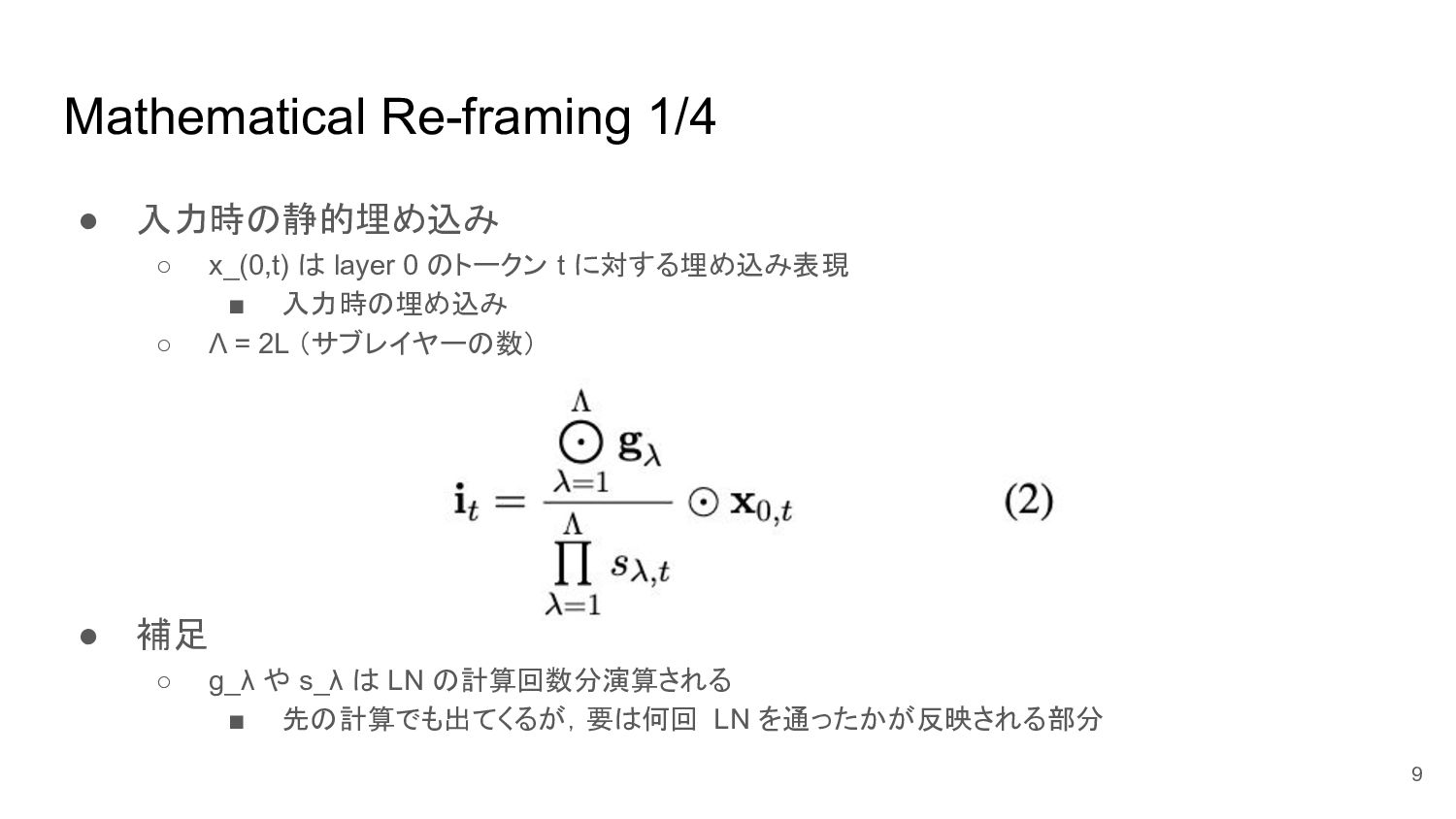
• 入力時の静的埋め込み ◦ x_(0,t) は layer 0 のトークン t に対する埋め込み表現
▪ 入力時の埋め込み ◦ Λ = 2L (サブレイヤーの数) • 補足 ◦ g_λ や s_λ は LN の計算回数分演算される ▪ 先の計算でも出てくるが,要は何回 LN を通ったかが反映される部分 Mathematical Re-framing 1/4 9
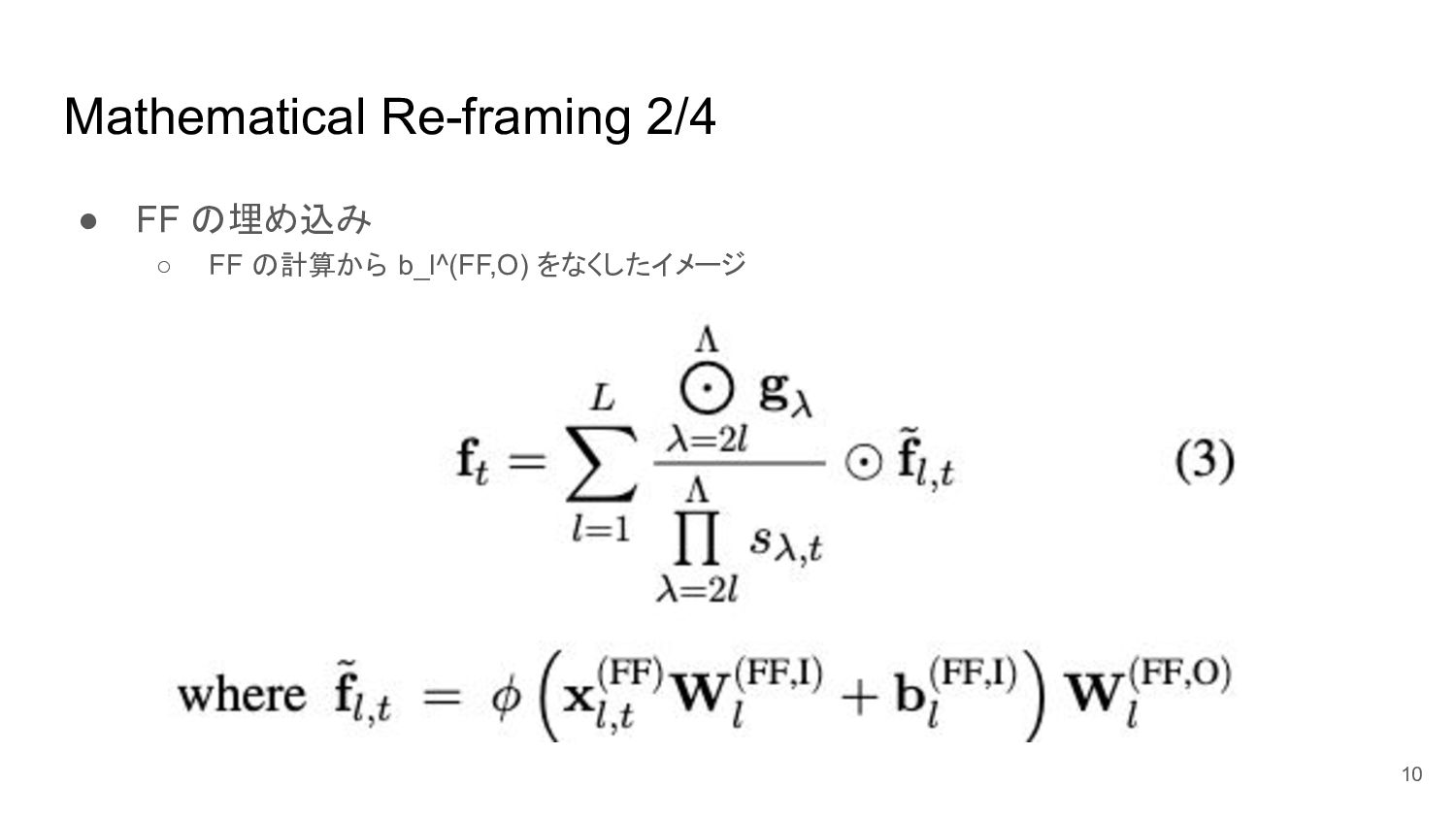
Mathematical Re-framing 2/4 • FF の埋め込み ◦ FF の計算から b_l^(FF,O)
をなくしたイメージ 10
Mathematical Re-framing 3/4 • MHA の埋め込み ◦ attention の重みにトークンとバリューの重み, MHAの重みをかけたイメージ
11
Mathematical Re-framing 4/4 • バイアス項 ◦ 以下の総和 i. LN でのバイアス
ii. 残差接続での平均 iii. MHA でのバイアス iv. FF でのバイアス 12
Additive structure in transformers (再掲) e_t : トークン t に対する埋め込み
i_t : 入力時の静的埋め込み h_t : MHA の埋め込み f_t : FF の埋め込み c_t : モデルのバイアス(上記以外) (数学的な導出は論文の付録に記載) 13
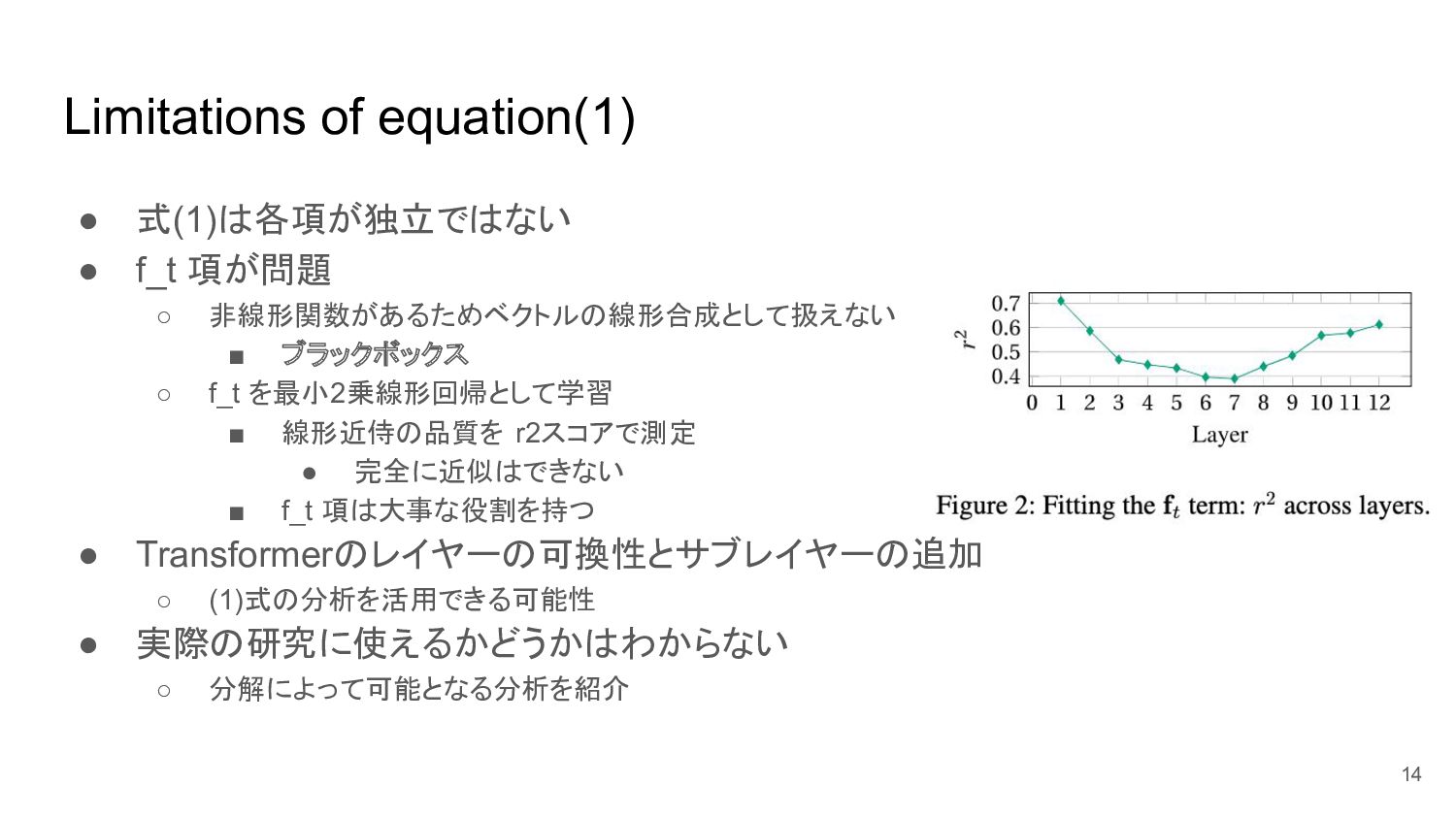
Limitations of equation(1) • 式(1)は各項が独立ではない • f_t 項が問題 ◦ 非線形関数があるためベクトルの線形合成として扱えない
▪ ブラックボックス ◦ f_t を最小2乗線形回帰として学習 ▪ 線形近侍の品質を r2スコアで測定 • 完全に近似はできない ▪ f_t 項は大事な役割を持つ • Transformerのレイヤーの可換性とサブレイヤーの追加 ◦ (1)式の分析を活用できる可能性 • 実際の研究に使えるかどうかはわからない ◦ 分解によって可能となる分析を紹介 14
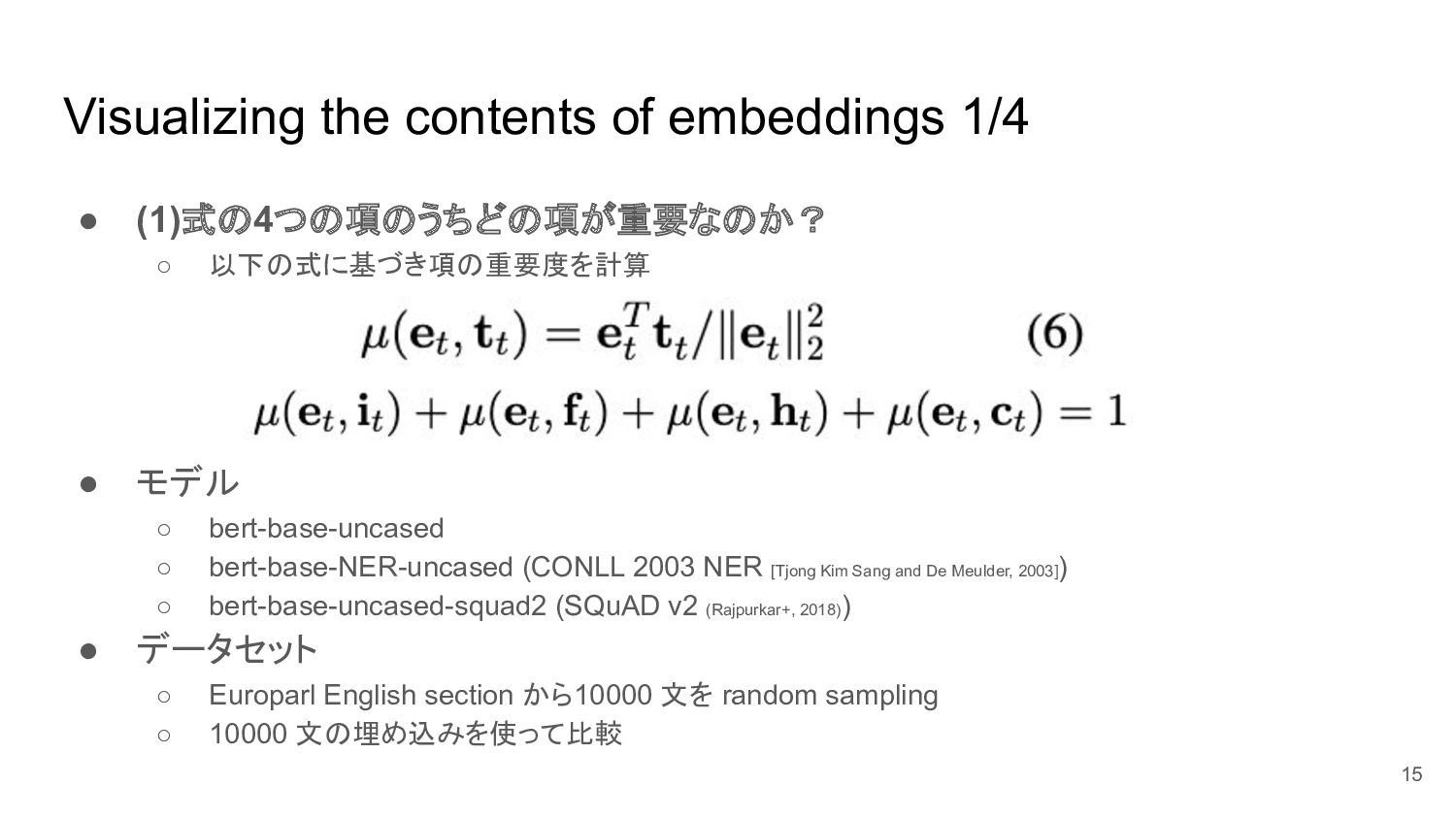
Visualizing the contents of embeddings 1/4 • (1)式の4つの項のうちどの項が重要なのか? ◦ 以下の式に基づき項の重要度を計算
• モデル ◦ bert-base-uncased ◦ bert-base-NER-uncased (CONLL 2003 NER [Tjong Kim Sang and De Meulder, 2003] ) ◦ bert-base-uncased-squad2 (SQuAD v2 (Rajpurkar+, 2018) ) • データセット ◦ Europarl English section から10000 文を random sampling ◦ 10000 文の埋め込みを使って比較 15
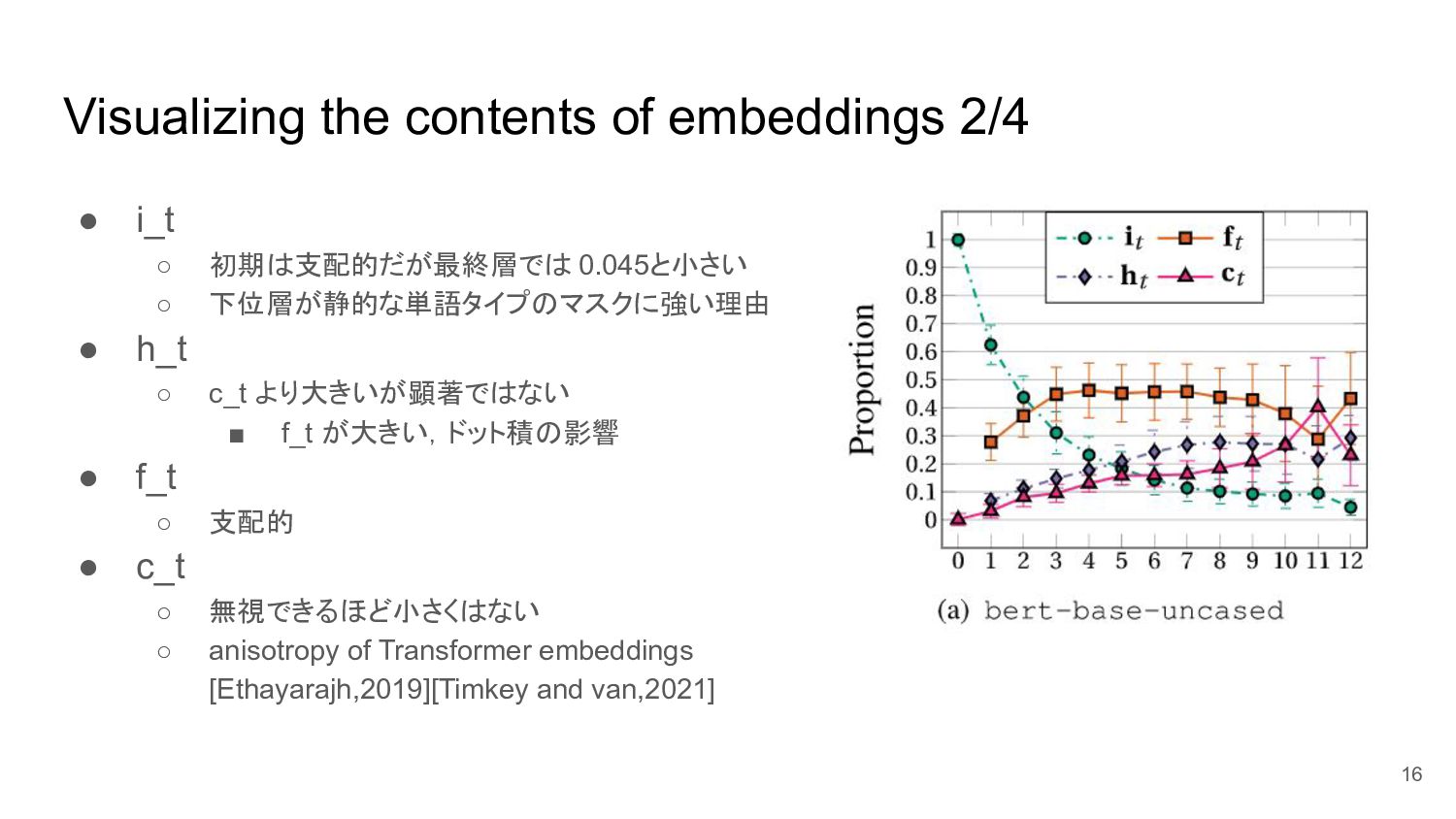
Visualizing the contents of embeddings 2/4 • i_t ◦ 初期は支配的だが最終層では
0.045と小さい ◦ 下位層が静的な単語タイプのマスクに強い理由 • h_t ◦ c_t より大きいが顕著ではない ▪ f_t が大きい,ドット積の影響 • f_t ◦ 支配的 • c_t ◦ 無視できるほど小さくはない ◦ anisotropy of Transformer embeddings [Ethayarajh,2019][Timkey and van,2021] 16
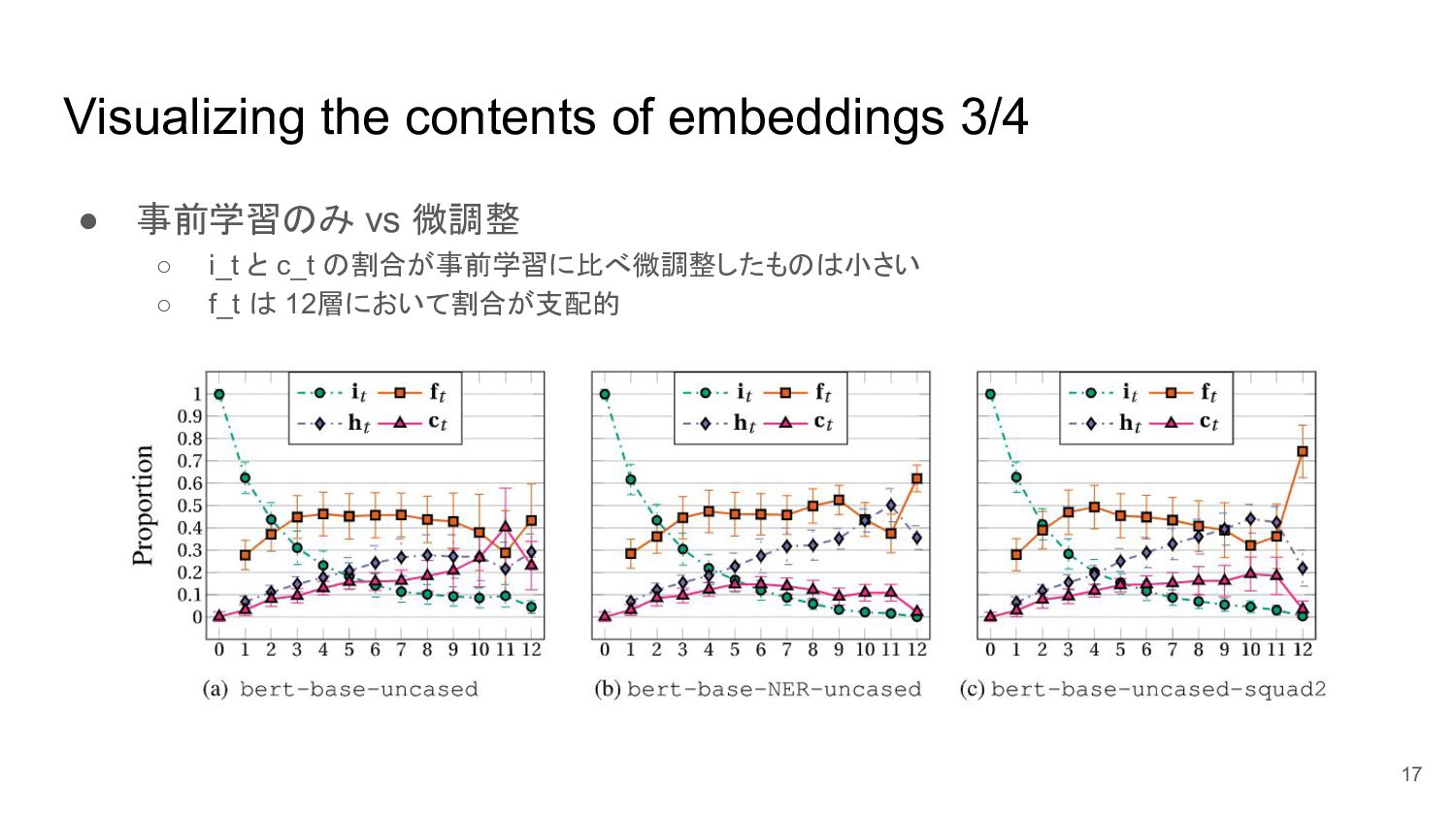
Visualizing the contents of embeddings 3/4 • 事前学習のみ vs 微調整
◦ i_t と c_t の割合が事前学習に比べ微調整したものは小さい ◦ f_t は 12層において割合が支配的 17
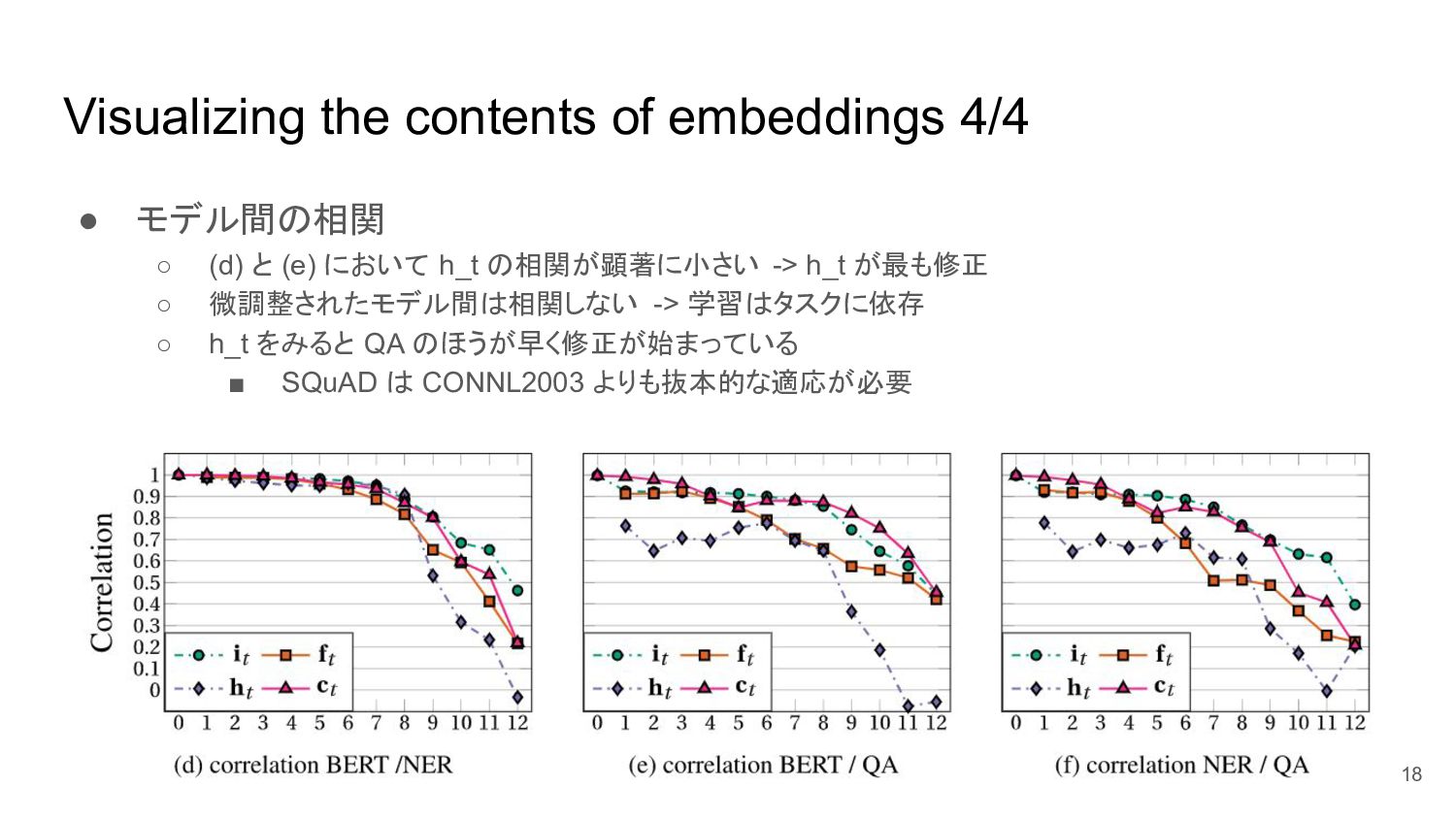
Visualizing the contents of embeddings 4/4 • モデル間の相関 ◦ (d)
と (e) において h_t の相関が顕著に小さい -> h_t が最も修正 ◦ 微調整されたモデル間は相関しない -> 学習はタスクに依存 ◦ h_t をみると QA のほうが早く修正が始まっている ▪ SQuAD は CONNL2003 よりも抜本的な適応が必要 18
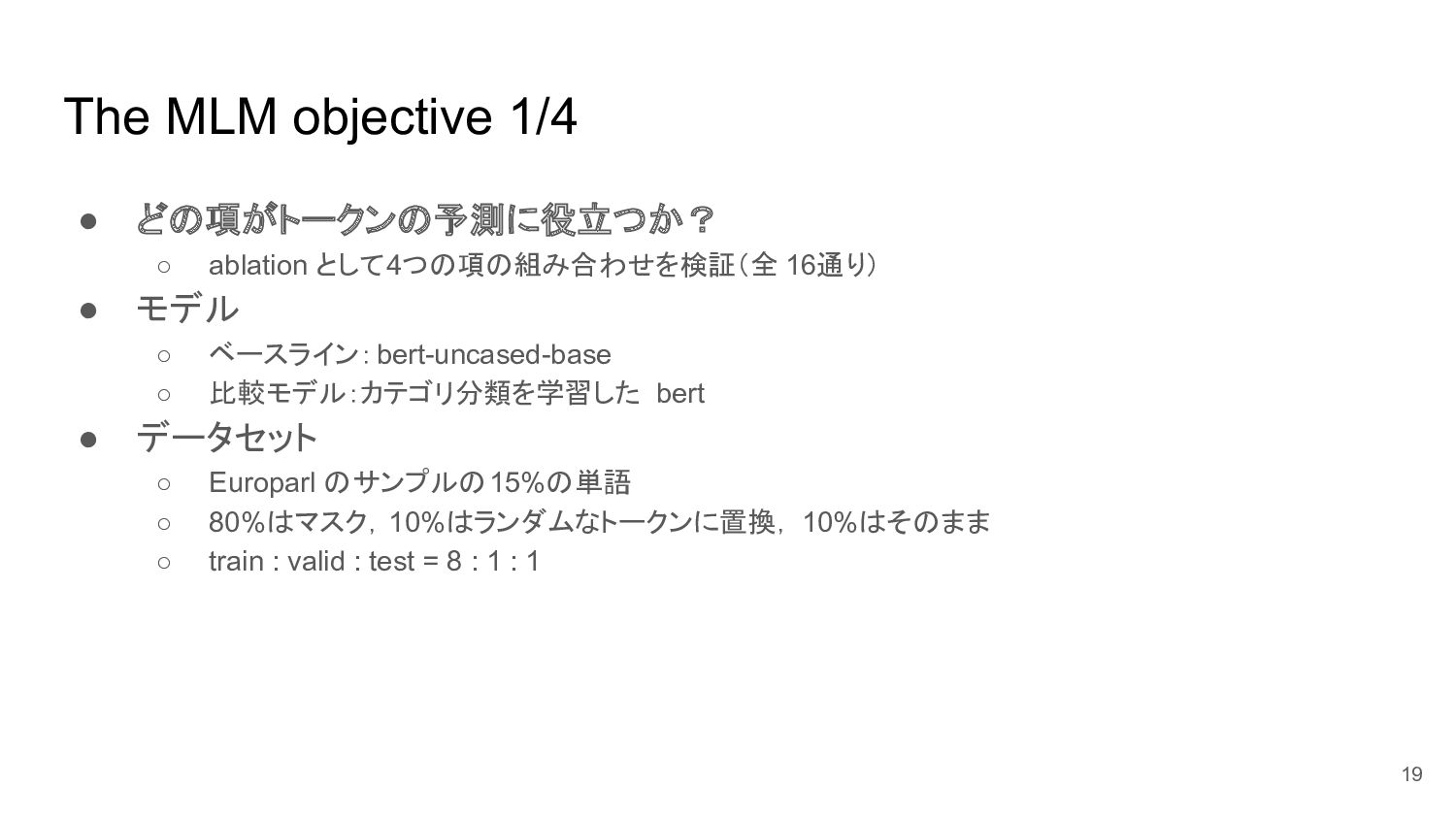
The MLM objective 1/4 • どの項がトークンの予測に役立つか? ◦ ablation として4つの項の組み合わせを検証(全 16通り)
• モデル ◦ ベースライン:bert-uncased-base ◦ 比較モデル:カテゴリ分類を学習した bert • データセット ◦ Europarl のサンプルの15%の単語 ◦ 80%はマスク,10%はランダムなトークンに置換, 10%はそのまま ◦ train : valid : test = 8 : 1 : 1 19
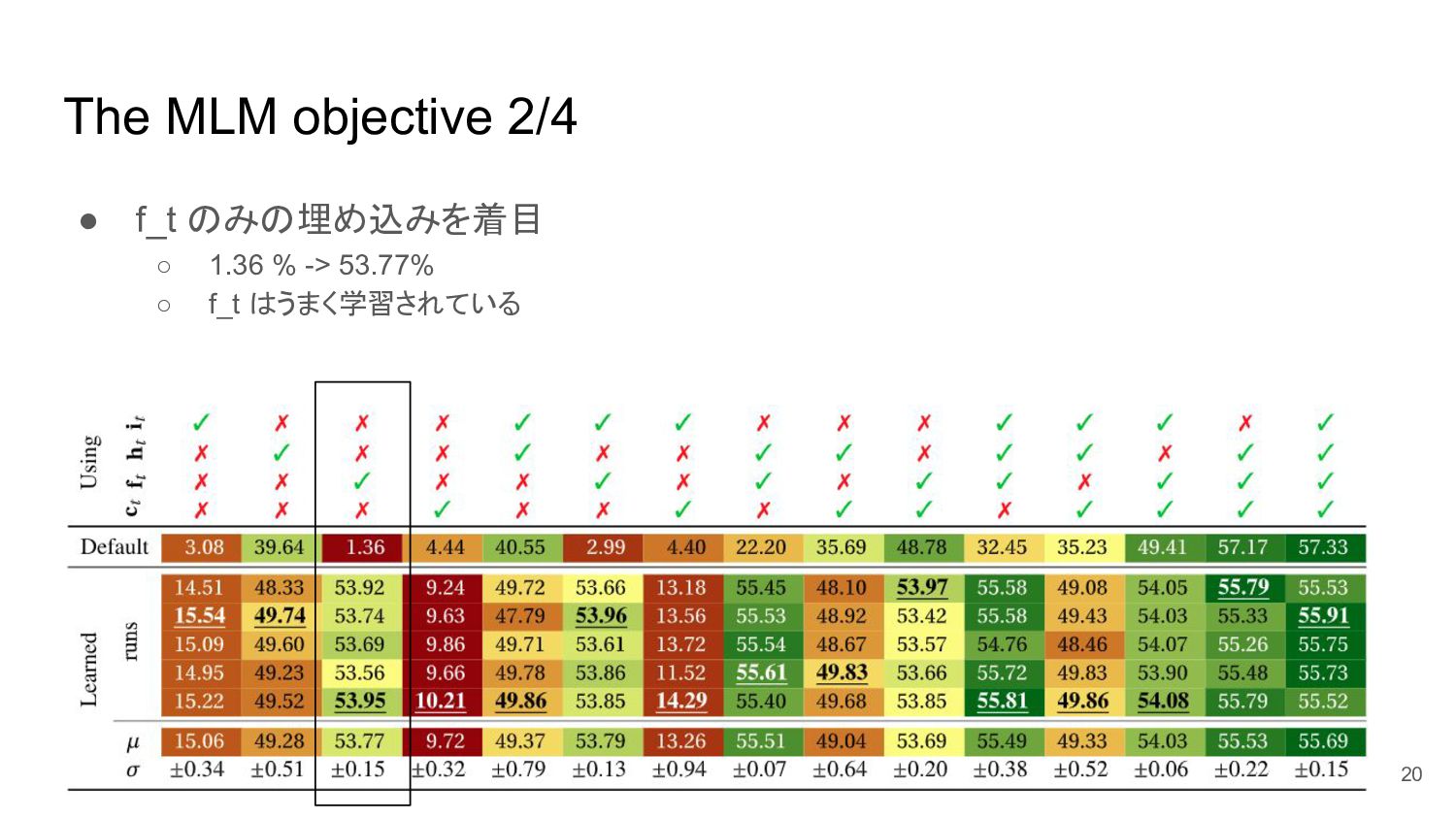
The MLM objective 2/4 • f_t のみの埋め込みを着目 ◦ 1.36 %
-> 53.77% ◦ f_t はうまく学習されている 20
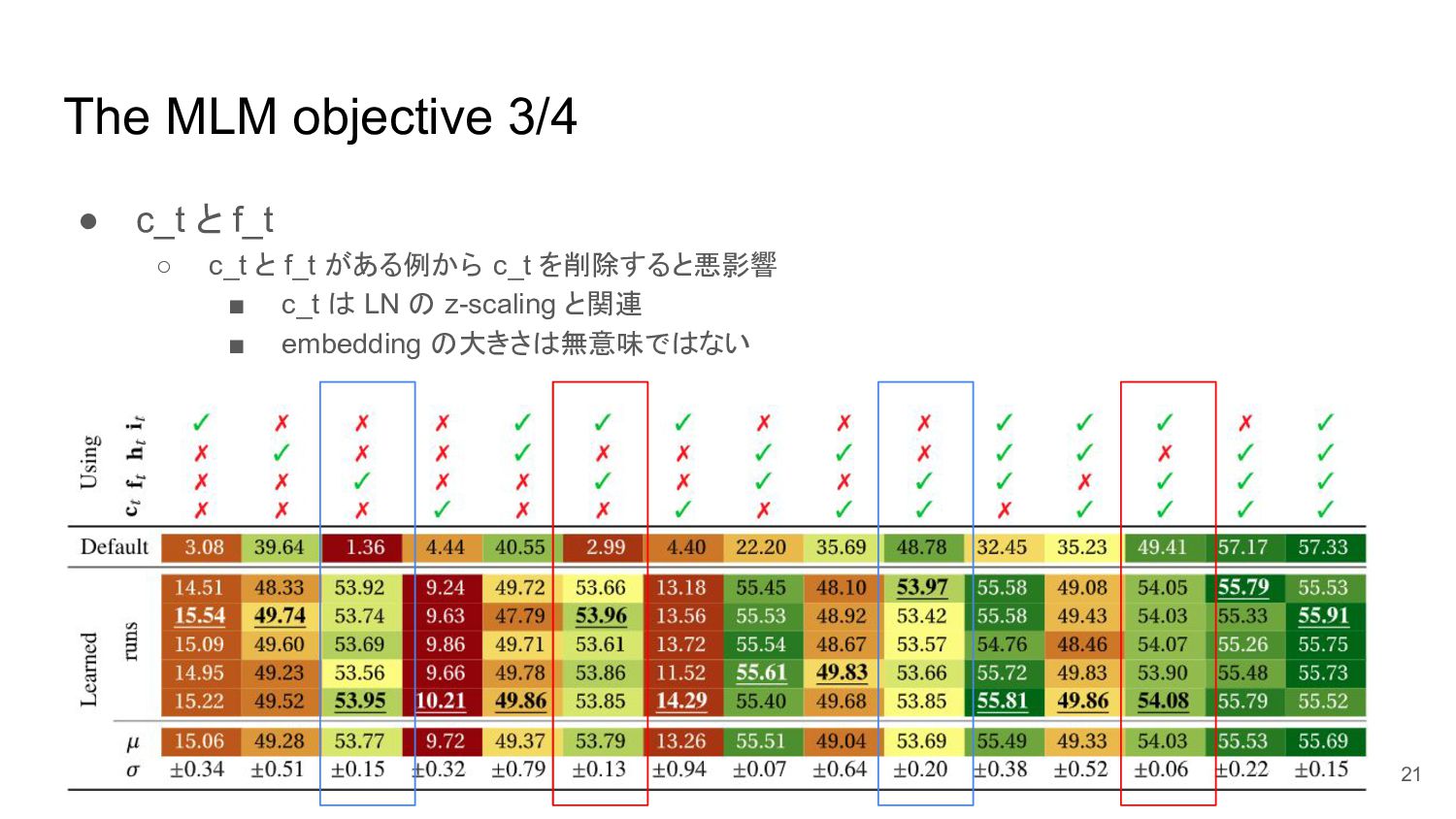
The MLM objective 3/4 • c_t と f_t ◦ c_t
と f_t がある例から c_t を削除すると悪影響 ▪ c_t は LN の z-scaling と関連 ▪ embedding の大きさは無意味ではない 21
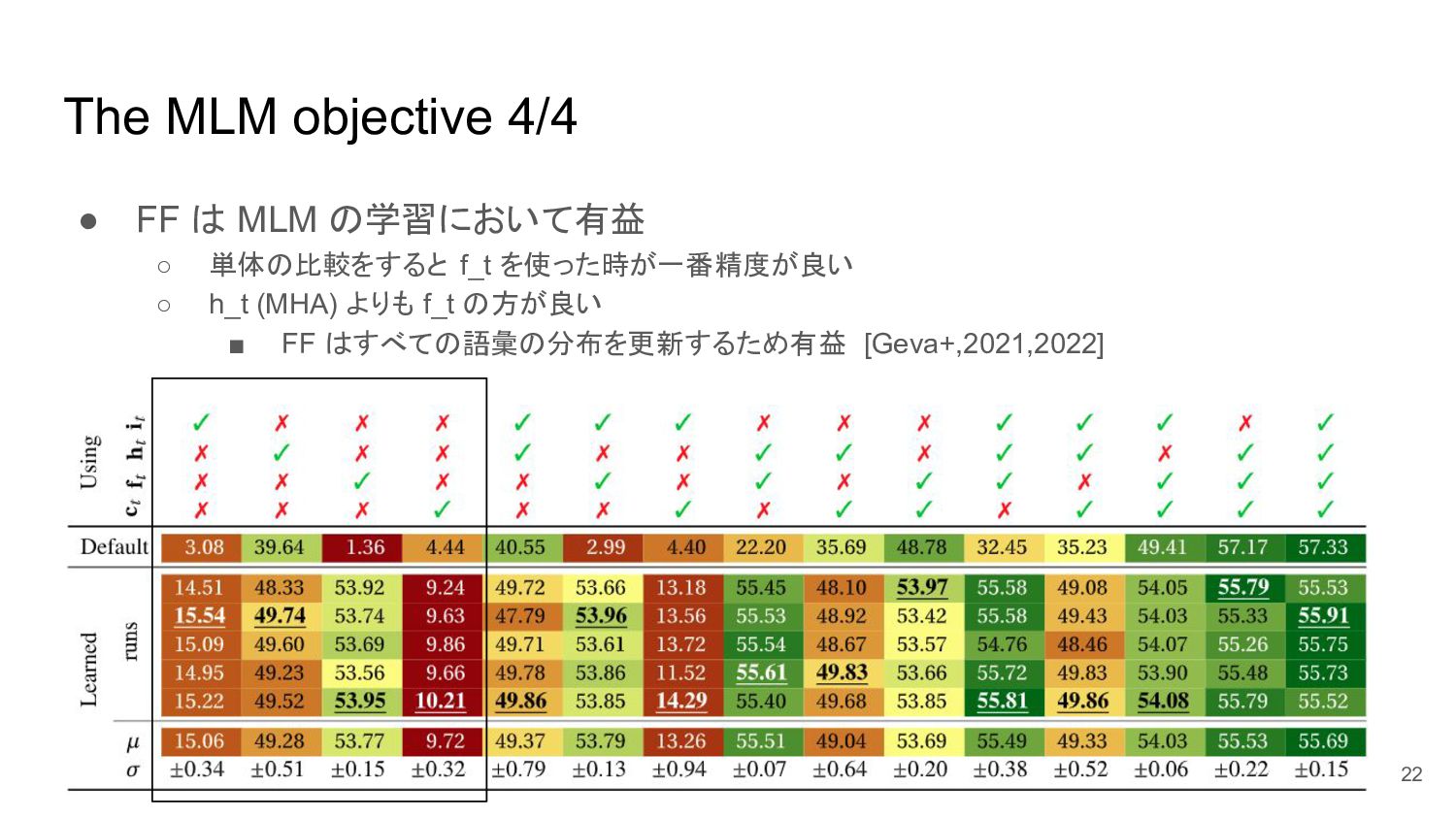
The MLM objective 4/4 • FF は MLM の学習において有益 ◦
単体の比較をすると f_t を使った時が一番精度が良い ◦ h_t (MHA) よりも f_t の方が良い ▪ FF はすべての語彙の分布を更新するため有益 [Geva+,2021,2022] 22
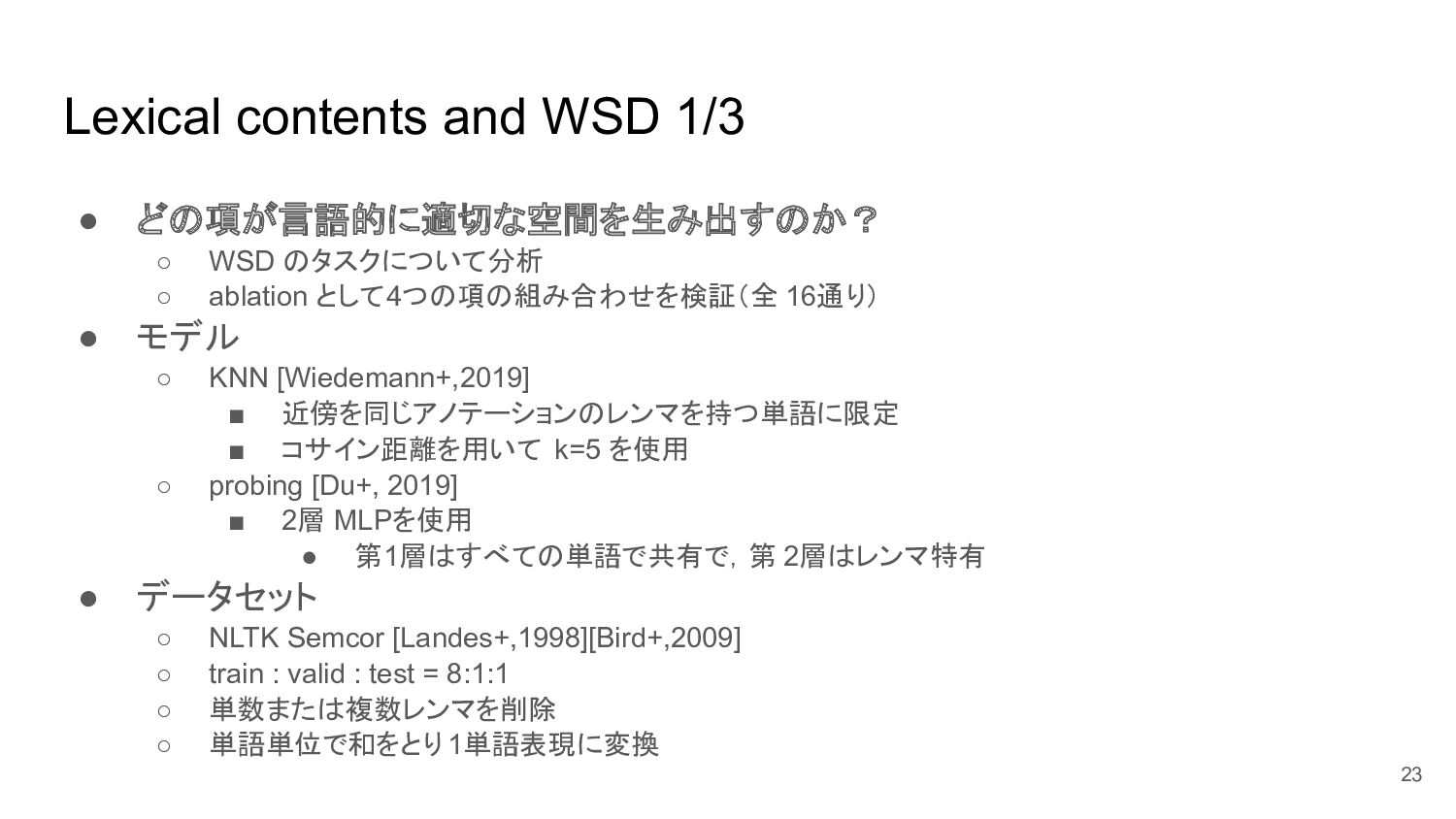
Lexical contents and WSD 1/3 • どの項が言語的に適切な空間を生み出すのか? ◦ WSD のタスクについて分析
◦ ablation として4つの項の組み合わせを検証(全 16通り) • モデル ◦ KNN [Wiedemann+,2019] ▪ 近傍を同じアノテーションのレンマを持つ単語に限定 ▪ コサイン距離を用いて k=5 を使用 ◦ probing [Du+, 2019] ▪ 2層 MLPを使用 • 第1層はすべての単語で共有で,第 2層はレンマ特有 • データセット ◦ NLTK Semcor [Landes+,1998][Bird+,2009] ◦ train : valid : test = 8:1:1 ◦ 単数または複数レンマを削除 ◦ 単語単位で和をとり1単語表現に変換 23
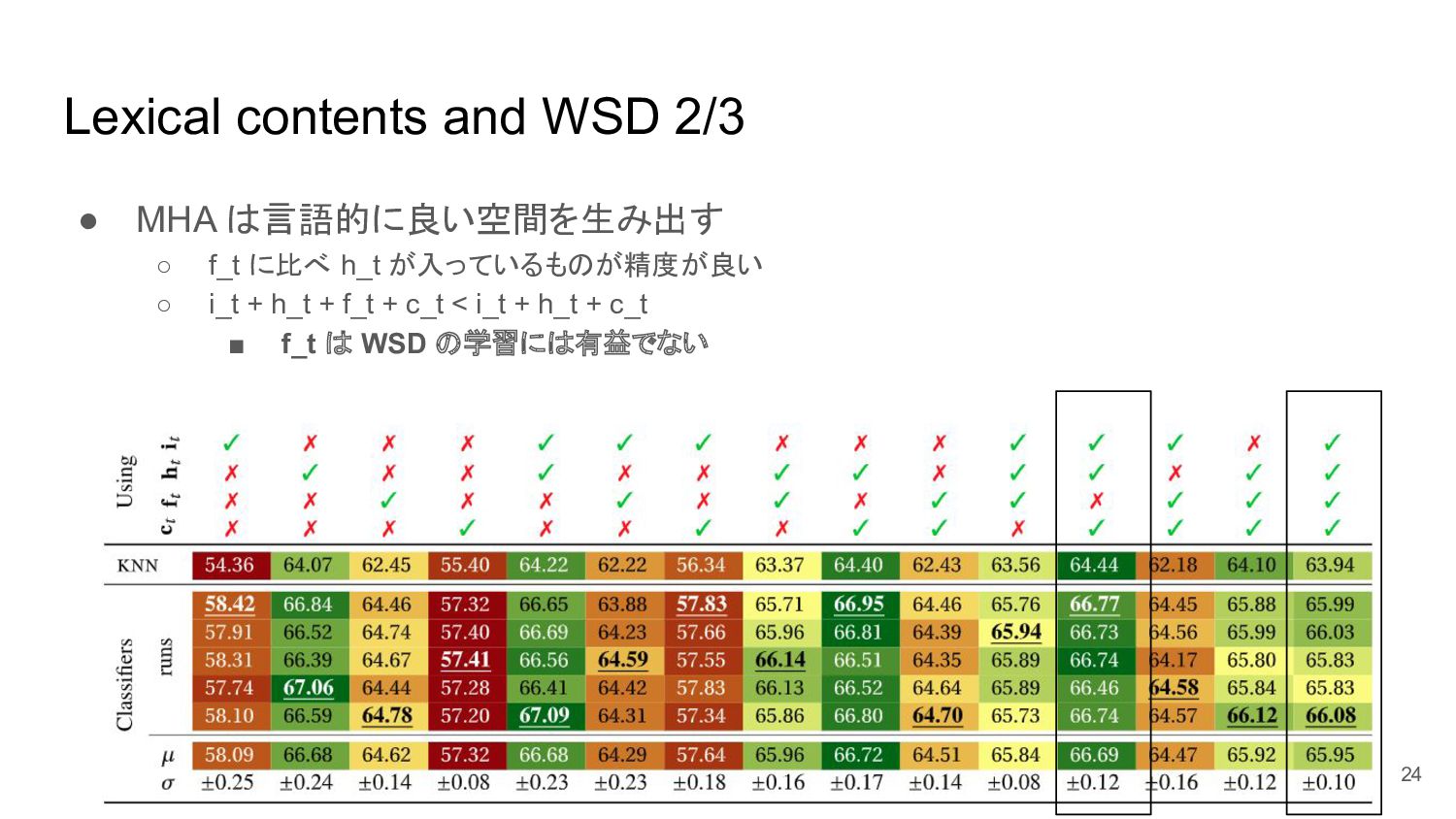
Lexical contents and WSD 2/3 • MHA は言語的に良い空間を生み出す ◦ f_t
に比べ h_t が入っているものが精度が良い ◦ i_t + h_t + f_t + c_t < i_t + h_t + c_t ▪ f_t は WSD の学習には有益でない 24
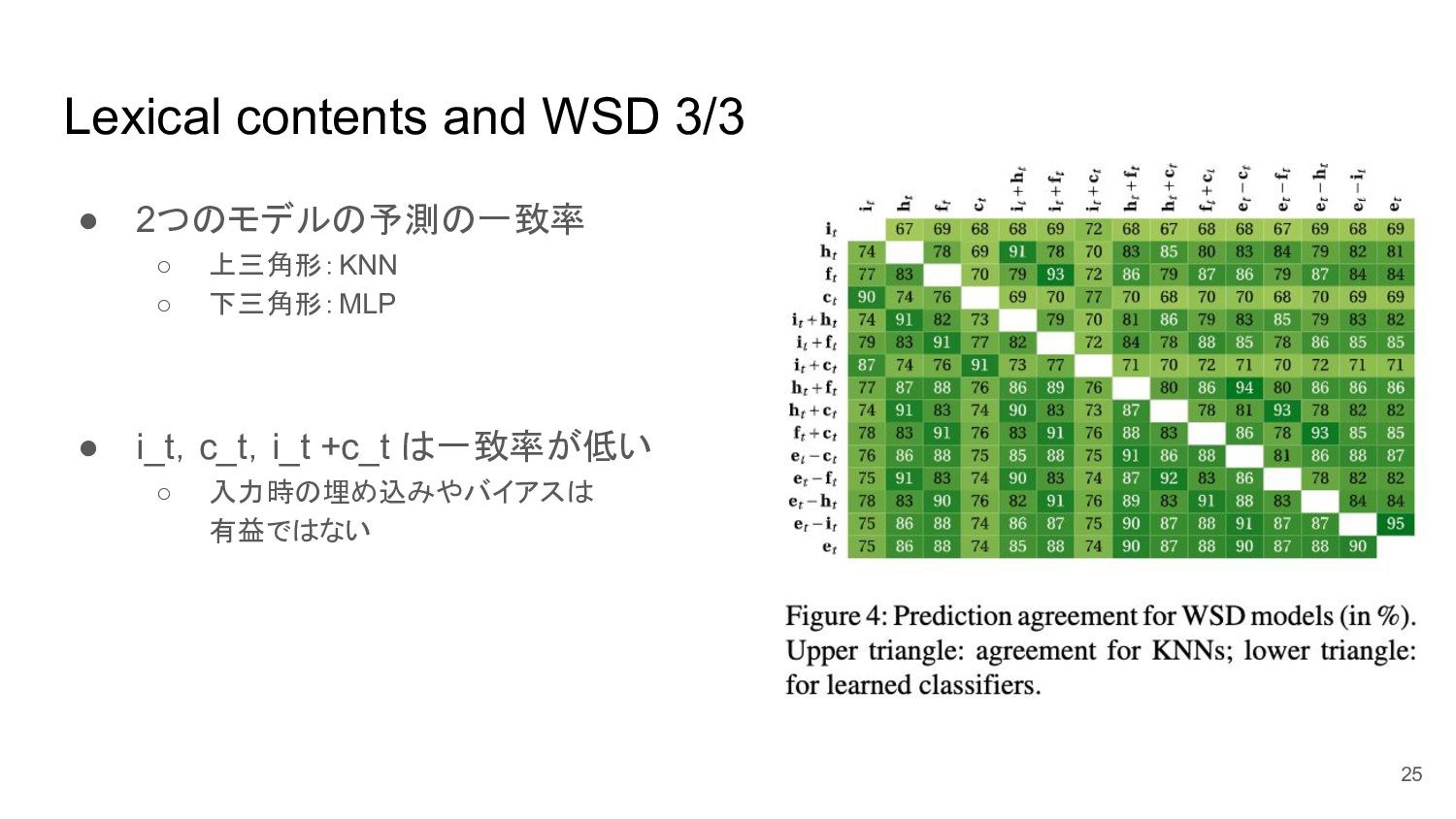
Lexical contents and WSD 3/3 • 2つのモデルの予測の一致率 ◦ 上三角形:KNN ◦
下三角形:MLP • i_t,c_t,i_t +c_t は一致率が低い ◦ 入力時の埋め込みやバイアスは 有益ではない 25
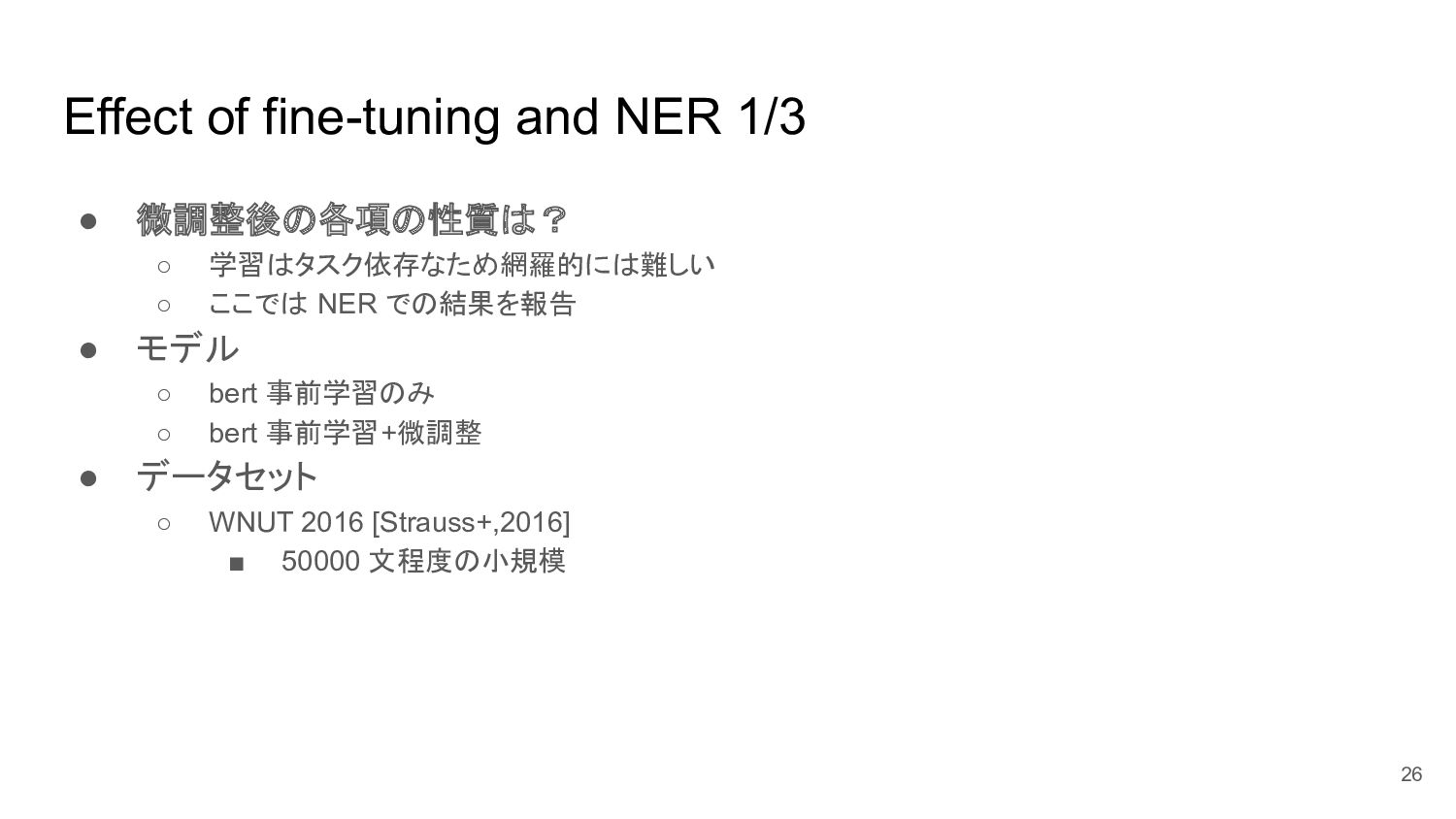
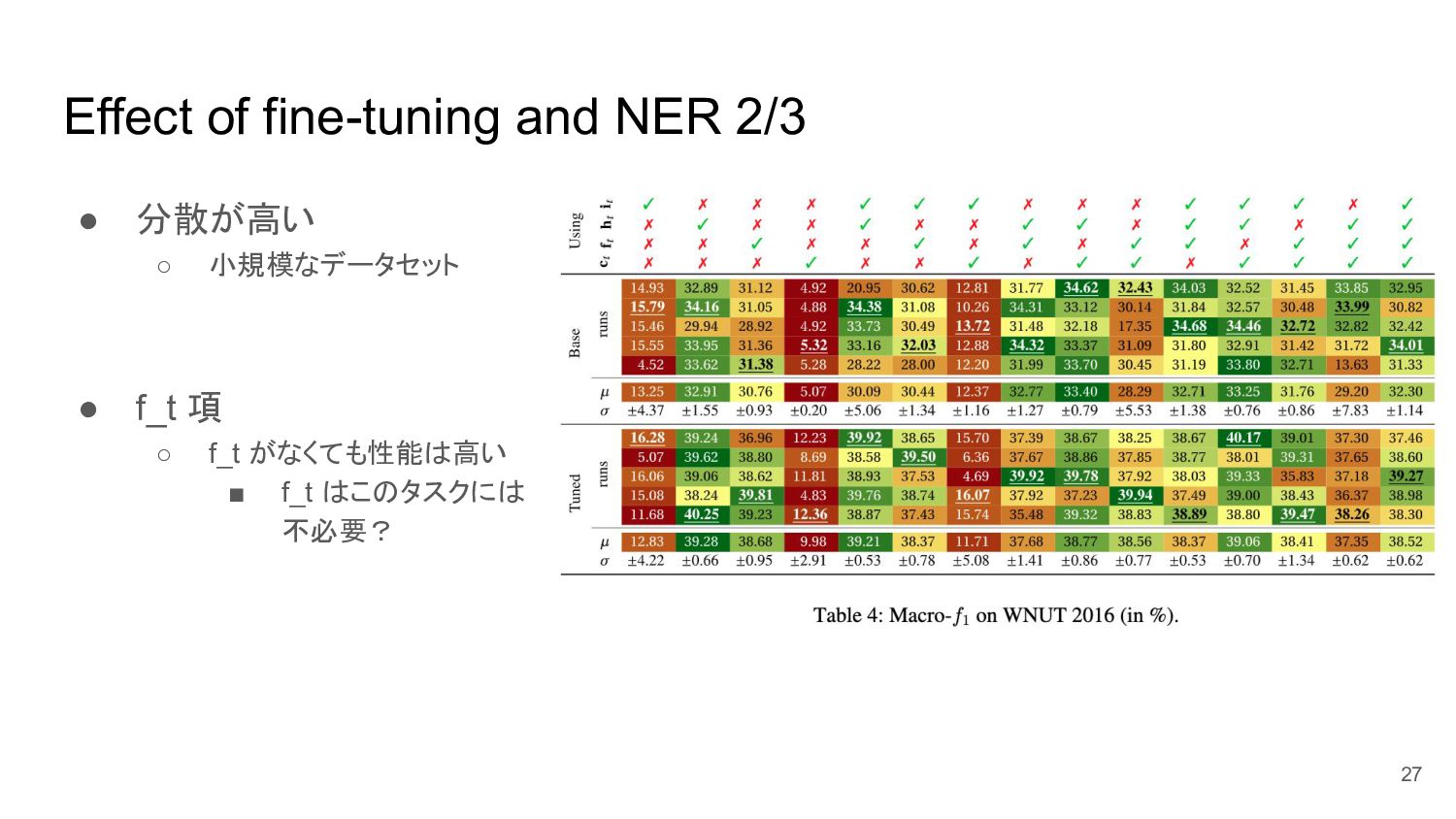
Effect of fine-tuning and NER 1/3 • 微調整後の各項の性質は? ◦ 学習はタスク依存なため網羅的には難しい
◦ ここでは NER での結果を報告 • モデル ◦ bert 事前学習のみ ◦ bert 事前学習+微調整 • データセット ◦ WNUT 2016 [Strauss+,2016] ▪ 50000 文程度の小規模 26
Effect of fine-tuning and NER 2/3 • 分散が高い ◦ 小規模なデータセット
• f_t 項 ◦ f_t がなくても性能は高い ▪ f_t はこのタスクには 不必要? 27
Effect of fine-tuning and NER 3/3 • 2つのモデルの予測の一致率 ◦ 上三角形:事前学習のみ
◦ 下三角形:微調整済み • i_t, c_t, i_t+c_t の挙動 ◦ 一致率がかなり低い ◦ FF や MHA が下流タスク特有に 28
Conclusions and future work • Transformer の埋め込みを分解し構成要素ごとの分析を行なった ◦ FF は
MLM の学習に有益 ◦ MHA は WSD や NER などのタスクに有益 • 今後の展望 ◦ (1)式の拡張 ▪ より細かい粒度や別の観点からの分解 ◦ 今後の Transformer の分析に用いる 29


 rudorudo11
 aemeredith
 marktimemedia
 frankvandijk
 samanthasiow
 codingconduct
 smashingmag
 aleyda
 jeffersonlam
 lauravandoore
 apolaine
 sabderemane
 cassininazir