Share
Embed
Structures de Données Exotiques
Devoxx France 2013 Conference, on advanced data structures.
SkipLists
Hash Array Mapped Tries
Bloom Filters
Count min sketch
Sam Bessalah
April 07, 2013
Transcript
69 slides
-
• Sam BESSALAH • Independent Software Developer, • Works for startups, finance shops,
mostly in Big Data, Machine Learning related projects. • Rambling on twitter as @samklr -
Powerful librairies, powerful frameworks. But .. « If all you
have is a hammer, everything looks like a nail ». Abraham H. Maslow -
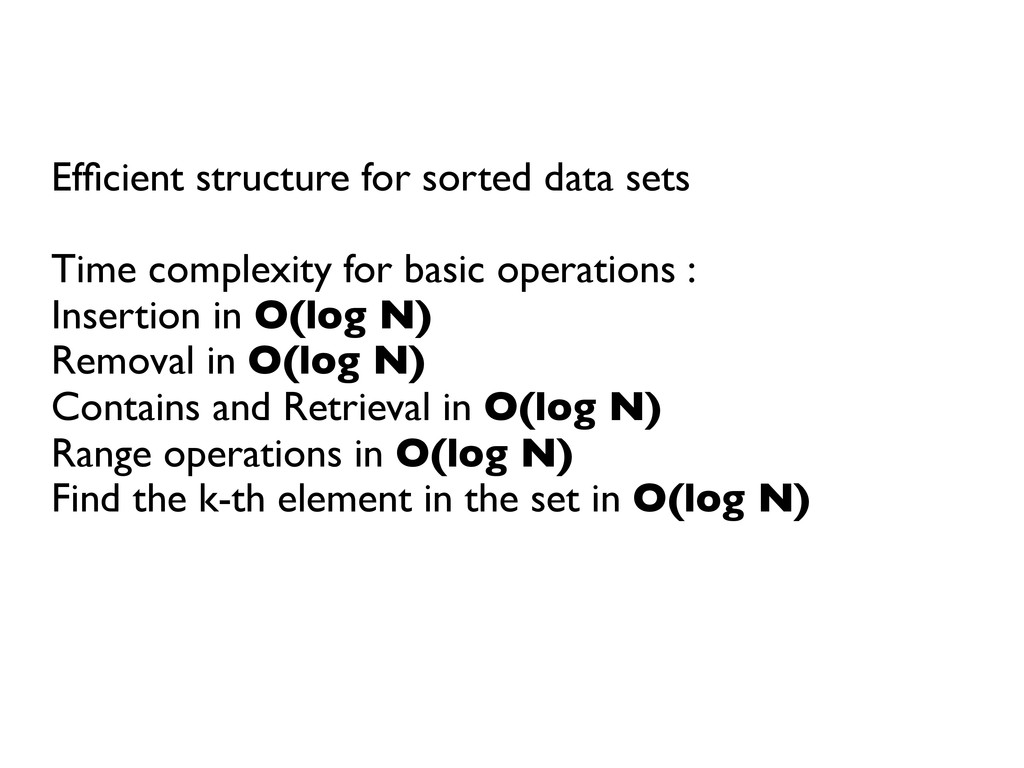
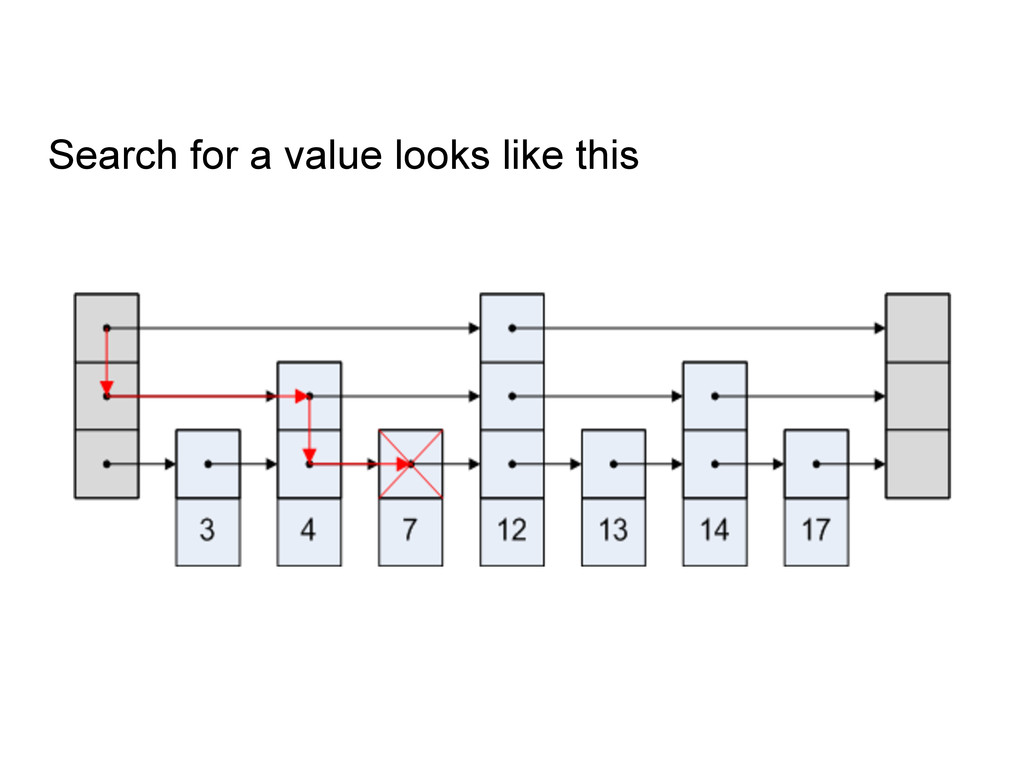
Efficient structure for sorted data sets Time complexity for basic
operations : Insertion in O(log N) Removal in O(log N) Contains and Retrieval in O(log N) Range operations in O(log N) Find the k-th element in the set in O(log N) -
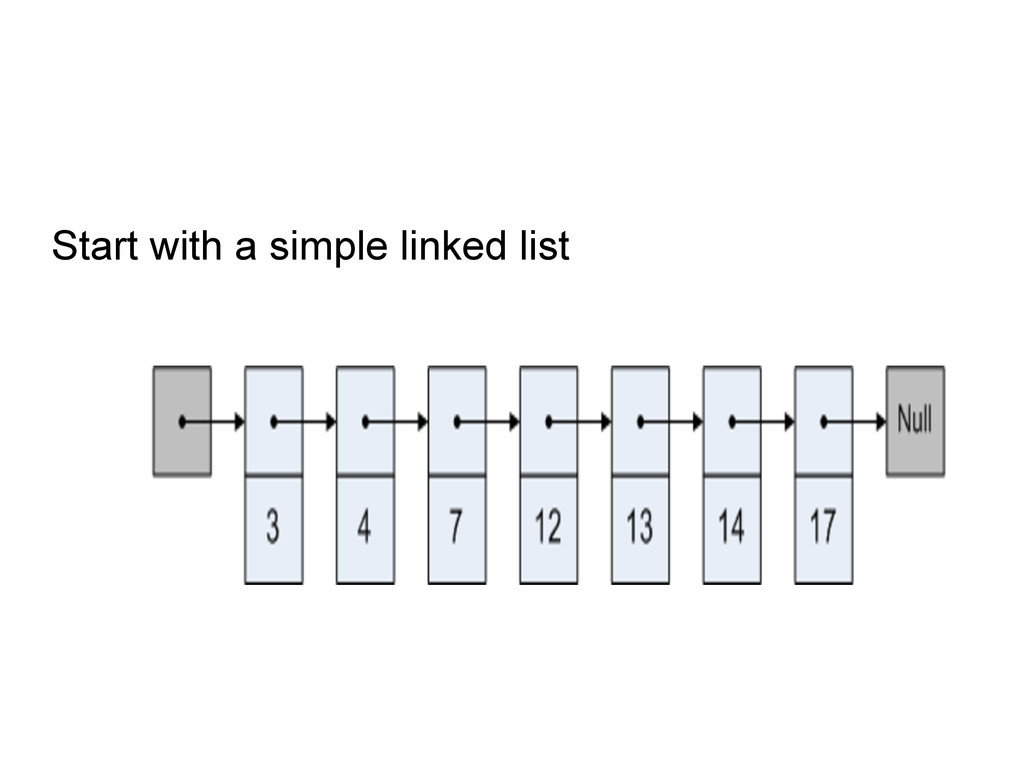
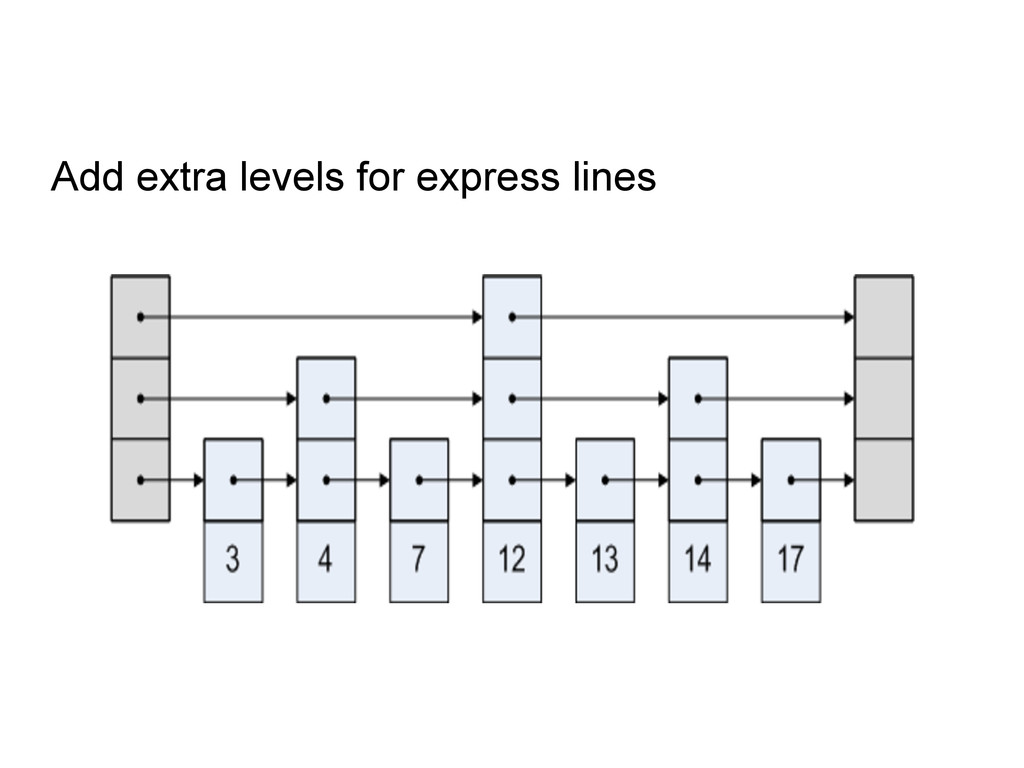
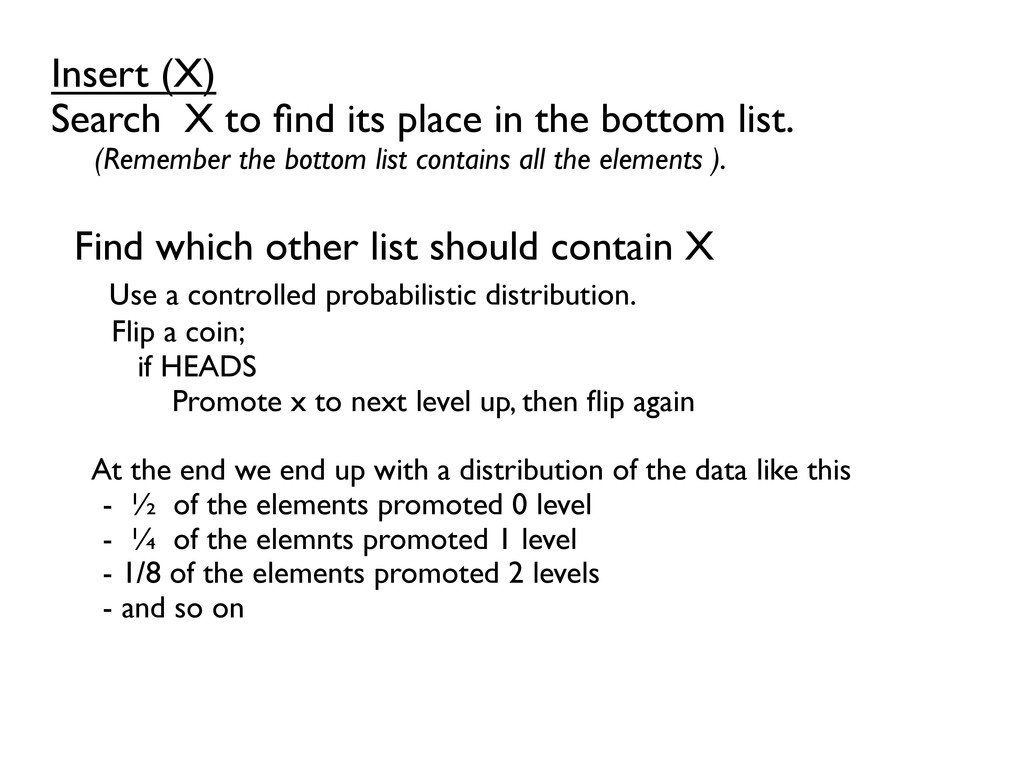
Insert (X) Search X to find its place in the
bottom list. (Remember the bottom list contains all the elements ). Find which other list should contain X Use a controlled probabilistic distribution. Flip a coin; if HEADS Promote x to next level up, then flip again At the end we end up with a distribution of the data like this - ½ of the elements promoted 0 level - ¼ of the elemnts promoted 1 level - 1/8 of the elements promoted 2 levels - and so on -
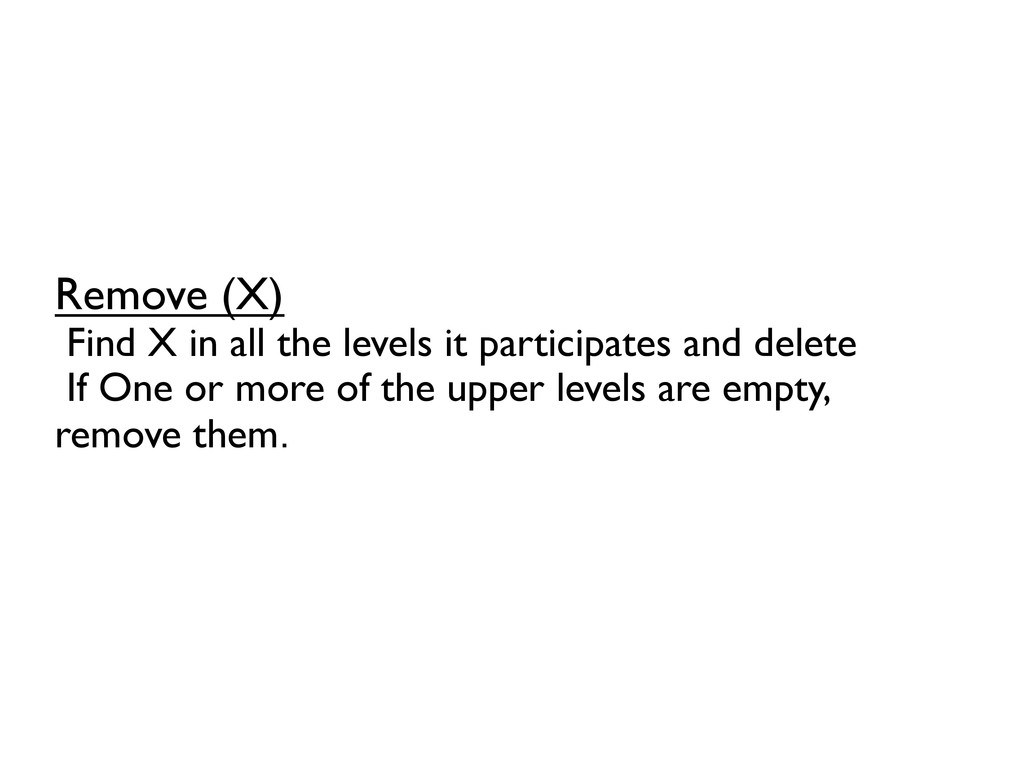
Remove (X) Find X in all the levels it participates
and delete If One or more of the upper levels are empty, remove them. -
Insert void insert(E value) { SkipNode<E> x = header; SkipNode<E>[]
update = new SkipNode[MAX_LEVEL + 1]; for (int i = level; i >= 0; i--) { while (x.forward[i] != null && x.forward[i].value.compareTo(value) < 0) { x = x.forward[i]; } update[i] = x; } x = x.forward[0]; if (x == null || !x.value.equals(value)) { int lvl = randomLevel(); if (lvl > level) { for (int i = level + 1; i <= lvl; i++) { update[i] = header; } level = lvl; } -
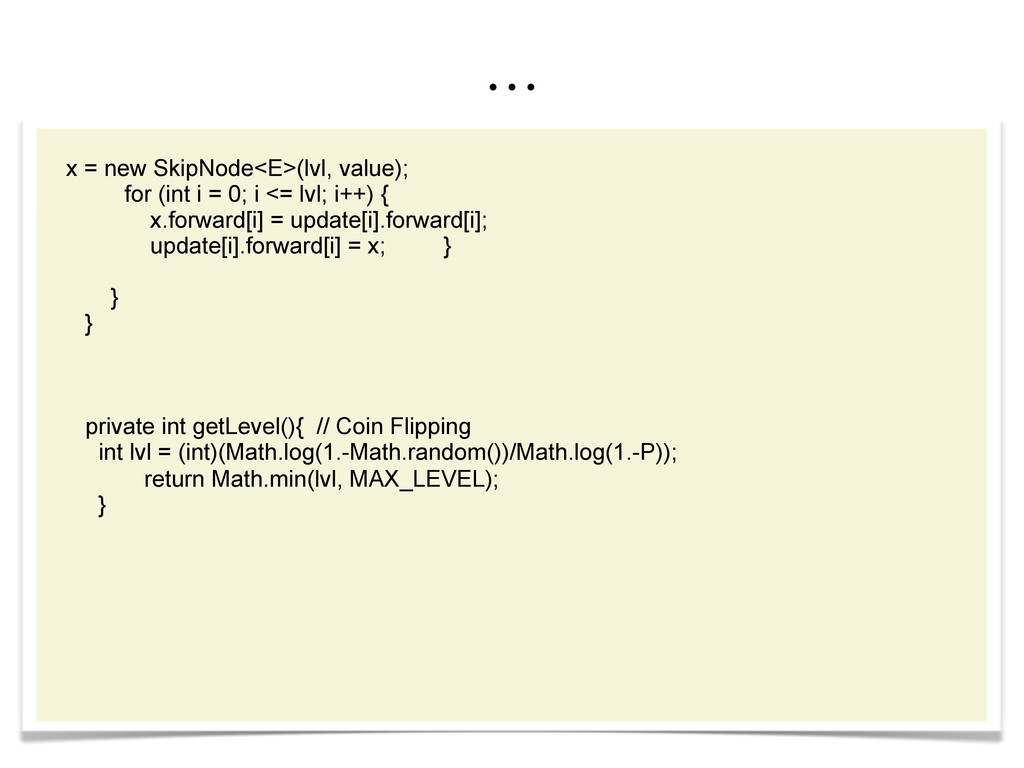
… x = new SkipNode<E>(lvl, value); for (int i =
0; i <= lvl; i++) { x.forward[i] = update[i].forward[i]; update[i].forward[i] = x; } } } private int getLevel(){ // Coin Flipping int lvl = (int)(Math.log(1.-Math.random())/Math.log(1.-P)); return Math.min(lvl, MAX_LEVEL); } -
Fast structure on average, very fast in practice Can be
implemented in a thread safe way without locking the entire strcture, and instead acting on pointers. In a lock free fashion, by using CAS instructions. In Java since JDK 1.6 within the collections java.util.concurrent.ConcurrentSkipListMap and java.util.concurrent.ConcurrentSkipListSet. Both are non blocking, thread safe data structures with locality of reference properties. Ideal for cache implementation. -
CAS instruction CAS(address, expected_value, new_value) Atomically replaces the value at
the address with the new_value if it is equal to the expected_value. In one instruction CMPXCHG Returns true if successful, false otherwise. -
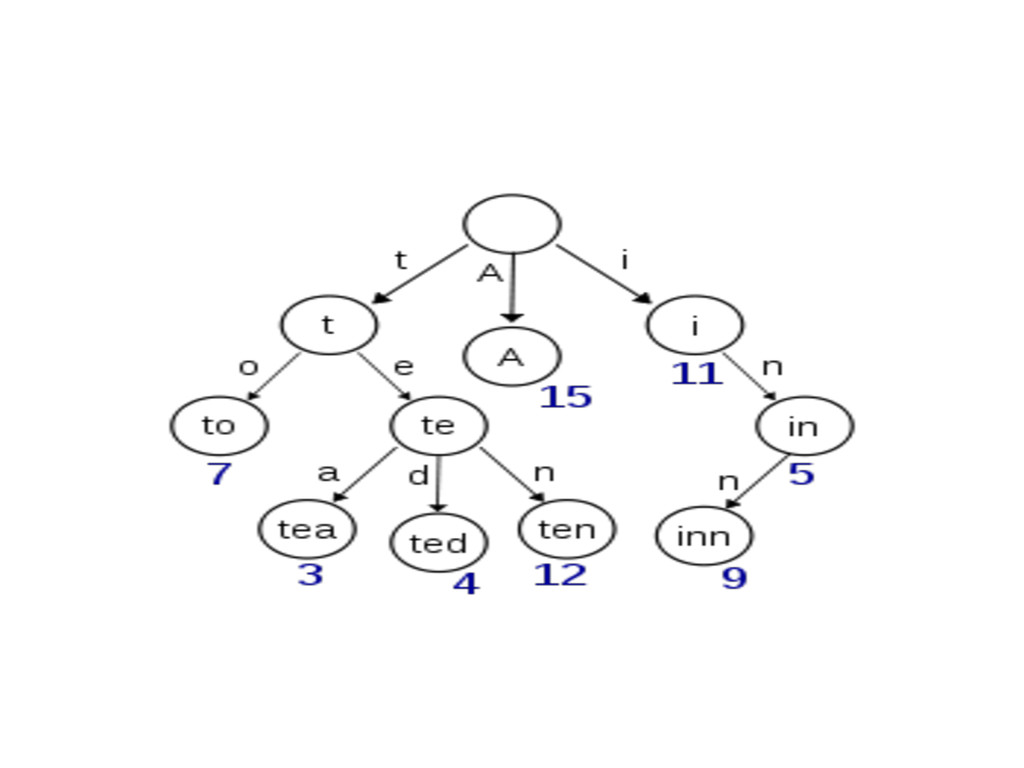
- Ordered Tree data structure, used to store associative arrays.
Usually, encoded keys through traversal, in the nodes of the tree with value in the leaves. -Used for dictionnary (Map), word completion, web requests parsing., etc. -Time complexity in O(k) where k is the length of searched string. Where it usually is O(length of the tree) -
How does it work? During association of K → V
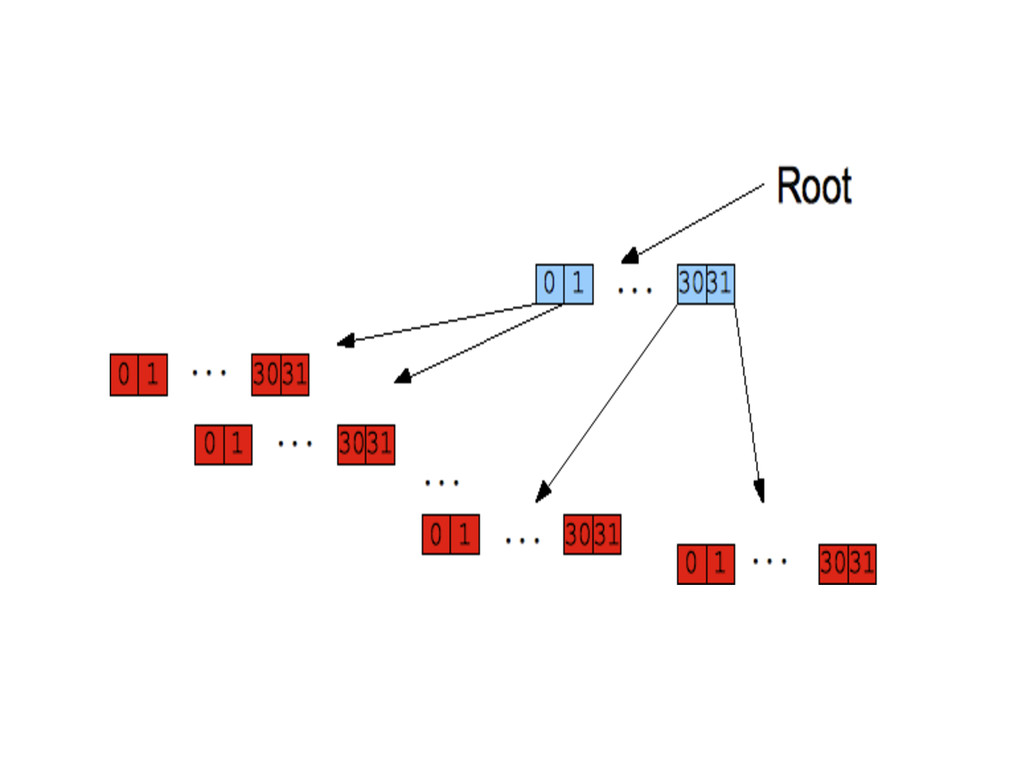
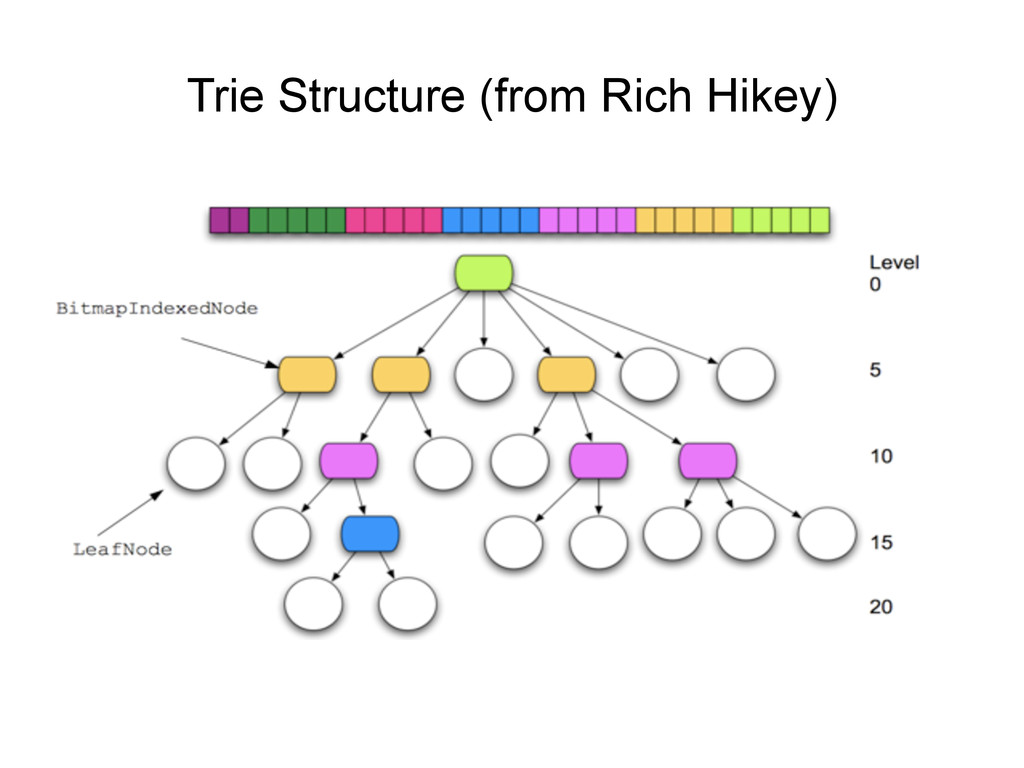
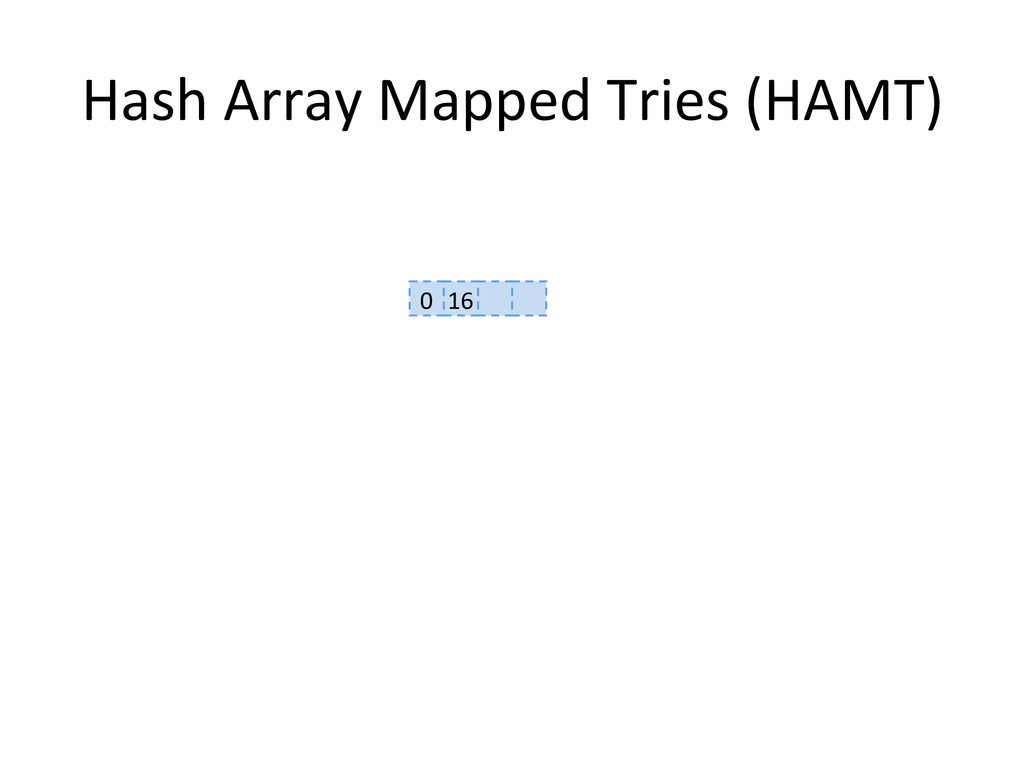
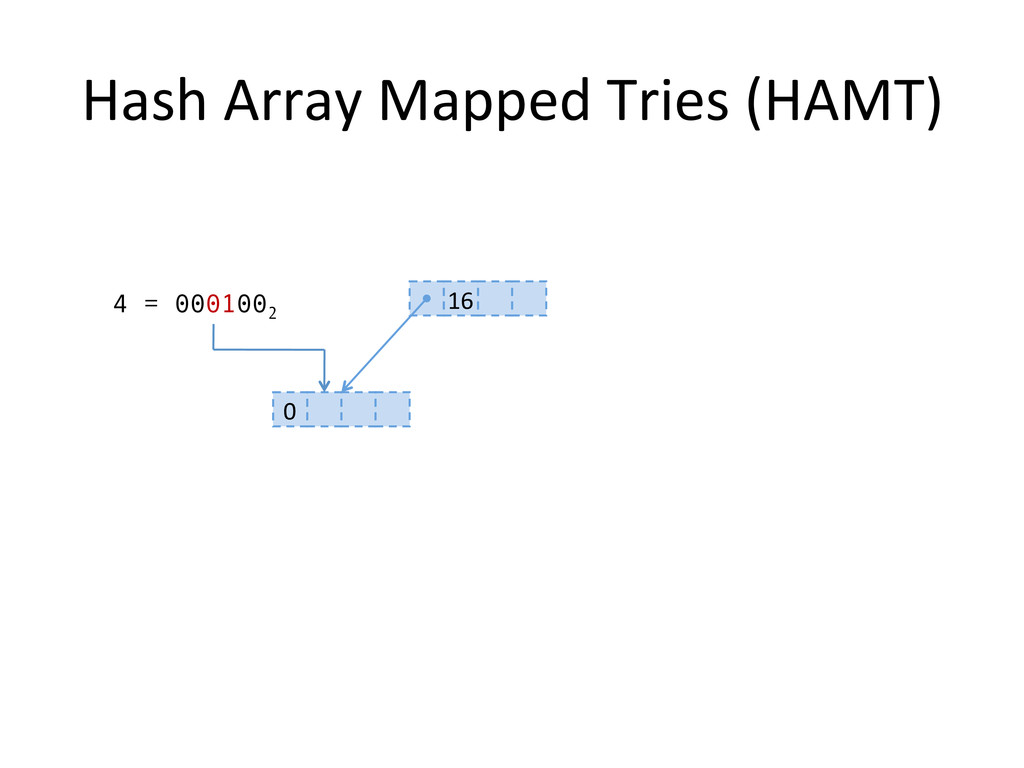
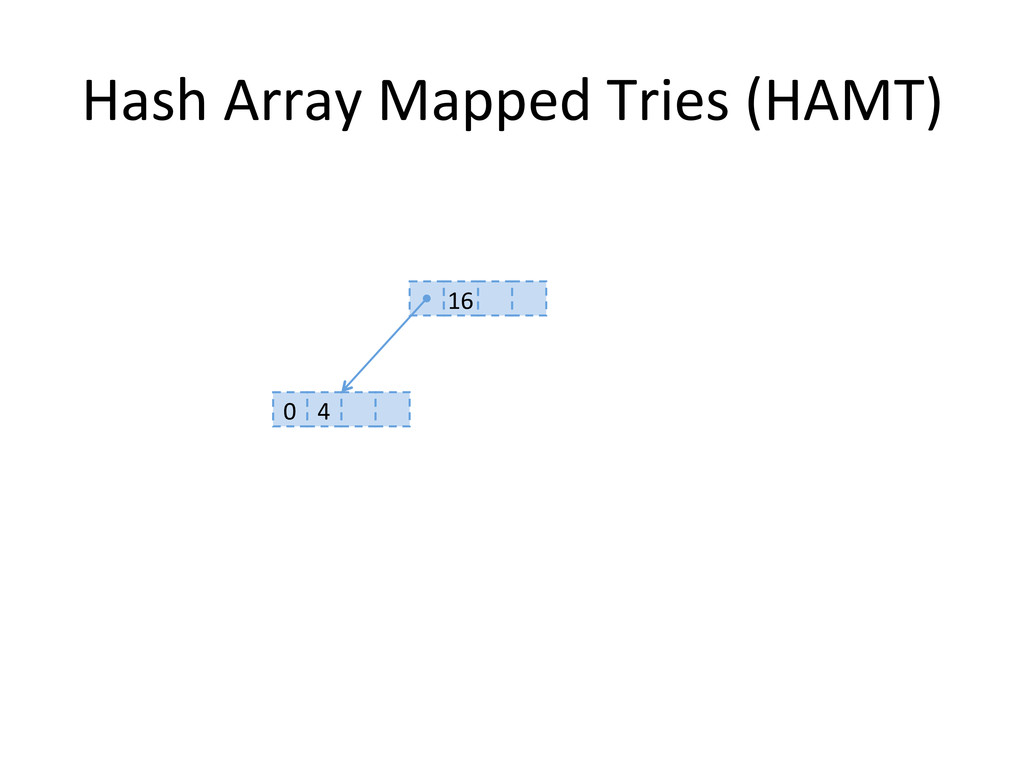
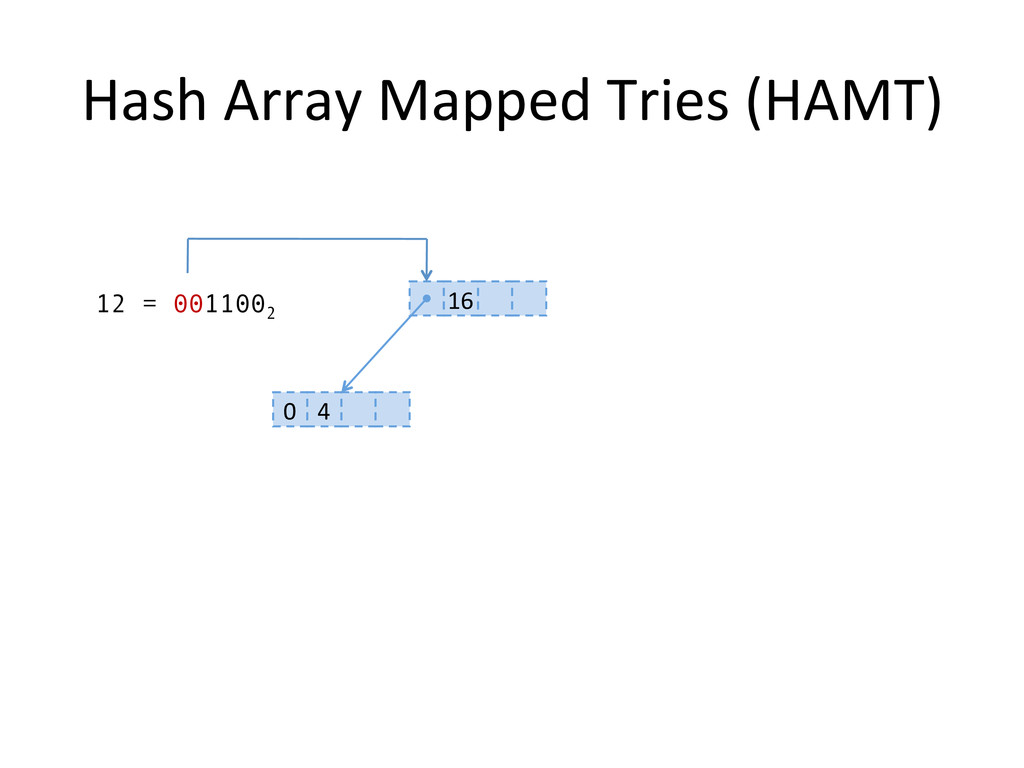
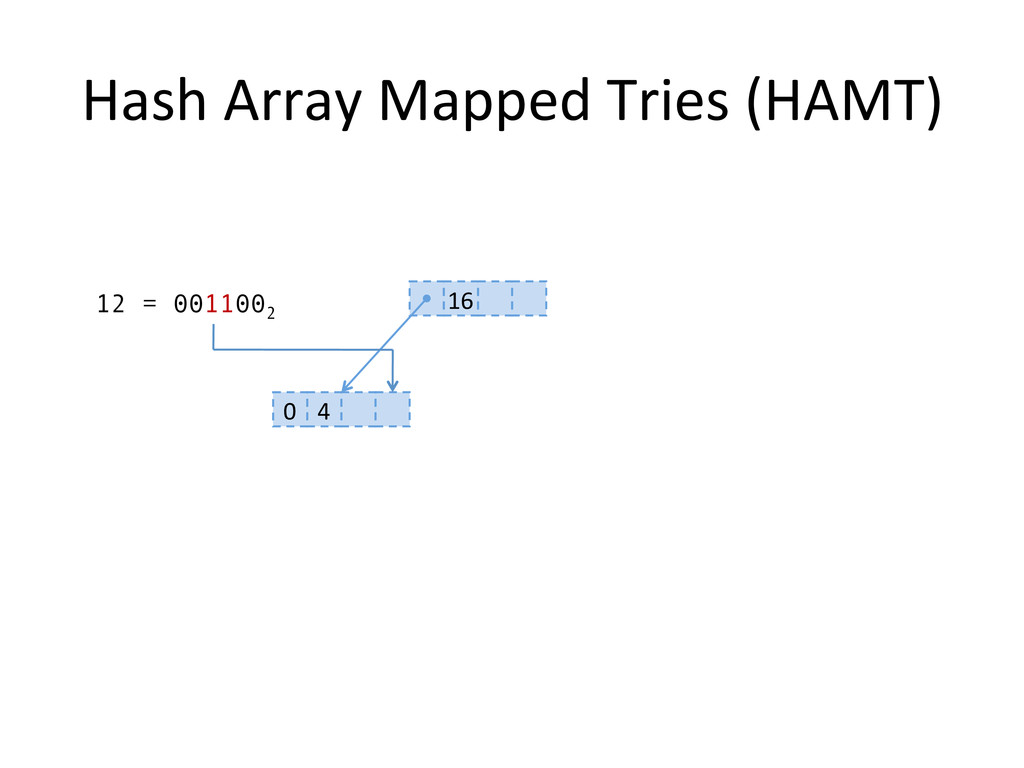
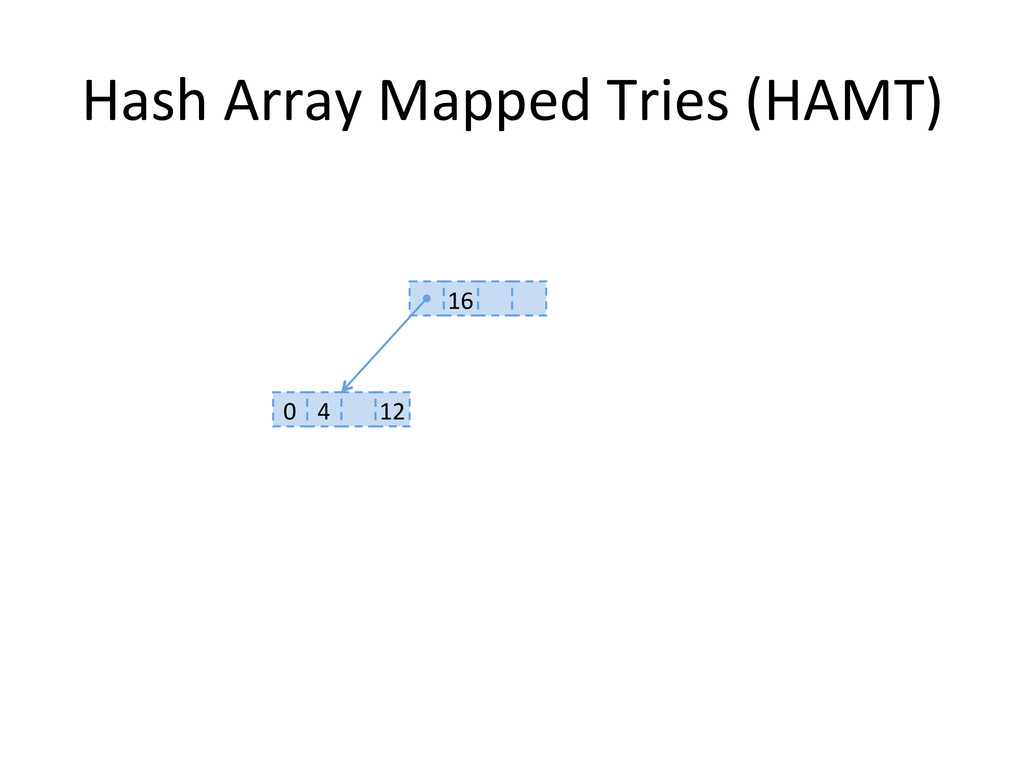
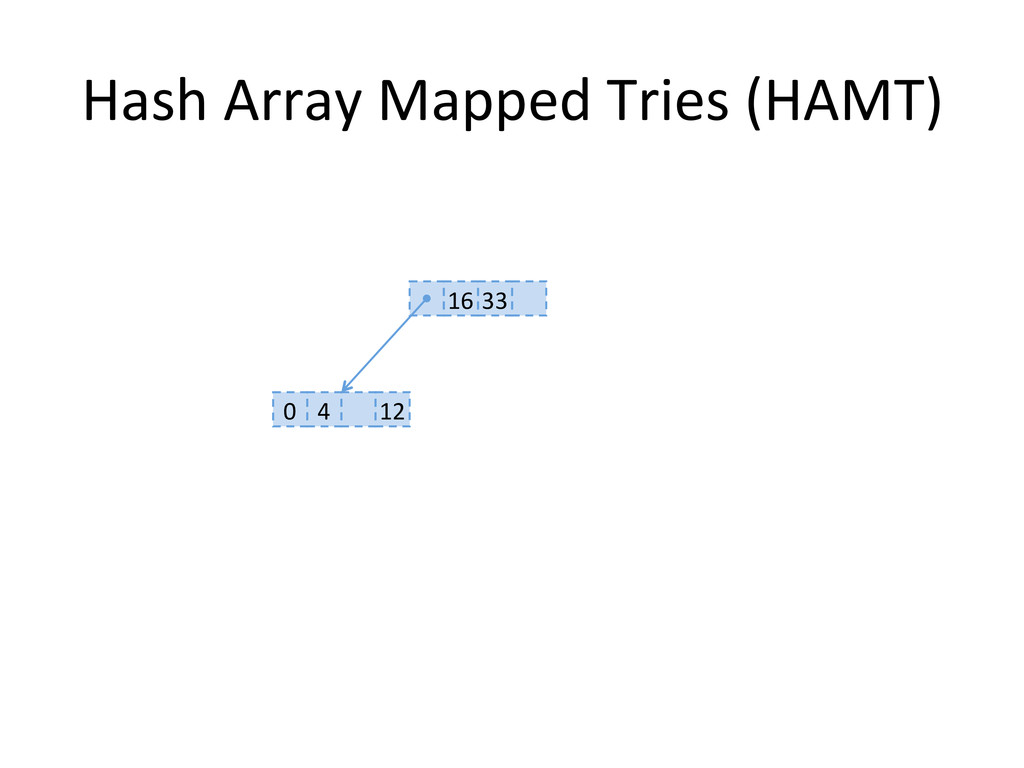
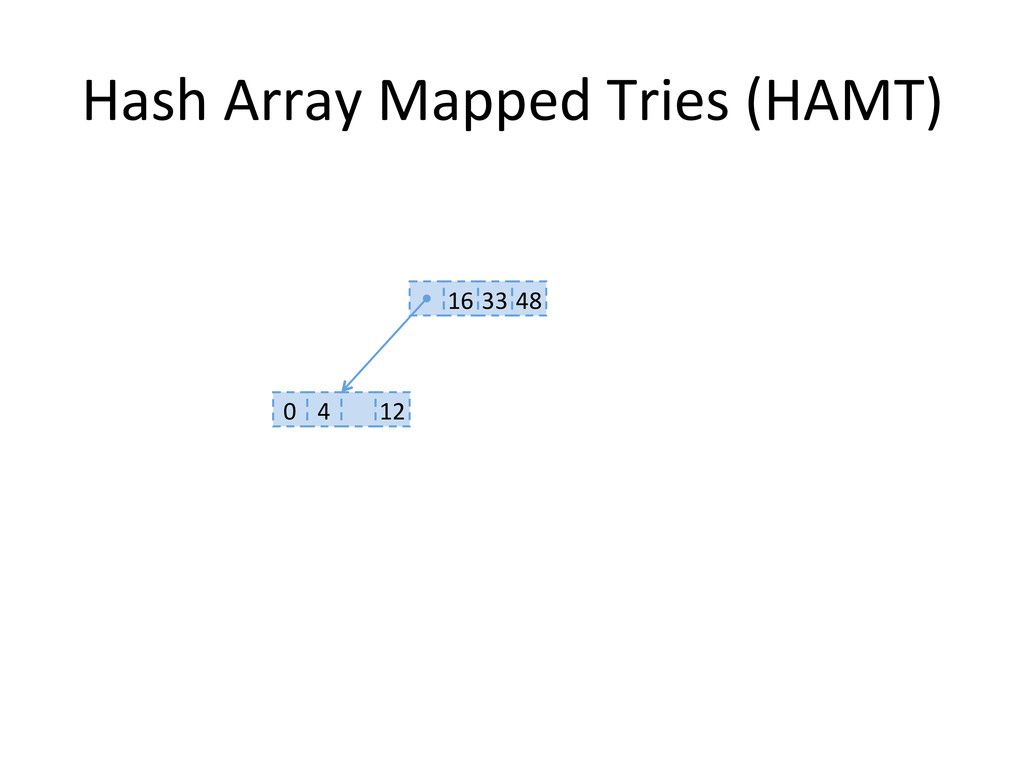
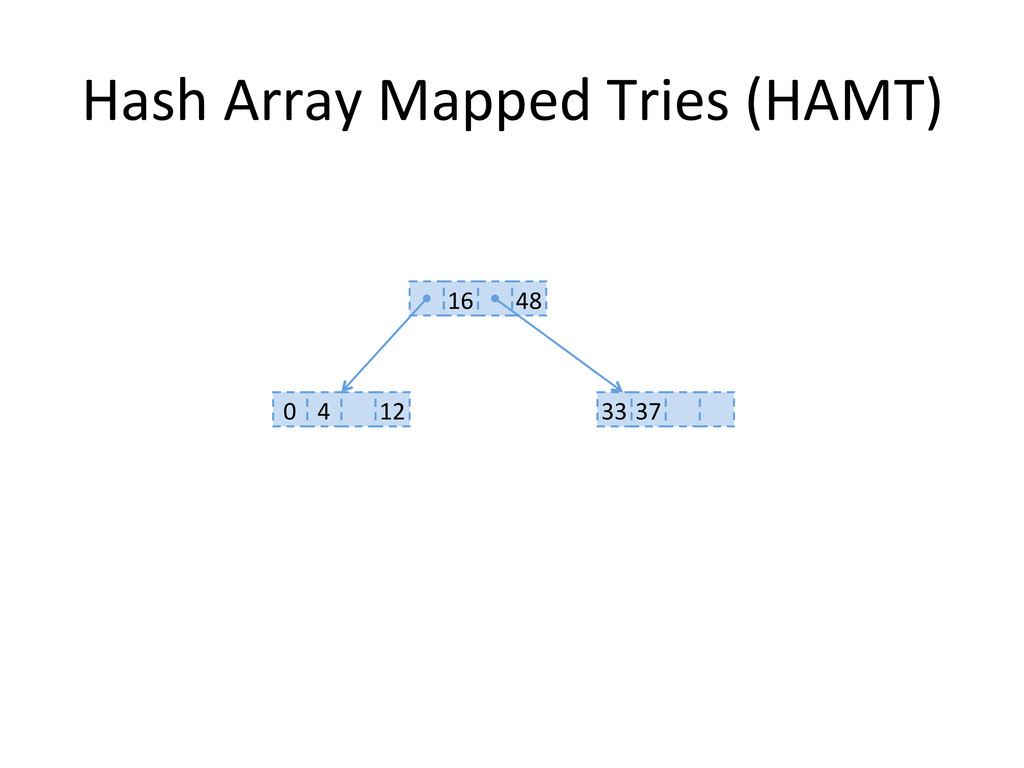
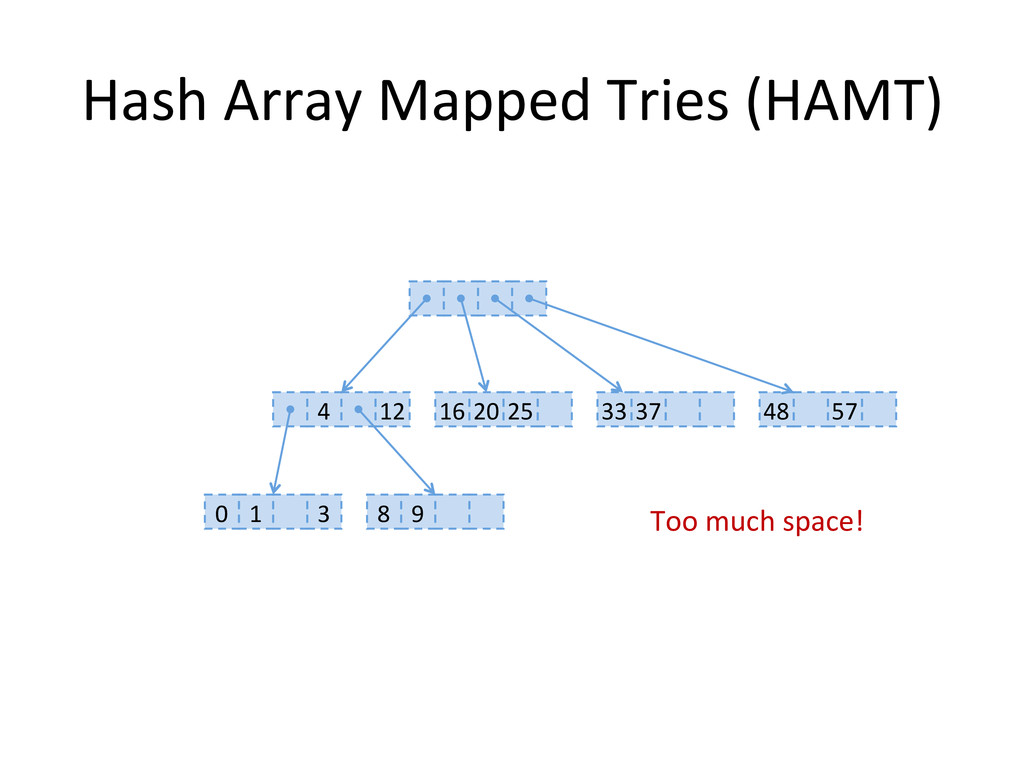
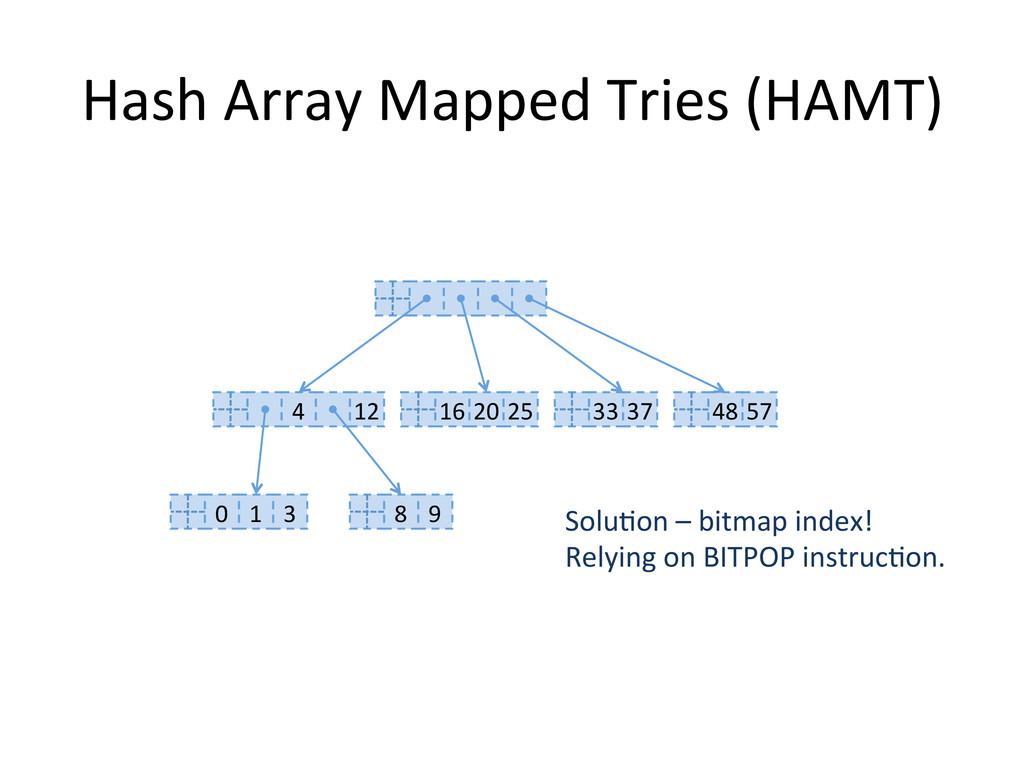
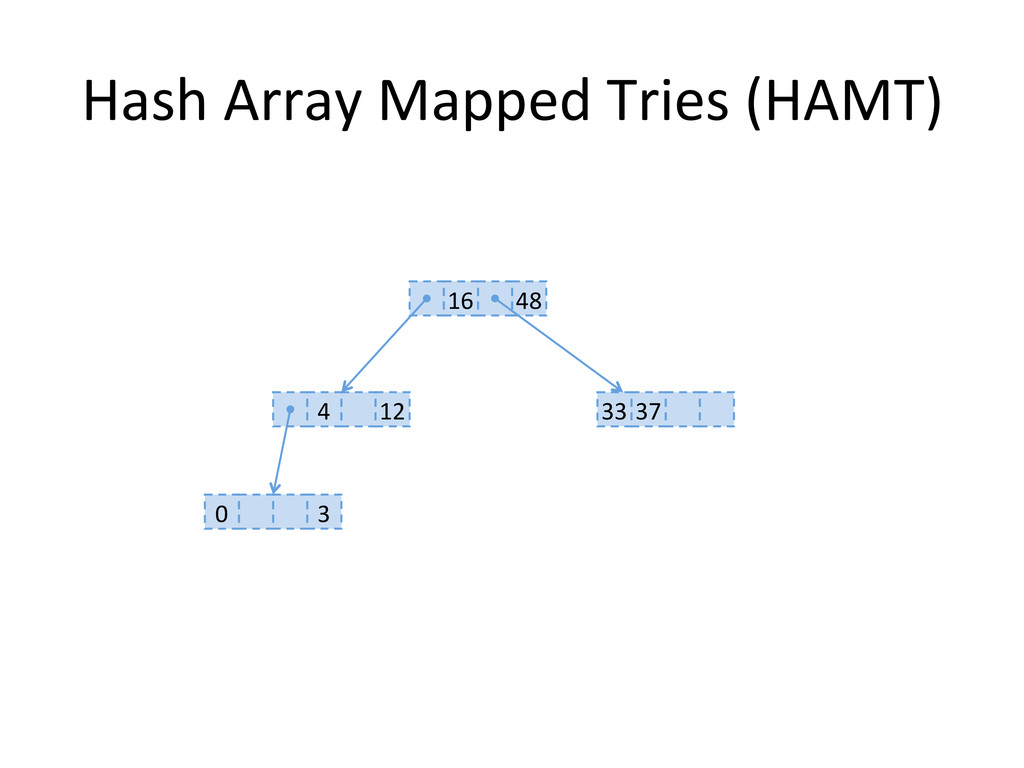
, compute hashes yielding an Integer or a long, coded on the JVM in 32 bits Partition those bits to blocks of 5 bits, representing a level in the tree structure, from the right most (root) to the left most (leaves) The colored nodes have between 2 and 31 children Each colored node maintain a bitmap, encoding how many children the nodes contains, and their indexes in the array. -
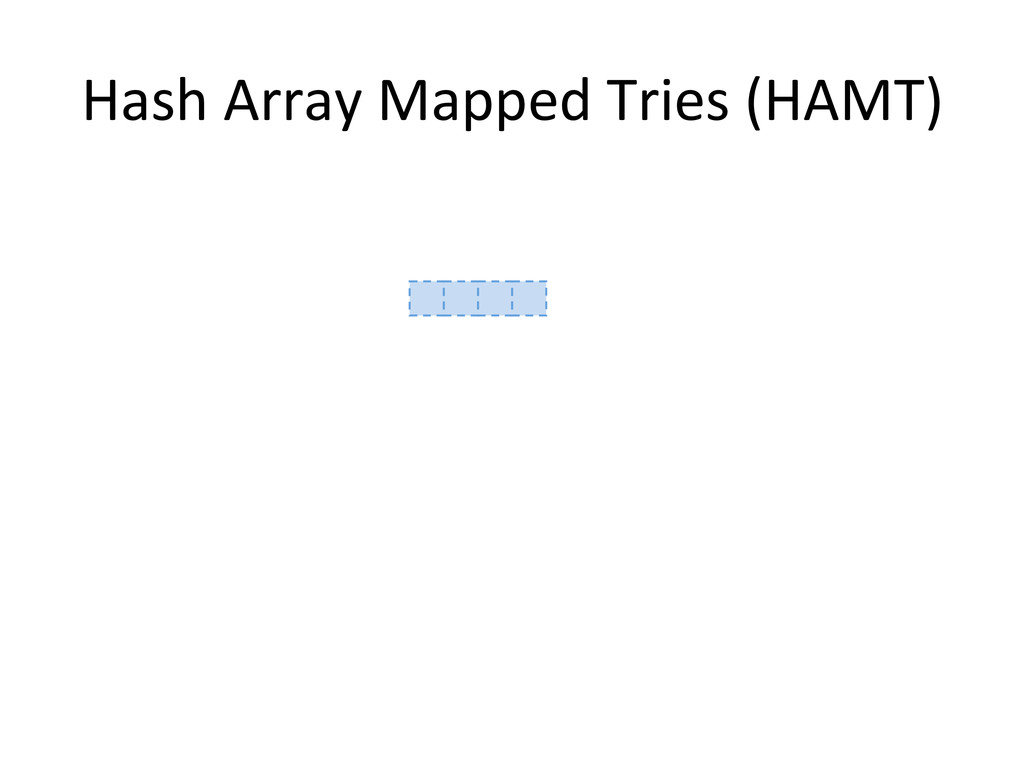
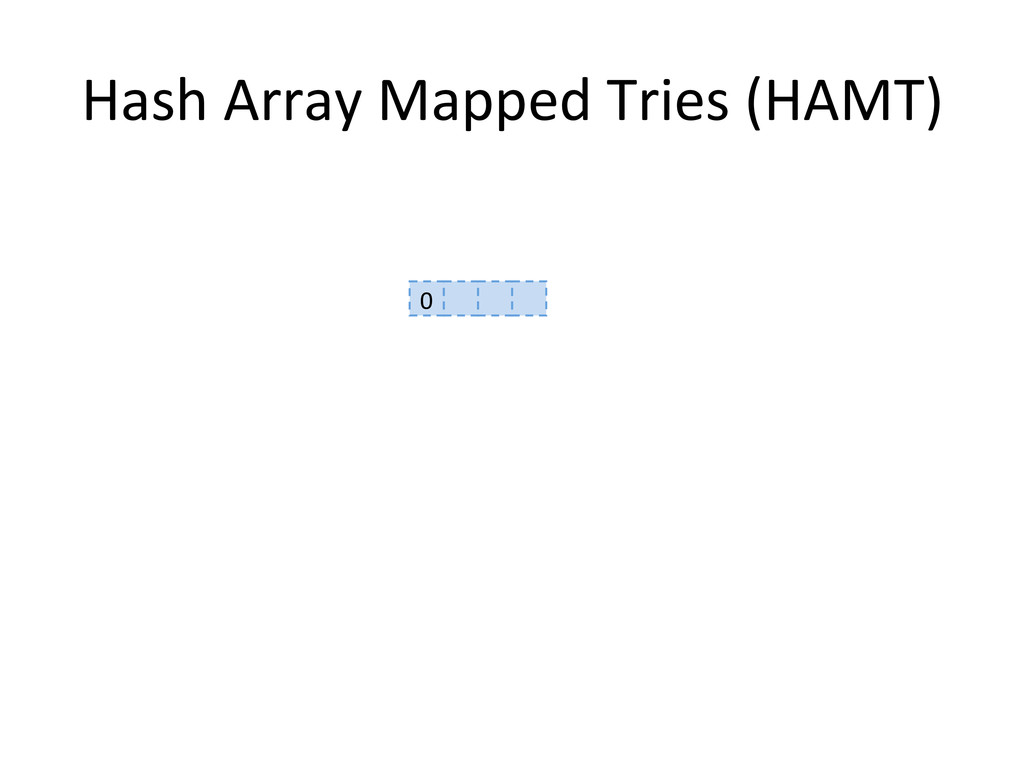
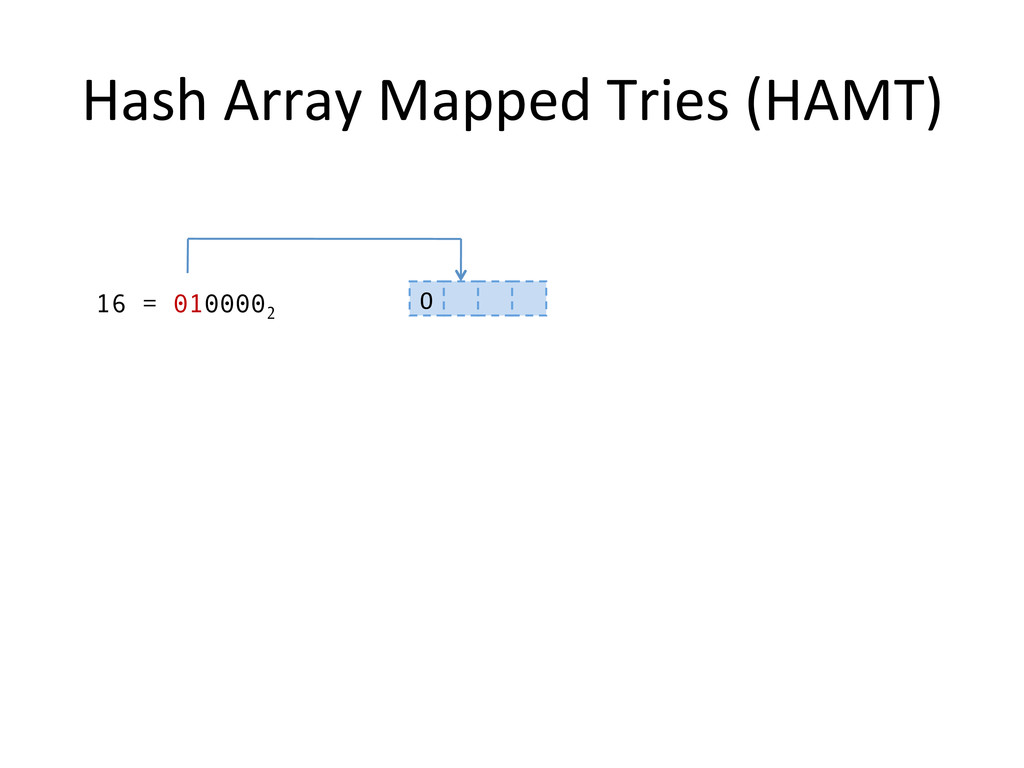
Hash Array Mapped Tries (HAMT) 0 16
4 = 0001002 -
Hash Array Mapped Tries (HAMT) 16 0
4 = 0001002 -
Hash Array Mapped Tries (HAMT) 16 0
4 12 = 0011002 -
Hash Array Mapped Tries (HAMT) 16 0
4 12 = 0011002 -
Hash Array Mapped Tries (HAMT) 16 0
4 12 48 33 37 -
Hash Array Mapped Tries (HAMT) 16 4
12 48 33 37 0 3 -
Hash Array Mapped Tries (HAMT) 4 12
16 20 25 33 37 0 1 8 9 3 48 57 -
Hash Array Mapped Tries (HAMT) 4 12
16 20 25 33 37 0 1 8 9 3 48 57 Too much space! -
Hash Array Mapped Tries (HAMT) 4 12
16 20 25 33 37 0 1 8 9 3 48 57 -
Hash Array Mapped Tries (HAMT) 4 12
16 20 25 33 37 0 1 8 9 3 48 57 Linear search at every level -‐ slow! -
Hash Array Mapped Tries (HAMT) 4 12
16 20 25 33 37 0 1 8 9 3 48 57 SoluHon – bitmap index! Relying on BITPOP instrucHon. -
Hash Array Mapped Tries (HAMT) 48 57
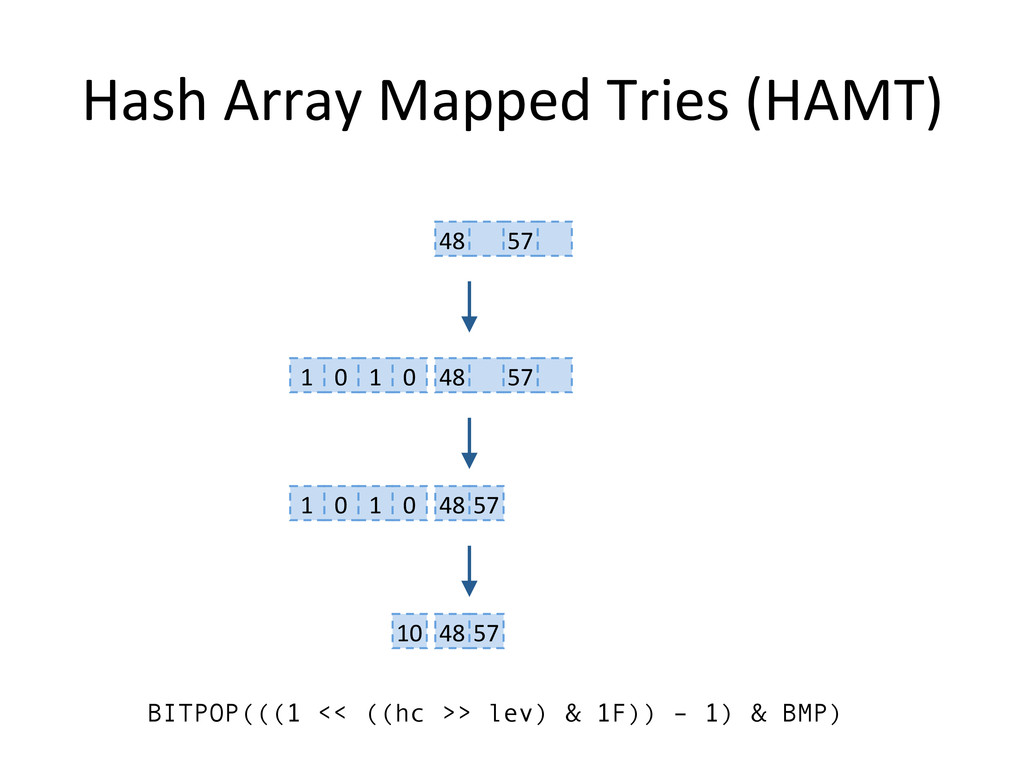
48 57 1 0 1 0 48 57 1 0 1 0 48 57 10 BITPOP(((1 << ((hc >> lev) & 1F)) – 1) & BMP) -
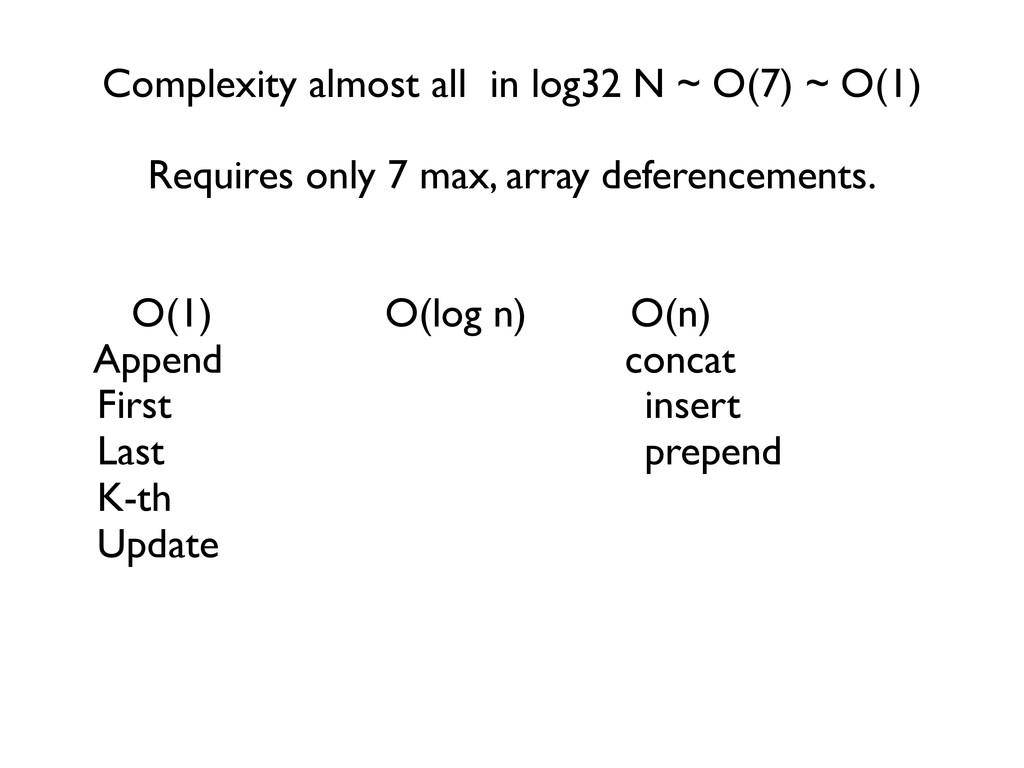
Complexity almost all in log32 N ~ O(7) ~ O(1)
Requires only 7 max, array deferencements. O(1) O(log n) O(n) Append concat First insert Last prepend K-th Update -
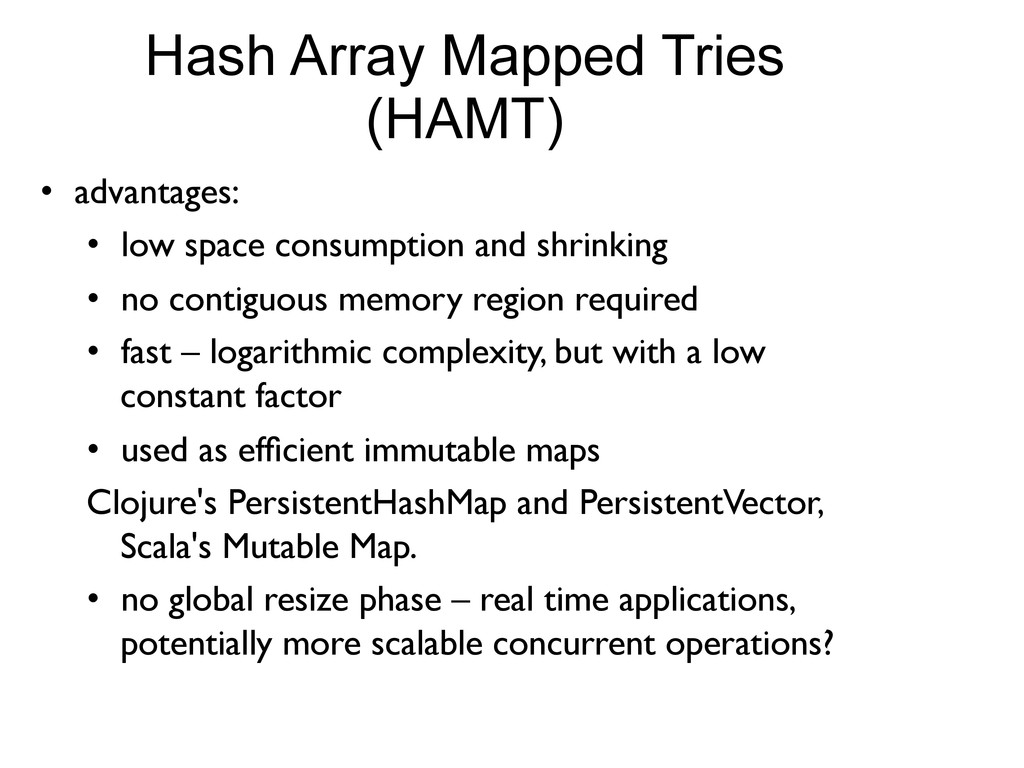
Hash Array Mapped Tries (HAMT) • advantages: • low space
consumption and shrinking • no contiguous memory region required • fast – logarithmic complexity, but with a low constant factor • used as efficient immutable maps Clojure's PersistentHashMap and PersistentVector, Scala's Mutable Map. • no global resize phase – real time applications, potentially more scalable concurrent operations? -
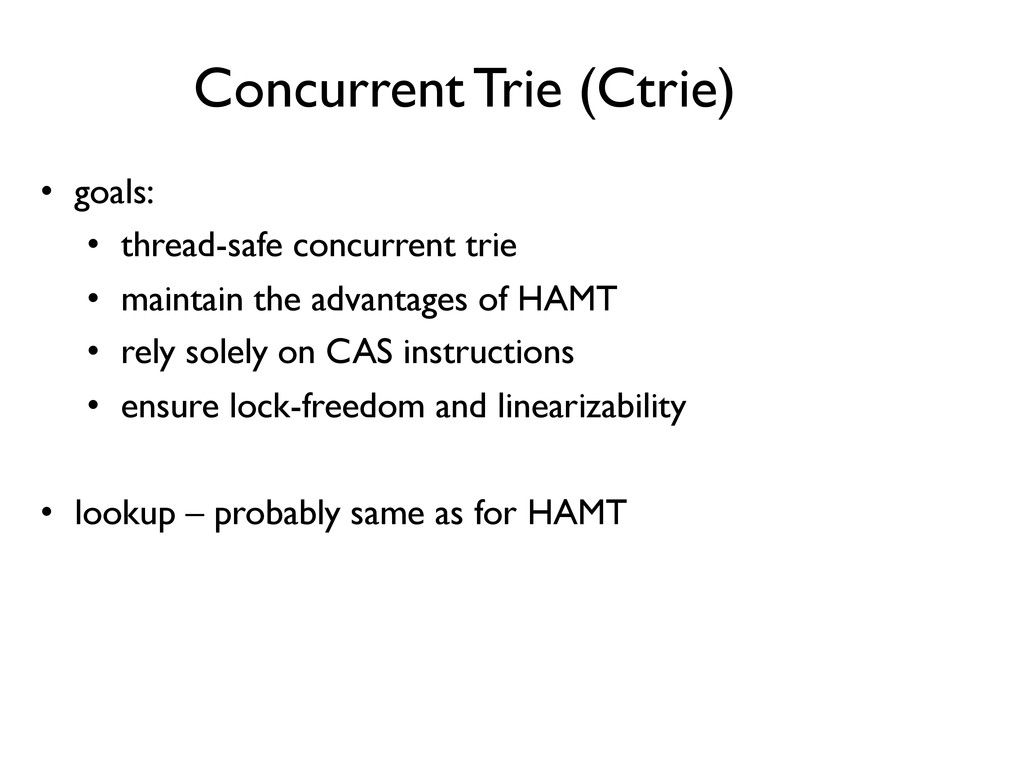
Concurrent Trie (Ctrie) • goals: • thread-safe concurrent trie •
maintain the advantages of HAMT • rely solely on CAS instructions • ensure lock-freedom and linearizability • lookup – probably same as for HAMT -
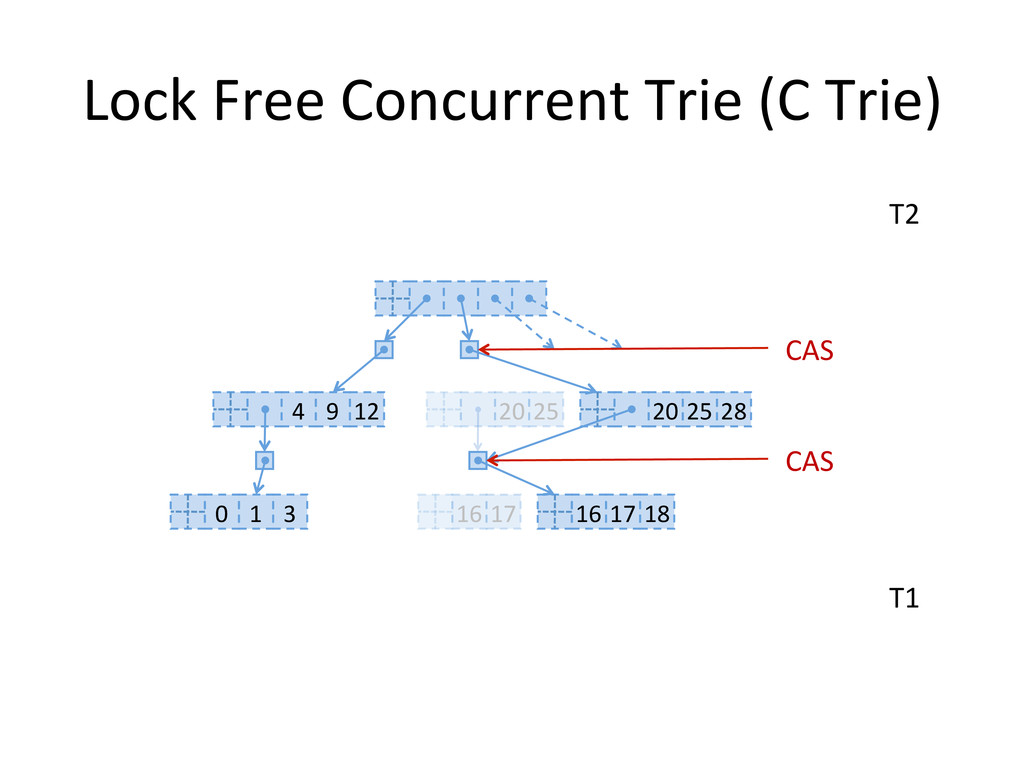
Lock Free Concurrent Trie (C Trie) 4 9
12 0 1 3 16 17 T1 T2 20 25 16 17 18 20 25 28 CAS CAS -
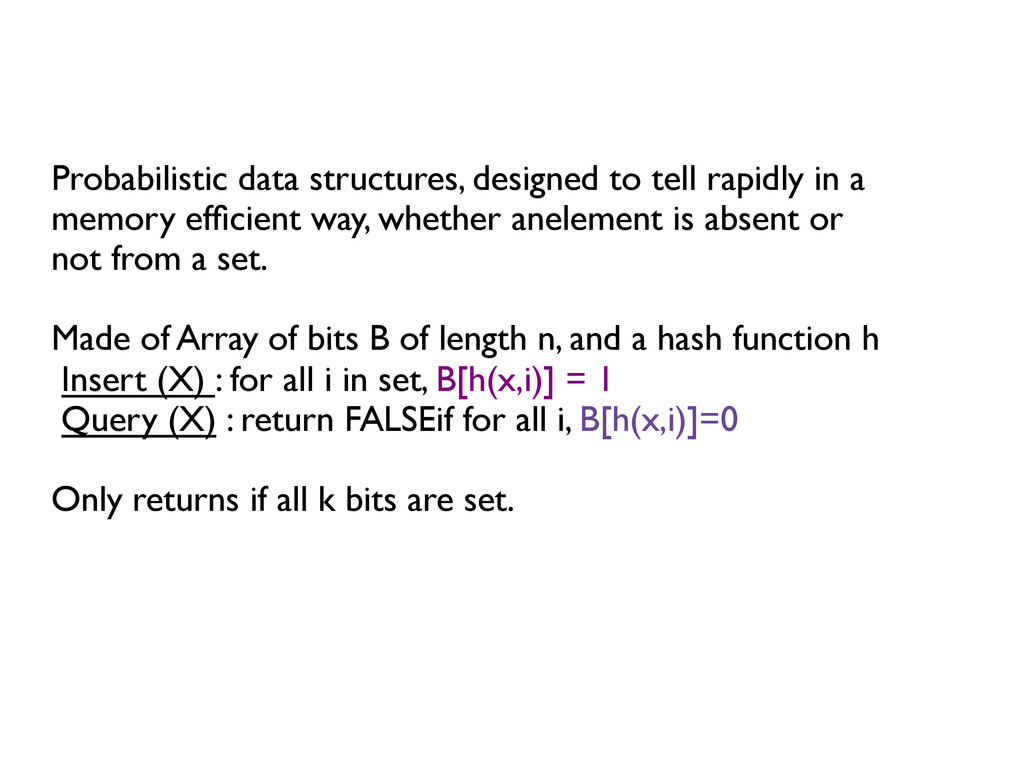
Probabilistic data structures, designed to tell rapidly in a memory
efficient way, whether anelement is absent or not from a set. Made of Array of bits B of length n, and a hash function h Insert (X) : for all i in set, B[h(x,i)] = 1 Query (X) : return FALSEif for all i, B[h(x,i)]=0 Only returns if all k bits are set. -
We can pick the error rate and optimize the size
of the filter to match requirements. -
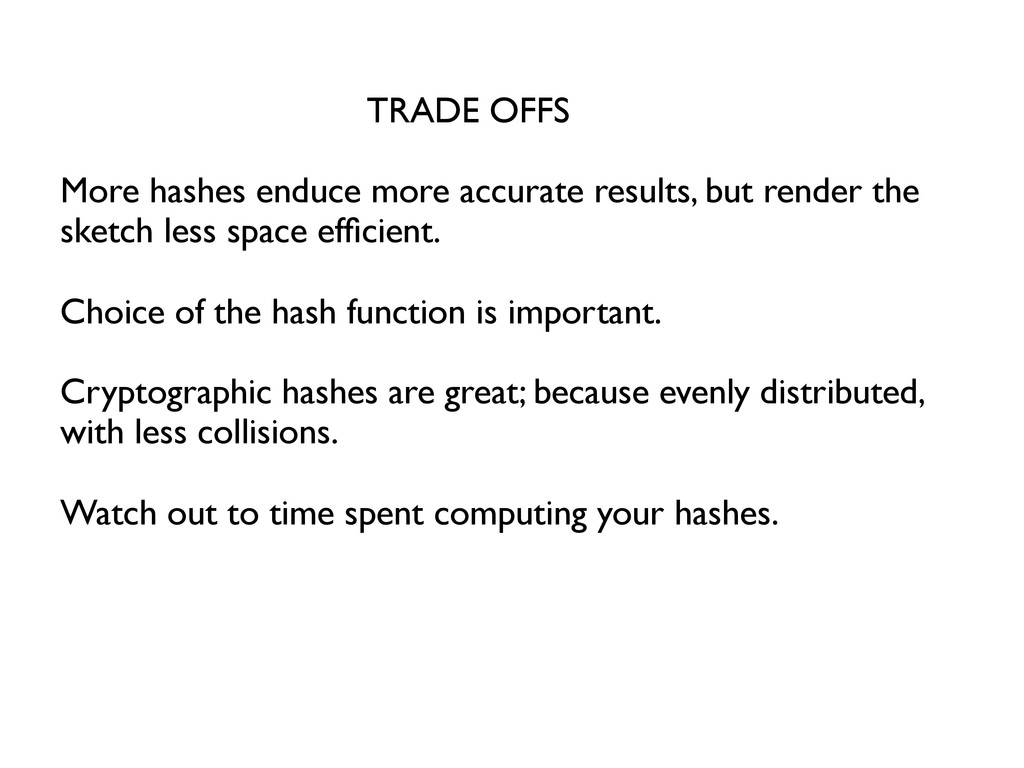
TRADE OFFS More hashes enduce more accurate results, but render
the sketch less space efficient. Choice of the hash function is important. Cryptographic hashes are great; because evenly distributed, with less collisions. Watch out to time spent computing your hashes. -
Cool properties Intersection and Union through AND and OR bitwise
operations No False negatives For union, helps with parallel construction of BF Fast approximation of set union, by using bit map instead of set manipulation -
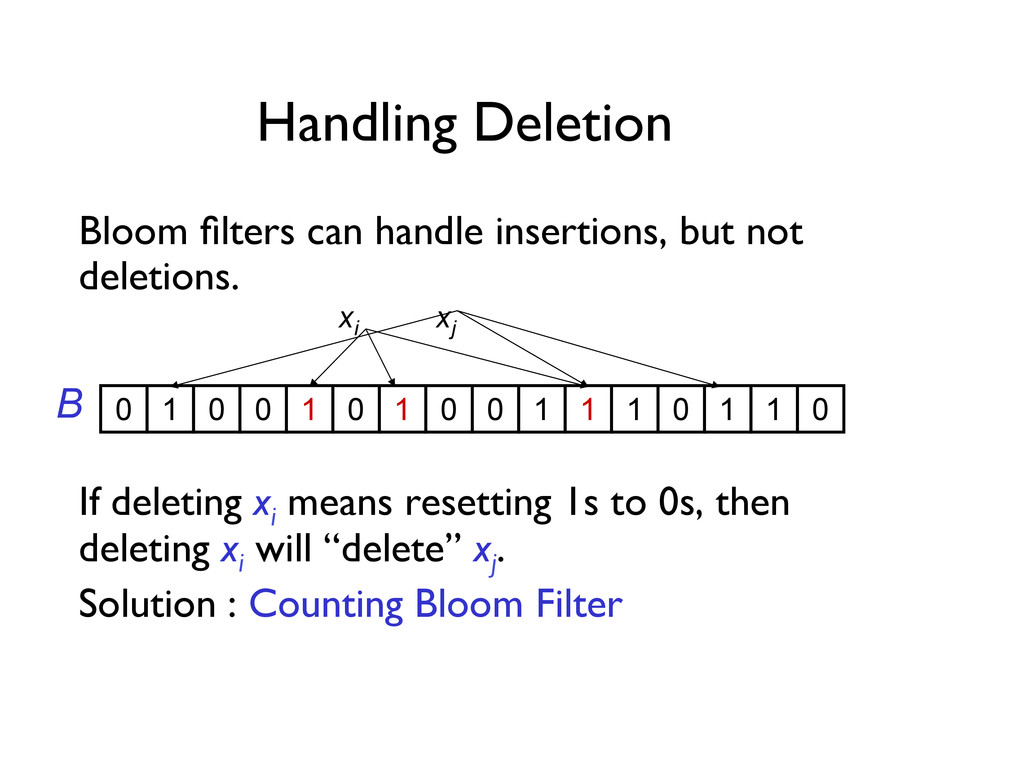
Handling Deletion Bloom filters can handle insertions, but not deletions.
If deleting xi means resetting 1s to 0s, then deleting xi will “delete” xj . Solution : Counting Bloom Filter 0 1 0 0 1 0 1 0 0 1 1 1 0 1 1 0 B xi xj -
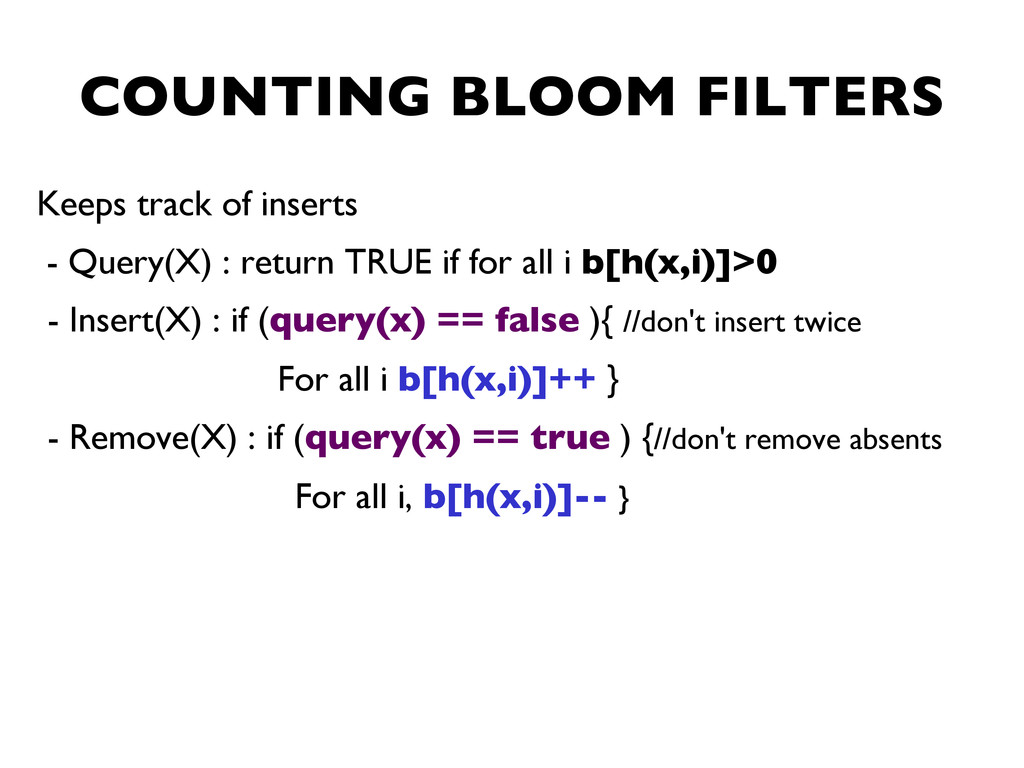
COUNTING BLOOM FILTERS Keeps track of inserts - Query(X) :
return TRUE if for all i b[h(x,i)]>0 - Insert(X) : if (query(x) == false ){ //don't insert twice For all i b[h(x,i)]++ } - Remove(X) : if (query(x) == true ) {//don't remove absents For all i, b[h(x,i)]-- } -
Usages - Fast web events tracking - IO optimisations in
databases like Cassandra Hadoop, Hbases .. - Network IP filtering ... -
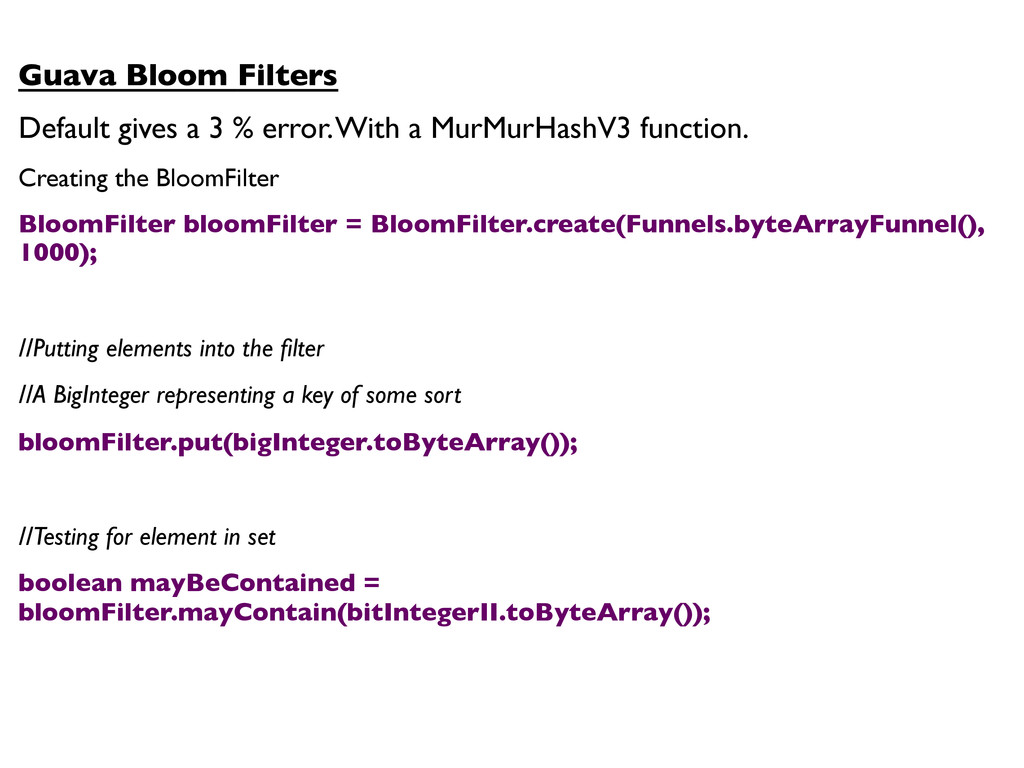
Guava Bloom Filters Default gives a 3 % error. With
a MurMurHashV3 function. Creating the BloomFilter BloomFilter bloomFilter = BloomFilter.create(Funnels.byteArrayFunnel(), 1000); //Putting elements into the filter //A BigInteger representing a key of some sort bloomFilter.put(bigInteger.toByteArray()); //Testing for element in set boolean mayBeContained = bloomFilter.mayContain(bitIntegerII.toByteArray()); -
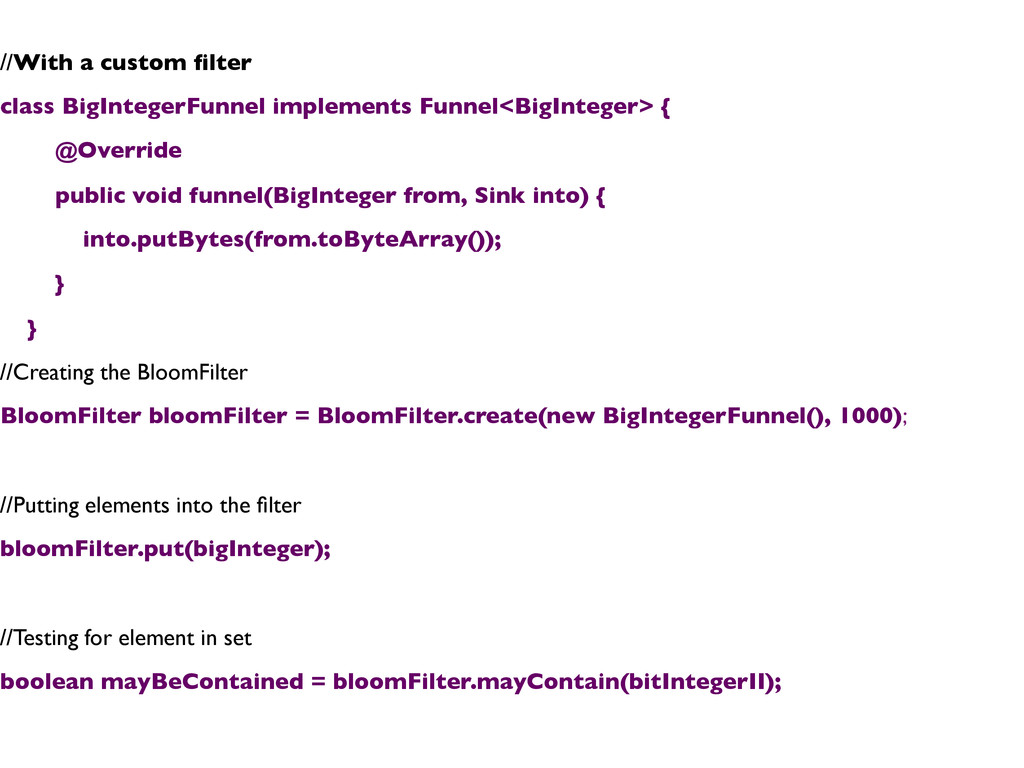
//With a custom filter class BigIntegerFunnel implements Funnel<BigInteger> { @Override
public void funnel(BigInteger from, Sink into) { into.putBytes(from.toByteArray()); } } //Creating the BloomFilter BloomFilter bloomFilter = BloomFilter.create(new BigIntegerFunnel(), 1000); //Putting elements into the filter bloomFilter.put(bigInteger); //Testing for element in set boolean mayBeContained = bloomFilter.mayContain(bitIntegerII); -
Family of memory efficient data structures, that can estimate frequency-related
properties of the data set. Used to find occurrences of an element in a set, in time / space efficient way, with a tunable accuracy. E.g Find heavy hitters elements; perform range queries (where the goal is to find the sum of frequencies of Elements in a certain range ), estimate quantiles. -
Algorithm : insert(x): for i =1 to d M[i,h(x,i)) ++
//Like counting bloom filters query(x): return min {h(x,i) for all 1 ≤ i ≤ d} -
Accuracy depends on the ratio between sketch size and number
of expected data. Works better with Highly uncorrelated, unstructured data. For higly skewed data, use noise estimation, and compute the median estimation Error Estimation -
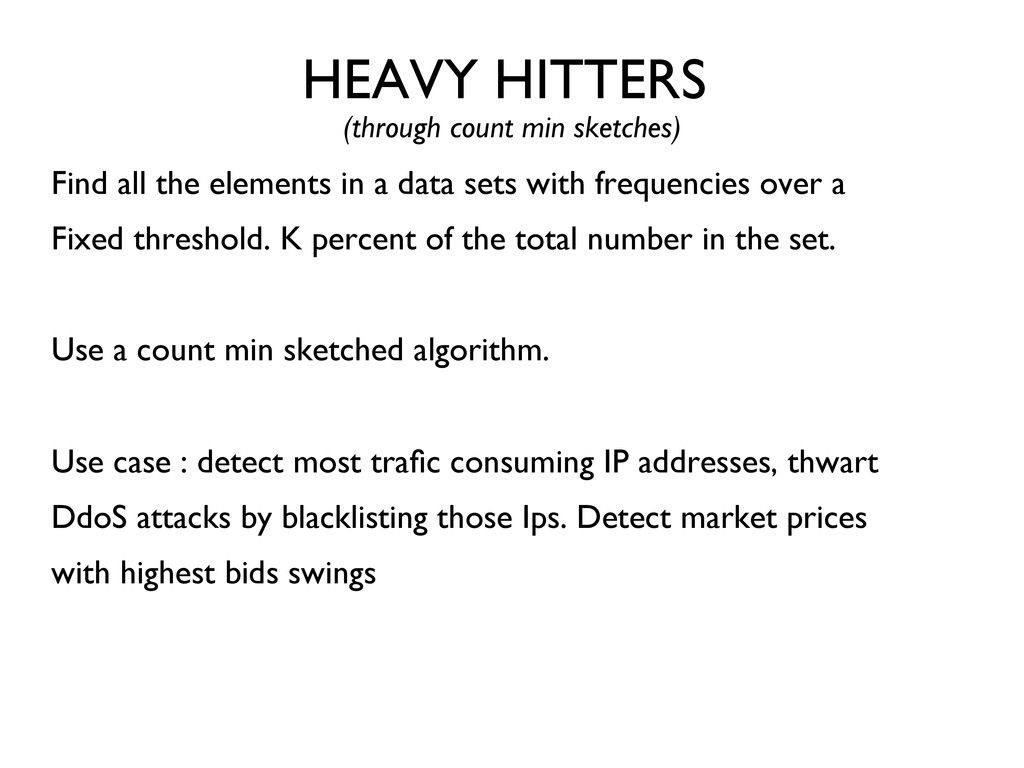
Find all the elements in a data sets with frequencies
over a Fixed threshold. K percent of the total number in the set. Use a count min sketched algorithm. Use case : detect most trafic consuming IP addresses, thwart DdoS attacks by blacklisting those Ips. Detect market prices with highest bids swings HEAVY HITTERS -
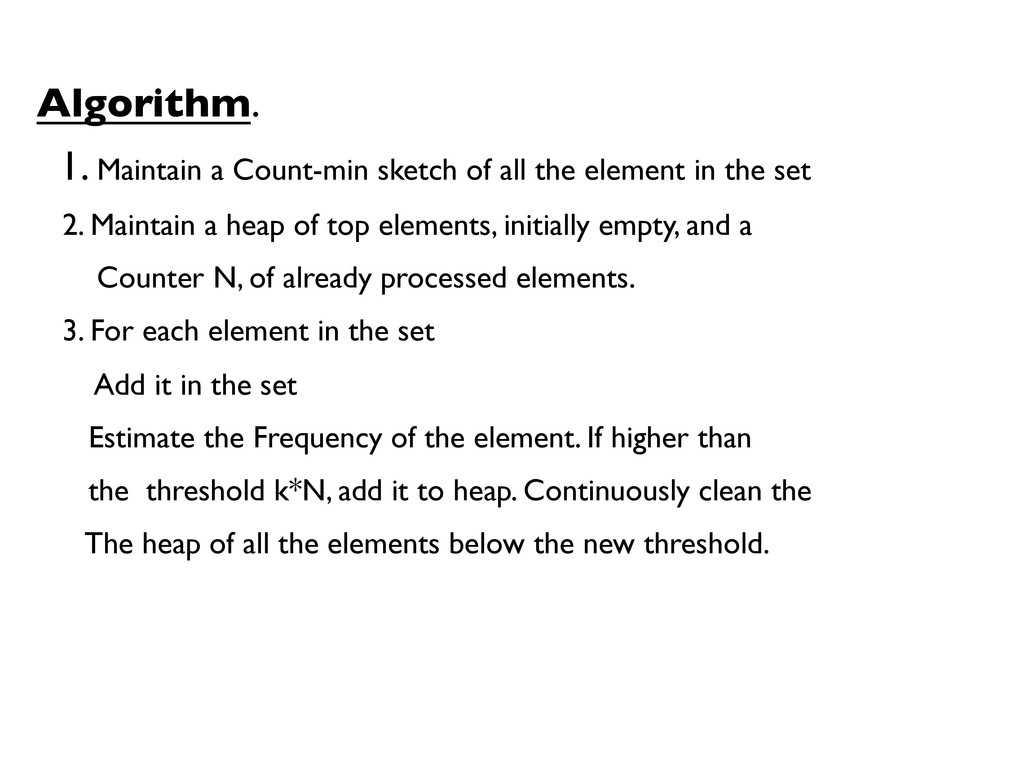
Algorithm. 1. Maintain a Count-min sketch of all the element
in the set 2. Maintain a heap of top elements, initially empty, and a Counter N, of already processed elements. 3. For each element in the set Add it in the set Estimate the Frequency of the element. If higher than the threshold k*N, add it to heap. Continuously clean the The heap of all the elements below the new threshold. -
Bibliographies & Blogs. http://highscalability.com/blog/2012/4/5/big-data-counting-how-to- count-a-billion-distinct-objects-us.html Librairies. http://github.com/slearspring/stream-lib org.apache.cassandra.utils.{MurmurHashV3, BloomFilter} Google
Guava. Ideal Hash Trees by Phil BagWell http://infoscience.epfl.ch/record/64398/files/idealhashtrees.pdf Concurrent Tries in the Scala Parallel Collections SkipLists By William Pugh.