Upgrade to Pro — share decks privately, control downloads, hide ads and more …

Who Carries the Risk in the AI Build-Out?

Who Carries the Risk in the AI Build-Out?

AI companies with weak credit are leasing huge amounts of equipment. If that proves to be overinvestment, losses fall on fund investors first and on chipmakers next. Analysis by E9 Technologies.

Avatar for Takuya Shimano

Takuya Shimano

November 06, 2026

More Decks by Takuya Shimano

Other Decks in Research

Transcript

  1. AI INFRASTRUCTURE RESEARCH Who Carries the Risk in the AI

    Build-Out? The burden of the guarantees gathers on the chipmakers that gave them, so buy TSMC and Micron: they get paid and give no guarantee.
  2. In AI capex, borrowers with weak credit lease huge amounts

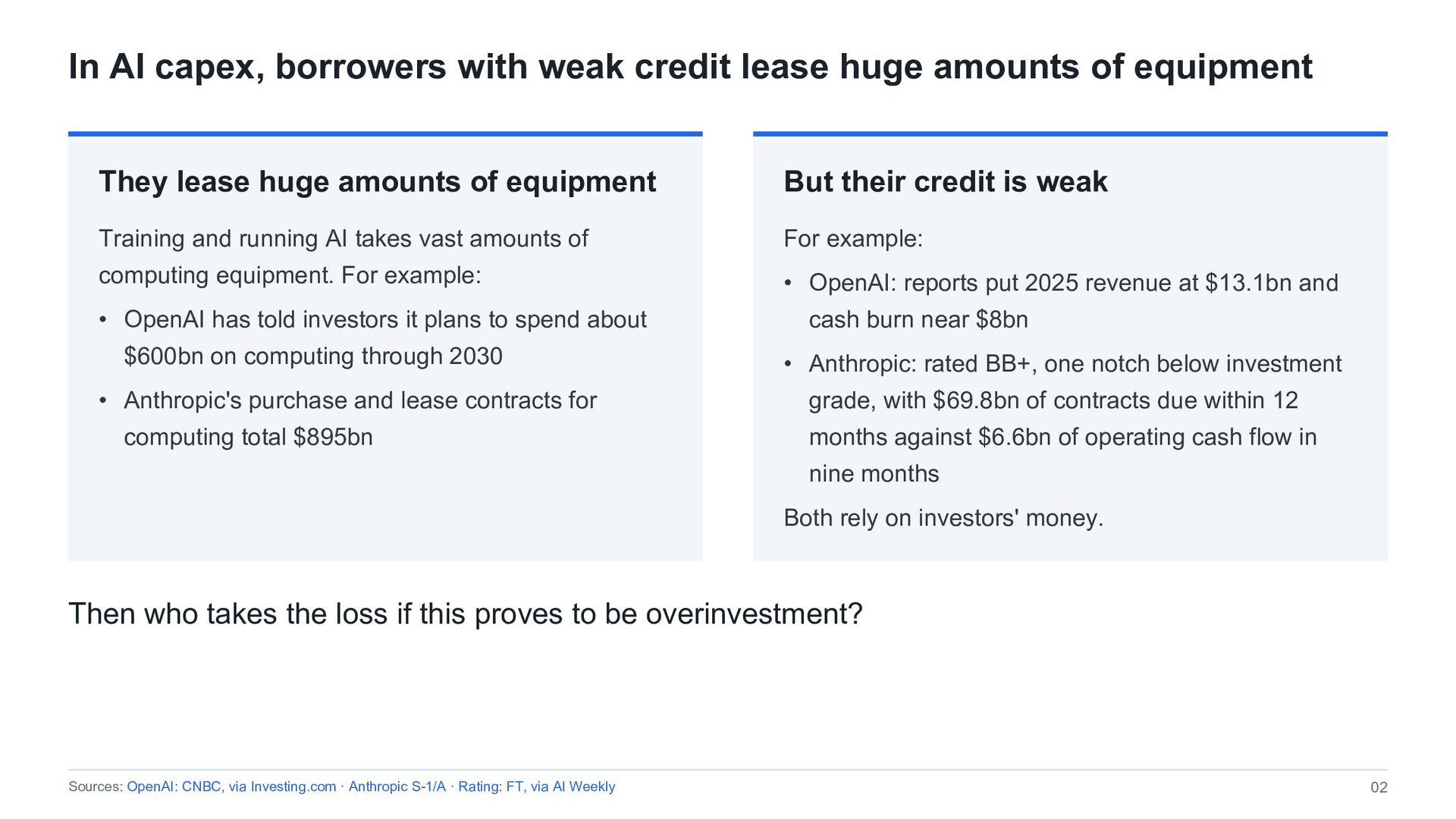
    of equipment They lease huge amounts of equipment But their credit is weak Training and running AI takes vast amounts of For example: computing equipment. For example: • OpenAI: reports put 2025 revenue at $13.1bn and • OpenAI has told investors it plans to spend about $600bn on computing through 2030 • Anthropic's purchase and lease contracts for computing total $895bn cash burn near $8bn • Anthropic: rated BB+, one notch below investment grade, with $69.8bn of contracts due within 12 months against $6.6bn of operating cash flow in nine months Both rely on investors' money. Then who takes the loss if this proves to be overinvestment? Sources: OpenAI: CNBC, via Investing.com · Anthropic S-1/A · Rating: FT, via AI Weekly 02
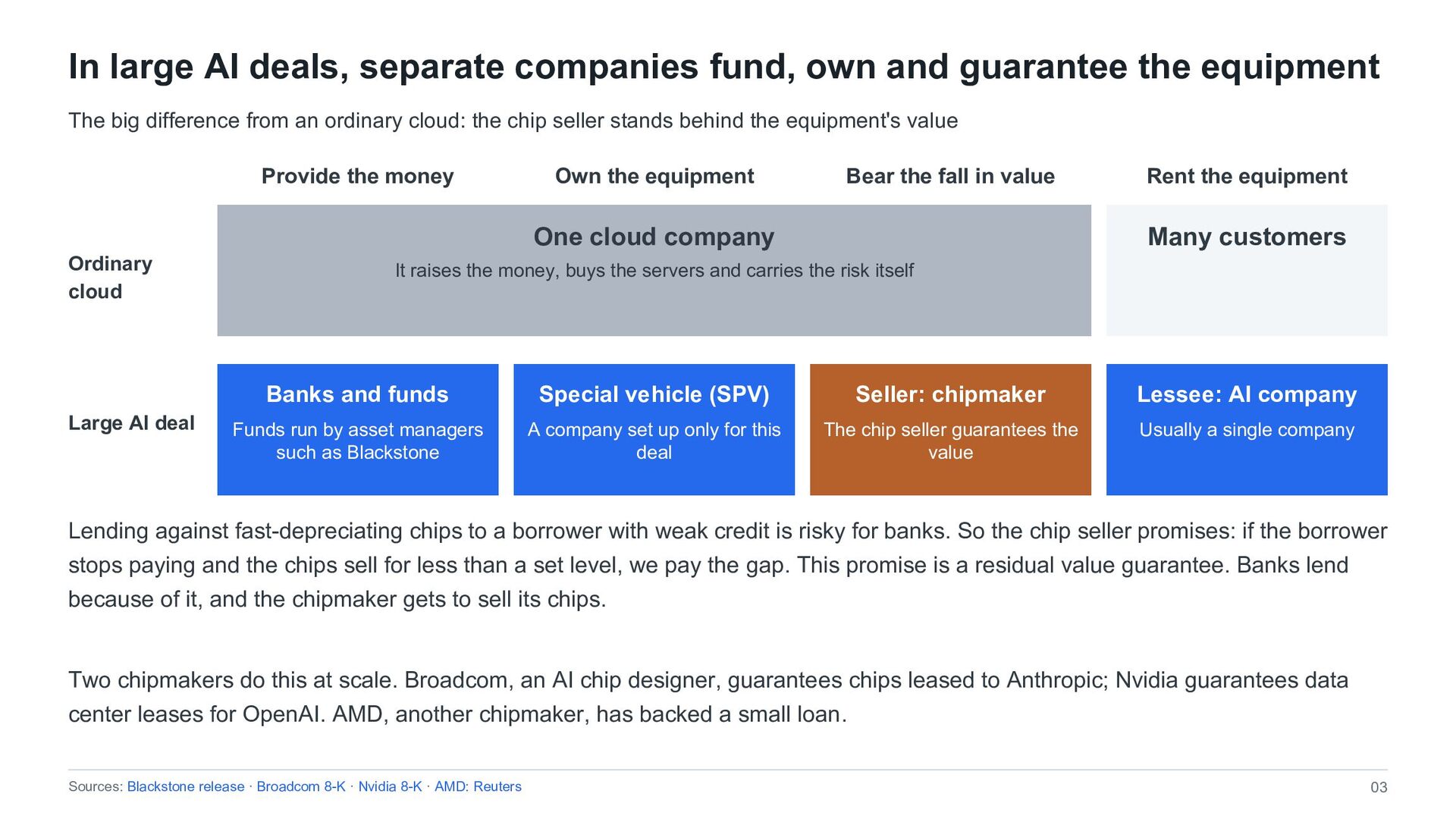
  3. In large AI deals, separate companies fund, own and guarantee

    the equipment The big difference from an ordinary cloud: the chip seller stands behind the equipment's value Provide the money Own the equipment Bear the fall in value One cloud company Ordinary cloud Large AI deal Rent the equipment Many customers It raises the money, buys the servers and carries the risk itself Banks and funds Special vehicle (SPV) Seller: chipmaker Lessee: AI company Funds run by asset managers such as Blackstone A company set up only for this deal The chip seller guarantees the value Usually a single company Lending against fast-depreciating chips to a borrower with weak credit is risky for banks. So the chip seller promises: if the borrower stops paying and the chips sell for less than a set level, we pay the gap. This promise is a residual value guarantee. Banks lend because of it, and the chipmaker gets to sell its chips. Two chipmakers do this at scale. Broadcom, an AI chip designer, guarantees chips leased to Anthropic; Nvidia guarantees data center leases for OpenAI. AMD, another chipmaker, has backed a small loan. Sources: Blackstone release · Broadcom 8-K · Nvidia 8-K · AMD: Reuters 03
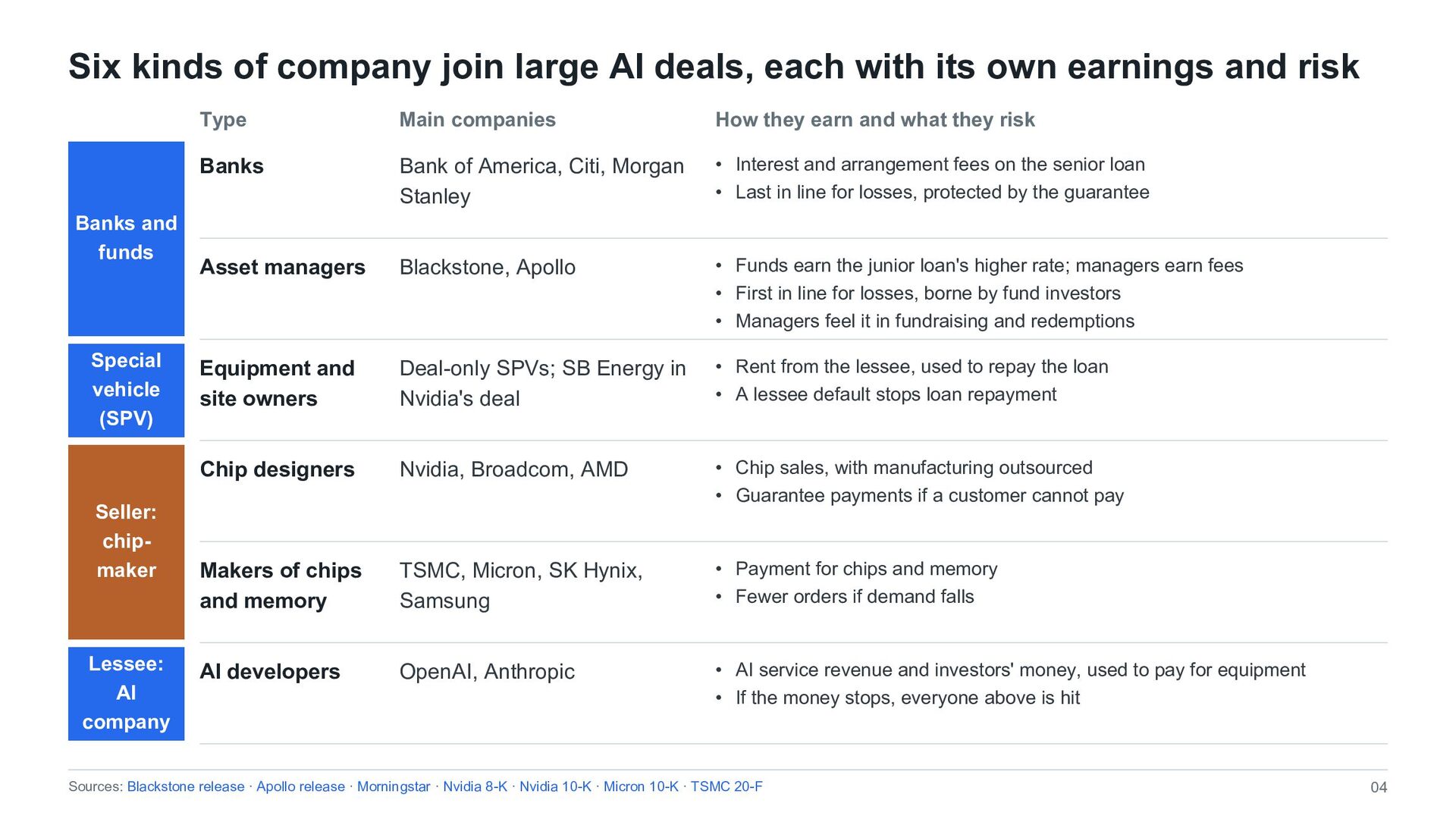
  4. Six kinds of company join large AI deals, each with

    its own earnings and risk Banks and funds Special vehicle (SPV) Seller: chipmaker Lessee: AI company Type Main companies How they earn and what they risk Banks Bank of America, Citi, Morgan Stanley • Interest and arrangement fees on the senior loan • Last in line for losses, protected by the guarantee Asset managers Blackstone, Apollo • Funds earn the junior loan's higher rate; managers earn fees • First in line for losses, borne by fund investors • Managers feel it in fundraising and redemptions Equipment and site owners Deal-only SPVs; SB Energy in Nvidia's deal • Rent from the lessee, used to repay the loan • A lessee default stops loan repayment Chip designers Nvidia, Broadcom, AMD • Chip sales, with manufacturing outsourced • Guarantee payments if a customer cannot pay Makers of chips and memory TSMC, Micron, SK Hynix, Samsung • Payment for chips and memory • Fewer orders if demand falls AI developers OpenAI, Anthropic • AI service revenue and investors' money, used to pay for equipment • If the money stops, everyone above is hit Sources: Blackstone release · Apollo release · Morningstar · Nvidia 8-K · Nvidia 10-K · Micron 10-K · TSMC 20-F 04
  5. Chipmakers' guarantees for OpenAI and Anthropic total $177bn Each chipmaker

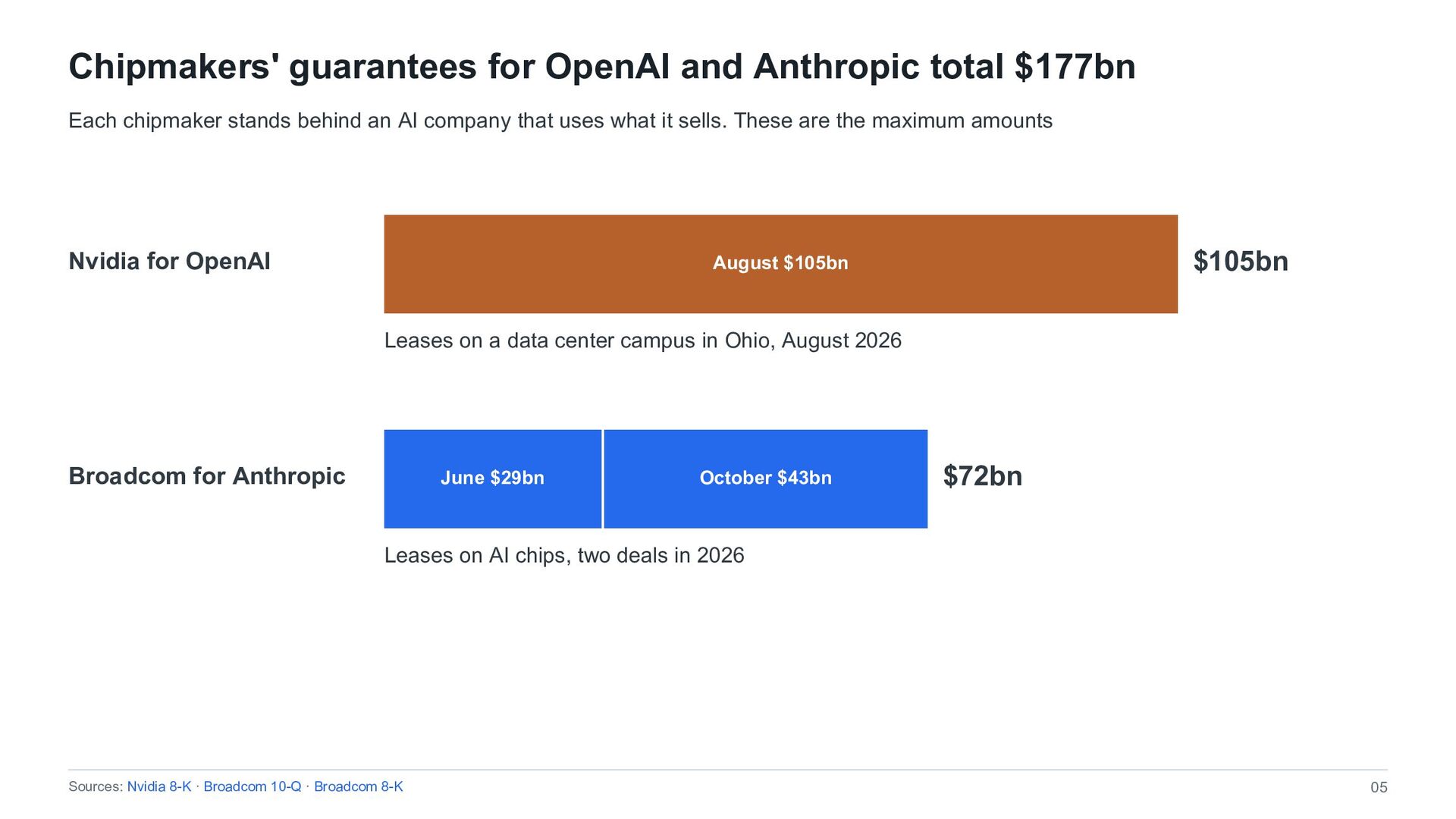
    stands behind an AI company that uses what it sells. These are the maximum amounts Nvidia for OpenAI $105bn August $105bn Leases on a data center campus in Ohio, August 2026 Broadcom for Anthropic June $29bn October $43bn $72bn Leases on AI chips, two deals in 2026 Sources: Nvidia 8-K · Broadcom 10-Q · Broadcom 8-K 05
  6. In a $63bn AI chip loan, the fund bears losses

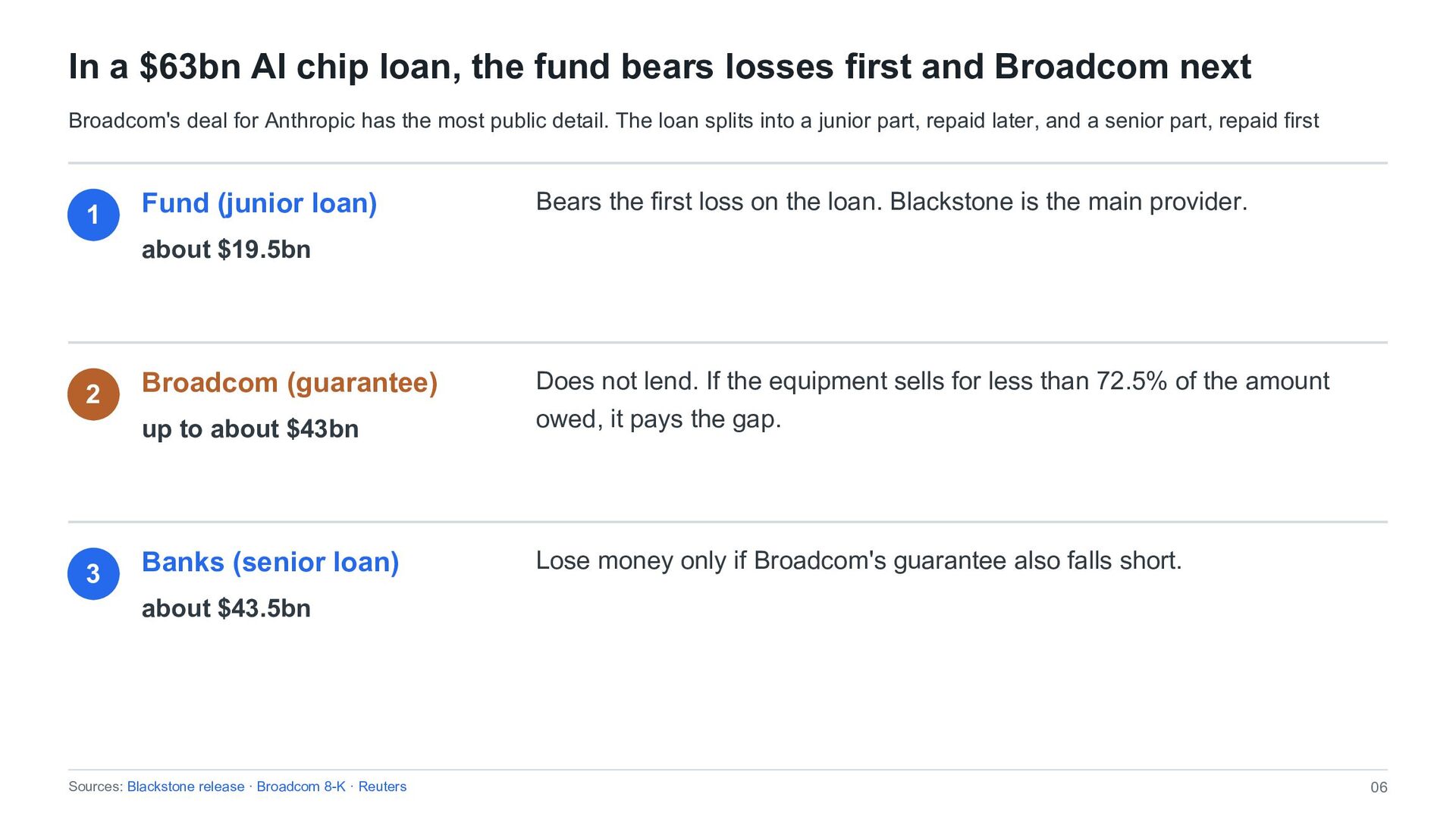
    first and Broadcom next Broadcom's deal for Anthropic has the most public detail. The loan splits into a junior part, repaid later, and a senior part, repaid first 1 Fund (junior loan) Bears the first loss on the loan. Blackstone is the main provider. about $19.5bn 2 3 up to about $43bn Does not lend. If the equipment sells for less than 72.5% of the amount owed, it pays the gap. Banks (senior loan) Lose money only if Broadcom's guarantee also falls short. Broadcom (guarantee) about $43.5bn Sources: Blackstone release · Broadcom 8-K · Reuters 06
  7. Credit markets treat chipmakers' guarantees as debt The guarantees barely

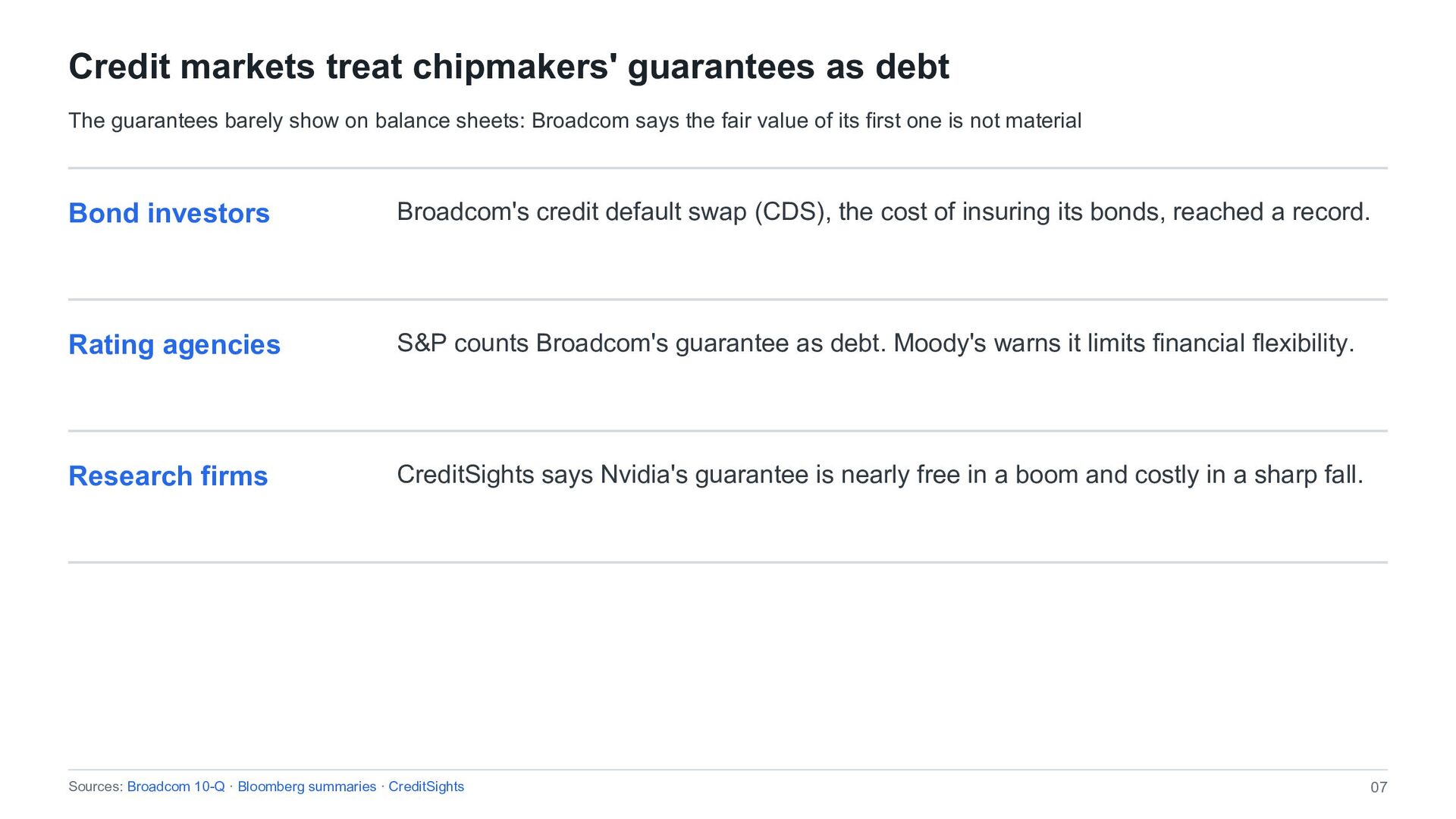
    show on balance sheets: Broadcom says the fair value of its first one is not material Bond investors Broadcom's credit default swap (CDS), the cost of insuring its bonds, reached a record. Rating agencies S&P counts Broadcom's guarantee as debt. Moody's warns it limits financial flexibility. Research firms CreditSights says Nvidia's guarantee is nearly free in a boom and costly in a sharp fall. Sources: Broadcom 10-Q · Bloomberg summaries · CreditSights 07
  8. For its guarantees, Broadcom won deals with $98bn of financing

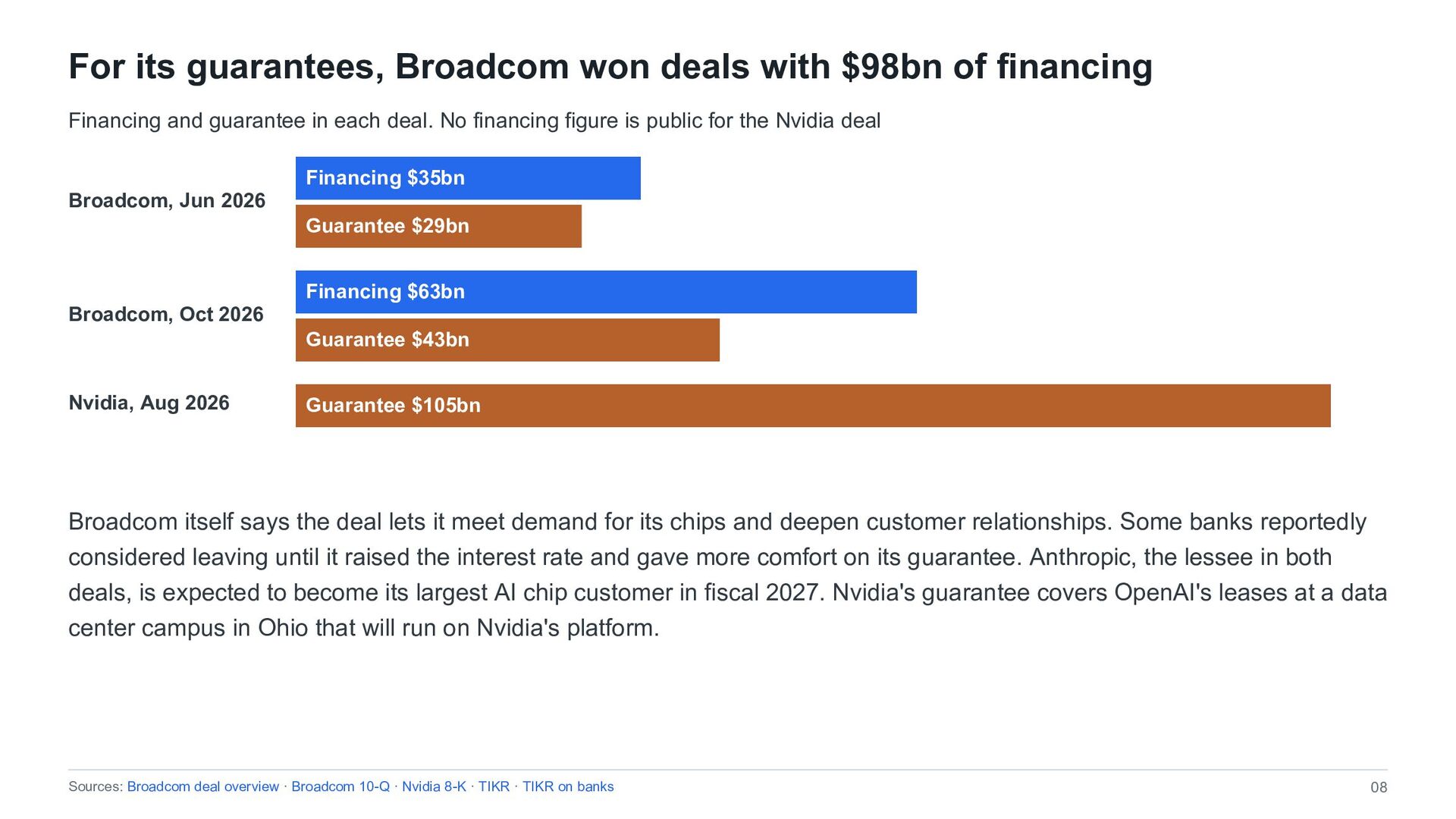
    Financing and guarantee in each deal. No financing figure is public for the Nvidia deal Financing $35bn Broadcom, Jun 2026 Guarantee $29bn Financing $63bn Broadcom, Oct 2026 Guarantee $43bn Nvidia, Aug 2026 Guarantee $105bn Broadcom itself says the deal lets it meet demand for its chips and deepen customer relationships. Some banks reportedly considered leaving until it raised the interest rate and gave more comfort on its guarantee. Anthropic, the lessee in both deals, is expected to become its largest AI chip customer in fiscal 2027. Nvidia's guarantee covers OpenAI's leases at a data center campus in Ohio that will run on Nvidia's platform. Sources: Broadcom deal overview · Broadcom 10-Q · Nvidia 8-K · TIKR · TIKR on banks 08
  9. Guarantee ceilings equal 0.8 years of cash flow at Nvidia

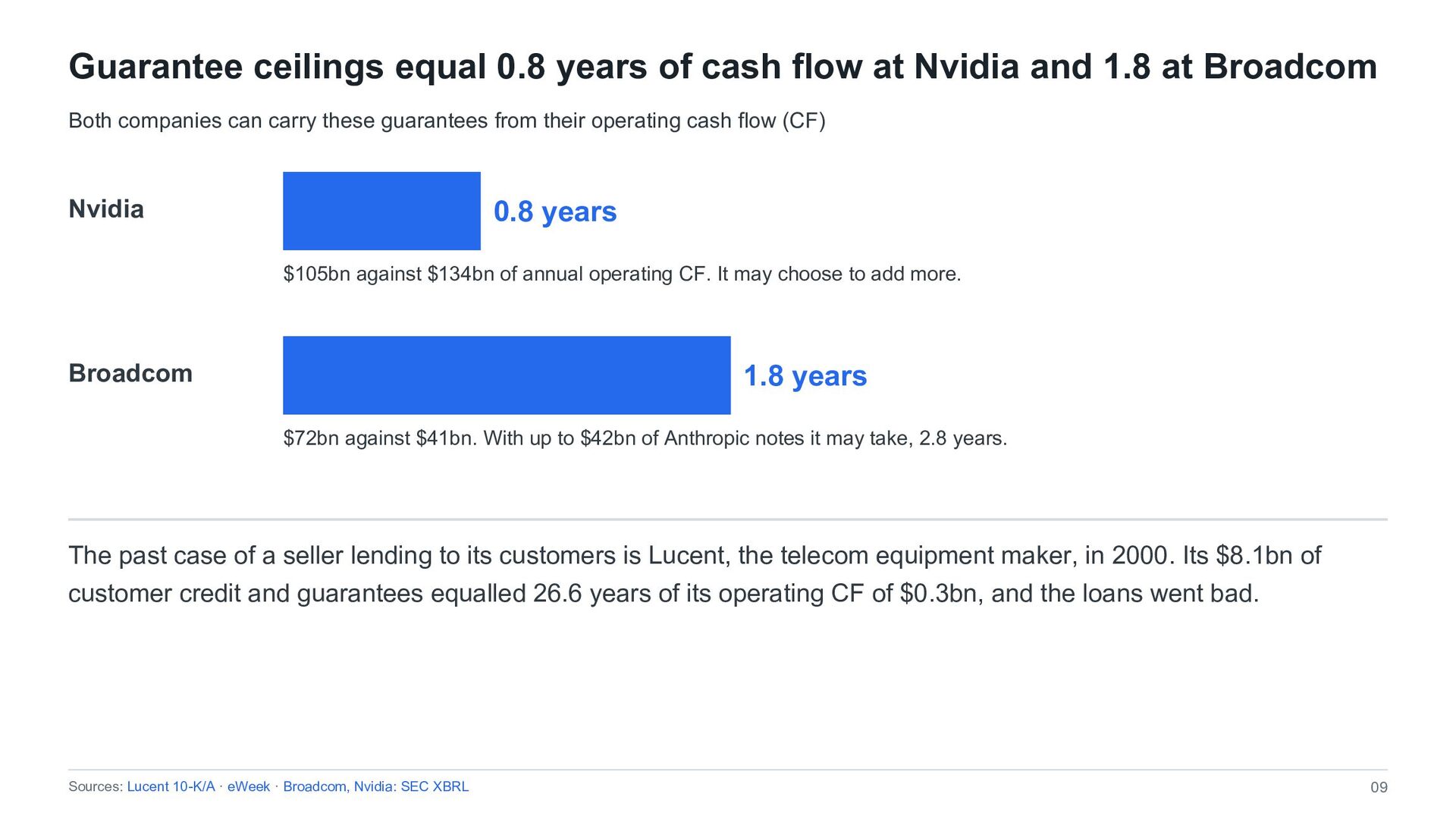
    and 1.8 at Broadcom Both companies can carry these guarantees from their operating cash flow (CF) Nvidia 0.8 years $105bn against $134bn of annual operating CF. It may choose to add more. Broadcom 1.8 years $72bn against $41bn. With up to $42bn of Anthropic notes it may take, 2.8 years. The past case of a seller lending to its customers is Lucent, the telecom equipment maker, in 2000. Its $8.1bn of customer credit and guarantees equalled 26.6 years of its operating CF of $0.3bn, and the loans went bad. Sources: Lucent 10-K/A · eWeek · Broadcom, Nvidia: SEC XBRL 09
  10. Broadcom pays any shortfall below 72.5% of the amount owed

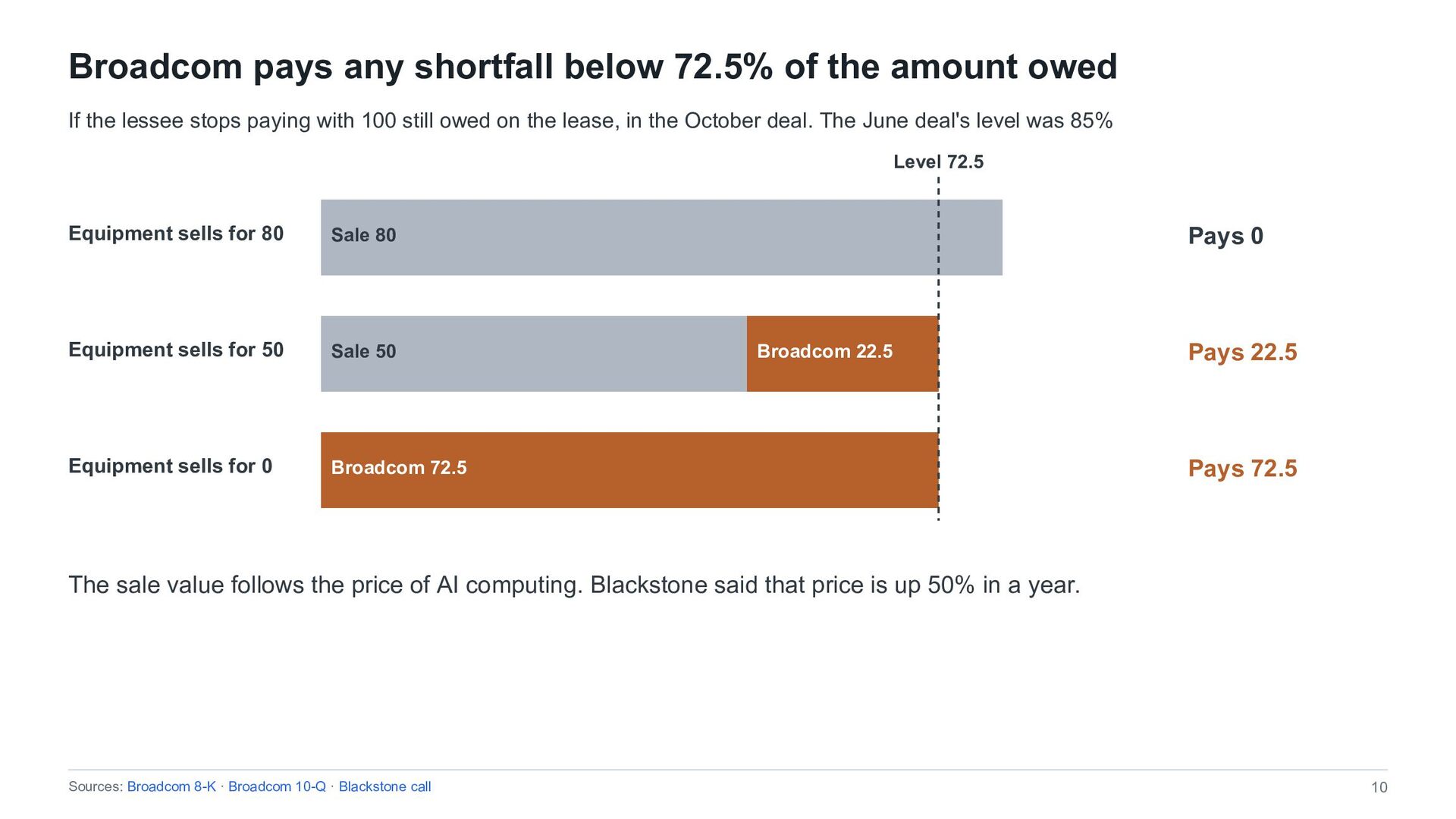
    If the lessee stops paying with 100 still owed on the lease, in the October deal. The June deal's level was 85% Level 72.5 Equipment sells for 80 Sale 80 Equipment sells for 50 Sale 50 Equipment sells for 0 Broadcom 72.5 Pays 0 Broadcom 22.5 Pays 22.5 Pays 72.5 The sale value follows the price of AI computing. Blackstone said that price is up 50% in a year. Sources: Broadcom 8-K · Broadcom 10-Q · Blackstone call 10
  11. Broadcom says its guarantee sits behind four layers and fades

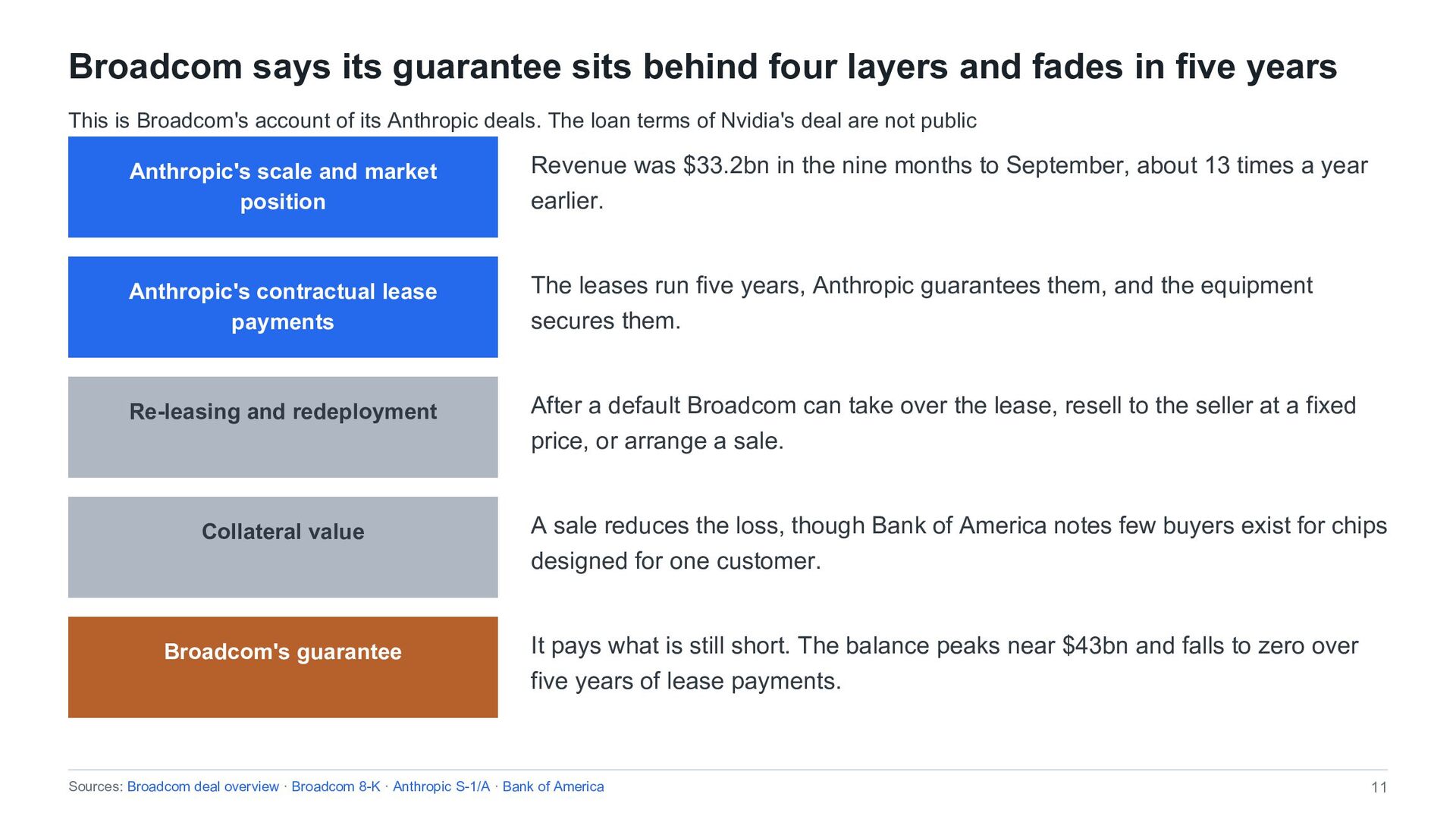
    in five years This is Broadcom's account of its Anthropic deals. The loan terms of Nvidia's deal are not public Anthropic's scale and market position Revenue was $33.2bn in the nine months to September, about 13 times a year earlier. Anthropic's contractual lease payments The leases run five years, Anthropic guarantees them, and the equipment secures them. Re-leasing and redeployment After a default Broadcom can take over the lease, resell to the seller at a fixed price, or arrange a sale. Collateral value A sale reduces the loss, though Bank of America notes few buyers exist for chips designed for one customer. Broadcom's guarantee It pays what is still short. The balance peaks near $43bn and falls to zero over five years of lease payments. Sources: Broadcom deal overview · Broadcom 8-K · Anthropic S-1/A · Bank of America 11
  12. But if AI demand falls, these layers break at once

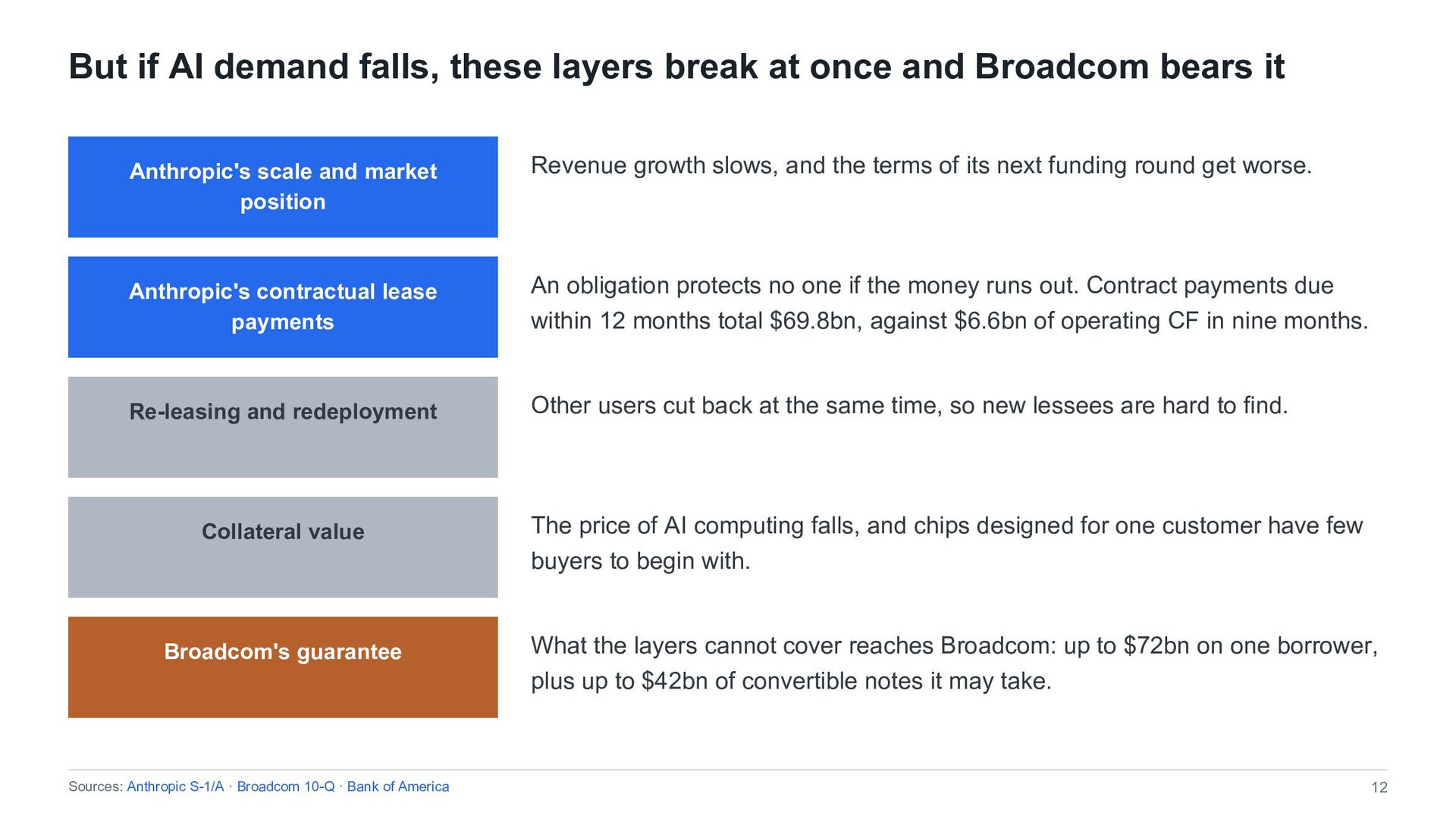
    and Broadcom bears it Anthropic's scale and market position Revenue growth slows, and the terms of its next funding round get worse. Anthropic's contractual lease payments An obligation protects no one if the money runs out. Contract payments due within 12 months total $69.8bn, against $6.6bn of operating CF in nine months. Re-leasing and redeployment Other users cut back at the same time, so new lessees are hard to find. Collateral value The price of AI computing falls, and chips designed for one customer have few buyers to begin with. Broadcom's guarantee What the layers cannot cover reaches Broadcom: up to $72bn on one borrower, plus up to $42bn of convertible notes it may take. Sources: Anthropic S-1/A · Broadcom 10-Q · Bank of America 12
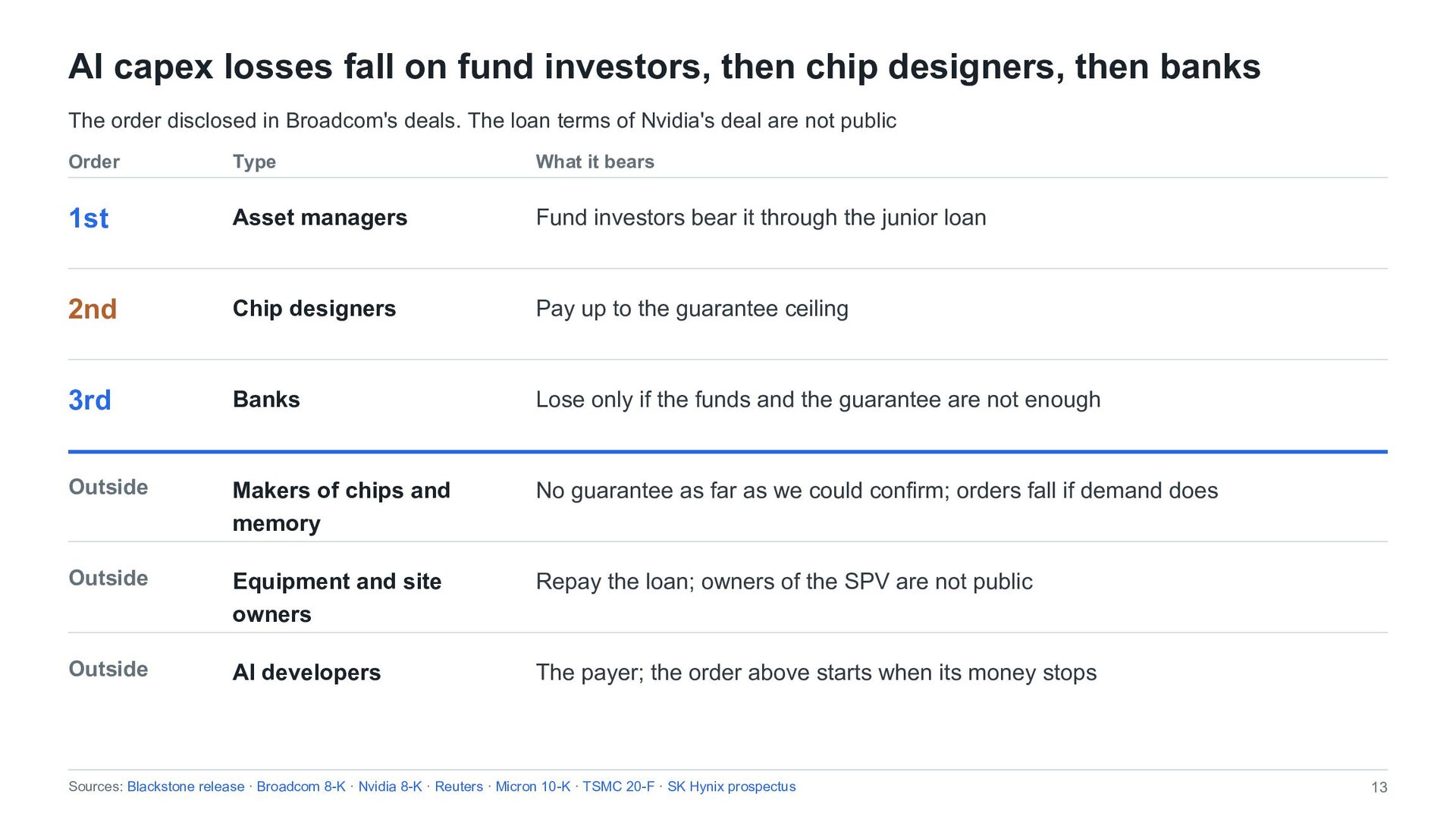
  13. AI capex losses fall on fund investors, then chip designers,

    then banks The order disclosed in Broadcom's deals. The loan terms of Nvidia's deal are not public Order Type What it bears 1st Asset managers Fund investors bear it through the junior loan 2nd Chip designers Pay up to the guarantee ceiling 3rd Banks Lose only if the funds and the guarantee are not enough Outside Makers of chips and memory No guarantee as far as we could confirm; orders fall if demand does Outside Equipment and site owners Repay the loan; owners of the SPV are not public Outside AI developers The payer; the order above starts when its money stops Sources: Blackstone release · Broadcom 8-K · Nvidia 8-K · Reuters · Micron 10-K · TSMC 20-F · SK Hynix prospectus 13
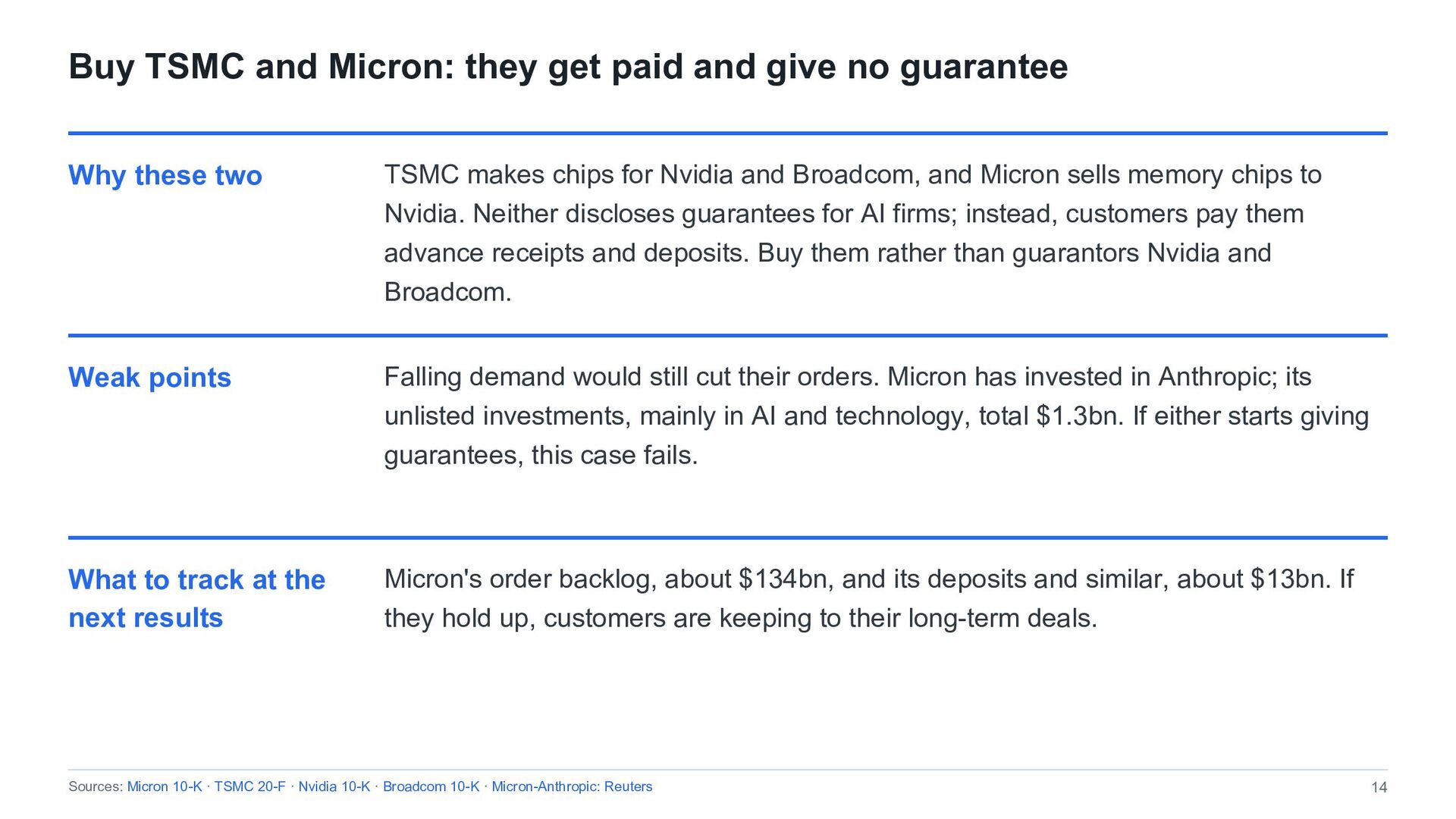
  14. Buy TSMC and Micron: they get paid and give no

    guarantee Why these two TSMC makes chips for Nvidia and Broadcom, and Micron sells memory chips to Nvidia. Neither discloses guarantees for AI firms; instead, customers pay them advance receipts and deposits. Buy them rather than guarantors Nvidia and Broadcom. Weak points Falling demand would still cut their orders. Micron has invested in Anthropic; its unlisted investments, mainly in AI and technology, total $1.3bn. If either starts giving guarantees, this case fails. What to track at the next results Micron's order backlog, about $134bn, and its deposits and similar, about $13bn. If they hold up, customers are keeping to their long-term deals. Sources: Micron 10-K · TSMC 20-F · Nvidia 10-K · Broadcom 10-K · Micron-Anthropic: Reuters 14
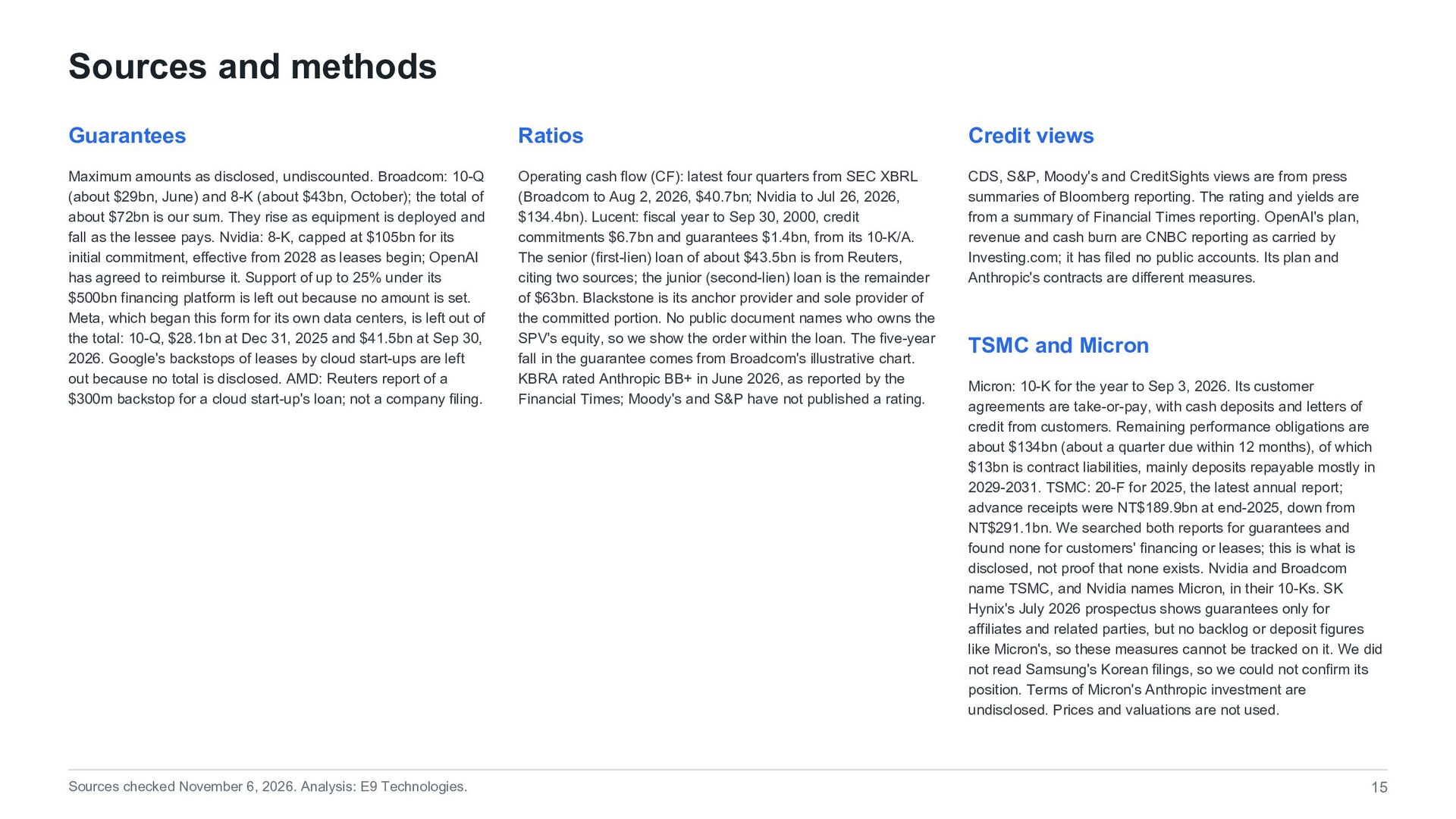
  15. Sources and methods Guarantees Ratios Credit views Maximum amounts as

    disclosed, undiscounted. Broadcom: 10-Q (about $29bn, June) and 8-K (about $43bn, October); the total of about $72bn is our sum. They rise as equipment is deployed and fall as the lessee pays. Nvidia: 8-K, capped at $105bn for its initial commitment, effective from 2028 as leases begin; OpenAI has agreed to reimburse it. Support of up to 25% under its $500bn financing platform is left out because no amount is set. Meta, which began this form for its own data centers, is left out of the total: 10-Q, $28.1bn at Dec 31, 2025 and $41.5bn at Sep 30, 2026. Google's backstops of leases by cloud start-ups are left out because no total is disclosed. AMD: Reuters report of a $300m backstop for a cloud start-up's loan; not a company filing. Operating cash flow (CF): latest four quarters from SEC XBRL (Broadcom to Aug 2, 2026, $40.7bn; Nvidia to Jul 26, 2026, $134.4bn). Lucent: fiscal year to Sep 30, 2000, credit commitments $6.7bn and guarantees $1.4bn, from its 10-K/A. The senior (first-lien) loan of about $43.5bn is from Reuters, citing two sources; the junior (second-lien) loan is the remainder of $63bn. Blackstone is its anchor provider and sole provider of the committed portion. No public document names who owns the SPV's equity, so we show the order within the loan. The five-year fall in the guarantee comes from Broadcom's illustrative chart. KBRA rated Anthropic BB+ in June 2026, as reported by the Financial Times; Moody's and S&P have not published a rating. CDS, S&P, Moody's and CreditSights views are from press summaries of Bloomberg reporting. The rating and yields are from a summary of Financial Times reporting. OpenAI's plan, revenue and cash burn are CNBC reporting as carried by Investing.com; it has filed no public accounts. Its plan and Anthropic's contracts are different measures. Sources checked November 6, 2026. Analysis: E9 Technologies. TSMC and Micron Micron: 10-K for the year to Sep 3, 2026. Its customer agreements are take-or-pay, with cash deposits and letters of credit from customers. Remaining performance obligations are about $134bn (about a quarter due within 12 months), of which $13bn is contract liabilities, mainly deposits repayable mostly in 2029-2031. TSMC: 20-F for 2025, the latest annual report; advance receipts were NT$189.9bn at end-2025, down from NT$291.1bn. We searched both reports for guarantees and found none for customers' financing or leases; this is what is disclosed, not proof that none exists. Nvidia and Broadcom name TSMC, and Nvidia names Micron, in their 10-Ks. SK Hynix's July 2026 prospectus shows guarantees only for affiliates and related parties, but no backlog or deposit figures like Micron's, so these measures cannot be tracked on it. We did not read Samsung's Korean filings, so we could not confirm its position. Terms of Micron's Anthropic investment are undisclosed. Prices and valuations are not used. 15