Share
Embed
Transcript
96 slides
-
Trends in Machine Learning and the SciPy Community SciPy -
Austin, TX - June 2013 Tuesday, June 25, 13 -
Outline • Black Box Models with scikit-learn • Probabilistic Programming
with PyMC • Deep Learning with PyLearn2 & Theano Tuesday, June 25, 13 -
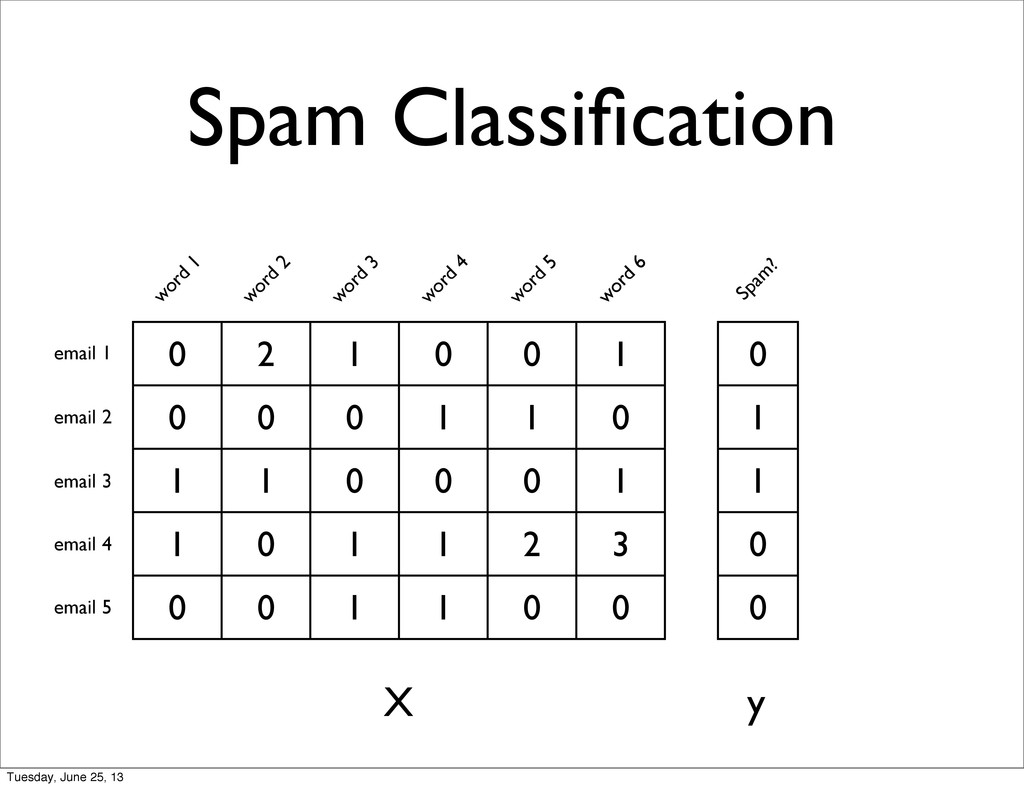
Spam Classification 0 2 1 0 0 1 0 0
0 1 1 0 1 1 0 0 0 1 1 0 1 1 2 3 0 0 1 1 0 0 word 1 word 2 word 3 word 4 word 5 word 6 email 1 email 2 email 3 email 4 email 5 X word 6 0 1 1 0 0 Spam ? y Tuesday, June 25, 13 -
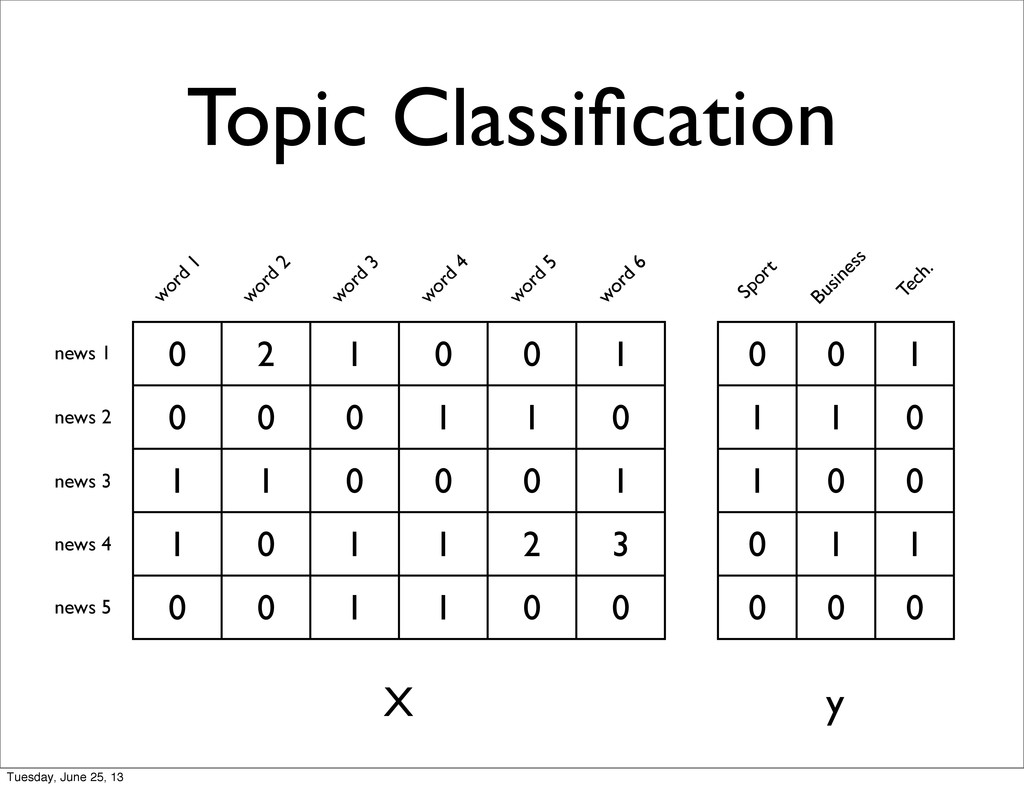
Topic Classification 0 2 1 0 0 1 0 0
0 1 1 0 1 1 0 0 0 1 1 0 1 1 2 3 0 0 1 1 0 0 word 1 word 2 word 3 word 4 word 5 word 6 news 1 news 2 news 3 news 4 news 5 X 0 0 1 1 1 0 1 0 0 0 1 1 0 0 0 word 6 Sport Business Tech. y Tuesday, June 25, 13 -
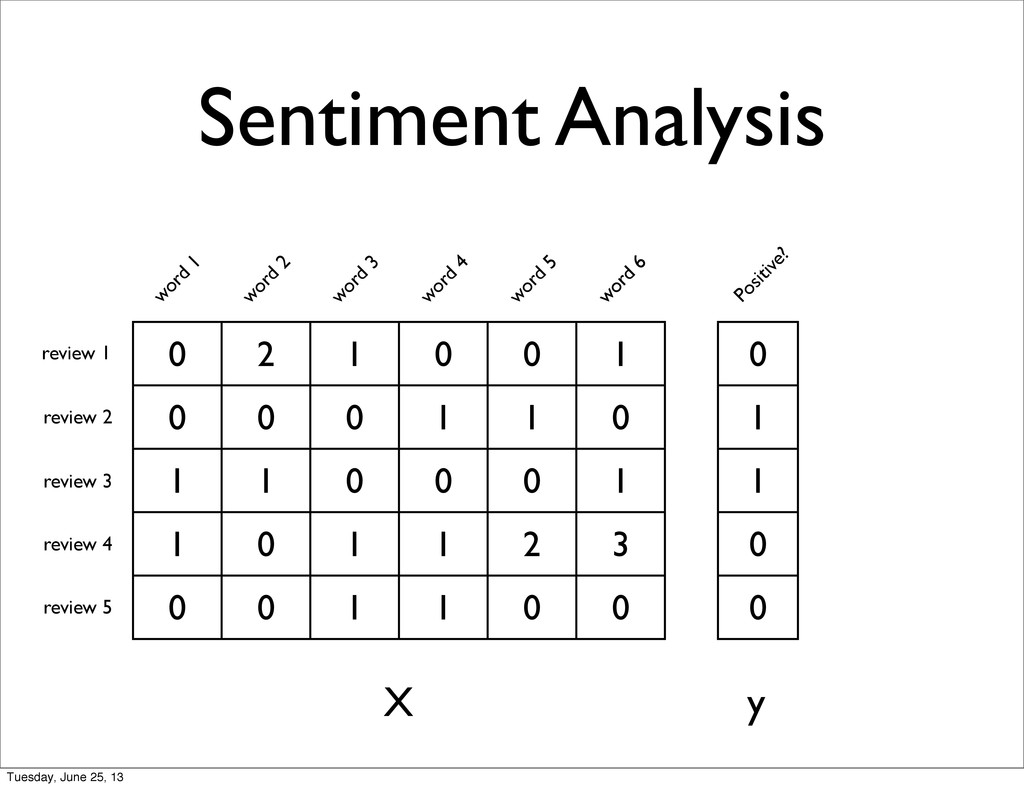
Sentiment Analysis 0 2 1 0 0 1 0 0
0 1 1 0 1 1 0 0 0 1 1 0 1 1 2 3 0 0 1 1 0 0 word 1 word 2 word 3 word 4 word 5 word 6 review 1 review 2 review 3 review 4 review 5 X 0 1 1 0 0 word 6 Positive? y Tuesday, June 25, 13 -
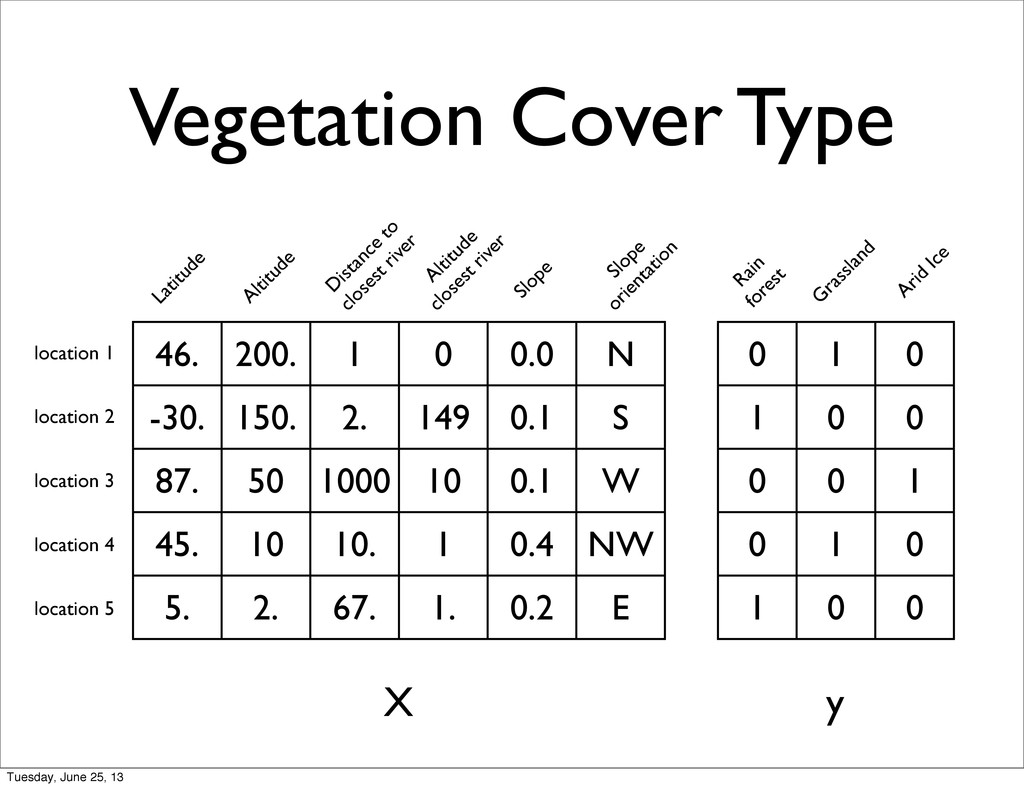
Vegetation Cover Type 46. 200. 1 0 0.0 N -30.
150. 2. 149 0.1 S 87. 50 1000 10 0.1 W 45. 10 10. 1 0.4 NW 5. 2. 67. 1. 0.2 E Latitude Altitude D istance to closest river Altitude closest river Slope Slope orientation location 1 X 0 1 0 1 0 0 0 0 1 0 1 0 1 0 0 Rain forest G rassland Arid Ice y location 2 location 3 location 4 location 5 Tuesday, June 25, 13 -
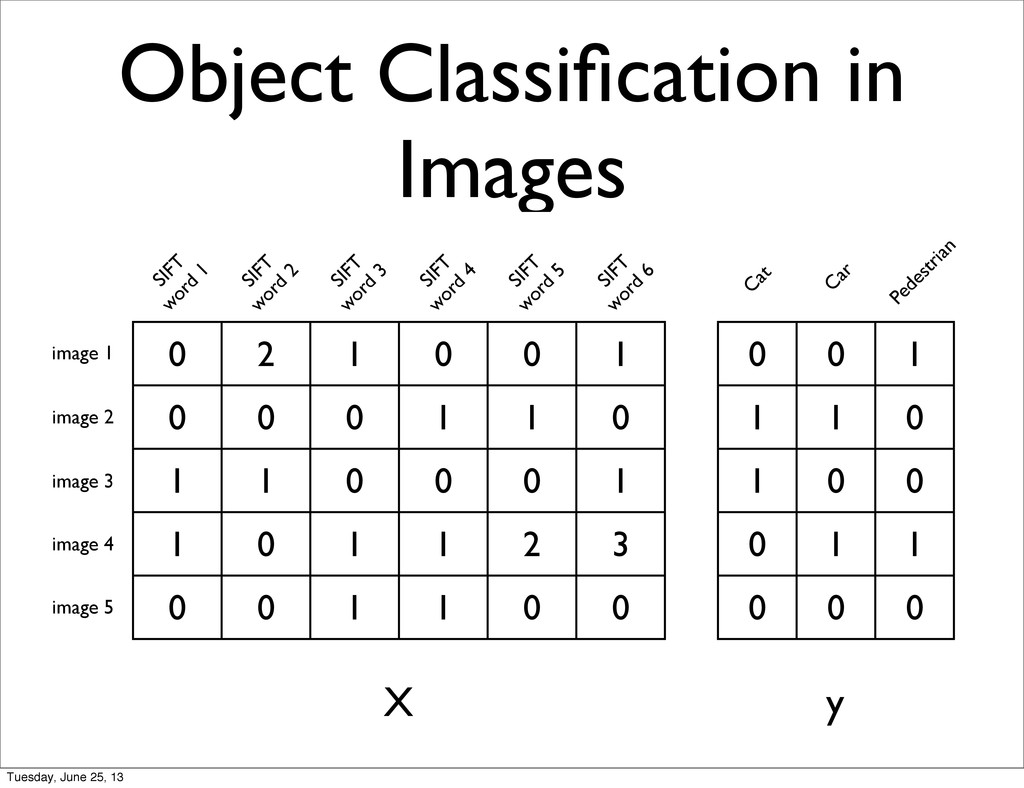
Object Classification in Images 0 2 1 0 0 1
0 0 0 1 1 0 1 1 0 0 0 1 1 0 1 1 2 3 0 0 1 1 0 0 SIFT word 1 SIFT word 2 SIFT word 3 SIFT word 4 SIFT word 5 SIFT word 6 image 1 image 2 image 3 image 4 image 5 X 0 0 1 1 1 0 1 0 0 0 1 1 0 0 0 C at C ar Pedestrian y Tuesday, June 25, 13 -
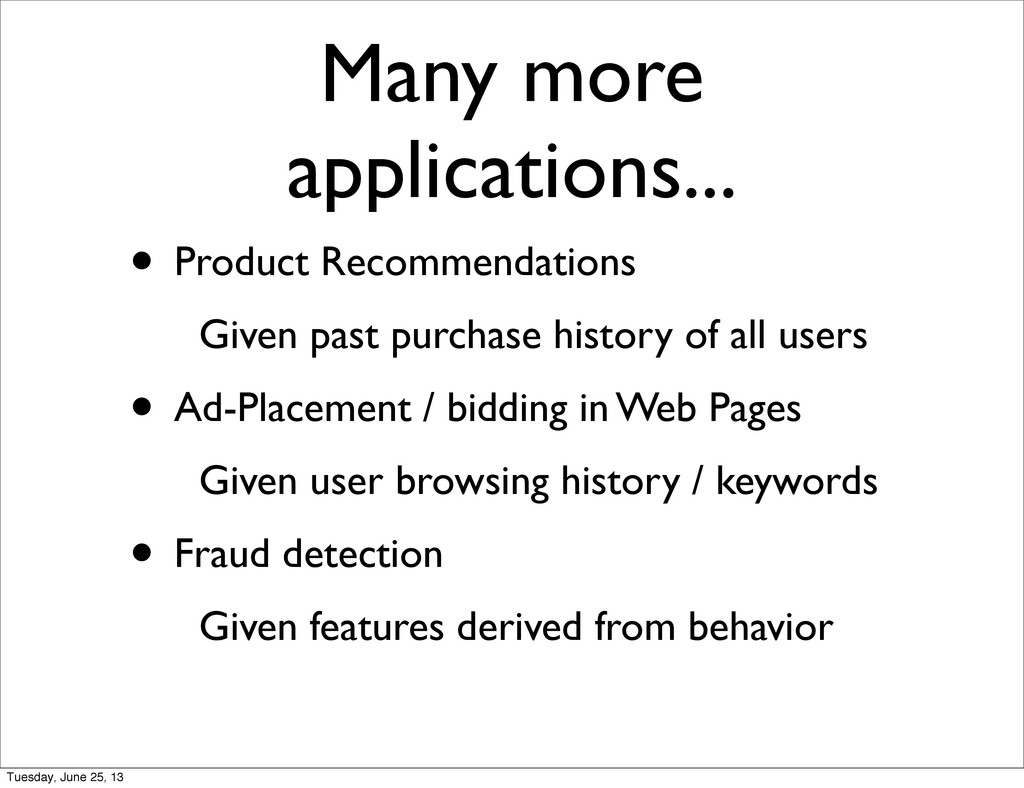
Many more applications... • Product Recommendations Given past purchase history
of all users • Ad-Placement / bidding in Web Pages Given user browsing history / keywords • Fraud detection Given features derived from behavior Tuesday, June 25, 13 -
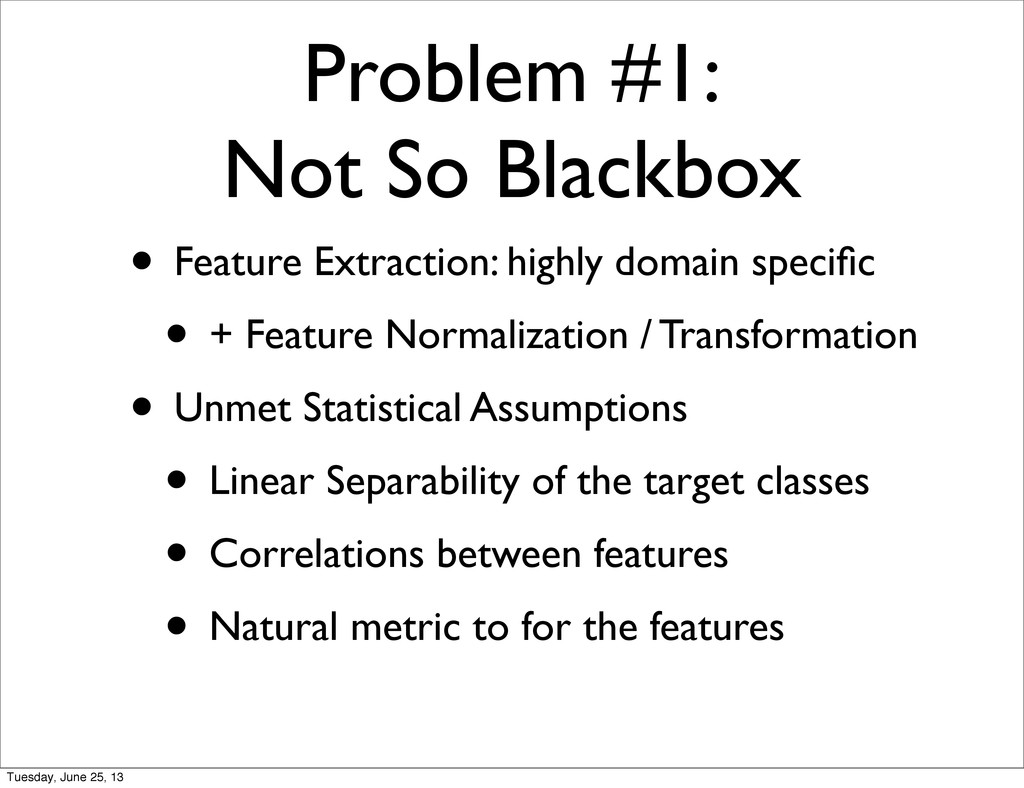
Problem #1: Not So Blackbox • Feature Extraction: highly domain
specific • + Feature Normalization / Transformation • Unmet Statistical Assumptions • Linear Separability of the target classes • Correlations between features • Natural metric to for the features Tuesday, June 25, 13 -
Problem #2: Lack of Explainability Blackbox models can rarely explain
what they learned. Expert knowledge required to understand the model behavior and gain deeper insight on the data: this is model specific. Tuesday, June 25, 13 -
Possible Solutions • Problem #1: Costly Feature Engineering • Unsupervised
feature extraction with Deep Learning • Problem #2: Lack of Explainability • Probabilistic Programming with generic inference engines Tuesday, June 25, 13 -
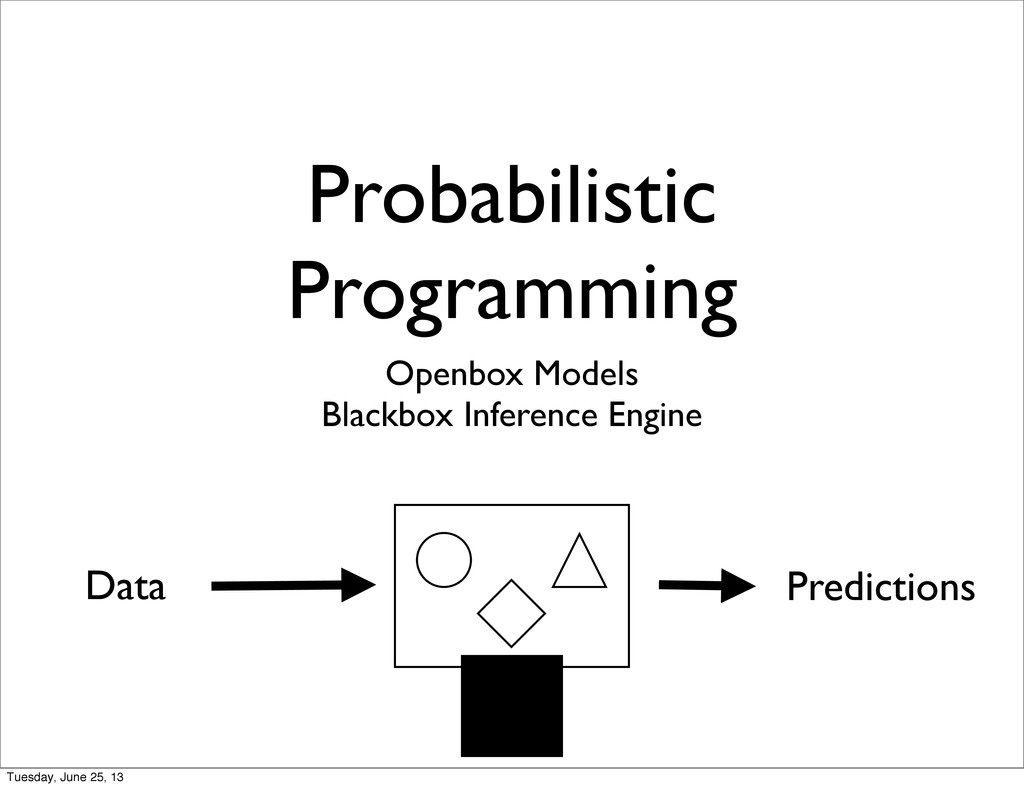
What is Prob. Programming? • Model unknown causes of a
phenomenon with random variables • Write a programmatic story to derive observables from unknown variables • Plug data into observed variables • Use engine to invert the story and assign prob. distributions to unknown params. Tuesday, June 25, 13 -
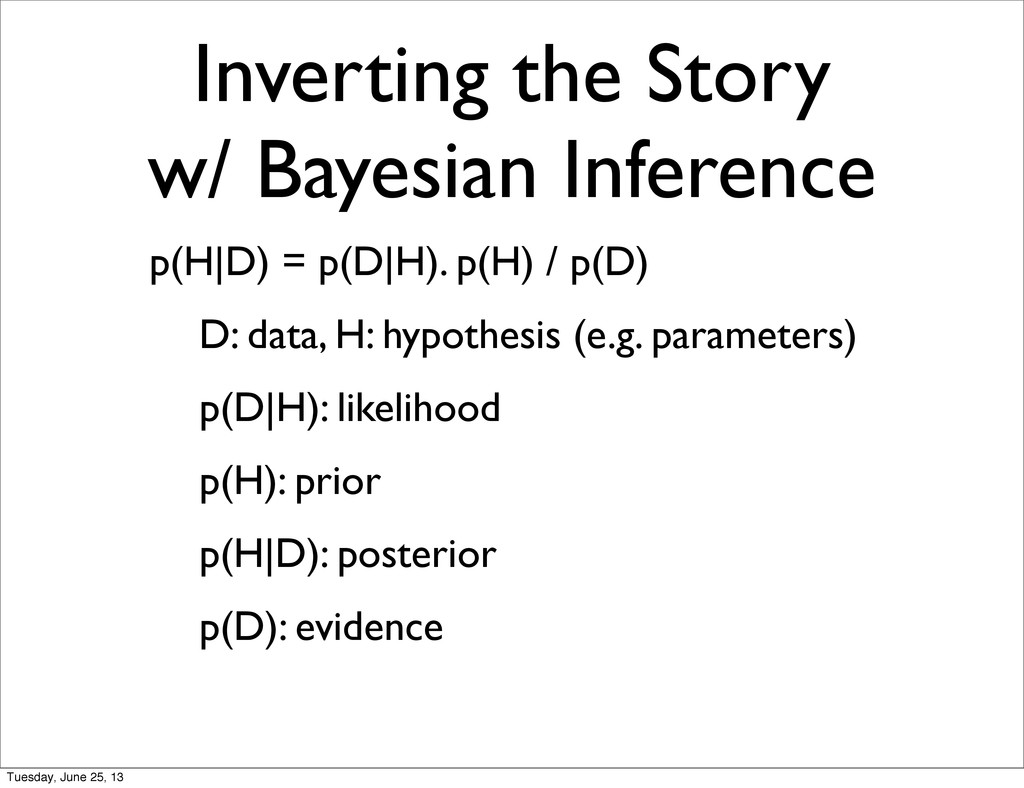
Inverting the Story w/ Bayesian Inference p(H|D) = p(D|H). p(H)
/ p(D) D: data, H: hypothesis (e.g. parameters) p(D|H): likelihood p(H): prior p(H|D): posterior p(D): evidence Tuesday, June 25, 13 -
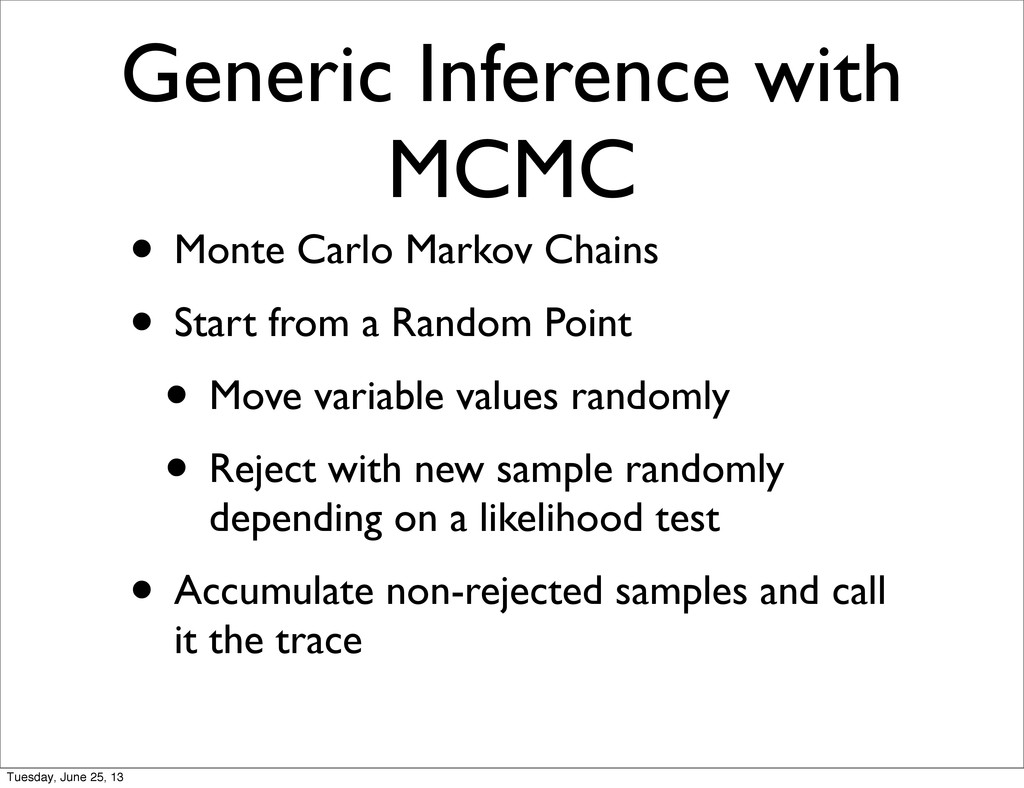
Generic Inference with MCMC • Monte Carlo Markov Chains •
Start from a Random Point • Move variable values randomly • Reject with new sample randomly depending on a likelihood test • Accumulate non-rejected samples and call it the trace Tuesday, June 25, 13 -
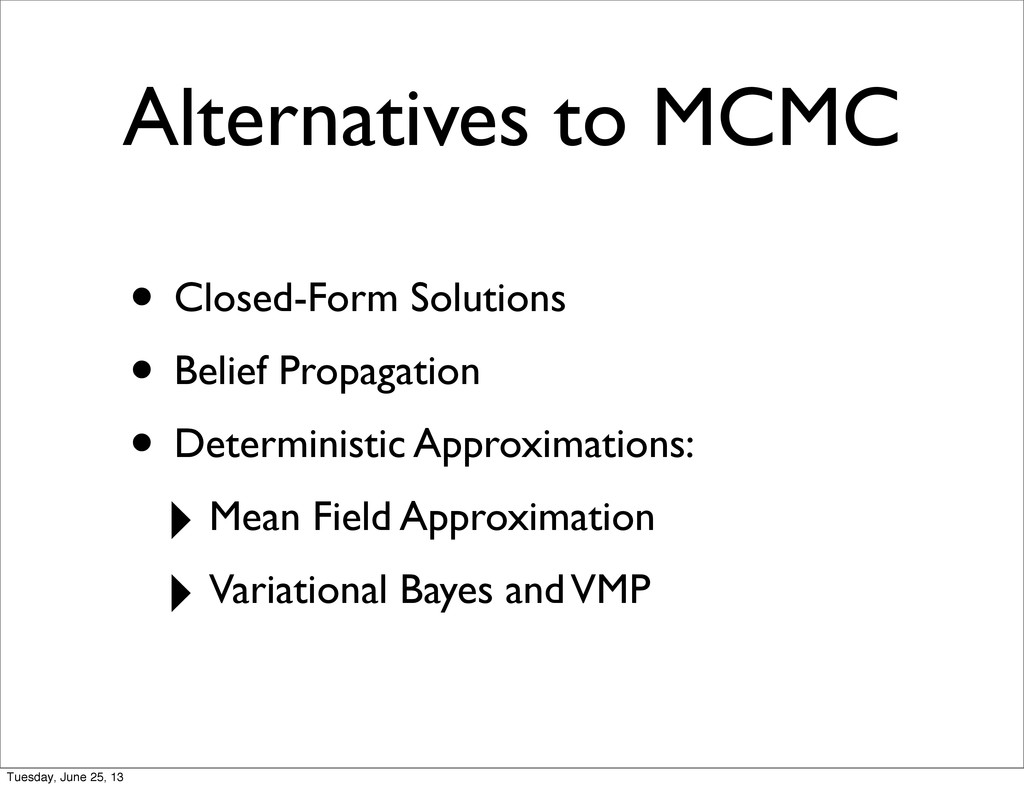
Alternatives to MCMC • Closed-Form Solutions • Belief Propagation •
Deterministic Approximations: ‣ Mean Field Approximation ‣ Variational Bayes and VMP Tuesday, June 25, 13 -
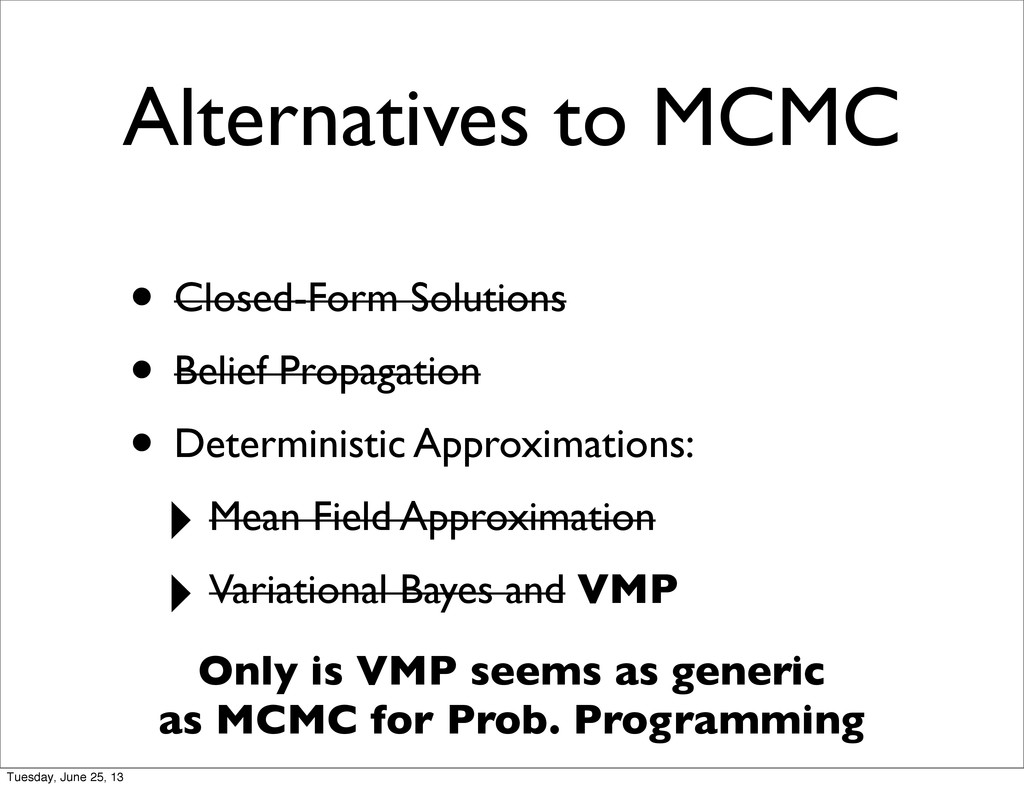
Alternatives to MCMC • Closed-Form Solutions • Belief Propagation •
Deterministic Approximations: ‣ Mean Field Approximation ‣ Variational Bayes and VMP Only is VMP seems as generic as MCMC for Prob. Programming Tuesday, June 25, 13 -
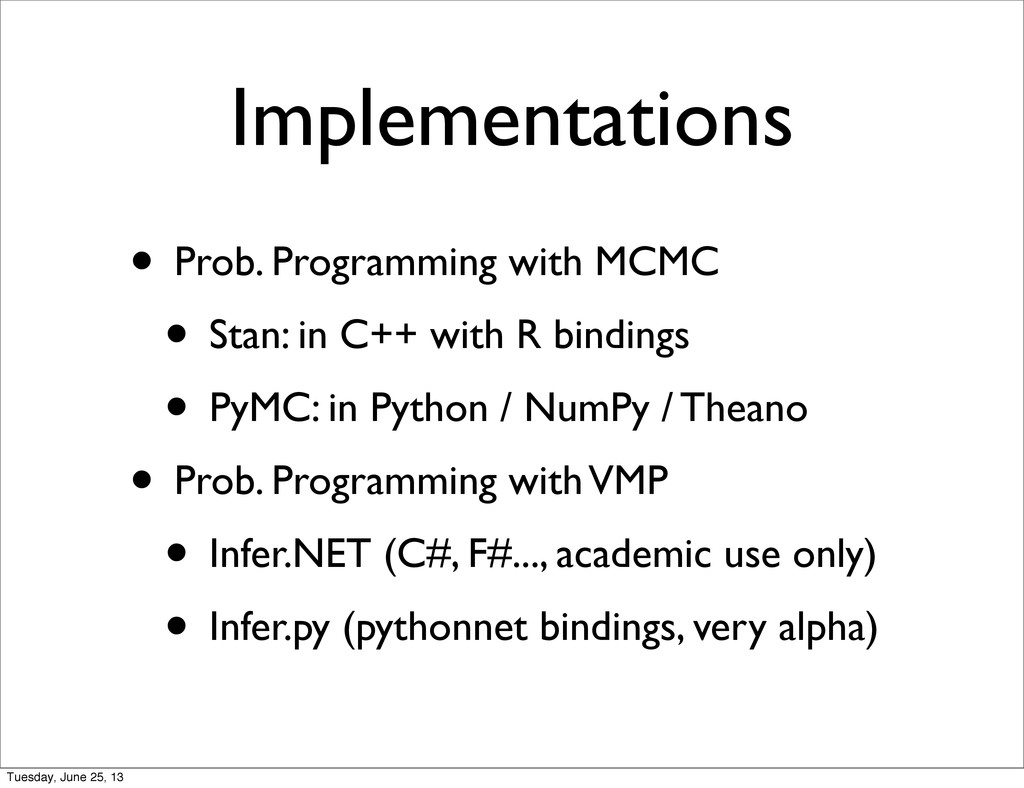
Implementations • Prob. Programming with MCMC • Stan: in C++
with R bindings • PyMC: in Python / NumPy / Theano • Prob. Programming with VMP • Infer.NET (C#, F#..., academic use only) • Infer.py (pythonnet bindings, very alpha) Tuesday, June 25, 13 -
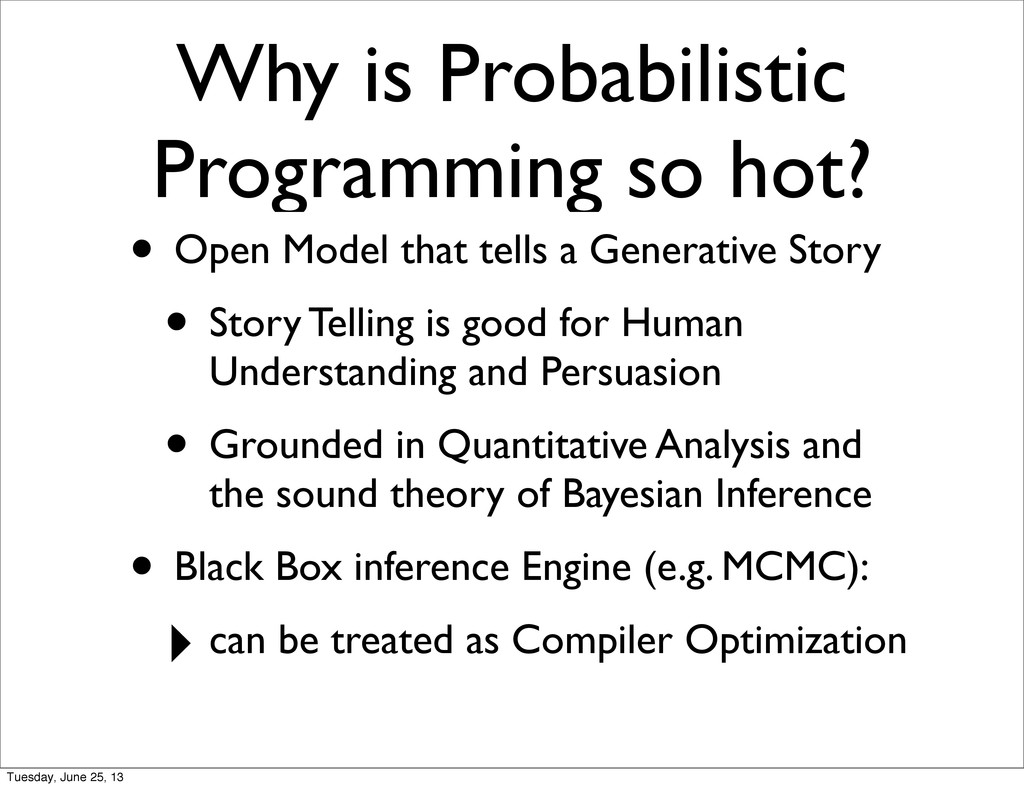
Why is Probabilistic Programming so hot? • Open Model that
tells a Generative Story • Story Telling is good for Human Understanding and Persuasion • Grounded in Quantitative Analysis and the sound theory of Bayesian Inference • Black Box inference Engine (e.g. MCMC): ‣ can be treated as Compiler Optimization Tuesday, June 25, 13 -
Why Bayesian Inference? • Makes it possible to explicitly model
uncertainty caused by lack of data using priors Tuesday, June 25, 13 -
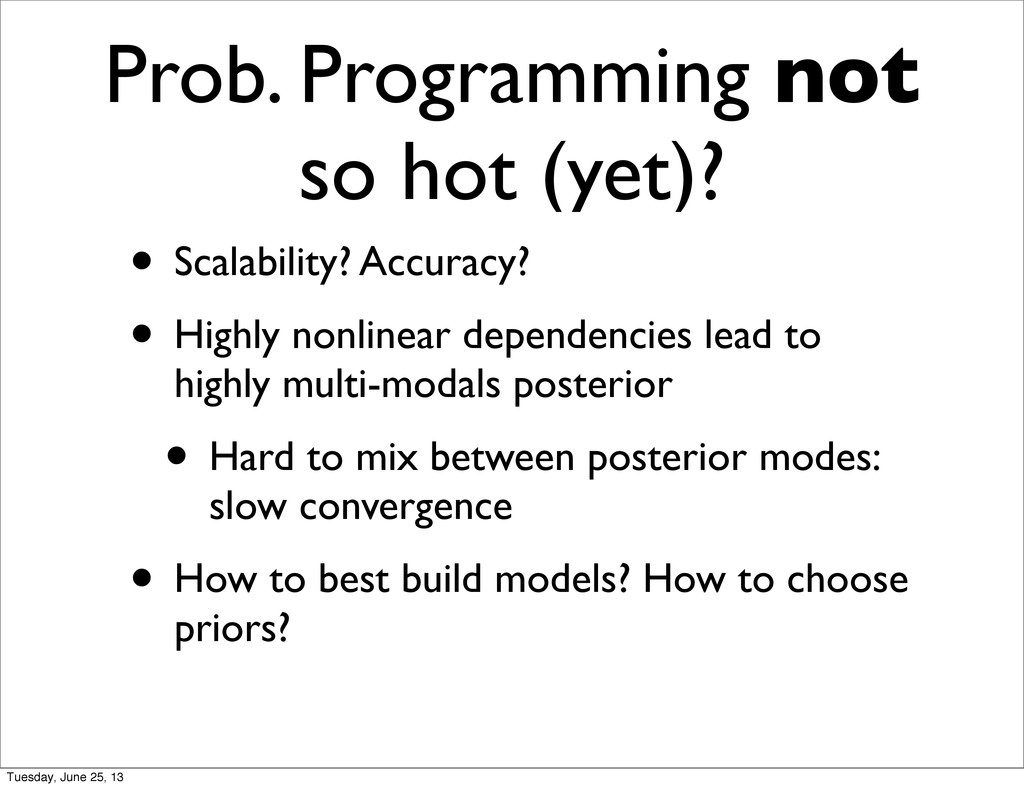
Prob. Programming not so hot (yet)? • Scalability? Accuracy? •
Highly nonlinear dependencies lead to highly multi-modals posterior • Hard to mix between posterior modes: slow convergence • How to best build models? How to choose priors? Tuesday, June 25, 13 -
Old idea but recent developments • No-U-Turn Sampler (2011): breakthrough
for scalability of MCMC for some model classes (in Stan and PyMC3 with Theano) • VMP (orig. paper 2005, generalized in 2011) in Infer.NET • New DARPA Program (2013-2017) to fund research on Prob. Programming. Tuesday, June 25, 13 -
Learning Prob. Programming • Probabilistic Programming and Bayesian Methods for
Hackers • Creative Commons Book on Github • Uses PyMC & IPython notebook • Doing Bayesian Data Analysis • Book with example in R and BUGS Tuesday, June 25, 13 -
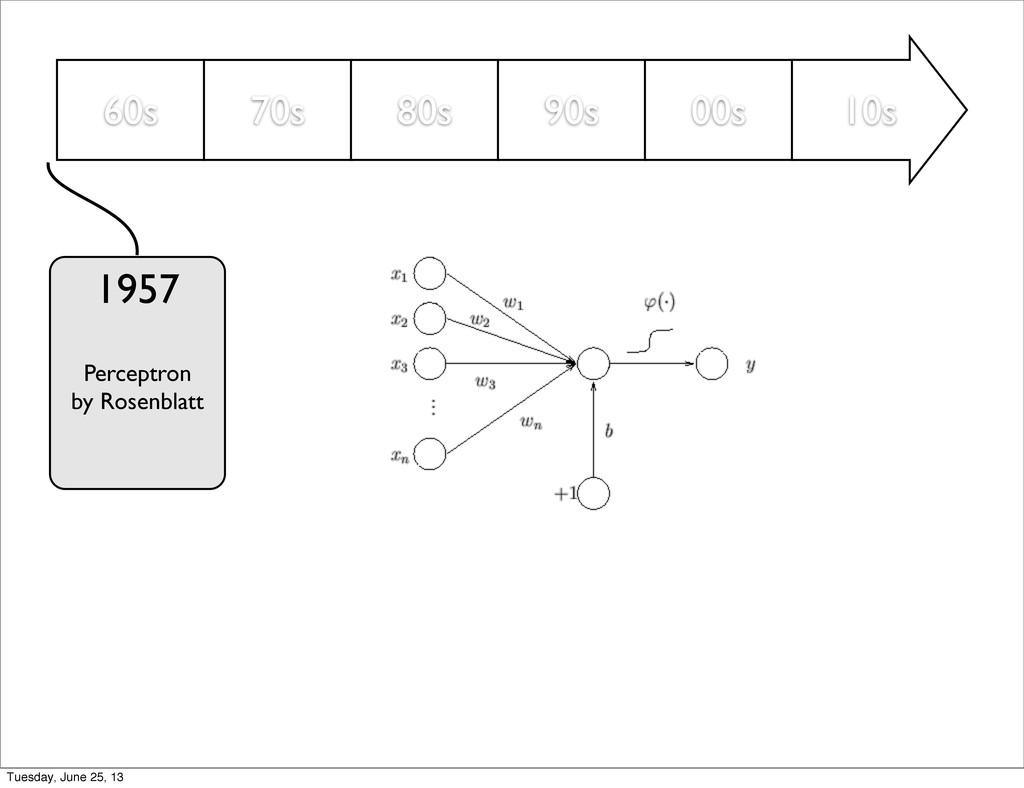
A bit of history It all started with connectionist models
in the late 50s early 60s Tuesday, June 25, 13 -
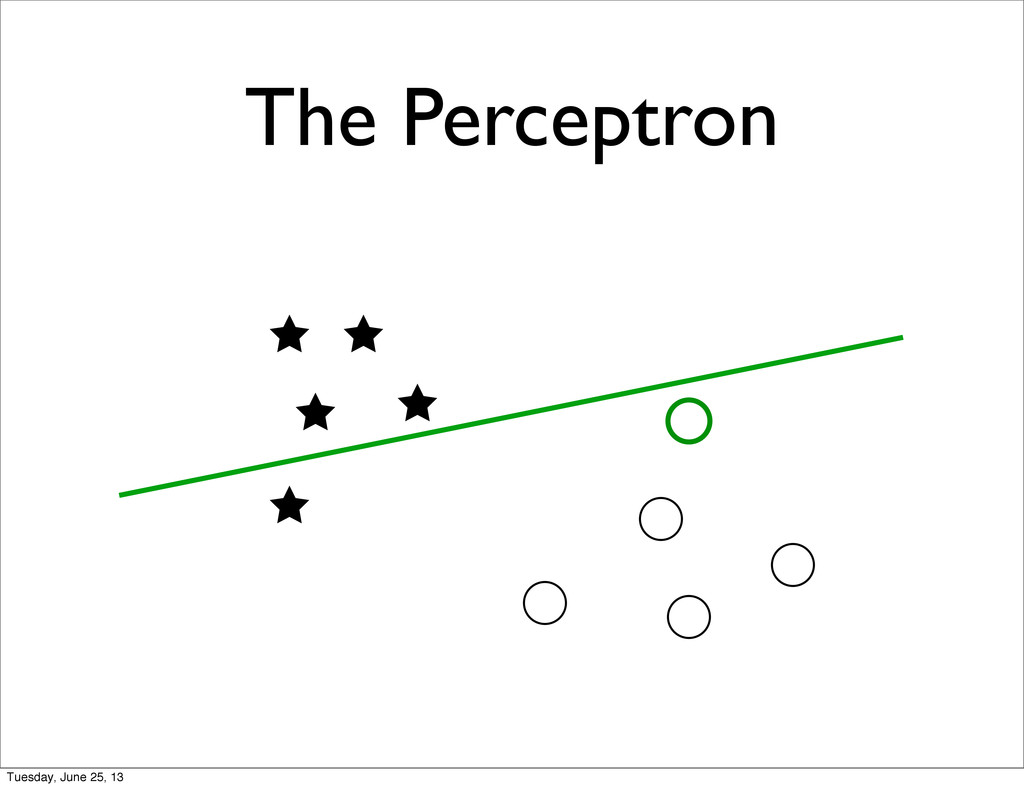
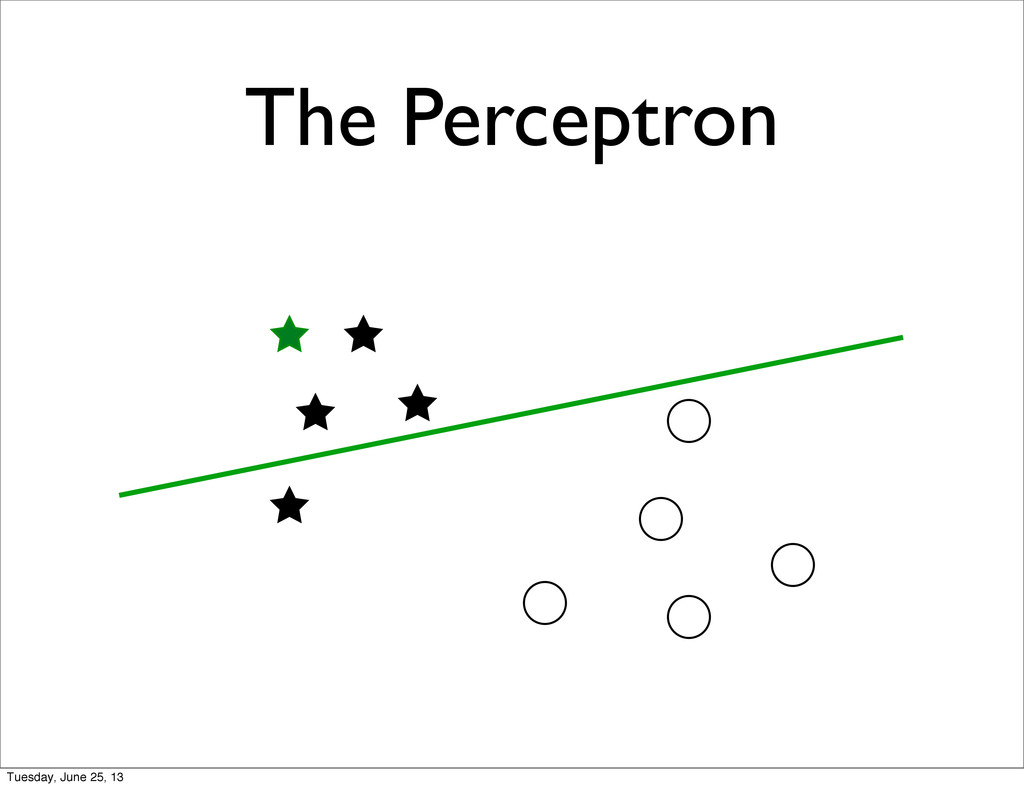
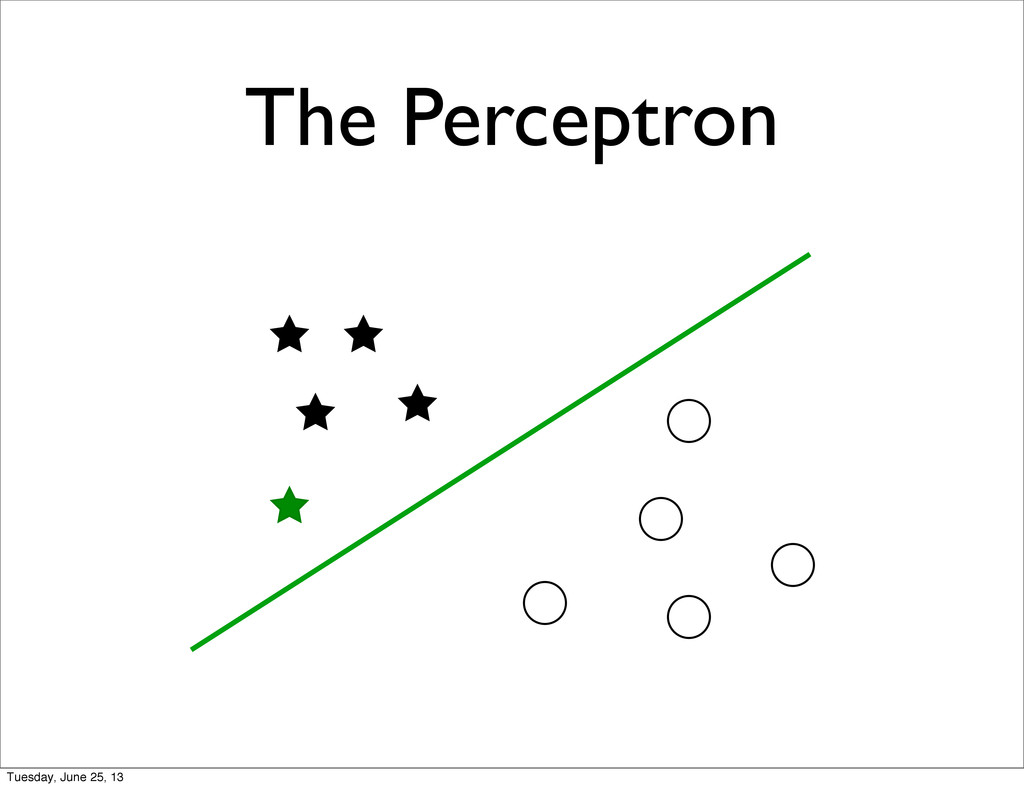
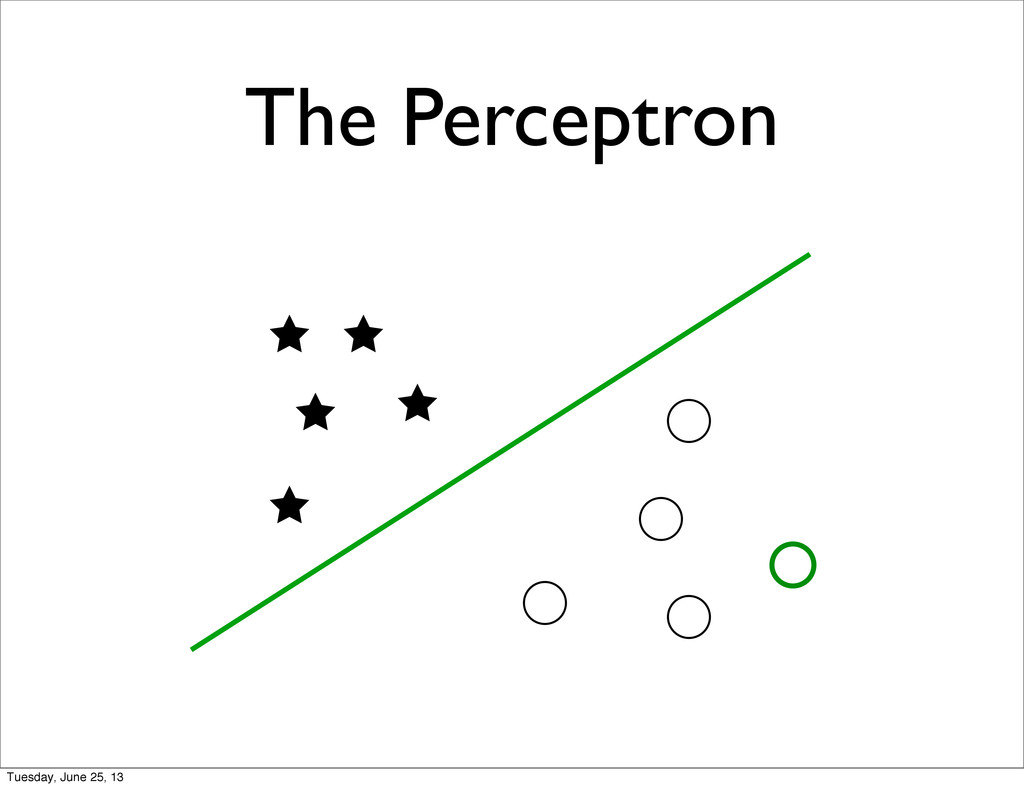
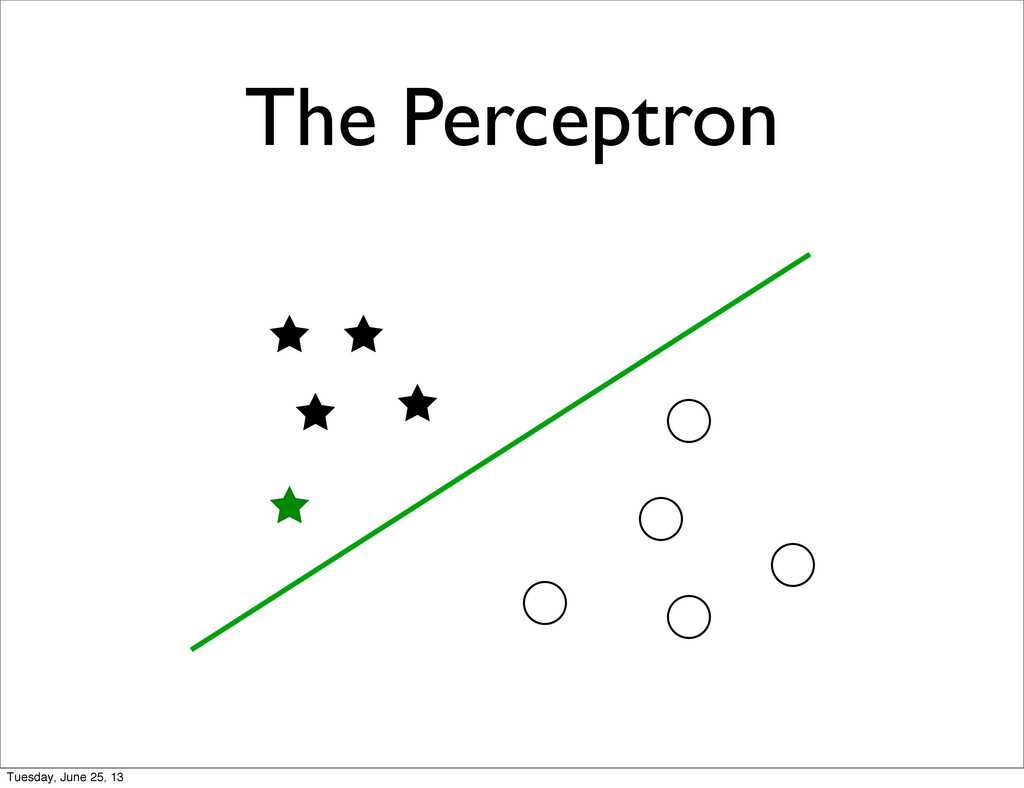
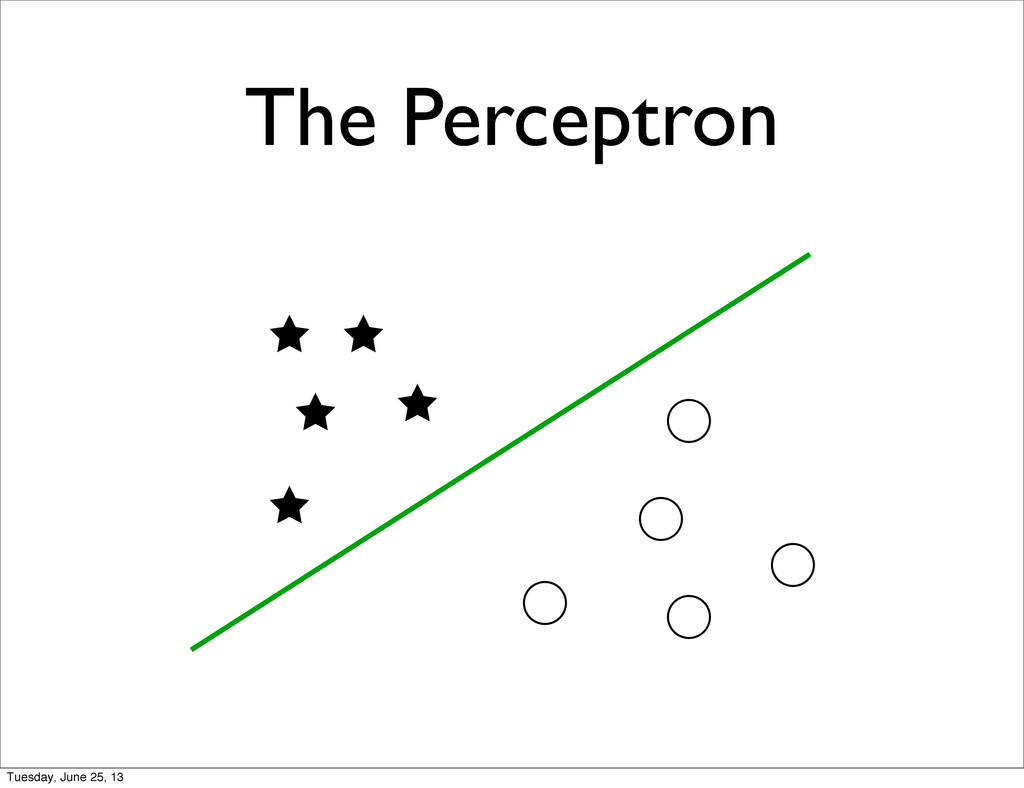
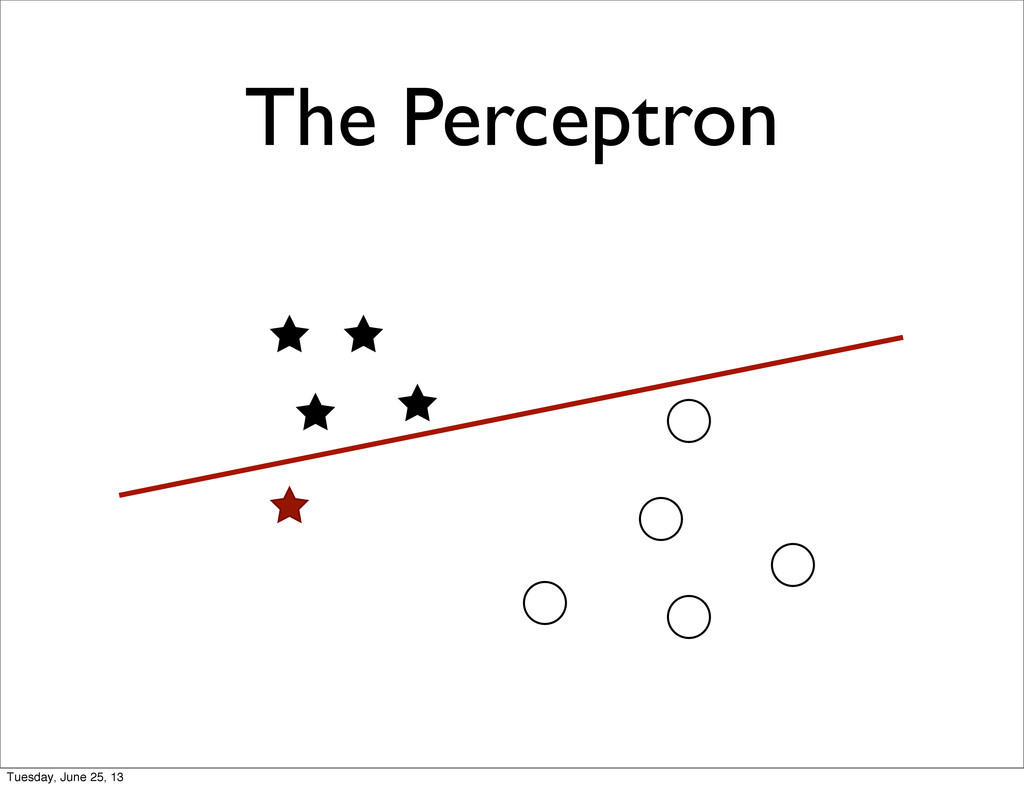
60s 70s 80s 90s 00s 10s Perceptron by Rosenblatt 1957
Tuesday, June 25, 13 -
Neural Nets progress in the 80s with early successes (e.g.
OCR) Tuesday, June 25, 13 -
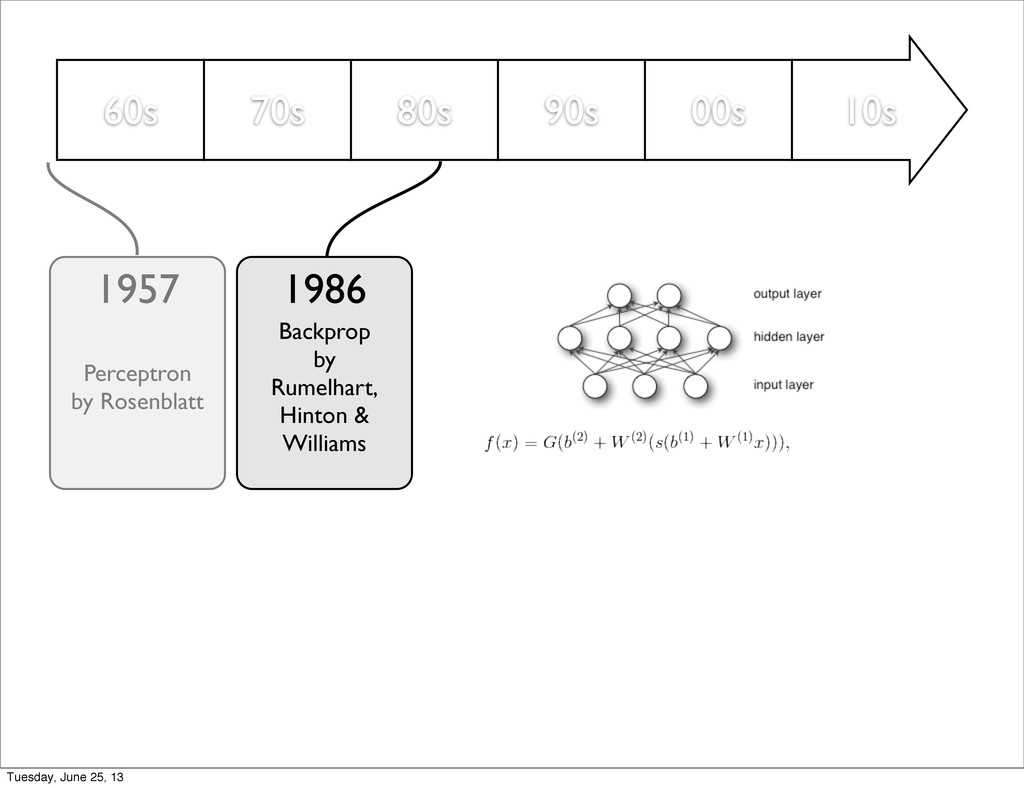
60s 70s 80s 90s 00s 10s Perceptron by Rosenblatt Backprop
by Rumelhart, Hinton & Williams 1957 1986 Tuesday, June 25, 13 -
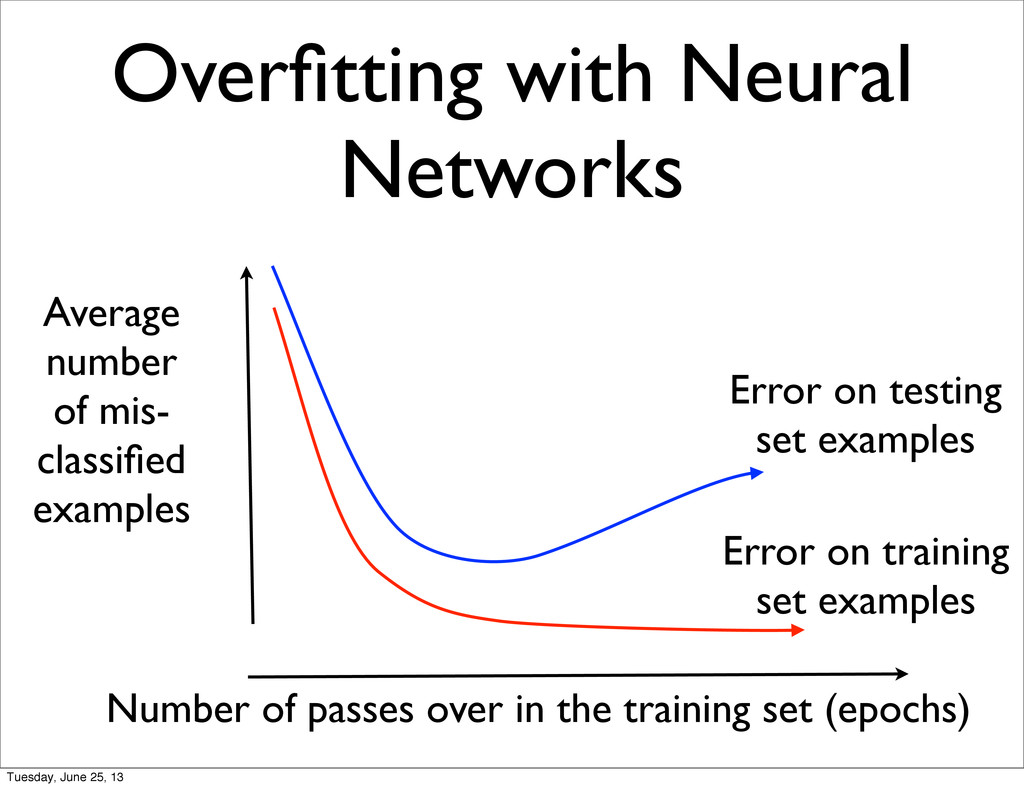
2 Major Problems • In practice Backpropagation stops working with
more than 1 or 2 hidden layers • Overfitting: forces early stopping Tuesday, June 25, 13 -
Overfitting with Neural Networks Number of passes over in the
training set (epochs) Average number of mis- classified examples Error on testing set examples Error on training set examples Tuesday, June 25, 13 -
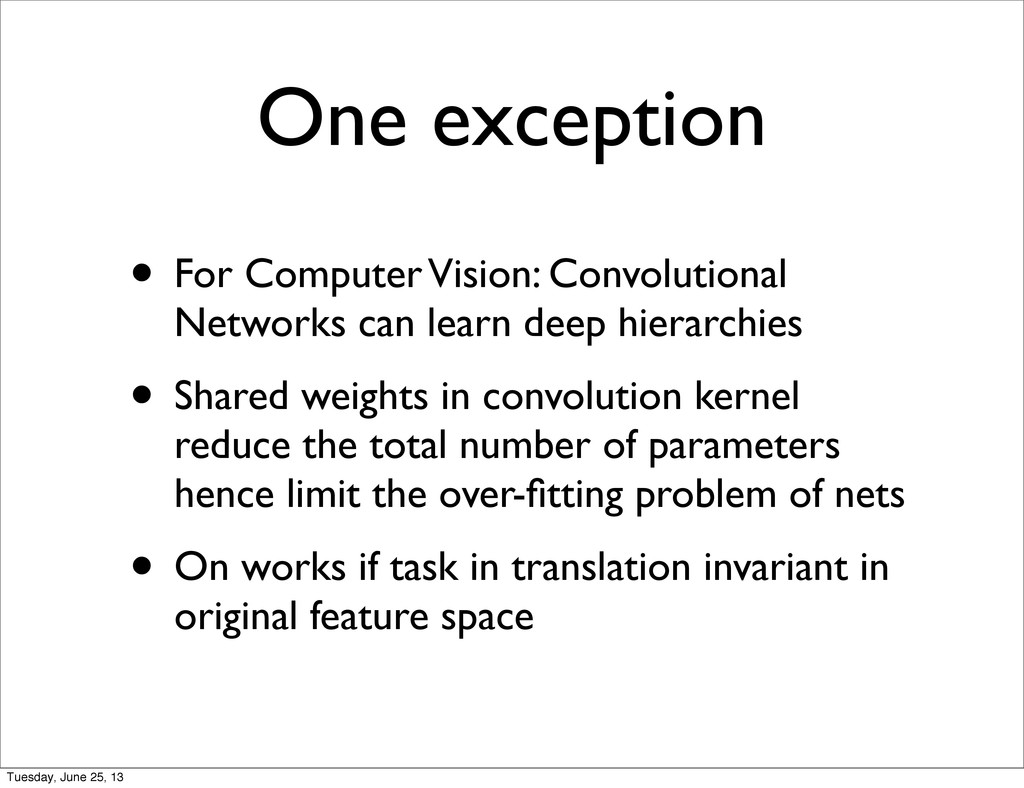
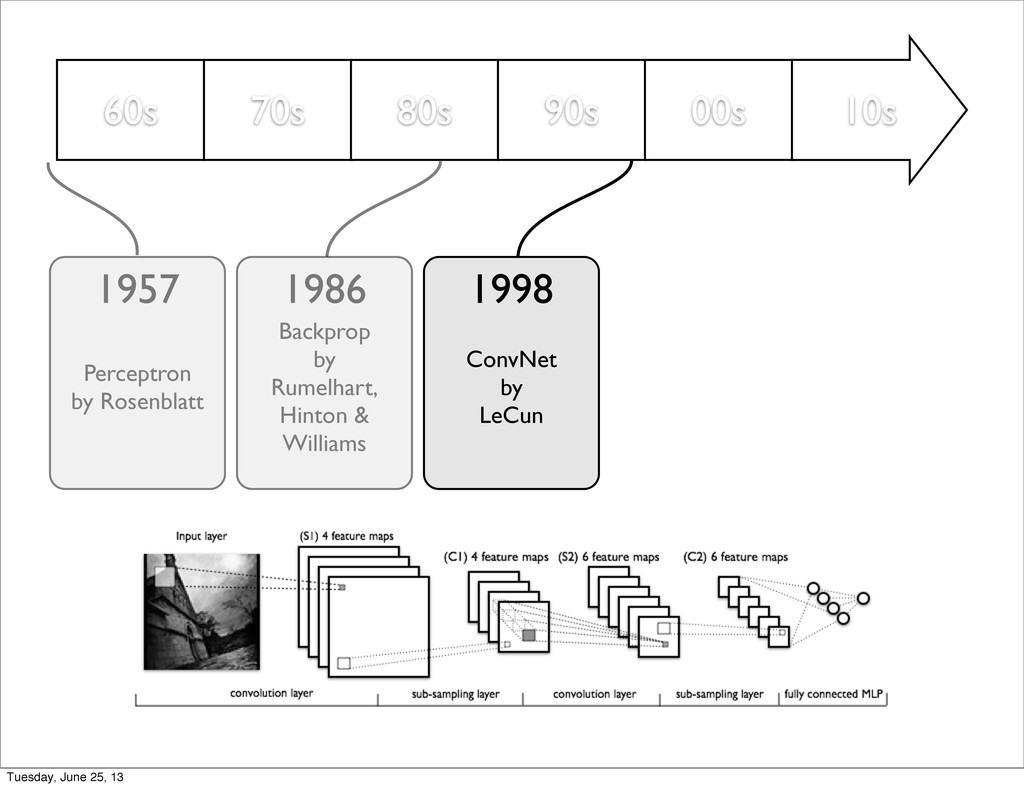
One exception • For Computer Vision: Convolutional Networks can learn
deep hierarchies • Shared weights in convolution kernel reduce the total number of parameters hence limit the over-fitting problem of nets • On works if task in translation invariant in original feature space Tuesday, June 25, 13 -
60s 70s 80s 90s 00s 10s Perceptron by Rosenblatt Backprop
by Rumelhart, Hinton & Williams 1957 1986 ConvNet by LeCun 1998 Tuesday, June 25, 13 -
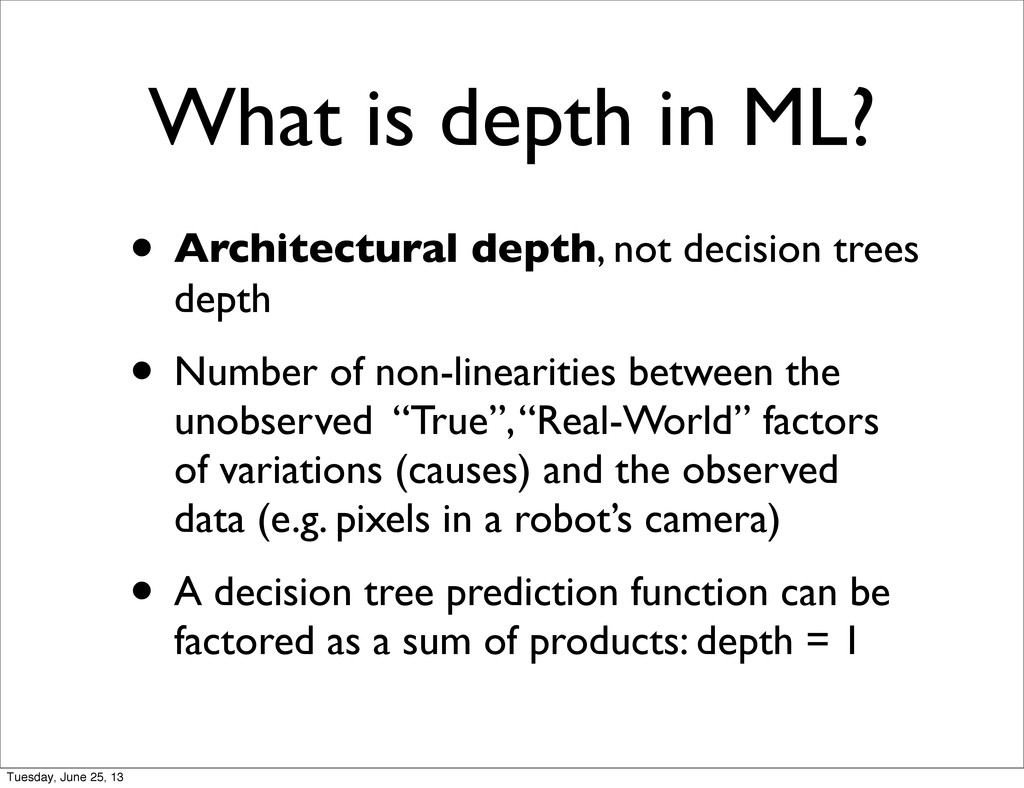
What is depth in ML? • Architectural depth, not decision
trees depth • Number of non-linearities between the unobserved “True”, “Real-World” factors of variations (causes) and the observed data (e.g. pixels in a robot’s camera) • A decision tree prediction function can be factored as a sum of products: depth = 1 Tuesday, June 25, 13 -
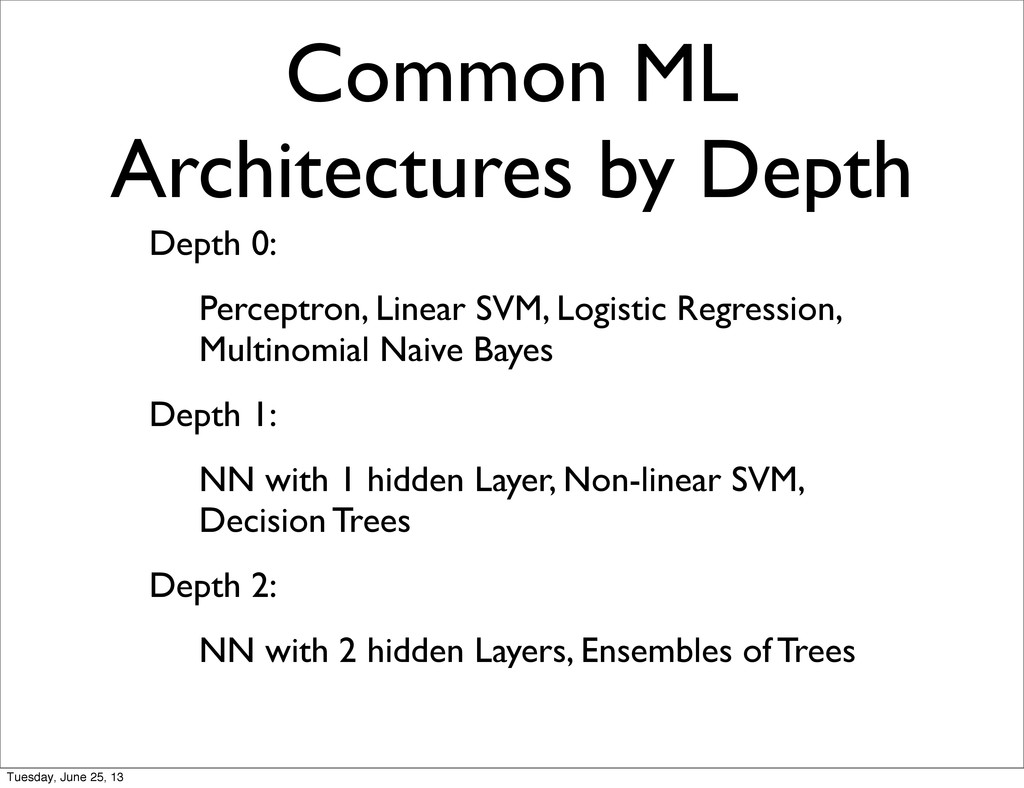
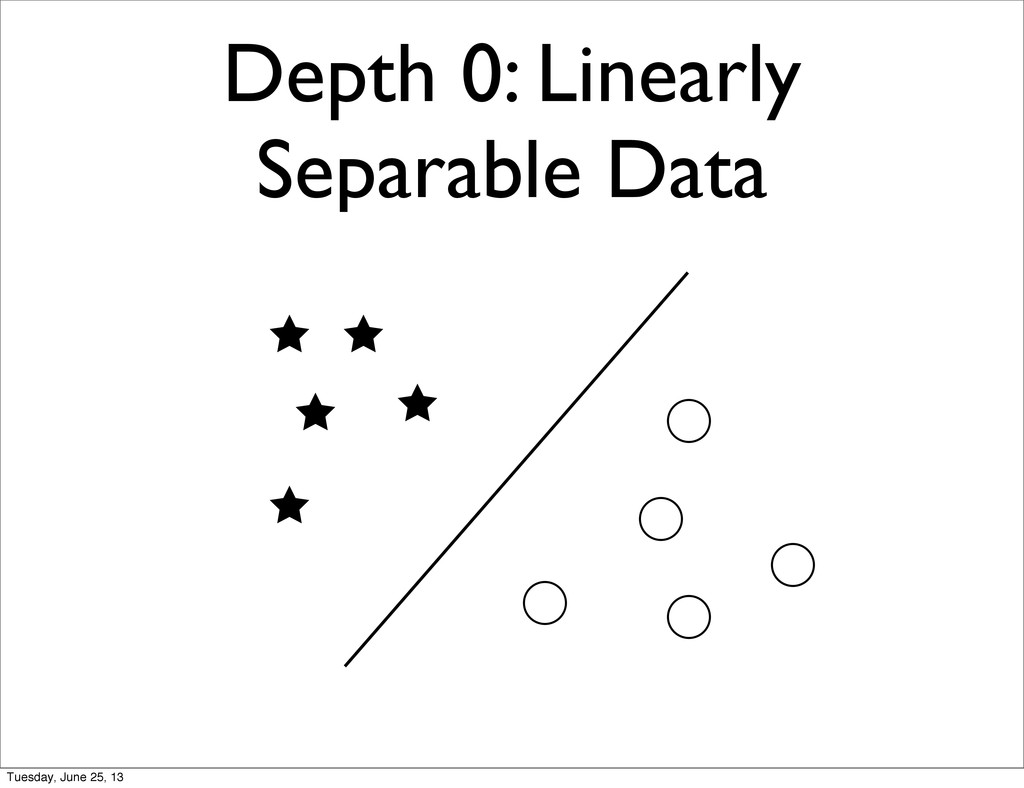
Common ML Architectures by Depth Depth 0: Perceptron, Linear SVM,
Logistic Regression, Multinomial Naive Bayes Depth 1: NN with 1 hidden Layer, Non-linear SVM, Decision Trees Depth 2: NN with 2 hidden Layers, Ensembles of Trees Tuesday, June 25, 13 -
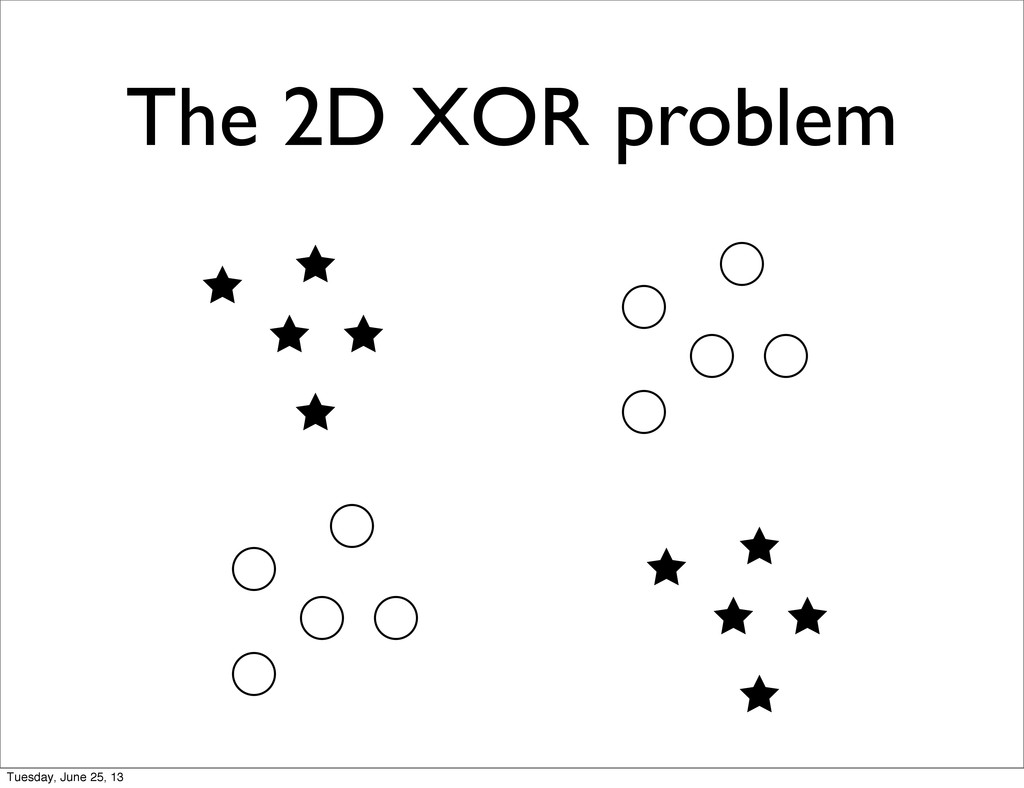
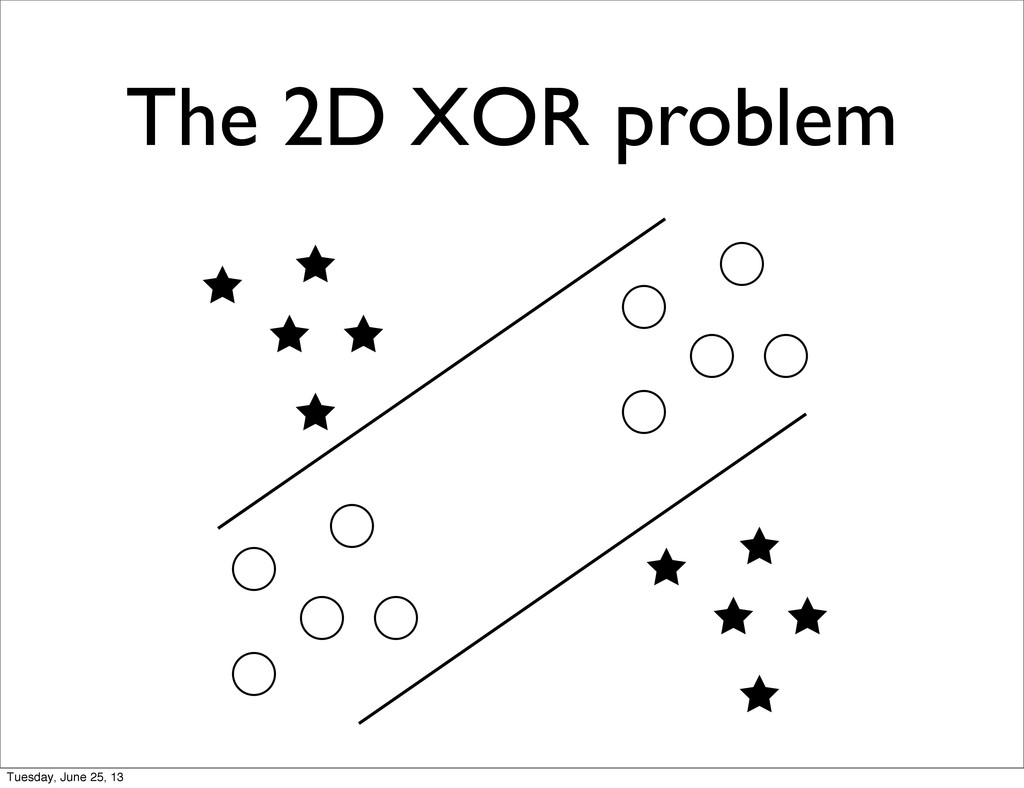
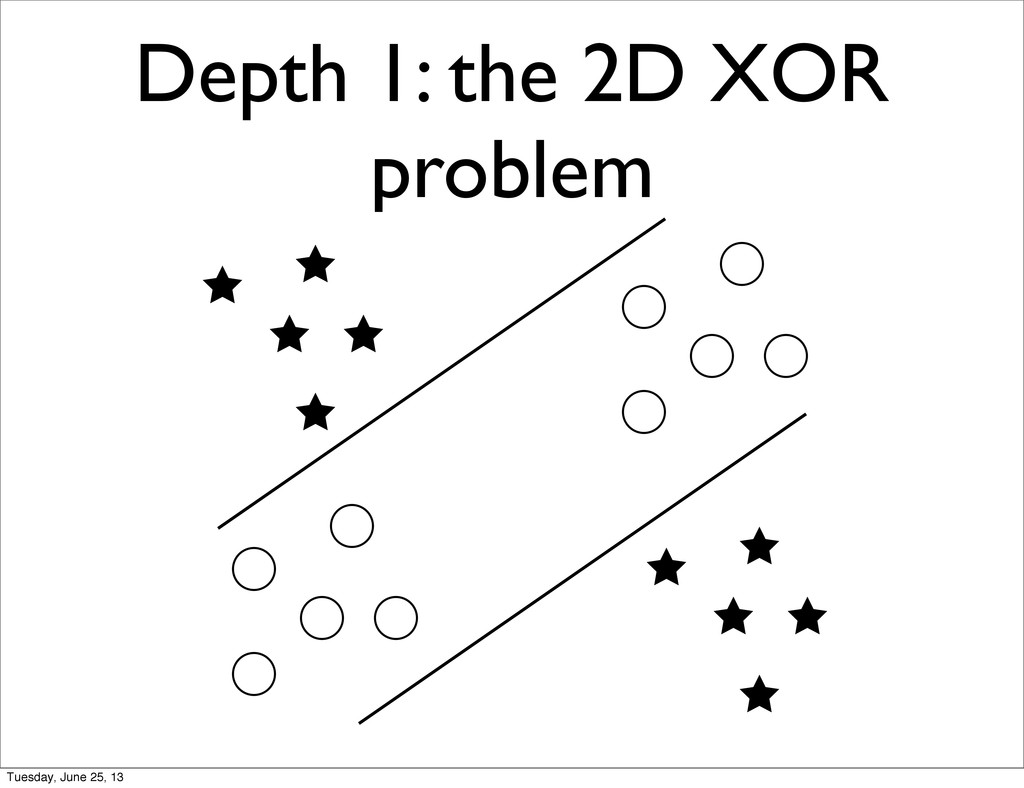
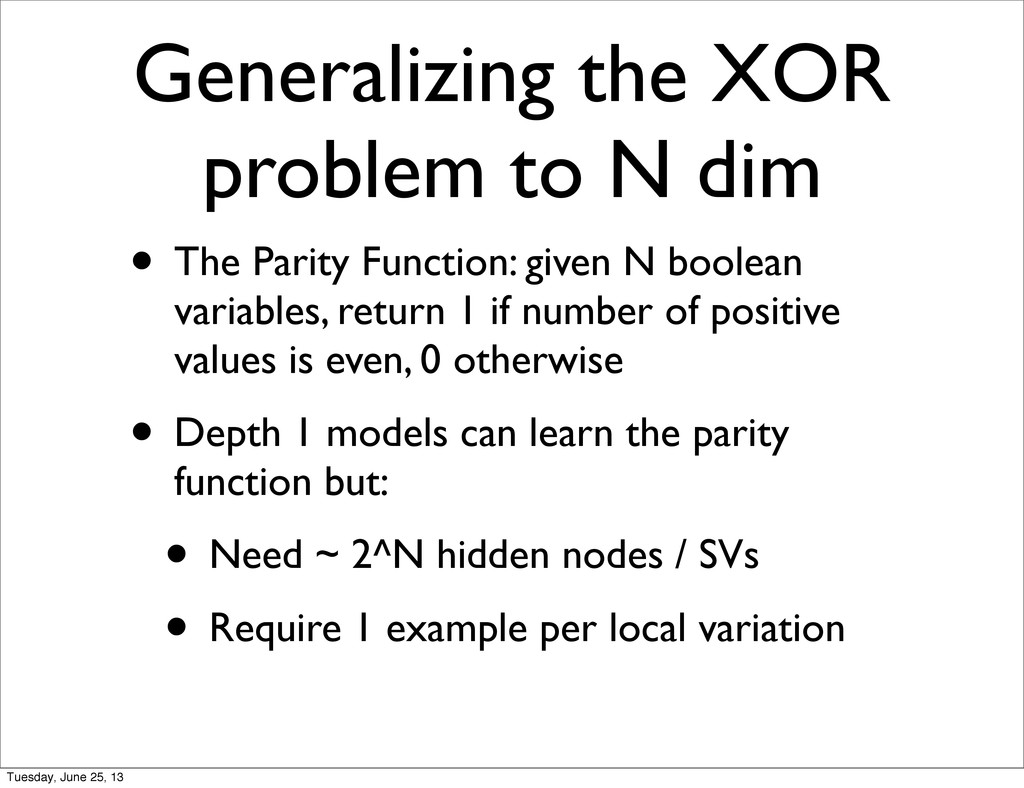
Generalizing the XOR problem to N dim • The Parity
Function: given N boolean variables, return 1 if number of positive values is even, 0 otherwise • Depth 1 models can learn the parity function but: • Need ~ 2^N hidden nodes / SVs • Require 1 example per local variation Tuesday, June 25, 13 -
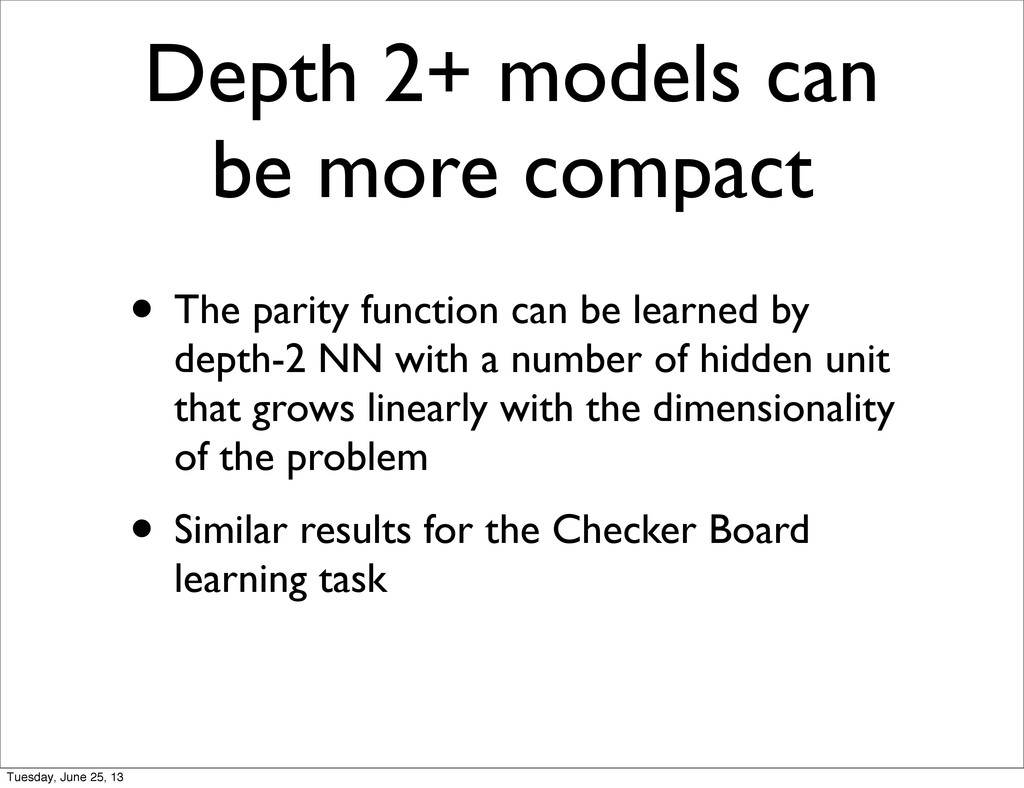
Depth 2+ models can be more compact • The parity
function can be learned by depth-2 NN with a number of hidden unit that grows linearly with the dimensionality of the problem • Similar results for the Checker Board learning task Tuesday, June 25, 13 -
Enough theory! and back to our chronology of Deep Learning
Tuesday, June 25, 13 -
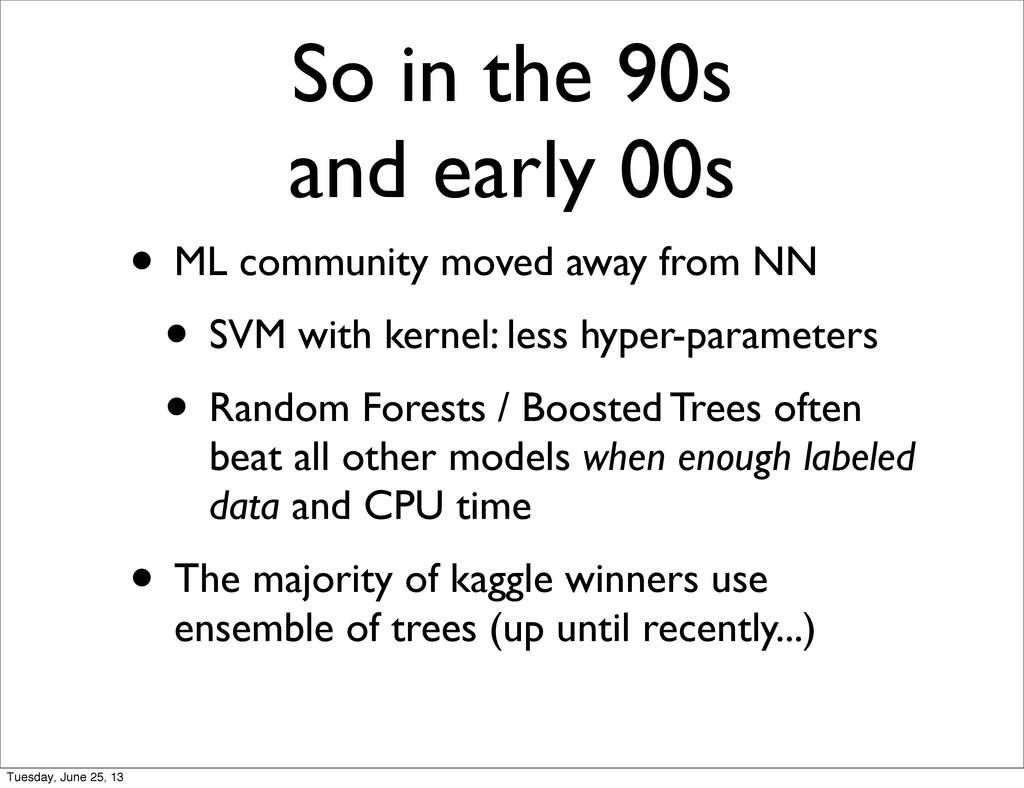
So in the 90s and early 00s • ML community
moved away from NN • SVM with kernel: less hyper-parameters • Random Forests / Boosted Trees often beat all other models when enough labeled data and CPU time • The majority of kaggle winners use ensemble of trees (up until recently...) Tuesday, June 25, 13 -
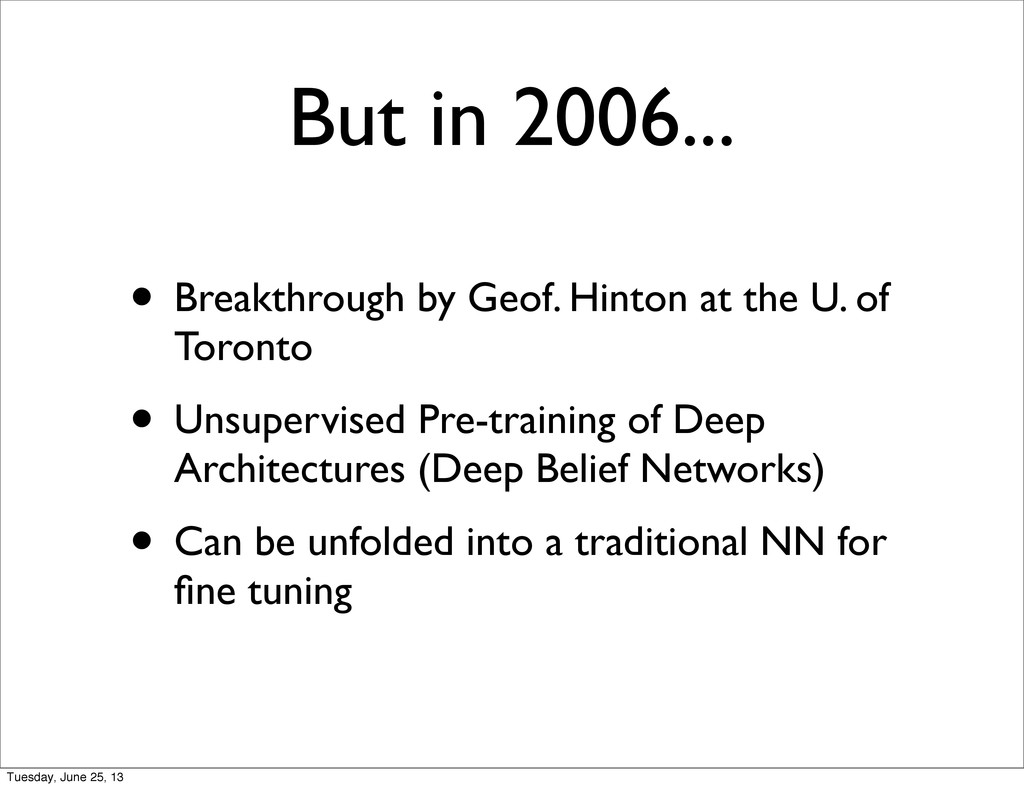
But in 2006... • Breakthrough by Geof. Hinton at the
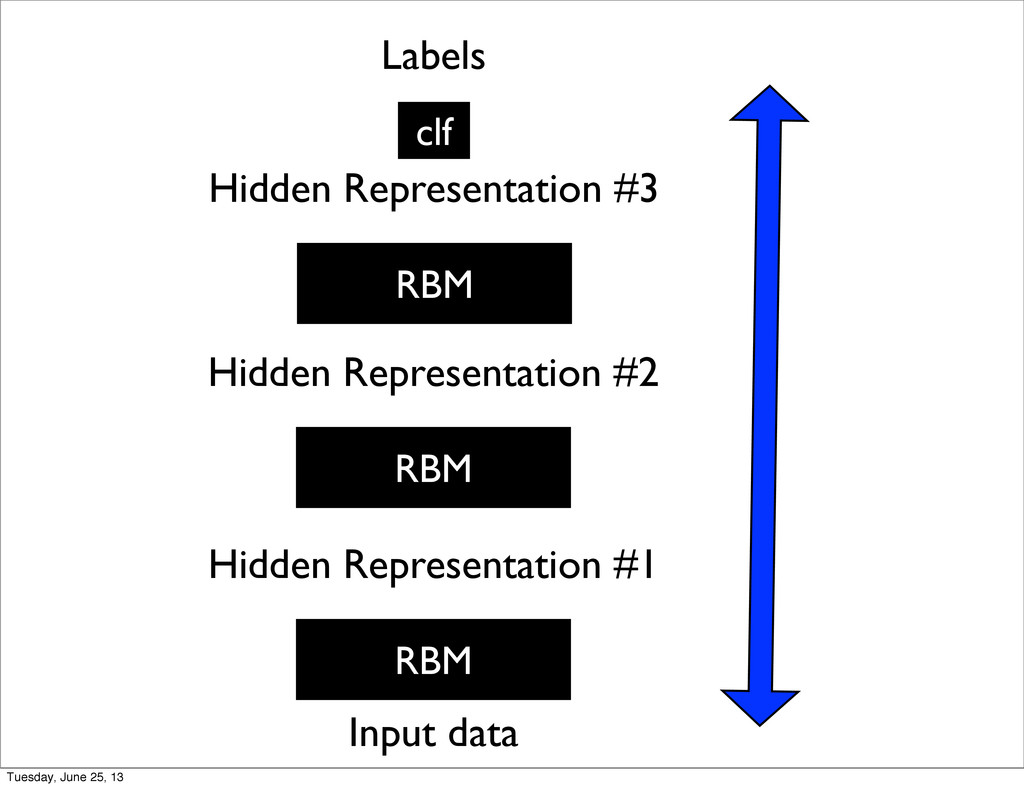
U. of Toronto • Unsupervised Pre-training of Deep Architectures (Deep Belief Networks) • Can be unfolded into a traditional NN for fine tuning Tuesday, June 25, 13 -
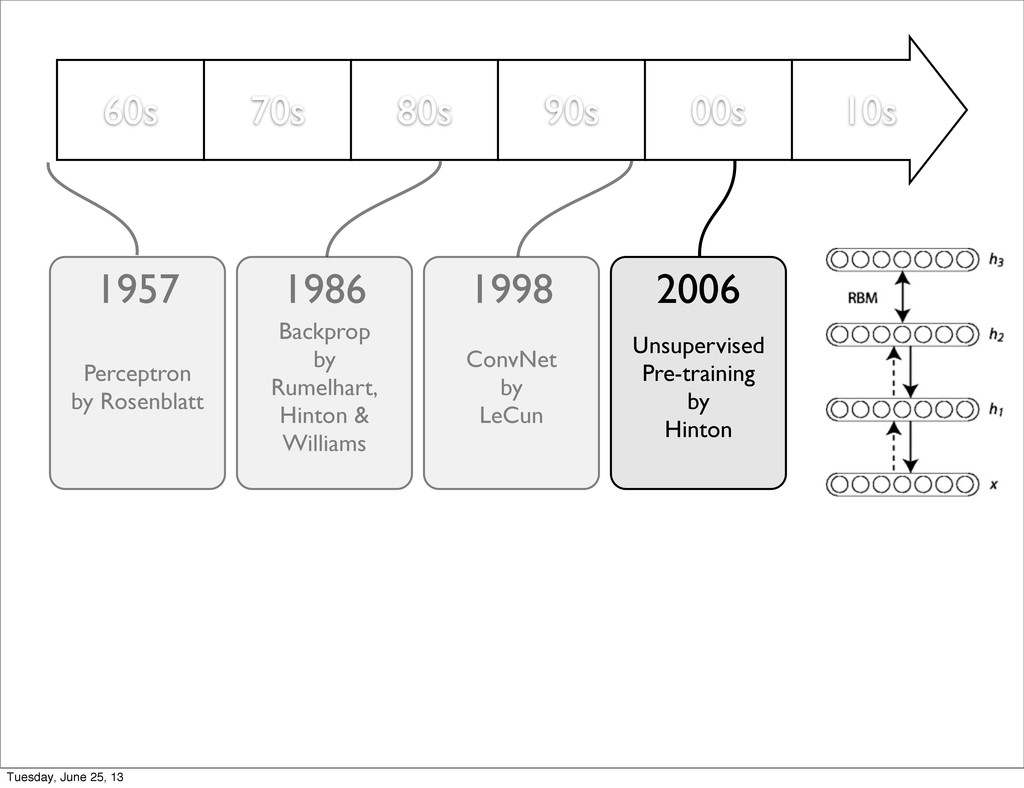
60s 70s 80s 90s 00s 10s Perceptron by Rosenblatt Backprop
by Rumelhart, Hinton & Williams Unsupervised Pre-training by Hinton 1957 1986 2006 ConvNet by LeCun 1998 Tuesday, June 25, 13 -
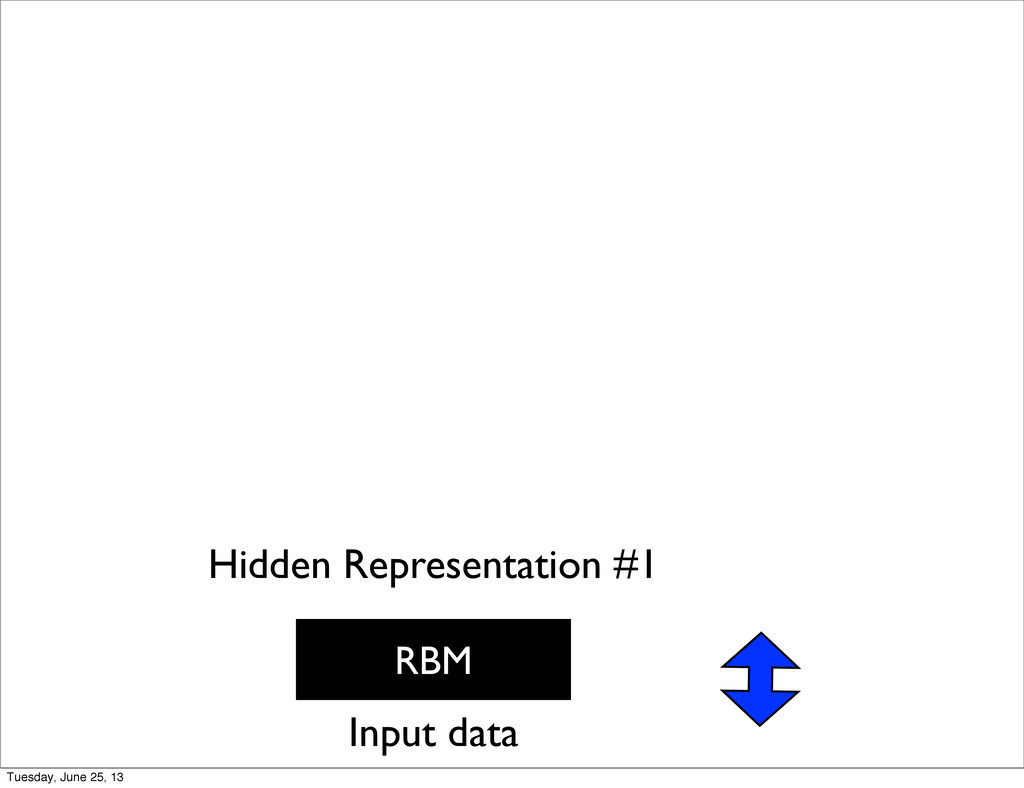
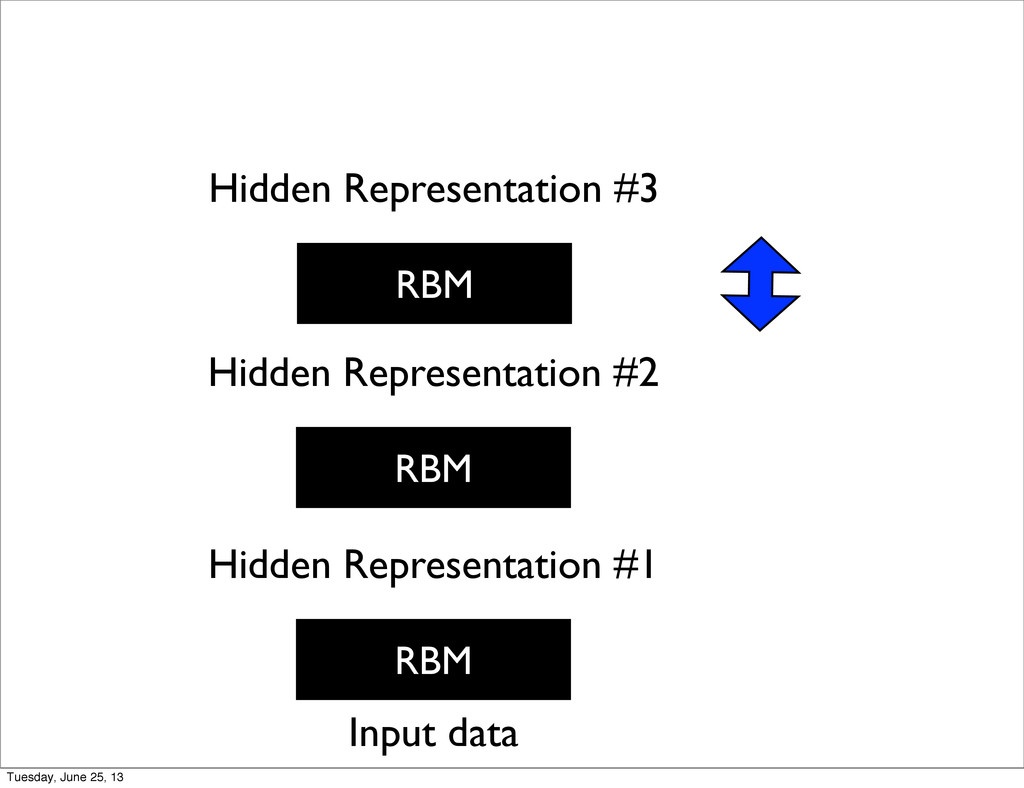
RBM Input data Hidden Representation #1 RBM Hidden Representation #2
Tuesday, June 25, 13 -
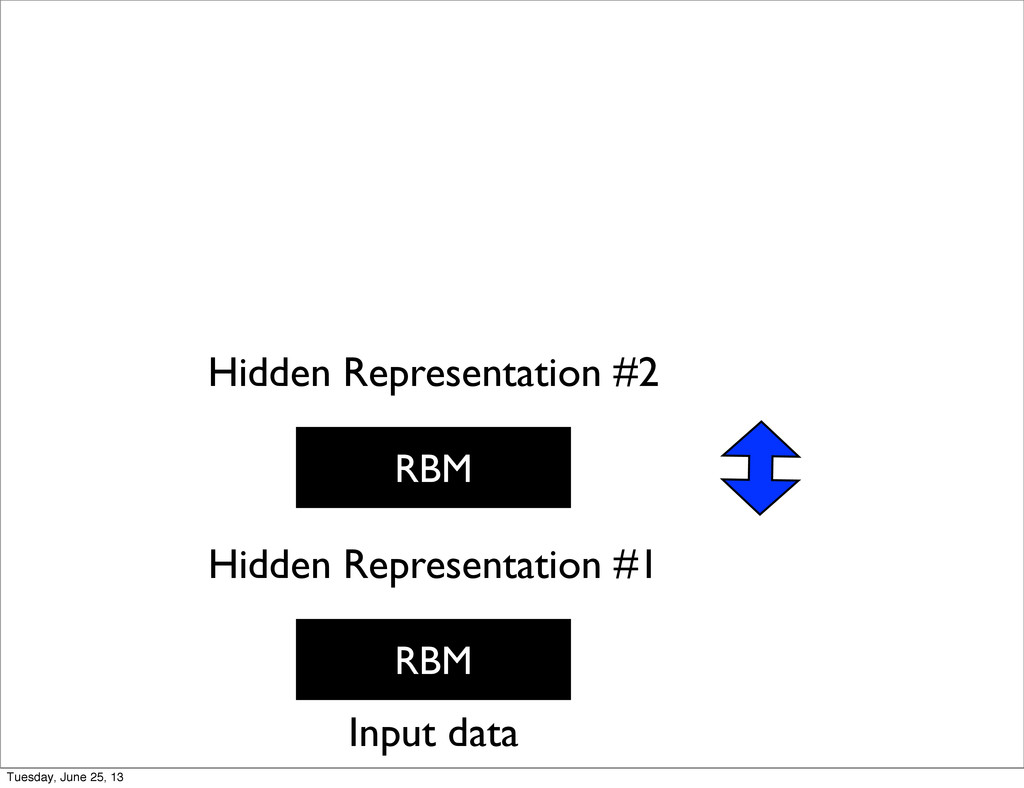
RBM Input data Hidden Representation #1 RBM Hidden Representation #2
RBM Hidden Representation #3 Tuesday, June 25, 13 -
RBM Input data Hidden Representation #1 RBM Hidden Representation #2
RBM Hidden Representation #3 Labels clf Tuesday, June 25, 13 -
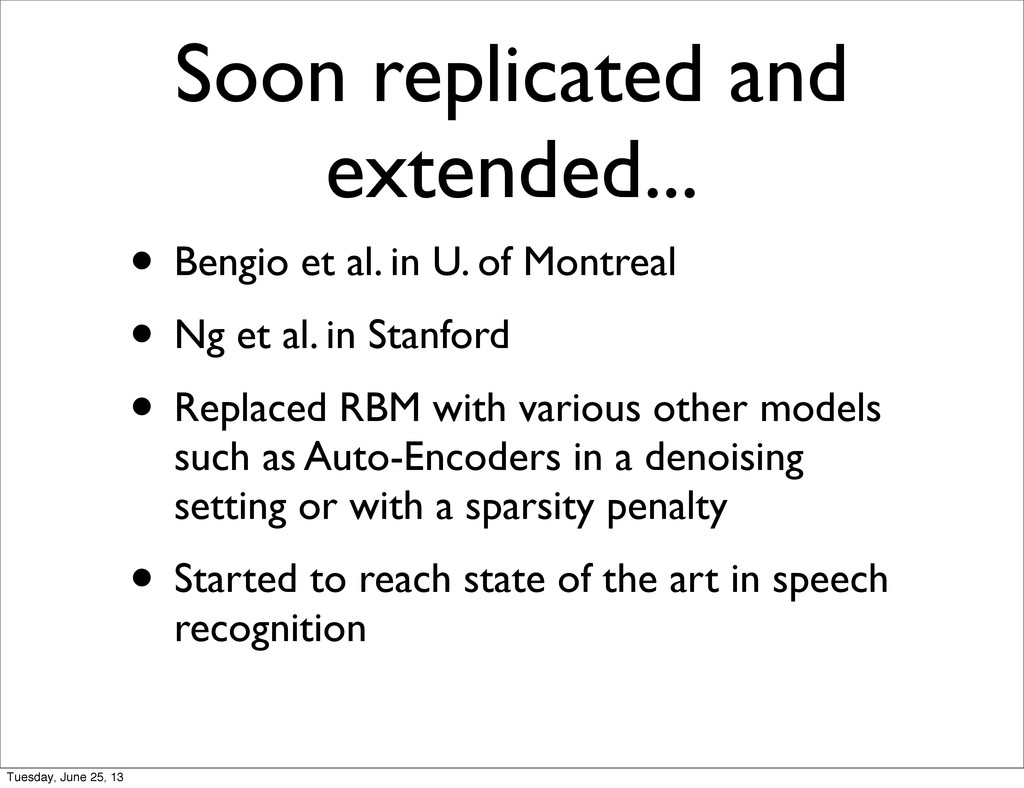
Soon replicated and extended... • Bengio et al. in U.
of Montreal • Ng et al. in Stanford • Replaced RBM with various other models such as Auto-Encoders in a denoising setting or with a sparsity penalty • Started to reach state of the art in speech recognition Tuesday, June 25, 13 -
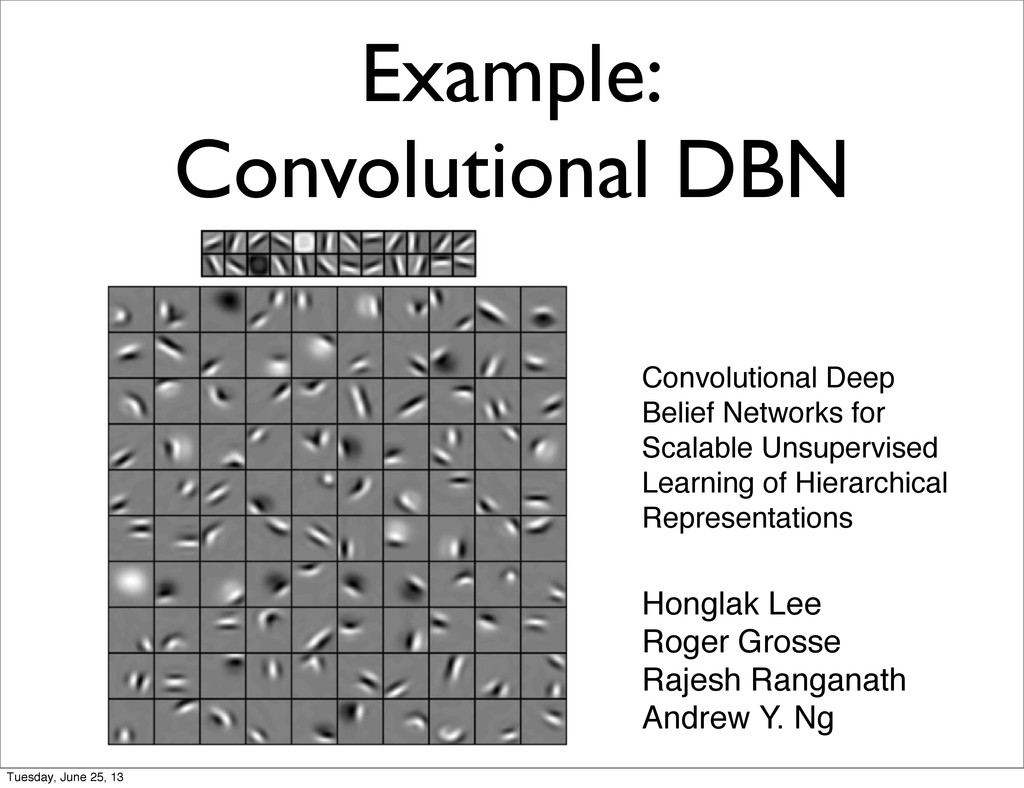
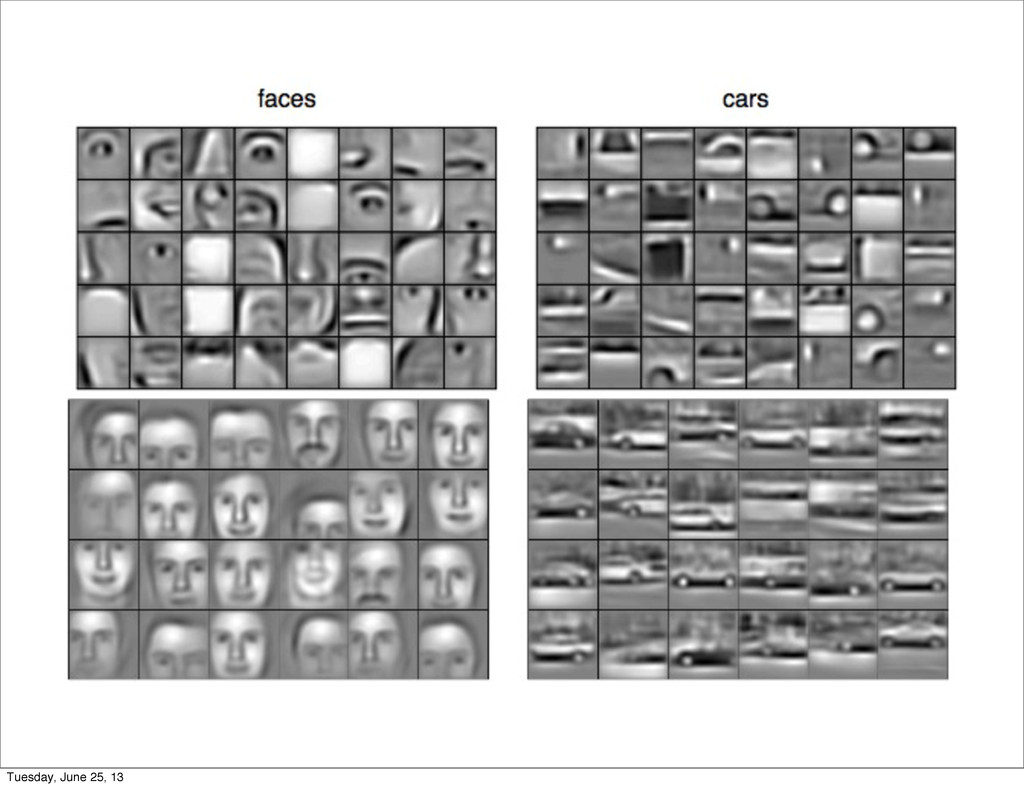
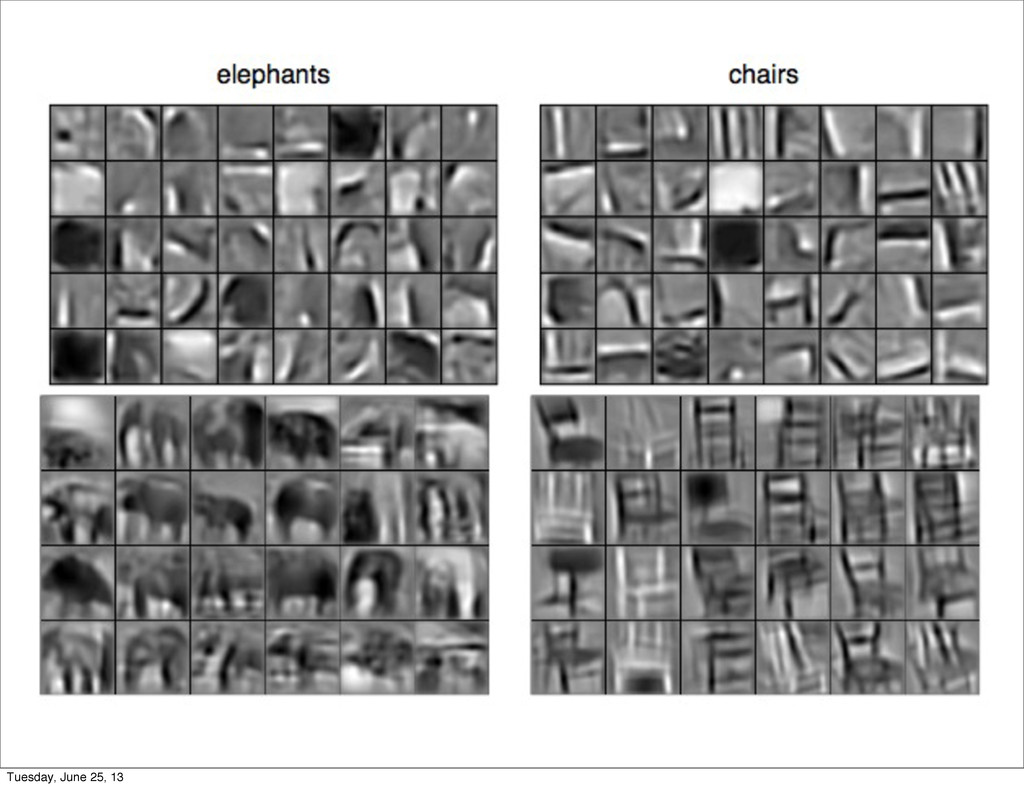
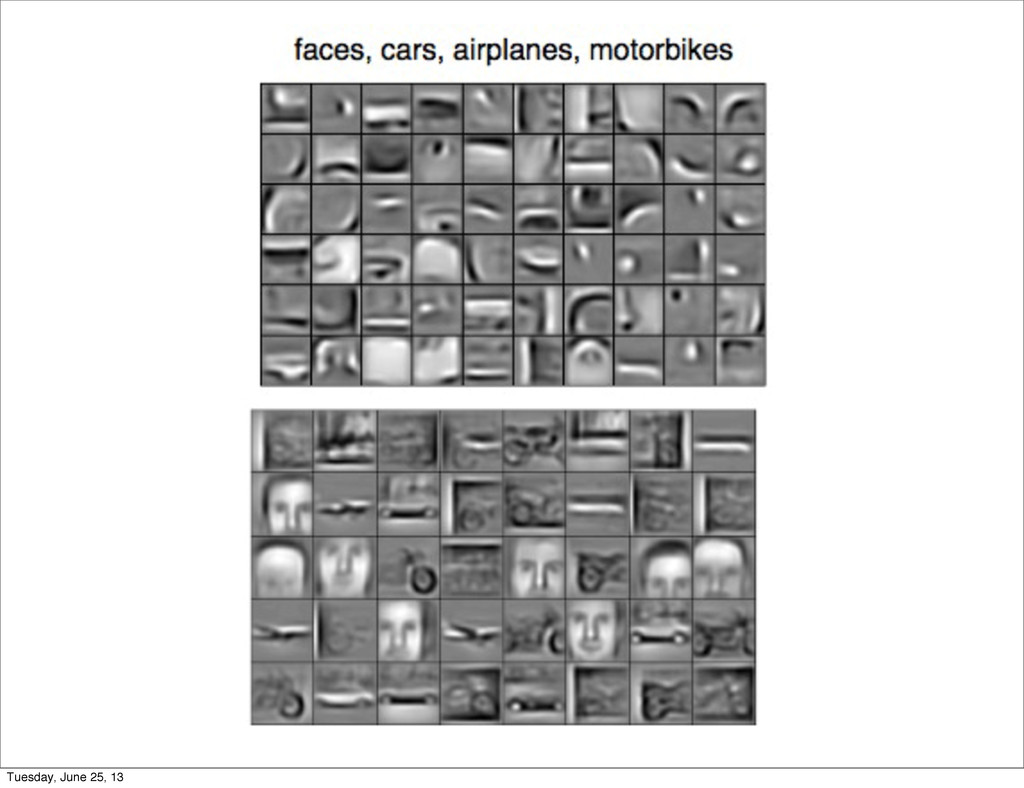
Example: Convolutional DBN Convolutional Deep Belief Networks for Scalable Unsupervised
Learning of Hierarchical Representations Honglak Lee Roger Grosse Rajesh Ranganath Andrew Y. Ng Tuesday, June 25, 13 -
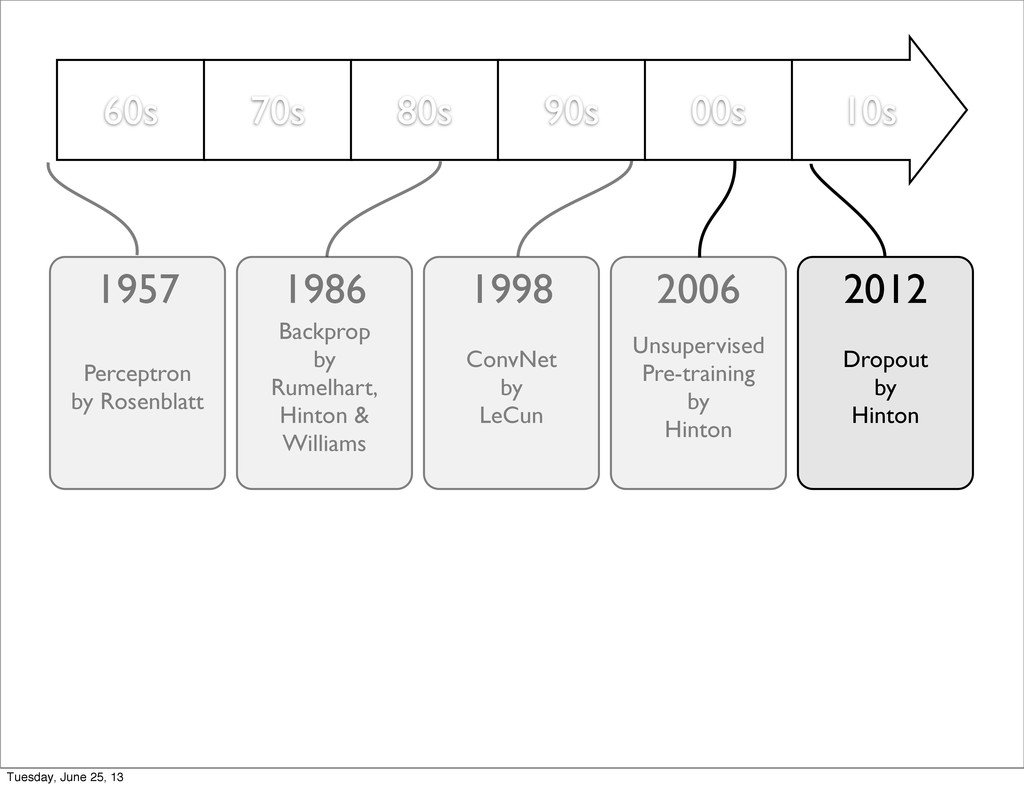
60s 70s 80s 90s 00s 10s Perceptron by Rosenblatt Backprop
by Rumelhart, Hinton & Williams Unsupervised Pre-training by Hinton 1957 1986 2006 Dropout by Hinton 2012 ConvNet by LeCun 1998 Tuesday, June 25, 13 -
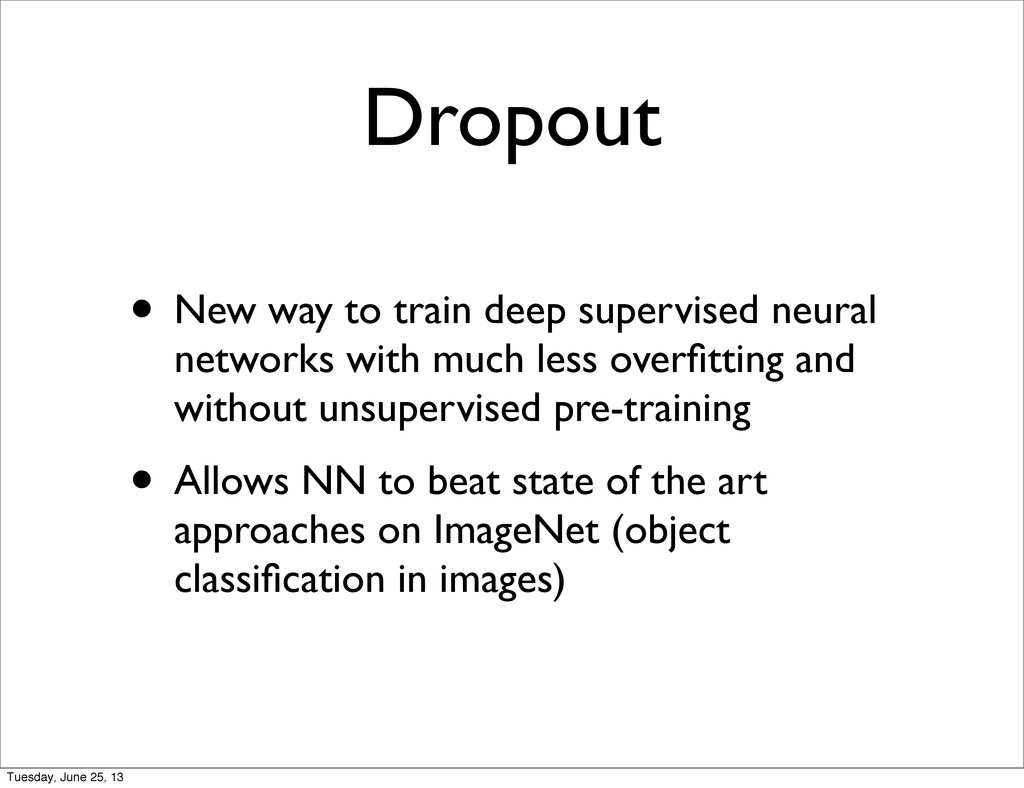
Dropout • New way to train deep supervised neural networks
with much less overfitting and without unsupervised pre-training • Allows NN to beat state of the art approaches on ImageNet (object classification in images) Tuesday, June 25, 13 -
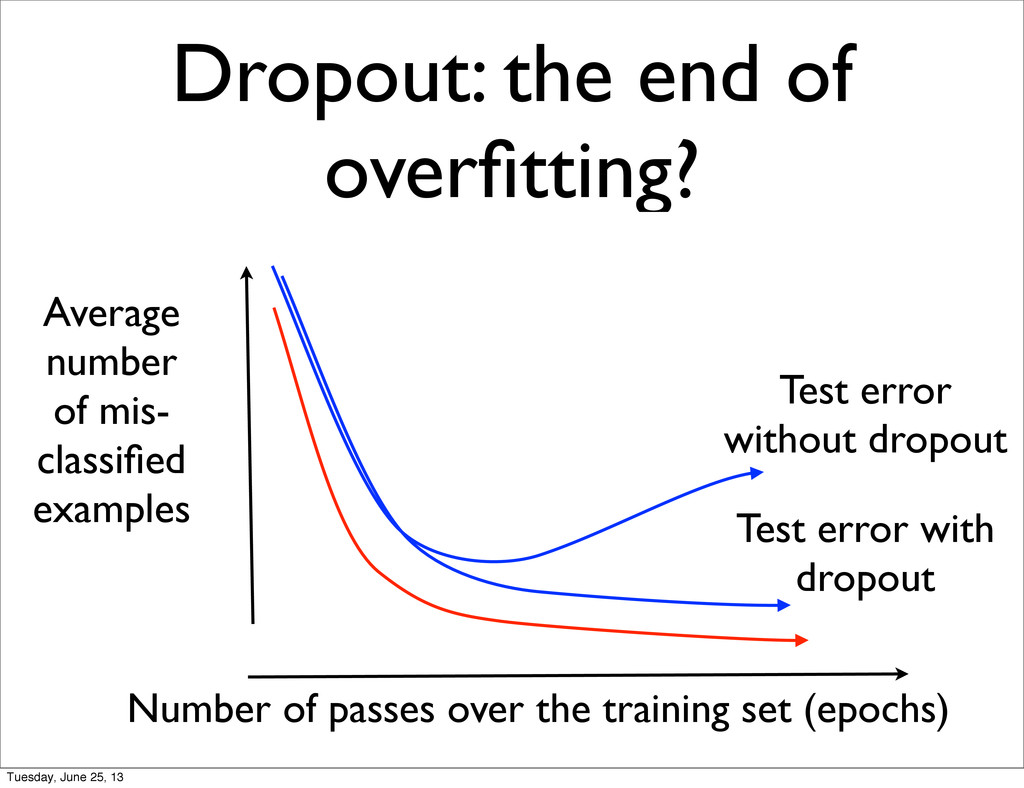
Dropout: the end of overfitting? Number of passes over the
training set (epochs) Average number of mis- classified examples Test error without dropout Test error with dropout Tuesday, June 25, 13 -
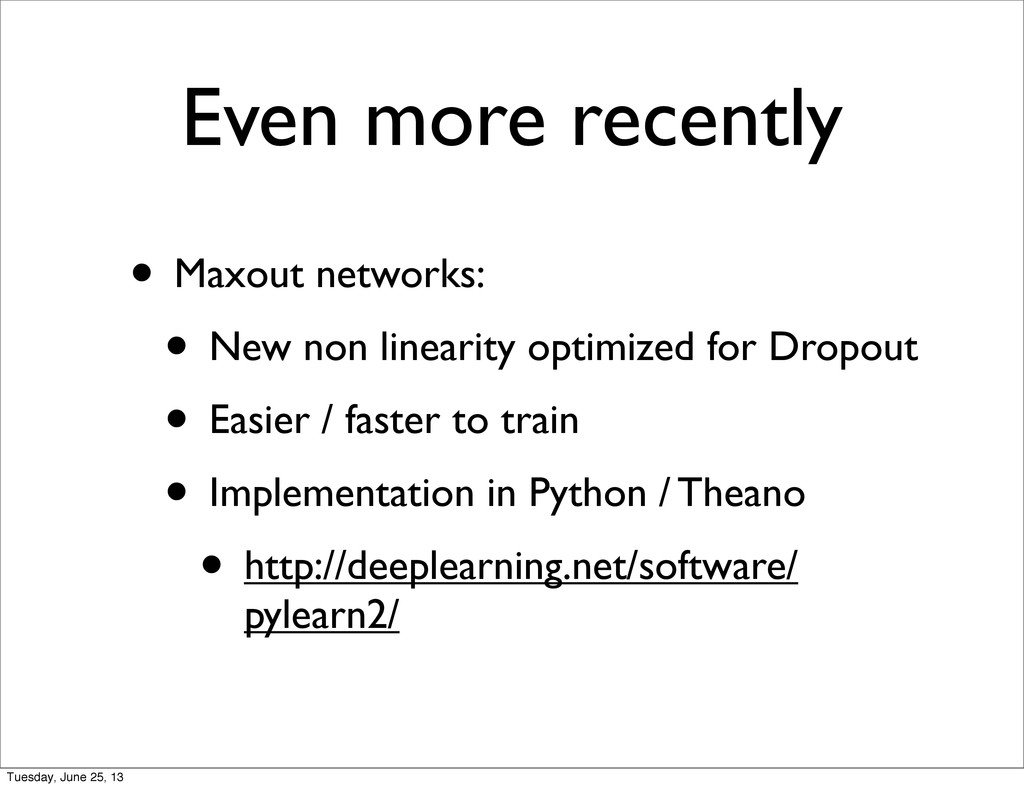
Even more recently • Maxout networks: • New non linearity
optimized for Dropout • Easier / faster to train • Implementation in Python / Theano • http://deeplearning.net/software/ pylearn2/ Tuesday, June 25, 13 -
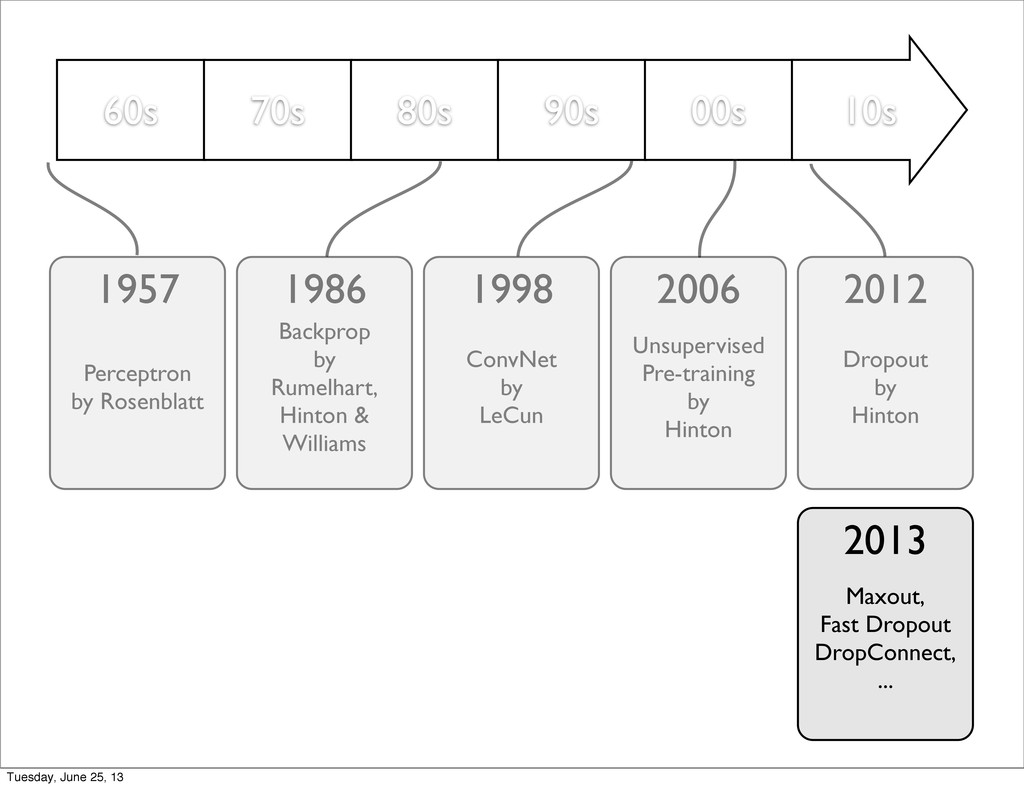
60s 70s 80s 90s 00s 10s Perceptron by Rosenblatt Backprop
by Rumelhart, Hinton & Williams Unsupervised Pre-training by Hinton 1957 1986 2006 Dropout by Hinton 2012 Maxout, Fast Dropout DropConnect, ... 2013 ConvNet by LeCun 1998 Tuesday, June 25, 13 -
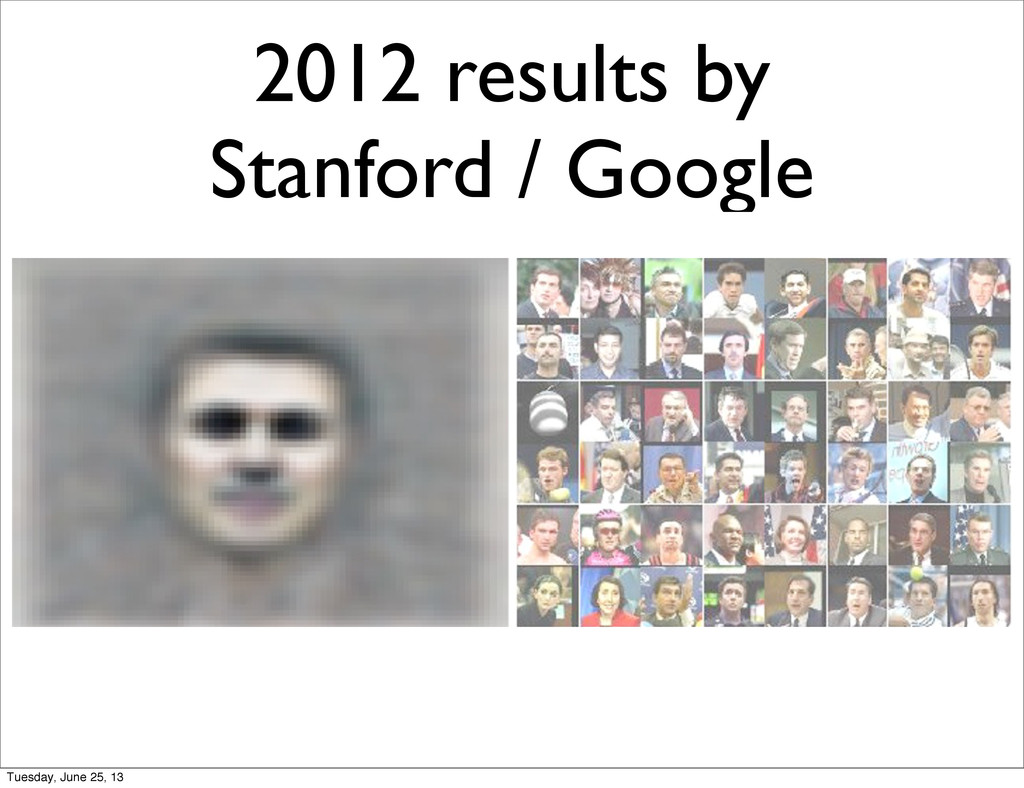
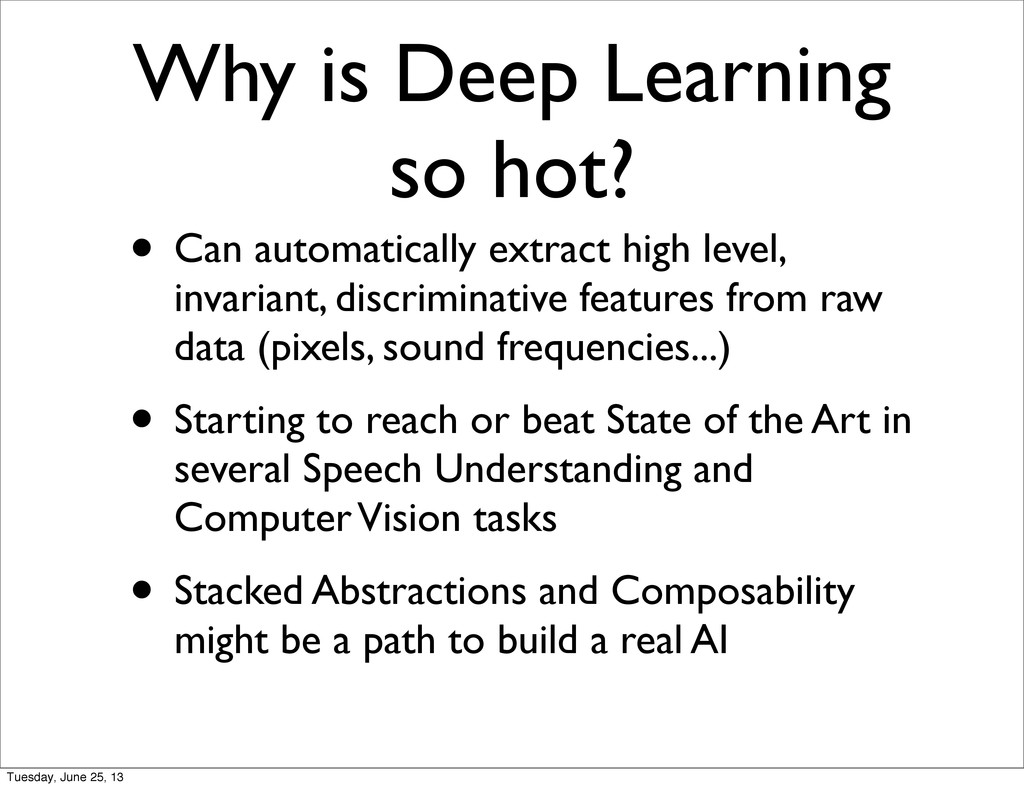
Why is Deep Learning so hot? • Can automatically extract
high level, invariant, discriminative features from raw data (pixels, sound frequencies...) • Starting to reach or beat State of the Art in several Speech Understanding and Computer Vision tasks • Stacked Abstractions and Composability might be a path to build a real AI Tuesday, June 25, 13 -
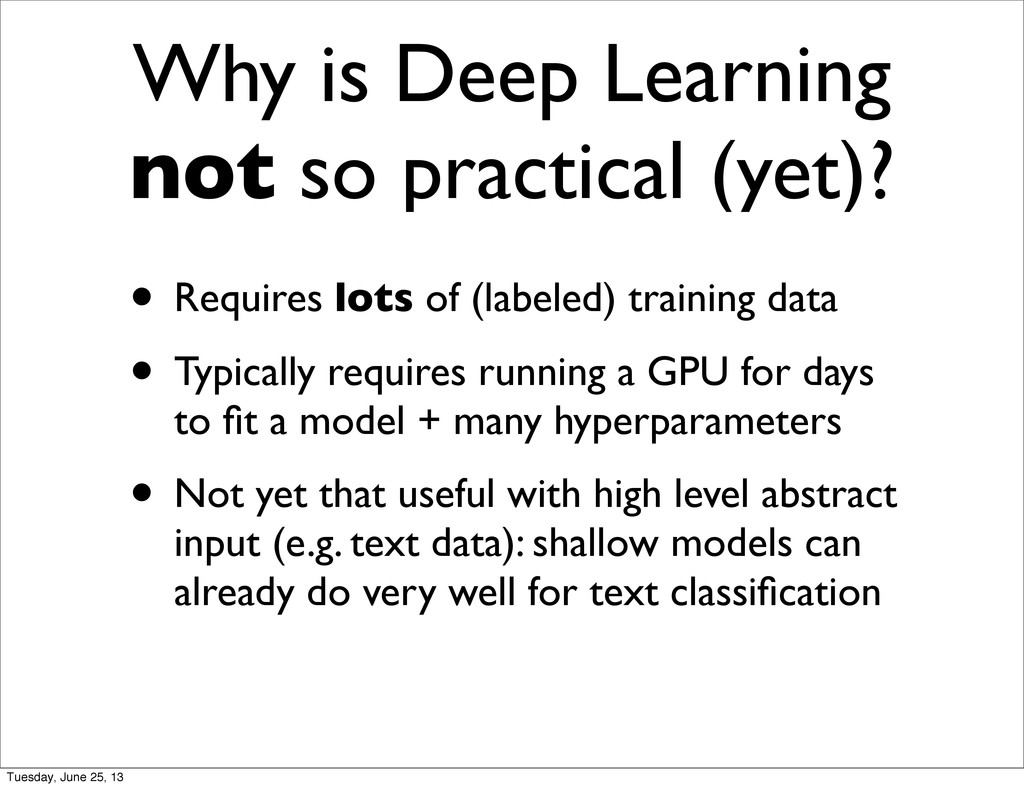
Why is Deep Learning not so practical (yet)? • Requires
lots of (labeled) training data • Typically requires running a GPU for days to fit a model + many hyperparameters • Not yet that useful with high level abstract input (e.g. text data): shallow models can already do very well for text classification Tuesday, June 25, 13 -
Deep Learning: very hot research area • Big Industry Players
(Google, Microsoft, IBM...) investing in DL for speech understanding and computer vision • Many top ML researchers are starting to look at DL & some on the theory side Tuesday, June 25, 13 -
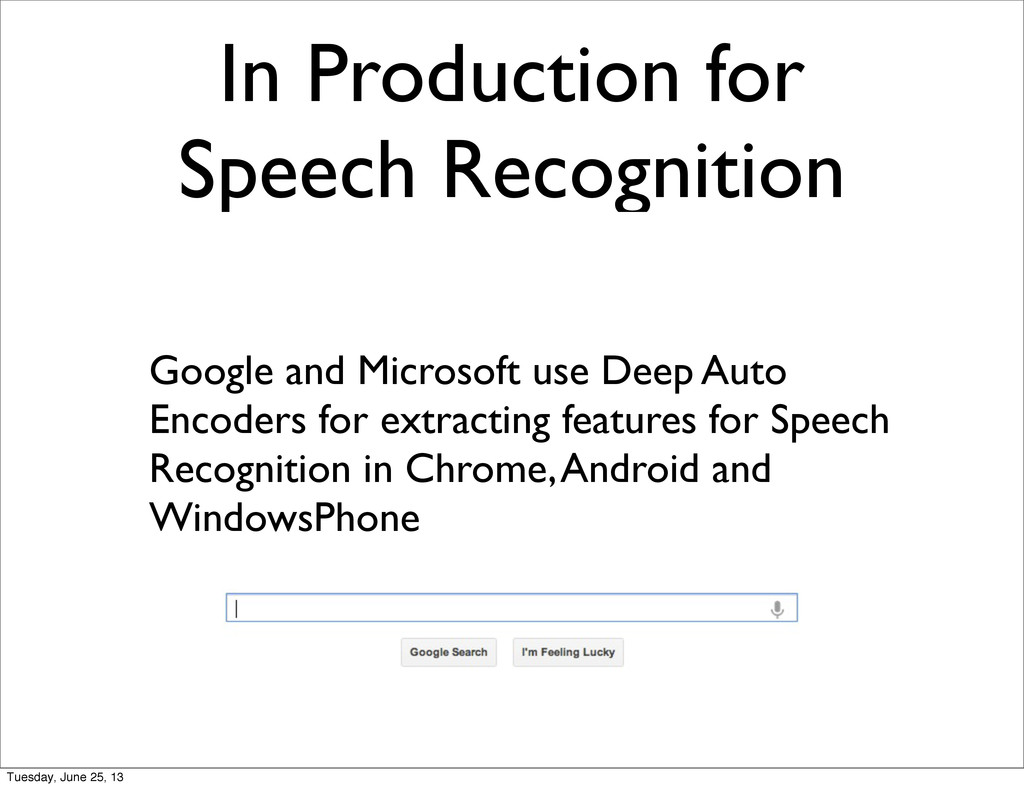
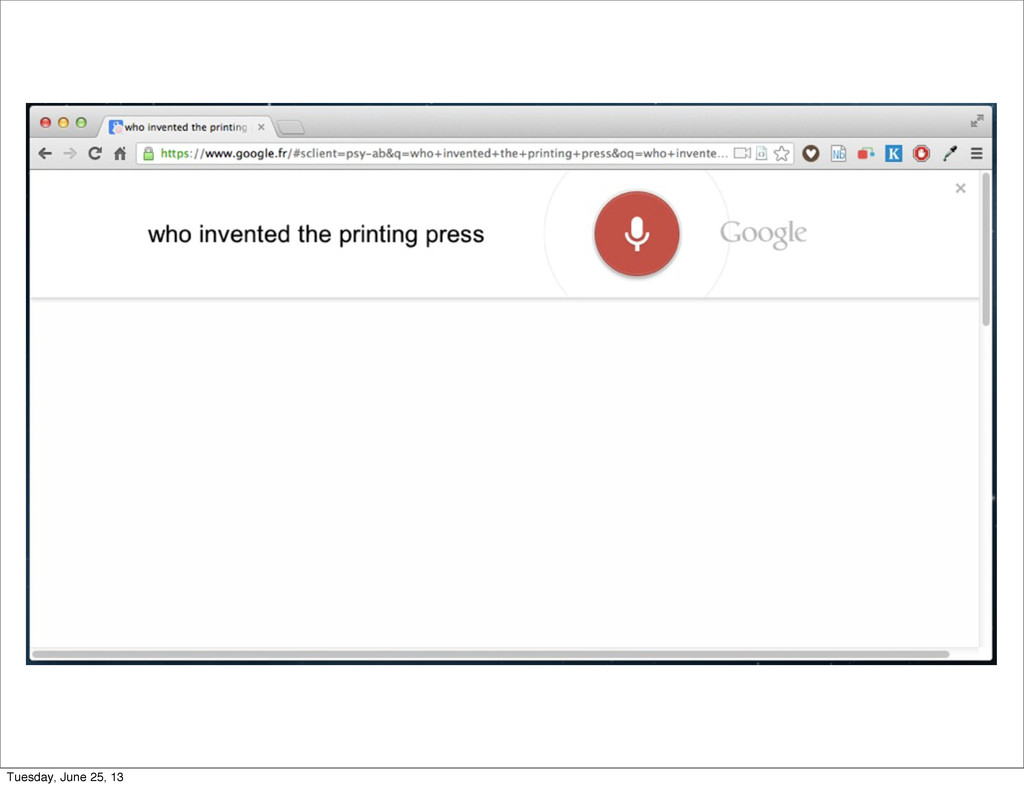
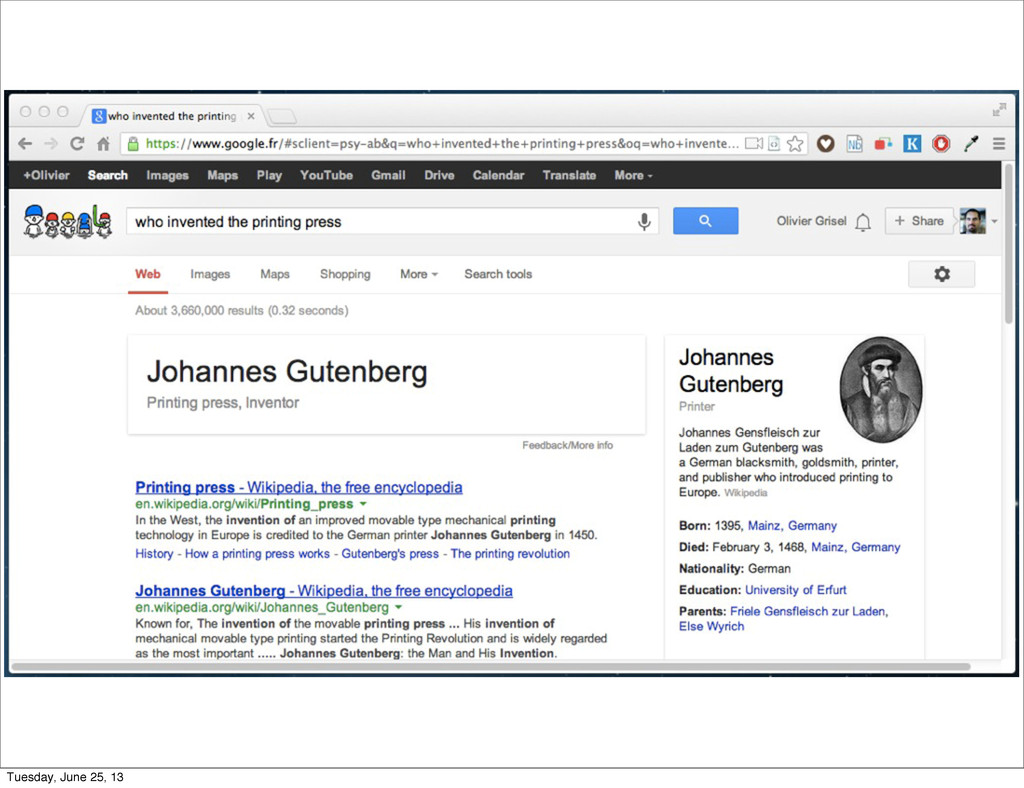
In Production for Speech Recognition Google and Microsoft use Deep
Auto Encoders for extracting features for Speech Recognition in Chrome, Android and WindowsPhone Tuesday, June 25, 13 -
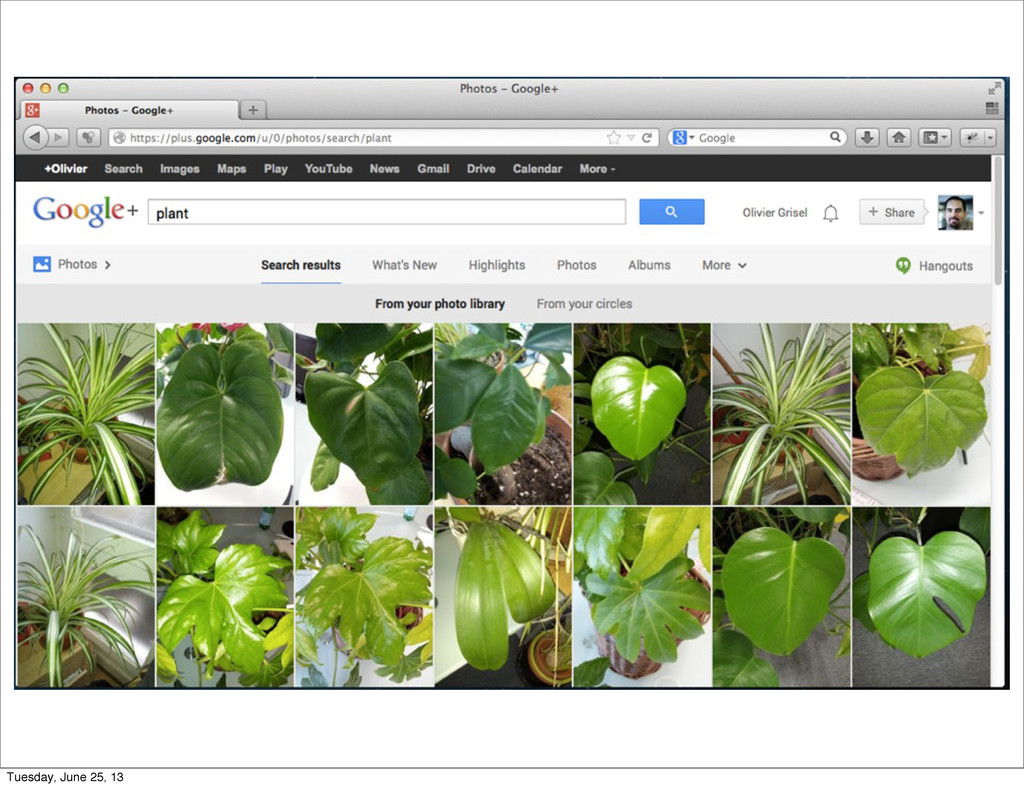
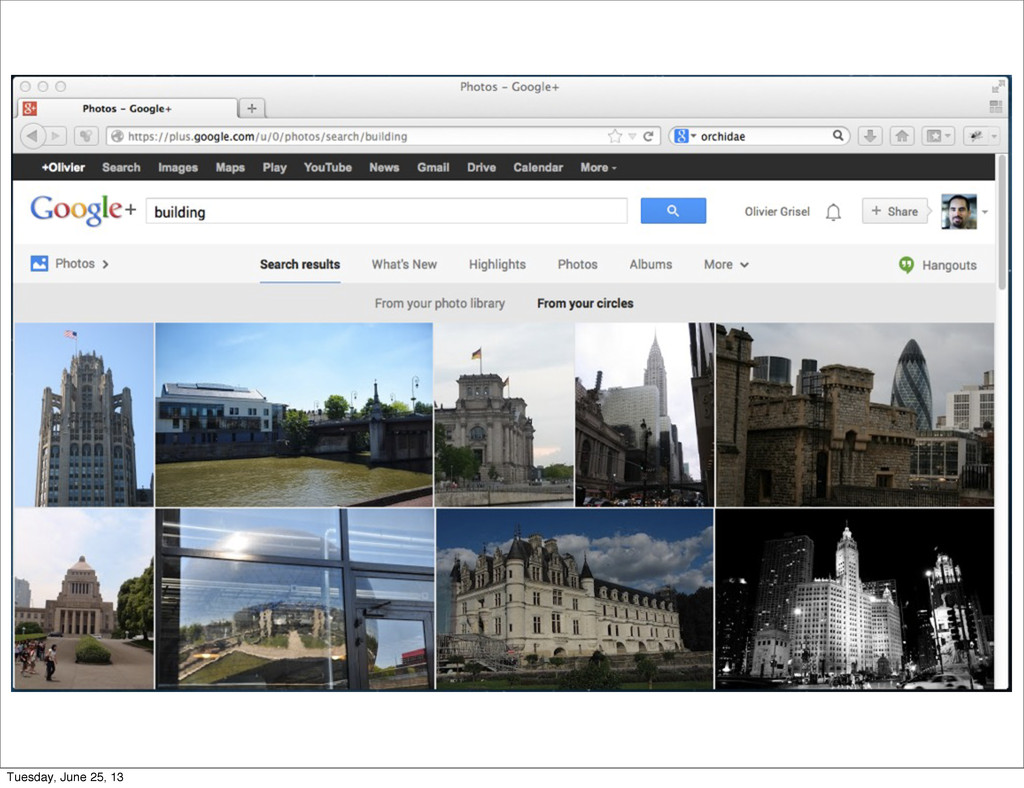
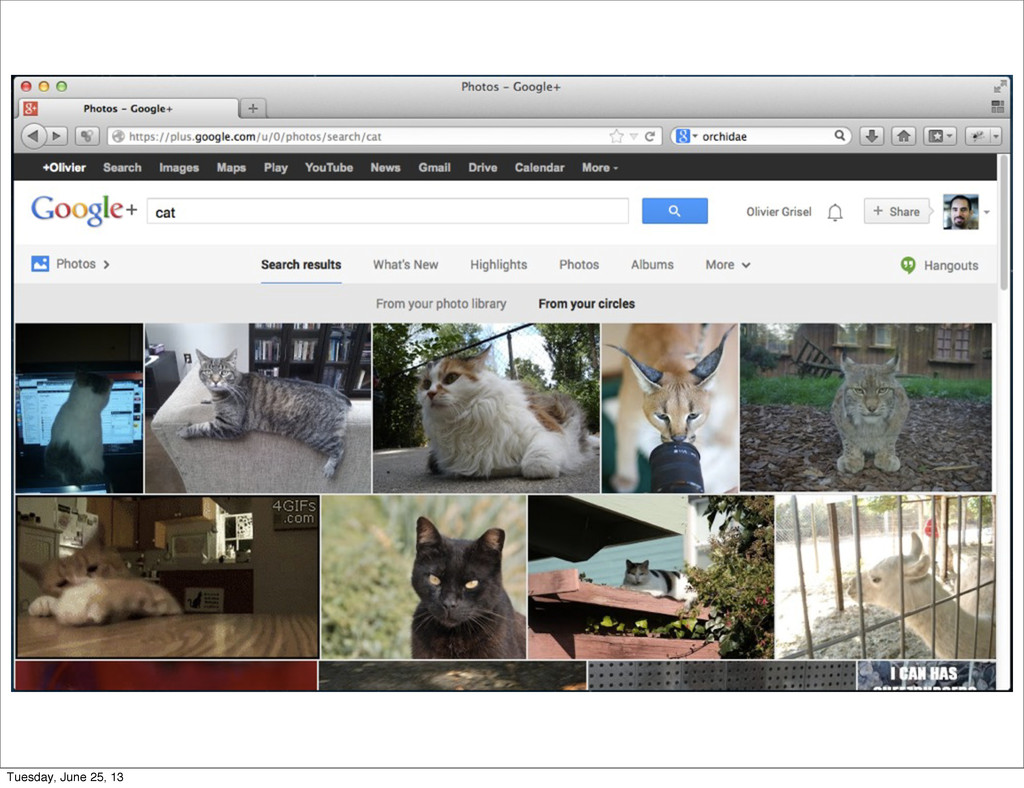
In Production for Computer Vision Google and Microsoft use Deep
Auto Encoders for extracting features for Speech Recognition in Chrome, Android and WindowsPhone Tuesday, June 25, 13 -
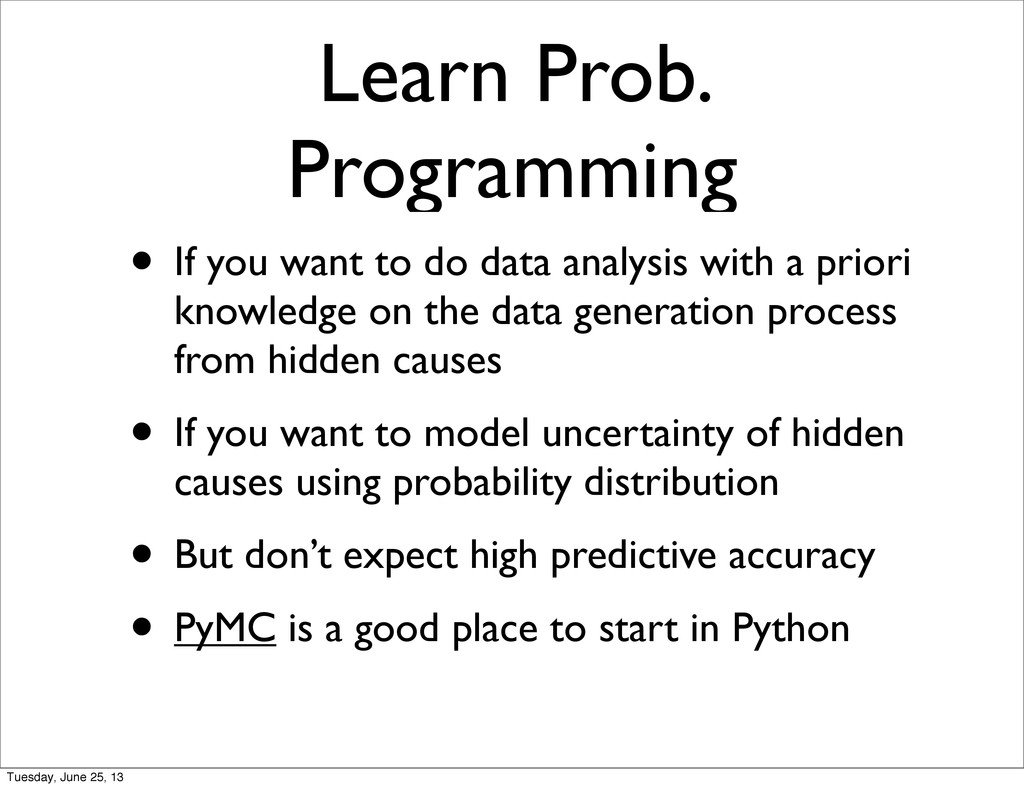
Learn Prob. Programming • If you want to do data
analysis with a priori knowledge on the data generation process from hidden causes • If you want to model uncertainty of hidden causes using probability distribution • But don’t expect high predictive accuracy • PyMC is a good place to start in Python Tuesday, June 25, 13 -
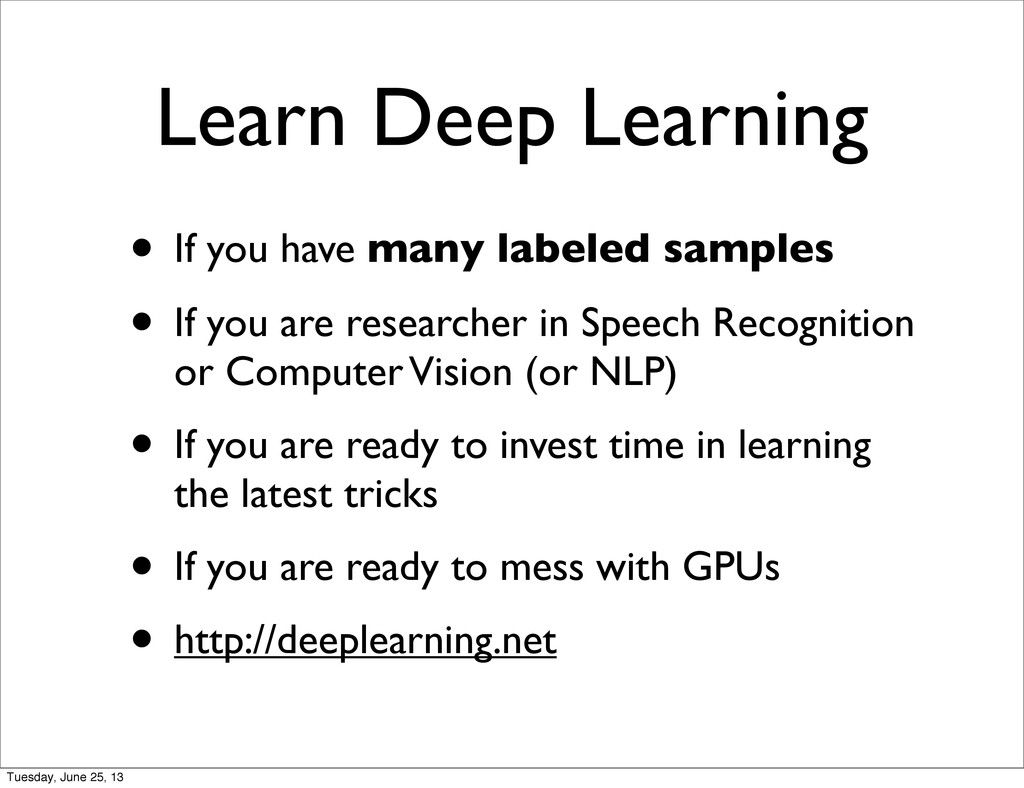
Learn Deep Learning • If you have many labeled samples
• If you are researcher in Speech Recognition or Computer Vision (or NLP) • If you are ready to invest time in learning the latest tricks • If you are ready to mess with GPUs • http://deeplearning.net Tuesday, June 25, 13 -
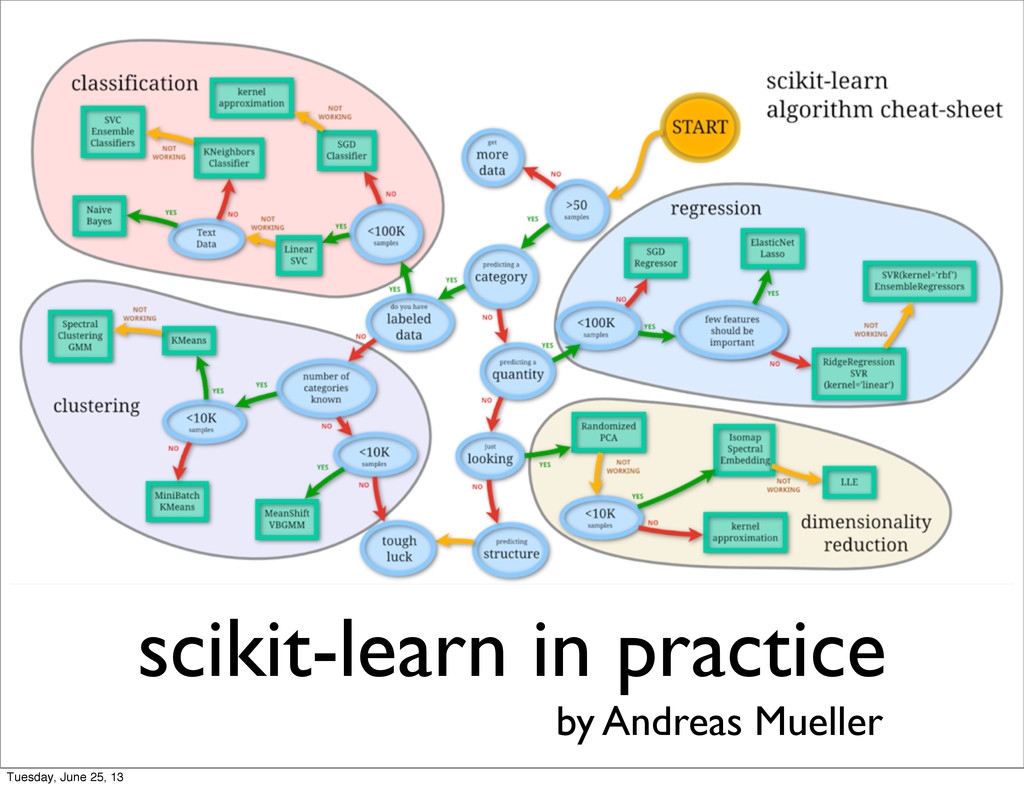
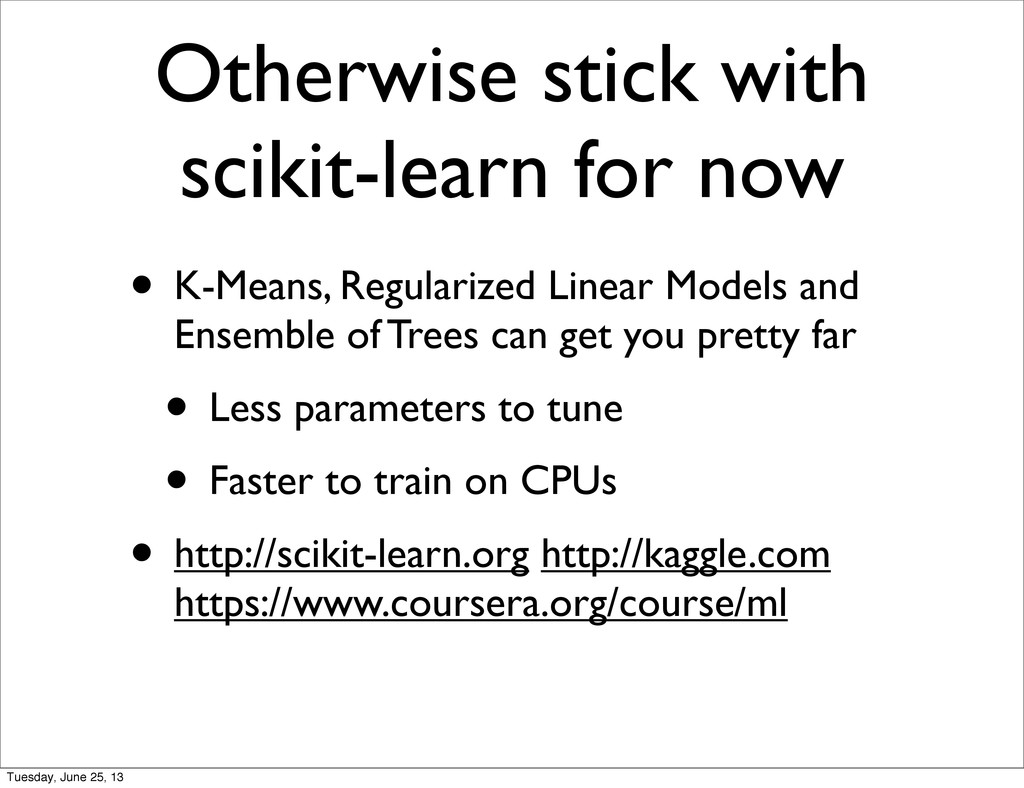
Otherwise stick with scikit-learn for now • K-Means, Regularized Linear
Models and Ensemble of Trees can get you pretty far • Less parameters to tune • Faster to train on CPUs • http://scikit-learn.org http://kaggle.com https://www.coursera.org/course/ml Tuesday, June 25, 13 -
Thanks • https://github.com/CamDavidsonPilon/ Probabilistic-Programming-and-Bayesian- Methods-for-Hackers • http://radar.oreilly.com/2013/04/ probabilistic-programming.html • http://deeplearning.net
• NIPS 2012, ICLR 2013, ICML 2013 Tuesday, June 25, 13