Share
Embed
Transcript
29 slides
-
Quick introduction to mongoDB MongoDB is a scalable, high-performance, open
source NoSQL database. •Document-oriented storage •Full Index Support •Replication & High Availability •Auto-Sharding •Querying •Fast In-Place Updates •Map/Reduce •GridFS -
> p = { author: "Ross", date: new Date(), body:
"About MongoDB...", tags: ["tech", "databases"]} > db.posts.save(p) Documents Blog Post Document -
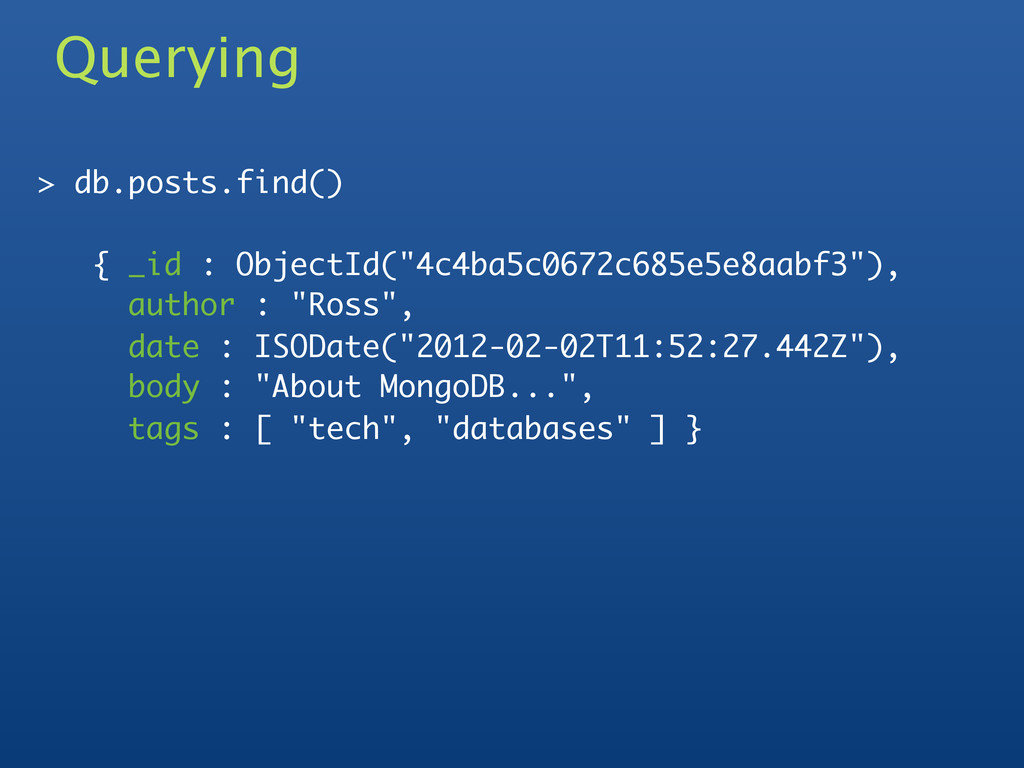
> db.posts.find() { _id : ObjectId("4c4ba5c0672c685e5e8aabf3"), author : "Ross", date
: ISODate("2012-02-02T11:52:27.442Z"), body : "About MongoDB...", tags : [ "tech", "databases" ] } Querying -
// 1 means ascending, -1 means descending > db.posts.ensureIndex({author: 1})
> db.posts.find({author: 'Ross'}) { _id : ObjectId("4c4ba5c0672c685e5e8aabf3"), author: "Ross", ... } Secondary Indexes Create index on any Field in Document -
// find posts with any tags > db.posts.find({tags: {$exists: true
}}) // find posts matching a regular expression > db.posts.find({author: /^ro*/i }) // count posts by author > db.posts.find({author: 'Ross'}).count() Query Operators Conditional Operators - $all, $exists, $mod, $ne, $in, $nin, $nor, $or, $size, $type - $lt, $lte, $gt, $gte -
> db.posts.find({"author": 'Ross'}).explain() { "cursor" : "BtreeCursor author_1", "nscanned" :
1, "nscannedObjects" : 1, "n" : 1, "millis" : 0, "indexBounds" : { "author" : [ [ "Ross", "Ross" ] ] } } Examine the query plan -
Atomic Operations $set, $unset, $inc, $push, $pushAll, $pull, $pullAll, $bit
// Create a comment > new_comment = { author: "Fred", date: new Date(), body: "Best Post Ever!"} // Add to post > db.posts.update({ _id: "..." }, {"$push": {comments: new_comment}, "$inc": {comments_count: 1} }); -
{ _id : ObjectId("4c4ba5c0672c685e5e8aabf3"), author : "Ross", date : "Thu
Feb 02 2012 11:50:01", body : "About MongoDB...", tags : [ "tech", "databases" ], comments : [{ author : "Fred", date : "Fri Feb 03 2012 13:23:11", body : "Best Post Ever!" }], comment_count : 1 } Nested Documents -
{ _id : ObjectId("4c4ba5c0672c685e5e8aabf3"), author : "Ross", date : "Thu
Feb 02 2012 11:50:01", body : "About MongoDB...", tags : [ "tech", "databases" ], comments : [{ author : "Fred", date : "Fri Feb 03 2012 13:23:11", body : "Best Post Ever!" }], comment_count : 1 } Nested Documents -
class Post(models.Model): author = models.CharField(max_length=250) title = models.CharField(max_length=250) body =
models.TextField() date = models.DateTimeField('date') tags = models.ManyToManyField('Tag') comments = models.ManyToManyField('Comment') class Tag(models.Model): text = models.CharField(max_length=250) class Comment(models.Model): author = models.CharField(max_length=250) body = models.TextField() date = models.DateTimeField('date') We already model to objects -
In a relational database post id author title body date
id post_id tag_id post_tags id text tag id post_id comment_id post_comments id author body date comment 0..* 0..* -
In mongoDB class Post(models.Model): author = models.CharField(max_length=250) title = models.CharField(max_length=250)
body = models.TextField() date = models.DateTimeField('date') tags = models.ManyToManyField('Tag') comments = models.ManyToManyField('Comment') -
{ _id : ObjectId("4c4ba5c0672c685e5e8aabf3"), author : "Fred", date : "Fri
Feb 03 2012 13:23:11", body : "Best Post Ever!" }] } author : "Ross", title : "mongoDB and Django can play nice", body : "About MongoDB...", date : "Thu Feb 02 2012 11:50:01", tags : [ "tech", "databases" ], comments : [{ In mongoDB -
Integration Choices •pymongo •Pick a ODM • MongoEngine • MongoKit
• MongoAlchemy • Minimongo • DictShield - roll your own •Django Nonrel -
# Connect to mongodb from pymongo import Connection connection =
Connection() db = connection.blog # In the view post = {"author": "Ross", "body": "mongoDB and Django ....", "tags": ["mongodb", "django", "pymongo"], "date": datetime.datetime.utcnow()} db.posts.save(post) pymongo -
pymongo + Go native, its fast and efficient You have
to understand how mongoDB works - You do all the work No document validation No auto forms generation No admin -
ODM Mappers - in general + Familiar to what you're
used to Defined schemas - Too familiar? MongoDB nuances and features hidden Slower Which library to choose? Varying levels of integration with Django -
# Settings.py import mongoengine mongoengine.connect('blog') # models.py class Post(Document): title
= StringField(max_length=120, required=True) body = StringField() author = ReferenceField(User) date = DateTimeField(default=datetime.datetime.utcnow) tags = ListField(StringField(max_length=30)) comments = ListField(EmbeddedDocumentField("Comment")) class Comment(EmbeddedDocument): body = StringField() author = StringField(max_length=120) ODM - MongoEngine -
# Usage examples posts = Post.objects.filter(comment__author=Ross) # Creating post, created
= Post.objects.get_or_create(form.cleaned_data) # Top tags - map / reduce in the background from operator import itemgetter freqs = Post.objects.item_frequencies('tag', normalize=True) tags = sorted(freqs.items(), key=itemgetter(1), reverse=True)[:10] ORM - MongoEngine -
MongoEngine + Familar Tries to follow Django API where sane
Can exist alongside relational databases Special mongoDB field types - listfield, dictfield etc. Some django integration * authentication backend * session backend Not Django specific - Its not the Django ORM Connect in settings.py Monolithic compared to pymongo No inbuilt Django forms / admin * django-mongotools - views / forms * django-mongonaut - for admin -
# Settings.py DATABASES = { "default": { "ENGINE": "django_mongodb_engine", "NAME":
"blog", } } # models.py from djangotoolbox.fields import EmbeddedModelField, ListField class Post(models.Model): author = models.CharField(max_length=250) title = models.CharField(max_length=250) body = models.TextField() date = models.DateTimeField('date') tags = ListField() comments = ListField(EmbeddedModelField('Comment')) Django Nonrel - Django MongoDB Engine -
Django Nonrel - Django MongoDB Engine + Full django integration
Special mongoDB field types - listfield, dictfield etc. Model forms Admin integration - Fork of Django 1.3 Can't fully support Django ORM API * joins, transactions, aggregates Admin limitations - EmbeddedFields / ListFields Can't pick up existing Django Apps and reuse them Sometimes confusing as to why you broke it -
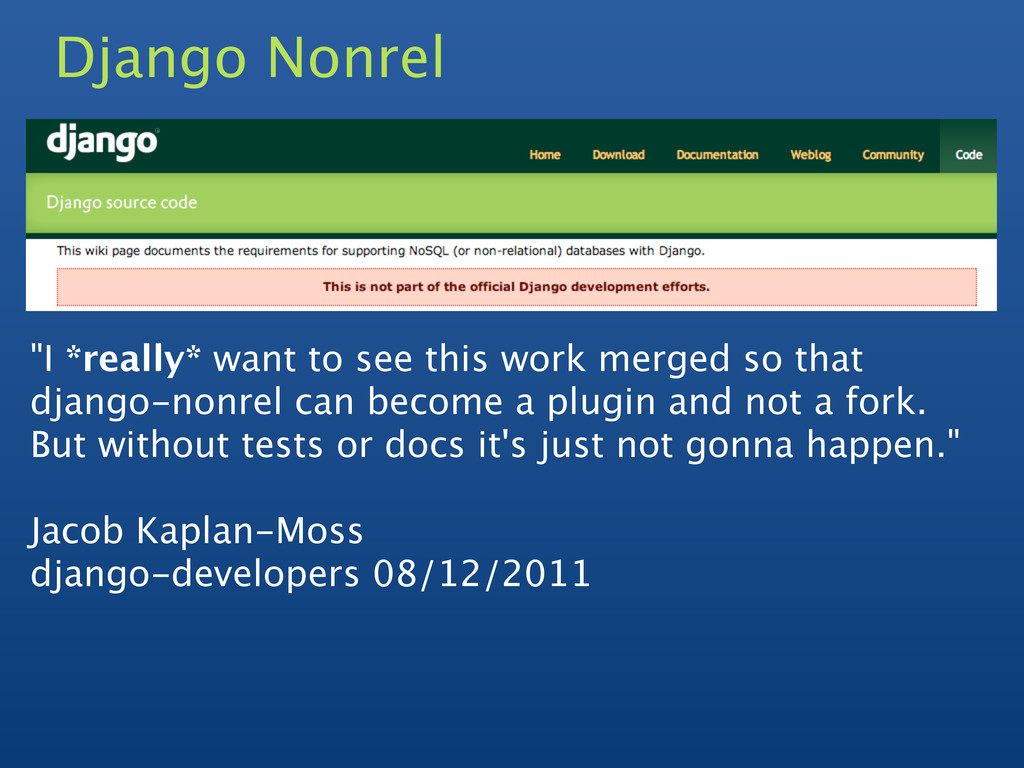
"I *really* want to see this work merged so that
django-nonrel can become a plugin and not a fork. But without tests or docs it's just not gonna happen." Jacob Kaplan-Moss django-developers 08/12/2011 Django Nonrel -
Playing nice • Growing desire for formal django integration •
You can chose your level of integration • Consider helping / contributing: http://api.mongodb.org/python/current/tools.html http://mongoengine.org https://github.com/django-nonrel http://django-mongodb.org -
@mongodb conferences, appearances, and meetups http://www.10gen.com/events http://bit.ly/mongofb Facebook | Twitter
| LinkedIn http://linkd.in/joinmongo download at mongodb.org support, training, and this talk brought to you by