Share
Embed
Blaze: Next Generation Numpy
Blaze is a next-generation NumPy sponsored by Continuum Analytics. It is designed as a foundational set of abstractions on which to build out-of-core and distributed algorithms. Blaze generalizes many of the ideas found in popular PyData projects such as Numpy, Pandas, and Theano into one generalized data-structure. Together with a powerful array-oriented virtual machine and run-time, Blaze will be capable of performing efficient linear algebra and indexing operations on top of a wide variety of data backends.
Stephen Diehl
October 26, 2012
Transcript
61 slides
-
. . . . . . . . . .
. . . Blaze Stephen Diehl Continuum Analytics Stephen Diehl Blaze -
. . . . . . . . Warning Extreme
talk, code and math ahead! Stephen Diehl Blaze -
. . . . . . . . Problems with
NumPy • Limited support for heterogeneous data • Missing values ( na ) • Uses a single buffer with strides overlayed • Cannot resize in place • Labeled arrays • No support for arrays larger than available memory ( out-of-core ) • No support for Distributed Arrays Stephen Diehl Blaze -
. . . . . . . . What is
Blaze How do we extend NumPy so that we can map array computations onto modern hardware? • Blaze is • a generalization of NumPy • a datashape description language • a generalized notion of data access • a way to view data stores as arrays and tables Stephen Diehl Blaze -
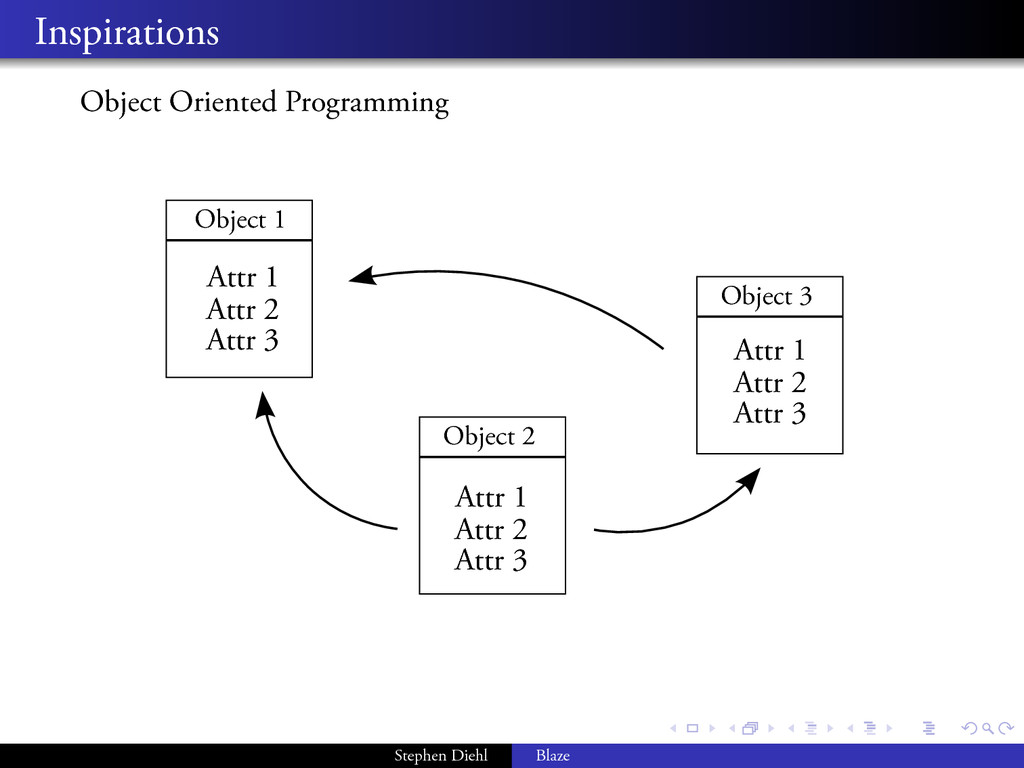
. . . . . . . . Inspirations Object
Oriented Programming Object 1 Object 3 Object 2 Attr 1 Attr 2 Attr 3 Attr 1 Attr 2 Attr 3 Attr 1 Attr 2 Attr 3 Stephen Diehl Blaze -
. . . . . . Array Oriented Programming Object
1 Object 2 Object 3 Attr 1 Attr 2 Attr 3 Stephen Diehl Blaze -
. . . . . . . . Array Oriented
Programming • APL • First class arrays • Chapel / ZPL • Domain Maps • Tensor Expressions Stephen Diehl Blaze -
. . . . . . . . APL Dialects
e notion of array shape is extremely fluid. > 3 4 2 $ a 0 1 2 3 4 5 6 7 8 0 1 2 3 4 5 6 7 8 0 1 2 3 4 5 ... Stephen Diehl Blaze -
. . . . . . forall ijkl in A
do A[ijkl] = reduce f [ijl] + reduce g [jkl] Very low barrier between the high-level mathematical notation and the programming notation. (a × b)i = εijkajbk Stephen Diehl Blaze -
. . . . . . . Functional Programming .
. . . . . . . • Haskell • Types • Lazy Evaluation • Data Parallel Haskell • Stream Fusion • Repa Stephen Diehl Blaze -
. . . . . . . . End-User Perspectives
Blaze is built around separation of concerns. • Domain experts • Richer structure to express high level ideas. • Algorithm writers • More information ( type, shape, layout ) to do clever optimizations. • Researchers • A platform in which to explore data and task parallelism. . Core Idea . . . . . . . . Leverage the existing community and projects. Stephen Diehl Blaze -
. . . . . . . . Ecosystem Requirements
Numpy DataFrame Business Data • Matrices • Multidimensional Models • Data Cubes • OLAP / MDX • Timeseries • Hierarchical Scalar Categorical Dimensions Structures Vectors Sets Sequential Random Data Access Strong Coupling of Values and Data Locality Weak Coupling of Values and Data Locality Walk kernels over grid structure of the array Statistical Aggregations Stephen Diehl Blaze -
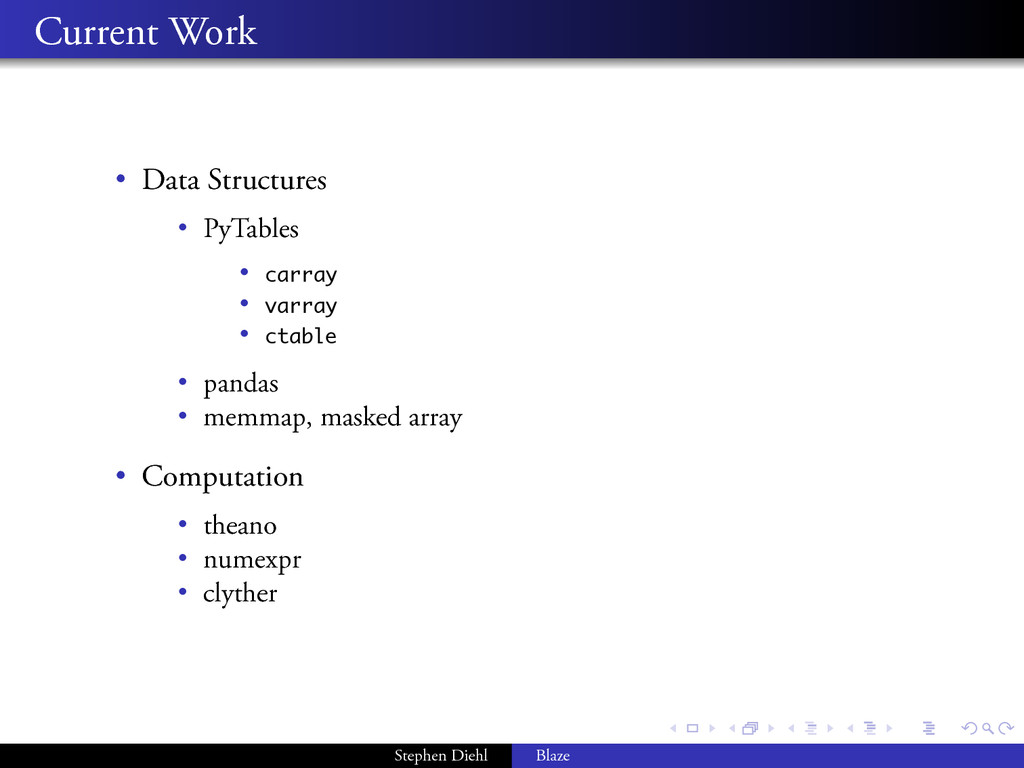
. . . . . . . . Current Work
• Data Structures • PyTables • carray • varray • ctable • pandas • memmap, masked array • Computation • theano • numexpr • clyther Stephen Diehl Blaze -
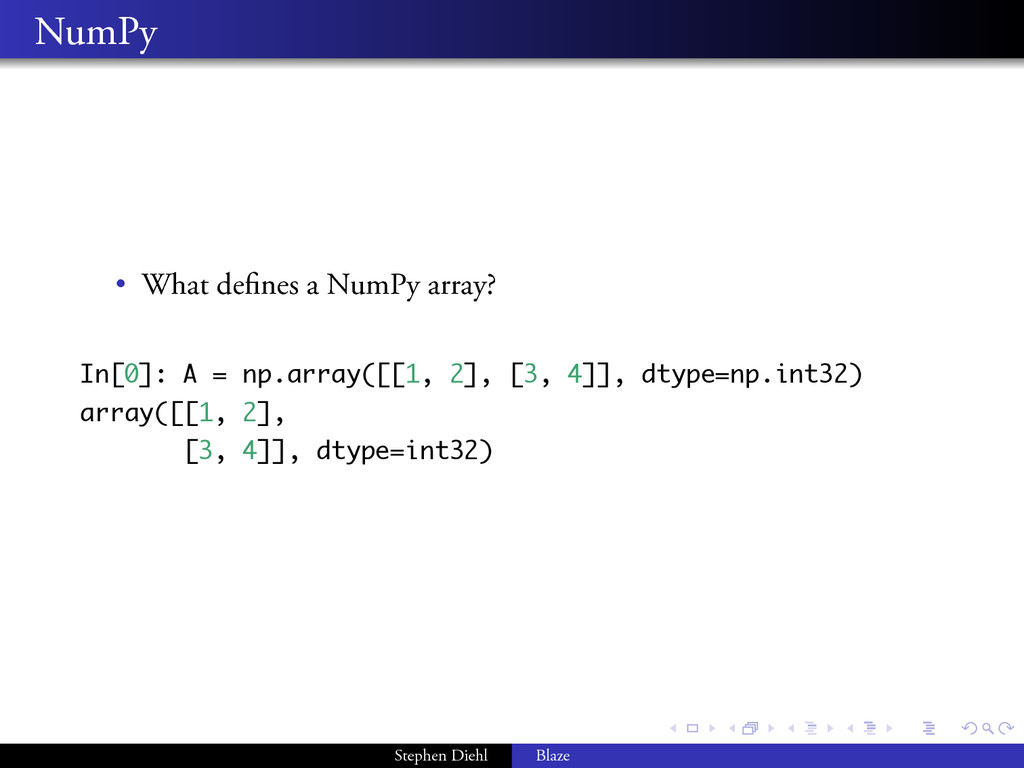
. . . . . . . . NumPy •
What defines a NumPy array? In[0]: A = np.array([[1, 2], [3, 4]], dtype=np.int32) array([[1, 2], [3, 4]], dtype=int32) Stephen Diehl Blaze -
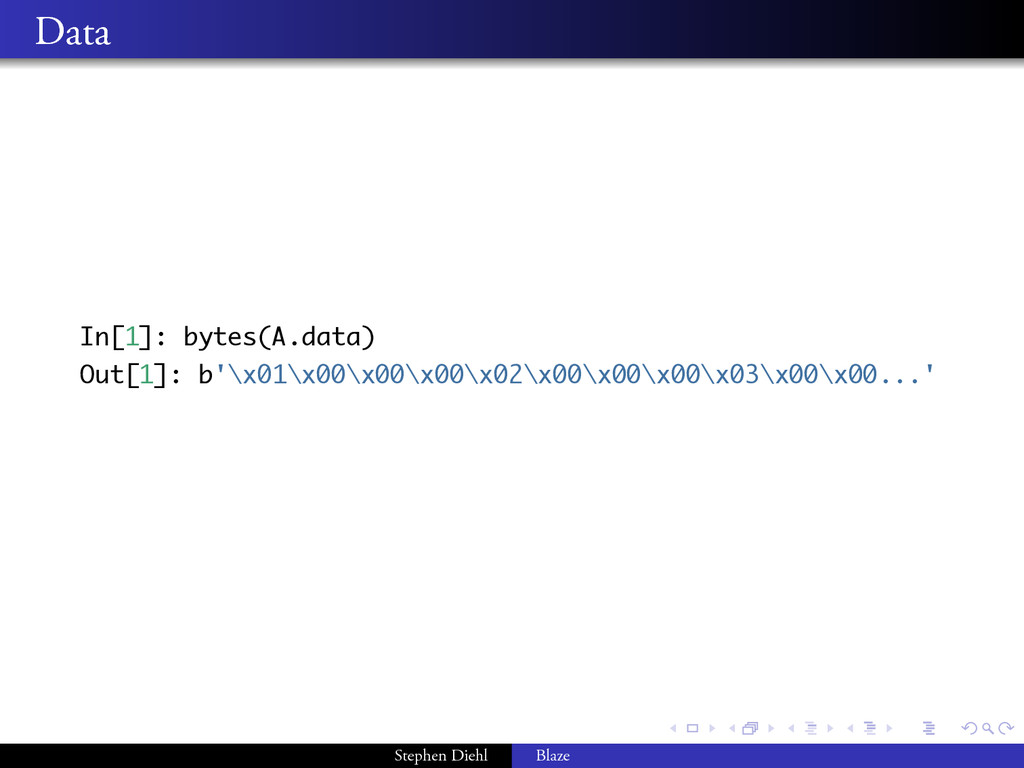
. . . . . . . . Data In[1]:
bytes(A.data) Out[1]: b'\x01\x00\x00\x00\x02\x00\x00\x00\x03\x00\x00...' Stephen Diehl Blaze -
. . . . . . . . Shape In[2]:
A.shape Out[2]: (2,2) Stephen Diehl Blaze -
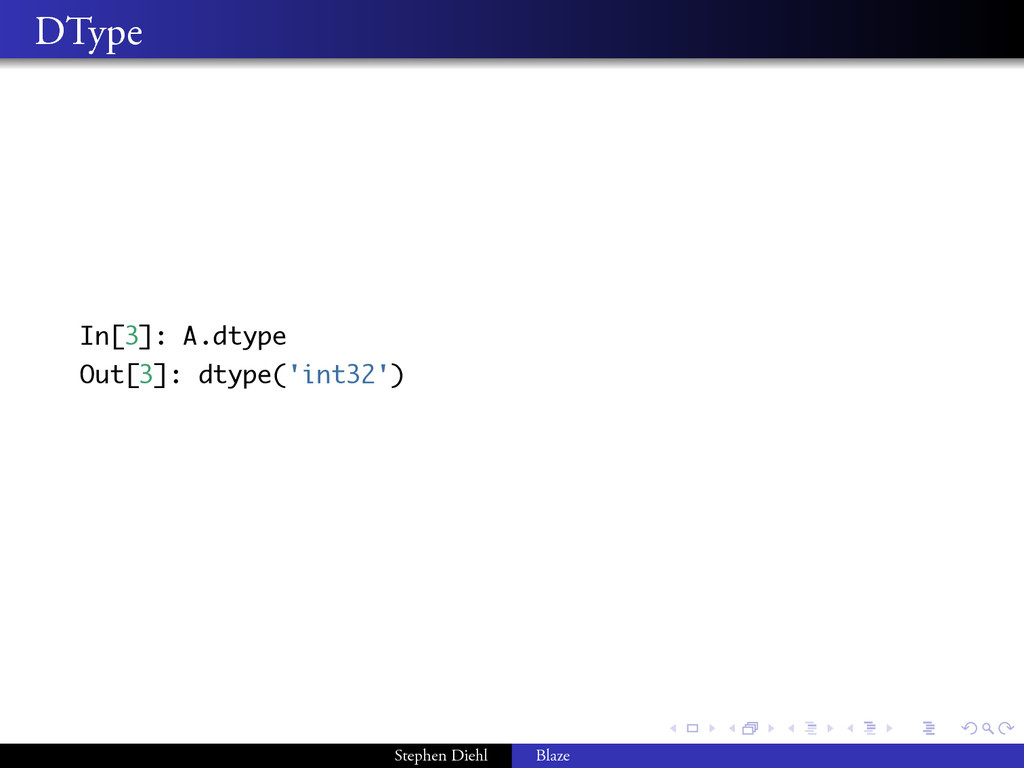
. . . . . . . . DType In[3]:
A.dtype Out[3]: dtype('int32') Stephen Diehl Blaze -
. . . . . . . . Strides In[4]:
A.strides Out[4]: (8,4) Stephen Diehl Blaze -
. . . . . . . . Flags In[5]:
A.flags Out[5]: C_CONTIGUOUS : True F_CONTIGUOUS : False OWNDATA : True WRITEABLE : True ALIGNED : True UPDATEIFCOPY : False Stephen Diehl Blaze -
. . . . . . How do we make
extend NumPy so that we can map array computations onto modern hardware? • How do we generalize dtype system? • How do we construct Numpy arrays out of multiple buffers? • How do we dispatch Numpy expressions to specialized kernels? Stephen Diehl Blaze -
. . . . . . . . Datashapes How
do we make dtype more general? Stephen Diehl Blaze -
. . . . . . . . Datashape DType
Shape Datashape Stephen Diehl Blaze -
. . . . . . . Datashape . .
. . . . . . Datashapes are an extension of dtype, expressed as a small DSL. Stephen Diehl Blaze -
. . . . . . . . Directory of
Images Endow existing data with structure. $ ls /folder1 lena1.png lena2.png /folder2 lena3.png lena4.png /folder3 lena5.png lena6.png ... /folderN Stephen Diehl Blaze -
. . . . . . N M 800 R
G B A 0 600 (N, M, 800, 600, RGBA) Stephen Diehl Blaze -
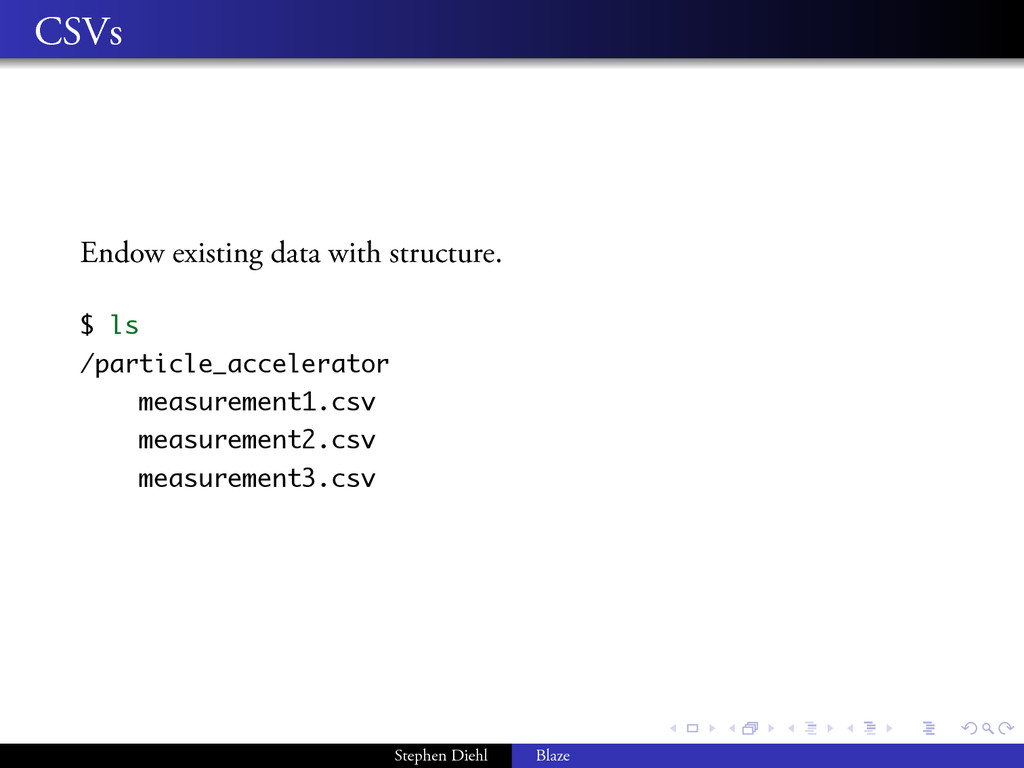
. . . . . . . . CSVs Endow
existing data with structure. $ ls /particle_accelerator measurement1.csv measurement2.csv measurement3.csv Stephen Diehl Blaze -
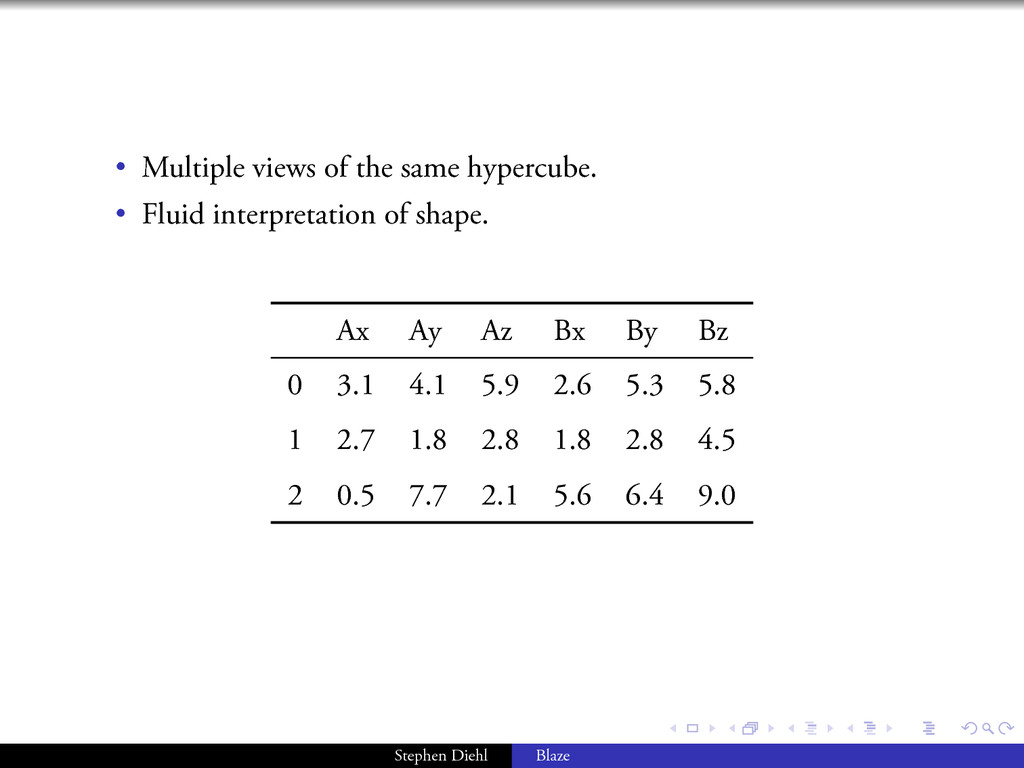
. . . . . . • Multiple views of
the same hypercube. • Fluid interpretation of shape. Ax Ay Az Bx By Bz 0 3.1 4.1 5.9 2.6 5.3 5.8 1 2.7 1.8 2.8 1.8 2.8 4.5 2 0.5 7.7 2.1 5.6 6.4 9.0 Stephen Diehl Blaze -
. . . . . . (A 0 , B
0 ) (A 2 , B 2 ) (A 1 , B 1 ) (A 3 , B 3 ) (A 5 , B 5 ) (A 4 , B 4 ) (A 6 , B 6 ) (A 8 , B 8 ) (A 7 , B 7 ) y x A y A x B x B y 3 1 0 1 2 7 1 5 4 9 6 4 7 8 3 1 1 2 0 8 1 5 8 2 Stephen Diehl Blaze -
. . . . . . 5, 5, int32 N,
M, 800, 600, RGBA 300, Record(uid=int32, name=string) Var(25), Record(uid=int32, name=string) 200, 300, Either(int32, na) 10, 10, Quaternion Stephen Diehl Blaze -
. . . . . . . . Record class
Stock(RecordClass): name = string open = decimal close = decimal max = int64 min = int64 @derived def mid(self): # Types are inferred return (self.min + self.max)/2 Stephen Diehl Blaze -
. . . . . . . . Type Constructors
• Alias types RGBA = Record(r=int32, g=int32, b=int32, a=int8) Stock = Record(open=decimal, close=decimal, name=string) • Parametric types SquareMatrix A = A, A Mesh A B = 5, 5, Record(x=A, y=B) Portfolio R = R, Stock Stephen Diehl Blaze -
. . . . . . . . Usage In[0]:
stream = blaze.open('yahoo://GOOG:20120100') In[1]: nd = NDTable(stream, datashape='Var(100), Stock') In[2]: nd[0] name open close max min mid Google Inc. 681.79 705.92 695 621 658 Syntax not final. Stephen Diehl Blaze -
. . . . . . . . Coordinates •
How do we construct NumPy arrays out of multiple buffers? Stephen Diehl Blaze -
. . . . . . . . Memory Access
void * PyArray_GetPtr(PyArrayObject *obj, npy_intp* ind) { int n = obj->nd; npy_intp *strides = obj->strides; char *dptr = obj->data; while (n--) { // Core pointer arithmetic of Numpy dptr += (*strides++) * (*ind++); } return (void *)dptr; } Stephen Diehl Blaze -
. . . . . . . . Numpy Data
Access Sn = itemsize × m ∏ n+1 shapen I = (i, j, k, ...) Ai,j,k = S · I Stephen Diehl Blaze -
. . . . . . . . Blaze Data
Access Sn = m ∏ n+1 datashapen I = (i, j, k, ...) Ai,j,k = f(S; I) Stephen Diehl Blaze -
. . . . . . • Stride vectors are
now functions of indexers and the datashape. Sn = m ∏ n+1 datashapen • Generalized indexers: scalars, labels, references. I = (i, j, k, ...) Ai,j,k = f(S; I) • In the case of strided memory access: f = (·) . Stephen Diehl Blaze -
. . . . . . . . Coordinates •
Coordinates • Atlas of regions in memory to resolve partitions. • Charts of memory with coordinate systems. • Coordinate transformations between charts. • Index space transformations are homomorphisms between charts. Stephen Diehl Blaze -
. . . . . . 0 0 0 0
0 0 0 0 0 0 0 0 1 1 1 1 1 1 1 1 1 1 1 1 vstack ( ( , 3 4 x 3 4 x T 0 0 0 0 0 0 0 0 0 0 0 0 1 1 1 1 1 1 1 1 1 1 1 1 6 4 x 4 6 x 0 0 0 0 0 0 0 0 0 0 0 0 1 1 1 1 1 1 1 1 1 1 1 1 f = vstack p = (0,3) g = transpose Stephen Diehl Blaze -
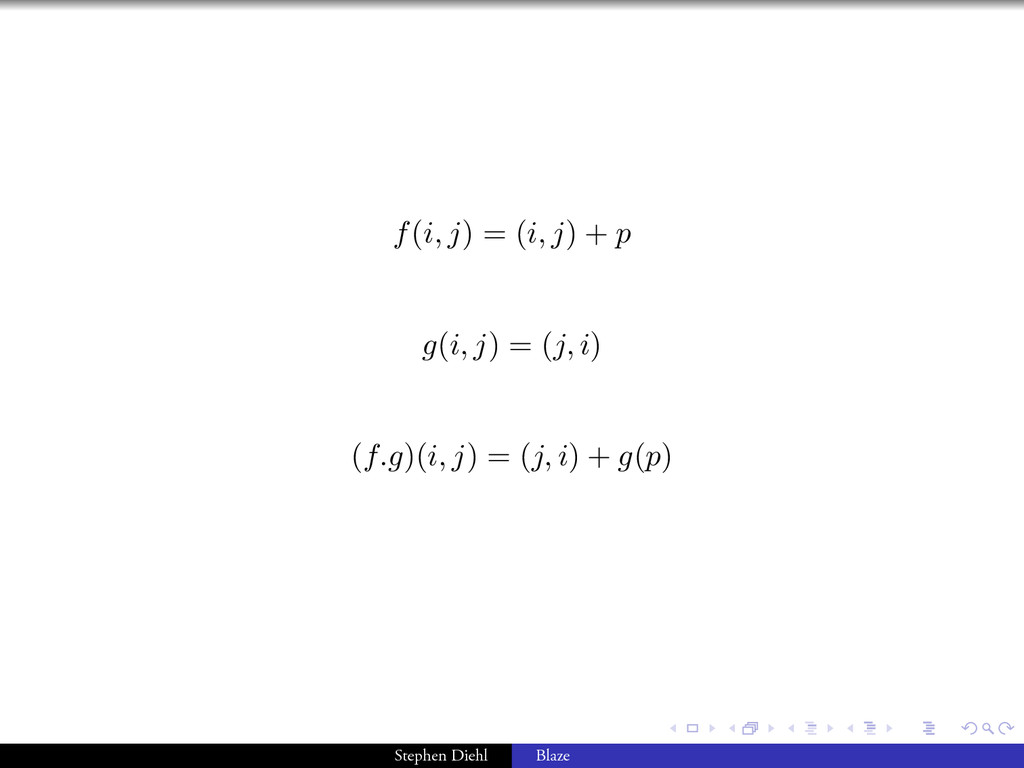
. . . . . . f(i, j) = (i,
j) + p g(i, j) = (j, i) (f.g)(i, j) = (j, i) + g(p) Stephen Diehl Blaze -
. . . . . . (3,5) 4 6 x
0 0 0 0 0 0 0 0 0 0 0 0 1 1 1 1 1 1 1 1 1 1 1 1 Stephen Diehl Blaze -
. . . . . . (2,3) 0 0 0
0 0 0 0 0 0 0 0 0 1 1 1 1 1 1 1 1 1 1 1 1 Stephen Diehl Blaze -
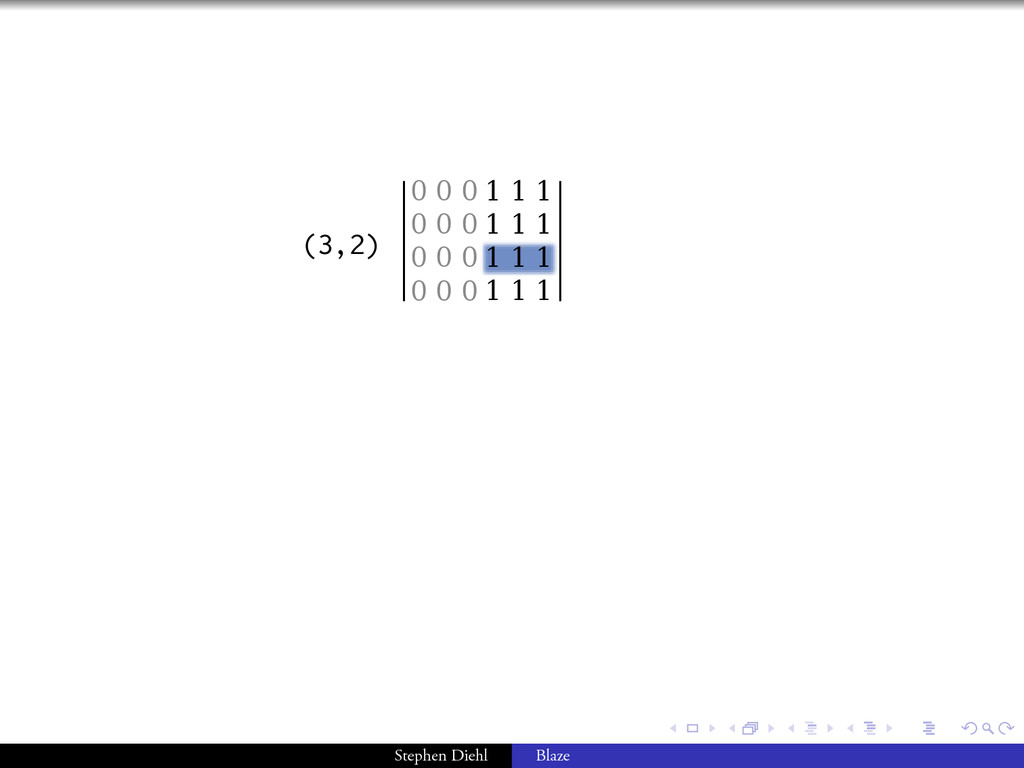
. . . . . . (3,2) 0 0 0
0 0 0 0 0 0 0 0 0 1 1 1 1 1 1 1 1 1 1 1 1 Stephen Diehl Blaze -
. . . . . . \x00\x00\x00\x00\x00\x00\xf0?\x00\x00\x00\x00\x00\x00 \xf0?\x00\x00\x00\x00\x00\x00\xf0?\x00\x00\x00\x00\x00 \x00\xf0?\x00\x00\x00\x00\x00\x00\xf0?\x00\x00\x00\x00 \x00\x00\xf0?\x00\x00\x00\x00\x00\x00\xf0?\x00\x00\x00
\x00\x00\x00\xf0?\x00\x00\x00\x00\x00\x00\xf0?\x00\x00 \x00\x00\x00\x00\xf0?\x00\x00\x00\x00\x00\x00\xf0?\x00 \x00\x00\x00\x00\x00\xf0?' int32 = 4 bytes offset = 16 0 0 0 0 0 0 0 0 0 0 0 0 1 1 1 1 1 1 1 1 1 1 1 1 Stephen Diehl Blaze -
. . . . . . . . Blaze Data
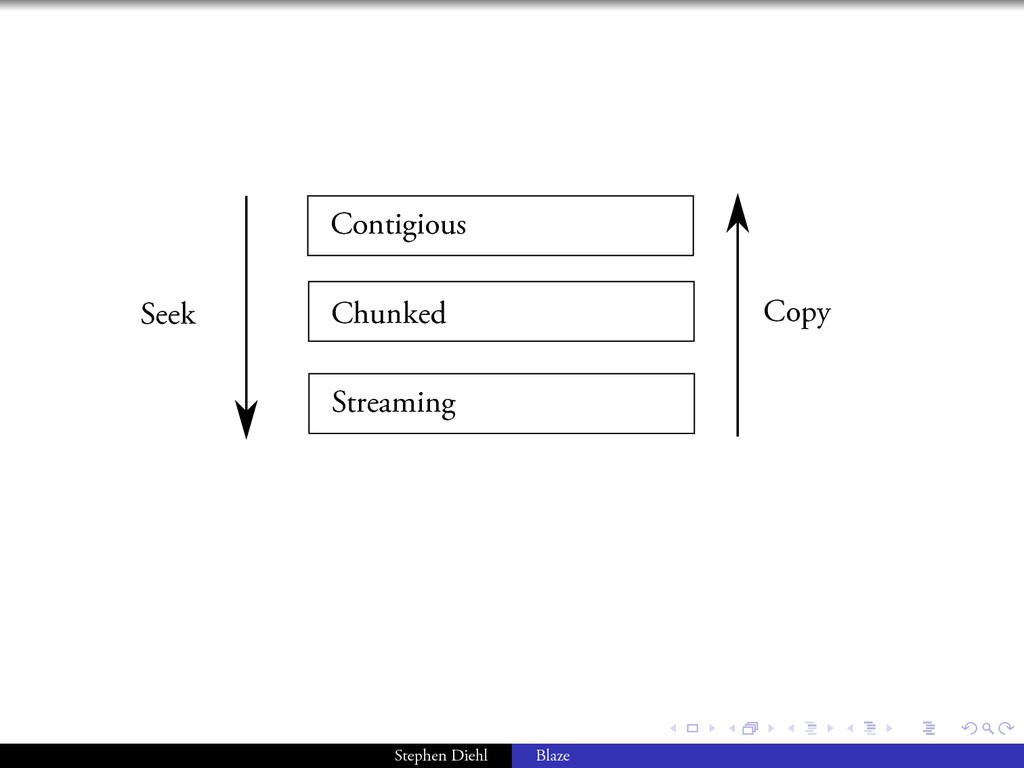
Descriptors At some level our coordinates manifest simply as byte offsets in some storage medium. • Memory Like • Arbitrary Slices • Random Seeks • File Like • Chunks • Random Seeks • Stream Like • Chunks • Sequential Seeks Stephen Diehl Blaze -
. . . . . . Chunked Streaming Contigious Copy
Seek Stephen Diehl Blaze -
. . . . . . . . Dispatch How
do we dispatch NumPy expressions to specialized kernels? Stephen Diehl Blaze -
. . . . . . . . Indexables .
Lazy Evaluation . . . . . . . . Expressions are not evaluated until forced. • Deferred table. • Appends graph nodes onto existing graph. • Data processing scripts, fine grained control over evaluation. • Immediate table. • Forces graph immediately. • Data exploration at REPL, when you just want a number. Stephen Diehl Blaze -
. . . . . . NDTable NDArray Deferred Indexable
Immediate Deferred Immediate Stephen Diehl Blaze -
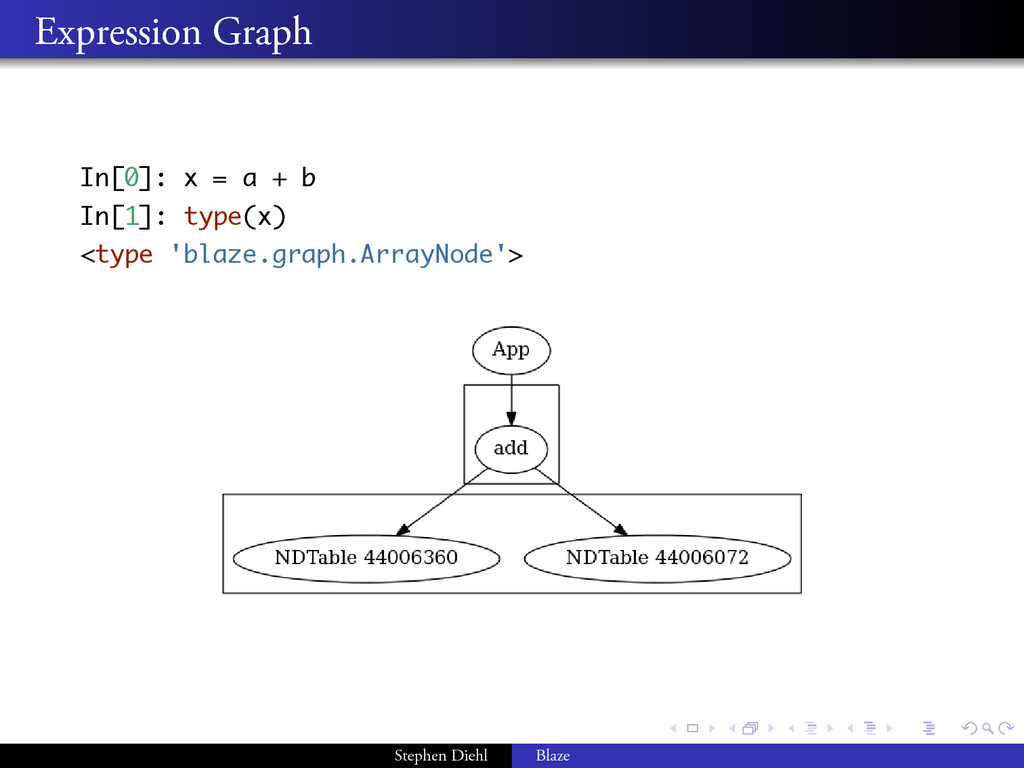
. . . . . . . . Expression Graph
In[0]: x = a + b In[1]: type(x) <type 'blaze.graph.ArrayNode'> Stephen Diehl Blaze -
. . . . . . . . Expression Graph
In[0]: x = a + b In[1]: type(x) <type 'blaze.graph.ArrayNode'> In[2]: e = LA.eig(x) In[3]: e.eval() Out[3]: array([[ 0.70710678+0.j , 0.70710678+0.j ], [ 0.00000000-0.70710678j, 0.00000000+0.70710678j]]) Stephen Diehl Blaze -
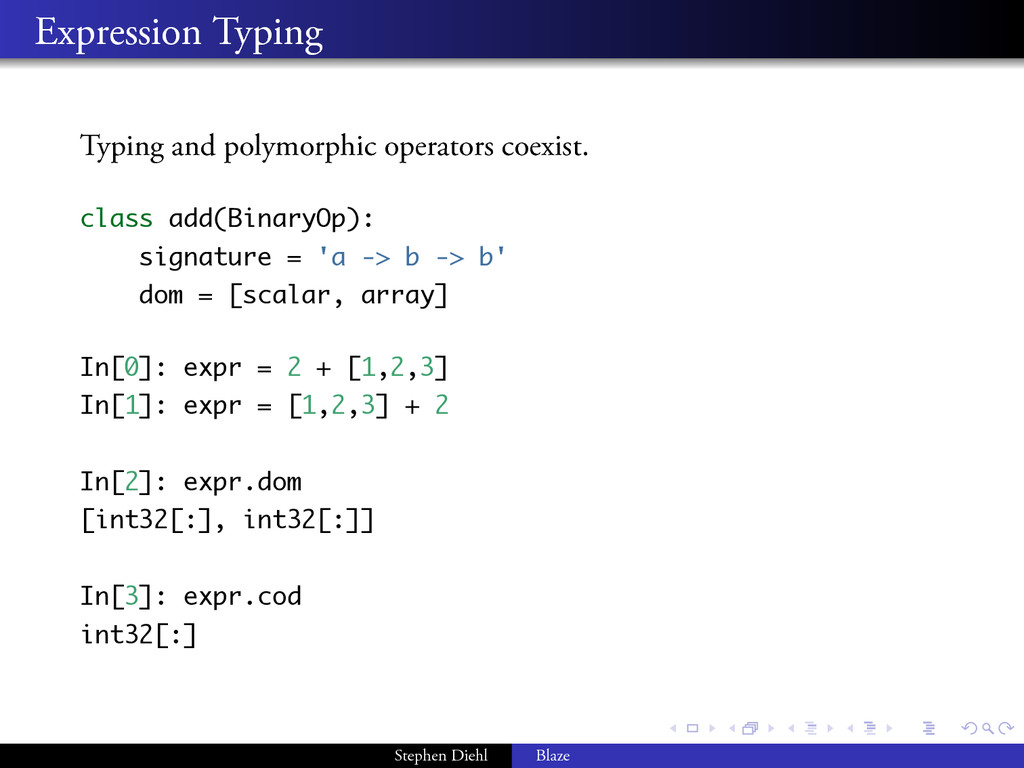
. . . . . . . . Expression Typing
Typing and polymorphic operators coexist. class add(BinaryOp): signature = 'a -> b -> b' dom = [scalar, array] In[0]: expr = 2 + [1,2,3] In[1]: expr = [1,2,3] + 2 In[2]: expr.dom [int32[:], int32[:]] In[3]: expr.cod int32[:] Stephen Diehl Blaze -
. . . . . . . . Transformations f(a,
b) :: (Indexable, Indexable) → Indexable • Index space transformation • How coordinates transform under f. • Value space transformation • How values transform under f. • Metadata space transformation • How metadata is merged from operands a, b. Preserving type and metadata information allows us to write more clever algorithms that avoid needless seeks and scans. Stephen Diehl Blaze -
. . . . . . . . Nuances of
Evaluation • Forcing Evaluation • Many properties of arrays are not knowable a priori. Evaluation is forced when we need to peek into a opaque type. • Can't write coordinate transformations in terms of coordinates we can't describe. • Side effectful operations. ( numpy.fill, numpy.put ) • (reduce, groupby) also force evaluation. In general operations which are not index space homomorphisms. • Just like NumPy. ere are benefits to writing in functional style, but one can still drop into raw memory manipulation when needed. Stephen Diehl Blaze -
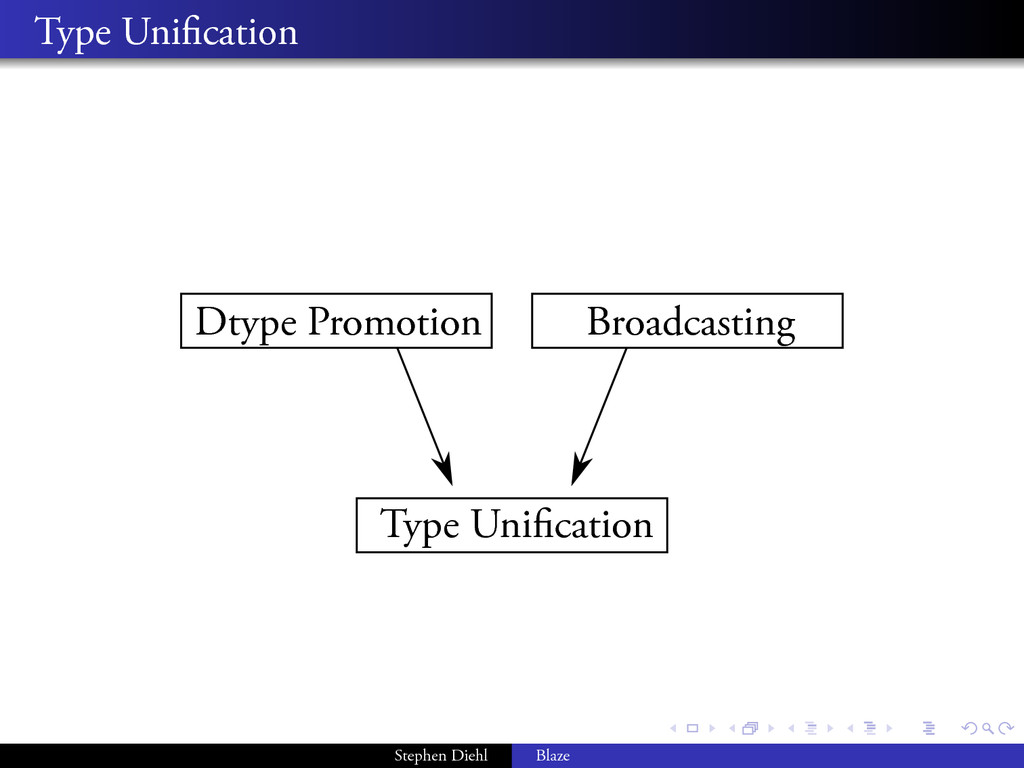
. . . . . . . . Type Unification
Dtype Promotion Broadcasting Type Unification Stephen Diehl Blaze -
. . . . . . NumPy A 5 x
4 B 1 broadcast(A,B) 5 x 4 Blaze A 3, 2, Var(10), int32 B 1, Var(100), float32 unify(A,B) 3, 2, Var(100), float32 Stephen Diehl Blaze -
. . . . . . . . Metadata •
Data Warehousing • Provenance: Where does this number come from? • Propagate metadata about source through ETL pipeline. • Orthogonal matrix • A−1 → AT • Value Space Transform → Index Space Transform • Matrix density • density(A) + density(B) in terms of density(A,B) Provide an extensible algebra of propagating information through the expression graph. Stephen Diehl Blaze -
. . . . . . . . Global Arrays
Blaze as the lingua franca of Python data exchange. • Remote Computation • Push code to data • Remote Data Retrieval • Pull data to code Stephen Diehl Blaze -
. . . . . . . . Compiler Backend
• Code generation • Numba & Minivect ( target LLVM ) • Array VM ( target custom bytecode ) Kernel Specialization Metadata Data Locality Data Layout OpenMP BLAS/LAPACK Cuda Stephen Diehl Blaze -
. . . . . . . . Blaze Blaze
is still a work in progress. Look for more details at the end of November. • Blaze will be open source! • Blaze will have tight integration with Numba. • Blaze Studio will have premium features on top of Blaze and Numba and will include IOPro. Stephen Diehl Blaze -
. . . . . . . . Blaze Project
. People . . . . . . . . • Travis Oliphant • Peter Wang • Mark Wiebe ( numpy ) • Francesc Alted ( pytables, numexpr ) • Mark Florisson ( minivect, numba ) • Stephen Diehl . Contact . . . . . . . . • Github: github.com/ContinuumIO/blaze • URL: http://www.continuum.io • Twitter: @ContinuumIO Stephen Diehl Blaze