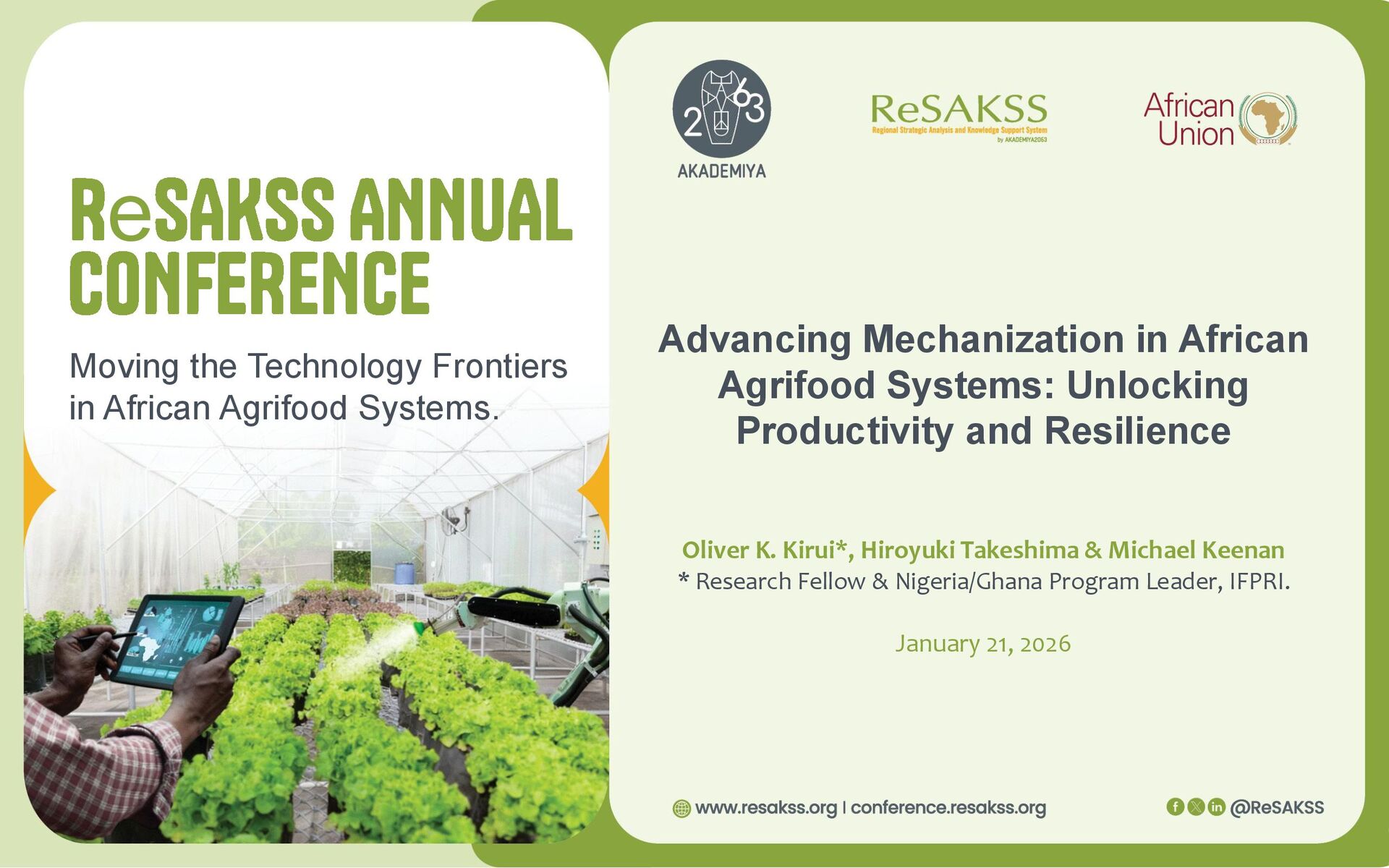
Advancing Mechanization in African Agrifood Systems: Unlocking Productivity and Resilience Oliver K. Kirui*, Hiroyuki Takeshima & Michael Keenan * Research Fellow & Nigeria/Ghana Program Leader, IFPRI. January 21, 2026
scarcity, and growing food demand. ▪ Strong policy commitments (Agenda 2063, Malabo/Kampala Declaration, SAMA) call for a shift beyond hand-hoe agriculture. ▪ Reality gap remains large: Africa is still the least mechanized region globally: o 60% of land cultivated manually o ~10% of farm power from motorized sources ▪ Emerging solutions include service-based mechanization, small-scale machinery, and public– private partnerships ▪ This study asks: how can mechanization drive productivity, resilience, and inclusive transformation at scale?
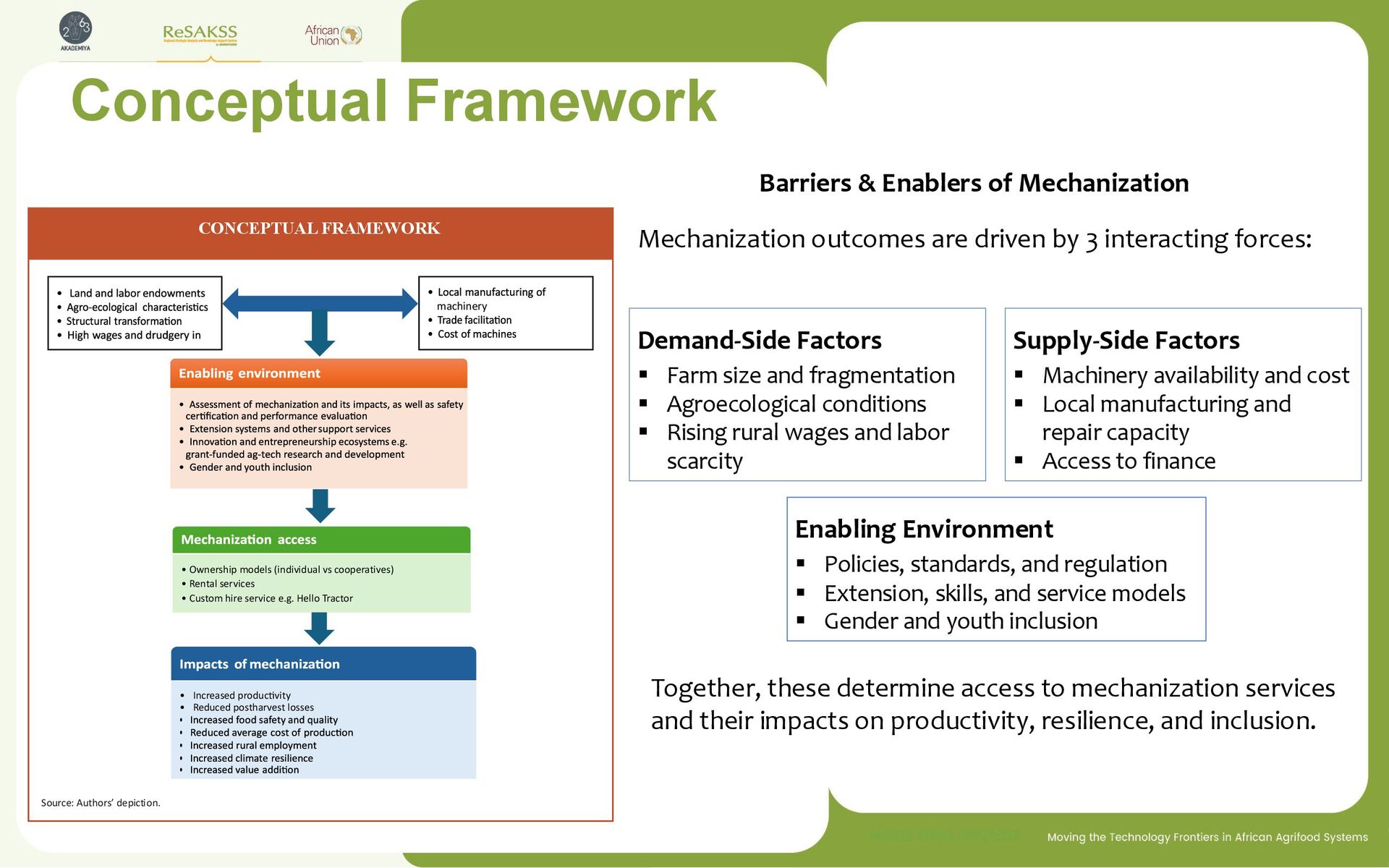
Agroecological conditions ▪ Rising rural wages and labor scarcity Enabling Environment ▪ Policies, standards, and regulation ▪ Extension, skills, and service models ▪ Gender and youth inclusion CONCEPTUAL FRAMEWORK • Ownership models (individual vs cooperatives) • Rental services • Custom hire service e.g. Hello Tractor Source: Authors’ depiction. • ncre sed produc it • educed posth r est osses chiner Barriers & Enablers of Mechanization Supply-Side Factors ▪ Machinery availability and cost ▪ Local manufacturing and repair capacity ▪ Access to finance Mechanization outcomes are driven by 3 interacting forces: Together, these determine access to mechanization services and their impacts on productivity, resilience, and inclusion.
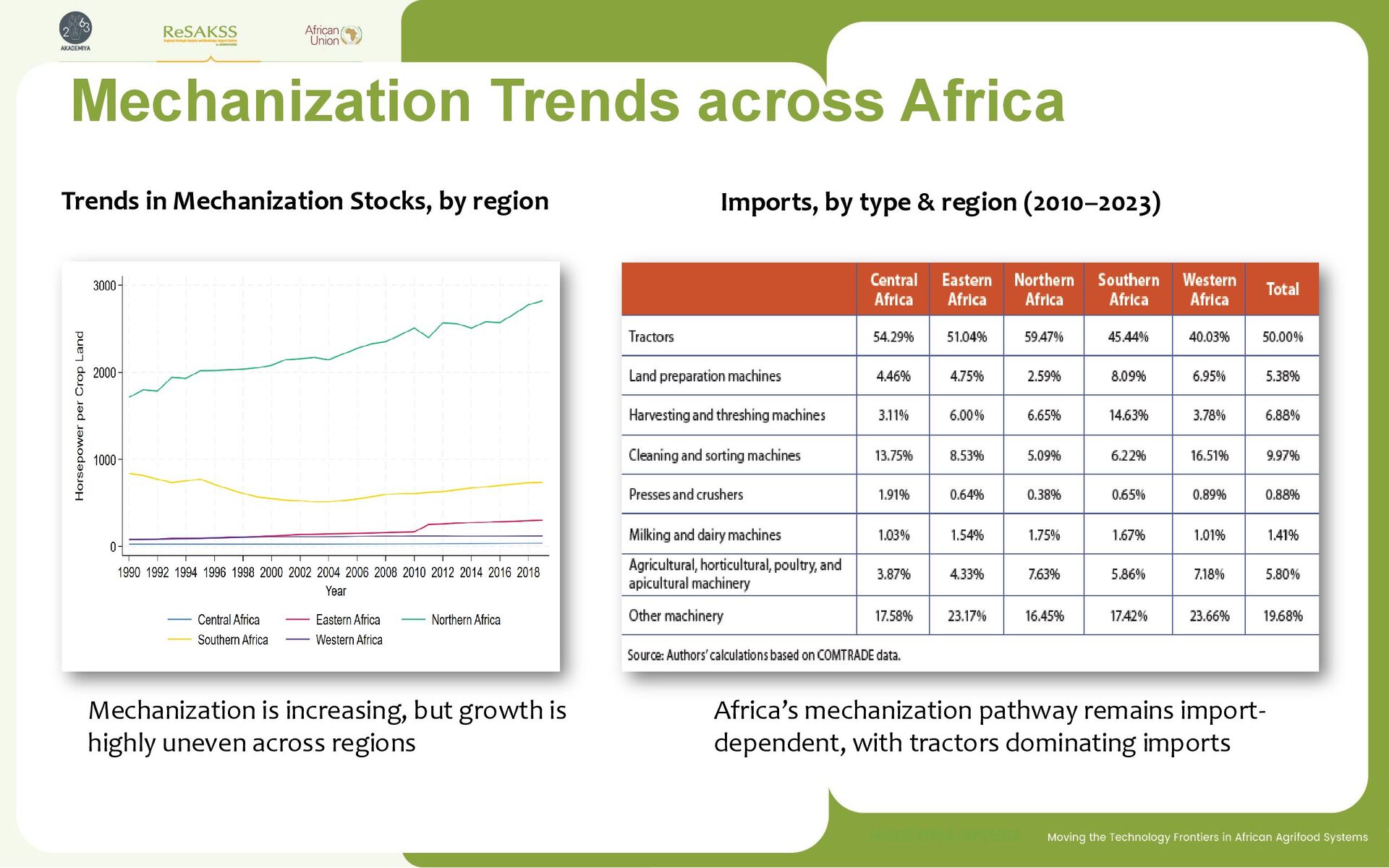
Imports, by type & region (2010–2023) Africa’s mechanization pathway remains import- dependent, with tractors dominating imports Mechanization is increasing, but growth is highly uneven across regions
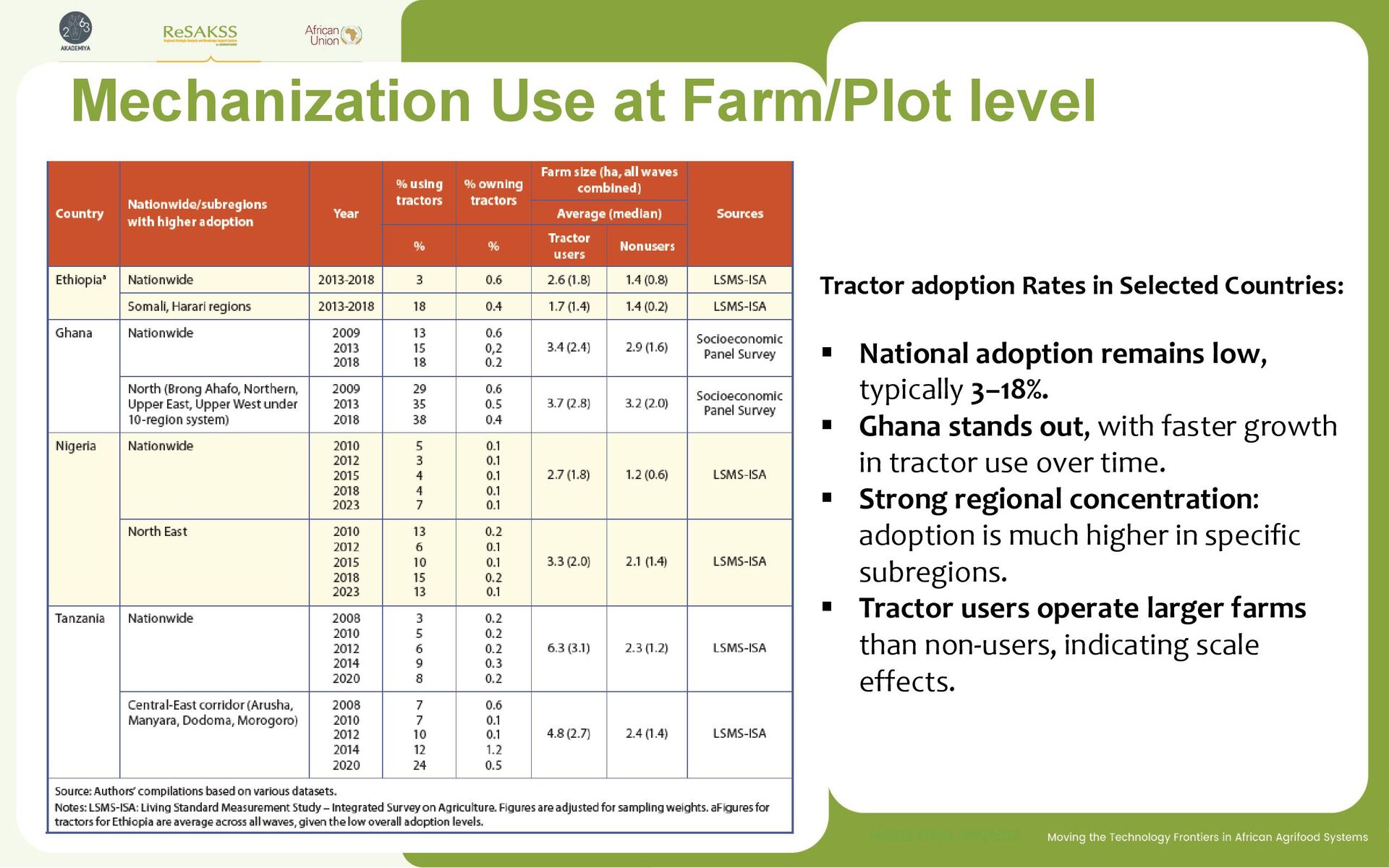
Countries: ▪ National adoption remains low, typically 3–18%. ▪ Ghana stands out, with faster growth in tractor use over time. ▪ Strong regional concentration: adoption is much higher in specific subregions. ▪ Tractor users operate larger farms than non-users, indicating scale effects.
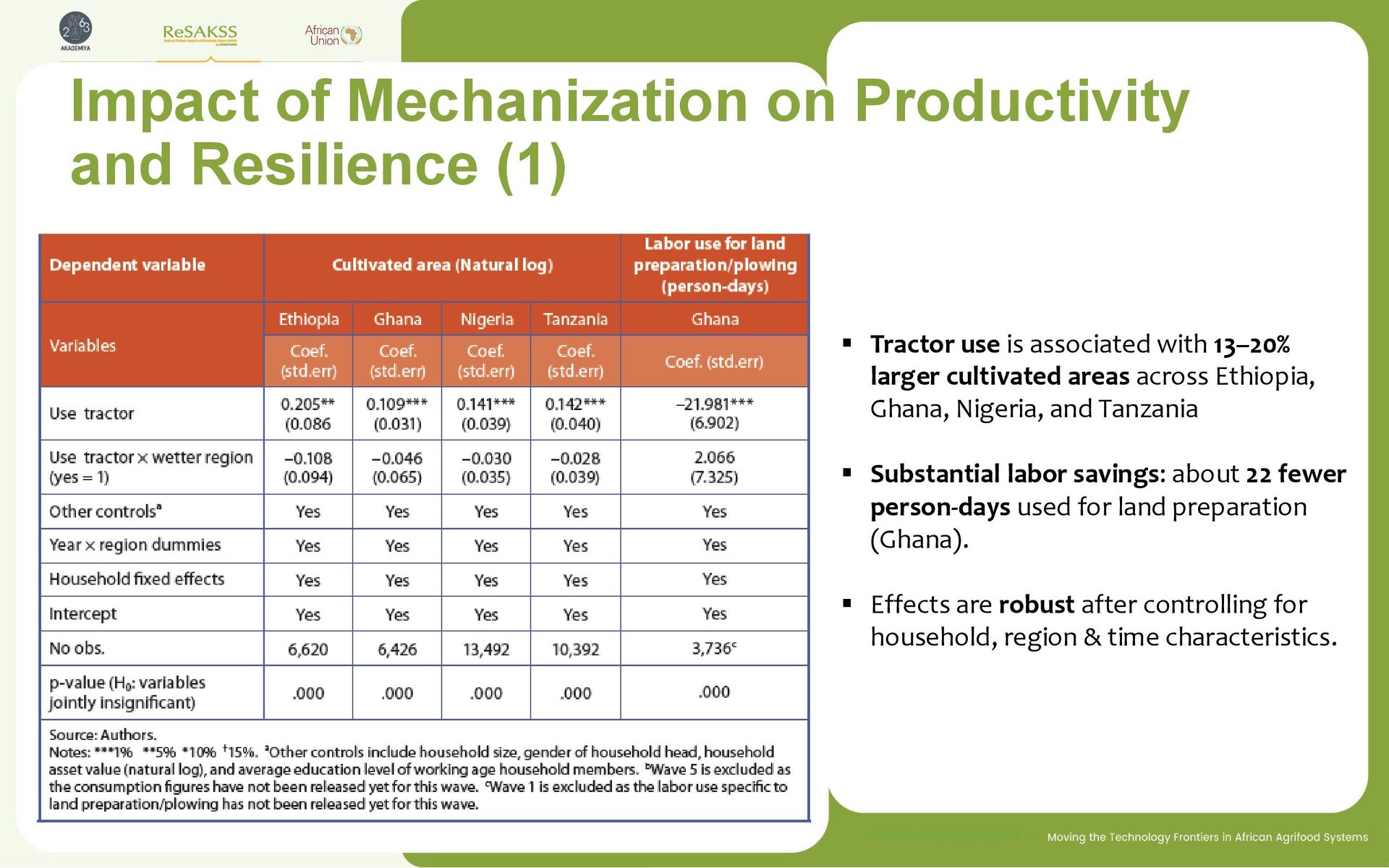
use is associated with 13–20% larger cultivated areas across Ethiopia, Ghana, Nigeria, and Tanzania ▪ Substantial labor savings: about 22 fewer person-days used for land preparation (Ghana). ▪ Effects are robust after controlling for household, region & time characteristics.
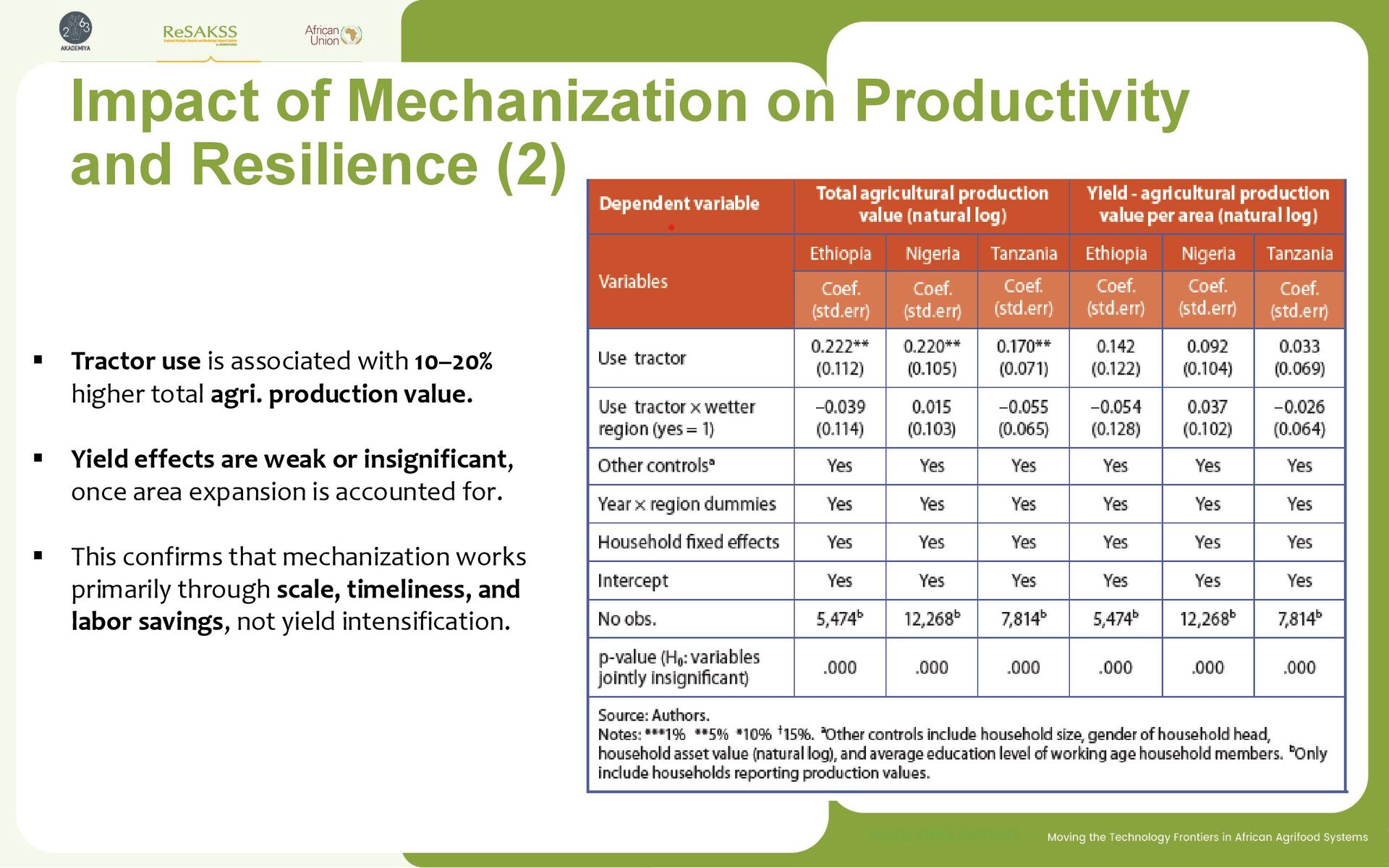
use is associated with 10–20% higher total agri. production value. ▪ Yield effects are weak or insignificant, once area expansion is accounted for. ▪ This confirms that mechanization works primarily through scale, timeliness, and labor savings, not yield intensification.
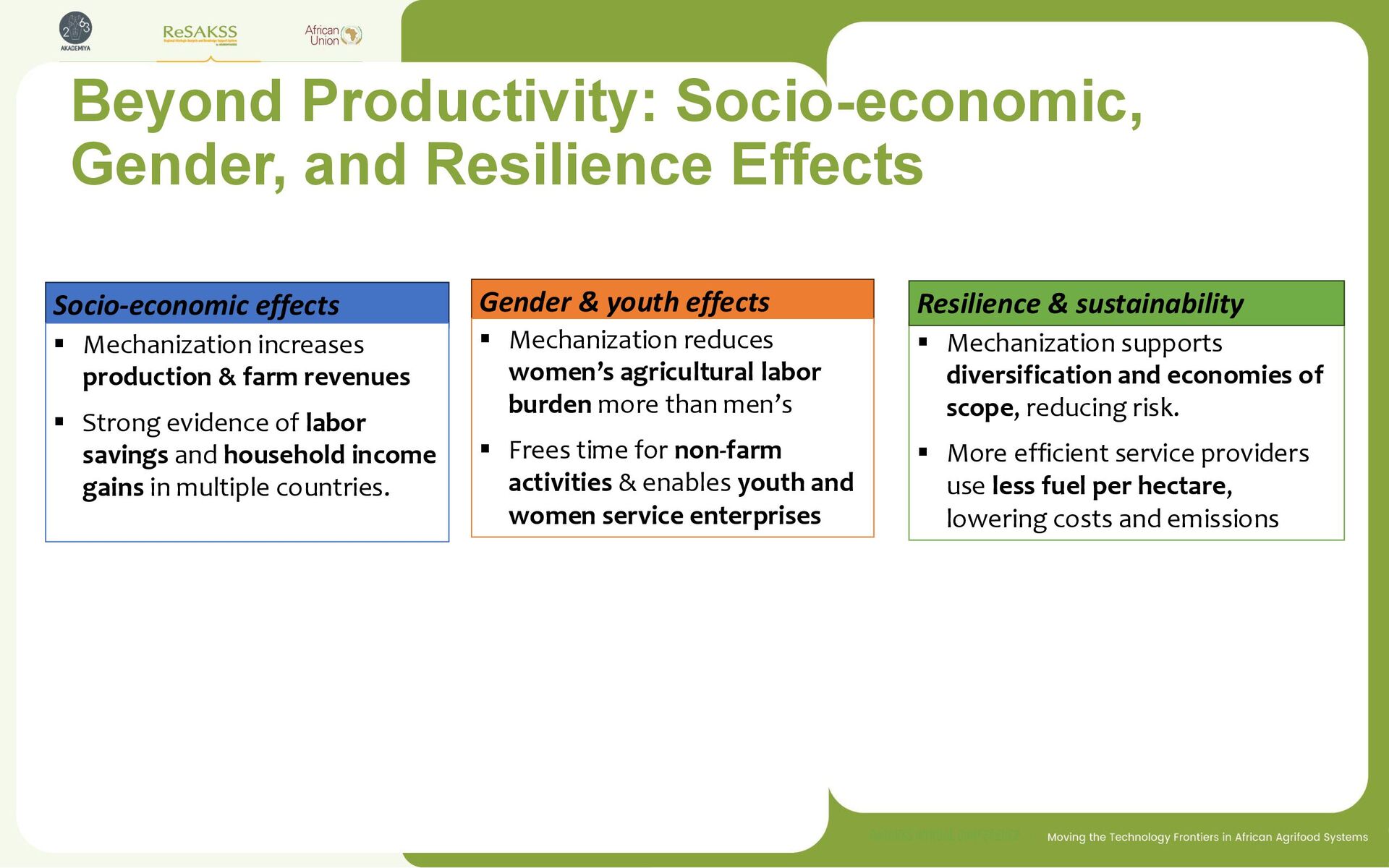
Strong evidence of labor savings and household income gains in multiple countries. Gender & youth effects ▪ Mechanization reduces women’s agricultural labor burden more than men’s ▪ Frees time for non-farm activities & enables youth and women service enterprises ▪ Mechanization supports diversification and economies of scope, reducing risk. ▪ More efficient service providers use less fuel per hectare, lowering costs and emissions Resilience & sustainability Beyond Productivity: Socio-economic, Gender, and Resilience Effects
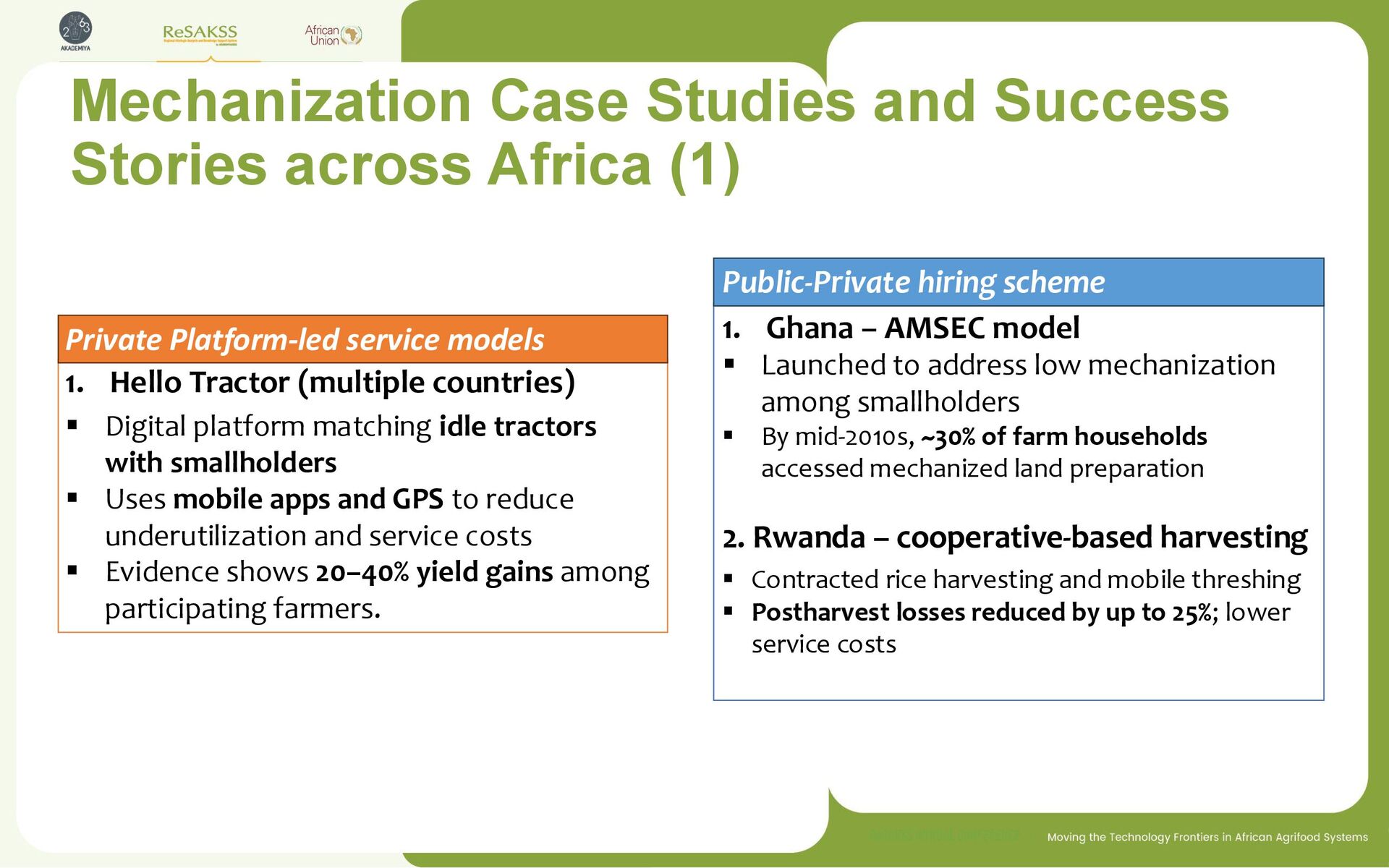
tractors with smallholders ▪ Uses mobile apps and GPS to reduce underutilization and service costs ▪ Evidence shows 20–40% yield gains among participating farmers. 1. Ghana – AMSEC model ▪ Launched to address low mechanization among smallholders ▪ By mid-2010s, ~30% of farm households accessed mechanized land preparation 2. Rwanda – cooperative-based harvesting ▪ Contracted rice harvesting and mobile threshing ▪ Postharvest losses reduced by up to 25%; lower service costs Public-Private hiring scheme Private Platform-led service models Mechanization Case Studies and Success Stories across Africa (1)
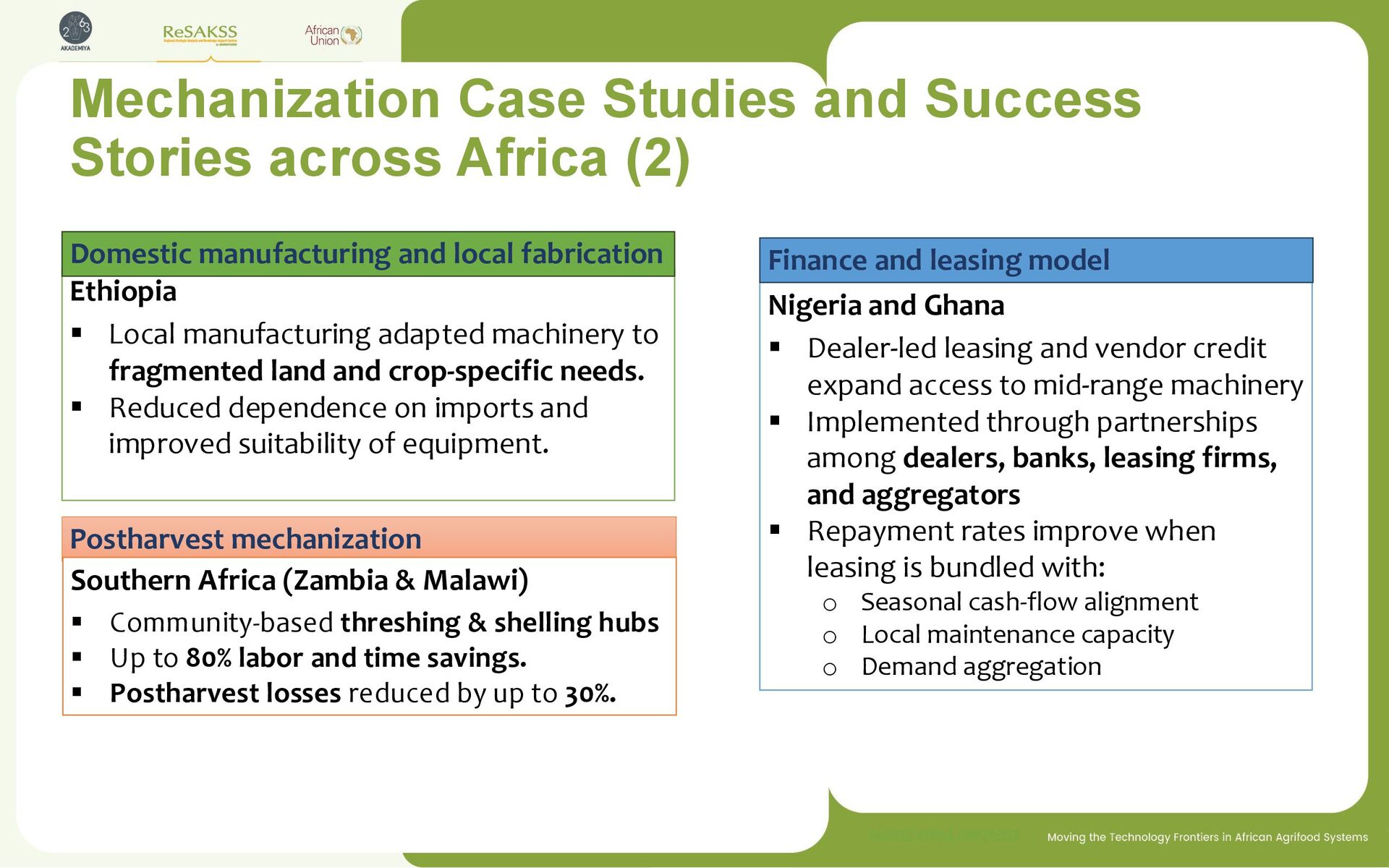
access to mid-range machinery ▪ Implemented through partnerships among dealers, banks, leasing firms, and aggregators ▪ Repayment rates improve when leasing is bundled with: o Seasonal cash-flow alignment o Local maintenance capacity o Demand aggregation Ethiopia ▪ Local manufacturing adapted machinery to fragmented land and crop-specific needs. ▪ Reduced dependence on imports and improved suitability of equipment. Domestic manufacturing and local fabrication Postharvest mechanization Southern Africa (Zambia & Malawi) ▪ Community-based threshing & shelling hubs ▪ Up to 80% labor and time savings. ▪ Postharvest losses reduced by up to 30%. Finance and leasing model Mechanization Case Studies and Success Stories across Africa (2)
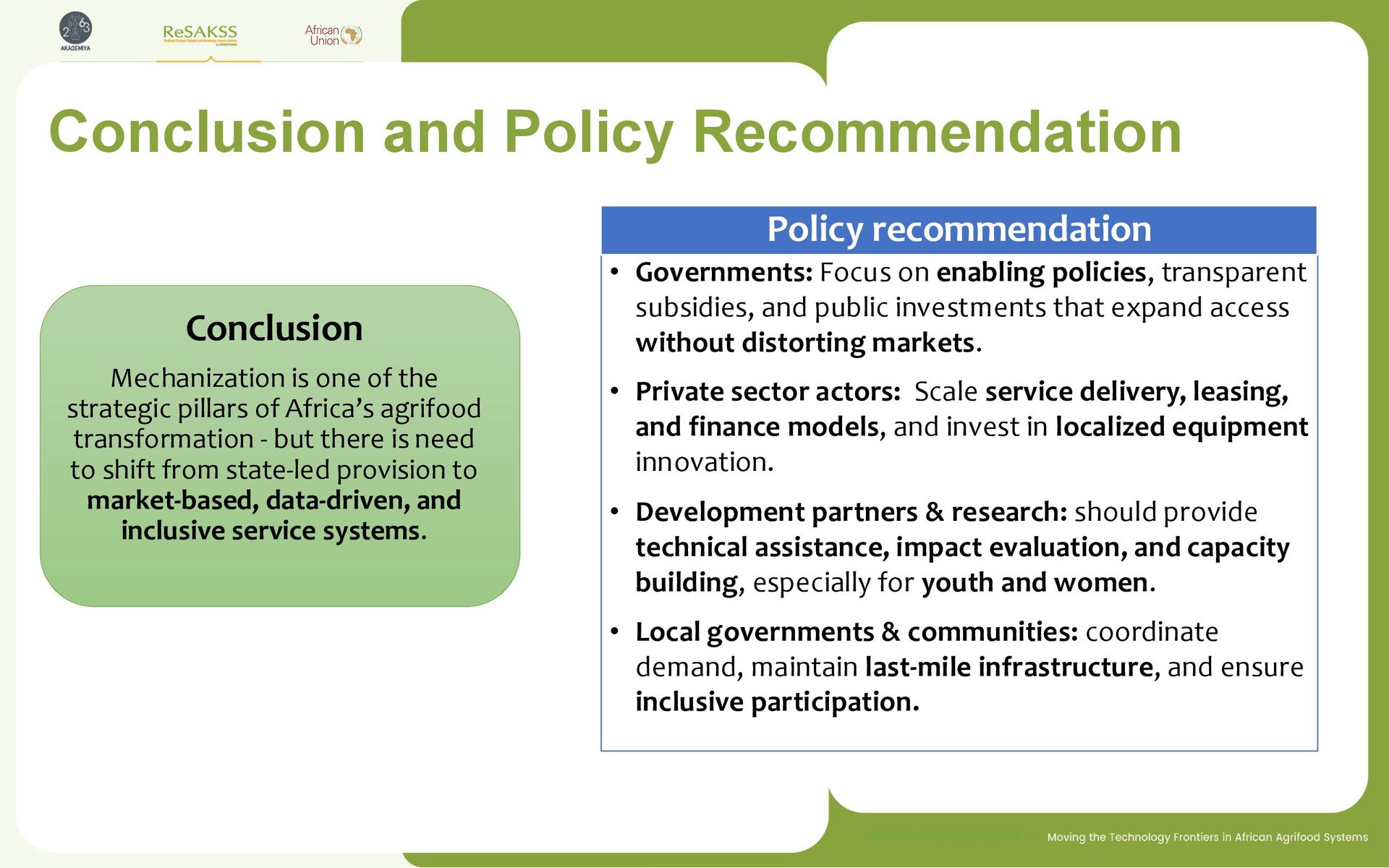
transparent subsidies, and public investments that expand access without distorting markets. • Private sector actors: Scale service delivery, leasing, and finance models, and invest in localized equipment innovation. • Development partners & research: should provide technical assistance, impact evaluation, and capacity building, especially for youth and women. • Local governments & communities: coordinate demand, maintain last-mile infrastructure, and ensure inclusive participation. Conclusion Mechanization is one of the strategic pillars of Africa’s agrifood transformation - but there is need to shift from state-led provision to market-based, data-driven, and inclusive service systems. Policy recommendation


 akademiya2063
 hariby
 izumiyama_lab
 institudelelevage
 yukako_nakano
 monochromegane
 microbaseinc
 murakawatakuya
 polipoli
 wataruuuuu
 rikkabotan7
 s_mizuki_nlp
 yukinobaba
 jnunemaker
 rkendrick25
 reverentgeek
 cassininazir
 shpigford
 rabernat
 marktimemedia
 smashingmag
 portentint
 tammyeverts
 soysaucechin
 lynnandtonic