Upgrade to Pro
— share decks privately, control downloads, hide ads and more …
Speaker Deck
Sign up for free
Menu
Search
Features
All features
Private URLs
Password Protection
Custom URLS
Scheduled publishing
Remove Branding
Restrict embedding
Deck Collections
Notes
Features
All features
Private URLs
Password Protection
Custom URLS
Scheduled publishing
Remove Branding
Restrict embedding
Deck Collections
Notes
Explore
Featured decks
Featured speakers
Programming
Technology
Storyboards
Explore
Featured decks
Featured speakers
Programming
Technology
Storyboards
Pricing
Search
Sign in
Sign up for free
Beyond grep – PyCon JP
Search
Sponsored
·
Your Podcast. Everywhere. Effortlessly.
Share. Educate. Inspire. Entertain. You do you. We'll handle the rest.
→
Hynek Schlawack
October 10, 2015
Programming
3.8k
1
Share
Embed
Copy iframe code
Copy JS code
Copy link
Start on current slide
Beyond grep – PyCon JP
Hynek Schlawack
October 10, 2015
More Decks by Hynek Schlawack
See All by Hynek Schlawack
Python’s True Superpower
hynek
0
300
Design Pressure
hynek
0
1.9k
Subclassing, Composition, Python, and You
hynek
3
590
Classy Abstractions @ Python Web Conf
hynek
0
240
On the Meaning of Version Numbers
hynek
0
450
Maintaining a Python Project When It’s Not Your Job
hynek
1
2.5k
How to Write Deployment-friendly Applications
hynek
0
2.6k
Solid Snakes or: How to Take 5 Weeks of Vacation
hynek
2
6k
Get Instrumented: How Prometheus Can Unify Your Metrics
hynek
4
11k
Other Decks in Programming
See All in Programming
The Rails Doctrine Decade
koic
2
150
変化を抱擁するドキュメントの作り方 - ビジネスルール駆動開発がもたらす、コードとの新しい関係
ioki
2
220
C#の現在地 進化の歴史と、AI時代の.NET Everywhere
neuecc
4
2.8k
Augmenting AI with the Power of Jakarta EE
ivargrimstad
0
220
[GoCon2026] When Goroutines Are Not Enough: Runtime Locality in High-Throughput Go
takehaya
6
2.3k
What We Talk About When We Talk About XP
m_seki
2
660
Streamlitで実現する自然言語データアプリ開発
ayumu_yamaguchi
1
290
すこし踏み込む CancellationToken
htkym
2
580
数年滞っていたダークモード対応をおよそ2週間で完了させる
chigichan24
0
730
setup-vp GitLab対応の裏側
naokihaba
0
110
JPUG勉強会 OSSデータベースの内部構造を理解しよう(第2回)
oga5
0
260
Heart of Swift Concurrency
koher
0
910
Featured
See All Featured
Navigating Algorithm Shifts & AI Overviews - #SMXNext
aleyda
1
1.6k
Public Speaking Without Barfing On Your Shoes - THAT 2023
reverentgeek
1
570
"I'm Feeling Lucky" - Building Great Search Experiences for Today's Users (#IAC19)
danielanewman
230
23k
Writing Fast Ruby
sferik
630
63k
A Guide to Academic Writing Using Generative AI - A Workshop
ks91
PRO
1
470
Understanding Cognitive Biases in Performance Measurement
bluesmoon
32
3k
Heart Work Chapter 1 - Part 1
lfama
PRO
10
36k
コードの90%をAIが書く世界で何が待っているのか / What awaits us in a world where 90% of the code is written by AI
rkaga
63
46k
Primal Persuasion: How to Engage the Brain for Learning That Lasts
tmiket
0
460
From π to Pie charts
rasagy
1
370
Documentation Writing (for coders)
carmenintech
77
5.5k
Leading Effective Engineering Teams in the AI Era
addyosmani
9
2.6k
Transcript
Beyond grep Pragmatic Logging & Metrics Hynek Schlawack
None
ͩΩͷ΅! @hynek https://hynek.me https://github.com/hynek
www.variomedia.de
ox.cx/b
Agenda
Agenda
Agenda
Agenda
Errors
Errors
Requirements
Requirements •fast
Requirements •fast •once
Requirements •fast •once
Requirements •fast •once •context
Requirements •fast •once •context
None
None
None
None
None
None
None
None
None
None
Raven-Python
Raven-Python Transports:
Raven-Python Transports: • gevent
Raven-Python Transports: • gevent • aiohttp
Raven-Python Transports: • gevent • aiohttp • Twisted
Raven-Python Transports: • gevent • aiohttp • Twisted • …8
others
Raven-Python Integrations: Transports: • gevent • aiohttp • Twisted •
…8 others
Raven-Python Integrations: • logging Transports: • gevent • aiohttp •
Twisted • …8 others
Raven-Python Integrations: • logging • Django Transports: • gevent •
aiohttp • Twisted • …8 others
Raven-Python Integrations: • logging • Django • WSGI Transports: •
gevent • aiohttp • Twisted • …8 others
Raven-Python Integrations: • logging • Django • WSGI • …9
others Transports: • gevent • aiohttp • Twisted • …8 others
Vanilla from raven import Client client = Client("https://yoursentry") try: 1
/ 0 except ZeroDivisionError: client.captureException()
Vanilla from raven import Client client = Client("https://yoursentry") try: 1
/ 0 except ZeroDivisionError: client.captureException()
Vanilla from raven import Client client = Client("https://yoursentry") try: 1
/ 0 except ZeroDivisionError: client.captureException()
Vanilla @client.capture_exceptions def foo(): raise Exception()
Django INSTALLED_APPS = ( … "raven.contrib.django.raven_compat", … )
Progress!
Progress! ✓
Metrics
Metrics?
Metrics? • numbers in a DB
Metrics? • numbers in a DB • guessing vs knowing
–D. J. Bernstein “Measure. Don’t speculate.”
System Metrics vs App Metrics • load • network traffic
• I/O • …
System Metrics vs App Metrics • load • network traffic
• I/O • … • counters
System Metrics vs App Metrics • load • network traffic
• I/O • … • counters • timers
System Metrics vs App Metrics • load • network traffic
• I/O • … • counters • timers • gauges
System Metrics vs App Metrics • load • network traffic
• I/O • … • counters • timers • gauges • …
Aggregation
Correlation
Math
Math • # reqs / s?
Math • # reqs / s? • worst 0.01% ⟨req
time⟩?
Math • # reqs / s? • worst 0.01% ⟨req
time⟩? • don’t try this alone!
Monitoring
Monitoring • latency
Monitoring • latency • error rates
Monitoring • latency • error rates • anomalies
Storage
Librato Metrics
Graphite 800 pound gorilla
Grafana
InfluxDB Graphite++ in Go
InfluxDB Graphite++ in Go
Prometheus Metrics & Monitoring
Prometheus Metrics & Monitoring
Prometheus Metrics & Monitoring
Prometheus Metrics & Monitoring
Prometheus Metrics & Monitoring
Prometheus Metrics & Monitoring
Collecting
Approaches
Approaches 1. external aggregation: StatsD, Riemann
Approaches 1. external aggregation: StatsD, Riemann + no state, simple
Approaches 1. external aggregation: StatsD, Riemann + no state, simple
– no direct introspection
Approaches 1. external aggregation: StatsD, Riemann + no state, simple
– no direct introspection 2. aggregate in-app, deliver to DB
Approaches 1. external aggregation: StatsD, Riemann + no state, simple
– no direct introspection 2. aggregate in-app, deliver to DB + in-app dashboard, useful in dev
Approaches 1. external aggregation: StatsD, Riemann + no state, simple
– no direct introspection 2. aggregate in-app, deliver to DB + in-app dashboard, useful in dev – state w/i app
None
(g|py)?statsd(py|-client)? import statsd c = statsd.StatsClient( "statsd.local", 8125 )
(g|py)?statsd(py|-client)?
(g|py)?statsd(py|-client)? c.incr("foo")
(g|py)?statsd(py|-client)? c.incr("foo") c.timing("stats.timed", 320)
Scales from greplin import scales from greplin.scales.meter import MeterStat STATS
= scales.collection( "/Resource", MeterStat("reqs"), scales.PmfStat("request_time") )
Scales from greplin import scales from greplin.scales.meter import MeterStat STATS
= scales.collection( "/Resource", MeterStat("reqs"), scales.PmfStat("request_time") )
Scales
Scales STATS.reqs.mark()
Scales STATS.reqs.mark() with STATS.request_time.time():
Scales STATS.reqs.mark() with STATS.request_time.time(): do_something_expensive()
Dashboard Scales
Dashboard Scales
Dashboard Scales … "request_time": { "count": 567315293, "99percentile": 0.10978688716888428, "75percentile":
0.013181567192077637, "min": 0.0002448558807373047, "max": 30.134822130203247, "98percentile": 0.08934824466705339, "95percentile": 0.027234303951263434, "median": 0.009176492691040039, "999percentile": 0.14235656142234793, "stddev": 0.01676855570363413, "mean": 0.013247184020535955 }, …
from greplin.scales import graphite pusher = graphite.GraphitePeriodicPusher( "graphite.host", 2003, period=30,
prefix="yourapp", ) pusher.allow("**") pusher.start()
Prometheus
Prometheus import random, time from prometheus_client import \ start_http_server, Summary
Prometheus import random, time from prometheus_client import \ start_http_server, Summary
FUNC_TIME = Summary( "func_seconds", "Time spent in func")
Prometheus import random, time from prometheus_client import \ start_http_server, Summary
FUNC_TIME = Summary( "func_seconds", "Time spent in func") @FUNC_TIME.time() def func(t): time.sleep(t)
Prometheus import random, time from prometheus_client import \ start_http_server, Summary
FUNC_TIME = Summary( "func_seconds", "Time spent in func") @FUNC_TIME.time() def func(t): time.sleep(t) if __name__ == '__main__': start_http_server(8000) while True: func(random.random())
Prometheus # HELP func_seconds Time spent in func # TYPE
func_seconds summary func_seconds_count 78.0 func_seconds_sum 37.8028838634491
Progress! ✓
Progress! ✓ ✓
Logging
Splunk
Splunk
Papertrail
loggly
ELK Elasticsearch + Logstash + Kibana
None
None
Logstash
Elasticsearch Logstash
Elasticsearch Logstash
Elasticsearch Logstash Kibana
Graylog
Graylog
Graylog
Graylog
None
None
Goal @400000005270e0d604afce64 { "event": "logged_in", "user": "guido", "ip": "8.8.8.8", "referrer":
"http://google.com" }
Context & Format
structlog
BoundLogger structlog
Original Logger BoundLogger structlog e.g. logging.Logger
Original Logger BoundLogger bind values log.bind(key=value) Context structlog
Original Logger BoundLogger bind values log.bind(key=value) Context log events log.info(event,
another_key=another_value) + structlog
Original Logger BoundLogger Processor 1 Processor n Return Value Return
Value bind values log.bind(key=value) Context log events log.info(event, another_key=another_value) + structlog
>>> import structlog >>> log = structlog.get_logger() >>> log.error("ohai", why=42,
wtf=True) why=42 wtf=True event='ohai'
>>> import structlog >>> log = structlog.get_logger() >>> log.error("ohai", why=42,
wtf=True) why=42 wtf=True event='ohai'
>>> import structlog >>> log = structlog.get_logger() >>> log.error("ohai", why=42,
wtf=True) why=42 wtf=True event='ohai'
>>> import structlog >>> log = structlog.get_logger() >>> log.error("ohai", why=42,
wtf=True) why=42 wtf=True event='ohai'
>>> from structlog import get_logger >>> log = get_logger() >>>
log = log.bind(user='anonymous', some_key=23) >>> log = log.bind(user='hynek', another_key=42) >>> log.info('user.logged_in', happy=True) some_key=23 user='hynek' another_key=42 happy=True event='user.logged_in'
>>> from structlog import get_logger >>> log = get_logger() >>>
log = log.bind(user='anonymous', some_key=23) >>> log = log.bind(user='hynek', another_key=42) >>> log.info('user.logged_in', happy=True) some_key=23 user='hynek' another_key=42 happy=True event='user.logged_in'
>>> from structlog import get_logger >>> log = get_logger() >>>
log = log.bind(user='anonymous', some_key=23) >>> log = log.bind(user='hynek', another_key=42) >>> log.info('user.logged_in', happy=True) some_key=23 user='hynek' another_key=42 happy=True event='user.logged_in'
>>> from structlog import get_logger >>> log = get_logger() >>>
log = log.bind(user='anonymous', some_key=23) >>> log = log.bind(user='hynek', another_key=42) >>> log.info('user.logged_in', happy=True) some_key=23 user='hynek' another_key=42 happy=True event='user.logged_in'
>>> from structlog import get_logger >>> log = get_logger() >>>
log = log.bind(user='anonymous', some_key=23) >>> log = log.bind(user='hynek', another_key=42) >>> log.info('user.logged_in', happy=True) some_key=23 user='hynek' another_key=42 happy=True event='user.logged_in'
def view(request): log = logger.bind(request=request) log.info("view_rendered") return "hello, world"
def view(request): log = logger.bind(request=request) log.info("view_rendered") return "hello, world"
def view(request): log = logger.bind(request=request) log.info("view_rendered") return "hello, world"
def request_extractor(_, __, event): req = event.pop("request", None) if req
is not None: event.update({ "client_addr": req.client_addr, "user_id": req.authenticated_userid, }) return event
def request_extractor(_, __, event): req = event.pop("request", None) if req
is not None: event.update({ "client_addr": req.client_addr, "user_id": req.authenticated_userid, }) return event
def request_extractor(_, __, event): req = event.pop("request", None) if req
is not None: event.update({ "client_addr": req.client_addr, "user_id": req.authenticated_userid, }) return event
def request_extractor(_, __, event): req = event.pop("request", None) if req
is not None: event.update({ "client_addr": req.client_addr, "user_id": req.authenticated_userid, }) return event
{"client_addr": "192.168.42.42", "user_id": null, "event": "view_rendered"}
import logging, sys logger = logging.getLogger() logger.addHandler( logging.StreamHandler( sys.stdout )
)
import logging, sys logger = logging.getLogger() logger.addHandler( logging.StreamHandler( sys.stdout )
)
Capture
Capture • into files
Capture • into files • to syslog / a queue
Capture • into files • to syslog / a queue
• pipe into a logging agent
None
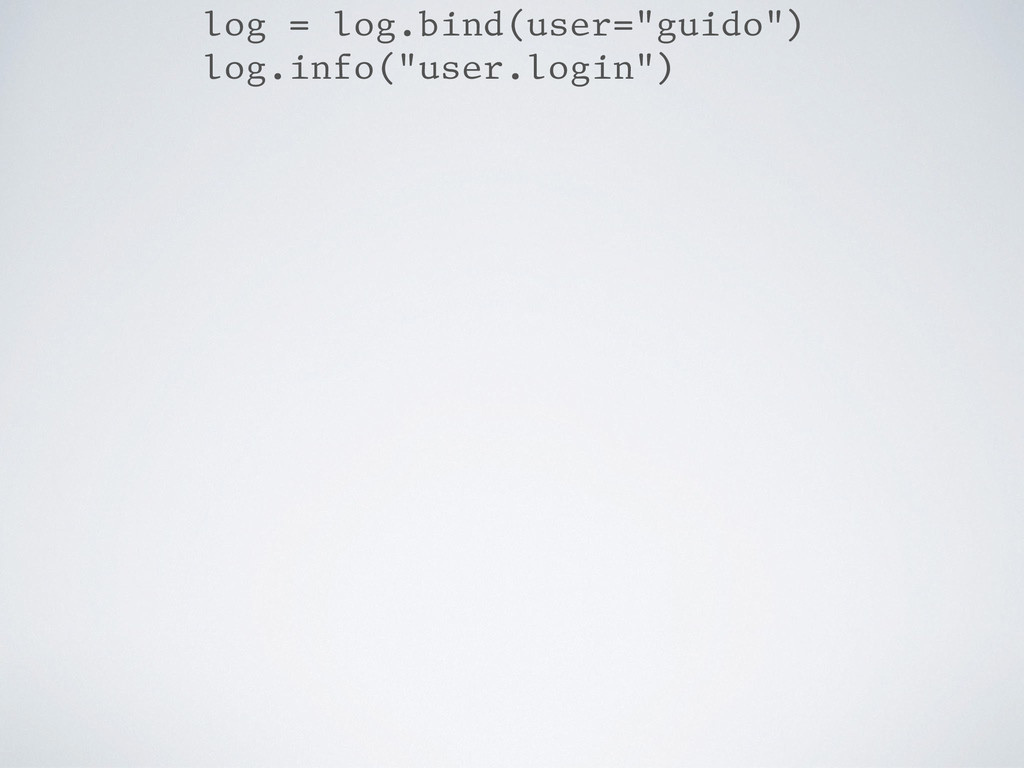
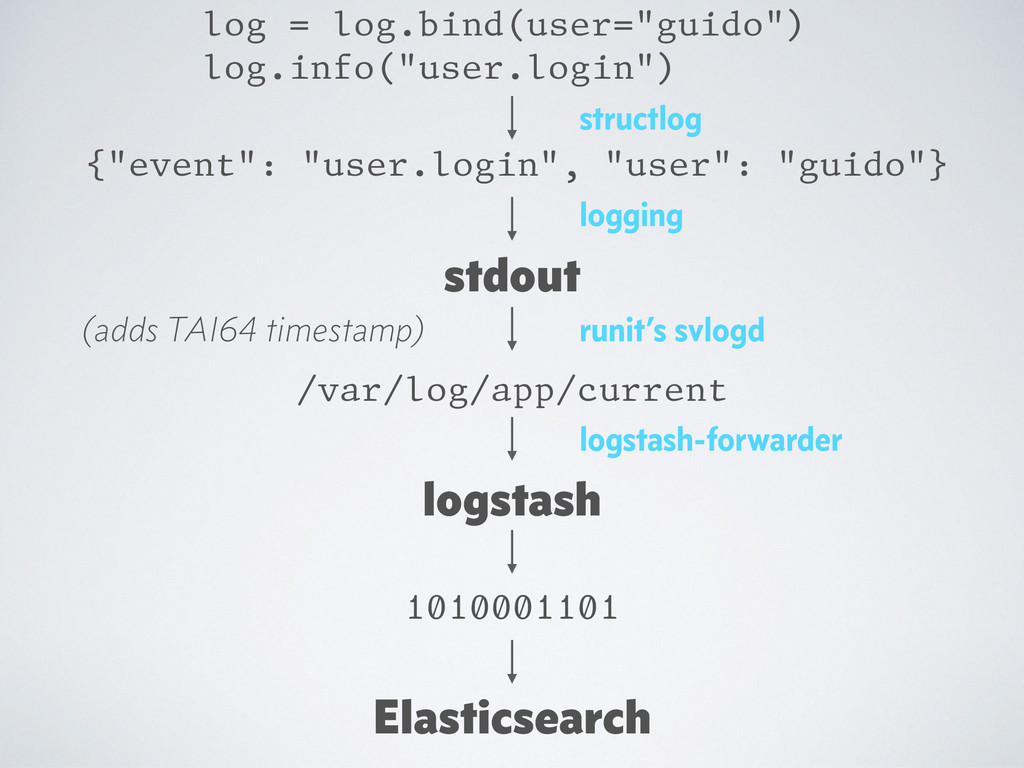
log = log.bind(user="guido") log.info("user.login")
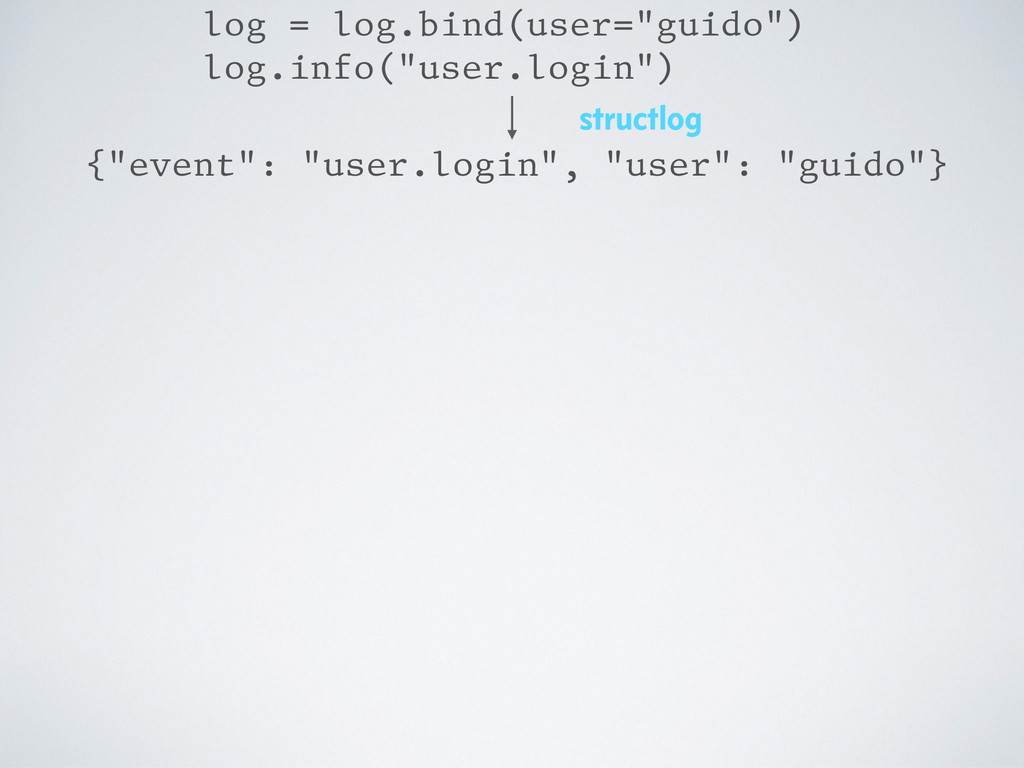
{"event": "user.login", "user": "guido"} log = log.bind(user="guido") log.info("user.login") structlog
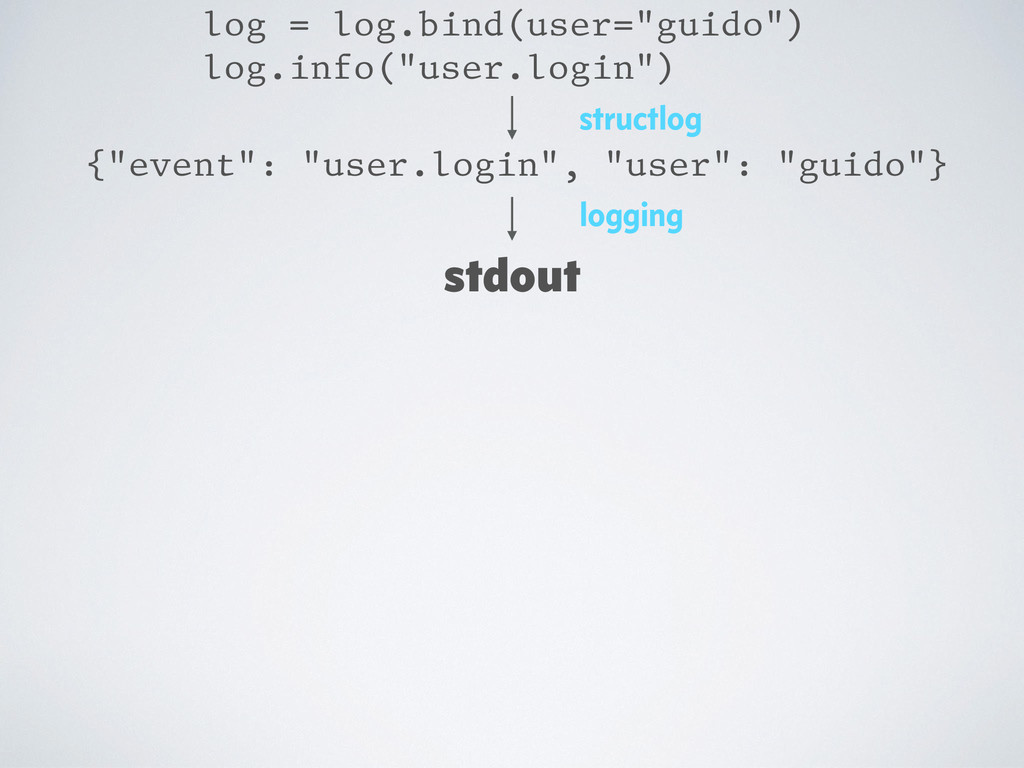
{"event": "user.login", "user": "guido"} log = log.bind(user="guido") log.info("user.login") structlog stdout
logging
{"event": "user.login", "user": "guido"} log = log.bind(user="guido") log.info("user.login") structlog stdout
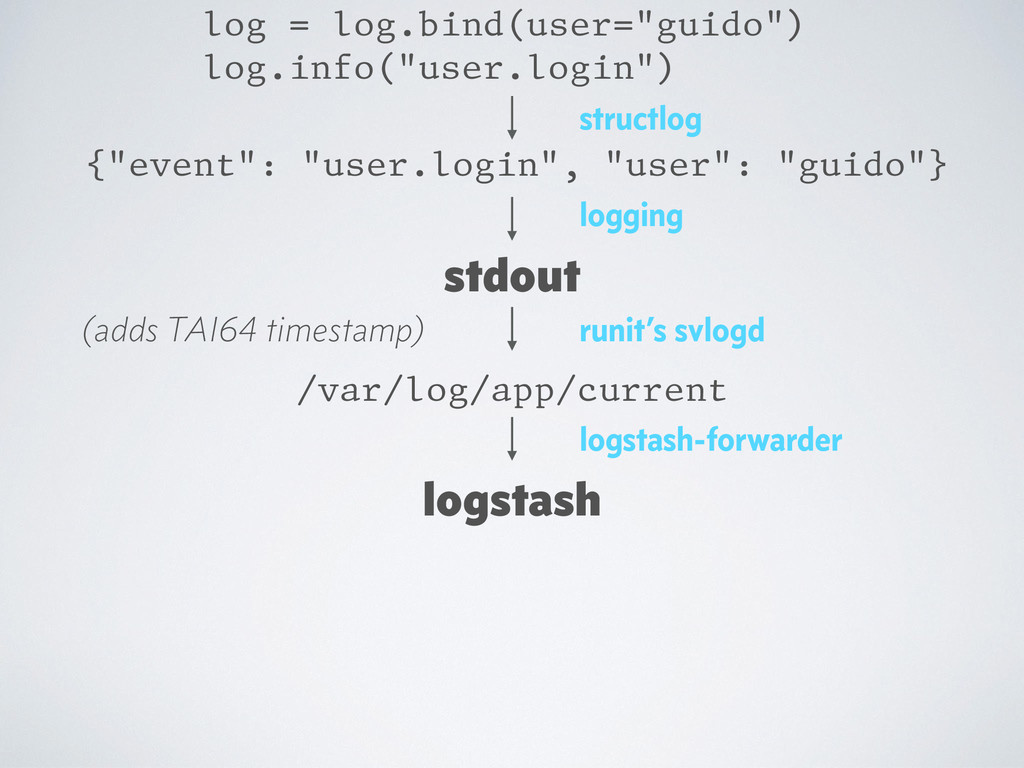
logging /var/log/app/current runit’s svlogd (adds TAI64 timestamp)
{"event": "user.login", "user": "guido"} log = log.bind(user="guido") log.info("user.login") structlog logstash-forwarder
logstash stdout logging /var/log/app/current runit’s svlogd (adds TAI64 timestamp)
{"event": "user.login", "user": "guido"} log = log.bind(user="guido") log.info("user.login") structlog logstash-forwarder
logstash 1010001101 Elasticsearch stdout logging /var/log/app/current runit’s svlogd (adds TAI64 timestamp)
Progress! ✓ ✓
Progress! ✓ ✓ ✓
Wait a Minute…
Wait a Minute…
Ugh try: STATS.time.timing(): something() except Exception as e: log.error("omg", exc_info=e)
raven_client.captureError() STATS.errors.mark()
Ugh try: STATS.time.timing(): something() except Exception as e: log.error("omg", exc_info=e)
raven_client.captureError() STATS.errors.mark()
Awww try: something() except Exception as e: log.exception("omg")
Errors
Errors • logging integration
Errors • logging integration • structlog
Errors • logging integration • structlog • web apps: error
views
Error View @view_config(context=Exception) def err(exc, request): return Response( "oops: "
+ raven_client.captureException() )
None
Metrics measure from outside
WSGI Servers
WSGI Servers • gunicorn: --statsd-host <host>
WSGI Servers • gunicorn: --statsd-host <host> • uWSGI:
WSGI Servers • gunicorn: --statsd-host <host> • uWSGI: • --stats-push
statsd:<host>
WSGI Servers • gunicorn: --statsd-host <host> • uWSGI: • --stats-push
statsd:<host> • --carbon <host>
Middleware def timing_tween_factory(handler, registry): def timing_tween(request): with STATS.request_time.time(): return handler(request)
return timing_tween
Middleware def timing_tween_factory(handler, registry): def timing_tween(request): with STATS.request_time.time(): return handler(request)
return timing_tween
Extract from Logs
Extract from Logs logstash
Extract from Logs logstash • StatsD
Extract from Logs logstash • StatsD • Graphite
Extract from Logs logstash • StatsD • Graphite • librato
Extract from Logs logstash • StatsD • Graphite • librato
• …
Extract from Logs logstash • StatsD • Graphite • librato
• … or structlog
Leverage Monitoring
Remaining
Remaining 1. measure code paths
Remaining 1. measure code paths 2. expose gauges
Summary
Summary
Summary
Summary
Summary
ox.cx/b @hynek vrmd.de


 hynek
hynek
 koic
koic
 ioki
ioki
 neuecc
 ivargrimstad
 takehaya
 m_seki
 ayumu_yamaguchi
 htkym
htkym
 chigichan24
 naokihaba
 oga5
oga5
 koher
koher
 aleyda
 reverentgeek
 danielanewman
 sferik
 ks91
ks91
 bluesmoon
 lfama
lfama
 rkaga
rkaga
 tmiket
 rasagy
 carmenintech
 addyosmani