Share
Embed
Annual Pro sale · Save $30
Have presentations of your own?
Share with private links, password protection, and more control over your work.
Transcript
26 slides
-
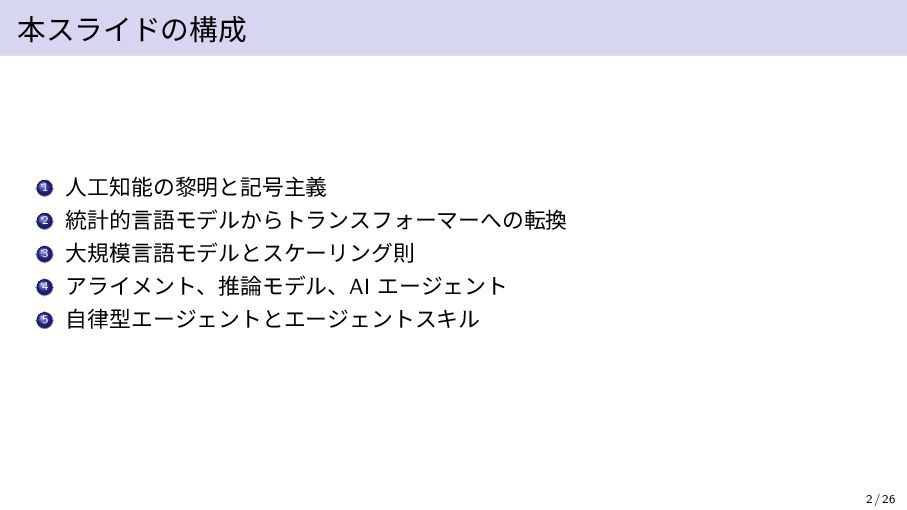
本スライドの構成 1 人工知能の黎明と記号主義 2 統計的言語モデルからトランスフォーマーへの転換 3 大規模言語モデルとスケーリング則 4 アライメント、推論モデル、AI エージェント
5 自律型エージェントとエージェントスキル 2 / 26 -
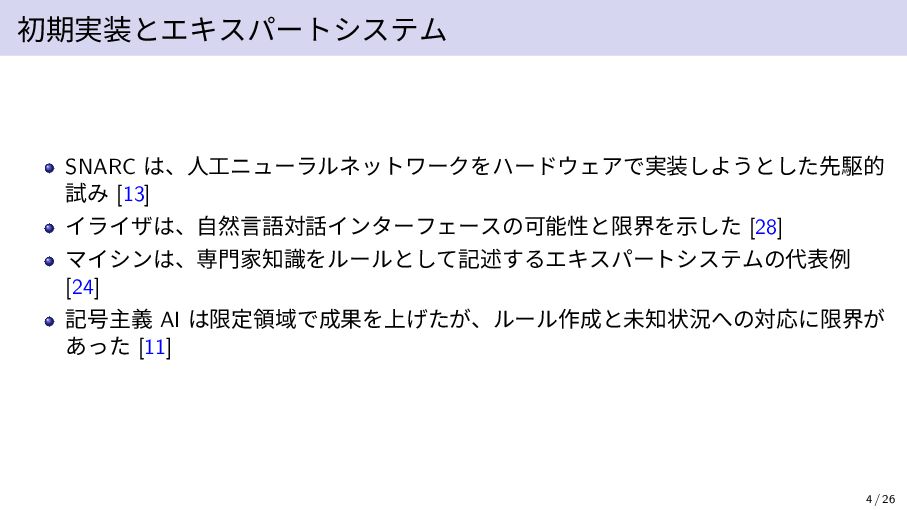
初期実装とエキスパートシステム SNARC は、人工ニューラルネットワークをハードウェアで実装しようとした先駆的 試み [13] イライザは、自然言語対話インターフェースの可能性と限界を示した [28] マイシンは、専門家知識をルールとして記述するエキスパートシステムの代表例 [24] 記号主義
AI は限定領域で成果を上げたが、ルール作成と未知状況への対応に限界が あった [11] 4 / 26 -
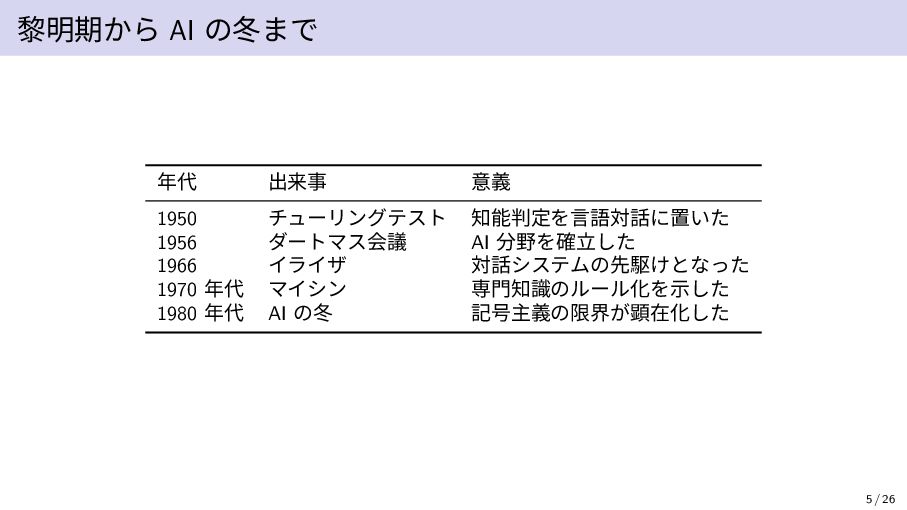
黎明期から AI の冬まで 年代 出来事 意義 1950 チューリングテスト 知能判定を言語対話に置いた 1956
ダートマス会議 AI 分野を確立した 1966 イライザ 対話システムの先駆けとなった 1970 年代 マイシン 専門知識のルール化を示した 1980 年代 AI の冬 記号主義の限界が顕在化した 5 / 26 -
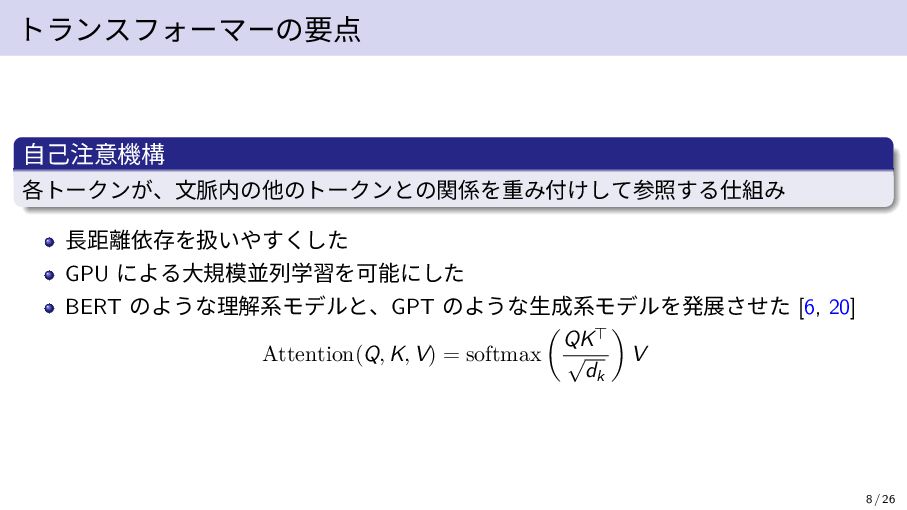
トランスフォーマーの要点 自己注意機構 各トークンが、文脈内の他のトークンとの関係を重み付けして参照する仕組み 長距離依存を扱いやすくした GPU による大規模並列学習を可能にした BERT のような理解系モデルと、GPT のような生成系モデルを発展させた [6,
20] Attention(Q, K, V) = softmax ( QK⊤ √ dk ) V 8 / 26 -
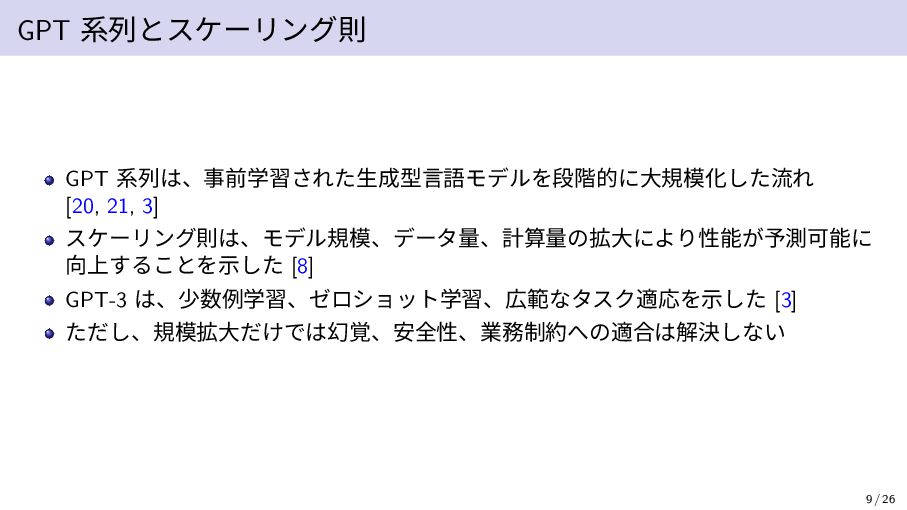
GPT 系列とスケーリング則 GPT 系列は、事前学習された生成型言語モデルを段階的に大規模化した流れ [20, 21, 3] スケーリング則は、モデル規模、データ量、計算量の拡大により性能が予測可能に 向上することを示した [8]
GPT-3 は、少数例学習、ゼロショット学習、広範なタスク適応を示した [3] ただし、規模拡大だけでは幻覚、安全性、業務制約への適合は解決しない 9 / 26 -
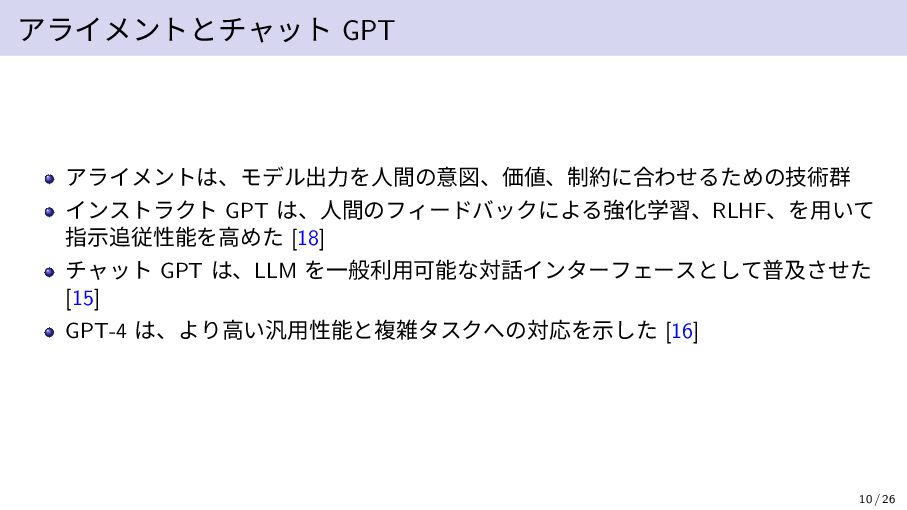
アライメントとチャット GPT アライメントは、モデル出力を人間の意図、価値、制約に合わせるための技術群 インストラクト GPT は、人間のフィードバックによる強化学習、RLHF、を用いて 指示追従性能を高めた [18] チャット GPT
は、LLM を一般利用可能な対話インターフェースとして普及させた [15] GPT-4 は、より高い汎用性能と複雑タスクへの対応を示した [16] 10 / 26 -
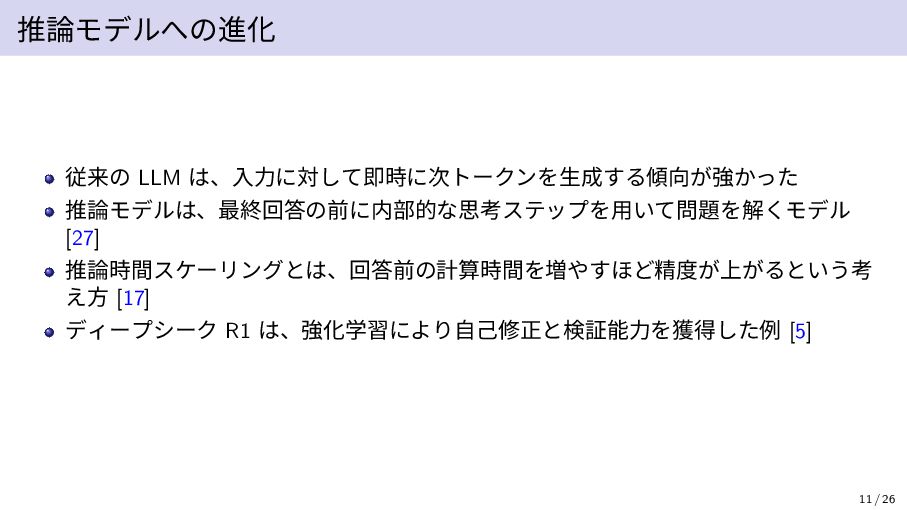
推論モデルへの進化 従来の LLM は、入力に対して即時に次トークンを生成する傾向が強かった 推論モデルは、最終回答の前に内部的な思考ステップを用いて問題を解くモデル [27] 推論時間スケーリングとは、回答前の計算時間を増やすほど精度が上がるという考 え方 [17] ディープシーク
R1 は、強化学習により自己修正と検証能力を獲得した例 [5] 11 / 26 -
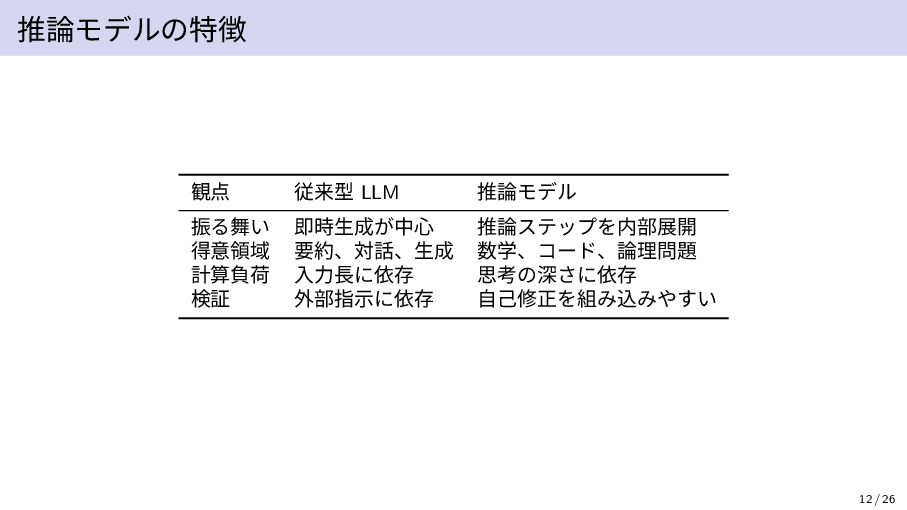
推論モデルの特徴 観点 従来型 LLM 推論モデル 振る舞い 即時生成が中心 推論ステップを内部展開 得意領域 要約、対話、生成
数学、コード、論理問題 計算負荷 入力長に依存 思考の深さに依存 検証 外部指示に依存 自己修正を組み込みやすい 12 / 26 -
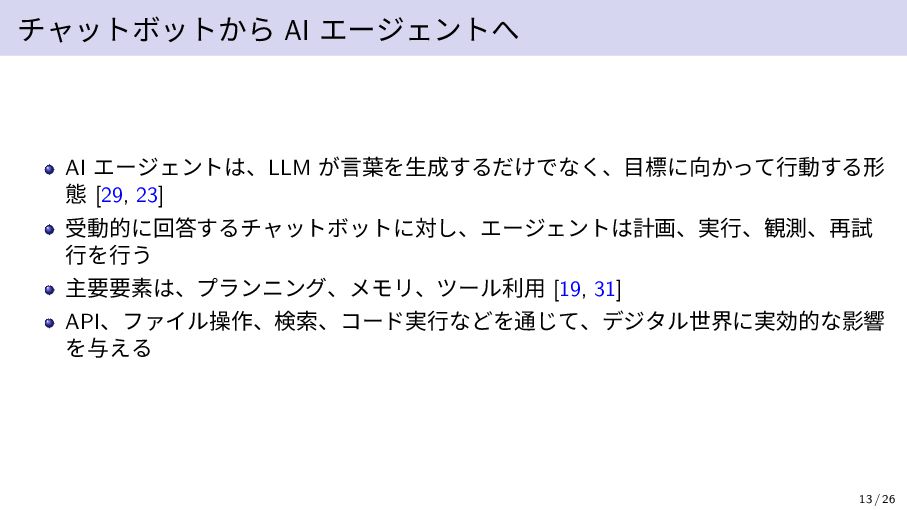
チャットボットから AI エージェントへ AI エージェントは、LLM が言葉を生成するだけでなく、目標に向かって行動する形 態 [29, 23] 受動的に回答するチャットボットに対し、エージェントは計画、実行、観測、再試
行を行う 主要要素は、プランニング、メモリ、ツール利用 [19, 31] API、ファイル操作、検索、コード実行などを通じて、デジタル世界に実効的な影響 を与える 13 / 26 -
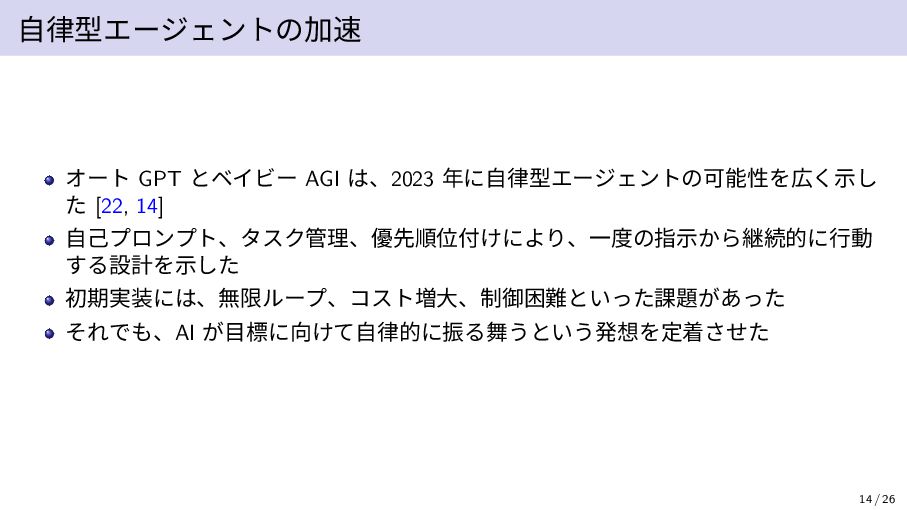
自律型エージェントの加速 オート GPT とベイビー AGI は、2023 年に自律型エージェントの可能性を広く示し た [22, 14]
自己プロンプト、タスク管理、優先順位付けにより、一度の指示から継続的に行動 する設計を示した 初期実装には、無限ループ、コスト増大、制御困難といった課題があった それでも、AI が目標に向けて自律的に振る舞うという発想を定着させた 14 / 26 -
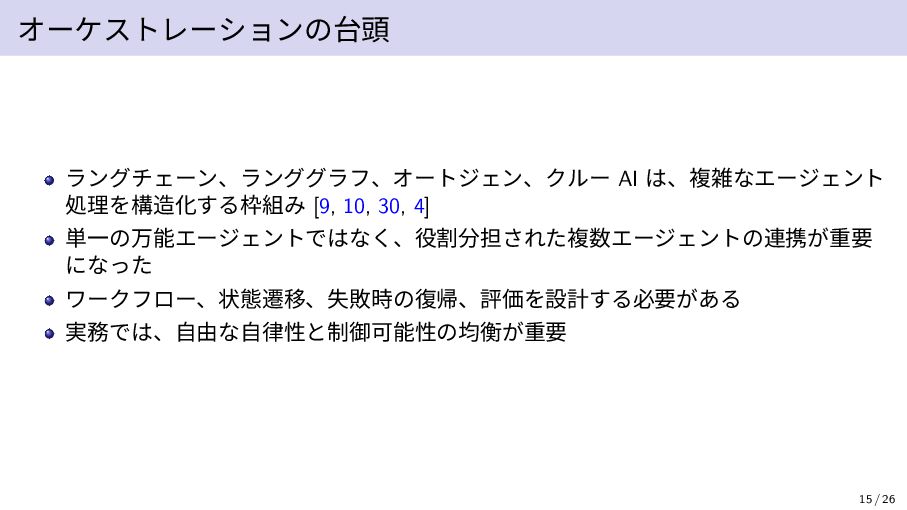
オーケストレーションの台頭 ラングチェーン、ランググラフ、オートジェン、クルー AI は、複雑なエージェント 処理を構造化する枠組み [9, 10, 30, 4] 単一の万能エージェントではなく、役割分担された複数エージェントの連携が重要
になった ワークフロー、状態遷移、失敗時の復帰、評価を設計する必要がある 実務では、自由な自律性と制御可能性の均衡が重要 15 / 26 -
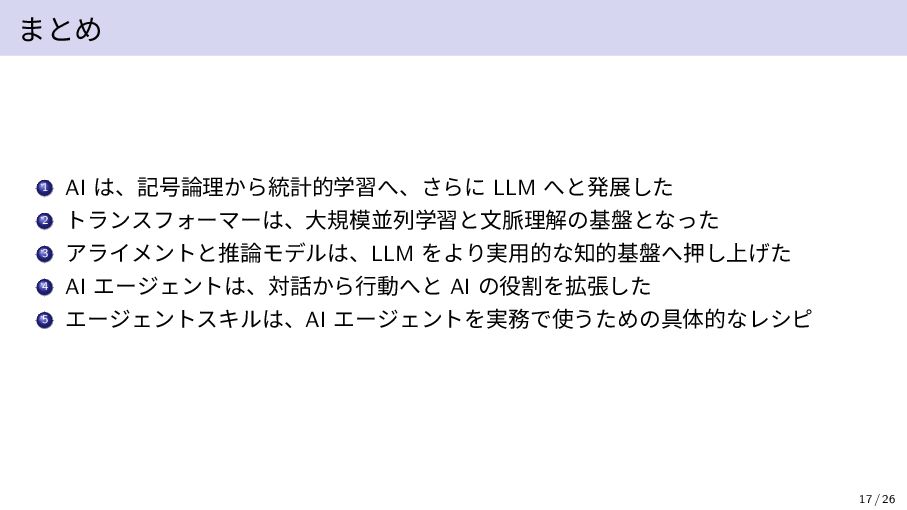
まとめ 1 AI は、記号論理から統計的学習へ、さらに LLM へと発展した 2 トランスフォーマーは、大規模並列学習と文脈理解の基盤となった 3 アライメントと推論モデルは、LLM
をより実用的な知的基盤へ押し上げた 4 AI エージェントは、対話から行動へと AI の役割を拡張した 5 エージェントスキルは、AI エージェントを実務で使うための具体的なレシピ 17 / 26 -
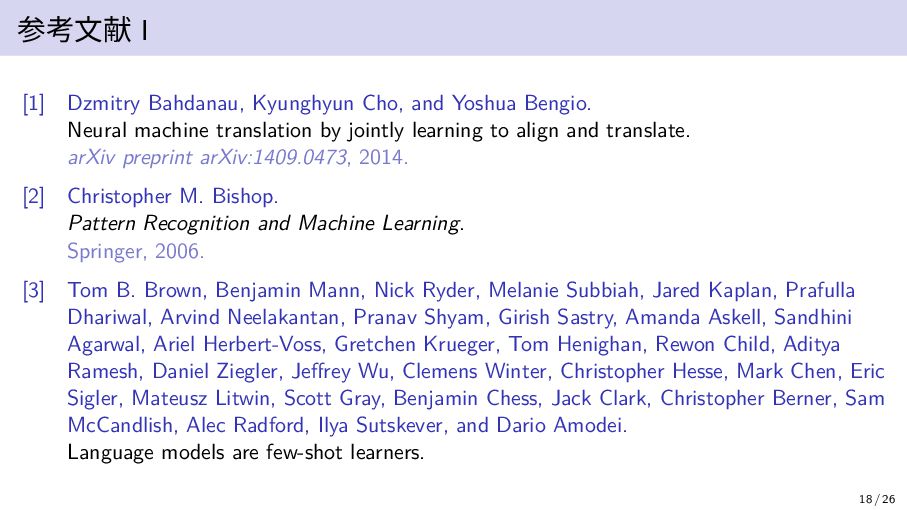
参考文献 I [1] Dzmitry Bahdanau, Kyunghyun Cho, and Yoshua Bengio.
Neural machine translation by jointly learning to align and translate. arXiv preprint arXiv:1409.0473, 2014. [2] Christopher M. Bishop. Pattern Recognition and Machine Learning. Springer, 2006. [3] Tom B. Brown, Benjamin Mann, Nick Ryder, Melanie Subbiah, Jared Kaplan, Prafulla Dhariwal, Arvind Neelakantan, Pranav Shyam, Girish Sastry, Amanda Askell, Sandhini Agarwal, Ariel Herbert-Voss, Gretchen Krueger, Tom Henighan, Rewon Child, Aditya Ramesh, Daniel Ziegler, Jeffrey Wu, Clemens Winter, Christopher Hesse, Mark Chen, Eric Sigler, Mateusz Litwin, Scott Gray, Benjamin Chess, Jack Clark, Christopher Berner, Sam McCandlish, Alec Radford, Ilya Sutskever, and Dario Amodei. Language models are few-shot learners. 18 / 26 -
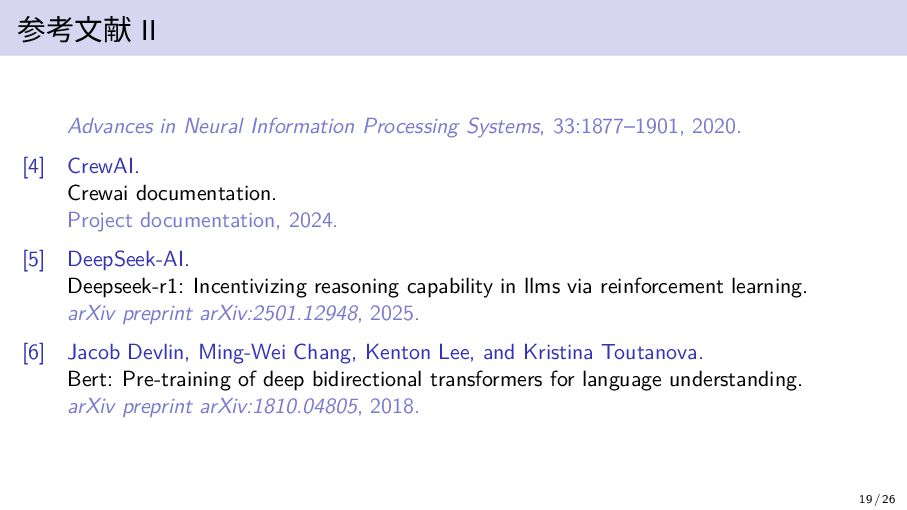
参考文献 II Advances in Neural Information Processing Systems, 33:1877–1901, 2020.
[4] CrewAI. Crewai documentation. Project documentation, 2024. [5] DeepSeek-AI. Deepseek-r1: Incentivizing reasoning capability in llms via reinforcement learning. arXiv preprint arXiv:2501.12948, 2025. [6] Jacob Devlin, Ming-Wei Chang, Kenton Lee, and Kristina Toutanova. Bert: Pre-training of deep bidirectional transformers for language understanding. arXiv preprint arXiv:1810.04805, 2018. 19 / 26 -
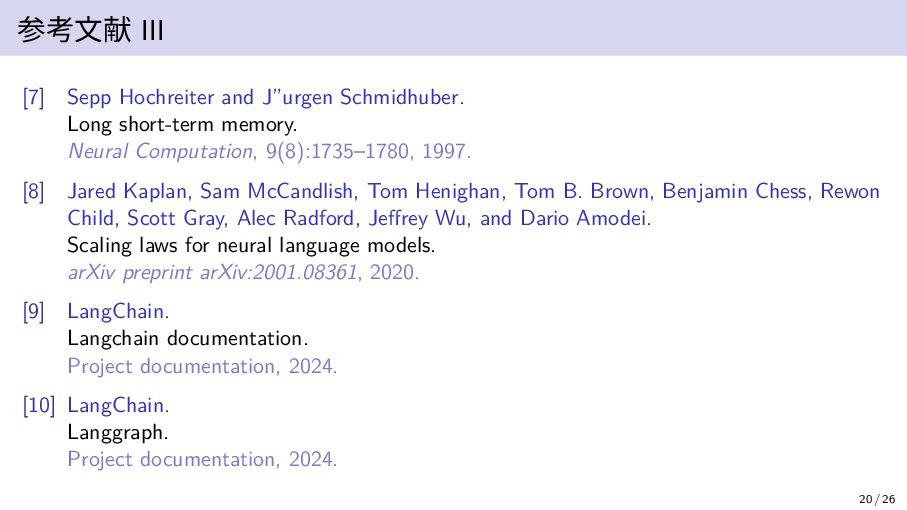
参考文献 III [7] Sepp Hochreiter and J”urgen Schmidhuber. Long short-term
memory. Neural Computation, 9(8):1735–1780, 1997. [8] Jared Kaplan, Sam McCandlish, Tom Henighan, Tom B. Brown, Benjamin Chess, Rewon Child, Scott Gray, Alec Radford, Jeffrey Wu, and Dario Amodei. Scaling laws for neural language models. arXiv preprint arXiv:2001.08361, 2020. [9] LangChain. Langchain documentation. Project documentation, 2024. [10] LangChain. Langgraph. Project documentation, 2024. 20 / 26 -
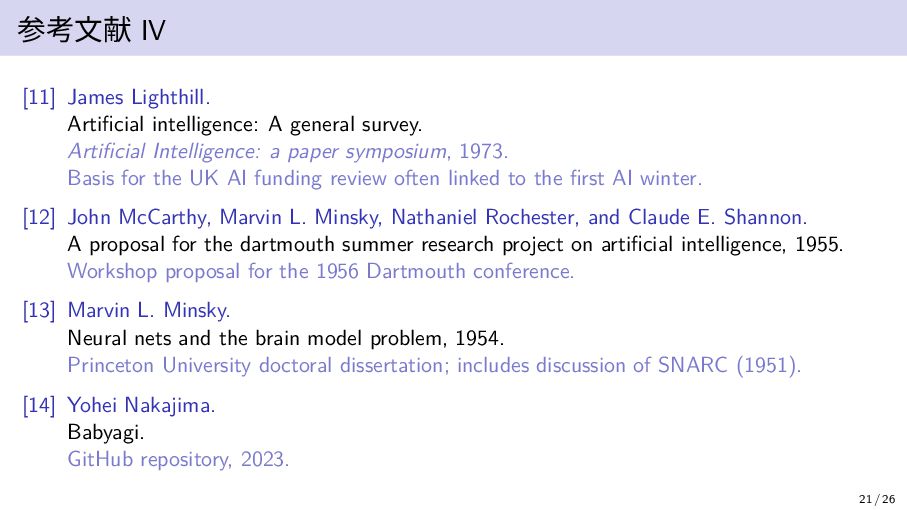
参考文献 IV [11] James Lighthill. Artificial intelligence: A general survey.
Artificial Intelligence: a paper symposium, 1973. Basis for the UK AI funding review often linked to the first AI winter. [12] John McCarthy, Marvin L. Minsky, Nathaniel Rochester, and Claude E. Shannon. A proposal for the dartmouth summer research project on artificial intelligence, 1955. Workshop proposal for the 1956 Dartmouth conference. [13] Marvin L. Minsky. Neural nets and the brain model problem, 1954. Princeton University doctoral dissertation; includes discussion of SNARC (1951). [14] Yohei Nakajima. Babyagi. GitHub repository, 2023. 21 / 26 -
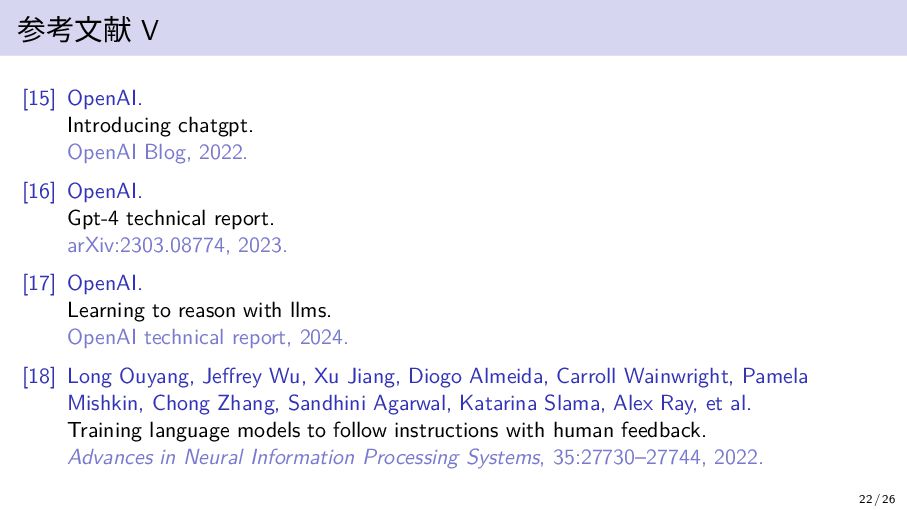
参考文献 V [15] OpenAI. Introducing chatgpt. OpenAI Blog, 2022. [16]
OpenAI. Gpt-4 technical report. arXiv:2303.08774, 2023. [17] OpenAI. Learning to reason with llms. OpenAI technical report, 2024. [18] Long Ouyang, Jeffrey Wu, Xu Jiang, Diogo Almeida, Carroll Wainwright, Pamela Mishkin, Chong Zhang, Sandhini Agarwal, Katarina Slama, Alex Ray, et al. Training language models to follow instructions with human feedback. Advances in Neural Information Processing Systems, 35:27730–27744, 2022. 22 / 26 -
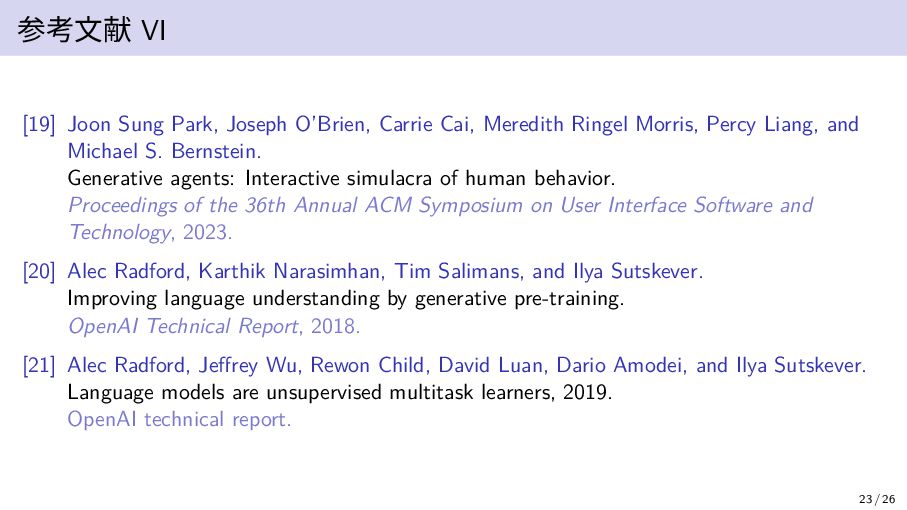
参考文献 VI [19] Joon Sung Park, Joseph O’Brien, Carrie Cai,
Meredith Ringel Morris, Percy Liang, and Michael S. Bernstein. Generative agents: Interactive simulacra of human behavior. Proceedings of the 36th Annual ACM Symposium on User Interface Software and Technology, 2023. [20] Alec Radford, Karthik Narasimhan, Tim Salimans, and Ilya Sutskever. Improving language understanding by generative pre-training. OpenAI Technical Report, 2018. [21] Alec Radford, Jeffrey Wu, Rewon Child, David Luan, Dario Amodei, and Ilya Sutskever. Language models are unsupervised multitask learners, 2019. OpenAI technical report. 23 / 26 -
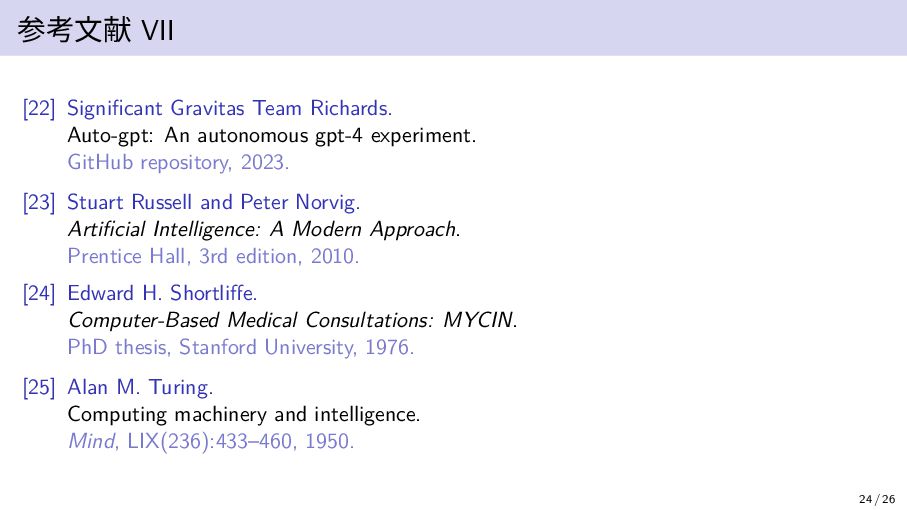
参考文献 VII [22] Significant Gravitas Team Richards. Auto-gpt: An autonomous
gpt-4 experiment. GitHub repository, 2023. [23] Stuart Russell and Peter Norvig. Artificial Intelligence: A Modern Approach. Prentice Hall, 3rd edition, 2010. [24] Edward H. Shortliffe. Computer-Based Medical Consultations: MYCIN. PhD thesis, Stanford University, 1976. [25] Alan M. Turing. Computing machinery and intelligence. Mind, LIX(236):433–460, 1950. 24 / 26 -
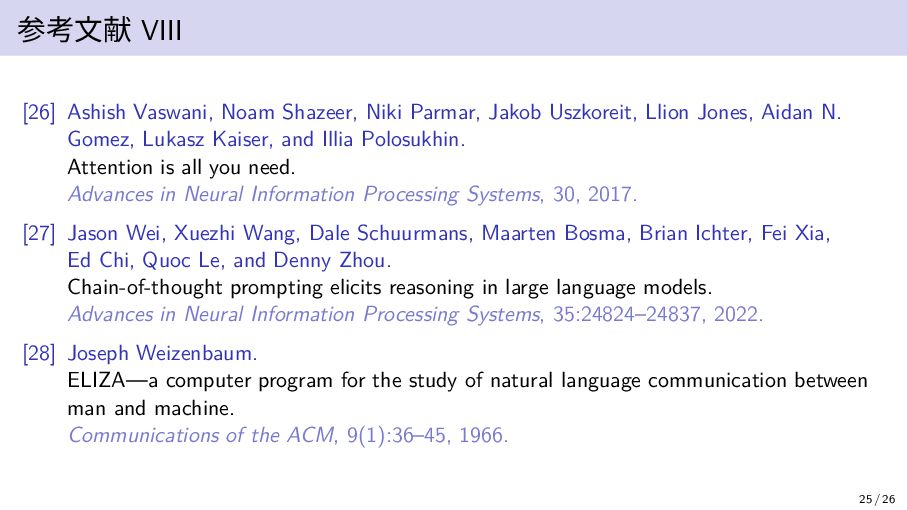
参考文献 VIII [26] Ashish Vaswani, Noam Shazeer, Niki Parmar, Jakob
Uszkoreit, Llion Jones, Aidan N. Gomez, Lukasz Kaiser, and Illia Polosukhin. Attention is all you need. Advances in Neural Information Processing Systems, 30, 2017. [27] Jason Wei, Xuezhi Wang, Dale Schuurmans, Maarten Bosma, Brian Ichter, Fei Xia, Ed Chi, Quoc Le, and Denny Zhou. Chain-of-thought prompting elicits reasoning in large language models. Advances in Neural Information Processing Systems, 35:24824–24837, 2022. [28] Joseph Weizenbaum. ELIZA—a computer program for the study of natural language communication between man and machine. Communications of the ACM, 9(1):36–45, 1966. 25 / 26 -
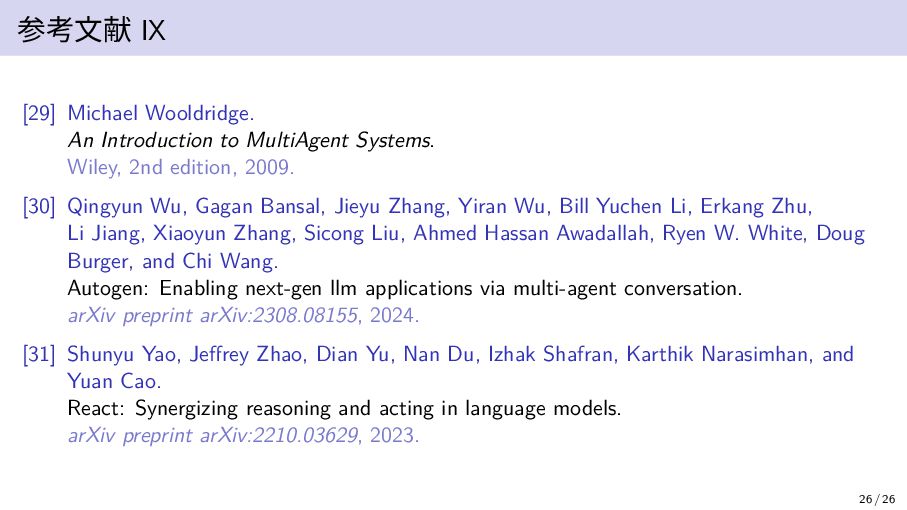
参考文献 IX [29] Michael Wooldridge. An Introduction to MultiAgent Systems.
Wiley, 2nd edition, 2009. [30] Qingyun Wu, Gagan Bansal, Jieyu Zhang, Yiran Wu, Bill Yuchen Li, Erkang Zhu, Li Jiang, Xiaoyun Zhang, Sicong Liu, Ahmed Hassan Awadallah, Ryen W. White, Doug Burger, and Chi Wang. Autogen: Enabling next-gen llm applications via multi-agent conversation. arXiv preprint arXiv:2308.08155, 2024. [31] Shunyu Yao, Jeffrey Zhao, Dian Yu, Nan Du, Izhak Shafran, Karthik Narasimhan, and Yuan Cao. React: Synergizing reasoning and acting in language models. arXiv preprint arXiv:2210.03629, 2023. 26 / 26