Upgrade to Pro — share decks privately, control downloads, hide ads and more …

Biological Source, Chemical Constituents And Th...

Biological Source, Chemical Constituents And Therapeutic Efficacy of Crude Drug (Part-I)

* **Laxatives (e.g., Senna):** Dried leaflets of *Cassia angustifolia* (Fabaceae). Contains anthraquinone glycosides (**sennosides A and B**). Stimulates colon peristalsis and inhibits water absorption to relieve acute and habitual constipation.
* **Cardiotonics (e.g., Digitalis):** Dried leaves of *Digitalis purpurea* (Plantaginaceae). Rich in cardiac glycosides (**digoxin and digitoxin**). Exerts a positive inotropic effect by inhibiting the Na⁺/K⁺-ATPase pump, strengthening myocardial contraction in congestive heart failure.
* **Carminatives & G.I. Regulators (e.g., Fennel):** Dried ripe fruits of *Foeniculum vulgare* (Apiaceae). Contains volatile oils (**anethole and fenchone**). Relieves gastrointestinal flatulence, eases visceral smooth-muscle spasms, and stimulates digestion.

Avatar for Pawan Kumar Sahu

Pawan Kumar Sahu

October 15, 2026

More Decks by Pawan Kumar Sahu

Other Decks in Education

Transcript

  1. Biological Source, Chemical Constituents And Therapeutic Efficacy of Crude Drug

    (Part-I) Department of Pharmacy | Pawan Kumar Sahu, Lecturer, Rudauli College of Pharmacy, Ayodhya (U.P.)
  2. LAXATIVE A laxative is any medicine or substance used to

    relieve constipation (difficulty passing stool) and encourage the evacuation or clearance of stool. Department of Pharmacy | Pawan Kumar Sahu, Lecturer, Rudauli College of Pharmacy, Ayodhya (U.P.) They are generally classified into four primary types: Saline Purgatives Fecal Softeners (Stool Softeners) Contact Purgatives (Stimulant Laxatives) Bulk Laxatives
  3. 1. Aloe Synonyms: Musabbar, Kumari, Aloe. Biological Source: Aloe is

    the dried juice obtained from the leaves of various species of Aloe, mainly Aloe barbadensis Miller (Curacao aloes), Aloe ferox Miller (Cape aloes), and Aloe perryi (Socotrine and Zanzibar varieties). Family: Liliaceae. Geographical Sources: It is indigenous (natively found) to eastern and southern Africa, and is widely cultivated in Europe and many parts of India. Department of Pharmacy | Pawan Kumar Sahu, Lecturer, Rudauli College of Pharmacy, Ayodhya (U.P.)
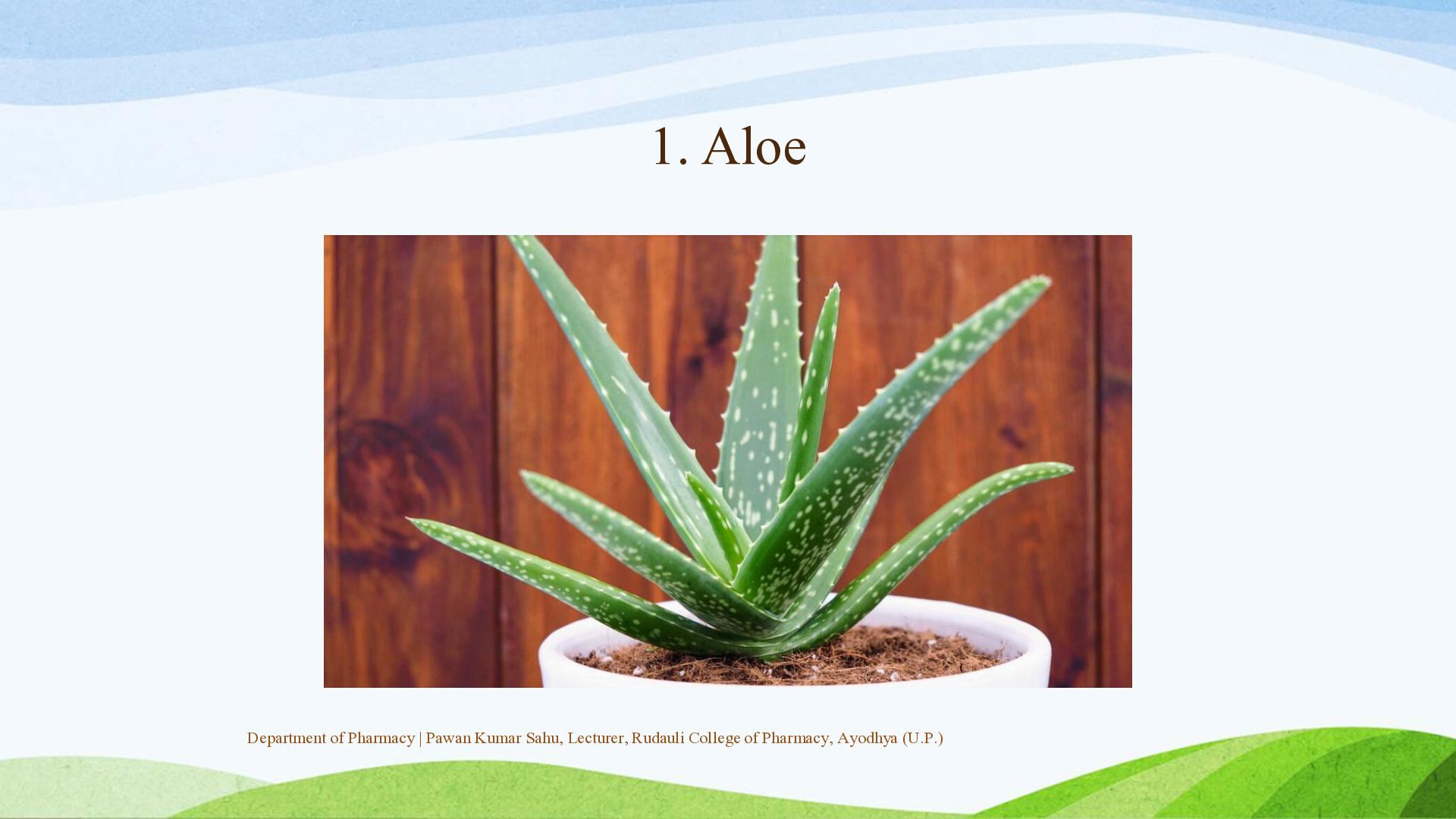
  4. 1. Aloe Department of Pharmacy | Pawan Kumar Sahu, Lecturer,

    Rudauli College of Pharmacy, Ayodhya (U.P.)
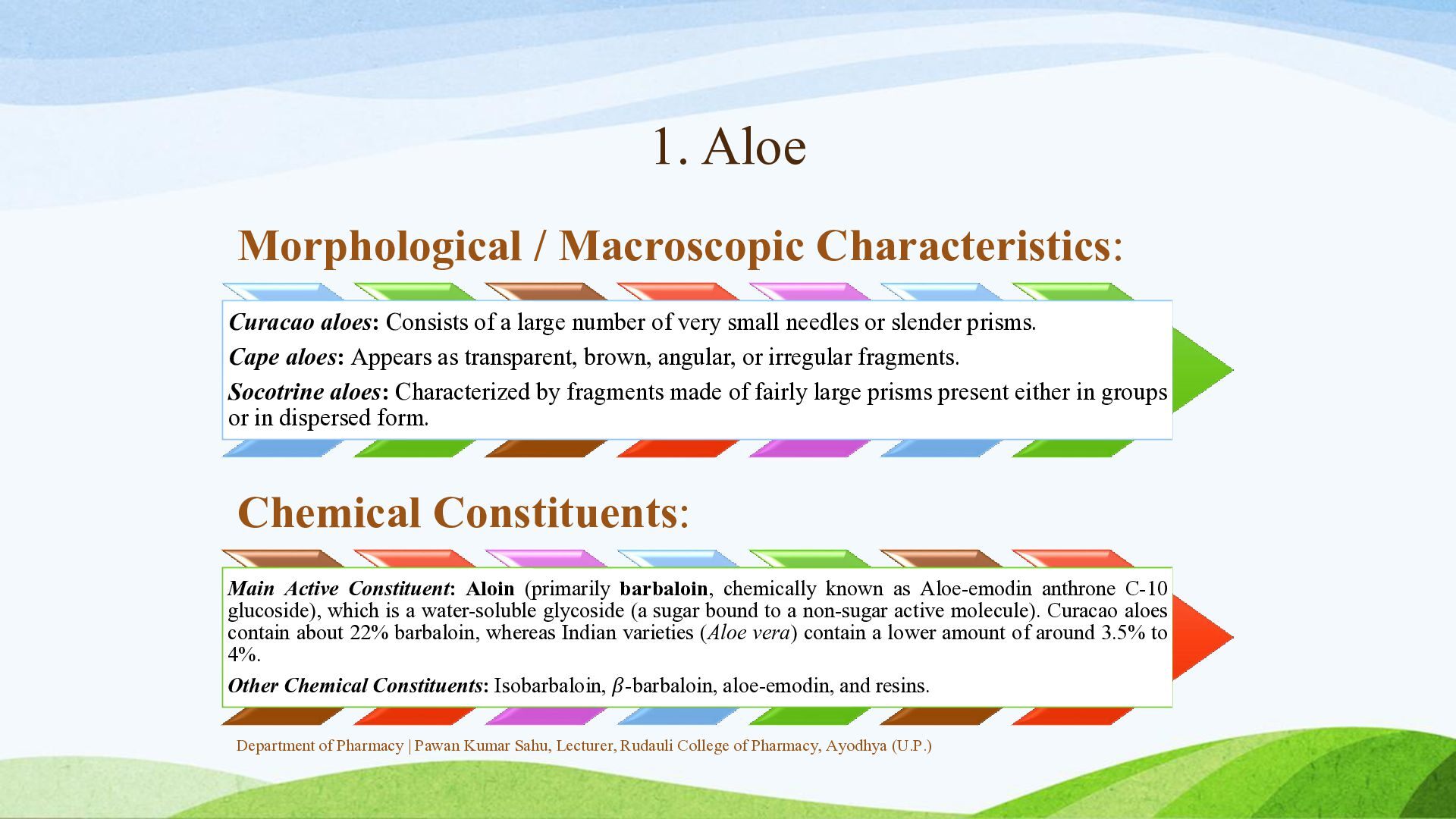
  5. 1. Aloe Morphological / Macroscopic Characteristics: Curacao aloes: Consists of

    a large number of very small needles or slender prisms. Cape aloes: Appears as transparent, brown, angular, or irregular fragments. Socotrine aloes: Characterized by fragments made of fairly large prisms present either in groups or in dispersed form. Chemical Constituents: Main Active Constituent: Aloin (primarily barbaloin, chemically known as Aloe-emodin anthrone C-10 glucoside), which is a water-soluble glycoside (a sugar bound to a non-sugar active molecule). Curacao aloes contain about 22% barbaloin, whereas Indian varieties (Aloe vera) contain a lower amount of around 3.5% to 4%. Other Chemical Constituents: Isobarbaloin, 𝛽-barbaloin, aloe-emodin, and resins. start equation beta Department of Pharmacy | Pawan Kumar Sahu, Lecturer, Rudauli College of Pharmacy, Ayodhya (U.P.)
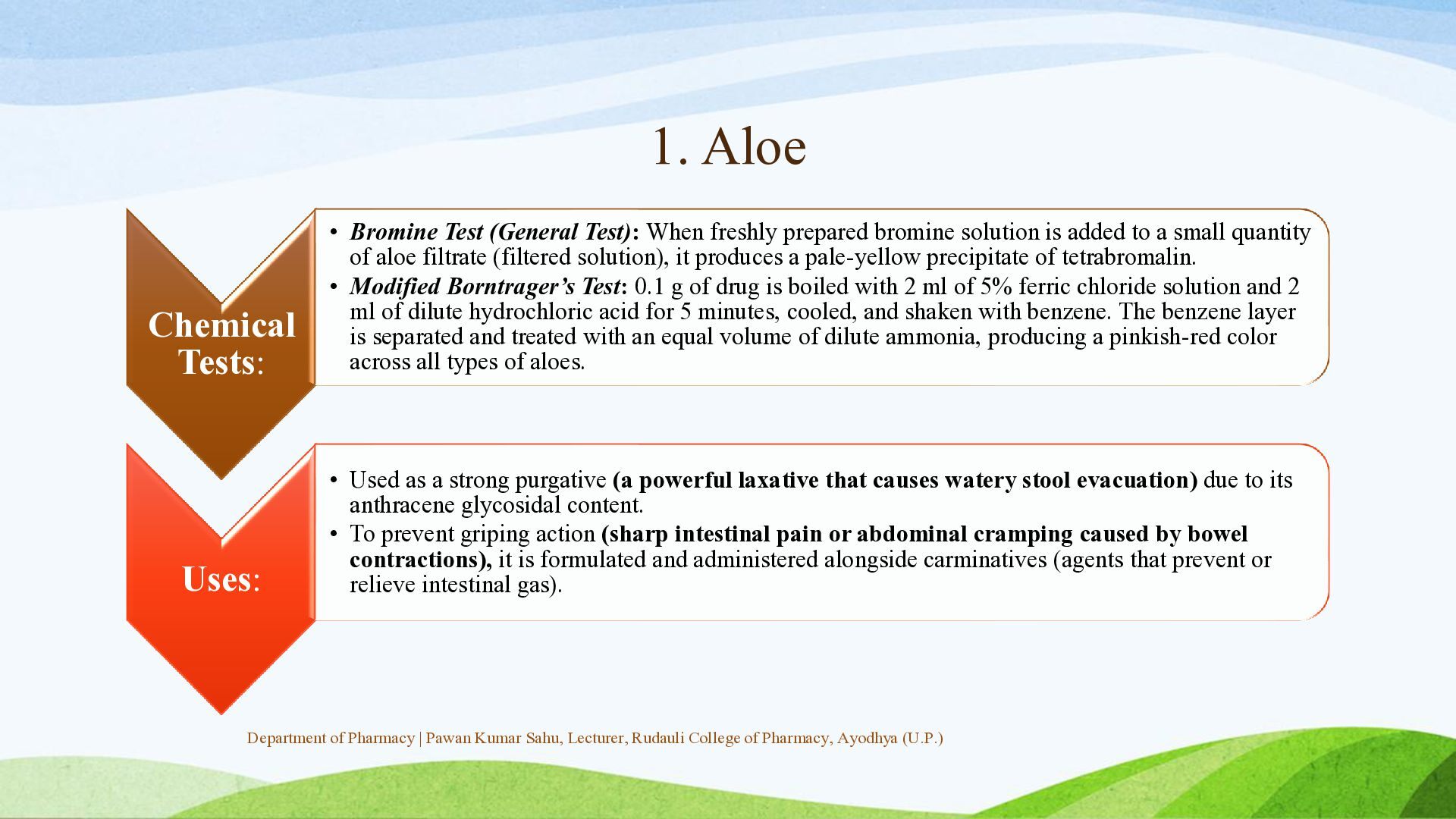
  6. 1. Aloe Chemical Tests: • Bromine Test (General Test): When

    freshly prepared bromine solution is added to a small quantity of aloe filtrate (filtered solution), it produces a pale-yellow precipitate of tetrabromalin. • Modified Borntrager’s Test: 0.1 g of drug is boiled with 2 ml of 5% ferric chloride solution and 2 ml of dilute hydrochloric acid for 5 minutes, cooled, and shaken with benzene. The benzene layer is separated and treated with an equal volume of dilute ammonia, producing a pinkish-red color across all types of aloes. Uses: • Used as a strong purgative (a powerful laxative that causes watery stool evacuation) due to its anthracene glycosidal content. • To prevent griping action (sharp intestinal pain or abdominal cramping caused by bowel contractions), it is formulated and administered alongside carminatives (agents that prevent or relieve intestinal gas). Department of Pharmacy | Pawan Kumar Sahu, Lecturer, Rudauli College of Pharmacy, Ayodhya (U.P.)
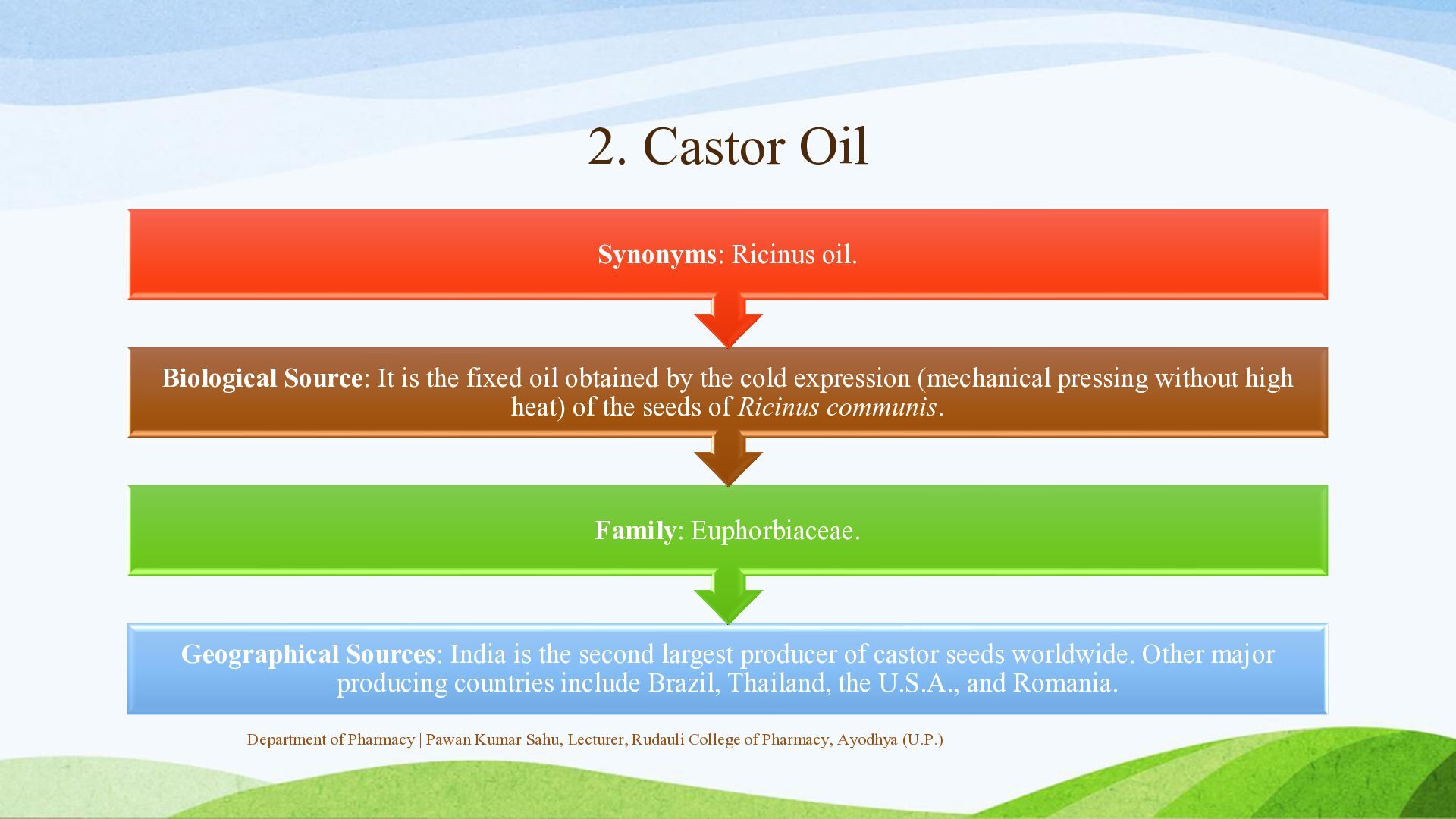
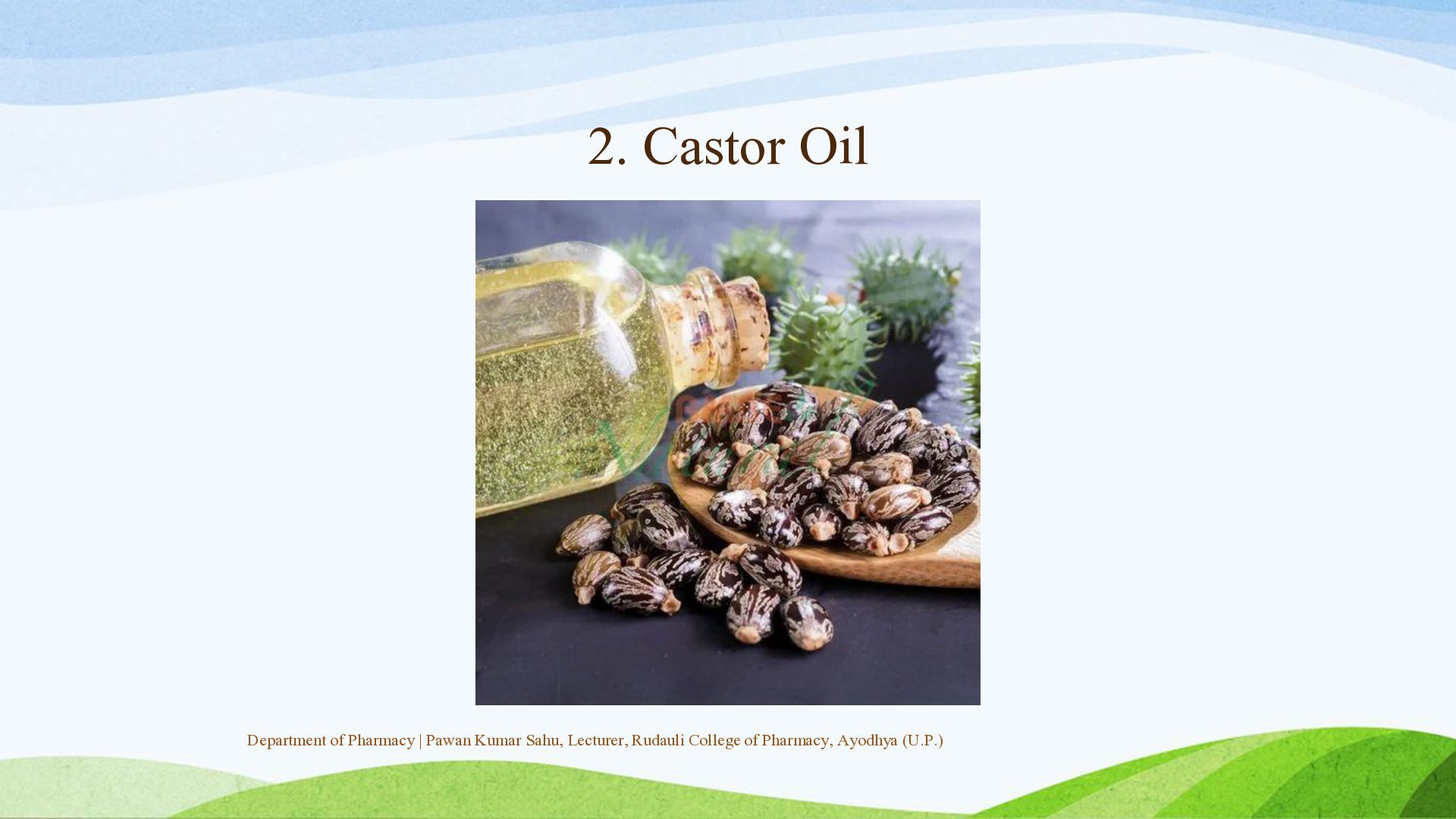
  7. 2. Castor Oil Synonyms: Ricinus oil. Biological Source: It is

    the fixed oil obtained by the cold expression (mechanical pressing without high heat) of the seeds of Ricinus communis. Family: Euphorbiaceae. Geographical Sources: India is the second largest producer of castor seeds worldwide. Other major producing countries include Brazil, Thailand, the U.S.A., and Romania. Department of Pharmacy | Pawan Kumar Sahu, Lecturer, Rudauli College of Pharmacy, Ayodhya (U.P.)
  8. 2. Castor Oil Department of Pharmacy | Pawan Kumar Sahu,

    Lecturer, Rudauli College of Pharmacy, Ayodhya (U.P.)
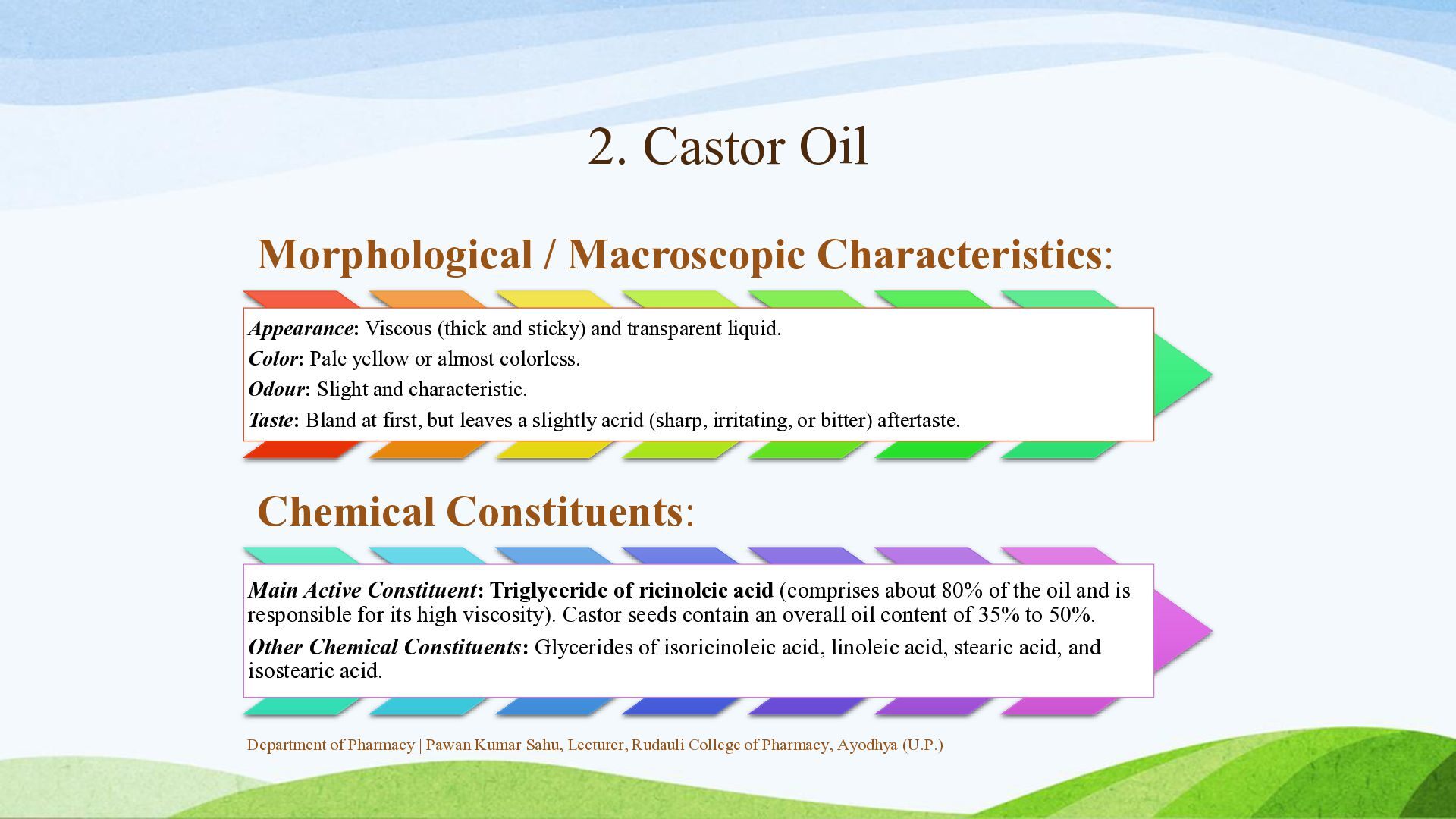
  9. 2. Castor Oil Morphological / Macroscopic Characteristics: Appearance: Viscous (thick

    and sticky) and transparent liquid. Color: Pale yellow or almost colorless. Odour: Slight and characteristic. Taste: Bland at first, but leaves a slightly acrid (sharp, irritating, or bitter) aftertaste. Chemical Constituents: Main Active Constituent: Triglyceride of ricinoleic acid (comprises about 80% of the oil and is responsible for its high viscosity). Castor seeds contain an overall oil content of 35% to 50%. Other Chemical Constituents: Glycerides of isoricinoleic acid, linoleic acid, stearic acid, and isostearic acid. Department of Pharmacy | Pawan Kumar Sahu, Lecturer, Rudauli College of Pharmacy, Ayodhya (U.P.)
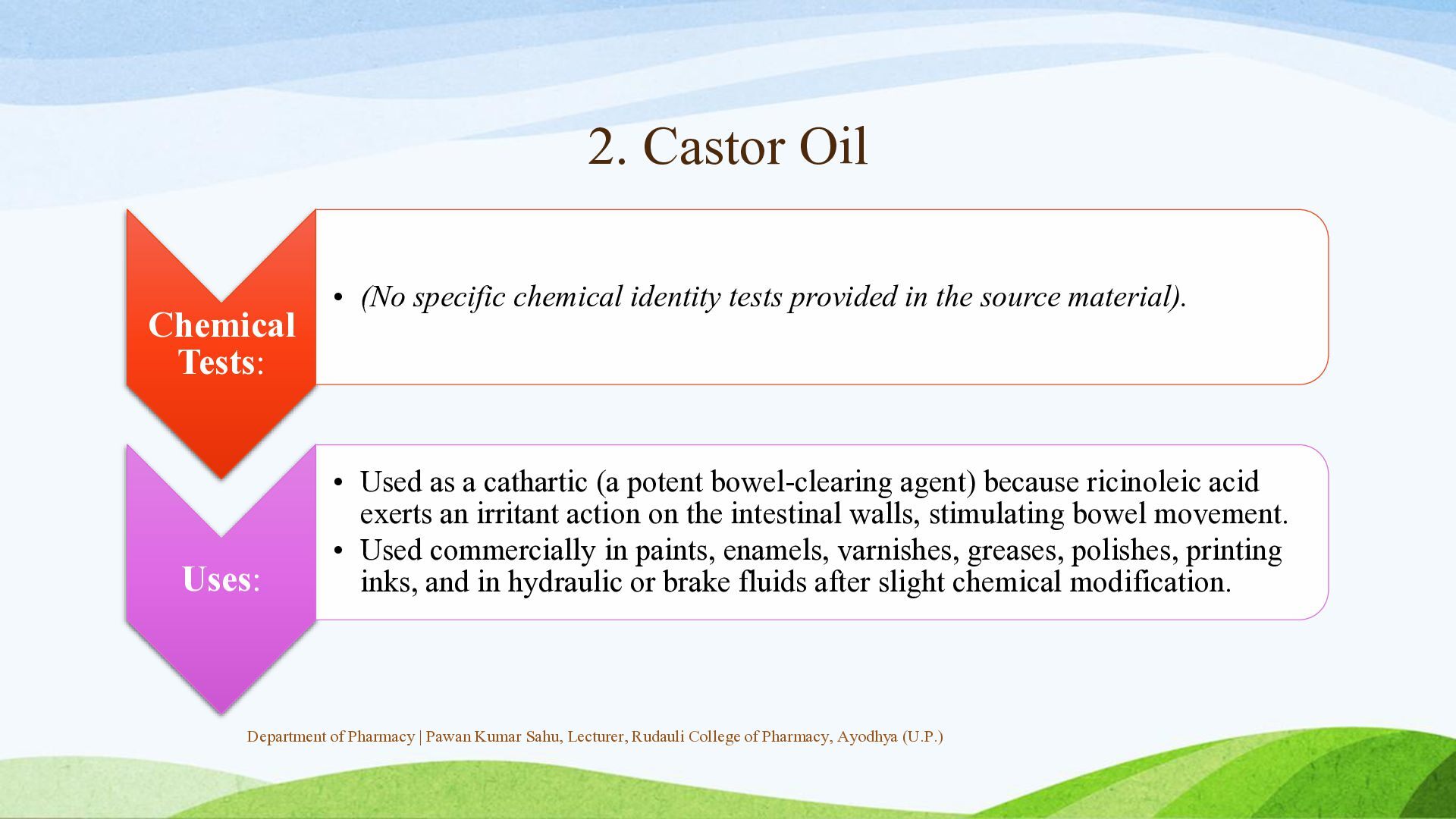
  10. 2. Castor Oil Chemical Tests: Uses: • (No specific chemical

    identity tests provided in the source material). • Used as a cathartic (a potent bowel-clearing agent) because ricinoleic acid exerts an irritant action on the intestinal walls, stimulating bowel movement. • Used commercially in paints, enamels, varnishes, greases, polishes, printing inks, and in hydraulic or brake fluids after slight chemical modification. Department of Pharmacy | Pawan Kumar Sahu, Lecturer, Rudauli College of Pharmacy, Ayodhya (U.P.)
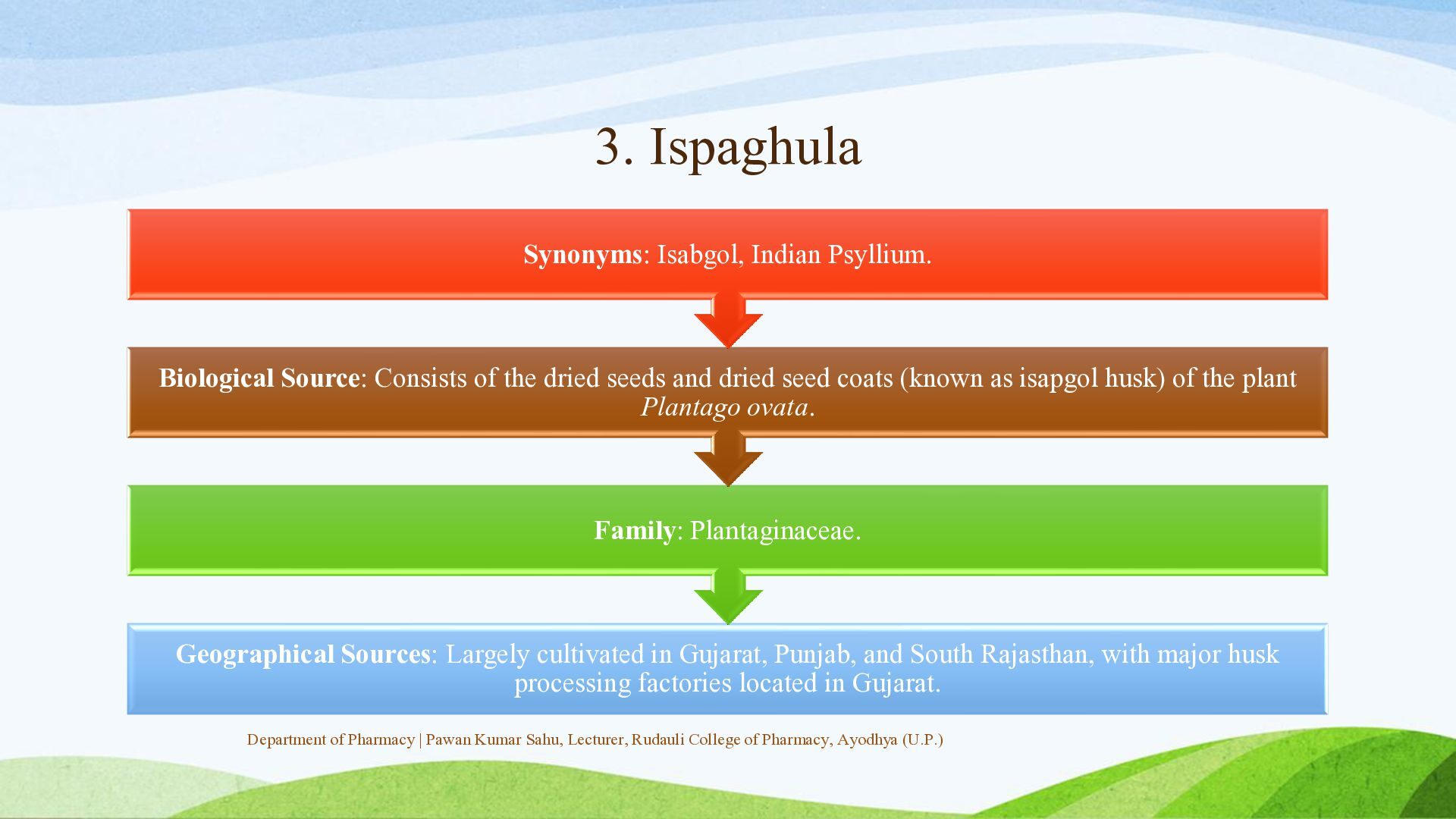
  11. 3. Ispaghula Synonyms: Isabgol, Indian Psyllium. Biological Source: Consists of

    the dried seeds and dried seed coats (known as isapgol husk) of the plant Plantago ovata. Family: Plantaginaceae. Geographical Sources: Largely cultivated in Gujarat, Punjab, and South Rajasthan, with major husk processing factories located in Gujarat. Department of Pharmacy | Pawan Kumar Sahu, Lecturer, Rudauli College of Pharmacy, Ayodhya (U.P.)
  12. 3. Ispaghula Department of Pharmacy | Pawan Kumar Sahu, Lecturer,

    Rudauli College of Pharmacy, Ayodhya (U.P.)
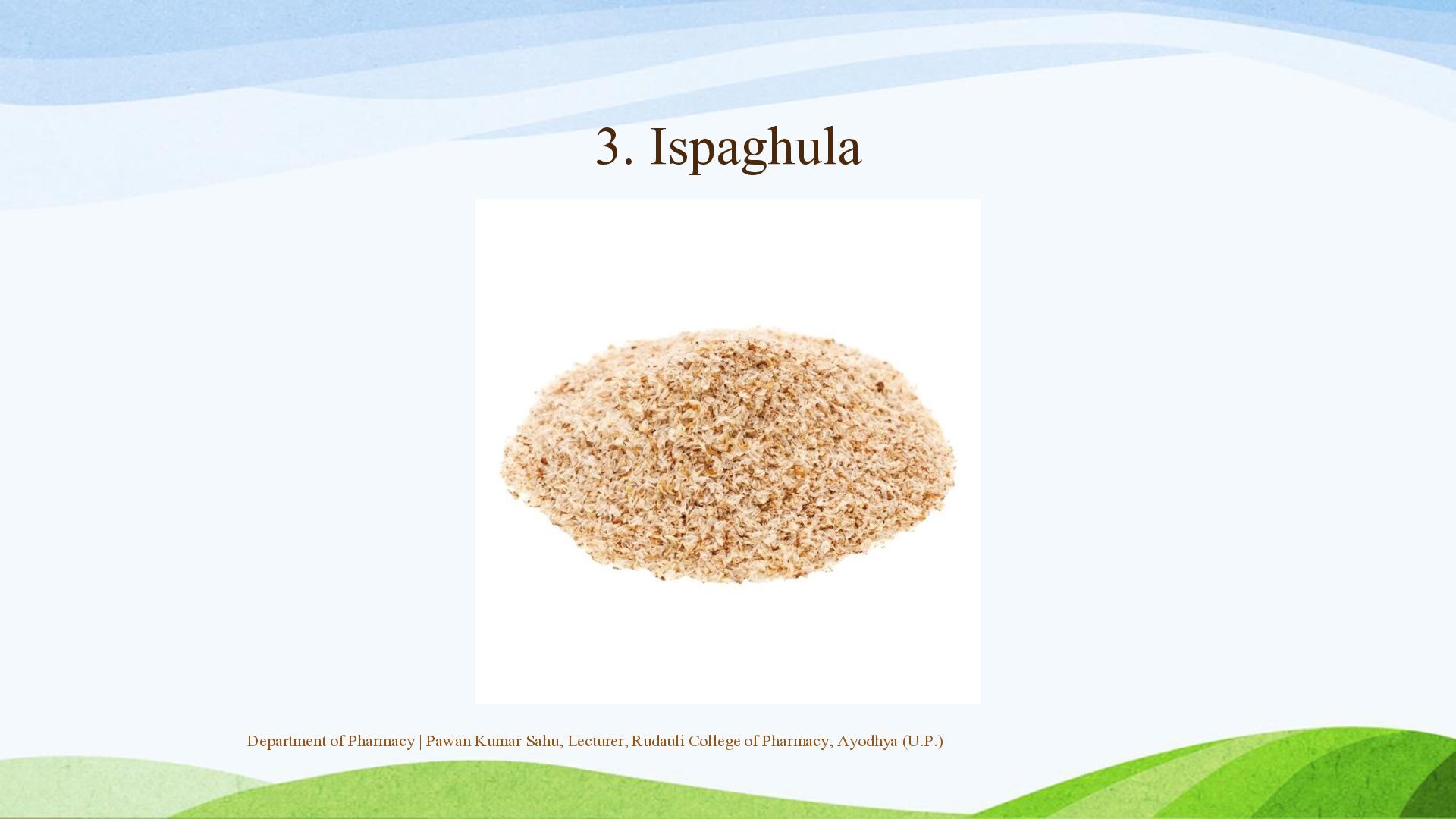
  13. 3. Ispaghula Morphological / Macroscopic Characteristics: Shape: Ovate-cymbiform (boat-shaped with

    an oval outline). The convex outer surface is smooth, translucent, and firm, with a central reddish-brown or grey oval spot. Color: Pinkish-grey to brown. Odour: None. Chemical Constituents: Main Active Constituent: Mucilage (a thick, gelatinous dietary fiber present in the seed epidermis). Other Chemical Constituents: Pentosans, aldobionic acid, and hydrolysis products including xylose, arabinose, galacturonic acid, and rhamnose. Department of Pharmacy | Pawan Kumar Sahu, Lecturer, Rudauli College of Pharmacy, Ayodhya (U.P.)
  14. 3. Ispaghula Chemical Tests: • Swelling Factor Test (Purity Criterion):

    1 g of drug is placed in 20 ml of water with occasional shaking and allowed to stand for 24 hours. The final volume occupied by the swollen seeds is measured to determine the swelling index/factor. • Ruthenium Red Test: Treating ispaghula with ruthenium red solution imparts a distinct pink color due to the presence of mucilage. Uses: • Used as a bulk-forming laxative to treat constipation and as an emollient (a soothing agent that coats and softens irritated mucous membranes). • Used in pharmacy as an enteric coating material (a coating that resists stomach acid and dissolves in the intestine), a tablet disintegrator (an agent that helps tablets break apart upon swallowing), and in sustained-release formulations. Department of Pharmacy | Pawan Kumar Sahu, Lecturer, Rudauli College of Pharmacy, Ayodhya (U.P.)
  15. 4. Senna Synonyms: Alexandrian senna, Tinnevelley senna, Folia sennae. Biological

    Source: Consists of the dried leaflets of Cassia acutifolia (Alexandrian senna) and Cassia angustifolia Vahl. (Tinnevelley senna). Family: Leguminosae. Geographical Sources: Alexandrian senna: Indigenous to South Africa, tropical Africa, middle and upper Nile territories, and especially Sudan. Tinnevelley senna: Cultivated extensively in India, primarily in the Madurai and Ramanathapuram districts of Tamil Nadu. Department of Pharmacy | Pawan Kumar Sahu, Lecturer, Rudauli College of Pharmacy, Ayodhya (U.P.)
  16. 4. Senna Department of Pharmacy | Pawan Kumar Sahu, Lecturer,

    Rudauli College of Pharmacy, Ayodhya (U.P.)
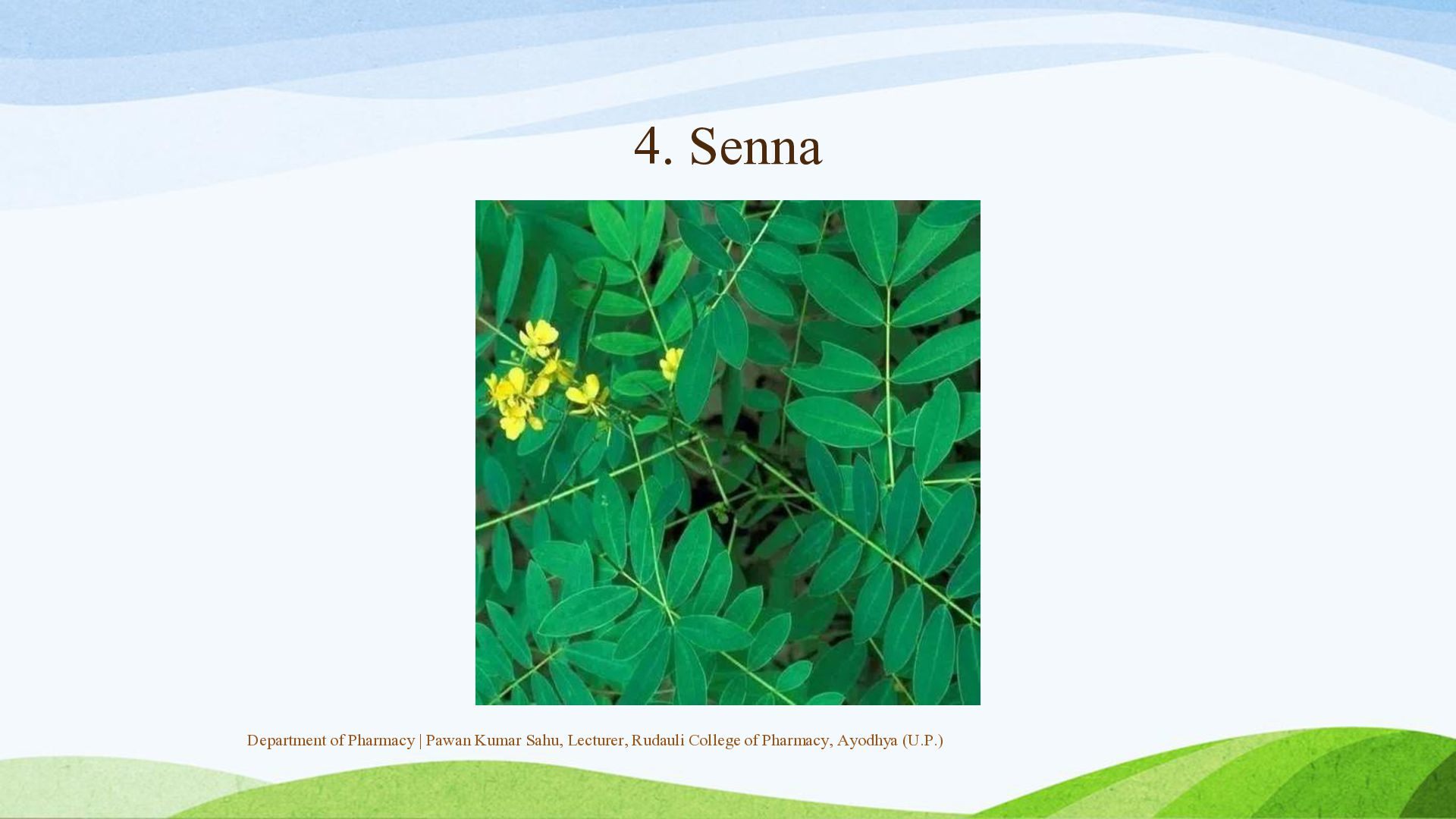
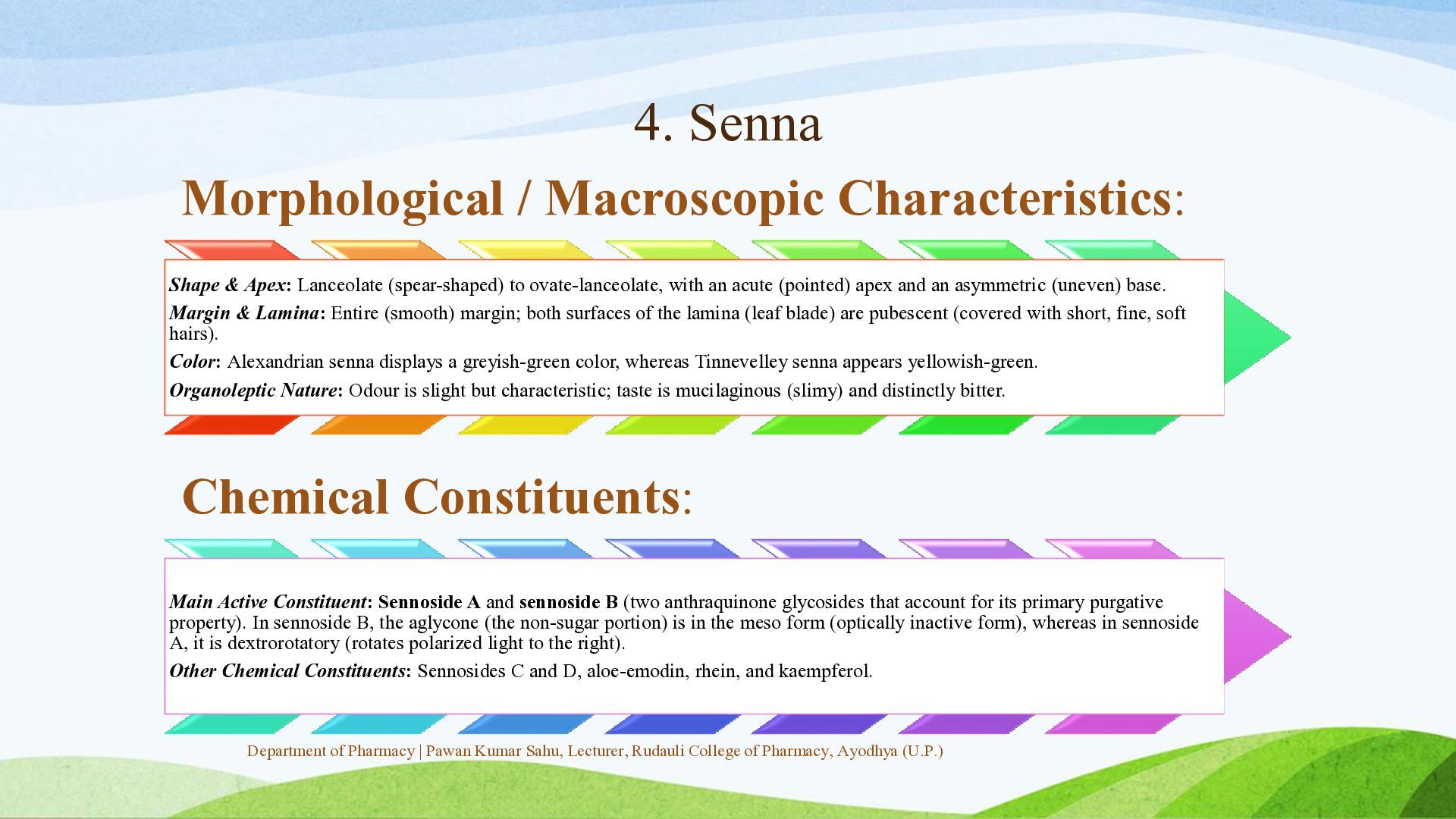
  17. 4. Senna Morphological / Macroscopic Characteristics: Shape & Apex: Lanceolate

    (spear-shaped) to ovate-lanceolate, with an acute (pointed) apex and an asymmetric (uneven) base. Margin & Lamina: Entire (smooth) margin; both surfaces of the lamina (leaf blade) are pubescent (covered with short, fine, soft hairs). Color: Alexandrian senna displays a greyish-green color, whereas Tinnevelley senna appears yellowish-green. Organoleptic Nature: Odour is slight but characteristic; taste is mucilaginous (slimy) and distinctly bitter. Chemical Constituents: Main Active Constituent: Sennoside A and sennoside B (two anthraquinone glycosides that account for its primary purgative property). In sennoside B, the aglycone (the non-sugar portion) is in the meso form (optically inactive form), whereas in sennoside A, it is dextrorotatory (rotates polarized light to the right). Other Chemical Constituents: Sennosides C and D, aloe-emodin, rhein, and kaempferol. Department of Pharmacy | Pawan Kumar Sahu, Lecturer, Rudauli College of Pharmacy, Ayodhya (U.P.)
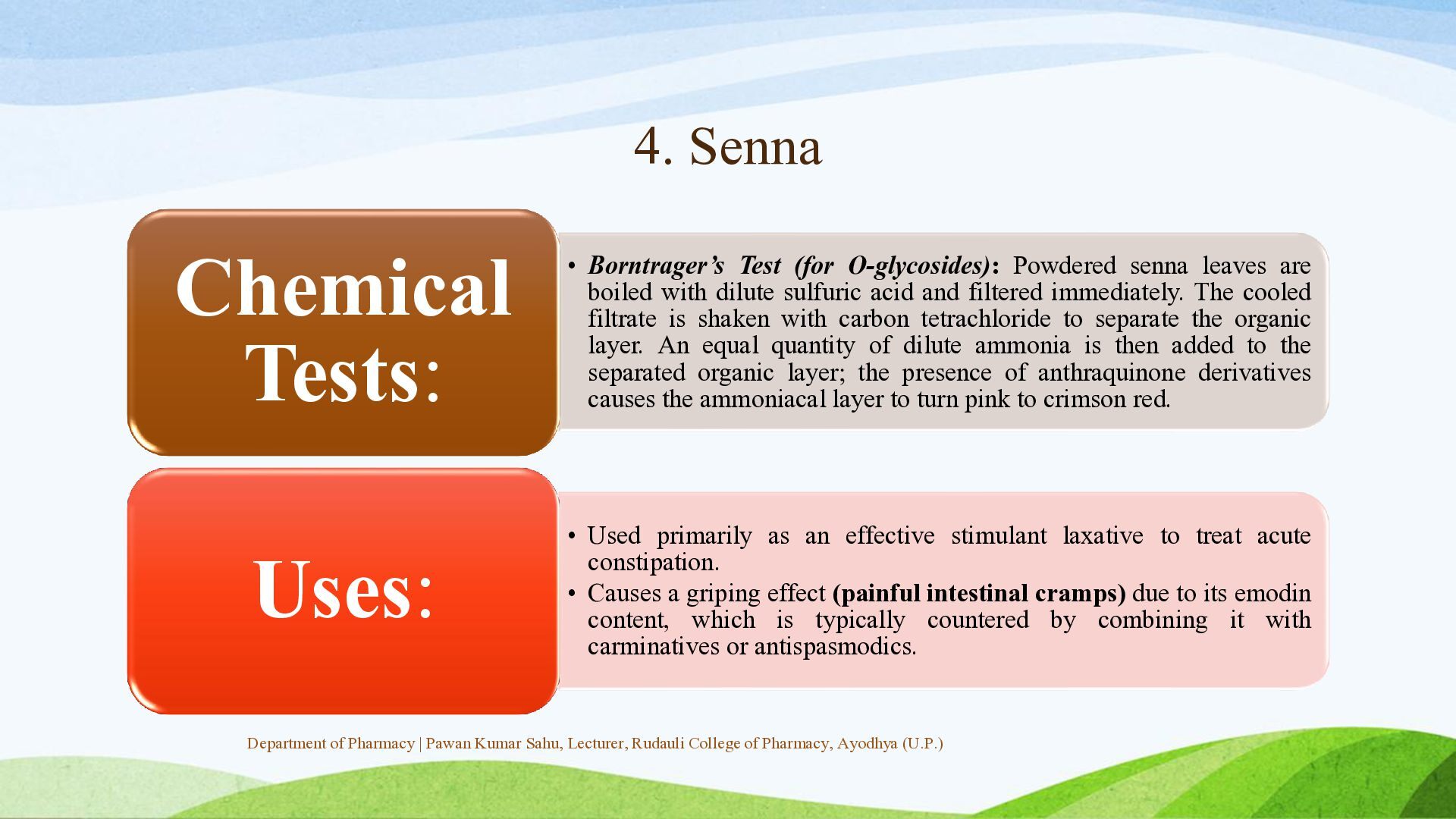
  18. 4. Senna Chemical Tests: • Borntrager’s Test (for O-glycosides): Powdered

    senna leaves are boiled with dilute sulfuric acid and filtered immediately. The cooled filtrate is shaken with carbon tetrachloride to separate the organic layer. An equal quantity of dilute ammonia is then added to the separated organic layer; the presence of anthraquinone derivatives causes the ammoniacal layer to turn pink to crimson red. Uses: • Used primarily as an effective stimulant laxative to treat acute constipation. • Causes a griping effect (painful intestinal cramps) due to its emodin content, which is typically countered by combining it with carminatives or antispasmodics. Department of Pharmacy | Pawan Kumar Sahu, Lecturer, Rudauli College of Pharmacy, Ayodhya (U.P.)
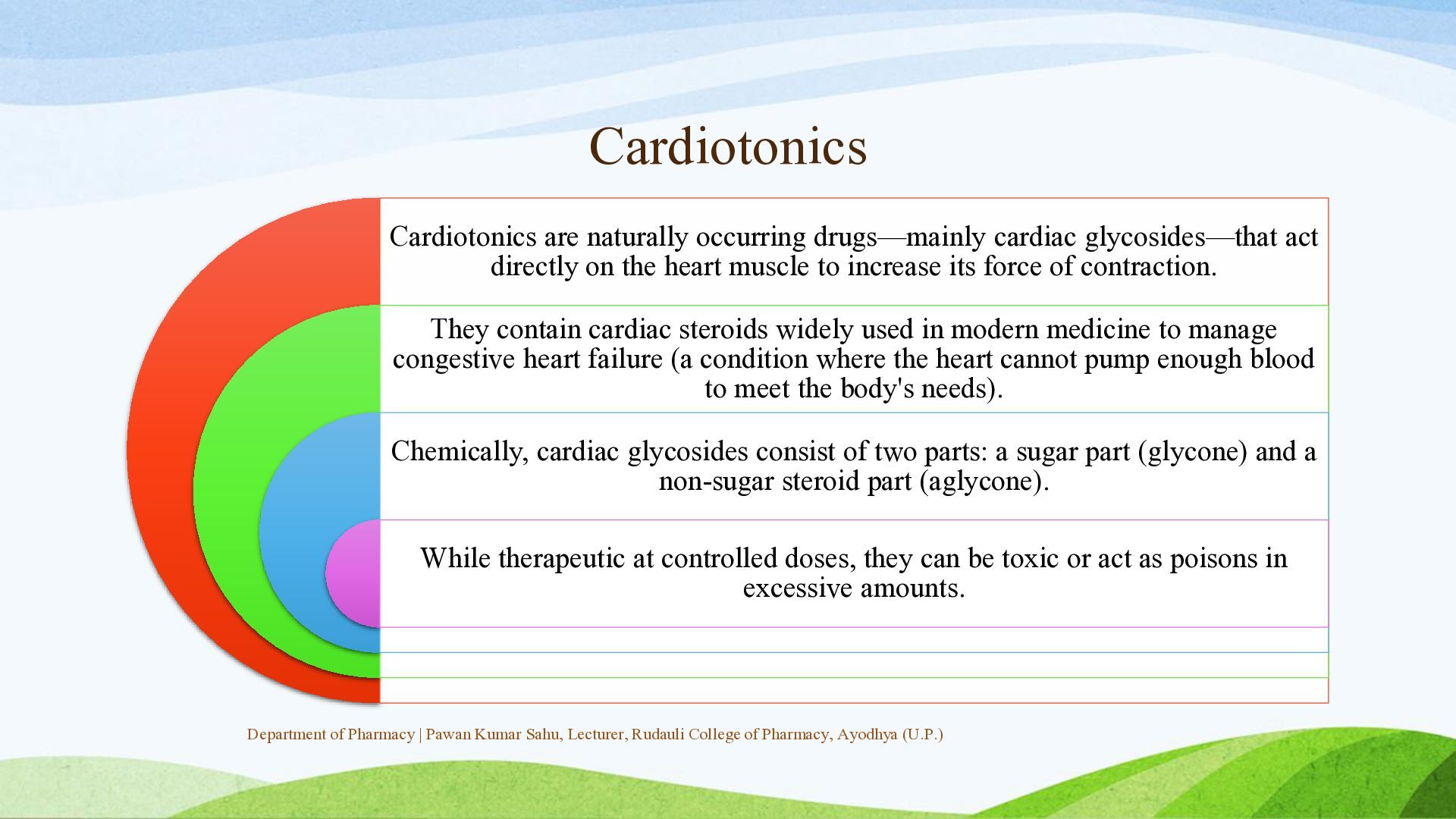
  19. Cardiotonics Cardiotonics are naturally occurring drugs—mainly cardiac glycosides—that act directly

    on the heart muscle to increase its force of contraction. They contain cardiac steroids widely used in modern medicine to manage congestive heart failure (a condition where the heart cannot pump enough blood to meet the body's needs). Chemically, cardiac glycosides consist of two parts: a sugar part (glycone) and a non-sugar steroid part (aglycone). While therapeutic at controlled doses, they can be toxic or act as poisons in excessive amounts. Department of Pharmacy | Pawan Kumar Sahu, Lecturer, Rudauli College of Pharmacy, Ayodhya (U.P.)
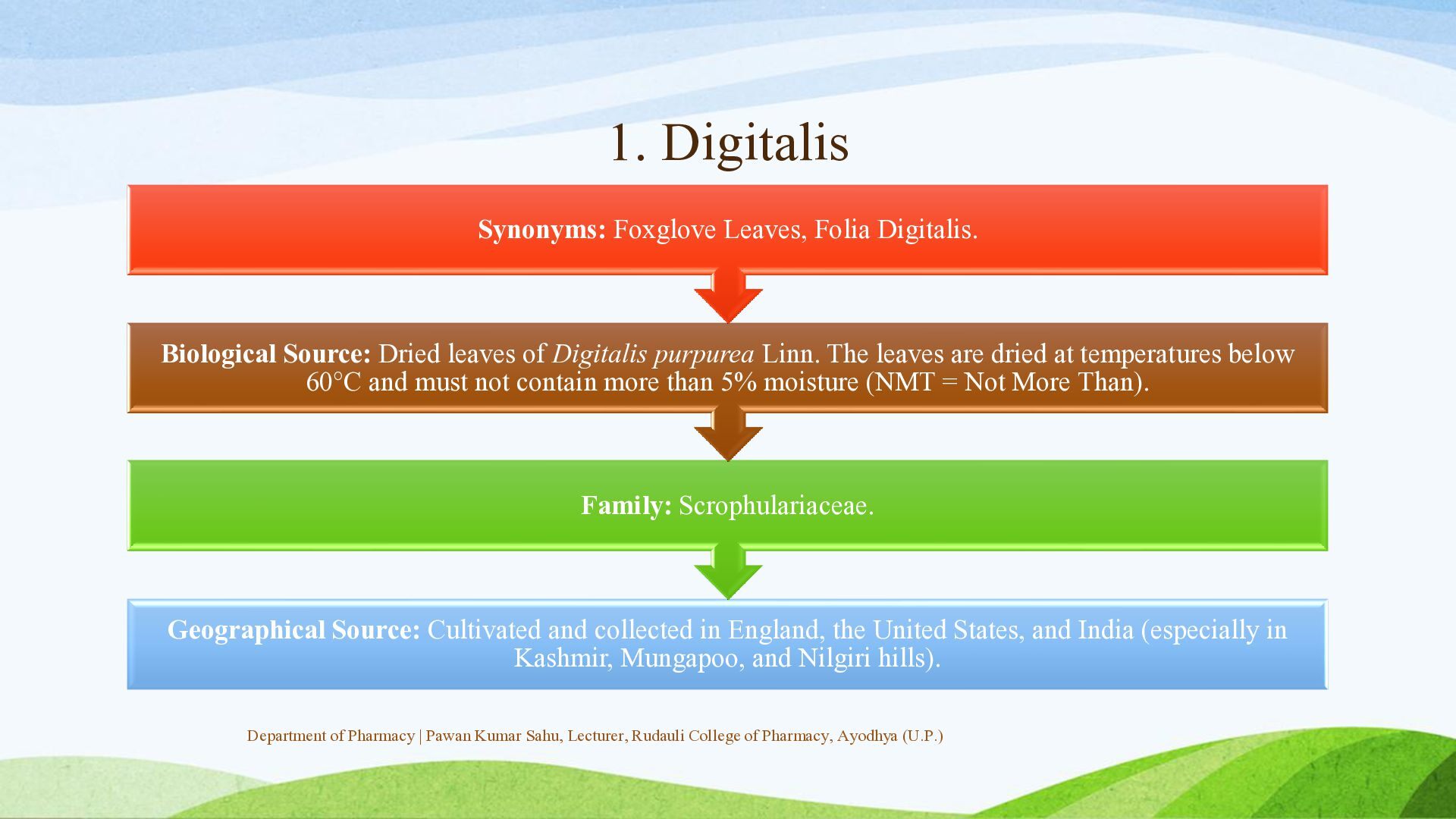
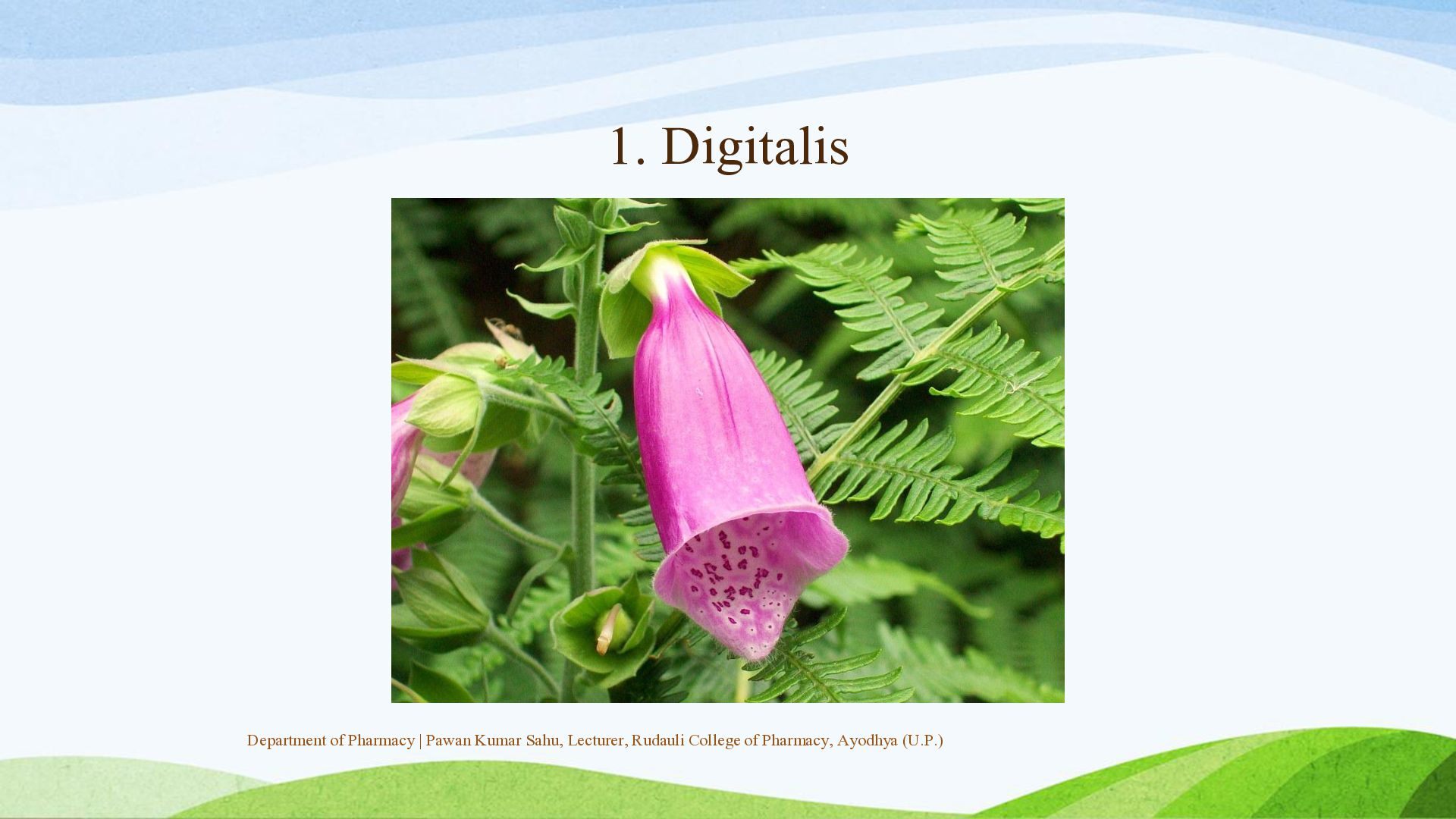
  20. 1. Digitalis Synonyms: Foxglove Leaves, Folia Digitalis. Biological Source: Dried

    leaves of Digitalis purpurea Linn. The leaves are dried at temperatures below 60°C and must not contain more than 5% moisture (NMT = Not More Than). Family: Scrophulariaceae. Geographical Source: Cultivated and collected in England, the United States, and India (especially in Kashmir, Mungapoo, and Nilgiri hills). Department of Pharmacy | Pawan Kumar Sahu, Lecturer, Rudauli College of Pharmacy, Ayodhya (U.P.)
  21. 1. Digitalis Department of Pharmacy | Pawan Kumar Sahu, Lecturer,

    Rudauli College of Pharmacy, Ayodhya (U.P.)
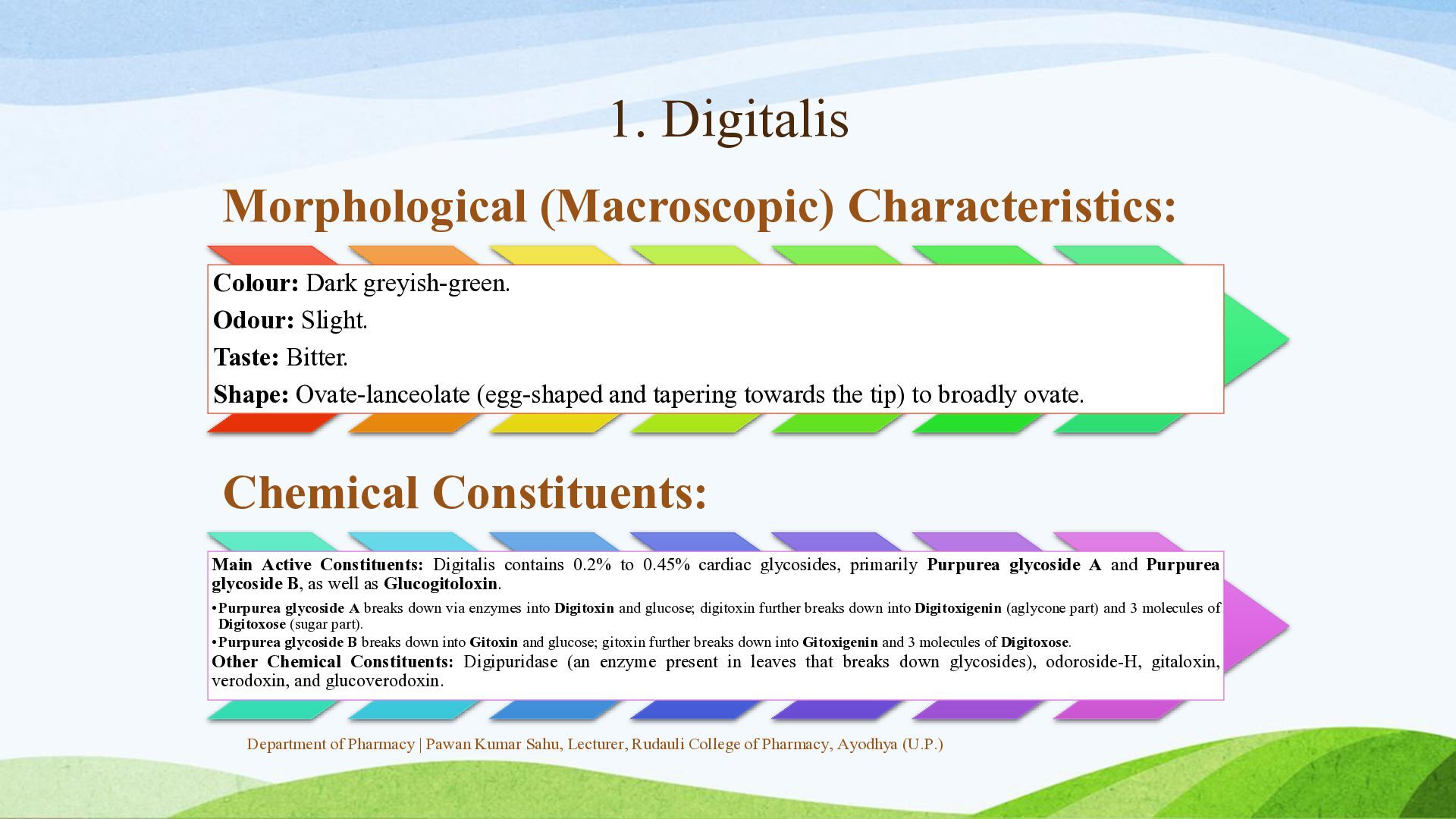
  22. 1. Digitalis Morphological (Macroscopic) Characteristics: Colour: Dark greyish-green. Odour: Slight.

    Taste: Bitter. Shape: Ovate-lanceolate (egg-shaped and tapering towards the tip) to broadly ovate. Chemical Constituents: Main Active Constituents: Digitalis contains 0.2% to 0.45% cardiac glycosides, primarily Purpurea glycoside A and Purpurea glycoside B, as well as Glucogitoloxin. • Purpurea glycoside A breaks down via enzymes into Digitoxin and glucose; digitoxin further breaks down into Digitoxigenin (aglycone part) and 3 molecules of Digitoxose (sugar part). • Purpurea glycoside B breaks down into Gitoxin and glucose; gitoxin further breaks down into Gitoxigenin and 3 molecules of Digitoxose. Other Chemical Constituents: Digipuridase (an enzyme present in leaves that breaks down glycosides), odoroside-H, gitaloxin, verodoxin, and glucoverodoxin. Department of Pharmacy | Pawan Kumar Sahu, Lecturer, Rudauli College of Pharmacy, Ayodhya (U.P.)
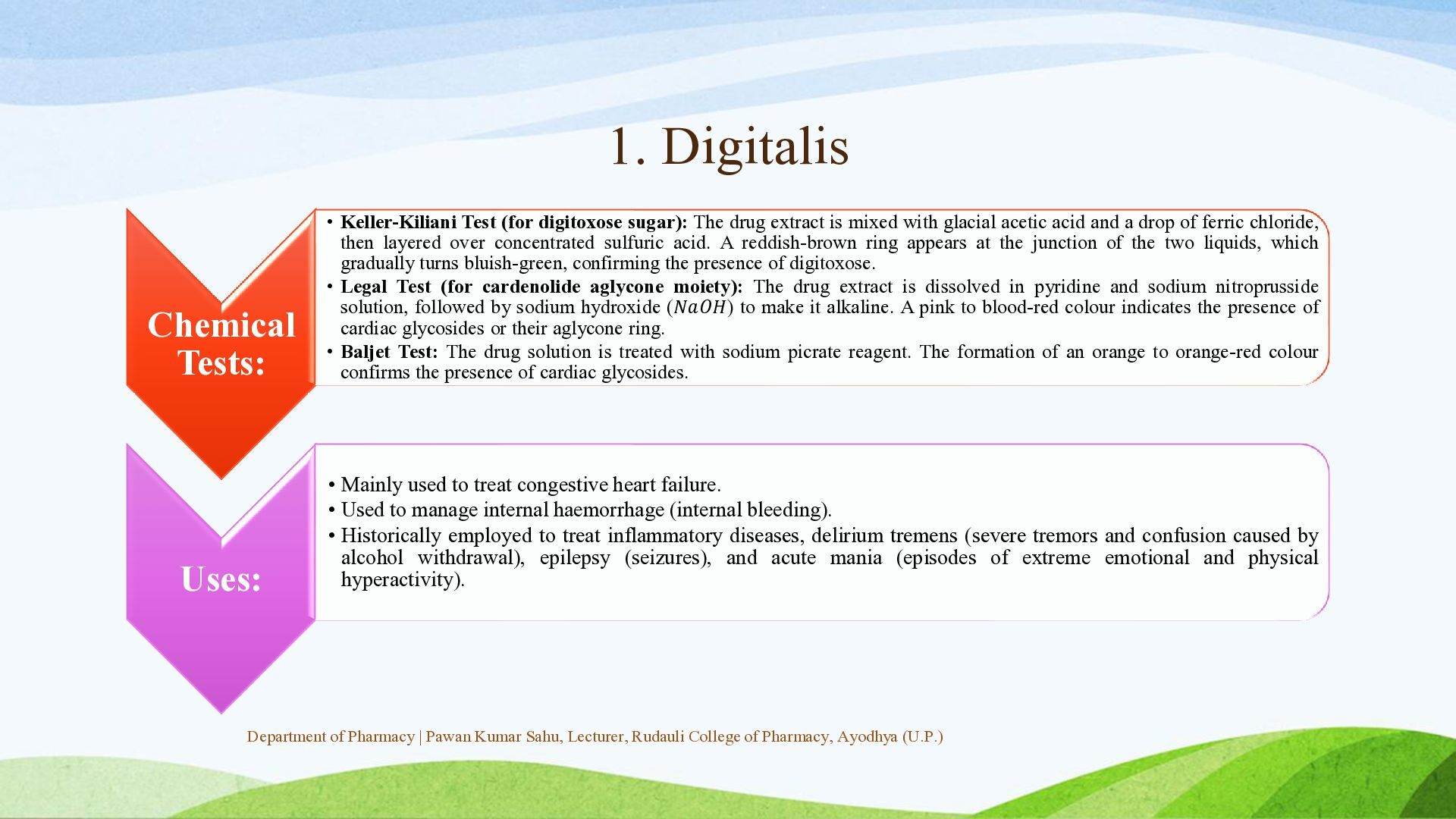
  23. 1. Digitalis Chemical Tests: • Keller-Kiliani Test (for digitoxose sugar):

    The drug extract is mixed with glacial acetic acid and a drop of ferric chloride, then layered over concentrated sulfuric acid. A reddish-brown ring appears at the junction of the two liquids, which gradually turns bluish-green, confirming the presence of digitoxose. • Legal Test (for cardenolide aglycone moiety): The drug extract is dissolved in pyridine and sodium nitroprusside solution, followed by sodium hydroxide (𝑁𝑎𝑂𝐻) to make it alkaline. A pink to blood-red colour indicates the presence of cardiac glycosides or their aglycone ring. • Baljet Test: The drug solution is treated with sodium picrate reagent. The formation of an orange to orange-red colour confirms the presence of cardiac glycosides. Uses: • Mainly used to treat congestive heart failure. • Used to manage internal haemorrhage (internal bleeding). • Historically employed to treat inflammatory diseases, delirium tremens (severe tremors and confusion caused by alcohol withdrawal), epilepsy (seizures), and acute mania (episodes of extreme emotional and physical hyperactivity). cap N a. cap O cap H Department of Pharmacy | Pawan Kumar Sahu, Lecturer, Rudauli College of Pharmacy, Ayodhya (U.P.)
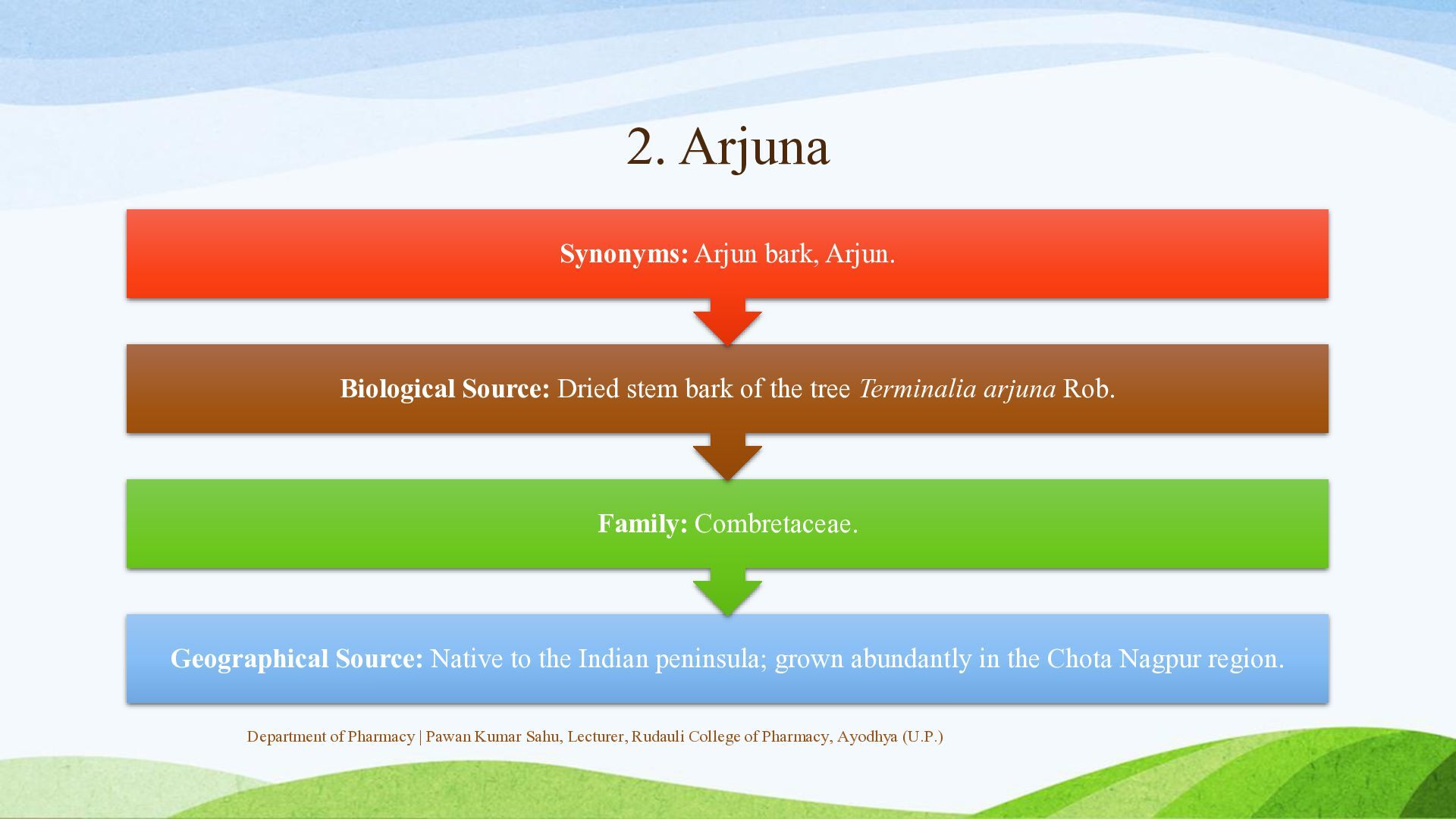
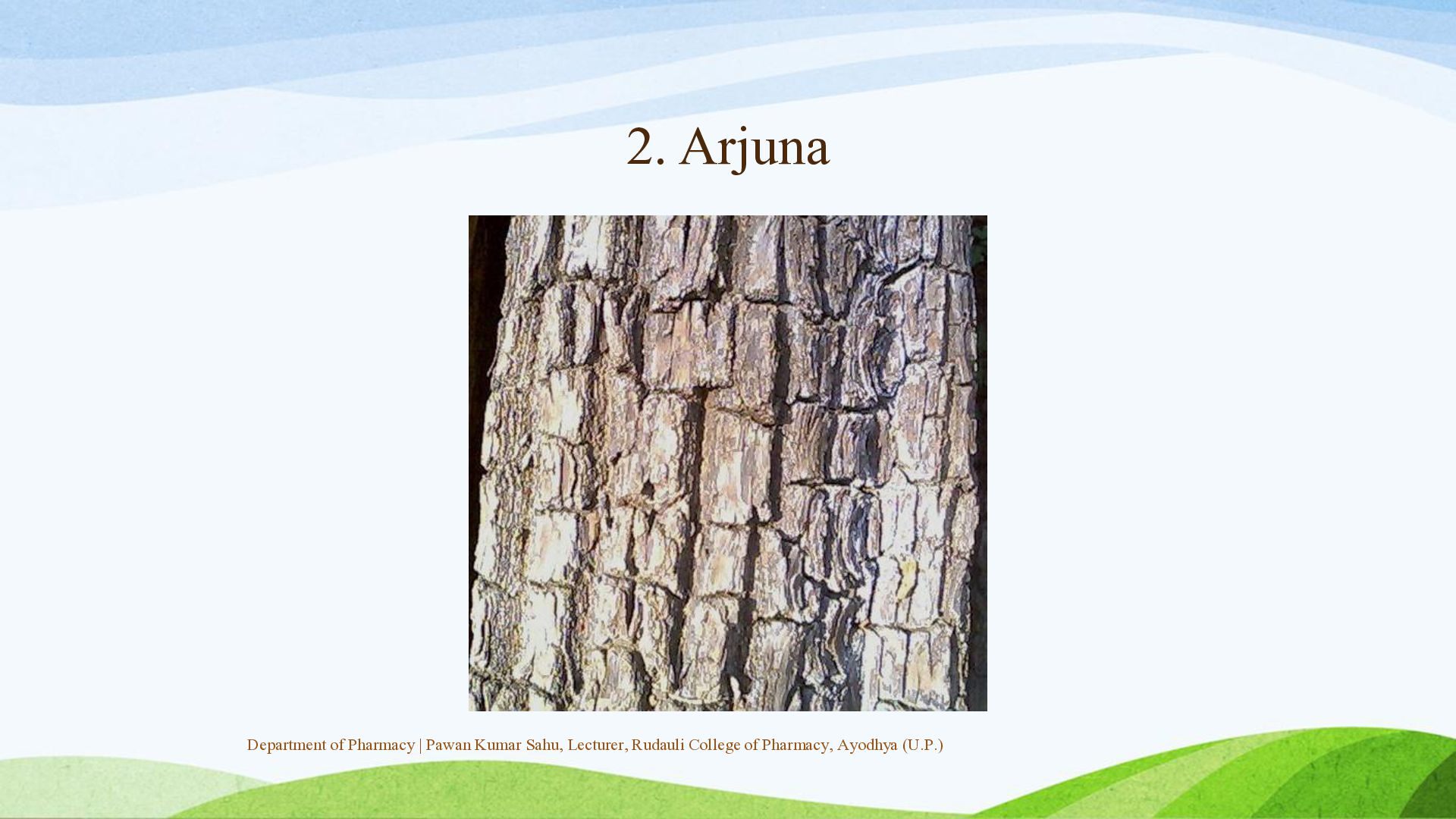
  24. 2. Arjuna Synonyms: Arjun bark, Arjun. Biological Source: Dried stem

    bark of the tree Terminalia arjuna Rob. Family: Combretaceae. Geographical Source: Native to the Indian peninsula; grown abundantly in the Chota Nagpur region. Department of Pharmacy | Pawan Kumar Sahu, Lecturer, Rudauli College of Pharmacy, Ayodhya (U.P.)
  25. 2. Arjuna Department of Pharmacy | Pawan Kumar Sahu, Lecturer,

    Rudauli College of Pharmacy, Ayodhya (U.P.)
  26. 2. Arjuna Morphological (Macroscopic) Characteristics: Colour: Outer surface is greyish-brown;

    inner surface is reddish-brown. Odour: None. Taste: Astringent (causes dry, puckering sensation in the mouth). Shape: Flat pieces (flats). Chemical Constituents: Main Active Constituents: Contains about 15% Hydrolysable tannins and triterpenoid saponins— mainly Arjunolic acid and Arjungenin. Other Chemical Constituents: Flavonoids such as arjunolone, arjunone, and arjunetin; beta-sitosterol, ellagic acid, arjunic acid, and crystallizable compounds including arjunine and arjunetine. Department of Pharmacy | Pawan Kumar Sahu, Lecturer, Rudauli College of Pharmacy, Ayodhya (U.P.)
  27. 2. Arjuna Chemical Test: Uses: • Fluorescence Test: An ethereal

    extract (extract made using ether) of arjuna bark shows a distinct pinkish fluorescence when examined under ultraviolet (UV) light. • Acts as a reliable cardiotonic to support heart health and muscular function. • Acts as a diuretic (increases urine formation and excretion), primarily due to the presence of arjunolic acid. • Possesses general tonic properties (revitalizes body tissues). • Exhibits hypotensive action (lowers elevated blood pressure) by promoting vasodilation (widening of blood vessels) and slowing heart rate. Department of Pharmacy | Pawan Kumar Sahu, Lecturer, Rudauli College of Pharmacy, Ayodhya (U.P.)
  28. Carminative and GI Regulator A carminative (derived from the Latin

    word carminare, meaning "to clean") is an agent or substance that relieves flatulence (excess gas in the digestive tract) or abdominal pain by causing the expulsion of gas from the stomach or intestines. A GI regulator helps regulate gastrointestinal motility and digestion. Department of Pharmacy | Pawan Kumar Sahu, Lecturer, Rudauli College of Pharmacy, Ayodhya (U.P.)
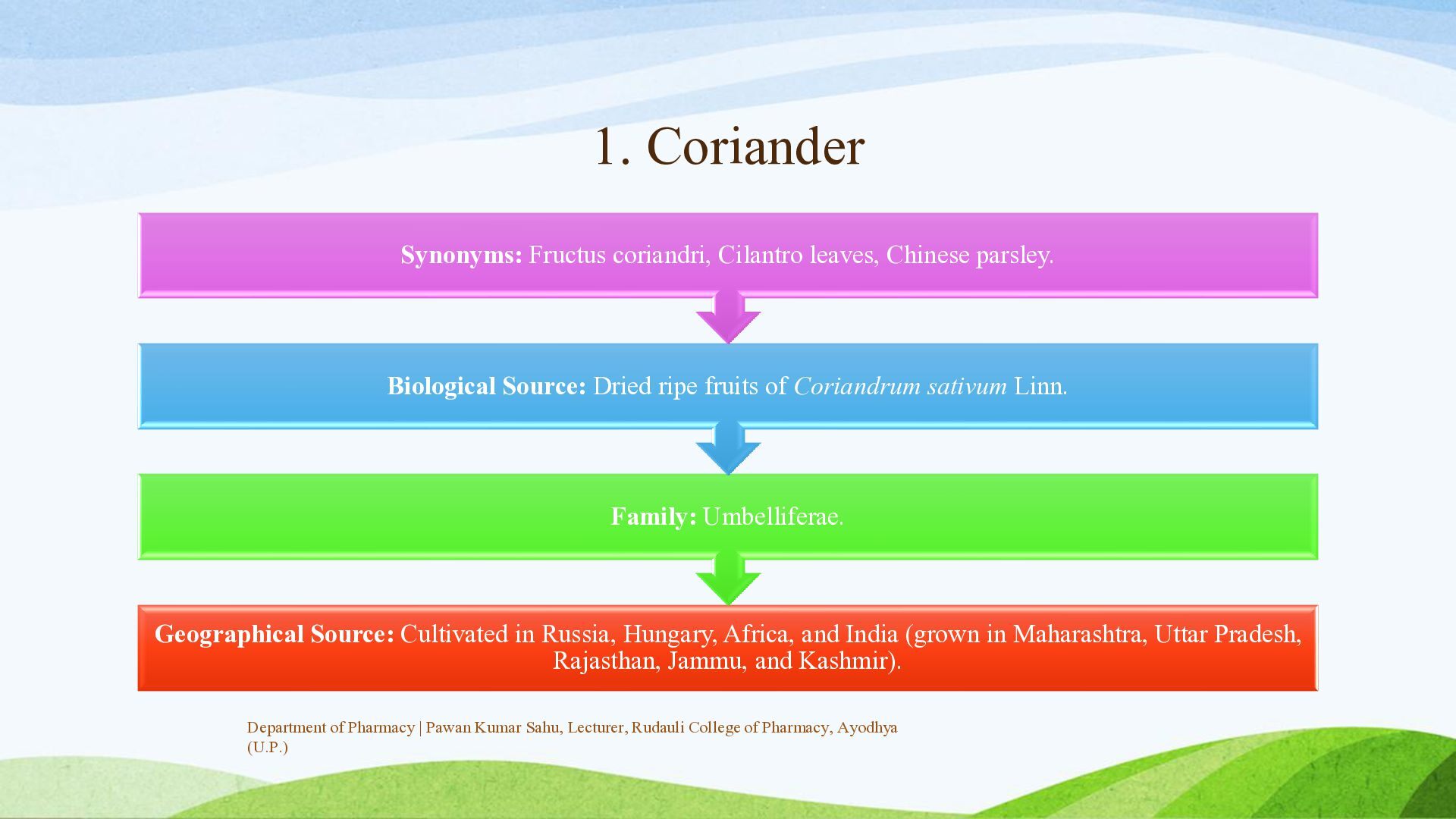
  29. 1. Coriander Synonyms: Fructus coriandri, Cilantro leaves, Chinese parsley. Biological

    Source: Dried ripe fruits of Coriandrum sativum Linn. Family: Umbelliferae. Geographical Source: Cultivated in Russia, Hungary, Africa, and India (grown in Maharashtra, Uttar Pradesh, Rajasthan, Jammu, and Kashmir). Department of Pharmacy | Pawan Kumar Sahu, Lecturer, Rudauli College of Pharmacy, Ayodhya (U.P.)
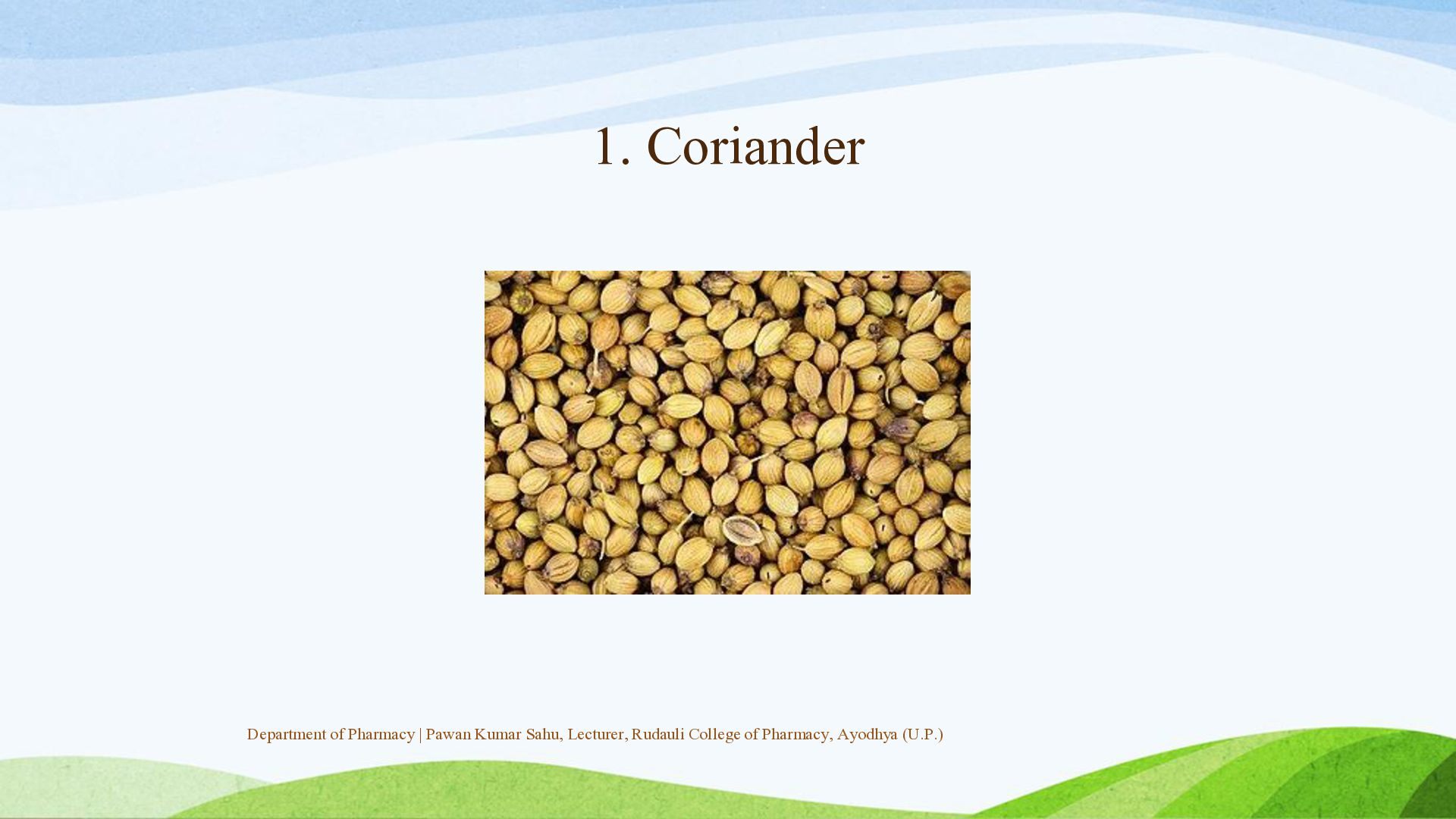
  30. 1. Coriander Department of Pharmacy | Pawan Kumar Sahu, Lecturer,

    Rudauli College of Pharmacy, Ayodhya (U.P.)
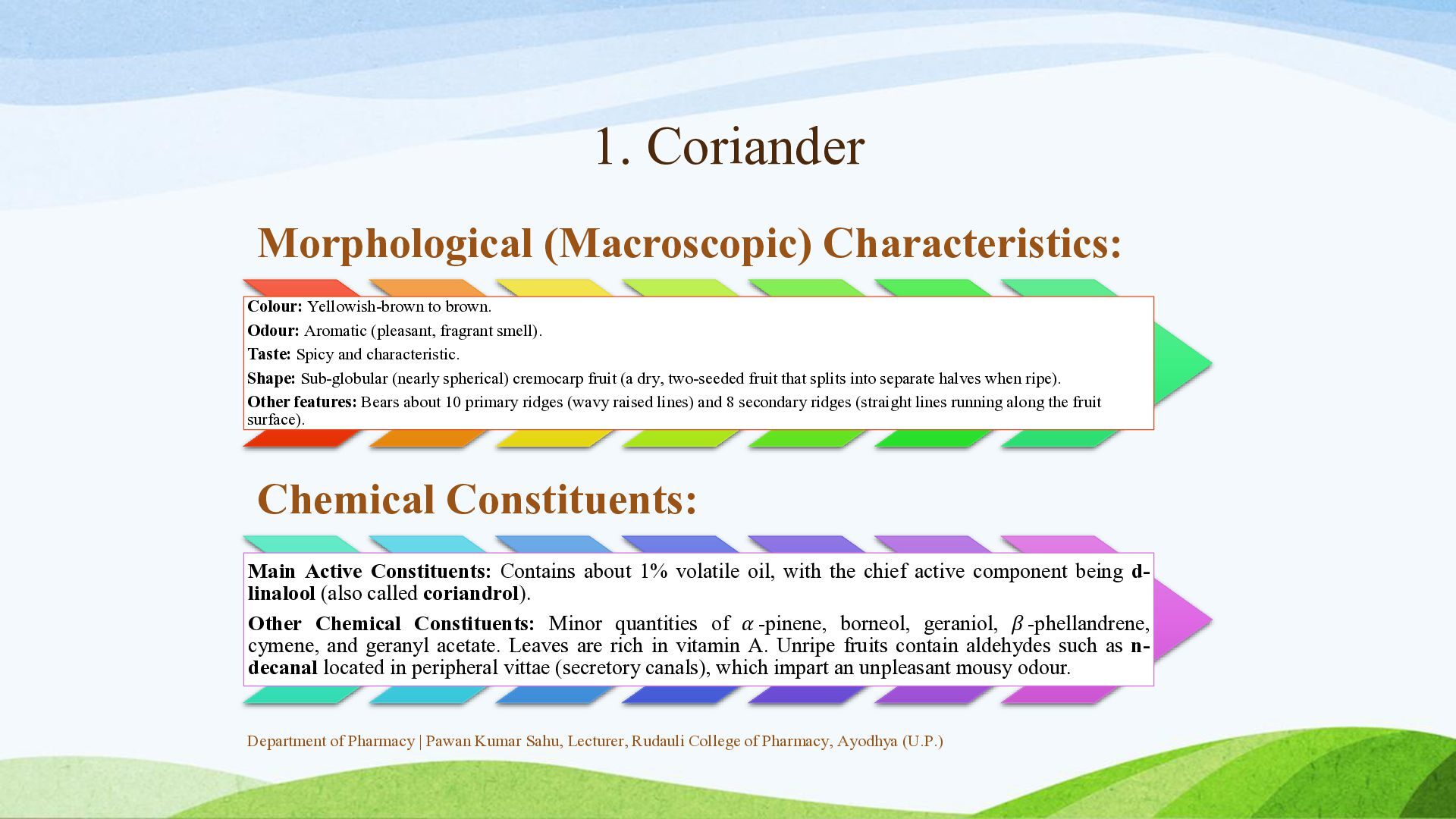
  31. 1. Coriander Morphological (Macroscopic) Characteristics: Colour: Yellowish-brown to brown. Odour:

    Aromatic (pleasant, fragrant smell). Taste: Spicy and characteristic. Shape: Sub-globular (nearly spherical) cremocarp fruit (a dry, two-seeded fruit that splits into separate halves when ripe). Other features: Bears about 10 primary ridges (wavy raised lines) and 8 secondary ridges (straight lines running along the fruit surface). Chemical Constituents: Main Active Constituents: Contains about 1% volatile oil, with the chief active component being dlinalool (also called coriandrol). Other Chemical Constituents: Minor quantities of 𝛼 -pinene, borneol, geraniol, 𝛽 -phellandrene, cymene, and geranyl acetate. Leaves are rich in vitamin A. Unripe fruits contain aldehydes such as ndecanal located in peripheral vittae (secretory canals), which impart an unpleasant mousy odour. start equation alpha Department of Pharmacy | Pawan Kumar Sahu, Lecturer, Rudauli College of Pharmacy, Ayodhya (U.P.) start equation beta
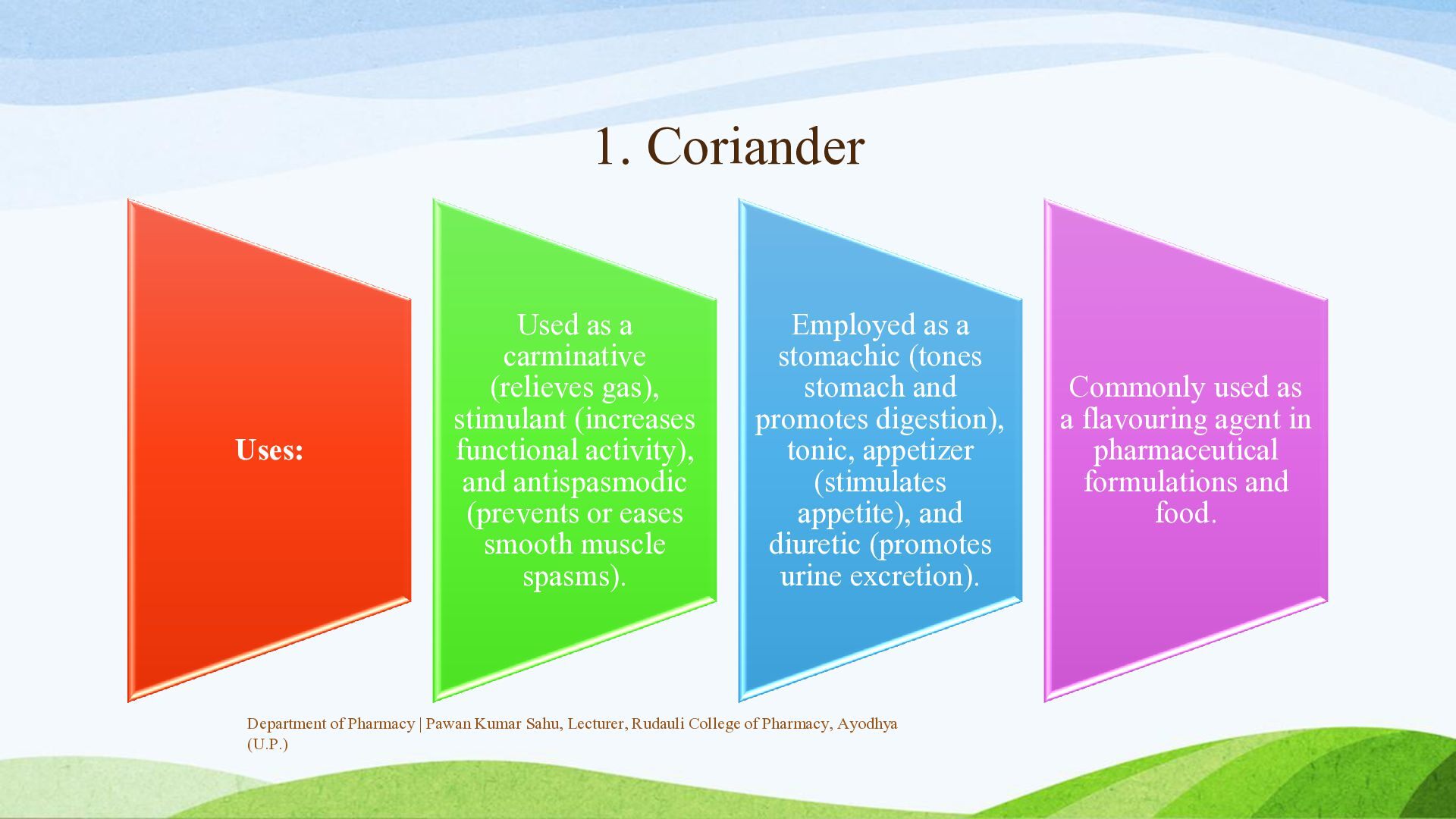
  32. 1. Coriander Uses: Used as a carminative (relieves gas), stimulant

    (increases functional activity), and antispasmodic (prevents or eases smooth muscle spasms). Employed as a stomachic (tones stomach and promotes digestion), tonic, appetizer (stimulates appetite), and diuretic (promotes urine excretion). Department of Pharmacy | Pawan Kumar Sahu, Lecturer, Rudauli College of Pharmacy, Ayodhya (U.P.) Commonly used as a flavouring agent in pharmaceutical formulations and food.
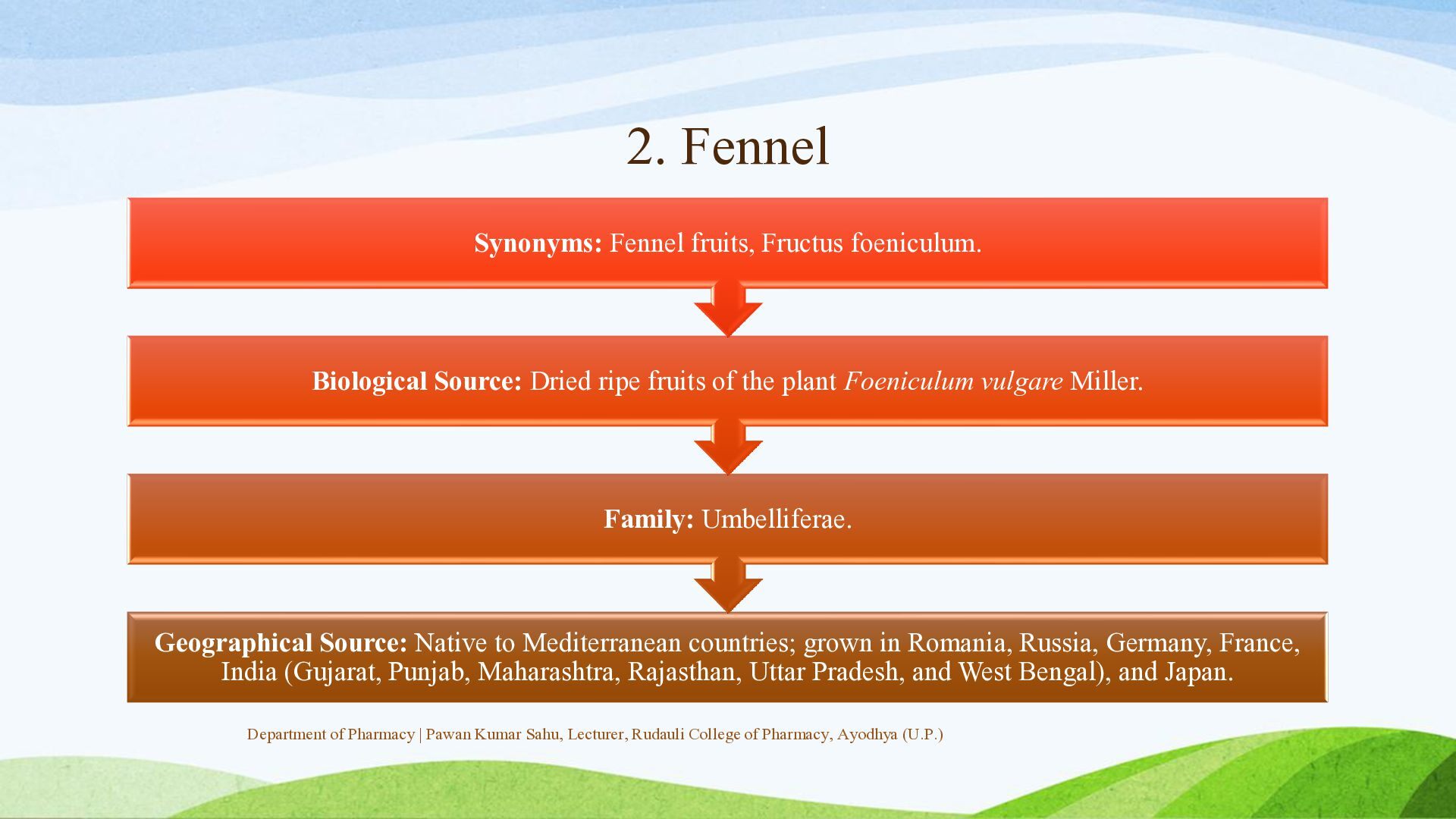
  33. 2. Fennel Synonyms: Fennel fruits, Fructus foeniculum. Biological Source: Dried

    ripe fruits of the plant Foeniculum vulgare Miller. Family: Umbelliferae. Geographical Source: Native to Mediterranean countries; grown in Romania, Russia, Germany, France, India (Gujarat, Punjab, Maharashtra, Rajasthan, Uttar Pradesh, and West Bengal), and Japan. Department of Pharmacy | Pawan Kumar Sahu, Lecturer, Rudauli College of Pharmacy, Ayodhya (U.P.)
  34. 2. Fennel Department of Pharmacy | Pawan Kumar Sahu, Lecturer,

    Rudauli College of Pharmacy, Ayodhya (U.P.)
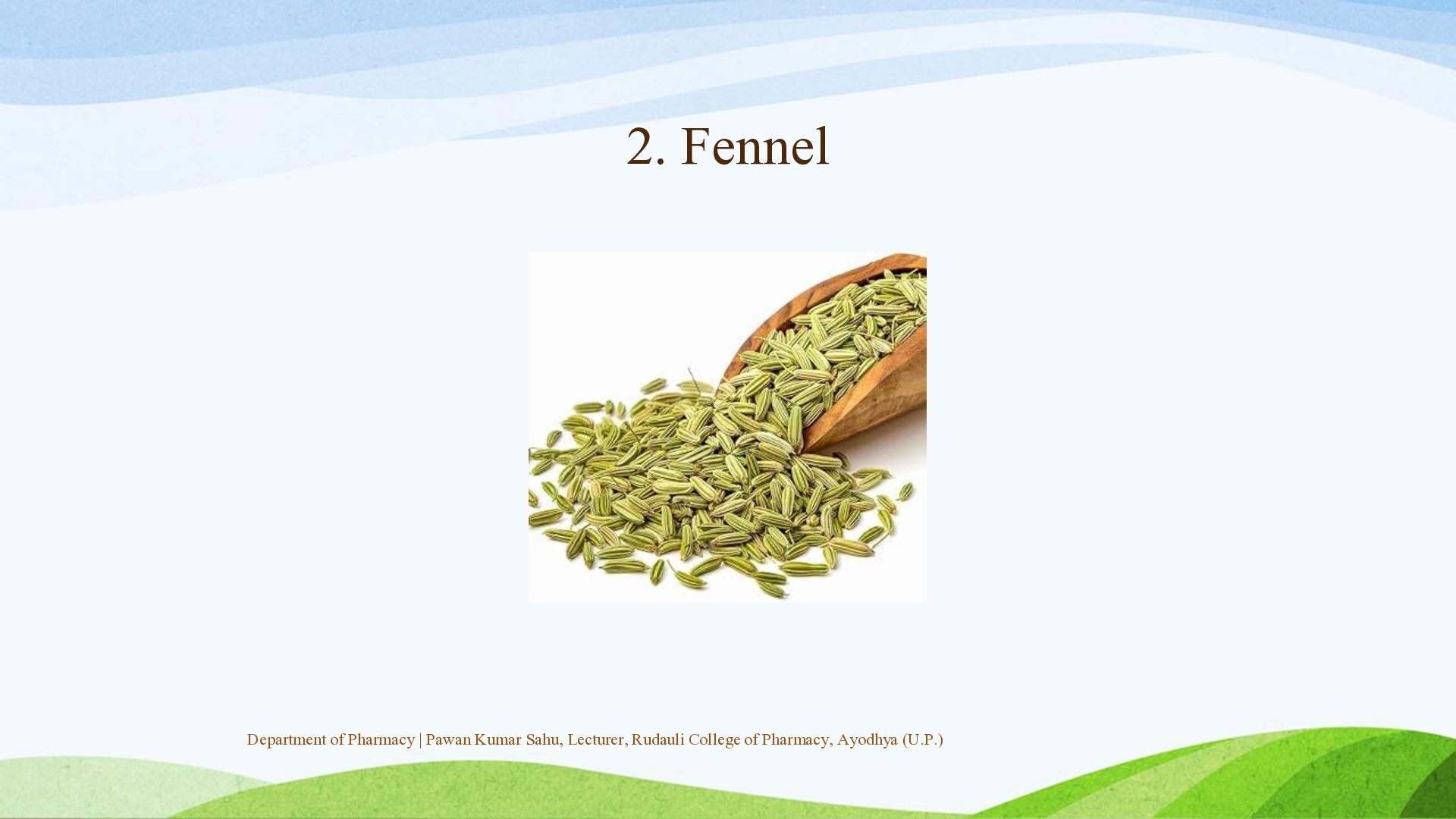
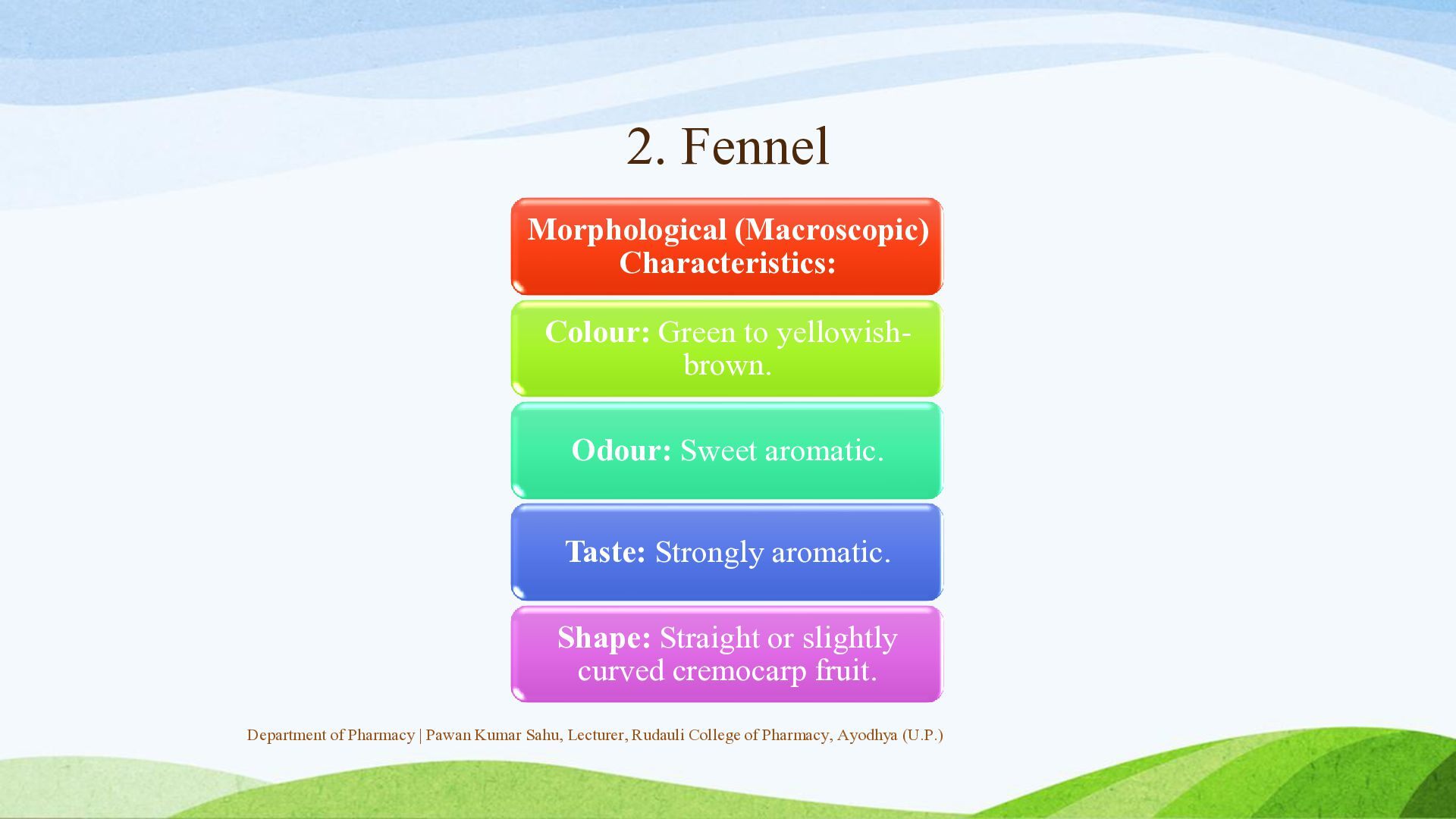
  35. 2. Fennel Morphological (Macroscopic) Characteristics: Colour: Green to yellowishbrown. Odour:

    Sweet aromatic. Taste: Strongly aromatic. Shape: Straight or slightly curved cremocarp fruit. Department of Pharmacy | Pawan Kumar Sahu, Lecturer, Rudauli College of Pharmacy, Ayodhya (U.P.)
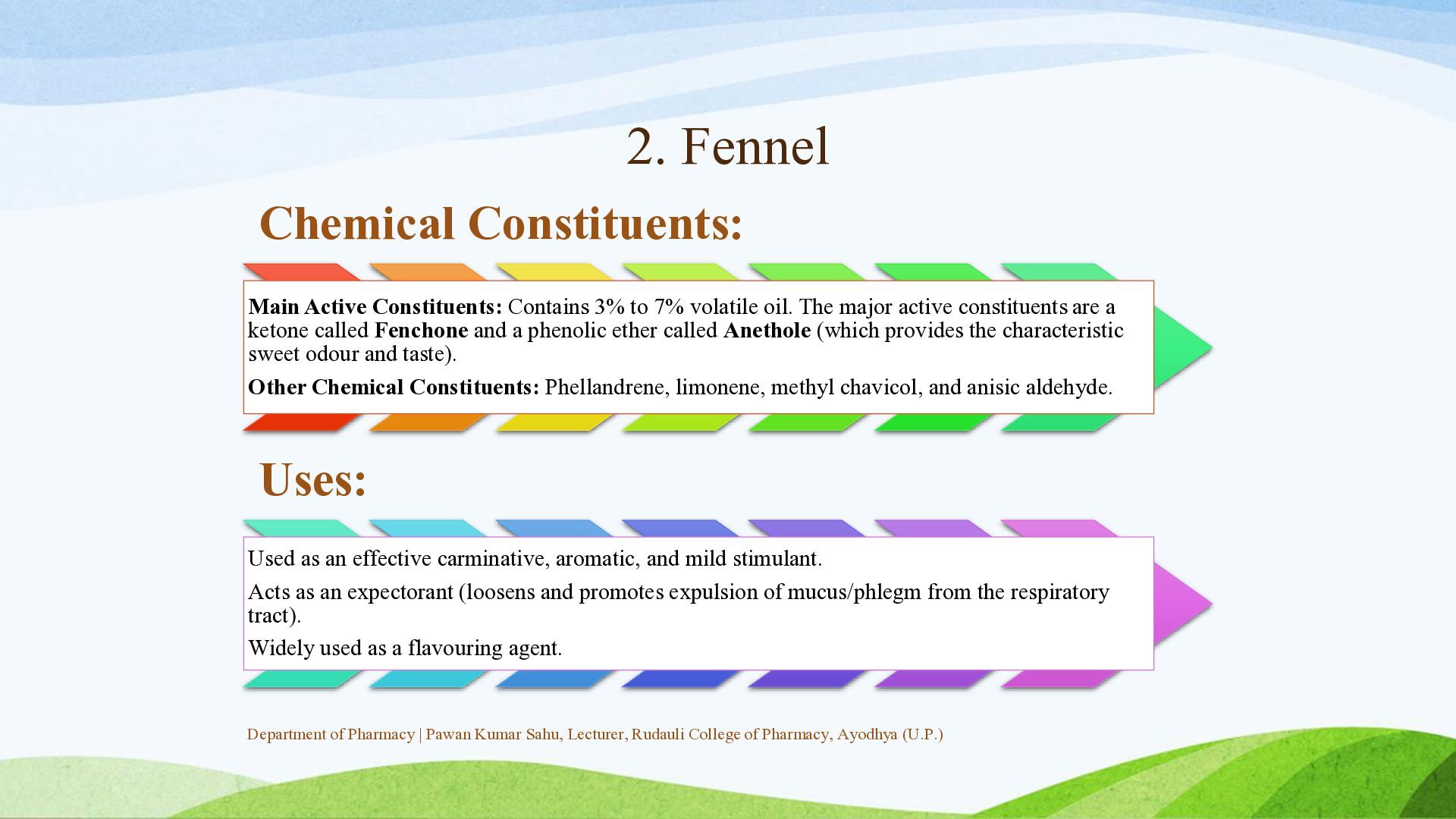
  36. 2. Fennel Chemical Constituents: Main Active Constituents: Contains 3% to

    7% volatile oil. The major active constituents are a ketone called Fenchone and a phenolic ether called Anethole (which provides the characteristic sweet odour and taste). Other Chemical Constituents: Phellandrene, limonene, methyl chavicol, and anisic aldehyde. Uses: Used as an effective carminative, aromatic, and mild stimulant. Acts as an expectorant (loosens and promotes expulsion of mucus/phlegm from the respiratory tract). Widely used as a flavouring agent. Department of Pharmacy | Pawan Kumar Sahu, Lecturer, Rudauli College of Pharmacy, Ayodhya (U.P.)
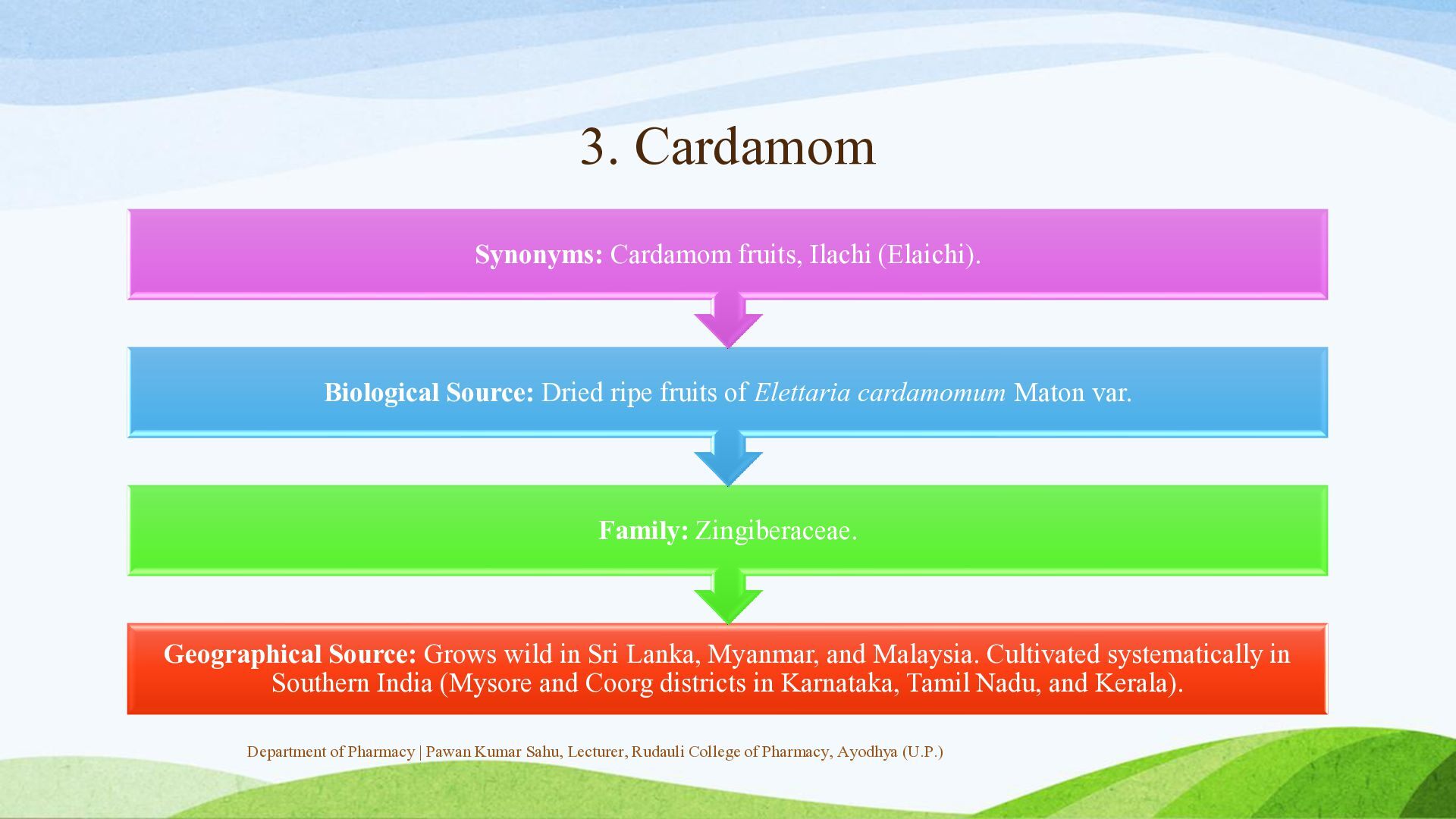
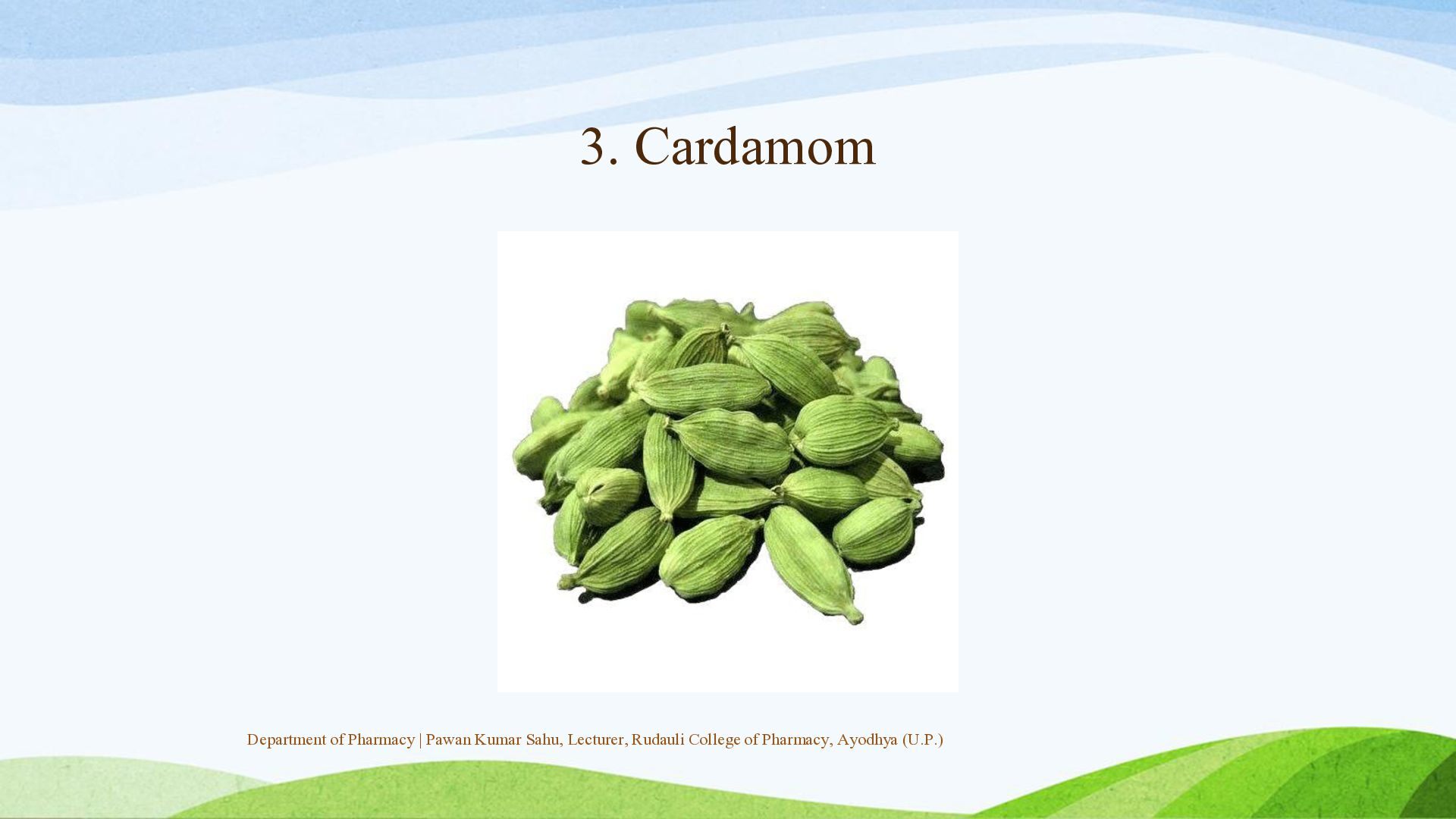
  37. 3. Cardamom Synonyms: Cardamom fruits, Ilachi (Elaichi). Biological Source: Dried

    ripe fruits of Elettaria cardamomum Maton var. Family: Zingiberaceae. Geographical Source: Grows wild in Sri Lanka, Myanmar, and Malaysia. Cultivated systematically in Southern India (Mysore and Coorg districts in Karnataka, Tamil Nadu, and Kerala). Department of Pharmacy | Pawan Kumar Sahu, Lecturer, Rudauli College of Pharmacy, Ayodhya (U.P.)
  38. 3. Cardamom Department of Pharmacy | Pawan Kumar Sahu, Lecturer,

    Rudauli College of Pharmacy, Ayodhya (U.P.)
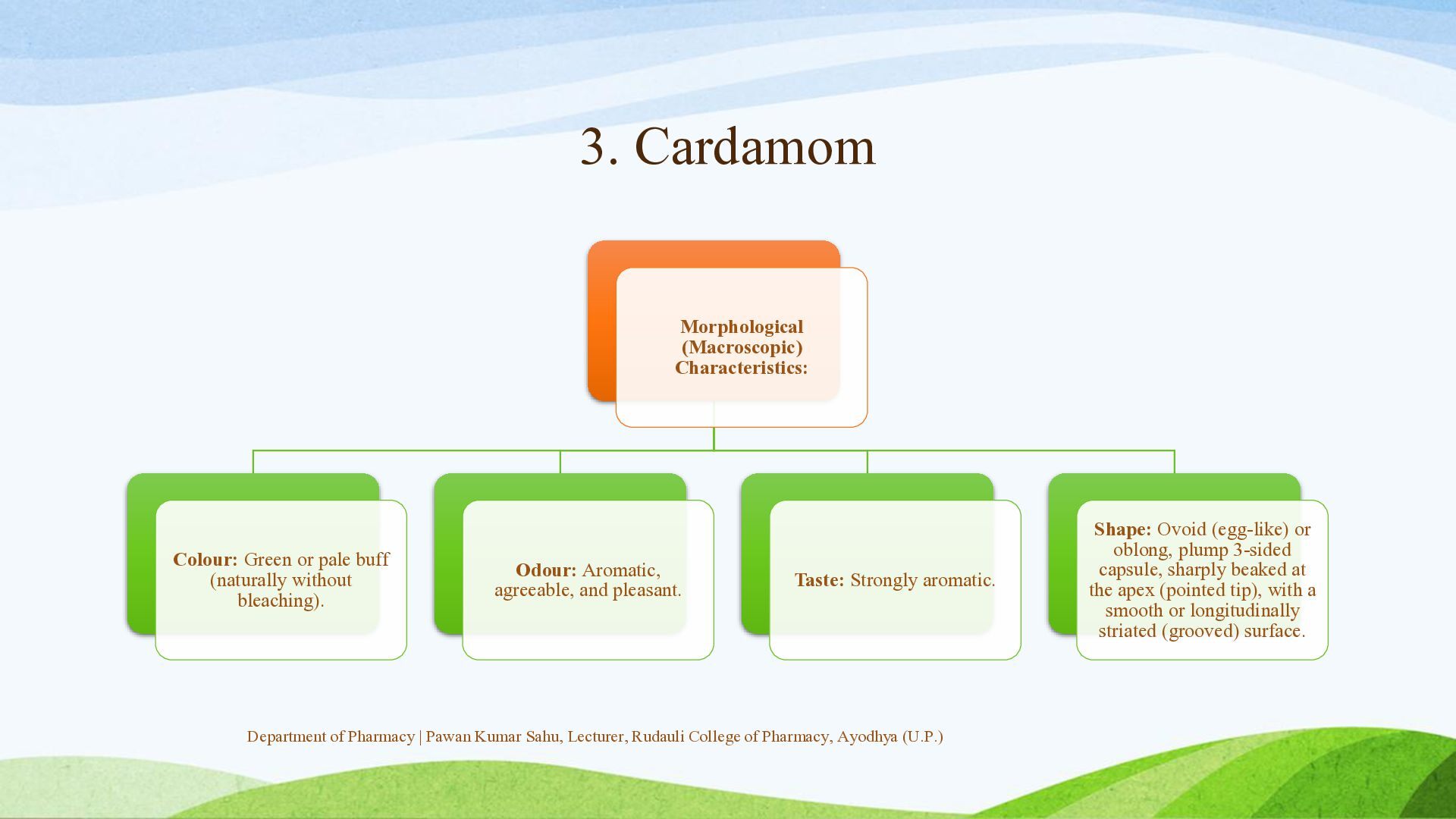
  39. 3. Cardamom Morphological (Macroscopic) Characteristics: Colour: Green or pale buff

    (naturally without bleaching). Odour: Aromatic, agreeable, and pleasant. Taste: Strongly aromatic. Department of Pharmacy | Pawan Kumar Sahu, Lecturer, Rudauli College of Pharmacy, Ayodhya (U.P.) Shape: Ovoid (egg-like) or oblong, plump 3-sided capsule, sharply beaked at the apex (pointed tip), with a smooth or longitudinally striated (grooved) surface.
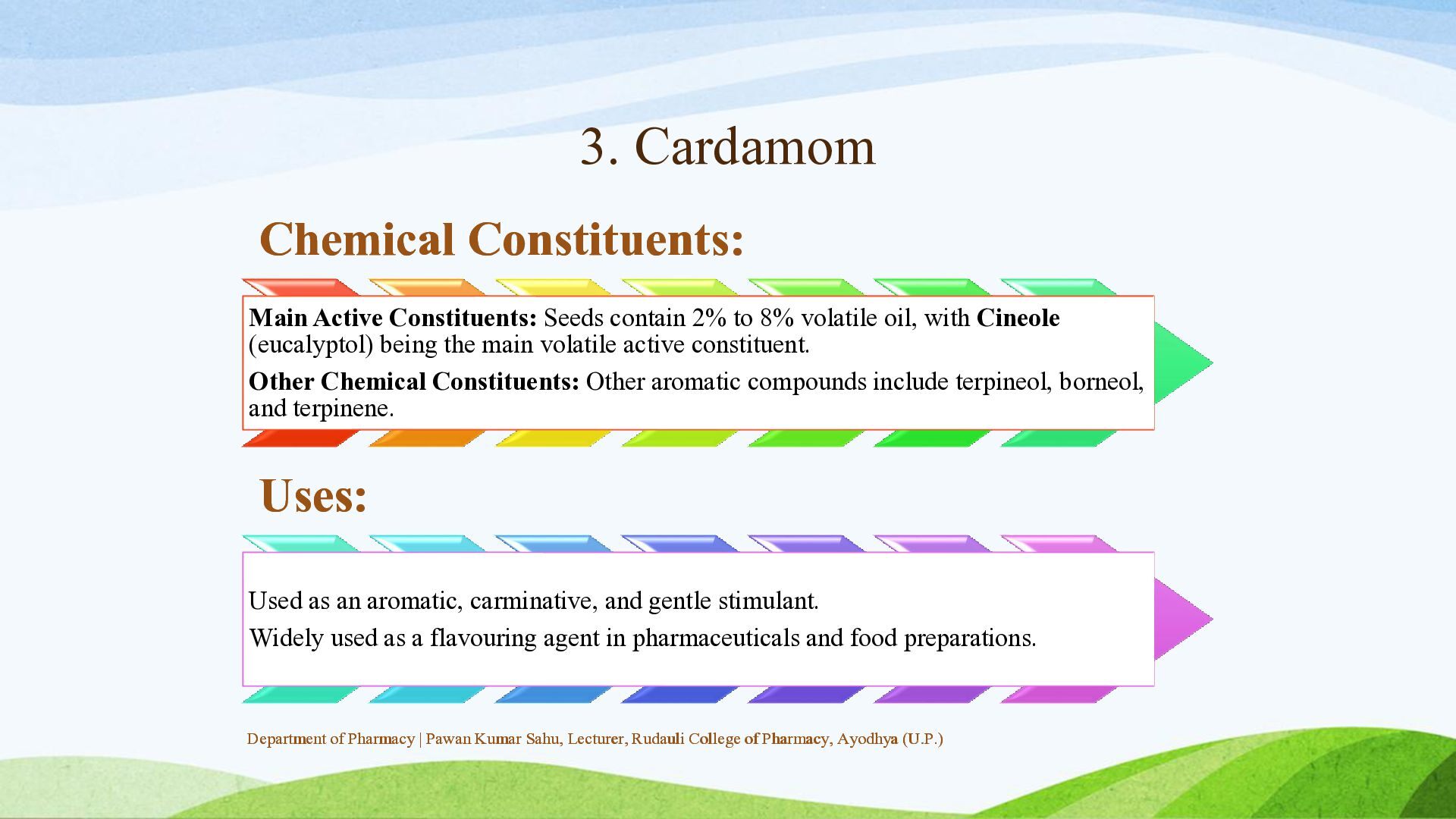
  40. 3. Cardamom Chemical Constituents: Main Active Constituents: Seeds contain 2%

    to 8% volatile oil, with Cineole (eucalyptol) being the main volatile active constituent. Other Chemical Constituents: Other aromatic compounds include terpineol, borneol, and terpinene. Uses: Used as an aromatic, carminative, and gentle stimulant. Widely used as a flavouring agent in pharmaceuticals and food preparations. Department of Pharmacy | Pawan Kumar Sahu, Lecturer, Rudauli College of Pharmacy, Ayodhya (U.P.)
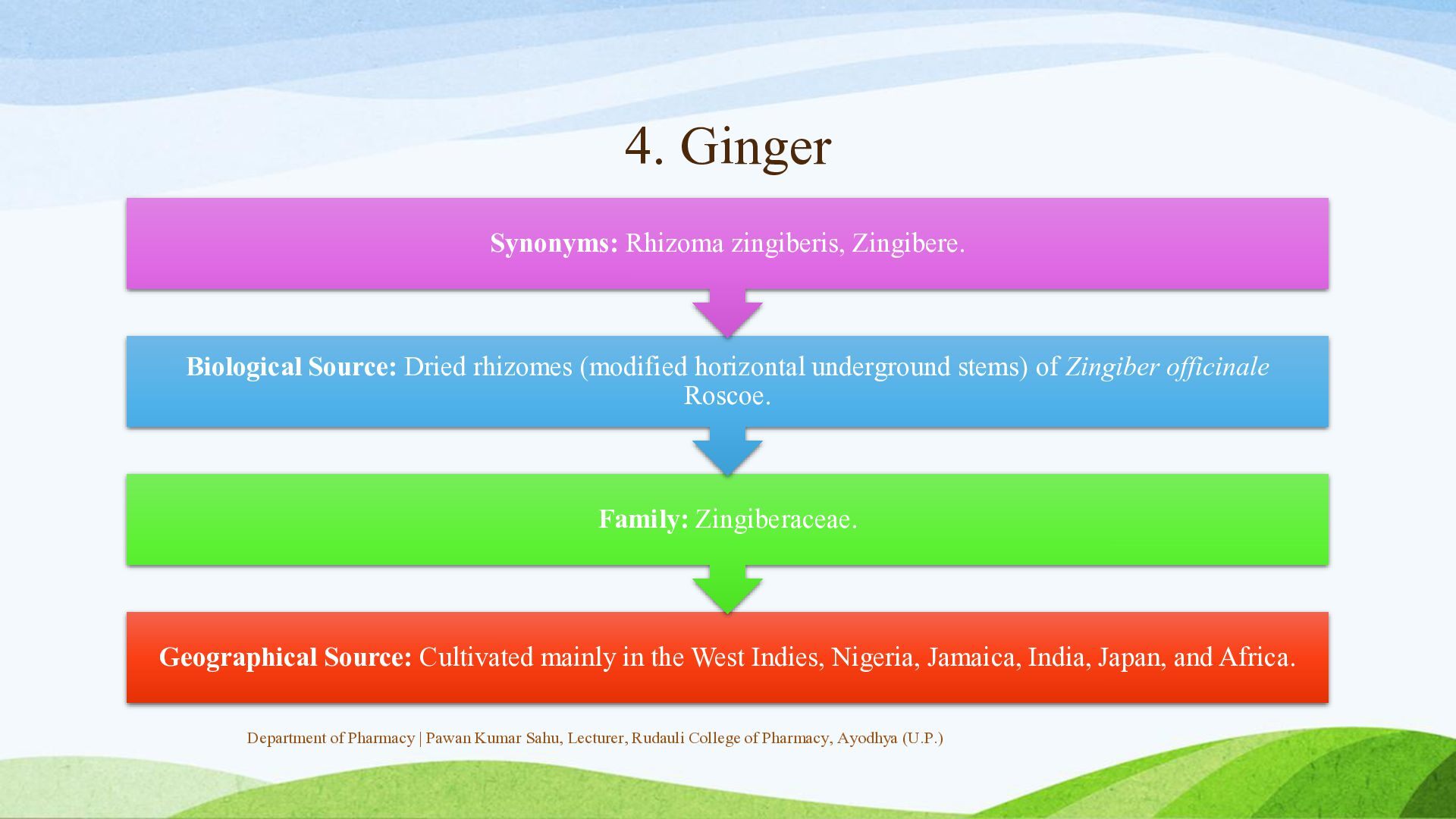
  41. 4. Ginger Synonyms: Rhizoma zingiberis, Zingibere. Biological Source: Dried rhizomes

    (modified horizontal underground stems) of Zingiber officinale Roscoe. Family: Zingiberaceae. Geographical Source: Cultivated mainly in the West Indies, Nigeria, Jamaica, India, Japan, and Africa. Department of Pharmacy | Pawan Kumar Sahu, Lecturer, Rudauli College of Pharmacy, Ayodhya (U.P.)
  42. 4. Ginger Department of Pharmacy | Pawan Kumar Sahu, Lecturer,

    Rudauli College of Pharmacy, Ayodhya (U.P.)
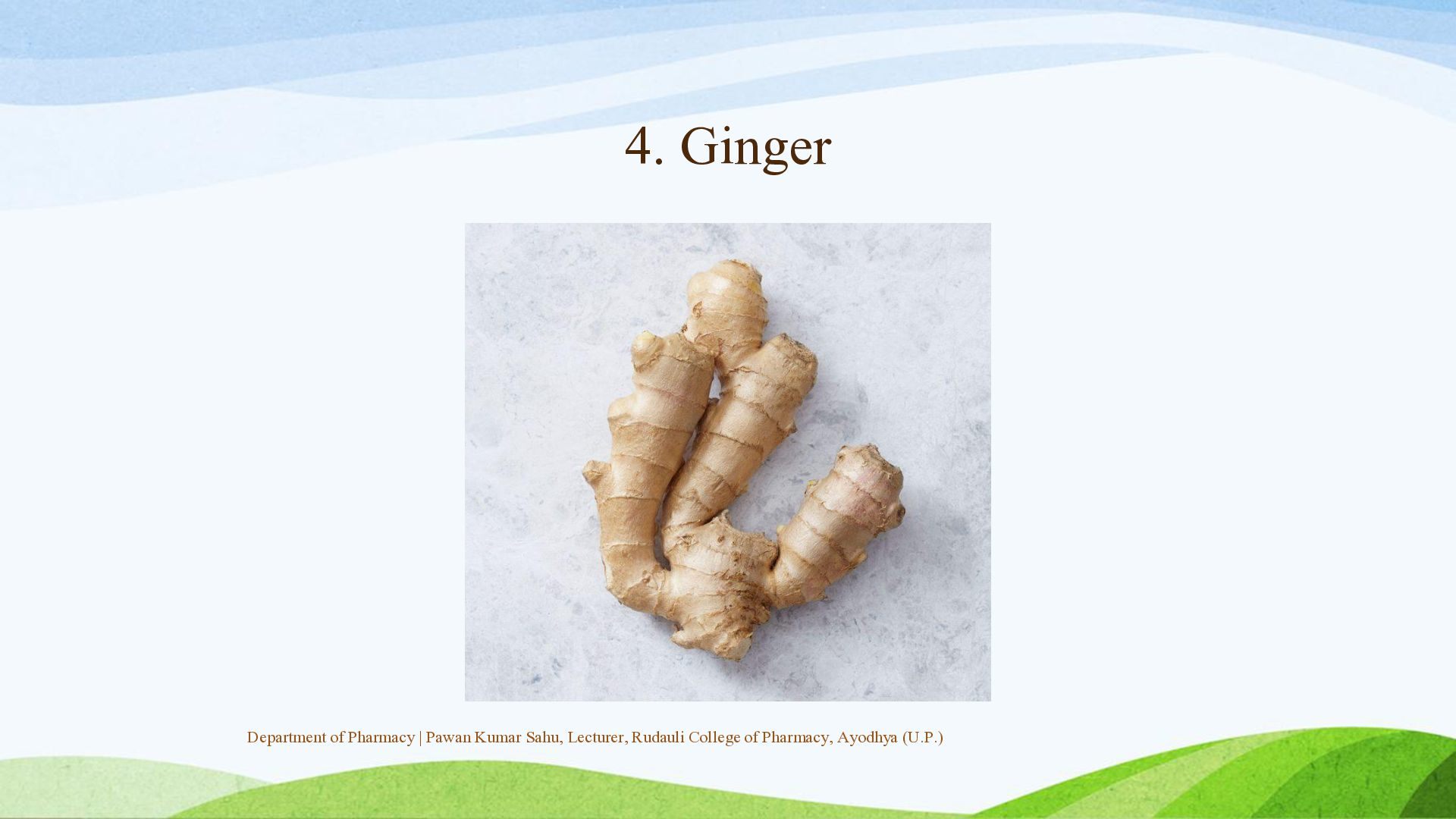
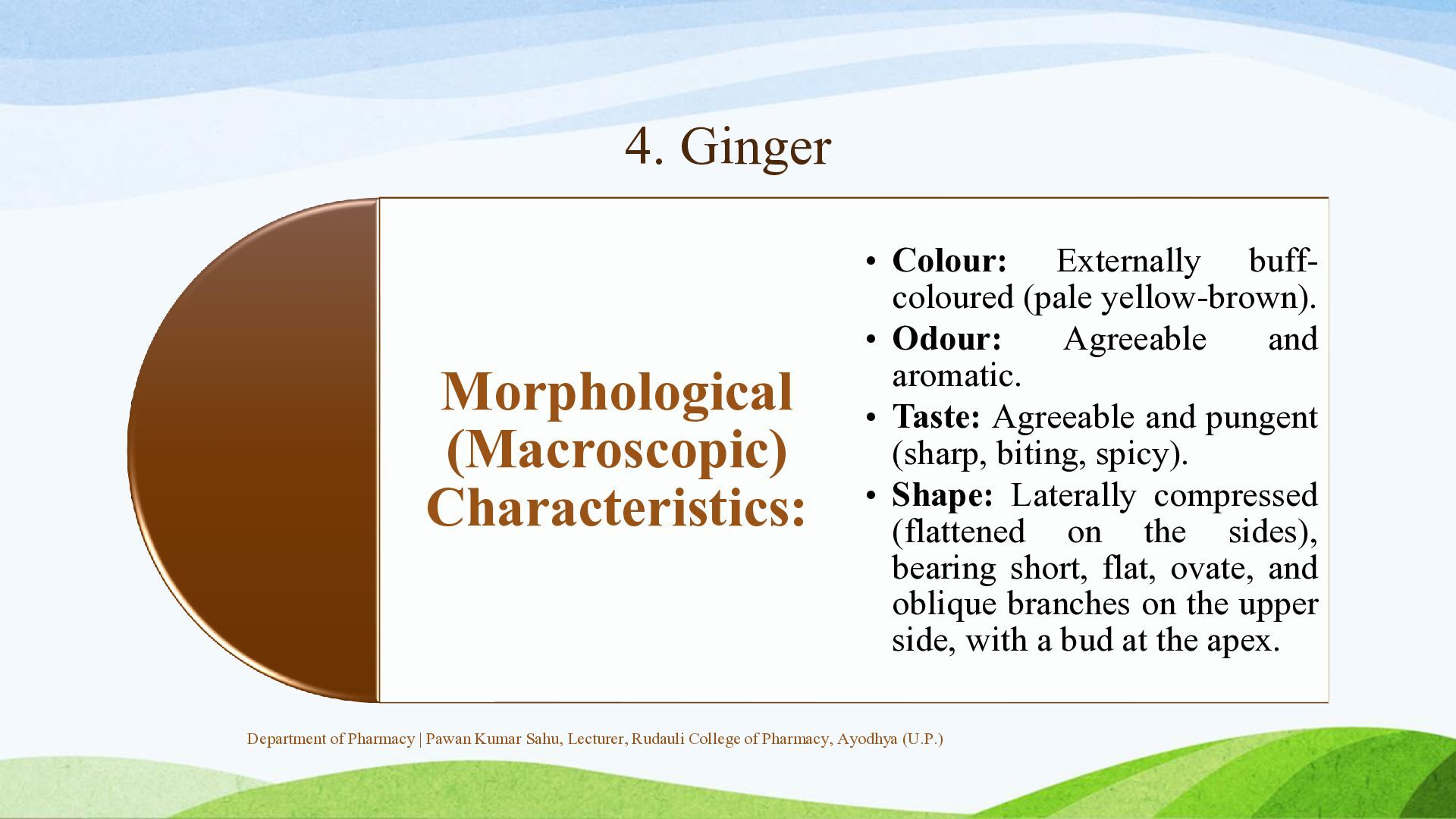
  43. 4. Ginger Morphological (Macroscopic) Characteristics: • Colour: Externally buffcoloured (pale

    yellow-brown). • Odour: Agreeable and aromatic. • Taste: Agreeable and pungent (sharp, biting, spicy). • Shape: Laterally compressed (flattened on the sides), bearing short, flat, ovate, and oblique branches on the upper side, with a bud at the apex. Department of Pharmacy | Pawan Kumar Sahu, Lecturer, Rudauli College of Pharmacy, Ayodhya (U.P.)
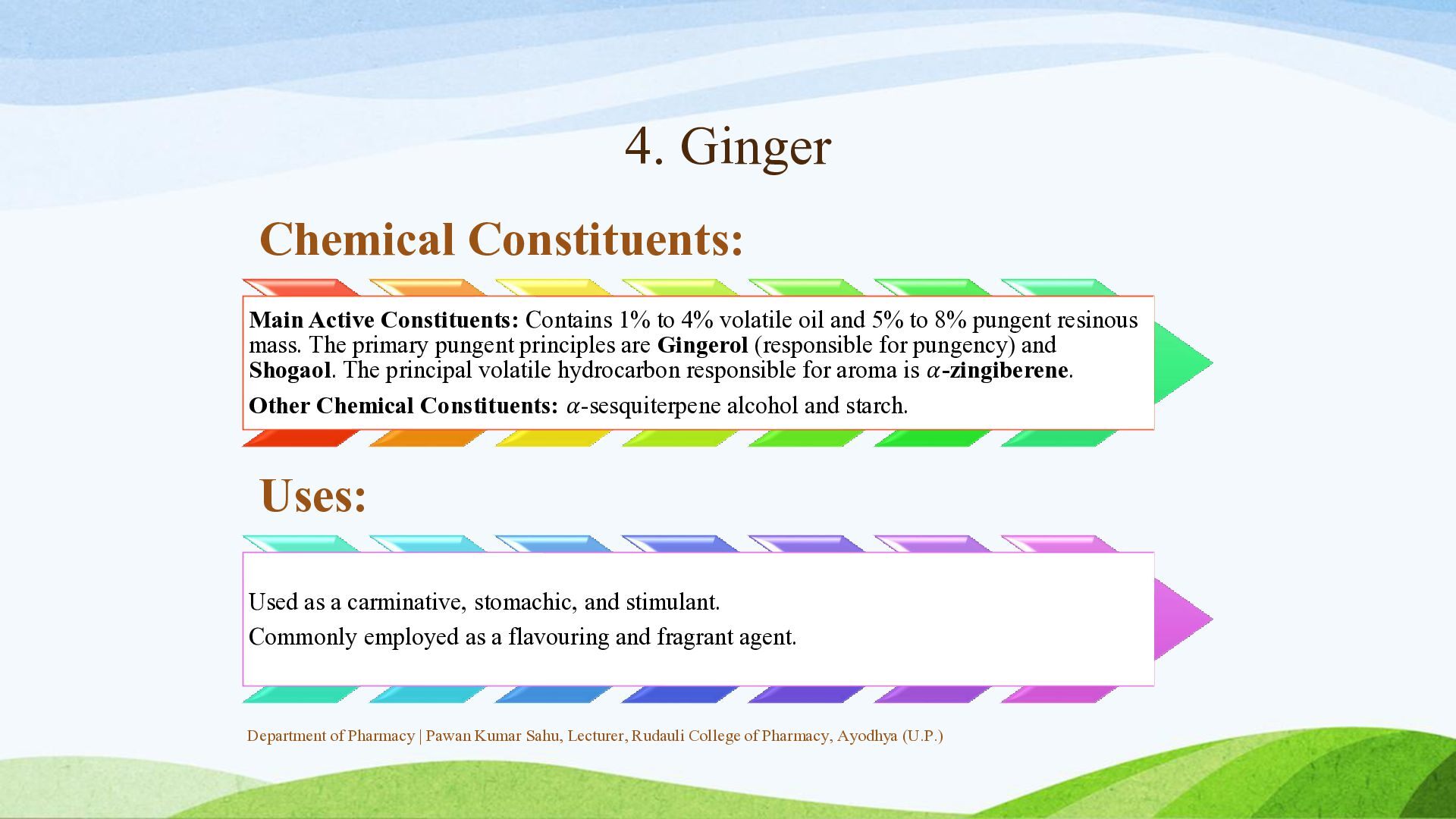
  44. 4. Ginger Chemical Constituents: Main Active Constituents: Contains 1% to

    4% volatile oil and 5% to 8% pungent resinous mass. The primary pungent principles are Gingerol (responsible for pungency) and Shogaol. The principal volatile hydrocarbon responsible for aroma is 𝛼-zingiberene. Other Chemical Constituents: 𝛼-sesquiterpene alcohol and starch. start equation alpha start equation alpha Uses: Used as a carminative, stomachic, and stimulant. Commonly employed as a flavouring and fragrant agent. Department of Pharmacy | Pawan Kumar Sahu, Lecturer, Rudauli College of Pharmacy, Ayodhya (U.P.)
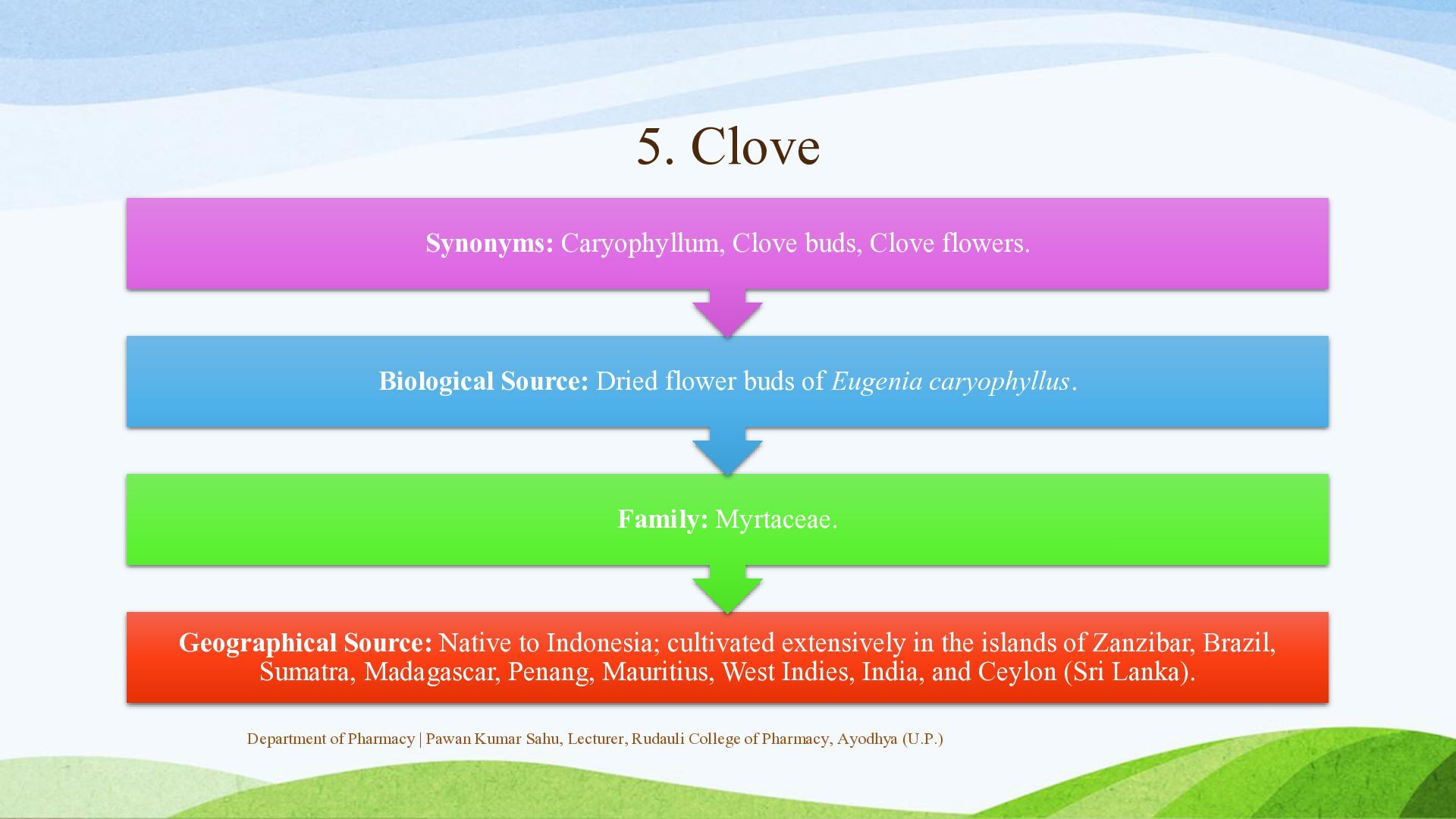
  45. 5. Clove Synonyms: Caryophyllum, Clove buds, Clove flowers. Biological Source:

    Dried flower buds of Eugenia caryophyllus. Family: Myrtaceae. Geographical Source: Native to Indonesia; cultivated extensively in the islands of Zanzibar, Brazil, Sumatra, Madagascar, Penang, Mauritius, West Indies, India, and Ceylon (Sri Lanka). Department of Pharmacy | Pawan Kumar Sahu, Lecturer, Rudauli College of Pharmacy, Ayodhya (U.P.)
  46. 5. Clove Department of Pharmacy | Pawan Kumar Sahu, Lecturer,

    Rudauli College of Pharmacy, Ayodhya (U.P.)
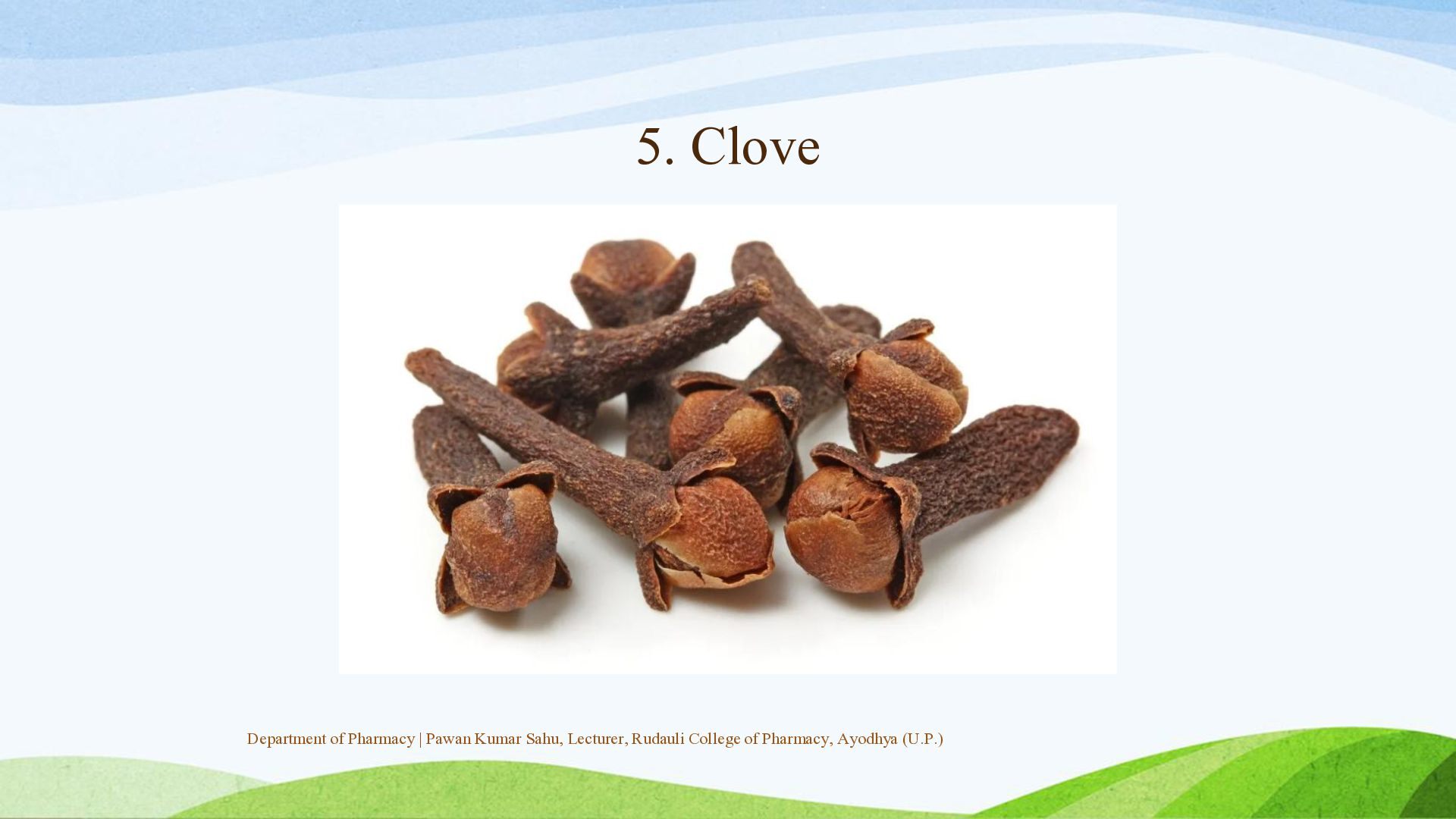
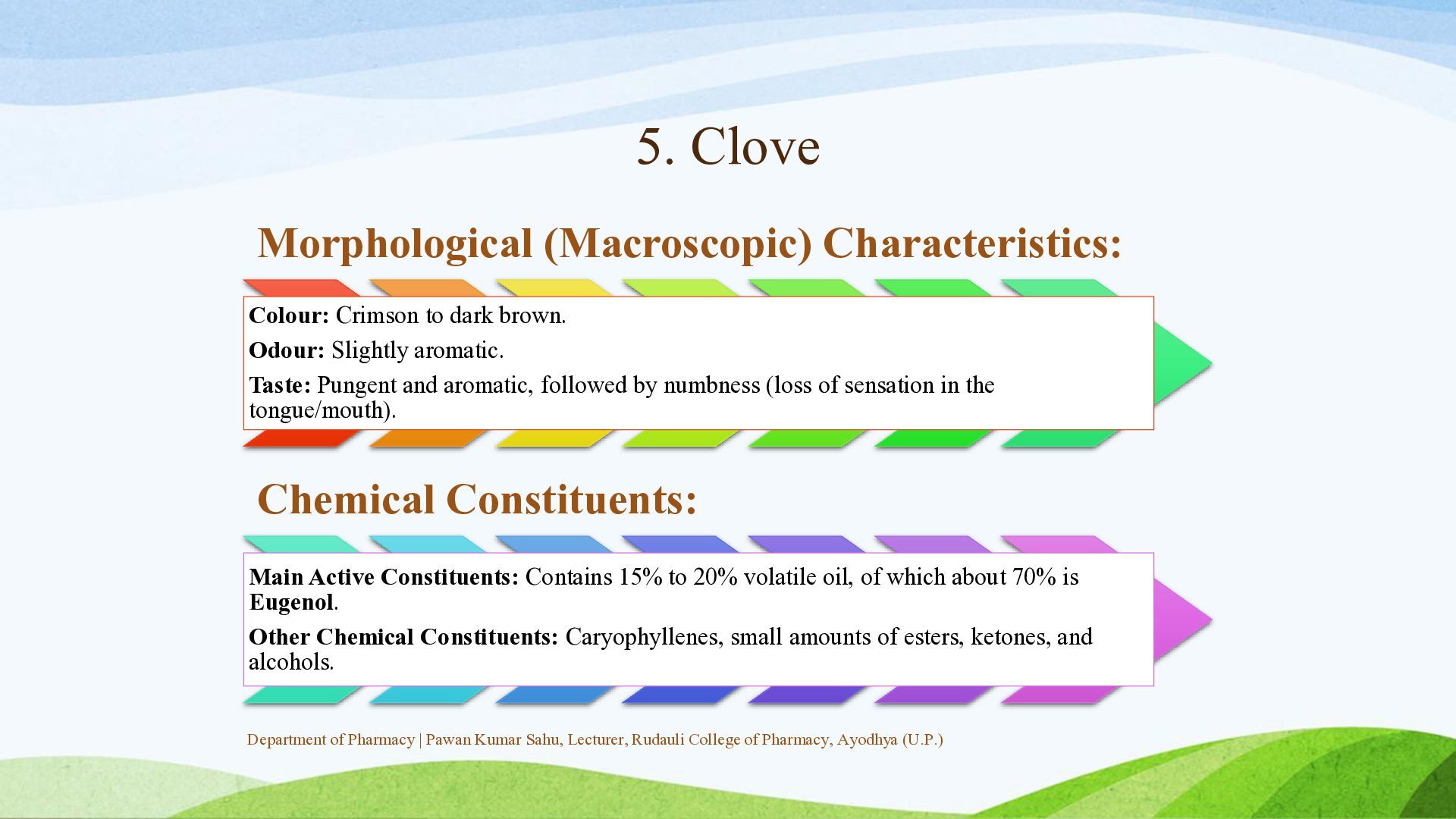
  47. 5. Clove Morphological (Macroscopic) Characteristics: Colour: Crimson to dark brown.

    Odour: Slightly aromatic. Taste: Pungent and aromatic, followed by numbness (loss of sensation in the tongue/mouth). Chemical Constituents: Main Active Constituents: Contains 15% to 20% volatile oil, of which about 70% is Eugenol. Other Chemical Constituents: Caryophyllenes, small amounts of esters, ketones, and alcohols. Department of Pharmacy | Pawan Kumar Sahu, Lecturer, Rudauli College of Pharmacy, Ayodhya (U.P.)
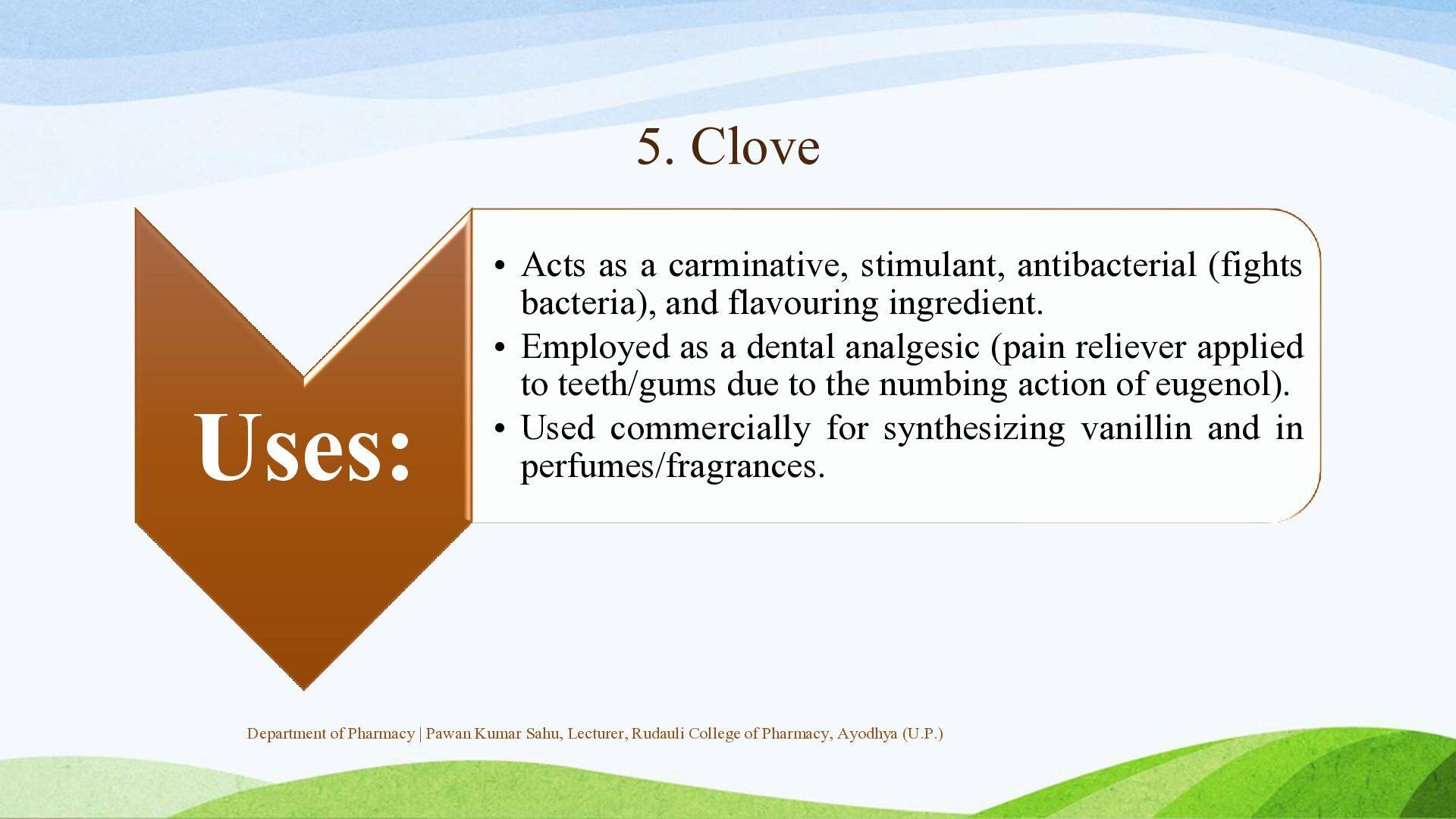
  48. 5. Clove Uses: • Acts as a carminative, stimulant, antibacterial

    (fights bacteria), and flavouring ingredient. • Employed as a dental analgesic (pain reliever applied to teeth/gums due to the numbing action of eugenol). • Used commercially for synthesizing vanillin and in perfumes/fragrances. Department of Pharmacy | Pawan Kumar Sahu, Lecturer, Rudauli College of Pharmacy, Ayodhya (U.P.)
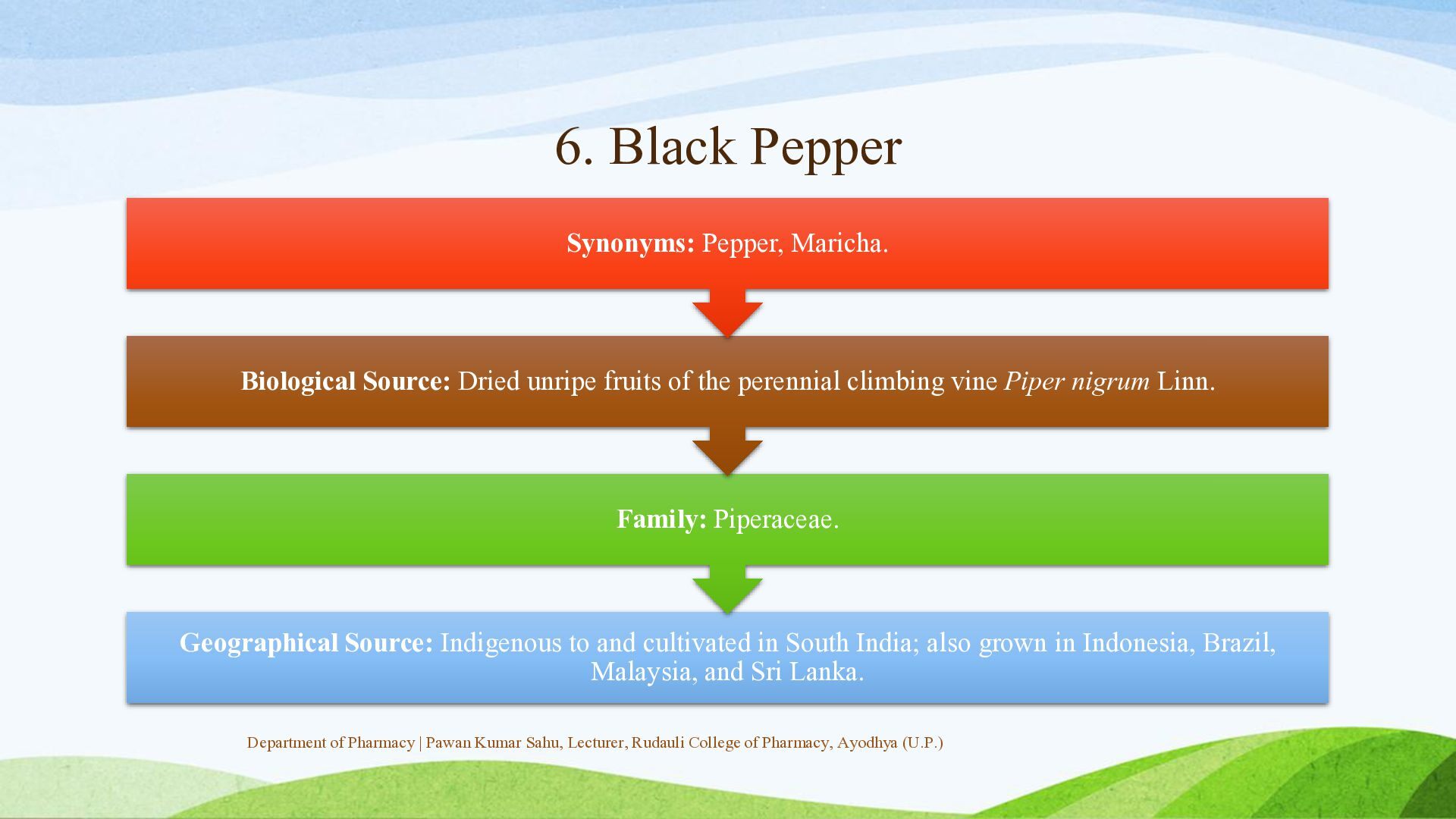
  49. 6. Black Pepper Synonyms: Pepper, Maricha. Biological Source: Dried unripe

    fruits of the perennial climbing vine Piper nigrum Linn. Family: Piperaceae. Geographical Source: Indigenous to and cultivated in South India; also grown in Indonesia, Brazil, Malaysia, and Sri Lanka. Department of Pharmacy | Pawan Kumar Sahu, Lecturer, Rudauli College of Pharmacy, Ayodhya (U.P.)
  50. 6. Black Pepper Department of Pharmacy | Pawan Kumar Sahu,

    Lecturer, Rudauli College of Pharmacy, Ayodhya (U.P.)
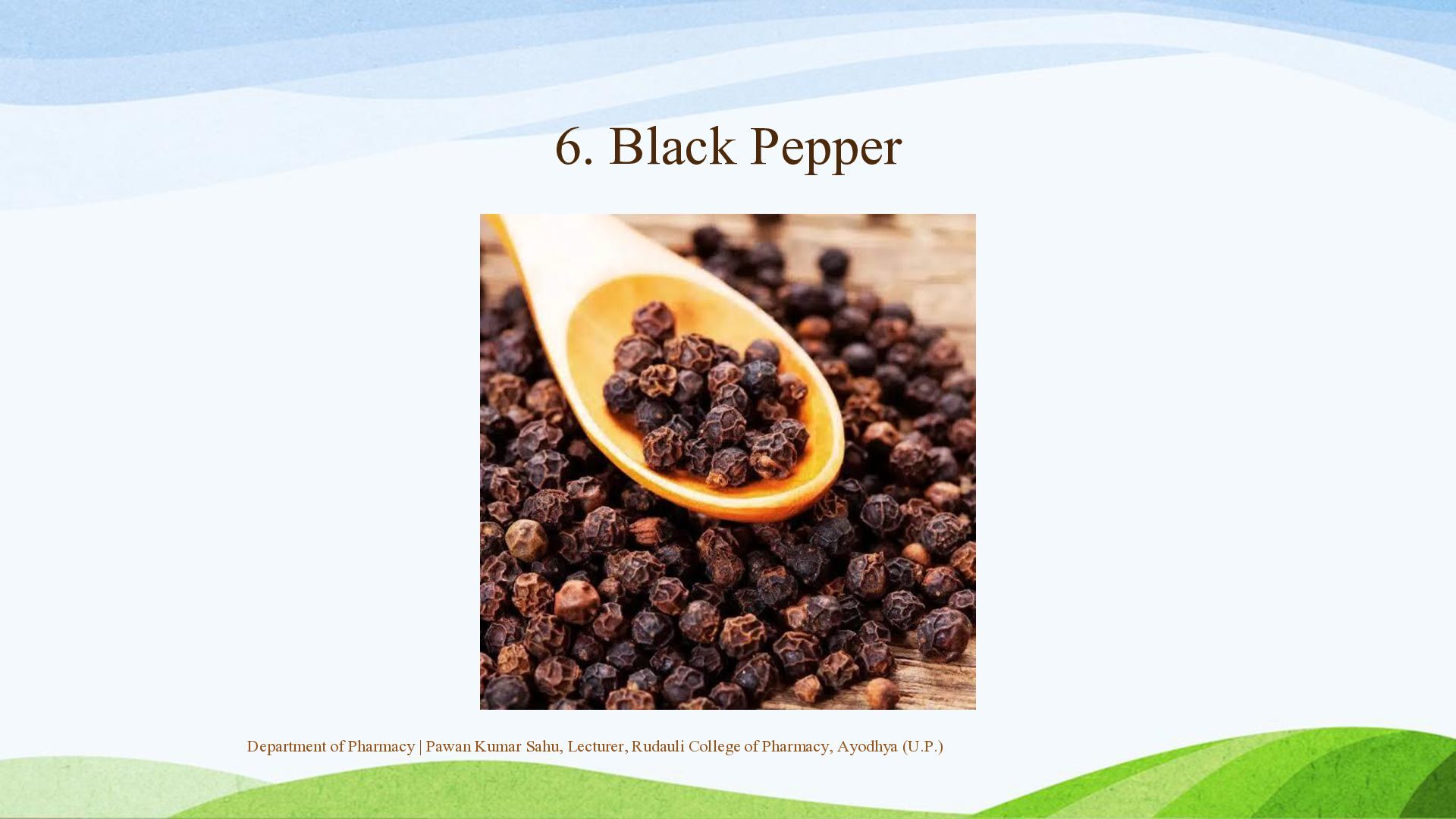
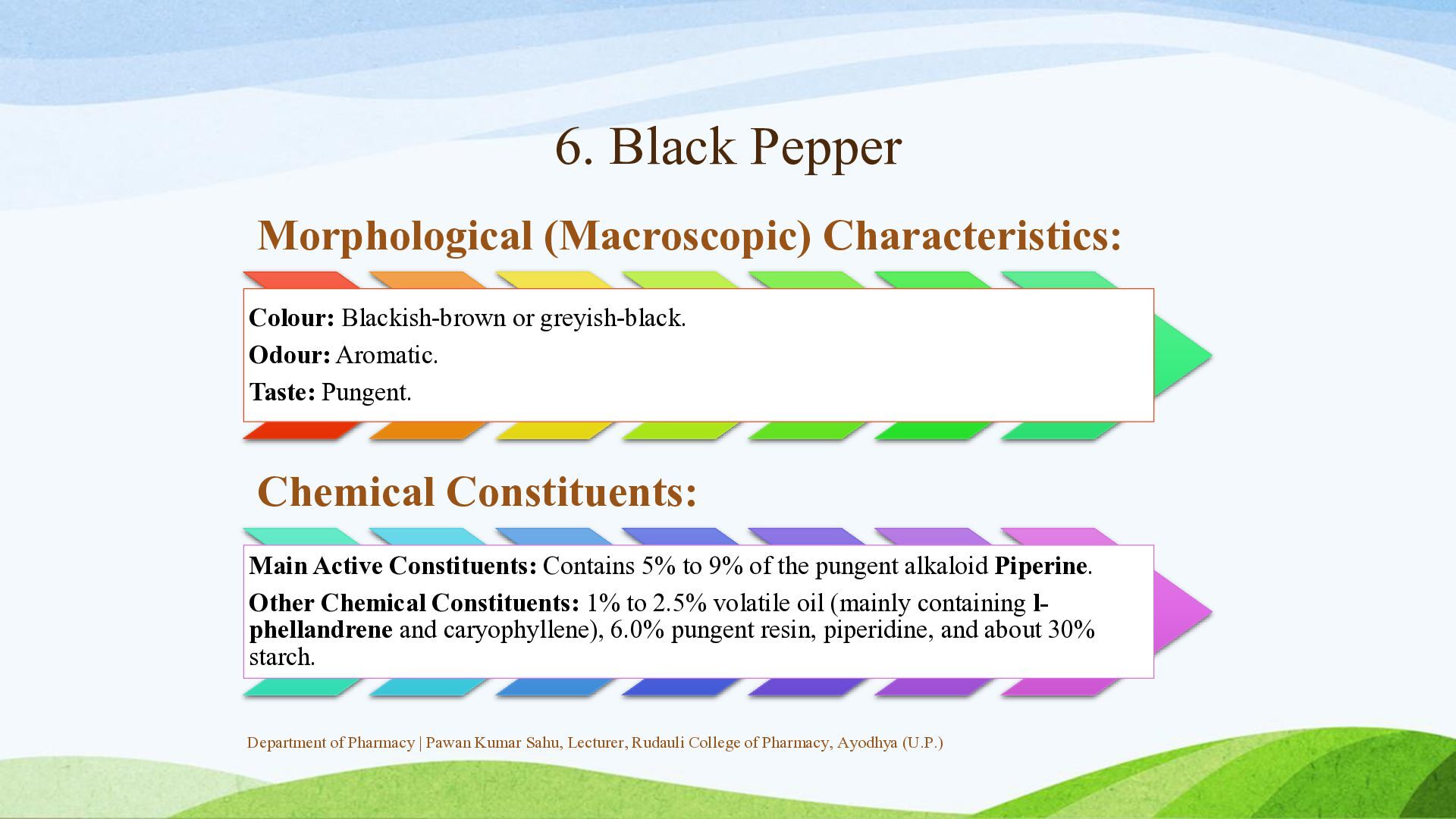
  51. 6. Black Pepper Morphological (Macroscopic) Characteristics: Colour: Blackish-brown or greyish-black.

    Odour: Aromatic. Taste: Pungent. Chemical Constituents: Main Active Constituents: Contains 5% to 9% of the pungent alkaloid Piperine. Other Chemical Constituents: 1% to 2.5% volatile oil (mainly containing lphellandrene and caryophyllene), 6.0% pungent resin, piperidine, and about 30% starch. Department of Pharmacy | Pawan Kumar Sahu, Lecturer, Rudauli College of Pharmacy, Ayodhya (U.P.)
  52. 6. Black Pepper Uses: • Used as an aromatic, stomachic,

    stimulant, and carminative. • Extensively used as a condiment (food seasoning/spice). Department of Pharmacy | Pawan Kumar Sahu, Lecturer, Rudauli College of Pharmacy, Ayodhya (U.P.)
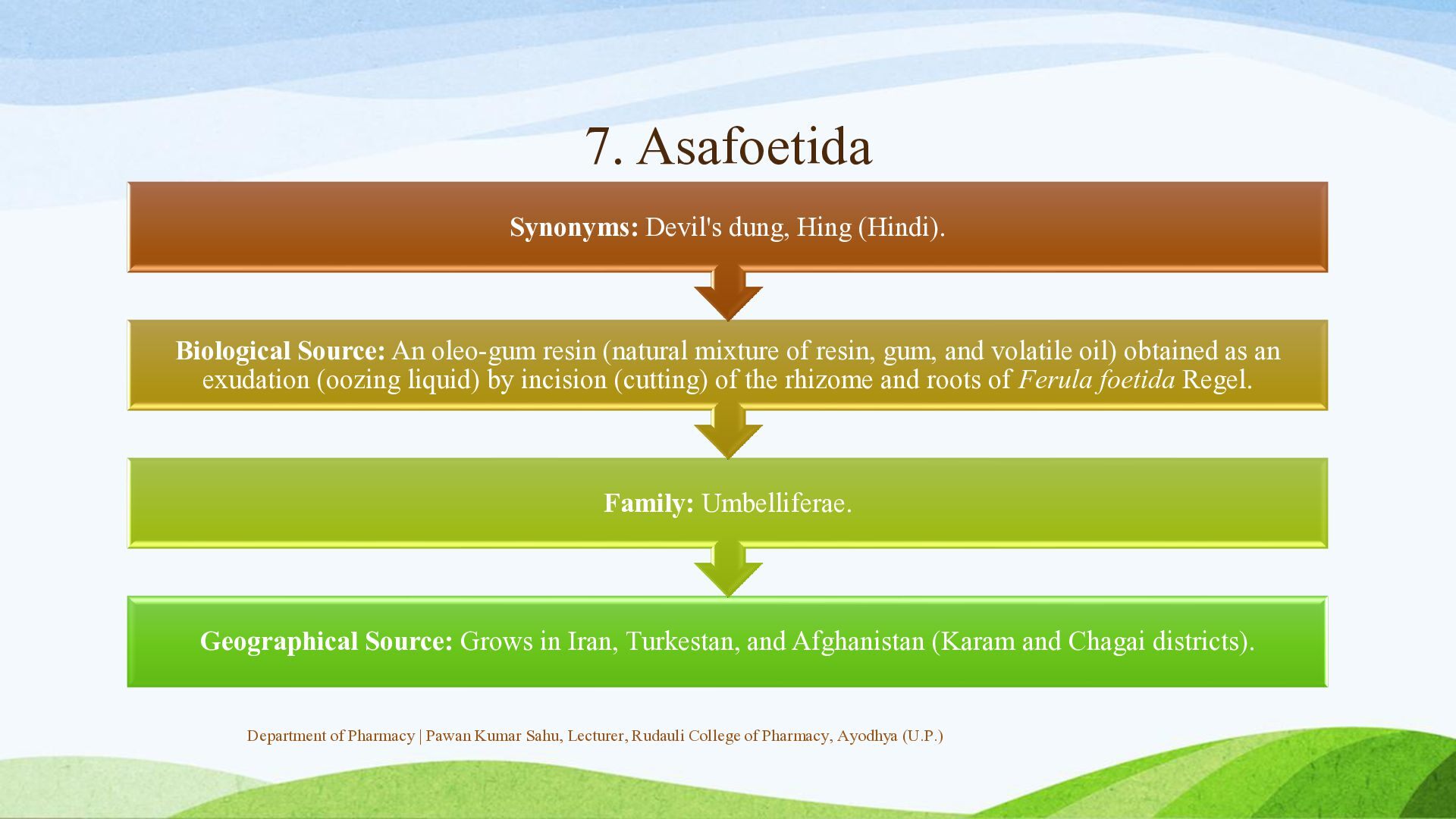
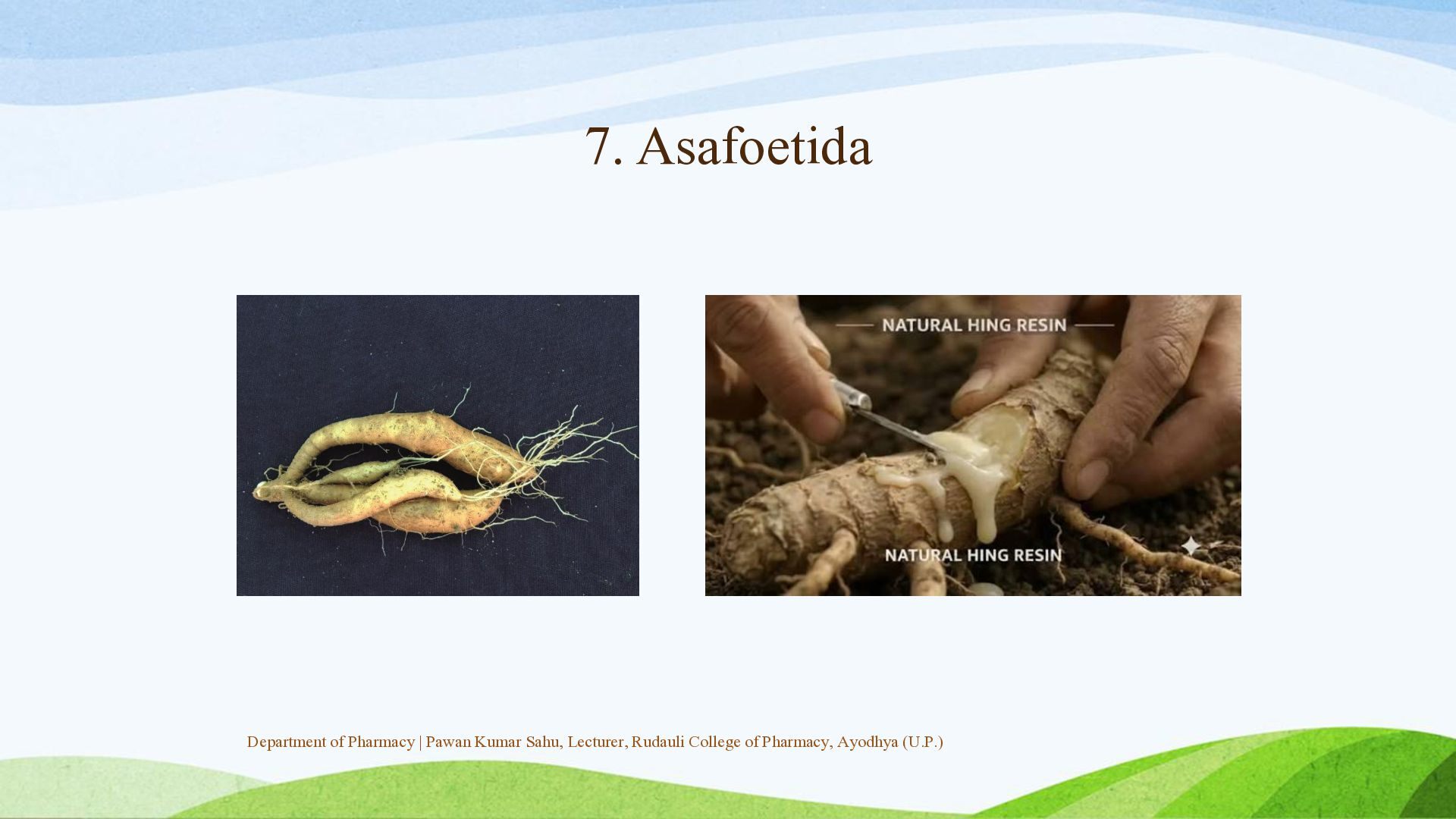
  53. 7. Asafoetida Synonyms: Devil's dung, Hing (Hindi). Biological Source: An

    oleo-gum resin (natural mixture of resin, gum, and volatile oil) obtained as an exudation (oozing liquid) by incision (cutting) of the rhizome and roots of Ferula foetida Regel. Family: Umbelliferae. Geographical Source: Grows in Iran, Turkestan, and Afghanistan (Karam and Chagai districts). Department of Pharmacy | Pawan Kumar Sahu, Lecturer, Rudauli College of Pharmacy, Ayodhya (U.P.)
  54. 7. Asafoetida Department of Pharmacy | Pawan Kumar Sahu, Lecturer,

    Rudauli College of Pharmacy, Ayodhya (U.P.)
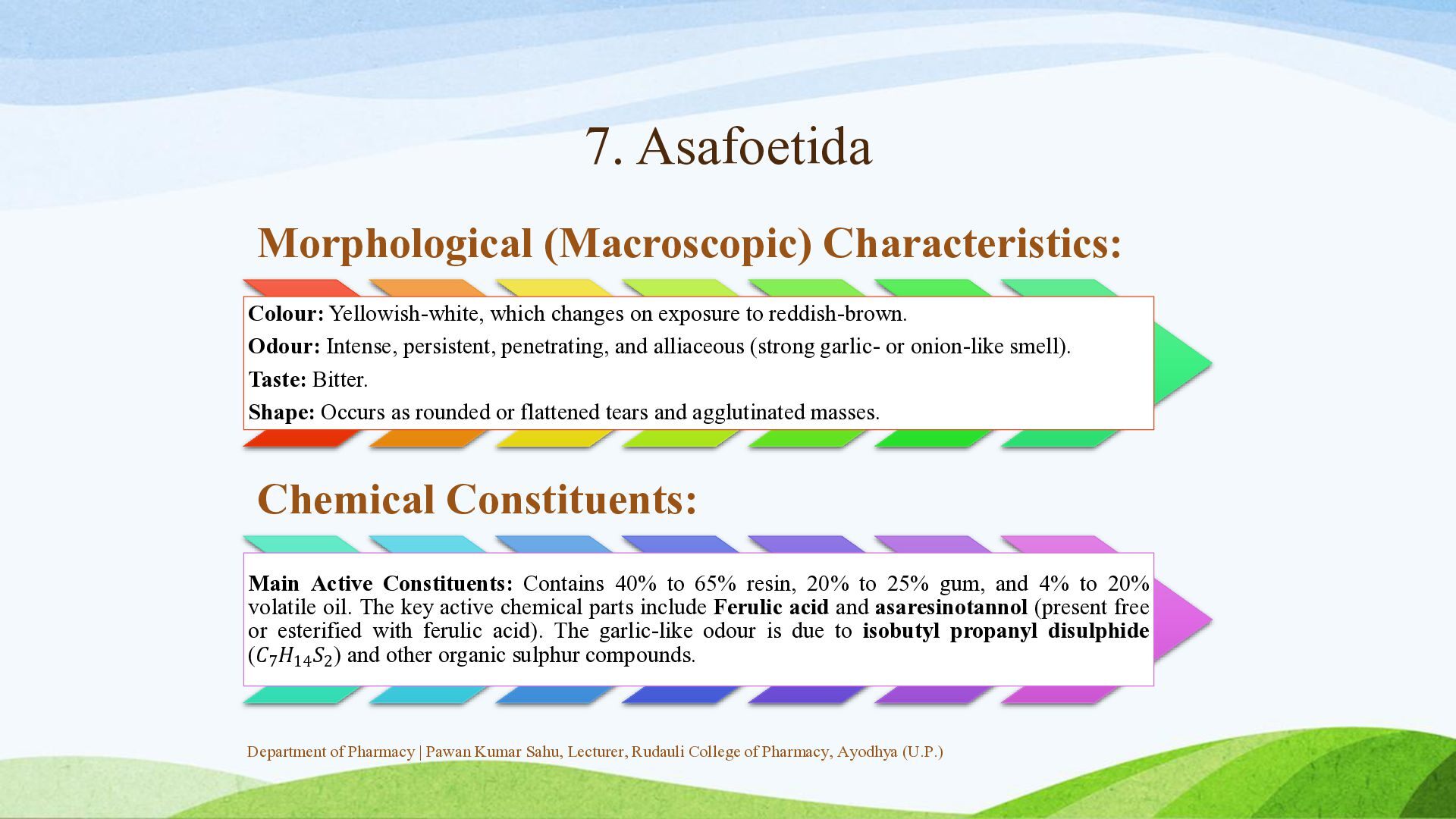
  55. 7. Asafoetida Morphological (Macroscopic) Characteristics: Colour: Yellowish-white, which changes on

    exposure to reddish-brown. Odour: Intense, persistent, penetrating, and alliaceous (strong garlic- or onion-like smell). Taste: Bitter. Shape: Occurs as rounded or flattened tears and agglutinated masses. Chemical Constituents: Main Active Constituents: Contains 40% to 65% resin, 20% to 25% gum, and 4% to 20% volatile oil. The key active chemical parts include Ferulic acid and asaresinotannol (present free or esterified with ferulic acid). The garlic-like odour is due to isobutyl propanyl disulphide (𝐶7 𝐻14 𝑆2 ) and other organic sulphur compounds. cap C sub 7 , cap H sub 14 , cap S sub 2 Department of Pharmacy | Pawan Kumar Sahu, Lecturer, Rudauli College of Pharmacy, Ayodhya (U.P.)
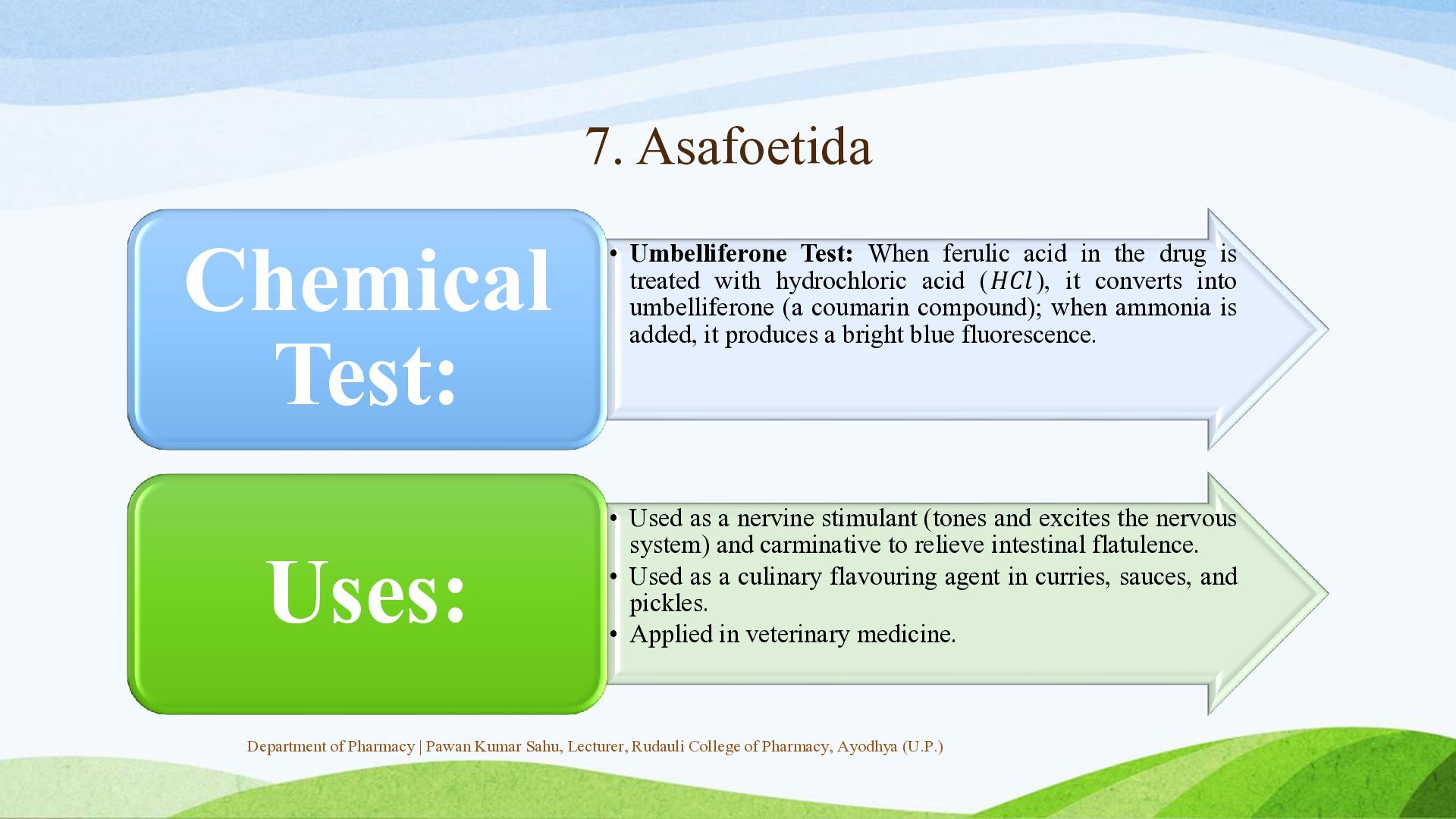
  56. 7. Asafoetida Chemical Test: Uses: • Umbelliferone Test: When ferulic

    acid in the drug is treated with hydrochloric acid (𝐻𝐶𝑙 ), it converts into umbelliferone (a coumarin compound); when ammonia is added, it produces a bright blue fluorescence. cap H cap C l • Used as a nervine stimulant (tones and excites the nervous system) and carminative to relieve intestinal flatulence. • Used as a culinary flavouring agent in curries, sauces, and pickles. • Applied in veterinary medicine. Department of Pharmacy | Pawan Kumar Sahu, Lecturer, Rudauli College of Pharmacy, Ayodhya (U.P.)
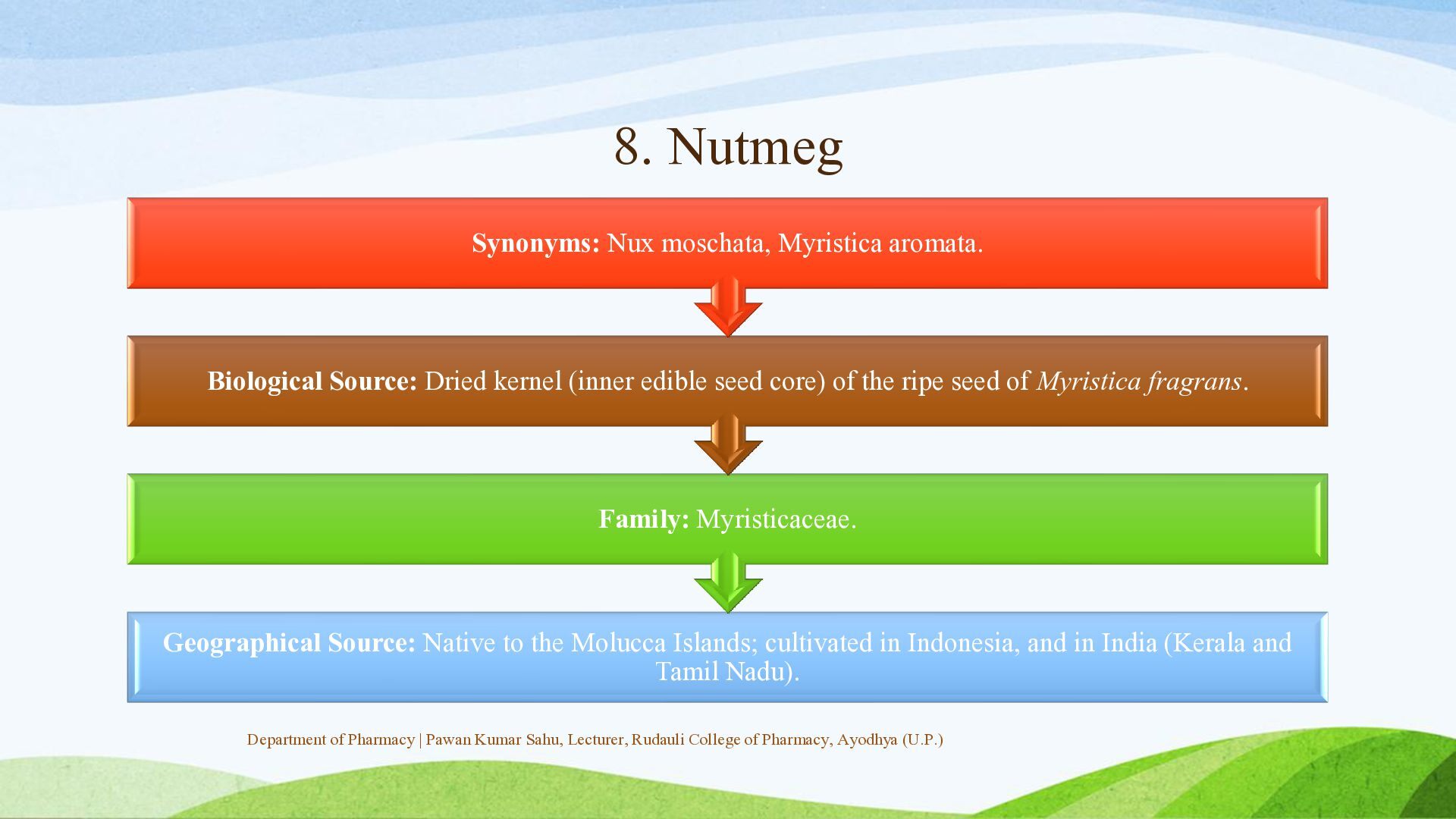
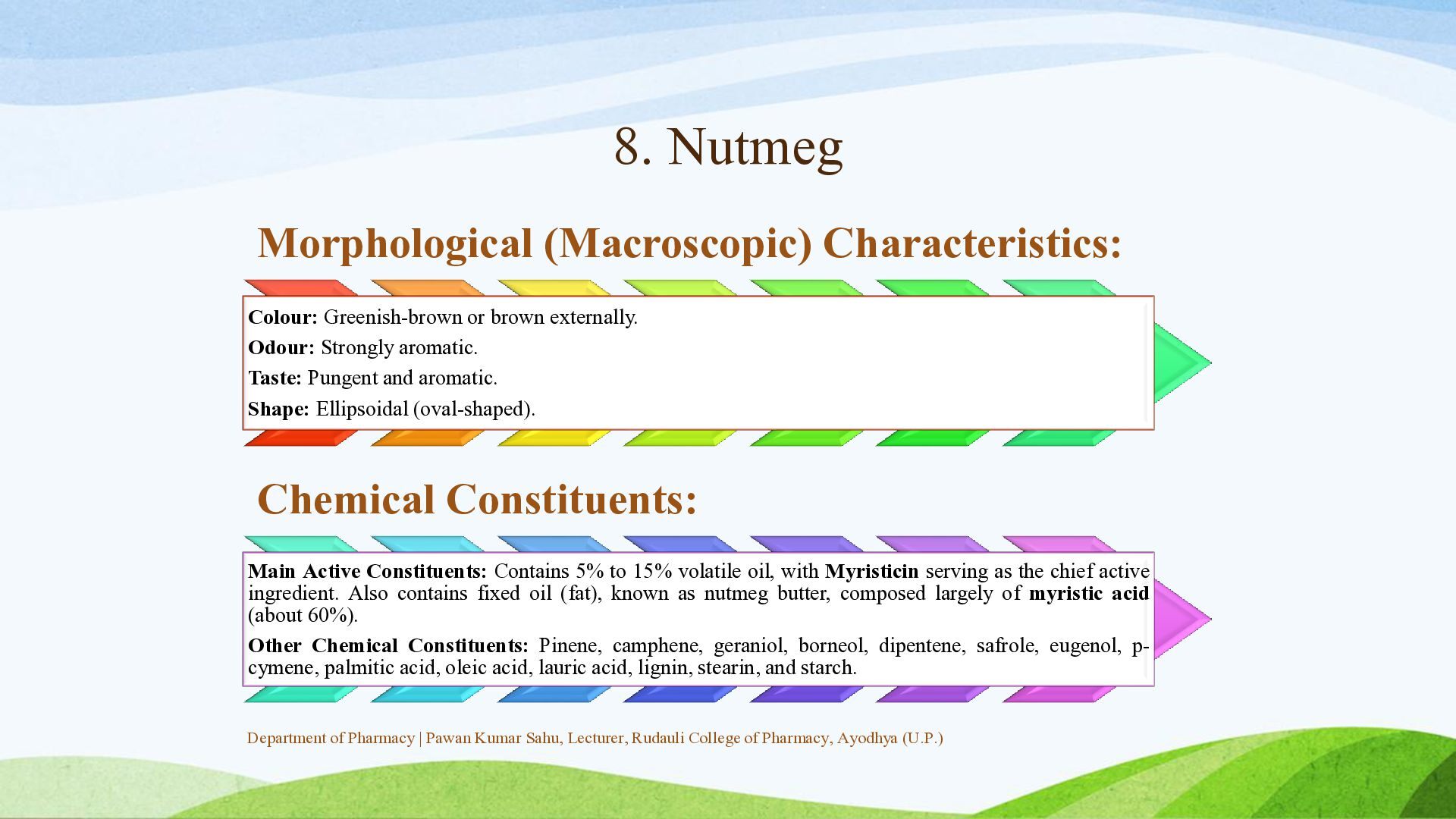
  57. 8. Nutmeg Synonyms: Nux moschata, Myristica aromata. Biological Source: Dried

    kernel (inner edible seed core) of the ripe seed of Myristica fragrans. Family: Myristicaceae. Geographical Source: Native to the Molucca Islands; cultivated in Indonesia, and in India (Kerala and Tamil Nadu). Department of Pharmacy | Pawan Kumar Sahu, Lecturer, Rudauli College of Pharmacy, Ayodhya (U.P.)
  58. 8. Nutmeg Department of Pharmacy | Pawan Kumar Sahu, Lecturer,

    Rudauli College of Pharmacy, Ayodhya (U.P.)
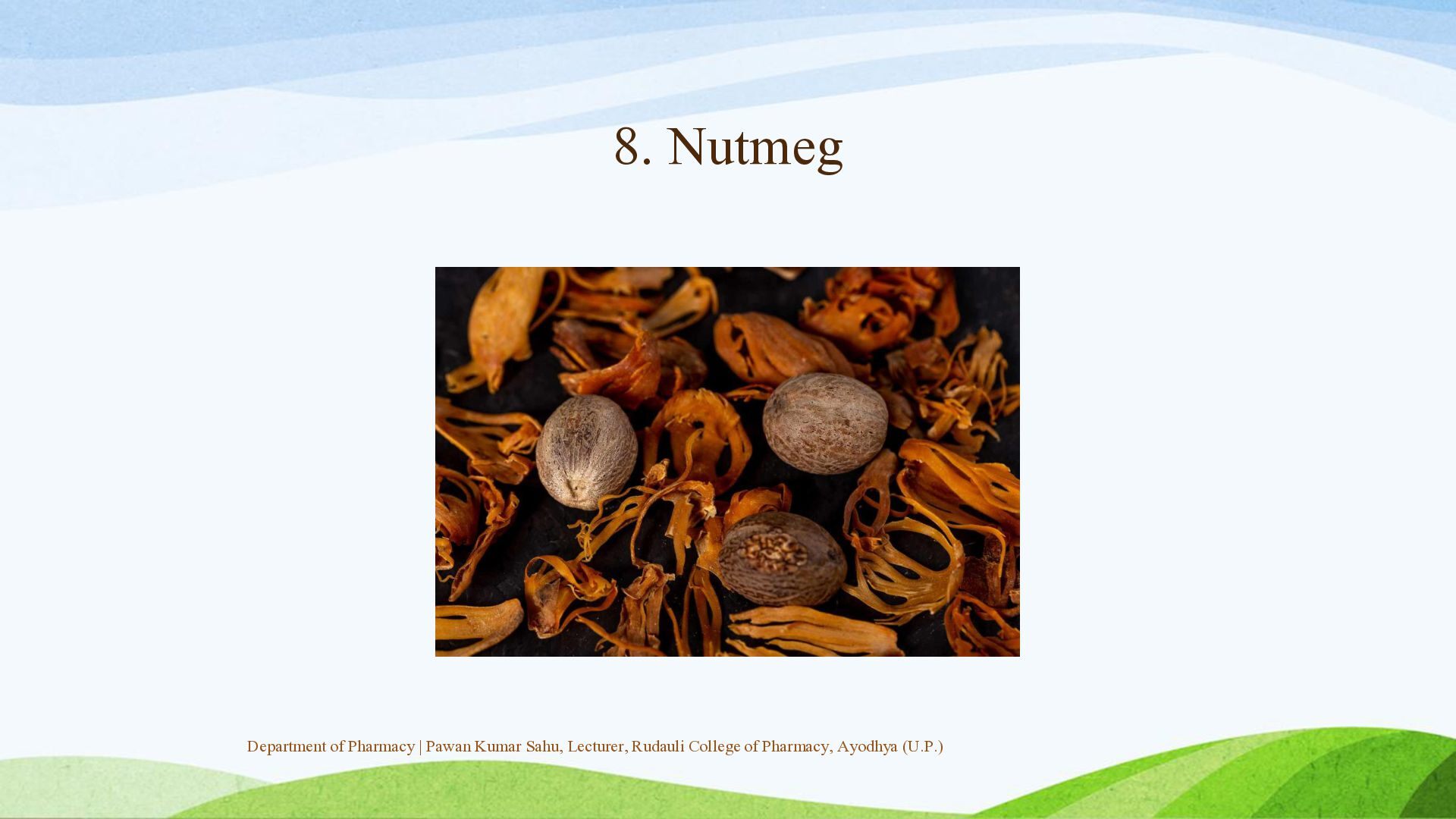
  59. 8. Nutmeg Morphological (Macroscopic) Characteristics: Colour: Greenish-brown or brown externally.

    Odour: Strongly aromatic. Taste: Pungent and aromatic. Shape: Ellipsoidal (oval-shaped). Chemical Constituents: Main Active Constituents: Contains 5% to 15% volatile oil, with Myristicin serving as the chief active ingredient. Also contains fixed oil (fat), known as nutmeg butter, composed largely of myristic acid (about 60%). Other Chemical Constituents: Pinene, camphene, geraniol, borneol, dipentene, safrole, eugenol, pcymene, palmitic acid, oleic acid, lauric acid, lignin, stearin, and starch. Department of Pharmacy | Pawan Kumar Sahu, Lecturer, Rudauli College of Pharmacy, Ayodhya (U.P.)
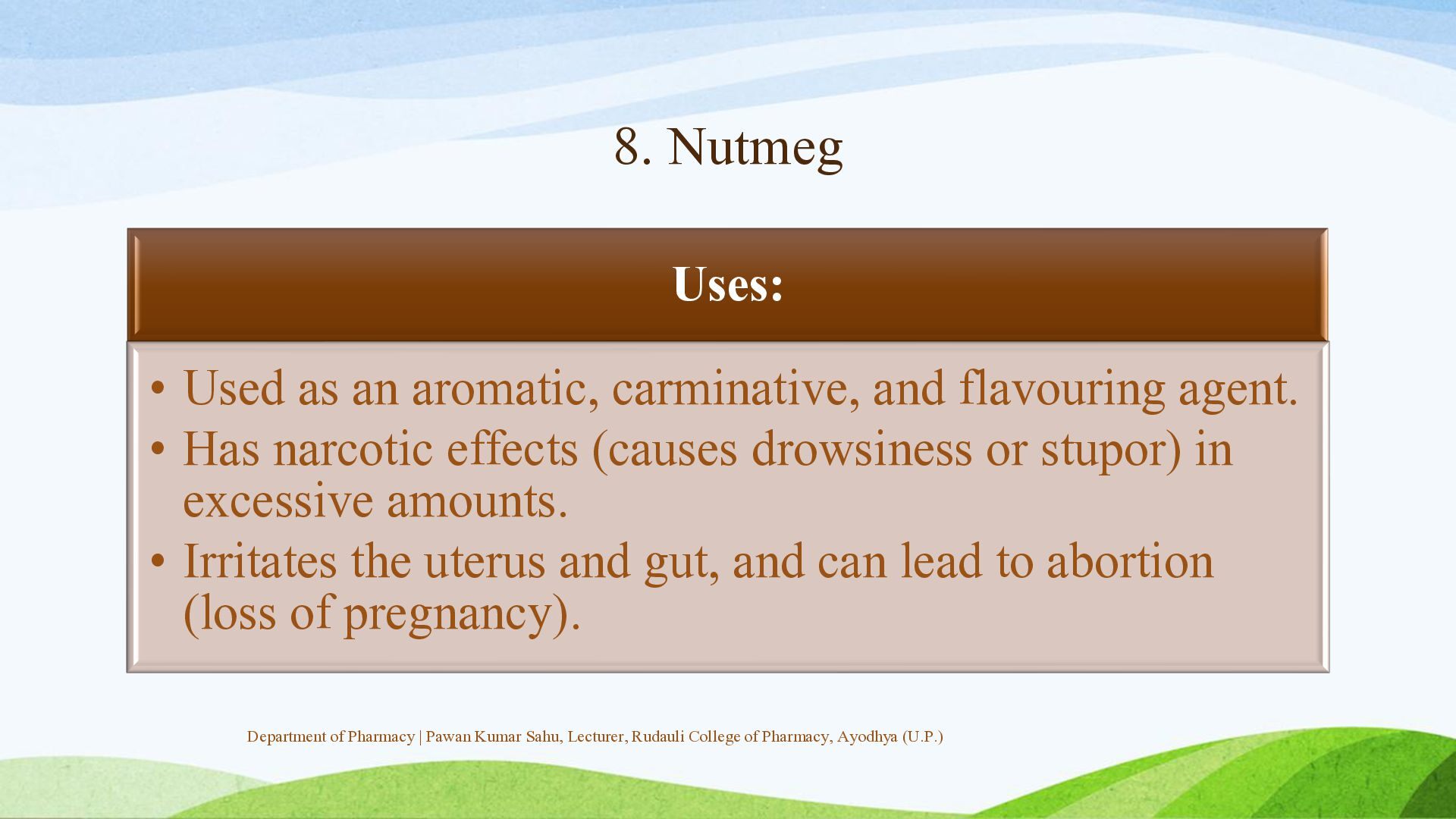
  60. 8. Nutmeg Uses: • Used as an aromatic, carminative, and

    flavouring agent. • Has narcotic effects (causes drowsiness or stupor) in excessive amounts. • Irritates the uterus and gut, and can lead to abortion (loss of pregnancy). Department of Pharmacy | Pawan Kumar Sahu, Lecturer, Rudauli College of Pharmacy, Ayodhya (U.P.)
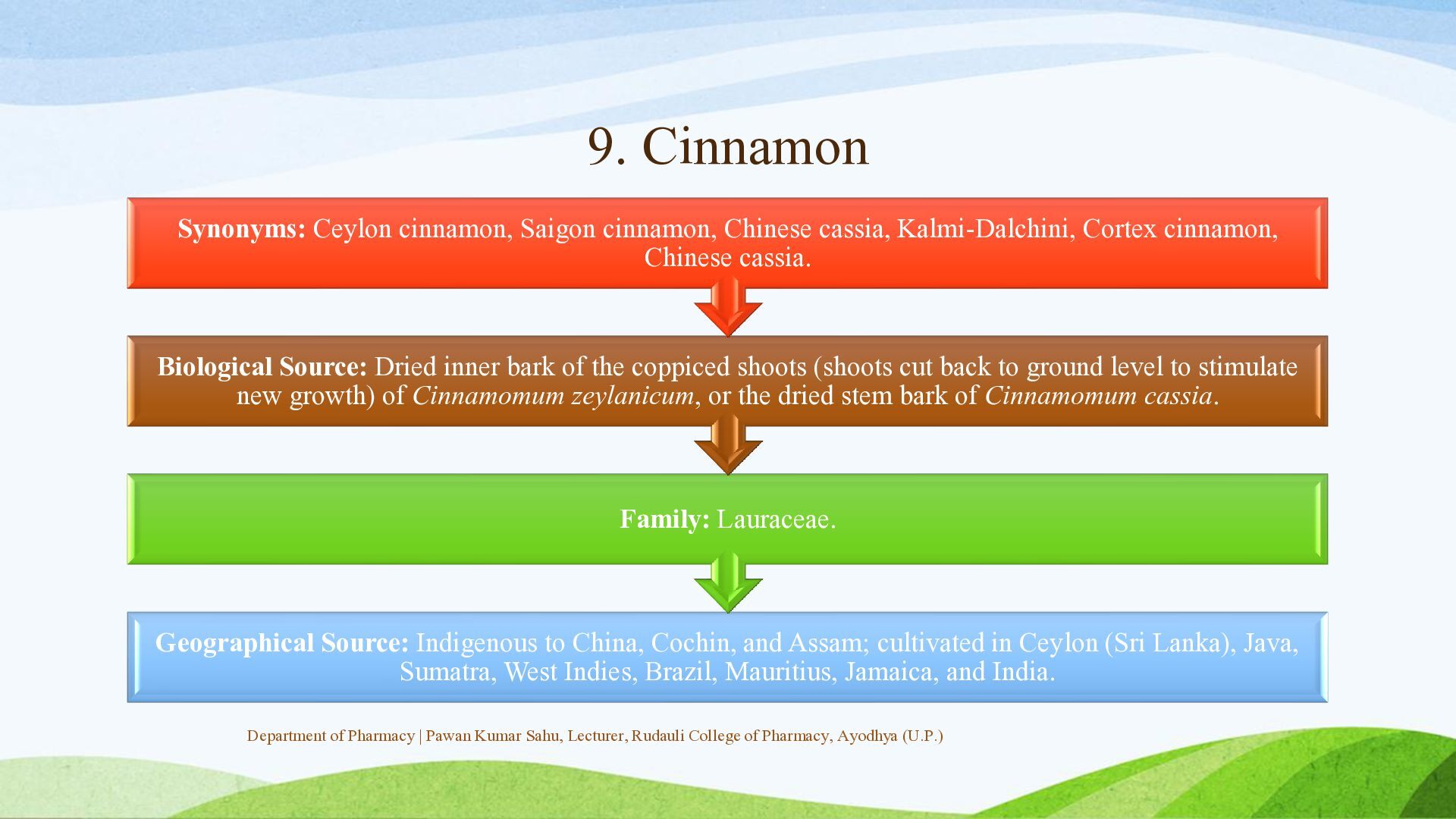
  61. 9. Cinnamon Synonyms: Ceylon cinnamon, Saigon cinnamon, Chinese cassia, Kalmi-Dalchini,

    Cortex cinnamon, Chinese cassia. Biological Source: Dried inner bark of the coppiced shoots (shoots cut back to ground level to stimulate new growth) of Cinnamomum zeylanicum, or the dried stem bark of Cinnamomum cassia. Family: Lauraceae. Geographical Source: Indigenous to China, Cochin, and Assam; cultivated in Ceylon (Sri Lanka), Java, Sumatra, West Indies, Brazil, Mauritius, Jamaica, and India. Department of Pharmacy | Pawan Kumar Sahu, Lecturer, Rudauli College of Pharmacy, Ayodhya (U.P.)
  62. 9. Cinnamon Department of Pharmacy | Pawan Kumar Sahu, Lecturer,

    Rudauli College of Pharmacy, Ayodhya (U.P.)
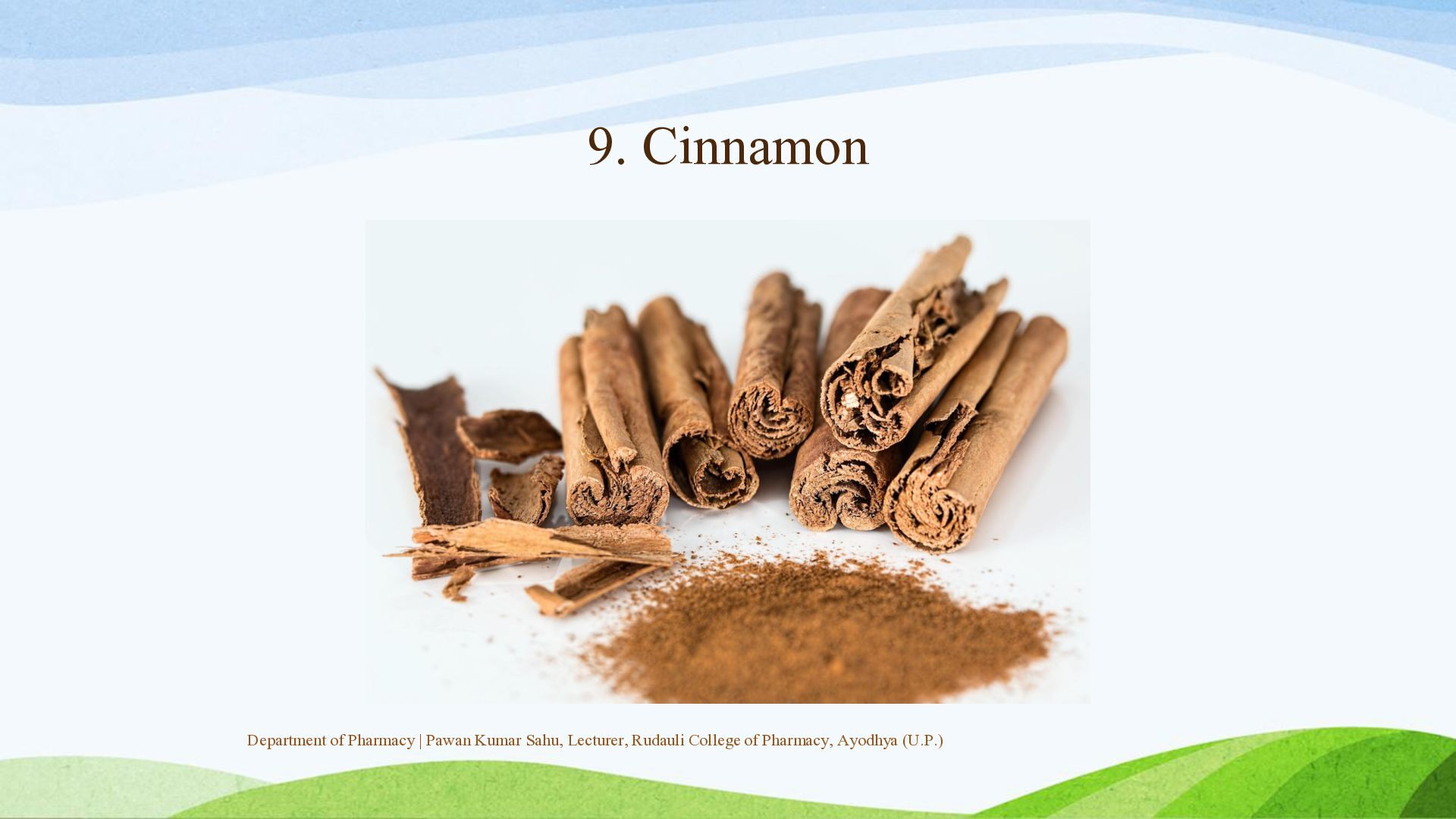
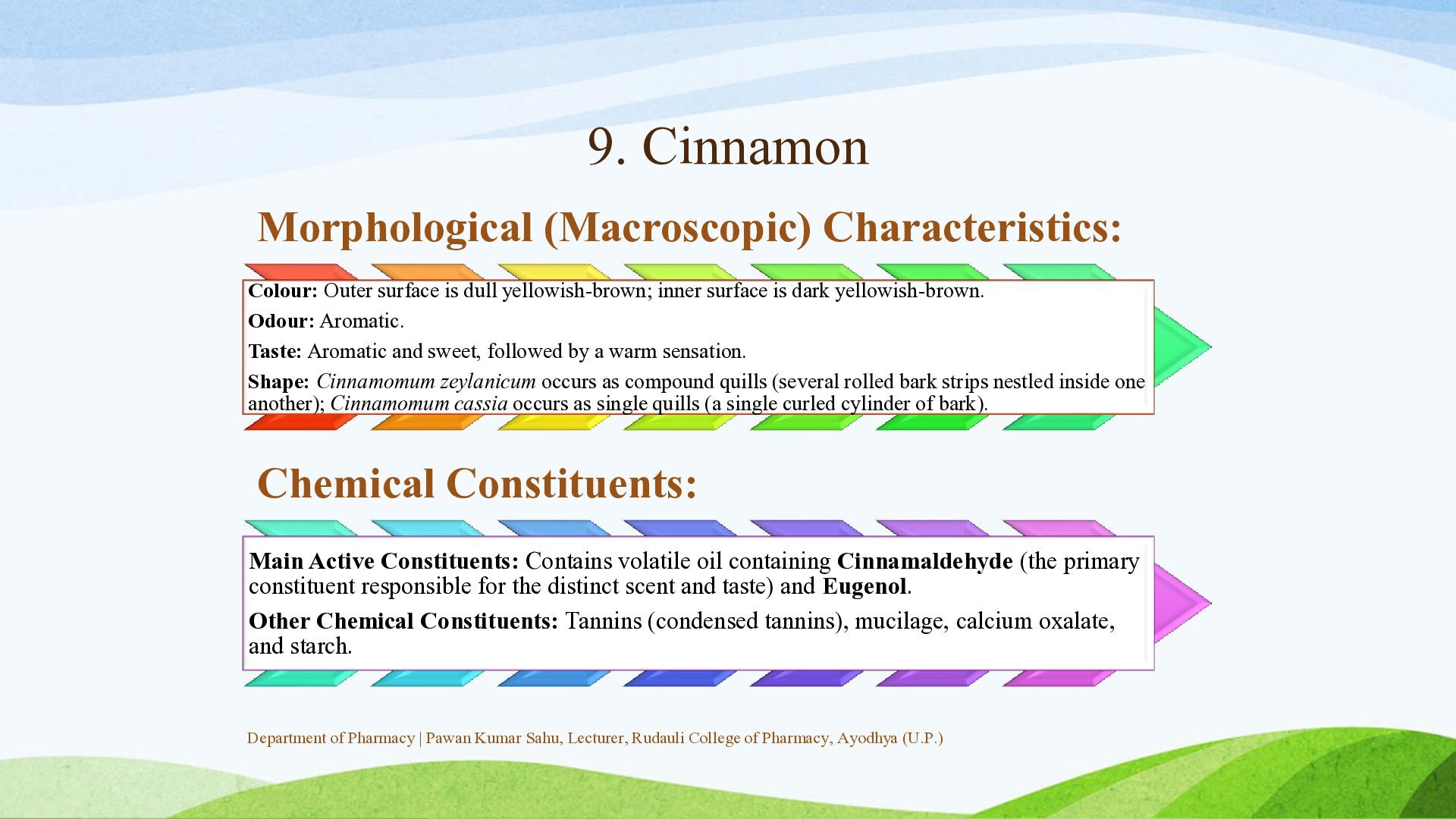
  63. 9. Cinnamon Morphological (Macroscopic) Characteristics: Colour: Outer surface is dull

    yellowish-brown; inner surface is dark yellowish-brown. Odour: Aromatic. Taste: Aromatic and sweet, followed by a warm sensation. Shape: Cinnamomum zeylanicum occurs as compound quills (several rolled bark strips nestled inside one another); Cinnamomum cassia occurs as single quills (a single curled cylinder of bark). Chemical Constituents: Main Active Constituents: Contains volatile oil containing Cinnamaldehyde (the primary constituent responsible for the distinct scent and taste) and Eugenol. Other Chemical Constituents: Tannins (condensed tannins), mucilage, calcium oxalate, and starch. Department of Pharmacy | Pawan Kumar Sahu, Lecturer, Rudauli College of Pharmacy, Ayodhya (U.P.)
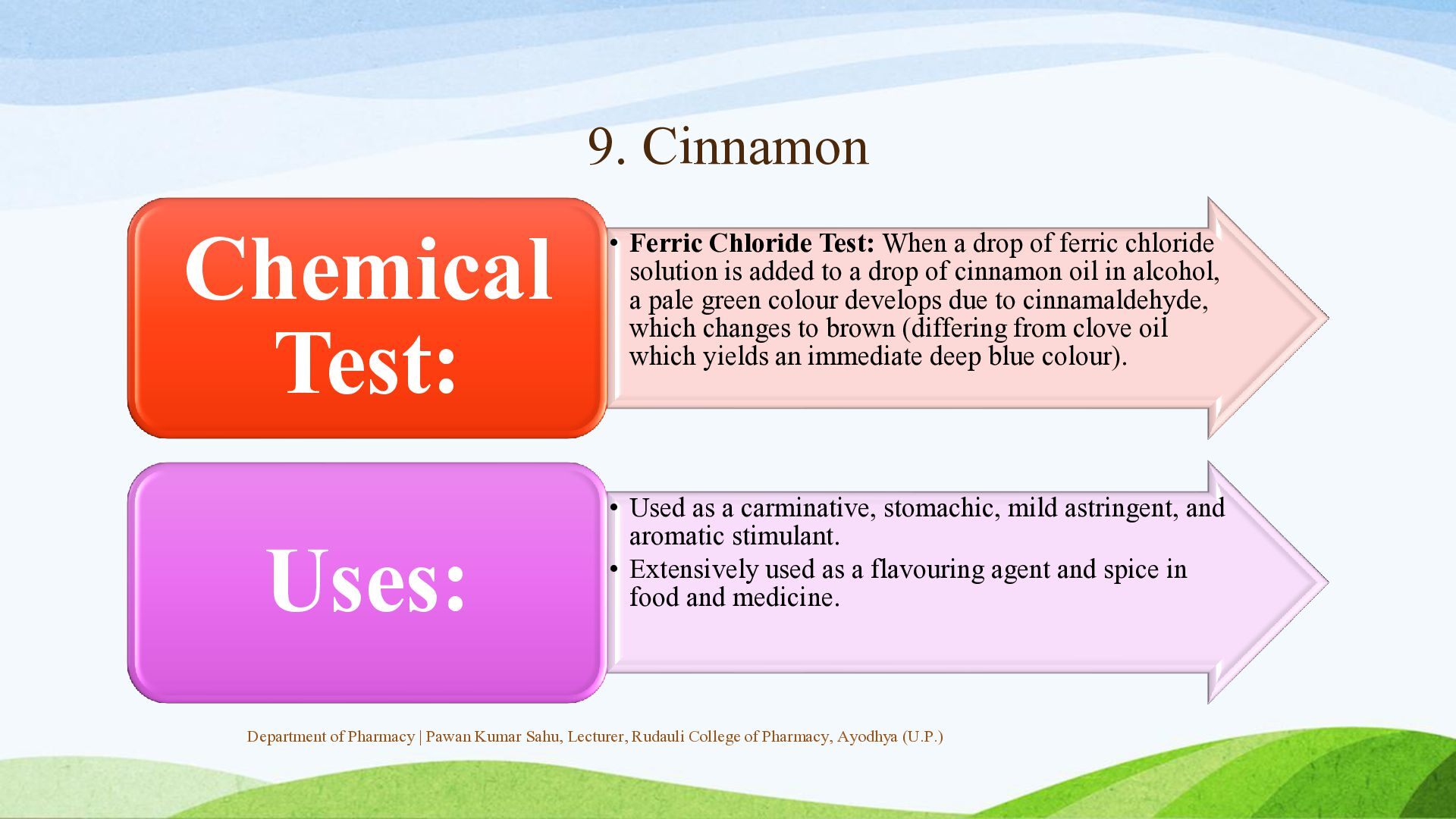
  64. 9. Cinnamon Chemical Test: Uses: • Ferric Chloride Test: When

    a drop of ferric chloride solution is added to a drop of cinnamon oil in alcohol, a pale green colour develops due to cinnamaldehyde, which changes to brown (differing from clove oil which yields an immediate deep blue colour). • Used as a carminative, stomachic, mild astringent, and aromatic stimulant. • Extensively used as a flavouring agent and spice in food and medicine. Department of Pharmacy | Pawan Kumar Sahu, Lecturer, Rudauli College of Pharmacy, Ayodhya (U.P.)
  65. THANK YOU Department of Pharmacy | Pawan Kumar Sahu, Lecturer,

    Rudauli College of Pharmacy, Ayodhya (U.P.)