Introduction to Pharmacognosy: History, Sources, and Scope
Explore the scientific study of natural crude drugs, their historical milestones, sources, classifications, and modern applications in medicine, biotechnology, and herbal standardization.
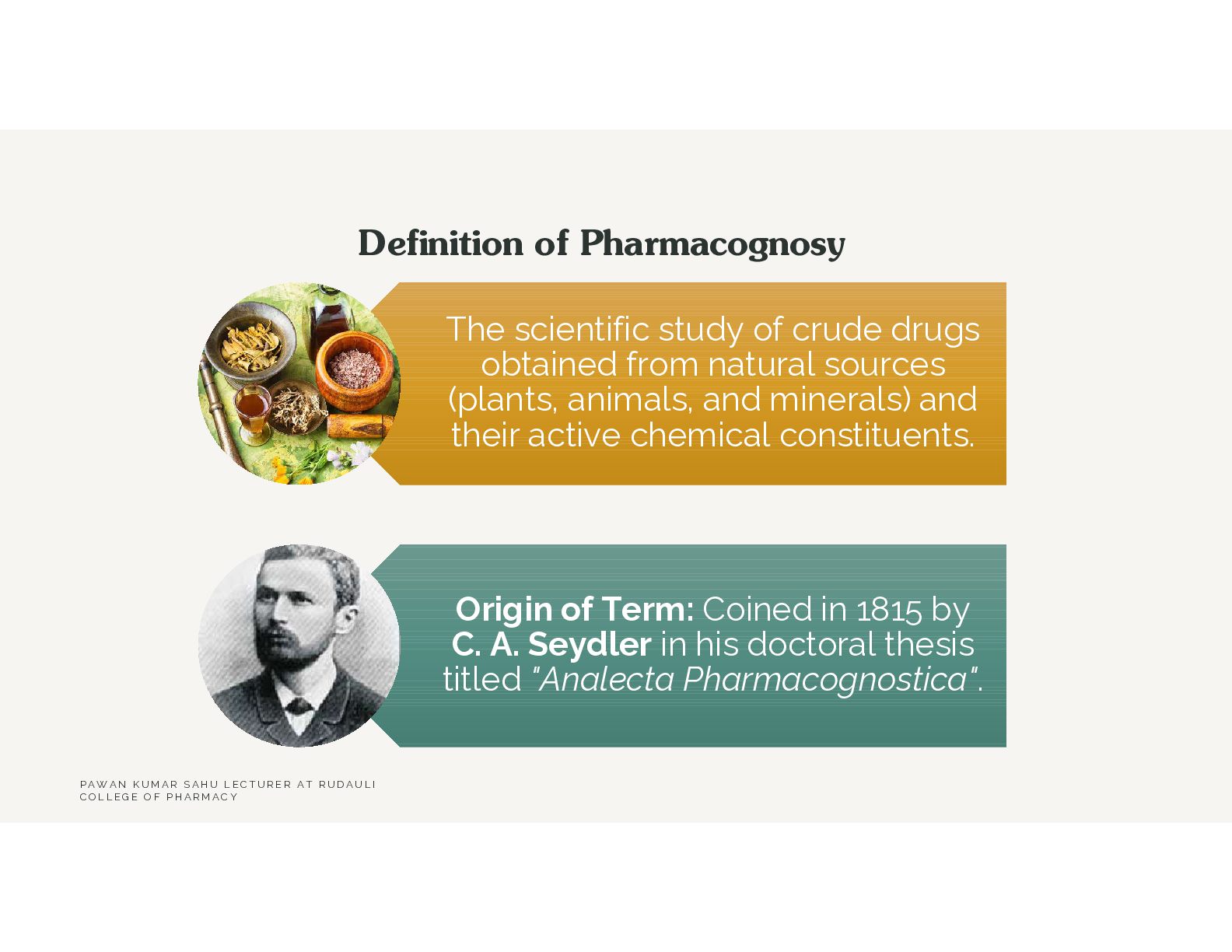
from natural sources (plants, animals, and minerals) and their active chemical constituents. Origin of Term: Coined in 1815 by C. A. Seydler in his doctoral thesis titled "Analecta Pharmacognostica". PAWAN KUMAR SAHU LECTURER AT RUDAULI COLLEGE OF PHARMACY
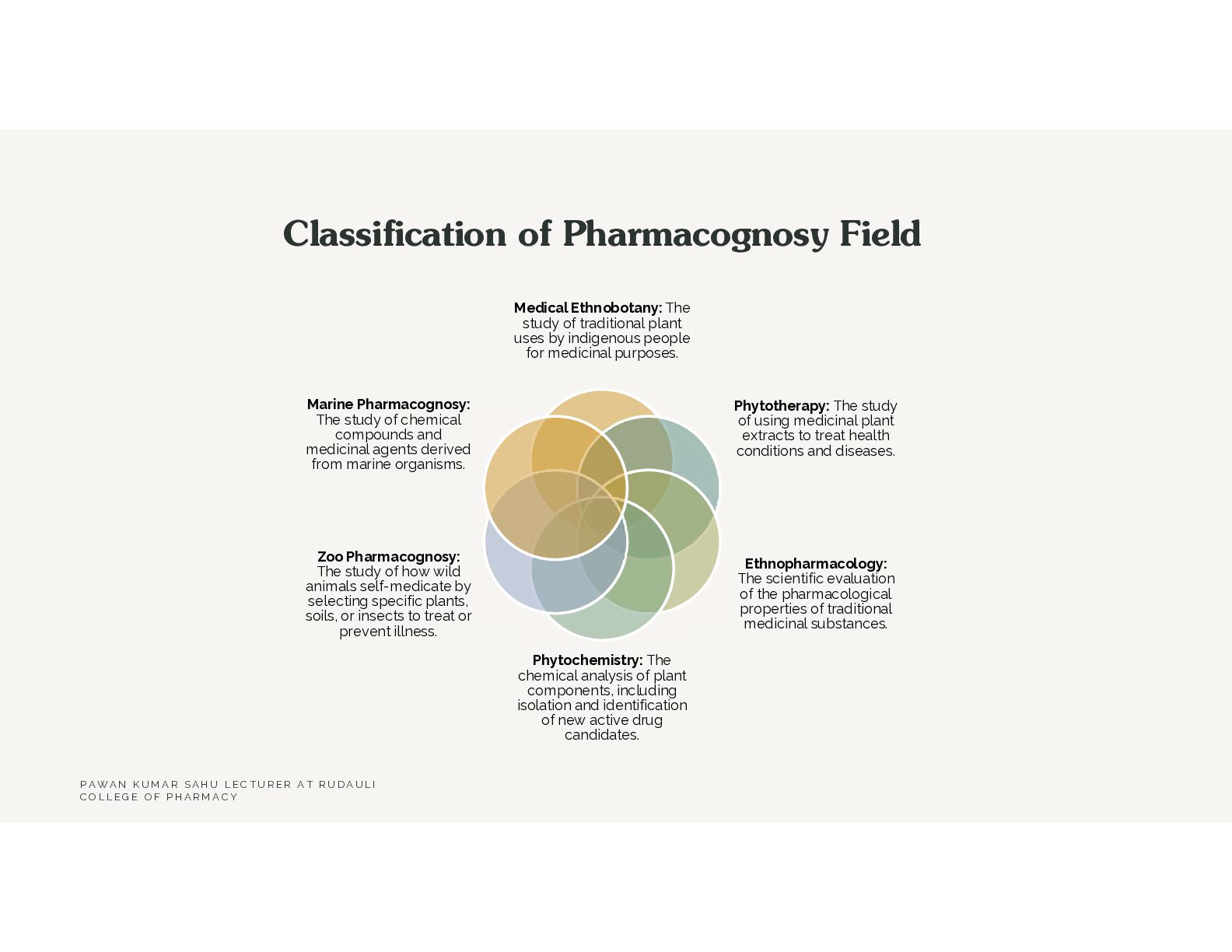
plant uses by indigenous people for medicinal purposes. Marine Pharmacognosy: The study of chemical compounds and medicinal agents derived from marine organisms. Phytotherapy: The study of using medicinal plant extracts to treat health conditions and diseases. Zoo Pharmacognosy: The study of how wild animals self-medicate by selecting specific plants, soils, or insects to treat or prevent illness. Ethnopharmacology: The scientific evaluation of the pharmacological properties of traditional medicinal substances. Phytochemistry: The chemical analysis of plant components, including isolation and identification of new active drug candidates. PAWAN KUMAR SAHU LECTURER AT RUDAULI COLLEGE OF PHARMACY
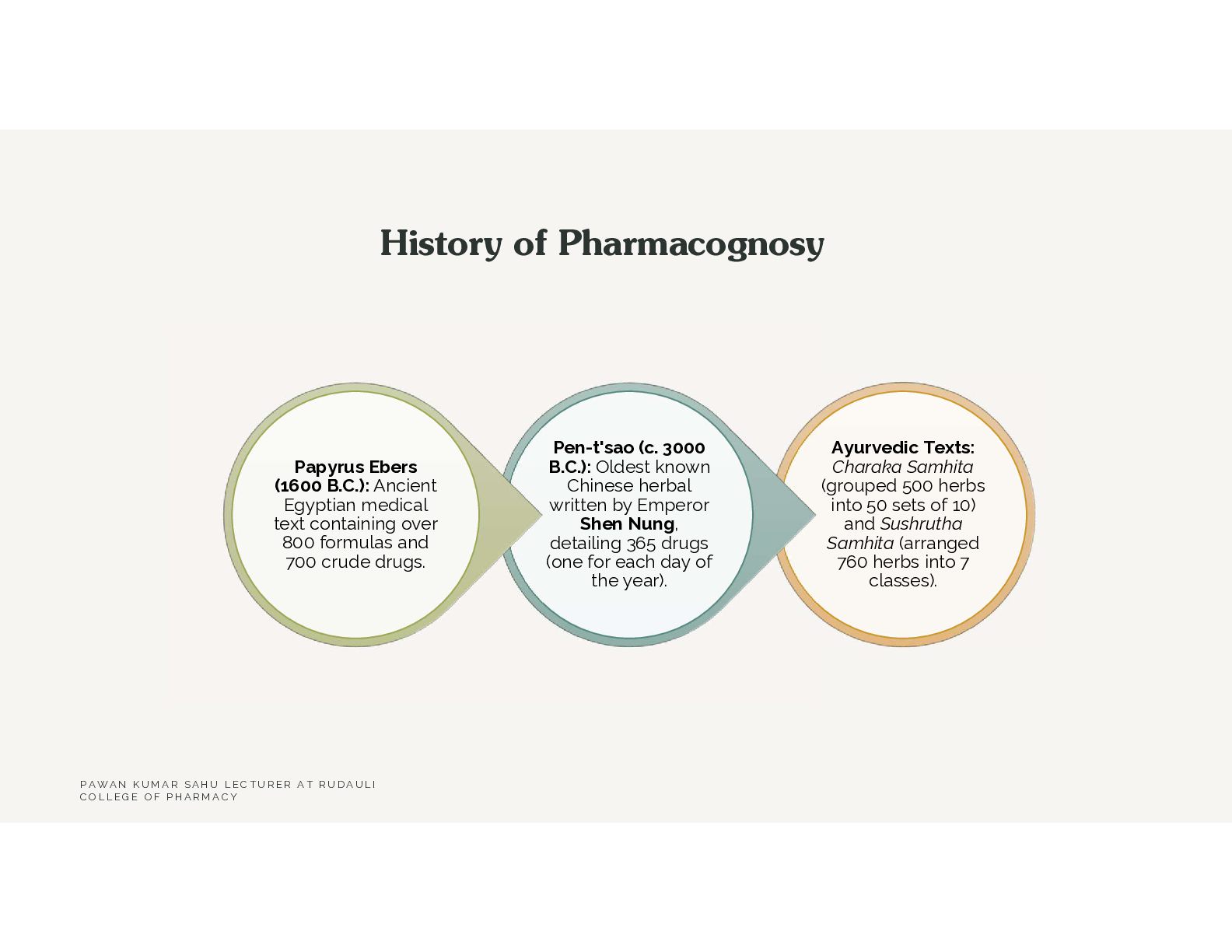
text containing over 800 formulas and 700 crude drugs. PAWAN KUMAR SAHU LECTURER AT RUDAULI COLLEGE OF PHARMACY Pen-t'sao (c. 3000 B.C.): Oldest known Chinese herbal written by Emperor Shen Nung, detailing 365 drugs (one for each day of the year). Ayurvedic Texts: Charaka Samhita (grouped 500 herbs into 50 sets of 10) and Sushrutha Samhita (arranged 760 herbs into 7 classes).
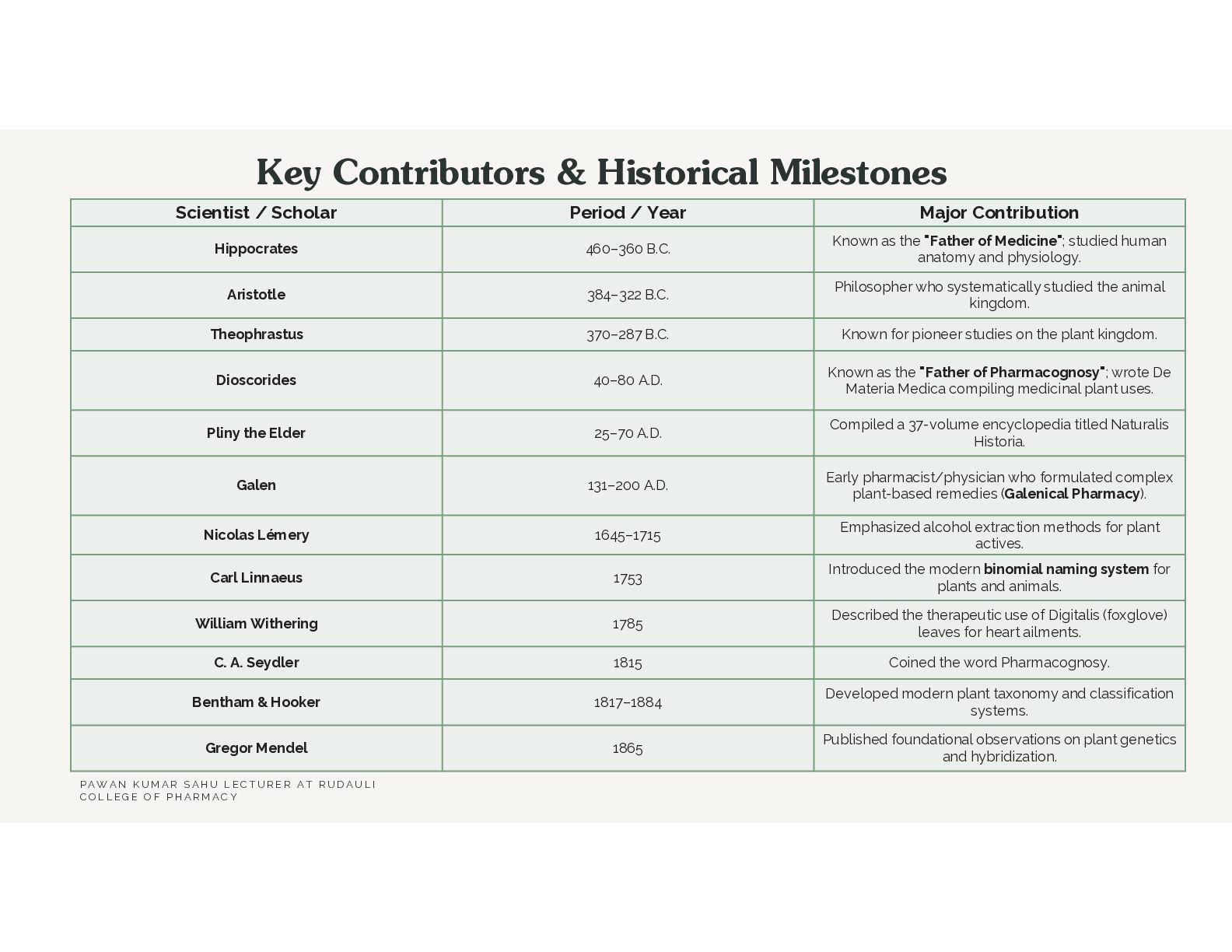
Year Major Contribution Hippocrates 460–360 B.C. Known as the "Father of Medicine"; studied human anatomy and physiology. Aristotle 384–322 B.C. Philosopher who systematically studied the animal kingdom. Theophrastus 370–287 B.C. Known for pioneer studies on the plant kingdom. Dioscorides 40–80 A.D. Known as the "Father of Pharmacognosy"; wrote De Materia Medica compiling medicinal plant uses. Pliny the Elder 25–70 A.D. Compiled a 37-volume encyclopedia titled Naturalis Historia. Galen 131–200 A.D. Early pharmacist/physician who formulated complex plant-based remedies (Galenical Pharmacy). Nicolas Lémery 1645–1715 Emphasized alcohol extraction methods for plant actives. Carl Linnaeus 1753 Introduced the modern binomial naming system for plants and animals. William Withering 1785 Described the therapeutic use of Digitalis (foxglove) leaves for heart ailments. C. A. Seydler 1815 Coined the word Pharmacognosy. Bentham & Hooker 1817–1884 Developed modern plant taxonomy and classification systems. Gregor Mendel 1865 Published foundational observations on plant genetics and hybridization. PAWAN KUMAR SAHU LECTURER AT RUDAULI COLLEGE OF PHARMACY
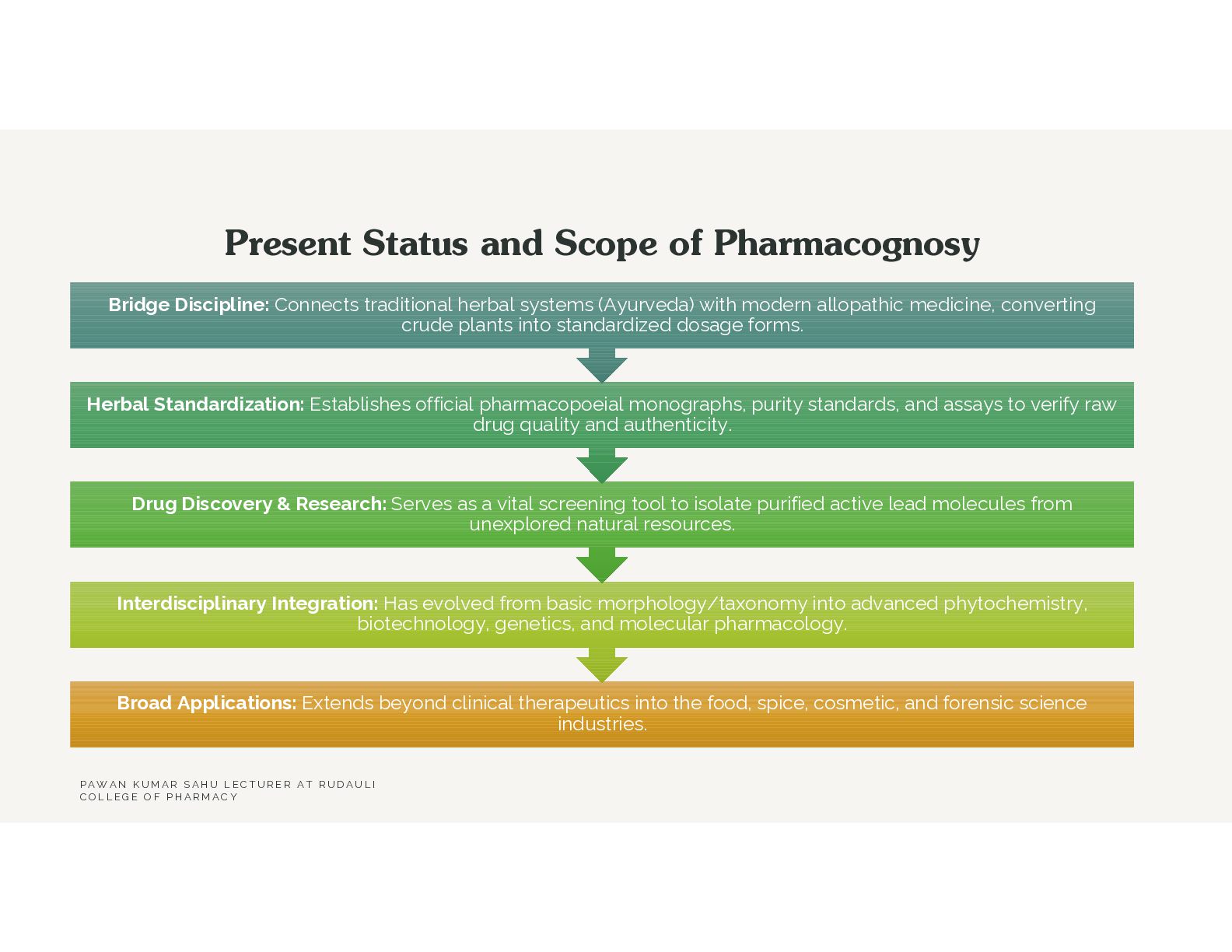
herbal systems (Ayurveda) with modern allopathic medicine, converting crude plants into standardized dosage forms. Herbal Standardization: Establishes official pharmacopoeial monographs, purity standards, and assays to verify raw drug quality and authenticity. Drug Discovery & Research: Serves as a vital screening tool to isolate purified active lead molecules from unexplored natural resources. Interdisciplinary Integration: Has evolved from basic morphology/taxonomy into advanced phytochemistry, biotechnology, genetics, and molecular pharmacology. Broad Applications: Extends beyond clinical therapeutics into the food, spice, cosmetic, and forensic science industries. PAWAN KUMAR SAHU LECTURER AT RUDAULI COLLEGE OF PHARMACY


 pawan_pharm
 frievea
 naoji_taniguchi_ksk_0827
 juanmartin2026
 uranoken
 cbtlibrary
 ainischool
 matleenalaakso
 hiola
hiola
 kentaroy47
 arnoknobbe
 jdbedics
 mutomasa
 bcantrill
 rkendrick25
 rkaga
rkaga
 mfonobong
 auna
auna
 twada
twada
 skoyamalab
 inesmontani
 sugarenia
 skipperchong
 mayatellez
 joshbly