Upgrade to Pro — share decks privately, control downloads, hide ads and more …

2025 ReSAKSS - Processing and Value Addition Te...

2025 ReSAKSS - Processing and Value Addition Technologies in African Agrifood Systems: Dr. Ramadhani Omari Majubwa

Dr. Ramadhani Omari Majubwa, Senior Lecturer, Sokoine University of Agriculture

Avatar for AKADEMIYA2063

AKADEMIYA2063 PRO

January 22, 2026
Tweet

More Decks by AKADEMIYA2063

Other Decks in Research

Transcript

  1. ReSAKSSANNUAL CONFERENCE Moving the Technology Frontiers in African Agrifood Systems.

    Processing and Value Addition Technologies in African Agri-food Systems *Ramadhani Omari Majubwa, Jamal Kussaga and Rashid Suleiman *Senior Lecturer, Sokoine University of Agriculture (SUA) January 21, 2026
  2. 1. INTRODUCTION • Agrifood processing and value addition are essential

    to Africa's agricultural transformation and inclusive economic growth • Agriculture employs 65% of the continent's active population, but face a significant migration of youth to cities in search of employment opportunities. The shift is projected to increase urban population from 43.5% in 2020 to 48.4% by 2030. • Industrialization, particularly value addition and agrifood processing, presents chances of employment for the semi-skilled and unskilled labor • Require investment in technology and innovation; digital technologies for agriculture, climate-smart agricultural practices, biotechnology, and agrifood processing infrastructure to improve productivity and competitiveness of agrifood systems • This chapter give in-depth examination of agrifood processing and value addition in Africa’s agrifood systems, linking CAADP and Agenda 2063 to practical realities via statistics, VC classifications, technology and Innovation levels, and case studies
  3. 2. CONCEPT OF AGRIFOOD PROCESSING AND VALUE ADDITION IN AGRIFOOD

    SYSTEMS • Value addition refers to any process or technique that enhances the utilization, usefulness and value of an agricultural commodity, whereas Agrifood processing is specific activity of transforming raw agricultural food products into intermediate or final products with high market value • Drivers: Urbanization, population growth, changing consumer preferences, change in income, health and safety and sustainability concerns • Growth in urbanization has intensified the need for convenient, ready-to- eat foods, which raw and perishable commodities are unable to satisfy • Value-added processing prolongs shelf life, boost safety and nutrition, improve marketability, and promote environmental sustainability Propels AA-2063 and key Sustainable Development Goals (SDGs) including; Zero Hunger (SDG 2), Clean Water and Sanitation (SDG 6), Reduced Food Loss (SDG 12.3), Climate Action (SDG 13), and Life on Land (SDG 15
  4. 4. KEY FOOD VALUE CHAINS IN AFRICA AGRIFOOD SYSTEMS 4.1

    Potential food value chains for processing and value addition • CAADP Strategy (2026–2035) and the Feed Africa Strategy for Agricultural Transformation prioritized 18 agri-food value chains; • Bases for selection; enhance food security/dietary diversification, stimulate economic growth, promote regional integration, consumer preferences, compete with imports, offer export potential, facilitate scalability –mass production and processing. Rice, maize, cassava, millet, palm oil, cocoa, horticulture (fruits, vegetables, and spices), wheat, coffee, cashews, cotton, aquaculture, sorghum, cowpeas, soybeans, beef, chicken, and dairy
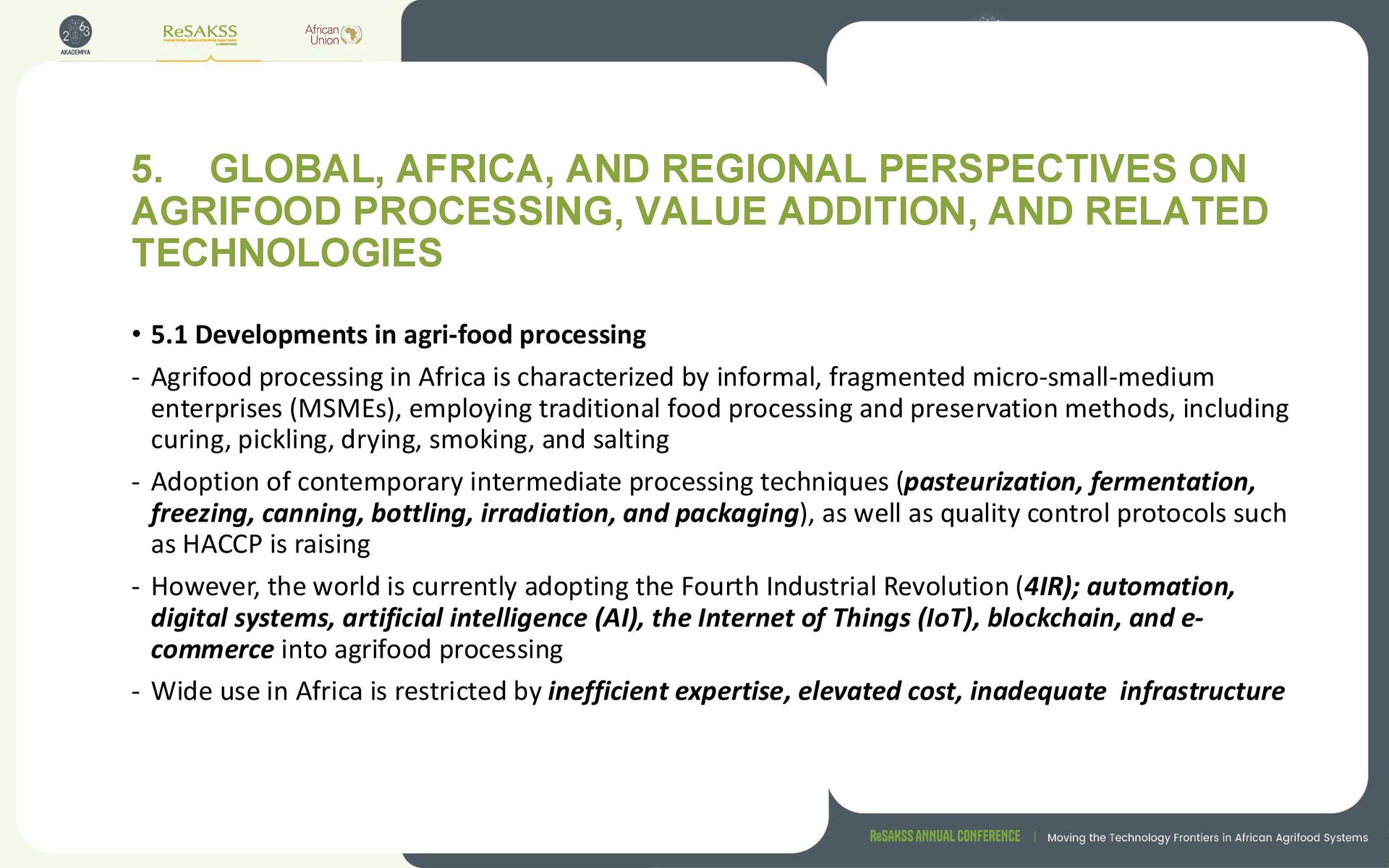
  5. 5. GLOBAL, AFRICA, AND REGIONAL PERSPECTIVES ON AGRIFOOD PROCESSING, VALUE

    ADDITION, AND RELATED TECHNOLOGIES • 5.1 Developments in agri-food processing - Agrifood processing in Africa is characterized by informal, fragmented micro-small-medium enterprises (MSMEs), employing traditional food processing and preservation methods, including curing, pickling, drying, smoking, and salting - Adoption of contemporary intermediate processing techniques (pasteurization, fermentation, freezing, canning, bottling, irradiation, and packaging), as well as quality control protocols such as HACCP is raising - However, the world is currently adopting the Fourth Industrial Revolution (4IR); automation, digital systems, artificial intelligence (AI), the Internet of Things (IoT), blockchain, and e- commerce into agrifood processing - Wide use in Africa is restricted by inefficient expertise, elevated cost, inadequate infrastructure
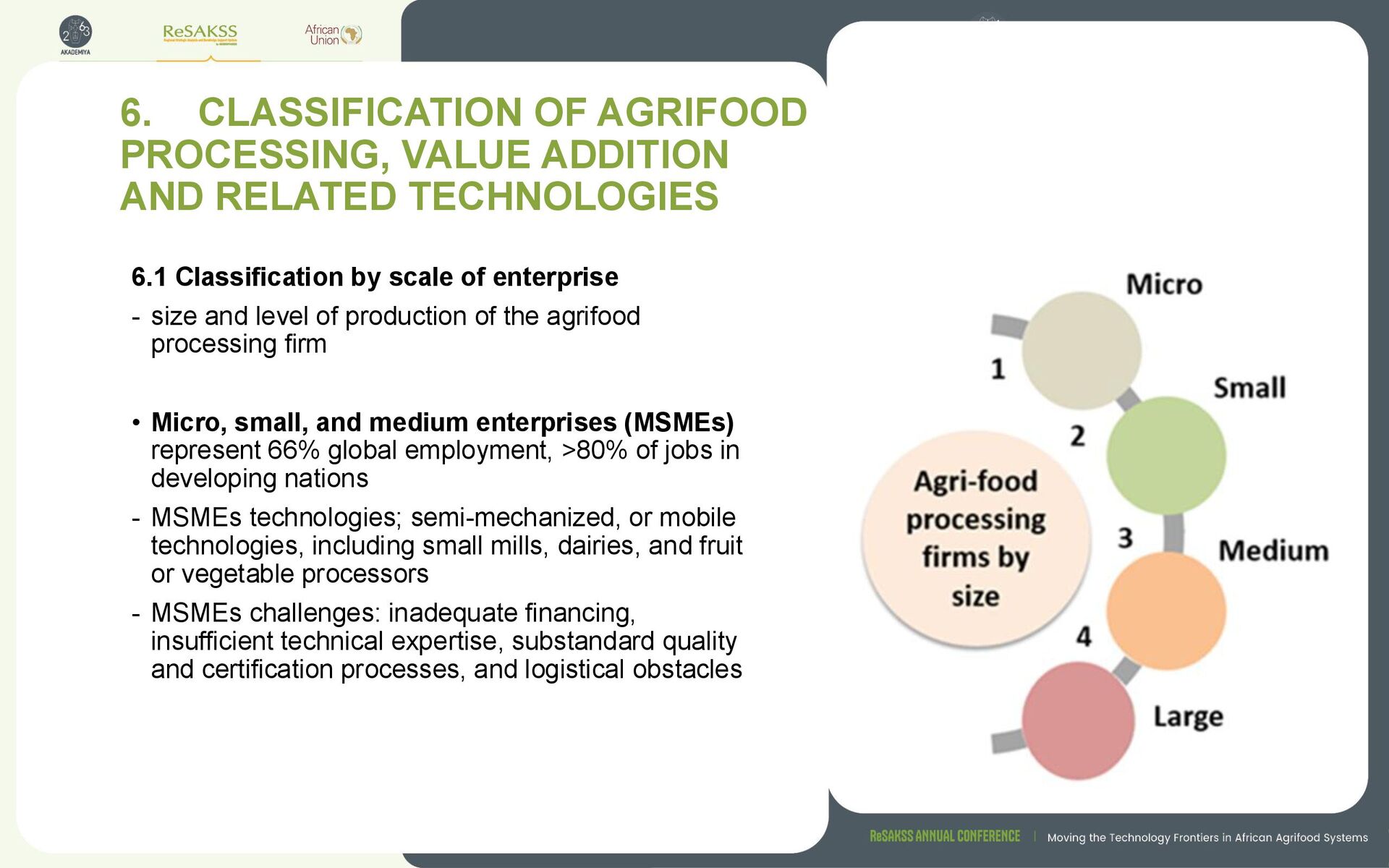
  6. 6.1 Classification by scale of enterprise - size and level

    of production of the agrifood processing firm • Micro, small, and medium enterprises (MSMEs) represent 66% global employment, >80% of jobs in developing nations - MSMEs technologies; semi-mechanized, or mobile technologies, including small mills, dairies, and fruit or vegetable processors - MSMEs challenges: inadequate financing, insufficient technical expertise, substandard quality and certification processes, and logistical obstacles 6. CLASSIFICATION OF AGRIFOOD PROCESSING, VALUE ADDITION AND RELATED TECHNOLOGIES
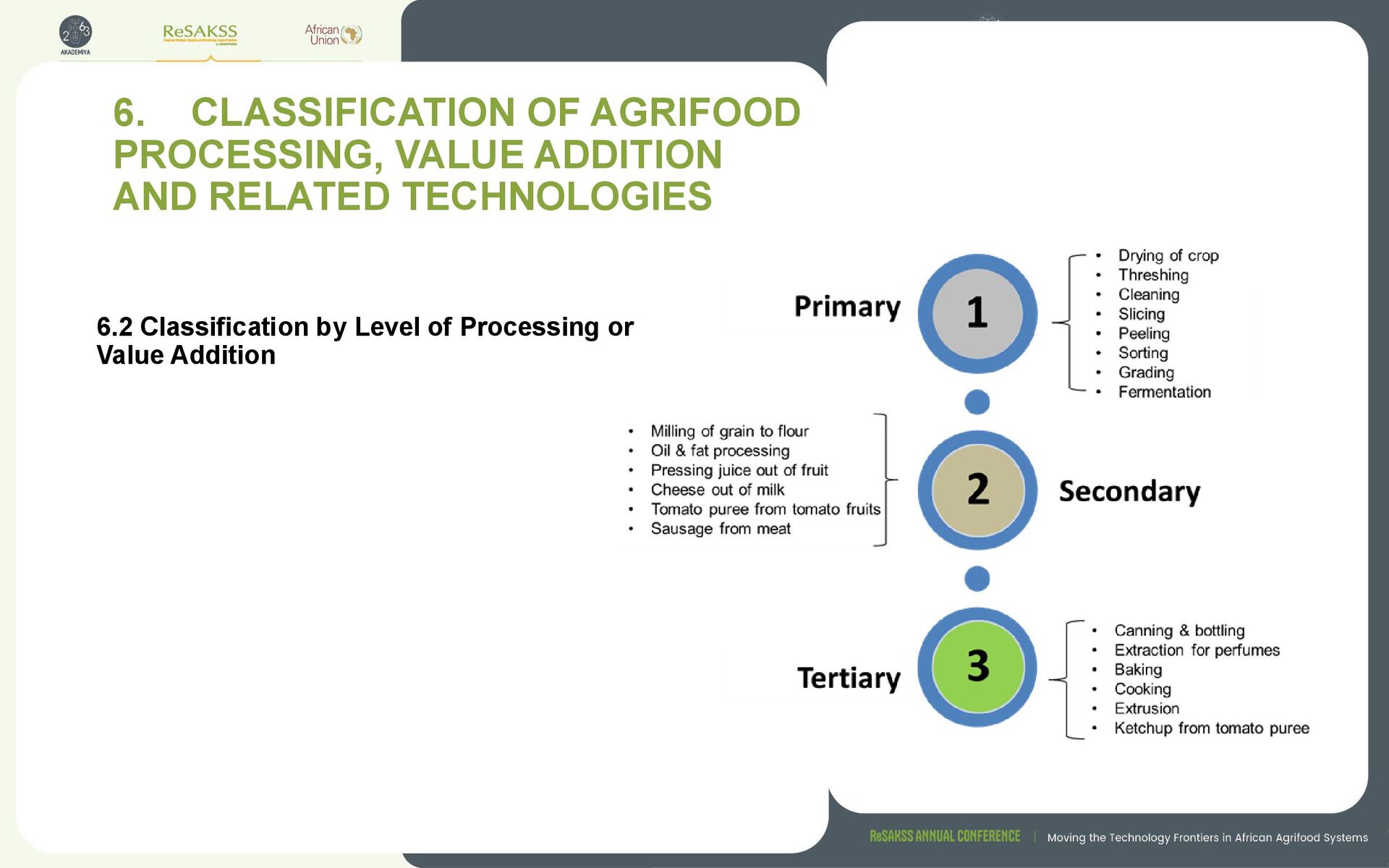
  7. 6.2 Classification by Level of Processing or Value Addition 6.

    CLASSIFICATION OF AGRIFOOD PROCESSING, VALUE ADDITION AND RELATED TECHNOLOGIES
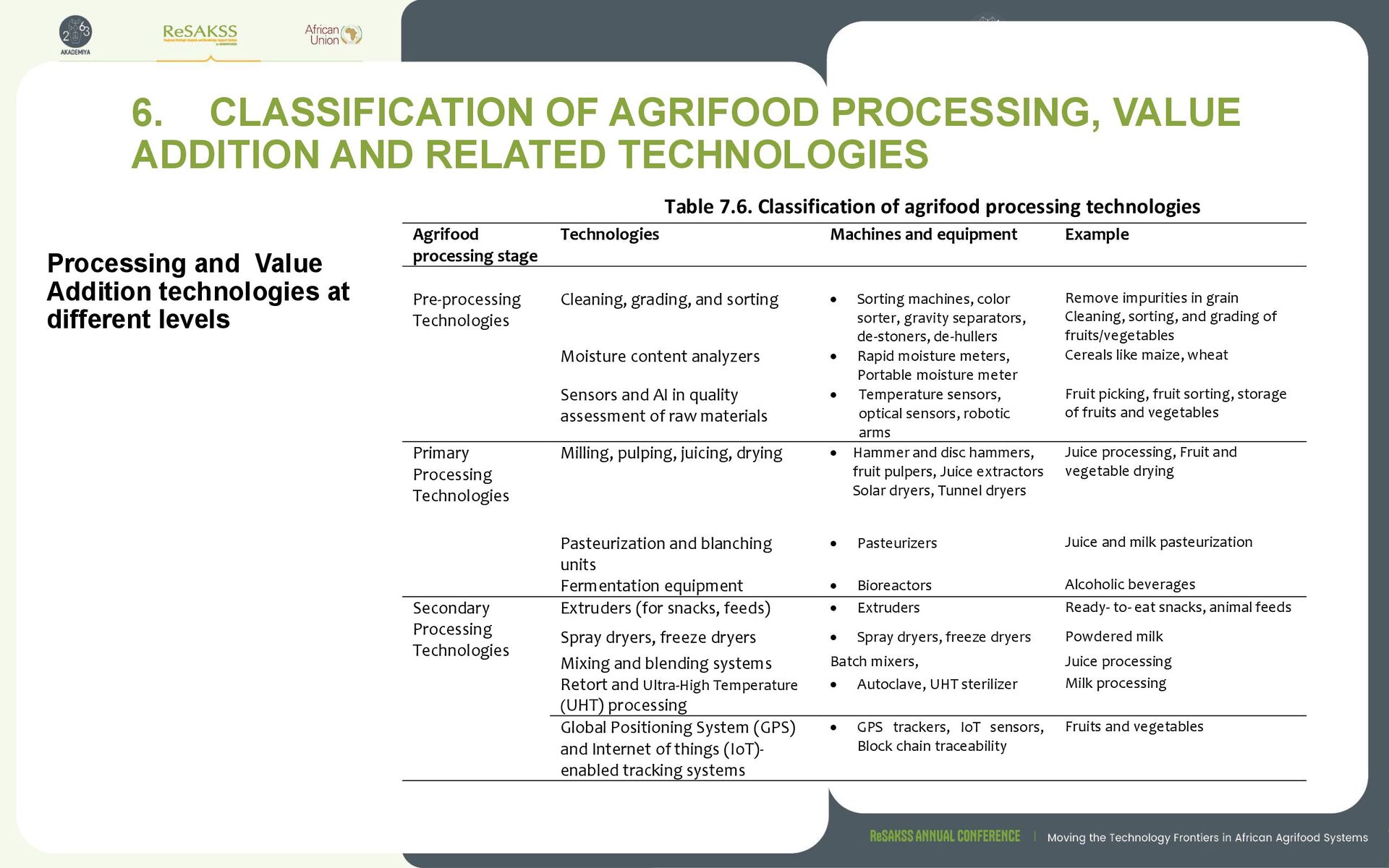
  8. Processing and Value Addition technologies at different levels 6. CLASSIFICATION

    OF AGRIFOOD PROCESSING, VALUE ADDITION AND RELATED TECHNOLOGIES Table 7.6. Classification of agrifood processing technologies Agrifood processing stage Technologies Machines and equipment Example Pre-processing Technologies Cleaning, grading, and sorting • Sorting machines, color sorter, gravity separators, de-stoners, de-hullers Remove impurities in grain Cleaning, sorting, and grading of fruits/vegetables Moisture content analyzers • Rapid moisture meters, Portable moisture meter Cereals like maize, wheat Sensors and AI in quality assessment of raw materials • Temperature sensors, optical sensors, robotic arms Fruit picking, fruit sorting, storage of fruits and vegetables Primary Processing Technologies Milling, pulping, juicing, drying • Hammer and disc hammers, fruit pulpers, Juice extractors Solar dryers, Tunnel dryers Juice processing, Fruit and vegetable drying Pasteurization and blanching units • Pasteurizers Juice and milk pasteurization Fermentation equipment • Bioreactors Alcoholic beverages Secondary Processing Technologies Extruders (for snacks, feeds) • Extruders Ready- to- eat snacks, animal feeds Spray dryers, freeze dryers • Spray dryers, freeze dryers Powdered milk Mixing and blending systems Batch mixers, Juice processing Retort and Ultra-High Temperature (UHT) processing • Autoclave, UHT sterilizer Milk processing Global Positioning System (GPS) and Internet of things (IoT)- enabled tracking systems • GPS trackers, IoT sensors, Block chain traceability Fruits and vegetables
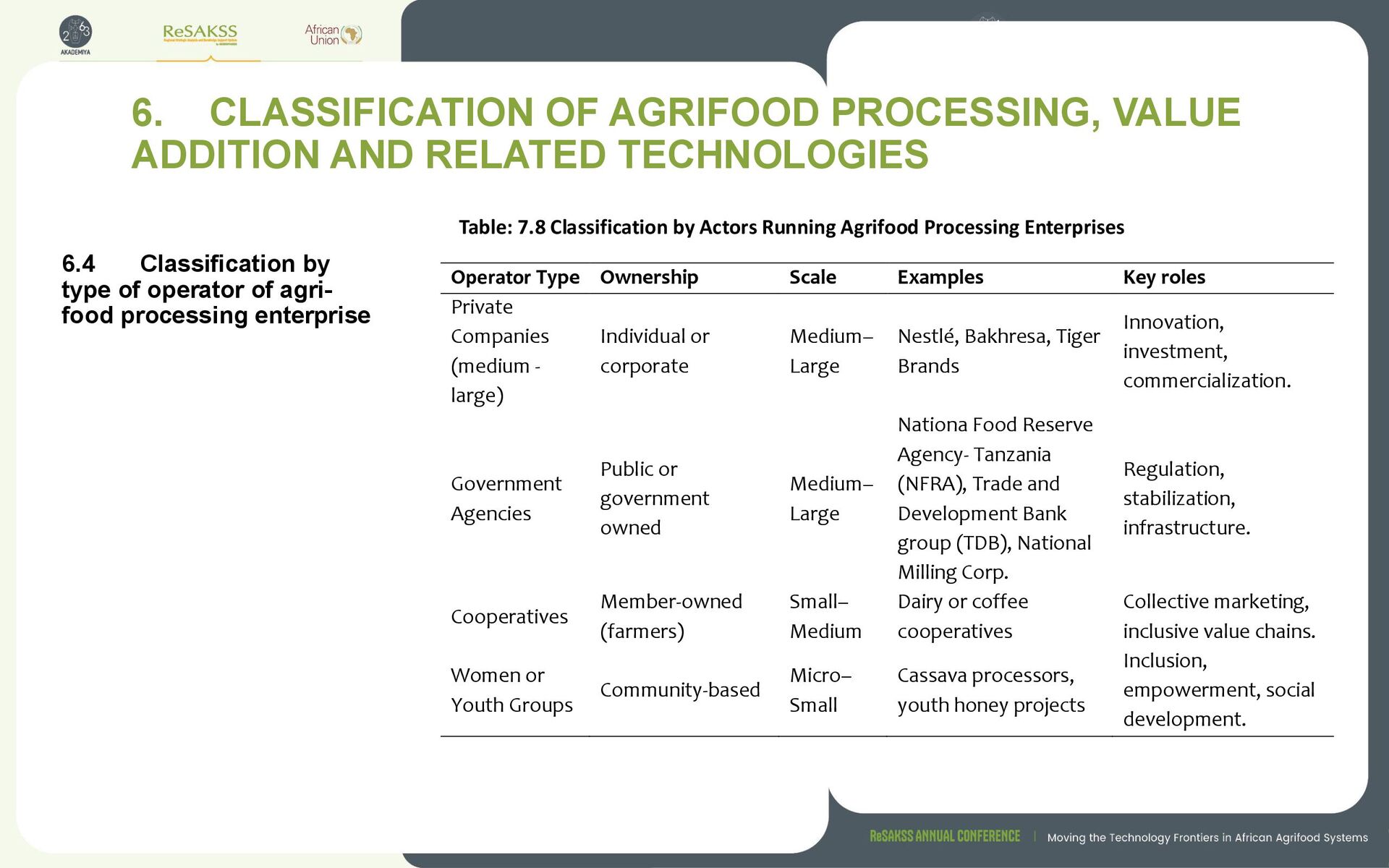
  9. 6.4 Classification by type of operator of agri- food processing

    enterprise 6. CLASSIFICATION OF AGRIFOOD PROCESSING, VALUE ADDITION AND RELATED TECHNOLOGIES Table: 7.8 Classification by Actors Running Agrifood Processing Enterprises Operator Type Ownership Scale Examples Key roles Private Companies (medium - large) Individual or corporate Medium– Large Nestlé, Bakhresa, Tiger Brands Innovation, investment, commercialization. Government Agencies Public or government owned Medium– Large Nationa Food Reserve Agency- Tanzania (NFRA), Trade and Development Bank group (TDB), National Milling Corp. Regulation, stabilization, infrastructure. Cooperatives Member-owned (farmers) Small– Medium Dairy or coffee cooperatives Collective marketing, inclusive value chains. Women or Youth Groups Community-based Micro– Small Cassava processors, youth honey projects Inclusion, empowerment, social development.
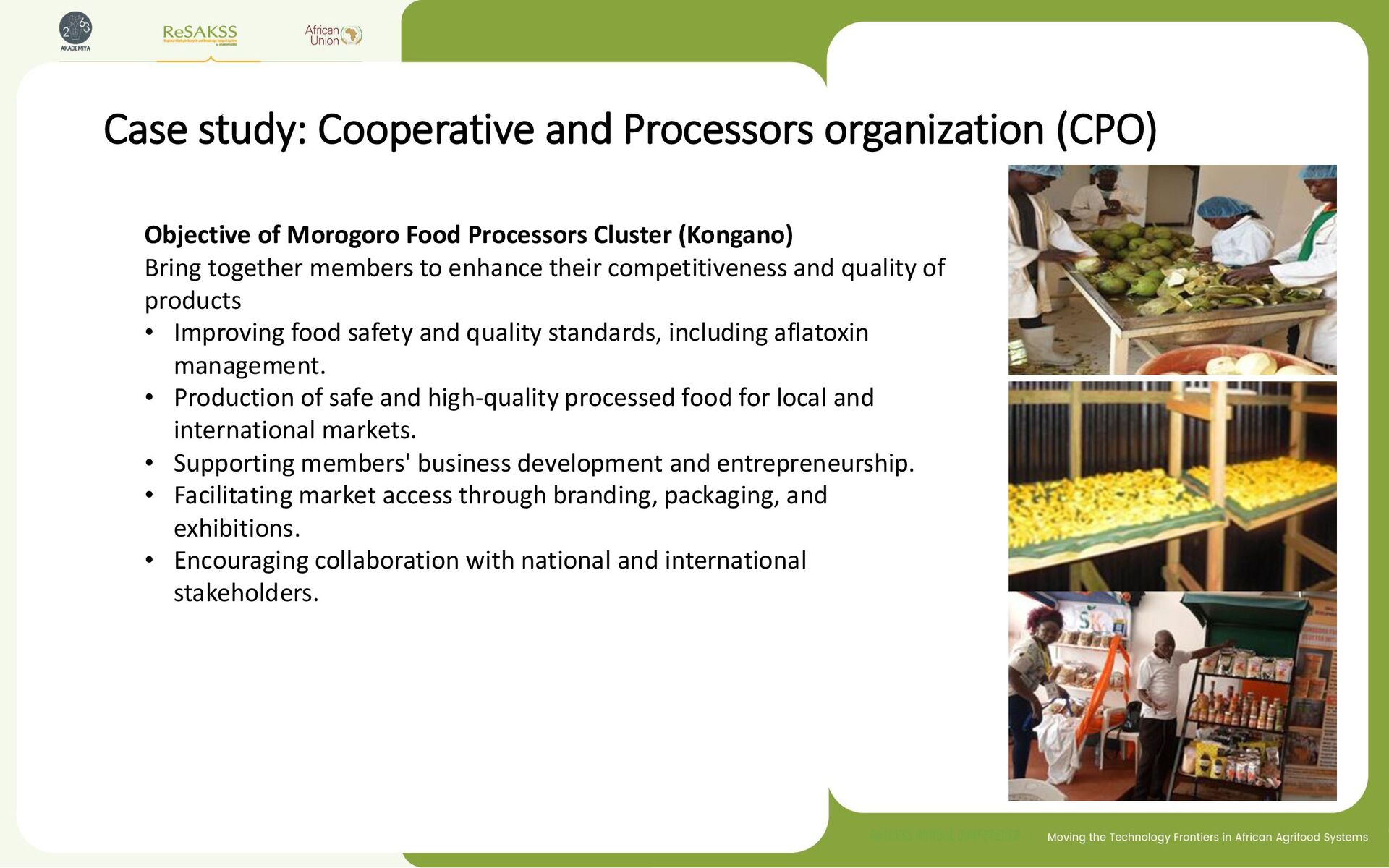
  10. Case study: Cooperative and Processors organization (CPO) Objective of Morogoro

    Food Processors Cluster (Kongano) Bring together members to enhance their competitiveness and quality of products • Improving food safety and quality standards, including aflatoxin management. • Production of safe and high-quality processed food for local and international markets. • Supporting members' business development and entrepreneurship. • Facilitating market access through branding, packaging, and exhibitions. • Encouraging collaboration with national and international stakeholders.
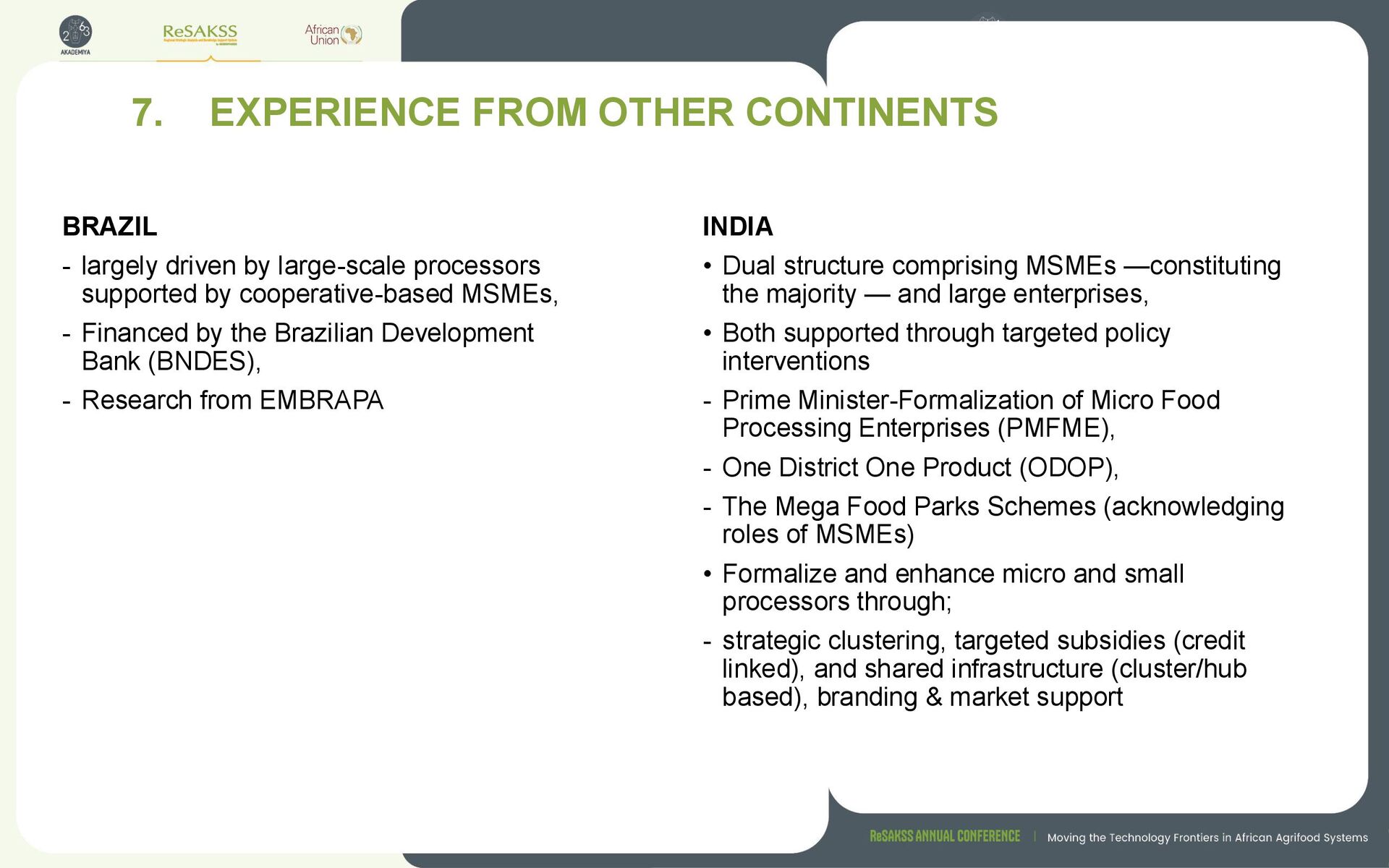
  11. BRAZIL - largely driven by large-scale processors supported by cooperative-based

    MSMEs, - Financed by the Brazilian Development Bank (BNDES), - Research from EMBRAPA 7. EXPERIENCE FROM OTHER CONTINENTS INDIA • Dual structure comprising MSMEs —constituting the majority — and large enterprises, • Both supported through targeted policy interventions - Prime Minister-Formalization of Micro Food Processing Enterprises (PMFME), - One District One Product (ODOP), - The Mega Food Parks Schemes (acknowledging roles of MSMEs) • Formalize and enhance micro and small processors through; - strategic clustering, targeted subsidies (credit linked), and shared infrastructure (cluster/hub based), branding & market support
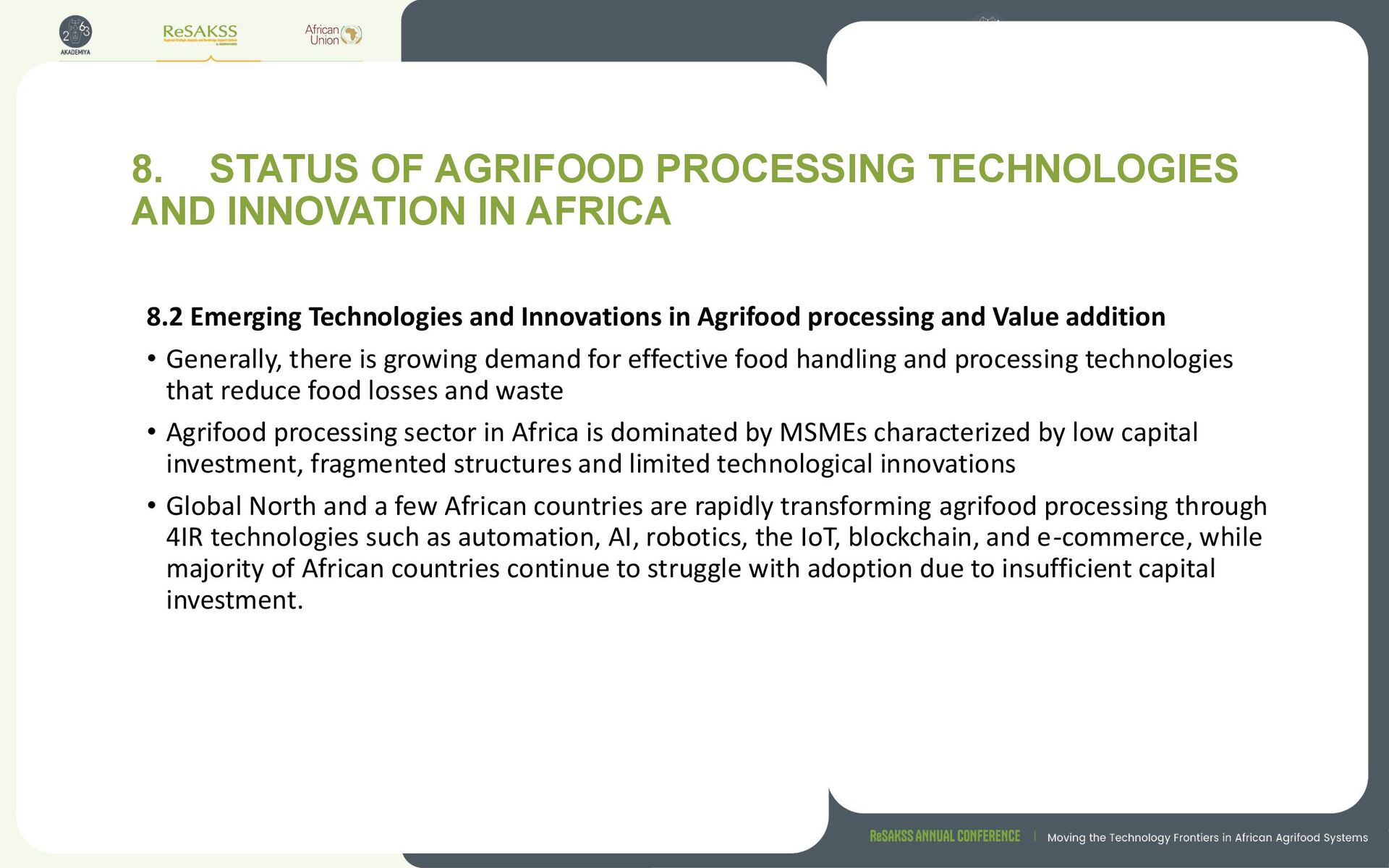
  12. 8. STATUS OF AGRIFOOD PROCESSING TECHNOLOGIES AND INNOVATION IN AFRICA

    8.2 Emerging Technologies and Innovations in Agrifood processing and Value addition • Generally, there is growing demand for effective food handling and processing technologies that reduce food losses and waste • Agrifood processing sector in Africa is dominated by MSMEs characterized by low capital investment, fragmented structures and limited technological innovations • Global North and a few African countries are rapidly transforming agrifood processing through 4IR technologies such as automation, AI, robotics, the IoT, blockchain, and e-commerce, while majority of African countries continue to struggle with adoption due to insufficient capital investment.
  13. 8. STATUS OF AGRIFOOD PROCESSING TECHNOLOGIES AND INNOVATION IN AFRICA

    8.3 Waste treatment, Valorization and Circular economy • Irrespective of the quality of agricultural products, consumers and agrifood processors do not fully utilize all raw materials • Hence, waste treatment has become an necessary component of sustainable agrifood processing • Several waste treatment methods including; Landfilling, incineration, aerobic and anaerobic, adsorption and absorption technologies have been used but with some deficits • Zero waster (Circular economy) is gaining prominence. It involves transform waste into wealth through the reuse, recovery, and redistribution of surplus or unmarketable food that is suitable for consumption, thereby reducing greenhouse gas emissions & ecological footprint • Circular economy emphasis on proper processing, packaging, storage, distribution and recycling of unavoidably spoiled food into other usable items, such as fertilizers (compost), fuel (food waste charcoal), and animal feeds.
  14. 9. CONCLUSION Agrifood processing in most African countries remains at

    infant stage. It is dominated by MSMEs which face several systemic barriers limiting their ability to the meet rising consumer demand and compete in global value chains • Formalize and integrate agri-food processing MSMEs into global markets through strategic clustering, catalytic financing, targeted subsidies, and shared infrastructure • Embrace circular economy principles to improve food security, minimize waste, and strengthen climate resilience • Attract FDI in agrifood processing by ensuring favorable policies and regulations, adequate workforce quality, standard raw materials, and reliable electricity supplies • Invest in modern infrastructure, enhance market access, promote innovation and improve financial ecosystems, and accelerate the adoption of advanced technologies such as automation, IoT, AI, and blockchain • Unless Africa employ a coordinated and bold action on the above, risk falling behind the 4IR