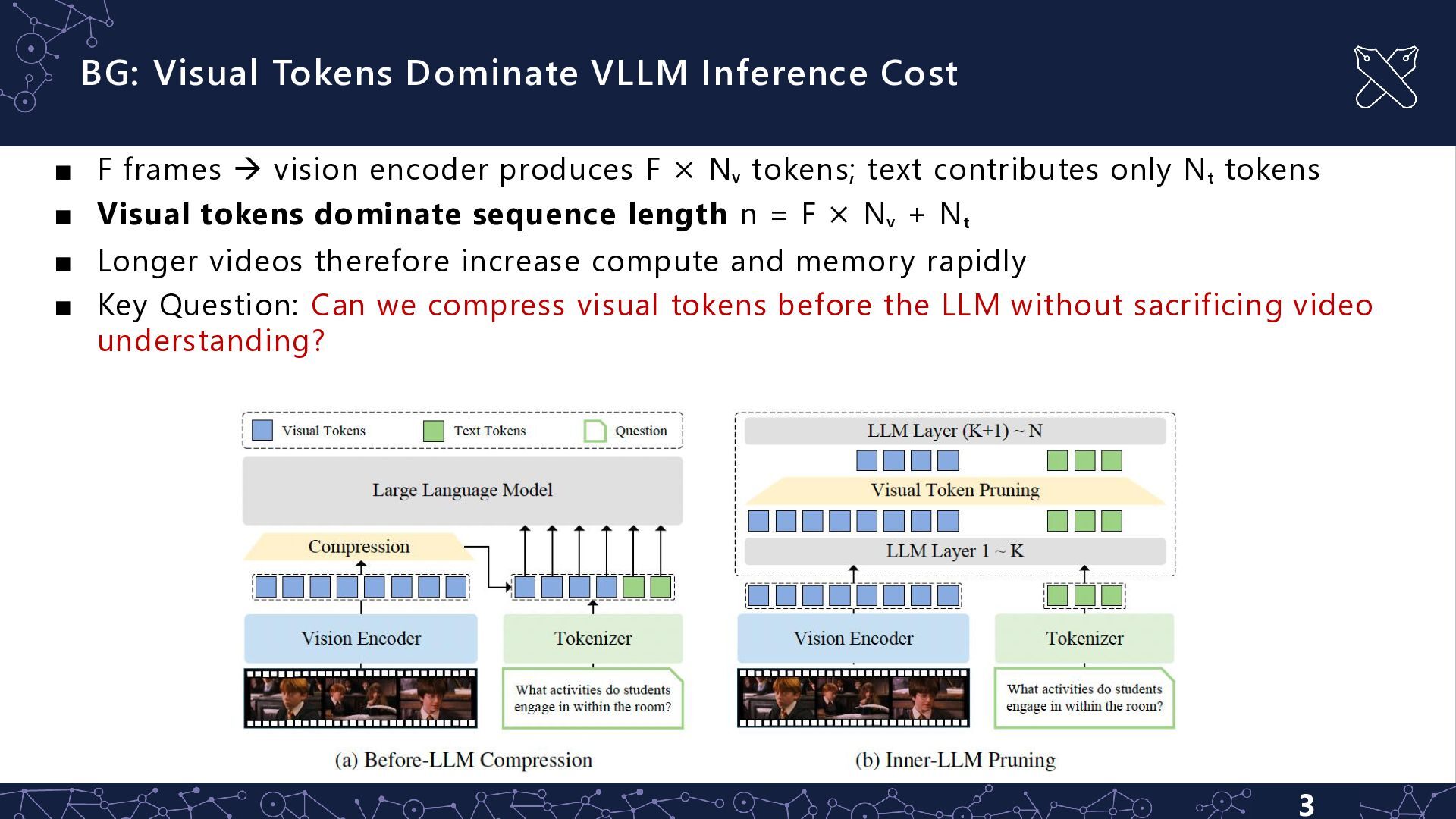
→ vision encoder produces F × Nᵥ tokens; text contributes only Nₜ tokens ▪ Visual tokens dominate sequence length n = F × Nᵥ + Nₜ ▪ Longer videos therefore increase compute and memory rapidly ▪ Key Question: Can we compress visual tokens before the LLM without sacrificing video understanding? 3
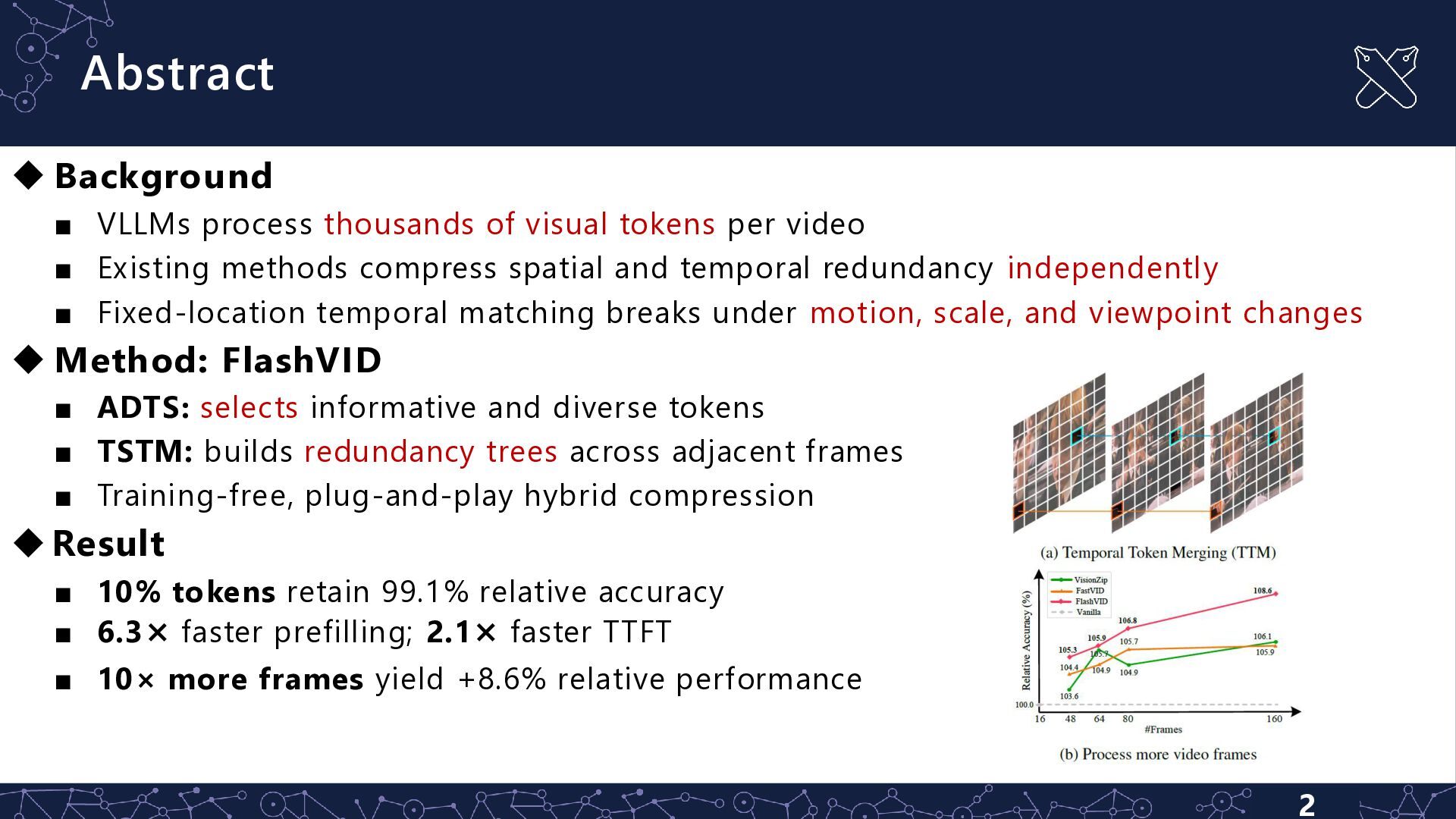
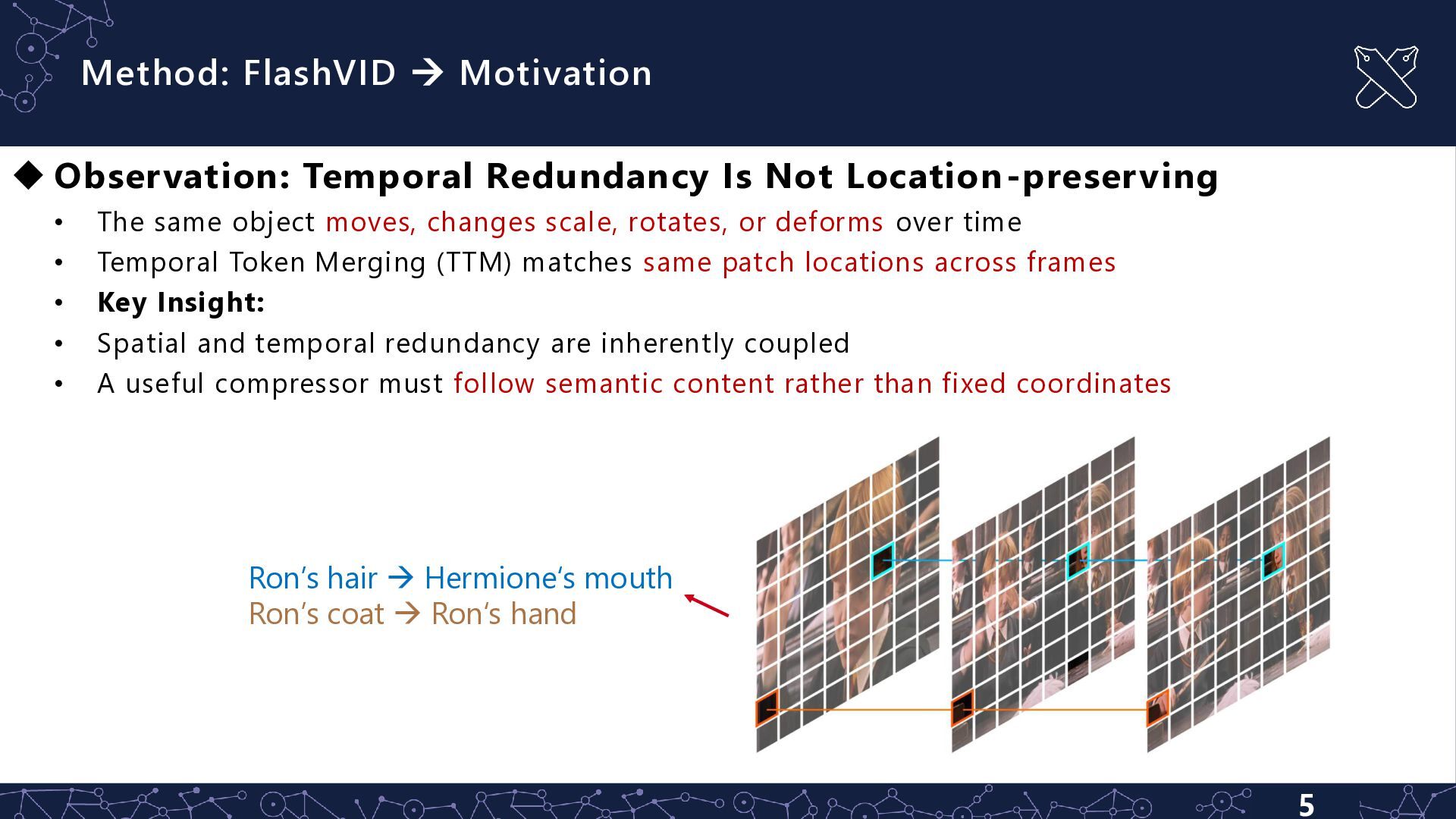
Location -preserving • • • • • The same object moves, changes scale, rotates, or deforms over time Temporal Token Merging (TTM) matches same patch locations across frames Key Insight: Spatial and temporal redundancy are inherently coupled A useful compressor must follow semantic content rather than fixed coordinates Ron’s hair → Hermione‘s mouth Ron’s coat → Ron‘s hand 5
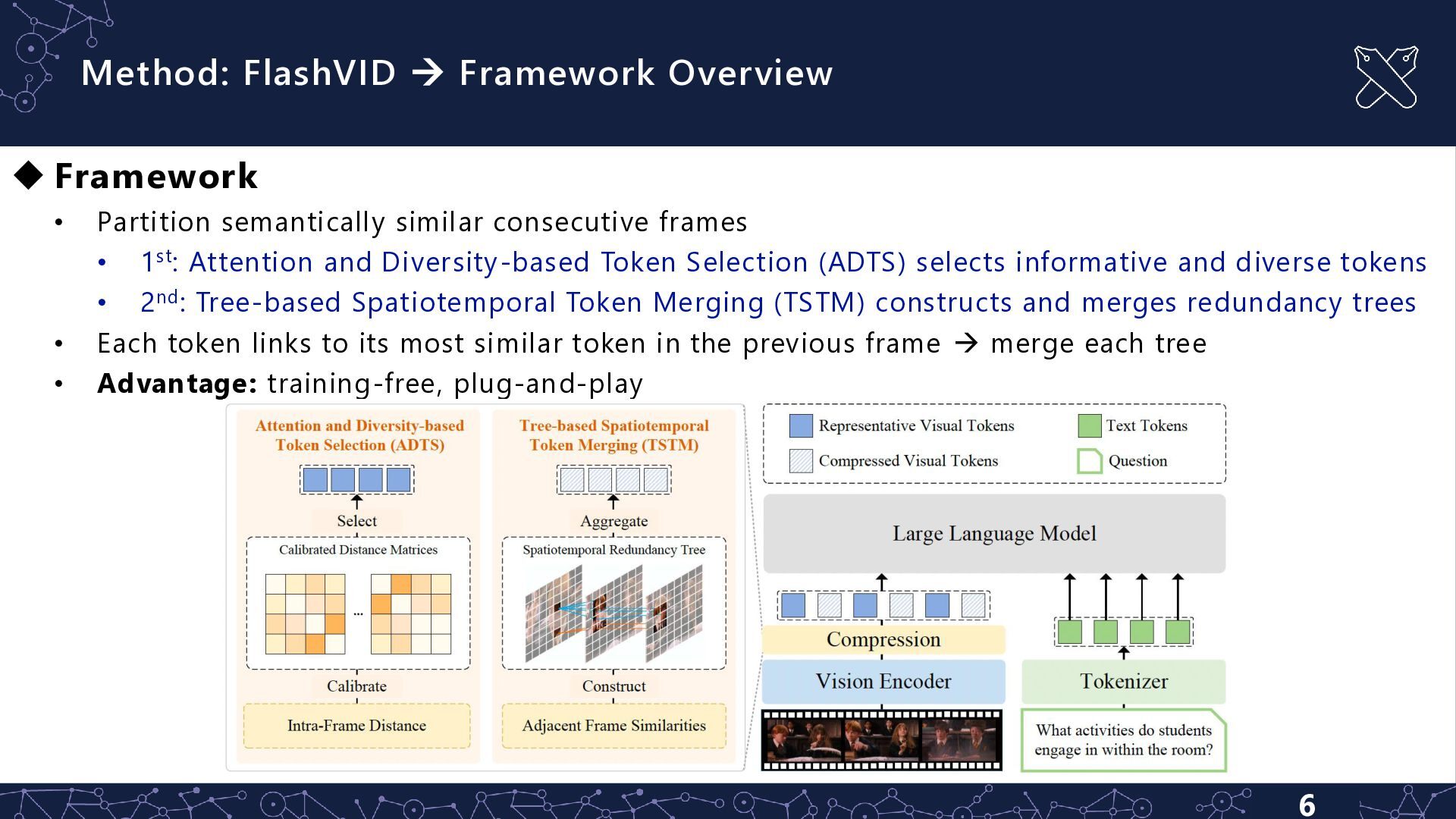
Partition semantically similar consecutive frames • 1 st : Attention and Diversity-based Token Selection (ADTS) selects informative and diverse tokens • 2 nd : Tree-based Spatiotemporal Token Merging (TSTM) constructs and merges redundancy trees Each token links to its most similar token in the previous frame → merge each tree Advantage: training-free, plug-and-play 6
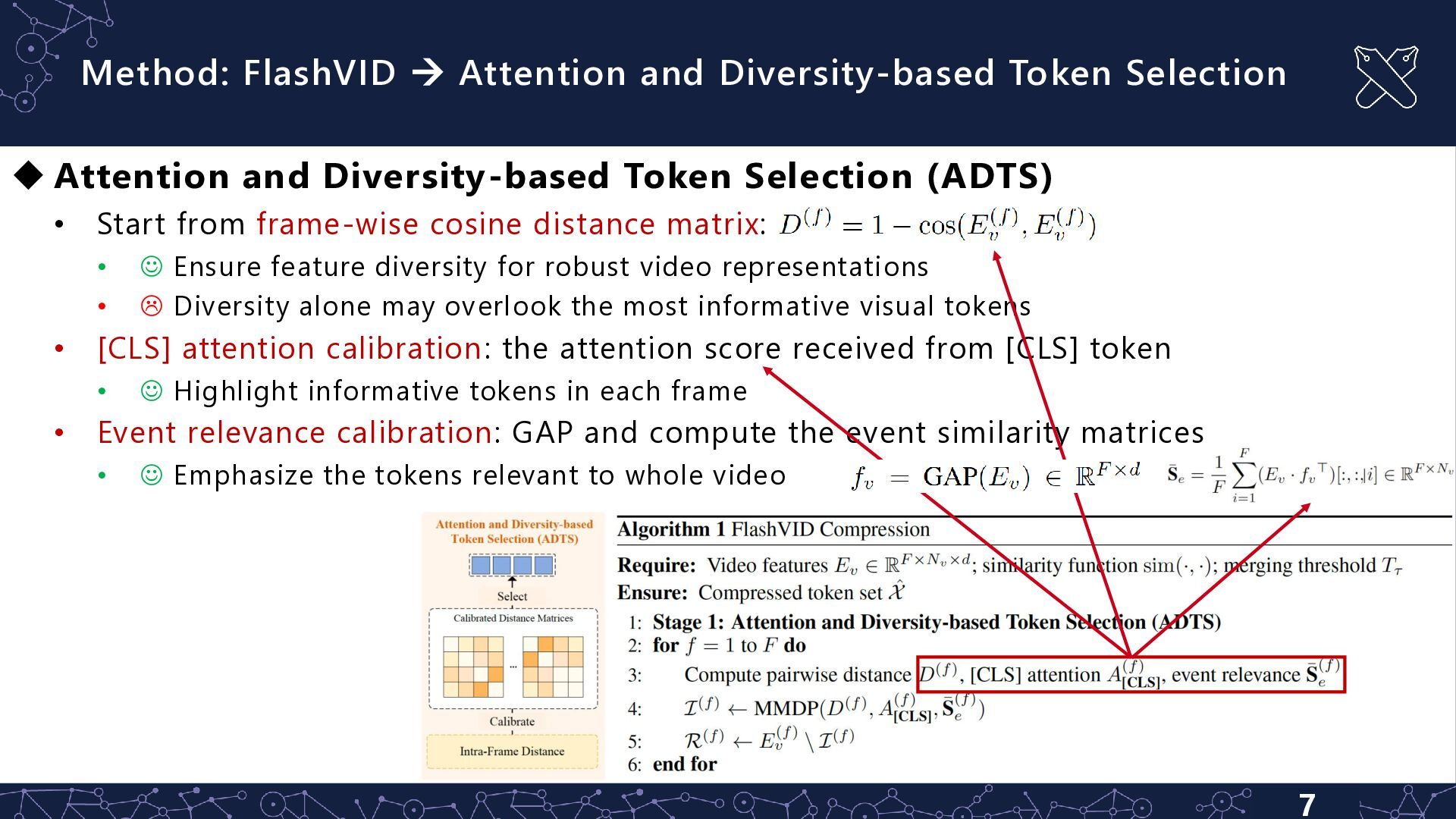
and Diversity-based Token Selection (ADTS) • Start from frame-wise cosine distance matrix: • • • [CLS] attention calibration: the attention score received from [CLS] token • • ☺ Ensure feature diversity for robust video representations Diversity alone may overlook the most informative visual tokens ☺ Highlight informative tokens in each frame Event relevance calibration: GAP and compute the event similarity matrices • ☺ Emphasize the tokens relevant to whole video 7
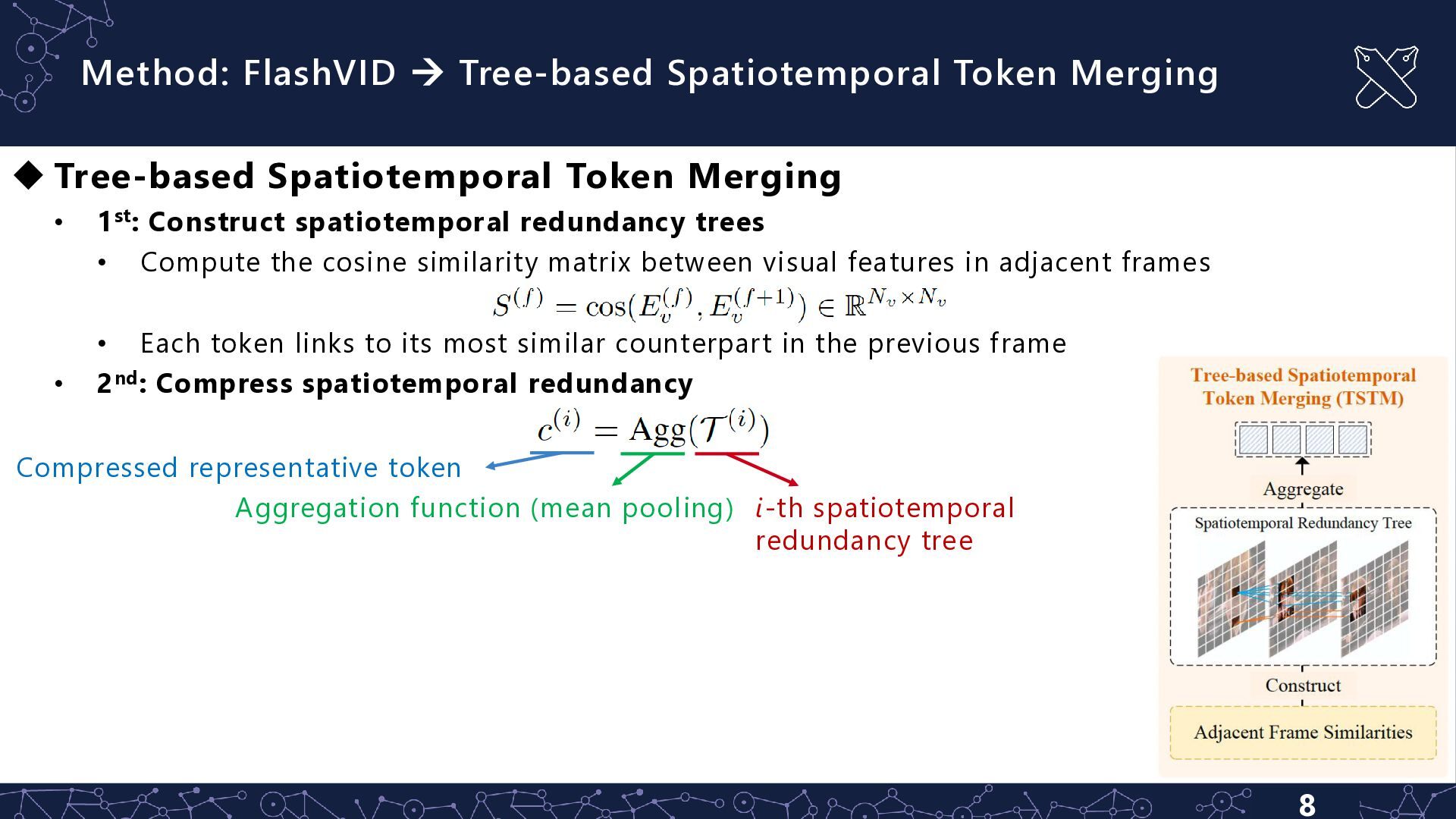
Token Merging • • 1 st : Construct spatiotemporal redundancy trees • Compute the cosine similarity matrix between visual features in adjacent frames • Each token links to its most similar counterpart in the previous frame 2 nd: Compress spatiotemporal redundancy Compressed representative token Aggregation function (mean pooling) i-th spatiotemporal redundancy tree 8
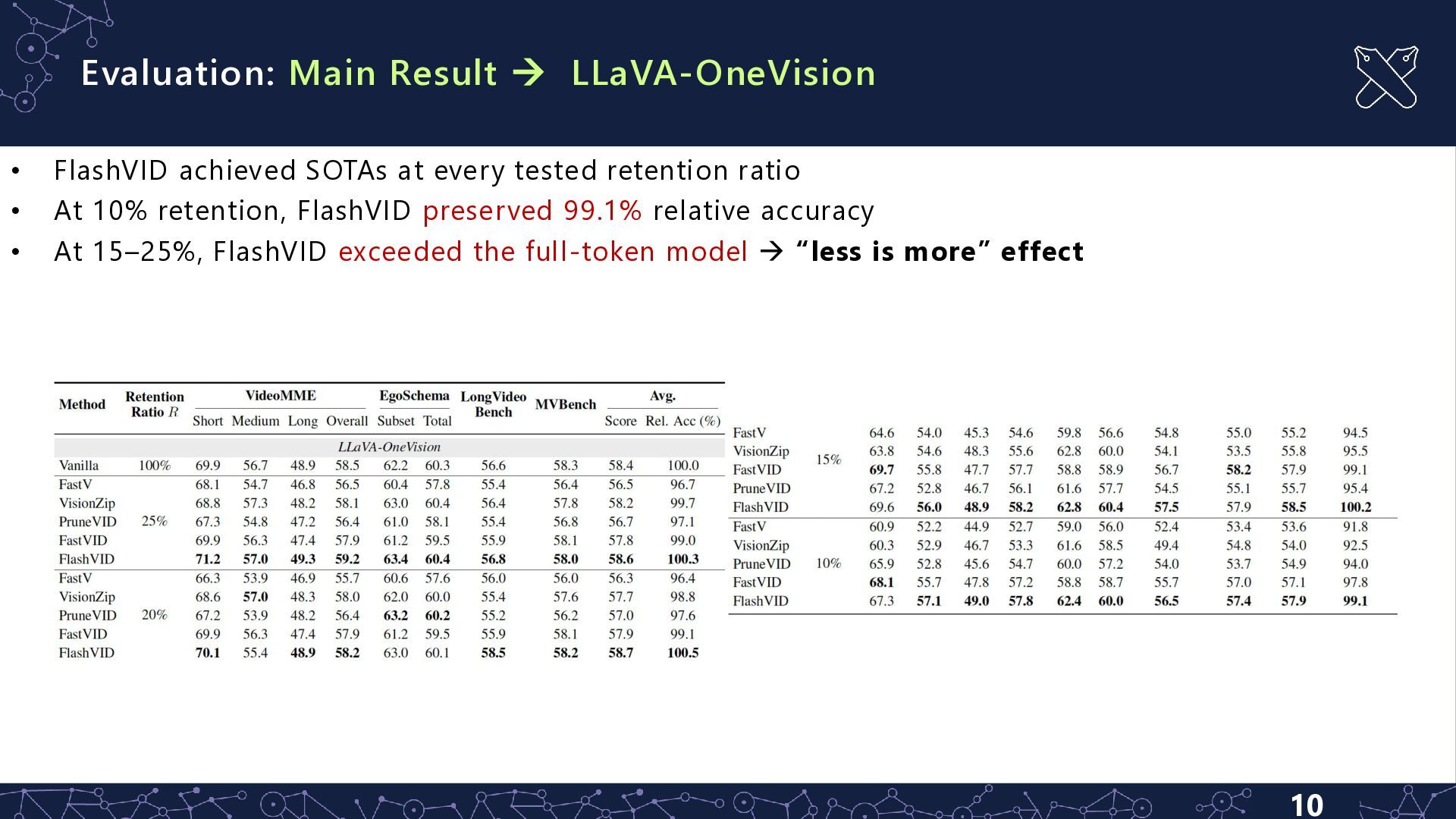
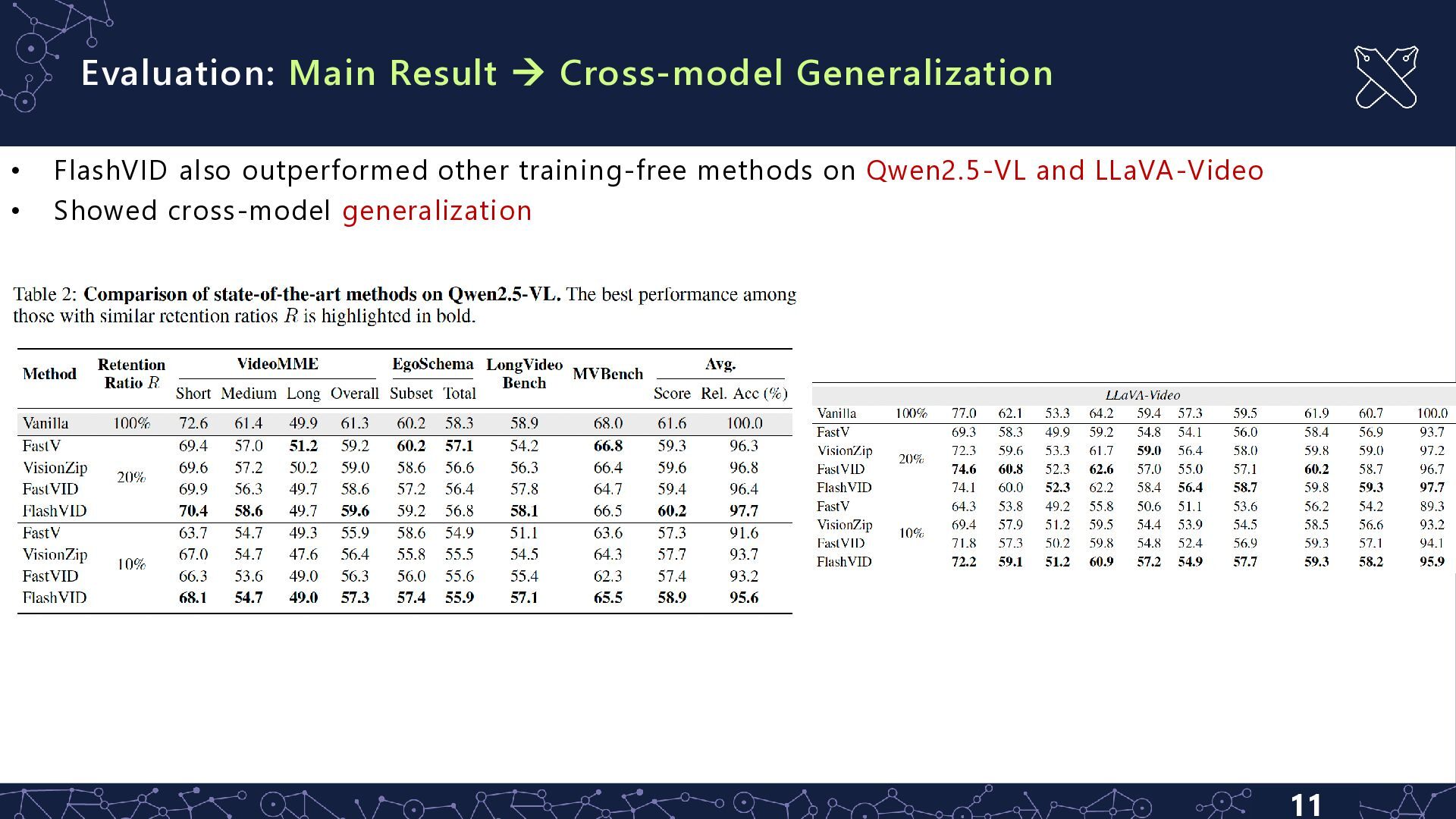
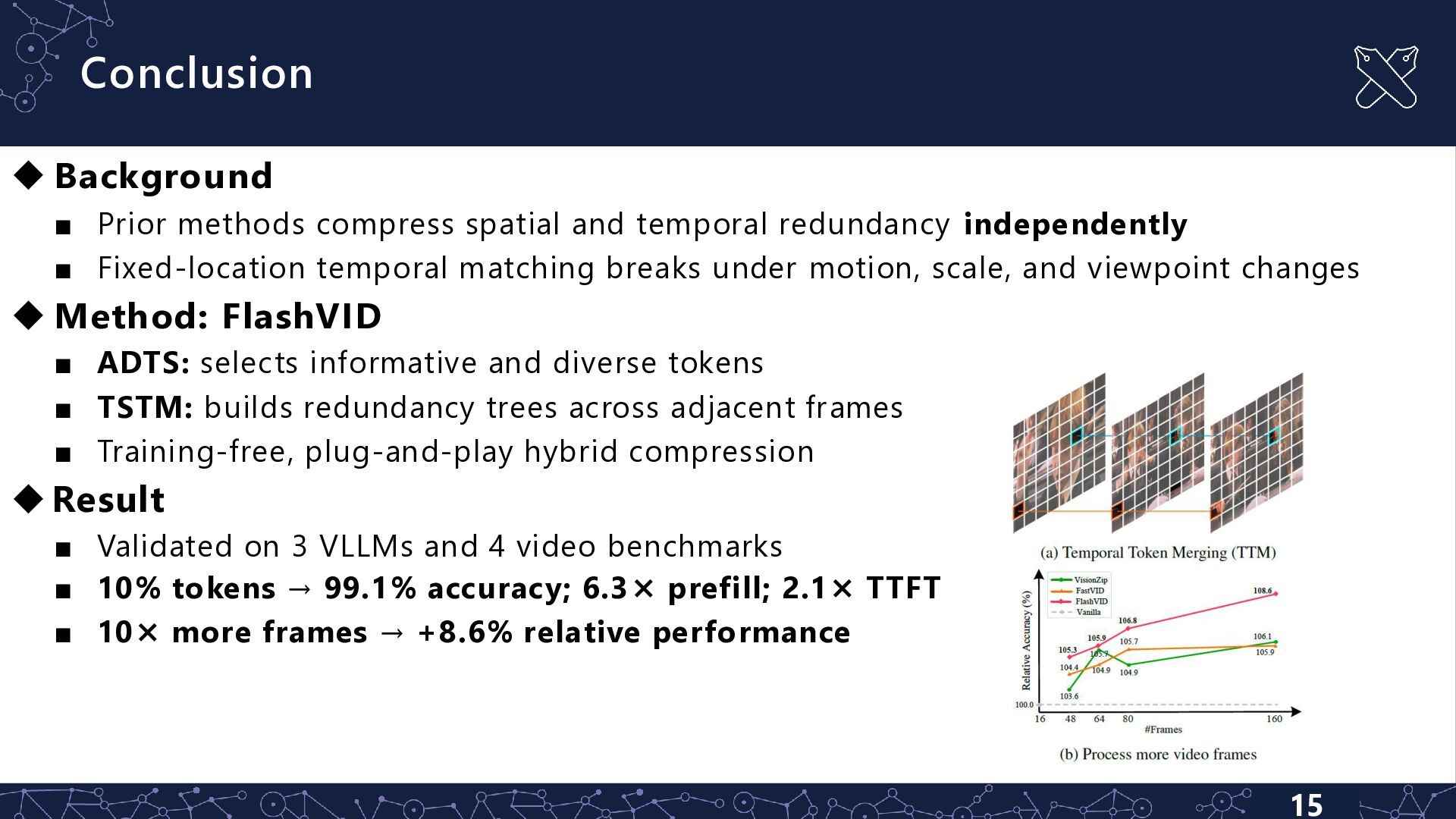
SOTAs at every tested retention ratio At 10% retention, FlashVID preserved 99.1% relative accuracy At 15–25%, FlashVID exceeded the full-token model → “less is more” effect 10
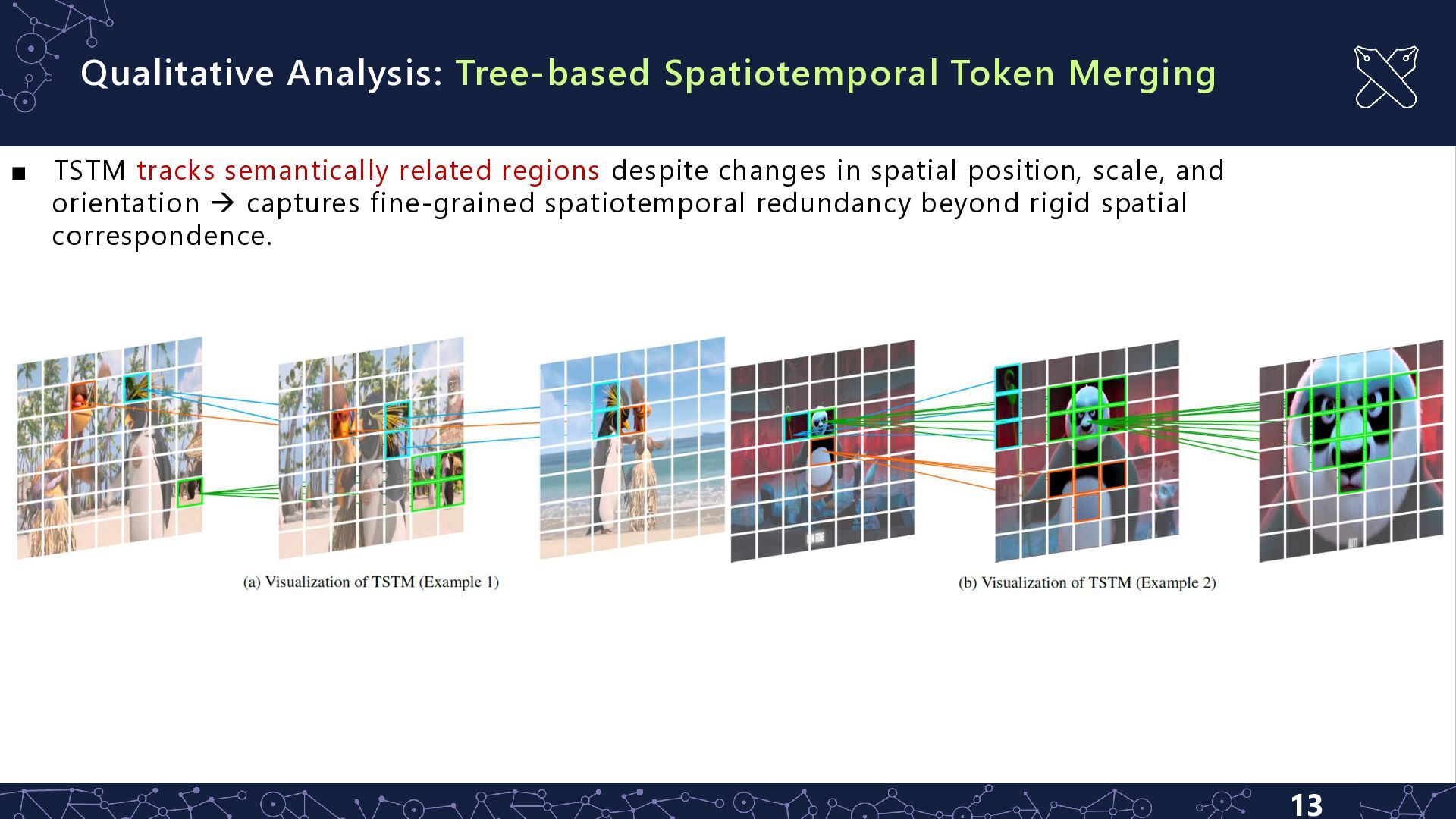
related regions despite changes in spatial position, scale, and orientation → captures fine-grained spatiotemporal redundancy beyond rigid spatial correspondence. 13
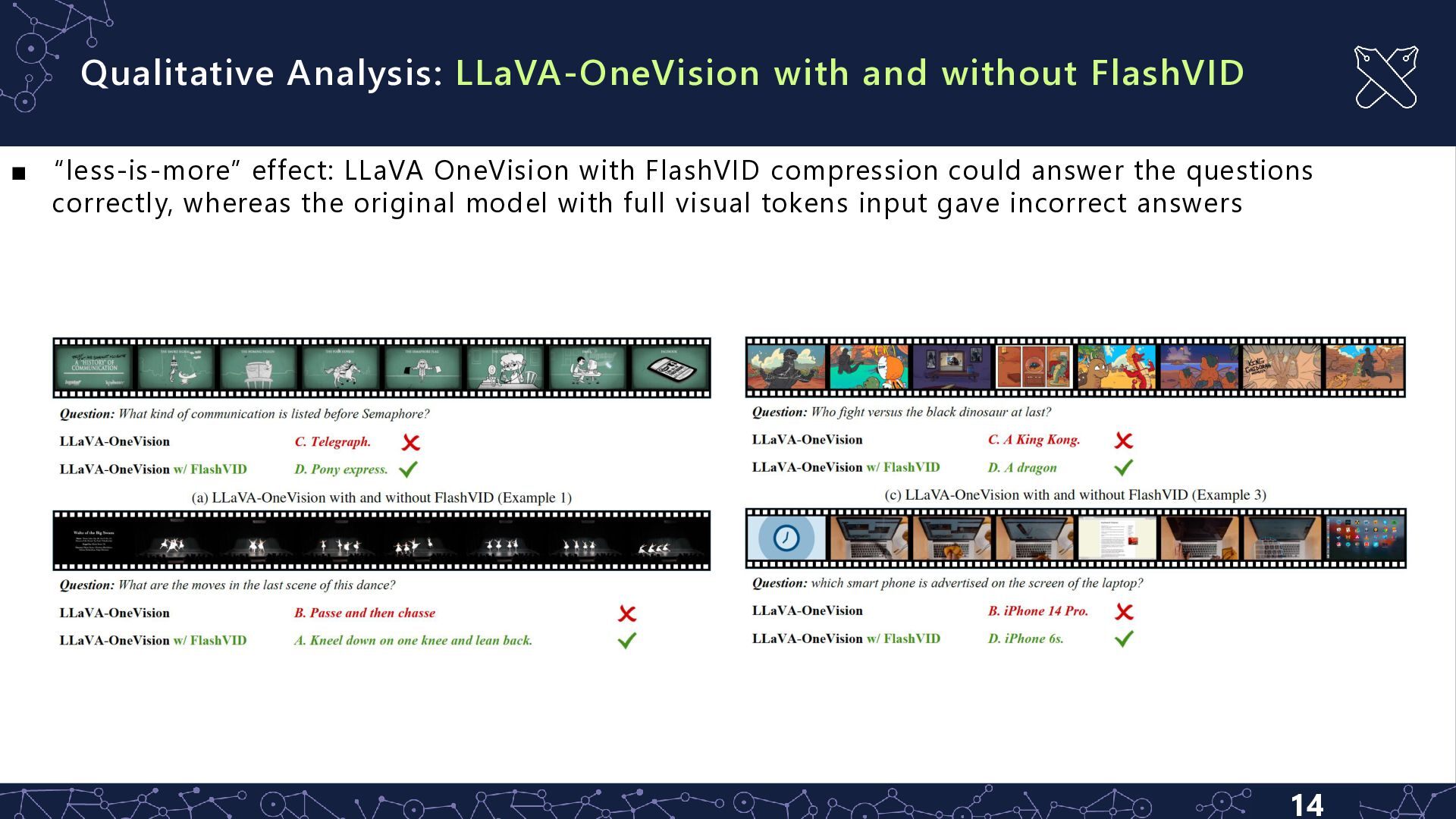
LLaVA OneVision with FlashVID compression could answer the questions correctly, whereas the original model with full visual tokens input gave incorrect answers 14


 keio_smilab
 sansan33
 freee
freee
 willnet
 kenichiodo
 makocchi
 ivry_presentationmaterials
 usanchuu
 rfdnxbro
 nttcom
 pfn
pfn
 hiracky16
 masakiokuda
 swwweet
 jonoalderson
 sstephenson
 inesmontani
 pedronauck
 marktimemedia
 tmiket
 ryanjones
 baasie
 chrislema
 cassininazir
 apolaine